_____________________________________________________________________________________________________
Minerals, Vitamins and Amino Acids Compositions
of Melanthera biflora
E. C. Kalu
1*, O. C. Ikewuchi
1and C. J. Ayalogu
11
Department of Biochemistry, Faculty of Science, University of Port Harcourt, P.M.B. 5323, Choba, Rivers State, Nigeria.
Authors’ contributions
This work was carried out in collaboration between all authors. All authors read and approved the final manuscript.
Article Information
DOI: 10.9734/IJBCRR/2018/v24i430062 Editor(s): (1) Dr. Fatih Oz, Professor, Department of Food Engineering, Agriculture Faculty, Ataturk University, Turkey. Reviewers: (1) Anna Leśniewicz, Analytical Chemistry and Chemical Metallurgy Division, Faculty of Chemistry, Wrocław University of Science and Technology, Wybrzeże Wyspiańskiego 27, 50-370 Wrocław, Poland. (2)Irfan Ur Rauf Tak, Centre of Research for Development, University of Kashmir, India. (3)M. H. Shagal, Department of Chemistry Modibbo Adama University of Technology Yola, Adamawa State, Nigeria. Complete Peer review History:http://www.sdiarticle3.com/review-history/34900
Received 03 November 2017 Accepted 24 January 2018 Published 21 February 2019
ABSTRACT
The minerals, vitamins and Amino acids composition of Melanthera biflora leaves were investigated using standard methods. The result shows that out of the eleven vitamins detected; only vitamin C was found in moderately high amount (99.37 mg/100 g), while the rest were in insignificant amount. Ten minerals element were detected, including iron (14.63) copper (2.32). Cobalt (0.04) manganese (5.13), calcium (93.52) magnesium (126.17), potassium (71.39) sodium (32.37), phosphorus 36.50, selenium (0.006) all in mg/100 g. The leaves have essentials and non-essential amino acid of 47.5% and 45.94% respectively. It has all the essential amino acids except tryptophan. This result shows that the leaves contain an appreciable amount of amino acids, vitamins and minerals that could be included in diets to supplement our daily dietary allowance.
Keywords: Minerals; vitamins; amino acids; essentials.
1. INTRODUCTION
Green leafy vegetables occupy an important place among the food crops as they provide adequate amount of vital nutrients, vitamins and minerals for human consumption. They are also rich source of carotene, ascorbic riboflavin, folic acids, among others. They also contain many minerals like calcium, iron and phosphorus [1].
Plants constitute an important source of natural products which differ widely in terms of structure and biological properties. They have played a remarkable role in food industries, local consumption as well as in the orthodox medicine of various countries.
Generally vegetables species abound in the world. Green leafy vegetables constitute an indispensable constituent of human diet in Africa and in West Africa in particular [2]. Nigeria is blessed with great natural tropical rain forest that is characterized with viable soil where vegetables of high nutritional value are grown. Most of these vegetables are not well known, hence not consumed as their nutritional compositions are not known.
Melanthera biflora, is a perennial herbaceous plant which belong to the family of asterecae. Its common name is beach daisy. It is known among the Igbos in south-eastern Nigeria as “akwuwa” and “akwuba” among the Efiks in Cross Rivers State of Nigeria. It produces luxurious, edible leaves which are used in making soup.
The present study therefore is aimed at evaluating the level of mineral elements, vitamins and amino acids composition of Melanthera biflora, a tropical leafy vegetable found in south eastern Nigeria so as to encourage its consumption in other to enhance healthy living.
2. MATERIALS AND METHODS
2.1 Sample Collection and Preparation
The leaves of Melenthera biflora were harvested fresh from “Ude” plantation in okon, Aku, in Ohafia Local Government of Abia State and was later identified by a taxonomist in the herbarium of the department of plant science, University of Port Harcourt, Dr. Edwin Nwosu.
The harvested vegetable leaves were destalked, washed with cold running tap dried in an oven at 600C for 24 hours, after the drying the leaves
were grounded into a fine power using a mortar and a pestle and sieved to pass through a 40-mesh sieve and stored in an air-tight container under refrigerated temperature for further use.
2.2 Determination of Mineral Composition
2.2.1 Ashing
The pulverized sample (1.0 g) was weighed into a petri dish. The sample in the petri dish was emptied into the muffle furnace pot. The pot and its contents were placed in the furnace at 550°C for 4 hours. The sample in the pot was allowed to cool in the dessicator. The process was repeated until a constant weight was attained.
2.3 Determination of Mineral Composition
2.3.1 Ashing
The pulverized sample (1.0 g) was weighed and place in the petri dish. The sample in the petri dish was emptied into the muffle furnace pot. The pot and its content were placed in the furnace at 550”C for 4 hours. The sample in the pot was allowed to cool in the desiccators. The process was repeated until a constant weight was obtained.
2.4 Mineral Analysis
The ashed sample (0.2 g) was weighed into the pre-cleaned borosilicate 250 ml capacity beaker for digestion. 30 ml of the nitric acid was added into the weighed sample in the beaker. The sample within the digesting solvent was placed on the hot plate for digestion in the fume cupboard. The beaker and its content after the digestion were allowed to cool. Another 20 ml of the digesting solvent was added further in the fume cupboard and the mixture were allowed to cool to the room temperature. The mixture was filtered into the 250 ml volumetric capacity borosilicate container. The filtrate was made up to the mark with the deionized water. The same procedure was followed for the digestion of the other samples.
All the digested samples were sub-sampled into pre- cleaned borosilicate glass containers for atomic Absorption Spectrophotometer analysis.
were made from the each of the heavy metals solution of 1000mg/c stock solutions of be analytes. The set of standard solutions and the filtrate of the digested samples were analyzed by AAS. The detection limit of the metals in the sample was 0.000/mg/l by means of the
UniCAM 929 London, Atomic Absorption Spectrophotometer powered by the SOLAR software. Iron, copper, cobalt, manganese, selenium, calcium, magnesium, Potassium and sodium cathode lamps were used for the analysis of the respective minerals ions in the standard and the filtrate of the samples. Gas mixtures were used in the generation of the flame.
2.5 Determination of Phosphorus
The sample (25 mg) was weighed into the schoniger flask and burnt in excess of oxygen gas. The product was digested with nitric acid. The content was boiled for a minute to ensure complete conversion of phosphorus pentoxide to orthophosphate.
The solution was passed through a 10 cm long resin column, and the filtrate was collected, in a 10 ml Pyrex test tube, 2 ml of the colour development reagent was added for the absorbance reading at 650 mm for both the standards and the sample filtrate.
2.6 Vitamin Determination of Vitamin Composition
2.6.1 Sample preparation
The Vitamins content of the sample was analyzed by a modification of AOAC Methods 992.03, 992.04 and 999.26 [3]. The sample was made to attain the laboratory atmospheric conditions on the bench after removing the samples from the storage chamber at less than or equal to 4◦C.The sample was pressed in the mortar carefully to avoid forming balls. The homogenized sample (0.10g) was weighed into a beaker. After the extraction, the extracts were concentrated to 1.0 ml for the chromatographic analysis. GC condition of analysis were as follows: Injection temperature: split injection, Split Ratio 20:1, Carrier gas: Nitrogen, Flow Rate: 1.0 ml/min, Inlet Temperature: 2500C, Column Type: HP5, Column Dimensions: 30m x 0.25 mm x 0.25 mm, Over program: Initial Temperature at 500C, For 2 minutes, Detector: PFPD, Detector Temperature: 3200C Hydrogen Pressure: 20Psi, Compressed Air: 30 Psi.
2.7 Determination of Amino Acid
Extraction: Modified AOAC method 982.30 2006 was followed in the extraction of the sample for the amino acid analysis.
The dried and pulverized sample was made to be free of water by ensuring constant weight for a period of time in the laboratory.
The sample of 10.0g was weighed into the 250ml conical flask capacity. The sample was defatted by extracting the fat content of the sample with 30ml of the petroleum spirit three times with soxhlet that was equipped with thimble. The sample was hydrolyzed three times for complete hydrolysis to be achieved.
The amino acid content of the sample was recovered by extracting with 30 ml of the
dichloromethane three times before
concentrating to 1.0 ml. The concentrated extract was derivastized for volatility that is suitable for gas chromatography. The GC conditions for amino acids is as follows.
Injection temperature : split injection, Split Ratio: 20:1Carrier Gas: Hydrogen Flow Rate: 1.0ml/min, Inlet Temperature: 2500C Colum Type: HP5Column Dimensions: 30m x 0.25 mm x 25m Over program: initial at 600C, first Ramp at 80C/min for 20 min, maintained for 2min second Ramp at 120C/min 6 min, constant for 2 mins, Detector: FFPD, Detector Temperature: 3200C, Hydrogen Pressure 20 Psi, Compressed Air:35 Psi.
3. RESULTS AND DISCUSSION
The leaves of Melanthera biflora had higher calcium, sodium and magnesium (Table 1) than
suggested that commonly consumed leafy vegetables are superior sources of calcium compared to milk [7]. Deficiency of calcium can lead to malformation of bones and shells. Magnesium and potassium are needed for maintaining the acid – base balance in the body; magnesium is an obligate cofactor for DNA synthesis, while potassium is required for muscle and nerves functions. Melanthera biflora is rich in magnesium, and so, can be used to supplement low magnesium based stable foods such as cassava. It is therefore recommended for hypertensive patients, since magnesium has a hypotensive effect. Iron content of Melanthera biflora was higher than those of T. occidentalis
and A. hybridus [7], and would be beneficial for anaemic patients. Therefore Melanthera biflora
can serve as an excellent source of minerals for human nutrition.
Table 1. Mineral composition of Melanthera biflora leaves
Minerals Amount
(mg/100 g) %
Composition
Iron 14.67 3.829
Copper 2.322 0.608
Cobalt 0.041 0.011
Manganese 5.125 1.342
Calcium 93.516 24.481
Magnesium 16.17 33.029
Potassium 71.39 18.690
Sodium 32.373 8.476
Phosphorus 36.50 9.555
Selenium 0.006 0.0016
Total 381.999
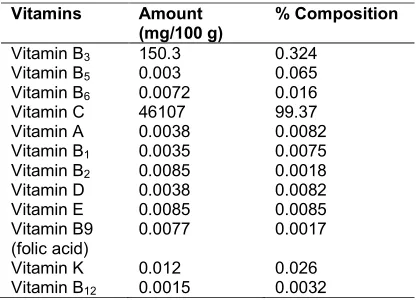
The Melanthera biflora is rich in ascorbic acid, which is higher than the concentration previously reported for some other stable vegetables such
T. occidentalis, T. triangular, C. argentea, S.
nodiflorium, B. alba, S. acthiopica, A. caudatus,
A.hybridus, C. pepo and AmaratusSpinosus (6). The body cannot synthesis ascorbic acid, so it must be obtained entirely through diet, in this connection, Melantherabiflora should serve as a good source of the water soluble vitamin. Ascorbic acid is essential for the healthy formation of bones and teeth. It is a powerful antioxidant [8] whose deficiency results in scurvy with swellings of the joints and gums, loosening of the teeth and haemorrhages of the skin and mucus membrane. Niacin, thiamine and riboflavin play important roles in nutrient metabolism, Melanthera biflora is also a good source of these micronutrients.
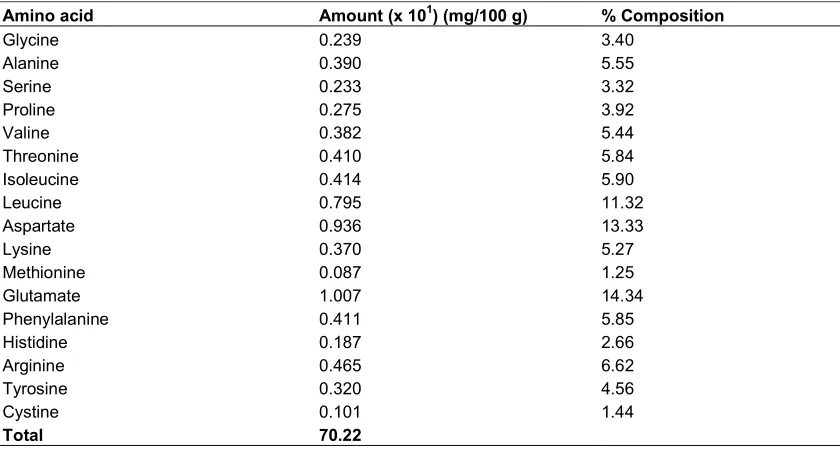
Melanthera biflora leaf contain higher total essential amino acid (47.5%) than total
non-essential amino acid (45.94%) but has higher total aromatic amino acid (10.44%) than total sulphur containing amino acid (5.56%).
Melanthera biflora is rich in essential amino acids, leucine, isoleucine, valine, phenylalanine, lysine, histidine and threonine and can meet the minimum daily requirements for them [9]. The dominant essential amino acid is leucine (11.32%) and is higher than that of G. latifolium
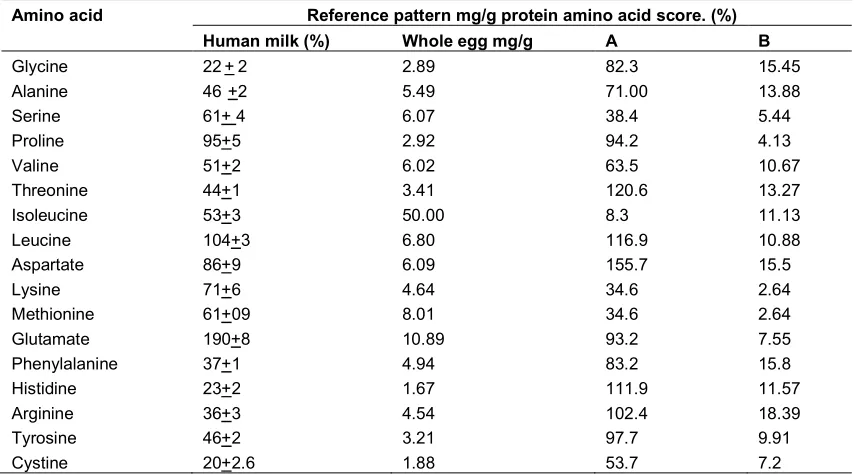
(2.25%) and Vernonia amydalina (1.66%) [10]. A 100g serving of Melanthera biflora can provide about 43-99% of therecommended dietary allowance (Table 5). This high protein content implies that this plant can contributessignificantly to the daily human protein requirements, usually about 23-56 g. In comparison to the egg protein and human milk protein reference, the green leafy vegetable score higher than those previously reported for G. latifolium and V. amydalina [10].
Table 2. Comparison of mineral composition of Melanthera biflora leaves with the WHO
RDA
Minerals Melantera
biflora (mg/100 g)
RDA
Iron 14.627 15 mg
Copper 2.322 2 mg
Cobalt 0.041 Less than 20 mg
Manganese 5.125 5 mg
Calcium 93.516 1000 mg
Magnesium 126.171 350 mg
Potassium 71.39 3500 mg
Sodium 32.373 2400 mg
Phosphorus 36.50 1000 mg
Selenium 0.006 35 μg
End Note: Percentages are based on the weight of the compounds per the total extract of its family
Table 3. The vitamin composition of
Melanthera biflora leaves
Vitamins Amount
(mg/100 g)
% Composition
Vitamin B3 150.3 0.324
Vitamin B5 0.003 0.065
Vitamin B6 0.0072 0.016
Vitamin C 46107 99.37
Vitamin A 0.0038 0.0082
Vitamin B1 0.0035 0.0075
Vitamin B2 0.0085 0.0018
Vitamin D 0.0038 0.0082
Vitamin E 0.0085 0.0085
Vitamin B9 (folic acid)
0.0077 0.0017
Vitamin K 0.012 0.026
Table 4. Comparison of vitamin from leaves of Melanthera biflora with WHO recommended daily allowance
Vitamins Melanthera biflora (mg/100 g) RDA
Vitamin B3 0.324 20 mg
Vitamin B4 0.065 1.2 mg
Vitamin B6 0.16 1-2 mg
Vitamin C 99.37 75 mg
Vitamin A 0.0082 600 mg
Vitamin B1 0.0075 1.4 mg
Vitamin B2 0.0018 1.5 mg
Vitamin D 0.0082 10 μg
Vitamin E 0.0085 8-10 mg
Vitamin B9 (folate) 0.0017 40 μg
Vitamin K 0.026 50-100 mg
Vitamin B12 0.0032 1-2 μg
Table 5. Amino acid composition of Melanthera biflora leaves
Amino acid Amount (x 101) (mg/100 g) % Composition
Glycine 0.239 3.40
Alanine 0.390 5.55
Serine 0.233 3.32
Proline 0.275 3.92
Valine 0.382 5.44
Threonine 0.410 5.84
Isoleucine 0.414 5.90
Leucine 0.795 11.32
Aspartate 0.936 13.33
Lysine 0.370 5.27
Methionine 0.087 1.25
Glutamate 1.007 14.34
Phenylalanine 0.411 5.85
Histidine 0.187 2.66
Arginine 0.465 6.62
Tyrosine 0.320 4.56
Cystine 0.101 1.44
Total 70.22
Table 6. Comparison of essential amino acid and composition of Melanthera biflora with World Health Organization Recommend daily amount for essential amino acid
Amino acid Melanthera biflora mg/kg boiled mg/70 kg mg/100 kg
Histidine 18.7 10 700 1,000
Isoleucine 41.4 20 1,400 2,000
Leucine 79.5 39 2,730 3,900
Lysine 37.0 30 2,100 3,000
Methionine 0.86 45 (total) 1,050 1,500
phenylalanine 41 25 (total) 1,750 2,500
Threonine 41 15 1,050 1,500
Tryptophan - 4 280 400
Valine 38.2 26 1,820 2600
Table 7. Comparison of chemical scores of Melenthera biflora leaves with WHO reference protein pattern
Amino acid Reference pattern mg/g protein amino acid score. (%)
Human milk (%) Whole egg mg/g A B
Glycine 22+2 2.89 82.3 15.45
Alanine 46 +2 5.49 71.00 13.88
Serine 61+ 4 6.07 38.4 5.44
Proline 95+5 2.92 94.2 4.13
Valine 51+2 6.02 63.5 10.67
Threonine 44+1 3.41 120.6 13.27
Isoleucine 53+3 50.00 8.3 11.13
Leucine 104+3 6.80 116.9 10.88
Aspartate 86+9 6.09 155.7 15.5
Lysine 71+6 4.64 34.6 2.64
Methionine 61+09 8.01 34.6 2.64
Glutamate 190+8 10.89 93.2 7.55
Phenylalanine 37+1 4.94 83.2 15.8
Histidine 23+2 1.67 111.9 11.57
Arginine 36+3 4.54 102.4 18.39
Tyrosine 46+2 3.21 97.7 9.91
Cystine 20+2.6 1.88 53.7 7.2
A = Melanthera biflora compared with human milk B = Melanthera biflora compared fowl egg protein pattern
4. CONCLUSION
This result that reveals that the leaves contain an appreciable amount of nutrients, Vitamin, Amino acid and mineral elements that should be include in diets to supplement our daily allowance needed by the body. So it is my believed that these results will help to stimulate the consumption or utilization of this leafy vegetable as a good source of nutrients, need for healthy growths.
COMPETING INTERESTS
Authors have declared that no competing interests exist.
REFERENCES
1. Fasuyi AO. Nutritional Potentials of bone some tropical vegetable meals. Chemical Characterization and functional properties. African Journal of Biotechnology. 2006; 5(1):49-53.
2. Osagie AU, Offiong UE. Nutritional quality of plant food. Amik press. Post-harvest Unit. University of Benin, Benin City Nigeria; 1998.
3. AOAC International. Official Methods of Analysis of the AOAC (W. Horwitiz, Editor). 18th Edition. AOAC International: Washington DC, USA; 2006.
4. Oguntona T. Green leafy vegetables. In A.U. Osagie and O.U. Eka (Eds.), Nutritional quality of plant foods. Nigeria: Post Harvest Research Unit, Department of Biochemistry, University of Benin, Benin City. 1998;120-133.
5. Islam MR, Paul DK, Shasha RK. Nutritional importance of some leafy vegetables in Bangladesh. Pakistan Journal of Biological Sciences. 2004;7(8):1380-1384.
6. Olaiya C, Adebisi J. Phytoevaluation of the nutritional values of ten green leafy vegetables in South-Western Nigeria. The Internet Journal of Nutrition and Wellness. 2009;9(2):7458.
7. Oke OL. Chemical studies on the commonly used leafy vegetables in Nigeria. Journal of the West African Science Association. 1996;11:42-48. 8. Szeto YT, Tomlinson B, Benzie FF. Total
9. FAO/WHO/UNU. Energy and protein requirements: Report of a Joint FAO/WHO/UNU Expert Consultation. WHO Technical Report Series 724; 1991.
ISSN: 0512-3054.
Available:Http://www.fao.org/docrep/003/a a040e/AA040E01.htm
10. Afolabi F, Afolabi OJ. Phytochemical constituents that produce definite physiological action on the human body. Greener Journals. 3:16-17.
_________________________________________________________________________________ © 2018 Kalu et al.; This is an Open Access article distributed under the terms of the Creative Commons Attribution License (http://creativecommons.org/licenses/by/4.0), which permits unrestricted use, distribution, and reproduction in any medium, provided the original work is properly cited.
Peer-review history: