
INTRODUCTION
Due to the specific lifestyle, Lumbricidae play a key role in soil environments as “ecosystem en
-gineers” [Jouquet et al. 2006]. These organisms are subject to ecological worldwide research. In order to determine the qualitative and quantitative composition of earthworms in a given environ
-ment, both correct soil sampling and subsequent animal extraction are necessary. There are two groups of methods for obtaining Lumbricidae from the environment, i.e. physical and behav
-ioral [Bartlett et al. 2010, Valckx et al. 2012]. The
first group consists of manual sorting of the soil or washing the soil sample with a stream of wa
-ter and then sieving it on sieves of varying mesh size. In turn, the behavioral methods are based on the extraction of Lumbricidae using, e.g. chemi
-cal, electrical or thermal means. A combination
of the methods from both groups is also used, i.e. manual segregation and extraction using a chemi
-cal agent [EN ISO 23611–1: 2006]. The advan
-tage of manual soil sorting is the ability to find Lumbricidae in all developmental stages: mature, young individuals and cocoons as well as active forms and those being at rest – diapause [Gutier
-rez-Lopez et al. 2016]. However, the young and small specimens are often omitted [Jiménez et al. 2006]. In turn, the disadvantages of the screen
-ing method include low efficiency and damage to individuals arising under the influence of e.g. a water jet. This makes it difficult to identify the collected material [Valckx et al. 2012].
The behavioral methods usually use a solu
-tion of formaldehyde (formalin), mustard sus
-pension and allyl isothiocyanate (AITC) [Butt et al. 2010, Singh et al. 2015]. High efficiency and shorter extraction time, e.g. compared to manual
Accepted: 2020.05.08 Available online: 2020.05.25 Volume 21, Issue 5, July 2020, pages 114–119
https://doi.org/10.12911/22998993/122237
Effectiveness of Lumbricidae Extracting with an Environmentally
Friendly Method
Anna Mazur-Pączka
1*, Grzegorz Pączka
1, Joanna Kostecka
1, Agnieszka Podolak
1,
Mariola Garczyńska
11 Department of the Basis of Agriculture and Waste Management, Institute of Agricultural Sciences,
Environmental Protection and Management, College of Natural Sciences, University of Rzeszow, Ćwiklinskiej 2, 35-601 Rzeszow, Poland
* Corresponding author’s e-mail: [email protected]
ABSTRACT
Lumbricidae, as representatives of edaphone, are used in ecological research. Over the years, various attempts to improve the ways of earthworm extraction have been made. One of the pro-environmental methods for extracting these animals from the soil is the method involving the application of electric current (octet). The aim of the study was to compare the efficiency of the earthworm extraction using the mixed method (manual segregation along with the use of 0.5% formalin solution) with the method applying the electroshocking. The species composition of earthworms extracted using both methods was the same (seven species of earthworms belonging to three ecomor -phological groups were found). A lower number and biomass of earthworms were found in the permanent grass -land and arable -land with the help of octet than using the mixed method. Further research is needed to improve the existing methods for Lumbricidae extraction and to implement new ones that would be safe for the edaphon representatives.
screening, have made the chemotactic methods widely used in the studies of Lumbricidae clusters [Valckx et al. 2012]. Despite the high efficiency in earthworm extraction, formalin is a toxic com
-pound for the plant, animal and human organisms [Conolly et al. 2002, Čoja et al. 2008]. The ir
-ritants contained in mustard (allyl isothiocyanate) are less harmful compounds to the environment. For this purpose, a ready-made commercial mus
-tard emulsion is used [Pelosi et al. 2009] or mus
-tard powder extract is prepared [Eisenhauer et al. 2008]. The disadvantage, however, is that the concentration of AITC in mustard and mustard powder is not exactly known and may vary in the starting material used to make solutions, which hinders the standardization of the method [Valckx et al. 2012]. The work on the application of on
-ion (Allium cepa L.) extracts is also underway; however, implementation of this method requires further research in diverse habitats [Steffen et al. 2013, Singh et al. 2017].
In addition to the use of mustard and onion, the method using low intensity electric current (octet) is characterized by low harmfulness to the soil organisms [Thielemann 1986, Schmidt 2001]. In Poland, the use of this pro-environmen
-tal method is not widespread.
The aim of the study was to determine the efficiency of Lumbricidae extraction from the
soil using low intensity electric current, com
-pared to the mixed method recommended by ISO [EN ISO 23611–1: 2006].
MATERIAL AND METHODS
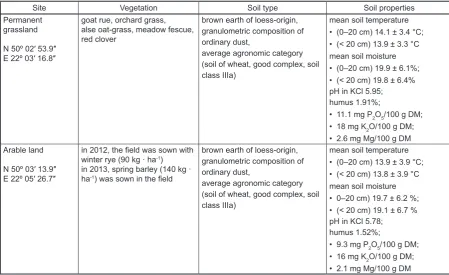
The research was carried out at two sites – per
-manent grassland (50 a) and arable land sown with cereals (5 ha) (Table 1) located at the Di
-dactic and Research Station of the University of Rzeszów in Krasne near Rzeszów (SE Poland).
At research sites, earthworms were sought us
-ing the electroshock-ing method. The octet device is built of eight soil probes in an octagonal ar
-rangement (6 mm in diameter and 65 cm active length) with insulated handles around the circle (52 cm in diameter covering an area of 0.22 m2).
Outside, the wires are terminated with clamps that give the possibility of electrical connection with the soil probe. The adjacent bars are spaced 20 cm apart and the opposite bars 52 cm apart. The opposite bars were paired according to the code (1–5, 2–6, 3–7, 4–8), which was marked on the front panel of the device with letters A, B, C, D. In the octet device, the electric field circulates successively in the sampling area, where the soil probe pairs are electrified in eight sequences: AB, ABC, BC, BCD, CD, ACD, AD, ABD. The 12 V
Table 1. Characterization of research site in Krasne
Site Vegetation Soil type Soil properties
Permanent grassland
N 50º 02′ 53.9″ E 22º 03′ 16.8″
goat rue, orchard grass, alse oat-grass, meadow fescue, red clover
brown earth of loess-origin, granulometric composition of ordinary dust,
average agronomic category (soil of wheat, good complex, soil class IIIa)
mean soil temperature
• (0–20 cm) 14.1 ± 3.4 °C; • (< 20 cm) 13.9 ± 3.3 °C
mean soil moisture
• (0–20 cm) 19.9 ± 6.1%; • (< 20 cm) 19.8 ± 6.4% pH in KCl 5.95; humus 1.91%;
• 11.1 mg P2O5/100 g DM; • 18 mg K2O/100 g DM; • 2.6 mg Mg/100 g DM
Arable land
N 50º 03′ 13.9″ E 22º 05′ 26.7″
in 2012, the field was sown with winter rye (90 kg · ha-1)
in 2013, spring barley (140 kg ·
ha-1) was sown in the field
brown earth of loess-origin, granulometric composition of ordinary dust,
average agronomic category (soil of wheat, good complex, soil class IIIa)
mean soil temperature
• (0–20 cm) 13.9 ± 3.9 °C; • (< 20 cm) 13.8 ± 3.9 °C
mean soil moisture
• 0–20 cm) 19.7 ± 6.2 %; • (< 20 cm) 19.1 ± 6.7 % pH in KCl 5.78;
humus 1.52%;
• 9.3 mg P2O5/100 g DM; • 16 mg K2O/100 g DM; • 2.1 mg Mg/100 g DM
direct voltage is supplied from the battery and di
-rected to the inverter, where it is converted into 230 V alternating voltage. From there, i.e. the regulated autotransformer, it is fed to the trans
-former, where depending on the needs, it is pos
-sible to increase the voltage to 450 V. The cur
-rent with the appropriate voltage is directed from the transformer to the soil probes. The voltage and current parameters at the output to the soil probes are measured by a voltmeter and ammeter (Figure 1). The time for each sequence is 2.5 min. The earthworms for analysis were collected from the central part defined by the ring and probe (Figure 1).
In the test sites, apart from the collection of earthworms with the octet method, a mixed meth
-od of Lumbricidae extraction proposed by ISO [EN ISO 23611–1: 2006] was used in parallel. For this purpose, the 25×25×25 cm soil blocks were sorted manually. From the deeper layers of the soil profile, the earthworms were extracted by pouring the surface of the well formed after selecting the sample with 10 liters of 0.4% for
-malin solution (HCHO from CHEM-PUR). Ap
-plying Zisci’s recommendations [1962], eight test samples were taken each time at the sites (using the current method and the mixed method), deter
-mining them randomly by casting a metal frame. The samples were collected annually from May to November 2012 and from April to November 2013. Identification of the found species was car
-ried out using the keys for marking the Polish ter
-restrial Oligochaeta [Kasprzak 1986].
At the test sites, the soil temperature and hu
-midity were measured each time at a depth of 0–20 cm and beneath. The soil moisture was de
-termined with a drying method at 105°C [PN ISO
11465: 1999]. The soil was also taken from each site for pH analysis in KCl, organic carbon (using the Tiurin method in the Nikitin modification), the content of available phosphorus, potassium and magnesium forms according to Mehlich III [MAFF1981].
In order to characterize the Lumbricidae population, Shannon-Wiener (H) indices were determined:
H = – Σ pi ln pi (1)
where: pi is the number of specimens of a par
-ticular species vs. population size of all organisms.
The data obtained are presented as mean ± standard deviation (SD). The results were statisti
-cally analyzed in the STATISTICA ver. 10 soft
-ware using the Student’s t-test or Mann-Whitney U test (if the assumptions for parametric tests were not met).
RESULTS
Seven earthworm species were identified in the study area using the octet method: Dendrodri-lus rubidus tenuis (Savigny 1826), Dendrobaena octaedra (Savigny 1826), Lumbricus rubellus (Hoffmeister 1843), Aporrectodea caliginosa (Savigny 1826), Aporrectodea rosea (Savigny 1826), Octolasion lacteum (Oerley 1881), Lum-bricus terrestris (L. 1758). The individuals found belonged to three ecomorphological groups (epi
-geic, endogeic and anecic). The quality compo
-sition of the earthworms found by means of this method coincided with the one determined using the mixed method [EEN ISO 23611–1: 2006] on
Figure 1. Block diagram of the octet device:
Ak. – 12 V battery; Prz. – inverter; Atr. – autotransformer (regulating output voltage); Tr. – transformer (increases voltage from 230 V to a maximum of 450 V); A – ammeter;
permanent grassland as well as on the arable land (Table 2).
With the use of electricity, both the permanent grassland and the arable land have lower density of earthworms (22.03 ± 4.12 ind.·m-2 and 18.21
± 4.15 ind.·m-2, respectively) compared to mixed
extraction method (101.01 ± 18.03 ind.·m-2 and
82.12 ± 18.26 ind.·m-2) (p < 0.001) (Table 3).
A similar trend was observed for Lumbricidae biomass (p < 0.001). Shannon-Wiener diversity index on the meadow and arable land was similar for both methods (p > 0.05) (Table 3).
The density and biomass of earthworms from individual ecomorphological groups extracted applying the octet method were lower compared to the mixed method (p < 0.05) (Table 4).
DISCUSSION
The use of electricity to extract the earth
-worms has been tested, among others, by Tiho and Josens [2000], Schmidt [2001], Čoja et al. [2008] and Butt et al. [2010]. In this method, the voltage is transmitted from the soil probes of the octet de
-vice to the soil column, which irritates Lumbric
-idae and causes them to escape to the soil surface.
In this study, the species structure of Lumbricidae extracted by means of the octet method coincided with that obtained applying the mixed method recommended by ISO [EN ISO 23611–1: 2006]. Seven earthworm species belonging to all three ecomorphological groups were found using both methods (Table 2). It can be assumed that the use of electric current reflects the qualitative struc
-ture of earthworms in a given area. This is con
-firmed by the similar values of the Shannon-Wie
-ner index at the tested sites for the earthworms extracted with electric current and the mixed method (Table 3). The analysis of the qualita
-tive structure of earthworms extracted with the help of the octet device is recommended in the places where the chemical extraction is prohib
-ited or ineffective. This method can be more ef
-fective on slopes, in urban areas or in the areas where minimal environmental disturbances are required, i.e. in protected areas or natural commu
-nities [Schmidt 2001]. Staddon et al. [2003] have shown that this method is safe for the plant and animal organisms. The electroshocking did not have any negative effect on the groups of Enchy
-traeidae, nematodes, Collembola and mites [Blair et al. 1995]. Lower density and biomass of earth
-worms in the study area obtained with the help
Table 3. Characteristics of earthworm population extracted by octet method (OM) and mixed method (MM) on permanent grassland and in arable land
Ecological parameters
Research sites
permanent grassland arable land
OM MM OM MM
Earthworm density [ind. · m-2] 22.03a ± 4.12 101.01b ± 18.03 18.21a ± 4.15 82.12b ± 18.26
Earthworm biomass [g · m-2] 12.64a ± 2.62 77.72b ± 15.30 10.71a ± 2.67 54.34b ± 11.72
Shannon-Wiener diversity index (H) 0.64a ± 0.23 0.60a ± 0.18 0.66a ± 0.25 0.57a ± 0.16
ab – statistically significant differences (p < 0.05). aa – statistically insignificant differences (p > 0.05).
Table 2. Species of earthworms found with the octet method (OM) and the mixed method (MM) at research sites in Krasne
Species of Lumbricidae
Research sites
permanent grassland arable land
OM MM OM MM
D. rubidus tenuisa a + + + +
D. octaedra a + + -
-L. rubellus a + + + +
A. caliginosa b + + + +
A. rosea b + + + +
O. lacteum b + + + +
L. terrestris c + + + +
+ – presence, – – absence.
of octet (Table 3) could be due to low soil mois
-ture in the summer months. Low water content in the soil is one of the factors limiting this method [Schmidt 2001, Szlavecz et al. 2013]. Eisenhauer et al. [2008] verified the improvement of octet efficiency by adding water to the dry soil, from which the samples were previously taken. The addition of water to dry soil did not increase the efficiency of the method. This was probably due to the earlier transition of some species into the state of anabiosis caused by adverse environmen
-tal factors. It was also found that the extraction of the earthworms from the endogeic group was more effective with the octet method than using formalin. In this study, with the help of the octet method, in turn, a lower number and Lumbricidae biomass from all three ecomorphological groups were recorded (Table 4). The effectiveness of the octet method largely depends on the type of soil, vegetation cover and pH of the substrate [Weyers et al. 2008]. More earthworms are extracted from the low pH soil [Čoja et al. 2008].
CONCLUSIONS
1. In the studied ecosystems, the species com
-position of Lumbricidae found with the help of the octet method coincided with the struc
-ture of earthworms extracted by means of the mixed method. The octet method, due to its pro-environmental nature, can be used to iden
-tify the qualitative structure of Lumbricidae in the protected areas.
2. Lower number and biomass of earthworms were found at the tested sites applying octet compared to the mixed method. Extraction of earthworms using electric current did not re
-flect the quantitative structure of earthworms.
The effectiveness of the electroshocking meth
-od depends largely on the moisture content of the substrate, soil type and type of plant cover. 3. The research on the effectiveness of the Lum
-bricidae extraction with a help of an octet device requires continuation in diverse ecosystems.
REFERENCES
1. Bartlett M.D., Briones M.J.I., Neilson R., Schmidt O., Spurgeon D., Creamer R.E., 2010. A critical review of current methods in earthworm ecology: from individuals to populations. European Journal of Soil Biology, 46, 67–73.
2. Blair J.M., Bohlen P.J., Edwards C.A., Stinner B.R., McCartney D.A., Allen M.F. 1995. Manipulation of earthworm populations in field experiments in agro -ecosystems. Acta Zoologica Fennica, 196, 48–51. 3. Butt K.R., Kostecka J., Lowe C.N. 2010. Field col
-lection of earthworms: comparisons of commonly used techniques. Zeszyty Problemowe Postepów Nauk Rolniczych, 547, 67–75.
4. Čoja T., Zehetner K., Bruckner A., Watzinger A., Meyer E. 2008. Efficacy and side effects of five sampling methods for soil earthworms. (Annelida, Lumbricidae). Ecotoxicology and Environmental Safety, 71, 552–565.
5. Conolly R.B., Kimbell J.S., Janszen D.B., Miller F.J. 2002. Dose response for formaldehyde-induced cytotoxicity in the human respiratory tract. Regula -tory Toxicology Pharmacology, 35, 32–43. 6. Eisenhauer N., Straube D., Scheu S. 2008. Effi
-ciency of two widespread non-destructive extrac -tion methods under dry soil condi-tions for different ecological earthworm groups. European Journal of Soil Biology, 44, 141–145.
7. EN ISO 23611–1:2006. Soil quality. Sampling of soil invertebrates. Part 1. Hand-sorting and formalin extraction of earthworms. Geneva. Switzerland.
Table 4. Earthworm ecomorphological group characteristics (D – density [ind.·m-2], B – biomass [g·m-2])
extracted by octet method (OM) and mixed method (MM) on sites in Krasne
Ecomorphological group
Research sites
permanent grassland arable land
OM MM OM MM
Epigeic D 2.83a ± 1.75 5.33b ± 2.42 2.32a ± 1.20 4.50b ± 3.19
B 0.6a ± 0.42 1.46b ± 0.97 0.45a ± 0.25 1.25b ± 0.74
Endogeic D 6.87a ± 4.09 29.25b ± 12.07 8.92a ± 5.22 23.91b ± 9.20
B 2.37a ± 1.36 10.82b ± 6.07 3.35a ± 1.54 10.85b ± 4.15
Anecic D 2.37a ± 1.07 15.50b ± 8.97 2.49a ± 1.05 6.25b ± 4.76
B 6.22a ± 3.25 40.04b ± 25.80 5.04a ± 2.27 16.99b ± 12.99
8. Jiménez J.J., Lavelle P., Decaëns T. 2006. The ef -ficiency of soil hand-sorting in assesssing the abun -dance and biomass of earthworm communities. Its usefulness in population dynamics and cohort anal -ysis studies. European Journal of Soil Biology, 42, 225–230.
9. Jouquet P., Dauber J., Lagerlof J., Lavelle P., Lepage M. 2006. Soil invertebrates as ecosystem engineers: intended and accidental effects on soil and feedback loops. Applied Soil Ecology, 32, 153–164.
10. Gutierrez-Lopez M., Moreno G., Trigo D., Juarez E., Jesus J.B. Cosin D.J.D. 2016. The efficiency of earthworm extraction methods is determined by species and soil properties in the Mediterranean communities of Central-Western Spain. European Journal of Soil Biology, 73, 59–68.
11. Kasprzak K. 1986. Soil Oligochaeta III – The fam -ily of Earthworms (Lumbricidae). The keys to in -dicate the invertebrates of Poland. PWN, Warsaw (in Polish).
12. MAFF. 1981. The analysis of agricultural materials 2nd edn. A manual of the analytical methods used by the agricultural Development and Advisory Service (ADAS). HMSO, London.
13. Mazur-Pączka A., Pączka G., Kostecka J., Garczyńska M., Podolak A., Szura R. 2019. Com -munity structure of Lumbricidae in permanent grassland and arable land. Journal of Ecological Engineering, 20(5), 1–6.
14. Pelosi C., Bertrand M., Capowiez Y., Boizard H., Roger-Estrade J. 2009. Earthworm collection from agricultural fields: comparisons of selected expel -lants in presence/absence of hand-sorting. European Journal of Soil Biology, 45, 176–183.
15. PN-ISO 11465:1999. Soil quality – Determination of soil dry matter and water content in soil in terms of dry soil mass – weight metod (in Polish). 16. Singh J., Singh S., Vig A.P. 2015. Extraction of
earthworm from soil by different sampling method: a review. Environment Development and Sustain -ability, 18, 1521–1539.
17. Singh J., Singh S., Bhat S.A., Vig A.P., Schädler M. 2017. Eco-friendly method for the extraction of earthworms: Comparative account of formalin, AITC and Allium cepa as extractant. Applied Soil Ecology, doi.org/10.1016/j.apsoil.2017.11.007 18. Schmidt O. 2001. Appraisal of the electrical oc
-tet method for estimating earthworm populations in arabie land. Annals of Applied Biology, 38(2), 231–241.
19. Szlavecz K., Pitz S.L., Bernard M.J., Xia L., O’Neill J.P., Chang C.H. 2013. Manipulating earthworm abundance using electroshocking in deciduous for -ests. Pedobiologia, 56. 33–40.
20. Staddon P.L., Ostle N., Fitter A.H. 2003. Earthworm extraction by electroshocking does not affect canopy CO2 exchange, root respiration, mycorrhizal fungal abundance Or mycorrhizal fungal vitality. Soil Biol -ogy and Biochemistry, 35(3), 421–426.
21. Steffen G.P.K., Antoniolli Z.I., Steffen R.B., Jacques R.J.S., Dos Santos M.L. 2013. Earthworm extraction with onion solution. Applied Soil Ecology, 69, 28–31. 22. Thieleman U. 1986. Electric extraction with using
octet method. Pedobiologia, 29(4), 296–302 (in German).
23. Tiho S., Josens G. 2000. Earthworm populations of Roosevelt Avenue (Brussels, Belgium): composi -tion, density and biomass. Belgian Journal of Zool -ogy, 130(2), 131–138.
24. Valckx J., Govers G., Hermy M., Muys B. 2012. Optimizing Earthworm Sampling in Ecosystems. [In:] A. Karaca (Ed.) Biology of Earthworm. Soil Biology. Springer, 24, 19–38.
25. Weyers S.L., Schomberg H.H., Hendrix P.F., Spokas K.A., Endale D.M. 2008. Construction of an electri -cal device for sampling earthworm populations in the field. Applied Engineering in Agriculture. 24, 391–398.


![Table 4. Earthworm ecomorphological group characteristics (D – density [ind.·m-2], B – biomass [g·m-2]) extracted by octet method (OM) and mixed method (MM) on sites in Krasne](https://thumb-us.123doks.com/thumbv2/123dok_us/8373316.1675944/5.595.70.526.97.213/earthworm-ecomorphological-characteristics-density-biomass-extracted-method-krasne.webp)
