Abstract— Bilateral filtering has gained a high awareness level in medical image process and non-destructive testing. Bilateral filtering technique is that it permits for considering each the spatial neighborhood and neighboring points with similar amplitudes at a similar time that build it will higher protective the image edges and textures than the traditional linear filtering algorithms. This paper illustrates the survey of Lazy window for SIMD Architectures and Histogram-Based Bilateral Filtering (BF). During this paper a modified bilateral filtering for image de-noising rule with low procedure complexness is projected. The projected technique is enforced by developing a Graphical computer program in MATLAB and conjointly enforced on the Spartan 3E Field Programmable Device. The results are found to be higher than earlier ways and conjointly sturdy in terms of preserving the distinction and fine details of the image even at high noise densities.
Index Terms— Bilateral filter, Image processing, Mean deviation, Median filter, Salt and Pepper noise.
I. INTRODUCTION
During the previous couple of years there has been myriad range of analysis papers revealed in varied journals on the applying of median filters for removal of salt and pepper noise from the pictures, by varied authors [1], [2],[ 3]. The success of median filters is often attributed to two intrinsic properties: edge preservation and economical noise attenuation with hardiness against impulsive kind noise. Edge preservation is important in image process attributable to the character of perception. Edges additionally occur in medical specialty signals once the ―system‖ moves from one state to a different .The fact that some signals are invariant to median filtering offers fascinating prospects. In noise filtering, the essential plan is a way to preserve some desired signal options whereas attenuating the noise. Associate best state of affairs would arise if the filter might be designed so the required options were invariant to the filtering operation and solely noise would be affected. Because the principle of superposition cannot be applied to non-linear filters, this will ne'er be totally achieved. However, once an indication consists of constant areas and stepwise changes between
In spite of this, the median filter is way from being an ideal filtering technique since it's going to take away fine details, sharp corners and skinny lines. The most reason is that the ordering method destroys any structural and spatial neighbourhood data.
To overcome such issues several modifications were applied to median filters that resulted varied new filters. As an example, Bilateral filter.
Bilateral filtering [1] has well-liked in image process attributable to its capability of reducing noise whereas protective the structural data of a picture. The detail-preserving property of the filter is principally caused by the nonlinear filter element. It selects the pixels of comparable intensity that are averaged by the linear element. The noise reduction via selective averaging and also the amount of the blurring via low-pass filtering and protective the fine details of an image are done by two components i.e. domain and range filtering. There are several applications in image process like distinction Management, Depth Reconstruction, information Fusion, 3D Fairing wherever it's vital to get rid of noise within the pictures before these resulting processes. Therefore varied techniques for removing noise in pictures are delineated during this paper.
Lazy Sliding Window For SIMD Architectures [17] this is an efficient implementation of the bilateral filter on parallel architectures of digital signal processors is presented. The fact that the bilateral filter applies the same processing at every pixel makes it especially suitable for single instruction multiple data (SIMD) type processors, such as many modern DSPs and multimedia extensions in many general purpose CPUs (e.g., Intel SSE). A special type of raster scan referred to as the lazy sliding window, which allows performing bilateral filtering in an efficient manner for real time applications is presented but the memory requirement for implementation is high which is a major drawback.
Histogram Based Bilateral Filtering (BF)[20] presents memory reduction methods exploit the progressive computing characteristics to reduce the memory cost to 0.003%–0.020%, as compared with the original
Implementation of Bilateral Filter for Image
Denoising Using FPGA
P.Charishma Reddy,D.Maruthi Kumar
Furthermore, the architecture design techniques adopt range domain parallelism and take advantage of the computing order and the numerical properties to solve the complexity, bandwidth, and range-table problems. The example design with a 90-nm complementary metal–oxide–semiconductor process can deliver the throughput to 124 Mpixels/s with 356-K gate counts and 23-KB on-chip memory [20].The memory demand of this histogram bilateral filtering is also high but real time performance can be achieved by VLSI Design shown in [20].
Classical Bilateral filtering formula could be a non-linear and non-iterative image de-noising technique in spatial domain that utilizes the spatial data and also the intensity data between some extent and its neighbours to sleek the droning pictures whereas protective edges well. The bilateral filter is chosen for one distinctive reason: It reduces noise whereas protective details of an image. The look is delineated on register-transfer level [10]. The goodliness of this style idea consists of fixing the clock domain during a manner that kernel-based process is feasible, which suggests the process of the complete filter window at one picture element clock cycle. This feature of the kernel-based style is supported by the arrangement of the computer file into teams so the inner clock of the look could be a multiple of the picture element clock given by a targeted system.
Figure1: Functional units of Bilateral filter Expression for filtering operation of bilateral filter:
m= (m, n) pixel coordinates in the image to be filtered. m0 = (m0, n0) coordinates of centered pixel in the noisy.
-m0= (-m0,-n0) coordinates of centered pixel in the filtered
image.
Gray value of pixel being filtered
The bilateral filter embodies the thought of a mix of domain and varies filtering. The domain filter averages the near picture element values and acts thereby as a low-pass filter. The vary filter stands for the nonlinear element and plays a very important half in edge protective. This element permits averaging of comparable picture element values solely, despite their position within the filter window. If the worth of a picture element within the filter window diverges from the worth of the picture element being filtered by an exact quantity, the picture element is skipped [10].But there is a drawback, center pixel is more influenced by noise even after replace with weighted average value [18].So to overcome this issues modified bilateral filter is proposed.
II. PROPOSEDALGORITHM
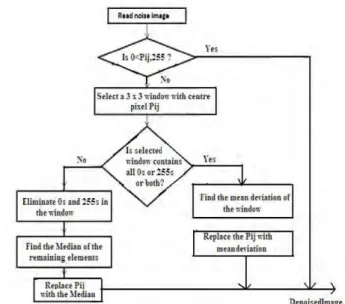
In this Modified Bilateral filtering is used to reduce the noises like salt and pepper, Gaussian noise etc. Actually, now several denoising strategies typically need the precise worth of the noise distribution as an important filter parameter. So, the noise estimation strategies within the abstraction domain use the variance or variance to estimate the particular value-added noise distribution. However it's found that the mean deviation from the mean provides higher results than the variance or variance to estimate the noise distribution. The advantage of this approach is that the mean deviation from the mean is really additional economical than the quality deviation in sensible things [9].The standard deviation emphasizes a bigger deviation; squaring the values makes every unit of distance from the mean exponentially (rather than additively) larger [10]. The larger deviation can cause overestimation or underneath estimation of the noise. So, we tend to assume that use of the mean deviation from the mean could contribute to additional correct noise estimation. Keeping these points see able, the authors have used the mean deviation from the mean parameter decide the noise pel and replaced the central pel by its mean deviation from the mean rather than its mean. The steps within the projected rule area unit are given below.
Step 1: choose 2-D window of size 3x 3. Assume that the pel being processed is PIJ.
Step 2: If this pel worth lies between zero and 255, 0< PIJ
< 255, this is often thought-about as uncorrupted pel. So, no process is needed and its worth is left unchanged.
Step 3: If PIJ = zero or 255, it indicates that the pel is
corrupted by salt and pepper noise. Here 2 cases area unit thought-about
Case i: The chosen window contains few zero or 255 parts and different parts lie between zero and 255.Then the zero and 255 parts area unit discarded and also the median of the remaining parts is found. The PIJ pel is replaced with this
median worth (intensity value).
Case ii: Suppose the window into consideration has all the pel worth either zero or 255 .Then median of those parts may additionally be either zero or 255 so it again a small issue. Now, realize this issue by the mean deviation from the mean or absolute mean deviation from the mean of the window which may ne'er be zero or 255.Replace the pel PIJ with this
mean deviation from the mean worth.
Step 4: If the pel PIJ is corrupted by guassian noise then
replaced the central pel by median worth.
Step 5: Apply the steps one to four for all the pixels within the image for complete the process of noise reduction.
A. Illustration of the Proposed Algorithm
This section explains the proposed algorithm with a flow chart and numerical examples. In the processing methodology the entire image must be checked for the presence of noise. The flow chart of the algorithm is shown in Fig.1.Let us first consider the Case ii. The 3x3 window under consideration has all the elements between 0 and 255 as shown below.
Here the central pixel Pij is 86 which is a noise free pixel .So, no further processing is required for this pixel.
Figure 2: Flow chart of the proposed algorithm for reduction salt and pepper noise
Next, let us consider a 3x3 window which contain both 0 and 255 elements along with other elements as shown below.
Here the Pij is 255.To process this pixel, eliminate all the 0 and 255 elements and arrange the remaining elements in the ascending order. The ascending order after elimination is
The median of the window now is 69.So; the central pixel 255 is replaced by 69. As a last illustration let us consider the Case ii: Let us consider the 3x3 window shown below which contains all the 0 or 255 elements.
For this window the central pixel Pij is equal to 255.The median of the window is either 0 or 255.Replacing the Pij with this value is of no use. So, find the mean deviation of the window. The mean deviation of the window is
Where x is the element of the window, x- is the mean of the window elements and n is the total number of elements. So, for the above window the mean deviation is 126.So, the central pixel 255 is replaced with the value 126.
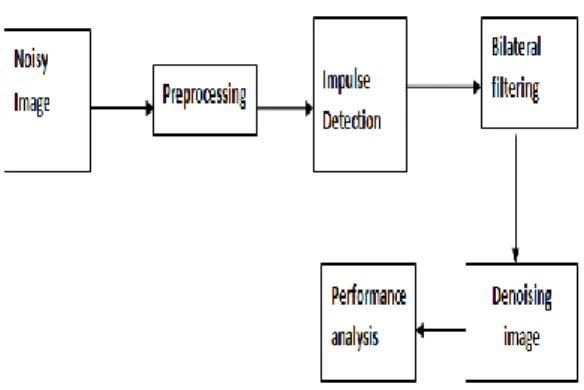
Figure 3: Block Diagram of Impulse Noise Removal
III. RESULTS
In order to evaluate the performance of the noise reduction and the accuracy of the detail preservation, criteria for the image quality assessment are required. The criteria chosen in this work is PSNR.
Where GV max represents the peak value,
represents the original image and represents the filtered image.Peak signal to noise ratio (PSNR) between the filtered image and original image is used to measure the denoising performance of thee bilateral filter.Here, we test the proposed algorithm on 8-bit gray image.
Actually, the lower of the signal to noise ratio, the more PSNR improvement of the proposed algorithm can be achieved better.
The proposed algorithm is simulated by using MATLAB and XILINX Platform Studio.
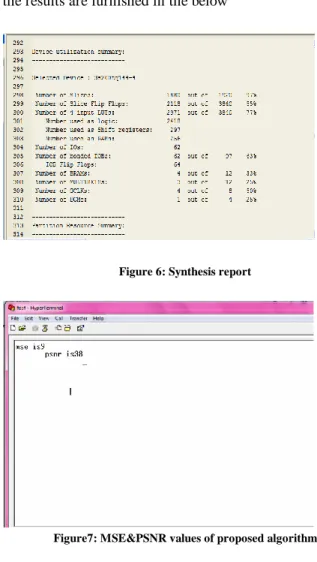
The Algorithm is implemented in Micro blaze Processor and the results are furnished in the below
Figure 4: Noisy Image
The Algorithm is implemented in Micro blaze Processor and the results are furnished in the below
Figure 6: Synthesis report
Figure7: MSE&PSNR values of proposed algorithm
IV. CONCLUSION
The projected rule is tested victimization the MATLAB and FPGA hardware. From this result, one will come back to the conclusion that the current methodology is showing moderately smart performance at high noise density levels. Additionally it's clear that the fine details of the image are preserved and therefore the distinction levels square measure far better within the case of the projected rule. Indeed each image process rule cannot be enforced effectively in hardware. But Projected Image Denoising methodology is enforced effectively on FPGA.
So it's easy and straightforward to implement. The projected methodology is synchronous and capable of real-time operation supporting high clock frequencies. Measurability of the planning so as to change the implementation of impulsive filter window size with low
V. REFERENCES
[1] C. Tomasi and P. Manduchi, ―Bilateral filtering for gray and color images,‖ in Proc. IEEE ICCV, 1998, pp. 839–846. [2] B. Zhang and J. P. Allebach, ―Adaptive bilateral filter for sharpness enhancement and noise removal,‖ IEEE Trans. Image Process., vol. 17, no. 5, pp. 664–678, May 2008. [3] B. Yan and A.-D. Saleh, ―Structure enhancing bilateral filtering of images,‖ in Proc. IEEE PCSPA, 2010, pp. 614–617.
[4] M. de-Frutos-López, H. Medina-Chanca, S. Sanz-Rodríguez, C. Peláez- Moreno, and F. Díaz-de-María, ―Perceptually-aware bilateral filter for quality improvement in low bit rate video coding,‖ in Proc. IEEE PCS, 2012, pp. 477–480.
[5] J. Won Lee, R.-H. Park, and S. Chang, ―Noise reduction and adaptive contrast enhancement for local tone mapping,‖ IEEE Trans. Consum. Electron., vol. 58, no. 2, pp. 578–586, May 2012.
[6] J. Giraldo, Z. Kelm, L. Yu, J. Fletcher, B. Erickson, and C. McCollough, ―Comparative study of two image space noise reduction methods for computed tomography: Bilateral filter and nonlocal means,‖ in Proc. Conf. IEEE EMBS, 2009, pp. 3529–3532.
[7] L. Yu, A. Manduca, J. Trzasko, N. Khaylova, J. Kofler, C. McCollough, and J. Fletcher, ―Sinogram smoothing with bilateral filtering for lowdose CT,‖ in Proc. SPIE Med. Imag.: Phys. Med. Imag., 2008, vol. 6913, pp. 691329-1–691329-8.
[8] A. Gabiger, R. Weigel, S. Oeckl, and P. Schmitt, ―Enhancement of CT image quality via bilateral filtering of projections,‖ in Proc. 1st Int. Conf. Image Formation X-ray Comput. Tomography, 2010, pp. 140–143.
[9] A. Gabiger-Rose, R. Rose, M. Kube, P. Schmitt, and R. Weigel, ―Noise adaptive bilateral filtering of projections for computed tomography,‖ in Proc. 11th Int. Meet. Fully Three-Dimens. Image Reconstruction Radiol. Nucl. Med., 2011, pp. 306 309.
[10] A. Gabiger, M. Kube, and R. Weigel, ―A synchronous FPGA design of a bilateral filter for image processing,‖ in Proc. IEEE IECON, 2009, pp. 1990–1995.
[11] T. Riesgo, Y. Torroja, and E. de la Torre, ―Design methodologies based on hardware description languages,‖ IEEE Trans. Ind. Electron., vol. 46, no. 1, pp. 3–12, Feb. 1999.
[12] T. Q. Pham and L. J. van Vliet, ―Separable bilateral filtering for fast video preprocessing,‖ in Proc. IEEE ICME, 2005, pp. 1–4.
[14] S. Paris and F. Durand, ―A fast approximation of the bilateral filter using a signal processing approach,‖ in Proc. ECCV, 2006, pp. 568–580.
[15] J. Chen, S. Paris, and F. Durand, ―Real-time edge-aware image processing with the bilateral grid,‖ ACM Trans. Graph., vol. 26, no. 3, pp. 1–9,
Jul. 2007.
[16] Q. Yang, K.-H. Tan, and N. Ahuja, ―Real-time O(1) bilateral filtering,‖ in Proc. IEEE CVPR, 2009, pp. 557–564. [17] M. M. Bronstein, ―Lazy sliding window implementation of the bilateral filter on parallel architectures,‖ IEEE Trans. Image Process., vol. 20, no. 6, pp. 1751–1756, Jun. 2011. [18] B. Weiss, ―Fast median and bilateral filtering,‖ ACM Trans. Graph., vol. 25, no. 3, pp. 519–526, Jul. 2006. [19] F. Porikli, ―Constant time O(1) bilateral filtering,‖ in Proc. IEEE CVPR, 2008, pp. 1–8.
[20] Y.-C. Tseng, P.-H. Hsu, and T.-S. Chang, ―A 124 Mpixels/sec VLSI design for histogram-based joint bilateral filtering,‖ in IEEE Trans. Image Process., Nov. 2011, vol. 20, no. 11, pp. 3231–3241.
AUTHORS PROFILE
P.Charishma Reddy M.Tech in VLSI Design, Dept.of E.C.E, Srinivasa Ramanujan Institute of Technology, Anantapur, Andhrapradesh, India.
D.Maruthi Kumar Assistant Professor, Dept.of E.C.E, Srinivasa Ramanujan Institute of Technology, Anantapur, Andhrapradesh, India.