A STRUCTURAL AND COMPARATIVE ANALYSIS OF THE ENTREPRENEURIAL PROCESS
Daniel Auguste
A dissertation submitted to the faculty of the University of North Carolina at Chapel Hill in partial fulfillment of the requirements for the degree of Doctor of Philosophy in the Department
of Sociology. Chapel Hill 2017 Approved by: Ted Mouw François Nielsen Howard Aldrich Martin Ruel Arne Kalleberg
© 2017 Daniel Auguste ALL RIGHTS RESERVED
ABSTRACT
Daniel Auguste: A Structural and Comparative Analysis of the Entrepreneurial Process (Under the direction of Ted Mouw and François Nielsen)
Research on the determinants of entrepreneurial entry and success have been dominated by individual-centered arguments. Explanations pertaining to structural forces that may condition the emergence and success of new entrepreneurs have been overlooked in this debate. This project fills this gap in the literature by exploring the structural dimensions of the entrepreneurial process and the interplay between structural forces and individual characteristics, and potential consequences of this link between micro and macro processes for who gets to become involved in entrepreneurship and achieve entrepreneurial success. To this end, this project develops a theoretical framework linking macro- and micro-level forces with the entrepreneurial process. The empirical analysis evaluates this theoretical framework, using indicators of early-stage entrepreneurial activities, business ownership and macro-level forces across a large range of developed and less developed economies. Results from mixed-effects logistic regressions
demonstrate the importance of structural forces for the likelihood that individuals would become involved in trying to start a business and eventually become business owners.
First, results show that in societies where beliefs that men make better leaders and that men have more right to employment are strong, women are less likely than men to become involved in starting a new business. Second, findings demonstrate that societal-level economic inequality increases the likelihood that individuals would become engaged in starting a new business and become business owners. However, the result also show that societal-level
it decreases entrepreneurship at high levels of economic development. Third, the findings show that the way that individual characteristics, such as educational attainment and income, influence the entrepreneurial process varies significantly across countries. The analysis also demonstrates that societal-level economic inequality accounts for substantial portions of the cross-national variations in the effects of individuals’ educational attainment and income on the likelihood of becoming engaged in entrepreneurial efforts and eventually becoming business owners. In
conclusion, this analysis demonstrates that structural forces matter for who gets to participate and to what extent in the entrepreneurial process. The importance of structural forces for the
ACKNOWLEDGEMENTS
It is often said that “it takes a village to raise a child.” This is true for my intellectual development, which has been shaped by a strong and loving community of scholars. I am particularly grateful to these great scholars for their contribution to the development of the ideas and writing presented in this dissertation.
I am immensely grateful to Ted Mouw for his great mentorship and insights, which were instrumental in the completion of this project. Ted, you have helped me to become the scholar I am today. I am equally indebted to François Nielsen for his invaluable and candid feedback throughout the development of this dissertation. Francois, your insights have strengthened the ideas and writing presented in these pages. I would also like to thank the other members of my dissertation committee--Howard Aldrich, Martin Ruef and Arne Kalleberg--for their priceless feedback on multiple drafts of this project. Your insights and support, at every step of the way, have contributed to the maturation of the research and writing contained in this dissertation.
This journey would not have been possible without the love and support of family and a great community of friends. I particularly thank Susan and Harris Cummings for their love and support throughout my college career and during the past six years of my graduate school voyage. Since I have been in the United States, the Cummings family has become my family, and their home has been my home. This project is dedicated to you. I would also like to express my deepest appreciation to Gary and Holly Campbell and Ann Klein. Gary, Holly and Ann, without your support that allowed me to come to the United States and attend Covenant College, this achievement would not have been possible. I also dedicate this dissertation to you.
Finally, I thank all my colleagues in the Sociology Department at the University of North Carolina at Chapel Hill. I particularly thank Holly Straut Eppsteiner, Courtney Boen, Kristen Schorpp, Didem Turkoglu, Hajar Yazdiha, Brian Foster, Raquel Zanatta Coutinho and Michael Good for making this voyage a success.
TABLE OF CONTENTS
LIST OF TABLES ... xi
LIST OF FIGURES ... xii
CHAPTER 1: INTRODUCTION ... 1
REFERENCES ... 6
CHAPTER 2: VARIETIES OF GENDERED-CAPITALISM: INSTITUTIONAL ENVIRONMENT AND GENDER INEQUALITY IN ENTREPRENEURSHIP ... 7
Institution and Gender Inequality in Entrepreneurship ... 9
Theoretical Mechanisms of the Relationship between Shared Gender Beliefs and the Gender Gap in Entrepreneurship ... 11
Shared Beliefs about Women’s Leadership Competency and the Gender Gap in Entrepreneurship ... 12
Shared Belief about Women’s Right to Employment and the Gender Gap in Entrepreneurship ... 16
Data, Measurement and Methods ... 19
Measurement of Entrepreneurial Entry: Early-stage Entrepreneurship ... 19
Measurement of Societal-level Gender Belief Variables ... 20
Societal-level Control Variables ... 21
Individual-level Control Variables ... 22
Modeling Techniques... 23
Modeling the Gender Gap in Entrepreneurship: Early-Stage Entrepreneurship ... 24
Modeling the Effect of the Society-level Gender Beliefs Factors on the Gender Gap in Early-stage Entrepreneurship ... 25
Cross-National Patterns of the Gender Gap in Entrepreneurship ... 26
Bivariate Analysis of the Relationship between Societal-level Beliefs that Men make Better Leaders and Men Have More Right to Scarce Jobs and the Gender Gap in Early-stage Entrepreneurship ... 27
Modeling the Gender Gap in Entrepreneurship ... 30
Modeling the Relationship between Societal-level Belief Factors and the Gender Gap in Early-stage Entrepreneurship ... 30
The Robustness Analysis ... 34
Modeling the Relationship between Societal-level Beliefs that Men Make Better Leaders, Men Have More Right to Scarce Jobs and the Gender Gap in Self-employment ... 35
Discussion and Conclusion ... 37
Contribution ... 42
Limitations and Suggestions for Future Research ... 44
APPENDIX ... 60
REFERENCES ... 63
CHAPTER 3: HOW GOOD OR BAD IS ECONOMIC INEQUALITY FOR ENTREPRENEURSHIP: DOES A SOCIETY’S STAGE OF DEVELOPMENT MAKE A DIFFERENCE? ... 69
The Theoretical Link between Societal-Level Economic Inequality, Economic Development, and Entrepreneurship ... 71
Economic Inequality and Economic Development ... 71
Economic Inequality and Entrepreneurship ... 74
Economic Inequality, Economic Efficiency, and Entrepreneurship ... 76
Data, Methods, and Measurement ... 79
Entrepreneurship Measures ... 79
Societal-level Economic Inequality and Economic Development ... 80
Individual-level and Societal-level Controls ... 81
Results ... 84
Modeling the Effect of Economic Inequality on Early-stage Entrepreneurship, Business Ownership and the Moderating Effect of Economic Development on the Effect of Economic Inequality ... 85
Discussion and Conclusion ... 89
Contribution ... 92
Limitations and Suggestions for Future Research ... 93
REFERENCES ... 104
CHAPTER 4: CONTEXT-BOUNDEDNESS NATURE OF THE RELATIONSHIP BETWEEN HUMAN AND FINANCIAL CAPITAL AND ENTREPRENEURSHIP: DOES SOCIETAL-LEVEL ECONOMIC INEQUALITY MAKE DIFFERENCE? ... 106
The Theoretical Link between Societal-Level Economic Inequality, Individuals’ Education, Income, and Entrepreneurship ... 107
Individual Educational Attainment, Entrepreneurial Entry, and Business Ownership ... 107
Financial Capital, Entrepreneurial Entry, and Business Ownership ... 110
The Conditioning Effect of Societal-level Economic Inequality on the Impacts of Educational Achievement and Personal Income on Entrepreneurial Entry and Business Ownership ... 113
Data, Measurement, and Methods ... 114
Entrepreneurship Measures ... 114
Individual and Societal-Level Controls ... 116
Method ... 118
Results ... 119
Modeling the Effect of Individuals’ Education and Income on Early- stage Entrepreneurial Activities, and the Moderating Effect of Societal- level Economic Inequality ... 119
Modeling the Effect of Education and Income on Ownership of a Nascent Business (i.e., a Business up to 42 Months Old), and the Moderating Effect of Societal-level Economic Inequality ... 124
Contribution ... 130 Limitations and Suggestions for Future Research ... 131 REFERENCES ... 140 CHAPTER 5: CONCLUSION, LIMITATIONS AND SUGGESTIONS FOR
FUTURE RESEARCH ... 142 REFERENCES ... 149
LIST OF TABLES
Table 2.1: Descriptive Statistics of Variables used in the Analyses ... 48 Table 2.2: Mixed-effects Regression Estimates of the Effect of Gender and Gender
Status Beliefs on the Log-odds of Early-stage Entrepreneurship ... 50 Table 2.3: Mixed-effects Regression Estimates of the Effect of Gender and Gender
Status Beliefs on the Log-odds of being Self-employed (Data source: WVS) ... 51 Table 3.1: Mean, Standard Deviation and Range of the Key Variables Used in this
Analysis... 95 Table 3.2: Pairwise Correlations Between the Dependent and Independent Variables
Used in this Analysis ... 96 Table 3.3: Mixed-effects Regression Estimates of the Effect of Societal-level
Economic Inequality and Economic Development on the Log-odds of Early-stage
Entrepreneurship ... 97 Table 3.4: Mixed-effects Regression Estimates of the Effect of Societal-level
Economic Inequality and Economic Development on the Log-odds of Established
Business Ownership ... 99 Table 4.1: Mean, Standard Deviation and Range of the Key Variables Used in this
Analysis... 133 Table 4.2: Pairwise Correlation between the Dependent and Independent Variables
Used in this Analysis ... 134 Table 4.3: Mixed-effects Regression Estimates of the Effect of Human and Financial
Capital and Societal-level Economic Inequality on the Log-odds of Early-stage
Entrepreneurship ... 135 Table 4.4: Mixed-effects Regression Estimates of the Effect of Human and Financial
Capital and Societal-level Economic Inequality on the Log-odds of Ownership of a
LIST OF FIGURES
Figure 2.1: Percentage of the Workforce who are Involved in Early-stage
Entrepreneurship across Countries by Gender ... 52 Figure 2.2: Size of the Gender Gap in Odds of being Involved in Early-stage
Entrepreneurship across Countries ... 53 Figure 2.3: Size of the Gender Gap in Odds of being Involved Early-stage
Entrepreneurship across Countries, by Societal-level Belief that Men make
Better Leaders ... 54 Figure 2.4: Size of the Gender Gap in Odds of being Involved in Early-stage
Entrepreneurship across Countries, by Societal-level Belief that Men Have More
Right to Scarce Jobs ... 55 Figure 2.5: Predicted Probability of Early-stage Entrepreneurship for Men and
Women, by Societal-level Belief that Men make Better Leaders than Women do ... 56 Figure 2.6: Predicted Probability of Early-stage Entrepreneurship for Men and Women,
by Societal Men Have More Right to Scarce Jobs than Women do ... 57 Figure 2.7: Predicted Probability of Being Self-employed for Men and Women, by
Societal-level Belief that Men make Better Leaders than Women do (Data source: WVS) ... 58 Figure 2.8: Predicted Probability of Being Self-employed for Men and Women, by
Societal-level Belief that Men Have More Right to Scarce Jobs than Women do
(Data source: WVS) ... 59 Figure 3.1: Theoretical Link between Societal-level Economic Inequality, Economic
Development and Entrepreneurship ... 101 Figure 3.2: The Effect of Gini coefficient on Early-stage Entrepreneurship by Economic
Development levels (Model 4, Table 3) ... 102 Figure 3.3: The Effect of Gini coefficient on Ownership of Established Businesses by
Economic Development levels (Model 4, Table 4) ... 103 Figure 4.1: Theoretical Framework of the Interplay between Structural and Individual
CHAPTER 1: INTRODUCTION
Entrepreneurship, because of its significance for job creation and economic development, has occupied an important place in academic and policy discourses. Entrepreneurship research, building on the large body of organization theories (e.g., ecological theory (e.g., Freeman and Audia 2006; Hannan and Freeman 1977; Ruef 2000), network theory (e.g., Powell, White, Koput and Owen-Smith 2005; Burt 2004), evolutionary theory (Aldrich and Ruef 2006) and
institutional theory (Meyers and Rowan 1977; DiMaggio and Powell 1983)), has highlighted various social mechanisms underlying the entrepreneurial process and success. There is consensus among entrepreneurship and organization scholars, particularly those from the sociology research tradition, that the environmental conditions are crucial for understanding the entrepreneurial process and answering questions about who gets to engage, and to what extent, in entrepreneurial efforts (e.g., Aldrich and Ruef 2006; Ruef 2013; Thébaud 2015a; Yang and Aldrich 2014).
Although entrepreneurship theorists have clearly acknowledged the importance of the structural or macro-level factors in shaping organization emergence and change,
entrepreneurship theories about social mechanisms underlying processes of entrepreneurial entry and success tend to gravitate largely toward micro or individual-level explanations. As a result, insufficient attention is paid to the interplay of micro- and macro-level processes in theorizing about social mechanisms underlying entrepreneurial entry and success. In the same vein, there have been few empirical investigations of the interplay of micro- and macro-level mechanisms, and their consequences for the entrepreneurial process. Acknowledging this gap in the
entrepreneurship literature, the journal Entrepreneurship Theory and Practice recently launched a special issue calling on scholars to pay closer attention to understanding characteristics of the structural environment facilitating the emergence of entrepreneurs, as opposed to focusing merely on the qualities of the people who have become entrepreneurs and succeeded in entrepreneurship (Burton, Sørensen and Dobrev 2016). However, a few studies have already made some strides in this area by emphasizing the characteristics of entrepreneurs’ embedded environment as opposed to focusing only on understanding of entrepreneurs’ personal qualities that might have influenced their entrepreneurial efforts and success. For instance, previous research has emphasized community-level social trust in the United States (Kwon, Heflin and Ruef 2013), the interplay between societal-level trust and the rule of law in a group of emerging economies (Kim and Li 2014) and work-family policy in 24 advanced economies (Thébaud 2015b) as important structural determinants of individual likelihood of becoming involved in starting a new business and of achieving entrepreneurial success.
Thus, the present project fits into this research niche pertaining to understanding the characteristics of the structural environments that shape the emergence of entrepreneurs and determine the nature of the entrepreneurial process. Particularly, this project aims at exploring the structural dimension of the entrepreneurial process and the interplay between structural forces and individual characteristics, and potential consequences of this link between micro and macro processes for who gets to become involved in entrepreneurship and achieve
entrepreneurial success. This project accomplishes this objective by building on contemporary and classical macro sociological theory to develop a theoretical framework linking macro- and micro-level forces with the entrepreneurial process. This framework facilitates theoretical and empirical investigations of questions about the entrepreneurial process, reflecting more clearly
the complexities of the social reality, which theories that focused disproportionately on micro-level dimensions of the entrepreneurial process have been unable to accomplish. This theoretical framework is developed and evaluated in three complementary phases, namely in Chapter 2, Chapter 3 and Chapter 4.
Chapter 2 builds on gender theory and institutional theory to develop a theoretical
framework linking societal-level perception about gender differences in competency and right to valued resources and differences in the propensity that men and women have for becoming engaged in trying to start a new business. Using data from Global Entrepreneurship Monitor (GEM) at the early stage of the entrepreneurial process and societal-level measures of attitudes about gender differences in leadership competency and right to employment from World Values Survey, the empirical analysis evaluates this theoretical framework. Results from mixed-effects logistic regressions lend support to the argument advanced in this chapter. The results show that the stronger the beliefs in a society that men make better leaders, the greater the gender gap in the likelihood of becoming involved in trying to start a new business in that society. Results also demonstrate that the stronger the beliefs in a society that men have more right to employment, the greater the gender gap in the likelihood of becoming involved in trying to start a new business there.
Chapter 3 theorizes about entrepreneurial dynamics under conditions of high economic inequality and the potential importance of a society’s development stage for how economic inequality influences the entrepreneurial process. The empirical analysis evaluates this chapter’s theoretical argument using entrepreneurship data from GEM and economic inequality and economic development data from various sources. Results from mixed-effects logistic
people have for becoming involved in trying to start a new business and becoming business owners. The results also show that the effect of economic inequality is conditioned by a society’s development stage. That is, the analysis demonstrates that economic inequality increases the likelihood that individuals will become involved in starting a new business and eventually become business owners at low levels of economic development. On the other hand, economic inequality lowers the likelihood that individuals will become involved in starting a new business and become business owners at high levels of economic development.
Chapter 4 further investigates the mechanisms underlying the relationship between societal-level economic inequality and entrepreneurial entry and business ownership. This is done by examining potential conditioning effects of societal-level economic inequality on the ways personal characteristics of potential entrepreneurs shape their chances of becoming involved in starting a new business and eventually becoming business owners. To this end, this chapter reviews previous arguments about the importance of individual educational and financial capital for entrepreneurial entry and success. In doing so, this chapter develops theoretical arguments and testable propositions about the importance of societal-level economic inequality for how individuals’ educational attainment and financial capital impact their chances of becoming involved in entrepreneurship and becoming business owners.
Results from mixed-effects logistic regressions lend support to previous research showing that individual education and financial capital are important for individuals’ propensity for becoming engaged in entrepreneurial efforts and becoming business owners. Consistent with the theoretical argument advanced in Chapter 4, results demonstrated that societal-level economic inequality conditions how individuals’ educational attainment and financial capital influence their chances of becoming engaged in starting a new business and eventually becoming business
owners. That is, in line with Chapter 4’s theoretical framework, the empirical findings show that societal-level economic inequality conditions how individuals’ education and financial capital influence their likelihood of becoming involved in starting a new business and eventually becoming business owners. For example, the results show that in societies where economic inequality is high, people who are at the middle and the top of the income distribution have a lesser propensity for becoming owners of a nascent business.
REFERENCES
Aldrich, Howard E. and Martin Ruef. 2006. Organizations Evolving: Second Edition. Sage. Burt, Ron. 2004. “Structural Holes and Good Ideas.” American Journal of Sociology 110(2):
349-99.
Burton DM, Sørensen JB and Dobrev SD. 2016. “A careers perspective on entrepreneurship. Entrepreneurship.” Theory and Practice 40(2): 237–247.
DiMaggio, Paul J. and Walter W. Powell 1983. "The iron cage revisited: Institutional isomorphism and collective rationality in organizational fields." American Sociological Review 48: 147-60.
Freeman, John and Pino Audia. 2006. “Community Ecology and the Sociology of Organizations.” Annual Review of Sociology 32: 145-69.
Hannan, Michael T. and John Freeman. 1977. "The population ecology of organizations." American Journal of Sociology 82: 929-64.
Meyer, John W., and Brian Rowan 1977. “Institutional organizations: Structure as myth and ceremony.” American Journal of Sociology 83: 340-63.
Powell, Walter W., D. White, K. Koput, and J. Owen-Smith. 2005. “Network Dynamics and Field Evolution: The Growth of Interorganizational Collaboration in the Biotechnology Industry.” American Journal of Sociology 110(4):1132-1205
Ruef, Martin. 2000. “The emergence of organizational forms: A community ecology approach.” American Journal of Sociology 106: 658-714.
Ruef, Martin. 2010. The Entrepreneurial Group: Social Identities, Relations, and Collective Action. Princeton, NJ: Princeton University Press.
Thébaud, Sarah. 2015a. “Status Beliefs and the Spirit of Capitalism: Accounting for Gender Biases in Entrepreneurship and Innovation” Social Forces. Social Forces 94: 61-86.
Thébaud, Sarah. 2015b. “Business as plan B? Institutional foundations of gender inequality in entrepreneurship across 24 industrialized countries.” Administrative Science Quarterly, 60(4): 671–711.
Yang, Tiantian, and Howard E. Aldrich. 2014. “Who’s the Boss? Explaining Gender Inequality in Entrepreneurial Teams.” American Sociological Review 79(2):303–327.
Kim, Phillip H. and Mingxiang Li. 2014. “Seeking Assurances When Taking Action: Legal Systems, Social Trust, and Starting Businesses in Emerging Economies.” Organization Studies 35(3): 359–391
Kwon, Seok-Woo, Colleen Heflin and Martin Ruef. 2013. “Community Social Capital and Entrepreneurship.” American Sociological Review 78(6): 980–1008.
CHAPTER 2: VARIETIES OF GENDERED-CAPITALISM: INSTITUTIONAL ENVIRONMENT AND GENDER INEQUALITY IN ENTREPRENEURSHIP
Although women have made great strides in closing the gender gap in many areas of economic life, research has shown that women continue to be underrepresented among owners of established business and nascent entrepreneurs around the world (Kelley, Singer and Herrington 2016). Research conducted in the United States, for example, has found that in the 2000s women represented 43 percent of managers, legislators, and senior officials (UNDP 2009). However, women made up only 28 percent of all private firms in the United States (CWBR 2009). Women also tend to be underrepresented among owners of high-growth, large-size, and innovative businesses (Loscocco and Bird 2012; Kalleberg and Leicht 1991; Tonoyan and Strohmeyer 2005; Thébaud 2015a).
The persistence of these gender inequalities across time and space, has fueled the debate about the root causes of the reproduction and persistence of gender inequalities in
entrepreneurship. The popular narrative in this debate has, however, focused primarily on supply-side mechanisms, emphasizing an entrepreneur’s personal characteristics, such as gender differences in work experience, social networks, motivation, personal life values, income, education, and psychological disposition toward risk taking (Loscocco et al. 1991; Marlow and McAdam 2010; Minniti and Nardone 2007; Renzulli, Aldrich and Moody 2000; Thébaud 2010). Insufficient attention has been paid to macro-level social forces, such as societal-shared gender beliefs, that tend to disadvantage women compared with men in accessing society’s valued resources (Ridgeway 2011).
Moreover, most previous research on gender stratification in entrepreneurship has been disproportionately conducted in advanced industrial societies (Thébaud 2010, 2015a). The disproportionate focus on advanced industrial societies persists, despite it having been well established in gender stratification literature that mechanisms underlying the reproduction of gender inequality in social organizations tend to be context-specific (Ridgeway 2011) and vary by societies’ development stage (Inglehart and Norris 2003).
The present study fills this gap in previous research by proposing a macro theoretical framework based on institutional and structural theories (Meyer and Rowan 1978, Durkheim’s ([1912] 1995), and gender theory (Ridgeway 2011) linking the societal gender status beliefs system with the persistent gender gap in entrepreneurship. This framework particularly establishes a connection between a societal shared belief about gender differences in
competencies and the right to valued resources to the gender gap in entrepreneurial entry and the ownership of established businesses. Societal-level beliefs about gender differences in
competencies is conceptualized here as gender differences in leadership competency; and the societal-level belief about gender differences in the right to valuable resources is operationalized as gender difference in the right to scarce jobs. This theoretical framework is evaluated using multilevel estimation techniques, indicators of societal-shared gender beliefs and
entrepreneurship from 62 economically, politically, and culturally diverse countries drawn from two cross-national and country representation surveys, namely the Global Entrepreneurship Monitor and the World Values Survey.
Consistent with the theoretical argument advanced in this study, the empirical analysis shows that women are less likely than men to become involved in the early-stage entrepreneurial process, and to become owners of established businesses. The analysis also shows that the
gender gaps in early-stage entrepreneurship and the ownership of established businesses varies substantially across countries. The results demonstrate that the gender gap in early-stage entrepreneurship and the ownership of established businesses is larger in societies where the beliefs that men make betters leaders and that men have more right to scarce jobs are strong. These findings are robust using three different measures of entrepreneurship from the two surveys mentioned above. Thus, the broader implication of the adverse impact of the societal-level belief that men make better leaders and that men have more right to scarce jobs on women’s entrepreneurship (compared with men) is that structural factors, such as a society’s gender belief system, shape the differential chances that men and women have to participate in the capitalist production process.
The following section develops the theoretical framework and testable hypotheses about the social mechanisms by which societal-level beliefs about gender differences in leadership competency and the right to scarce jobs relate to the gender gap in entrepreneurial entry and the ownership of established businesses. This is followed by a description of the data, the analytic techniques, and a presentation of the results. Implication of the results, contribution, limitations, and suggestions for future research are discussed in the final sections.
Institution and Gender Inequality in Entrepreneurship
An institution may be understood as a collective body or a manner of organizing social life that is common to members of a society. In this regard, an institution can be an organization that has a certain way of doing things, often guided by written rules, to achieve a certain goal. An institution may also be understood as sets of unwritten rules, semiotic codes, or specific practices that shape social interactions (Meyer and Rowan 1977; Jepperson 1990). Institutions, as
Rowan (1977) referred to as institutional logic, around which social life, behaviors, and organizational practices gravitate. This study uses this conceptualization of an institution as unwritten rules, belief, and social norms (Meyer and Rowan 1977; Jepperson 1990) to theorize about the social embeddedness and taken-for-grantedness of social attitudes about gender differences regarding competency and the right to economic resources and the implications for gender stratification in entrepreneurship.
The theoretical framework proposed here is based on the premise that the working of social organizations depends on society’s shared beliefs about what is real. This assumption is particularly useful here because in times of uncertainty and a lack of information or in situations of asymmetric information (e.g., when one party, in a social exchange, has more information than the other), which are inherent to the entrepreneurial process, collective beliefs and cultural codes may be particularly important in shaping the course of actions for both individuals and organizations. For example, to deal with market uncertainty and illegitimacy, new or small organizations tend to mimic prevailing institutional norms, often implemented by more
established organizations (DiMaggio and Powell 1983). Furthermore, in the labor market, to deal with uncertainty, employers tend to rely on common beliefs about the relative competence of potential employees in making hiring decisions (Ridgeway 2011; 2014).
The moral of this argument is that whether or not a given shared social belief is true, it may become real to individuals and have a real impact on social organizations, once a large enough number of people abide by it or believe it to be true (Merton 1968). In regard to the organization of an economy, for instance, shared beliefs about the working of the market (whether these beliefs are true or not) may become real to individuals and economic
people will tend to adjust their behaviors to fit these popular beliefs. This is what Goffman implied when he said people tend to adjust their behaviors to fit societal expectations, as
performers of scripts set by society (Goffman 1959, 1967), and Durkheim when he claimed that individual behaviors are the sum of the collective consciousness ([1912] 1995). For example, if a large enough number of people believe that the economy will grow next year (regardless of the veracity of such a belief), people and organizations may feel confident and start spending and investing, which would result in actual economic growth. In the same vein, if a large enough number of people, for example, believe that banks will lack solvency next year (regardless of the veracity of such a belief), people may start withdrawing their money, which would result in actual bank insolvency. Similar to beliefs about the working of the market, perceptions about the competency and rights of individuals and groups to valued resources are embedded in a social belief system and institutional logic that infuse them with the power to structure the rules that define the distribution of rewards and access to these valued resources. As a result, societal-shared beliefs about differential competency and the right to society’s valued resources may impact inequality in participation in the capitalist production process, such as differential chances of entrepreneurial entry and business ownership across individuals.
Theoretical Mechanisms of the Relationship between Shared Gender Beliefs and the Gender Gap in Entrepreneurship
As stated above, this section builds on Durkheim’s structure theory ([1912] 1995), Goffman’s cultural acting theory (Goffman 1959, 1967), and Merton’s theory of self-fulfilling prophesy (1968) to show how societal perceptions about subordinate leadership competency, and the employment rights of women compared with men (although these differences are not
inherently true), may be made real by society. This section also uses Ridgeway’s (2011) gender performativity theory and Meyer’s and Rowan’s social norms and belief system as sources of
logic for markets (1977) to show how these negative perceptions regarding leadership
competency and the rights of women to employment, may negatively impact women’s ability to access resources necessary for business development, thereby lowering women’s chances of entering entrepreneurship and becoming owners of established enterprises.
Shared Beliefs about Women’s Leadership Competency and the Gender Gap in Entrepreneurship
Societal perceptions about women’s leadership ability compared with men are a theoretically appropriate concept for testing this paper’s argument that unfavorable gender attitudes may impact differences in the degree to which men and women would participate in economic production, such as differences in the likelihood of becoming entrepreneurs. Although one may question whether entrepreneurs are naturally endowed with unique leadership ability, both scholars and business practitioners tend to perceive leadership quality as an important quality for transitioning to entrepreneurship and entrepreneurial success. Entrepreneurs are often described as people who have strong managerial and leadership qualities and who are risk takers. Indeed, leadership courses are among the core courses that business administration students have to take at all major business schools. Some scholars, supporting the concept of entrepreneurial leadership, have compared entrepreneurs with salary earners to highlight differences in
leadership characteristics between entrepreneurs and salary workers. Using the World Values Survey data, Lee-Ross (2015) investigated how likely entrepreneurs (measured as
self-employment), compared with salary earners, are to possess characteristics perceived to be
entrepreneurial leadership quality, such as locus of control, and to be innovators, risk-takers, and competitively aggressive. These perceived leadership characteristics are believed to be important for entrepreneurial entry and are seen as sources of competitive advantage (Küpers and Weibler 2008), which are believed to be crucial for organization success (Luthans and Youssef 2007).
While leadership quality is perceived to be important for entrepreneurial entry and success, research has shown that perceived leadership quality tends to be attributed to men (see Koenig et al 2011 for a review of this literature). For example, research has found that in organizations being a manager is perceived as a male role (e.g., Powell and Butterfield 1979, 2015, Eagly et al. 1992, Schein and Davidson 1993, Powell et al. 2002, Sczesny 2003, Koenig et al. 2011). Given this emphasis on entrepreneurial leadership quality and the low level of
entrepreneurial entry and business ownership of women compared with men, scholars have turned their attention to understanding the factors believed to facilitate female leadership development. Research using Global Entrepreneurship Monitor data has investigated environmental factors that may promote leadership quality in women across 92 countries (Yousafzai and Saeed 2015). Research conducted in England and Wales emphasized personal quality relating to women’s leadership style in order to understand the determinants of female entrepreneurship (Vassiliki, Jones, Mitchelmore, and Nikolopoulos 2015), whereas others using longitudinal data from Northern Ireland tried to understand how social and human capital may impact young female leadership development, which may in turn influence these women’s entrepreneurial entry later in life (McGowan, Cooper, Durkin, and O’Kane 2015). The underlying assumption in this literature is that leadership and its mastery are important for entrepreneurial entry and success. Another assumption is the implicit belief that if factors
fostering leadership quality or the competencies of women are identified and promoted, women’s disadvantage in entrepreneurial entry compared with men may be reduced.
Given this emphasis on the strong leadership quality of entrepreneurs, perception about a person’s leadership ability may be important for how others evaluate the chances of success of one’s entrepreneurial efforts and ideas, because people believe leadership quality to be
important. Because producers, consumers, and potential investors generally lack adequate information or knowledge to evaluate the potential success of entrepreneurial efforts, especially when these activities lack legitimacy, they tend to rely on cultural codes and society’s shared beliefs to determine legitimacy and manage uncertainty about the quality of products and the potential success of ventures.
In this regard, societal perception about women’s leadership competency may impact women’s likelihood of being entrepreneurs relative to men in two primary ways. Attitude toward women’s leadership competency, acting as a cultural code (Aldrich and Yang 2014; 2012), may directly and indirectly impact women’s chances of being entrepreneurs (Ridgeway 2014). Directly, unfavorable societal evaluation of women’s leadership competency relative to that of men may discourage women from pursuing entrepreneurial activity. Because people entering entrepreneurship are perceived to possess high leadership ability and because women may internalize the negative societal belief that women possess lesser leadership competency
compared with men (Ridgeway 2014), many women that could pursue entrepreneurship careers might refrain from doing so, because they might think they lack the necessary skills to succeed as entrepreneurs, which Merton referred to as a self-fulling prophecy (1968). In fact, research conducted across 24 industrial countries (including the United States), using Global
Entrepreneurship Monitor data, found that women’s self-perception about entrepreneurial
competencies was adversely related to their chances of becoming entrepreneurs (Thébaud 2010). Indirectly, perceptions about women’s leadership competency may adversely affect women’s likelihood of being entrepreneurs compared with men by negatively impacting women’s chances of accessing necessary resources for business creation. Society defines the cultural codes by which the potential success of individuals and organizations may be evaluated.
Cultural codes often serve as a default template to evaluate the potential success of business and business ideas (Aldrich and Yang 2014, 2012; Ridgeway 2014). Cultural codes as a template for evaluating the potential success of an individual would be particularly important in a situation of uncertainty, like deciding on the quality of products and the potential success of businesses, for example. Regarding a new business, consumers and potential stakeholders often lack information about the ability of entrepreneurs and the likelihood of entrepreneurial success (Aldrich and Ruef 2006; Aldrich and Fiol 1994; Suchman1995). The gender of entrepreneurs may become salient and cultural beliefs about the inferior ability of women compared with men may prescribe lower expectations about women’s competency compared with men (Foschi 2000; Ridgeway 2011), negatively affecting the willingness to support women-owned ventures and entrepreneurship ideas.
Furthermore, negative attitudes toward women’s competency compared with men may cause uncertainty about the potential success of women-owned businesses and ideas for new ventures, and may ascribe an illegitimate status to women-owned ventures. Illegitimacy and uncertainty about the potential success of women-owned ventures may negatively affect
willingness to support women-owned businesses and entrepreneurship ideas. Consequently, this would disadvantage women entrepreneurs in their quest for resources necessary for business creation. This would lower both women’s entrepreneurial entry and the ownership of established businesses. Thus, attitudes toward the leadership competency of women compared with men may serve as a social schema or cultural code for evaluating the relative success of women’s
compared with men’s entrepreneurial efforts, affecting the differential chances of accessing necessary resources for business creation and success. Based on the above argument, the following hypotheses are formulated.
Hypothesis 1 (H1): All else equal, the gender gap in entrepreneurial entry will be larger in societies where the belief that men make better leaders than women do is strong.
Shared Belief about Women’s Right to Employment and the Gender Gap in Entrepreneurship Societal perceptions about women’s right to employment compared with men is a theoretically appropriate measure for testing the argument of this paper that the belief about gender differences in the right to valuable resources, such as employment, should impact the gender gap in entrepreneurship. Differences in societal perceptions about women’s and men’s rights to employment may produce biases regarding “who is more competent, more deserving of jobs, promotion and money…” (Ridgeway 2014). Access to employment is a particularly
important factor for understanding the differences in the likelihood that individuals may become entrepreneurs, because many new ventures are started while entrepreneurs are still working. Ideas for new ventures often emerge from prior work experiences and information from social networks built during one’s employment career. Societal perceptions about individuals’ right to employment may affect the chances that one would be employed, which, through its impact on one’s ability to acquire work experience and build valuable social networks, would impact the chances that one may start a new business and succeed as an entrepreneur.
In this section, I argue that the societal-level belief that men have more right to scarce employment than women do (although such differences may not inherently be true) may have a real impact on the differential chances of men and women becoming entrepreneurs. Differences in the societal shared belief about the right of women to employment compared with men would have a real impact on differential opportunities available to men and women for entry into entrepreneurship.
Institutional sociological theories emphasize the importance of collective norms and beliefs in determining individual actions (Meyer and Rowen 1977; Durkheim [1900] 1960). A process through which the institutional environment shapes human behaviors is by building habits (Aldrich and Yang 2014, 2012; Wood, Quinn, and Kashy 2002). In regard to becoming entrepreneurs, individuals may develop habits and learn skills about how to succeed as
entrepreneurs through their employers, co-workers, and via on the job learning and training (Aldrich and yang 2014). Indeed, research has shown that the knowledge acquired from prior work experience tends to improve entrepreneurial performance (Wiklund and Shepherd 2003). Moreover, an underlying assumption of many studies emphasizing a knowledge-based approach to understanding the business creation process is that prior employment provides nascent
entrepreneurs with valuable entrepreneurial skills (Aldrich and Yang 2014, 2012). Research has also found that time spent as an employee, compared to time spent with family and in other non-economic activities, tends to be more valuable for building the necessary habits and routines to successfully transition to entrepreneurship (Miner et al 2011).
Because work experience is so important for entrepreneurial knowledge, building habits, and routines valuable for entrepreneurial entry and success, differential access to wok should matter for differences in the likelihood of entering entrepreneurship and becoming owners of established enterprises between individuals. Society’s unfavorable attitude toward women’s right to employment compared with men may disadvantage women in their search for employment, preventing women from benefiting from the positives of work experience that have been shown to be valuable for transitioning to entrepreneurship and entrepreneurial success (Aldrich and Yan 2014; Sørensen and Fassiotto 2011; Miner et al 2011). While it is fair to argue that there are no inherent differences in the right to employment between men and women, the societal belief that
men have more right to employment than women do may disadvantage women compared with men regarding access to employment (Ridgeway 2014). That is, the shared belief that when jobs are scarce men have more right to employment than women do may serve as a cultural code, shaping employers’ hiring decisions, especially in a situation in which the gender of potential employees is a salient characteristic (Ridgeway 2014).
This argument about the influence of gender beliefs on hiring decisions does not,
however, undermine the meritocratic aspect of job recruitment prevalent in the capitalist mode of production. It implies that despite the meritocratic criteria of job recruitment, perceptions related to ascribed characteristics, such as a belief about gender differences in the right to employment, may impact who employers choose to hire. As Goffman described it, individuals perform society’s cultural scripts (Goffman 1959, 1967). Cultural scripts and frames often reside in the subconscious mind, guiding individuals’ everyday interactions and behaviors. Societal beliefs about the right of women to employment compared with men may still act as an important factor, alongside meritocratic ones, in hiring decisions. Thus, all else being equal, given favorable societal attitudes toward men’s right to employment compared with women, employers may be more likely to hire men over women. Such a disparity in the chances of being employed between men and women is likely to impact differential access to necessary resources for entrepreneurial entry and ultimately success between men and women. Based on the above argument, the following hypotheses are formulated.
Hypothesis 2 (H2): All else equal, the gender gap in entrepreneurial entry will be larger in societies where the belief that men have more right to scarce jobs than women do is strong.
Data, Measurement and Methods
The entrepreneurship data used to evaluate these hypotheses are provided by the Global Entrepreneurship Monitor (GEM) and the gender beliefs data by the World Values Survey (WVS). Both GEM and WVS are cross-national and country representative surveys administered to individuals aged 18 and older. The sample of individuals under study here is restricted to the working-age population, ranging from 18 to 65 years old. GEM is designed to measure the state and evolution of entrepreneurship and organization founding across the world. It is conducted yearly, and the first wave of surveys started in 1998 across a small group of countries. It now contains data for approximately 80 countries. The present analysis uses data collected between 2001 and 2012 across 62 countries. The 2012 wave is the latest way of the GEM data used here, because it is the most recent wave of data that GEM has made publicly available. WVS was designed to examine changes in values and beliefs across the world, and how those changes relate to changes in other social phenomena, such as economic activities. WVS has a total of six waves of data, spanning 1994 to 2014. The data were collected through face-to-face interviews and by phone surveys in remote areas. Thus, the societal-level gender beliefs factors are drawn from WVS and merged with the entrepreneurship variables (provided by GEM) on country-year, using GEM as the base data set.
Measurement of Entrepreneurial Entry: Early-stage Entrepreneurship
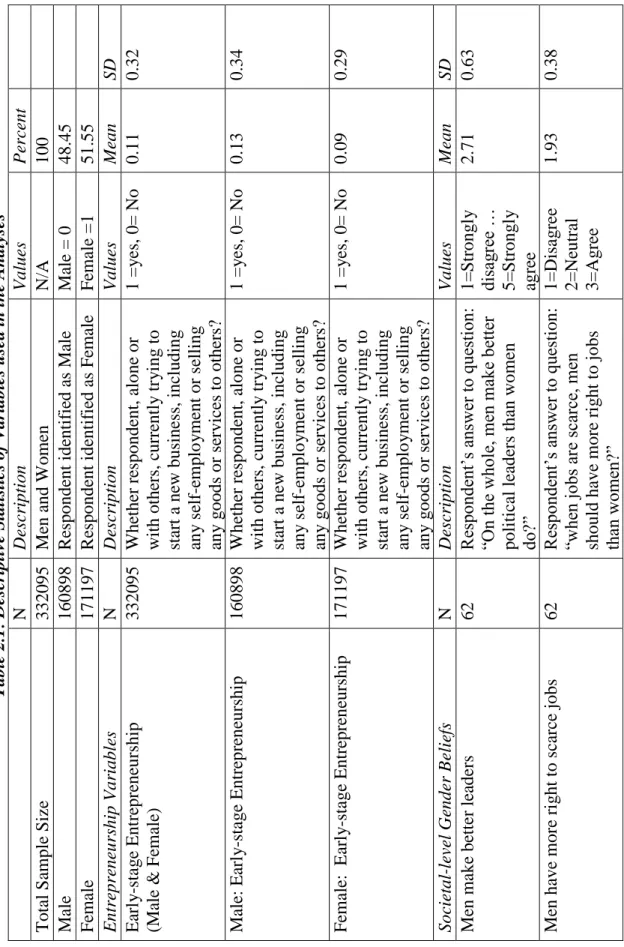
Early-stage entrepreneurship. GEM measures early-stage entrepreneurship by asking individuals whether they were ‘‘alone or with others, trying to start a new business” at the time of the interview. Being engaged in early-stage entrepreneurship is coded “1” if the participant reported that she or he was currently trying to start a new business, otherwise it is coded “0.” The analytical sample size for this variable is 346,059, of which 167,311 are men (i.e., 48.05%) and
they were actively trying to start a new business. About 13.04 percent of men were actively trying to start a new business compared with 8.80 percent of women (see Table 1 for a more detailed description). The level of early-stage entrepreneurship varies substantially across countries (see Figure 1). For instance, less than five percent of people surveyed in Puerto Rico, Hong Kong, Tunisia, Russia, Japan, Croatia, France and Italy indicated that they were involved in starting a new business. On the other hand, more than 30 percent of the survey participants in Zambia, Peru and Uganda reported that they were involved in starting a new business at the time of the interviews.
Measurement of Societal-level Gender Belief Variables
The societal-level belief that men make better leaders than women do (i.e., Men make better leaders). The men make better leaders variable is measured in the World Values Survey by asking the respondents whether they agreed with the following statement: “On the whole, men make better political leaders than women do.” Possible responses are measured on a four-point scale, ranking from 1= strongly disagree, through 2=disagree, 3=agree, and 4 = strongly agree (see Table 1 for a more detailed description). The societal-level belief that men make better leaders than women do was constructed by calculating the average of the individual responses by country-year. As demonstrated by the results in Table 1, the average belief that men make better leaders than women do is stronger in some societies than others, which is indicated by a mean of 2.71 and a standard deviation of 0.63 across the 62 countries.
Societal-level beliefs that men have more right to scarce jobs than women do (i.e., men have more right to jobs). WVS measures the belief that men have more right to scarce jobs by asking the respondents whether they agreed, disagreed, or neither agreed nor disagreed with the following statement: “when jobs are scarce, men should have more right to a job than women.” Possible responses were scored on a three-point scale, ranking from 1 = disagree; through 2 =
neither, and 3 = agree. Similar to the societal-level belief that men make better leaders variable, the societal-level belief that men have more right to scarce jobs was constructed by calculating the average of individual responses to the question. As indicated by the results in Table 1, the average belief that men have more right to scarce jobs is stronger in some societies than others. This is shown by a mean of about two out of three and a standard deviation of 0.38 across the 62 countries (see Table 1). Thus, the analytical data set was constructed by merging the societal-level gender belief variables with the entrepreneurship indicator on country-year using GEM as the base data set.
Societal-level Control Variables
Female labor force participation and economic development. Female labor force participation and economic development are controlled for in this analysis because of their theoretical importance for business ownership as a whole, and the gender gap in the chances of becoming involved in early-stage of the start-up process, and of becoming owners of established businesses. A key argument of this paper is that work experience is important for learning skills, and access to the necessary resources for business development. Consequently, female labor force participation may influence the gender gap in entrepreneurship independently of societal-level beliefs that men make better leaders and men have more right to scarce jobs than women do. This is important because research has found that women tend to experience low labor force participation (compared with men) in most countries around the world (Tzannatos 1999). In addition to controlling for female labor force participation, accounting for economic
development is also important, because economic development tends to be associated with a greater proportion of people working as salaried and wage workers as opposed to being self-employed. This is revealed in the Figures 1 and 2, where the proportion of people who indicated
substantially higher in less developed countries compared with their developed counterparts. As a result, one may expect greater economic development to lower both men’s and women’s self-employment (Acs et al. 2004), which would impact the gender gap in entrepreneurship
independently of the societal-level beliefs that men make better leaders and that men have more right to scarce jobs.
Consequently, this analysis accounts for the effects of female labor force participation and economic development on the gender gap in entrepreneurship. Female labor force
participation is measured as the percentage of the female population who are working for pay (i.e., female labor force participation rate). The female labor force participation data were drawn from the International Labour Organization (2015). The economic development variable is measured as real gross domestic product per capita in US dollars (i.e., real GDP per capita). That is, real gross domestic product divided by the population size. The real GDP per capita data were drawn from the Penn World Tables (Feenstra, Inklaar and Timmer 2015). Using GEM as the base data set, the female labor force participation and real GDP per capita data were merged on country-year with the entrepreneurship data. As indicated by the results in Table 1, the countries under study here differ significantly in levels of development and the proportion of the female population who are in the labor forces.
Individual-level Control Variables
A common argument made in research on gender inequality in entrepreneurship is that personal characteristics, such as education, income, marital, and parental status, have differential impacts on men’s and women’s labor market decision, including the decision to become
entrepreneurs (Carr 1996; Taniguchi 2002; Thébaud 2016; Burton, Sørensen and Dobrev 2016). As a result, education, income, age, and marital and parental status are often implicated as causes of gender inequality in entrepreneurship (Thebaud 2016). A key argument of the present study is
that structural factors, such as societal-shared gender beliefs, influence the differential chances that men and women have of becoming entrepreneurs, independent of these individual qualities commonly proposed in existing research. To empirically evaluate the validity of this argument, the present analysis accounts for differences in education, income, age, and marital and parental status across the individuals included in this study. GEM is the primary data set used here, because it contains measures of entrepreneurship at an early-stage of the entrepreneurial process (i.e., nascent entrepreneurs). In GEM, education is measured as the highest educational level an individual has completed, ranking from no formal education (coded 1) to postsecondary degree or higher (coded 9). Income is measured in percentiles, raking from the lowest 33rd income percentile (coded 1) to the upper income percentile (coded 4). A detailed description of these variables is presented in Table 1.
Although GEM permits the examination of the gender gap in the early-stage entrepreneurship process, GEM lacks demographic information about individuals, such as marital and parental status, that are theoretically important for explaining gender inequality in entrepreneurship. Thus, to compensate for the lack of these measures in GEM and to test the robustness of the results using GEM data, the analysis is also conducted using the World Values Survey. This is because WVS collected information about individuals’ marital and parental status, in addition to the age, education, and income information collected by GEM. However, WVS is not used as the primary data set here, because it only contains self-employment, which does not clearly capture early-stage entrepreneurial as it is done in the GEM. A detailed
description of the variables from WVS is presented in Tables 6 and 7 in the Appendix. Modeling Techniques
and the strength of the beliefs that men make better leaders and that men have more right to scarce jobs in a society. Stages 2 and 3 evaluate the two hypotheses advanced in this paper using multi-level binomial logistics regression techniques that account for competing explanations for the gender gap in entrepreneurship. The multi-level estimation techniques facilitate the
simultaneous estimation of the effects of individual and societal-level factors on the gender gap in entrepreneurship. That is, accounting for men’s and women’s personal characteristics and other country-level factors (see Table 1 for description), the multi-level estimation method permits the examination of the net effects of societal-level beliefs about gender differences in leadership competency, and the right to scarce jobs on the gender gap in entrepreneurship.
Moreover, an important aspect of the gender status beliefs argument is that the mechanisms by which gender status reproduces social inequalities operate differently across societies. That is, the mechanisms by which beliefs about gender differences in leadership competency and the right to scarce jobs operate to reproduce gender inequality in
entrepreneurship should be different across societies. Multi-level modeling enables this study to account for these potential cross-country variations in the relationship between beliefs about gender differences in leadership competency and the right to scarce jobs by estimating cross-level interactions between gender and the belief about gender differences in leadership competency and the right to scarce jobs. The following section describes the models to be estimated.
Modeling the Gender Gap in Entrepreneurship: Early-Stage Entrepreneurship
The first equation is the base model, which assesses the gender gap and how early-stage entrepreneurship and the ownership of established businesses vary across the 62 countries. This
model does not account for individual and country-level controls1. Equation 2 models the gender gap and controls for the theoretically important individual and country-level factors described in the data section (see Table 1 for a description of these control variables).
Equation 1: Early-stage entrepreneurshipij = β0j+ β1j (Gender) + Ɛij
Equation 2: Early-stage entrepreneurshipij = β0j + β1j (Gender) + β2 (Marital status) + β3 (Education) + β4 (Having children) + β5 (Income) + Ɛij
The i denotes individual effects, whereas the j indicates society-level effects. In these models, it is assumed that the distribution of Ɛij is random normal, has a mean of 0, and a variance of σ2. Modeling the Effect of the Society-level Gender Beliefs Factors on the Gender Gap in Early-stage Entrepreneurship
To explore the effect of society-level beliefs about leadership competency and the right to employment for women compared with men, the analysis models the effect of the society-level belief that men make better leaders and the societal-level belief that men have more right to scarce jobs on the random coefficient for gender (β1j) from equations 1 and 2, which are represented by the following equations.
Equation 3: β1j = γ00 + γ01 (men make better leaders) + γ02 (Female*men make better leaders) + γ03 (men have more right to scarce jobs) + γ04 (Female labor force participation rate) + γ05(GDP per capita) + μ0j
Equation 4: β1j = γ00 + γ01 (men make better leaders) + γ02 (men have more right to scarce jobs) + γ03 (Female*men have more right to scarce jobs) + γ04 (Female labor force participation rate) + γ05(GDP per capita) + μ0j
1 Marital and parental status are accounted for in the robustness analysis using the World Values Survey and self-employment as measure of entrepreneurship.
In this equation, j indicates the country-level impact. β0j is the random intercept and it measures individual involvement in early-stage entrepreneurship adjusting for individual and country-level factors, whereas μ0j represents country-level errors.
Results
Cross-National Patterns of the Gender Gap in Entrepreneurship
Patterns of the Gender Gap in Early-stage Entrepreneurship. For this analysis, the Gender Gap is expressed as risk ratios. That is, the odds of being involved in early-stage entrepreneurship (i.e., women’s probability/men’s probability). The predicted probability was estimated from mixed-effect logistic models that controlled for the individual-level
characteristics described in the data section (see Table 1)2. The gender gap in the odds of being involved in early-stage entrepreneurship is presented in Figure 2 for the 62 countries under study here. Figure 2 shows large cross-country variations in the gender gap in the odds of being
involved in starting a new business. The gender gap in the odds of being involved in early-stage entrepreneurship is, for example, largest in Pakistan, and smallest in Malaysia and Russia. That is, in Pakistan, men are more than 0.16 time as likely as women to be involved in starting a new business. On the other hand, in Malaysia and Russia, men are less than 0.05 time as likely as women to be involved in starting a new venture.
These results are consistent with previous research that has found women to be less likely than men to become entrepreneurs in many countries around the world (Terrell and Troilo 2010; Thébaud 2015). The following sections examine the bivariate relationship between the gender
2 The predicted probability of being involved in early-stage entrepreneurship was calculated using both the fixed and random components of the mixed-effects model.
gap in early-stage entrepreneurship (presented in Figure 2) and the societal-level beliefs that men make better leaders, and the societal-level belief that men have more right to scarce jobs.
Bivariate Analysis of the Relationship between Societal-level Beliefs that Men make Better Leaders and Men Have More Right to Scarce Jobs and the Gender Gap in Early-stage Entrepreneurship
A key argument advanced in this study is that the stronger the beliefs that men make better leaders and that men should have more right to scarce jobs in a society, the greater the gap in the chance that men and women have of becoming involved in early-stage entrepreneurship in that society. In this section, Figure 3 presents a preliminary evaluation of the argument that the gender gap in early-stage entrepreneurship will be larger in societies where the belief that men make better leaders is strong. The bivariate results in Figure 4 provide a preliminary assessment of the proposition that the gender gap in early-stage entrepreneurship will be larger in societies where the belief that men have more right to scarce jobs is strong.
The Societal-level Belief that Men Make Better Leaders. Figure 3 presents the bivariate correlation between the size of the gender gap in the odds of being involved in early-stage entrepreneurship (presented in Figure 2) and the strength of the societal-shared beliefs that men make better leaders than women do across the 62 countries. The strength of the belief that men make better leaders in a society is measured on a five-point scale (see Table 1 for a more detailed description). The one to five-point scale means that a society’s average score of one indicates that the prevalence of the belief that men make better leaders is very weak in that society, whereas an average score of five means that this belief is very strong in the society. Figure 3 shows a positive correlation between the size of the gender gap in the odds of being involved in early-stage entrepreneurship and the strength of the belief that men make better leaders than women do in a society. That is, this result indicates that the stronger the belief that men make
better leaders in a society, the greater, on average, the gender gap in the odds of being involved in early-stage entrepreneurship.
This result also shows that the relationship between the size of the gender gap in the odds of being involved in early-stage entrepreneurship and the strength of the beliefs that men make better leaders varies across the 62 countries. For instance, the strength of the belief that men make better leaders in Tunisia and Russia is about 3.90 and 3.33 out of 5, respectively. This belief is relatively weaker, for example, in Peru and the United States. The average score is 2.35 in Peru and 2.30 in the United States. However, although the belief that men make better leaders is stronger is Tunisia and Russia compared with Peru and the United States, the gender gap in the probability of being involved in early-stage entrepreneurship is larger in Peru and the United States. In Peru and the United States, men are, respectively, 0.03 and 0.04 time as likely as women to be involved in early-stage entrepreneurship. However, men are, respectively, 0.02 time and 0.008 time as likely as women to be involved in early-stage entrepreneurship in Tunisia and Russia.
Although these results show that the relationship between the societal-shared belief that men make better leaders and the gender gap in early-stage entrepreneurship varies across societies, the findings also demonstrate that the relationship is overall positive. This is indicated by the positive slope of the correlation line. It means that, overall, the stronger the belief that men make better leaders in society, the larger the size of the gender gap in the predicted
probability of being involved in early-stage entrepreneurship across the 62 countries included in this analysis. Thus, these results lend some preliminary support to the first hypothesis stating that the gender gap in early-stage entrepreneurship will be larger in societies where the belief that men make better leaders is strong.
The Societal-level Belief that Men Have More Right to Scarce Jobs. Figure 4 presents the bivariate correlation between the size of the gender gap in the predicted probability of being involved in early-stage entrepreneurship and the societal-level belief that men have more right to scarce jobs. The strength of the belief that men have more right to scarce jobs in a society is measured on a three-point scale. This one to three-points scale means that a society’s average score of one out of three indicates that the prevalence of the belief that men have more right to scarce jobs is very weak in that society, whereas an average score of three out of three means that this belief is very strong in the society.
Figure 4 shows a positive correlation between the size of the gender gap in the probability of being engaged in early-stage entrepreneurial activities and the strength of the belief that men have more right to scarce jobs across the 62 countries. This indicates that the stronger the belief that men have more right to scarce jobs in a society, the larger the difference between men’s and women’s probabilities of being involved in early-stage entrepreneurship. Similar to the result in Figure 3, this relationship varies substantially across countries. For example, the belief that men have more right to scarce jobs is stronger in Tunisia (i.e., the average score=2.6 out of 3) than in Australia (i.e., the average score=1.7 out of 3). However, the size of the gender gap in the odds of being involved in early-stage entrepreneurship is
substantially larger in Australia (i.e., the gender gap in Australia=0.60) than in Tunisia (i.e., the gender gap in Tunisia=0.02). That is, in Australia men are 0.06 time as likely as women to be involved in early-stage entrepreneurial activities, whereas in Tunisia men are 0.02 time as likely as women to be involved in early-stage entrepreneurship.
Although these results highlight substantial variations in the relationship between the strength of the belief about men’s right to scarce jobs and the size of the gender gap in
early-stage entrepreneurship, the findings show that, as indicated by the positive slop of the correlation line, the size of the gender gap is, overall, positively associated with the strength of the societal-level beliefs that men have more right to scarce jobs. In other words, the stronger the belief that men have more right to scarce jobs in a society, the greater the gender gap in the probability of becoming involved in early-stage entrepreneurship. Thus, these results lend some preliminary support to the third hypothesis stating that the gender gap in early-stage entrepreneurship will be larger in societies where the belief that men have more right to scarce jobs is strong.
In summary, the descriptive analysis provides some preliminary support for the two propositions suggested in this study. The following sections examine the robustness of these descriptive findings by fitting a series of multivariate models (formulated in the methods section in Equations 1-4) that account for other competing explanations about the causes of the observed gender gap in entrepreneurship (i.e., presented in Figures 2). The multivariate analysis is
conducted in two stages. The first stage tests the two hypotheses (i.e., H1 and H2), which state that the gender gap in early-stage entrepreneurship will be greater in contexts where the beliefs that men make better leaders (H1) and men have more right to scarce jobs are strong (H2). The second stage tests the robustness of the results from the first stage of the analysis. It does so by using self-employment (as a proxy measure of entrepreneurship) from the World Values Survey and by controlling for important family-related factors (such as marital and parental status), which are unavailable in the Global Entrepreneurship Monitor data.
Modeling the Gender Gap in Entrepreneurship
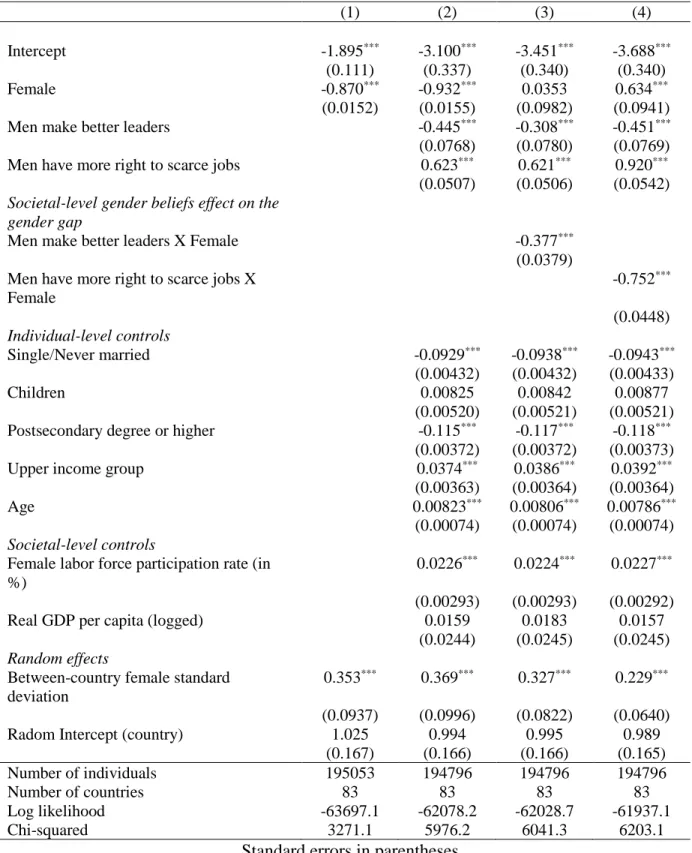
Modeling the Relationship between Societal-level Belief Factors and the Gender Gap in Early-stage Entrepreneurship
The following models test the argument that the gender gap in early-stage