MASTER OF BIOMEDICAL ENGINEERING (M-BME):
A PROPOSAL
Shiley School of Engineering
Table of Contents
Biomedical engineering is an interdisciplinary field that involves the continuous development of new technologies that span the broad field of healthcare, from managing patient information to aid decision-making, to improving diagnostic equipment to detect disease and injury, to designing therapeutic solutions to treat disease and injury.
The Masters in Biomedical Engineering (M-BME) program is a professional masters degree for students who have an undergraduate STEM degree and want to enter the fast-growing biomedical engineering industry. The target population includes current University of Portland (UP) students pursuing a 4+1 or 4+2 option consisting of an undergraduate degree in engineering, math, or science in combination with the M-BME. The program is designed so that recent non-UP graduates and early career professionals can also matriculate.
The interdisciplinary program emphasizes the broad education necessary to produce innovative solutions at the intersection of healthcare and engineering. The standard 12-month program begins in the summer with an applied internship along with two courses, and runs continuously through the fall and spring semesters with the degree conferred in May. Students without all of the prerequisites will need up to an additional two semesters plus a summer to complete the degree.
Adding a M-BME program allows UP to meet the growing national demand for biomedical engineering professionals while building the graduate offerings in the Shiley School and providing a foundation that can be used to add an accredited undergraduate program if needed in the future. A 2012 Forbes ranking lists biomedical engineering as the #1 major in the USA. Recent issues of CNN’s Fortune and Money magazine include similar rankings. The Bureau of Labor Statistics job outlook for 2012 – 2020 predicts a 62% growth rate for jobs in the biomedical engineering profession; a much higher than average rating. The most recent 10-year data from the American Society of Engineering Education (2002-2011) shows that biomedical engineering has grown much faster than the engineering field as a whole as measured by both undergraduate (209% versus 24%) and masters (139% versus 51%) degrees granted. Finally, biomedical engineering programs represent the largest growth in newly accredited (ABET) engineering programs in recent years.
The M-BME program fits with the mission of UP (Appendix A) and the Shiley School (Appendix B), along with UP’s most recent strategic plan. Further, the M-BME program honors Mr. Donald P. Shiley ’51, for whom the School is named, as a pioneer in the biomedical engineering profession. No university in Oregon currently offers a masters degree (traditional or professional) in biomedical engineering and no university in the Pacific Northwest offers a professional masters degree in biomedical engineering. UP can fill that market need while further strengthening its leadership position in the healthcare industry.
A University-wide ad-hoc committee of faculty and staff met (approximately monthly) during the 2012-2013 AY to develop an “ideal” curriculum for the program. The committee met with an industry advisory board (IAB) in March 2013 to present a first draft of the curriculum and receive feedback that was used to revise the curriculum. Further discussions were held between the deans of the participating units, the Provost, and various department/program chairs to adjust the curriculum to meet financial constraints. Final discussions were held amongst the Shiley School faculty who voted to move the proposal to CAR with support from the School. The vote tally was 12 in favor, 4 against, with 6 abstaining. The Dean did not vote.
The IAB meeting (March 2013) along with surveys of current students (April 2013) indicates that the regional market for a M-BME is sound. The publicity strategy includes a) traditional marketing techniques to universities throughout the US, b) marketing via the Graduate School’s consulting arrangement, c) marketing to current UP students as a 4+1 (or 4+2 for non engineering STEM students) program, and d) marketing to incoming freshmen as a 4+1 (or 4+2 program) via the admissions process.
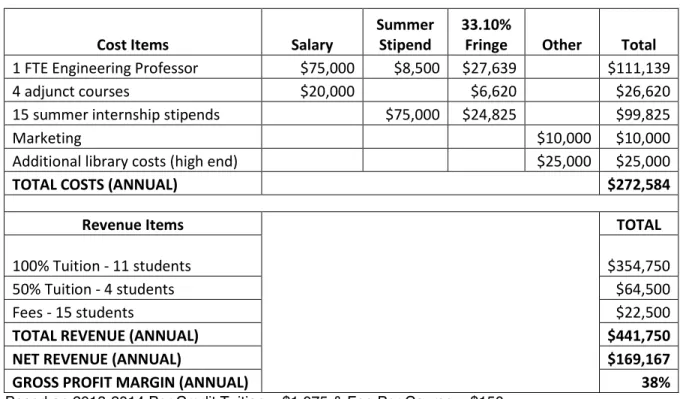
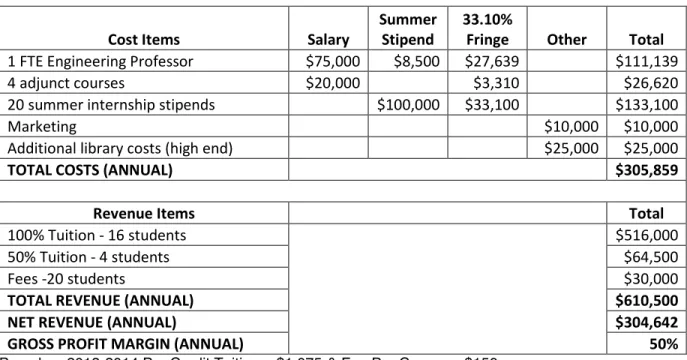
The program is designed to sustain the quality of the undergraduate programs while being revenue positive. Tuition revenue covers programming expenses and faculty needs, generates revenue for UP, and brings new resources to the School and University. Financial projections based on cohorts of 15 and 20 produce gross profit margins of 38%, and 50% respectively. The breakeven cohort size is nine students as shown in the table below.
Break-even Analysis
Based on 2013-2014 per credit tuition = $1,075 & Fee Per Course = $150
Summer Stipend is based on 1 month salary, however a conservative estimate is used for this proposal.
It is likely that it will take a few years to achieve the desired cohort size of 15 to 20 students. The program cannot be started without the new faculty and staff positions shown in the above table. Advertising for new faculty begins a year before the faculty member starts his/her position. Marketing will also be essential to build the cohort size and the overall reputation of the program. Given that the objective is to build much of the cohort with UP STEM graduates, marketing to prospective first-year students is a key part of any overall marketing strategy. This also means that the products of that marketing will not be seen for four years from when it starts i.e., recruiting graduate students to start in summer 2018 means marketing to entering freshmen students for fall 2014. In those interim years, the cohort size is likely to be lower than the desired cohort size.
The overall risk associated with starting a new program can be minimized with a 3-year renewable visiting faculty member appointment.
A University-wide ad hoc committee of faculty and staff met (approximately monthly) during the 2012-2013 AY to develop the “ideal” curriculum for a new M-BME program. Representatives came from Chemistry, Biology, Mathematics, Mechanical Engineering, Electrical Engineering, Computer Science, and the Center for Entrepreneurship. Their work included benchmarking existing programs and discussions with relevant industry representatives. They convened an industry advisory board (IAB) meeting in March 2013 to present a first draft of the curriculum. They then addressed comments as part of the final curriculum draft produced in May 2013. The deans of the participating units, the Provost, and various department/program chairs engaged in several meetings to adjust the draft curriculum to meet expected financial resources. In addition, the Dean of Engineering’s Office surveyed various student cohorts in April 2013 regarding their interest in such a program. We supplemented this information with other indicators of market need. Final discussions were held amongst the Shiley School faculty who voted to move the proposal to CAR with support from the School. The vote tally was 12 in favor, 4 against, with 6 abstaining. The Dean did not vote. We describe the resulting program design in Part 1. In Part 2, we describe the implementation logistics. Part 3 includes the financial analysis.
The M-BME program is a professional masters degree for students who have an undergraduate STEM degree and want to enter the evolving and fast-growing biomedical engineering industry. The standard 12-month program begins in the summer with two courses and an applied internship, and runs
continuously through the fall and spring semesters with the degree conferred in May. Students who do not have some of the prerequisite courses will need up to two additional semesters plus a summer to complete the degree. The interdisciplinary program emphasizes innovation and the broad education necessary to be leaders in an industry that lies at the intersection of healthcare and engineering. The standard program cost for each student based on 2013-2014 graduate school tuition and fees is $32,250. Students also have costs for housing, books, travel, and miscellaneous items. In turn, they each receive a $5,000 summer internship stipend as part of the program.
Adding the M-BME program will allow the University of Portland (UP) to meet the growing interest in biomedical engineering while building the graduate offerings in the Shiley School and providing a
foundation that can be used to add an accredited undergraduate program in this area if needed at a later time. The M-BME program fits with the mission of UP and with the most recent strategic plan that calls for growth in the graduate offerings from the Shiley School. Further, the M-BME program honors Mr. Donald P. Shiley ’51, for whom the School is named, as a pioneer in the biomedical engineering profession. A 2012 Forbes ranking includes biomedical engineering as the #1 major in the USA. Recent issues of CNN’s Fortune and Money magazine include similar rankings. The Bureau of Labor Statistics job outlook for 2012 – 2020 predicts a 62% growth rate for jobs in the biomedical engineering profession; a much higher than average rating. The most recent 10-year data from the American Society for Engineering Education (2002-2011) shows that biomedical engineering has grown much faster than the engineering field as a whole as measured by both undergraduate (209% versus 24%) and masters (139% versus 51%) degrees granted. Finally, biomedical engineering programs represent the largest growth in newly accredited (ABET) engineering programs in recent years.
Anecdotally, the Admissions Office and the Shiley School are receiving increasing numbers of inquiries about a biomedical engineering option. UP does not currently offer a similar degree although high-performing BS graduates in mechanical engineering, electrical engineering, computer science, and several of the science and math majors can enter biomedical engineering graduate programs at other institutions. Table 1 shows that regional competitors such as University of Santa Clara, Washington State University, Oregon State University, and University of Washington currently offer undergraduate degrees in biomedical engineering, or closely related fields.
Table 1. Regional Undergraduate Competitors with Biomedical Engineering BS (Masters Programs indicated if applicable)
Institution Degree 2012 Graduates (ASEE)
University of Santa Clara BS Bioengineering 21
University of Santa Clara MS Bioengineering Started fall 2012 (traditional MS degree)
Washington State University BS Bioengineering 10
Oregon State University BS Bioengineering 20
University of Washington BS Bioengineering 46
University of Washington MS Bioengineering/Master of Medical Engineering
22 combined; MME stopped in 2012
Note: Biomedical engineering is a subset of bioengineering, however all of the programs listed above are more similar to biomedical engineering than other disciplines.
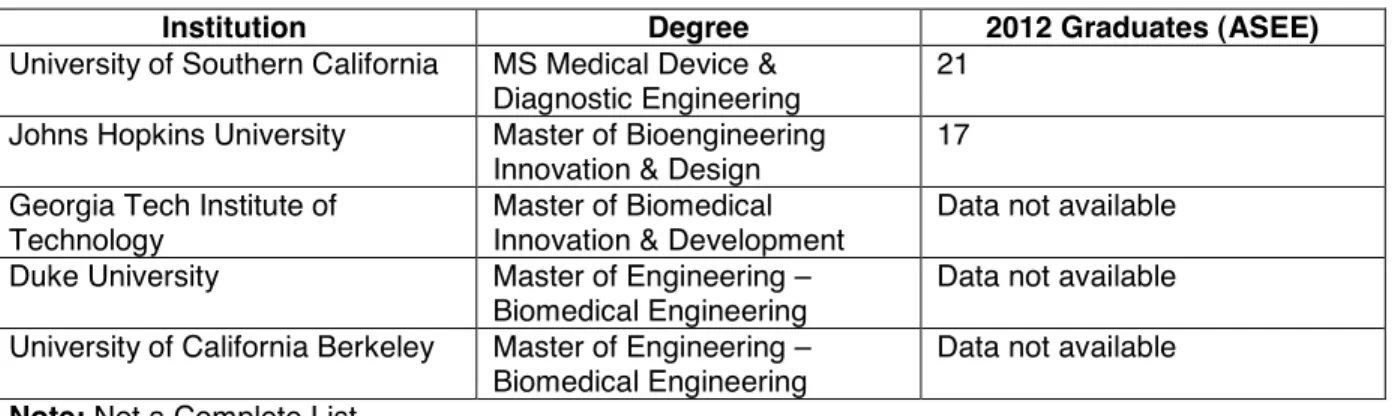
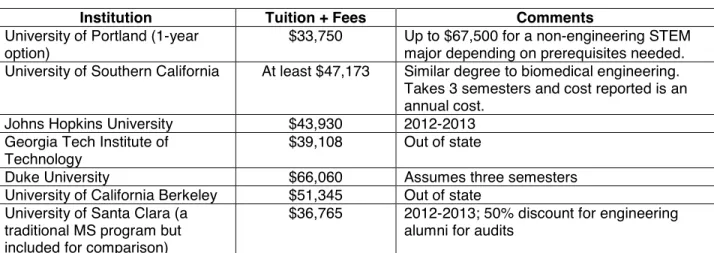
No university in Oregon currently offers a masters degree (traditional or professional) in biomedical engineering. UP can fill that market need while further strengthening its leadership position in the healthcare industry. OHSU offers a small Ph.D. program in biomedical engineering with no interest in adding a masters program at this time (Conversation, August 13th 2012). The University of Washington offers a traditional MS Bioengineering option. And, University of Santa Clara started a traditional MS in Bioengineering in Fall 2012 with a focus on biomolecular engineering and medical devices. Table 2 shows the professional masters degree options at four of the top ten ranked biomedical engineering graduate programs in the USA: Georgia Tech, Johns Hopkins, Duke University, and UC Berkeley, along with a similar program at USC given its proximity to UP. These five professional programs are year-long (or three semesters) cross-disciplinary programs that provide a broad preparation in engineering, science and innovation relevant for the healthcare profession. More details about these programs can be found in Appendix C.
Table 2. National Competitors with Biomedical Engineering Professional Masters Programs
Institution Degree 2012 Graduates (ASEE)
University of Southern California MS Medical Device & Diagnostic Engineering
21 Johns Hopkins University Master of Bioengineering
Innovation & Design
17 Georgia Tech Institute of
Technology
Master of Biomedical Innovation & Development
Data not available
Duke University Master of Engineering –
Biomedical Engineering
Data not available University of California Berkeley Master of Engineering –
Biomedical Engineering
Data not available
Note: Not a Complete List.
Table 1 shows that the University of Washington graduated 22 students with biomedical engineering masters degrees in 2012. The 2013 Petersen’s Guide for Graduate Programs reports that the acceptance rate for the biomedical engineering graduate program at University of Washington is 17%. Although this acceptance rate includes both masters and doctoral candidates, there are similar student numbers for both programs indicating that there is more interest from applicants for masters in biomedical engineering programs than can be met with the supply in the Pacific Northwest.
A 2013 spring survey of UP engineering seniors shows that 16 students would stay at UP for a 4+1 BME masters degree. A similar 2013 survey of UP engineering freshmen shows that 24 would stay at UP for a
4+1 BME masters degree. No information is available for other UP STEM majors. We suggest that if the 4+1 option is included in undergraduate recruiting information for STEM majors, these numbers will be higher. In addition, targeted recruiting at the graduate level should attract non-UP undergraduates to the major. In the longer term, there is the potential to offer a hybrid version of the degree that can reach a larger geographical region.
Biomedical engineering is an interdisciplinary field that involves the continuous development of new technologies that span the broad field of healthcare from managing patient information to aid decision-making, to improving diagnostic equipment to detect disease and injury, to designing therapeutic solutions to treat disease and injury. Biomedical engineering is a field that directly impacts the quality of human life and by necessity, requires engineering professionals who are innovative, ethical, and sensitive to the business of healthcare delivery. In other words, it is a field where the UP guiding principles of
“head, heart, and hands” are central to preparing leaders who can make a difference.
The overall philosophy for the UP M-BME is to build on UP’s existing strengths while adding targeted resources that result in a distinctive program with the following goals:
• Address the current interest among prospective students.
• Be accessible for a broad range of undergraduate STEM majors.
• Produce graduates who can immediately contribute to product development and technology innovation.
• Produce graduates who become recognized leaders in the industry and community.
The target population for this cohort-based degree is early career technical professionals who want a practice-oriented terminal degree. Early career refers to students who pursue the degree between 0 to 5 years after finishing their undergraduate degree. The pedagogical range for the cohort size is 15 to 20 students. The cohort is comprised as follows:
Engineering students complete the prerequisites as undergraduates and join the graduate student cohort after graduation with the BS degree. In other words, they begin the program with the summer internship and graduate the following May. Current UP engineering majors apply after their sophomore year and are accepted during fall semester junior year so that they can complete the necessary prerequisites with their electives in the remaining three semesters. Engineering majors from universities other than UP need to complete the prerequisites before starting the program. The prerequisites are typically offered during the two UP summer sessions. As such, these students begin the graduate program in the fall semester and graduate the following August.
Non-engineering STEM students complete a maximum of one prerequisite year after graduation and then join a graduate student cohort beginning with either the summer internship, or the fall semester, with graduation in the following May or August accordingly. The prerequisite year is completed as part of a two-year graduate degree option for these students. However, non-engineering STEM students can apply to the graduate program after their sophomore year with acceptance in the fall of the junior year. This timing allows these students to use their electives to complete many of the prerequisites before graduation with their BS degree.
The student outcomes for all students in the M-BME program are as follows: 1. Students practice real-world experiential learning.
2. Students are skilled in the broad technical field of biomedical engineering including biomaterials, biomechanics, and bioinstrumentation.
3. Students understand the business and patient care aspects of the healthcare industry. 4. Students can holistically analyze complex biomedical engineering issues.
As stated, biomedical engineering is an interdisciplinary field. Prerequisite courses (or their equivalents) for the major are necessary to provide the mathematics, science, and engineering foundation to
successfully complete the core courses in the M-BME curriculum. The core courses and overall program design is modeled after the leading professional masters degrees at Georgia Tech, Johns Hopkins, Duke, and Berkeley while using the existing strengths at UP. Although we have no intention at this time1 to accredit the graduate degree, the degree is designed in keeping with the ABET accreditation criteria specific to biomedical engineering issued by the Biomedical Engineering Society as follows:
The structure of the curriculum must provide both breadth and depth across the range of engineering topics implied by the title of the program. The program must prepare graduates to have: an understanding of biology and physiology, and the capability to apply advanced
mathematics (including differential equations and statistics), science, and engineering to solve the problems at the interface of engineering and biology; the curriculum must prepare graduates with the ability to make measurements on and interpret data from living systems, addressing the problems associated with the interaction between living and non-living materials and systems. [2013-2014]
In addition, the overall M-BME program, including prerequisites, is designed to be a broad degree that does not give a significant preference to mechanical engineering versus electrical engineering
undergraduate students at UP. The reason for this design aspect is that there is already an imbalance between these two undergraduate majors at UP in terms of student enrollment that causes resource strain on faculty, staff, and facilities. Further imbalance is undesirable.
The prerequisites for the M-BME include the following courses and their equivalents:
• MATH 201 Calculus I
• MATH 202 Calculus II
• MATH 321 Ordinary Differential Equations
• A Statistics course
• BIO 207/277 Cell Biology
• CHM 207/271 General Chemistry I
• PHY 204/274 General Physics Lecture & Laboratory
• PHY 205/275 General Physics Lecture & Laboratory
• A computer programming course
• EGR 211 Engineering Mechanics: Statics
• EGR 212 or 213 or 214 Engineering Mechanics: Dynamics
• EE 261/271 Electrical Circuits
• EE 262 Signals & Systems
• EE 351 Electronics 1 - strongly recommended
The core curriculum for the M-BME includes nine required courses with detailed descriptions in Appendix D. The four courses indicated by a * are not currently offered at UP, BME 561 is currently taught by an adjunct, and BME/BUS 551 is currently offered every other year by an adjunct. In other words, six of the nine required courses need additional resources. In addition, the undergraduate version of BME 562 (BME 462) is a very popular elective.
• BME 550 Anatomy & Physiology for Biomedical Engineers – 3 credits*
• BME/BUS 551 Introduction to Health Care Management– 3 credits
• BME 555 Design of Biomedical Experiments – 3 credits*
• BME 561 Biomaterials – 3 credits
• BME 562 Biomechanics – 3 credits
• BME 563/EE 562 Digital Signal Processing – 3 credits
• BME 564 Biomedical Instrumentation & Computer Interfaces – 3 credits*
• BME/BUS 578 Management of Technology Ventures – 3 credits
• BME 580 Biomedical Engineering & Society Capstone - 3 credits* The requirements for the M-BME also include the following:
• 1 Restricted Elective
• Applied Internship2 - no credit
• If a student has completed any of the core curriculum courses prior to matriculation, he/she must complete the equivalent number of credits with Restricted Electives.
Available restricted electives that are currently taught3 at UP include the courses below. While these courses are sufficient to offer the major, it is desirable to offer several additional restricted electives that focus on biomedical engineering, however this depends on the resources and interest in the relevant programs (Chemistry, Physics, Math, Biology, and the Shiley School).4
• CS 521 Artificial Intelligence (F)
• CS 523 Computational Biology (F)
• CS 534 Database Management Systems (F)
• EE 504 Automatic Control Systems (F)
• EE 533 Microprocessor Interfacing and Communications (S)
• EE 538 Introduction to Digital VLSI Design (S)
• EE 551 Advanced Analog Electronics (F)
• EE 563 Real-time Digital Signal Processing (F)
• ME 521 Failure Analysis (F)
• ME 522 Composite Materials (S)
• ME 543 Systems & Measurements (F)
• ME 553 Mechanical Vibrations (S)
As stated, all students complete an applied biomedical engineering internship that provides experiential learning for students that carries through their coursework. All students also complete a 3-credit
biomedical engineering and society capstone course. This capstone allows each student to evaluate various complex multi-disciplinary projects from “bench-scale to bedside.” This projects course provides the holistic capstone experience for the graduate students. Appendix D includes more details.
Appendix E includes sample schedules for the student cohorts.
The program does not overlap with any of the current offerings at UP. Instead it builds on several existing strengths.
Assuming that resources are received for the new courses, the M-BME program has several possible impacts listed below along with suggested mitigation measures.
• All existing courses that are required courses in the M-BME will need to be cross listed with new course numbers created.
• BME/BUS 551 Introduction to Health Care Management is an existing course (BUS designation) in the MBA program, however it is only offered every other year with an adjunct. As a required course in
the M-BME program, this course will need to be offered every year. Budget is needed for this adjunct expense. A M-BME cohort of 15 students will require one section because only a small number of MBA students take that course.• BME/BUS 578 Management of Technology Ventures is an existing course (BUS designation) offered primarily for the Technology Entrepreneurship Certificate. Based on conversations with the Dean of the Pamplin School (May 2013) and the Director for the Center of Entrepreneurship (June 2013), the course can accommodate a M-BME cohort of 15 students.
• BME 561 & BME 562 (Biomaterials and Biomechanics) are currently offered at the 400-level as electives for our undergraduate students (primarily ME majors). Biomechanics is a very popular elective and Biomaterials has been in select years, however these courses will be required for the M-BME program and graduate students will have priority. With a 15-student cohort, some
undergraduate interest should be accommodated, however a negative impact is possible. In addition, as the M-BME program grows, the 400-level of these courses may be phased out with the creation of a 400-level Introduction to Biomedical Engineering elective course for undergraduate students to offset the loss.
• BME 563/EE 562 (Digital Signal Processing) is currently offered as a cross-listed undergraduate elective and graduate course in the EE Program. The historic course enrollment has been low and there is capacity for up to 20 additional graduate students. There may need to be some renumbering of courses for better alignment.
• The M-BME students will complete one Restricted Elective (and possibly some more depending on their undergraduate preparation). The current courses available as Restricted Electives are dual listed as electives for the undergraduate engineering majors, in particular CS, EE, and ME majors.
However, none of these electives is currently at capacity, therefore this should not cause an impact particularly if students spread out among the courses. That said, several of these courses are traditionally offered in the fall semester whereas the M-BME Restricted Elective is scheduled for the spring semester. As such, some scheduling changes will be needed based on demand.
• In terms of the prerequisite courses, several may be affected by increased enrollment due to interest in the M-BME from current students. The courses that may be affected and are already at, or over capacity include BIO 207/277, EGR 211, EGR 212 or 213 or 214, and EE 261/271. The
computer science, math, and physics courses may also be affected if large numbers of BA/BS Biology majors decide to pursue the M-BME, however this is not expected.5 Fortunately, all of the courses that may be affected are routinely offered in the summer sessions and this should minimize the impact. We also include adjunct support in the M-BME budget for an additional section of BIO 207/277 since undergraduate engineering students who are interested in the M-BME program will need to take that course as their science elective. Note, that many engineering students already take this course as their required science elective.
Based on the requirements, the program is directly supported by faculty members in Engineering and Business as follows:
• Engineering faculty are needed to teach seven of the required courses – BME 550, BME 555, BME 561, BME 562, BME 563, BME 564, and BME 580. The Shiley School has one biomedical
engineering faculty member (assistant professor) who currently teaches BME 562, but primarily supports the ME undergraduate program. BME 561 is taught by an adjunct. BME 563 (or EE 562) is currently taught by an electrical engineering professor in the Shiley School. The remaining four courses are new courses. Given the different expertise needs and the additional courses, one new engineering faculty member and one adjunct-course load is needed. The course requirements will be split among the new faculty member, the existing faculty member, and the adjunct based on expertise to be determined during the hiring process. Both FTE faculty members will also teach undergraduate courses to ensure that they are fully integrated into the Shiley School.
• Business faculty are needed to teach BME 551 and BME 578
o BME 551 will need to be increased to one section per year depending on cohort size. It is currently taught by an adjunct.
o There are no impacts to BME 578. It is taught by current Business faculty and the Director for the Center for Entrepreneurship every summer and the course has capacity for a 15 to 20-student cohort.
• The remaining course is a Restricted Elective chosen from current offerings that for the most part have capacity. No additional resources are needed at this time.
• The Shiley School of Engineering is at, or over capacity in terms of faculty resources due to recent enrollment increases that show no sign of stopping.
Given the need for an additional faculty member and the risk of starting a new program such as the M-BME, we propose hiring one visiting faculty member in Engineering as well as using three adjunct course loads for an initial three-year period. The three-year period provides time to determine if the program is financially sustainable. In addition, we propose adding one adjunct course load to Biology based on the demand for the prerequisite BIO 207/277.
This Program will not be successful without administrative support for the following activities:
• Academic program coordination given the interdisciplinary nature of the program that directly includes the Shiley School and the Pamplin School and primarily affects majors in both the Shiley School and the College of Arts and Sciences. Coordination includes regular faculty meetings, monitoring
developments in the discipline, faculty hiring and evaluations including adjuncts, course scheduling, etc.
• Program publicity and marketing since this is a new offering for the Shiley School that is not known for its graduate programs. This includes marketing both internally and externally.
• Admissions process including selecting an optimal cohort with many accepted during their junior year at UP, communicating with the cohort regarding prerequisite courses etc., selecting students for assistantships, etc.
• Internship coordination including maintaining partnerships, matching students and internships, evaluating the internships, etc.
• Assessment of student outcomes.
• Overall program evaluation.
Although the Shiley School currently offers a Master of Engineering program, the program has been extremely under-enrolled to date due to a number of factors. As such, the Shiley School does not have an
associate dean for graduate programs, nor any dedicated staff for graduate programs. To administer a successful M-BME program, the following minimum support is needed:• One course release & summer stipend for the M-BME Program Chair who is a faculty member in the program. The course release is similar to that for the Chairs of the existing engineering programs. The summer stipend should be the equivalent of one month of salary given the logistical needs for orientation for the new cohort plus the internships.
• When the enrollment reaches the 15-student cohort on an annual basis, a 0.5 FTE administrative assistant (A2) to take care of all of the logistics listed above under the direction of the Program Chair. The Shiley School will also establish a standing Oversight Committee that continually assesses the Program in the first three years to ensure that School resources are being effectively used and that students are being effectively served. In addition, the Dean will act as Program Chair for the first three years since both of the main faculty members for the Program are not tenured faculty at this time. Note that if UP develops other graduate programs of a similar size in the Shiley School, an associate dean for graduate programs will be necessary.
The IAB meeting and surveys of current students (April 2013) indicate that the market for the program is sound. The publicity strategy includes a) traditional marketing techniques to non UP students via posters and brochures to universities throughout the US, b) marketing to non UP students via the Graduate School’s consulting arrangement, c) marketing to current UP students via brochures and information sessions, and c) marketing to incoming first year students via the admissions process including targeted brochures and electronic media.
The program is cohort-based and current UP STEM students will apply during the first semester of the junior year and have first priority for the program. Remaining spots are then awarded on a competitive basis to non-UP students. This system allows us to adjust the marketing strategy as needed from year to year to fill the cohort.
Given that UP does not have a significant biomedical engineering presence and that the Shiley School is not known for strong graduate programs, it is important to attract a core group of academically talented students to the M-BME program particularly in the early years. As such, the marketing strategy includes four teaching and research assistantships, each with a 50% tuition discount.
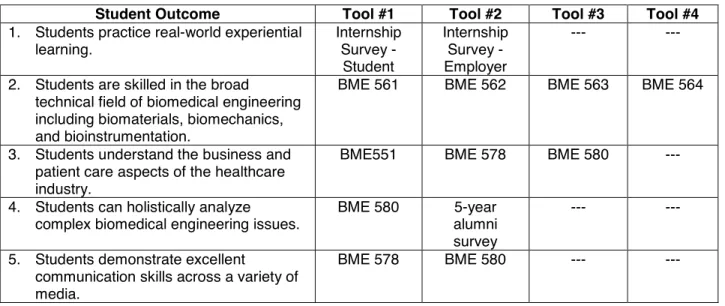
We will assess each of the five student outcomes using a minimum of two tools. Benchmark courses will include course-embedded assessment as a direct assessment tool. We will also use annual internship surveys; an indirect assessment tool. Table 3 shows the mapping of assessment tools to the five student outcomes.
Table 3. Mapping of Assessment Tools to Student Outcomes
Student Outcome Tool #1 Tool #2 Tool #3 Tool #4
1. Students practice real-world experiential learning. Internship Survey - Student Internship Survey - Employer --- ---
2. Students are skilled in the broad
technical field of biomedical engineering including biomaterials, biomechanics, and bioinstrumentation.
BME 561 BME 562 BME 563 BME 564
3. Students understand the business and patient care aspects of the healthcare industry.
BME551 BME 578 BME 580 ---
4. Students can holistically analyze
complex biomedical engineering issues.
BME 580 5-year
alumni survey
--- ---
5. Students demonstrate excellent
communication skills across a variety of media.
BME 578 BME 580 --- ---
Overall assessment of the program is critical since this is a very new effort for the Shiley School and for UP and we are relying on a visiting professor for the initial startup with the intent that the Program can support the funding needs. Table 4 shows how each of the program goals will be assessed.
Table 4. Program Goals Assessment
Program Goal Metric Timeline
Address the current interest among prospective students.
At least 10 UP undergraduate students continue for the
M-BME degree
Annually starting with the BS Class of 2018. Be accessible for a broad range of
undergraduate STEM majors.
Of the M-BME cohort, at least 20% are non-engineering
STEM majors
Annually starting with the BS Class of 2018. Produce graduates who can immediately
contribute to product development and technology innovation.
At least 90% of M-BME graduates are placed with relevant companies within 6
months of graduation
Annually starting with the M-BME graduating Class
of 2016. Produce graduates who become recognized
leaders in the industry and community.
Qualitative based on alumni surveys and news reports.
Annually starting in 2021.
Below is a summary of the various needs along with a financial analysis.
• 1 FTE professor in engineering (at the assistant professor level).
• 1 month faculty summer stipend plus benefits.
• 4 adjunct courses.
• Depending on program growth, an additional FTE in either engineering or biology may be added to replace several of the adjuncts and to add additional and more focused electives, however this is not part of the proposal at this time.
• Four student assistantships for either research, or teaching that are awarded competitively and each provides a 50% tuition grant. This represents less revenue from the program.
• While some internships may be supported by the internship company, it is prudent to plan to support all of the internships as part of the M-BME program. Estimating $5,000 per internship, and a 15 to 20 student cohort, the funding need is $75,000 to $100,000 per year.
• Ideally, the graduate students will have space that is conducive to teamwork and innovation, however this space is currently not available. Instead, we will make “creative” use of the Shiley Hall
laboratories with the addition of cabinets, etc. as needed.
• The M-BME program does not require traditional laboratories or project courses other than the Capstone course. The experiential portion is primarily gained from the internships along with laboratories embedded in the courses. That said, there will be some demands on the technical support staff from students and faculty, particularly for the Capstone course. This demand will not require additional staff.
• At least 4 additional courses offered in the academic year (two each semester) during the 8:00 am to 5:00 pm time frame. The Shiley School is currently close to, or over classroom quota at every time slot during that time frame. Since the M-BME cohort is separate from the undergraduate student cohort, attempts will be made to schedule these additional courses in time slots that have remaining capacity.
• Other courses are currently offered, will be offered in the evening, or will be offered in the summer.
• The new faculty member will need an office. There is currently one vacant faculty office in Shiley Hall that can be used.
• Once enrollment increases to at least 15 students, a part-time administrative staff person will be needed along with the associated office space. No additional office space is available in Shiley Hall, however the M-BME staff member will likely share office space with another administrative staff member. Note that these requests are not part of this proposal at this time.
• The new faculty member for the M-BME program may need additional equipment to support his/her scholarship and courses. These needs are hard to estimate at this time. Foundation and grant support may be funding sources. Hiring visiting faculty for the start-up of the program provides time to pursue such funding opportunities, therefore an estimate is not included.
The support letter from the Library is included with this proposal. As indicated in the letter, an additional $20,000 to $25,000 is needed to acquire the depth of resources needed to support the degree. The higher amount is used for the financial analysis.
A marketing budget is needed to advertise the program nationally to students and regionally to employers and other internship partners. The estimated annual need is $10,000.
Tables 5, 6, and 7 show the financial analysis for cohorts of 15, 20, and an approximate breakeven cohort size of nine students. Table 8 shows a comparison of the degree cost for each student who does not have an assistantship. All analyses are based on the 2013-2014 graduate tuition and fees.
Table 5.0 Financial Analysis for a 15-Student Cohort
Based on 2013-2014 Per Credit Tuition = $1,075 & Fee Per Course = $150
Table 6.0 Financial Analysis for a 20-Student Cohort
Based on 2013-2014 Per Credit Tuition = $1,075 & Fee Per Course = $150
Summer Stipend is based on 1 month salary, however a conservative estimate is used for this proposal.
Table 7.0 Break-even Analysis
Based on 2013-2014 Per Credit Tuition = $1,075 & Fee Per Course = $150
Summer Stipend is based on 1 month salary, however a conservative estimate is used for this proposal.
Table 8.0 Comparison of 2013-2014 Tuition & Fees for Professional Biomedical Engineering Masters Programs
Institution Tuition + Fees Comments
University of Portland (1-year option)
$33,750 Up to $67,500 for a non-engineering STEM major depending on prerequisites needed. University of Southern California At least $47,173 Similar degree to biomedical engineering.
Takes 3 semesters and cost reported is an annual cost.
Johns Hopkins University $43,930 2012-2013
Georgia Tech Institute of Technology
$39,108 Out of state
Duke University $66,060 Assumes three semesters
University of California Berkeley $51,345 Out of state University of Santa Clara (a
traditional MS program but included for comparison)
$36,765 2012-2013; 50% discount for engineering alumni for audits
* Typically non-engineering undergraduates cannot complete a professional masters degree in engineering at the other institutions without several prerequisites.
The University of Portland, an independently governed Catholic university guided by the Congregation of Holy Cross, addresses significant questions of human concern through disciplinary and interdisciplinary studies of the arts, sciences, and humanities and through studies in majors and professional programs at the undergraduate and graduate levels. As a diverse community of scholars dedicated to excellence and innovation, we pursue teaching and learning, faith and formation, service and leadership in the
classroom, residence halls, and the world. Because we value the development of the whole person, the University honors faith and reason as ways of knowing, promotes ethical reflection, and prepares people who respond to the needs of the world and its human family.
To provide the best possible education to its students, thus enabling the students to become competent practicing engineers and computer scientists. The programs also provide a base for both graduate study and lifelong learning in support of evolving career objectives. These objectives include being informed, effective, and responsible participants in the engineering profession and society. The School endeavors to develop qualities that are essential for the practice of engineering and beneficial service to the community. These qualities include a knowledge of engineering principles, the ability to apply those principles to solve problems, and the development of professional, personal, and social values.