This document is scheduled to be published in the Federal Register on 04/25/2016 and available online at
http://federalregister.gov/a/2016-09399, and on FDsys.gov CMS-1645-P
DEPARTMENT OF HEALTH AND HUMAN SERVICES Centers for Medicare & Medicaid Services
CMS-1645-P RIN 0938-AS75
Medicare Program; Prospective Payment System and Consolidated Billing for Skilled Nursing Facilities Proposed Rule for FY 2017, SNF Value-Based Purchasing Program, SNF Quality Reporting Program, and SNF Payment Models Research
AGENCY: Centers for Medicare & Medicaid Services (CMS), HHS.
ACTION: Proposed rule.
SUMMARY: This proposed rule would update the payment rates used under the prospective payment system (PPS) for skilled nursing facilities (SNFs) for fiscal year (FY) 2017. In
addition, it includes a proposal to specify a potentially preventable readmission measure for the Skilled Nursing Facility Value-Based Purchasing Program (SNF VBP), and other proposals for that program aimed at implementing value-based purchasing for SNFs. Additionally, this proposed rule proposes additional polices and measures in the Skilled Nursing Facility Quality Reporting Program (SNF QRP). This proposed rule also includes an update on the SNF Payment Models Research (PMR) project.
DATES: To be assured consideration, comments must be received at one of the addresses provided below, no later than 5 p.m. on June 20, 2016.
ADDRESSES: In commenting, please refer to file code CMS-1645-P. Because of staff and resource limitations, we cannot accept comments by facsimile (FAX) transmission.
You may submit comments in one of four ways (please choose only one of the ways listed):
http://www.regulations.gov. Within the search bar, enter the Regulation Identifier Number associated with this regulation, 0938-AS44, and then click on the “Comment Now” box
2. By regular mail. You may mail written comments to the following address ONLY: Centers for Medicare & Medicaid Services,
Department of Health and Human Services, Attention: CMS-1645-P,
P.O. Box 8016,
Baltimore, MD 21244-8016.
Please allow sufficient time for mailed comments to be received before the close of the comment period.
3. By express or overnight mail. You may send written comments to the following address ONLY:
Centers for Medicare & Medicaid Services, Department of Health and Human Services, Attention: CMS-1645-P,
Mail Stop C4-26-05, 7500 Security Boulevard, Baltimore, MD 21244-1850.
4. By hand or courier. If you prefer, you may deliver (by hand or courier) your written comments before the close of the comment period to either of the following addresses:
a. Centers for Medicare & Medicaid Services Department of Health and Human Services Room 445-G, Hubert H. Humphrey Building, 200 Independence Avenue, S.W.,
(Because access to the interior of the Hubert H. Humphrey Building is not readily available to persons without Federal Government identification, commenters are encouraged to leave their comments in the CMS drop slots located in the main lobby of the building. A stamp-in clock is available for persons wishstamp-ing to retastamp-in a proof of filstamp-ing by stampstamp-ing stamp-in and retastamp-instamp-ing an extra copy of the comments being filed.)
b. Centers for Medicare & Medicaid Services Department of Health and Human Services 7500 Security Boulevard,
Baltimore, MD 21244-1850
If you intend to deliver your comments to the Baltimore address, please call telephone number (410) 786-7195 in advance to schedule your arrival with one of our staff members.
Comments mailed to the addresses indicated as appropriate for hand or courier delivery may be delayed and received after the comment period.
For information on viewing public comments, see the beginning of the "SUPPLEMENTARY INFORMATION" section.
FOR FURTHER INFORMATION CONTACT:
Penny Gershman, (410) 786-6643, for information related to SNF PPS clinical issues.
John Kane, (410) 786-0557, for information related to the development of the payment rates and case-mix indexes.
Kia Sidbury, (410) 786-7816, for information related to the wage index.
Bill Ullman, (410) 786-5667, for information related to level of care determinations, consolidated billing, and general information.
Stephanie Frilling, (410) 786-4507, for information related to skilled nursing facility value-based purchasing.
reporting.
SUPPLEMENTARY INFORMATION: Inspection of Public Comments: All comments received before the close of the comment period are available for viewing by the public, including any personally identifiable or confidential business information that is included in a comment. We post all comments received before the close of the comment period on the following website as soon as possible after they have been received:
http://www.regulations.gov. Follow the search instructions on that website to view public comments.
Comments received timely will also be available for public inspection as they are received, generally beginning approximately 3 weeks after publication of a document, at the headquarters of the Centers for Medicare & Medicaid Services, 7500 Security Boulevard, Baltimore, Maryland 21244, Monday through Friday of each week from 8:30 a.m. to 4 p.m. To schedule an appointment to view public comments, phone 1-800-743-3951.
Availability of Certain Tables Exclusively Through the Internet on the CMS Website
As discussed in the FY 2016 SNF PPS final rule (80 FR 46390), tables setting forth the Wage Index for Urban Areas Based on CBSA Labor Market Areas and the Wage Index Based on CBSA Labor Market Areas for Rural Areas are no longer published in the Federal Register. Instead, these tables are available exclusively through the Internet on the CMS website. The wage index tables for this proposed rule can be accessed on the SNF PPS Wage Index home page, at
http://www.cms.gov/Medicare/Medicare-Fee-for-Service-Payment/SNFPPS/WageIndex.html.
Readers who experience any problems accessing any of these online SNF PPS wage index tables should contact Kia Sidbury at (410) 786-7816.
To assist readers in referencing sections contained in this document, we are providing the following Table of Contents.
Table of Contents
I. Executive Summary
A. Purpose
B. Summary of Major Provisions C. Summary of Cost and Benefits II. Background on SNF PPS
A. Statutory Basis and Scope
B. Initial Transition for the SNF PPS C. Required Annual Rate Updates
III. SNF PPS Rate Setting Methodology and FY 2017 Update A. Federal Base Rates
B. SNF Market Basket Update
C. Case-Mix Adjustment
D. Wage Index Adjustment
E. Adjusted Rate Computation Example IV. Additional Aspects of the SNF PPS
A. SNF Level of Care--Administrative Presumption B. Consolidated Billing
C. Payment for SNF-Level Swing-Bed Services V. Other Issues
A. Skilled Nursing Facility Value-Based Purchasing Program (SNF VBP) B. Skilled Nursing Facility (SNF) Quality Reporting Program (QRP)
C. SNF Payment Models Research
VI. Collection of Information Requirements VII. Response to Comments
VIII. Economic Analyses Regulation Text
Acronyms
In addition, because of the many terms to which we refer by acronym in this proposed rule, we are listing these abbreviations and their corresponding terms in alphabetical order below:
AIDS Acquired Immune Deficiency Syndrome
ARD Assessment reference date
BBA Balanced Budget Act of 1997, Pub. L. 105-33
BBRA Medicare, Medicaid, and SCHIP Balanced Budget Refinement Act of 1999, Pub. L. 106-113
BIPA Medicare, Medicaid, and SCHIP Benefits Improvement and Protection Act of 2000, Pub. L. 106-554
CAH Critical access hospital
CASPER Certification and Survey Provider Enhanced Reporting
CBSA Core-based statistical area
CCN CMS Certification Number
CFR Code of Federal Regulations
CMI Case-mix index
CMS Centers for Medicare & Medicaid Services
FFS Fee-for-service
FR Federal Register
FY Fiscal year
HCPCS Healthcare Common Procedure Coding System
HOQR Hospital Outpatient Quality Reporting
HRRP Hospital Readmissions Reduction Program
HVBP Hospital Value-Based Purchasing
IGI IHS (Information Handling Services) Global Insight, Inc.
IMPACT Improving Medicare Post-Acute Care Transformation Act of 2014, Pub. L. 113-185
IPPS Inpatient prospective payment system
IRF Inpatient Rehabilitation Facility
LTC Long-term care
LTCH Long-term care hospital
MAP Measures Application Partnership
MDS Minimum data set
MFP Multifactor productivity
MMA Medicare Prescription Drug, Improvement, and Modernization Act of 2003, Pub. L. 108-173
MSA Metropolitan statistical area
NF Nursing facility
NQF National Quality Forum
OMB Office of Management and Budget
PAC Post-acute care
PAMA Protecting Access to Medicare Act of 2014, Pub. L 113-93
PMR Payment Models Research
PPS Prospective Payment System
PQRS Physician Quality Reporting System
QIES ASAP Quality Improvement and Evaluation System Assessment Submission and Processing
QRP Quality Reporting Program
RAI Resident assessment instrument
RAVEN Resident assessment validation entry RFA Regulatory Flexibility Act, Pub. L. 96-354
RIA Regulatory impact analysis
RUG-III Resource Utilization Groups, Version 3 RUG-IV Resource Utilization Groups, Version 4
RUG-53 Refined 53-Group RUG-III Case-Mix Classification System SCHIP State Children's Health Insurance Program
sDTI Suspected deep tissue injuries
SNF Skilled nursing facility
SNF QRP Skill nursing facility quality reporting program
SNFRM Skilled Nursing Facility 30-Day All-Cause Readmission Measure
STM Staff time measurement
STRIVE Staff time and resource intensity verification
TEP Technical expert panel
UMRA Unfunded Mandates Reform Act, Pub. L. 104-4
VBP Value-based purchasing
I. Executive Summary
A. Purpose
This proposed rule would update the SNF prospective payment rates for FY 2017 as required under section 1888(e)(4)(E) of the Social Security Act (the Act). It would also respond to section 1888(e)(4)(H) of the Act, which requires the Secretary to provide for publication in the
Federal Register before the August 1 that precedes the start of each fiscal year (FY), certain specified information relating to the payment update (see section II.C.). This proposed rule also includes an update on the SNF PMR project. In addition, it proposes to specify a potentially preventable readmission measure for the Skilled Nursing Facility (SNF) Value-Based Purchasing (VBP) Program, and makes other proposals related to that Program’s implementation for FY 2019. We are also proposing four new quality and resource use measures for the SNF QRP and are proposing new SNF review and correction procedures for performance data that is to be publicly reported.
B. Summary of Major Provisions
In accordance with sections 1888(e)(4)(E)(ii)(IV) and 1888(e)(5) of the Act, the federal rates in this proposed rule would reflect an update to the rates that we published in the SNF PPS final rule for FY 2016 (80 FR 46390) which reflects the SNF market basket index, as adjusted by the multifactor productivity (MFP) adjustment for FY 2017. We also propose for the SNF VBP Program to specify a potentially preventable readmission measure, define performance standards, and adopt a scoring methodology, among other policies. We are also proposing to adopt and implement four new quality and resource use measures for the SNF QRP and are proposing new SNF review and correction procedures for performance data that is to be publicly reported as we continue to implement this program and meet the requirements of the IMPACT Act.
C. Summary of Cost and Benefits
Provision Description Total Transfers
Proposed FY 2017 SNF PPS payment rate update.
The overall economic impact of this proposed rule would be an estimated increase of $800 million in aggregate payments to SNFs during FY 2017.
II. Background on SNF PPS
As amended by section 4432 of the Balanced Budget Act of 1997 (BBA, Pub. L. 105-33, enacted on August 5, 1997), section 1888(e) of the Act provides for the implementation of a PPS for SNFs. This methodology uses prospective, case-mix adjusted per diem payment rates
applicable to all covered SNF services defined in section 1888(e)(2)(A) of the Act. The SNF PPS is effective for cost reporting periods beginning on or after July 1, 1998, and covers all costs of furnishing covered SNF services (routine, ancillary, and capital-related costs) other than costs associated with approved educational activities and bad debts. Under section 1888(e)(2)(A)(i) of the Act, covered SNF services include post-hospital extended care services for which benefits are provided under Part A, as well as those items and services (other than a small number of
excluded services, such as physician services) for which payment may otherwise be made under Part B and which are furnished to Medicare beneficiaries who are residents in a SNF during a covered Part A stay. A comprehensive discussion of these provisions appears in the
May 12, 1998 interim final rule (63 FR 26252). In addition, a detailed discussion of the legislative history of the SNF PPS is available online at
http://www.cms.gov/Medicare/Medicare-Fee-for-Service-Payment/SNFPPS/Downloads/Legislative_History_07302013.pdf.
Section 215(a) of PAMA added section 1888(g) to the Act requiring the Secretary to specify an all-cause all-condition hospital readmission measure and a resource use measure, an all-condition risk-adjusted potentially preventable hospital readmission measure, for the SNF setting. Additionally, section 215(b) of PAMA added section 1888(h) to the Act requiring the Secretary to implement a VBP program for SNFs. Finally, section 2(a) of the IMPACT Act added section 1899B to the Act that, among other things, requires SNFs to report standardized data for measures in specified quality and resource use domains. In addition, the IMPACT Act added section 1888(e)(6) to the Act, which requires the Secretary to implement a quality
reporting program for SNFs, which includes a requirement that SNFs report certain data to receive their full payment under the SNF PPS.
B. Initial Transition for the SNF PPS
Under sections 1888(e)(1)(A) and 1888(e)(11) of the Act, the SNF PPS included an initial, three-phase transition that blended a facility-specific rate (reflecting the individual facility’s historical cost experience) with the federal case-mix adjusted rate. The transition extended through the facility’s first 3 cost reporting periods under the PPS, up to and including the one that began in FY 2001. Thus, the SNF PPS is no longer operating under the transition, as all facilities have been paid at the full federal rate effective with cost reporting periods beginning in FY 2002. As we now base payments for SNFs entirely on the adjusted federal per diem rates, we no longer include adjustment factors under the transition related to facility-specific rates for the upcoming FY.
C. Required Annual Rate Updates
Section 1888(e)(4)(E) of the Act requires the SNF PPS payment rates to be updated annually. The most recent annual update occurred in a final rule that set forth updates to the SNF PPS payment rates for FY 2016 (80 FR 46390, August 4, 2015).
Section 1888(e)(4)(H) of the Act specifies that we provide for publication annually in the
Federal Register of the following:
● The unadjusted federal per diem rates to be applied to days of covered SNF services furnished during the upcoming FY.
● The case-mix classification system to be applied for these services during the upcoming FY.
● The factors to be applied in making the area wage adjustment for these services. Along with other revisions discussed later in this preamble, this proposed rule would provide the required annual updates to the per diem payment rates for SNFs for FY 2017.
III. SNF PPS Rate Setting Methodology and FY 2017 Update
A. Federal Base Rates
Under section 1888(e)(4) of the Act, the SNF PPS uses per diem federal payment rates based on mean SNF costs in a base year (FY 1995) updated for inflation to the first effective period of the PPS. We developed the federal payment rates using allowable costs from hospital-based and freestanding SNF cost reports for reporting periods beginning in FY 1995. The data used in developing the federal rates also incorporated a Part B add-on, which is an estimate of the amounts that, prior to the SNF PPS, would have been payable under Part B for covered SNF services furnished to individuals during the course of a covered Part A stay in a SNF.
In developing the rates for the initial period, we updated costs to the first effective year of the PPS (the 15-month period beginning July 1, 1998) using a SNF market basket index, and then standardized for geographic variations in wages and for the costs of facility differences in case mix. In compiling the database used to compute the federal payment rates, we excluded those providers that received new provider exemptions from the routine cost limits, as well as costs related to payments for exceptions to the routine cost limits. Using the formula that the BBA prescribed, we set the federal rates at a level equal to the weighted mean of freestanding costs plus 50 percent of the difference between the freestanding mean and weighted mean of all SNF costs (hospital-based and freestanding) combined. We computed and applied separately the payment rates for facilities located in urban and rural areas, and adjusted the portion of the federal rate attributable to wage-related costs by a wage index to reflect geographic variations in wages.
B. SNF Market Basket Update
1. SNF Market Basket Index
Section 1888(e)(5)(A) of the Act requires us to establish a SNF market basket index that reflects changes over time in the prices of an appropriate mix of goods and services included in
covered SNF services. Accordingly, we have developed a SNF market basket index that encompasses the most commonly used cost categories for SNF routine services, ancillary services, and capital-related expenses. We use the SNF market basket index, adjusted in the manner described below, to update the federal rates on an annual basis. In the SNF PPS final rule for FY 2014 (78 FR 47939 through 47946), we revised and rebased the market basket, which included updating the base year from FY 2004 to FY 2010.
For the FY 2017 proposed rule, the FY 2010-based SNF market basket growth rate is estimated to be 2.6 percent, which is based on the IHS Global Insight, Inc. (IGI) first quarter 2016 forecast with historical data through fourth quarter 2015. In section III.B.5. of this proposed rule, we discuss the specific application of this adjustment to the forthcoming annual update of the SNF PPS payment rates.
2. Use of the SNF Market Basket Percentage
Section 1888(e)(5)(B) of the Act defines the SNF market basket percentage as the percentage change in the SNF market basket index from the midpoint of the previous FY to the midpoint of the current FY. For the federal rates set forth in this proposed rule, we use the percentage change in the SNF market basket index to compute the update factor for FY 2017. This is based on the IGI first quarter 2016 forecast (with historical data through the fourth quarter 2015) of the FY 2017 percentage increase in the FY 2010-based SNF market basket index for routine, ancillary, and capital-related expenses, which is used to compute the update factor in this proposed rule. As discussed in sections III.B.3. and III.B.4. of this proposed rule, this market basket percentage change would be reduced by the applicable forecast error
correction (as described in §413.337(d)(2)) and by the MFP adjustment as required by section 1888(e)(5)(B)(ii) of the Act. Finally, as discussed in section II.B. of this proposed rule, we no longer compute update factors to adjust a facility-specific portion of the SNF PPS rates, because the initial three-phase transition period from facility-specific to full federal rates that started with
cost reporting periods beginning in July 1998 has expired. 3. Forecast Error Adjustment
As discussed in the June 10, 2003 supplemental proposed rule (68 FR 34768) and finalized in the August 4, 2003, final rule (68 FR 46057 through 46059), §413.337(d)(2)
provides for an adjustment to account for market basket forecast error. The initial adjustment for market basket forecast error applied to the update of the FY 2003 rate for FY 2004, and took into account the cumulative forecast error for the period from FY 2000 through FY 2002, resulting in an increase of 3.26 percent to the FY 2004 update. Subsequent adjustments in succeeding FYs take into account the forecast error from the most recently available FY for which there is final data, and apply the difference between the forecasted and actual change in the market basket when the difference exceeds a specified threshold. We originally used a 0.25 percentage point threshold for this purpose; however, for the reasons specified in the FY 2008 SNF PPS final rule (72 FR 43425, August 3, 2007), we adopted a 0.5 percentage point threshold effective for FY 2008 and subsequent FYs. As we stated in the final rule for FY 2004 that first issued the market basket forecast error adjustment (68 FR 46058, August 4, 2003), the adjustment will reflect both upward and downward adjustments, as appropriate.
For FY 2015 (the most recently available FY for which there is final data), the estimated increase in the market basket index was 2.5 percentage points, while the actual increase for FY 2015 was 2.3 percentage points, resulting in the actual increase being 0.2 percentage point lower than the estimated increase. Accordingly, as the difference between the estimated and actual amount of change in the market basket index does not exceed the 0.5 percentage point threshold, the FY 2017 market basket percentage change of 2.6 percent would be not adjusted to account for the forecast error correction. Table 1 shows the forecasted and actual market basket amounts for FY 2015.
TABLE 1: Difference Between the Forecasted and Actual Market Basket Increases for FY 2015 Index Forecasted FY 2015 Increase* Actual FY 2015 Increase** FY 2015 Difference SNF 2.5 2.3 0.2
*Published in Federal Register; based on second quarter 2014 IGI forecast (2010-based index).
**Based on the first quarter 2016 IGI forecast, with historical data through the fourth quarter 2015 (2010-based index).
4. Multifactor Productivity Adjustment
Section 3401(b) of the Affordable Care Act requires that, in FY 2012 (and in subsequent FYs), the market basket percentage under the SNF payment system as described in section 1888(e)(5)(B)(i) of the Act is to be reduced annually by the productivity adjustment described in section 1886(b)(3)(B)(xi)(II) of the Act. Section 1886(b)(3)(B)(xi)(II) of the Act, added by section 3401(a) of the Affordable Care Act, sets forth the definition of this productivity adjustment. The statute defines the productivity adjustment to be equal to the 10-year moving average of changes in annual economy-wide private nonfarm business multi-factor productivity (as projected by the Secretary for the 10-year period ending with the applicable FY, year, cost-reporting period, or other annual period) (the MFP adjustment). The Bureau of Labor Statistics (BLS) is the agency that publishes the official measure of private nonfarm business MFP. We refer readers to the BLS website athttp://www.bls.gov/mfp for the BLS historical published MFP data.
MFP is derived by subtracting the contribution of labor and capital inputs growth from output growth. The projections of the components of MFP are currently produced by IGI, a nationally recognized economic forecasting firm with which CMS contracts to forecast the components of the market baskets and MFP. To generate a forecast of MFP, IGI replicates the MFP measure calculated by the BLS, using a series of proxy variables derived from IGI’s U.S. macroeconomic models. For a discussion of the MFP projection methodology, we refer readers to the FY 2012 SNF PPS final rule (76 FR 48527 through 48529) and the FY 2016 SNF PPS
final rule (80 FR 46395). A complete description of the MFP projection methodology is
available on our website at http://www.cms.gov/Research-Statistics-Data-and-Systems/Statistics-Trends-and-Reports/MedicareProgramRatesStats/MarketBasketResearch.html.
a. Incorporating the MFP Adjustment into the Market Basket Update
Per section 1888(e)(5)(A) of the Act, the Secretary shall establish a SNF market basket index that reflects changes over time in the prices of an appropriate mix of goods and services included in covered SNF services. Section 1888(e)(5)(B)(ii) of the Act, added by section 3401(b) of the Affordable Care Act, requires that for FY 2012 and each subsequent FY, after determining the market basket percentage described in section 1888(e)(5)(B)(i) of the Act, the Secretary shall reduce such percentage by the productivity adjustment described in section 1886(b)(3)(B)(xi)(II) (which we refer to as the MFP adjustment). Section 1888(e)(5)(B)(ii) of the Act further states that the reduction of the market basket percentage by the MFP adjustment may result in the market basket percentage being less than zero for a FY, and may result in payment rates under section 1888(e) of the Act for a FY being less than such payment rates for the preceding FY. Thus, if the application of the MFP adjustment to the market basket
percentage calculated under section 1888(e)(5)(B)(i) of the Act results in an MFP-adjusted market basket percentage that is less than zero, then the annual update to the unadjusted federal per diem rates under section 1888(e)(4)(E)(ii) of the Act would be negative, and such rates would decrease relative to the prior FY.
For the FY 2017 update, the MFP adjustment is calculated as the 10-year moving average of changes in MFP for the period ending September 30, 2017, which is 0.5 percent. Consistent with section 1888(e)(5)(B)(i) of the Act and §413.337(d)(2) of the regulations, the market basket percentage for FY 2017 for the SNF PPS is based on IGI’s first quarter 2016 forecast of the SNF market basket update, which is estimated to be 2.6 percent. In accordance with section
§413.337(d)(3), this market basket percentage is then reduced by the MFP adjustment (the 10-year moving average of changes in MFP for the period ending September 30, 2017) of 0.5 percent, which is calculated as described above and based on IGI’sfirst quarter 2016 forecast. The resulting MFP-adjusted SNF market basket update is equal to 2.1 percent, or 2.6 percent less 0.5 percentage point.
5. Market Basket Update Factor for FY 2017
Sections 1888(e)(4)(E)(ii)(IV) and 1888(e)(5)(i) of the Act require that the update factor used to establish the FY 2017 unadjusted federal rates be at a level equal to the market basket index percentage change. Accordingly, we determined the total growth from the average market basket level for the period of October 1, 2015 through September 30, 2016 to the average market basket level for the period of October 1, 2016 through September 30, 2017. This process yields a percentage change in the market basket of 2.6 percent.
As further explained in section III.B.3. of this proposed rule, as applicable, we adjust the market basket percentage change by the forecast error from the most recently available FY for which there is final data and apply this adjustment whenever the difference between the forecasted and actual percentage change in the market basket exceeds a 0.5 percentage point threshold. Since the difference between the forecasted FY 2015 SNF market basket percentage change and the actual FY 2015 SNF market basket percentage change (FY 2015 is the most recently available FY for which there is historical data) did not exceed the 0.5 percentage point threshold, the FY 2017 market basket percentage change of 2.6 percent would not be adjusted by the forecast error correction.
For FY 2017, section 1888(e)(5)(B)(ii) of the Act requires us to reduce the market basket percentage change by the MFP adjustment (the 10-year moving average of changes in MFP for the period ending September 30, 2017) of 0.5 percent, as described in section III.B.4. of this proposed rule. The resulting net SNF market basket update would equal 2.1 percent, or 2.6
percent less the 0.5 percentage point MFP adjustment. We propose that if more recent data become available (for example, a more recent estimate of the FY 2010-based SNF market basket and/or MFP adjustment), we would use such data, if appropriate, to determine the FY 2017 SNF market basket percentage change, labor-related share relative importance, forecast error
adjustment, and MFP adjustment in the FY 2017 SNF PPS final rule.
We used the SNF market basket, adjusted as described above, to adjust each per diem component of the federal rates forward to reflect the change in the average prices for FY 2017 from average prices for FY 2016. We would further adjust the rates by a wage index budget neutrality factor, described later in this section. Tables 2 and 3 reflect the updated components of the unadjusted federal rates for FY 2017, prior to adjustment for case-mix.
TABLE 2: FY 2017 Unadjusted Federal Rate Per Diem Urban
Rate Component Nursing - Case-Mix
Therapy - Case-Mix
Therapy -
Non-Case-mix Non-Case-Mix
Per Diem Amount $174.71 $131.61 $17.33 $89.16
TABLE 3: FY 2017 Unadjusted Federal Rate Per Diem Rural
Rate Component Nursing - Case-Mix
Therapy - Case-Mix
Therapy -
Non-Case-mix Non-Case-Mix
Per Diem Amount $166.91 $151.74 $18.52 $90.82
C. Case-Mix Adjustment
Under section 1888(e)(4)(G)(i) of the Act, the federal rate also incorporates an
adjustment to account for facility case-mix, using a classification system that accounts for the relative resource utilization of different patient types. The statute specifies that the adjustment is to reflect both a resident classification system that the Secretary establishes to account for the relative resource use of different patient types, as well as resident assessment data and other data that the Secretary considers appropriate. In the interim final rule with comment period that initially implemented the SNF PPS (63 FR 26252, May 12, 1998), we developed the RUG-III
case-mix classification system, which tied the amount of payment to resident resource use in combination with resident characteristic information. Staff time measurement (STM) studies conducted in 1990, 1995, and 1997 provided information on resource use (time spent by staff members on residents) and resident characteristics that enabled us not only to establish RUG-III, but also to create case-mix indexes (CMIs). The original RUG-III grouper logic was based on clinical data collected in 1990, 1995, and 1997. As discussed in the SNF PPS proposed rule for FY 2010 (74 FR 22208), we subsequently conducted a multi-year data collection and analysis under the Staff Time and Resource Intensity Verification (STRIVE) project to update the case-mix classification system for FY 2011. The resulting Resource Utilization Groups, Version 4 (RUG-IV) case-mix classification system reflected the data collected in 2006-2007 during the STRIVE project, and was finalized in the FY 2010 SNF PPS final rule (74 FR 40288) to take effect in FY 2011 concurrently with an updated new resident assessment instrument, version 3.0 of the Minimum Data Set (MDS 3.0), which collects the clinical data used for case-mix
classification under RUG-IV.
We note that case-mix classification is based, in part, on the beneficiary's need for skilled nursing care and therapy services. The case-mix classification system uses clinical data from the MDS to assign a case-mix group to each patient that is then used to calculate a per diem payment under the SNF PPS. As discussed in section IV.A. of this proposed rule, the clinical orientation of the case-mix classification system supports the SNF PPS’s use of an administrative
presumption that considers a beneficiary’s initial case-mix classification to assist in making certain SNF level of care determinations. Further, because the MDS is used as a basis for payment, as well as a clinical assessment, we have provided extensive training on proper coding and the time frames for MDS completion in our Resident Assessment Instrument (RAI) Manual. For an MDS to be considered valid for use in determining payment, the MDS assessment must be completed in compliance with the instructions in the RAI Manual in effect at the time the
assessment is completed. For payment and quality monitoring purposes, the RAI Manual consists of both the Manual instructions and the interpretive guidance and policy clarifications posted on the appropriate MDS website at http://www.cms.gov/Medicare/Quality-Initiatives-Patient-Assessment-Instruments/NursingHomeQualityInits/MDS30RAIManual.html.
In addition, we note that section 511 of the Medicare Prescription Drug, Improvement, and Modernization Act of 2003 (MMA, Pub. L. 108-173) amended section 1888(e)(12) of the Act to provide for a temporary increase of 128 percent in the PPS per diem payment for any SNF residents with Acquired Immune Deficiency Syndrome (AIDS), effective with services furnished on or after October 1, 2004. This special add-on for SNF residents with AIDS was to remain in effect until the Secretary certifies that there is an appropriate adjustment in the case mix to compensate for the increased costs associated with such residents. The add-on for SNF residents with AIDS is also discussed in Program Transmittal #160 (Change Request #3291), issued on April 30, 2004, which is available online at www.cms.gov/transmittals/downloads/r160cp.pdf. In the SNF PPS final rule for FY 2010 (74 FR 40288), we did not address this certification in that final rule’s implementation of the case-mix refinements for RUG-IV, thus allowing the add-on payment required by sectiadd-on 511 of the MMA to remain in effect. For the limited number of SNF residents that qualify for this add-on, there is a significant increase in payments. For example, using FY 2014 data (which still used ICD-9-CM coding), we identified fewer than 4,800 SNF residents with a diagnosis code of 042 (Human Immunodeficiency Virus (HIV) Infection). As explained in the FY 2016 SNF PPS final rule (80 FR 46397 through 46398), on October 1, 2015 (consistent with section 212 of PAMA), we converted to using ICD-10-CM code B20 to identify those residents for whom it is appropriate to apply the AIDS add-on established by section 511 of the MMA. For FY 2017, an urban facility with a resident with AIDS in RUG-IV group “HC2” would have a case-mix adjusted per diem payment of $436.69 (see Table 4) before the application of the MMA adjustment. After an increase of 128 percent,
this urban facility would receive a case-mix adjusted per diem payment of approximately $995.65.
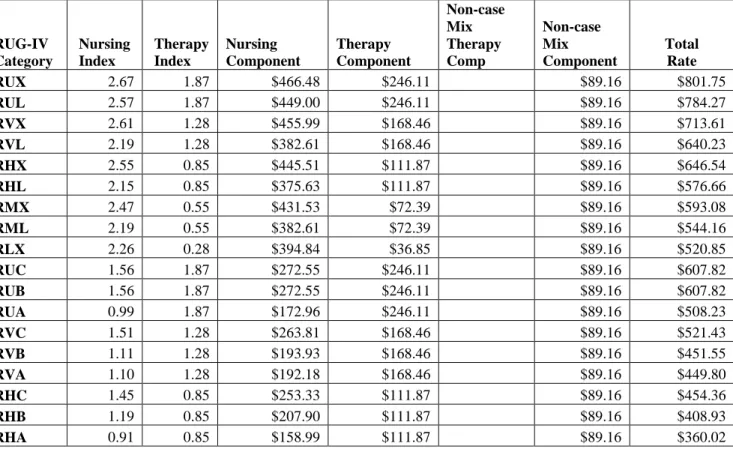
Under section 1888(e)(4)(H), each update of the payment rates must include the case-mix classification methodology applicable for the upcoming FY. The payment rates set forth in this proposed rule reflect the use of the RUG-IV case-mix classification system from October 1, 2016, through September 30, 2017. We list the proposed case-mix adjusted RUG-IV payment rates, provided separately for urban and rural SNFs, in Tables 4 and 5 with corresponding case-mix values. We use the revised OMB delineations adopted in the FY 2015 SNF PPS final rule (79 FR 45632, 45634) to identify a facility’s urban or rural status for the purpose of determining which set of rate tables would apply to the facility. Tables 4 and 5 do not reflect the add-on for SNF residents with AIDS enacted by section 511 of the MMA, which we apply only after making all other adjustments (such as wage index and case-mix).
TABLE 4: RUG-IV Case-Mix Adjusted Federal Rates and Associated Indexes URBAN RUG-IV Category Nursing Index Therapy Index Nursing Component Therapy Component Non-case Mix Therapy Comp Non-case Mix Component Total Rate RUX 2.67 1.87 $466.48 $246.11 $89.16 $801.75 RUL 2.57 1.87 $449.00 $246.11 $89.16 $784.27 RVX 2.61 1.28 $455.99 $168.46 $89.16 $713.61 RVL 2.19 1.28 $382.61 $168.46 $89.16 $640.23 RHX 2.55 0.85 $445.51 $111.87 $89.16 $646.54 RHL 2.15 0.85 $375.63 $111.87 $89.16 $576.66 RMX 2.47 0.55 $431.53 $72.39 $89.16 $593.08 RML 2.19 0.55 $382.61 $72.39 $89.16 $544.16 RLX 2.26 0.28 $394.84 $36.85 $89.16 $520.85 RUC 1.56 1.87 $272.55 $246.11 $89.16 $607.82 RUB 1.56 1.87 $272.55 $246.11 $89.16 $607.82 RUA 0.99 1.87 $172.96 $246.11 $89.16 $508.23 RVC 1.51 1.28 $263.81 $168.46 $89.16 $521.43 RVB 1.11 1.28 $193.93 $168.46 $89.16 $451.55 RVA 1.10 1.28 $192.18 $168.46 $89.16 $449.80 RHC 1.45 0.85 $253.33 $111.87 $89.16 $454.36 RHB 1.19 0.85 $207.90 $111.87 $89.16 $408.93 RHA 0.91 0.85 $158.99 $111.87 $89.16 $360.02
RUG-IV Category Nursing Index Therapy Index Nursing Component Therapy Component Non-case Mix Therapy Comp Non-case Mix Component Total Rate RMC 1.36 0.55 $237.61 $72.39 $89.16 $399.16 RMB 1.22 0.55 $213.15 $72.39 $89.16 $374.70 RMA 0.84 0.55 $146.76 $72.39 $89.16 $308.31 RLB 1.50 0.28 $262.07 $36.85 $89.16 $388.08 RLA 0.71 0.28 $124.04 $36.85 $89.16 $250.05 ES3 3.58 $625.46 $17.33 $89.16 $731.95 ES2 2.67 $466.48 $17.33 $89.16 $572.97 ES1 2.32 $405.33 $17.33 $89.16 $511.82 HE2 2.22 $387.86 $17.33 $89.16 $494.35 HE1 1.74 $304.00 $17.33 $89.16 $410.49 HD2 2.04 $356.41 $17.33 $89.16 $462.90 HD1 1.60 $279.54 $17.33 $89.16 $386.03 HC2 1.89 $330.20 $17.33 $89.16 $436.69 HC1 1.48 $258.57 $17.33 $89.16 $365.06 HB2 1.86 $324.96 $17.33 $89.16 $431.45 HB1 1.46 $255.08 $17.33 $89.16 $361.57 LE2 1.96 $342.43 $17.33 $89.16 $448.92 LE1 1.54 $269.05 $17.33 $89.16 $375.54 LD2 1.86 $324.96 $17.33 $89.16 $431.45 LD1 1.46 $255.08 $17.33 $89.16 $361.57 LC2 1.56 $272.55 $17.33 $89.16 $379.04 LC1 1.22 $213.15 $17.33 $89.16 $319.64 LB2 1.45 $253.33 $17.33 $89.16 $359.82 LB1 1.14 $199.17 $17.33 $89.16 $305.66 CE2 1.68 $293.51 $17.33 $89.16 $400.00 CE1 1.50 $262.07 $17.33 $89.16 $368.56 CD2 1.56 $272.55 $17.33 $89.16 $379.04 CD1 1.38 $241.10 $17.33 $89.16 $347.59 CC2 1.29 $225.38 $17.33 $89.16 $331.87 CC1 1.15 $200.92 $17.33 $89.16 $307.41 CB2 1.15 $200.92 $17.33 $89.16 $307.41 CB1 1.02 $178.20 $17.33 $89.16 $284.69 CA2 0.88 $153.74 $17.33 $89.16 $260.23 CA1 0.78 $136.27 $17.33 $89.16 $242.76 BB2 0.97 $169.47 $17.33 $89.16 $275.96 BB1 0.90 $157.24 $17.33 $89.16 $263.73 BA2 0.70 $122.30 $17.33 $89.16 $228.79 BA1 0.64 $111.81 $17.33 $89.16 $218.30 PE2 1.50 $262.07 $17.33 $89.16 $368.56 PE1 1.40 $244.59 $17.33 $89.16 $351.08 PD2 1.38 $241.10 $17.33 $89.16 $347.59 PD1 1.28 $223.63 $17.33 $89.16 $330.12 PC2 1.10 $192.18 $17.33 $89.16 $298.67 PC1 1.02 $178.20 $17.33 $89.16 $284.69 PB2 0.84 $146.76 $17.33 $89.16 $253.25
RUG-IV Category Nursing Index Therapy Index Nursing Component Therapy Component Non-case Mix Therapy Comp Non-case Mix Component Total Rate PB1 0.78 $136.27 $17.33 $89.16 $242.76 PA2 0.59 $103.08 $17.33 $89.16 $209.57 PA1 0.54 $94.34 $17.33 $89.16 $200.83
TABLE 5: RUG-IV Case-Mix Adjusted Federal Rates and Associated Indexes RURAL RUG-IV Category Nursing Index Therapy Index Nursing Component Therapy Component Non-case Mix Therapy Comp Non-case Mix Component Total Rate RUX 2.67 1.87 $445.65 $283.75 $90.82 $820.22 RUL 2.57 1.87 $428.96 $283.75 $90.82 $803.53 RVX 2.61 1.28 $435.64 $194.23 $90.82 $720.69 RVL 2.19 1.28 $365.53 $194.23 $90.82 $650.58 RHX 2.55 0.85 $425.62 $128.98 $90.82 $645.42 RHL 2.15 0.85 $358.86 $128.98 $90.82 $578.66 RMX 2.47 0.55 $412.27 $83.46 $90.82 $586.55 RML 2.19 0.55 $365.53 $83.46 $90.82 $539.81 RLX 2.26 0.28 $377.22 $42.49 $90.82 $510.53 RUC 1.56 1.87 $260.38 $283.75 $90.82 $634.95 RUB 1.56 1.87 $260.38 $283.75 $90.82 $634.95 RUA 0.99 1.87 $165.24 $283.75 $90.82 $539.81 RVC 1.51 1.28 $252.03 $194.23 $90.82 $537.08 RVB 1.11 1.28 $185.27 $194.23 $90.82 $470.32 RVA 1.10 1.28 $183.60 $194.23 $90.82 $468.65 RHC 1.45 0.85 $242.02 $128.98 $90.82 $461.82 RHB 1.19 0.85 $198.62 $128.98 $90.82 $418.42 RHA 0.91 0.85 $151.89 $128.98 $90.82 $371.69 RMC 1.36 0.55 $227.00 $83.46 $90.82 $401.28 RMB 1.22 0.55 $203.63 $83.46 $90.82 $377.91 RMA 0.84 0.55 $140.20 $83.46 $90.82 $314.48 RLB 1.50 0.28 $250.37 $42.49 $90.82 $383.68 RLA 0.71 0.28 $118.51 $42.49 $90.82 $251.82 ES3 3.58 $597.54 $18.52 $90.82 $706.88 ES2 2.67 $445.65 $18.52 $90.82 $554.99 ES1 2.32 $387.23 $18.52 $90.82 $496.57 HE2 2.22 $370.54 $18.52 $90.82 $479.88 HE1 1.74 $290.42 $18.52 $90.82 $399.76 HD2 2.04 $340.50 $18.52 $90.82 $449.84 HD1 1.60 $267.06 $18.52 $90.82 $376.40 HC2 1.89 $315.46 $18.52 $90.82 $424.80 HC1 1.48 $247.03 $18.52 $90.82 $356.37 HB2 1.86 $310.45 $18.52 $90.82 $419.79 HB1 1.46 $243.69 $18.52 $90.82 $353.03 LE2 1.96 $327.14 $18.52 $90.82 $436.48
RUG-IV Category Nursing Index Therapy Index Nursing Component Therapy Component Non-case Mix Therapy Comp Non-case Mix Component Total Rate LE1 1.54 $257.04 $18.52 $90.82 $366.38 LD2 1.86 $310.45 $18.52 $90.82 $419.79 LD1 1.46 $243.69 $18.52 $90.82 $353.03 LC2 1.56 $260.38 $18.52 $90.82 $369.72 LC1 1.22 $203.63 $18.52 $90.82 $312.97 LB2 1.45 $242.02 $18.52 $90.82 $351.36 LB1 1.14 $190.28 $18.52 $90.82 $299.62 CE2 1.68 $280.41 $18.52 $90.82 $389.75 CE1 1.50 $250.37 $18.52 $90.82 $359.71 CD2 1.56 $260.38 $18.52 $90.82 $369.72 CD1 1.38 $230.34 $18.52 $90.82 $339.68 CC2 1.29 $215.31 $18.52 $90.82 $324.65 CC1 1.15 $191.95 $18.52 $90.82 $301.29 CB2 1.15 $191.95 $18.52 $90.82 $301.29 CB1 1.02 $170.25 $18.52 $90.82 $279.59 CA2 0.88 $146.88 $18.52 $90.82 $256.22 CA1 0.78 $130.19 $18.52 $90.82 $239.53 BB2 0.97 $161.90 $18.52 $90.82 $271.24 BB1 0.90 $150.22 $18.52 $90.82 $259.56 BA2 0.70 $116.84 $18.52 $90.82 $226.18 BA1 0.64 $106.82 $18.52 $90.82 $216.16 PE2 1.50 $250.37 $18.52 $90.82 $359.71 PE1 1.40 $233.67 $18.52 $90.82 $343.01 PD2 1.38 $230.34 $18.52 $90.82 $339.68 PD1 1.28 $213.64 $18.52 $90.82 $322.98 PC2 1.10 $183.60 $18.52 $90.82 $292.94 PC1 1.02 $170.25 $18.52 $90.82 $279.59 PB2 0.84 $140.20 $18.52 $90.82 $249.54 PB1 0.78 $130.19 $18.52 $90.82 $239.53 PA2 0.59 $98.48 $18.52 $90.82 $207.82 PA1 0.54 $90.13 $18.52 $90.82 $199.47
D. Wage Index Adjustment
Section 1888(e)(4)(G)(ii) of the Act requires that we adjust the federal rates to account for differences in area wage levels, using a wage index that the Secretary determines appropriate. Since the inception of the SNF PPS, we have used hospital inpatient wage data in developing a wage index to be applied to SNFs. We propose to continue this practice for FY 2017, as we continue to believe that in the absence of SNF-specific wage data, using the hospital inpatient wage index data is appropriate and reasonable for the SNF PPS. As explained in the update notice for FY 2005 (69 FR 45786), the SNF PPS does not use the hospital area wage index’s
occupational mix adjustment, as this adjustment serves specifically to define the occupational categories more clearly in a hospital setting; moreover, the collection of the occupational wage data also excludes any wage data related to SNFs. Therefore, we believe that using the updated wage data exclusive of the occupational mix adjustment continues to be appropriate for SNF payments. For FY 2017, the updated wage data are for hospital cost reporting periods beginning on or after October 1, 2012 and before October 1, 2013 (FY 2013 cost report data).
We note that section 315 of the Medicare, Medicaid, and SCHIP Benefits Improvement and Protection Act of 2000 (BIPA, Pub. L. 106-554, enacted on December 21, 2000) authorized us to establish a geographic reclassification procedure that is specific to SNFs, but only after collecting the data necessary to establish a SNF wage index that is based on wage data from nursing homes. However, to date, this has proven to be unfeasible due to the volatility of existing SNF wage data and the significant amount of resources that would be required to improve the quality of that data.
In addition, we propose to continue to use the same methodology discussed in the SNF PPS final rule for FY 2008 (72 FR 43423) to address those geographic areas in which there are no hospitals, and thus, no hospital wage index data on which to base the calculation of the FY 2017 SNF PPS wage index. For rural geographic areas that do not have hospitals, and therefore, lack hospital wage data on which to base an area wage adjustment, we would use the average wage index from all contiguous Core-Based Statistical Areas (CBSAs) as a reasonable proxy. For FY 2017, there are no rural geographic areas that do not have hospitals, and thus, this
methodology would not be applied. For rural Puerto Rico, we would not apply this methodology due to the distinct economic circumstances that exist there (for example, due to the close
proximity to one another of almost all of Puerto Rico’s various urban and non-urban areas, this methodology would produce a wage index for rural Puerto Rico that is higher than that in half of its urban areas); instead, we would continue to use the most recent wage index previously
available for that area. For urban areas without specific hospital wage index data, we would use the average wage indexes of all of the urban areas within the state to serve as a reasonable proxy for the wage index of that urban CBSA. For FY 2017, the only urban area without wage index data available is CBSA 25980, Hinesville-Fort Stewart, GA. The proposed wage index
applicable to FY 2017 is set forth in Tables A and B available on the CMS Web site at
http://www.cms.gov/Medicare/Medicare-Fee-for-Service-Payment/SNFPPS/WageIndex.html. Once calculated, we would apply the wage index adjustment to the labor-related portion of the federal rate. Each year, we calculate a revised labor-related share, based on the relative importance of labor-related cost categories (that is, those cost categories that are labor-intensive and vary with the local labor market) in the input price index. In the SNF PPS final rule for FY 2014 (78 FR 47944 through 47946), we finalized a proposal to revise the labor-related share to reflect the relative importance of the FY 2010-based SNF market basket cost weights for the following cost categories: wages and salaries; employee benefits; the labor-related portion of nonmedical professional fees; administrative and facilities support services; all other--labor-related services; and a proportion of capital-other--labor-related expenses.
We calculate the labor-related relative importance from the SNF market basket, and it approximates the labor-related portion of the total costs after taking into account historical and projected price changes between the base year and FY 2017. The price proxies that move the different cost categories in the market basket do not necessarily change at the same rate, and the relative importance captures these changes. Accordingly, the relative importance figure more closely reflects the cost share weights for FY 2017 than the base year weights from the SNF market basket.
We calculate the labor-related relative importance for FY 2017 in four steps. First, we compute the FY 2017 price index level for the total market basket and each cost category of the market basket. Second, we calculate a ratio for each cost category by dividing the FY 2017 price
index level for that cost category by the total market basket price index level. Third, we
determine the FY 2017 relative importance for each cost category by multiplying this ratio by the base year (FY 2010) weight. Finally, we add the FY 2017 relative importance for each of the labor-related cost categories (wages and salaries, employee benefits, the labor-related portion of non-medical professional fees, administrative and facilities support services, all other: labor-related services, and a portion of capital-labor-related expenses) to produce the FY 2017 labor-labor-related relative importance. Table 6 summarizes the proposed updated labor-related share for FY 2017, compared to the labor-related share that was used for the FY 2016 SNF PPS final rule.
TABLE 6: Labor-Related Relative Importance, FY 2016 and FY 2017 Relative importance, labor-related, FY 2016 15:2 forecast1 Relative importance, labor-related, FY 2017 16:1 forecast2
Wages and salaries 48.8 48.8
Employee benefits 11.3 11.2
Nonmedical Professional
fees: labor-related 3.5 3.4
Administrative and facilities
support services 0.5 0.5
All Other: Labor-related
services 2.3 2.3
Capital-related (.391) 2.7 2.7
Total 69.1 68.9
1 Published in the Federal Register; based on second quarter 2015 IGI forecast
2 Based on first quarter 2016 IGI forecast, with historical data through fourth quarter 2015.
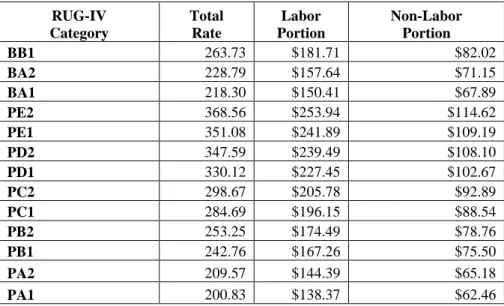
Tables 7 and 8 show the RUG-IV case-mix adjusted federal rates by labor-related and non-labor-related components.
TABLE 7: RUG-IV Case-Mix Adjusted Federal Rates for Urban SNFs By Labor and Non-Labor Component
RUG-IV Category Total Rate Labor Portion Non-Labor Portion RUX 801.75 $552.41 $249.34 RUL 784.27 $540.36 $243.91 RVX 713.61 $491.68 $221.93 RVL 640.23 $441.12 $199.11
RUG-IV Category Total Rate Labor Portion Non-Labor Portion RHX 646.54 $445.47 $201.07 RHL 576.66 $397.32 $179.34 RMX 593.08 $408.63 $184.45 RML 544.16 $374.93 $169.23 RLX 520.85 $358.87 $161.98 RUC 607.82 $418.79 $189.03 RUB 607.82 $418.79 $189.03 RUA 508.23 $350.17 $158.06 RVC 521.43 $359.27 $162.16 RVB 451.55 $311.12 $140.43 RVA 449.80 $309.91 $139.89 RHC 454.36 $313.05 $141.31 RHB 408.93 $281.75 $127.18 RHA 360.02 $248.05 $111.97 RMC 399.16 $275.02 $124.14 RMB 374.70 $258.17 $116.53 RMA 308.31 $212.43 $95.88 RLB 388.08 $267.39 $120.69 RLA 250.05 $172.28 $77.77 ES3 731.95 $504.31 $227.64 ES2 572.97 $394.78 $178.19 ES1 511.82 $352.64 $159.18 HE2 494.35 $340.61 $153.74 HE1 410.49 $282.83 $127.66 HD2 462.90 $318.94 $143.96 HD1 386.03 $265.97 $120.06 HC2 436.69 $300.88 $135.81 HC1 365.06 $251.53 $113.53 HB2 431.45 $297.27 $134.18 HB1 361.57 $249.12 $112.45 LE2 448.92 $309.31 $139.61 LE1 375.54 $258.75 $116.79 LD2 431.45 $297.27 $134.18 LD1 361.57 $249.12 $112.45 LC2 379.04 $261.16 $117.88 LC1 319.64 $220.23 $99.41 LB2 359.82 $247.92 $111.90 LB1 305.66 $210.60 $95.06 CE2 400.00 $275.60 $124.40 CE1 368.56 $253.94 $114.62 CD2 379.04 $261.16 $117.88 CD1 347.59 $239.49 $108.10 CC2 331.87 $228.66 $103.21 CC1 307.41 $211.81 $95.60 CB2 307.41 $211.81 $95.60 CB1 284.69 $196.15 $88.54 CA2 260.23 $179.30 $80.93 CA1 242.76 $167.26 $75.50 BB2 275.96 $190.14 $85.82
RUG-IV Category Total Rate Labor Portion Non-Labor Portion BB1 263.73 $181.71 $82.02 BA2 228.79 $157.64 $71.15 BA1 218.30 $150.41 $67.89 PE2 368.56 $253.94 $114.62 PE1 351.08 $241.89 $109.19 PD2 347.59 $239.49 $108.10 PD1 330.12 $227.45 $102.67 PC2 298.67 $205.78 $92.89 PC1 284.69 $196.15 $88.54 PB2 253.25 $174.49 $78.76 PB1 242.76 $167.26 $75.50 PA2 209.57 $144.39 $65.18 PA1 200.83 $138.37 $62.46
TABLE 8: RUG-IV Case-Mix Adjusted Federal Rates for Rural SNFs by Labor and Non-Labor Component RUG-IV Category Total Rate Labor Portion Non-Labor Portion RUX 820.22 $565.13 $255.09 RUL 803.53 $553.63 $249.90 RVX 720.69 $496.56 $224.13 RVL 650.58 $448.25 $202.33 RHX 645.42 $444.69 $200.73 RHL 578.66 $398.70 $179.96 RMX 586.55 $404.13 $182.42 RML 539.81 $371.93 $167.88 RLX 510.53 $351.76 $158.77 RUC 634.95 $437.48 $197.47 RUB 634.95 $437.48 $197.47 RUA 539.81 $371.93 $167.88 RVC 537.08 $370.05 $167.03 RVB 470.32 $324.05 $146.27 RVA 468.65 $322.90 $145.75 RHC 461.82 $318.19 $143.63 RHB 418.42 $288.29 $130.13 RHA 371.69 $256.09 $115.60 RMC 401.28 $276.48 $124.80 RMB 377.91 $260.38 $117.53 RMA 314.48 $216.68 $97.80 RLB 383.68 $264.36 $119.32 RLA 251.82 $173.50 $78.32 ES3 706.88 $487.04 $219.84 ES2 554.99 $382.39 $172.60 ES1 496.57 $342.14 $154.43 HE2 479.88 $330.64 $149.24 HE1 399.76 $275.43 $124.33 HD2 449.84 $309.94 $139.90
RUG-IV Category Total Rate Labor Portion Non-Labor Portion HD1 376.40 $259.34 $117.06 HC2 424.80 $292.69 $132.11 HC1 356.37 $245.54 $110.83 HB2 419.79 $289.24 $130.55 HB1 353.03 $243.24 $109.79 LE2 436.48 $300.73 $135.75 LE1 366.38 $252.44 $113.94 LD2 419.79 $289.24 $130.55 LD1 353.03 $243.24 $109.79 LC2 369.72 $254.74 $114.98 LC1 312.97 $215.64 $97.33 LB2 351.36 $242.09 $109.27 LB1 299.62 $206.44 $93.18 CE2 389.75 $268.54 $121.21 CE1 359.71 $247.84 $111.87 CD2 369.72 $254.74 $114.98 CD1 339.68 $234.04 $105.64 CC2 324.65 $223.68 $100.97 CC1 301.29 $207.59 $93.70 CB2 301.29 $207.59 $93.70 CB1 279.59 $192.64 $86.95 CA2 256.22 $176.54 $79.68 CA1 239.53 $165.04 $74.49 BB2 271.24 $186.88 $84.36 BB1 259.56 $178.84 $80.72 BA2 226.18 $155.84 $70.34 BA1 216.16 $148.93 $67.23 PE2 359.71 $247.84 $111.87 PE1 343.01 $236.33 $106.68 PD2 339.68 $234.04 $105.64 PD1 322.98 $222.53 $100.45 PC2 292.94 $201.84 $91.10 PC1 279.59 $192.64 $86.95 PB2 249.54 $171.93 $77.61 PB1 239.53 $165.04 $74.49 PA2 207.82 $143.19 $64.63 PA1 199.47 $137.43 $62.04
Section 1888(e)(4)(G)(ii) of the Act also requires that we apply this wage index in a manner that does not result in aggregate payments under the SNF PPS that are greater or less than would otherwise be made if the wage adjustment had not been made. For FY 2017 (federal rates effective October 1, 2016), we would apply an adjustment to fulfill the budget neutrality requirement. We would meet this requirement by multiplying each of the components of the
unadjusted federal rates by a budget neutrality factor equal to the ratio of the weighted average wage adjustment factor for FY 2016 to the weighted average wage adjustment factor for FY 2017. For this calculation, we would use the same FY 2015 claims utilization data for both the numerator and denominator of this ratio. We define the wage adjustment factor used in this calculation as the labor share of the rate component multiplied by the wage index plus the non-labor share of the rate component. The budget neutrality factor for FY 2017 would be 1.0000. In the SNF PPS final rule for FY 2006 (70 FR 45026, August 4, 2005), we adopted the changes discussed in the OMB Bulletin No. 03-04 (June 6, 2003), available online at
www.whitehouse.gov/omb/bulletins/b03-04.html, which announced revised definitions for MSAs and the creation of micropolitan statistical areas and combined statistical areas.
In adopting the CBSA geographic designations, we provided for a one-year transition in FY 2006 with a blended wage index for all providers. For FY 2006, the wage index for each provider consisted of a blend of 50 percent of the FY 2006 MSA-based wage index and 50 percent of the FY 2006 CBSA-based wage index (both using FY 2002 hospital data). We referred to the blended wage index as the FY 2006 SNF PPS transition wage index. As discussed in the SNF PPS final rule for FY 2006 (70 FR 45041), since the expiration of this one-year transition on September 30, 2006, we have used the full CBSA-based wage index values.
Generally, OMB issues major revisions to statistical areas every 10 years, based on the results of the decennial census. In the FY 2015 SNF PPS final rule (79 FR 45644 through 45646), we finalized changes to the SNF PPS wage index based on the newest OMB
delineations, as described in OMB Bulletin No. 13-01, beginning in FY 2015, including a 1-year transition with a blended wage index for FY 2015. OMB Bulletin No. 13-01 established revised delineations for Metropolitan Statistical Areas, Micropolitan Statistical Areas, and Combined Statistical Areas in the United States and Puerto Rico based on the 2010 Census, and provided
guidance on the use of the delineations of these statistical areas using standards published on June 28, 2010 in the Federal Register (75 FR 37246 through 37252). In addition, OMB occasionally issues minor updates and revisions to statistical areas in the years between the decennial censuses. On July 15, 2015, OMB issued OMB Bulletin No. 15-01, which provides minor updates to and supersedes OMB Bulletin No. 13-01 that was issued on February 28, 2013. The attachment to OMB Bulletin No. 15-01 provides detailed information on the update to statistical areas since February 28, 2013. The updates provided in OMB Bulletin No. 15-01 are based on the application of the 2010 Standards for Delineating Metropolitan and Micropolitan Statistical Areas to Census Bureau population estimates for July 1, 2012 and July 1, 2013. A copy of this bulletin may be obtained on the Web site at
https://www.whitehouse.gov/sites/default/files/omb/bulletins/2015/15-01.pdf. As we previously stated in the FY 2008 SNF PPS proposed and final rules (72 FR 25538 through 25539, and 72 FR 43423), we again wish to clarify that this and all subsequent SNF PPS rules and notices are considered to incorporate any such updates and revisions set forth in the most recent OMB bulletin that applies to the hospital wage data used to determine the current SNF PPS wage index. As noted above, the proposed wage index applicable to FY 2017 is set forth in Tables A and B available on the CMS Web site at http://www.cms.gov/Medicare/Medicare-Fee-for-Service-Payment/SNFPPS/WageIndex.html.
E. Adjusted Rate Computation Example
Using the hypothetical SNF XYZ described below, Table 9 shows the adjustments made to the federal per diem rates to compute the provider's actual per diem PPS payment. We derive the Labor and Non-labor columns from Table 7. The wage index used in this example is based on the proposed wage index, which may be found in Table A as referenced above. As illustrated in Table 9, SNF XYZ’s total PPS payment would equal $46,782.60.
TABLE 9: Adjusted Rate Computation Example SNF XYZ: Located in Frederick, MD (Urban CBSA 43524)
Wage Index: 0.9820
(See Proposed Wage Index in Table A)1
RUG-IV Group Labor Wage Index Adjusted Labor Non-Labor Adjusted Rate Percent Adjustment Medicare Days Payment RVX $491.68 0.982 $482.83 $221.93 $704.76 $704.76 14 $9,866.64 ES2 $394.78 0.982 $387.67 $178.19 $565.86 $565.86 30 $16,975.80 RHA $248.05 0.982 $243.59 $111.97 $355.56 $355.56 16 $5,688.96 CC2* $228.66 0.982 $224.54 $103.21 $327.75 $747.27 10 $7,472.70 BA2 $157.64 0.982 $154.80 $71.15 $225.95 $225.95 30 $6,778.50 100 $46,782.60
*Reflects a 128 percent adjustment from section 511 of the MMA.
1 Available on the CMS website at
http://www.cms.gov/Medicare/Medicare-Fee-for-Service-Payment/SNFPPS/WageIndex.html.
IV. Additional Aspects of the SNF PPS
A. SNF Level of Care--Administrative Presumption
The establishment of the SNF PPS did not change Medicare's fundamental requirements for SNF coverage. However, because the case-mix classification is based, in part, on the beneficiary’s need for skilled nursing care and therapy, we have attempted, where possible, to coordinate claims review procedures with the existing resident assessment process and case-mix classification system discussed in section III.C. of this proposed rule. This approach includes an administrative presumption that utilizes a beneficiary’s initial classification in one of the upper 52 RUGs of the 66-group RUG-IV case-mix classification system to assist in making certain SNF level of care determinations.
In accordance with section 1888(e)(4)(H)(ii) of the Act and the regulations at §413.345, we include in each update of the federal payment rates in the Federal Register the designation of those specific RUGs under the classification system that represent the required SNF level of care, as provided in §409.30. As set forth in the FY 2011 SNF PPS update notice (75 FR 42910), this designation reflects an administrative presumption under the 66-group RUG-IV system that beneficiaries who are correctly assigned to one of the upper 52 RUG-IV groups on
the initial five-day, Medicare-required assessment are automatically classified as meeting the SNF level of care definition up to and including the assessment reference date (ARD) on the 5-day Medicare-required assessment.
A beneficiary assigned to any of the lower 14 RUG-IV groups is not automatically classified as either meeting or not meeting the definition, but instead receives an individual level of care determination using the existing administrative criteria. This presumption recognizes the strong likelihood that beneficiaries assigned to one of the upper 52 RUG-IV groups during the immediate post-hospital period require a covered level of care, which would be less likely for those beneficiaries assigned to one of the lower 14 RUG-IV groups.
In the July 30, 1999 final rule (64 FR 41670), we indicated that we would announce any changes to the guidelines for Medicare level of care determinations related to modifications in the case-mix classification structure. In this proposed rule, we would continue to designate the upper 52 RUG-IV groups for purposes of this administrative presumption, consisting of all groups encompassed by the following RUG-IV categories:
● Rehabilitation plus Extensive Services. ● Ultra High Rehabilitation.
● Very High Rehabilitation. ● High Rehabilitation. ● Medium Rehabilitation. ● Low Rehabilitation. ● Extensive Services. ● Special Care High. ● Special Care Low. ● Clinically Complex.
SNF’s responsibility to ensure that its decisions relating to level of care are appropriate and timely, including a review to confirm that the services prompting the beneficiary’s assignment to one of the upper 52 RUG-IV groups (which, in turn, serves to trigger the administrative
presumption) are themselves medically necessary. As we explained in the FY 2000 SNF PPS final rule (64 FR 41667), the administrative presumption:
“. . . is itself rebuttable in those individual cases in which the services actually received by the resident do not meet the basic statutory criterion of being reasonable and necessary to diagnose or treat a beneficiary's condition (according to section 1862(a)(1) of the Act). Accordingly, the presumption would not apply, for example, in those situations in which a resident's assignment to one of the upper . . . groups is itself based on the receipt of services that are subsequently determined to be not reasonable and necessary.”
Moreover, we want to stress the importance of careful monitoring for changes in each patient’s condition to determine the continuing need for Part A SNF benefits after the ARD of the 5-day assessment.
B. Consolidated Billing
Sections 1842(b)(6)(E) and 1862(a)(18) of the Act (as added by section 4432(b) of the BBA) require a SNF to submit consolidated Medicare bills to its Medicare Administrative Contractor for almost all of the services that its residents receive during the course of a covered Part A stay. In addition, section 1862(a)(18) of the Act places the responsibility with the SNF for billing Medicare for physical therapy, occupational therapy, and speech-language pathology services that the resident receives during a noncovered stay. Section 1888(e)(2)(A) of the Act excludes a small list of services from the consolidated billing provision (primarily those services furnished by physicians and certain other types of practitioners), which remain separately
billable under Part B when furnished to a SNF’s Part A resident. These excluded service
(63 FR 26295 through 26297).
A detailed discussion of the legislative history of the consolidated billing provision is available on the SNF PPS website at http://www.cms.gov/Medicare/Medicare-Fee-for-Service-Payment/SNFPPS/Downloads/Legislative_History_07302013.pdf. In particular, section 103 of the Medicare, Medicaid, and SCHIP Balanced Budget Refinement Act of 1999 (BBRA) (Pub. L. 106-113, enacted on November 29, 1999) amended section 1888(e)(2)(A) of the Act by further excluding a number of individual high-cost, low probability services, identified by Healthcare Common Procedure Coding System (HCPCS) codes, within several broader categories
(chemotherapy items, chemotherapy administration services, radioisotope services, and
customized prosthetic devices) that otherwise remained subject to the provision. We discuss this BBRA amendment in greater detail in the SNF PPS proposed and final rules for FY 2001
(65 FR 19231 through 19232, April 10, 2000, and 65 FR 46790 through 46795, July 31, 2000), as well as in Program Memorandum AB-00-18 (Change Request #1070), issued March 2000, which is available online at www.cms.gov/transmittals/downloads/ab001860.pdf.
As explained in the FY 2001 proposed rule (65 FR 19232), the amendments enacted in section 103 of the BBRA not only identified for exclusion from this provision a number of particular service codes within four specified categories (that is, chemotherapy items,
chemotherapy administration services, radioisotope services, and customized prosthetic devices), but also gave the Secretary the authority to designate additional, individual services for exclusion within each of the specified service categories. In the proposed rule for FY 2001, we also noted that the BBRA Conference report (H.R. Rep. No. 106-479 at 854 (1999) (Conf. Rep.))
characterizes the individual services that this legislation targets for exclusion as high-cost, low probability events that could have devastating financial impacts because their costs far exceed the payment SNFs receive under the PPS. According to the conferees, section 103(a) of the BBRA is an attempt to exclude from the PPS certain services and costly items that are provided