Home Office and Ministry of Justice
Transforming contract management
The National Audit Office scrutinises public spending for Parliament and is independent of government. The Comptroller and Auditor General (C&AG), Sir Amyas Morse KCB, is an Officer of the House of Commons and leads the NAO, which employs some 820 employees. The C&AG certifies the accounts of all government departments and many other public sector bodies. He has statutory authority to examine and report to Parliament on whether departments and the bodies they fund have used their resources efficiently, effectively, and with economy. Our studies evaluate the value for money of public spending, nationally and locally. Our recommendations and reports on good practice help government improve public services, and our work led to audited savings of £1.1 billion in 2013.
Report by the Comptroller and Auditor General Ordered by the House of Commons
to be printed on 4 September 2014
This report has been prepared under Section 6 of the National Audit Act 1983 for presentation to the House of Commons in accordance with Section 9 of the Act Sir Amyas Morse KCB
Comptroller and Auditor General National Audit Office
29 August 2014
HC 268 | £10.00
Transforming contract
management
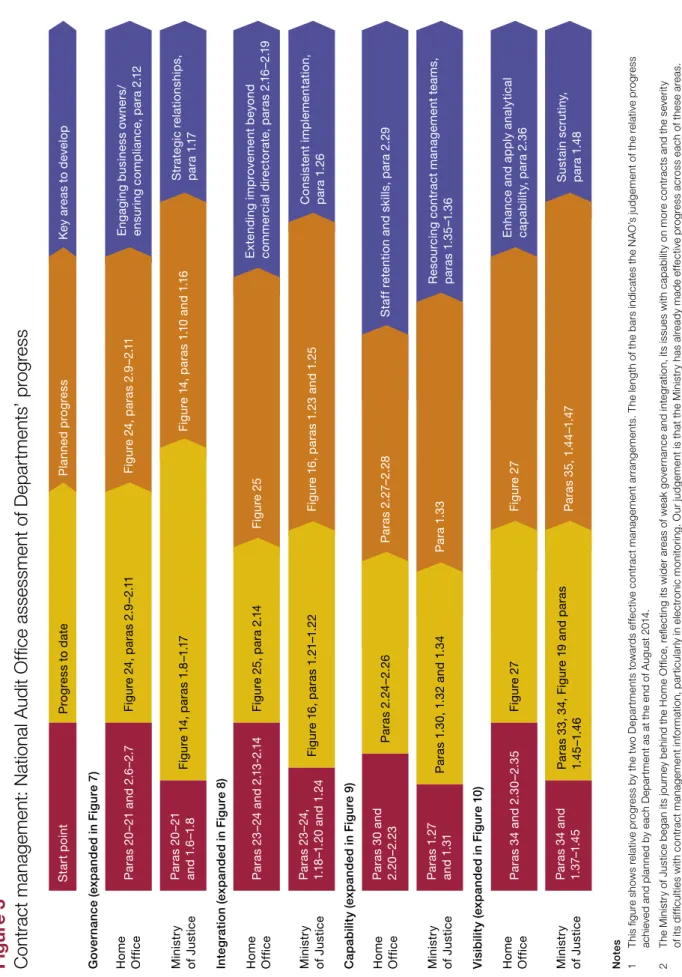
© National Audit Office 2014
The material featured in this document is subject to National Audit Office (NAO) copyright. The material may be copied or reproduced for non-commercial purposes only, namely reproduction for research, private study or for limited internal circulation within an organisation for the purpose of review.
Copying for non-commercial purposes is subject to the material being accompanied by a sufficient acknowledgement, reproduced accurately, and not being used in a misleading context. To reproduce NAO copyright material for any other use, you must contact [email protected]. Please tell us who you are, the organisation you represent (if any) and how and why you wish to use our material. Please include your full contact details: name, address, telephone number and email.
Please note that the material featured in this document may not be reproduced for commercial gain without the NAO’s express and direct permission and that the NAO reserves its right to pursue copyright infringement proceedings against individuals or companies who reproduce material for commercial gain without our permission.
Links to external websites were valid at the time of publication of this report. The National Audit Office is not responsible for the future validity of the links. 10477 09/14 NAO
The National Audit Office study team consisted of:
Neil Carey, Henry Midgley and Alex Quick, under the direction of Jeremy Lonsdale with
additional assistance provided by Christopher Barrett, Michael Dickson and Janani Pragasam.
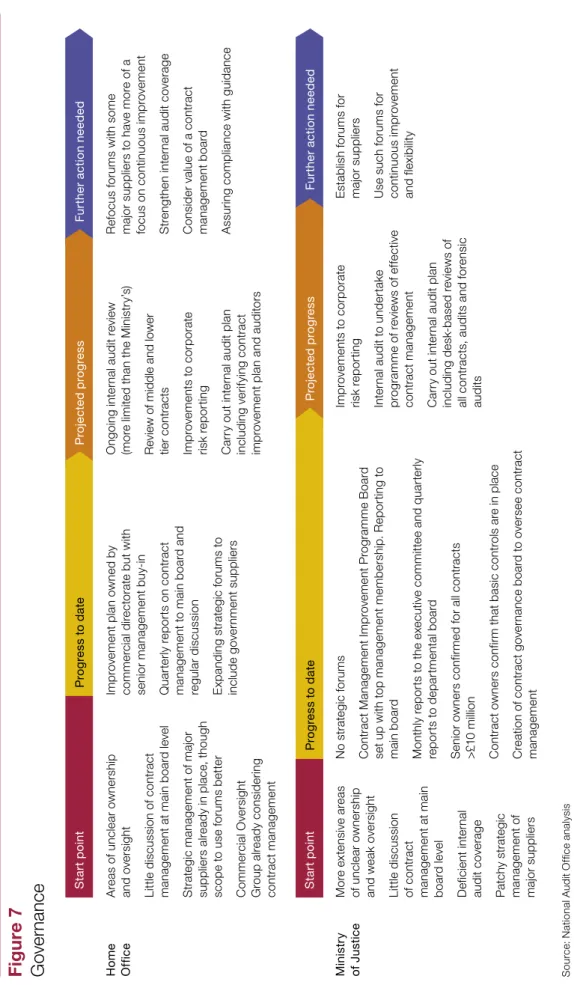
This report can be found on the National Audit Office website at www.nao.org.uk
For further information about the National Audit Office please contact: National Audit Office
Press Office
157–197 Buckingham Palace Road Victoria London SW1W 9SP Tel: 020 7798 7400 Enquiries: www.nao.org.uk/contact-us Website: www.nao.org.uk Twitter: @NAOorguk Appendix One
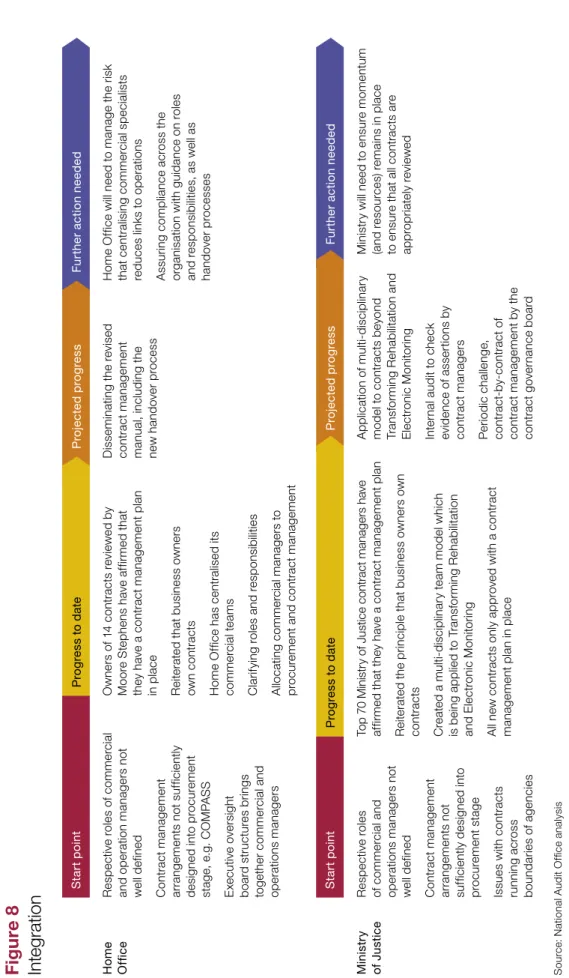
Contract management – Ministry of Justice 26
Appendix Two
Contract management – Home Office 43
Appendix Three
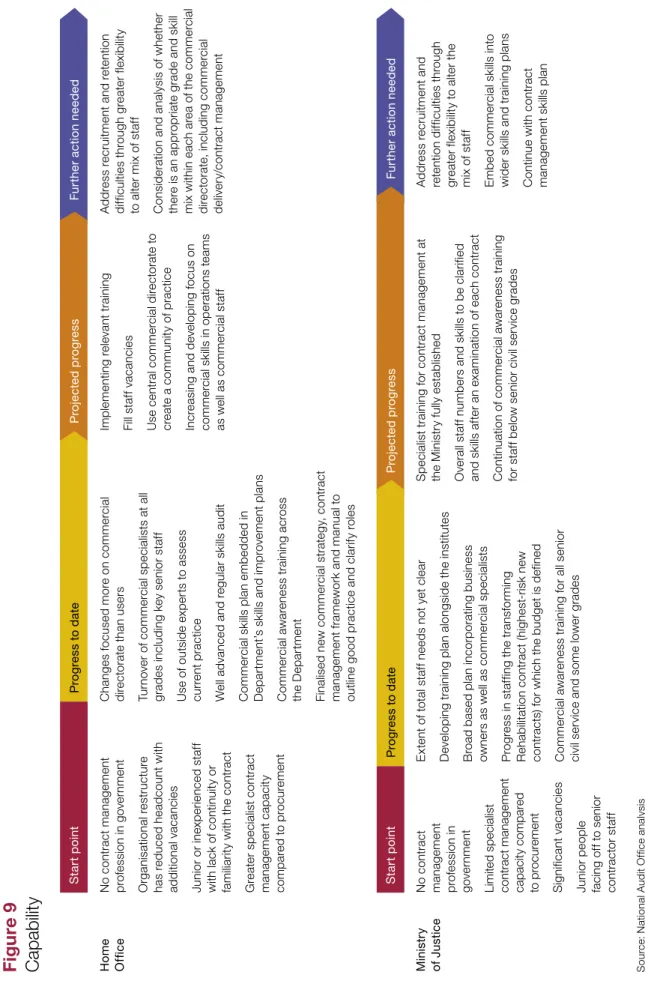
Our audit approach 61
Appendix Four
Our evidence base 63
Key facts
£2.5bn
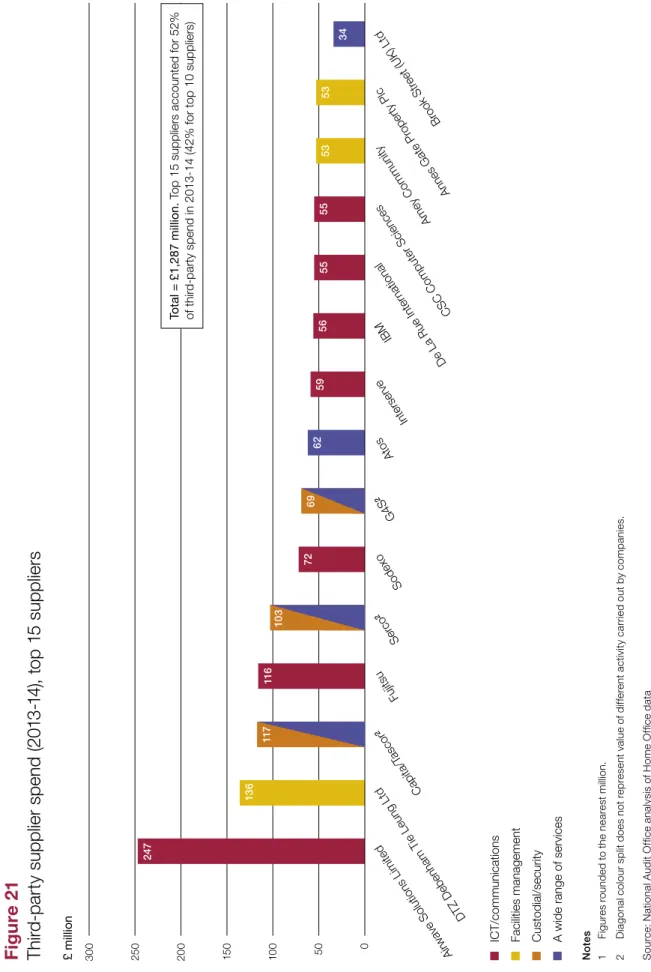
Home Offi ce third-party supplier spend, 2013-14£2.6bn
Ministry of Justice third-party supplier spend, 2013-14, excluding £1.8bn on legal aid£179.4m
amount the Ministry of Justice have been paid by Serco and G4SEst. £617 million contractor spend with G4S and Serco (both Departments)
Est. £0.3 million amount Moore Stephens detected the Home Offi ce have been overcharged
37 Ministry of Justice contracts, which the Ministry and PwC reviewed – including 27 forensic audits of contract billing and 15 contracts reviewed in the Breedon Review. The selected contracts for these reviews overlapped
13 Home Offi ce contracts reviewed by Moore Stephens in secondary review conducted upon request of the Department
182.7 full-time equivalent staff in post within Home Offi ce commercial
directorate. There are also, as of August 2014, 13 vacancies and 9 staff on secondment or career breaks
201 full-time equivalent staff in post within the Ministry of Justice commercial directorate. There are, as of August 2014, 25 vacancies
3% of commercial directorate staff at senior civil servant level, in the Home Offi ce
4% of commercial directorate staff at senior civil servant level, in the Ministry of Justice
2.5% estimated lifetime cost of contract management as a proportion of lifetime contract value under Ministry of Justice's Transforming Rehabilitation programme
Unknown the total annual cost of managing contracts in the Departments.
Unknown due to incomplete capture of costs including the time of various staff involved
Report
Contract management – Ministry of Justice and
the Home Office
Background
1 For several decades, governments have increased how much they use contracts to get services from the private sector. The range of services is broad, from facilities management to specialised services unique to government such as managing prisons. The trend has produced successes,1 but also examples of challenges and failings. In 2008, we reported that central government needed to manage contracts consistently, and use good practice.2 We also published guidance on contract management with the then Office of Government Commerce.3
2 In July 2013, the Justice Secretary told Parliament about significant anomalies in billing practices under the Ministry of Justice’s electronic monitoring contracts with Serco and G4S.4 These companies are major suppliers to government and particularly to the Ministry of Justice and the Home Office. Our reports on contracts for these departments also suggested difficulties.5 We reported on the challenges for government in managing its suppliers’ performance, leading to what we described as a crisis of confidence caused by contractors not appearing to treat the public sector fairly, and of departments themselves not being on top of the issues.6
3 In July 2013, Cabinet Office ministers initiated the Cross Government
Review of Major Contracts7 – led by the Cabinet Office and supported by
PriceWaterhouseCoopers (PwC) and Moore Stephens – which examined 28 of Serco and G4S’s largest contracts, worth in excess of £5.9 billion in total.8 The Ministry of Justice asked PwC to perform forensic audits of all of its contracts with Serco and G4S to identify any further over-billing, and its lead non-executive director, Tim Breedon, also led a contract management review (the Breedon Review) supported by PwC. The Home Office commissioned its internal auditors and Moore Stephens to carry out an additional review to provide further assurance. The reviews carried out across government are summarised at Figure 1 overleaf.
Figure 1
Number of contracts reviewed across government during 2013-14
Methodology of review Review Ministry of Justice
Home Office Rest of government
Total reviewed
Reviews of contract management using NAO 2008 Framework
Cross Government Review of Major Contracts (published December 2013)
9 19 28
Ministry's Breedon Review (published December 2013)
15 15
Electronic Monitoring Contracts (also considered by the Breedon Review)
2 2
Moore Stephens Review (unpublished March 2014)
13 13
DWP Reviews of contracts 15
Total contracts reviewed using NAO framework 17 22 34 73
Reviews of contract billing PwC Forensic Review of Ministry of Justice contracts with G4S and Serco
27 27
Moore Stephens review of transactions as part of their unpublished March 2014 review
5 5
Other Reviews 9 19 28
Total contracts reviewed for billing 27 14 19 60
Notes
1 Some contracts were examined as part of more than one review. For example, seven Ministry of Justice contracts (including two for electronic monitoring) were considered by both the Breedon review and the PwC forensic audit.
2 The total number of contracts examined: Ministry of Justice 37, Home Offi ce 22, rest of government 34. 3 PwC’s forensic audits were more detailed than the transaction testing performed by other reviews of billing. Source: National Audit Offi ce
4 The Breedon and cross-government reviews, published in December 2013, gave clear evidence that contract management across government needed major improvements. The Cross Government Review of Major Contracts found no evidence of deliberate acts or omissions by either firm leading to errors or irregularities in charging on the 28 contracts it investigated.9 The Ministry of Justice found errors, including some under- and over-billing, in 3 further contracts beyond electronic monitoring; for prisoner escorting and facilities management. The Home Office found smaller billing issues primarily within the immigrant escorting contract. Most contracts reviewed across government, including the Home Office and the Ministry, revealed weaknesses in contract management.
5 From late 2013, the Ministry of Justice and the Home Office responded with improvement plans, closely overseen and supported by their senior management.
Scope of this comparative report
6 This report gives a snapshot of reforms within both Departments. We are reporting now because both Departments are in the process of implementing changes and still face challenges in embedding positive contract management behaviours amongst their workforces. The Ministry and the Home Office, along with other government departments, also face constraints to their ability to recruit and retain experienced commercial staff. Improving contract management is currently high in both departments’ priorities, but each must maintain this commitment once the immediate problems are addressed.
7 Our unique cross government perspective enables us to compare and contrast approaches to contract management across government, as a basis for improvement. We accept the different contexts of the Home Office and the Ministry. However, they face similar challenges and can learn from each other. Many lessons also apply to other departments. One such lesson is that neither Department recognised the extent of their issues with contract management until 2013. The challenge facing all departments is to be sufficiently self-aware of their capabilities, and to understand the demands and obligations that contracting out continues to place upon them in terms of maintaining proportionate oversight of services.
8 Our findings also raise issues for the centre of government. These include ensuring that the contract management specialism is taken seriously across government. This would require consistently understood roles and responsibilities, and appropriate training and career progression for contract managers, whether commercial specialists or operations managers. This would be a natural extension to existing initiatives, such as the work of the Major Projects Authority, to improve project management. Common information technology to support contract management is another area for development. Cabinet Office is best placed to lead such work, in cooperation with departments. Our companion to this report, Transforming
government’s contract management,10 assesses central government more broadly,
9 The criteria for our examination come from our 2008 analytical framework, which departments are now using to define good practice.11 The report addresses practice in 4 main sections:
•
GovernanceWhether there is clear accountability for contracted services’ performance, and systems to identify and resolve issues and opportunities quickly, at proper levels.
•
IntegrationWhether the departments consider contract management enough during contract negotiation, and departmental and contractor staff understand their respective responsibilities.
•
CapabilityWhether the departments have enough skilled people to appropriately manage their contracts.
•
VisibilityWhether the departments have enough reliable information on the costs, performance and risks of contracts, and use this effectively.
Figure 2
Our two reports on contract management
The wider context and underlying causes
Source: National Audit Offi ce
Cross-government report: High-level findings across government Home Office and Ministry of Justice report: What this means for Home Office and Ministry of Justice
What needs to be done
Ministry of Justice The problems with contract
management and the immediate government response
Comparative assessment
10 The Home Office is the lead government Department for immigration and passports, drugs policy, crime, counterterrorism and police. It works with 27 agencies and public bodies and has 3 priorities: to cut crime, reduce immigration and prevent terrorism. The Ministry of Justice (the Ministry) works to protect the public, reduce reoffending, and provide a more effective, transparent and responsive justice system. It is supported by 5 executive agencies and 34 other public bodies.
11 Figure 3 overleaf summarises the National Audit Office’s judgement of the Departments’ starting points, progress and further plans, based on the evidence contained in this report and its appendices. The key differences between the Departments to date are:
•
The Ministry started its improvement initiative from a weaker position than the Home Office. Its detected over-billing was more severe and weaknesses in contract ownership clustered in some areas such as Her Majesty’s Courts and Tribunals Service. The review undertaken in the Ministry found similar weaknesses to those identified in the Home Office but in a greater number of contracts (Figure 5). Although both Departments needed to make significant and wide-rangingimprovements, different circumstances dictated these should take a different scale and sequence. So after an initial 8 month’s progress each Department’s response is more advanced in some areas than that of the other one.
•
Owing to the greater scale of identified weaknesses, the Ministry quicklyresponded with a more comprehensive improvement plan which has the potential to achieve fundamental change. It has designed a multi-disciplinary team structure incorporating both commercial and operations managers. The Home Office has so far focused its efforts through its commercial directorate, and intends to do more to engage wider participants such as operations managers (Figures 7 to 10).
•
The Home Office has advanced more in addressing its skills gaps in its commercial teams, through a skills strategy and training offer. Both Departments have more to do to extend contract management skills to operations managers, with the Ministry’s response now being more advanced for these participants.•
The Home Office already had stronger relationship management in place than the Ministry for its major contractors. It has also now reviewed its supplier relationship management approach to ‘middle-tier’ contractors.•
The Ministry has made more progress to date on improving contract data than the Home Office, including data scorecards which, when implemented, should disclose performance as well as commercial information.G o ve rn an ce ( ex p an d ed i n F ig u re 7 ) Int eg ra tio n ( ex p an de d in F ig u re 8 ) C ap ab ili ty ( ex p an d ed in F ig u re 9) V is ib ili ty ( ex p an d ed i n F ig u re 1 0)
Fi
g
ur
e 3
C
on
tr
ac
t m
an
age
m
en
t: Na
tio
nal A
ud
it O
ffi
ce a
ss
es
sm
en
t o
f D
ep
ar
tm
en
ts
’ p
rog
re
ss
Mini st ry of J us tic e S tr at eg ic r ela tio ns hi p s, p ar a 1 .1 7 Fi g ur e 1 4, p ar as 1 .1 0 a nd 1 .1 6 P ar as 20 –2 1 an d 1. 6 –1. 8 Fi g ur e 1 4, p ar as 1 .8 –1 .1 7 Hom e O ff ic e E xt en d in g i m p ro ve m en t b ey o nd co m m erc ia l d ire ct o rat e, pa ra s 2 .1 6 –2 .1 9 Figu re 2 5 P ar as 2 3 –2 4 a nd 2 .1 3-2. 14 Fi g ur e 2 5, p ar a 2 .1 4 Mini st ry of J us tic e P ar as 2 3 –2 4, 1. 18 –1. 20 a nd 1. 24 C o ns is te nt imp le m en ta tio n, p ar a 1. 26 Fi g ur e 1 6, p ar as 1 .2 3 a nd 1 .2 5 Fi g ur e 1 6, p ar as 1 .2 1– 1. 22 Hom e O ff ic e S ta ff r et en tio n a nd s ki lls , p ar a 2 .2 9 P ar as 2. 27 –2. 28 P ar as 3 0 a nd 2. 20 –2. 23 P ar as 2. 24 –2. 26 Hom e O ff ic e E nh anc e a nd a pply a na ly tic al cap ab ili ty , p ara 2 .3 6 Figu re 2 7 P ar as 3 4 a nd 2 .3 0 –2 .3 5 Figu re 2 7 Mini st ry of J us tic e S us tai n scr ut in y, p ar a 1 .4 8 P ar as 3 5, 1 .4 4 –1 .4 7 P ar as 3 4 a nd 1. 37 –1. 45 P ar as 3 3, 3 4, F ig ur e 1 9 a nd p ar as 1. 45 –1. 46 Mini st ry of J us tic e Re sou rc ing c o nt rac t m anag em en t t ea m s, p ar as 1 .35 –1 .3 6 P ara 1 .3 3 P ar as 1 .2 7 an d 1. 31 P ar as 1 .3 0, 1 .3 2 a nd 1 .3 4 Hom e O ff ic e E ng ag ing b us ine ss o w ne rs / en sur in g c om pl ia nc e, p ar a 2 .1 2 Fi g ur e 2 4, p ar as 2 .9 –2 .1 1 P ar as 20 –2 1 a nd 2 .6 –2 .7 Fi g ur e 2 4, p ar as 2 .9 –2 .1 1 N o te s 1 Th is fi g ur e s ho w s r el at iv e p ro gr es s b y t he t w o D ep ar tm en ts t ow ar d s e ffe ct iv e c on tr ac t m an ag em en t a rr an ge m en ts . T he l en gt h o f t he b ar s i nd ic at es t he N A O ’s j ud ge m en t o f t he r el at iv e p ro gr es s ac hi ev ed a nd p la nn ed b y e ac h D ep ar tm en t a s a t t he e nd o f A ug us t 2 01 4. 2 Th e M in is tr y o f J us tic e b eg an i ts j ou rn ey b eh in d t he H om e O ffi ce , r efl e ct in g i ts w id er a re as o f w ea k g ov er na nc e a nd i nt eg ra tio n, i ts i ss ue s w ith c ap ab ili ty o n m or e c on tr ac ts a nd t he s ev er ity of i ts d iffi c ul tie s w ith c on tr ac t m an ag em en t i nf or m at io n, p ar tic ul ar ly i n e le ct ro ni c m on ito rin g. O ur j ud ge m en t i s t ha t t he M in is tr y h as a lre ad y m ad e e ffe ct iv e p ro gr es s a cr os s e ac h o f t he se a re as . So ur ce : N at iona l A ud it O ffi ce a na ly si s K ey a re as t o d ev el o p P la nne d p ro g re ss S ta rt p o int P ro g re ss to d ate12 The Home Office can learn from parts of the Ministry’s plan to mitigate the risk of undiscovered problems. For example, it can increase its capability to analyse contract data, and establish a challenge function with sufficiently senior membership (from across the organisation) to routinely scrutinise existing contracts and to oversee contract management standards.
13 The context for contract management in each Department is different (Figure 4
overleaf). As a result, both are developing different improvement plans to reflect their circumstances and analyses. Neither plan is complete, nor fully implemented, and their effectiveness will only emerge in the next 2 years. Detailed coverage of each Department’s challenges and responses are at Appendices One and Two.
14 The problems found in the Departments’ 2013 reviews are summarised below (Figure 5 on page 13). Our own work (Figure 6 on page 14) found similarities between the issues in each Department, as well as some differences of emphasis and priority. The Home Office concerns are about capacity, capability and skills, which the
Department is focusing on by developing a more comprehensive commercial skills plan. The Ministry’s concerns relate to governance problems. Therefore, the Ministry has worked to fundamentally change its contract management governance structure. It is too early to judge the final impact of this work but initial progress is positive.
15 A general risk factor is the extent of public sector experience in the contracted-out service. For example, we understand that there are fewer problems in prisons, where government has operated facilities itself or outsourced for many years, than in electronic monitoring which has not been supplied from within the public sector.
16 Both Departments must access their contractors’ data more. Open-book accounting is sharing and managing information in a structured way – including data that could be commercially sensitive. It is part of a collaborative customer–supplier relationship.12 In November 2013, major contractors told Parliament they were willing to share total open-book information.13
Figure 4
Comparison of contract management in the Home Offi ce and Ministry of Justice
Key parameters Home Office Ministry of Justice
Scale of contracted services
£2.5 billion in 2013-14. £2.6 billion in 2013-14. This excludes £1.8 billion spend on legal aid.
Range of principal contracted services
Critical national services such as providing emergency services’ communication systems and the detection of radio-nuclear materials. Other services include facilities management, provision of asylum accommodation, ICT projects, immigration detainee transport and some national police services such as the Police National Database.
The Ministry has a more diverse range than the Home Office. It contracts for critical national services such as secure centres for youth offenders and operating prisons, and with individual solicitors’ firms for legal aid. Other services vital to the justice system include facilities management and prisoner escorting for courts, building prisons, and ICT services.
Responsibility for contract management
The Home Office centralised its commercial management of contracts in a single department in April 2014, mainly to concentrate expertise and raise standards. But commercial contract management staff remain physically co-located with the operations staff that they support.
The Ministry began to centralise its procurement services from 2008, starting in the prison service, followed by other corporate services from 2010. It is working to close a consequent gap in responsibility that emerged between commercial managers and operations managers in other parts of the Ministry who remain the ‘customers’ for the contracted services. There are different organisational structures for contract management in different agencies.
Scale of contract management capacity
Capacity comprises commercial specialists and operations managers. Some 182.7 commercial staff are deployed within the new centralised structure, with 74.1 FTEs deployed on contract management explicitly and 29.8 FTEs on procurement (Figure 26). The Department currently has 13 vacancies in its commercial directorate and it is considering the size and skills mix of the directorate, including a change in its staff mix towards fewer, more senior specialists. Numbers of operational staff involved in contract management are unclear.
Work to define the roles and responsibilities for contract management must be completed before the full staff requirement is known.
The Ministry has 201 commercial staff (with an additional 25 vacancies) with 44.7 FTEs working in contract management (Figure 18). There are currently 74.6 FTE equivalents working in operational contract management roles for the highest risk (gold) contracts within the Ministry. However, the number of operational staff managing other contracts is unknown. Work to define the roles and responsibilities for contract management is being undertaken on a programme and contract basis. It must be completed before the full staff requirement is known.
Extent of scrutiny of contract management
An internal audit review with Moore Stephens covered 14 contracts costing some £520 million, accounting for 20% of third party spend in 2012-13. The assessment of these will be updated quarterly by internal audit whose assurance will support the wider oversight and governance structures.
The Breedon review covered 15 contracts with a 2012-13 spend of approximately £425 million (16% of contracted spend in 2012-13). PWC conducted forensic audits in respect of 27 contracts.
Figure 5
Synopsis of main fi ndings from contract management reviews
Theme Home Office (by internal audit and Moore Stephens)
Ministry of Justice (Breedon Review) Coverage High-level review of 14 contracts.
Transaction testing on 5 out of the 14 contracts.
Review of 15 contracts.
Forensic work by PwC on 27 contracts including transaction testing.
Governance Issues identified in 4 out of 14 contracts reviewed.
In some cases ownership of contract management not fully clear.
No clear specification within Department for a contract manager role. Some managers concerned about overlaps.
Unclear how continuous improvement is reviewed and managed.
Best practice examples rare.
Issues identified in all 15 contracts.
Established governance processes, for example for escalation, not common.
Instances where contractual changes have not followed appropriate procedures.
Unclear roles and responsibilities.
Lack of appetite or flexibility for continuous improvement or innovation shown in some contracts.
Integration Some issues relating to handover from procurement teams to contract management.
Issues identified in 14 out of 15 contracts. Insufficient communication between contract and operations teams affected collective contractor management.
Capability ‘People’ issues noted on 5 of 14 contracts, relating mainly to lack of continuity.
Issues identified in 10 out of 15 contracts, including insufficient contract management resources. High number of vacancies.
Some staff perceive need for better skills, experience and training.
Visibility of information Inadequate information to manage either risk, performance or payments on 13 out of 14 contracts, including:
• Reliance on contractor data.
• Inefficient performance incentives poorly linked to service objectives.
• Variability in effectiveness of open-book accounting.
• No formal joint risk registers with contractors.
Issues identified in all 15 contracts.
Ministry relies on accuracy of contractor reporting with insufficient challenge.
Uncertainties over interpretation and intent of key performance indicators.
Insufficient scrutiny of invoiced services. Insufficient timely management information. Inadequate access to contractor data.
Note
1 The 14 contracts reviewed does not reconcile with Figure 1 (13) as Moore Stephen’s unpublished March 2014 review of the Home Offi ce major contracts did not include immigration removal centres. Moore Stephens did, however, follow-up on progress on these contracts, reported on as part of the Cross Government Review of Major Contracts, and they are included in the Department’s heat map.
Sources: Ministry of Justice, Contract Management Review, December 2013 and Moore Stephens, The Home Offi ce Review of Major Contracts: Contract Management & Transaction Testing, March 2014
Detailed assessment
Introduction
17 In this section we compare the Departments’ contract management challenges and plans. We assess them across the 4 areas of our analytical framework: governance, visibility, integration and capability. Appendices One and Two contains detailed evidence from each Department.
Governance
18 Good contract management governance requires:
•
sufficient leadership focus;•
escalation processes if contract issues occur;•
adequate assurance and oversight to check good practice, and•
forums for managing the supplier relationship, to encourage continuous improvement.19 Figure 7 shows progress and further action needed.
20 Both Departments have had difficulties with the governance of contract management, most notably in identifying and escalating problems to senior management within the Departments, and with overall assurance and oversight regimes of the Department. The Ministry’s problems were greater, in that there were more contracts where responsibilities for management of the contract were unclear.
Figure 6
Contract management issues identifi ed by our interviewees
Home Office Ministry of Justice Major contractors
Prevalence ranking
1 Training, learning and development 1 Leadership of contract management 1 Use of contract management resources
2 (Building) contract management capability
2 General control environment and assurance
2 Leadership of contract management
3 (Use of) contract management resources
3 (Use of) contract management resources
3 Culture of joint working between contractors and Departments
4 Clear responsibility for contracts 4 Clear responsibility for contracts 4 Supplier relationship management
5 Skills 5 Senior managers’ visibility of contract
management and performance
5 Senior management engagement with contractors
Note
1 Appendix Four lists the contractors interviewed. Source: National Audit Offi ce analysis of interviews
Fu rt he r ac tio n ne ede d P ro je ct ed p ro g re ss P ro g re ss to d ate S ta rt p o int
Fi
g
ur
e 7
G
ov
ern
an
ce
So ur ce : N at iona l A ud it O ffi ce a na ly si s Hom e O ff ic e Mini st ry of J us tic e A re as o f u nc le ar o w ne rs hi p an d ov er si gh t Lit tle d is cus si on o f c on tr act m an ag em en t a t m ai n b oa rd l ev el S tr at eg ic ma na ge m en t o f maj or sup pl ie rs a lre ad y i n pla ce , t ho ugh sc op e t o u se f or um s b et te r C omm er cia l O ve rsi gh t G ro up a lre ad y c on si de rin g con tr act ma na ge m en t M or e ex te ns iv e a re as of u nc le ar o w ne rs hi p an d w ea k ov er si gh t Lit tle d is cus si on of c on tr ac t m an ag em en t a t m ai n bo ar d l ev el D ef icie nt in te rna l au di t c ov er ag e P at ch y s tr at eg ic m an ag em en t o f maj or s up pl ie rs N o s tr at egic fo ru ms C on tr ac t M an ag em en t I m pr ov em en t P ro gr am m e B oa rd se t u p w ith t op m an ag em en t m em be rs hi p. R ep or tin g t o m ain b oa rd M on th ly r ep or ts t o t he ex ec ut iv e c om m itt ee a nd q ua rt er ly re po rt s t o d ep ar tm en ta l b oa rd S en io r o w ne rs c on fir m ed f or a ll c on tr ac ts >£ 10 m illi on C on tr ac t o w ne rs c on fir m t ha t b as ic c on tr ol s a re i n p la ce C re at io n o f c on tr ac t g ov er na nc e b oa rd t o ov er se e c on tr ac t ma na ge m en t Im pr ov em en ts t o c or po ra te ris k r ep or tin g In te rn al a ud it t o u nd er ta ke pr og ra m m e o f r ev ie w s o f e ffe ct iv e con tr act ma na ge m en t C ar ry o ut i nt er na l a ud it p la n in cl ud in g d es k-ba se d r ev ie w s o f al l c on tr ac ts, a ud its a nd f or en si c aud its E st ab lis h f or um s f or maj or s up pl ie rs U se s uc h f or um s f or con tin uo us imp ro ve m en t an d f le xib ili ty Im pr ov em en t p la n o w ne d b y comm er cia l d ire ct or at e b ut w ith sen io r m an ag em en t b uy -in Q ua rt er ly r ep or ts o n c on tr ac t m an ag em en t t o m ai n b oa rd a nd re gul ar di sc us sio n E xp an di ng s tr at egic fo ru ms to in cl ud e go ve rn m en t s up pl ie rs O ngoi ng in te rna l a ud it r ev ie w (m or e l im ite d t ha n t he M in is tr y’ s) Re vi ew o f mi ddl e a nd lo w er tie r c on tr act s Im pr ov em en ts t o c or po ra te ris k r ep or tin g C ar ry o ut i nt er na l a ud it p la n in cl ud in g ve rif yi ng c on tr act imp ro ve m en t pla n a nd a ud itor s R ef oc us for um s w ith s om e m aj or s up pl ie rs t o h av e m or e o f a fo cus on c on tin uo us imp ro ve m en t S tr en gt hen in tern al a ud it c ov er ag e C on si de r v al ue o f a c on tr ac t ma na ge m en t b oa rd A ss ur in g c ompl ia nc e w ith g ui da nc e Fu rt he r ac tio n ne ede d P ro je ct ed p ro g re ss P ro g re ss to d ate S ta rt p o int21 The Ministry started extensive action in December 2013. Its new contract governance board activated in July 2014 scrutinises contract management standards on new and existing contracts, and strengthens internal audit coverage. The Home Office has focused on disseminating contract management good practice in governance through a reorganised commercial directorate. The Home Office also has more developed strategic relationship management meetings to oversee its top 17 suppliers. The Ministry has lacked such forums in the past. Initial meetings have now been held with some contractors. These would help it focus on cross-cutting issues, such as improving relationships, contractors’ use of small and medium companies, overall performance and risk.
22 Both departments need to create a culture of continuous improvement with contractors. The Home Office has started this through its strategic relationship management forums, and has shared its experience of these forums with the Ministry.
Integration
23 Effective contract management requires close cooperation throughout the life cycle of the contract between those procuring contracts, specialists such as commercial experts, accountants and lawyers, and operations managers (such as court or detention centre managers) who run contracts. The Ministry of Justice and the Home Office face similar challenges integrating commercial contract management with their procurement activity, and with the operations they serve. Figure 8 summarises progress.
24 The Ministry began to centralise its procurement services from 2008, starting in the prison service, followed by other corporate services from 2010. It then found gaps in responsibility emerging between commercial and operations managers. These occurred particularly in HM Courts & Tribunals Service where operations managers and service users felt unable to influence performance. In response, the Ministry is beginning to implement a multi-disciplinary team model for major contracts. It has reiterated that the Ministry’s operations managers, not its commercial specialists, ‘own’ contracts. The Home Office is developing a centre of contract management expertise within its commercial directorate. That directorate has a role to standardise good practice and has produced guidance reiterating that business owners own their contracts. However, the Home Office has so far done much less work beyond the directorate. Centralising specialist teams can be a sensible way to make the best use of constrained specialist resources, as long as responsibilities are clear.
25 Both departments have given insufficient attention to managing contracts during the contract procurement stage. The Ministry is now requiring departmental contract managers to develop management plans during contract procurement. This is being done for new procurements, including electronic monitoring, transforming rehabilitation and technology contracts. Its contract governance board will scrutinise existing contracts periodically. This arrangement is further advanced than in the Home Office, where the commercial directorate has documented formal handover processes in a new manual.
Fu rt he r ac tio n ne ede d P ro je ct ed p ro g re ss P ro g re ss to d ate S ta rt p o int Fu rt he r ac tio n ne ede d P ro je ct ed p ro g re ss P ro g re ss to d ate S ta rt p o int
Fi
g
ur
e 8
In
te
gra
tio
n
So ur ce : N at iona l A ud it O ffi ce a na ly si s Hom e O ff ic e Mini st ry of J us tic e R es pe ct iv e r ole s o f c omm er cia l an d o pe ra tio n m an ag er s n ot w el l d ef in ed C on tr act ma na ge m en t ar ra ng em en ts n ot s uf fic ien tly de si gne d i nt o p ro cur em en t st ag e, e .g . C O M PA S S E xe cu tiv e ov er si gh t bo ar d s tr uct ur es b rin gs to ge the r c omm er cia l a nd op er at ion s ma na ge rs R es pe ct iv e r ole s of c omm er cia l a nd op er at ion s ma na ge rs n ot w el l d ef in ed C on tr act ma na ge m en t ar ra ng em en ts n ot su ffi cie nt ly d esi gne d i nt o pr oc ur eme nt s ta ge Is su es w ith c on tr ac ts ru nn in g a cr os s bo un da rie s o f a ge nc ie s Top 7 0 Mi ni st ry o f J us tic e c on tr act ma na ge rs h av e af fir m ed t ha t t he y h av e a c on tr ac t m an ag em en t p la n R eit er at ed the p rin ci ple th at b usi ne ss o w ne rs o w n co nt ra cts C re at ed a mul ti-di sc ip lin ar y t ea m mod el w hic h is b ei ng a pp lie d t o T ra nsf or m in g R eh ab ili ta tio n an d E le ct ron ic M on itor in g A ll n ew c on tr ac ts o nl y a pp rov ed w ith a c on tr ac t ma na ge m en t pla n i n pla ce A pp lic at io n o f mul ti-di sc ip lin ar y m od el t o c on tr ac ts b eyo nd Tr ansf or m in g R eh ab ili ta tio n a nd E le ct ron ic M on itor in g In te rn al a ud it t o c he ck ev id en ce o f a ss er tio ns b y con tr act ma na ge rs P er iodic c ha lle ng e, co nt rac t-by -c on trac t o f con tr act ma na ge m en t b y t he con tr act go ve rna nc e b oa rd M in is tr y w ill n ee d t o e ns ur e m om en tu m (a nd r es ou rc es ) r em ai ns i n p la ce to e ns ur e t ha t a ll c on tr ac ts a re ap pr op ria tel y r evi ew ed O w ne rs o f 1 4 c on tr ac ts r ev ie w ed b y M oo re S te ph en s h av e a ffi rm ed t ha t the y ha ve a c on tr act ma na ge m en t pla n in p la ce R eit er at ed tha t b usi ne ss o w ne rs ow n c on tr ac ts H om e O ffi ce h as c en tr al is ed i ts comm er cia l t ea m s C la rif yi ng r ole s a nd r es pon si bi lit ie s A llo ca tin g c omm er cia l ma na ge rs to pr oc ur em en t a nd c on tr act ma na ge m en t D is se mi na tin g t he r ev ise d con tr act ma na ge m en t m an ua l, i nc lu di ng t he ne w h an dov er p ro ce ss H om e O ffi ce w ill n ee d t o m an ag e t he r is k tha t c en tr al isi ng c omm er cia l s pe cia lis ts re du ce s l in ks t o o pe ra tio ns A ss ur in g c ompl ia nc e a cr os s t he or ga ni sa tion w ith g ui da nc e on r ole s an d r es po ns ib ili tie s, a s w el l a s ha nd ov er p ro ce ss es26 The Ministry was in a worse starting position than the Home Office. But the breadth of its improvement plan should, if fully implemented, place it in a stronger, integrated position with more robust governance and challenge, alongside a multi-disciplinary team for each major contract.
Capability
27 For effective contract management, departments must have enough staff with relevant expertise, arrangements to disseminate good practice, as well as:
•
clearly defined roles and skill requirements;•
allocating staff according to contract risk and business needs; and•
using skills data to plan appropriate training.28 Departments need to understand their return on the investment they put into contract management so they can continue to appropriately resource it in the future.
Figure 9 summarises progress.
29 The Ministry of Justice and Home Office, as with many government departments, are struggling to recruit and retain experienced contract management staff. Commercial staff vacancies at the Home Office are 13 of 182.7 full-time equivalent staff (although the department is currently considering the size and skills mix of its commercial directorate).14 At the Ministry there are 21 vacancies across 204 staff in the commercial directorate. Home Office’s commercial directorate’s running costs have reduced 11%, from £12.4 million to £11.0 million, between 2010-11 and 2013-14; however this excludes expenditure the department has stated as one off non-pay costs (see paragraph 2.21 and associated endnote). The Ministry’s commercial budget has increased by 7% this year, but it has still struggled to recruit appropriately skilled people. Across government, the civil service has not valued commercial and commissioning skills, with few senior civil servant positions in this area, major contracts often led by grade sixes and sevens, and limited career paths.15 Contract management has carried low status, compared with procurement, and limited understanding of best practice and professional standards.16
30 In early 2014, the Home Office audited the skills of its commercial staff and quantified skills gaps, particularly for junior staff. It has created a commercial skills plan with associated progress measures. The audit formed part of wider improvement activity, including training and commercial awareness sessions across the department. In comparison, the Ministry is still extending its multi-disciplinary staffing model across its major contracts, so does not yet know its capability gaps or have a comprehensive and quantified skills plan. However, it has provided commercial awareness training for senior civil servants and is now extending this to lower grades. The Ministry has also worked with the International Association for Contract and Commercial Management to develop bespoke contract management training. Thirty-three staff, selected from 7 teams across the Ministry commenced this training in August 2014.
Fu rt he r ac tio n ne ede d P ro je ct ed p ro g re ss P ro g re ss to d ate S ta rt p o int
Fi
g
ur
e 9
C
apa
bili
ty
So ur ce : N at iona l A ud it O ffi ce a na ly si s Hom e O ff ic e Mini st ry of J us tic e No c on tr act ma na ge m en t pr of es si on i n g ov er nm en t O rg an is at iona l r es tr uct ur e ha s r ed uc ed he adc oun t w ith ad dit ion al v ac an cie s Ju ni or o r i nex pe rie nc ed s ta ff w ith l ac k o f c on tin ui ty o r fa m ilia rit y w ith the c on tr act G re at er s pe cia lis t c on tr act ma na ge m en t c ap acit y co m pa re d t o p ro cu re m en t No c on tr act ma na ge m en t pr of es si on i n go vern m en t Lim ite d s pe ci alis t con tr act ma na ge m en t ca pa cit y c omp ar ed to p ro cu re m en t Si gn ifi ca nt v ac an cie s Jun ior p eople fa ci ng o ff t o s en io r con tr act or s ta ff E xt en t o f t ot al s ta ff n ee ds n ot y et c le ar D ev el opi ng tr ai ni ng pla n a lon gsi de the in st itu te s B ro ad b as ed pla n i nc or por at in g b usi ne ss ow ne rs a s w el l a s c omm er cia l s pe cia lis ts P ro gr es s i n s ta ffi ng t he t ra ns fo rm in g R eha bi lit at ion c on tr act (h ighe st -r is k ne w co nt ra ct s) f or w hi ch t he b ud ge t i s d ef in ed C omm er cia l a w ar ene ss tr ai ni ng for a ll s en ior ci vi l s er vi ce a nd s om e l ow er g ra de s S pe cia lis t t ra in in g f or c on tr act ma na ge m en t a t th e M in is tr y f ull y es ta blis he d O ve ra ll s ta ff n um be rs a nd s ki lls t o b e c la rif ie d an d s ki lls a ft er a n ex am in at io n o f e ac h c on tr ac t C on tin ua tion o f c omm er cia l a w ar ene ss tr ai ni ng fo r s ta ff b el ow s en io r c iv il s er vi ce g ra de s A dd re ss r ec ru itm en t a nd re te nt io n di ffic ul tie s t hr ou gh gr ea te r f lex ib ili ty t o a lte r t he m ix o f s ta ff E mb ed c omme rcia l s ki lls in to w id er s ki lls a nd t ra in in g p la ns C on tin ue w ith c on tr act ma na ge m en t s ki lls pla n Cha ng es fo cus ed m or e on c omm er cia l di re ct or at e t ha n us er s Tu rn ov er o f c om m er ci al s pe ci al is ts a t a ll gr ad es inc lu di ng k ey se nio r s ta ff U se o f o ut si de ex pe rt s t o a ss es s cu rr en t p ra ct ic e W el l a d va nc ed a nd r eg ul ar s ki lls a ud it C omm er cia l s ki lls pla n e mb ed de d i n D epa rt m en t’s s kills a nd im pr ov em en t p la ns C omm er cia l a w ar ene ss tr ai ni ng a cr os s th e D ep ar tm en t Fi na lis ed ne w c omm er cia l s tr at eg y, c on tr act m an ag em en t f ra m ew or k a nd m an ua l t o ou tli ne go od p ra ct ic e a nd cla rif y role s Imple me nt in g r ele va nt tr ai ni ng Fill s ta ff v ac an ci es U se c en tr al c omm er cia l d ire ct or at e t o cr ea te a c om m un ity o f p ra ct ic e In cr ea si ng a nd d ev el op in g f oc us o n comm er cia l s ki lls in op er at ion s t ea m s as w el l a s c om m er ci al s ta ff A dd re ss r ec ru itm en t a nd r et en tio n dif fic ult ie s t hr ough g re at er fle xi bi lit y to a lte r m ix o f s ta ff C on si de ra tion a nd a na ly si s o f w he the r th er e i s a n a pp ro pr ia te g ra de a nd s ki ll m ix w ith in e ac h a re a o f t he c om m er ci al di re ct or at e, in cl ud in g c omm er cia l de liv er y/ con tr act ma na ge m en t Fu rt he r ac tio n ne ede d P ro je ct ed p ro g re ss P ro g re ss to d ate S ta rt p o int31 Overall, the Ministry started from a worse position, finding problems with capability on 10 of the 15 contracts reviewed (Figure 5). It has applied its multi-disciplinary staffing model first to new procurements, and has more to do to determine the total contract management resources it needs across its contracts portfolio. The Home Office has integrated its approach to commercial skills into its overall skills strategy. In contrast to the Ministry, it has a more developed skills plan for commercial staff but more to do to assess contract management staffing in the wider business.
32 The departments are each working with different professional institutes to develop specialist contract management training.17 The work of the Cabinet Office on skills and training needs to coordinate such approaches to specialist training across government. This would help to create a critical mass of trainees and promote consistent contract management practice across public services.18
Visibility and use of management information
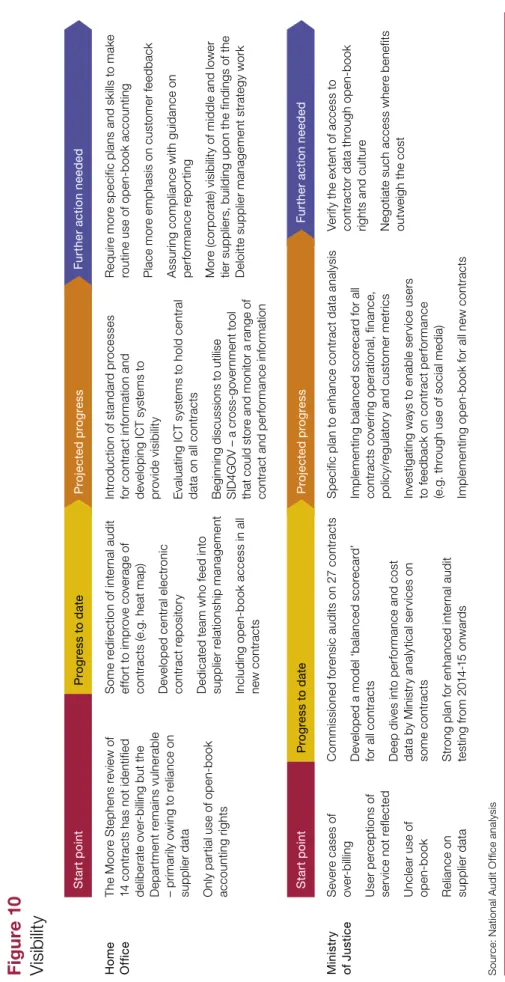
33 For good contract management, departments need accessible and reliable information on contract requirements, costs, performance and risks, ideally shared between customer and contractor. They should have a single management information system to ‘push’ regular reports and ‘pull’ responses to ad hoc queries in a consistent format on all contracts, for management scrutiny. Contracts should provide sufficient financial incentives on contractors to ensure that timely performance and cost data are accurately reported. Figure 10 summarises progress.
34 The Ministry faced greater challenges in developing its plan than the Home Office, as it found more severe billing issues on electronic monitoring in 2013 (see paragraph 11). In HM Courts & Tribunals Service, users of contracted services reported that their experience was less favourable than the department’s assessments of contractor performance. Such concerns were not evident within the Home Office. Both departments relied on unaudited contractor data and neither fully used
‘open-book’ access rights to data, to understand contractor costs and performance.
35 Both departments have made useful improvements, although taking different approaches. The Ministry has started to redesign the information it collates and analyses, developing better information on all contracts. In comparison, the Home Office made immediate changes to produce a ‘heat map’. This gives an overall picture of performance and risks on the 14 important and high-risk contracts selected for the Moore Stephens review. Trends in these contracts may not be representative of trends in the department’s wider portfolio.
Fi
g
ur
e 1
0
V
is
ib
ilit
y
So ur ce : N at iona l A ud it O ffi ce a na ly si s Hom e O ff ic e Mini st ry of J us tic e Th e M oo re S te ph en s r ev ie w o f 14 c on tr ac ts h as n ot i de nt ifi ed de lib er at e ov er -b ill in g b ut t he D ep ar tm en t r em ai ns v ul ner ab le – p rim ar ily o w in g t o r el ia nc e o n su pp lie r d at a O nl y p ar tia l u se o f o pe n-bo ok ac cou nt ing r ig ht s S ev er e c as es o f ov er -b illi ng U se r p er ce pt io ns o f se rv ic e no t r ef le ct ed Un cle ar us e o f op en -b ook R el ia nc e o n sup pl ie r da ta C omm is si one d for en si c aud its on 2 7 con tr act s D ev el op ed a m od el ‘ ba la nc ed s co re ca rd ’ fo r a ll c on tr ac ts D ee p d iv es i nt o p er fo rm an ce a nd c os t da ta b y M in is tr y a na ly tic al s er vi ce s o n som e con tr act s S tr on g pla n f or e nha nc ed in te rna l a ud it te st in g f ro m 2 01 4-15 o nw ar ds S pe cif ic pla n t o e nha nc e c on tr act d at a a na ly si s Imple m en tin g b ala nc ed s cor ec ar d f or a ll con tr act s c ov er in g op er at iona l, f in an ce , po lic y/ re gul at or y a nd c us to m er m et ric s In ve st ig at in g w ay s t o e na bl e s er vi ce u se rs to fe ed ba ck on c on tr act p er for ma nc e (e .g . t hr ou gh u se o f s oc ia l m ed ia ) Imple m en tin g op en -b ook for a ll ne w c on tr act s Ve rif y t he ex te nt o f a cc es s t o con tr act or d at a t hr ough op en -b ook righ ts a nd c ult ur e N ego tia te s uc h a cc es s w he re b ene fit s ou tw ei gh t he c os t S om e r ed ire ct ion o f i nt er na l a ud it ef fo rt t o i m pr ov e c ov er ag e o f con tr act s ( e. g. he at ma p) D ev el op ed c en tr al e le ct ron ic con tr act r ep osit or y D ed ic at ed t ea m w ho f ee d i nt o sup pl ie r r ela tion sh ip ma na ge m en t In cl ud in g o pe n-bo ok a cc es s i n a ll ne w c on tr act s In tr odu ct io n o f s ta nd ar d pr oc es se s for c on tr act in for ma tion a nd de ve lo pi ng I C T s ys te m s t o pr ov id e v is ib ili ty E va lu at in g I C T s ys te m s t o h ol d c en tr al da ta o n a ll c on tr ac ts B egi nni ng di sc us sio ns to u til ise S ID 4G O V – a c ro ss -g ov er nm en t t oo l th at c ou ld s to re a nd m on ito r a r an ge o f con tr act a nd p er for ma nc e i nf or ma tion R eq ui re m or e s pe ci fic p la ns a nd s ki lls t o m ak e rou tin e u se o f o pe n-bo ok a cc ou nt ing P la ce m or e e mpha si s on c us tom er fe ed ba ck A ss ur in g c ompl ia nc e w ith g ui da nc e on pe rf or m anc e r epo rt ing M or e ( co rp or at e) v is ib ili ty o f m id dl e a nd l ow er tie r s up pl ie rs, b ui ld in g u po n t he f in di ng s o f t he D el oit te s up pl ie r ma na ge m en t s tr at eg y w or k Fu rt he r ac tio n ne ede d P ro je ct ed p ro g re ss P ro g re ss to d ate S ta rt p o int Fu rt he r ac tio n ne ede d P ro je ct ed p ro g re ss P ro g re ss to d ate S ta rt p o int36 The Ministry is expanding its internal audit coverage of contract management and started work on ‘data scorecards’ for each contract (Figure 11). The Ministry has re-examined the data it collects through robust analytical reviews, in order to understand what information is needed to measure performance and validate payments. The
Ministry envisages that it may be able to reduce the amount of data it collects on some contracts. The Home Office has not done equivalent work, other than to increase its planned internal audit coverage of contract management from 0% to 3%. In addition, some of the department’s 2014-15 audit work is focused on project and programme management, which can include elements of contract management.
37 During 2014, the Ministry plans to implement its data scorecard approach and to roll out its internal audit programme across major contracts. The scorecards would give data about all dimensions of contract management. The Ministry aims to combine this data into an overall view of its contracts. The Home Office is not yet planning such a systematic approach. Both departments are also reviewing their information technology systems to collate master versions of contractual information centrally. The Home Office has issued standard procedures about contractual information and how it should be stored, for example in its newly-developed electronic contract repository. It has also begun to plan the implementation of SID4GOV – a cross-government tool intended to store and report a range of contract and performance information. The Ministry are also exploring how they might use SID4GOV.
Figure 11
Ministry of Justice balanced scorecard for major contracts
Operational
Agreed summary of lead operational Key Performance Indicatiors (KPIs)
Trend analysis of KPI performance over time Relevant comparison of performance against similar contracts (if appropriate)
KPIs may be quantitative or qualitative but will demonstrate current value against target
Policy or regulatory
Information linking contract delivery to the intended policy objective
KPIs relating to regulatory requirement (for example health and safety) KPIs relating to policy requirement (for example reoffending rates)
Source: Ministry of Justice
Finance
Contract value against actual spend Expected savings against actual savings Any significant changes with financial impact Cost impact of performance issues: • Service credits and debits
• Deductions due to non-delivery of service
Customer
End-user feedback for example helpdesk KPIs Customer survey results
38 Overall, the Home Office plans for data visibility include less activity than the Ministry’s data scorecard, robust analytical reviews and expansion of internal audit coverage. The Ministry is also considering new ways to gather user feedback, possibly via social media, although it is unclear whether this is feasible. The Home Office has focused on particular contracts and strengthening guidance to disseminate good practice in data collection, validation and reporting. If the departments implement both plans, the Ministry would be less exposed than the Home Office to management information risks, such as unidentified misreporting of performance or costs.
Overall conclusion on value for money
39 The root cause of the weaknesses in contract management is failure over many years to establish contract management as a distinct and respected specialism with a strong ethos and well-defined responsibilities. Our accompanying report confirms this to be the position across government.19 Contract management roles have carried lower status and profile than posts on major policy development or projects, and in procurement teams. We consider this a dangerous position for outsourced services. Good value for money depends on contract managers making the planned savings and efficiencies that project and procurement teams only negotiate and set up. Stronger contract management is a natural and essential extension to existing initiatives to improve project management.
40 Overall, the Ministry started from a weaker position than the Home Office, finding far greater over-billing and poor contract ownership by some of its executive agencies and business units. The Ministry has responded promptly to these discoveries with a more comprehensive improvement plan which has the potential to be transformative. Other departments, including the Home Office, can learn from elements of it, taking into account their own circumstances and areas of weakness. Both departments have more to do to achieve good value for money from their contracted services. They must capitalise on the desire to improve before the end of 2015 in order to make the most of the current impetus for change.
Recommendations
41 Our recommendations to the departments cover each aspect of good contract management, and are consistent with our review of contract management across government. The higher level recommendations apply to both departments, the
subsequent bullets highlight where we consider one department can learn from the other.
a Both departments must maintain their current impetus to improve contract
management so that good practice becomes business as usual. Once
the spotlight is off contract management, the departments need governance structures and processes to monitor compliance with good practice. They must make continuous improvement a routine part of contract management.
•
The Ministry of Justice should learn from the Home Office’s approachto strategic contractor relationship management. The Home Office has executive oversight boards with its strategic suppliers to review overall performance, the client-contractor relationship and contractors’ ‘corporate renewal’ programmes.
•
The Home Office should learn from the Ministry of Justice’sarrangements to ensure compliance with good practice. The Ministry’s contract governance board includes representatives from across the Department, including business owners. This board will govern contract management within the Ministry, and will routinely scrutinise the management of supplier relations, performance and the department’s management plans for different contracts. The Home Office are considering how best to locate such functions within its governance arrangements.
b Departments must be able to rely on contractor information on cost
and performance against contracts, without wholesale and costly re‑performance and checking of data. Departments should therefore specify in contracts the need for accurate reporting, and include stringent penalty clauses for misreporting which are routinely enforced. Through this recommendation, backed up by selective checking, departments will shift the onus from themselves to contractors to demonstrate that the terms of the contract are being met.
c Both departments need a balanced scorecard for each major contract,
containing performance, cost and risk information. The senior responsible officer should report this to top management, and use verified, shared contractor information. Senior management should review these scorecards. Departments should hold contract information, including updated contracts and change documentation, on a common central information system.
•
The Home Office should replicate aspects of the Ministry of Justice’s increased data analytics capability. The Ministry has increased its analytical work to develop balanced scorecards for all major contracts, and is creating specific analyst roles within contract management teams.d Both departments need to ensure a joined up approach to contract management between commercial, legal and finance specialists, and operations managers. The Ministry is rolling out a multi-disciplinary team model and the Home Office is standardising roles and processes through revised guidance. However, both departments must comply with their newly documented approaches to avoid uncoordinated activity and poor transition between procurement and contract management.
•
The Home Office should learn from the Ministry of Justice’smulti‑disciplinary team model. The Ministry has recently implemented a multi-disciplinary team model for all contracts, which includes operations staff as well as commercial, finance and legal specialists.
e Both departments should carry out periodic skills audits to identify levels of commercial and contract management skills across their organisations. The departments should use this data to feed into regularly monitored skills plans, fill gaps, and target training. Both departments should also be more flexible in staffing, to flex the mix of experienced and inexperienced contract management staff, and they should place them according to the risk and complexity of each contract.
•
The Home Office should extend its skills audit beyond its commercialdirectorate to assess training needs for all contract management staff.
•
The Ministry of Justice should learn from the Home Office’s approachto assessing skills. It has begun training selected staff before auditing skill levels among contract management staff generally. Though this has enabled a quick start for training staff on high profile contracts the Ministry should assess the needs of all contract management staff, to direct future training to where it is most needed.
Appendix One
Contract management – Ministry of Justice
Context
1.1 The Ministry of Justice (the Ministry) contracts for a wide range of services and its contracts vary in size and purpose. It contracts with providers to operate large facilities such as prisons, to maintain and operate court buildings, and to electronically tag offenders. Key contractors include G4S, Serco and ICT companies such as Hewlett Packard. In 2013-14, the Ministry spent £2.6 billion in total with commercial suppliers including £1.3 billion with its largest 15 suppliers (Figure 12).
0 20 40 60 80 100 120 140 160 180 155 109 109 94 93 88 63 61 56 52 47 47 39 37 37
Figure 12
The largest 15 suppliers for the Ministry of Justice, 2013-14
£ million
Notes
1 Figures rounded to the nearest million.
2 Diagonal colour split does not represent value of different activity carried out by companies. Source: National Audit Office analysis of Cabinet Office data
G4S 2 Serco 2 Atos 2 Steria Geo Amey Hewlett Packar d
Bridgend Custodial Services BFS Gr
oup Mitie
CGI IT UK
Fazakerley Prison Services Exel plc
Mor
eton Prison Service s EDF Energ y Capit a Facilities management ICT/communications
A wide range of services Custodial/security
Discovery of over-billing
1.2 During re-tendering of its electronic monitoring contracts, the Ministry became aware that G4S and Serco had over-billed the Department.20 In May 2013, it ordered a forensic audit by PwC of those contracts (worth £722 million until 2012-13)21 and forensic audits of other contracts with those companies were ordered in July 2013.22 Separately in March 2013, the Ministry found apparent disparities in performance reporting against actual performance in its prisoner escort services contract with Serco. This led the Ministry and Serco to ask the police to investigate potentially fraudulent conduct in August 2013. The Electronic Monitoring contracts, Facilities Management and Manchester Courts contracts have been referred to the Serious Fraud Office.
1.3 In total, PwC reviewed 27 contracts:
•
For electronic monitoring, their forensic audit team analysed contractor data to estimate the over-billing. In total, the 2 companies repaid the Ministry £179.4 million in respect of the Electronic Monitoring contract and 3 others (for Prisoner Escorting and 2 facilities management contracts).23•
For other contracts with G4S and Serco, the team conducted forensic audits which included investigating controls surrounding billing, recalculating some invoices and estimating any over-billing.1.4 In July 2013, the Secretary of State made a Parliamentary statement and
announced an inquiry into contract management throughout the Ministry.24 The Breedon Review sampled 15 contracts, representing approximately 16% of the Ministry’s
contracts by value (Figure 4). Selection took into account risk of a potentially major impact should contract performance fail, contract value, service type, and known weaknesses, so as to capture major contract management issues.25 The Review recommendations were accepted by the Ministry and formed the basis of their contract management improvement plan. A timeline of the plan is at Figure 13 overleaf.
1.5 The plan covers the entire Department, apart from the Legal Aid Agency which contracts separately for civil and criminal legal services from solicitors, barristers and non-profit providers (Appendix Three). The Agency’s improved management of billing has ensured that while the accounts of the Agency’s predecessor were qualified until 2012, they have subsequently been clear.26 The Ministry and the Agency share good practice about contract management.
Figure 13
Ministry of Justice timeline for improving contract management
Source: National Audit Offi ce analysis
Aug
PwC audit of electronic monitoring completed, other audits completed by December 2013 2013 2014 2014 2015 Oct–Dec Planned roll-out of IACCM training to Ministry staff Jan‑Feb Planned IACCM organisational certification Jul onwards Planned introduction of self-assessment tool for staff
Sep onwards
Planned introduction of data analytical scorecard to all contracts
Sep
Transforming rehabilitation planned to start with new contract management structure
Nov
National Audit Office published reports on Electronic Monitoring (November 2013) and Language Services (January 2013) which scrutinise the Ministry’s failure to manage contracts
Oct
Ministry internal review of electronic monitoring concluded
Aug
Announcement of investigation into the Prisoner Escort contracts with Serco
May
Commercial and Contract Governance Committee began meeting
May
All senior responsible owners had responded to Director General Finance, Assurance and Commercial’s letter confirming that they hold copies of their contract and have a suitable structure in place
Dec
Tim Breedon completes his review which points to major failings within the Ministry’s contract management
Feb 2014 onwards
Contract Management Programme Board meets fortnightly to monitor improvement programme
Dec
Director General Finance, Assurance and Commercial wrote to all senior responsible officers asking for assurance over their contracts
Apr
Transfer of management of the Electronic
Monitoring contract to the procurement directorate
May
Announcement of forensic audit into G4S and Serco Electronic Monitoring contracts following Ministry’s re-tendering of these contracts
Jul
In light of the forensic work, Chris Grayling announced a review of MoJ contract management by Tim Breedon
Mar–Apr
Ministry developed their model for contract management teams and updated job descriptions
Mar onwards
Analysis of performance information in contracts by analytical services team at the Ministry
Mar
Design of new internal audit strategy
Jul onwards
Planned roll out of new internal audit approach for financial year 2014-15
Figure 13
Ministry of Justice timeline for improving contract management
Source: National Audit Offi ce analysis
Aug
PwC audit of electronic monitoring completed, other audits completed by December 2013 2013 2014 2014 2015 Oct–Dec Planned roll-out of IACCM training to Ministry staff Jan‑Feb Planned IACCM organisational certification Jul onwards Planned introduction of self-assessment tool for staff
Sep onwards
Planned introduction of data analytical scorecard to all contracts
Sep
Transforming rehabilitation planned to start with new contract management structure
Nov
National Audit Office published reports on Electronic Monitoring (November 2013) and Language Services (January 2013) which scrutinise the Ministry’s failure to manage contracts
Oct
Ministry internal review of electronic monitoring concluded
Aug
Announcement of investigation into the Prisoner Escort contracts with Serco
May
Commercial and Contract Governance Committee began meeting
May
All senior responsible owners had responded to Director General Finance, Assurance and Commercial’s letter confirming that they hold copies of their contract and have a suitable structure in place
Dec
Tim Breedon completes his review which points to major failings within the Ministry’s contract management
Feb 2014 onwards
Contract Management Programme Board meets fortnightly to monitor improvement programme
Dec
Director General Finance, Assurance and Commercial wrote to all senior responsible officers asking for assurance over their contracts
Apr
Transfer of management of the Electronic
Monitoring contract to the procurement directorate
May
Announcement of forensic audit into G4S and Serco Electronic Monitoring contracts following Ministry’s re-tendering of these contracts
Jul
In light of the forensic work, Chris Grayling announced a review of MoJ contract management by Tim Breedon
Mar–Apr
Ministry developed their model for contract management teams and updated job descriptions
Mar onwards
Analysis of performance information in contracts by analytical services team at the Ministry
Mar
Design of new internal audit strategy
Jul onwards
Planned roll out of new internal audit approach for financial year 2014-15
Governance
Context
1.6 The absence of adequate governance structures, and of clearly defined roles and responsibilities for ongoing contracts, contributed to the problems on electronic monitoring. The Ministry had discovered billing issues in 2008, but nothing substantive was done at that time to address the issues.27 Within the Ministry, there was a culture in which managers did not hold themselves or teams accountable for contract management. Problems extended beyond electronic monitoring: the Breedon Review found issues with governance processes on each contract it examined.28
The Ministry are developing new contract management structures
1.7 Figure 14 summarises the findings of various reviews and the Ministry’s response.
Creating new corporate governance structures
1.8 Before 2014, the Ministry operated no senior boards or committees that focused on contract management. PwC concluded that, for electronic monitoring, inconsistent and insufficient oversight of the contract management team by senior management, and a decline in resources available to the contract management team, had been significant factors in the failure of contract management on those Electronic Monitoring contracts. In response, the Ministry has created new structures (Figure 15 on page 32) to guide the contract management reforms and ensure consistent senior oversight in the future. In January 2014, the Ministry created a programme board to administer a contract management improvement plan. The Director General (Finance, Assurance and Commercial) chaired the board, which included senior representatives from across the Ministry and its agencies.
1.9 From May 2014, the previous procurement committee was replaced by a
commercial and contract governance committee. This includes senior members within the Ministry and its agencies, and reports directly to the Ministry’s executive committee. Crucially, it covers live contracts as well as procurements.
1.10 To support this structure, the Ministry is strengthening internal audit coverage. It has developed a tiered approach to review all contracts worth more than £10 million with more detailed reviews for higher risk contracts, including potentially forensic audits with PwC assistance. The Ministry has provided internal audit with an additional £210,000 to carry out this work in 2014-15. Coverage of contracts is planned to rise from 3% to 15% of internal audit’s effort, becoming more proportionate to the Ministry’s spending through contracts (31.5% of the Ministry’s expenditure in 2012-13).