Learning Tetris Using the Noisy Cross-Entropy Method
Istv´an Szita [email protected] Andr´as Lorincz [email protected]
Department of Information Systems, E¨otv¨os Lor´and University, Budapest, Hungary H-1117
The cross-entropy method is an efficient and general optimization algo-rithm. However, its applicability in reinforcement learning (RL) seems to be limited because it often converges to suboptimal policies. We ap-ply noise for preventing early convergence of the cross-entropy method, using Tetris, a computer game, for demonstration. The resulting policy outperforms previous RL algorithms by almost two orders of magnitude. 1 Introduction
Tetris is one of the most popular computer games (see, e.g., Fahey, 2003). Despite its simple rules, playing the game well requires a complex strat-egy and lots of practice. Furthermore, Demaine, Hohenberger, and Liben-Nowell (2003) have shown that Tetris is hard in a mathematical sense as well. Finding the optimal strategy is NP-hard even if the sequence of tetro-minoes is known in advance. These properties make Tetris an appealing benchmark problem for testing reinforcement learning (and other machine learning) algorithms.
Reinforcement learning (RL) algorithms are quite effective in solving a variety of complex sequential decision problems. Despite this, RL ap-proaches tried to date on Tetris show surprisingly poor performance. The aim of this note is to show how to improve RL for this hard com-binatorial problem. In this article, we put forth a modified version of the cross-entropy (CE) method (de Boer, Kroese, Mannor, & Rubinstein, 2004).
2 Applying the Cross-Entropy Method to Tetris
2.1 Value Function and Action Selection. Following the approach in Bertsekas and Tsitsiklis (1996), we shall learn state-value functions that are linear combination of several basis functions. We use 22 such basis functions: maximal column height, individual column heights, differences of column heights, and the number of holes. More formally, ifsdenotes a Tetris state Neural Computation18, 2936–2941(2006) C2006 Massachusetts Institute of Technology
andφi(s) is the value of basis functioni in this state, then according to
weight vectorw, the value of statesis
Vw(s) :=
22
i=1
wiφi(s). (2.1)
During a game, the actual tetromino is test-placed in every legal posi-tion, and after erasing full rows (if any), the value of the resulting state is calculated according toVw. Finally, we choose the column and direction
with the highest value.
2.2 The Cross-Entropy Method. The cross-entropy (CE) method is a general algorithm for (approximately) solving global optimization tasks of the form
w∗=arg max
w S(w), (2.2)
whereSis a general real-valued objective function, with an optimum value γ∗=S(w∗). The main idea of CE is to maintain a distribution of possible solutions and update this distribution at each step (de Boer et al., 2004). Here a very brief overview is provided.
The CE method starts with a parametric family of probability distri-butionsF and an initial distribution f0∈F. Under this distribution, the probability of drawing a high-valued sample (having value near γ∗) is presumably very low; therefore, finding such samples by naive sampling is intractable. For any γ ∈R, let g≥γ be the uniform distribution over
the set{w:S(w)≥γ}. If one finds the distribution f1∈F closest to g≥γ
with regard to the cross-entropy measure, then f0 can be replaced by f1 andγ-valued samples will have larger probabilities. For many distri-bution families, the parameters of f1 can be estimated from samples of f0. This estimation is tractable if the probability of the γ-level set is not very low with regard to f0. Instead of the direct computation of the F -distribution closest tog≥γ∗, we can proceed iteratively. We select aγ0 ap-propriate for f0, update the distribution parameters to obtain f1, selectγ1, and so on, until we reach a sufficiently largeγk. Below we sketch the
spe-cial case whenw is sampled from a member of the gaussian distribution family.
Let the distribution of the parameter vector at iteration t be ft∼
N(µt, σt2). After drawingnsample vectorsw1, . . . , wnand obtaining their
valueS(w1), . . . ,S(wn), we select the bestρ·nsamples, where 0< ρ <1
is the selection ratio. This is equivalent to settingγt=S(wρ·n). Denoting the set of indices of the selected samples byI ⊆ {1,2, . . . ,n}, the mean and
the deviation of the distribution is updated using µt+1:= i∈Iwi |I| (2.3) and σ2 t+1:= i∈I(wi−µt+1)T(wi−µt+1) |I| . (2.4)
2.3 The Cross-Entropy Method and Reinforcement Learning. Appli-cations of the CE method to RL include the parameter tuning of radial basis functions (Menache, Mannor, & Shimkin, 2005) and adaptation of a param-eterized policy (Mannor, Rubinstein, & Gat, 2003). We apply CE to learn the weights of the basis functions, drawing each weight from an independent gaussian distribution.
2.4 Preventing Early Convergence. Preliminary investigations showed that applicability of CE to RL problems is restricted severely by the phe-nomenon that the distribution concentrates to a single point too fast. To prevent this, we adapt a trick frequently used in particle filtering: at each it-eration, we add some extra noise to the distribution: instead of equation 2.4, we use σ2 t+1:= i∈I(wi−µt+1)T(wi−µt+1) |I| +Zt+1, (2.5)
whereZt+1is a constant vector depending only ont. 3 Experiments
In the experiments we used the standard Tetris game described in Bertsekas and Tsitsiklis (1996), scoring 1 point for each cleared row. Each parameter had an initial distribution of N(0,100). We setn=100 andρ=0.1. Each drawn sample was evaluated by playing a single game using the corre-sponding value function. After each iteration, we updated distribution pa-rameters using equations 2.3 and 2.5 and evaluated the mean performance of the learned parameters. This was accomplished by playing 30 games us-ingVµt, and averaging the results. (The large number of evaluation games
was necessary because Tetris strategies have large performance deviations; Fahey, 2003.)
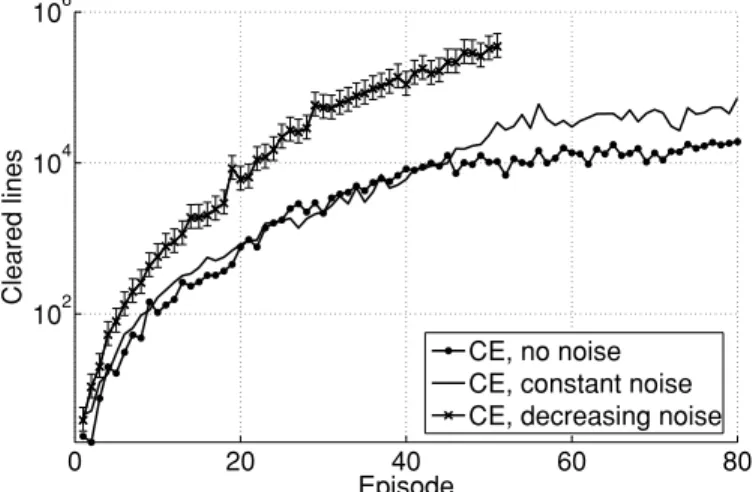
In experiment 1 we tested the original CE method (corresponding toZt=
0). As expected, deviations converge to 0 too fast, so the mean performance settles at about 20,000 points. In experiment 2 we used a constant noise rate
0 20 40 60 80 102 104 106 Episode Cleared lines CE, no noise CE, constant noise CE, decreasing noise
Figure 1: Tetris scores on logarithmic scale. Mean performance of 30 evalua-tions versus iteration number. Error bars denoting 95% confidence intervals are shown on one of the curves.
of Zt=4, raising mean performance to a 70,000 point level. Our analysis
showed that further improvement was counteracted by the amount of noise, which was too high, and thus prevented convergence of the distributions. Therefore, in experiment 3, we applied a decreasing amount of noise,Zt=
max(5−10t,0). With this setting, average score exceeded 300,000 points by the end of episode 50, and the best score exceeded 800,000 points. In experiments 2 and 3, noise parameters were selected in an ad hoc manner, and no optimization was carried out. Results are summarized in Figure 1 and in Table 1.
Assuming an exponential score distribution (Fahey, 2003), we calculated the 95% confidence intervals of the mean. For better visibility, confidence intervals have been plotted only for experiment 3.
Learning took more than one month of CPU time on a 1 GHz machine using Matlab. The main reason for the long learning course is the fact that for Tetris, evaluation time of the value function scales linearly with the score, and the score is very noisy.1 Related to this, the computational overhead of the CE method is negligibly small.
Because of the large running times, experiments consisted of only a single training run. However, preliminary results on simplified Tetris problems show that over multiple trials, the method consistently converges to the same region.
1It is conjectured that the length of a game can be approximated from its starting sequence (Fahey, 2003), which could reduce evaluation time considerably.
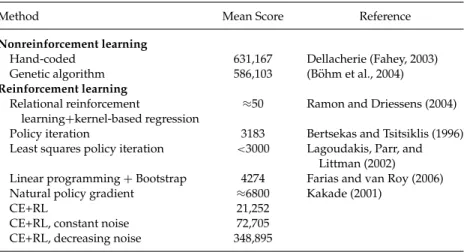
Table 1: Average Tetris Scores of Various Algorithms.
Method Mean Score Reference
Nonreinforcement learning
Hand-coded 631,167 Dellacherie (Fahey, 2003) Genetic algorithm 586,103 (B ¨ohm et al., 2004) Reinforcement learning
Relational reinforcement
learning+kernel-based regression
≈50 Ramon and Driessens (2004) Policy iteration 3183 Bertsekas and Tsitsiklis (1996) Least squares policy iteration <3000 Lagoudakis, Parr, and
Littman (2002) Linear programming+Bootstrap 4274 Farias and van Roy (2006) Natural policy gradient ≈6800 Kakade (2001)
CE+RL 21,252
CE+RL, constant noise 72,705 CE+RL, decreasing noise 348,895
3.1 Comparison to Previous Work. Tetris has been chosen as a bench-mark problem by many researchers to test their RL algorithms. Table 1 summarizes results known to us, comparing them to our algorithm and to two state-of-the-art non-RL algorithms as well.
The comparison shows that our method improves on the performance of the best RL algorithm by almost two orders of magnitude and gets close to the best non-RL algorithms (Fahey, 2003; B ¨ohm, K ´okai, & Mandl, 2004).
We think that by applying the performance enhancement tech-niques in B ¨ohm et al. (2004)—more basis functions, exponential value function—further significant improvement is possible.
References
Bertsekas, D. P., & Tsitsiklis, J. N. (1996).Neuro-Dynamic Programming. Nashua, NH: Athena Scientific.
B ¨ohm, N., K ´okai, G., & Mandl, S. (2004). Evolving a heuristic function for the game of Tetris. In T. Scheffer (Ed.),Proc. Lernen, Wissensentdeckung und Adaptivit¨at LWA—2004(pp. 118–122). Berlin.
de Boer, P., Kroese, D., Mannor, S., & Rubinstein, R. (2004). A tutorial on the cross-entropy method.Annals of Operations Research, 134(1), 19–67.
Demaine, E. D., Hohenberger, S., & Liben-Nowell, D. (2003). Tetris is hard, even to approximate. InProc. 9th International Computing and Combinatorics Conference (COCOON 2003)(pp. 351–363). Berlin: Springer.
Fahey, C. P. (2003). Tetris AI. Available online at http://www.colinfahey.com Farias, V. F., & van Roy, B. (2006).Tetris: A study of randomized constraint sampling. In
G. Calafiore & F. Dabbene (Eds.),Probabilistic and randomized methods for design under uncertainty. Berlin: Springer-Verlag.
Kakade, S. (2001). A natural policy gradient. In T. G. Dietterich, S. Becker, & Z. Ghahramani (Eds.), Advances in neural information processing systems, 14
(pp. 1531–1538). Cambridge, MA: MIT Press.
Lagoudakis, M. G., Parr, R., & Littman, M. L. (2002). Least-squares methods in reinforcement learning for control. InSETN ’02: Proceedings of the Second Hellenic Conference on AI(pp. 249–260). Berlin: Springer-Verlag.
Mannor, S., Rubinstein, R. Y., & Gat, Y. (2003). The cross-entropy method for fast policy search. InProc. International Conf. on Machine Learning (ICML 2003), (pp. 512–519). Menlo Park, CA: AAAI Press.
Menache, I., Mannor, S., & Shimkin, N. (2005). Basis function adaption in temporal difference reinforcement learning.Annals of Operations Research, 134(1), 215–238. Ramon, J., & Driessens, K. (2004). On the numeric stability of gaussian processes regression for relational reinforcement learning. InICML-2004 Workshop on Rela-tional Reinforcement Learning(pp. 10–14). N.p.: Omni press.