doi: 10.17700/jai.2019.1.1.507 53 Zsolt Csapó, Ádám Péntek, Tünde Csapóné Riskó: Perception and acceptance of cottage cheese made from goat milk – Statistical analysis of an emprical study
Hungarian Association of Agricultural Informatics European Federation for Information Technology in Agriculture, Food and the Environment
Journal of Agricultural Informatics. Vol. 10, No. 1 journal.magisz.org
Perception and acceptance of cottage cheese made from goat milk – Statistical
analysis of an emprical study
Zsolt Csapó1, Ádám Péntek2, Tünde Csapóné Riskó3
I N F O
Received 06 Sep 2019 Accepted 30 Sep 2019 Available on-line 30 Sep 2019 Responsible Editor: M. Herdon
Keywords:
goat milk, cottage cheese, health
A B S T R A C T
The economic importance of goat production has increased worldwide during the last few decades. Goats have many advantages that enable them to maintain their production under extreme climate and geographic conditions. Among domestic ruminants, goats have the highest capacity to effectively convert feed into meat and milk. Goat milk products are considered to be the dairy products with the greatest marketing potential. Fermented goat milk incorporating live probiotic cells represents a group of products with great prospects in the future with regards to their nutritive and therapeutic properties.
Although goat milk products have numerous health benefits, they are rarely bought and consumed in Hungary. The main objective of our empirical research was to analyse the respondents’ perception and acceptance towards cottage cheese made from goat milk in Debrecen, Hungary. The research method was blinded testing of cottage cheeses made from cow, sheep and goat milk. The research has been carried out in the autumn, 2018 and beginning of 2019 with a sample of 202. Based on the results it can be stated, that respondents had rather similar opinion (outlook, smell, taste, fatness and colour) on the three tested cottage cheeses. The affordable price is almost the same, roughly 0.8 – 1.0 EUR/250 gr. Regarding the preferred way of consumption, respondents would eat the cow and goat cottage cheese sweet while the sheep cottage cheese salty. This result might be related to their natural characteristics. Our blinded test did not support the negative stereotypes toward goat milk products. When marketing Hungarian goat cottage cheese, its colour, outlook, fatness, healthiness, ways of consumption (recipes) and local handmade nature should be emphasised.
1
Introduction
Milk is a prehistoric source of food for mankind produced by mammals to feed their infants (Kanwal et al. 2004 in Rasheed et al. 2016). Milk plays essential role in our daily life. It is consumed fresh and also in the form of various products such as yogurt, cheese, butter, etc. (Khan & Masud, 2013 and Sameen et al. 2010 in Rasheed et al. 2016).
Goat milk differs from cow or human milk in having better digestibility, alkalinity, buffering capacity and certain therapeutic values in human nutrition and medicine (Haenlein & Caccese 1984; Park & Chukwu 1989; Park 1994). The unique characteristics of goat milk have been fairly well surveyed regarding nutritional value and health effects. The superior digestibility of goat milk, the proper composition of fatty acids, protein and its content of bioactive compounds seem to give properties suitable for treating or preventing certain medical conditions. Goat milk has beneficial effects on malabsorption disorders and inflammatory bowel diseases. Goat milk contains higher amounts of calcium, magnesium and phosphorous than cow and human milk. More medium chain triglycerides and proteins occur in goat milk, and have been recognised as unique lipids and proteins
1 Zsolt Csapó
University of Debrecen, Faculty of Economics and Business [email protected]
2 Ádám Péntek
University of Debrecen, Faculty of Economics and Business [email protected]
3 Tünde Csapóné Riskó
doi: 10.17700/jai.2019.1.1.507 54 Zsolt Csapó, Ádám Péntek, Tünde Csapóné Riskó: Perception and acceptance of cottage cheese made from goat milk – Statistical analysis of an emprical study
with unique health benefits. The soft curd of goat milk may be an advantage for adult humans suffering from gastrointestinal disturbances and ulcers. Goat milk is important for prevention of cardiovascular disease, cancer, allergy and microorganism and used for stimulation of immunity. Goat milk is recommended for infants, old and convalescent people (Haenlein 2004; Zenebe et al. 2014).
Comparing the biological value of goat, sheep and cow milk protein, Fenyvessy (2009) stated that the protein of goat milk was the most valuable, followed by the protein of sheep and cow milk. The ratio of essential amino acids was 46.7% in cow milk, 48.0% in sheep milk and 52.5% in goat milk (Agnithori et al. 1993 and Fenyvessy et al. 2001 in Fenyvessy 2009).
Goat milk has predominantly smaller fat globules compared to cow milk and is easier to digest (Fevrier et al. 1993; Jandal 1996; López-Aliaga et al. 2003; Ramos Morales et al. 2005; Olalla et al. 2009; Yangilar 2013).
Jenness (1980) reports that one of the most important contributions of goat milk to human nutrition is the calcium and phosphate that it supplies. Human milk contains much less of these minerals. Goat milk provides a great excess of Ca and P, in relation to energy to human infants. Both calcium and phosphorus of goat milk are absorbed by the human infant.
Goat milk has been recommended as a substitute for patients allergic to cow milk (Taitz & Armitage 1984; Park 1994; Guo et al. 2004; Yangilar 2013). 40-100% of patients allergic to cow milk proteins tolerate goat milk (Zeman 1982; Park 1994). The uniqueness of goat milk, yoghurt and cheese in human nutrition has several aspects: goat milk can be used for the treatment of direct or indirect cow milk allergy (Grezesiak 1989 in Anaeto et al. 2010). Yangilar (2013) also emphasises that the goat’s milk nutritional properties and lower allergenicity in comparison to cow milk, especially in non-sensitised children, has led to an increased interest in goat milk as a functional food, and now it forms part of the current trend to healthy eating in developed countries. However, Polgár (2009) and Domonkos & Geiner (2009) indicate that the research results on this issue are rather contradictory. Robinson (2001) also emphasises that further research and controlled trials using in vitro and in vivo immunological techniques are needed to address the value of goat milk in cows milk protein intolerance and lactose intolerance.
The higher proportion of medium-chain fatty acids in goat milk are known to be anti-bacterial, antiviral, inhibit development and dissolve cholesterol deposits, and be absorbed rapidly from the intestine (Shingfield et al. 2008)
1.1 Production and consumption of goat milk products in Hungary
Until the end of the 1990s, goat breeding in Hungary was relatively unimportant. However, new demand for so-called alternative products meeting the requirements of healthy nutritional programmes began to appear in the country, as well. Initially, this new demand was met with imported products, since the national goat population and goat dairy products could not compete with imported products (Marticsek et al. 1999). Due to many efforts, today, local goat milk and manufactured goat milk products can meet any and all market requirements (Szigeti 2004).
The number of individuals and companies keeping goats as a livelihood generated income or business reasons is probably a few hundred in Hungary. The number of farmers keeping some goats as a hobby or providing the family with goat milk is probably a few thousand (Kukovics 2007a). There are around 3-5,000 goat keepers in Hungary (the exact number is not known) and less than 80% keeps less than 10 goats. The breeds mainly belongs to Hungarian breeds, but 10% stem from imported breeds, such as Saanen, Alpine, Boer or Anglo-Nubian (Kukovics 2008a). Many poor people keep goats in Hungary, in mainly underprivileged regions (Kukovics 2007b). The production level (and number of animals), as well as keeping conditions are lagging behind the data for France, Spain, Italy, Greece and the Netherlands (Kukovics 2008b). Production level of the sector is weak and has been struggling with several problems for many years. The number of goat breeders and goats continuously fluctuates and the data are patchy. With the growing importance of healthy nutrition and lifestyle, growing demand is expected for goat milk and goat milk products that could contribute to the development of the goat sector (Kocsisné Gráf 2011).
doi: 10.17700/jai.2019.1.1.507 55 Zsolt Csapó, Ádám Péntek, Tünde Csapóné Riskó: Perception and acceptance of cottage cheese made from goat milk – Statistical analysis of an emprical study
of milk producing farmers comes from milk and manufactured goat milk products. It is common in the sector that goat breeders sell the produced goat milk and self-made dairy goat products directly (Hungarian Chamber of Agriculture 2017).
Mowlem (2005) in Csapó and Csapóné (2019) mentions that in the UK there is s considerable prejudice against goat products. He assumes that goat milk would be described by almost everyone who was not a goat enthusiast as ‘strong, smelly, salty or sweet’. The situation is rather similar in Hungary.
Szigeti (2004) and Szigeti (2005) report on the results of an empirical research study carried out in Hungary. Only a small ratio of respondents reported only very rarely buying and consuming goat dairy products. The most often purchased product was cheese. The main reason for refusing goat dairy products were: they did not like the taste of goat dairy products, they did not even know these products, these products are not easy to find and buy. The main reasons for buying these products are: healthiness, taste and quality. The respondents were concerned that goat dairy products were expensive. The research revealed that respondents were not familiar with the available brands and nutritional benefits of goat dairy products. Another empirical research study (Szigeti el al. 2014) revealed that the opinion of Hungarian respondents had not changed much since the time of the previous studies. Goat dairy products are still rarely consumed. The most preferred products are cheeses, followed by cottage cheese. Goat dairy products should not be considered as mass products; rather, its niche should be strengthened. In building up their image, primarily their tastiness, healthiness and traditional nature should be emphasised, but their reliable Hungarian origin, as well as their quality should also be pointed out.
1.2 Goat milk products: Cottage cheese
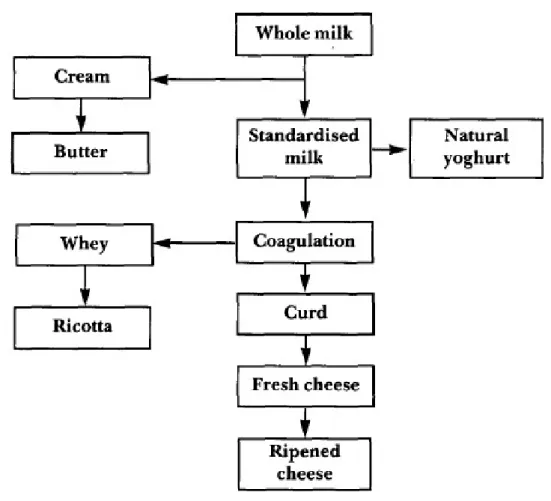
The chemical characteristics of goat milk can be used to manufacture a wide variety of products, including fluid beverage products (low fat, fortified, or flavoured) and UHT (ultra-high temperature) milk; fermented products, such as cheese, buttermilk or yogurt; frozen products, such as ice cream or frozen yogurt; butter; condensed/dried products; sweets and candies (Ribeiro & Ribeiro 2010; Yangilar 2013; Pal et al. 2017).Figure 1 shows the conversion of goat milk into main dairy products.
The high fat-content of goat's milk makes it very suitable for cheese-making, and so some delicious cheeses can be made (Peacock 1996).
Cheese is a fermented dairy product, which has hundreds of varieties. It is probably the most popular and well known value added dairy product (Pal 2014 in Pal et al. 2017). It is prepared from milk with the help of specific enzymes, starter bacteria and organic acid. Cheese is classified into various categories on the basis of appearance, manufacturing, ripening and chemical composition (Walstra et al. 2006 in Rasheed et al. 2016). Natural cheese is normally categorised on the basis of their moisture content or degree of softness or hardness. Cottage cheese is an example of soft cheese (Rasheed et al. 2016). Cheese can be classified into two groups: fresh and ripened. Fresh cheese is made from milk coagulated by acid or high heat and must be eaten quite soon after it is made or it will spoil. Cottage cheese is the most familiar example, but the category also includes cream cheese, Neuchatel, ricotta and mozzarella. Origin of the milk influences the flavour and aroma of a natural ripened cheese. Goat’s milk gives the cheese a spicier and more piquant flavour than cow’s milk primarily because of its fat has more caproic, caprylic and capric acid. These are fatty acids, distinguished from one another by the length of their carbon side chains. The milk also influences the colour of natural cheeses. The milk of sheep, water buffalo and some goats has little or no beta carotene, a yellow pigment, consequently the cheeses made from them are basically white (Kosikowski 1985).
doi: 10.17700/jai.2019.1.1.507 56 Zsolt Csapó, Ádám Péntek, Tünde Csapóné Riskó: Perception and acceptance of cottage cheese made from goat milk – Statistical analysis of an emprical study
Figure 1:Conversion of milk into dairy products
Source: Peacock 1996
“Cottage Cheese is a soft, rindless, unripened cheese in conformity with the General Standard for Cheese (CODEX STAN 283-1978) and the Standard for Unripened Cheese Including Fresh Cheese (CODEX STAN 221-2001). The body has a near white colour and a granular texture consisting of discrete individual soft curd granules of relatively uniform size, from approximately 3–12 mm depending on whether small or large type of curd is desired, and possibly covered with a creamy mixture (WHO-FAO 2011:148)”. The raw materials can be cows’ milk or buffaloes’ milk, or their mixtures, and products obtained from these milks (WHO-FAO 2011). Regarding raw materials, the Codex Alimentarius Hungaricus (2008) specifies the milk of more animals, such as cows’, sheep’, goats’ and buffaloes’ milk.
The permitted ingredients of cottage cheese are the following:
Starter cultures of harmless lactic acid and/ or flavour producing bacteria and cultures of other harmless micro-organisms
Rennet or other safe and suitable coagulating enzymes
Gelatine and starches: These substances can be used in the same function as stabilizers, provided they are added only in amounts functionally necessary as governed by Good Manufacturing Practice taking into account any use of the stabilizers/thickeners listed in section 4 of the Codex
Sodium chloride and potassium chloride as a salt substitute
Potable water
doi: 10.17700/jai.2019.1.1.507 57 Zsolt Csapó, Ádám Péntek, Tünde Csapóné Riskó: Perception and acceptance of cottage cheese made from goat milk – Statistical analysis of an emprical study
Carunchia Whetstine et al. (2003) emphasises that the flavour of dairy products, including cheese has been extensively studied, but dairy products made from goat milk have not been studied to the same extent as products made from cow milk. Products made from goat milk are typically characterised by a waxy, animal flavour. The flavours in fresh cheeses are much more delicate that those in aged cheese.
2
Material and methods
For analysing the perception and acceptance of cottage cheese made from goat, sheep and cow milk, blinded test was used as a primary research method. Respondents were asked to test the 3 different cottage cheeses. The three cheeses had been purchased directly from local producers, so they were handmade quality products. Respondents did not know what kind of cottage cheeses they tested. The cottage cheeses were numbered (No.1: made from cow milk, No.2: made from sheep milk and No.3: made from goat milk).
Characteristics (outlook, smell, taste, fatness and colour) of the 3 cottage cheeses were tested by the respondents using Likert scale 1-10 (1 meaning the worst and 10 meaning the best). The affordable price of 250 gr of the 3 different cottage cheese were also asked, as well as the preferred way of consumption.
The survey was conducted in the autumn 2018 and the beginning of 2019 with the involvement of 202 respondents. Location of data collection was a postsecondary school and companies in Debrecen, Hungary. Paper based data collection was carried out during the blinded test. Data were processed in SPSS. Regarding statistical methods, mean, median, standard deviation coefficient (H) and coefficient of variation (H2) were calculated. The coefficient of variation is the ratio of standard deviation to the mean expressed as percentage. Coefficient of variation can be defined as the coefficient of standard deviation with respect to mean which is generally expressed in terms of percentage. Coefficient of variation is used to compare the variability of two or more series. Standard deviation coefficient (H) is the square root of the coefficient of variation.
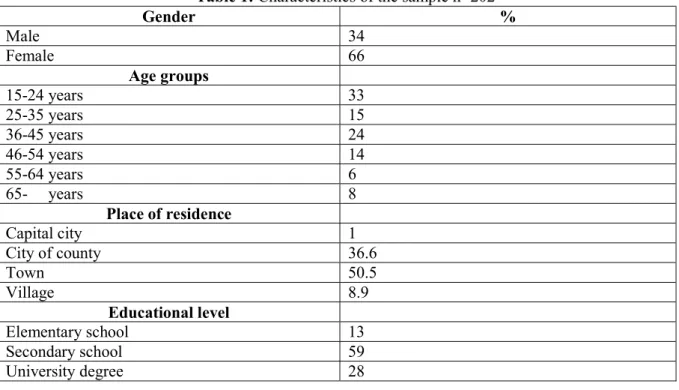
The introduction of the sample is shown in Table 1. It shows that the proportion of female to male in the sample is almost two times higher. Regarding the age distribution of the sample, the proportion of age group 15-24 is the highest. The place of residence is mainly city of county and town (36.6% and 50.5% respectively). The highest level of school respondents have completed is secondary school (59%). The perceived income level of respondents was average for most respondents (68.3%).
Table 1: Characteristics of the sample n=202
Gender %
Male 34
Female 66
Age groups
15-24 years 33
25-35 years 15
36-45 years 24
46-54 years 14
55-64 years 6
65- years 8
Place of residence
Capital city 1
City of county 36.6
Town 50.5
Village 8.9
Educational level
Elementary school 13
Secondary school 59
doi: 10.17700/jai.2019.1.1.507 58 Zsolt Csapó, Ádám Péntek, Tünde Csapóné Riskó: Perception and acceptance of cottage cheese made from goat milk – Statistical analysis of an emprical study
Perceived income level
Significantly under the average 3
Under the average 17.8
Average 68.3
Above the average 5
Significantly above the average 5.9
Source: own research, 2018, 2019
3
Results and discussion
Rasheed et al. (2016) carried out sensory evaluation of cottage cheese made from goat, cow, buffalo and sheep milk. The samples were evaluated by a panel consisting of 17 members by using 9 point Hedonic scale of Larmond. As they report, goat milk cottage cheese has higher mean flavour
score as compared to the other samples. As they report, this result is similar to the results of Soryal et al. (2004) and Mehanna and Hefnawy (1991). Texture of cottage cheese made from goat milk was extremely liked by the panel of judges as compared to the other cottage cheese samples. The taste of goat milk cottage cheese was more acceptable than the other cottage cheese samples. As regards after-taste, cottage cheese made from cow and goat milk was more acceptable than that of buffalo and sheep milk cottage cheeses. They report that this result is similar to the results of Adedokun et al. (2013). Generally Rasheed et al. (2016) state that all cottage cheese samples were of desirable quality attributes, but cottage cheese made from goat milk was more likeable compared to the ones made from sheep, buffalo and cow milk.
Our respondents had to evaluate the three different cottage cheeses using Likert scale 1-10 (1 is the worst and 10 is the best). Five different characteristics were evaluated by the respondents like outlook, smell, fatness, taste and colour. The cottage cheeses were marked with numbers and were offered on separate plates. Cottage cheese No. 1.: made from cow milk, Cottage cheese No. 2.: made from sheep milk and Cottage cheese No. 3.: made from goat milk. When tasting the cottage cheeses respondents were asked to fill in a questionnaire.
Evaluation of cottage cheese No 1 (made from cow milk) can be seen in Table 2.
Table 2: Evaluation of cottage cheese No. 1 n=202
Value Characteristics
Outlook Smell Taste Fatness Colour
Minimum 2.0 2.0 1.0 2.0 2.0
Maximum 10.0 10.0 10.0 10.0 10.0
Mean 8.1 7.5 7.3 7.7 8.5
Standard deviation 1.9 2.2 2.6 2.0 1.9
Source: own research, 2018, 2019
Regarding cottage cheese No. 2 (made from sheep milk) the same evaluation system was applied, results are shown in Table 3.
Table 3: Evaluation of cheese No. 2 n=202
Value Characteristics
Outlook Smell Taste Fatness Colour
Minimum 1.0 2.0 1.0 2.0 2.0
Maximum 10.0 10.0 10.0 10.0 10.0
Mean 7.8 8.0 7.7 7.2 8.2
Standard deviation 2.3 2.0 2.3 2.2 2.1
doi: 10.17700/jai.2019.1.1.507 59 Zsolt Csapó, Ádám Péntek, Tünde Csapóné Riskó: Perception and acceptance of cottage cheese made from goat milk – Statistical analysis of an emprical study
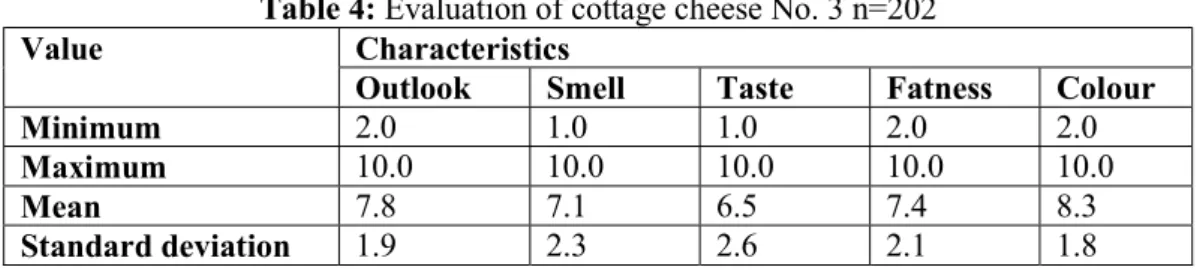
Results for cottage cheese No. 3 (made from goat milk) can be seen in Table 4.
Table 4: Evaluation of cottage cheese No. 3 n=202
Value Characteristics
Outlook Smell Taste Fatness Colour
Minimum 2.0 1.0 1.0 2.0 2.0
Maximum 10.0 10.0 10.0 10.0 10.0
Mean 7.8 7.1 6.5 7.4 8.3
Standard deviation 1.9 2.3 2.6 2.1 1.8
Source: own research, 2018, 2019
Results of the empirical research show, that the means are the highest for cottage cheese No. 1 (between 7.3-8.5). The means are relatively lower in case of cottage cheese No. 2 (7.2-8.2) and the lowest in case of cottage cheese No. 3 (6.5-8.3). It might reflect that cottage cheese made from cow milk is the most commonly consumed in Hungary. Cottage cheese made from sheep and goat are not so widely consumed. Regarding standard deviation, a low standard deviation indicates that the data points tend to be close to the mean of the set, while a high standard deviation indicates that the data points are spread out over a wider range of values. The standard deviation shows in all three cases that our data are not homogenous. The results show that the perceived characteristics of the tested cottage cheese were more or less similar for respondents, however the data were heterogeneous. This results is in contrary with the findings of some previous studies (Park 2010 and Mowlem 2005), that goat milk products have a “special smell or flavour”.
We wanted to know if there is any relation between the perceptible properties (outlook-smell, smell-taste, fatness-taste, colour-taste). So we set up 5 null hypothesis (H0) and 5 alternative hypothesis (H1). In the H0 we set that the two criteria are independent from each other. In the H1 we set that the two criteria are not independent from each other. Table 5 shows the result. We can state that the two criteria aren’t independent from each other and the strengthness of the relations between the two criteria are moderately strong at every product.
Table 5: Relations between the tested criteria n=202
Relations Cramer’s V
Cottage cheese No. 1 Cottage cheese No. 2 Cottage cheese No. 3
outlook-smell 0.562 0.517 0.432
smell-taste 0.597 0.602 0.452
fatness-taste 0.516 0.503 0.459
colour-taste 0.434 0.514 0.526
Source: own research, 2018, 2019
We asked our respondents how much they would pay for 250 gr cottage cheese? The mean was 0.88 EUR for cottage cheese No. 1, 1.00 EUR for cottage cheese No. 2 and 0.85 EUR for cottage cheese No. 3. It shows, that respondents would pay the highest amount for sheep cottage cheese. They would be willing to pay the lowest price for the cottage cheese made from goat milk. It could be reasoned with the fact that goat milk products are not easy to buy, their price is high and they are not widely known and consumed in Hungary.
doi: 10.17700/jai.2019.1.1.507 60 Zsolt Csapó, Ádám Péntek, Tünde Csapóné Riskó: Perception and acceptance of cottage cheese made from goat milk – Statistical analysis of an emprical study
Table 6: Preferred way of consumption of the tested cottage cheese n=202
Preferred way of consumption
Cottage Cheese No 1 (Percent)
Cottage Cheese No 2 (Percent)
Cottage Cheese No 3 (Percent)
Sweet 64.9 24.3 52.9
Salty 35.1 75.7 47.1
Total 100.0 100.0 100.0
Source: own research, 2018, 2019
4
Conclusions
doi: 10.17700/jai.2019.1.1.507 61 Zsolt Csapó, Ádám Péntek, Tünde Csapóné Riskó: Perception and acceptance of cottage cheese made from goat milk – Statistical analysis of an emprical study
5
REFERENCES
Adedokun, I.I., Okorie, S.U., Onyeneke E.N., Anoruo, S.A. (2013): Evaluation of yield, sensory and chemical characteristics of soft unripened cheese produced with partial incorporation of bambaranut milk. Academia Journal of Food Research 1(1): pp. 014-018 ISSN 2315-7763 http://dx.doi.org/10.15413/ajfr.2012.0114
Anaeto, M., Adeyeye, J. A., Chioma, G. O., Olarinmoye, A. O., Tayo, G. O. (2010): Goat products: Meeting the challenges of human health and nutrition. Agriculture and Biology Journal of North America. 1(6): 1231-1236 ISSN Print: 2151-7517, ISSN Online: pp. 2151-7525, http://dx.doi.org/10.5251/abjna.2010.1.6.1231.1236
Carunchia Whetstine, M. E., Karagul-Yuceer, Y., Avsar, Y. K., Drake, M. A. (2003): Identification of quantification of character aroma components in fresh chevre-style goat cheese. Journal of Food Science.68, (8), pp. 2441-2447 https://doi.org/10.1111/j.1365-2621.2003.tb07043.x
Csapó, Zs., Csapóné Riskó, T. (2019): Kecsketartás. kecsketejtermelés, kecsketej-termékek jelentősége, fogyasztása regionális kitekintéssel. Régiókutatás Szemle (1) 97-109 ISSN: 2559-9941
https://doi.org/10.30716/RSZ/2019/1/9
Domonkos, A., Greiner, E. (2009): A kiskérődzők teje a felnőttek táplálkozásában és a gyógy élelmezésben. In: A tej szerepe a humán táplálkozásban (Szerk.: Kukovics, S), Melánia Kiadó, Budapest, pp. 465-481 ISBN 978-963-9740-15-0
Fenyvessy, J. (2009): A kiskérődzők tejének értékes tulajdonságai a fogyasztás és a feldolgozás szempontjából. In: A tej szerepe a humán táplálkozásban (Szerk.: Kukovics, S), Melánia Kiadó, Budapest, pp. 417-424 ISBN 978-963-9740-15-0
Fevrier, C., Mourot, J., Jaguelin, Y., Mounier, A., Leberton, Y. (1993): Comparative digestive utilization of UHT goat and cow’s milk: nutritional effects of galation-use of a swine model. Lait 73:581-592 ISSN 0023-7302
Guo, M., Park, Y. W., Dixon, P. H., Gilmore, J. A., Kindstedt, P. S. (2004): Relationship between the yield of cheese (Chevre) and chemical composition of goat milk. Small Ruminant Research (52) pp. 103-107. ISSN 0921-4488 https://doi.org/10.1016/S0921-4488(03)00247-5
Haenlein, G. F. W., Caccese, R. (1984): Goat milk versus cow milk. In: Haenlein, G.F.W., Ace, D. (Eds.), Extension Goat Handbook. Fact Sheet E-1. United States Department of Agriculture, Washington, DC, 1984.
Haenlein, G. F. W. (2004): Goat milk in human nutrition. Small Ruminants Research. 51: pp.154-163 ISSN: 0921-4488 https://doi.org/10.1016/j.smallrumres.2003.08.010
Hungarian Chamber of Agriculture (2017): A kiskérődző ágazat stratégiai fejlesztése 2015. In: A kiskérődző szektor jelene és jövője – A Juh Terméktanács 25 éve tükrében. (Szerk: Kukovics, S) pp. 159-172
Jandal, J. M. (1996): Comparative aspects of goat and sheep milk. Small Ruminant Research 22: 177-185 ISSN: 0921-4488
Jenness, R. (1980): Composition and characteristics of goat milk- Review. Journal of Dairy Science. 63: pp. 1605-1630 https://doi.org/10.3168/jds.S0022-0302(80)83125-0
Kocsisné Gráf, M. (2011): A szánentáli kecskék életkorának és kondíciójának hatása a tejtermelésre és a szaporaságra. PhD Thesis. Debreceni Egyetem Agrár- és Gazdálkodástudományok Centruma, Állattenyésztési Tudományok Doktori Iskola
doi: 10.17700/jai.2019.1.1.507 62 Zsolt Csapó, Ádám Péntek, Tünde Csapóné Riskó: Perception and acceptance of cottage cheese made from goat milk – Statistical analysis of an emprical study
Kukovics, S. (2007a): A kecsketartásban alkalmazott gyephasználat. Magyar Mezőgazdaság, Magyar Juhászat + Kecsketenyésztés 16 (3) pp. 4-7
Kukovics, S. (2007b): Az anyakecske tartás támogatása. Őstermelő: Gazdálkodók Lapja 11(4):92 Kukovics, S. (2008a): A Magyar juh- és kecskeágazat helyzete és kilátásai. Magyar Mezőgazdaság. Magyar Juhászat + Kecsketenyésztés 17(3): 2-8
Kukovics, S. (2008b): Létszám és termelésváltozások az Európai (EU), valamint a magyar juh és kecskeszektorban. In: “A juhtenyésztés jelene és jövője az EU-ban”; (szerk.: Kukovics, S. – Jávor, A.); ISBN 978-963-8030-58-0. Kiadó: Magyar Juhtejgazdasági Egyesület - Debreceni Egyetem Agrár- és Műszaki Tudományok Centruma Herceghalom – Debrecen, 2008. pp. 9-29
López-Aliaga, I., Alférez, M. J. M., Barrionuevo, M. J., Nestares, T., Sanz-Sampelayo, M. R., Campos, M. S. (2003): Study of nutritive utilization of protein and magnesium in rats with resection of the distal small intestine. Beneficial effect of goat milk. Journal of Dairy Science (86) pp. 2958-2966. ISSN: 0022-0302 https://doi.org/10.3168/jds.S0022-0302(03)73893-4
Marticsek, J., Előd, R., Székelyhidi, T., Pataki, R., Belényesi, M. (1999): A kecskeágazat szerepe a nemzeti vidékfejlesztési és környezetgazdálkodási programokban. VI. Debreceni Állattenyésztési Napok. Debrecen. pp. 100-109
Mehanna, N. M., Hefnawy, S.A. (1991): Feasibility studies on manufacturing pickled soft cheese from goat’s milk. Egyptian Journal of Agricultural Research69: pp. 965-975
Mowlem, A. (2005): Marketing goat dairy produce in the UK. Small Ruminant Research 60: pp. 207-213 ISSN: 0921-4488 https://doi.org/10.1016/j.smallrumres.2005.06.036
Olalla, M., Ruiz-López, M. D., Navarro, M., Artacho, R., Cabrera, C., Gimėnez, R., Rodriquez, C., Mingorance, R. (2009): Nitrogen fractions of Andalusian goat milk compared to similar types of
commercial milk. Food Chemistry (113) pp. 835-838 ISSN: 0308-8146
https://doi.org/10.1016/j.foodchem.2008.10.022
Pal, M., Dudhrejiya, T. P., Pinto, S. (2017): Goat milk products and their significance. Beverage & Food World. 44 (7) pp. 21-25 ISSN 0970 6194
Park, Y. W. (1990): Nutrient profiles of commercial goat milk cheeses manufactured in the United
States. Journal of Dairy Science. 73: pp. 3059-3067 ISSN: 0022-0302
https://doi.org/10.3168/jds.S0022-0302(90)78993-X
Park, Y. W. (1994): Hypo-allergenic and therapeutic significance of goat milk. Small Ruminant Research 14: pp. 151-161 ISSN: 0921-4488 https://doi.org/10.1016/0921-4488(94)90105-8
Park, Y. W. (2010): Goat milk products: Quality, composition, processing, and marketing. In: Encyclopaedia of Animal Science, Publisher: CRC Press, Editors: Pond, W. G. and N. Bell, N. ISBN: 9781439809327
Park, Y. W., Chukwu, H. I. (1989): Trace mineral concentrations in goat milk from French-Alpine and Anglo-Nubian breeds during the first 5 months of lactation. Journal of Food Composition and Analysis 2: pp. 161-169 ISSN: 0889-1575 https://doi.org/10.1016/0889-1575(89)90077-X
Peacock, C. (1996): Improving Goat Production in the Tropics. Oxfam/FARM-Africa, pp. 307-315 ISBN 0 85598 268 36 (hardback) ISBN 0 85598 269 1 (paperback)
Polgár, M (2009): Van-e alternatív tejtáplálás a tehéntej-allergiás csecsemők és gyermekek számára? In: A tej szerepe a humán táplálkozásban (Szerk.: Kukovics, S), Melánia Kiadó, Budapest, pp. 437-443 ISBN 978-963-9740-15-0
doi: 10.17700/jai.2019.1.1.507 63 Zsolt Csapó, Ádám Péntek, Tünde Csapóné Riskó: Perception and acceptance of cottage cheese made from goat milk – Statistical analysis of an emprical study
Rasheed, S., Quazi, I. M., Ahmed, I., Durrani, Y., Azmat, Z. (2016): Comparative study of cottage cheese prepared from various sources of milk. Proceedings of the Pakistan Academy of Sciences: B. Life and Environmental Sciences 53 (4): pp. 269–282 (2016) ISSN: 4261 (print), ISSN 2518-427X (online)
Ribeiro, A. C., Ribeiro, S. D. A. (2010): Specialty products made from goat milk. Small Ruminant Research (89) pp. 225-233 ISSN: 0921-4488 https://doi.org/10.1016/j.smallrumres.2009.12.048 Robinson, F. (2001): Goats milk – a suitable hypoallergenic alternative? British Food Journal, Vol. 103 No. 3, pp. pp. 198-208 https://doi.org/10.1108/00070700110386746
Shingfield, K.J., Chilliard, Y., Toivonen, V., Kairenius, P., Givens, D.I. (2008): Trans fatty acids and bioactive lipids in ruminant milk. Adv. Exp. Med. Biol. 606: pp. 3–65. https://doi.org/10.1007/978-0-387-74087-4_1
Soryal, K.A., S.S. Zeng, B.R. Min, S.P. Hart, F.A. Beyene (2004): Effect of feeding systems on composition of goat milk and yield of Domiati cheese. Small Ruminant Research 54: pp. 121-129 ISSN: 0921-4488 https://doi.org/10.1016/j.smallrumres.2003.10.010
Szigeti, O. (2004): Kecsketejből készült élelmiszerek táplálkozási előnyei és fogyasztói szokásai. Élelmiszer, Táplálkozás és Marketing. 1 (1-2) pp. 1-17 ISSN 1786-3422 (Print) ISSN 2560-2551 (Online)
Szigeti, O., Szente, V., Szakály, Z. (2005): Fogyasztói megítélés a kecsketej termékek piacán. Élelmiszer, Táplálkozás és Marketing. 2 (1-2) 29-37 ISSN 1786-3422 (Print) ISSN 2560-2551 (Online)
Szigeti, O., Szente, V., Szűcs, A., Szendrő, K. (2014): Kecsketej termékek fogyasztói megítélése. Élelmiszer, Táplálkozás és Marketing. 10 (2) 29-34 ISSN 1786-3422 (Print) ISSN 2560-2551 (Online) Taitz, L. S., Armitage, B. L. (1984): Goat’s milk for infants and children. Br. Med. J., (288) pp. 428-429
Yangilar, F. (2013): As a potentially functional food: Goat’s milk and products. Journal of Food and Nutrition Research 1(4): pp. 68-81https://doi.org/10.12691/jfnr-1-4-6
Zeman, F. J. (1982): Clinical nutrition and dietetics. Callamore Press, D. C. Health & Co. Lexington, Massachusetts. USA
Zenebe, T., Ahmed, N., Kabeta, T., Kebede, G. (2014): Review on Medicinal and Nutritional Values of Goat Milk. Academic Journal of Nutrition 3 (3): pp. 30-39 ISSN 2309-8902 https://doi.org/10.5829/idosi.ajn.2014.3.3.93210
Codex Alimentarius Hungaricus (2008): Tejtermékek.
https://elelmiszerlanc.kormany.hu/download/2/25/b1000/13511_2008.pdf (Accessed: 10 May, 2019)
WHO-FAO (2011): Codex Alimentarius. Milk and milk products.