Digital Library Interoperability: Proposing a Model
M. Alipour Hafezi, Ph.D. Iranian Research Institute for Information Science and Technology (IRANDOC), Iran Corresponding author: [email protected]
A. Horri, Ph.D. Tehran University, Iran Email: [email protected]
A. Shiri, Ph.D. University of Alberta, Canada
Email:[email protected]
A. Ghaebi, Ph.D. Alzahra University, Iran Email: [email protected]
Abstract
The main purpose of this paper is identifying the current situation of Iranian digital libraries in terms of interoperability abilities and proposing an interoperability solution for Iranian digital libraries. Analytical survey is used in this research. In fact, questionnaire and observation were used for collecting data about the current situation of Iranian digital library applications. The gathered data were analyzed by system analytical method in order to propose some practical suggestions to use in Iranian digital library applications. Iranian digital libraries mostly collect text files. They store data in SQL server and in relational database systems. The majority of Iranian digital libraries do not respect interoperability. They mostly use just Z39.50 clients so as to gather bibliographic data to use in cataloguing center. In fact, most of studied digital libraries do not offer extracting standard formats. Also, they do not make use of structural and administrative metadata format in their bibliographic data. The proposed model is based on harvesting model, OAI protocol and METS/MODS metadata standard. Findings indicated that Iranian digital libraries should be alert about the essence of interoperability. Using the proposed model would help them to be able to exchange their data in a more cost-efficient and cost-effective manner.
Keywords: Interoperability, Digital Libraries, Interoperability Model, Metadata Format, Protocols, Information System Integration, Iran.
Introduction
format from 1970s. These activities have been one of the first steps in digital libraries' appearance. Progressively, information resources’ publication also changed from analogue to digital. So, we see currently electronic publications (e-book, e-journal, etc) that are published in only digital format (digital born) and we cannot find them in analogue formats. Therefore, these publications found their usage in pioneer digital libraries (DLs) and also the others. Even we currently see multimedia information resources which include text, sound, video and so on. These resources are factually called digital objects.
Considering financial, time and place restrictions that prevent collecting all related resources, libraries tried to find a way to make access to other library collections by interlibrary loan services. Though place restrictions owing to developing technologies and reducing costs of preservation and storage lose their importance, other restrictions have their importance and prevent collecting all resources by libraries and information centers. Therefore, importance of cooperation remains in the same manner.
In regard to digital collections and DLs, the way of interoperability among library applications in the analogue environment is changed. In fact, networks prepare facilities to exchange data easily and with little cost. Whereas DLs use different software packages and also store and preserve their bibliographic as well as digital objects in different ways, they encounter challenges in interoperability. On the other hand, librarians and users may not need expertise and knowledge in the field of computer systems. So, this may add to the importance of the problem. Thus, interoperability should be applicable in the way that users need the minimum computer knowledge (Miller 2000).
Statement of the Problem
One of important capabilities and library services is interoperability that was libraries’ concern for a long time (Shiri, 2003; Shi, 2005; Paepcke, Chang, Garcia-Molina & Winograd, 1998; Lynch & Garcia-Molina, 1995; Warren & Alsmeyer, 2005). In fact, libraries offered interlibrary loan services for this purpose. The use of ISO 2709 and Z39.50 in library software packages was just for this purpose. It should be considered that libraries used these formats just for bibliographic interchange and the result of this activity was used just by bibliographers in libraries. However, DLs need bibliographic and full-text data (full-image and all digital objects) for their interoperability plans. In fact, the result would be useful to users and also bibliographers.
protocol to be interoperable. Bear in mind that selecting a protocol has direct relation to the interoperability model that they want to work on. Therefore, identifying and introducing appropriate protocol and model could play an important role in designing a practical interoperability model. So, the main queries in this research are:
How DLs store data?
Which extracting formats do the studied DLs use?
Which methods and tools are used for interoperability among DLs?
Finally, what is the suitable model of interoperability in Iranian DLs?
Therefore, in this research, the way of storing data, extracting format, protocols and models used by Iranian DLs are surveyed. The findings prepare introductory data in order to be analyzed and the results are used for proposing an appropriate interoperability model. On the other hand, interoperability in this research is technical ability of information systems such as interoperability models, protocols, structural, descriptive and administrative metadata, context standard and so on to exchange their data with common protocols. According to this definition, the technical interoperability phrase is highlighted because interoperability as mentioned by Shi (2005) and NSDL project (NSDL Technical Infrastructure White Paper, 2004) has three technical, content and organizational levels. In regard to the importance and priority of technical level in interoperability, in this research the mentioned level is studied. In any way, the ultimate main purpose of this paper is proposing an interoperability solution for digital libraries in Iran.
Review of Literature
that they are not used by DLs. Their freshness is another reason for their not mentioning because they may not have opportunity to be used, and yet are laboratory products. On the other hand, it is possible that some are being used by projects but are not documented yet. Therefore, such cases were not surveyed in this research because cases that could be surveyed here were documented.
Primary study on research background showed that interoperability projects in DLs started from 1998 (Alipour-Hafezi, Horri, Shiri & Ghaebi, 2010; Maamar, 1998; Suleman, 2002). Regarding the appearance and generality of DLs that return to 1990s, we could find a direct relation between appearances of digital libraries and their use from interoperability techniques. Historical distribution of studied projects is presented in Table 1. As seen in Table 1, researchers and projects have more care for interoperability in DLs from 2003.
Table 1
Historical Distribution of Interoperability Projects (Alipour-Hafezi, Horri, Shiri & Ghaebi, 2010)
No Project Date Location Model Protocol Metadata Interchange
Mechanism
Full-text
1 SIGAL 1998 Canada Harvesting ? based on
HTTP ? ? ?
2 SDARTS 2001 USA Gathering SDARTS based on HTTP
STARTS
XML XML ?
3 ODL 2002 USA Harvesting OAI-PMH based on HTTP
XML Schema Description
(XSD)
XML ?
4 NDLTD 2003 USA Harvesting OAI-PMH
based on HTTP ETDMS XML ?
5 NSDL 2003 USA Harvesting OAI-PMH
based on HTTP DC XML ?
6 OAISter 2003 USA Harvesting OAI-PMH
based on HTTP DC XML ?
7 NASA 2003 USA Harvesting OAI-PMH
based on HTTP DC XML PDF
8 Greenstone 2003 New Zealand
Federated/ Harvesting/
Gathering
Z39.50/ OAI-PMH based on
HTTP/ SRW
MARC/
DC XML ?
9
Colorado digitization
program
2004 USA Federated Z39.50 DC/
MARC XML ?
10 CNDLTD 2004 China Harvesting OAI-PMH
No Project Date Location Model Protocol Metadata Interchange Mechanism
Full-text
11 LFDL 2004 China Federated Z39.50 ? XML PDF
12
State wide meta search
service
2005 USA Federated/ Harvesting
Z39.50/ OAI-PMH based on
HTTP
MARC/
DC MARCXML ?
13 NDAP 2005 Taiwan Harvesting OAI-PMH
based on HTTP DC XML ?
14 MWDL 2005 Canada Harvesting/ Federated
OAI-PMH based on HTTP/ Z39.50
DC MARCXML ?
15 CDS/ISIS 2006 ? Harvesting OAI-PMH
based on HTTP ? XML ?
16
University of Arizona Library
2006 USA Harvesting OAI-PMH based on HTTP
Qualified
DC RDF ?
17 ETD 2006 Wales Harvesting OAI-PMH based on HTTP
Qualified DC/
MODS/ UKETD
18
Integrating Digital Library
2006 USA Gathering ? based on HTTP
Global
Schema ? ?
19 HKUST 2007 Hong
Kong Harvesting
OAI-PMH based on HTTP
Qualified
DC XML PDF
20 Iran Library
Software 2008 Iran Harvesting
OAI-PMH
based on HTTP DC XML PDF
Furthermore, primary study in this case demonstrated that about 50 percent of the projects are related to USA that most of the projects related to interoperability are implemented in them (Alipour-Hafezi, Horri, Shiri & Ghaebi, 2010). XML, because of its hierarchical structure, is used in the most of the projects as a context layer format. Moreover, Qualified Dublin Core is used as a metadata standard in bibliographic data exchange. Open Achieves Initiative (OAI) is used in the most of the projects as a common protocol. It seems that OAI could be implementing more simply than Z39.50 used by libraries as a protocol for bibliographic data exchange. In fact, interoperability model that support this protocol is Harvesting model. Therefore, this model is used by the most of the projects (Alipour-Hafezi, Horri, Shiri & Ghaebi, 2010).
Methodology
Identifying target group
We encounter many DLs in Iran that are not DL in truth. Some with subscribing databases, some with gathering data about a distinct subject and the like call themselves DL. On the other hand, there are DLs that do not call themselves DL. For this purpose, the researchers prepared a digital library definition to identify the focus group of this research.
In this research, in order to identify research framework and research population a definition was presented for digital library and interoperability. Therefore, we offered 5 criteria in digital library definition. Digital library is an organization that has the following criteria: 1) Digital information resources should be gathered or published in regard to collection development policy; 2) Expert ones should select digital objects and organize them; 3) Digital objects should be offered to users by networks; 4) Managing digital objects should be based on file managing mechanisms such as managing presenting digital objects for users, managing access points, etc. and 5) Digital objects should be accessible such as resistant information resources. In this research, DLs that have these criteria without noting the amount of them are entitled digital library.
All in all, 11 DL applications observed the 5 mentioned criteria in the definition. Consequently, 11 DL applications were made target group of this research. The mentioned DL applications are as follows:
Azarakhsh digital library application
DID digital library application
Elm-o-Sanaat digital library application
Eram digital library application
Noor digital library application
Parvan digital library application
Payam digital library application
Sana digital library application
Simorgh digital library application
Tebyan digital library application
Vesta digital library application
Current situation
applications. As was mentioned before, the main tool in this research was researcher-made questionnaire. In order to make sure of some answers, researchers tested the abilities of studied software packages and observed their capabilities. In this case, a few answers were changed according to observation.
At all events, researchers prepared a questionnaire as a tool to survey the target group. The researchers made a questionnaire including 32 queries that were categorized in 4 parts. The first part which consists of queries 1-9, examines the resources and their formats in DLs. The second part which consists of queries 10-19, examines the way of resource repository in DLs. The first and second parts were used to answer the first main question of this research. The two mentioned primary parts answered the first basic question. The third part which consists of queries 20-25, examines the standard extractions of DLs. This section was related to the second main question. Finally, the fourth part which consists of queries 26-32, examines the way of interoperability in DLs. This section was related to the third basic question. The questionnaires were answered by DL managers and designers.3
Proposing interoperability model
System analytical method is used to propose an interoperability model based on literature review and study the current situation of DLs in the case of interoperability. In fact, literature review and current situation of target group made preliminary data to be analyzed so as to propose an appropriate interoperability model. Thus, the proposed model considers the current situation and mostly used interoperability tools and techniques. Its approach is factually forward-looking.
Findings
The way of storing data
Acquired information from the research population in the case of used operating system (OS) in the server-side showed that about 91 percent of them use windows OS. Therefore, using windows OS indicate that the mentioned ones have public acceptance in library applications. So, the first step in interoperability that is having similar OS on the server-side was performed.
From the scanning and the number of scanned items’ point of view, findings indicate that journal articles, books and theses are in the top priority in proportion to other resources. So, textual files have more important role in exchanging data between DLs.
Search into the scanned textual items could be possible by optical character recognition (OCR). In fact, findings indicate that just 4 libraries, use OCR for preparing search into the full-text. Regarding less use of this technique, there is less probability of using full-text search in items used in interoperability process.
Storing and presenting formats of digital objects in computer systems are various. However, DLs could use diverse formats in storing and also presenting data. In fact, homogeneity in use or supporting specific formats helps us to have less limitation in using lateral software in DLs. Actually, findings showed that PDF format for textual items is highly used in comparison to other formats.
In the case of image files, findings indicate that JPG and JPEG are highly used in comparison to others. Therefore, the two mentioned formats because of their quality and capacity could be used in image files in interoperability plan.
Findings indicate that MP3, WMI and WAV are highly used in audio files. Therefore, MP3 or each one of the mentioned formats could be used in exchanging audio files. Bear in mind that because of less use of this format, making a definite suggestion is difficult.
Also findings demonstrate that AVI and WMI are highly used in video files. Therefore, the mentioned format could be used in exchanging video files. Bear in mind that because of less usage of these files like audio files, making a definite suggestion is difficult.
Using descriptive metadata to identify digital objects is one of the important parts of preserving and retrieval in DLs. These metadata are as a tool for retrieving information especially for scanned items that their content is not identifiable by information systems. Findings indicate that all of the studied applications support metadata for describing digital objects. Therefore, bibliographic data could be used as an efficient tool for identifying digital objects and in interoperability between DL information systems. Bear in mind that descriptive metadata is not applicable without structural and administrative metadata in interoperability plans.
metadata standard, we should use converter because of using different kinds of MARC. In fact, the fields of Title, Author, Description, Publisher, Co-author, Date and Language are essential fields used by DLs regardless of the supported formats. The mentioned fields were emphasized by 91 percent of studied DLs.
Regarding the use of SQL database management system (DBMS) with the relational structure of data storage by 73 percent of the DLs, we could admit whether we need to design or make DBMS for interoperability especially when we use harvesting model, the SQL DBMS with relational structure could be used in local database.
Regarding the findings of this research, the public way of access to content in studied DLs is search in pre-coordinated index, presenting metadata and then presenting content in controlled way. Even though other methods are also used by studied DLs, the prevailing method is using index, presenting metadata and then controlled content. However, the proposed method could use this method in interoperability. Actually, in the systems that do not use this method, we could prepare simply this process regarding their use of metadata, SQL DBMS and also relational structure of data storage.
In the case of security in access to digital objects, in 73 percent of studied DLs, they first identify users and then get permission to search, access to metadata and finally access to digital objects. In fact, 3 other DLs use this process approximately. They firstly permit users and then let them access metadata. But when users want to get access to digital objects they need to be a member user. All in all, in the case of security in interoperability and getting access to digital objects, we should pay attention to these three steps.
At all events, findings of questions 1 to 19 of the questionnaire, in response to the first main question, demonstrate that the most common types of resources in DLs are text resources (mainly PDF format). In fact, there are a limited amount of image, sound and video files. Also, they make bibliographic data in MARC standard and store them in SQL server DBMS and also in relational structure. Furthermore, the process of information retrieval is search in pre-coordinated index, presenting metadata and then presenting content in controlled way. Also, the prevailing process in access to digital objects includes identifying users, search, presenting metadata and finally controlled access to digital objects.
Extract formats
Using XML in extracting bibliographic data in 82 percent of DLs and MARC format in 64 percent of DLs demonstrate that these two are more public. Therefore, in interoperability plans, we should pay attention to them. DLs that do not currently use XML, regarding the generality of it and capability of converting data to XML by DBMSs, could use it simply.
with interoperability plan, there is possibility of homogeneity regarding the current standards in extracting data. On the other hand, most of DLs demonstrate standard data to their users and only 4 of them demonstrate bibliographic standard data for all. Furthermore, in most of the DLs (in 73%), the mentioned ability is demonstrated just in the place of the library or maximum in the LAN of the library. This could be another limitation of DLs in interoperability plans in Iran. Thus, persuading DLs’ managers to demonstrate standard bibliographic data for users on the net should be in the preference of interoperability plans. Also, there is no relation between metadata and digital objects in about 64 percent of DLs. So, we should make plan to eliminate this problem. The mentioned ability could be eliminated with adding a hyperlink field to metadata fields.
Findings demonstrate that 91 percent of DL bibliographic data are not indexed by public search engines. Nevertheless, in 45 percent of them, if we had plan, we could do it simply. So, using federated model in interoperability would be too difficult.
In order to answer the second basic question, 6 queries from 20-25 in the questionnaire are allocated to it. Findings demonstrate that the metadata extracting data which are generally used by studied DLs is MARCXML. Nevertheless, some of them use MODS or MARC21. Unfortunately, extracting schema which is used in DLs is not accessible by users. However, a few of them present this facility in their local networks.
Interoperability ability among DL applications
Findings of this research showed that there is no possibility of interoperability among information systems in about 73 percent of studied DLs. In fact, just 3 of them applied interoperability in metadata level by Z39.50 in client side. Therefore, exchanging data among the studied DLs is not possible in such situation. Also, just one of them had planned to use Open Achieves Initiative (OAI) protocol. Thus, it seems that the interoperability plan could be applied simply by using Z39.50 protocol. Bear in mind that the mentioned protocol is just used in bibliographic level and less used in other DLs in overseas.
XML in context level, MARC in metadata level and Z39.50 as a protocol are mostly used by studied DLs. Just one of the DLs is going to use Metadata Encoding & Transmission Standard (METS). Therefore, the mentioned items could be used more than other cases. Bear in mind that MARC has limitations in DLs and is less used by DLs nowadays. Anyway, XML in context level, MARC in descriptive metadata level and METS in structural and administrative metadata levels could be used in interoperability plan of Iranian DLs. But, we should think about a substitute for MARC. In fact, MODS which is a new generation of MARC 21 for digital world could be a good substitute for MARC in metadata level of interoperability.
In fact, a few of them use Z39.50 protocol in the client and server-side, but most of the time this facility in server-side is not accessible by users and other information systems. But if they present this, they could interchange bibliographic data and the issue of exchanging digital objects is yet unsolved.
However, findings of this research demonstrate that Iranian DLs do not pay attention to interoperability. So, the necessity of planning in this regard is obvious. In fact, this research is the starting point in this area.
Conclusion and Discussion
DL interoperability can be achieved at three technical, content and organizational levels. Technical level cover formats, protocols and security systems so that data can be exchanged. Content level covers the data and metadata and includes semantic agreements on the interpretation of the data. Organizational level covers the ground rules for access, for changing collections and services, payment, authentication, etc. (Shi, 2005). In fact, technical level of interoperability is fundamental. Also according to findings of this research Iranian DLs do not offer interoperability properly. Therefore, this research emphasizes the technical level. So, findings of this research are limited on this level. Altogether, interoperability in DLs needs the following items:
Interoperability in technical level can be applied with one of the Federated, Harvesting or Gathering models (NSDL Technical Infrastructure White Paper, 2004; Shi, 2005);
Interoperability can be applied by a model, related protocol to the model, context standard such as XML, common metadata format and a way to exchange digital objects (Arms, et al., 2002);
There are many protocols such as Z39.50, SRU/W, SDARTS, OAI, STARTS and so on that are used by DLs;
There are many metadata formats such as MARC, Dublin Core, MODS and so on that are used by DLs.
Some significant findings of this research are:
Windows OS is highly used in Iranian DL server-side;
Text resources such as books, theses and journal articles are the priority of Iranian DLs in serving their users;
Text files are in PDF format in Iranian DLs;
MARC and its UNIMARC version have the most generality in Iranian DLs.
Most of Iranian DLs do not pay attention to structural and administrative metadata standards like METS.
SQL DBMS and relational structure of data storage have general use in Iranian DLs.
Prevailing process in access to digital objects includes identifying users, search, presenting metadata and finally controlled access to digital objects.
XML is highly used in extracting data in Iranian DLs.
Iranian DLs do not permit others to get access to their extracting schema.
There is no relation between metadata and digital objects in about 50 percent of Iranian DLs.
Public search engines do not have permission to index the studied DLs.
Just a few of Iranian DLs could be interoperable by Z39.50 protocol.
Currently, Iranian DLs are not interoperable in the content level.
Proposed interoperability model
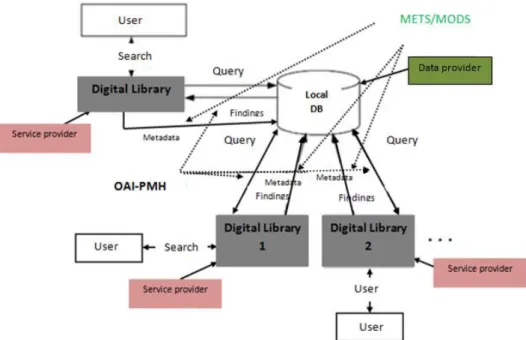
In regard to the findings of this research, literature review findings and new technology in the field of interoperability, the following model is suggested. As it was mentioned, further interoperability in the technical level needs a model, related protocol to selected model, metadata format, formats in surface level in order to transfer metadata and also in some cases to transfer digital objects. In this field the proposed model tries to cover all the mentioned procedures.
Figure 1: Proposed model for interoperability between DLs
In this model users can be identified at the first step. Also, local databases include just metadata. So, access to the database could actually be possible for everybody. But access to digital objects in the target databases needs the users’ confirmation by the target databases. While the user submitted to the system at the first step, there is no need to submit in target databases. So, authorized users could have access to digital objects.
All the DLs should support MODS as extraction metadata format. Because of using MARC as research population’s extraction format, making MODS format is simple and applicable for all of them. Also, target group’s databases should be open, at least for local database’s robot. Therefore, the local database just includes metadata that make up-to-date automatically by its robot. The used protocol in this model is OAI. Thus, robot could work automatically and could gather metadata from target groups’ open databases.
References
Alipour Hafezi, M.; Horri, A.; Shiri, A. & Ghaebi, A. (2010). Interoperability models in DLs: An overview. The Electronic Library,28 (3), 438-452.
Arms, W. Y., et al. (2002). A spectrum of interoperability: The site for science prototype for NSDL. D-Lib Magazine, 8 (1), 1-16.
Lynch, C. & Garcia-Molina, H. (1995). ITTA digital libraries workshop. Stanford Digital
Library. Retrieved on April10, 2008 from www.diglib.stanford.edu/diglib/
pub/reports/iita-dlw/main.html.
Maamar, Z. (1998). Contribution a la resolution des proble`mes d’ interope´rabilite´ des
syste`mes: Une me´thode de conception par frameworks orientes-agents logiciels.
(Unpublished Doctoral Dissertation). Montreal: Universite Laval.
Miller, P. (2000). Interoperability: What is it and why should I want it? Ariadne, 24. Retrieved on December18, 2008 fromwww.ariadne.ac.uk/issue24/interoperability/ intro.html.
NSDL Technical Infrastructure White Paper. June 05, 2004. Retrieved on April 10, 2008 from http://nsdl.comm.nsdl.org/meeting/archives/smete/workgroups/technical/ nsdl_ tech_arch20.
Paepcke, A.; Chang, C.; Garcia-Molina, H. & Winograd, T. (1998). Interoperability for digital libraries worldwide. Communications of the ACM, 41 (4), 33-43.
Shi, R. (2005). Lightweight federation of non-cooperating DLs. (Unpublished Thesis). Norfolk, VA: Old Dominion University.
Shiri, A. (2003). Digital library research: Current developments and trends. Library
Review, 52 (5), 198-202.
Suleman, H. (2002). Open digital libraries. (Unpublished Doctoral Dissertation). VA: Virginia Polytechnic Institute and State University.
Warren, P. & Alsmeyer, D. (2005). Applying semantic technology to a digital library: A case study. Library Management, 26 (415), 196-205.
Notes
1. The authors would like to thank Dr. Hamid-Reza Jamali and Dr. Yazdan Mansourian for their
kind help in editing the article and suggesting some important directions in order to enhance the
article.
2. In order to get more information about the interoperability background study refer to
Alipour-Hafezi, Horri, Shiri, Ghaebi (2010). Interoperability models in DLs: An overview. The Electronic
Library, 28(3), 438-452.
Appendix: DL interoperability questionnaire A)
1. Which operating system do you use in the server-side?
a. Windows b. Macintosh c. Linux d. Unix
e. Other (Please identify)
2. Which resources and with which priority does Your DL offers to users? (Please identify your priority with no 1-10)
a. Books b. Journals c. Pictures d. Maps
e. Technical reports f. Thesis g. Sound h. Video i. Multimedia j. Others (Please identify)
3. Which one of the following objects do you scan?
a. Books b. Journals c. Pictures d. Maps
e. Technical reports f. Thesis g. Sound h. Video i. Others (Please identify)
4. What percent of the following items have been scanned till now?
a. Books b. Journals c. Pictures d. Maps
e. Technical reports f. Thesis g. Sound h. Video i. Others (Please identify)
5. For which one of the following scanned items do you do OCR?
a. Books b. Journals c. Maps d. Technical reports
e. Thesis f. Others (Please identify)
6. Which formats do you use for full-text items?
a. PDF b. DOC(X) c. TXT d. HTM (L)
e. XML f. MHT g. CHM h. In the DBMS format
i. Others (Please identify)
7. Which formats do you use for image files?
a. JPG b. JPEG c. GIF d. BMP
e. PNG f. TIFF g. In the DBMS format
8. Which formats do you use for audio files?
a. MP3 b. WMA c. RA d. AC3
e. WAV f. In the DBMS format g. Others (Please identify)
9. Which formats do you use for video files?
a. MP4 b. MPEG c. AVI d. MOV
e. 3GP f. In the DBMS format g. Others (Please identify)
B)
10. How do you describe digital objects?
a. With bibliographic data b. With abstract c. With bibliographic data and abstract d. With summarizing e. Others (Please identify)
11. Which descriptive metadata standard do you use?
a. MARC b. Dublin Core c. MODS
d. EAD e. Others (Please identify)
12. Whether you use MARC, please identify the edition:
a. UNIMARC b. MARC21 c. USMARC
d. IranMARC e. Others (Please identify)
13. Whether you use Dublin Core, please identify the edition:
a. DC b. Qualified DC c. Others (Please identify)
14. Do you make changes in your metadata format? (Whether you do changes, do you present your schema?)
a. Yes b. No
15. Which one of the following metadata fields do you use? (The fields extracted from DC. Please add other fields which you used, and identify which one of them is searchable.)
a. Title b. Creator c. Description d. Publisher
e. Contributor f. Data g. Type h. Format
i. Identifier j. Source k. Language l. Relation
16. Which application do you use for DBMS?
a. SQL b. MYSQL c. Access d. Oracle
e. Others (Please identify)
17. Which DB structure do you use?
a. Relational b. Hierarchical c. Object Oriented
d. Mixed (Relational/Object Oriented) e. Others (Please identify)
18. How do you do full-text search?
a. Search in the coordinated index, presenting clipped part of text and metadata, Presenting full-text
b. Search in the coordinated index, presenting metadata, presenting full-text
c. Search in the full-text for each one of digital objects separately, presenting digital object d. Search in the full-text and metadata, presenting digital object
e. Thesauri search, presenting digital object f. Others (Please identify)
19. How is the process of access to digital objects? a. User identification, Search, Metadata, Digital object b. User identification, Search, Digital object
c. Search, Metadata, User identification, Digital object d. Search, User identification, Digital object
e. Others (Please identify)
C)
20. Which metadata extractions does the system have? - Context standard
a. ISO text b. Structured text c. XML
d. ODBC interface e. HTML f. Others (Please identify)
- Metadata standard
a. MARC b. MARCXML c. Dublin Core
d. MODS e. Others (Please identify)
21. Do you offer your metadata schema?
22. Can users get metadata formats automatically?
a. Yes b. No
23. How could users receive metadata formats?
a. In the physical place of library b. Local Area Network
c. Internet d. Others (Please identify)
24. How do you relate metadata to digital objects in extracted formats? a. There is no relation
b. By hypertext link in the metadata c. Embedded d. Others (Please identify)
25. Can public search engines index your databases?
a. Yes (It needs some settings) b. Yes (Ordinary) c. No (It is limited)
D)
26. Do you exchange your data with other information systems? a. Yes (Please identify your used connection standard)
b. No
c. To a certain extent
27. If there is no ability to exchange data, can librarians set it? a. Yes b. No c. To a certain extent
28. If there is ability of exchanging data, which level is work?
a. Metadata b. Digital object c. Metadata and digital object d. Others (Please identify)
29. Which protocol do you use for interoperability?
a. Z39.50 b. SRU c. SRW d. OAI
e. Others (Please identify)
30. Which metadata format do you use in interoperability service? - Context standard
- Metadata standard
a. MARC b. MARCXML c. Dublin Core
d. MODS e. Others (Please identify)
- Structural and administrative standard
a. METS b. EAD
- Context standard
a. ISO text b. Structured text c. XML
d. ODBC interface e. HTML f. Others (Please identify)
- Metadata standard
a. MARC b. MARCXML c. Dublin Core
d. MODS e. Others (Please identify)
31. How can you exchange digital objects? a. There is no possibility
b. Open data bases (Every system could get access simply on the web) c. Valid users could get access to digital objects
d. Others (Please identify)
32. How users get access to interoperability service? a. There is no possibility