Discovering Comfortable Driving Strategies Using Simulation-Based
Multiobjective Optimization
Erik Dovgan and Tea Tušar
Jožef Stefan Institute, Jamova cesta 39, Ljubljana, Slovenia
Jožef Stefan International Postgraduate School, Jamova cesta 39, Ljubljana, Slovenia E-mail: {erik.dovgan, tea.tusar}@ijs.si, http://dis.ijs.si
Matija Javorski
Faculty of Mechanical Engineering, University of Ljubljana, Aškerˇceva cesta 6, Ljubljana, Slovenia E-mail: [email protected], http://www.fs.uni-lj.si
Bogdan Filipiˇc
Jožef Stefan Institute, Jamova cesta 39, Ljubljana, Slovenia
Jožef Stefan International Postgraduate School, Jamova cesta 39, Ljubljana, Slovenia E-mail: [email protected], http://dis.ijs.si
Keywords:driving strategies, multiobjective optimization, traveling time, fuel consumption, driving comfort
Received:May 28, 2012
Driving a vehicle along a route consists of control actions applied to the vehicle by taking into account the vehicle and route states. Control actions are usually selected by optimizing the traveling time and the fuel consumption. However, the resulting vehicle behavior can be uncomfortable for the driver/passengers. The comfort is measured as the change of acceleration, i.e., jerk. To obtain more comfortable driving strategies, we introduce comfort as an objective to the Multiobjective Optimization algorithm for discovering Driving Strategies (MODS), thus obtaining the Multiobjective Optimization algorithm for discovering Comfortable Driving Strategies (MOCDS). The two algorithms are compared on a real-world route. The results show that MOCDS finds more comfortable driving strategies than MODS, while not significantly deteriorating their traveling time and fuel consumption. The most significant improvement in comfort is achieved on driving strategies with low fuel consumption, which are highly uncomfortable and therefore have the most room for improvement. On the other hand, the driving strategies found by MODS with short traveling time are already comfortable and therefore cannot be additionally improved.
Povzetek: Prispevek predstavlja algoritem za iskanje strategij vožnje, ki ne optimira le ˇcasa vožnje in porabe goriva, temveˇc tudi udobje za voznika/potnike.
1
Introduction
When driving a vehicle along a route, two objectives are usually optimized: the traveling time and the fuel con-sumption. However, the algorithms optimizing only these objectives usually find pulse-and-glide driving strategies [10, 12]. Such driving strategies repeatedly exchange high throttle percentage and zero throttle percentage. Therefore, the acceleration continuously changes which significantly reduces the driving comfort [14]. Low driving comfort is unacceptable from the user point of view, even though such driving strategies efficiently reduce the traveling time and the consumed fuel. Consequently, the driving comfort has to be taken into account when discovering driving strate-gies.
In our previous work we designed and implemented
sented a car-following model focused on passenger com-fort. A comfortable vehicle driving was achieved by lim-iting the jerk. The same measure was also used by Haj-Fraj et al. [6] who searched for the optimal control of gear shift operations. In order to obtain a comfortable shifting, a dynamic programming algorithm was implemented which minimizes the jerk.
Comfort can be defined in various other ways, too. For example, a comfortable driving strategy may be a strat-egy that does not change the control actions frequently. In addition, it is not compulsory to consider the comfort as an objective in the algorithm to obtain comfortable driv-ing strategies. For example, Gerdts [5] and Kirches et al. [9] developed single objective algorithms that search for the optimal double-lane-change manoeuver on a short (140 m) horizontal route and minimize the traveling time. The same problem was tackled by Logist et al. [13], who devel-oped a multiobjetive algorithm that minimizes the travel-ing time and the fuel consumption. Although none of them optimizes the comfort, they obtained comfortable driving strategies that do not change the control actions frequently. However, such driving strategies were obtained by using model-based approaches, which cannot be applied when a black-box simulator is used. In addition, the algorithms were tested only on a short horizontal artificially generated route. Therefore, it is not clear if these algorithms would produce comfortable driving strategies also on data from (longer) real-world routes with inclined route segments and velocity limits.
In this paper we present the two-level Multiobjective Optimization algorithm for discovering Comfortable Driv-ing Strategies (MOCDS) that minimizes the travelDriv-ing time, fuel consumption and discomfort, i.e., jerk. The lower-level algorithm is based on breadth-first search [17] and Nondominated Sorting Genetic Algorithm (NSGA-II) [1]. The best input-parameter values for the lower-level algo-rithm are found by the upper-level evolutionary algoalgo-rithm. MOCDS returns a set of nondominated [1] driving strate-gies and leaves the selection of the preferred driving strat-egy to the user.
The paper is further organized as follows. The MOCDS algorithm is described in Section 2. Section 3 presents the experiments and the obtained results. Finally, Section 5 concludes the paper with ideas for future work.
2
The Algorithm for Discovering
Comfortable Driving Strategies
This section presents the two-level algorithm for discov-ering comfortable driving strategies (MOCDS) that mini-mizes the traveling timet, the fuel consumptionc, and the driving discomfortd.
A driving strategy is a set of connections between the ve-hicle and route states, i.e., the state space, on the one hand, and the weights used to select the control action that is ap-plied to the vehicle during the driving simulation on the other hand. The vehicle state is defined with the vehicle ve-locity, while the route state is defined with the inclinations and the velocity limits of the current and the next segments, and the route to the next segment. The control action is de-fined with the throttle and braking percentage εVand the
geargV, while the weights are the consumption weightωc
and time weightωt. The state space, control actions and
weights are discretized in advance. The subspaces obtained by the state space discretization are called hypercubes [18]. Each hypercube stores a consumption weight and a time weight. These data are used to select the appropriate con-trol action when the vehicle and route states correspond to the hypercube.
The driving strategy is evaluated with a black-box vehi-cle driving simulator that was implemented based on the vehicle description from [11, 15] and is described in [4]. The simulator receives the control action for the vehicle, simulates the vehicle driving for one route step, where the length of a step is∆s, and returns the spent time, the con-sumed fuel, the driving discomfort, and the new vehicle and route states. The new vehicle and route states are then used to select the current hypercube, and consequently to find the new control action that is used for the simulation of the next route step. This process continues until the trav-eling along the entire route has been simulated, i.e., until
∑x
1∆s=s, wheresis the length of the route andxis the
number of already simulated route steps.
2.2
Lower-level algorithm
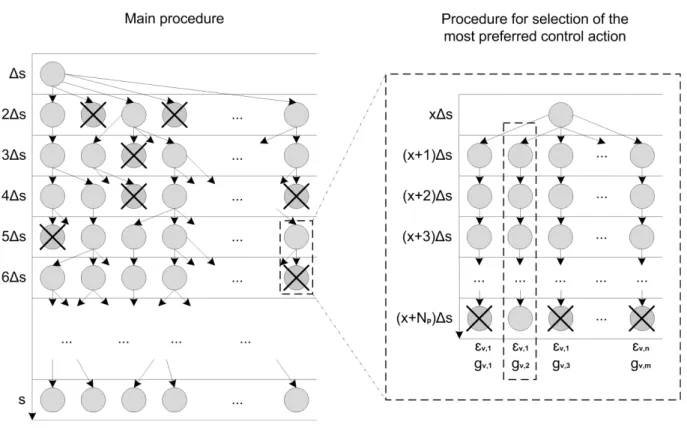
The lower-level algorithm is a deterministic multiobjec-tive algorithm for discovering comfortable driving strate-gies that minimizes the traveling time, the fuel consump-tion and the driving discomfort (see Figure 1). It starts with a single driving strategy with empty hypercubes. Then it simulates the vehicle driving for several route steps with several driving strategies until the driving along the entire route has been simulated (Main procedure in Figure 1). If the current hypercube of a driving strategy at a route step is empty, the driving strategy is cloned for each discrete set of weights{ωc, ωt}and this data is stored in the hypercube.
More precisely, the driving strategy is cloned when the ve-hicle and route states correspond to the current hypercube for the first time during the driving simulation. When the current hypercube stores the weights, these data are used to select the most preferred control action as shown in Figure 1. The control action is selected by predicting the vehicle driving forNPprediction steps ahead for each possible
dis-crete control action{εV, gV}. Afterwards, the spent timet,
com-Figure 1: The lower-level algorithm for discovering driving strategies.
bined into the cost functionf:
f =ωcc+ωtt+ (1−ωc−ωt)d, (1)
and the control action that minimizesf is selected for one step simulation (in the Main procedure in Figure 1). The driving discomfort is calculated by summing up the mag-nitudes of the jerk, i.e., the differences in acceleration a
denoted as∆a, during the driving simulation as follows:
d=
(x+∑NP)∆s
x∆s
|∆a| (2)
Since the driving strategies are cloned, the number of driv-ing strategies grows exponentially. To reduce their num-ber, fast nondominated sort and crowding distance mecha-nisms from the Nondominated Sorting Genetic Algorithm (NSGA-II) [1] are used at each route step to select the most promising driving strategies with respect to the objec-tives and maintain a constant number of driving strategies. The non-promising driving strategies are deleted and are marked with “×” in the Main procedure in Figure 1. When the vehicle driving along the entire route has been simu-lated, the algorithm returns a set of nondominated driving strategies.
The lower-level algorithm requires the following input parameters:
– discretization of vehicle and route state space,
– discretization of control actions,
– discretization of weights, and
– number of prediction stepsNP.
2.3
Upper-level algorithm
The upper-level evolutionary algorithm searches for the best sets of input-parameter values for the lower-level algo-rithm and maximizes the hypervolume [20]. A set of input-parameter values is an level solution. The upper-level algorithm applies evolutionary principles, i.e., selec-tion, crossover and mutaselec-tion, to the set of upper-level so-lutions through several generations [1]. The evaluation of an upper-level solution is carried out as follows. Firstly, the lower-level algorithm finds the nondominated driving strategies using the input-parameter values stored in the upper-level solution. Finally, the hypervolume covered by the driving strategies is calculated. For more details see [3, 4].
3
Experiments and Results
80 110
140 170
0.06 0.08
0.10 0.12 0.14 0
10 20 30 40 50 60 70
Discomfort [m/s
3]
(a)
s
1
s
2
s
3
s
4
MODS MOCDS
Time [s]
Fuel consumption [l] 0.06 0.07 0.08 0.09 0.1 0.11 0.12 0.13 0.14 0.15
80 100 120 140 160 180 200
Fuel consumption [l]
Time [s]
s
1
s
2
s
3
s
4
(b)
Figure 3: Driving strategies found by MODS and MOCDS.
-0.04 -0.02 0.00 0.02 0.04
0 200 400 600 800 1000
Inclination [rad]
Route [m]
Figure 2: Inclinations of the testing route; the velocity limit is 50 km/h along the entire route.
Figure 3 shows the nondominated driving strategies found by MOCDS and MODS. Specifically, Figure 3(a) shows the driving strategies in the objective space of all three objectives, while Figure 3(b) shows a projection of the driving strategies to the objective space with only the objectives t andc. Ideally, MOCDS should find all the driving strategies obtained by MODS. However, Figure 3 shows that MOCDS does not find (all) these driving strate-gies. This is due to the fact that the number of driving strategies grows exponentially at each route step and, there-fore, several driving strategies have to be deleted as de-scribed in Subsection 2.2. More precisely, MOCDS and MODS maintain the same number of driving strategies but MOCDS has a larger search space due to the additional ob-jective. Consequently, several driving strategies that are promising in the values oftandcare deleted by MOCDS since a larger search space has to be covered by the same number of driving strategies. Those driving strategies are not deleted by MODS and therefore MODS better
opti-mizes the traveling time and fuel consumption. Neverthe-less, the results show that MOCDS is able to find, in addi-tion to the comfortable driving strategies, driving strategies similar to the ones found by MODS in terms of traveling time and fuel consumption.
Four interesting driving strategies were further analyzed. They are marked in Figure 3 as follows:
– s1is a driving strategy with short traveling time found
by MODS;
– s2 is a driving strategy with low fuel consumption
found by MODS;
– s3is the driving strategy with the highest comfort but
also long traveling time and high fuel consumption found by MOCDS; and
– s4is a driving strategy found by MOCDS, which has
similar traveling time and fuel consumption but sig-nificantly higher comfort thans2.
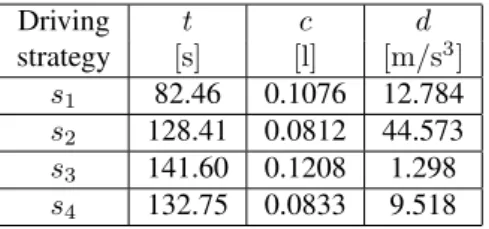
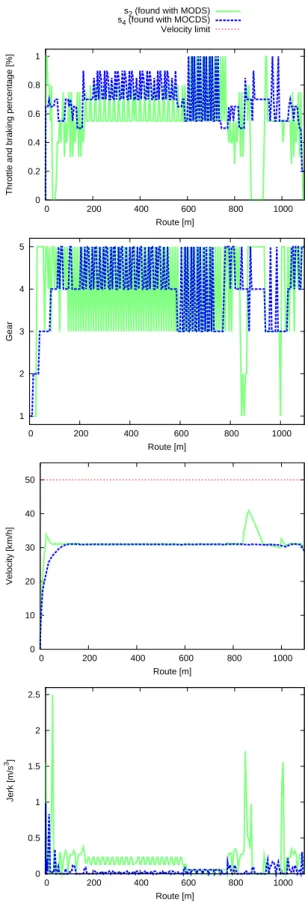
The objective values of these driving strategies are shown in Table 1. Moreover, the vehicle behavior obtained by ap-plying these driving strategies can be seen in Figures 4 and 5. These figures show the control actions, i.e., the throt-tle and braking percentage and the gear, the vehicle veloc-ity and the jerk along the entire route. The results show that in order to obtain highly comfortable driving strategies (e.g., s3), the control actions must rarely change.
Conse-quently, the vehicle velocity slowly changes and the jerk is low along the entire route. On the other hand, when the comfort is not taken into account (e.g.,s1ands2), the
Driving t c d
strategy [s] [l] [m/s3]
s1 82.46 0.1076 12.784
s2 128.41 0.0812 44.573
s3 141.60 0.1208 1.298
s4 132.75 0.0833 9.518
Table 1: The objective values of the driving strategies marked in Figure 3.
in terms of traveling time and fuel consumption, but sig-nificantly differ in comfort (see also Table 1). More pre-cisely, it shows that a driving strategy of the same quality in terms of traveling time and fuel consumption but signif-icantly more comfortable can be obtained by reducing the changes of control actions. Such driving strategy can be obtained by MOCDS but not by MODS.
Although the MOCDS driving strategies change the con-trol actions, such as the gear, less frequently than the MODS driving strategies, the number and frequency of changes remains high when nondominated driving strate-gies in terms of traveling time and fuel consumption are taken into account, e.g., s4 (see Figure 5). Nevertheless,
MOCDS also finds driving strategies with a significantly lower number and frequency of changes, see the driving strategy with the highest comfort, s3 (see Figure 4). To
even further reduce the number and frequency of changes of control actions, the comfort should be redefined, e.g., by penalizing the changes in control actions, or the search space should be limited, for example, by restricting the changes of control actions.
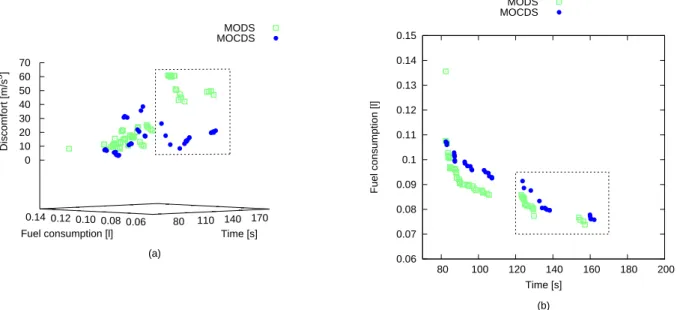
Figure 6 shows the driving strategies found by MODS and MOCDS which are nondominated with regard to ob-jectivestandc. These driving strategies found by MOCDS are the most interesting ones since they are similar to the driving strategies obtained by MODS in terms of travel-ing time and fuel consumption. The figure shows that MOCDS does not find more comfortable driving strate-gies than MODS when traveling time is short (the driv-ing strategies outside the dashed rectangle in Figure 6), since MODS finds driving strategies with short traveling time that are already comfortable and cannot be improved in comfort anymore. However, MOCDS finds significantly more comfortable driving strategies than MODS when fuel consumption is low (the driving strategies inside the dashed rectangle in Figure 6). This is due to the fact that MODS finds driving strategies with low fuel consumption that are highly uncomfortable and, therefore, have the most room for improvement. In summary, the results show that MOCDS finds more comfortable driving strategies than MODS, while not significantly deteriorating the other ob-jectives, especially when the fuel consumption is reduced.
Finally, the computation and simulated times are shown in Table 2. It shows that the average computation time per driving strategy is longer than the simulated traveling times of driving strategies but still in the order of minutes.
4
Conclusion
We presented a two-level multiobjective optimization al-gorithm for discovering comfortable driving strategies (MOCDS). The lower-level algorithm is a determinis-tic multiobjecitve algorithm that searches for comfortable driving strategies, while the upper-level algorithm is an evolutionary algorithm that searches for the best input-parameter values for the lower-level algorithm. The ob-tained driving strategies were compared to the driving strategies found by the algorithm that does not optimize the comfort, i.e., MODS. The results show that comfortable driving strategies either rarely change the control actions or reduce the changes of the control actions. Moreover, when comparing the driving strategies with low fuel con-sumption, those found by MOCDS are significantly more comfortable than those found by MODS. However, when comparing the driving strategies with short traveling time, there is no significant difference in comfort between those found by MOCDS and those found by MODS, since both are already comfortable and cannot be improved anymore. In the future work, we will test other approaches for creasing the driving comfort. These approaches will in-clude an objective other than jerk. However, the comfort-able driving strategies may be obtained by not including the third objective but limiting the search space, e.g., re-stricting the changes of control actions. It would be also interesting to include the third objective in the algorithms used so far, i.e., predictive control and dynamic program-ming, and/or limit the search space of these algorithms to compare the obtained driving strategies with those found by MOCDS.
Acknowledgement
We would like to thank Matjaž Gams for his contribution to the research presented in this paper.
References
[1] K. Deb, A. Pratap, S. Agrawal and T. Meyarivan (2002) A fast and elitist multiobjective genetic algo-rithm: NSGA-II,IEEE Transactions on Evolutionary
Computation, IEEE Computational Intelligence
Soci-ety, vol. 6, no. 2, pp. 182–197.
[2] E. Dovgan, M. Gams and B. Filipiˇc (2011) A multi-objective optimization algorithm for discovering driv-ing strategies, GECCO’11 proceedings, ACM, New York, pp. 751–754.
0 0.2 0.4 0.6 0.8 1
0 200 400 600 800 1000
Throttle and braking percentage [%]
Route [m] Velocity limit
1 2 3 4 5
0 200 400 600 800 1000
Gear
Route [m]
0 10 20 30 40 50
0 200 400 600 800 1000
Velocity [km/h]
Route [m]
0 0.5 1 1.5 2 2.5
0 200 400 600 800 1000
Jerk [m/s
3]
Route [m]
Figure 4: Examples of vehicle behavior obtained by apply-ing the drivapply-ing strategies with high fuel consumption (s1
ands3from Figure 3).
0 0.2 0.4 0.6 0.8 1
0 200 400 600 800 1000
Throttle and braking percentage [%]
Route [m] Velocity limit
1 2 3 4 5
0 200 400 600 800 1000
Gear
Route [m]
0 10 20 30 40 50
0 200 400 600 800 1000
Velocity [km/h]
Route [m]
0 0.5 1 1.5 2 2.5
0 200 400 600 800 1000
Jerk [m/s
3]
Route [m]
Figure 5: Examples of vehicle behavior obtained by apply-ing the drivapply-ing strategies with low fuel consumption (s2
80 110 140 170 0.06
0.08 0.10 0.12 0.14 0 10 20 30 40 50 60 70
Discomfort [m/s
3 ]
(a)
MODS MOCDS
Time [s] Fuel consumption [l]
0.06 0.07 0.08 0.09 0.1 0.11 0.12 0.13 0.14 0.15
80 100 120 140 160 180 200
Fuel consumption [l]
Time [s]
(b) MODS MOCDS
Figure 6: Nondominated driving strategies in the objective space with only the objectivestandcfound by MOCDS and MODS. The dashed rectangle denotes the driving strategies with low fuel consumption.
Algorithm MODS MOCDS
Total computation time (h:m:s) 6:41:49 23:18:48
Number of found nondominated driving strategies 90 119 Average computation time per driving strategy (m:s) 4:28 11:45 Minimal simulated traveling time of driving strategies (m:s) 1:22 1:22 Maximal simulated traveling time of driving strategies (m:s) 2:37 3:06
Table 2: Comparison of computation and simulated times of MODS and MOCDS.
[4] E. Dovgan, M. Javorski, T. Tušar, M. Gams and B. Filipiˇc (2012) Discovering Driving Strategies with a Multiobjective Optimization Algorithm, submitted for publication.
[5] M. Gerdts (2005) Solving mixed-integer optimal con-trol problems by branch&bound: a case study from automobile test-driving with gear shift,Optimal Con-trol Applications and Methods, John Wiley & Sons, vol. 26, no. 1, pp. 1–18.
[6] A. Haj-Fraj and F. Pfeiffer (2001) Optimal control of gear shift operations in automatic transmissions,
Journal of the Franklin Institute, Elsevier, vol. 338, pp. 371–390.
[7] E. Hellstrom, J. Aslund and L. Nielsen (2010) Design of an efficient algorithm for fuel-optimal look-ahead control,Control Engineering Practice, Elsevier, vol. 18, no. 11, pp. 1318–1327.
[8] E. Hellstrom, M. Ivarsson, J. Aslund and L. Nielsen (2009) Look-ahead control for heavy trucks to min-imize trip time and fuel consumption,Control Engi-neering Practice, Elsevier, vol. 17, no. 2, pp. 245– 254.
[9] C. Kirches, S. Sager, H. G. Bock and J. P. Schloder (2010) Time-optimal control of automobile test drives with gear shifts, Optimal Control Applications and Methods, John Wiley & Sons, vol. 31, no. 2, pp. 137– 153.
[10] D. Kroushl (2005) Prius marathoners top 100 mpg, available online: http://www.toyota.com/ html/hybridsynergyview/2005/fall/ marathon.html.
[11] G. Lechner and H. Naunheimer (1999) Automotive Transmissions: Fundamentals, Selection, Design and Application, Springer.
[12] J. Lee (2009)Vehicle inertia impact on fuel consump-tion of convenconsump-tional and hybrid electric vehicles us-ing acceleration and coast drivus-ing strategy, Virginia Polytechnic Institute and State University.
[13] F. Logist, S. Sager, C. Kirches and J. F. Van Impe (2010) Efficient multiple objective optimal control of dynamic systems with integer controls, Journal of Process Control, Elsevier, vol. 20, no. 7, pp. 810–822.
systems for internal combustion engines, avail-able online: http://www.heat2power. net/downloads/GPC2007/20070618_ heat2power_GPC_WHR_presentation.pdf.
[16] L. Del Re, F. Allgower, L. Glielmo, C. Guardiola and I. Kolmanovsky (2010),Automotive Model
Pre-dictive Control: Models, Methods and Applications,
Springer.
[17] S. J. Russell and P. Norvig (2010) Artificial
Intelli-gence: A Modern Approach, Prentice Hall.
[18] E. Vareilles, M. Aldanondo and P. Gaborit (2009) How to take into account piecewise constraints in constraint satisfaction problems,Engineering Appli-cations of Artificial Intelligence, Elsevier, vol. 22, no. 4–5, pp. 778–785.
[19] Z. Wu, Y. Liu and G. Pan (2009) A smart car con-trol model for brake comfort based on car following,
IEEE Transactions on Intelligent Transportation Sys-tems, IEEE Intelligent Transportation Systems Soci-ety, vol. 10, no. 1, pp. 42–46.
[20] E. Zitzler and L. Thiele (1999) Multiobjective evo-lutionary algorithms: A comparative case study and the strength Pareto approach,IEEE Transactions on
Evolutionary Computation, IEEE Computational