Linking the Witness Simulation
Software to an Expert System to
Represent a Decision–Making Process
Stewart Robinson , John S. Edwards
and Wu Yongfa
Operational Research and Systems Group, Warwick Business School, University of Warwick, Coventry, United Kingdom Operations and Information Management Group, Aston Business School, Aston University, Birmingham, United Kingdom
Department of Management Engineering, South East University in Nanjing, Jiangsu, P.R. China
Expert systems, and artificial intelligence more generally, can provide a useful means for representing decision-making processes. By linking expert systems software to simulation software, an effective means of including these decision-making processes in a simulation model can be achieved. This paper demonstrates how a com-mercial off-the-shelf simulation package(Witness)can
be linked to an expert systems package (XpertRule)
through a Visual Basic interface. The methodology adopted could be used for models, and possibly software, other than those presented here.
Keywords: simulation, artificial intelligence, expert
sys-tems, decision making processes.
1. Introduction
The majority of simulation models contain at least one, and probably more, decision-making processes. These might be computer-based
(e.g. a production control system), human(e.g. a branch manager in a bank)or a mixture of the two(e.g. computer based decision support sys-tems often rely on human intervention to sug-gest potential improvements). Such decision-making processes are often modelled using the commands available in the simulation software. Some, however, have adopted artificial intelli-gence methods as a means of representation, for instance, Flitman and Hurrion(1987), O’Keefe
(1989), Williams(1996), Lyu and Gunasekaran
(1997) and Robinson et al. (1998). These give the advantage of providing a well devel-oped framework for representing, and eliciting, knowledge(Doukidis and Angelides, 1994).
The purpose of this paper is to describe how a commercial off-the-shelf(COTS) simulation package, Witness(Lanner Group, 2001), can be linked to an off-the-shelf expert systems pack-age, XpertRule(Attar Software, 2000), in order to provide a means of representing a decision-making process. The approach is demonstrated by reference to an example model. The aim is to illustrate how the two packages can be linked successfully. Albeit that the example presented is fairly simple, the approach provides the basis for further work on more complex problems.
The paper starts with a brief review of previous work in which simulations and expert systems have been linked. After this, the example simu-lation model is described and the representation of the decision-making process in XpertRule is explained. An overview of the methodology for linking Witness and XpertRule is given, as well as a detailed description of the Visual Basic code required to link the two software packages. A full listing of this code is provided in the ap-pendix.
2. Previous Work Linking Simulations with Expert Systems
Fortran on one computer with a Prolog-based expert system on another computer. Similarly, O’Keefe (1989) developed a tool that linked GPSS with Prolog.
Some have taken the approach of developing ar-chitectures for linking expert systems with sim-ulation that do not rely upon specific simsim-ulation or expert systems software. Artiba and Aghez-zaf(1997)developed an architecture for linking expert systems, simulation, optimisation algo-rithms and heuristics for looking at complex production planning and scheduling problems. Zeigler et al. (1996)embed an expert systems shell within the DEVS environment.
Others have linked specific simulation pack-ages with expert systems. Lyu and Gunasekaran
(1997)achieve this by developing both a sim-ulation model and expert system within SIM-SCRIPT II.5 for modelling harbour unloading by a steel company. They note that this is only effective when the rules are sufficiently simple to be represented within the simulation software. Standridge and Steward (2000)link SLAMSYSTEM with an expert system writ-ten in C. Neither of these represent the use of a standard simulation software package with a standard expert systems package, as described in this paper.
The contribution of the current work is to show how commercial off-the-shelf software can be linked with reference to two specific packages,
Witness and XpertRule. As the functionality of such software continues to grow, the possibility for using them in collaboration will increase. As such, both researchers and practitioners should find the method for linking such software de-scribed in this paper of interest.
3. Example Model
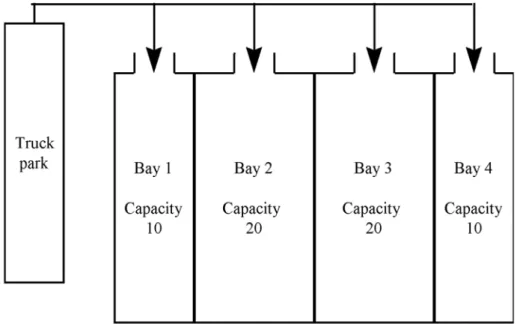
A model of a fictional truck loading bay( Fig-ure 1)was developed in the Witness simulation package(Witness 2001 release 1.0). Trucks ar-rive at the truck park at an average interval of 10 minutes(based on a negative exponential distri-bution)and require loads of between 5 and 20 items (uniformly distributed). On arrival, the trucks are allocated to a loading bay, should a suitable one be available. In making this deci-sion, account must be taken of the restrictions on the bay capacities. Trucks requiring more than 10 items must be allocated to bay 2 or 3, since bays 1 and 4 only have capacity for up to 10 items. Should a bay not be available, then the truck waits in the park until a suitable bay becomes available. Once a truck is allocated, it moves to the bay where it is loaded before de-parting from the system. Trucks take 1 minute to move to the loading bay where each item takes 1 minute to be loaded.
4. The Expert System
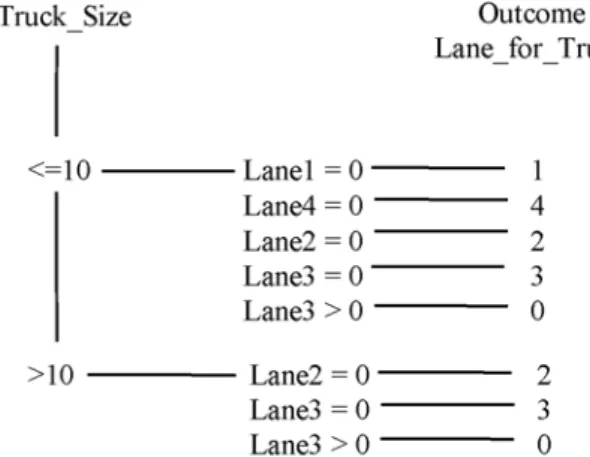
A rule-based expert system was developed in XpertRule (version 3.92, 32-bit) to represent the decision to allocate trucks to lanes. The resulting decision tree is shown in Figure 2. There are five key attributes to the decision: the size of the truck(’Truck Size’)in terms of the number of items to be loaded; and the cur-rent allocation of trucks to lanes, denoted by the attributes ’Lane1’ to ’Lane4’. If no truck is presently allocated to a lane, the lane attribute is set to zero, otherwise it is set to the number of the truck that is allocated to that lane(note that truck numbers denote the sequence in which the trucks arrive in the simulation model). A third attribute ’Lane for Truck’ reports the outcome of the decision made by the expert system. This is set to the number of the lane that a truck is to be allocated to, or to zero if no allocation can be made.
Fig. 2. Truck Lane Allocation Decision Tree.
The decision tree shows that the allocation de-cision rests primarily on the size of the truck. If this is less than or equal to 10 items, then the truck can be allocated to any one of the lanes. An attempt is made to allocate the truck to the smaller lanes first(lanes 1 and 4). Trucks that require more than 10 items can only be allocated to lanes 2 and 3.
In this example, because the decision is simple, the decision tree has been developed by a sim-ple process of deduction as to what would en-tail a sensible decision-making process. Indeed, such is the nature of this decision that it could
be coded directly in most simulation software. One useful extension to this approach, however, is to use the simulation as a means of knowledge elicitation. At a decision point the simulation would stop and wait for input. Expert decision-makers could enter their decisions at each deci-sion point. In this way, a history of cases and decisions could be developed, which could then be used to induce rules within the expert system. In more complex examples, this approach has the significant advantage that example decisions can be obtained faster than real time with repro-ducible conditions. This approach may prove more reliable than interviewing experts, partic-ularly when they are unable to express clearly how they make decisions. The latter is a well-known problem in developing knowledge-based systems; see for example Kidd(1987).
5. Methodology for Linking Witness with XpertRule
The simulation model and expert system were linked using Object Linking and Embedding
(OLE) within Windows NT version 4.0. The obvious approach would have been to make calls to XpertRule from Witness as and when a decision point is reached (a truck arrives or a lane becomes free). This, however, is not possible, since Witness only acts as an OLE slave. As a result, it was necessary to develop a model controller in Visual Basic (Figure 3). The model controller initiates the run of the simulation model. At a point where an alloca-tion decision is required, the simulaalloca-tion model automatically stops and waits until the model controller returns a decision and continues the simulation run. Once the model controller has
detected that the model is not running, it ex-tracts data from the model which it passes to the expert system for a decision. The decision is returned to the simulation model via the model controller. Some effort was required to ensure that this sequence of events was adherred to. The code required to achieve this is described below.
6. Witness Requirements
Within Witness, two specific actions are re-quired. First to stop the model when a decision point is reached. This occurs either when a truck arrives in the truck park and so it will look for a lane to be allocated to, or when a truck leaves the loading bay and so a lane becomes free and a truck may be allocated to it. The model is stopped by issuing the ’Stop’ command within the Witness actions language at these two deci-sion points.
The second action that is required is to update the variables and attributes within the Witness model, so that if a truck has been allocated, it moves to its loading bay lane. This takes place once a decision has been taken and the model has been restarted from the model controller. To enable this, a dummy process(’machine’)is defined within Witness. At the point when the model is stopped a toggle variable is set to 1, this triggers the dummy process to start by pulling a dummy part from the ’world’. As a result, the dummy process is the next event that will occur when the model restarts. In the actions on the dummy process, assuming a lane has been allocated to a truck (the Witness variable ’al-locate lane’>0), all the relevant variables and attributes are updated and the toggle variable is reset to zero.
7. Visual Basic Code
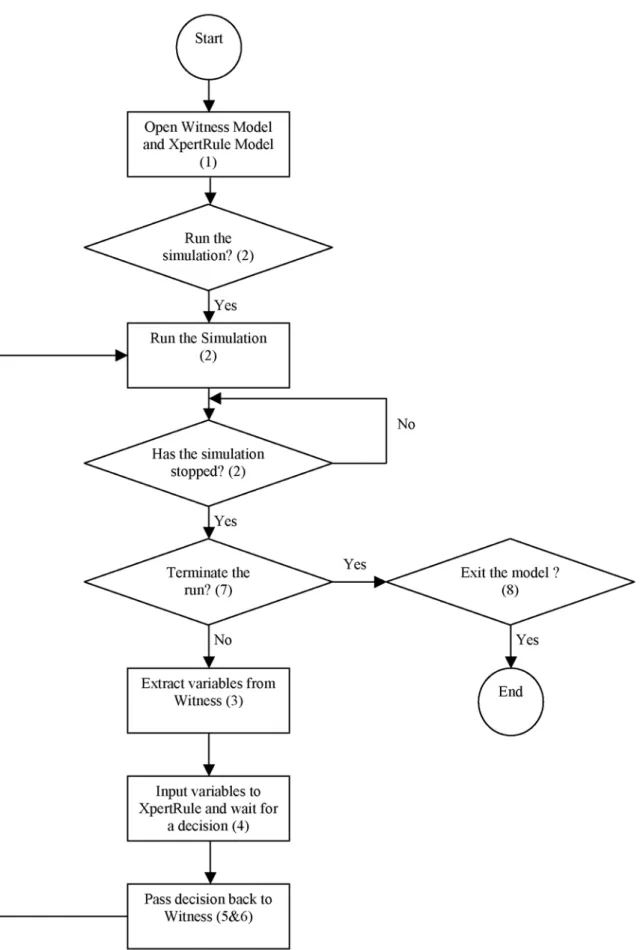
The Visual Basic code, for which a full list-ing is provided in the appendix, was developed in version 6.0 (32-bit). A flow chart outlin-ing the code is shown in Figure 4. The num-bers in brackets refer to the segments of code identified in the appendix. The details of the code, relating to each segment, are described be-low. Before proceeding, it should be noted that
no specific modifications were needed to make the XpertRule application compatible with the model controller.
7.1. On Loading Visual Basic (VB): Sub-Routine Form Load
The Form Load routine(appendix segment 1) is invoked when the VB program is started. At this point, Witness and the Witness model ’truck.mod’ are loaded via the shell command, the integer value referring to the mode in which the software is run, in this case minimised. Following this, an XpertRule object is created and the specific expert system (’truck.xra’) is loaded. Note that the run-time version of Xpert-Rule is loaded, known as XpertRun or ’xr32run’.
7.2. On Running the Model: Sub-Routine RunModel Click
The ’Run Model’ button invokes the RunMo-del Click sub-routine. This performs the vari-ous functions that link the simulation and the ex-pert system. It starts the Witness model running and detects when it has stopped. The variables required to make the decision in XpertRule are extracted from Witness and input to XpertRule. A decision is then obtained from XpertRule and returned to Witness.
Simulation Model Control (appendix segment 2)
Fig. 4. Flow Chart of the Visual Basic Code(Segments of the Code Shown in the Appendix are Identified in
Extract Variables from Witness (appendix segment 3)
The total number of trucks in the truck park is determined by using the Witness function ’NPARTS’. This is necessary because an at-tempt will be made to allocate a lane to each truck, in turn, that is waiting in the truck park. The allocation status of each lane is extracted from the Witness variable ’allocated’, and the size of each truck in the truck park is obtained from the Witness attribute ’loadsize’.
Input Variables to XpertRule and Make a Decision (appendix segment 4)
For each truck, in turn, the five decision at-tributes(the allocation status of the four lanes and the size of the truck)are passed to XpertRule using the Poke method. The ’CONTINUE’ command is issued to XpertRule in order to ob-tain an allocation decision. The VB code then enters a loop until XpertRule has reached a con-clusion concerning the decision, that is, the soft-ware status is ’READY’. At this point the result is obtained from XpertRule. "Lane for Truck" will report a value between 1 and 4 if a lane has been allocated, otherwise it will be set to a value of zero if no allocation is possible.
Return Decision to Witness (appendix segment 5)
If a lane has been allocated to a truck (the de-cision is non-zero), then the decision is passed to Witness by setting two variables. The ’allo-cate lane’ variable holds the number of the lane to be allocated. The ’allocate truck’ variable holds the number of the truck that is to be allo-cated to that lane. Once an allocation has been made, no further allocations are possible. This is because an allocation decision is triggered by a single state change in the simulation, that is, a truck arrives or a lane becomes available. As a result, no further attempt is made to allocate any other trucks in the truck park, and the code jumps to the ’endalloc’ label.
On Failure to Allocate a Truck (appendix segment 6)
If, having attempted to allocate all the trucks in the truck park to a lane, no allocation decision is possible, then return a zero decision to Witness.
7.3. Stopping the Model:
Sub-Routine StopModel Click
The while loop in the RunModel Click sub-routine will continue to loop between running the Witness model, stopping the model at a de-cision point, obtaining a dede-cision and returning it to Witness. In order to interrupt this loop the variable ’continue’ needs to be set to zero. This is done in the StopModel Click sub-routine( ap-pendix segment 7), which is invoked on clicking the ’Stop Model’ button. It should be noted that, having clicked on the ’Stop Model’ button, the Witness model will not stop running until it has reached the next decision point. The simulation model may be restarted by clicking on the ’Run Model’ button.
7.4. Exiting the Model:
Sub-Routine ExitModel Click
Should the model user wish to leave the simula-tion altogether, then by clicking on the ’Exit Model’ button the code within the ExitMo-del Click sub-routine is invoked(appendix seg-ment 8). This closes both the Witness and XpertRule packages.
8. Conclusion
intelligence systems, as long as these could act as an OLE slave.
Another requirement might arise if more than one decision-making process is present within the same simulation model. This would re-quire some adaptation to the approach described above. A separate XpertRule model would need to be developed for each decision-making pro-cess, and then run in parallel during the running of the simulation. In terms of the Visual Basic code, this would mean that n XpertruleObjects would need to be defined, where n is the number of decision-making processes. Depending on which decision is being taken, the relevant vari-ables would have to be extracted from Witness, the correct object would have to be invoked and the relevant variables returned to Witness. Un-less the variables involved in the decision are exactly the same, this would require separate segments of code for each decision-making pro-cess. The other requirement would be to iden-tify, which decision-making process had caused the simulation to stop. This could simply be identified by setting a flag in Witness, to a value between 1 and n.
The linking of the simulation and expert system would have been made easier if Witness could act as an OLE client. This would have removed the need for the VB model controller. It would also result in the model running faster by re-moving the overhead of the model controller. The use of Witness could, therefore, be ques-tioned. Why not use an alternative package that can act as an OLE client? For many, including the authors, this decision can only be considered when first deciding which simulation software to purchase. The costs of replacing an existing package are simply too great. The approach described above provides a useful method for linking Witness, and probably other simulation software that cannot act as OLE clients, to an-other software package.
Acknowledgements
The authors would like to acknowledge the fi-nancial support given by the British Council’s Sino-British Friendship Scholarship Scheme and by the Lanner Group.
References
1] ARTIBA, A.ANDAGHEZZAF, E.H.(1997). “An
Ar-chitecture of a Multi–Model System for Planning and Scheduling.” International Journal of Computer
Integrated Manufacturing, 10(No. 5), pp. 380–393.
2] ATTARSOFTWARE (2000). XpertRule KBS
Refer-ence Manual. Attar Software, Leigh, UK.
3] DOUKIDIS, G.I.ANDANGELIDES, M.C.(1994). “A
Framework for Integrating Artificial Intelligence and Simulation.” Artificial Intelligence Review, 8, pp. 55–85.
4] FLITMAN, A.M.ANDHURRION, R.D.(1987).
“Link-ing Discrete–Event Simulation Models with Expert Systems.” Journal of the Operational Research
So-ciety, 38(No. 8), pp. 723–734.
5] KIDD, A.L.(1987)Knowledge Acquisition for
Ex-pert Systems: A Practical Handbook. Plenum Press
New York.
6] LANNER GROUP (2001). Witness 2001. Lanner
Group, Redditch, UK.
7] LYU, J. AND GUNASEKARAN, A. (1997). “An
in-telligent simulation model to evaluate scheduling strategies in a steel company.” International Journal
of Systems Science, 28(No. 6), pp. 611–616.
8] NISSEN, M.E. (1998). “Redesigning
Reengineer-ing through Measurement–Driven Inference.” MIS
Quarterly, 22(No. 4), pp. 509–534.
9] O’KEEFE, R.M.(1989). “The Role of Artificial
In-telligence in Discrete–Event Simulation.” In: Wid-man, L.E., Loparo, K.A. and Neilsen, N.R. (eds).
Artificial Intelligence, Simulation and Modeling.
Wiley: New York, pp. 359–379.
10] WILLIAMS, T.(1996). “Simulating the Man–in–the–
Loop.” OR Insight, 9(No. 4), pp. 17– 21.
11] ROBINSON, S., EDWARDS, J.S. AND YONGFA, W. (1998). “An Expert Systems Approach to
Simulat-ing the Human Decision Maker.” Winter Simulation
Conference 1998(D.J. Medeiros, E.F. Watson, M.
Manivannan, J. Carson, eds.), The Society for
Com-puter Simulation, San Diego, CA, pp. 1541–1545.
12] ROBINSON, S., ALIFANTIS, A., EDWARDS, J.S., HUR
-RION, R.D., LADBROOK, J.ANDWALLER, T.(2001).
“Modelling and Improving Human Decision Mak-ing with Simulation.” Winter Simulation Conference
2001(B.A. Peters, J.S. Smith, D.J. Medeiros, M.W.
Rohrer, eds.), The Society for Computer Simulation,
San Diego, CA, pp. 913–920.
13] STANDRIDGE, C.R.ANDSTEWARD, D.(2000).
“Us-ing Expert Systems for Simulation Model“Us-ing of Patient Scheduling.” Simulation, 75 (No. 3), pp.
148–156.
14] ZEIGLER, B.P., CHO, T.H. AND ROZENBLIT, J.W. (1996). “A Knowledge–Based Simulation
Envi-ronment for Hierarchical Flexible Manufacturing.”
IEEE Transactions on Systems, Man, and Cyber-netics – Part A: Systems and Humans, 26(No. 1),
Received: November, 2002 Revised: May, 2003 Accepted: May, 2003
Contact address:
Stewart Robinson Operational Research and Systems Group Warwick Business School University of Warwick, Coventry CV4 7AL United Kingdom John S. Edwards Operations and Information Management Group Aston Business School Aston University Birmingham B4 7ET United Kingdom Wu Yongfa Department of Management Engineering South East University in Nanjing Jiangsu P.R. China
STEWARTROBINSONis a Senior Lecturer in Operational Research at Warwick Business School in the UK. He holds a BSc and PhD in Man-agement Science from Lancaster University. Previously employed in simulation consultancy, he supported the use of simulation in companies throughout Europe and the rest of the world. His research interests are in finding ways to improve the use of operational research, and specifi-cally simulation, within industry. He is author/co–author of two books
on simulation. His current work involves an investigation into the use of expert systems to represent a human decision–maker in simulation models, the analysis of complex output behaviours from simulations, and developing an understanding of quality in relation to operational research and simulation studies.
JOHNS. EDWARDSis Professor of Operational Research and Systems at Aston Business School, Birmingham, UK. He holds MA and PhD degrees(in mathematics and operational research respectively)from
Cambridge University. His principal research interests are knowledge– based systems and decision support systems, especially methods for their development. He has written more than 30 research papers on these topics, and two books, Building Knowledge–based Systems and
Decision Making with Computers, both published by Pitman. His
cur-rent work includes a study of the use of artificial intelligence techniques in management accounting.