Developing a Spell Checker
as an Expert System
ˇSandor Dembitz , Petar Kneˇzevi´c and Mladen Sokele
Faculty of Electrical Engineering and Computing, University of Zagreb, Croatia Croatian Telecom, Zagreb, Croatia
In this paper we discuss some basic concepts of know-ledge engineering, expressing our feeling that there is something missing. In our opinion, the missing link, able to clarify all the basic concepts, should be the concept of energy, not in use in knowledge engineering practice and theory at all. Since energy is an extremely abstract concept, which led to misunderstandings even in physics, we humbly introduce it by describing an existing expert system, called Hascheck. Hascheck is a spell checker for Croatian language, implemented as learning
(semi)automaton, accessible via E-mail and Web, and
being in public use nearly 10 years. We also present here a mathematical model of Hascheck’s learning. The model led to the so-called cognoelectrical analogy, which allowed some energy considerations about learning, and knowledge.
Keywords: spell checker, knowledge acquisition,
mo-delling of learning, energy.
1. Introduction
Knowledge management is currently attracting a great deal of interest in scientific and busi-ness communities. However, is knowledge en-gineering a scientifically well-founded disci-pline? There are some reasons to doubt this.
“Expert systems have to be an applied disci-pline, not a theoretical one. In application, real-word needs such as knowledge-based mainte-nance and learning need to be accommodated. We need to see expert systems as primarily a discipline to do with supporting knowledge ap-plications; primarily an applied discipline, pri-marily concerned with the logic of the know-ledge and only secondarily a technological dis-cipline. This needs a modification of viewpoint on the part of many expert systems practition-ers.” (Taylor, 1999; p. 8)
The quoted thoughts of R.M. Taylor bring know-ledge engineers in the position of ancient Ro-man civil engineers constructing bridges. It is not such a bad position. Not knowing Newton axioms, they constructed many bridges, some of which are still in operation, from Spain to the Near East, from England to Africa. But, for modern engineers, this position is very weird; they are taught to think axiomatically. It is not so easy when knowledge is concerned.
On the other hand, there are some attempts to formalise fundamentals of knowledge engineer-ing. How it works will be illustrated by quoting only one of these attempts,(Uschold, 1998). In his introduction M. Uschold says: “Very impor-tantly, this is a descriptive exercise, not a
nor-mative one”(p. 5). A few pages later he says: “In particular, readers are expected to know how the term KNOWLEDGE is being used, and what INFERENCE is. They should be familiar with fundamental notations of LANGUAGE in gen-eral and KNOWLEDGE REPRESENTATION LANGUAGES in particular, as well as what is meant by a KNOWLEDGE BASE”(p. 8).
Do we all mean the same when using terms like
knowledge, reasoning or language? Surely not!
Speaking of language, the authors of these lines primarily think of their own, Croatian language.
Regarding Uschold’s and others’ papers about theoretical foundations of knowledge engineer-ing we got a strong feelengineer-ing that there is some-thing missing, somesome-thing that could connect, physically, all basic, weakly defined concepts. Being engineers, we believe that we have found the missing link in the concept of energy.
“Knowledge is power”, people say. Every-one will agree that learning is difficult. Thus, in everyday life we describe knowledge and knowledge acquisition, or learning, with energy terms. Nowadays many researchers and engi-neers are trying to build up learning automata, or knowledge-based systems. Do they consider their attempts through energy analysis? Usually not, because of the lack of scientific concepts which could support such considerations.
Even in physics, energy is an extremely abstract concept, which led to many misunderstandings: only perpetuum mobile is to be mentioned as an example. Therefore, our paper has to be re-garded as a humble – but practical – attempt, pointing where to research further in order to enable energy considerations about knowledge and learning.
At the very beginning we had a simple – for many years now commonly regarded as unattrac-tive – knowledge engineering task: to collect word types and build up an acceptable spell checker for Croatian language. Our approach was unconventional: we decided to implement our checker as a telematic service embedded in E-mail, so the users had to send their texts to a given address and to wait for an automatic re-ply in the form of the checker’s report. Texts sent for checking demonstrated to be a valuable source of new knowledge for the checker. This provoked our interest for learning in technical systems.
The simplicity of our original task had two faces: positive and negative. Firstly the neg-ative: we dealt with common knowledge, cor-rectly and incorcor-rectly written Croatian words. Each na¨ıve user, and most Hascheck users are “na¨ıve” in the sense of the spell checker – expert system – development problem, having some competence reparding Croatian language, could judge whether our product functioned well or not. Fortunately, they accepted Hascheck. The positive side of our job was that we did not have to cope much with structures, relations and
sim-ilar aspects complicating most knowledge engi-neering tasks. These circumstances allowed us to go fairly deep in modelling learning. The results will be presented in this paper.
Section 2 describes the checker. Section 3 vides a mathematical model of the learning pro-cess based on data collected during the first 5 years of the checker’s life; data collected later brought nothing new to the model. Finally, Section 4 introduces a cognoelectrical analogy that allows some energy considerations about knowledge and learning.
2. Hascheck – A Learning (Semi)automaton
“Spelling is one of the best examples I’ve seen of the need for prototyping: build something small, try it, see how useful it is in practice, then modify and extend” (Bentley, 1985; p. 460). This idea led to Croatian Academic Spelling Checker, called Hascheck(an acronym derived from its full Croatian name: Hrvatski
akademski spelling checker). Hascheck is the first Croatian spell checker; some other Croatian checkers were developed later(Sokele, 1997). Hascheck functions as a telematic service em-bedded in E-mail(the address: hacheck@fer.
hr). In the last few years it is also accessible via World Wide Web on the address http://www.
hr/hacheck/. The service has been in operation since March 21, 1994.
ty-pos), and the spell checker’s job is to find( de-tect)them.
With a small initial dictionary we encountered several problems. Croatian is a Slavic lan-guage, like Russian, Polish, Bulgarian and oth-ers. They all belong to the group of highly inflected languages with a great variety of dif-ferent word forms – and word types – for each lemmatised word. A Russian estimation sets the lowest limit of dictionary size for an acceptable spell checker at 1,000,000 word types; the up-per limit is 100,000,000 word types(Dolgopov, 1986). Having a dictionary 10 times smaller than the estimated lowest limit, we had to find, in order to make the Hascheck report useful for the users, the way to divide unrecognised tokens from a text into legal word types and nonwords, respectively. An idea describing how to treat this problem was found in a paper dating from the very beginning of practical spell checking
(Morris&Cherry, 1975).
The AT&T Bell Labs’ spell checker typo – not in use anywhere for many years now – used the concept of string peculiarity. This concept – despite its original technical implementation – meant that strings like approachment and
ap-prchment have to be treated differently. For
any person having some knowledge of English the first string resembles an English word much more than the second one. Is it possible to build up a program able to make a similar distinction?
An acceptable solution was found by apply-ing binary n-grams (n=3,4,5,6) derived from a common word dictionary. It is a classical AI technique used mostly for error corrections
(Riseman&Hanson, 1974; Ullmann, 1977). Fi-nally, a very human-like fuzzy evaluation of strings not contained in the dictionary appeared, classifying them in several classes of pecu-liarity. The solution proved to be language-dependant. We experimented both in Croat-ian and English(Dembitz, 1993), but we never managed to put more than 50% of unknown En-glish word types in the class of the lowest pe-culiarity; the best result in Croatian was around 80%. By all these attempts the rate of typos and misspellings in the same class varied between 10–15% for both languages.
Using our classifying algorithm we were able to bring majority of nonword types at the begin-ning of Hascheck report; legal Croatian word
types not included in the dictionary, were pushed to the end of the report. Such selectivity, taking into account a small dictionary volume, i.e. a poor coverage of incoming texts at the begin-ning of service life, was of great importance for accepting Hascheck as a useful service.
It is the variety of word endings that makes a language highly inflected. Text sent for check-ing became a valuable source of new word types unknown to Hascheck. Inspired by(Weischedel et al., 1993)we developed a tagging algorithm for spell checking purposes. The tagging al-gorithm is applied to collections of Hascheck reports recorded for learning purposes. The tagging for common words is applied on less peculiar strings. Strings beginning with cap-itals, or consisting of capital letters only are assumed to be potential names and are treated separately. The tagging for names is applied to all classes.
Our word-guessing method succeeds in tagging correctly more than 70% of unknown Croatian word types. These data refer to common words
(common nouns, verbs etc.), while efficiency of the algorithm with name types(proper names, acronyms etc.) is around 50%. In both cases the noise – percentage of typos and misspellings in a set of tagged strings is under 10%.
Final result of our research and development was a spell checker functioning as a learning
(semi)automaton. The classifier classifies un-recognised tokens from a text as more or less peculiar. The tagger processes the less peculiar. According to capitalisation, the tagger treats po-tential common words and popo-tential names sep-arately. It produces collections of new word types that should be learned. After minor hu-man supervision and correction(therefrom pre-fix semi- when describing Hascheck)new word types are added to Hascheck name and common word dictionary, respectively. If necessary, only accepted common word types are used for up-dating the n-gram base.
tokens. The difference between the first and the second part of Hascheck’s life gives an idea about the quality of its service.
As mentioned earlier, Hascheck started to ope-rate with a dictionary of less than 100,000 com-mon word types. In the first 5 years its know-ledge grew to more than 300,000 Croatian com-mon word types, and more than 80,000 name types. The increase in the next 5 years ( ap-proximately) – this period was not taken into account by modelling that follows – was not so prominent. Only 100,000 new common word types and 50,000 new name types were learned from the corpus of over 20,000,000 tokens.
3. Learning Process
Hascheck learns words to improve its cover-ing of Croatian texts. In order to keep track of learning, an elementary statistical record fol-lows each processing. On the basis of these records, two variables – text coverage(TC)and learning index(LI), are calculated:
TC= 1;
NumberO f UnrecognizedTokens TextVolume
100 (1)
LI=
NumberO f WordTy pesLearned TextVolume
100 (2)
To describe Hascheck learning process over the time it was necessary to find the connection be-tween TC and LI, respectively, and the volume of previously processed corpus (PPC). PPC, the total amount of text processed by Hascheck before the checking of a particular text file, is the only acceptable measure of Hascheck’s ma-turity. PPC is the natural substitution for time in analytical modelling of Hascheck’s learning.
We took 20 LI values obtained by proofreading the Croatian Lexicon(Dembitz&Sokele, 1998). The Croatian Lexicon was split into 20 text files. These files came in for checking sepa-rately, with long time spans, during the period between November 1994 and May 1997. The Lexicon proofreading was an extremely well controlled process. Therefore, we are sure that statistical data obtained from this process are very reliable.
Using PPC as the time variable, we looked for functions that best fit the data. The number of
free parameters in all tested functions was lim-ited to 3 or less. The best fit was obtained by using:
LI =a+(100;a)e ;
PPC;∆t
τ (3)
Construction of the function (3) needs an ex-planation. Learning index LI, as defined in(2), cannot exceed the value of 100. The extreme value of LI can be reached only at the very be-ginning of learning, when the “time”, PPC;∆t, equals 0. The “time” shift∆t is also easy to
ex-plain. To put Hascheck in operation, capable to receive the first user’s text and to give a satisfac-tory response, some amount of research, devel-opment and programming was needed, as well as processing of a certain amount of text in or-der to acquire basic Croatian word knowledge. All these are expressed through∆t parameter.
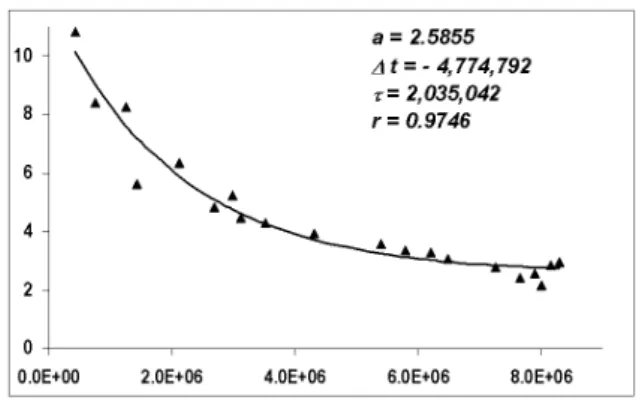
The result of fitting is presented in Fig. 1, to-gether with optimal values of free function pa-rameters a,∆t and τ, and with obtained corre-lation coefficient r. It is worth mentioning that even physicists experimenting with some fun-damental physical law, would be satisfied with the correlation of 0.975.
Fig. 1. Fitting of learning index LI
(X;axis=PPCtokens]; Y;axis=LI).
Independent of learning indexes we took 20 TC values representing average text coverage cal-culated on the basis of a 3-month period of pro-cessing. These 20 points have a total span of 5 years or 12,000,000 tokens, when counted in
PPC. By fitting these data we fixed the
parame-ters∆t andτ on values obtained in the previous fitting. The function we chose was a natural choice:
TC =b 1;e
;
PPC;∆t
τ
The result of this fitting is presented in Fig. 2. The fitting was again very good, since the cor-relation coefficient(parameter r in Fig. 2)was near 0.92.
Fig. 2. Fitting of text coverage TC
(X;axis=PPCtokens]; Y;axis=TC%] ).
Functions (3) and (4) correspond to human experience. Learning words is a never-ending process, since every living language constantly produces new words; this is expressed by the small constant a in Fig. 1. “3 to 5% of word to-kens are usually missing in the lexicon( diction-ary)when tagging a real-world text”(Mikheev, 1996). The value obtained for b in Fig. 2 con-firms these borders.
This correspondence with experience is giving us the faith that our mathematical model of learning makes sense.
4. Cognoelectrical Analogy
Analogy is not the best way of scientific rea-soning. However, if there is no better way of thinking, one must take this one.
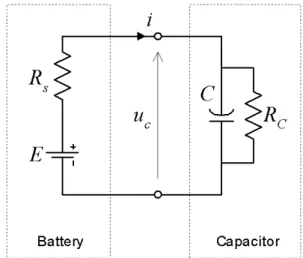
Functions very similar to(3) and (4)describe the charging of a real capacitor connected to a real battery (Fig. 3) where τ = C RC Rs=(RC+Rs). According to the standard nota-tion in circuit theory, the battery is represented by an electromotive force voltage source with constant voltage E and source resistance Rs.
The capacitor is represented by a capacitance
C and capacitor resistance RC: When they are connected, the current(i)and the voltage(uC)
follow the equation(5)and(6), respectively.
i= E RC+Rs
+ E Rs
RC
RC+Rs e
;
t
τ
(5)
uC =
ERC RC+Rs
(1;e ;
t
τ) (6)
The power function, p(t)=iuC, has an extreme if RC >Rs. When the extreme of power exists, it is maximum in t =τln2RC=(RC;Rs)].
Fig. 3. Electrical equivalence of Hascheck learning
process.
Words are the charge for Hascheck. The flow of words, expressed by learning index LI, can be regarded as an equivalent to current i. Ana-logously, the text coverage can be regarded as voltage uC. Users, with their natural language
competence, are the battery; Hascheck is the ca-pacitor. We call this a cognoelectrical analogy.
Having equivalences between LI and i, and be-tween TC and uC, it is normal to construct and
analyse the power of learning function(PoL):
PoL=
h
a+(100;a)e ;
PPC;∆t
τ
i
b
1;e ;
PPC;∆t
τ
The function(7)has an extreme when the “time” has a value of(parameters are taken from Fig. 1):
PPC;∆t=τln
200;2a 100;2a
=1465315tokens] (8)
Now we must go back to the consideration of the value of “time” shift ∆t=;4774792 to-kens], obtained by fitting. As we have already said, this value expresses the fact that Hascheck needed acquisition of basic word knowledge be-fore it could become a useful service. However the “time” shift amounting of nearly 5 Mto-kens cannot be verified by the text corpus used for it; only 800,000 real tokens, processed by Hascheck before it was offered to public use, can be quoted(Dembitz, 1993). The rest has to be considered as another type of time in know-ledge acquisition, the time needed for research, development and programming of Hascheck.
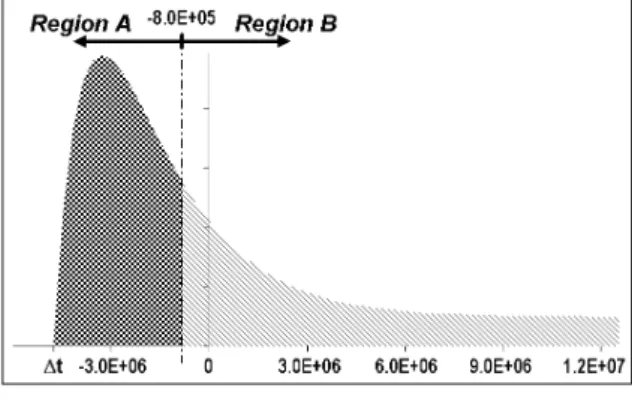
Therefore we split the entire life of Hascheck in two periods: its virtual time, approximately 2τ long, when Hascheck was only an idea, and its real time, approximately 7τ long, when Hascheck was coping with real texts.
Fig. 4. The Hascheck power of learning function: Region A = energy spent in virtual
time of Hascheck’s life; Region B = energy spent in real time
of Hascheck’s life;
(X;axis=PPCtokens]; Y;axis=PoL).
The Hascheck power of learning function PoL is presented in Fig. 4. It is obvious that the most energy-demanding period was the virtual time of Hascheck’s life. The doubts, when one is faced with many problems to be solved, con-sume much energy. During the real time of Hascheck’s life, when we had these problems
mainly solved, the demand for energy dropped significantly. Here the analytic model proves our own experience.
Generally speaking, these energy considera-tions do not contradict common sense. Au-tomata are built up to save human energy; users sent their text to Hascheck to save their own time needed for proofreading. In case of learn-ing automata – or semiautomata, like Hascheck – it should be compensated by the authors’ en-ergy spent in the course of making such an au-tomaton operable. To put it simply, learning automata operate due to the power = knowledge initially supplied by their authors. Whether they will function well or not, it depends upon the quality and quantity of knowledge initially sup-plied, and in each concrete case an estimation of these is still pure art.
Since expert systems are still an applied dis-cipline, and not a theoretical one, let us con-clude with the last Hascheck practical achieve-ment. In the first week of September 2003 Hascheck checked the entire Comprehensive
Dictionary of Croatian Language. The 4th edi-tion of Ani´c’s well known dicedi-tionary (Ani´c, 1991, 1994, 1998) is to appear soon under a new title, because of an increase of vocabu-lary volume covered by the Dictionary. Before its appearance in the book-shops the publisher wanted to check the final lay-out of the Dic-tionary, so he decided to use Hascheck. The results were astonishing(for the publisher). In the text of 1,300,000 tokens Hascheck detected more than 600 typos and misspellings. Glob-ally, for the publisher, it was a very good rate because 0.05% error-rate is acceptable even in better lexicographies than Croatian, but the peo-ple who spent a decade or more working on the Dictionary project couldn’t believe they had never noticed these errors. From the Dictionary proofreading Hascheck learned only 2,000 new word types.
5. Conclusion
literature 50 years ago (Shannon, 1951; Zipf, 1949), but was later replaced by structural and algebra-based approaches to language( Chom-sky, 1957). Inspired by Martinet’s philosophy of language (Martinet, 1960), we decided to explore the hidden, natural language energy, or geometry of language, in order to solve, with minimal effort, the problem of developing a good spell checker for our highly inflected language. We believe that our achievement, presented here, might produce some impact on the renewal of energy considerations about lan-guage and knowledge, since these two concepts are inseparable.
References
1] ANIC´, V., Rjeˇcnik hrvatskoga jezika (Dictionary
of Croatian Language, 1stedition 1991, 2ndedition
1994, 3rdedition 1998), Novi Liber, Zagreb, Croatia,
1991, 1994, 1998.
2] BENTLEY, J., A Spelling Checker, Commun. of the
ACM, 1985, 28(5):456–462.
3] CHOMSKY, N., Syntactic Structures, Mouton&Co.,
The Hague, 1957.
4] DEMBITZ, S., Automatic Misspelling Detection and
Telecommunication Services (in Croatian), PhD
Thesis, Faculty of Electrical Engineering, Univer-sity of Zagreb, 1993.
5] DEMBITZ, S. & SOKELE, M., Computational
Proof-reading of the Croatian Lexicon, Proc. of the 9th
Mediterranean Electrotechnical Conference, 1998,
pp. 1370–1374, Tel-Aviv, Israel, May 18–20.
6] DOLGOPOV, A.S., Automatic Spelling Correction,
Cybernetics, 1986, 22(3):332–339.
7] MARTINET, A., El´ements de linguistique g´en´erale,
Armand Colin, Paris, 1960.
8] MIKHEEV, A., Unsupervised Learning of
Word-Category Guessing Rules, Proceedings of the 34th
Annual Meeting of the Association for Computa-tional Linguistics, University of California, Santa
Cruz, 1996, pp. 62–70.
9] MORRIS, R. & CHERRY, L.L., Computer Detection of
Typographical Errors, IEEE Trans. on Professional
Communications, 1975, PC-18(1):54–64.
10] RISEMAN, E.M. & HANSON, A.R., A Contextual
Postprocessing System for Error Correction Us-ing Binary n-Grams, IEEE Trans. Comput., 1974, C-23(5):480–493.
11] SHANNON, C.E., Prediction and Entropy of Printed
English, Bell System Technical Journal, 1951, 30(1):50–64.
12] SOKELE, M., Croatian Spelling Checkers(in
Croa-tian), WIN.INI, 1997, 6(3):38–49.
13] TAYLOR, R.M., Expert Systems in the Knowledge
Management Era, Applications and Innovations in
Expert Systems VI(R.Milne et al., Eds), 1999, pp.
3–8, Springer-Verlag.
14] ULLMANN, J.R., A Binary n-Gram Technique for
Automatic Correction of Substitution, Deletion, In-sertion and Reversal Errors in Words, Computer
Journal, 1977, 20(2):141–147.
15] USCHOLD, M., Knowledge Level Modelling:
Con-cepts and Terminology, The Knowledge Engineering
Review, 1998, 13(1):5–29.
16] WEISCHEDEL, R., METEER, M., SCHWARTZ, R.,
RAMSHOW, L. & PALMUCCI, J., Coping with Am-biguity and Unknown Words through Probabilis-tic Models, Computational Linguistics, 1993, 19(2):359–383.
17] ZIPF, G.K., Human Behavior and the Principle of
Least Effort, Cambridge: Addison-Wesley, 1949.
Received: April, 2002 Revised: November, 2003 Accepted: December, 2003
Contact address:
ˇSandor Dembitz, Petar Kneˇzevi´c Faculty of Electrical Engineering and Computing
University of Zagreb Unska 3 10000 Zagreb Croatia Phone:+385 1 6129760
Fax:+385 1 6129616
e-mail:[email protected] [email protected]
Mladen Sokele HT – Croatian Telecom Inc. Corporate Strategy and Development Department Hebrangova 32–34 10000 Zagreb Croatia e-mail:[email protected]
ˇSANDOR DEMBITZreceived the BSc(1973), MSc(1981)and PhD
(1993)degrees in electrical engineering, all from the University of
Za-greb, Croatia. He is presently an assistant professor at the Faculty of Electrical Engineering and Computing, University of Zagreb. His cur-rent research interests include natural language processing and expert systems.
PETARKNEZEVIˇ C´received the BSc(1974), MSc(1977)and PhD(1982)
degrees in electrical engineering, all from the University of Zagreb, Croatia. He is presently an associate professor at the Faculty of Elec-trical Engineering and Computing, University of Zagreb. His current research interests include formal description techniques for protocol specification, performance analysis and system modelling.
MLADENSOKELEreceived the BSc(1983)and MSc(1987)degrees
in electrical engineering, both from the University of Zagreb, Croatia. He is presently at the Corporate Strategy and Development Department of HT(Croatian Telecom), where he runs the Research and