55
PHYSIOLOGICAL FEATURES OF THE TERRESTRIAL ORCHIDS
CEPHALANTHERA LONGIFOLIA AND PLATANTHERA BIFOLIA THAT
GROW IN THE PEDO-CLIMATIC CONDITIONS FROM OLTENIA REGION
OF ROMANIA
BUSE-DRAGOMIR LUMINITA (1), NICOLAE ION (2), NICULESCU MARIANA (3)
(1) University of Craiova, E-mail: [email protected] (2) University of Craiova, E-mail: [email protected] (3) University of Craiova, E-mail: [email protected]
*Corresponding author email: [email protected]
Key words: terrestrial orchids, transpiration, photosynthesis, light
ABSTRACT
For studying the physiology of terrestrial orchids, plants from the species
Cephalanthera longifolia and Platanthera bifolia have been used.
The experiences were carried out directly on the field, in Mehedinţi County, Comanesti Hills.
In both species of orchids, the seasonal dynamics of photosynthesis registers a peak during the flowering period that corresponds to a maximum content of assimilating pigments and also a maximum leaf surface.
In terrestrial orchids, the seasonal dynamics of leaf transpiration intensity is highest during spring, when the water content in the soil is high and minimal in summer.
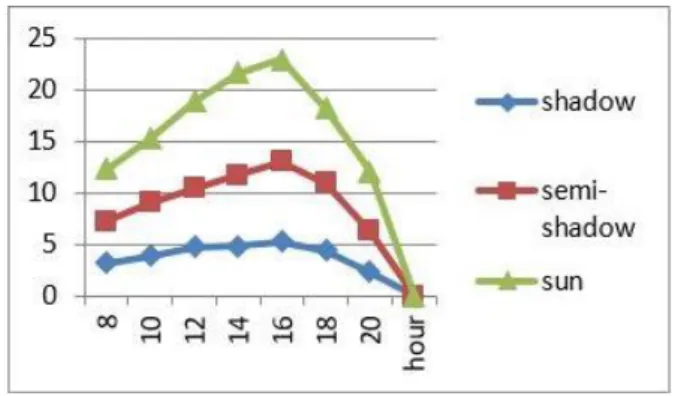
The graphs showing the diurnal variation of photosynthesis for the two species indicate that Cephalanthera longifolia prefers semi-shaded and sunny habitats, while the plants of
Platanthera bifolia that are found in the studied areas prefer a more shaded environment
INTRODUCTION
Orchids that grow directly at the ground level in large areas of Europe or on the grasslands of the tropical regions of America are called terrestrial orchids.
All orchid species are included under Annex B of the Convention on International Trade in Endangered Species of Wild Fauna and Flora (CITES)https://cites.org/eng/node/38541.
Like most other plants, the orchids have roots, rhizomes or tubers in the ground, leaves of different colors and shapes displayed along the stem and they produce flowers (that are characteristic for the genus) during a well-defined period of the year.
All orchids from Romania are terrestrial, perennial, having a rhizome or
two, more or less globular or digitally-branched tubules. From the main tuber comes the flowering stem. This tubercle, in the lower part, has a root character and in the upper part it has a stem character.
Each year, a secondary tuber is formed from a lateral bud, which will give rise to the flowering stem in the coming year.
The main root is missing from orchids, with only secondary roots or cylindrical adventives.
The single stem is simple, erect, and the leaves are arranged spirally or in two rows.
56
are gathered in more or less dense, spiciform, or racemose, rarely solitary inflorescences.
Pollinators act as a driving force in the reproduction and diversification of orchids (Cozzolino and Widmer, 2005) because they contribute to the establishment of reproductive isolation between species.Appropriate strategies for attracting pollinators and ensuring that cross-pollination is taking place efficiently are essential in the adaptation and evolution of the species. Particularly, orchids are known to have developed various and original strategies. Given their strong influence on pollination efficiency, the adaptive value of floral traits displayed by orchids has received considerable attention from evolutionary biologists
(https://www.ncbi.nlm.nih.gov/pmc/article s/PMC5787349).
Currently, terrestrial orchid populations are declining in areas that are not protected. The main causesare the destruction of habitats, deforestation, over-grazing, human intervention under the form of constructions.
Climate change, which has been observed in the research fields, also affects the growth and development of different species of orchids. For this reason, the knowledge on the physiology of these plants is important, in order to know what their degree of adaptability is.
MATERIALS AND METHODS
In order to study the physiology of terrestrial orchids, plants from the species
Cephalanthera longifolia and Platanthera bifolia were used.
The experiences were carried out directly in the field, in Mehedinti county, in the Comanesti Hills. These are located west of the Motru river and belong to Comanesti village, Bala commune. From an altitudinal point of view, these range from 150 m to 450 m. The geographical coordinates are: 440 58' N latitude and
220 54' E longitude.The area is included
in the Central-European climate regime with sub-Mediterranean influences. From the hydrographic point of view, the main watercourse is represented by the Pistrita stream, a tributary of the Motru river, which runs through the hills from west to east. The Călugărita stream is another tributary, with a lower water flow, which runs on the northern side of the hills.
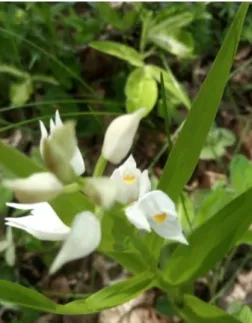
Cephalanthera longifolia (L.) Fritsch (fig. 1) is found throughout temperate and Mediterranean Eurasia, from the Atlantic to the Himalayas. It is widespread and often abundant but becomes more local and rarer in the northwestern periphery of its range. In the UK, it occurs in southern England, the Midlands, Cumbria, West Wales and Scotland. This species is found from sea level to 2,000 m altitude (Lang 2004, Harrap and Harrap 2009, Delforge 1995).
Cephalanthera longifoliais common in some parts of its European range, such as southern France and Spain, but endangered particularly in northern areas such as Belgium.In Italy it is present on the whole territory of the country (https://www.floraitaliae.actaplantarum.or g/viewtopic.php?t=2176).
In Britain and Ireland it is a quite uncommon and declining species, and conservation work is being carried out at a number of sites to safeguard it.
In 2007 it was listed as a priority species under the UK Biodiversity Action Plan. The charity Plantlife International is leading this work in the United Kingdom.
(rare-Plant-Monitoring_Newsletter-2018.pdf).
57
are under increased threat due to anthropogenic effects and only a limited number of species are welldistributed and exist in larger colonies(Gülden Sandal, 2017). Typical habitats of Cephalanthera
longifolia include grassy places,
woodland edges, clearings and glades, sometimes open grassland and open woodlands. It grows in calcareous or decalcified cool soils, prefers lime-rich soil and is always found in semi-shade. The flowering time of the species takes place from May to June (Lang 2004, Delforge 1995).
Fig.1.Cephalanthera longifolia (photo by Buse L.)
Cephalanthera longifolia reaches on average 20–60 centimetres (7.9–23.6 in) of height in typical conditions. This orchid has erect and glabrous multiple stems. The leaves are dark green, long and narrowly tapering (hence the common name of Sword-leaved Helleborine). The inflorescence is a lax, five to twenty-flowered spike with the bell-shaped flowers ascending in an oblique spiral. The flowers are white, about 1 cm (0.4 in) long, with a yellow-edged labellum and they usually open only during the warmest and brightest hours of the day. This plant can be found in bloom from April to June, depending on location and altitude. The fruit is a dry capsule and the dust-like seeds are dispersed by the
wind.The flowers are pollinated by solitary bees. The flowers produce little nectar and the yellowish dust on the labellum which the insects collect is of little nutritional value. The actual pollen is contained in two pollinia which adhere to the hairs on the bee's back. The flower spikes are eaten by deer.
(https://www.floraitaliae.actaplantaru m.org/viewtopic.php?t=2176).
Platanthera bifoliaL.(Rich) (fig. 2)is widespread in Europe and Asia and also found in North Africa. In Europe, the species can be found north to the Faeroe Islands and in northern Scandinavia. South, the species extends to Spain, Italy, northern Greece, and eastwards to Crimea and the Caucasus. It also occurs on the Balearic Islands, Corsica, Sardinia, Sicily and the Aegean islands. The species can be found up to 2,500 m altitude.(Rankou, 2011).
The geographic distribution of
Platanthera species (also known as “butterfly orchids”) covers most of the temperate zone throughout the Northern Hemisphere (Hultén, Fries, 1986) and this orchid genus encompasses five species in mainland Europe, two of which are widespread: P. chlorantha (Custer) Rchb. and P. bifolia (L.) Rich. (Bateman et al., 2009) (Esposito Fabiana, 2018,(https://www.ncbi.nlm.nih.gov/pmc/a rticles/PMC5787349).
58 Platanthera bifoliais found in shady forests, meadows, in orchards and on the edge of forests. The plant has large tubercles, with short, cylindrical secondary roots.
The stem which measures 25 to 45 cm is rigid, erect, or slightly flexural, of a light green color.
The two glabrous leaves are glossy,of bright green color andplaced at the base of the stem. Above, on the stem,there can be 1 to 3 leaves which are much smaller, lanceolate, sharp, bracteiform, with a smooth margin. The inflorescence is present at the top on an almost cylindrical spike; the flowers are of a dirty white or greenish-white and pleasantly scented (the scent is similar with that of the lily of the valley).
The experiments focused on the intensity of leaf photosynthesis, leaf respiration intensity, transpiration intensity, leaf water content and chlorophyll content.
Photosynthesis, respiration and transpiration were determined with the portable Lci apparatus.
The chlorophyll content was determined using the Minolta portable chlorophillmeter, the results being expressed in SPAD units, and the total water content was determined gravimetrically by drying the plant material at the oven at 105 0C.
Determinations were made in three different periods:
- May 2019, during the period of vegetative growth
- June-July 2019, during the flowering period for both species
- the end of September 2019, which corresponds with the period in which the species goes dormant
Thus, the seasonal dynamics of photosynthesis and transpiration processes could be represented.
In order to represent the diurnal dynamics of the two processes, determinations were made in July at different times of the day.
RESEARCH RESULTS
Photosynthesis intensity
Regarding the seasonal dynamics of photosynthesis (gr.1), in both species of orchids it registers a maximum in the flowering period (10.40 μmol / m 2 / s at
Cephalanthera longifolia, and 9,91μmol /
m 2 / s at Platanthera bifolia),
corresponding to a maximum content of assimilating pigments and a maximum leaf surface.
The minimum value of the intensity of photosynthesis is recorded in the autumn, when the catabolic processes (of degradation) are dominant.
Graphic 1. The seasonal variation of photosynthesis (μmol / m2 / s)
To determine the diurnal variation of photosynthesis, measurements were made on forest plants, plants grown in the shade, partially shaded plants, plants from the edge of the forest and plants found in the meadows, in full sun.
Graphic 2. The diurnal variation of photosynthesis (μmol / m2 / s) in the
Cephalantheralongifolia species
0 5 10 15
59
The graphical data (gr.2) indicates that Cephalanthera longifolia prefers semi-shaded and sunny areas, because it has the maximum photosynthesis in these conditions. Plants grown in the shade, in the forest have much lower values of photosynthesis, due to the reduced light, which becomes a limiting factor.
In the case of Platanthera bifolia, plants grown in the sun show lower values of photosynthesis than those grown under shade (gr.3). This is why this species prefers shaded areas, but can adapt to other lighting conditions.Under these conditions, it has a lower photosynthesis efficiency.
Graphic 3. The diurnal variation of photosynthesis (μmol / m2 / s) to the Cephalanthera longifolia
species
Respiration intensity
The determination of the intensity of the respiration in the leaves of the two species was carried out at different times of the year, corresponding to different phases of growth and development. The data from graphs 4 and 5 indicate that the flowering period requires the highest amount of energy. Therefore, during this period, the respiration reaches a maximum. High values are recorded in very young plants, with the leaves in the growing period.
Graphic 4. The respiration intensity of leaves a Cephalantheria longifolia plants (μmol / m2 / s)
Graphic 5. The respiration intensity of leaves at Cephalantheria longifolia plants (μmol / m2 / s)
The intensity of the transpiration process
The seasonal variation of the transpiration presents a maximum during the period of vegetative growth, due to the higher quantity of water in the soil. In
Cephalanthera longifolia, throughout the determinations, the values are lower than in Platanthera bifolia. The fact that the latter has high transpiration values is a disadvantage, especially for individuals who grow in sunny habitats and will suffer from dehydration.
The diurnal variation, determined during the flowering period, indicates a maximum at 14-16 hours in plants grown in the shade. In the case of
Cephalanthera longifoliaplants which grow in a sunny environment, transpiration is reduced at noon, but in 0
2 4 6 8
8 10 12 14 16 18 20
h
o
u
r
shadow
semi-shadow sun
0 2 4 6 8 10 12 14
0 1 2 3 4 5
60 Platanthera, the values remain high, even in these conditions.
Graphic 6. The seasonal variation of leaf transpiration (mmol/m2 /s) at Cephalanthera
longifolia and Platanthera bifolia
Graphic 7. The diurnal variation of leaf transpiration (mmol/m2 /s) at Cephalanthera
longifolia and Platanthera bifoliain shade conditions
Graphic 8. The diurnal variation of leaf transpiration (mmol/m2 /s) at Cephalanthera
longifolia and Platanthera bifolia in sunny conditions
The water content of leaves
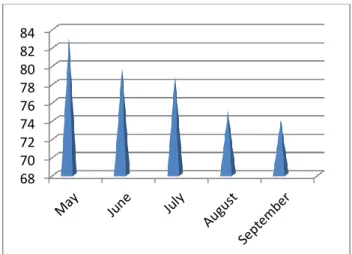
In both species of orchids, the maximum leaf water content is recorded in May, during the period of vegetative growth.
It is maintained at high values until the end of July, after which it gradually decreases, due to the decrease of the quantity of water in the soil.
Of the two species, Platanthera
bifolia has higher values of water content in spring and much lower values in autumn.
Graphic. 9. Total water content of the leaves (%) at Cephalanthera longifolia plants
Graphic. 9. Total water content of the leaves (%)at Platanthera bifolia plants
68 70 72 74 76 78 80 82 84
0 2 4 6
8 12
16 20
Cephalanthera Platanthera 0
2 4 6
Ma
y
Ju
n
e
Ju
ly
Au
gu
st
Se
p
te
m
b
e
r
Cephalanthera Platanthera
0 2 4 6
8 12
16 20
Cephalanthera Platanthera
61 The content in chlorophyll pigments
The determination of the content of chlorophyll pigments in the leaves of
Cephalanthera longifolia and Platanthera bifolia revealed significant differences during the vegetation period, with a maximum in July, during the maximum flowering period, and a minimum in May.
Low chlorophyll content is also found in September, before entering the resting state(gr.10).
Graphic 10The amount of chlorophyll
pigments in the leaves of Cephalanthera longifolia
and Platanthera bifolia (SPAD units)
CONCLUSIONS
In the researched area, the two species of orchids find optimal conditions for growth and development.
They grow both in the forest, in shady conditions, at its edge in semi-shade, or on the nearby sunny meadows. The diurnal variation of photosynthesis registers a maximum at noon and a minimum in the morning.
The maximum photosynthesis is recorded during the flowering period, when the chlorophyll content is alsoreaching a maximum.
The seasonal variation of the transpiration registers a maximum during
the period of vegetative growth, due to the greater quantity of water in the soil.
The water content shows significant variations throughout the vegetation period, with a maximum duringspring.
Cephalanthera longifolia prefers semi-shaded and sunny habitats, while the plants of Platanthera bifolia that are found in the studied areas prefer a more shaded environment.
BIBLIOGRAPHY
1.Cozzolino, D’Emerico, Widmer 2004,Evidence for reproductive isolate
selection in Mediterranean orchids:
karyotype differences compensate for the lack of pollinator specificity. Proceedings of the Royal Society B: Biological Sciences
2. Delforge, P. 1995. Orchids of Britain and Europe. Delachaux et Niestlé SA, Lausanne
3. Esposito Fabiana, Nicolas J. Vereecken, Maddalena Gammella, Rosita Rinaldi, Pascal Laurent, Daniel Tyteca, 2018, Characterization of sympatric
Platanthera bifolia and Platanthera
chlorantha (Orchidaceae) populations
with intermediate plants,
https://www.ncbi.nlm.nih.gov/pmc/arti cles/PMC5787349/
4. Gülden Sandal Erzurumlu, Kemal TuluhanYılmaz, ZerrinSöğüt, 2017,
A Regional Scale Evaluation of Conservation Status of Orchid Species Recorded in The Eastern Mediterranean Region of Turkey,Turkish Journal of Agriculture p 996-1001
5.Harrap, A. and Harrap, S. 2009.
Orchids of Britain and Ireland A field and Site Guide. A&C Black Publishers Ltd., London.
6.Lang, D. 2004. Britain's Orchids. WILD Guides Ltd., Old Basing.
7.Rankou, H. 2011. Platanthera bifolia. The IUCN Red List of Threatened Species 2011
62
https://www.floraitaliae.actaplantarum.org /viewtopic.php?t=2176
(rare-Plant-Monitoring_Newsletter-2018.pdf