IS THE FLIPPED INSTRUCTIONAL MODEL
WORTH IT?
Caroline Johnson Caswell, Rhode Island College
INTRODUCTION
Today, numerous rapid changes have occurred in the ways which humans communicate. Many of those changes have included technological tools in the work place and at home. With individuals expecting information to be sent and received via technology, educators must pause and consider its relevance to their practice. The advancement of technology requires educators to think about how instruction might change. Traditional lecture is understood to be a method where students passively obtain information (Abeysekera & Dawson, 2015; Clark, 2015; Guerrero et al., 2015; Kensington-Miller et al., 2016) which is no longer encouraged or recommended. As a result, faculty members and teachers are looking for ways to integrate technology into instruction in a meaningful way (Strayer, 2012; Maxson & Szaniszlo, 2015) in an effort to increase student engagement. One instructional strategy that integrates technology and engages students is the “flipped classroom” (Gilboy et al., 2015; Gross et al., 2015; Clark, 2015; Anderson & Brennan, 2015; Ford, 2015; Ziegelmeier & Topaz, 2015; Guerrero et al., 2015; Chili-Turner, 2015; Kensington-Miller et al., 2016; Lei & Lai, 2017).
This study will look at four sections of preservice elementary education mathematics taught by the same instructor: two taught traditionally and two using the flipped model. This researcher’s objective is to contribute to the steadily increasing body of knowledge surrounding the flipped model instructional methodology. Over the past two years, journals have devoted entire issues to the flipped classroom (e.g., PRIMUS, 25 (9-10)). As a teacher educator, the instructor in this study will employ a variety of engaging activities in all sections in an effort to identify if in-class pedagogy impacts the instructional model. Class attendance, final exams, final grades, student evaluations, and student work will be analyzed through mixed methods. The research question is to what degree does an instructional model (i.e., traditional or flipped) influence student achievement and student perceptions of the course and instructor.
RATIONALE
As a joint appointment in the Mathematics & Computer Science and Educational Studies Departments of an urban college in Rhode Island, I teach elementary education teacher candidates (TCs) mathematics. To model effective instruction, a variety of literacy strategies (e.g., KWL, Frayer model, Four Corners, Interactive Notebooks, Foldables, etc.) and mathematical tools (e.g., base ten blocks, anglegs, etc.) are implemented during class instruction.
practiced the content through homework. Once in a while an activity would be introduced which included group work. Students consistently mentioned, on the narrative portion of their evaluations, that homework should be graded to motivate students.
Various online homework and companions to a textbook like WebAssign or MyLab were explored, but students complained it was difficult to answer questions. Some students struggled to complete homework independently outside of class. Half of the next class was spent going over homework for 5 out of 30 students. None of this appeared to be a good use of class-time which is approximately four hours per week. Coupled with summative assessment (i.e., quizzes and exams), there was very little time for students to explore and work in groups on problems. A few years ago, more active learning strategies during class were included. Although still not satisfied that students have deep content knowledge when they completed the course, the ultimate conclusion was that there must be a better approach. Perhaps a flipped model was a viable alternative.
DEFINITION
There is some discussion about whether the flipped classroom holds its origins in the inverted classroom model. Lage et al. (2000) provides a simplistic definition that inverting the classroom means to switch the lecture from inside the classroom to outside with homework from outside to inside. According to Lo & Hew (2017) the flipped model should include, at minimum: 1) audio or video materials for students to prepare prior to class and 2) face-to-face in-class sessions which sounds vaguely similar to the inverted method of instruction. However, the flipped classroom model is designed to deliver the content before class through online videos, in order to free-up the in-class time for active learning and problem solving activities (Lo and Hew, 2017).
Furthermore, Flores et al. (2016) states that well-organized teaching plans are the first necessary step to ensure successful implementation. The in-class component should be active and problem based (Love et al., 2014) turning the passive student into an active one (Liou et al., 2016). To add further confusion, Kennedy et al. (2015) writes that the “flipped classroom” refers to how the content is delivered while “inverted pedagogy” refers to an educational paradigm in which classroom time is reserved for deep and enriching activities instead of direct instruction.” It is no wonder that the research results are mixed as there are a number of approaches to the flipped classroom. Flipped lessons can be used on a single topic, weekly or various topics, and entire course (Talbot, 2014).
Whether the content is learned out of class and the homework is moved to “in class” via text, online methods, or deep meaningful activities, all constitute some form of flipping the traditional classroom. However, the preferred use of class time according to McGivney-Burelle & Xue, “... is devoted to affording students an opportunity to assimilate their knowledge through structured group problem-solving activities, small group discussions, and whole-class discussions all under the guidance of a more knowledgeable instructor (2015, p. 478).”
providing personalized, interactive, and collaborative learning experiences (Guerrero et al., 2015, p. 815).” Davidson (2015) reminds us that peer instruction deepens one’s own understanding.
It is important to recognize that the conceptual model may not reflect all flipped classrooms. If the flipped model is more of the inverted method, then merely switching lecture and homework settings may not fully represent the intention of the flipped classroom. That is not the intention of this study.
LITERATURE REVIEW
Lage et al. (2000) are predominantly credited with the initial inverted classroom from which the flipped model likely developed. Bergmann and Sams are considered the “fathers” of the flipped classroom. They have written a number of books on the model (2012, 2015) for various content areas. The team list many positive characteristics of implementing the flipped classroom:
● saves time re-teaching the same lesson to catch students up who missed class; ● better student performance on end of chapter assessments;
● tailor class time to student needs addressing personalization; ● tutor instead of presenter;
● creates a student centered classroom;
● creates equity as traditional model provides attention to best and brightest (who raises their hand more);
● opens your door to transparency; ● increases parental involvement;
● challenges students to take responsibility for their learning; ● provides immediate feedback to students; and
● increased discourse in class.
A number of researchers claim there haven’t been many studies conducted on the flipped classroom effectiveness (Al-Zahrani, 2015; Abeysekera & Dawson, 2015). Perhaps at the time of their studies that was true. However, over forty studies have attempted to assess the effectiveness of the flipped model in a variety of content areas and fields of study. An extensive review of the literature found mixed results with the flipped classroom. A number of studies boast of increased student achievement (Wilson, 2013; Hung, 2014; Little, 2015; Flores et al., 2016; Hwang & Lai, 2017), increased final exam pass rates (Chili-Turner, 2015; Porcaro et al., 2016; Schroeder et al., 2015; Overmyer, 2015), less course failures (Petrillo, 2015; Gonza ́lez-Go ́mez et al., 2016), higher grades and passing rate (Weng, 2015), and better performance in the next course (Schroeder et al., 2015). Yet Palmer (2015) who also studied Calculus II students did not yield statistically significant results from prior flipped model students. (Liou et al. (2016) yielded results on a post test that showed encouraging increases of enhancing knowledge, comprehension and application skills of the learners.
quiet/shy students to participate more fully in a virtual setting (Zainuddin & Attaran, 2016; Palmer, 2015). Some studies mentioned students appreciated the ability to rewind and rewatch videos (Talbert, 2014; Yong et al., 2015; Gonza ́lez-Go ́mez et al., 2016) and ability to ask questions with no wasted class time (Ogden, 2015). Instructors appreciated the ability to consistently and constantly formatively assess students (Kennedy et al., 2015) and reported less time prepping for class (Platt et al., 2000).
In Clark’s study, “students shared how they previously thought effective teaching only involved listening to lectures and taking notes; however, after experiencing the flipped classroom, they gained a new understanding of what effective teaching looked like (2015, p. 105).” Flipped model is the best of both worlds, where students can learn anytime, anywhere if they have the tools, however if students do not have the tools it can be difficult (Kennedy et al., 2015; Wang, 2017).
Not all of the studies yielded positive results. There were a number that did not yield improvement in academic achievement (Frederickson et al., 2005; Fraga & Harmon, 2014; Clark, 2015; Yong et al., 2015; Zack et al., 2015; Ziegelmeier & Topaz, 2015), pre/post, midterms, and a final (Guerrero et al., 2015) on standardized measures (Wang, 2017), and exams (Kennedy et al., 2015).
However, Chili-Tuner found that students did not enjoy it significantly more than traditional lecture (2015). In general, some studies reported increased student satisfaction and retention in quantitative courses (Weng, 2015; Swart & Wuensch, 2016). The flipped model promotes teaching students how to learn (Porcaro et al., 2016). There were a number of issues that arose: lack of students viewing the videos (Gaughan, 2014; Palmer, 2015; Weng, 2015; Ford, 2015; Gouia & Gunn, 2016; Lei & Lai, 2017), frustration of dependent learners (Fraga & Harmon, 2014), lack of feedback from instructor (Al-Zahrani, 2015; Zack et al., 2015), decreased class attendance (Palmer, 2015) and increased student (Wilson, 2013; Abeysekera & Dawson, 2015; Schroeder et al., 2015; Lo & Hew, 2017) and teacher (Wang, 2017) out of class preparation. Guerrero et al. in their study summarized that, “Even though there was no direct impact of the flipped approach on test scores, teacher interviews and observations highlighted the fact that students in the flipped section got more in-class time to engage with the content in authentic ways that promoted collaboration, communication, and exploration of concepts (2015, p. 827).”
METHOD
classroom, it became apparent how much time and effort it took to create videos (Gaughan, 2014; Talbert, 2014; Schroeder et al., 2015; McGivney-Burelle & Xue, 2015; Porcaro et al., 2016; Lo & Hew, 2017) and that time might be better spent elsewhere. However, some researchers believe it is important for the instructor to create their own videos (Ford, 2015; Ziegelmeier & Topaz, 2015; Gouia & Gunn, 2016; Abbasian & Sieben, 2016). Considering both perspectives yielded in time spent selecting the best lectures on each area of the content focusing on multiple strategies for solving each problem.
Assigned two sections of the same course, it made sense to try a flipped classroom in one section and compare it to the traditional setting of lecturing during class in the second section. This was a common research practice in the literature review. However, after a short time, the preparation for each lesson was taking up to five hours for each class. Not only selecting the appropriate videos, but developing targeted tasks for in class activities also had a huge impact on time management. Still, it was deemed an important endeavor, so both of the classes were flipped and compared against the results of the prior year’s two classes.
THE STUDY
The institution is a small public urban four-year college in New England with less than 9,000 students. Approximately two-thirds of the study body is female and one-quarter are students of color. Many of the students are the first in their families to attend college. The majority of students commute to school and work twenty hours or more per week.
This study covers four sections of Mathematics for Elementary Teachers I taught by the same faculty member. Much like Ford (2015), the course content included “numeration, sets, relations, bases, and the development of the number system” (p. 370) which is standard elementary education mathematics syllabi coverage.
In the traditional classroom, the technology included: a Smartboard, document camera, one projector and screen, and a desktop computer. Two students were seated at each table for partner work and could turn to make a group of four. Both sections were scheduled three times weekly. Two days were fifty minutes in length which consisted of mainly lecture and review of homework. One day per week the class was nearly two hours long which consisted of assessments and group work. The official text for both traditional classes was Long, DeTemple, and Millan’s Mathematical Reasoning for Elementary Teachers (2009) and Dolan et al.’s Volume 1 Mathematical Activities for Elementary Teachers (2009) which were custom editions for the college.
For the flipped classroom, the physical space was two long dry erase boards spanning the classroom walls, two overhead projectors with screens, a document camera, and a desktop computer. The classroom is considered a STEM room where tables can be rearranged to form groups. The class was often set up to accommodate groups of four where two lab tables were placed together. The flipped classes were held twice weekly for approximately two-hours. Tasks were assigned each class. Group work was the expectation for each task. The tasks were often adapted from Mathematics for Elementary Teachers: Real Numbers (Jones, 2013). Some of the task questions were designed to be more inquiry based. There was more student choice introduced as well. The official text for the course was Freitag’s
Mathematics for Elementary School Teachers a Process Approach (2014), which was adopted by the department in the spring 2016. At the beginning of the semester, group work norms were established by each class.
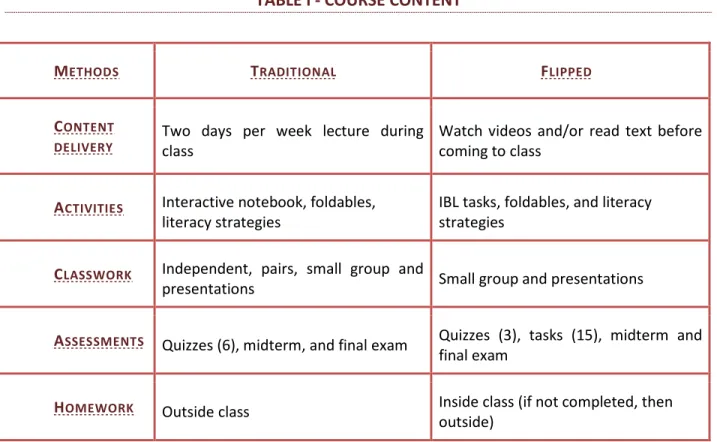
quizzes and exams. The flipped model had more graded inquiry based tasks and less formal quizzes and exams. Groups in the flipped classroom were able to choose whether they preferred a group grade for the task or an individual grade. The traditional and flipped classroom structure is listed below (Table I). The course content was virtually the same in all four sections.
TABLE I - COURSE CONTENT
METHODS TRADITIONAL FLIPPED
CONTENT
DELIVERY Two days per week lecture during class Watch videos and/or read text before coming to class
ACTIVITIES Interactive notebook, foldables,
literacy strategies IBL tasks, foldables, and literacy strategies
CLASSWORK Independent, pairs, small group and
presentations Small group and presentations
ASSESSMENTS Quizzes (6), midterm, and final exam Quizzes (3), tasks (15), midterm and
final exam
HOMEWORK Outside class Inside class (if not completed, then
outside)
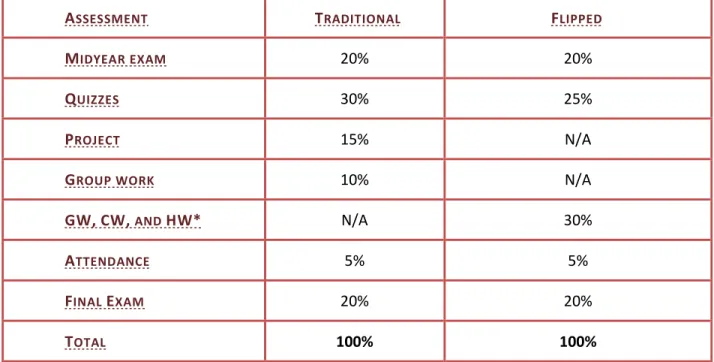
The grading system did not vary significantly between the traditional and flipped models (see Table II). As a result of feedback from prior semesters’ student evaluations, homework was occasionally graded in the flipped classrooms. The traditional classroom students were required to complete an Interactive Notebook project. In the flipped classroom, instead of a project, there were more in class TASKS that were graded. Some of the questions required a written narrative and the mathematics problems were sometimes open ended. These TASKS were challenging for most of the students. Students worked in groups of 3 or 4 to complete them. Appendix A contains a sample TASK.
STUDENT DEMOGRAPHICS
TABLE II - GRADING SYSTEM
ASSESSMENT TRADITIONAL FLIPPED
MIDYEAR EXAM 20% 20%
QUIZZES 30% 25%
PROJECT 15% N/A
GROUP WORK 10% N/A
GW,CW, AND HW* N/A 30%
ATTENDANCE 5% 5%
FINAL EXAM 20% 20%
TOTAL 100% 100%
* GW – group work, CW – classwork, and HW – homework
TABLE III - STUDENT DEMOGRAPHICS
DEMOGRAPHICS TRADITIONAL FLIPPED TOTALS
GENDER
Male 7 5 12
Female 50 47 97
RACE
Asian 2 2 4
Black 0 2 2
Hispanic 8 3 11
Mixed 0 1 1
White 47 44 91
STATUS
Sophomore 16 10 26
Junior 18 4 22
Senior/gradua
te 4 2 6
TOTAL 57 52 109
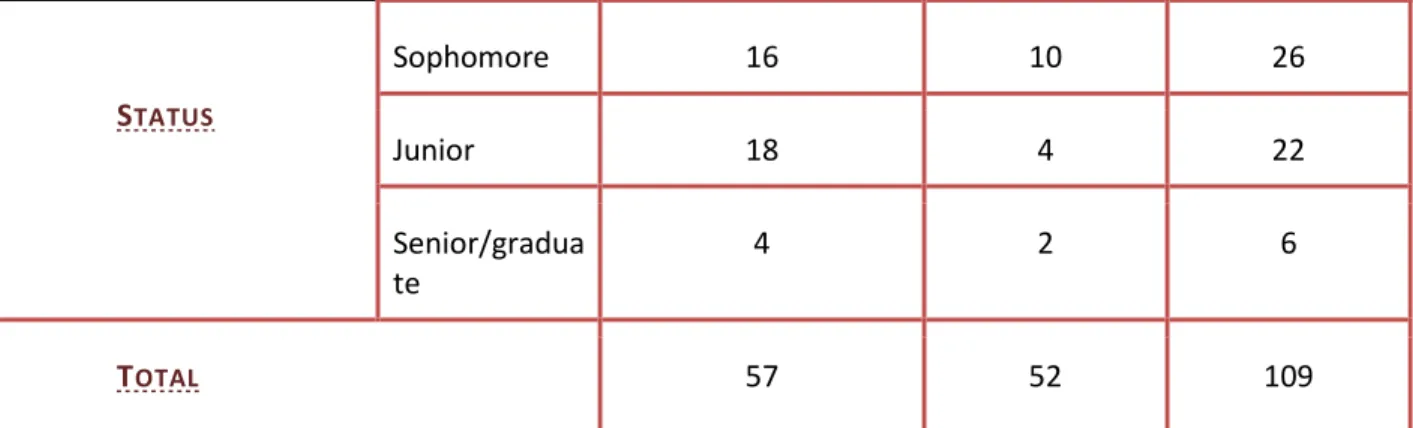
Elementary education students are more likely to be female which is indicative in this study as almost ninety percent are female. The race of the students is predominantly white, just over eighty percent. Approximately seventy percent were freshmen in the flipped classroom as opposed to thirty-nine percent in the traditional setting. Eighty-eight percent of flipped classroom students were freshmen and sophomores while two-thirds were in their first two years in the traditional setting.
FINAL EXAM
The final exam was the same for both sections of each year, but the traditional exam and flipped exam were not the same. Table IV lists the final exam format.
TABLE IV – FINAL EXAM FORMAT
QUESTION FORMAT TRADITIONAL FLIPPED
True/False 10 6
Sometimes, Always, Never 0 4
Multiple choice (1 answer) 18 0
Multiple choice (multiple answers) 12 17
RESULTS
FINAL EXAM AND FINAL GRADE
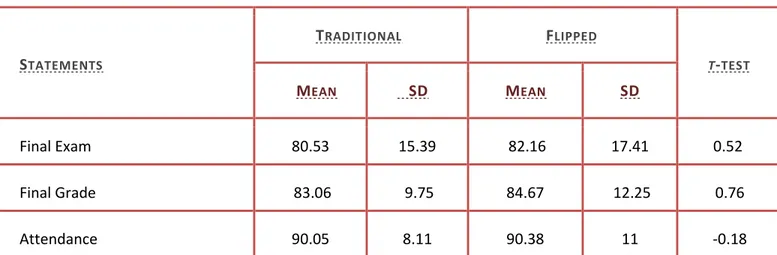
Independent sample t-tests were performed for the final examination grades, final semester averages, and attendance comparing traditional model and flipped model students. The null hypotheses for each test was that there were no significant differences between the final exam averages, the course grades, or the attendance within the student groups from the traditional versus the flipped model classrooms. The results of the t-tests are reported below (Table V).
TABLE V - SUMMARY STATISTICS AND
T
-TEST RESULTS
STATEMENTS
TRADITIONAL FLIPPED
T-TEST
MEAN SD MEAN SD
Final Exam 80.53 15.39 82.16 17.41 0.52
Final Grade 83.06 9.75 84.67 12.25 0.76
Attendance 90.05 8.11 90.38 11 -0.18
None of the tests yielded a statistically significant result, which means the null hypothesis was not rejected for either the final exam, end of course grade, or attendance. Thus, it is assumed that students from either instructional model performed similarly on the final exam and earning of course grades. The results also indicated that, no matter which section or instructional method students were in, their attendance did not appear to be influenced by the model.
STUDENT EVALUATIONS
Next the student evaluations were analyzed for patterns. Towards the end of each semester, students evaluate each mathematics course/instructor. Students complete the 14 statements on an anonymous and confidential “bubble sheet.” Instructors are not permitted to be present and cannot transport the results for analysis. A student is responsible to turn in the completed evaluations to the department office. The following statement is read to students:
Each semester the Math & CS Department administers evaluations in every course offered. These are completely anonymous, and you should place neither your name nor social security number anywhere on the evaluation materials. Instructors do not receive the results until well after course grades are submitted, so responses can in no way affect your course grade.
material. For these reasons we would appreciate responses that are both honest and reflective (Instructions for Student Evaluations, RIC 2015-2016). The ratings for each of the fourteen statements are:
5.0 excellent 4.0 good 3.0 satisfactory
2.0 less than satisfactory 1.0 very poor
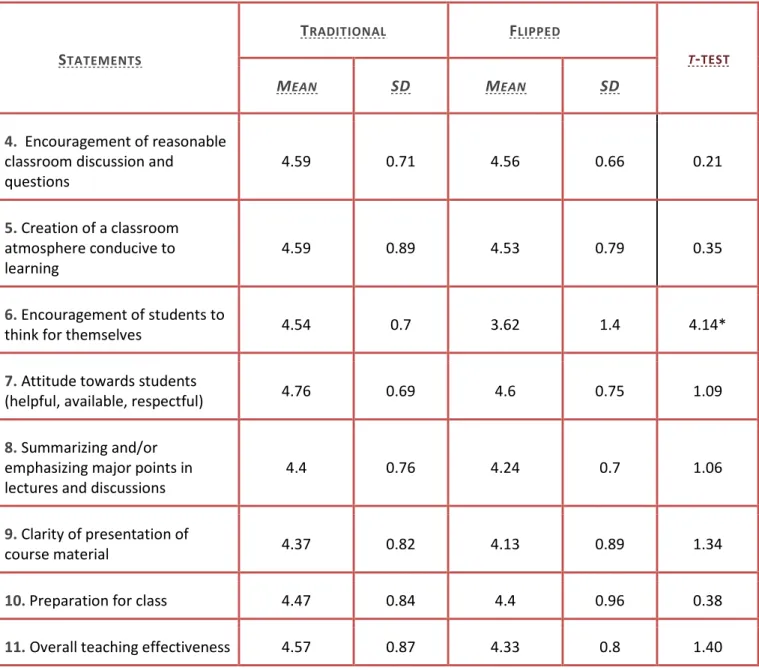
Table VI (below) lists the results of independent samples t-tests performed on Statements 4-11.
TABLE VI - STUDENT EVALUATION
T
-TEST RESULTS
STATEMENTS
TRADITIONAL FLIPPED
T-TEST
MEAN SD MEAN SD
4. Encouragement of reasonable classroom discussion and
questions 4.59 0.71 4.56 0.66 0.21
5. Creation of a classroom atmosphere conducive to
learning 4.59 0.89 4.53 0.79 0.35
6. Encouragement of students to
think for themselves 4.54 0.7 3.62 1.4 4.14*
7. Attitude towards students
(helpful, available, respectful) 4.76 0.69 4.6 0.75 1.09
8. Summarizing and/or emphasizing major points in
lectures and discussions 4.4 0.76 4.24 0.7 1.06
9. Clarity of presentation of
Only one statement (#6) yielded statistically significant results. The null hypothesis result yielded no statistically significant difference between the traditional model and flipped model in student perceptions of the instructors’ encouragement of students to think for themselves. The null hypothesis is therefore rejected and there were differences in student perceptions. Traditional classroom students reported higher levels of encouragement to think for themselves than students in the flipped classroom. This is an unexpected finding as in class tasks were inquiry based adapted from Mathematics for Elementary Teachers: Real Numbers (Jones, 2013).
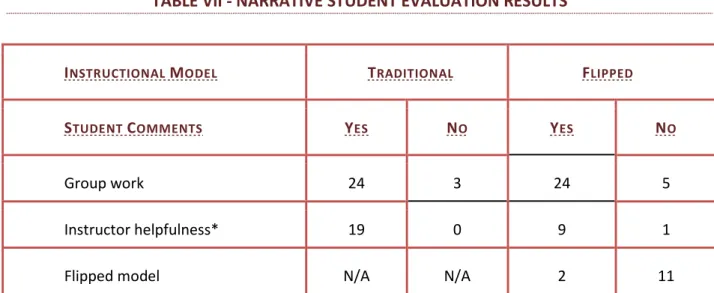
The second part of the student evaluation process is the narrative. This is where students can write specific feedback to instructors. The request for comments includes: Course Content, Text, Exams and Homework, Instructor, Technology, Group Work, and Computer Facilities. The narrative responses from all four sections were analyzed to look for common themes or patterns in their statements. “Yes” meant they made a positive statement and “No” meant they made a negative statement. It is important to note that many students do not write anything in some or all sections. The three areas that appeared to have a substantial common theme are reported below (Table VII).
TABLE VII - NARRATIVE STUDENT EVALUATION RESULTS
INSTRUCTIONAL MODEL TRADITIONAL FLIPPED
STUDENT COMMENTS YES NO YES NO
Group work 24 3 24 5
Instructor helpfulness* 19 0 9 1
Flipped model N/A N/A 2 11
*When counting teacher “helpfulness” the adjectives interesting, fun, and nice were not counted. Approximately 52% of the students in the traditional classroom reported group work being useful while, 7% did not enjoy it or find it useful, and 41% didn’t respond to the prompt. In the flipped classroom, 65% of the students in the mentioned enjoying and/or finding group work (GW) helpful for learning while, 14% did not find it useful, and 21% did not respond.
A few examples of the traditional model student comments about group work were: “We did GW very often, almost every Friday and it was very helpful.”
“Helped encourage me to work with others/learn better,” while flipped model comments included statements like:
“GW helped by allowing us to use our different strategies with one another and learn different techniques.”
“GW – was necessary and helpful to complete the extremely difficult task sheets.”
Only thirteen students mentioned the flipped model in their narratives, however, it is important to note that there was no prompt regarding this instructional model. Even so 13 students felt strongly enough to mention the flipped classroom. A striking 11 out of 13 students strongly disliked the model.
One would think that teacher candidates would be more open to learning new instructional strategies, but that is not what occurred. In fact, a number of students mentioned their dislike of the flip model. As other studies have mentioned, some students are not comfortable with the change of roles which is different than what they are used to (Strayer, 2012; Chili-Turner, 2015). There are students that feel they are teaching themselves (Zack et al., 2015) and not receiving enough feedback from the instructor (Al-Zahrani, 2015).
The following are comments students made regarding the flipped model: Student 1
When she first mentioned the flipped classroom idea, I heard negative reviews.
She said she would try it out, I felt like a guinea pig. After time it got better because she taught in class, but the flipped classroom idea wasn’t positive.
Student 2
Wasn’t a huge fan of the flipped classroom.
Thought it was confusing while watching the videos because I didn’t understand what I was watching.
Student 3
I did not like watching videos… Student 4
The only thing I didn’t like was doing a flip classroom… Student 5
I hate the flip classroom could find more ways to teach material. Student 6
Some videos used were not as helpful because teaching methods presented were different. Overall found videos and task sheets helpful.
Student 7
Flipped classroom does not work, especially when we still get homework, very overwhelming.
Student 8
Student 10
The homework videos were very helpful. Student 11
Not a fan of the videos.
One could assume that the other students (approximately 39) may not have felt strongly either way about the flipped model and therefore, did not feel inclined to mention it one way or the other. Still, that is of interest that a completely new instructional strategy did not impact them positively or negatively.
LIMITATIONS
The final exam for the spring 2015 group was different than the final exam for the flipped sections, although format and content was similar.
This study involved a teacher as researcher whereby the instructor also conducted the study. The student population included mostly elementary education preservice teachers who often have math anxiety and a lack of confidence in mathematics (Ford, 2015). Additionally, the majority of the sample was female students so this study is not generalizable to all students.
Finally, the nature of the course is more interactive than most college classrooms. The traditional sections still included quite a bit of group work and hands-on learning activities. This study more closely resembles looking at two different active learning strategies.
INTERPRETATION AND FINDINGS
There is a distinction between an inverted classroom where homework is done in class and the lecture out of class. Others distinguish flipped models whereby the flipped classroom is just that, videos at home and homework in class, much the same as the inverted model. In contrast, the flipped learning environment includes inquiry based activities. (Overmyer, 2015).
The outcome of this study was surprising. Not only did the flipped classroom students not outperform the traditional model students, but their perceptions of the instructor were not expected. Overall, students did not feel they were encouraged to think for themselves and did not find the instructor all that helpful.
Some of the lack of power could be due to the fact that the instructor did not use strictly traditional lecture. She also included group work, projects, and other alternate assessment methods. Although the final examination grades and course grades do not reflect increased student performance, students were engaged in more meaningful, deeper mathematics than in previous semesters. For example, on the final exam students were able to “prove” why 21 is not an even number using the definition of an odd number.
researchers. In fact, until now little research has been conducted on students with multiple courses with a flipped model (Schroeder et al., 2015, Palmer, 2015).
Some researchers reported the need to ensure students were watching the videos (Gaughan, 2014; Ogden, 2015; Chili-Turner, 2015). Quizzes and other note-taking strategies were employed in this study to try to capture who was actually watching the videos. There were guided notes and Kahoot, an online survey and quiz software program, which afforded the instructor confidence that the majority of the students were indeed watching the videos.
Like Ford (2015), the instructor was surprised that preservice teachers resisted learning content they would teach in the future particularly in engaging and challenging ways. Similar to Zack et al. (2015), the instructor felt that some students were resistant to taking ownership of their own learning.
IMPLICATIONS
Flipping the classroom should be undertaken thoughtfully and with care which involves a huge amount of preparation (Porcaro et al., 2016). In Yong et al.’s study (2015) they recognized that due to their model, class time was spent doing homework. This model does not afford the interactive and engaging exploration that other activities might. The activities designed for in class should be interactive and communicative where teacher feedback is important (Zainuddin & Attaran, 2016).
The traditional teaching model including active learning strategies may be as effective as the flipped classroom regarding student achievement. Each instructor must question whether he/she believes it is the best use of his/her energies. The question begs are there other ways to motivate and engage students that are just as effective? Perhaps the flipped model is most effective when used for certain topics at certain times. Promoting authentic exploration and actively engaging students may yield the best effect, no matter which instructional method is used. Some teachers feel if they lecture they don’t have time for the actively learning strategies. However, finding alternative ways to structure the classroom will be beneficial for an inclusive classroom.
Truly, it depends on the personal style and preference of each professor and the needs of his/her students. The flipped classroom model may not be suitable for every teacher, every student, and/or in every situation (Petrillo, 2015; Guerrero et al., 2015), but it may be an option for those seeking an alternative to traditional lecture methods. A variety of teaching strategies should be employed for the most effective classroom one which includes lecture, active learning, and some flipped methods.
Bibliography
Abbasian, R. & Sieben, J. (2016). Creating Math Videos: Comparing Platforms and Software.
Al-Zahrani, A. M. (2015). From passive to active: The Impact of the flipped classroom through
social learning platforms on higher education students’ creative thinking. British Journal of Educational Technology, 46(6), 1133-1148.
Anderson, L. & Brennan, J. (2015). An Experiment in “Flipped” Teaching in Freshman Calculus. PRIMUS, 25(9-10), 861-875.
Bergmann, J., and Sams, A. (2015). Flipped Learning for Math Instruction. Arlington, VA: ISTE.
Bergmann, J., & Sams, A. (June 2012). Flip Your Classroom: Reach Every Student in Every Class Every Day. Arlington, VA: ISTE and Alexander, VA: ASCD.
Cilli-Turner, E. (2015). Measuring Learning Outcomes and Attitudes in a Flipped Introductory Statistics Course. PRIMUS, 25(9–10), 833–846.
Clark, K. (2015). The Effects of the Flipped Model of Instruction on Student Engagement and Performance in the Secondary Mathematics Classroom. Journal of Educators Online, 12(1), 91–115.
Davidson, D. L. (2015). Using Peer Instruction and the Flipped Classroom to Teach Reliability and Validity. Syllabus, 4(2), 1-5.
Dolan, D., Williamson, J., and Muri, M. (2009). Mathematical Activities for Elementary Teachers Volume 1: Custom Edition for Rhode Island College. Upper Saddle River, NJ: Addison-Wesley, Pearson Education Company.
Flores, O., del Arco, I., & Silva, P. (2016). The flipped classroom model at the university: analysis based on professors’ and students’ assessment in the educational field.
International Journal of Educational Technology in Higher Education, 13(21), 1-12.
PRIMUS, 25(4), 369-380.
Fraga, L., and Harmon, J. (2014). The Flipped Classroom Model of Learning in Higher
Education: An Investigation of Preservice Teachers’ Perspectives and Achievement. Journal of Digital Learning in Teacher Education, 31(1), 18-27.
Frederickson, N., Reed, P., and Clifford, V. (2005). Evaluating web-supported learning versus lecture-based teaching: Quantitative and qualitative perspectives. Higher Education, 50(4), 645–664.
Freitag, M. (2014). Mathematics for Elementary School Teachers A Process Approach. Cengage Learning. Belmont, CA.
Gaughan, J. E. (February 2014). The Flipped classroom in world history. The History Teacher, 47(2), 221-244.
Gilboy, M. B., Heinerichs, S., & Pazzaglia, G. (2015). Enhancing student engagement using the flipped classroom. Journal of Nutrition Education and Behavior, 47(1), 109–114.
Gonza ́lez-Go ́mez, D., Su Jeong, J., Rodrı ́guez, D., & Can ̃ada-Can ̃ada, F. (2016).
Performance and Perception in the Flipped Learning Model: An Initial Approach to Evaluate the Effectiveness of a New Teaching Methodology in a General Science Classroom. Journal Science Education Technology, 45(3), 317-324.
Gouia, R., and Gunn, C. (2016). Making mathematics meaningful for freshmen students: investigating students’ preferences of pre-class videos. Research and Practice in Technology Enhanced Learning, 11(2), 1-8.
814–832.
Hung, H. (2015). Flipping the classroom for English language learners to foster active learning.
Computer Assisted Language Learning, 28(1), 81-96.
Hwang, G.-J., & Lai, C.-L. (2017). Facilitating and Bridging Out-Of-Class and In-Class
Learning: An Interactive E-Book-Based Flipped Learning Approach for Math Courses. Educational Technology & Society, 20 (1), 184–197.
Jones, M. (May 2013). Mathematics for Elementary Teachers: Real Numbers. Journal of Inquiry Based Learning in Math, 32, 1-42.
Kennedy, E., Beaudrie, B., Ernst, D., & St. Laurent, R. (2015). Inverted Pedagogy in Second Semester Calculus. PRIMUS, 25(9–10), 892–906.
Kensington-Miller, B., Novak, J., & Evans, T. (2016). Just do it: flipped lecture, determinants and debate, International Journal of Mathematical Education in Science and Technology, 47:6, 853-862.
Lage, M., Platt, G., & Treglia, M. (Winter 2000). Inverting the Classroom:A Gateway to
Creating an Inclusive Learning Environment. The Journal of Economic Education, 31 (1), 30-43.
Lei, K. & Lai, Y. (2017). Facilitating higher-order thinking with the flipped classroom model: a
student teacher’s experience in a Hong Kong secondary school. Research and Practice in Technology Enhanced Learning, 12(8), 1-14.
Liou, W., Bhagat, K., & Chang, C. (2016). Beyond the Flipped Classroom: A Highly Interactive
Cloud-Classroom (HIC) Embedded into Basic Materials Science Courses. Journal of Science Education and Technology, 25, 460-473.
Little, C. (2015). The flipped classroom in further education: literature review and case study.
Research in Post-Compulsory Education, 20(3), 265–279.
education: possible solutions and recommendations for future research. Research and Practice in Technology Enhanced Learning, 12(4), 1-22.
Long, C., DeTemple, D., & Millan, R. (2008). Mathematical Reasoning for Elementary Teachers. Upper Saddle River, NJ: Addison-Wesley, Pearson Education Company.
Love, B., Hodge, A., Grandgenett, N., & Swift, A. (2014). Student learning and perceptions in a flipped linear algebra course. International Journal of Mathematical Education in Science and Technology, 45(3), 317–324.
Maxson, K. & Szaniszlo, Z. (2015). The Flipped Classroom and a Look at its Effectiveness as an Instructional Model. PRIMUS, 25(9–10), 765–767.
McGivney-Burelle, J. & Xue, F. (2015). Flipping Calculus. PRIMUS, 23(5), 477-486.
Ogden, L. (2015). Student Perceptions of the Flipped Classroom in College Algebra. PRIMUS, 25(9–10), 782–791.
Overmyer, J. (2015). Research on Flipping College Algebra: Lessons Learned and Practical Advice for Flipping Multiple Sections. PRIMUS, 25(9–10): 792–802.
Palmer, K. (2015). Flipping a Calculus Class: One Instructor’s Experience. PRIMUS, 25(9-10), 886-891.
Petrillo, J. (June 2016). On flipping first-semester calculus: a case study. International Journal of Mathematical Education in Science & Technology, 47(4), 573-582.
Porcaro, P., Jackson, D., McLaughlin, P., & O’Malley, C. (2016). Curriculum Design of a
Strayer, J. (2012). How learning in an inverted classroom influences cooperation, innovation and task orientation. Learning Environment Research, 15, 171–193.
Swart, W., & Wuensch, K. (January 2016). Flipping Quantitative Classes: A Triple Win.
Decision Sciences Journal of Innovative Education, 14(1), 67-89.
Talbert, R. (2014). Inverting the Linear Algebra Classroom. PRIMUS, 24(5): 361–374.
Wang, T. (2017). Overcoming barriers to ‘flip’: building teacher’s capacity for the adoption of flipped classroom in Hong Kong secondary schools. Research and Practice in Technology Enhanced Learning, 12(6), 1-11.
Weng, P. (2015). Developmental Math, Flipped and Self-Paced. PRIMUS, 25(9-10), 768-781.
Wilson, S. (2013). The Flipped Class: A Method to Address the Challenges of an Undergraduate Statistics Course. Teaching of Psychology, 40(3), 193-199.
Yong, D., Levy, R., & Lape, N. (2015). Why No Difference? A Controlled Flipped Classroom Study for Introductory Differential Equations Course. PRIMUS, 25 (9–10), 907–921.
Zack, L., Fuselier, J., Graham-Squire, A., Lamb, R. & O’Hara, K. (2015). Flipping Freshman Mathematics. PRIMUS, 25(9-10), 803-813.
Zainuddin, Z. & Attaran, M. (2016). Malaysian students’ perceptions of flipped classroom: a case study. Innovations in Education and Teaching International, 53(6), 660–670.
APPENDIX A: SAMPLE TASK – NUMBER THEORY
IF M IS A NATURAL NUMBER, IS IT TRUE THAT THE FACTORS OF M MUST ALL BE SMALLER THAN M?EXPLAIN.
EXPLAIN WHY 20,30, AND 50 ARE MULTIPLES OF 10?DRAW A DIAGRAM TO JUSTIFY YOUR ANSWER.
WRITE A CONJECTURE ABOUT MULTIPLES OF 10 AND DIVISIBILITY OF 2,5, AND 10.TEST YOUR CONJECTURE WITH MULTIPLES OF 10 LARGER THAN 100.CAN YOU VERIFY OR USE A COUNTER EXAMPLE TO DISPROVE YOUR CONJECTURE?
USING COUNTERS (BUILD IT) THEN DRAW DIAGRAMS TO ILLUSTRATE HOW YOU CAN USE COUNTERS TO SHOW THAT 10 IS DIVISIBLE BY 2,5, AND 10.
USING CUISENAIRE RODS:
1.BUILD THE NUMBERS 3 THROUGH 12 USING ONLY RED RODS, IF POSSIBLE, OR RED RODS AND ONE WHITE CUBE.
USING CUISENAIRE RODS:
1.BUILD THE NUMBERS 3 THROUGH 12 USING ONLY LIGHT GREEN RODS, IF POSSIBLE, OR LIGHT GREEN RODS AND ONE OR TWO WHITE CUBES.DESCRIBE HOW 100 AND 1000 WOULD BE BUILT USING THIS METHOD.
2.DESCRIBE THE RELATIONSHIP BETWEEN BEING A MULTIPLE OF 3 OR NOT A MULTIPLE OF 3 AND HOW A NUMBER CAN BE BUILT USING RODS.
WRITE 48 IN EXPANDED FORM.THEN DRAW 48 USING BASE 10 BLOCKS.LOOKING AT THE EXPANDED FORM AND THE BLOCKS, WHY IS BEING A MULTIPLE OF 3 DEPENDENT ON WHETHER OR NOT 4+8 IS A MULTIPLE OF
3?
WRITE 115 IN EXPANDED FORM.THEN DRAW 115 USING BASE 10 BLOCKS.LOOKING AT THE BLOCKS, WHY IS BEING A MULTIPLE OF 3 DEPENDENT ON WHETHER OR NOT 1+1+5 IS A MULTIPLE OF 3?EXPLAIN WHY THE RULE FOR 3 WORKS.
EXPLAIN WHY NO POWER OF 10 CAN BE DIVISIBLE BY 3?
LET N BE ANY INTEGER.EXPLAIN WHY N CAN BE WRITTEN AS A MULTIPLE OF 10 PLUS A ONE-DIGIT NUMBER
COME UP WITH A DIVISIBILITY RULE FOR 25.EXPLAIN HOW IT WORKS.THEN, EXPLAIN WHY YOU CAN CHECK WHETHER ANY NUMBER IS A MULTIPLE OF 25 BY JUST CHECKING ITS LAST TWO DIGITS.
A STUDENT ASKS YOU IF ALL PRIMES ARE ODD NUMBERS.HOW DO YOU RESPOND?
WRITE DOWN ANY FOUR DIGIT NUMBER AND ADD IT TO THE NUMBER WITH THE SAME DIGITS IN REVERSED ORDER.CAN YOU EXPLAIN WHY THEIR SUM IS ALWAYS DIVISIBLE BY 11?
KATE BELIEVES THAT ALL PRIME NUMBERS EXCEPT 2 AND 3 BELONG TO THE ARITHMETIC SEQUENCES
1,7,13,19,… AND 5,11,17,23,…IS SHE CORRECT?EXPLAIN YOUR ANSWER.
WILL THE SUM OF AN EVEN NUMBER AND AN EVEN NUMBER ALWAYS BE EVEN?
WILL THE SUM OF TWO ODD NUMBERS ALWAYS BE EVEN?
WILL THE SUM OF TWO MULTIPLES OF 3 ALWAYS BE A MULTIPLE OF 3?
EXPLAIN WHY 1 IS OR IS NOT A PRIME NUMBER.