International Journal of Research in Engineering & Applied Sciences Email:- [email protected], http://www.euroasiapub.org
15
Development of Extracted Biometric Watermark Recognition using Chain Code
and Support Vector Machine
Ms. Monika Patel
1,
Research Scholar
G. H. Patel Dept. of Computer Science and Technology Sardar Patel University,
Vallabh Vidyanagar, Gujarat, India
Dr. Priti Srinivas Sajja
2Professor,
G. H. Patel Dept. of Computer Science and Technology Sardar Patel University,
Vallabh Vidyanagar, Gujarat, India
ABSTRACT
In today’s digital world, the major source of communication is digital media such as images, video, audio or text. Therefore imitate and copyright protection of digital content remains a vital problem across the globe. To deal with this problem, digital watermarking using biometric watermark has become valuable solution for providing ownership of digital content. After extracting the biometric watermark it becomes necessary to check whether it is matched with original one or not. In this paper we have developed a chain code based feature extraction method for developing fingerprint recognition system. We have implemented 8 neighborhood method allows generation of eight different codes for each fingerprint. These codes have been used as features of the fingerprint image, which have been later used for training and testing through Support Vector Machine (SVM) classifiers. This paper illustrates working of the proposed model and aforesaid algorithm for extracted watermark fingerprint recognition.
Keywords - Digital Watermarking, Biometric Watermark, Chain Code, Support Vector Machine, Watermark Fingerprint Recognition.
Introduction
Due to the proliferation of the World Wide Web and high speed internet, a huge amount of multimedia content such as text, graphics, images, video, and audio are easily accessible by the millions of the users. As a result, security, copyright protection and protecting ownership have become important problems in current research and applications. As a key, Digital watermarking is the most suitable technology to prove ownership on copyrighted material and detect the originality of illegally made copies and their usage over the network. In today’s scenario biometric data like fingerprint, face and iris can be used as a watermark to present appropriate security to the digital data.
International Journal of Research in Engineering & Applied Sciences Email:- [email protected], http://www.euroasiapub.org
16
Biometric Watermark Recognition
In this method we have used fingerprint as a biometric watermark. So after extracting any watermark it becomes necessary to verify the matching ratio of original watermark and extracted watermark.
Biometrics is an automated technique which is used to recognize a person based on their physical and behavioral characteristics. Among all biometrics, like face, hand, iris, voice etc fingerprints is the most dominant biometric technology in commercial applications due to their distinctiveness, persistence, accuracy, throughput, size and cost of readers [5]. Nowadays fingerprint based recognition is popular for individual identification because it will not change by age. It is unique to individuals and with the new technologies it is easy and low cost to implement [5,7,28,30,31].
Architecture of Fingerprint Recognition System
Fingerprint recognition system can operate in either identification or verification mode. In verification mode system verifies the person’s identity by comparing input fingerprint with individual’s own template of fingerprints stored in database. In identification mode fingerprint of an individual is matched with all templates present in database. The general architecture of fingerprint recognition system is shown in below figure 1. Fingerprint recognition system basically follows four steps - Image Acquisition, Preprocessing, Feature extraction and Pattern Matching [10,12,15,18,27].
Figure 1: The general block diagram of Fingerprint recognition system [10,12,15,18,27]
1) Image Acquisition: user has to acquire the fingerprint of an individual to the system.
2) Preprocessing: After acquiring an image preprocessing is applied on image. Sometimes image may contain noise during acquisition process, so noise can be removed and image is converted into binary image.
3) Feature extraction: During this phase, the fingerprint is further processed to generate discriminative properties like ridges, valleys, minutiae, singular points etc. These features are helpful for identification or verification of individual.
International Journal of Research in Engineering & Applied Sciences Email:- [email protected], http://www.euroasiapub.org
17
Introduction to Chain Code
Chain code is one of the simplest ways to represent the images based on its boundary. Now a day, image representation through its boundary has been widely used as a topic of research. Because this representation influences the information for some process like in digital image processing, pattern recognition and machine vision system. Moreover chain code preserves information and allows considerable data reduction, provides a very compact region representation which is suitable for detecting such feature of a region as sharp corners, area, perimeter, moments, centers, eccentricity, projection and straight-line segments [4,21].
Basically chain code is working based on two different manners such as 4- neighborhood method or 8-neighborhood method. In order to obtain the chain code, from the first pixel of the image, we move downwards row by row and consider the first pixel of the body of image which exactly has got one neighbor, as the start point of the chain code. If a fingerprint has no initial point, we will consider its chain code as zero. Each pixel of image has received its eight neighbors; to each neighbor we assign one value between 0 and 7. After finding the start point of the chain code neighbors of a pixel and value is assigned to it in a given fingerprint image, we move to the next neighbor pixel which also be a part of image. Again in the cases of having two or more neighbor pixels with the above condition use the directional priority. While passing one pixel to its next pixel, we have inserted the number related to that next in the chain code of that image. After receiving the chain code for all segmented characters, we come to know that the chain code for different fingerprints has different size, and size of each chain code depends on the length of the desired fingerprints. In more ever, length of the chain codes is usually high; therefore one should convert it into it’s normalize form. This chain code as its length will be fixed and limited [4,9,21].
Figure 2: 8-neighborhood for chain code[4,9,21]
Algorithm for generating chain code considering 8neighborhood is as follows[4,9,21]: Step1: Find out starting point which has nonzero values and store it in first
Step2: Initialize 0-7 total eight directions Step3: Travels all 8 neighbors
Step4: Find first nonzero value Step5: Add it in to chain code list Step6: Move to next position
International Journal of Research in Engineering & Applied Sciences Email:- [email protected], http://www.euroasiapub.org
18
Chain Code Normalization
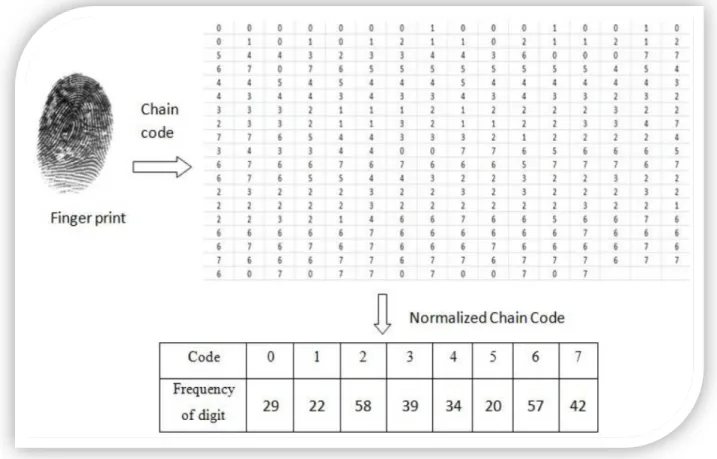
After applying chain code on segmented image, we can get the chain code of that image. So we can observe the length of obtained chain code which is too long. So in this case it becomes difficult to keep chain code of whole database of fingerprints. To overcome this problem we have to normalize the obtained chain code by transforming it into a two dimensional matrix. In this matrix, the first row contains the value of the chain code and the second row contains the frequency of occurrence of the each code (0 to 7). The following figure 3 demonstrates the example of chain code generation and normalization of fingerprint image [4,9,21].
Figure 3: Example of Feature Extraction using normalized chain code
Introduction to SVM
International Journal of Research in Engineering & Applied Sciences Email:- [email protected], http://www.euroasiapub.org
19
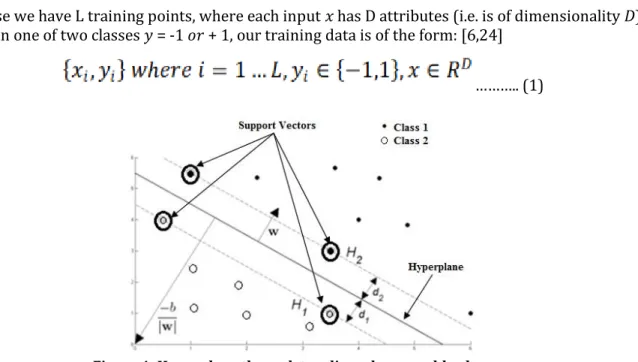
Suppose we have L training points, where each input 𝑥 has D attributes (i.e. is of dimensionality 𝐷) and is in one of two classes 𝑦 = -1 𝑜𝑟 + 1, our training data is of the form: [6,24]……….. (1)
Figure 4: Hyperplane through two linearly separable classes.
Here we assume that the data is linearly separable, that means we can draw a line on a graph of 𝑥1 𝑣𝑠𝑥2 separating the two classes when D = 2 and a hyperplane on graphs of 𝑥1, 𝑥2 . . . 𝑥𝐷 for when 𝐷 >
2. This hyperplane can be described by 𝑤 · 𝑥 + 𝑏 = 0, 𝑤h𝑒𝑟𝑒𝑤 is normal to the hyperplane, |𝑏|/|w| is the perpendicular distance from the hyperplane to the origin [2]. |w| is the Euclidean norm of w. Let d+(d-) be the shortest distance from the separating hyperplane to the closest positive (negative)
example. Define the “margin” of a separating hyperplane to be d+ +d-.
For the linearly separable case, the support vector algorithm simply looks for the separating hyperplane with largest margin. This can be formulated as follows: suppose that all the training data satisfy the following constraints:[6,24]
…………. (2)
………….. (3)
This equations can be combined into following form:
…………(4)
Proposed System
International Journal of Research in Engineering & Applied Sciences Email:- [email protected], http://www.euroasiapub.org
20
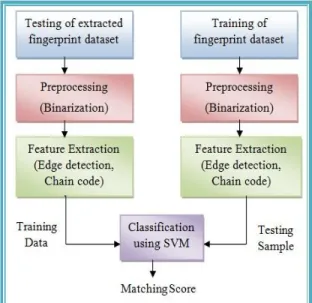
generate normalized chain code and save it into the text file, which is supply to SVM classifier to test the data. Same way training of fingerprint data set is performed. The proposed model is shown in below figure 5.Figure 5: Proposed System
Algorithm for Testing Fingerprint Dataset
Step 1: Input cover image and fingerprint dataset
Step 2: Perform watermark embedding using DWT based alpha blending technique Step 3: Watermarked images are generated having different fingerprints.
Step 4: Apply watermark extraction using DWT based alpha blending technique Step 5: Perform binarization on each fingerprint image.
Step 6: Apply edge detection technique to extract the edges of image. Step 7: Generate chain code for the extracted edges.
Step 8: Apply normalization on chain code and save it in “.txt” file. Step 9: Test the text file using SVM tool.
Same way repeat steps 5 to 9 for training the fingerprint dataset.
Results
International Journal of Research in Engineering & Applied Sciences Email:- [email protected], http://www.euroasiapub.org
21
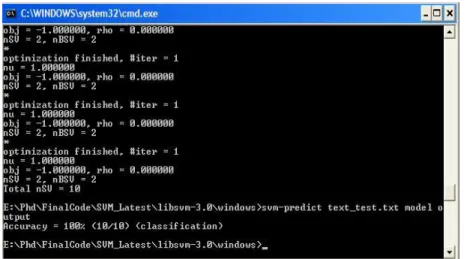
Figure 6: Result of SVM Classification
Conclusion
We have developed efficient fingerprint recognition system using chain code and support vector machine. Selection of feature extraction method is most important aspect for achieving high recognition ratio. In this work, we have implemented chain code based on 8-neighborhood feature extraction method. With the use of this obtained feature, we have trained the SVM classifier for fingerprint recognition. In the investigated work, the recognition rate is 100% for watermark fingerprint recognition. . In future we can implement PCA based pattern recognition technique using SVM. We can also use this technique for iris, face or any other biometric recognition.
References
[1] Al-Ani, M. S. (2013). A Novel Thinning Algorithm for Fingerprint Recognition. International Journal of Engineering Sciences, 2 (2), 43-48.
[2] Alka Shrivastava, R. R. (2013). A SVM and K-means Clustering based Fast and Efficient Intrusion Detection System. International Journal of Computer Applications, 72 (6), 25-29.
[3] Anil K. Jain, A. R. (2014). An Introduction to Biometric Recognition. IEEE TRANSACTIONS ON CIRCUITS AND SYSTEMS FOR VIDEO TECHNOLOGY, 14 (1), 4-20.
[4] Arora, S. (2011). Features Combined in a MLP-based System to Recognize Handwritten Devnagari Character. Journal of Information Hiding and Multimedia Signal Processing, 2 (1).
[5] Bey, K. B. (2008). Agent based approach for distribution of fingerprint matching in a metacomputing environment. 8th international conference on New technologies in distributed system. Lyon, Franc.
[6] BURGES, C. J. (1998). A Tutorial on Support Vector Machines for Pattern Recognition. Data Mining and Knowledge Discovery, 2, 121-167.
International Journal of Research in Engineering & Applied Sciences Email:- [email protected], http://www.euroasiapub.org
22
[8] Dewi Nasien, H. H. The Heuristic Extraction Algorithms for Freeman Chain Code of HandwrittenCharacter. International Journal of Experimental Algorithms (IJEA), 1 (1).
[9] H. Imran Khan, S. U. (2013). Isolated Kannada Character Recognition using Chain Code Features.
International Journal of Science and Research, 2 (8), 67-70.
[10] Hemlata Patel, P. A. (2012). Fingerprint Matching Using Two Methods . International Journal of Engineering Research and Applications, 2 (3), 857-860.
[11] HYERAN BYUN, S.-W. L. (2003). A Survey of Pattern Recognision Applications of Support Vector Machines. International Journal of Pattern Recognition and Artificial Intelligence , 7 (3), 459-486.
[12] Jyoti Rajharia, D. P. Fingerprint-Based Identification System:A Survey. International Journal of Computer Technology and Electronics Engineering (IJCTEE), 1 (3), 98-101.
[13] Kresimir Delac, M. G. (2004). A SURVEY OF BIOMETRIC RECOGNITION METHODS. 46th International Symposium Electronics in Marine, ELMAR-2004, (pp. 184-193). Zadar, Croatia .
[14] Lin, C.-J. (n.d.). A Library for Support Vector Machines. Retrieved from
http://www.csie.ntu.edu.tw/~cjlin/libsvm/
[15] Megha Kulshrestha, V. K. (2012). Finger Print Recognition: Survey of Minutiae and Gabor Filtering Approach. International Journal of Computer Applications, 50 (4), 17-21.
[16] Monika Patel, D. P. (2016). A Novel DWT based Alpha Blending Watermarking Technique for Video Authentication. Women in Science & Technology: Creating Sustainable Career (pp. 183-189). V. V. Nagar: Indian Journal of Technical Education, Special Issue.
[17] Monika Patel, P. S. (2015). The Significant Impact of Biometric Watermark for Providing Image Security using DWT based Alpha Blending Watermarking Technique. International Journal of Innovative Research in Computer and Communication Engineering, 3 (5), 3943-3952.
[18] Parth BPathak, P. A. (2013). A Survey on Different Fingerprint Recognition System.
International Journal of Advanced Research in Computer Engineering & Technology (IJARCET), 2
(2), 519-523.
[19] Quratulain Shafi, J. K. (2010). Fingerprint Verification over the Network and its Application in Attendance Management. Taxila, Pakistan: Computer Engineering Department,University of Engineering and Technology.
[20] Ratiporn Chanklan, K. C. (2015). Fingerprint Recognition with Edge Detection and Dimensionality Reduction Techniques. 3rd International Conference on Industrial Application Engineering, (pp. 569-574).
[21] Ravi Sheth, N. C. (2011). Handwritten Character Recognition System using Chain code and Correlation Coefficient. International Conference on Recent Trends in Information Technology and Computer Science, (pp. 31-36).
International Journal of Research in Engineering & Applied Sciences Email:- [email protected], http://www.euroasiapub.org
23
[23] Ravi Subban, D. P. (2013). A Study of Biometric Approach Using Fingerprint Recognition .Lecture Notes on Software Engineering, 1 (2), 209-213.
[24] S. Adebayo Daramola, T. S. (2013). Fingerprint Verification System Using Support Vector Machine. International Journal on Computer Science and Engineering (IJCSE), 5 (7), 678-683.
[25] Sami, E. (2012). Support Vector Machines for classification and locating faults on transmission lines. Applied Soft Computing, 12, 1650-1658.
[26] Sangame S.K, R. R. (2009). Recognition of isolated handwritten Kannada vowels. Advances in Computational Research, 1 (2), 52-55.
[27] Sangram Bana, D. D. (2011). Fingerprint Recognition using Image Segmentation.
INTERNATIONAL JOURNAL OF ADVANCED ENGINEERING SCIENCES AND TECHNOLOGIES, 5 (1),
12-23.
[28] Wang Y., X. A. (2006). A fingerprint recognition algorithm based on principal component analysis. IEEE Region 10 Conference.
[29] Yuan Yao, P. F. (2001). Fingerprint Classification with Combinations of Support Vector Machines. AVBPA 2001, LNCS 2091 (pp. 253-258). Springer-Verlag Berlin Heidelberg .
[30] Yulan Z., J. C. (2009). New algorithm of automation fingerprint recognition. Information Engineering and Computer Science, ICIECS 2009.
[31] International Conference.
[32] Zhi Y., W. J. (2009). Fingerprint image enhancement by super resolution with early stopping.
![Figure 1: The general block diagram of Fingerprint recognition system [10,12,15,18,27] 1) Image Acquisition: user has to acquire the fingerprint of an individual to the system](https://thumb-us.123doks.com/thumbv2/123dok_us/8059046.2134110/2.918.125.830.543.730/figure-general-diagram-fingerprint-recognition-acquisition-fingerprint-individual.webp)
![Figure 2: 8-neighborhood for chain code[4,9,21]](https://thumb-us.123doks.com/thumbv2/123dok_us/8059046.2134110/3.918.345.590.618.831/figure-neighborhood-for-chain-code.webp)