Vol. 3, No. 2, 2010, 194-212
ISSN 1307-5543 – www.ejpam.com
Scientific Data Visualization with Shape Preserving
C
1Rational
Cubic Interpolation
Malik Zawwar Hussain
1∗, Muhammad Sarfraz
2, Maria Hussain
3 1 Department of Mathematics, University of the Punjab, Lahore, Pakistan2Department of Information Sciences, Adailiya Campus, Kuwait University, Kuwait 3Lahore College for Women University, Lahore, Pakistan
Abstract. This paper deals with the shape preserving C1rational cubic interpolation. The developed
rational cubic interpolating function has only one free parameter. The approximation order of rational cubic function is investigated and range of optimal error constant is determined. Moreover, positive, constrained and monotone data preserving schemes are developed.
2000 Mathematics Subject Classifications: 68U05, 65D05, 65D07, 65D18.
Key Words and Phrases: Rational cubic, Spline, Peano Kernel theorem, Interpolation, Visualization.
1. Introduction
The development of interpolating and approximating techniques for shape control and shape preservation is a germane area of research in Computer Graphics and Data Visualization environment. The data are classified as positive, constrained, monotone and convex according to their shapes. Stability of radioactive substance and chemical reactions, solvability of solute in solvent, population statistics[3], resistance offered by an electric circuit, probability distri-bution[3]are a few examples of entities which are always positive. Monotonicity is applied in the specification of Digital to Analog Converters (DACs), Analog to Digital Converters (ADCs) and sensors. These devices are used in control system applications where non-monotonicity is unacceptable[9]. Erythrocyte sedimentation rate (E.S.R.) in cancer patients[9], uric acid level in patients suffering from gout[9], approximation of couples and quasi couples in statis-tics[2], data generated from stress of a material[9], rate of dissemination of drug in blood [2]are a few examples of entities which are always monotone.
∗Corresponding author.
Email addresses:malikzawwarmath.pu.edu.pk(M. Z. Hussain),prof.m.sarfrazgmail.om(M.
Sarfraz),mariahussain_1yahoo.om(M. Hussain)
In the past quite a few authors have worked in the area of shape preserving interpolation. The positivity preserving scheme, by Butt and Brodlie [3], preserved the shape of data by interval subdivision technique. In the interval, where the piecewise cubic interpolant lost the positive shape of data, the authors inserted an additional knot (increase in number of data points) in such a way that original shape of the data was preserved. Fahr and Kallay[5]used a monotone rational B-spline of degree one to preserve the shape of monotone data. Goodman et al[7]developed rational cubic interpolating schemes to preserve the shape of data lying on the either side of straight line. The first scheme scaled weights by some scale factors and the second scheme adopted the method of insertion of a new interpolation point. Goodman [8]surveyed the shape preserving interpolating schemes for planar data. Hussain and Sarfraz used four parameter family of rational cubic function to preserve the shape of positive and monotone data in[10]and[11]respectively. Lamberti and Manni[12]used cubic Hermite in parametric form to preserve the shape of data. The step length was used as shape preserving parameters. The first order derivatives at the knots were estimated imposing second derivative continuity at the knots, which resulted in tridiagonal system of equations. Sarfraz et al[13] addressed the problems of positive and monotone curve data interpolation using rational cubic function with two parameters. Sarfraz et al [14]developed aGC1 cubic function with one free parameter to preserve the positive, monotone and convex data. Schmidt and Hess[15] developed sufficient conditions on derivatives at the knots to assure positivity of interpolating cubic polynomial.
This paper presents shape preserving interpolating schemes for positive, constrained and monotone data. A one parameter family of rational cubic function has been developed to pre-serve the shape of the data. In different intervals, the free parameter adopts different value. That is, the interpolant has same structure but different functions in different intervals. The presented schemes are neither dependent on data nor on derivatives. Unlike the methodolo-gies in[3, 7,12], the scheme developed in this paper does not constrain interval length. The developed scheme is equally applicable whether the data is with derivatives or the derivative is estimated by derivative estimation techniques[10-11]. The schemes presented in this paper use one parameter family of rational function to preserve the shape of data thus computation-ally less expansive than[10-11, 13]. The order of continuity achieved isC1, whereas, in[14] it wasGC1.
The remainder of the paper is organized as follows. In Section 2, the C1 rational cubic interpolant with one free parameter is developed and Section 2.1 discusses its approximation properties. The visualization problems of positive, constrained, and monotone data interpo-lation are discussed in Sections 3, 4 and 5 respectively. Section 6 concludes the paper.
2. Rational Cubic Function
In this Section, a C1 rational cubic function with one parameter and linear denominator has been developed. Let{(xi,fi), i=0, 1, 2, . . . ,n}be a given set of data points defined over the interval [a,b], where a = x0 < x1 < x2 < · · · < xn = b. The C1 piecewise rational
0, 1, 2, . . . ,n−1 as:
S(x)≡Si(x) =
pi(θ)
qi(θ), (1)
where
pi(θ) = 3
X
i=0
(1−θ)3−iθAi,
A0 = (αi+1)fi,
A1 = (2αi+3)fi+hidi, A2 = (αi+3)fi+1−hidi+1,
A3 = fi+1,
qi(θ) = 1+αi(1−θ),
hi = xi+1−xi, θ = (x−xi)
hi ,
S(xi) = fi, S(xi+1) = fi+1, S(1)(xi) =di, S(1)(xi+1) =di+1. (2) S(1)(x)denotes the derivative with respect toxanddi denotes derivative values estimated or
given. It is noted that whenαi=0, the piecewise rational cubic function (1) reduces to cubic Hermite spline. In this paper, the parameterαi can assume any positive real value.
2.1. Error Estimation of Interpolation
In this Section, the error of interpolation is estimated when the function being interpolated is f(x)∈C2[x0,xn]. The interpolation scheme developed in Section 2 is local, which allows investigating the error in an arbitrary subinterval Ii = [xi,xi+1] without loss of generality.
Using Peano Kernel Theorem[16]the error of interpolation in each subintervalIi= [xi,xi+1]
is:
R[f] = f(x)−Si(x) =
1 2
Z xi+1
xi
f(2)(τ)Rx[(x−τ)+]dτ. (3)
It is assumed that the function being interpolated is f(x)∈C2[x0,xn]. The absolute error in Ii = [xi,xi+1]is:
|f(x)−Si(x)| ≤ 1
2kf
(2)(τ)k
Z xi+1
xi
|Rx[(x−τ)+]|dτ, (4)
where
Rx[(x−τ)+] =
¨
u(τ,x), xi< τ <x,
v(τ,x), x< τ <xi+1.
«
, (5)
The integral involved in (4) is expressed as:
Z xi+1
xi
|Rx[(x−τ)+]|dτ=
Z x
xi
|u(τ,x)|dτ+
Z xi+1
x
For theC1rational cubic function (1),u(τ,x)andv(τ,x)have the values
u(τ,x) = (x−τ)− θ 2
qi(θ)[(1−θ){(αi+3)(xi+1−τ)−hi}+θ(xi+1−τ)], (7)
v(τ,x) = − θ 2
qi(θ)[(1−θ){(αi+3)(xi+1−τ)−hi}+θ(xi+1−τ)]. (8)
The roots ofu(x,x)andv(x,x)in[0, 1]areθ=0 andθ=1. The root ofu(τ,x) =0 isτ1= x− hiθ2(αi+2)
(αi+1)+θ(αi+2).
The root of v(τ,x) =0 isτ2= xi+1−
hi(1−θ)
1+(αi+2)(1−θ).
The above discussion leads to the following manipulation:
|f(x)−Si(x)| ≤ 1
2kf
(2)(τ)kh2
iω(αi,θ), ω(αi,θ) =
Z x
xi
|u(τ,x)|dτ+
Z xi+1
x
|v(τ,x)|dτ
=
Z τ1
xi
u(τ,x)dτ−
Z x
τ1
u(τ,x)dτ−
Z τ2
x
v(τ,x)dτ+
Z xi+1
τ2
v(τ,x)dτ
= θ
2{−θ2(α
i+2)2qi(θ) + (αi+1)2(1+θ)2((αi+3)−θ(αi+2))}
qi(θ){1+αi+θ(αi+2)}2
+2θ
2(1−θ)2
qi(θ) −
2θ4(1−θ)(αi+2)
qi(θ){1+αi+θ(αi+2)}+
θ2(1−θ)2
qi(θ){1+ (αi+2)(1−θ)}.
The above discussion is summarized as follows:
Theorem 1. The error of C1 rational cubic function (1), for f(x)∈C2[x0,xn], in each subin-terval Ii= [xi,xi+1]is
|f(x)−Si(x)| ≤1
2kf
(2)(τ)kh2
ici, (9)
where ci is the maximum value ofω(αi,θ)for0≤θ ≤1andαi≥0.
Theorem 2. For any given positive parameterαi, the error optimal constant ci in Theorem 1 are bounded with0≤ci≤0.2685.
3. Positivity Preserving Interpolation
This section provides sufficient conditions on parameters for positive interpolation of curve data. Let{(xi,fi), i=0, 1, 2, . . . ,n}be the positive data defined over the interval[a,b]. The
necessary condition for the positivity of data is
The piecewise rational cubic function (1) preserves positivity if Si(x)>0, i=0, 1, 2, . . . ,n−1.
Now,Si(x)>0 if
pi(θ)>0 and qi(θ).
But,qi(θ)if
αi >0.
Using the result developed by Schmidt and Hess in[15], the cubic polynomialpi(θ)>0 if
(p′i(0),pi′(1))∈R1UR2, where
R1 =
(a, b):a> −3fi
hi
, b< 3fi+1
hi
,
R2 = {(a,b): 36fifi+1(a2+b2+a b−3∆i(a+b) +3∆2i) +4hi(a3fi+1−b3fi)
+3(a fi+1−b fi)(2hia b−3a fi+1+3b fi)−h2ia
2b2≥0}.
For the rational cubic function (1), we have
p′i(0) = −αifi+hidi
hi
andp′i(1) =−αifi+1+hidi+1
hi
.
(p′i(0), p′i(1))∈R1 if
−αifi+hidi
hi
> −3fi
hi
, (11)
and
−αifi+1+hidi+1
hi < 3fi+1
hi . (12)
The inequality (11) leads to the following relation:
αi< hidi
fi
+3. (13)
The inequality (12) imposes the following restriction on the free parameterαi:
αi > hidi+1
fi+1
−3. (14)
Further(p′i(0), p′i(1))∈R2if
φ(αi) = 36fifi+1[φ12(αi) +φ22(αi) +φ1(αi)φ2(αi)−3∆i(φ1(αi) +φ2(αi)) +3∆2i]
+3[fi+1φ1(αi)−fiφ2(αi)][2hiφ1(αi)φ2(αi)−3fi+1φ1(αi) +3fiφ2(αi)]
Theorem 3. The piecewise C1 rational cubic interpolant S(x), defined over the interval[a,b], in (1), is positive if in each subinterval Ii = [xi,xi+1] the following sufficient conditions are satisfied:
C on1< αi<C on2, where
C on1=M a x
0,hidi+1 fi+1 −3
and C on2=
hidi fi +3. The above constraints can be rearranged as:
C on1+ki=αi =C on2−li,
where ki>0and li>0.
Thus we have the following algorithm for the manipulation of positive curve design.
Algorithm 1
Step 1. Enter the(n+1)positive data points{(xi,fi): i=0, 1, 2, . . . ,n}.
Step 2. Estimate the first order derivatives di, i =0, 1, 2, . . . ,nat knots. (Note: The step 2 is only applicable if data is not provided with derivatives).
Step 3. Calculate the value of free parameterαi using Theorem 3.
Step 4. Substitute the values of fi, di, i= 0, 1, 2, . . . ,nandαi, i=0, 1, 2, . . . ,n−1 in
rational cubic function (1) to obtain positive curve through positive data.
3.1. Demonstration
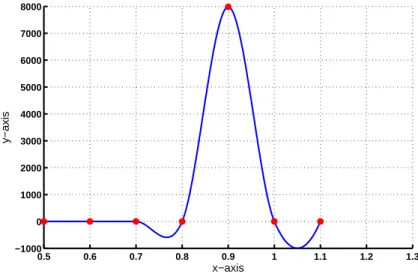
Example 1. A positive data set in Table 1 is taken from [6]. The Figure 1 is produced from
Table1: Apositivedata takenfrom[6℄.
x 0.5 0.6 0.7 0.8 0.9 1.0 1.1
f 0.4804 0.5669 0.7262 0.1 7985 0.8658 0.9281
the data set in Table 1 using the cubic Hermite spline interpolation technique which loses the positive shape of data. The positive curve in Figure 2 is produced by using positive curve data interpolation scheme developed in Section 3.
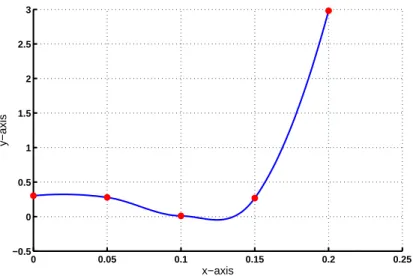
Example 2. The positive data set in Table 2 is taken from[6]. The Figure 3 is produced from the
Table2: Anotherpositivedatatakenfrom[6℄.
0.5 0.6 0.7 0.8 0.9 1 1.1 1.2 1.3 −1000
0 1000 2000 3000 4000 5000 6000 7000 8000
x−axis
y−axis
Figure1: CubiHermitespline.
0.5 0.6 0.7 0.8 0.9 1 1.1 1.2 1.3
0 1000 2000 3000 4000 5000 6000 7000 8000
x−axis
y−axis
Figure2: PositiveC
1
0 0.05 0.1 0.15 0.2 0.25 −0.5
0 0.5 1 1.5 2 2.5 3
x−axis
y−axis
Figure3: CubiHermitespline.
0 0.05 0.1 0.15 0.2 0.25
0 0.5 1 1.5 2 2.5 3
x−axis
y−axis
Figure4: PositiveC
1
4. Constrained Data Interpolation
Let{(xi, fi), i=0, 1, 2, . . . ,n}be the given set of data points lying above the straight line y=mx+c i.e.
fi>mxi+c, ∀ i=0, 1, 2, . . . ,n. (16) The curve will lie above the straight line if the C1 rational cubic function (1) satisfies the following condition:
S(x)>mx+c, ∀x∈[x0,xn].
For each subintervalIi= [xi,xi+1], the above relation in parametric form is expressed as
Si(x)>ai(1−θ) +biθ, (17) whereθ= x−xi
hi andai(1−θ)+biθis the parametric equation of straight line withai =mxi+c
andbi=mxi+1+c. The rearrangement of (17) leads to the following relation:
Ui(θ) = 3
X
i=0
(1−θ)3−iθiBi, (18)
where
B0 = (αi+1)(fi−ai),
B1 = αi(2fi−ai−bi) +3fi−2ai−bi+hidi, B2 = (αi+2)(fi+1−bi) +fi+1−hidi+1−ai, B3 = fi+1−bi.
Now, Ui(θ)>0 ifBi >0,i=0, 1, 2, 3. It is straightforward to know thatB0 >0 and B3 >0 are true from the necessary condition defined in (16) andαi>0.B1>0 provides the follow-ing constraints onαi:
If 2fi−ai−bi>0 thenαi >−fi+bi−hidi
2fi−ai−bi . Similarly, if 2fi−ai−bi<0 thenαi<
−fi+bi−hidi
2fi−ai−bi .
One can also note thatB2>0 ifαi> −fi+1+hidi+1+ai fi+1−bi .
The above discussion can be summarized as:
Theorem 4. The piecewise C1 rational cubic interpolant S(x), defined over the interval[a, b], in (1), preserves the shape of data that lies above the straight line if in each subinterval Ii = [xi,xi+1]the following sufficient conditions are satisfied:
C on3 < αi <C on4, C on3 = M a x
0,−fi+bi−hidi 2fi−ai−bi ,
−fi+1+hidi+1+ai
fi+1−bi
,
C on4 =
−fi+bi−hidi
The above constraints can be rearranged as:
C on3+mi=αi=C on4−ni,
where mi >0and ni>0.
Thus we have the following algorithm for the manipulation of curve design.
Algorithm 2
Step 1. Enter the(n+1)positive data points{(xi,fi): i=0, 1, 2, . . . ,n}.
Step 2. Estimate the first order derivatives di, i =0, 1, 2, . . . ,nat knots. (Note: The
step 2 is only applicable if data is not provided with derivatives). Step 3. Calculate the value of free parameterαiusing Theorem 4.
Step 4. Substitute the values of fi, di, i= 0, 1, 2, . . . ,nandαi, i=0, 1, 2, . . . ,n−1 in
rational cubic function (1) to obtain the curve lying above the straight line.
4.1. Demonstration
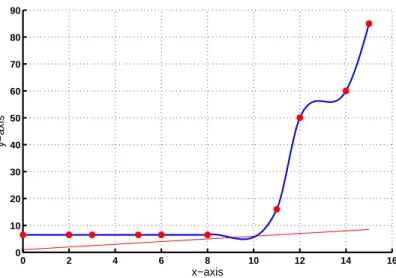
Example 3. The data set in Table 3 is lying above the straight line y = 2x +1and is taken from [1]with slight modification. The Figure 5 is produced from the data set in Table 3 using cubic
Table3:
x 0 2 3 5 6 8 11 12 14 15
f 6.5 6.5 6.5 6.5 6.5 6.5 16 50 60 85
Hermite spline. It is clear from the Figure 5 that some part of the curve is lying below the line y = x
2 +1. This flaw is recovered nicely in Figure 6 using constrained data interpolation scheme
developed in Section 4. It is clear from Figure 6 shape of the data is recovered.
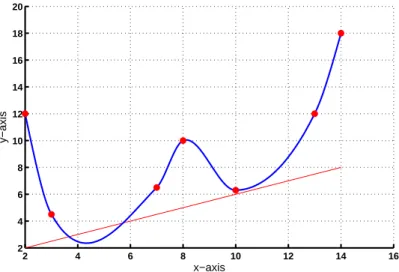
Example 4. The data set[10]in Table 4 is lying above the straight line y = x
2 +1. Figure 7
Table4: Thedatasetlyingabove thestraightline y=
x 2+1.
x 2 3 7 8 10 13 14
f 12 4.5 6.5 10 6.3 12 18
is produced from the data set in Table 4 using cubic Hermite spline. It is clear from Figure 7 that cubic Hermite spline loses the shape of data. Figure 8 is produced from the same data set using constrained curve data interpolation scheme developed in Section 4. It is clear from the Figure 8 that curve is lying above the straight line y= x
0 2 4 6 8 10 12 14 16 0
10 20 30 40 50 60 70 80 90
x−axis
y−axis
Figure5: CubiHermitespline.
0 2 4 6 8 10 12 14 16
0 10 20 30 40 50 60 70 80 90
x−axis
y−axis
Figure6: ConstrainedC
1
2 4 6 8 10 12 14 16 2
4 6 8 10 12 14 16 18 20
x−axis
y−axis
Figure7: CubiHermitespline.
2 4 6 8 10 12 14 16
2 4 6 8 10 12 14 16 18 20
x−axis
y−axis
Figure8: ConstrainedC
1
5. Monotonicity Preserving Interpolation
Let{(xi,fi), i=0, 1, 2, . . . ,n}be the monotone data defined over the interval[a,b]such that
∆i = fi+1− fi
hi
>, di>0, i=0, 1, 2, . . . ,n−1. (19)
The piecewise rational cubic function (1) preserves monotonicity if S(1)(x)>0, i=0, 1, 2, . . . ,n−1, where
Si(1)(x) =
P3
i=0(1−θ) 3−iθiC
i
(qi(θ))2
, (20)
C0 = (αi+1)di,
C1 = (αi+1){(2αi+6)∆i−2di+1−di},
C2 = (4αi+6)∆i−di+1−2di, C3 = di+1.
From (20),Si(1)(x)if Ci >0, i=0, 1, 2, 3. We know thatC0 >0 and C3 >0 are always true from the necessary condition of monotonicity defined in (19) andαi >0. One can see that
C1>0 if
αi>M a x
0,2di+1+di 2∆i
.
Similarly,C2>0 if
αi>M a x
0,di+1+2di 4∆i
.
The above can be summarized as:
Theorem 5. The piecewise C1 rational cubic interpolant S(x), defined over the interval[a,b], in (1), is monotone if in each subinterval Ii = [xi,xi+1]the following sufficient conditions are satisfied:
αi>M a x
0,2di+1+di 2∆i ,
di+1+2di 4∆i
.
The above constraints can be rearranged as:
αi =mi+M a x
0,2di+1+di 2∆i ,
di+1+2di
4∆i
, mi>0.
Algorithm 3
Step 1. Enter the(n+1)points{(xi, fi): i=0, 1, 2, . . . ,n}.
Step 2. Estimate the first order derivatives di, i=0, 1, 2, . . . ,nat knots. (Note: The step 2 is only applicable if data is not provided with derivatives).
Step 3. Calculate the value of free parameterαi using Theorem 5. Step 4.
If∆i>0 then di=0
S(x)≡Si(x) = fi
else
S(x)≡Si(x) = pi(θ) qi(θ)
end
5.1. Demonstration
Table5: Amonotonedataset.
x 4.0 6.0 7.0 f 3.9 4.2 5.7
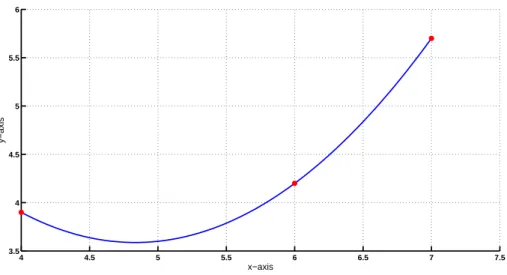
Example 5. A monotone data set is taken in Table 5. Non-monotone curve in Figure 9 is produced from the monotone data set taken in Table 5 using cubic Hermite spline. The monotone curve (from the same data set) is produced in Figure 10 using monotonicity preserving scheme developed in Section 5.
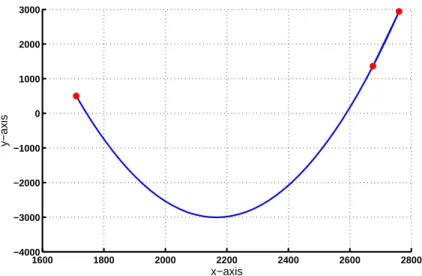
Table6: Amonotonedataset.
x 1710 2650 2760 f 500 1360 2940
4 4.5 5 5.5 6 6.5 7 7.5 3.5
4 4.5 5 5.5 6
x−axis
y−axis
Figure9: CubiHermitespline.
4 4.5 5 5.5 6 6.5 7 7.5
3.5 4 4.5 5 5.5 6
x−axis
y−axis
Figure10: MonotoneC
1
1600 1800 2000 2200 2400 2600 2800 −4000
−3000 −2000 −1000 0 1000 2000 3000
x−axis
y−axis
Figure11: CubiHermitespline.
1600 1800 2000 2200 2400 2600 2800
500 1000 1500 2000 2500 3000
x−axis
y−axis
Figure12: MonotoneC
1
6. Conclusion
The work in this paper is concerned to the development of shape preserving interpolating schemes. The developed schemes have the following advantageous features over the existing schemes. These are equally worthy for data with and without derivatives, whereas, authors in [15] had to constrain derivatives at knots to preserve the shape of positive data. The developed schemers are based on automated selection of free parameters thus do not require the modification of data. But, the authors in [3, 7, 12] constrained the interval length to preserve the shape of data. In[13]and[10-11], rational functions with two and four family of free parameters were used to preserve the shape of data hence computationally expansive than shape preserving schemes developed in this paper. The order of continuity attained in [14]wasGC1, whereas, in this paper it isC1.
References
[1] Akima, H., A new method of interpolation and smooth curve fitting based on local procedures,Journal of the Association for Computing Machinery,17, (1970), 589-602. [2] Beliakov, G., Monotonicity preserving approximation of multivariate scattered data,BIT,
45(4), (2005), 653-677.
[3] Butt, S. and Brodlie, K. W., Preserving positivity using piecewise cubic interpolation, Computers and Graphics,17(1), (1993), 55-64.
[4] Duan, Q., Zhang, H., Zhang, Y. and Twizell, E. H., Error estimation of a kind of rational spline,Journal of Computational and Applied Mathematics,200(1), (2007), 1-11. [5] Fahr, R. D. and Kallay, M., Monotone linear rational spline interpolation,Computer Aided
Geometric Design,9, (1992), 313-319.
[6] Gerald, C. F. and Wheatley, P. O., Applied Numerical Analysis, 7th Edition, Addison Wesley Publishing Company, (2003).
[7] Goodman, T. N. T., Ong, B. H. and Unsworth, K., Constrained interpolation using ratio-nal cubic splines, Proceedings of NURBS for Curve and Surface Design, G. Farin (eds), (1991), 59-74.
[8] Goodman, T. N. T., Shape preserving interpolation by curves, Proceeding of Algorithms for Approximation IV, J. Levesley, I. J. Anderson and J. C. Mason(eds.), University of Huddersfeld, (2002), 24-35.
[9] Hussain, M. Z. and Hussain, M., Visualization of data preserving monotonicity,Applied Mathematics and Computation,190, (2007), 1353-1364.
[11] Hussain, M. Z. and Sarfraz, M., Monotone piecewise rational cubic interpolation, To be appeared inInternational Journal of Computer Mathematics,86, (2009).
[12] Lamberti, P. and Manni, C., Shape-preserving functional interpolation via parametric cubics,Numerical Algorithms,28, (2001), 229-254.
[13] Sarfraz, M., Butt, S. and Hussain, M. Z., Visualization of shaped data by a rational cubic spline interpolation,Computers and Graphics,25(5), (2001), 833-845.
[14] Sarfraz, M., Hussain, M. Z. and Chaudhry, F. S., Shape preserving cubic spline for data visualization,Computer Graphics and CAD/CAM,01, (2005), 189-193.
[15] Schmidt, J. W. and Hess, W., Positivity of cubic polynomial on intervals and positive spline interpolation,BIT,28, (1988), 340-352.