http://www.sciencepublishinggroup.com/j/mlr doi: 10.11648/j.mlr.20170202.13
Optimization of the Launching Process in the Electric Drive
with the Help of Genetic Algorithm
Shukurillo Usmonov
Department of Electro Technical, Electro Mechanical and Electro Technology, Faculty of Elector Engineering, Ferghana Polytechnic Institute (FerPI), Fergana, Uzbekistan
Email address:
[email protected]To cite this article:
Shukurillo Usmonov. Optimization of the Launching Process in the Electric Drive with the Help of Genetic Algorithm. Machine Learning Research. Vol. 2, No. 2, 2017, pp. 61-65. doi: 10.11648/j.mlr.20170202.13
Received: January 31, 2017; Accepted: February 21, 2017; Published: March 9, 2017
Abstract:
In the terms of limited resources and rise of energy prices, one of the most priority directions of modern research is increasing the energy efficiency of electric drives, which are widely used in industrial enterprises. The present methods of minimizing losses are designed for stationary modes. Little attention is paid to the development of algorithms of reducing losses in transition modes. Owing to high complexity of multivariate dynamic processes of optimal control laws, it is advisable to carry out with the help of stochastic optimization techniques. The particularity of the proposed method of optimization is multiple simulation of the used drive in order to find the start-up characteristics, where minimum of energy losses is provided. Automation of search was performed with the help of developed program, which contains the genetic algorithm module and linking module with the electric drive model in Matlab/Simulink environment. The program allows you to select the parameters of the genetic algorithm and control process of optimization.Keywords:
Frequency-Controlling Drive, Energy Save, Optimization, Genetic Algorithm1. Introduction
Application of the proposed method allowed getting optimal start-up characteristics "voltage-frequency" in tabular form, with a following linear approximation of data acquired. Increase of efficiency because of using start-up law is confirmed by comparing the results of simulation of the drive at the start according to linear and optimal performances. The assessment of decreasing of is given for the load of various pattern in a wide range of its changes.
The use of variable electric driver (VED) of pumping machines (PM) on a number of objects require special approach due to the occurrence of hydraulic impacts and pressure fluctuations in a long pipeline (LP) at changing operating parameters of piping systems [1].
Direct start of the induction motor is carried out connecting stator windings directly to the network. The main negative factor of the start-up is high currents excessing nominal value 5-7 times. These currents lead to heating and occurrence of the dynamic forces in the windings, which contribute to increased wear isolation. Sudden changes in the time art capable of creating tension in the mechanical parts of
the drive, therefore increasing wear. These factors have a negative impact on the reliability of the drive as a whole.
Another disadvantage of direct start-up is manifested in low power networks, for instance, oil production facilities, which are remote from networks of a unified energy system receiving power from independent generators. In weakly convergent nets, high values of starting currents cause significant voltage drop in the lines that violate the starting process of the engine and adversely affect the performance of other consumers [1].
Depending on the relationship between the parameters of the equivalent power at the point of supply and motor parameters, besides direct start-up of induction motor, it is possible to use other ways of start-up, for instance, using reactors, autotransformer, switching the connection schemes of the stator windings, and the starters based on semiconductors.
inverter are linearly increased from zero to nominal value. However, this algorithm realizes not all the possibilities of frequency control. So the use of the algorithm current stabilization [2] makes it possible to increase the engine speed acceleration and reduce start-up time. In [3] it is shown that the application special laws of amplitude changes during start-up enables to enhance the energy characteristics of the electric drive by minimizing energy losses in the drive. The search of such laws is based on optimization techniques.
The complex nature of the mathematical model of the drive as a system of nonlinear differential equations of higher order, taking into account the key mode of operation of the frequency converter makes it difficult to use traditional optimization methods to estimate the number and nature of the objective function extremum. To find the optimal starting characteristics, it is advisable to use intellectual stochastic optimization techniques, which have recently been developed and are increasingly used in various fields of technology. Among them we can separate out genetic algorithm, particle swarm method, simulation method of annealing and so forth. [4]. Let’s consider the way of acquiring the optimum starting characteristics by using genetic algorithm.
Minimizing of losses in start-up mode of the drive is connected with finding the law of variation of voltage amplitude as a function of frequency, in which the objective function in the form of energy loss Qd takes a minimum value [5]:
Qd = ( ) →min, (1)
Pd(t)= is2(t)Rs+ ir2(t)Rr+ ic2(t)Rc (2)
where Pd is power of energy losses in the engine, tst is start-up time, where is, ir are modules of vectors of the stator and rotor currents, ic is unit current vector of parallel branch of equivalent circuit that takes into account losses in the steel with the help of resistance Rc.
Optimum law of start-up will be sought in the form of discrete values vector of modulation signal amplitudes of PWM =[u1, u2, u3,…., um], 0≤ui≤1 defined on a discrete frequency grid =[0,5,10,15…50].
2. Methods
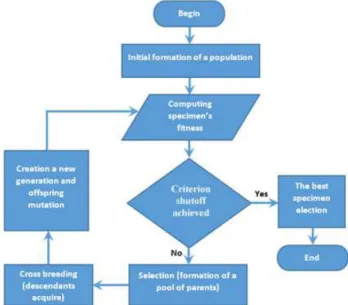
Genetic algorithm reflects the selection process, in which the researcher selects specimens, which possess the sign necessary for him, and creates a new population relying on them. A chromosome gives the distinctive character of a specimen. The meaning of a chromosome is a vector argument of the target function in the task of optimization. Each specimen is characterized by its adaptability. [6]
A set of specimens form the population. The core of the algorithm is the selection of specimens to the parent pool that will be involved in the formation of the next generation. Two parents are selected out of the pool obtained randomly on which the operation of cross breeding is performed combining parents’ chromosomes in a certain way. The obtained chromosome undergoes mutation, where each gene
suffers random changes. In this way, a predetermined number of offspring are generated which in turn form a new population. Next, the operations of selection, cross breeding and mutation are repeated for a new population. The selection process of derivation ends if the difference between the best derivations for two generations becomes less than the threshold.
The scheme of genetic algorithm is shown on Figure 1.
Figure 1. Block diagram of a genetic algorithm.
The first step is the initial formation of a population consisting of N specimens. The meaning of a specimen in this work is a separate start-up characteristics. The specimen is characterized by chromosome, which is associated with a vector of the reference signal amplitude PWM u=[u1,u2,…um]. Individual values of a vector are genes. Fitness of a specimen is determined by the value of the objective function obtained by modeling the engine start:
fitness( )=1/Qd( ) (3)
The less energy losses during start-up at a specific starting characteristic are, the higher the fitness of the specimen is. The values of the elements of the vectors in the original population are determined randomly.
Next, the selection of specimens occurs to form a new generation on the basis of the ranking selection operator. Each specimen is assigned a rank r according to its adaptability. A specimen with the highest fitness value receives the highest rank r=1, a specimen with the lowest value receives the lowest rank r= N. Thereafter the formation of a pool of parents occurs. The pool gets multiple copies of each specimen. A number of copies n depends on the rank r, coefficients of tuning a, b and is described by the function:
n=ae-br (4)
The next step is that the creation of descendants occurs. For this purpose, two parents with chromosomes (1) and
(2)
are chosen out of randomly obtained parent pool, which are used to form an offspring chromosome (c) using the following rule: each element of the vector of a descendant u(c) is calculated according to the corresponding elements of the vectors of parents u(1) and u(2) i=1,…,m
ui (c) = 0.5·[(1-β)·ui (1) + (1+ β)·ui (2)] (5)
= (2 ) , ≤ 0.5
(2(1 − )) , > 0.5 (6) where:
v is a random number evenly distributed in the interval [0; 1]
n=[2.5] is the power of search.
The obtained value of the gene is in some neighborhood with one of parental values.
The width of this neighborhood is defined by parameter η. The higher the value of search power is, the closer the value of the descendant gene to the parent value [6]. Parent cross breeding is produced, until it reaches a specified population size N.
Next, the mutation of the descendants occurs, where each gene ui of a chromosome ofall specimens obtained in the previous step, change with probability pm. The new value an element ui is randomly selected from the range [ui-k·r;
ui+k·r].
Where k is the coefficient of mutation, r is the width of range of elements of the vector .
For the new generation, the cycle of transformations with the exception of the first phase of initialization repeats itself. The criterion for stopping the search is the stabilization of the genetic properties of the population.
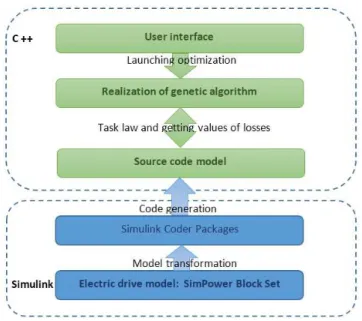
Figure 2. Functional diagram of the optimization program.
Construction of an automated search system of optimal starting characteristics
For optimum performance computational tools of Matlab system were used: Simulink, SimPowerBlockset packages, SimulinkCoder, C ++ programming language. The calculation of the target function (1) for each start-up characteristics is performed using the model of the electric drive built out of elements SimPowerBlockset package. According to the specified algorithm, software "Optimization of launching process frequency-controlled electric drive with the help of genetic algorithm" has been developed, the structure of which is shown in the Figure 2. The program includes the implementation of the genetic algorithm in the language C ++, the source code of which is shown in annex B, the simulation control interface and power coupling the drive model and genetic algorithm with SimulinkCoder package.
The program interface allows carrying out the initialization of the model, setting input data, running calculations and automatic search of optimum performance.
The scheme of the electric drive used in the work is shown in Figure 3.
Figure 3. Model VFD in the Simulink environment and the unit of automatic search of an optimum start-up characteristic.
The induction motor is represented as a dynamic model taking into account the losses in copper and steel of a motor [7]. The drive is powered by a voltage source with a rigid characteristic. The drive includes uncontrolled rectifier, DC link, a PWM inverter based on IGBT-modules, a frequency control system and an induction motor.
The inputs of the model are the frequency f and amplitude
u of a modulation signal PWM, and the moment of resistance load Mc. The output signals are rotary speed, electromagnetic torque and the value of total losses of energy Qd, calculated according to the formula (1). The simulation was performed for two types of mechanical load, the load with constant torque, beyond the control of the rotation speed and load, the resistance moment of which is proportional to the square of the speed of the rotor.
3. Results
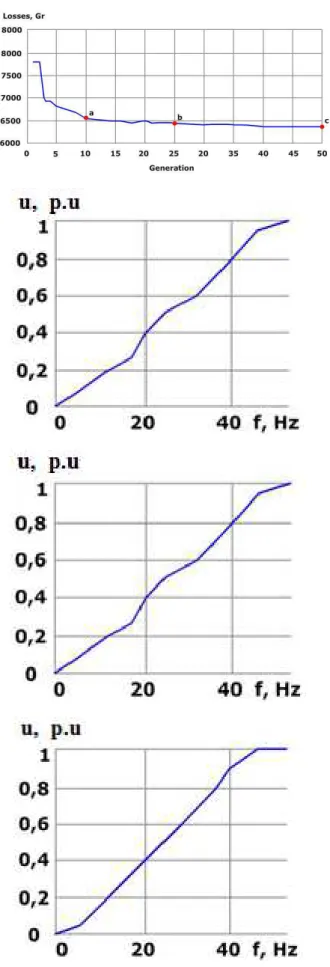
performance for generations10, 25 and 50.
Figure 4. The search of an optimal start-up performance with the help of genetic algorithm.
When searching for an optimum start-up performance in the work, the following parameters of the genetic algorithm were used: the population size N=20, the probability of mutation - pm=0,07, mutation rate k=0,04, the search power n=2, the coefficients a=2, b=0.1. Parameters are selected empirically on the basis of the maximum rate of convergence of the algorithm.
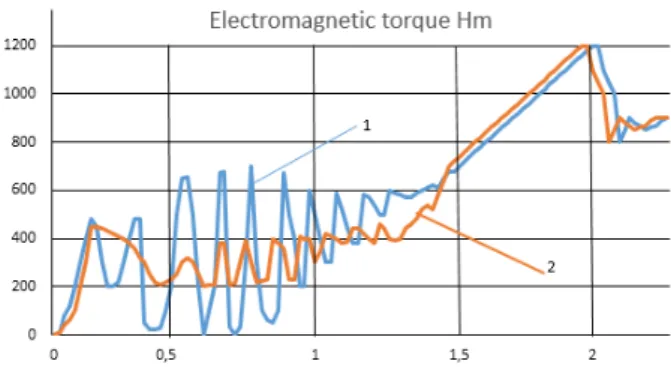
Figure 5 shows the oscillogram of the module of the stator current vector and the change in energy losses and electromagnetic torque at linear start-up law and the law derived with the help of genetic optimization algorithm.
Oscillogram analysis shows that in the case of the linear start-up performance, the energy consumption during the start-up is 7.75 kJ, and with optimum performance, it is6.38 kJ. Reducing the energy losses by 18% due to the use of optimum performance is achieved due to reducing stator and rotor currents. The additional effect of start-up currents reduction is to reduce the current load to the inverter keys of the voltage.
Figure 5. Changing the current I (t), the energy losses Qd (t), and the
electromagnetic torque M (t) at the optimal start-up law–1 and linear law–2.
Figure 6. a) Optimum performance for constant resistance torque b) A comparison of the energy losses at linear and optimum performance.
Similar dependences are derived from the drive mechanism with the ventilatory performance. The optimal start-up laws are shown in Figure 7a) the comparison of losses for two start-up method sat traditional and optimal performance is shown in Figure 7b).
Figure 7. a) Optimal performance for ventilatory load, b) Comparing the energy losses at the linear and optimal performance.
4. Conclusion
These characteristics make it possible to reduce energy
losses during the start-up by 20% in comparison with the linear performance, to reduce the electromagnetic torque ripple, to increase reliability and electromagnetic compatibility of the electric drive with the network due to start-up current reduction. The implementation of optimum performance does not require modification of the control system, and easily interfaces with modern frequency converter control system. The proposed approach can also be used to seek for optimal performance of start-up VFD based on a different type of engines.
References
[1] Hashimov AM Investigation of the influence of powerful start induction motors of gas compressor units on the power supply mode /A. M Hashimov, RN Rakhmanov // Energetics 2012 №1. S.17-22.
[2] Improving the algorithm of private control of an induction motor/V. N. Meleshkin, K. A. Nikofirov, K. I. Skotnikov, IS Khromov // Electronics №1 2013. S.36-42.
[3] I. J. Braslavsky. The optimization of star-up process in the system "Real network -PCH-AD" /I. YA. Braslavsky, AV Kostylёv, D. V. Tsibanov // Electric drives of AC: The works of the International scientific and technical fifteenth conference / Ural Federal University of the first President of Russia B. N. Yeltsin. Ekaterinburg, 2012. p 175-178.
[4] Minakov I. A. Comparative analysis of some methods of random search and optimization // Bulletin of Samara Scientific Center of the Russian Academy of Sciences. 1999. №2. S.286-293.
[5] Shonin O. B. Minimizing energy losses at the start of VFD based genetic optimization algorithm / Shonin O. B. Pron'ko V. S. // Notes Mining Institute. Volume 216, Saint-Petersburg 2015.
[6] Krishnan R. Electric motor drives modeling, analysis and control. Upper Saddle River, NJ: Prenrice-Hall, 2001. 626p. [7] Herrera F., Lozano M., Sanchez A. M. Hybrid Crossover
Operators for Real-Coded Genetic Algorithms: An Experimental Study. Soft Comput. 2005. N 9 (4), p. 280-298. [8] Thanga Raj C., Srivastava S. P., Pramod Agarwal. Energy
Efficient Control of Three-Phase Induction Motor – A Review. International Journal of Computer and Electrical Engineering. 2009. Vol. 1. N 1, p. 61-71.
[9] Anoufriev IE, Smirnov AB, Smirnova EN MATLAB 7.-SPb: BHV-Petersburg, 2005-1104: il.