A Dialogue-management
Evaluation Study
Melita Hajdinjak and France Miheli
c
ˇ
Faculty of Electrical Engineering, University of Ljubljana, Slovenia
We present a highly portable and cooperative dialogue-manager component of a developing, Slovenian and Croatian spoken dialogue system for weather-information retrieval. In order to evaluate the performance of this component, two Wizard-of-Oz experiments were per-formed. The only difference between the two experi-ment settings was in the dialogue-manageexperi-ment manner, i.e., while in the first experiment dialogue manage-ment was performed by a human, the wizard, in the second experiment it was performed by the newly-implemented dialogue-manager component. The data from both Wizard-of-Oz experiments was evaluated with the PARADISE evaluation framework,which was pro-posed as a potential general methodology for evaluating and comparing different versions of spoken-language dialogue systems. The study ascertains a remarkable difference in the performance functions when taking different satisfaction-measure sums, or even individual scores as the target to be predicted, it introduces the dialogue costs database parameters, and it confirms the dialogue manager’s cooperativity subject to the incorporated knowledge representation.
Keywords: dialogue system, dialogue management, con-versational game theory, Wizard-of-Oz experiment, dialogue-system evaluation, PARADISE framework
1. Introduction
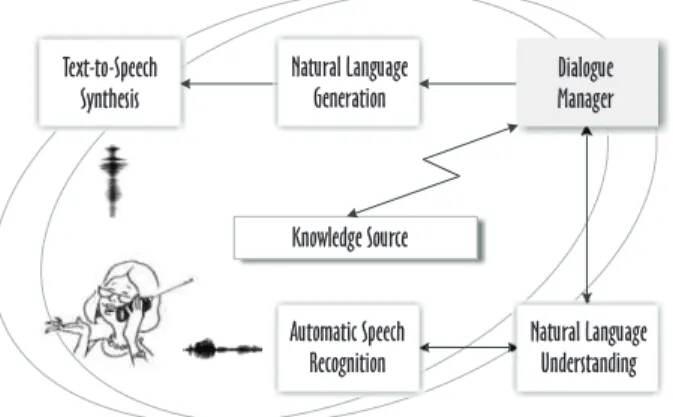
There has recently been a great deal of interest in developing dialogue systems for accessing information sources through the telephone net-work[16, 24]or the internet[4]using spoken or written natural language. However, the central module of any natural-language dialogue sys-tem(Figure 1) is the dialogue manager, which plays the role of an intermediate agent between the user and the knowledge source. The dia-logue manager operates on a meaning represen-tation, modeling what the user has written or what the speech-recognition module has recog-nized, and its overall goal is to take an active
Figure 1.Natural-language dialogue system.
role in directing the dialogue flow toward a suc-cessful conclusion for the user.
Most of the natural-language dialogue systems constructed to date use the slot-filling ( frame-based) approach to dialogue management [6], where the dialogue manager responds to user’s queries with a sequence of clarifications to ob-tain enough information in order to perform a specific action. In this approach the task and the dialogue strategy are separated; the task is to fill the slots, which can be achieved using various dialogue strategies. These strategies are independent of the contents of the slots, this is why they can be reused when porting the sys-tem to a new domain. In Section 2, a highly portable, slot-filling dialogue-manager compo-nent[7] of a developing, bilingual-spoken dia-logue system for weather-information retrieval
In order to evaluate the performance of spoken-language dialogue systems, Walker et al. [21]
proposed PARADISE(PARAdigm for DIalogue System Evaluation), a framework that models user satisfaction as a linear combination of mea-sures reflectingtask successanddialogue costs. Some important PARADISE details and issues were, however, highlighted by Hajdinjak and Mihelicˇ[9]. Applying PARADISE to dialogue data requires the dialogue corpora to be col-lected via controlled experiments during which users subjectively rate their satisfaction. There-fore, in order to evaluate the dialogue man-ager of the developing, bilingual-spoken dia-logue system [25], two Wizard-of-Oz (WOZ)
experiments[8]were conducted. While in the first WOZ experiment dialogue management was still one of the tasks of the wizard, in the second WOZ experiment it was performed by the dialogue-manager component. Both exper-iment settings are described in Section 3. We claim that the influence of automatic speech recognition hinders the other parameters from showing significance when evaluating the per-formance of the dialogue-management process. Therefore, in both WOZ systems, which were carried out in order to evaluate dialogue man-agement, automatic speech understanding was not performed. In Section 4, the application of PARADISE to the data from both WOZ ex-periments is detailed, and interesting evaluation results are given.
2. Dialogue Management
In the developing, Slovenian and Croatian spo-ken dialogue system for weather-information retrieval [25, 7]the slot-filling approach [6]to dialogue management was used, and because of the relative simplicity(i.e., a property common to almost all information-providing domains)of the weather domain only three different types of slots, i.e.,location,time, andinformation, were defined. Moreover, a special knowledge rep-resentation [7], which is consistently flexible in directing the user to select relevant, avail-able data, was incorporated into the dialogue-management process.
The dialogue strategy was modeled using con-versational game theory[18, 11, 13, 17], where conversations are structured on two functional
levels, i.e.,conversational gamesand conversa-tional moves. The level of conversational games is associated with mutually understood conver-sational goals, such as obtaining information or getting the conversational partner to perform a specific action. They are made up of sets of utterances starting with an initiation and encom-passing all utterances up until the purpose of the conversational game has been either fulfilled or abandoned, and are analysed as conversational moves where a move is an utterance, a partial utterance, or a group of utterances that convey the same specific intent, such as instructing or requesting a clarification. However, a theoret-ical account of dialogue, where conversational moves are viewed as objects that update, revise, and align the informational states of the conver-sational partners, was promoted in the TRINDI project[14].
Note, the construction of the dialogue manager was guided by the evaluation outcomes(Section 4) of the data from the first WOZ experiment
(Subsection 3.1).
2.1. Modeling the Dialogue Strategy
Obviously, the ability to employ a rich set of conversational strategies greatly influences the usability and ultimately the success of natural-language dialogue systems. Therefore, conver-sational games that encompass not only ground-ing behaviours, e.g., confirmations and disam-biguation, and turn-taking behaviour, but also the ability to handle requests for help and pro-viding context-specific help messages, for re-peating the last statement, suspending the dia-logue, and re-establishing the context were de-fined. These definitions were made in agree-ment with the findings of the first WOZ experi-ment[8]and according to the coding system[1], applied to a corpus of spontaneous task-oriented spoken dialogues.
Consequently, we decided to distinguish three basic types of conversational moves:
• initiating moves occur at the beginning of a game, where they introduce a new discourse purpose into the dialogue;
• response movesoccur within games, after an initiation and serve to fulfill the expectations set up within the game;
Furthermore, we came to the conclusion that an extension of the set of conversational games im-plemented in the TRINDI project[14]is needed to enable greater portability and/or greater co-operativity of the dialogue system. We defined 11 fundamental initiating moves;
• GREETIndicates a greeting.
• INDECIPHERABLE Indicates a user’s query that was indecipherable to the system. • PARDONIndicates an asking for repetition of
the last query.
• HELPIndicates a user’s appeal for help. • TIMEOUTIndicates a system’s belief that the
user didn’t say anything in the allotted time. • INTERRUPTIndicates a user’s interruption of
playing an information-providing game. • ALIGN Indicates a user’s checking to see if
the system’s understanding is in accordance with his/her understanding.
• CHECK Indicates a system’s question about something that it believes it already knows the answer to, but is not absolutely certain. These moves cover past dialogue events. • END Indicates a user’s decision to end the
conversation.
• QUERY-YNIndicates any question that takes yes or no as the answer and does not count as a CHECKor an ALIGNmove.
• QUERY-WRMostly indicates a wh-question, a request for certain information or addi-tional data.
and 3 slot-related initiating moves;
• QUERY-WIRefers to the slotinformationand indicates a user’s request to list the types of information that the system is able to pro-vide.
• QUERY-WL Refers to the slot location and indicates a user’s request to list the spatial data for which the system is able to provide the requested information.
• QUERY-WT Refers to the slottimeand indi-cates a user’s request to list the temporal data for which the system is able to provide the requested information.
7 fundamental response moves;
• ACKNOWLEDGEIndicates a verbal response that minimally shows that the move was un-derstood and/or accepted.
• REPLY-HELPIndicates a system’s reply to a HELPmove.
• REPLY-TIMEOUT Indicates a system’s reply to a TIMEOUTmove.
• REPLY-Y Indicates a reply with yes to any query with a yes-no possible answer (i.e., QUERY-YN, CHECK, ALIGN).
• REPLY-N Indicates a reply with no to any query with a yes-no possible answer (i.e., QUERY-YN, CHECK).
• REPLY-MOD Indicates a reply with a cor-rection to a yes-no possible answer (i.e., QUERY-YN, CHECK, ALIGN).
• REPLY-WRIndicates a reply to a QUERY-WR move.
and 3 slot-related response moves;
• REPLY-WIIndicates a system’s response to a QUERY-WImove.
• REPLY-WLIndicates a system’s response to a QUERY-WLmove.
• REPLY-WTIndicates a system’s response to a QUERY-WTmove.
one ready move;
• READYIndicates that the previous game has just been completed and a new game is about to begin.
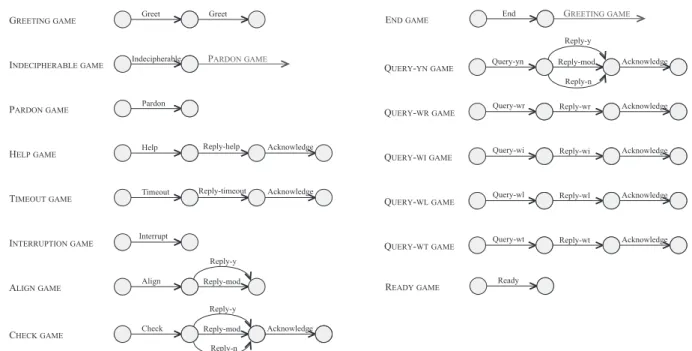
With respect to the extended set of conversa-tional moves, 15 conversaconversa-tional games(Figure 2), which correspond to the initiating moves and the ready move, respectively, were imple-mented. These games are formalized as recur-sive transition networks, i.e., diagrams consist-ing of paths that may be followed and of opera-tions along these paths that must be carried out, that permit arbitrary nesting, i.e., they enable any conversational game to occur at any point within any other conversational game as soon as one game is initiated to serve the larger goal of a game that has been initiated before.
Note, slot-related conversational games (i.e., QUERY-WI GAME, QUERY-WL GAME, and QUERY -WT GAME), each referring to one of the defined slots, have not been used before. Such slot-related games, on the one hand, offer the advan-tage of representing the human-computer dia-logue flow in a more structured way, and, on the other hand, enable users to ask for available data. This is very important in information-providing dialogue systems where the need to inform the user about the scope of the system’s knowledge is one of the most critical aspects
Figure 2.Implemented conversational games.
The dialogue in Table 1, generated using the sys-tem’s dialogue-manager component and natural-language generation, shows a number of
em-ployed conversational strategies; GREETING GAME, initiated by S1 and S10; QUERY-WR GAME, initiated by U1, U2, U5, and U7; CHECK
S1: Hello. The dialogue system for weather-forecast information speaking. Can I help you? U1: Yes, I would like the weather for Slovenia tomorrow.
S2: In Slovenia tomorrow - partly cloudy, the rainfalls and the snowfalls will stop. Is there something else?
U2: Yes. What about the weather in the mountains?
S3: Are you asking for tomorrow? U3: ...
S4: You haven’t told me all the necessary information or I haven’t understood it. If you have any other question, please ask, otherwise answer the following question: Are you asking for tomorrow?
U4: No, I would like the current weather please.
S5: Sorry, but I have no data about the current weather in the mountains. However, I have data about the current weather on Kredarica, Vogel, Kanin, Krvavec, and Predel. I can also give you the weather forecast in the mountains for today and for tomorrow.
U5: Tell me for Vogel please.
S6: Are you asking about the current weather? U6: Yes.
S7: On Vogel at this moment - fog. Anything else?
U7: Yes, tell me the air temperature and the depth of the snow on Vogel please.
S8: On Vogel at this moment - the air temperature is -7 degrees Celsius, the depth of the snow is 180 cm. Do you have any other question?
U8: Could you tell me what kind of information you have for Ljubljana at this moment?
S9: For Ljubljana at this moment I have information about the weather, the humidity, the air temperature, the wind speed, and the wind direction. Is there anything I can inform you about?
U9: No. That’s all.
S10: Thank you. Goodbye.
GAME, initiated by S3 and S6; TIMEOUT GAME, initiated by U3 when the user did not respond in the allotted time; QUERY-WI GAME, initiated by U8; END GAME, initiated by U9. Indispensable in re-establishing the context, however, is the conversational game CHECK GAME, which cov-ers past dialogue events. In this game, instead of making definite conclusions, the system re-quests the user to confirm the information that it already assumes to be true. The REPLY-WR move S5, on the other hand, shows how the sys-tem directs the user to select relevant, available data when not being able to give the answer to his/her explicit request.
3. Wizard-of-Oz Experiments
The construction of the dialogue manager( Sec-tion 2) began by conducting the WOZ experi-ment [5, 2]. In WOZ studies subjects are told to interact with a computer system, though in fact they are not. The system is at least partly simulated by a human, the wizard, with the con-sequence that the subjects can be given more freedom of expression or be constrained in more systematic ways than this is the case in already existing dialogue systems. Since the dialogues collected during such an experiment reflect the language that would be attempted when com-municating with a computer system, the WOZ experiment proves successful in the early stages of the construction of natural-language dialogue systems.
Hence, while the aim of the first WOZ experi-ment was, first of all, to collect human-computer data, the aim of the second WOZ experiment was to evaluate the newly-implemented dialo-gue-manager component.
3.1. First WOZ Experiment
The task of the wizard in the first WOZ exper-iment[8]was to simulate Slovenian speech un-derstanding(i.e., speech recognition and natural-language understanding)and dialogue manage-ment within the weather-information-providing, Slovenian and Croatian spoken dialogue sys-tem [25]. Since only Slovene users were in-volved into the experiment, Croatian speech un-derstanding was not performed.
However, a total of 76 Slovene users (38 fe-male, 38 male)were chosen to take part in the first WOZ experiment. They were given ver-bal instructions about the general functionality of the system and a sheet of paper containing a description of the tasks they were supposed to complete. The users had two scenarios to enact. The first task was to obtain a particular piece of weather-forecast information, such as the temperature in London or the weather fore-cast for Slovenia tomorrow, and the second task was a given situation, such as “You are plan-ning a trip to... What are you interested in?”, the aim of which was to stimulate the user to ask context-specific questions. After these two sce-narios, and in contrast to previous experiments, users were given the freedom to ask additional questions.
In order to evaluate user satisfaction, users were given the user-satisfaction survey(Table 2)used within the PARADISE framework, which asks to specify the degree to which one agrees with several questions about the behaviour or the per-formance of the system (TTS Performance,
ASR Performance, Task Ease, Interaction
1. Was the system easy to understand? (TTS Performance)
2. Did the system understand what you said? (ASR Performance)
3. In this conversation, was it easy tofind the message you wanted? (Task Ease)
4. Was the pace of the interaction with the system appropriate?(Interaction Pace)
5. In this conversation, did you know what you could say at each point of the dialogue? (User Expertise)
6. How often was the system sluggish and slow to reply to you? (System Response)
7. Did the system work the way you expected it to? (Expected Behaviour)
8. From your current experience with using the weather-information providing dialogue system, do you think you’d use the system regularly when you need information about the weather? (Future Use)
Pace, User Expertise, System Response, Ex-pected Behaviour, Future Use). The answers to the questions were based on a five-class rank-ing scale from 1, indicatrank-ing strong disagree-ment, to 5, indicating strong agreement. A com-prehensive User Satisfaction was then com-puted by summing each question’s score, and thus ranged in value from a low of 8 to a high of 40. In the first WOZ experiment, the meanUser Satisfaction value was 34.08, with a standard deviation of 5.07.
3.2. Second WOZ Experiment
In contrast to the first WOZ experiment, the task of the wizard in the second WOZ experiment was only to simulate Slovenian speech under-standing. The wizard was sitting behind the interface of the newly-implemented dialogue manager and entered the meaning representa-tion of what the user said. All the other compo-nents of the system remained the same.
A total of 68 Slovene users(29 female, 39 male) were chosen to take part in the second WOZ experiment. They were given the same instruc-tions and the same user-satisfaction survey as in the first experiment. The mean User Satisfac-tionvalue was 31.96, with a standard deviation of 4.99.
Note, it was expected that in the second experi-ment theUser Satisfactionvalue would be a bit worse(statistically significant withp< 0.015)
since the wizard with her human-level intelli-gence should have been able to manage the di-alogue better than the implemented didi-alogue- dialogue-manager component.
4. Evaluation
In order to find the most significant parameters
(i.e.,predictors)of the dialogue manager’s per-formance, the PARADISE framework[21]was used. It maintains that the system’s primary objective is to maximize user satisfaction, and it derives a combined performance metric for a dialogue system as a weighted linear combi-nation of task-success measures and dialogue costs. Consequently, applying PARADISE to dialogue data requires the dialogue corpora to be collected via controlled experiments during which users subjectively rate their satisfaction. In addition, the other parameters of the model of performance, i.e. the task-success measures and
the dialogue costs, must be either automatically logged by the system or hand-labeled.
The PARADISE model of performance [22]
posits that a performance function can then be derived by applying multivariate linear regres-sion(MLR) withUser Satisfactionas the de-pendent variable and task-success measures and dialogue costs as the independent variables:
Performance= (α ∗ N(κ))− n
i=1
wi∗ N(ci)
Here,α is the weight on the Kappa coefficient
κ[3], which can be calculated from a confusion matrix that summarizes how well the dialogue system achieves the information requirements of particular tasks within the dialogue and mea-sures task success, wi are weights on the
dia-logue costsci, andN is a Z-score normalization
function:
N(x) = x−x0
σx0
where x0 and σx0 are the mean value and the standard deviation forx, respectively, computed from the sample set of observations. The nor-malization functionNguarantees that the weig-hts directly indicate the relative contributions to the performance function, which can be used to predictUser Satisfaction.
Because of the often reported finding [22, 12, 23, 15] that the mean concept accuracy, of-ten referred to as the mean recognition score, is the exceptional predictor of a dialogue sys-tem’s performance, we claim that the influence of speech recognition hinders the other param-eters from showing significance when evaluat-ing the performance of a specific component of a dialogue system. Therefore, in our WOZ experiments (Section 3), which were carried out in order to compare and to evaluate both dialogue-management manners, speech under-standing was performed by a human wizard.
4.1. Selection of Regression Parameters
The selection of the regression parameters is of great importance and, therefore, has to be made on a thorough consideration. In order to com-pare the performance of both WOZ systems, 25 regression parameters were selected, i.e. the task-success measure
mostly relevant changes in the meaning rep-resentations of user’s utterances,
and the dialogue costs
• Mean Elapsed Time(MET), i.e. the mean elapsed time of user-initiated, information-providing conversational games(QUERY-WR GAMESand QUERY-YN GAMES)that occurred within the interaction,
• Mean User Moves (MUM), i.e. the mean number of conversational moves that the user needed to either fulfil or abandon the initi-ated information-providing games,
• Task Completion (Comp), i.e. the user’s perception of completing the first task, • Number of User Initiatives(NUI), i.e. the
number of user’s moves initiating information-providing games,
• Mean Words per Turn (MWT), i.e. the mean number of words per user’s turn, • Mean Response Time(MRT), i.e. the mean
system-response time,
• Number of Missing Responses(NMR), i.e. the difference between the number of sys-tem’s turns and the number of user’s turns, which, on the one hand, reflects the num-ber of user’s TIMEOUT moves, and, on the other hand, his/her unreadiness to greet the system,
• Number of Unsuitable Requests (NUR)
andUnsuitable-Request Ratio(URR), i.e. the number and the ratio of user’s initiating moves that were out of context,
• Number of Inappropriate Responses(NIR) andInappropriate-Response Ratio(IRR), i.e. the number and the ratio of contextually inappropriate system’s responses, including PARDONmoves,
• Number of Errors(Error), i.e. the number of system errors, including interruptions of the telephone connection, unsuitable natural-language sentences, and contradictory state-ments,
• Number of Help Messages (NHM) and
Help-Message Ratio(HMR), i.e. the num-ber and the ratio of system’s REPLY-HELPand REPLY-TIMEOUTmoves,
• Number of Check Moves (NCM) and
Check-Move Ratio (CMR), i.e. the num-ber and the ratio of system’s CHECKmoves, • Number of Given Data(NGD)and Given-Data Ratio (GDR), i.e. the number and the ratio of system’s information-providing moves,
• Number of Relevant Data(NRD)and
Relevant-Data Ratio (RDR), i.e. the num-ber and the ratio of system’s moves directing the user to select relevant, available data, • Number of No Data (NND) andNo-Data
Ratio (NDR), i.e. the number and the ratio of system’s moves stating that the requested information is not available, and
• Number of Abandoned Requests (NAR) andAbandoned-Request Ratio(ARR), i.e. the number and the ratio of the information-providing games that were abandoned by the user.
Note, we considered both quantitative and pro-portional parameters in order to ascertain users’ sensitivities.
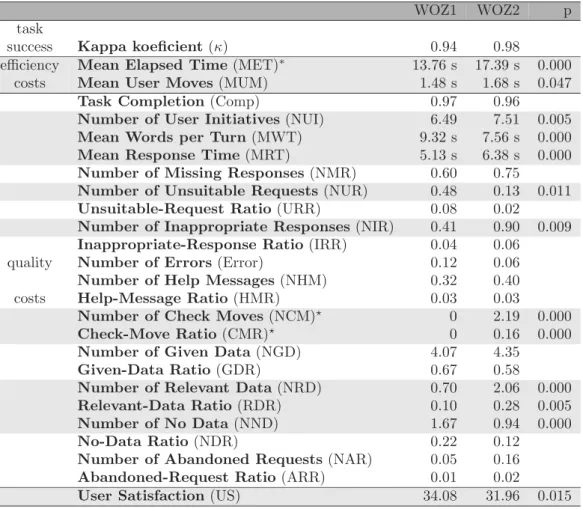
All the mean values of the listed parameters are given in Table 3. Those that showed a signifi-cant change in value across both WOZ experi-ments are shaded grey and the corresponding p value[19] is given. The p value is a measure of how much evidence we have against the null hypotheses, i.e. the probability that our sample could have been drawn from the population(s) being tested(or that a more improbable sample could be drawn) given the assumption that the null hypothesis is true.
First, Table 3 says that MET and MUM were significantly greater(i.e.p < 0.0005 and p <
0.05, respectively)in the second WOZ experi-ment. Obviously, this was partly due to the con-versational game CHECK GAME, which was im-plemented in the dialogue-manager component. Moreover, since the majority of the replies to CHECKmoves contained less than three words, this dialogue strategy gave rise to a significantly lower(p < 0.0005)value of MWT. Neverthe-less, the increase of MET was also influenced by the significantly longer (p < 0.0005) sys-tem’s response times(MRT) in the second ex-periment, which was a reflection of the wizard’s time-consuming typing of the meaning repre-sentations of users’ utterances.
Second, an interesting finding is the relatively high negative correlation(i.e.−0.53 in the first experiment and −0.51 in the second experi-ment)between NUI and MUM, which reflects the users’ ability to adapt to the system’s be-haviour and to learn how to more efficiently complete the tasks.
WOZ1 WOZ2 p task
success Kappa koeficient(κ) 0.94 0.98
efficiency Mean Elapsed Time(MET)∗ 13.76 s 17.39 s 0.000
costs Mean User Moves(MUM) 1.48 s 1.68 s 0.047
Task Completion(Comp) 0.97 0.96
Number of User Initiatives(NUI) 6.49 7.51 0.005
Mean Words per Turn(MWT) 9.32 s 7.56 s 0.000
Mean Response Time(MRT) 5.13 s 6.38 s 0.000
Number of Missing Responses(NMR) 0.60 0.75
Number of Unsuitable Requests(NUR) 0.48 0.13 0.011
Unsuitable-Request Ratio(URR) 0.08 0.02
Number of Inappropriate Responses(NIR) 0.41 0.90 0.009
Inappropriate-Response Ratio(IRR) 0.04 0.06
quality Number of Errors(Error) 0.12 0.06
Number of Help Messages(NHM) 0.32 0.40
costs Help-Message Ratio(HMR) 0.03 0.03
Number of Check Moves(NCM) 0 2.19 0.000
Check-Move Ratio(CMR) 0 0.16 0.000
Number of Given Data(NGD) 4.07 4.35
Given-Data Ratio(GDR) 0.67 0.58
Number of Relevant Data(NRD) 0.70 2.06 0.000
Relevant-Data Ratio(RDR) 0.10 0.28 0.005
Number of No Data(NND) 1.67 0.94 0.000
No-Data Ratio(NDR) 0.22 0.12
Number of Abandoned Requests(NAR) 0.05 0.16
Abandoned-Request Ratio(ARR) 0.01 0.02
User Satisfaction(US) 34.08 31.96 0.015
∗ Duration of the system’s replies is not included.
In the first WOZ experiment, the wizard did not performCheckmoves.
Table 3.Mean values of the selected parameters in the first(WOZ1)and the second(WOZ2)WOZ experiment.
will refer to them as database parameters. It has, however, been argued[22]that the database size might be a relevant predictor of perfor-mance. Indeed, in our experiments, relying on the extremely sparse and dynamical weather-information source [7] with a time-dependent data structure, it turned out that these parame-ters can play an important part in predicting the performance of a dialogue system, the perfor-mance of its specific components, and even in predicting individual user-satisfaction metrics
(Subsection 4.3).
Another interesting finding is that, although in the first experiment the users were more com-prehensive for quantitative database parameters
(i.e. NGD, NRD, NND) than for proportional database parameters(i.e. GDR, RDR, NDR), in the second experiment it was just the other way round.
In addition, Table 3 says that in the second WOZ experiment NRD and RDR were almost three
times greater than in the first experiment, which confirms the dialogue manager’s ability to direct the user to select relevant, available data when his/her explicit request yields no information. Consequently, in the second WOZ experiment, NND was significantly lower(p<0.0005).
4.2. Why Model the Sum of User-Satisfaction Scores
Indeed, our experiments showed a remarkable difference in the significance of the parame-ters when taking different satisfaction-measure sums or even individual scores as the target to be predicted(Subsection 4.3). Another interesting finding is that some individual user-satisfaction metrics, could not be well modeled.
4.3. Performance Function Results
As the target to be predicted we first tookUser Satisfaction (US) and afterwards the sum of those user-satisfaction values that(in our opin-ion) measured the dialogue manager’s perfor-mance(DM), i.e. the sum of the user-satisfaction-survey scores assigned to the questions associ-ated withASR Performance,Task Ease, Sys-tem Response, andExpected Behaviour ( Ta-ble 2). The selected user-satisfaction values could all be well modeled and they were all un-der the influence of the dialogue-management manner.
Eliminating outliers, i.e. observations that lie at an abnormal distance from other values, is a common practice in multivariate linear re-gression[20]. In compliance with this practice, about 10% of the outliers in the data from both WOZ experiments were removed.
However, considering the data from the first WOZ experiment, backward elimination for
Fout = 2 [19] gave the following performance
equations:
N(US) =−0.69N(NND)−0.16N(NRD)
N(US) =−0.61N(NND) +0.21N(Comp) =−0.16N(NRD)
with 58% (i.e., R2 = 0.58) and 59% of the
variance explained, respectively. To be able to observe the close similarity between these two equations, note that Comp was significant for US(p<0.02), but removed by backward elim-ination.
In contrast, considering the data from the sec-ond WOZ experiment, backward elimination for Fout = 2 gave the following performance
equations:
N(US) =−0.30N(CMR)−0.23N(MET) +0.18N(κ)
N(DM) =−0.35N(CMR) +0.35N(GDR) +0.35N(κ)−0.17N(ARR)
with 26% and 46% of the variance explained, respectively. Again, it is necessary to know that MET was significant for DM (p < 0.02)
and thatGDRandARRwere significant for US
(p<0.04), but all removed by backward elimi-nation.
Let us compare both performance equations pre-dicting DM, ascertain the effect of the dialogue-manager component. The first observation that we make is that none of the predictors is com-mon to both performance equations. All the predictors from the first performance equation
(i.e., NND, Comp, NRD) were insignificant
(p>0.1)for DM in the second experiment. On the other hand, the only predictor from the sec-ond performance equation that was significant for DM(p<0.004)in the first experiment, but removed by backward elimination, was GDR.
Unlike the first performance equation with the database parameters NND and NRD as cru-cial negative predictors, the second performance equation clearly shows their insignificance to users’ satisfaction with the dialogue manager’s performance. Hence it follows that the know-ledge representation [7], which was incorpo-rated into the dialogue-management process in the second WOZ system, with its rather con-sistent flexibility in directing the user to select relevant, available data, has no(negative) influ-ence on users’ satisfaction.
In addition, we thought that it would be very in-teresting to see which parameters are significant for individual user-satisfaction metrics. First, we discovered that Future Use could not be well modeled in the first experiment and that
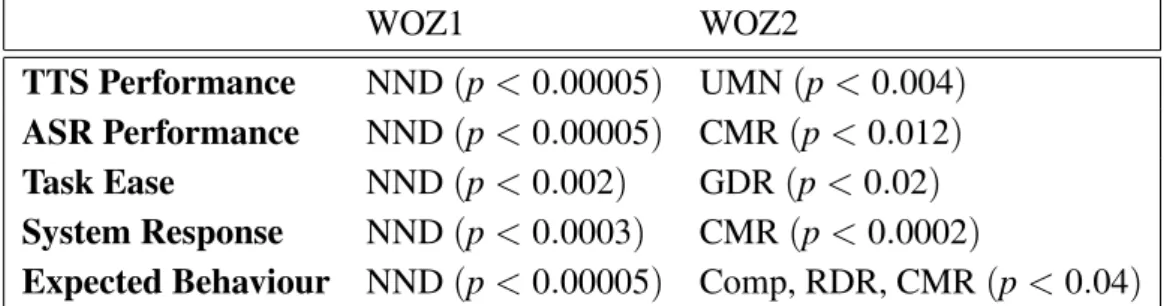
User ExpertiseandInteraction Pacecould not be well modeled in the second experiment, the corresponding MLR models explained less than 10% of the variance. Second, the parameters that most significantly predicted the remaining, individual user-satisfaction measures are given in Table 4.
cooper-WOZ1 WOZ2
TTS Performance NND(p<0.00005) UMN(p<0.004) ASR Performance NND(p<0.00005) CMR(p<0.012) Task Ease NND(p<0.002) GDR(p<0.02) System Response NND(p<0.0003) CMR(p<0.0002)
Expected Behaviour NND(p<0.00005) Comp, RDR, CMR(p<0.04)
Table 4.Most significant predictors of the individual user-satisfaction measures in the first(WOZ1)
and the second(WOZ2)WOZ experiment.
ativity subject to the incorporated knowledge representation [7]. Moreover, all the parame-ters that were most significant to an individ-ual user-satisfaction measure in the second ex-periment were insignificant to the same mea-sure in the first experiment. On the one hand, this could indicate that the selected individual user-satisfaction measures really measure the performance of the dialogue manager and con-sequently illustrate the obvious difference be-tween both dialogue-management manners. On the other hand, one could argue that this simply means that the individual user-satisfaction mea-sures are not appropriate meamea-sures of attitude because people are likely to vary in the way they interpret the item wording [9]. Though, due to the huge difference in significance, this seems an unlikely explanation.
5. Conclusion
In this study we have presented the highly porta-ble dialogue-manager component of the de-veloping, bilingual-spoken dialogue system for weather information retrieval. The data gath-ered in two WOZ experiments was evaluated with the PARADISE framework. This evalua-tion resulted in several performance equaevalua-tions predicting different dependent variables, all try-ing to express the performance of the dialogue manager. The observed differences between the derived performance equations make demands upon further empirical research. Not only does a reliable user-satisfaction measure that would capture the performance-measures of different dialogue-system components need to be estab-lished, but the reasons for the possible differ-ences between several performance equations also need to be understood and properly as-sessed.
References
[1] J. CARLETTA, A. ISARD, S. ISARD, J. KOWTKO, G. DOHERTY-SNEDDON, A. ANDERSON, HCRC
Dia-logue Structure Coding Manual. Research paper 82, Human Communication Research Centre, Uni-versity of Edinburgh, Scotland,(1996).
[2] N. DAHLBACK¨ , A. J ¨ONSSON, L. AHRENBERG, Wiz-ard of Oz studies – why and how.Knowledge-Based SystemsVol. 6, No. 4(1993), pp. 258–256.
[3] B. DI EUGENIO, M. GLASS, The Kappa statistic:
a second look.Computational Linguistics Vol. 30, No. 1(2004), pp. 95–101.
[4] A. FERREIRA-CABRERA, J. A. ATKINSON-ABUTRI -DY, A Model for Generating Explanatory Web-based
Natural-Language Dialogue Interactions for Docu-ment Filtering.Journal of Research and Practice in Information TechnologyVol. 34, No. 1,(2002), pp. 2–19.
[5] N. M. FRASER, G. N. GILBERT, Simulating Speech
Systems.Computer Speech and Language Vol. 5, No. 1,(1991), pp. 81–99.
[6] D. GODDEAU, H. MENG, J. POLIFRONI, S. SENEFF, S. BUSAYAPONGCHAI, A Form-Based Dialogue Man-ager for Spoken Language Applications. Presented at theProceedings of the International Conference on Spoken Language Processing,(1996), Philadel-phia, USA.
[7] M. HAJDINJAK, F. MIHELICˇ, Information-providing
dialogue management. InLecture Notes in Artificial Intelligence 3206: Text, Speech and Dialogue(P. Sojka, I. Kopecek, K. Pala, Eds.), Berlin, Springer,
(2004), pp. 595–602.
[8] M. HAJDINJAK, F. MIHELICˇ, Conducting the
Wizard-of-Oz experiment. Informatica Vol. 28, No. 4,
(2004), pp. 425–429.
[9] M. HAJDINJAK, F. MIHELICˇ, The PARADISE
Eval-uation Framework: Issues and Findings. Computa-tional LinguisticsVol. 32, No. 2,(2006),
[10] K. S. HONE, R. GRAHAM, Towards a tool for the
Subjective Assesment of Speech System Interfaces
(SASSI).Natural Language Engineering: Special Issue on Best Practice in Spoken Dialogue Systems Vol. 6 No. 3-4(2000), pp. 287–303.
[11] G. HOUGHTON, S. D. ISARD, Why to speak, what to say and how to say it: Modelling language pro-duction in discourse. In Modelling Cognition (P. Morris, Ed.),(1987), pp. 249–267. John Wiley & Sons, New York.
[12] C. KAMM, M. WALKER, D. LITMAN, Evaluating spo-ken language systems. Presented at theProceedings of American Voice Input/Output Society. (1999), San Jose, USA.
[13] J. KOWTKO, S. D. ISARD, Conversational Games Within Dialogue.Research paper 31, Human Com-munication Research Centre, University of Edin-burgh, Scotland,(1992).
[14] S. LARSSON, D. TRAUM, Information state and
dia-logue management in the TRINDI Diadia-logue Move Engine Toolkit.Natural Language Engineering, No. 6,(2000), pp. 323–340.
[15] D. J. LITMAN, P. SHIMEI, P Designing and evaluating
an adaptive spoken dialogue system.User Modeling and User-Adapted Interaction, No. 12,(2002), pp. 111–137.
[16] K. PEPELNJAK, F. MIHELICˇ, N. PAVESIˇC´, Semantic
decomposition of sentences in the system supporting flight services.Journal of Computing and Informa-tion Technology, Vol. 4, No. 1,(1996), pp. 17–24.
[17] M. POESIO, D. R. TRAUM, Conversational actions
and discourse situations. Computational Intelli-gence, Vol. 13, No. 3,(1997), pp. 309–349.
[18] R. POWER, The organization of purposeful dia-logues.Linguistics, No. 17,(1979), pp. 107–152.
[19] G. A. F. SEBER, Linear Regression Analysis. John
Wiley & Sons, New York,(1977).
[20] B. G. TABACHNICK, S. FIDELL,Using Multivariate
Statistics (3rd ed.). Harper Collins, New York,
(1996).
[21] M. A. WALKER, D. LITMAN, C. A. KAMM, A. ABELLA, PARADISE: A General Framework for
Evaluating Spoken Dialogue Agents. Presented at theProceedings of the 35th Annual Meeting of the Association of Computational Linguistics,(1997), Madrid, Spain.
[22] M. A. WALKER, D. J. LITMAN, C. A. KAMM, A.
ABELLA, Evaluating spoken dialogue agents with PARADISE: Two case studies. Computer Speech and Language, Vol. 12, No. 3,(1998), pp. 317–347.
[23] M. A. WALKER, C. KAMM, D. LITMAN, Towards
Developing General Models of Usability with PAR-ADISE. Natural Language Engineering: Special Issue on Best Practice in Spoken Dialogue Systems, Vol. 6, No. 3-4,(2000), pp. 363–377.
[24] V. ZUE, S. SENEFF, J. GLASS, J. POLIFRONI, C.
PAO, T. J. HAZEN, L. HETHERINGTON, JUPITER:
A Telephone-Based Conversational Interface for Weather Information.IEEE Transactions on Speech and Audio Processing, Vol. 8, No. 1,(2000), pp. 85–96.
[25] J. ZIBERTˇ , S. MARTINCIˇ C´-IPˇSIC´, M. HAJDINJAK, I. IPSIˇC´, F. MIHELICˇ, Development of a Bilingual
Spoken Dialog System for Weather Information Retrieval. Presented at the Procedings of the 8th European Conference on Speech Communication and Technology,(2003), Geneva, Switzerland.
Received:January, 2006
Accepted:January, 2007
Contact addresses:
Melita Hajdinjak Faculty of Electrical Engineering University of Ljubljana Trˇzaˇska 25, 10000 Ljubljana, Slovenia e-mail:[email protected]
France Mihelicˇ
Faculty of Electrical Engineering University of Ljubljana Trˇzaˇska 25, 10000 Ljubljana, Slovenia
MELITAHAJDINJAKis an Assistant of Mathematics and a Researcher at the Faculty of Electrical Engineering, University of Ljubljana, Slove-nia. She received her Ph.D. in Electrical Engineering in 2006 and is currently working toward her Ph.D. in Mathematics.
FRANCEMIHELICˇis an Associate Professor at the Faculty of Electrical