Research on Construction and
Application of Individual
Knowledge Management
Maturity Evaluation Model
Dan Chang
1, Xiaoying Han
1and Baowei Chen
21School of Economics and Management, Beijing Jiaotong University, Beijing, China 2Junior College of Zhejiang Wanli University, Ningbo, China
Individual knowledge management is basic component of organizational knowledge management, and the maturity of individual knowledge management has a significant impact on organizational knowledge management. This research introduces scientific idea of capability maturity model into individual knowledge management, build-ing correspondbuild-ing assessment criteria combined with features of individual knowledge management, and con-structing an individual knowledge management maturity model with gray comprehensive evaluation method. In the fourth part of this paper, the validity of the model has been verified by applying the model on an instance. This research is made in order to provide references and sug-gestions on improving the level of individual knowledge management in knowledge-based organizations.
Keywords: individual knowledge management maturity model, gray comprehensive evaluation method, white-nization weight function
1. Introduction
Knowledge management can help staff of an organization in adapting to changing and in-novating in time to add value to the organiza-tion. Knowledge has been the capital of compe-tition between organizations in this knowledge-based economy age. Therefore, how to manage knowledge is in the spotlight by both academy and industry. Knowledge management is the process of organizational and individual advan-tage of knowledge which creates value on busi-ness goals and economic performance. In this process, production, sharing, application and innovation of knowledge have been achieved
through information technology and the sources of knowledge are various. Individual know-ledge management is applying ideas and meth-ods of knowledge management on individuals. This is effective scientific method to manage individual knowledge. Exchange and sharing knowledge between individuals of an organiza-tion can generate new knowledge continually, accumulate and expand knowledge resources, and improve the efficiency of the organization’s knowledge management. Individual knowledge management is essential part of organizational knowledge management and it is critical in or-ganizational knowledge management. The ma-turity of individual knowledge management has a significant impact on organizational know-ledge management, thus individual knowknow-ledge management maturity evaluation is a crucial re-search topic. At present, much of domestic and foreign research of knowledge management focused on ideas, implementation method and technology of organizational knowledge man-agement, the research about individual know-ledge management, is unusual (Ma, Jiang, & Kang, 2004).
Capability maturity model is a set of crite-ria to evaluate capability and maturity of soft-ware which is put forward by Carnegie – Mel-lon University Software Engineering Institute (SEI). The management idea of capability ma-turity model can be traced back to earlier prod-uct quality control principles(Paulk, Chrissis, &Weber, 1993). In the 1930s, Shehwart de-veloped the quality statistical control principle.
Deming, Juran and Crosby proposed the idea of changing quality principles to maturity frame-work, and described the five stages of quality events with the quality management maturity Grid (QMMG). Afterwards, Humphrey com-bined the principles of the Deming, the content of Juran improvement, as well as the quantita-tive maturity of Crosby, applied together, to the software development process, increasing the concept of maturity level, and gradually devel-oped into the capability maturity model. Robin-son et al proposed that the maturity model can help an organization construct and implemented knowledge management, measure the final per-formance of implemented knowledge manage-ment projects and cases, and put forward a con-ceptual diagram of the knowledge management maturity (Robinson, Anumba, & Carrillo, et al., 2006). Liu Yu, Li Guangling, and Hu Wei constructed industry group knowledge manage-ment maturity model and evaluation index sys-tem(Liu, Li, & Hu, 2013). Zhang Ruihong built the three levels fuzzy comprehensive evaluation model of knowledge management performance evaluation index system using analytic hier-archy constructed from a balanced scorecard perspective, and combined AHP-FCE method and the model to evaluate knowledge manage-ment performance (Zhang, 2011). Zhu Xi-aomin put forward a four-dimensional individ-ual teacher individindivid-ual knowledge management performance evaluation system, and evaluated it using the comprehensive evaluation method that the LWD and LOWA operator construct Feng Changli, Li Tianpeng and Yan Yutao re-search on the influence factors of knowledge sharing in supply chain based on the perspec-tive of knowledge characteristics (Feng, Li, & Yan, 2011). Syed Nausheen and Lin Xiaoyan explored the linkage between knowledge man-agement practices and company performance, and knowledge management was positively re-lated to company performance (Syed & Lin, 2013).
This research introduces scientific idea of ca-pability maturity model into individual know-ledge management, building corresponding as-sessment criteria combined with features of individual knowledge management, and con-structing an individual knowledge management maturity model with gray comprehensive eval-uation method. In fourth section of this paper, the validity of the model has been verified by applying the model on an instance. This re-search is made in order to provide references
and suggestions on improving the level of indi-vidual knowledge management in knowledge-based organizations.
2. Individual Knowledge Management Maturity Level and Characteristics Determination
Knowledge Management Maturity Model (KMMM) evolved by the Capability Maturity Model (CMM), is used to measure the degree of enterprise knowledge management. Capa-bility Maturity Model has five levels: the initial level, repeatable level, defined level, manage-ment level and optimization level. Except the first level, other levels consist of some key pro-cess areas, and each level is interdependent. The upper layer contains the lower’s objectives and practices, and each level is continuous. The CMM-based Knowledge Management Matu-rity Model has the Siemens KMMM, the In-fosys KMMM, Paulzen and PERC’s Knowledge Process Quality Model (KPQM), and Kulka-rni and Freeze’s Knowledge Management Ca-pability Assessment Model(KMCA). Based on the specialty of individual knowledge manage-ment, by analysis of the existing maturity level, this research learn Paulzen and the Perc’s know-ledge process quality model, construct individ-ual knowledge management maturity level, and the characteristics of each level is described in Table 1.
3. Building of Individual Knowledge Management Maturity Model
3.1. Determinate the Evaluation Index System
Level Maturity Level Level Features
1 Initial Level Not focused on knowledge management activities, and hasn’t managedindividual knowledge consciously yet.
2 Repeatable Level
Has realized the importance of individual knowledge management, and under-stands the knowledge management and application, can improve the efficiency of acquiring knowledge; began to consciously pay attention to individual knowledge management activities.
3 Defined Level Has developed a set of methods about individual knowledge management tomanage individual knowledge systematics. 4 Management Level Uses scientific management methods to manage individual knowledge andevaluate benefit of individual knowledge management. 5 Optimization Level Gets feedback through individual knowledge management evaluation toimprove the management methods, efficiency and circulation.
Table 1.Individual knowledge management maturity level and level features.
3.2. Determine the Index Weight
Due to the characteristics of individual know-ledge management maturity evaluation, fuzzy analytic hierarchy process is used in this re-search to calculate the weights of the index sys-tem.
1. Construct fuzzy judgment matrix
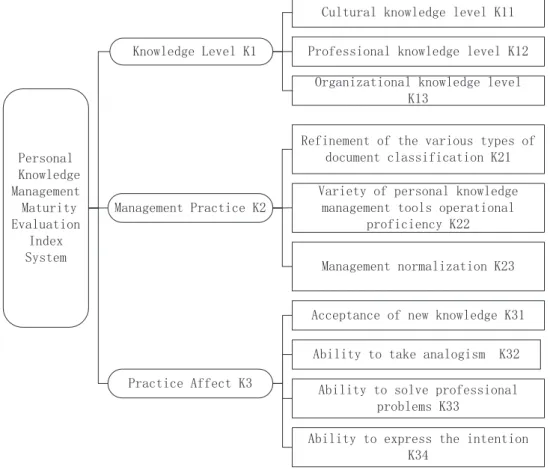
First, construct fuzzy judgment matrix of fac-tors in every level based on expert judgment. The evaluation team consists of 10 knowledge management experts discussing and scoring to get fuzzy judgment matrix after in-depth know-ledge of the meaning of every indicator. The fuzzy judgment matrixes against the evaluation criteria specified in Figure 1 are as follows:
3HUVRQDO .QRZOHGJH 0DQDJHPHQW
0DWXULW\ (YDOXDWLRQ
,QGH[ 6\VWHP
.QRZOHGJH/HYHO.
0DQDJHPHQW3UDFWLFH.
&XOWXUDONQRZOHGJHOHYHO.
3URIHVVLRQDONQRZOHGJHOHYHO.
2UJDQL]DWLRQDONQRZOHGJHOHYHO .
9DULHW\RISHUVRQDONQRZOHGJH PDQDJHPHQWWRROVRSHUDWLRQDO
SURILFLHQF\.
5HILQHPHQWRIWKHYDULRXVW\SHVRI GRFXPHQWFODVVLILFDWLRQ.
3UDFWLFH$IIHFW.
$ELOLW\WRWDNHDQDORJLVP. $FFHSWDQFHRIQHZNQRZOHGJH.
$ELOLW\WRVROYHSURIHVVLRQDO SUREOHPV.
$ELOLW\WRH[SUHVVWKHLQWHQWLRQ .
0DQDJHPHQWQRUPDOL]DWLRQ.
The first level judge matrix is shown in Table 2.
Individual Knowledge Management
Maturity Evaluation K1 K2 K3
Knowledge LevelK1 0.5 0.3 0.4
Management PracticeK2 0.7 0.5 0.7
Practice AffectK3 0.6 0.3 0.5
Table 2.The first level judge matrix.
The second level judge matrix is shown in Ta-ble 3 to TaTa-ble 5.
Knowledge levelK1 K11 K12 K13
Cultural knowledge levelK11 0.5 0.3 0.3
Professional knowledge levelK12 0.7 0.5 0.55
Organizational knowledge levelK13 0.7 0.45 0.5
Table 3.Knowledge level sub judgment matrix.
Professional knowledge levelK2 K21 K22 K23
Refinement of the various types
of document classificationK21 0.5 0.4 0.4
Variety of individual knowledge management tools operational proficiencyK22
0.6 0.5 0.45 Management normalizationK23 0.6 0.55 0.5
Table 4.Management practice sub judgment matrix.
Practice affectK3 K31 K32 K33 K34
Acceptance of new
knowledgeK31 0.5 0.4 0.6 0.3
Ability to take analogismK32 0.6 0.5 0.55 0.5
Ability to solve
professional problemsK33 0.4 0.45 0.5 0.45
Ability to express
the intentionK34 0.7 0.5 0.55 0.5
Table 5.Practice affect sub judgment matrix.
2. Determine the index weight
If the judgment matrix is fuzzy consistent, that is the elements of the matrix K and its weight match the formula(1),then formula (2)can be used to calculate the weight.
kij=0.5+a(wi−wj) (1)
wi= 1n −21a + na1
n
k=1
kik (2)
If the judgment matrix isn’t fuzzy consistent, that is to say, the elements of the matrixK and its weight don’t match the formula(1), then the weight vectorW = [w1,w2,w3, . . .wn]T can be
get use least-squares method, that is to solve the constraint programming problem as shown in formula(3).
⎧ ⎪ ⎪ ⎨ ⎪ ⎪ ⎩
minz= n i=1
n
j=1[
0.5+a(wi−wj)−kij]2
s. t.n
i=1wi =1, wi≥0, (1≤i≤n)
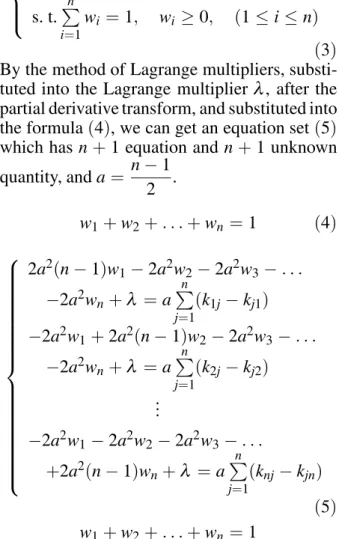
(3) By the method of Lagrange multipliers, substi-tuted into the Lagrange multiplier, after the partial derivative transform, and substituted into the formula(4), we can get an equation set(5) which has n+1 equation and n+1 unknown quantity, anda= n−2 1.
w1+w2+. . .+wn =1 (4)
⎧ ⎪ ⎪ ⎪ ⎪ ⎪ ⎪ ⎪ ⎪ ⎪ ⎪ ⎪ ⎪ ⎪ ⎪ ⎪ ⎪ ⎨ ⎪ ⎪ ⎪ ⎪ ⎪ ⎪ ⎪ ⎪ ⎪ ⎪ ⎪ ⎪ ⎪ ⎪ ⎪ ⎪ ⎩
2a2(n−1)w
1−2a2w2−2a2w3−. . .
−2a2wn+ =a n
j=1(k1j−kj1)
−2a2w
1+2a2(n−1)w2−2a2w3−. . .
−2a2w
n+ =a n
j=1(
k2j−kj2)
...
−2a2w1−2a2w2−2a2w3−. . .
+2a2(n−1)wn+ =an
j=1(knj −kjn)
(5)
w1+w2+. . .+wn =1
By solving this equation, we can get the weight vectorW = [w1,w2,w3, . . . ,wn]T.
Finally, through weighted average, we can get weight of each index relative to the overall goal of the weights.
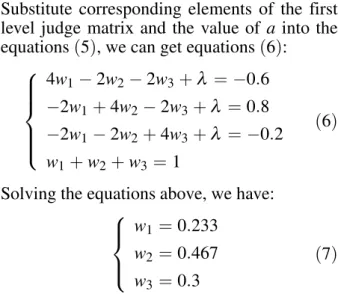
Substitute corresponding elements of the first level judge matrix and the value of a into the equations(5), we can get equations(6):
⎧ ⎪ ⎪ ⎪ ⎨ ⎪ ⎪ ⎪ ⎩
4w1−2w2−2w3+ =−0.6
−2w1+4w2−2w3+ =0.8
−2w1−2w2+4w3+ =−0.2 w1+w2+w3=1
(6)
Solving the equations above, we have:
⎧ ⎪ ⎨ ⎪ ⎩
w1 =0.233 w2 =0.467 w3 =0.3
(7)
The weight vector of knowledge level, profes-sional knowledge level and practice affect is
W = [0.233,0.467,0.3]T.
Similarly, the index system of weights can be calculated, and the result is shown in Table 6.
3.3. Evaluate Using Gray Comprehensive Evaluation Method
1. Determine the evaluation standard and sam-ple matrix
The evaluation criteria are divided into five lev-els: “optimization level”, “management level”, “defined level”, “repeatable level” and “initial level”, according to former discussion of matu-rity level. These five evaluation criteria were assigned values 9, 7, 5, 3, 1, and scoring takes ten-point system. The scores of indicator level higher than the highest level, between two ad-jacent levels and below the lowest level, are 10, 8, 6, 4, 2, 0. Grading is shown in Table 7. Assume that number of experts in the expert evaluation team is P, the kth (k = 1,2, . . . ,p)
experts scorecard of indicators Kij is dijk, we
can get individual knowledge management ma-turity evaluation sample matrix D after experts scoring.
2. Determine gray class assessment
Assume evaluation gray class ise, the evaluation gray class has 5 classes according to evaluation level, that ise=1,2,3,4,5, the corresponding gray number is ⊗ = (⊗1,⊗2,⊗3,⊗4,⊗5) =
(9,7,5,3,1) (Dong, Xiao, Liu, et al., 2010), and the corresponding whitenization weight functions as below[9]:
Evaluation
objectives level indexThe first
Weight coefficient
of index The second level index
Weight coefficient
of index Knowledge
levelK1 0.233 Cultural knowledge levelK11 0.2
Professional knowledge levelK12 0.417
Individual management
maturity evaluation knowledge
Professional knowledge
levelK2
Organizational knowledge levelK13 0.383
0.467 Refinement of the various types ofdocument classificationK21 0.267
Variety of individual knowledge
management tools operational proficiencyK22 0.35
Management normalizationK23 0.383
Acceptance of new knowledgeK31 0.2278
Practice affectK3
Ability to take analogismK32 0.2666
0.3 Ability to solve professional problemsK
33 0.2278
Ability to express the intentionK34 0.2778
Table 6.Individual knowledge management maturity evaluation index system of weights.
Score 9≤d<10 7≤d<9 5≤d<7 3≤d<5 0≤d<3 Level Optimization Level Management Level Defined Level Repeatable Level Initial Level
(1) The first gray class is optimization level,
e = l, gray number is ⊗1 ∈ [0,9,10],
whit-enization weight function f1(dijk) is shown in
formula(8):
f1(dijk) =
⎧ ⎪ ⎨ ⎪ ⎩ 1
9dijk dijk∈[0,9]
1 dijk∈[9,10]
0 dijk∈/ [0,10]
(8)
(2)The second gray class is management level,
e = 2, gray number is ⊗2 ∈ [0,7,10],
whit-enization weight function f2(dijk) is shown in
formula(9):
f2(dijk) =
⎧ ⎪ ⎨ ⎪ ⎩ 1
7dijk dijk ∈[0,7] 1
3(10−dijk) dijk ∈(7,10]
0 dijk ∈/ [0,10]
(9)
(3)The third gray class is defined level,e=3, gray number is ⊗3 ∈ [0,5,10], whitenization
weight function f3(dijk) is shown in formula
(10):
f3(dijk) =
⎧ ⎪ ⎨ ⎪ ⎩ 1
5dijk dijk∈[0,5] 1
5(10−dijk) dijk∈(5,10]
0 dijk∈/ [0,10]
(10)
(4) The fourth gray class is repeatable level,
e = 4, gray number is ⊗4 ∈ [0,3,6],
whit-enization weight function f4(dijk) is shown in
formula(11):
f4(dijk) =
⎧ ⎪ ⎨ ⎪ ⎩ 1
3dijk dijk∈[0,3] 1
3(6−dijk) dijk∈(3,6]
0 dijk∈/ [0,6]
(11)
(5)The fifth gray class is initial level,e=5 gray number is ⊗5 ∈ [0,1,2], whitenization weight
functionf5(dijk)is shown in formula(12):
f5(dijk) =
⎧ ⎨ ⎩
dijk dijk∈[0,1]
2−dijk dijk∈(1,2]
0 dijk∈/ [0,2]
(12)
3. Calculate the gray evaluation coefficient
For evaluation index Kij, in all expert scores, fe(dij1), fe(dij2),. . .,fe(dijp) is the whitening
weight of gray class which belongs to the eth
(e = 1,2, . . . ,5). The gray evaluation coef-ficient of the index Kij which belongs to the eth evaluation gray classX
ijecan be calculated
using formula(13).
Xije= p
k=1
fe(dijk) (13)
For evaluation index Kij, the gray evaluation
coefficient belonging to every evaluation gray classXijcan be calculated using formula(14).
Xij =
g
e=1
Xijk (g=5) (14)
4. Calculate the evaluation weight vector and weight matrix
If all experts claim that the gray evaluation co-efficient of the eth evaluation gray class is rije
for evaluation indexKij, then:
rije= XXije
j (e=1,2, . . . ,5) (15)
Evaluation indexKijof all gray-evaluation weight
vectorsrij= (rj1,rj2, . . . ,rj5).
RecordRiis the gray evaluation weight matrix
of indexKij, then:
Ri =
⎛ ⎜ ⎝ ri1 ri2 . . . rhi ⎞ ⎟ ⎠= ⎛ ⎜ ⎝
ri11 ri12 . . . ri15 ri21 ri22 . . . ri25
. . . .
rhi1 rhi2 . . . rhi5 ⎞ ⎟ ⎠ (16)
5. Comprehensive evaluation of the first and second level indicators
Record the comprehensive evaluation result of evaluation indexKi isBi, then Bi = Wi·Ri =
(bi1,bi2, . . . ,bi5) Gray evaluation weight
ma-trix of evaluation object K for all evaluation gray classes is:
R= B 1 B2 B3 = b
11 b12 . . . b15 b21 b22 . . . b25 b31 b32 . . . b35
Record the comprehensive evaluation result of the final evaluation index K is B, then B =
W ·R= (b1,b2,b3,b4,b5).
6. Calculate comprehensive evaluation value
Assign values for every evaluation gray class level by their gray level, that is, the value of the first level gray class “optimization level” is 9, the value of the second level gray class “man-agement level” is 7, the value of the third level gray class “defined level” is 5, the value of the fourth level gray class “repeatable level” is 3, the value of the fifth level gray class “initial level” is 1. Then the value vector of every evaluation gray class levelA= (9,7,5,3,1), the compre-hensive evaluation valueQof evaluation object can be calculated by formula(18).
Q=B·AT (18)
The higher the final calculated score, the better the knowledge management practices of eval-uated object, and the higher management ma-turity. On the contrary, at the same time, the individual knowledge management maturity is lower.
4. Examples of the Application of the Model
To verify the validity of individual knowledge management maturity evaluation model,we took a graduate student in a research center for ex-ample, using the model built in this research to evaluate the student’s individual knowledge management ability, and to determine the stu-dent’s individual knowledge management ma-turity, then give suggestions in accordance with the analysis results.
1. Obtain the sample matrix D
We invited 10 experts evaluation team to score the secondary indexKijof individual knowledge
management maturity evaluation index system, in accordance with the previously evaluation criteria. The evaluation sample matrix D can be obtained according to the scoring results of the expert team.
D= ⎛ ⎜ ⎜ ⎜ ⎜ ⎜ ⎜ ⎜ ⎜ ⎜ ⎜ ⎜ ⎜ ⎝
8 7 6 9 7 8 7 5 4 7 6 9 8 8 7 6 8 4 7 5 7 4 3 6 5 4 6 2 5 6 8 6 7 7 6 5 6 5 4 3 3 1 2 3 2 0 5 4 4 1 2 0 3 2 1 2 3 3 4 3 8 8 7 8 6 7 7 5 7 6 7 8 7 5 6 7 6 7 5 4 9 8 9 7 8 6 8 7 8 8 4 5 6 8 5 7 7 5 6 6
⎞ ⎟ ⎟ ⎟ ⎟ ⎟ ⎟ ⎟ ⎟ ⎟ ⎟ ⎟ ⎟ ⎠
(19)
2. Calculate the gray class evaluation weight matrix Ri
The evaluation weight matrix of every gray class
Ri(i=1,2,3)that the secondary indexKij
rel-ative to the first level indexKican get using the
whitening weight function and its gray evalua-tion coefficient formula.
R1=
r
1 r2 r3
(20)
=
0.3378 0.3492 0.2683 0.0447 0
0.3452 0.3350 0.2741 0.0457 0 0.2274 0.2923 0.3240 0.1563 0
R2=
r
21 r22 r23
(21)
=
0.2669 0.3230 0.3118 0.0983 0
0.1461 0.1878 0.2629 0.2980 0.1052 0.1386 0.1782 0.2494 0.3796 0.0542
R3=
r
31 r32 r33
(22)
= ⎛ ⎜ ⎝
0.3388 0.3725 0.2740 0.0147 0 0.2957 0.3597 0.3017 0.0429 0 0.4350 0.3442 0.2208 0 0 0.2734 0.3317 0.3253 0.0695 0
⎞ ⎟ ⎠
3. Comprehensive evaluation
Comprehensive evaluate the second index Kij, record the second index weight vector is Wi
(i = 1,2,3), and the evaluation results is Bi
B1=W1·R1 (23)
=(0.2986 0.3215 0.2921 0.0879 0)
B2=W2·R2 (24)
=(0.1755 0.2202 0.2707 0.2759 0.0576)
B3=W3·R3 (25)
=(0.3311 0.3513 0.2835 0.0341 0)
Hence the gray evaluation weight matrix R of in-dividual knowledge management maturity eval-uation is:
R=
B
1 B2 B3
(26)
=
0.2986 0.3215 0.2921 0.0879 0
0.1755 0.2202 0.2707 0.2759 0.0576 0.3311 0.3513 0.2835 0.0341 0
Comprehensive evaluate the first level indexKi, record the comprehensive evaluate result is B, and then have:
B=W ·R (27) =(0.2508 0.2831 0.2795 0.1596 0.0269)
Finally, the comprehensive evaluation value of this student’s individual knowledge manage-ment maturity is:
Q=B·AT = ⎛ ⎜ ⎜ ⎜ ⎝
0.2508 0.2831 0.2795 0.1596 0.0269
⎞ ⎟ ⎟ ⎟ ⎠
T⎛
⎜ ⎜ ⎜ ⎝
9 7 5 3 1
⎞ ⎟ ⎟ ⎟ ⎠
=6.1429 (28)
4. Analysis of the results and suggestions for improvement
We can see from the analysis of sample matrixD
and gray-class evaluation weight matrixRithat, practice results R3 has the best expert
evalua-tion results, the knowledge levelR1is followed,
and the management practicesR2has the worst
evaluate result. The ultimate comprehensive evaluate score of this graduate is 6.1429. According to the grading criterion, this stu-dent’s individual knowledge management matu-rity level is “defined level”, that means that this
student has realized the importance of individ-ual knowledge management, and begin to con-sciously focus on individual knowledge man-agement activities. And he has also developed a set of methods of individual knowledge man-agement to manage individual knowledge sys-tematically in practice, but still lacks of scien-tific management means and methods.
This student knowledge acquisition process should pay more attention to detailed classifi-cation of documents, and strengthen the use of variety of individual knowledge management tools in future, in order to improve the stan-dardization of management, so that the effect of individual knowledge management is more significant.
5. Conclusion
For the time being, research about knowledge management maturity model has been relatively mature, while the individual knowledge man-agement maturity model research is very lim-ited. This research tries to build a scientific and effective individual knowledge manage-ment maturity evaluation index system by tak-ing into account all aspects that have impact on individual knowledge management maturity, and to determine the index weights using math-ematical method in order to establish a scien-tific and operational individual knowledge man-agement maturity evaluation model, to evaluate knowledge management maturity of individu-als in organizations. But individual knowledge management maturity evaluation is a complex problem that requires more theoretical and em-pirical research to improve. Hopefully, this pa-per can contribute to future research as a pre-liminary attempt.
Acknowledgements
References
[1] F. Y. DONG, M. D. XIAO, B. LIU, Y. HAN,
Con-struction method of whitenization weight function in grey system teaching. Journal of North China Institute of Water Conservancy and Hydroelectric Power,31(3) (2010), 97–99.
[2] C. L. FENG, T. P. LI, Y. T. YAN, Research on the
Influence Factors of Knowledge Sharing in Supply Chain – Based on the Perspective of Knowledge Characteristics.Journal of System and Management Sciences,1(3) (2011), 21–30.
[3] Y. LIU, G. L. LI, W. HU, Construction of industrial clusters knowledge management maturity model (KMMM) based on the method of grey compre-hensive.Manufacturing Automation,35(2) (2013), 4–10.
[4] W. C. MA, Y. L. JIANG, Z. KANG, A fuzzy
evalua-tion method of individual knowledge capability in knowledge management. Journal of Northeastern university (Natural science), 25(7) (2004), 711– 714.
[5] M. C. PAULK, M. B. CHRISSIS, C. V. WEBER,
Ca-pability Maturity Model for Software, Version 1.1. Software Engineering Institute, Pittsburgh, 1993. [6] H. S. ROBINSON, C. J. ANUMBA, P. M. CARRILLO,
Steps: a knowledge management maturity roadmap for corporate sustainability.Business Process Man-agement Journal,12(6) (2006), 793–808.
[7] N. SYED, X. Y. LIN, The linkage between knowledge
management practices and company performance: Empirical evidence.Journal of Industrial Engineer-ing and Management,6(1) (2013), 1–6.
[8] R. H. ZHANG, Study on performance evaluation
model and evaluation method of enterprise know-ledge management based on balanced score card. Science and Technology Management Research,23 (2011), 159–162.
[9] X. M. ZHU, The Individual knowledge
manage-ment performance evaluation system and method of university teachers.Higher Education Development and Evaluation,25(1) (2009), 100–105.
[10] X. Y. HAN, Building and Application of Personal Knowledge Management Maturity Comprehensive Evaluation Model.Proceedings of 3rd International Conference on Logistics, Informatics and Service Science,(2013)Beijing, China, pp. 529–537.
Received:November, 2013
Revised:March, 2014
Accepted:July, 2014
Contact address:
Dan Chang School of Economics and Management Beijing Jiaotong University Beijing, China, 100044 e-mail:[email protected]
Xiaoying Han School of Economics and Management Beijing Jiaotong University Beijing, China, 100044 e-mail:[email protected]
Baowei Chen Junior College of Zhejiang Wanli University Ningbo, China, 315101 e-mail:[email protected]
DANCHANGis an associate professor in the School of Economics and Management of Beijing Jiaotong University. She has received her PhD in information management from Beijing Jiaotong University in 2013. Her research interests are economic mathematical modeling and mobile e-commerce.
XIAOYINGHANhas received her master’s is degree in information man-agement from Beijing Jiaotong University in 2014. Her research interest is economic mathematical modeling.