International Journal of Research in Engineering & Applied Sciences
http://www.euroasiapub.org 54
PRODUCTIVITY IMPROVEMENT BY FIXTURE MODIFICATION
Amit Vashist* R. C. Sharma** Sumit Taneja***
___________________________________________________________________________
ABSTRACT
This case study is about the productivity improvement in a small scale Indian automobile industry. Industry produces the parts of light commercial vehicle for a multi-national company. Industry is unable to produce a nut steering knuckle component used in light commercial vehicle at economic rate due to a problem of higher rejection rate having average 15.18 % defective pieces per month. Study is carried out by applying the fishbone method of root cause analysis on planning and manufacturing processes of nut steering knuckle component. Findings of this study show that fixture is also a factor of its production incapability. Modified fixture and implemented and a satisfactory result is obtained. When production after applying suggested modifications is run, a 0.78% reduction is observed in rejection rate of that particular component.
Keyword: Productivity, Fixture, Improvement, Defect, Analysis, Rejection
___________________________________________________________________________ *Assistant Professor in Department of Mechanical Engineering, Delhi Institute of
Technology & Management, Gannaur-131101, Sonipat, Haryana, India
**Professor in Department of Mechanical Engineering, M.M. Engineering College, Mullana, MM University, Ambala-133203, Haryana, India
International Journal of Research in Engineering & Applied Sciences
http://www.euroasiapub.org 55
INTRODUCTION:
At present, micro small and medium enterprises are facing difficulties because input cost (like raw material cost, electricity cost, fuel cost and transportation cost) has increased but final product price are not increasing accordingly. There is no space for rejection/reworking because it is a non value added activity of the company. No customer will pay cost for this. So customer wants defect free product with economical price. There is no second thought that those companies will remain in the market that can compete in the market through better product with economical prices. In small scale sector where a technological up-gradation is a barrier because of inadequate technical knowhow. The older methods of manufacturing are now obsolete with the introduction of CNC machines. But still there is a large scope in India to adopt the more economical ways of manufacturing method in small scale sector through better design of fixturing systems.
1.
FIXTURES:
A fixture is a device used for rapidly and accurately position (or “locate” as is the more commonly used term) the work piece, and support and secure it adequately such that all parts that are produced using this fixture will be within the design specifications for that part [3]. Fixtures are important in both traditional manufacturing and modern flexible manufacturing systems (FMS), which directly affect machining quality, productivity, and cost of products. Fixtures were developed for job, batch and mass productions, which are widely used in manufacturing operations to locate and hold a part firmly in position so that the required manufacturing processes can be carried out according to design specifications. So a faster and more profitable method requires some device on which the component can quickly be positions in the correct relationship to the cutting tools a quickly clamped before machining takes place.
1.1 THE STRUCTURE OF A FIXTURE:
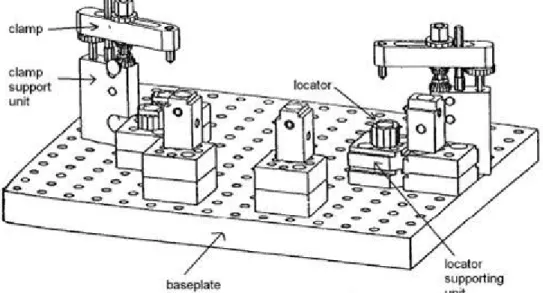
Physically a fixture is comprised of devices capable of supporting and clamping the work piece. Typical fixture structure is shown in Figure 1
International Journal of Research in Engineering & Applied Sciences
http://www.euroasiapub.org 56 Fixtures provide extra support where necessary for unusually shaped or large work pieces. Finally one of the most important aspects of a fixture is that it should not add unnecessarily to production costs, whether the cost is incurred as a result of fixture assembly time, expensive materials, fixture manufacture costs, and so on [4].
1.2 STUDY OF EXISTING FIXTURE:
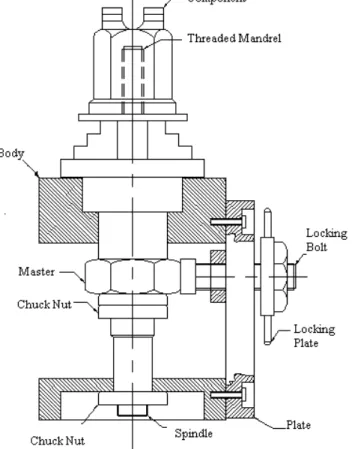
The company was using indexing fixture. This fixture was very simple and any lay man can operate this fixture. Also the repair was very less. Only disadvantage of this fixture for nut steering knuckle was that the clamping of the component on this fixture was through threading i.e. threaded mandrel was used to hold the component and then slotting was done. It was a time consumable process as it took more time for loading and unloading through threading. Figure 2 shows assembly of indexing fixture with nut steering knuckle.
Figure 2: Existing Assembly of Indexing Fixture with Component
2.
METHODOLOGY:
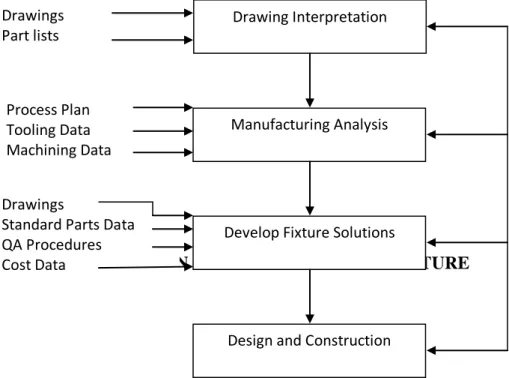
The aim of the proposed work is to develop a fixture that can be used for Nut Steering Knuckle in slot milling operation. The following methodology will be adopted for design of fixture for slot milling. [6]
Step1. Drawing interpretation
• Size and shape of the work piece • Accuracy required
• Work piece material • Quantity required
International Journal of Research in Engineering & Applied Sciences
http://www.euroasiapub.org 57 • Type/Size of machine tool
• Type/Size of tooling • Sequence of operations
• Orientation of the work piece relative to the tooling • Cutting forces
Step3. Develop fixture solutions
• Can an existing fixture be modified or not? • Will the cost of proposed fixture be justified? Step4. Design and construction
• Detail drawings for the component parts of the fixture assembly
• General arrangement drawing which includes a part list to detail the parts in terms of materials, quantity and part number.
• Construction according to the shape of the work piece. Step5. Verification
• Checking the manufactured fixture against the drawings. • Producing a test run of parts.
• Checking to ensure that the tool can be operated safely and easily. This is elaborated in Fig. 3 as shown below:-
FIGURE 3: DESIGN METHODOLOGY FOR FIXTURE
2.1 ANALYSIS OF DEFECTS:
Analysis of data is an important task. The production data was collected of six months and analysis of defects was done for existing fixture. [2]
For holding the component on milling machine, company was using threaded mandrel. It was taking more time for clamping the component and by operator’s mistake the tendency of thread damage was high. This was because of misalignment of the component and the Existing Fixture
Drawing Interpretation
Manufacturing Analysis
Develop Fixture Solutions
Design and Construction Drawings Part lists Process Plan Tooling Data Machining Data Drawings
International Journal of Research in Engineering & Applied Sciences
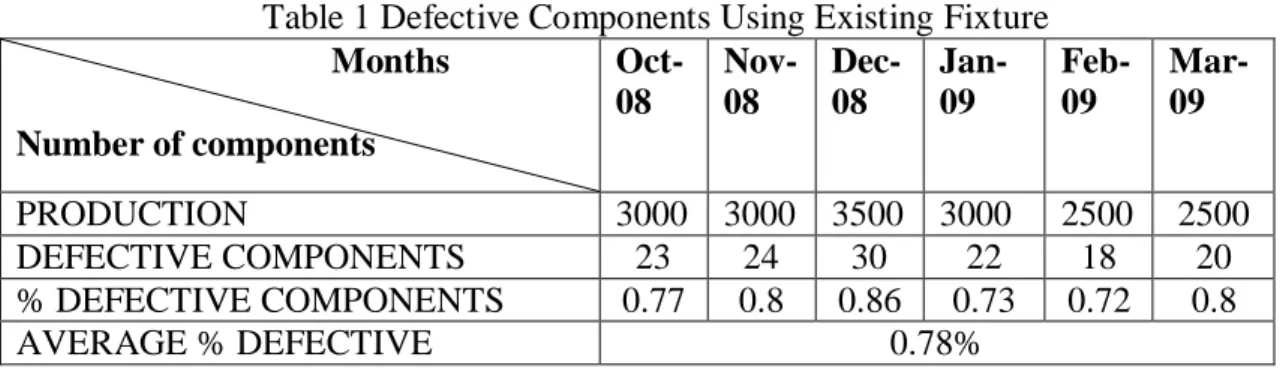
http://www.euroasiapub.org 58 threaded mandrel which leads to thread distortion. Table 4.4 shows the month wise description of defective pieces of nut steering knuckle using existing fixture.
Table 1 Defective Components Using Existing Fixture Months
Number of components
Oct-08
Nov-08
Dec-08
Jan-09
Feb-09
Mar-09
PRODUCTION 3000 3000 3500 3000 2500 2500 DEFECTIVE COMPONENTS 23 24 30 22 18 20 % DEFECTIVE COMPONENTS 0.77 0.8 0.86 0.73 0.72 0.8
AVERAGE % DEFECTIVE 0.78%
The percentage of defective component is less than 1%.
Above table shows the Defective Components with percentage. The defective components are due to existing fixture clamping method. So fixture modification is required for reduction of defective component.
3.
MODIFIED FIXTURE:
It was decided to perform threading operation after heat treatment to avoid the rejection of component. But if threading was done after the heat treatment then the clamping of the component should be changed from the previous clamping method where it was held through threaded mandrel. Hence for slot milling operation a need of fixture modification was required in existing fixture. For this the component was directly clamped through hard jaws without threaded mandrel.
3.1Clamping through Hard Jaws
International Journal of Research in Engineering & Applied Sciences
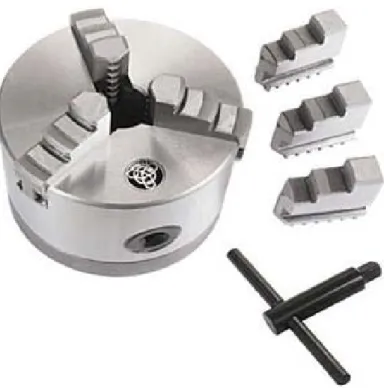
http://www.euroasiapub.org 59 Figure 4: Three Jaw Self Centering Standard Chuck
When the component was fitted in the chuck and slotting operation was carried out, it was found that component comes out from the chuck. Again, the component was clamped with more force in the three jaw chuck but result remains same i.e. component comes out from the chuck.
Then analysis was carried out, from which following results were obtained:
International Journal of Research in Engineering & Applied Sciences
http://www.euroasiapub.org 60 Figure 5: Clamping Through Hard Jaws
• Due to heavy clamping force applied on the component, the surface of the component was damaged.
• The unclamping of the component was due to higher cutting force of form cutter.
Hard jaws used were made from steel by case hardening which has carbon content from 0.15% to 0.25% and Mn 0.6% to 0.9%. These jaws cannot be machined because of hardness of jaws. Hence this clamping system was not suitable for this operation.
3.2 Clamping through Soft Jaws
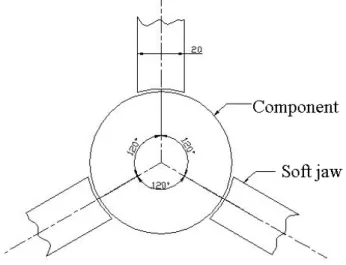
Standard hard jaws are used for many different size components, but these jaws cannot be modified according to the shape and size of component. So it was decided that instead of hard jaws, soft jaws should be used. The material of these jaws is plain carbon steel in which carbon content is from 0.48% to 0.55% and Mn 0.6% to 0.9%. These jaws are available in rectangular shape. Since soft jaws can be shaped according to the requirement i.e. it can be machined to any specification, so in this case, jaws were modified as per the shape and size of the component as shown in Figure 6. The gripping area of the jaws was increased. Initially the gripping width for hard jaws was 5 mm per jaw whereas the modified gripping width of soft jaw was 20 mm per jaw. So when the slotting operation was carried out with the soft jaws, it was found that the component was able to bear the force of the milling cutter. Hence, slotting operation was done successfully.
Figure 6: Clamping Through Soft Jaws
International Journal of Research in Engineering & Applied Sciences
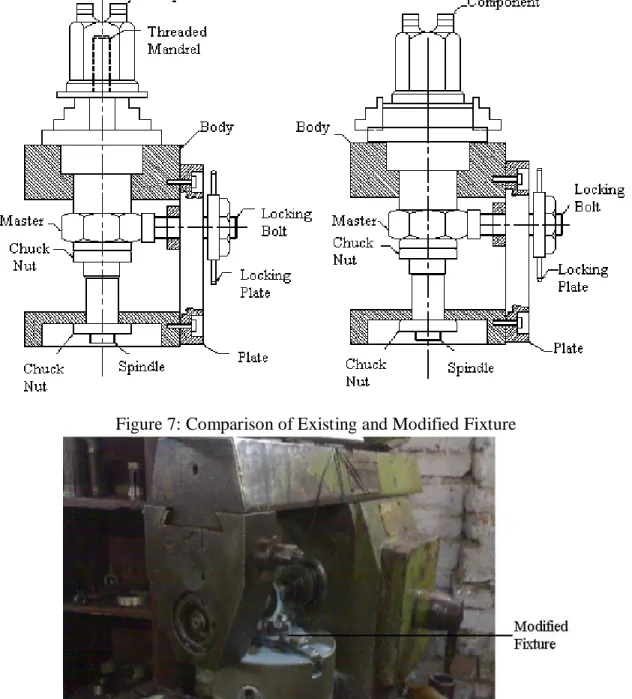
http://www.euroasiapub.org 61 Figure 7: Comparison of Existing and Modified Fixture
Figure 8: Slotting Operation
4.
RESULT AND CONCLUSION:
Above comparison of the Existing and Modified fixture it is found that the rejection rate of nut steering knuckle is reduced by 0.78%.
International Journal of Research in Engineering & Applied Sciences
http://www.euroasiapub.org 62 design involves the identification of clamp, locator, and support points, and the selection of corresponding fixture elements for their respective functions.
REFERENCES
[1] O. P. Khanna, “Statistical Quality Control”, Dhanpat Rai Publications, New Delhi, 1st Edition, 2001.
[2] Kanishka Bedi, “Quality Management”, Oxford University Press, New Delhi, 1st Edition, 2006.
[3] Cyril Donaldson, George H Lecain and V. C. Goold, “ Tool Deisgn”, Tata McGraw-Hill Publishing Company Limited, New Delhi, 36th Edition, 2006.
[4] Peter Scallan, “Process Planning: The Design/Manufacture Interface”, Butterworth Heinemann Publication, London, 1st Edition, 2003.
[5] P. H. Joshi, “Jigs and Fixtures”, Khanna Publishers, New Delhi, 2005.