Biologics
Delay
Progression
of
Crohn’s
Disease,
but
Not
Early
Surgery,
in
Children
Basavaraj
Kerur,*
,‡Jason
T.
Machan,
‡,§Jason
M.
Shapiro,*
,‡Carolina
S.
Cerezo,*
,‡James
Markowitz,
kDavid
R.
Mack,
¶Anne
M.
Grif
fi
ths,
#Anthony
R.
Otley,**
Marian
D.
Pfefferkorn,
‡‡Joel
R.
Rosh,
§§David
J.
Keljo,
kkBrendan
Boyle,
¶¶Maria
Oliva-Hemker,
##Marsha
H.
Kay,***
Shehzad
A.
Saeed,
‡‡‡Andrew
B.
Grossman,
§§§Boris
Sudel,
kkkMichael
D.
Kappelman,
¶¶¶Marc
Schaefer,
###Gitit
Tomer,****
Athos
Bousvaros,
‡‡‡‡Trudy
Lerer,
§§§§Jeffrey
S.
Hyams,
§§§§and
Neal
S.
LeLeiko*
,‡*PediatricGastroenterologyandNutrition,HasbroChildrenHospital,Providence,RhodeIsland;‡TheWarrenAlpertMedical School,BrownUniversity,Providence,RhodeIsland;§LifespanBiostatisticsCore,RhodeIslandHospital,Providence,Rhode Island;kSteven&AlexandraCohenChildren’sMedicalCenter,LakeSuccess,NewYork;¶Children’sHospitalofEastern Ontario,Ottawa,Ontario,Canada;#HospitalforSickChildren,Toronto,Ontario,Canada;**IWKHealthCentre,Halifax,Nova Scotia,Canada;‡‡JamesWhitcombRileyHospitalforChildren,Indianapolis,Indiana;§§GoryebChildren’sHospital/Atlantic Health,Morristown,NewJersey;kkChildren’sHospitalofPittsburgh,UniversityofPittsburghMedicalCenter,Pittsburgh, Pennsylvania;¶¶NationwideChildrensHospital,Columbus,Ohio;##JohnsHopkinsUniversitySchoolofMedicine,Baltimore, Maryland;***TheClevelandClinicFoundation,Cleveland,Ohio;‡‡‡CincinnatiChildren’sHospital,Cincinnati,Ohio;
§§§
Children’s Hospital of Philadelphia, Philadelphia, Pennsylvania;kkkUniversity of Minnesota, Minneapolis, Minnesota; ¶¶¶
University of North Carolina Chapel Hill, Chapel Hill, North Carolina;###Penn State Hershey Children’s Hospital, Hershey, Pennsylvania; ****Children’s Hospital at Montefiore, Bronx, New York;‡‡‡‡Boston Childrens Hospital, Boston, Massachusetts; §§§§
Connecticut Children’s Medical Center, Hartford, Connecticut
BACKGROUND & AIMS: Up to 30% of patients with Crohn’s disease (CD) require surgery within thefirst 5 years from
diagnosis. We investigated the recent risk of bowel surgery in an inception cohort of pediatric patients with CD and whether early use of biologics (tumor necrosis factor antagonists) alters later disease course.
METHODS: We collected data from the Pediatric Inflammatory Bowel Disease Collaborative Research
Group registry on 1442 children (age, £16 y) diagnosed with CD from January 2002 through December 2014. Data were collected at diagnosis, 30 days following diagnosis, and then quarterly and during hospitalizations for up to 12 years. Our primary aim was to determine the 10-year risk for surgery in children with CD. Our secondary aim was to determine whether early use of biologics (<3 mo of diagnosis) affected risk of disease progression.
RESULTS: The 10-year risk of first bowel surgery was 26%. The 5-year risk of bowel surgery did not
change from 2002 through 2014, and remained between 13% and 14%. Most surgeries occurred within 3 years from diagnosis. The only predictor of surgery was disease behavior at diagnosis. CD with inflammatory behavior had the lowest risk of surgery compared to stric-turing disease, penetrating disease, or both. We associated slowing of disease progression to stricturing or penetrating disease (but not surgery) with early use of biologics, but this effect only became evident after 5 years of disease. Our results indicate that biologics slow disease progression over time (hazard ratio, 0.85; 95% CI, 0.76–0.95).
CONCLUSIONS: In an analysis of data from a registry of pediatric patients with CD, we found that
among those with significant and progressing disease at or shortly after presentation,
Abbreviations used in this paper:CD, Crohn’s disease; IBD, inflammatory
bowel disease; RISK, Risk Stratification and Identification of
Immuno-genic and Microbial Markers of Rapid Disease Progression in Children
early surgery is difficult to prevent, even with early use of biologics. Early use of biologics (<3 mo of diagnosis) can delay later disease progression to stricturing and/or penetrating disease, but this affect could become evident only years after initial management decisions are made.
Keywords:IBD; Treatment; Anti-TNF Therapy; Risk Factor; PIBDCRG.
C
rohnprogressive in’s disease (CD) is a chronic, frequentlyflammatory disorder characterized by an exaggerated mucosal immune response of the gastrointestinal system in a genetically susceptible indi-vidual.1CD and ulcerative colitis are the 2 major clinical phenotypes and affect approximately 1 in 200 people in the Western world, with an increasing prevalence in developing countries.2–4More than 50% of children are expected to develop complicated disease behavior (stricturing and/or penetrating behavior) by 5 years after diagnosis. Disease progression is worse in children compared with adults.5The impact of medical management on disease pro-gression and on surgical rates remains controversial.6–26 We previously reported, using data from this same patient registry, that the 5-year risk of bowel surgery in pediatric CD was 13.8%.27 Retrospective pediatric studies have reported the 5-year risk of surgery to be between 14.2% and 34%.28–30
Our primary goal was to determine the 10-year surgical risk in children with CD. Our secondary goal was to deter-mine if the early use of biologics (anti–tumor necrosis factor [TNF]a) influenced the risk of disease progression.
Materials and Methods
Study Population
The Pediatric Inflammatory Bowel Disease Collabora-tive Research Group registry was established by 26 North American pediatric inflammatory bowel disease (IBD) centers in 2002 to study the contemporary natural history of IBD. Newly diagnosed children 16 years of age and younger were enrolled. Patients were managed according to the practice of their individual physician. Uniform data were collected at diagnosis, 30 days after diagnosis, and then quarterly and during hospitalizations. Between January 2002 and December 2014, the registry enrolled 2116 pediatric IBD patients. The 1442 CD patients (68% of the total) constitute the study population of this report.
Outcomes
The outcomes of interest were time from diagnosis to (a)first intestinal surgery and (b) time to progression to stricturing and/or penetrating disease.
Description of Variables
Day 0 was defined as the date of initial diagnosis. The study end date for patients who had a CD-related surgery was the date of thefirst bowel surgery. The patients who did not have surgery had a study end date defined by the last quarter of follow-up evaluation, which also was used to censor values in time-to-event analyses. Bowel sur-gery was defined as intestinal resection with primary anastomosis or diverting ostomy (including subtotal and total colectomy) or strictureplasty. Other surgical pro-cedures such as abdominal or perianal abscess drainage, orfistulotomy, were excluded. Family history of IBD was defined as having an affected mother, father, or sibling. Disease location was recorded within 30 days of diag-nosis. The presence of endoscopic, histologic, or radio-logic disease was recorded for the esophagus, gastroduodenum, jejunum, ileum, right colon, transverse colon, left colon, and for disease of the sigmoid colon and/or rectum. Disease location was classified as esophagus to jejunum, ileum to right colon, and trans-verse colon to rectum. Disease behavior was recorded at baseline, 30 days after diagnosis, and then quarterly. Disease behavior was defined as nonstricturing, non-penetrating (inflammatory) disease (B1), stricturing (B2), and penetrating disease (B3). If a patient had a missing disease behavior for a particular quarter, the previous quarter’s disease behavior was carried forward. Disease progression was defined as change from inflammatory only to either stricturing or pene-trating or both. Regarding treatments, use of biologics was considered “early” if patients were started during the first quarter after diagnosis and completed their induction phase.20Immunomodulator use was defined if the use of 6-mercaptopurine, azathioprine, or metho-trexate was documented for more than 1 quarter.
Statistical Methods
The Kaplan–Meier method was used to estimate survival functions with 95% CIs forfirst bowel surgery,
as stricturing or penetrating disease relative to infl am-matory disease. Age was treated as continuous. All statistical analyses were performed using SAS version 9.4 (The SAS Institute, Inc, Cary, NC).
The protocol for the Pediatric Inflammatory Bowel Disease Collaborative Research Group registry was approved by the institutional review boards of all participating institutions, and informed consent/ assent was obtained at the time of enrollment in the registry.
Results
Demographics
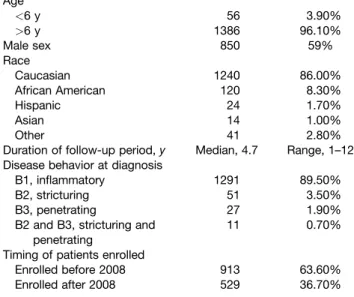
Demographics and disease characteristics for the 1442 CD patients enrolled in our study are shown in Table 1.
Risk of Crohn
’
s Disease
–
Related Bowel Surgery
The Kaplan–Meier estimated risk of CD-related bowel surgery was 4% at 1 year, 13% at 5 years, and 26% at 10 years (Figure 1A). A total of 241 subjects underwent any type of surgery, 171 of these had bowel-related surgery (Table 2).
Figure 1Bshows the monthly occurrence of the 171 bowel surgeries since the diagnosis. Two patients (1%) underwent bowel resection at diagnosis and were not included in our analyses, 66% of first bowel sur-geries occurred within 36 months from diagnosis and the remaining 33% occurred over the last 84 months of the study.
Speci
fi
c Risks for Surgery
Patients with stricturing and/or penetrating disease behavior at diagnosis were at a significantly higher risk of surgery over time (P ¼ .001) (Figure 1C). Table 3
shows the risk of surgery for subsets of patients based on age, sex, and disease behavior. Overall, our analyses show that over time neither age of the patient (P¼.05), disease location at diagnosis (P ¼.8), year of diagnosis (P¼.6), nor presence of perianal disease (P¼.4) predict differences in the risk of surgery. There was also no difference in the 5-year risk of surgery between patients who entered the study between 2002 and 2007 and those enrolled between 2008 and 2014 (Figure 2A), despite an increased use of biologics (Figure 2B) and the earlier initiation of biologics (Figure 2C).
No significant effects on disease progression were identified for nonbiologic treatments.
Impact of Treatment on Disease Progression
Among patients who received a biologic agent at any time during the study (including thefirst 3 months), the risk of disease progression to stricturing or penetrating disease was statistically significantly reduced by biologic use as analyzed by proportional hazards (Cox) regres-sion with biologic use as a time-varying covariate (hazard ratio, 0.85; 95% CI, 0.76–0.95; P ¼ .005). No significant effect on surgery was found.
We examined the impact of biologics on disease progression in children with inflammatory (B1) disease. Of the 1291 patients with B1 disease at diagnosis, 145 patients had been started by their pediatric gastro-enterologists on biologics within thefirst 3 months after diagnosis. Analyses (Figure 3A) of those who were treated early showed that disease progression from B1 to B2 or B3 after 5 years was decreased when compared with those not receiving early biologics (P <.005). No statistically significant effect was found on progression to surgery. We could not show a significant impact on any outcome in those groups in which the biologics were started after the first 3 months.
Interestingly, Figure 3B shows that patients with B1 disease, exposed to biologics in the first quarter of their disease, seemed more likely to have early surgery than those with B1 disease who were not started on biologics.
Discussion
The long-term effect of current IBD therapies, espe-cially biologics, in children is not clear.25,26 Recently Kugathasan et al20 showed that children enrolled in the Risk Stratification and Identification of Immunogenic and Microbial Markers of Rapid Disease Progression in Chil-dren with Crohn’s (RISK)20 cohort, who received early (within the first 3 months from diagnosis) anti-TNFa therapy, showed a reduction in penetrating disease but
Patient characteristics (N¼1442)
Age
<6 y 56 3.90%
>6 y 1386 96.10%
Male sex 850 59%
Race
Caucasian 1240 86.00%
African American 120 8.30%
Hispanic 24 1.70%
Asian 14 1.00%
Other 41 2.80%
Duration of follow-up period,y Median, 4.7 Range, 1–12 Disease behavior at diagnosis
B1, inflammatory 1291 89.50%
B2, stricturing 51 3.50%
B3, penetrating 27 1.90%
B2 and B3, stricturing and penetrating
11 0.70%
Timing of patients enrolled
Enrolled before 2008 913 63.60%
Enrolled after 2008 529 36.70%
Table1.Characteristicsofthe1442PatientsWithCD
not stricturing disease within their first 4 years after diagnosis. Our study was not able to show an effect on disease progression within a timeframe similar to that of the RISK study. We were, however, able to show an overall effect on disease progression after 5 years. The difference reflects the differences in study populations. The RISK study20included only children who were still classified as having inflammatory (B1) disease at 90 days after diagnosis, excluding children with disease progression within 3 months of diagnosis. We included
those children. By including many children in whom early disease progression already had taken place, we lessened our ability to show an early effect on their group as a whole. More than 15% of our cohort already had theirfirst bowel-related surgery in thefirst 90 days after diagnosis (Figure 1B).
Figure 1.(A) Cumulative incidence of CD bowel-related surgery over 10 years. The x-axis represents the years since the
diagnosis. The y-axis represents surgery-free survival. (B) Occurrences of bowel surgery since the diagnosis. The x-axis represents each month (and longer time periods) since the diagnosis. The y-axis represents the average number of surgeries performed per month in each time period (as recorded in the legend box). (C) Cumulative incidence of bowel surgery stratified by disease behavior at diagnosis. B1, inflammatory; B2, stricturing; B3, penetrating; B2 and B3, both stricturing and penetrating.
Table 2.First Bowel Surgery: 171 Patients
Ileocecal resection 74
Segmental resection and anastomosis of small bowel 62 Segmental resection and anastomosis of large bowel 15
Ostomy of small bowel 18
Ostomy of large bowel 11
Strictureplasty 3
Colectomy with ostomy 1
Colectomy with IPAA 1
NOTE. Table does not include patients who had surgery related to intravenous access devices appendectomy, anal examination under anesthesia, washout offistula, local abscess drainage, G-tube insertion, and so forth. Table may include more than 1 procedure atfirst surgery (ie, resectionþostomy). IPAA, ileal pouch–anal anastomosis.
Table 3.Risk of Surgery by Demographics of CD
Kaplan–Meier estimated
surgery rate Time since diagnosis,y
Risk of bowel surgery 1 5 10 Significance
Age at diagnosis NS
<6y 3.80% 13% 21.60%
>6y 4% 13% 26.90%
Sex NS
Males 3% 12.50% 20%
Females 5% 14% 32%
Disease behavior at diagnosis
P<.001
B1 2.50% 11.50% 24.50%
B2 2.50% 37% —
B3 30% 46% 46%
The 5-year risk of surgery in our prospective cohort was 13%, and the 10-year risk was 26% (Figure 1A). This is identical to a recent single-center retrospective study in children published by an Israeli group.28 However, the risk is lower than all other published pediatric and adult studies.29,30 The difference may be related to this being a true inception cohort of patients, or to the era of diagnosis. The surgical rates are less when compared with most of the population-based cohorts in adults, suggesting that the risk of surgery may be different in pediatric Crohn’s disease compared with adult-onset Crohn’s disease. However, the 5-year risk of surgery did not change significantly when comparing cohorts diagnosed between 2002 and 2007 (13.8%)27and 2008 and 2014 (13%) (Figure 2A). This is true despite the documented earlier and increasingly frequent use of biologics over the course of the study (Figure 2BandC).
Disease behavior (inflammatory vs stricturing vs penetrating) at diagnosis was the best predictor of sur-gery (Figure 1C). None of the other disease characteris-tics at diagnosis such as disease location, sex, age at onset, year of diagnosis, or center from which patient was recruited predicted surgery.
Although several studies have shown that disease location does not predict the risk of surgery,31–33 a recent study by Cleynen et al,14 one of the larger genotype-phenotype correlation studies of IBD, showed that the risk of surgery was low in colonic disease compared with those with ileocolonic/ileal disease.
Our results reflect the natural progression of CD over 10 years. Our analysis shows that the use of biologics is associated with slowing disease progression from inflammatory to stricturing/penetrating (hazard ratio, 0.85; 95% CI, 0.76–0.95; P ¼ .005). Our work extends the findings recently reported by Kugathasan et al,20 that early anti-TNFa therapy was associated with a reduction in penetrating disease generally occurring within a 2-year period. They suggest that a specific ileal extracellular matrix protein gene signature present at diagnosis predicted stricturing disease in pediatric Crohn’s disease. We suggest that their exclu-sion of patients with disease progresexclu-sion occurring in thefirst 90 days skews their study population toward a less severe group than we are reporting and toward a group more able to show response to early treatment. Most importantly, both reports support the positive impact of early therapy with biologics to prevent the
Figure 2.(A) Cumulative incidence of bowel surgery stratified by year of diagnosis (diagnosed before 2008 to after 2008). The
significant complications associated with disease progression.
It should be noted that we found that in the group receiving early biologics (n ¼145), the risk of surgery appears to be increased paradoxically in thefirst 5 years after diagnosis (Figure 2B). This suggests that our practicing pediatric gastroenterologists may have selected the sicker patients to start biologics. If this is the case then this introduces a bias that strengthens our
findings because it would be the sicker patients who are, in our study, experiencing the better long-term outcome (ie, less disease progression).
The strengths of our study include its long-term follow-up period, its large sample size, and being a true inception cohort (ie, inclusion of children within thefirst 30 days from diagnoses). These enable us to better assess temporal trends associated with the incidence of surgery. There were limitations, however, of the study. This study was started more than 15 years ago and conceived before our current ability to collect and pro-cess biological samples and to monitor anti-TNFablood levels. As a registry-based study, disease location data were not universally available on follow-up evaluation, endoscopic and pathologic data were not collected uniformly, and variation in practice at different centers may have influenced the results. Even though details of the treatment were documented, we do not have infor-mation about whether therapeutic drug monitoring of biologics or immunomodulators were used to optimize these treatments during the study. Another important limitation was the decrease in the number of patients over time, similar to other prospective cohort studies. Some of these limitations also limit the analytic approaches available to us.
Overall, this study provides important information about temporal trends of surgical risk in pediatric
Crohn’s disease. The initial 5-year risk of surgery has not changed over the 12 years of our study despite the use of newer therapies. We believe that this may reflect sig-nificant subclinical and clinical disease progression before diagnosis and before current medications capable of altering disease course are used. However owing to limitation of the registry model, we could not prove that surgery would decrease with earlier or more aggressive biologic use.
Taken together, our work and the work of Kugatha-san et al20present a picture consistent with the view that a critical factor in preventing bowel complications of IBD is starting effective treatment early, before the accumu-lation of significant bowel damage.
References
1. Khor B, Gardet A, Xavier RJ. Genetics and pathogenesis of inflammatory bowel disease. Nature 2011;474:307–317. 2. Molodecky NA, Soon IS, Rabi DM, et al. Increasing incidence
and prevalence of the inflammatory bowel diseases with time, based on systematic review. Gastroenterology 2012;142:46–54. 3. Kaplan GG. The global burden of IBD: from 2015 to 2025. Nat
Rev Gastroenterol Hepatol 2015;12:720–727.
4. Shapiro JM, Zoega H, Shah SA, et al. Incidence of Crohn’s disease and ulcerative colitis in Rhode Island: report from the Ocean State Crohn’s and Colitis Area Registry. Inflamm Bowel Dis 2016;22:1456–1461.
5. Gower-Rousseau C, Vasseur F, Fumery M, et al. Epidemiology of inflammatory bowel diseases: new insights from a French population-based registry (EPIMAD). Dig Liver Dis 2013; 45:89–94.
6. Solberg IC, Morten HV, Ole H, et al. Clinical course in Crohn’s disease: results of a Norwegian population-based ten-year follow-up study. Clin Gastroenterol Hepatol 2007;5:1430–1438. 7. Cosnes J, Nion-Larmurier I, Beaugerie L, et al. Impact of the increasing use of immunosuppressants in Crohn’s disease on the need for intestinal surgery. Gut 2005;54:237–241.
Figure 3.(A) Disease progression from inflammatory to stricturing and/or penetrating compared between the early initiation of
8. Overstraeten AB, Wolthuis A, D’Hoore A. Surgery for Crohn’s disease in the era of biologicals: a reduced need or delayed verdict? World J Gastroenterol 2012;18:3828–3832.
9. Chang MI, Cohen BL, Greenstein AJ. A review of the impact of biologics on surgical complications in Crohn’s disease. Inflamm Bowel Dis 2015;21:1472–1477.
10. Colombel JF, Sandborn WJ, Reinisch W, et al. The SONIC Study Group. Infliximab, azathioprine, or combination therapy for Crohn’s disease. N Engl J Med 2010;362:1383–1395.
11. Feagan BG, Panaccione R, Sandborn WJ, et al. Effects of adalimumab therapy on incidence of hospitalization and surgery in Crohn’s disease: results from the CHARM study. Gastroen-terology 2008;135:1493–1499.
12. Colombel JF, Sandborn WJ, Rutgeerts P, et al. Adalimumab for maintenance of clinical response and remission in patients with Crohn’s disease: the CHARM trial. Gastroenterology 2007; 132:52–65.
13. Hanauer SB, Feagan BG, Lichtenstein GR, et al. ACCENT I Study Group, maintenance infliximab for Crohn’s disease: the ACCENT I randomized trial. Lancet 2002;359:1541–1549. 14. Cleynen I, Boucher G, Jostins L, et al. 2015. Inherited
determinants of Crohn’s disease and ulcerative colitis pheno-types: a genetic association study. Lancet 2016;387:156–167. 15. Wolters FL, Russel MG, Sijbrandij J, et al. Disease outcome of
inflammatory bowel disease patients: general outline of a Europe-wide population-based 10-year clinical follow-up study. Scand J Gastroenterol Suppl 2006;243:46–54.
16. Ramadas AV, Gunesh S, Thomas GA, et al. Natural history of Crohn’s disease in a population-based cohort from Cardiff (1986-2003): a study of changes in medical treatment and surgical resection rates. Gut 2010;59:1200–1206.
17. Peyrin-Biroulet L, Oussalah A, Williet N, et al. Impact of azathi-oprine and tumour necrosis factor antagonists on the need for surgery in newly diagnosed Crohn’s disease. Gut 2011; 60:930–936.
18. Hazlewood GS, Rezaie A, Borman M, et al. Comparative effectiveness of immunosuppressants and biologics for inducing and maintaining remission in Crohn’s disease: a network meta-analysis. Gastroenterology 2015;148:344–354. 19. Nuti F, Civitelli F, Bloise S, et al. Prospective evaluation of the
achievement of mucosal healing with anti-TNF-a therapy in a paediatric Crohn’s disease cohort. J Crohns Colitis 2016;10:5–12. 20. Kugathasan S, Denson LA, Walters TD, et al. Prediction of complicated disease course for children newly diagnosed with Crohn’s disease: a multicentre inception cohort study. Lancet 2017;389:1710–1718.
21. Frolkis AD, Dykeman J, Negron ME, et al. Cumulative incidence offirst intestinal surgery in adult and pediatric Crohn’s disease: a systematic review and meta-analysis. Gastroenterology 2013; 145:996–1006.
22. Nguyen GC, Nugent Z, Shaw S, et al. Outcomes of patients with Crohn’s disease improved from 1988 to 2008 and were asso-ciated with increased specialist care. Gastroenterology 2011; 141:90–97.
23. Peyrin-Biroulet L, Harmsen WS, Tremaine WJ, et al. Surgery in a population-based cohort of Crohn’s disease from Olmsted County, Minnesota (1970-2004). Am J Gastroenterol 2012; 107:1693–1701.
24. Thia KT, Sandborn WJ, Harmsen WS, et al. Risk factors asso-ciated with progression to intestinal complications of Crohn’s disease in a population-based cohort. Gastroenterology 2010; 139:1147–1155.
25. Burke JP, Velupillai Y, O’Connell PR, et al. National trends in intestinal resection for Cohn’s disease in the post-biologic era. Int J Colorectal Dis 2013;28:1401–1406.
26. Debruyn JC, Soon IS, Hubbard J, et al. Nationwide temporal trends in incidence of hospitalization and surgical intestinal resection in pediatric inflammatory bowel diseases in the United states from 1997 to 2009. Inflamm Bowel Dis 2013; 19:2423–2432.
27. Schaefer ME, Machan JT, Kawatu D, et al. Factors that deter-mine risk for surgery in pediatric patients with Crohn’s disease. Clin Gastroenterol Hepatol 2010;8:789–794.
28. Rinawi F, Assa A, Hartman C, et al. Incidence of bowel surgery and associated risk factors in pediatric-onset Crohn’s disease. Inflamm Bowel Dis 2016;22:2917–2923.
29. Gupta N, Cohen SA, Bostrom AG, et al. Risk factors for initial surgery in pediatric patients with Crohn’s disease. Gastroen-terology 2006;130:1069–1077.
30. Vernier-Massouille G, Balde M, Salleron J, et al. Natural history of pediatric Crohn’s disease: a population-based cohort study. Gastroenterology 2008;135:1106–1113.
31. Whelan G, Farmer RG, Fazio VW, et al. Recurrence after surgery in Crohn’s disease. Relationship to location of disease (clinical pattern) and surgical indication. Gastroenterology 1985; 88:1826–1833.
32. Ryan JD, Silverberg MS, Xu W, et al. Predicting complicated Crohn’s disease and surgery phenotypes, genetics, serology and psychological characteristics of a population-based cohort. Aliment Pharmacol Ther 2013;38:274–283.
33. Rieder F, Zimmermann EM, Remzi FH, et al. Crohn’s disease complicated by strictures: a systematic review. Gut 2013; 62:1072–1084.
Reprint requests
Address requests for reprints to: Neal S. LeLeiko, MD, PhD, Pediatric Gastroenterology, Nutrition, and Liver Diseases, Warren Alpert Medical School of Brown University, Hasbro Children’s Hospital, Providence, Rhode Island 02906. e-mail:[email protected]; fax: (401) 444-8748.
Conflicts of interest