TECHNICAL UNIVERSITY OF CLUJ-NAPOCA
ACTA TECHNICA NAPOCENSIS
Series: Applied Mathematics, Mechanics, and Engineering Vol. 61, Issue IV, November, 2018
ISO CHECKER, AN ANDROID APPLICATION FOR FIT CALCULATION
ACCORDING TO THE LATEST ISO GPS STANDARDS
Grigore Marian POP, Liviu Adrian CRIȘAN, Mihai TRIPA, Numan DURAKBASA
Abstract: This paper presents an android application developed to be used by students, teachers and engineers working in quality assurance, dimensional measurements and design. One of the main advantages given by mobile applications is that they are available round the clock, once installed the user can easily get access to the provided information. Nowadays students are more driven towards using a smartphone for every purpose; this would be one of the main reasons why the authors decided to develop this application. The results provided by this application, such as: values for clearances and interferences, type of the fit, graphical representations of the tolerance intervals are in concordance to ISO 286-1:2010 and ISO 286-2:2010. ISO Checker will be available in three different languages, German, English and Romanian, offering the main information presented in ISO SYSTEM OF LIMITS AND FITS, lecture of Tolerances and Dimensional Control.
Key words: ISO FIT Calculation, Geometrical Product Specification (GPS), Android Application.
1. INTRODUCTION
GPS stands for Geometrical Product Specifications. This acronym is the subpart of the name of the Technical Committee ISO/TC 213 Dimensional and Geometrical Product Specifications and Verification. The Committee was established in 1996, when a group of three ISO technical committees’ experts, led by Per Bennich, decided to start to cope with the problem of the contradictions, gaps and the lack
of cohesion with needs of modern
CAD/CAM/CAQ systems in the current set of standards devoted to dimensioning and tolerancing [1].
The development of the GPS standards is executed internationally in the ISO/TC 213 and thanks to the Vienna agreement [6], all ISO standards in the GPS field are processed parallel in Europe in its mirror committee CEN/TC 290. The GPS standards are prepared in the ISO/TC 213 by active cooperation of 24 participating countries and 28 observer countries. The ISO/TC 213 has annually two meetings and its core expert group that comprises about 30
people, however since 1996 over 150 people have served as experts. The experts represent automobile, aircraft and other high-tech industry, leading measuring equipment manufacturers, universities and consulting business [1]. Generally, GPS gives an assurance for obtaining some essential properties of the product such as functionality, safety, dependability, interchangeability. Geometrical product specifications (GPS) - Matrix model (ISO 14638:2015 prepared by Technical Committee ISO/TC 213 and Technical Committee CEN/TC 290 "Dimensional and geometrical product specifications and verification" presents all GPS standards divided in three different groups: fundamental GPS
standards, general GPS standards,
complementary GPS standards.
The aim of this paper is to develop an easy to use application that generates all the necessary information related to fits according to ISO 286.
2. ANALISYS OF THE AVAILABLE ANDROID APPILCATIONS
More and more companies are developing and introducing applications or “apps” for mobile devices, companies that have recently joined this trend, created mobile apps aimed for students, employees, and apprentices (trainees) in all technical sectors, or engineers working in design and manufacturing. For fit calculation some of the apps that can be downloaded, for free, from Google play, are: ISO Fits, developed by Trelleborg, Mech Tab developed by Werder, Fit Tolerance ISO developed by Ames and ISO Tolerances developed by Daniel Zurhausen (see Figure 1). The authors analyzed all the above presented applications before developing ISO Checker.
What were the expectations from an ISO fit calculator:
1) input parameters:
• to indicate the nominal dimension;
• to indicate the tolerance class for the hole; • to indicate the tolerance class for the shaft; 2) results:
• to indicate the upper and lower limit deviations as well as the upper and lower limits of size for the holes and shafts;
• to calculate the fit resulting from the chosen tolerance classes for the hole and the shaft;
• to generate a graphical representation of the tolerance intervals for the chosen fit;
• to be multilingual;
• to indicate the basis system of the chosen fit;
• to indicate the type of the chosen fit; • to indicate if the chosen fit is an ISO standardized fit;
• to indicate if the chosen fit is a preferable fit according to the recommendation of ISO 286; • to indicate if the minimum clearance is 0; • to indicate the incorrect basis system selection;
• to indicate if the user selects other tolerance classes that the ones indicated in the tables of ISO 286-2.
By analyzing the available applications, the authors identified that none of these applications allow the user to translate the results in different languages. None of them indicate basis system of the chosen fit, or if it is a standardized, preferable fit.
(a) (b) (c)
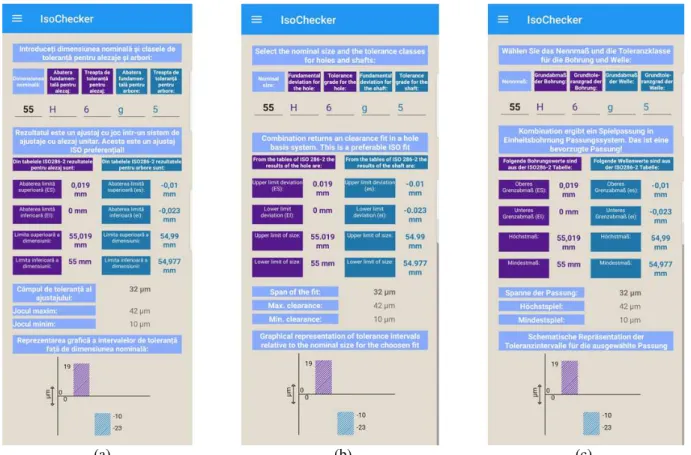
Fig. 2: Results given by ISO Checker for the fit 55 H6/g5: (a) Romanian, (b) English and (c) German
(a) (b) (c)
(a) (b) (c)
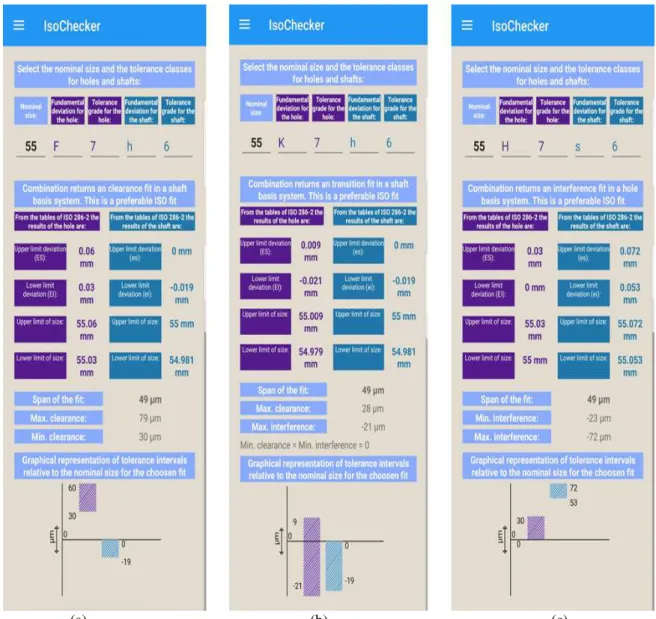
Fig. 4: Results given by ISO Checker for different types of fits: (a) 55 F7/h6, (b) 55 K7/h6, (c) 55 H7/s6
3. ISO CHECKER DESCRIPTON
Upon entering the nominal dimension, the user selects the tolerance classes for holes and shafts, then the application provides, the complete information regarding the chosen fit, all relevant values including, type of fit, basis system, if it is a recommended or preferable fit and a graphical representation of the tolerance intervals.
As shown in figure 2, after introducing a nominal size of 55 mm and selecting the fundamental deviations and tolerance grades for the hole, H6, and shaft, g5, the application calculates the span of the fit, minimum and maximum clearance, generates a graphical representation of the tolerance intervals. It also prints the upper and lower limit deviations as well as the upper and lower limits of size
according to ISO 286-2. ISO Checker provides information regarding the system of the selected fit and whether it’s a preferable fit.
Another useful feature is the language menu. When launched, the application will start in English, but if needed, if the user does not understand the terms in English, at a click of a button, Romanian or German language can be used. This feature is available at any time, even after a fit has been calculated (see Figure 5).
Fig. 5: Language menu
situation, when selecting the basic hole in combination with the basic shaft, the application generates an additional message saying that the minimum clearance is 0.
If the user selects other tolerance grades that the ones recommended by ISO 286, the application will calculate the resulted fit, but it will also print a red highlighted message mentioning that the selected combination does not return an ISO standardized fit (see Figure 3 (a)). The same message is generated if the user does not select a hole or a shaft basis system (see Figure 3 (b)). When selecting other nominal dimensions that the ones listed in ISO 286-2, for each tolerance class, the application will generate a message indicating the interval for the selection of the nominal size (see Figure 3 (c)).
Fig. 6: Results given by ISO Checker in English for the fit, 55 H7/h6
To avoid supplementary costs by using too many tools and gauges it is recommended that one of the preferable fits indicated according to ISO 286 should be chosen. ISO Checker also provides this information for the chosen fit (see Figure 4).
The presented application was developed in C# using the framework Xamarin and the graphical representation using the SkiaSharp library.
4. CONCLUSIONS
The developed Android application presented in this paper is able to calculate fits according to ISO 286 having the following features:
1. multilingual (the results can be provided in Romanian, English and German); 2. indicates trough a message the type and
the basis system of the chosen fit; 3. indicates trough a message if the selected
fit is a preferable fit;
4. indicates a highlighted message if the chosen fit is not an ISO standardized fit; 5. easy to use by unexperienced users.
5. ACKNOWLEDGMENTS
Stelian Ionele, developer at the company Lisam Systems Romania is gratefully thanked for programming.
6. REFERENCES
[1] Zbigniew Humienny, State of art in standardization in GPS area, CIRP Journal of Manufacturing Science and Technology, 2, pp. 1–7, (2009).
[2]https://www.tss.trelleborg.com/global/en/ser vice/desing_support/fits_tolerance/fits_toler ance_1.html
[3]https://play.google.com/store/apps/details?id =de.dzapps.iso_system_din286_1&hl=en [4]https://www.samuelwerder.ch/mechtab/intro
/?userlang=EN
[5]http://www.amesweb.info/FitTolerance/FitT olerance.aspx
[7] ISO 286:2010, GPS ISO code system for tolerances of linear sizes – Part 1: Basis of tolerances, deviations and fits – Part 2: Tables
of standard tolerance grades and limit deviations for holes and shafts, (2010).
ISO CHECKER, O APLICATIE ANDROID PENTRU CALCULUL AJUSTAJELOR IN CONFORMITATE CU STANDARDELE ISO GPS
Rezumat: Această lucrare prezintă o aplicație android dezvoltată pentru studenți, profesori și ingineri care lucrează în asigurarea calității, control dimensional și design industrial. Unul dintre principalele avantaje oferite de aplicațiile mobile este faptul că sunt disponibile non-stop, iar după instalare, utilizatorul poate accesa cu ușurință informațiile furnizate de aceasta. În zilele noastre studenții sunt interesati să folosească smartphone-ul pentru majoritatea activităților, acesta ar fi unul dintre principalele motive pentru care autorii au decis să dezvolte această aplicație. Rezultatele furnizate de această aplicație, cum ar fi: valorile jocurilor și a strangerilor, tipul ajustajului, reprezentarea grafică a intervalelor de toleranță sunt în conformitate cu standardele ISO 286-1:2010 și ISO 286-2:2010.
ISO CHECKER este disponibilă în trei limbi, germană, engleză și română, oferind informațiile
principale prezentate în cursul SISTEMUL ISO DE TOLERANȚE ȘI AJUSTAJE al disciplinei
TOLERANȚE ȘI CONTROL DIMENSIONAL.
Grigore Marian POP, Lecturer Eng., PhD, Technical University of Cluj-Napoca – Department of Design Engineering and Robotics, [email protected].
Liviu CRISAN, Professor, PhD, Technical University of Cluj-Napoca – Department of Design Engineering and Robotics, [email protected].
Mihai TRIPA, Associate Professor, PhD, Technical University of Cluj-Napoca – Department of Design Engineering and Robotics, [email protected].
![Fig. 1: Results given by different android applications available in Google play [2-5] for the fit, 55 H6/g5](https://thumb-us.123doks.com/thumbv2/123dok_us/7996508.2120392/2.892.113.758.660.1138/fig-results-given-different-android-applications-available-google.webp)