TECHNICAL UNIVERSITY OF CLUJ-NAPOCA
ACTA TECHNICA NAPOCENSIS
Series: Applied Mathematics, Mechanics, and Engineering Vol. 62, Issue IV, November, 2019
DESIGNING A CAR SEAT FOR ELECTRICAL CAR
Sergiu SOLCAN, Raul ROZSOS, Paul BERE, Vlad NICOLAE, Daniel GRAD, Calin NEAMTU
Abstract: The paper presents the design stages of an electric car seat using the Design Thinking
methodology. The designed seat is made of composite materials dedicated to urban electric cars.
Key words: Design Thinking, electric car, car seats, compozit materials.
1. INTRODUCTION
The paper presents the steps and how to develop and validate a seat for a small electric car from the L6e category. The development of this chair was made using a creative, innovative, iterative and cooperative Design Thinking algorithm.
Fig. 1 Design Thinking [1]
The design team is an interdisciplinary one that includes designers, engineers, composite material specialists and ergonomics specialists.
2. EMPATIA - CAR SEATS DESIGN REVIEW
At this stage a careful and extensive research of the car seat design trends was carried out, the aim of the team was to identify the new trends in shape and design of materials and comfort
elements that are expected to be used on medium and long term by the main “actors” in the automotive sector. One of the trends identified in the market is the design and realization of monocoque chairs (Fig. 2).
Fig. 2 Monocoque car seats [2, 3]
the comfort of the sponge / foam the heating system and the material that confers the final shape and appearance of the seat.
A second interesting trend at the moment for a small electric car is the design of seats in the form of a banquet similar to those from the 80s (Fig. 3).
Fig. 3 Bench type seats [4, 5]
This type of seats is suitable for smaller spaces and offers a high level of comfort during short-term trips such as those in the urban area. In terms of materials, three different streams have been identified. The first uses the classic materials currently found on the market in the vast majority of automobiles: foam, textiles and natural or organic leather in various variants and combinations. The second identified trend uses composite materials based on glass fiber and / or carbon fiber to create chairs similar to those in the sports motor. The third trend is the use of new and unconventional materials such as various types of rubber and elastic materials that allow the removal of the design of the arcs and soft materials that provide the comfort of traditional seats Fig. 4.
Fig. 4 Kinetic Seat Lexus [6]
3. DEFINE - DESIGN SPECIFICATION
At this stage of development, the requirements for the seat that will be developed for the concept machine set out in Fig. 5.
Fig. 5 URBIVEL Concept Car
The machine stitch will be made of carbon fiber composite material so that at this stage a constraint on the material and with it and the manufacturing process is introduced. The design specifications are as follows:
the seat should be monocoque
assure the comfort needed for short and medium distances
minimalist design similar to the sports seat seats
ergonomic use
possibilities for adjusting the horizontal position
4. IDEATE – DESIGNING THE SEAT
This stage is an innovation and generates the solution to the problem. Through successive analyzes and improvements, a result that can be used in the prototyping stage is reached.
The first variant of the seat is shown in Fig. 6 and is similar to the seats in the sports motor. The shape of the seat allows the manufacture of composite materials, which will be lined with foam and textiles.
Fig. 6 Version 1
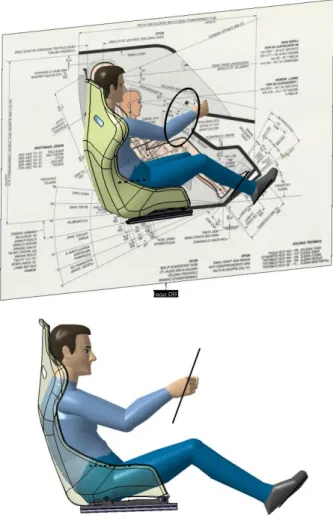
After the first model was followed, an analysis phase followed, using the Catia V5 / 6 to analyze the driving position of the driver. The position of the driver in the seat made of composite material is shown in Fig. 7 and is identical to the position in the classic seat, the seat line follows the natural body position.
Fig. 7 Driver's position
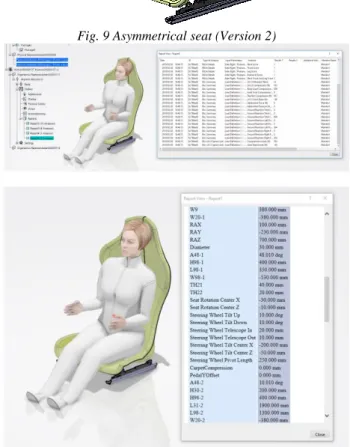
After assembly of the seats in the body of the prototype (Fig. 8) one of the problems identified is a certain difficulty when the occupant is sitting in the seat because of the quite high edges. To remove this shortcoming, an asymmetric chair with one of the smallest sides is modeled to facilitate the positioning and lifting of the seat Fig. 9.
Fig. 9 Asymmetrical seat (Version 2)
Fig. 10 Ergonomics analysis
To increase the comfort fence, design a one-piece chair that has a set of slots on the back and sides of the backrest to allow air circulation and increase the backrest elasticity, thus increasing comfort (Fig. 11). In this version of the seat, the surfaces were modeled in such a way that they could be made in a single mold. The advantage of such a chair is that it has a higher elasticity than the classic ones, is easy to maintain and can be used in combination with sponge cushions to increase the occupant's comfort. The low surface of the seat helps to accelerate acclimatization as there are areas (where there are cuts) where there
is no contact between the seat and the occupant's body.
The seats designed so far offer only one degree of mobility, namely horizontal translation. The latest version of the seat offers a higher degree of comfort due to the folding back (Fig. 12).
Fig. 12 Folding chair (Version 4)
The chairs designed so far offer only one degree of mobility, namely the horizontal translation. The last variant of the seat offers a higher degree of comfort due to the folding backrest (Fig. 12).
5. SEAT PROTOTYPE
For model prototyping (Fig. 13), two types of 3D printers were used: FDM (Leap Frog XL and
Dot Bot) and SLA (Form Lab2), and three 1:10 scales were printed (Fig. 14)
Fig. 13 Printed seat models
Fig. 14 Prototype printing
6. PROTOTYPE TESTING
7. CONCLUSIONS
The paper presents the steps of developing a car seat made of composite materials for an electric city car. The main innovation in this seat is the shape of the backrest and the sides of the seat, which features cutouts that give the seat an elasticity fence, allowing the soft padding of the seat and the better ventilation of the occupant. The chair is at the stage of designing the composite material and prototype manufacturing. The development of the chair was done using the Design Thinking method.
8. ACKNOWLEDGMENTS
This work was supported by the project “Advanced technologies for intelligent urban electric vehicles”- URBIVEL - Contract no.11/01.09.2016, project co-founded from the European Regional Development Fund through the Competitiveness Operational Program 2014-2020
9. REFERENCES
[1]Soegaard, M., The Basics of User Experience Design. Interaction Design Foundation, ed. 2018:
[2] Skoda-Auto, Vision E http://www.skoda-auto.rs/company/visione. 2019 [cited 2019 March ].
[3] FORD AUTOMOBILE, EVOS Interior Concept. 2019 [cited 2019 March];
Available from:
http://www.seriouswheels.com/2011/def/201
1-Ford-Evos-Concept-Interior-1280x960.htm.
[4] BMW. BMW i3 Concept. 2018 [cited 2019 February]; Available from: https://www.bimmertoday.de/2012/06/13/b
mw-i3-concept-mit-seriennaherem-innenraum-in-london-prasentiert/.
[5] BUTTS, H.-M. Curbside Concepts: Honda Urban EV – Are Bench Seats Coming Back? 2017 [cited 2019 February]; Available from: http://www.curbsideclassic.com/uncategoriz ed/curbside-concepts-honda-urban-ev-are-bench-seats-coming-back/.
[6] Lexus. Lexus Kinetic Seat Concept World Premiere at the 2016 Paris Motor Show. 2016 [cited 2019 March]; Available from: http://pressroom.lexus.com/releases/lexus- kinetic-seat-concept-premiere-2016-paris-motor-show.htm
DESIGN SCAUN AUTO PENTRU MASINA ELECTRICA
Lucrarea prezinta etapele de proiectare a unui scaun pentru un automobil electric utilizând metodologia Design Thinking
Sergiu SOLCAN, Technical University of Cluj-Napoca, Design Engineering and Robotics, Bd. Muncii 103-105, Romania
Raul ROZSOS, Technical University of Cluj-Napoca, Design Engineering and Robotics, Bd. Muncii 103-105, Romania
Paul BERE, Technical University of Cluj-Napoca, Manufacturing Engineering, Bd. Muncii 103-105, Romania
Nicolae VLAD, Technical University of Cluj-Napoca, Automotive Engineering and Transportation, Bd. Muncii 103-105, Romania
Grad DANIEL, Eng., Belco-Avia SRL, Livezile Str. Cruci Nr. 423, Bistrita-Nasaud county, Romania
![Fig. 2 Monocoque car seats [2, 3]](https://thumb-us.123doks.com/thumbv2/123dok_us/7994638.2119992/1.892.108.455.669.922/fig-monocoque-car-seats.webp)
![Fig. 3 Bench type seats [4, 5]](https://thumb-us.123doks.com/thumbv2/123dok_us/7994638.2119992/2.892.438.788.117.476/fig-bench-type-seats.webp)