64
transition word. This article refers to an experimental research about the effectiveness of Four Square Writing in teaching writing at a senior high school. The population of the research is the eleventh grade students of a senior high school, in Karanganyar. The sample of the research consist of two classes; IX Science 1 was used as experimental class treated by using Four Square Writing and IX Science 2 was used as control class treated by using Guided Writing. The sampling technique used is cluster random sampling. The instruments used to collect the data are students’ creativity test and writing test. The data were analyzed by using multifactor analysis of variance (ANOVA 2X2) and Tukey test. Based on the result of the analysis, the findings of the research are: (1) Four Square Writing is more effective than Guided Writing to teach writing; (2) the students having high creativity have better writing skill than those having low creativity; and (3) there is an interaction between teaching techniques and students’ creativity to teach writing. In conclusion, Four Square Writing is an effective technique to teach writing for eleventh grade students of a senior high school, Karanganyar. The effectiveness of technique is influenced by the students’ level of creativity.
Writing is an activity in which learners form graphic symbols, arrange them to form words, and put the words in order and link them together in a certain way to produce a logical sequence of sentence (Hernowo, 2004: 43). It is in line with Byrne (1997: 1) states that writing is the use of graphic symbols which are arranged according to a certain convention to form of words and sentences. He defines writing as a sequence of sentences arranged in a particular order and linked together in a certain ways. Hence, it can be said that to write needs gradual stages.
Furthermore, the researcher chooses writing because most EFL learners might agree when it is said that writing is difficult skills for them to master. According to Depdiknas (2009: 1) the difficulty lies not only in generating and organizing ideas, but also in translating these ideas into readable text. The skills involved in writing are highly complex. EFL writers have to pay attention to higher level skills of planning and organizing as well as lower skills of spelling, punctuation, word choice, and so on. The difficulty then becomes more pronounced if their language proficiency is weak.
Because of that, learning to write is not an easy task to do. Many students still make errors and mistakes and, then, they are fossilized. Their interest becomes less and less and students begin to create negative stimuli about learning to write. This condition drives the students to assume that writing is a very difficult task to do. The problem emerges as students are not familiar yet with the types of written discourse in English due to lack of exposure. Consequently, they are not able to or willing to think directly in English. They, then, tend to formulate their ideas in Indonesian language when they express ideas in writing. Afterward they try to translate them into English which is not an easy task and even dangerous.
However, both teacher and students get difficulties to organize writing practice regularly. Teacher does not have proper time allocation in teaching writing. He or she focuses on another skill. Therefore, teacher gives writing activity to students as an out-of-class activity. Students discover lack of clear specific instruction and also lack of control and monitor from teacher during the writing process. It emerges some new problems to students.
Meanwhile, Guided Writing is an essential tool in a balanced writing curriculum, providing an additional supporting step towards independent writing. Through Guided Writing, students are supported during the different stages of the writing process. The aim is to provide support that is going to help students improve their writing and to work with increasing independence (Primary National Strategy, 2007: 6). Moreover, Ontario (2005: 5.1) defines Guided Writing as a strategy that gives students the opportunity to review a recently taught writing skill in a small-group setting and then, to apply the skill through independent writing.
In addition, both techniques will be applied successfully in teaching writing if they are supported by the students’ creativity. Creativity means having the power or quality to express yourself in your own way (Muhammad, Sahibzada, and Raheel, 2012: 1). Moreover, according to Sarsani in Sarsani (2005: 2), creativity involves the skill to produce original ideas and to perceive new relationship among unrelated things. Thus, it will bring some things new. The students who have high creativity in writing, the students will have a skill to create new ideas. They perform better learning than students who have low creativity. They will really be serious to create brilliant ideas and arrange them into good sentences. On the other hand, low creative students usually accept what they have done. They limit their motivation in a certain condition. Thus, the teacher should be able to provide the students with activities which can increase students’ creativity by implementing challenging atmosphere of learning activities.
Considering to the background above, the researcher formulates the problems of the research as follows: (1) Is Four Square Writing more effective than Guided Writing to teach writing? ; (2) Do students who have creativity have better writing skill than those who have low creativity? ; and (3) Is there any interaction between teaching techniques and students’ creativity in teaching writing?.
Writing is transforming thoughts into language; it means that we need to think about the content of our writing first and then arrange the ideas using appropriate language (e.g. grammar and vocabulary). Nunan (2003: 88) states that writing is the process of thinking to invent ideas, thinking about how to express into good writing, and arranging the ideas into statement and paragraph clearly. Furthermore, writing, like playing tennis, is an activity made up of several processes, such as thinking what to write and the order to put it in (Grundy, 1991: 7). In the process, writing and thinking are so inseparable, if the researcher cannot think clearly about an idea, he cannot write well. On the contrary, if he has creative thinking in the writing process, the actual writing process will be easier.
Based on the theories above, it can be summarized that writing is a process of thinking, expressing, and arranging the ideas also in form of graphic symbols. It will be arranged into a form of words and linked it together in the logical sequence of sentences stage by stage.
There are some indicators that indicate whether or not student has good writing. Based on the writing concepts from many experts above, writing should involve some elements such as content, organization, vocabulary, language use, and mechanics. It can be said that those elements are the indicators of writing. Moreover, those indicators will also be the criteria of measuring writing.
Interesting teaching technique is also important. It is applied in order students are interested in teaching and learning process. One of the technique is Four Square Writing. Four Square Writing is a technique to improve students’ writing ability in organizing and connecting thought. It helps writer to generalize thought across the curriculum to make meaningful connections between self, world, and other text; prepare the students for demand/prompt writing; and encourage meta-cognitive writing with confidence. Thus, Four Square Writing may assist students’ writing by giving them a preliminary structure for organizing their thoughts. Teachers should be encouraged to vary their graphic organizers and the ways they use them to make sure all students have the strategies they need to be successful (Tompkins in Wallace, et al., 2006: 49).
make grading easier. It can be used across grade levels such as: versatile, sentences, paragraph, essays, research, and vocabulary.
From the definition above, it can be summarized that Four Square Writing techniques is a technique to improve, help, connect, and organize students thought in writing. It also helps the students to generalize and combine the best outline, fact and ideas.
According to Simpson (1998: 1), Guided Writing is a strategy in which the teacher demonstrates for students the process of writing a sentence or a paragraph using proper English conventions. Students are then given opportunities to show that they can use these strategies and conventions on their own work. Meanwhile Tyner (2004: 8) state that Guided Writing is an instructional writing context chiefly teaching the writing process through modeling, support, and practice. Furthermore, the principle of Guided Writing strategy is to provide instructional materials or relevant media to help students write. For example, in traditional writing instruction, the teacher generally guides students to express ideas by providing paper-based text, pictures or video media related to the writing subject.
Another important thing that needs to be considered in teaching writing is students’ creativity. As stated by Amabile (1996: 1) creativity is the production of novel and useful ideas in any domain. In order to be considered creative, a product or an idea must be different from what has been done before. But the product or idea cannot be merely different for difference’s sake; it must also be appropriate to the goal at hand, correct, valuable, or expensive of meaning. In addition, according to Sternberg and Lubart in Sternberg (1999: 3), creativity is the ability to produce work that is both novel (i.e., original, unexpected) and appropriate (i.e., useful, adaptive concerning task constraints).
Meanwhile, according Newell and Shaw in Sefertzi (2000: 2), creativity is the generation of imaginative new ideas, involving a radical newness innovation or solution to a problem, and a radical reformulation of problems. Moreover, Higgins in Sefertzi (2000: 2) state that a creative solution can simply integrate existing knowledge in a different way. A third set of definitions proposes that a creative solution, either new or recombined, must have value. It can be said that creativity involves the generation of new ideas or the recombination of known elements into something new, providing valuable solutions to a problem. It also involves motivation and emotion. Creativity is a fundamental feature of human intelligence in general.
problems. It can simply integrate existing knowledge in a different way. Thus, creativity will recombine something new and providing valuable solution to a problem.
Based on the theoretical description above, the hypothesis can be formulated as follows: (1) Four Square Writing is more effective than Guided Writing to teach writing; (2) The students having high creativity have better writing skill that those having low creativity; and (3) There is an interaction between teaching techniques and students’ creativity in teaching writing.
The research was conducted in a senior high school, in Karanganyar, Central Java. This research was conducted from January to February 2014. This school is established in October 9 1982. At the first time, there were 3 classrooms, but now there are 30 classrooms evenly divided for class X, XI, and XII. This research was carried out at the eleventh grade students in academic year of 2013/2014.
The method applied in this research is an experimental method. Experimental research is a research in which the researcher manipulates the independent variable, as stated by Johnson and Christensen (2000: 23), the purpose of experimental research is to determine cause and effect relationships. The experimental research method enables us to identify causal relationships because it allows us to observe, under controlled condition, the effect of systematically hanging one or more variables.
The population of this research was all the eleventh grades of a senior high school in the academic year of 2013/2014. The XI IPA Reguler grades of this school are divided into four classes, those are: XI.A1, XI.A2, XI.A3, XI.A4. Then, the researcher decided to take only 72 students or two classes from all of population as the sample of this study. One class is experimental group and the other is control group. Thus, in this research, the researcher used cluster random sampling. In this case, the researcher took samples of the research and determine two preexisting classes used as experimental and control groups. It was carried out by doing lottery. The lottery was carried out towards the four classes of the population. Each group has the same possibility to be the sample of the research. Based on the lottery, there were two classes chosen to be the subject of the research, those were XI.A.1 and XI.A.2. The result of the next lottery reveals that class XI.A.1 became the experimental group and class XI. A.2 became the control group. The experimental group that was chosen would be given a treatment by using Four Square Writing. On the other hand, the control group was taught by using Guided Writing.
other class was taught by Guided Writing, so there were four groups: (1) students with high creativity who were taught by Four Square Writing ; (2) students with high creativity who were taught by Guided Writing; (3) students with low creativity who were taught by Four Square Writing ; (4) students with low creativity who were taught by Guided Writing.
Meanwhile, the data needed in this research are the scores of students’ creativity and the score of students writing. The score of creativity are taken from the result of creativity test. The researcher conducts the test before teaching the students with Four Square Writing and Guided Writing. Based on the result of creativity test, the students from both experimental and control group were classified into students with high creativity and the ones with low creativity.
Data analysis is aimed at testing the research hypotheses. The researcher used a descriptive and inferential statistics. The descriptive statistics is used to know the mean, median, mode standard deviation, histogram, and polygon of students’ scores in writing. Inferential statistics is used to test the research hypothesis. Testing hypothesis is conducted in order to manage the research data which are in the form of numbers, so that they can produce a real conclusion. It is also used to test whether the hypothesis of the research is accepted or rejected. Knowing the result of normality and homogeneity test, the researcher used analysis of variance (ANOVA) and Tukey test.
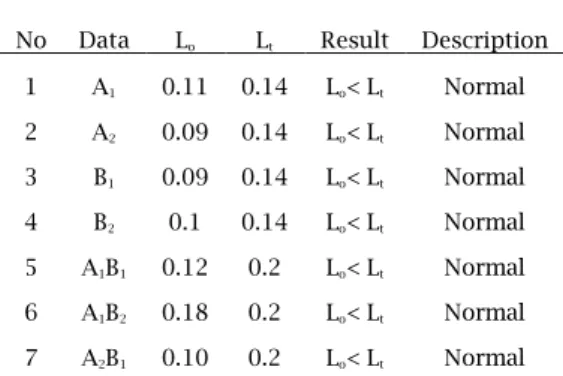
Before testing the hypothesis, a prerequisite test must be done first. In order to know whether the sample is in normal distribution or not, the normality test is done. Moreover, homogeneity test is used to know whether the data are homogeneous or not. Both normality and homogeneity test can be seen in table 1 as follows:
1. Normality Test
The normality test is used to determine whether the sample in this research is in normal distribution or not. The result is presented in table 1.
Table 1 Normality Test
No Data Lo Lt Result Description
1 A1 0.11 0.14 Lo< Lt Normal
2 A2 0.09 0.14 Lo< Lt Normal
3 B1 0.09 0.14 Lo< Lt Normal
4 B2 0.1 0.14 Lo< Lt Normal
5 A1B1 0.12 0.2 Lo< Lt Normal
6 A1B2 0.18 0.2 Lo< Lt Normal
The summary of normality using Lilliefors test shows that all of the values (L0)
obtained are lower than Lt. Therefore, it can be concluded that all of the samples based
on both teaching techniques and creativity levels are normal. 2. Homogeneity Test
The test is done to find out whether the data are homogenous or not. The result is presented in table 2.
Table 2 Homogeneity Test
Based on the above computation, it can be seen that χ02 (6.23) is lower than χt2 at the
level of significance α = 0.05 (7.81) or χ02 < χt2
(6.23 < 7.81). Thus, it can be stated that the data are homogenous.
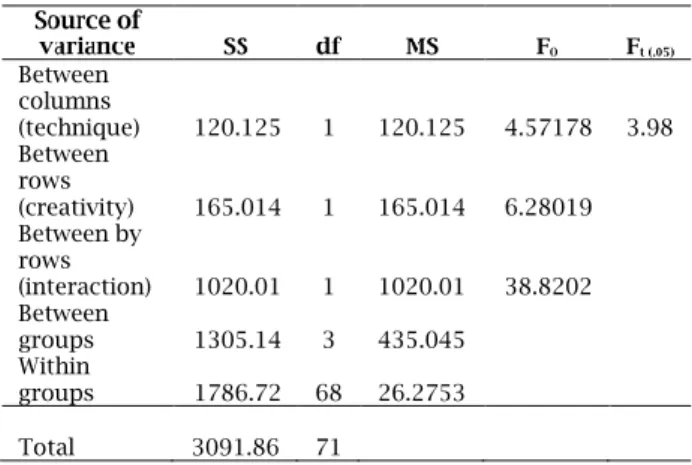
The data analysis is conducted by using Multifactor Analysis of Variance (ANOVA) 2x2. The null hypothesis (H0) is rejected if F0
is higher than Ft (F0 > Ft). It means that there is a significant effect of two independent
variables to dependent variable. After knowing that the null hypothesis (H0) is rejected,
the analysis is continued by performing the comparison of the mean between cells to see where the significant difference is using Tukey Test. To know which group is better, the means between cells are compared. The 2 x 2 ANOVA and Tukey test are listed in table 3.
Table 3 2 x 2 Multifactor Analysis of Variance
Between columns
(technique) 120.125 1 120.125 4.57178 3.98 Between
rows
(creativity) 165.014 1 165.014 6.28019 Between by
rows
(interaction) 1020.01 1 1020.01 38.8202 Between
groups 1305.14 3 435.045
Within
groups 1786.72 68 26.2753
Total 3091.86 71
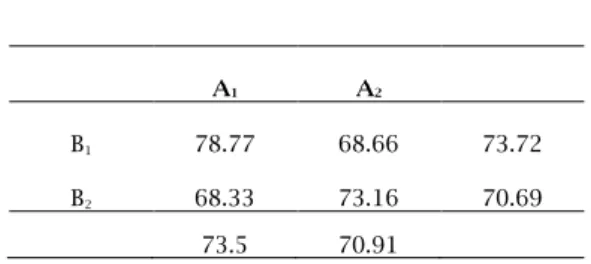
The result of mean score is presented in Table 4.
8 A2B2 0.19 0.2 Lo< Lt Normal
A1B1 17 0.0588 19.947 1.2998 22.0981
A1B2 17 0.0588 47.947 1.6807 28.5730
A2B1 17 0.0588 19.411 1.2880 21.8971
A2B2 17 0.0588 17.794 1.2502 21.2547
Sum 93.823
Table 4 Mean Scores
B1 78.77 68.66 73.72
B2 68.33 73.16 70.69
73.5 70.91
In conclusion, the computation result of ANOVA Test are (1) Because F0 (4.57) is
higher than Ft at the level of significant α = 0.05 (3.98), H0 is rejected and the difference
between columns is significant. It can be summarized that Four Square Writing to teach writing at the second grade students of a senior high school differs significantly from Guided Writing. In addition, the mean score of students who are taught using Four Square Writing (73.5) is higher than that of those who are taught using Guided Writing (70.91). It can summarized that teaching writing using Four Square Writing is more effective than Guided Writing; (2) Because F0 (6.28) is higher than Ft at the level of
significance α = 0.05 (3.98), H0 is rejected and the difference between rows is significant.
In conclusion, students having high creativity differ significantly from those who have low creativity. In addition, the mean score of students who have high creativity (73.72) is higher than that of those who have low creativity (70.69). In summary, the students having high creativity have better writing skill than those who have low creativity; and (3) Because F0 interaction (38.82) is higher than Ft at the level significant α = 0.05 (3.92),
H0 is rejected and there is interaction between the two variables, the teaching
techniques and students’ creativity to teach writing at the eleventh grade students of Senior High School.
The researcher continued analyzing the data using Tukey test. The results of analyzing the data using Tukey test are listed in Table 5.
Table 5 The Result of Tukey Test
Data Sample q0 qt Α Status
A1 - A2 36 3.02 2.86 0,05 Significant
B1 - B2 36 3.02 2.86 0.05 Significant
A1B1
-A2B1 18 8.36 2.97 0.05 Significant
A1B2
-A2B2 18 4.09 2.97 0.05 Significant
applying Four Square Writing differs significantly from Guided Writing to teach writing. Because the mean of A1 (73.5) is higher than A2 (70.91), it can be concluded that Four
Square Writing is more effective than Guided Writing to teach writing; (2) Because q0
between row (3.02) is higher than qt at the level of significance α = 0.05 (2.86), it can be
concluded that students who have high creativity and those who have low creativity are significantly different in their writing skill. Because the mean of B1 (73.72) is higher than
B2 (70.69), it can be concluded that the students who have high creativity have better
writing skill than those who have low creativity; (3) Because q0 between cells A1B1 and
A2B1 (8.36) is higher than qt at the level of significance α = 0.05 (2.97), applying Four
Square Writing differs significantly from Guided Writing for teaching writing to the students who have high creativity. Then, the mean of students who have high creativity or A1B1 (78.77) is higher than A1B2 (68.66). It can be concluded that applying Four
Square Writing is more effective than Guided Writing to teach writing for students who have high creativity; and (4) Because q0 between cells A1B2 and A2B2 (4.09) is higher than
qt at the level of significance α = 0.05 (2.97), applying Guided Writing differs
significantly from Four Square Writing for teaching writing to the students who have low creativity. Because the mean of A1B2 (68.33) is lower than A2B2 (73.16), it can be
concluded that Guided Writing is more effective than Four Square Writing for teaching writing to the students who have low creativity.
After knowing the findings of the research, a discussion is presented:
In summary, it can be said that Four Square Writing technique is the use of simple graphic organizer that assist the students in organizing and connecting their idea. It also helps the students to activate both their prior knowledge and vocabulary that can be used to explore their idea into a good writing.
Otherwise, Guided Writing technique is classical technique or teacher-centered that makes the students become passive. The teacher’s role is too dominant during writing class. The students do the guideline from the teacher. This technique includes interactive and modeled writing. Through this technique, the students are supported during every stage of writing process. The teacher will guide and monitor the students in creating their writing along the process of writing. Besides that, the teacher also helps the students to identify students’ strength and to make clear suggestions as to how they can make their text more effective. Principally, Guided Writing is different to Four Square Writing, in Four Square Writing the students can organize and connect their ideas independently but in Guided Writing, the students need assistance and guidance from the teacher during the writing class. As supported by Rog (2003: 9), Guided Writing provides support for students as they practice their skills and knowledge. In addition, the teacher plays an important role in helping students develop viable strategies for getting started, drafting, revising and editing (Silva in Lan, Hung, and Hsu, 2011: 149). Thus, Four Square Writing is more effective than Guided Writing to teach writing.
The students having high creativity have better writing skill than the students’ having low creativity. The students who have high creativity are indicated by high potential and willingness to produce something new and original. They also have responses and favorable personality traits. Then, they still struggle to find and explore their ideas. The students who have creativity are easy to generate imaginative and radical ideas. Consequently, the students who have high creativity work hard to achieve the product of their writing. They will try to express their own ideas without thinking about the risk. This goes in line with Barron in Sternberg (2010: 400), creative students have the ability to produce work that is both original and appropriate or useful. Furthermore, Higgs and McCarthy (2008: 116) state that creative students need to play, give critical judgment, and take risks.
cannot come up fresh idea in producing their writing. They like to get guidance and modeling from the teacher. Furthermore, the teacher should treat and control them intensively to enhance their creativity in learning writing. It is supported by with Chan and Chan (1999: 185) stating that students who have low creativity are usually conventional, timid, lack of confidence, and conforming. They often do not study seriously.
In line with the explanation above, it can be concluded that students having high creativity will be easy to connect, develop, and organize the ideas in the process of writing. They are actively participating teaching and learning process. On the contrary, the students having low creativity always need guidance from the teacher and cannot organize the idea in the process of writing. It makes significant difference between students having high creativity and students having low creativity. Thus, the students having high creativity have better writing skill than students having low creativity.
In Four Square Writing, the teaching and learning process centralizes more on the students, while teacher’s role is to observe students activity. Furthermore, Four Square Writing is students-centered technique. By using Four Square graphic organizer, the students are active, independent, and easy to develop their own ideas. Four Square Writing is cooperative learning technique in solution for the problems. The graphic organizer will help students to connect every idea in the square and increase the students’ vocabulary knowledge. Thus, they can develop their ideas into a good writing. Those statements are similar to Dye’s in Brunn (2002: 522) that Four Square Writing is a technique that its attributes are arranged in the graphic or spatial organizer. The teacher can lead the discussion of the words and concepts toward topics past and future and focus on the objectives for students learning.
Therefore, the students have strong desire to generate and explore their ideas. It is in line with Gould and Burke (2010: 5), using Four Square Writing tool can strengthen structure, which help with organization and memory. It is a map for ideas, words, phrases, and can be used for all language levels. Thus, the students with high creativity are appropriate to use Four Square Writing.
On the other hand, Guided Writing is more teacher-centered since the teacher has control over the teaching learning process. In Guided Writing the teacher provides situation and helps the students both oral and written assistance. The teacher will give the examples of the texts, guide the students to mention the generic structure of the text, ask them to brainstorm many ideas, write down on the white board, and give time to the students to compose paragraph. Furthermore, the students are dependent on the teacher’s guidance and they have little opportunity to develop their own ideas creatively. This statement similar to Kroll in Matsuda (2003: 20), Guided Writing includes any writing for which students are given assistance such as a model, to follow, a plan or outline to expand from, a partly-written version with indications of how to complete it.
Students having low creativity have different characteristics with creative students. The students having low creativity get difficulties in generating and expressing their ideas. They tend to be passive in joining the class. It is because they have little effort in doing the task given.
Consequently, they do not want to produce something new. The students will need the guidance and help during process of writing. This goes in line with Manktelow (2004: 9) stating that uncreative students do not think about creativity, and do not give themselves the opportunity to create anything new. Thus, students having low creativity do not want to create their own writing without guidance from the teacher. In this stage teacher’s role is very dominant. The teacher should guide, help, explain, model, and prompt the students during writing process. Those characteristics are similar with Guided Writing technique. Shortly, Guided Writing technique is suitable with the characteristic of low creativity students. It is in line with the result of this research that Guided Writing is more effective for the students having low creativity.
Based on the description of the data analysis, some findings are as follows: (1) The students who are taught using Four Square Writing have better writing skill than those who are using Guided Writing. In other words, the use of Four Square Writing is more effective than Guided Writing to teach writing to the eleventh grade students of a senior high school; (2) The students who have high level of creativity have better writing skill than those who have low level creativity for the eleventh grade students of a senior high school; and (3) There is an interaction between teaching techniques and creativity to teach writing. This can be seen from the finding of this research that the students who are taught by using Four Square Writing have better writing skill than those taught by using Guided Writing for the students who have high creativity. The students who are taught by using Guided Writing have better writing ability than those taught by using Four Square Writing for the students who have low creativity.
The result of the research implies that Four Square is an effective teaching technique for teaching writing especially narrative text to the eleventh grade students. It is proved from the research findings showing that the students who are taught by using Four Square Writing have better writing skill than those who are taught using Guided Writing. It can motivate students to write actively during the process of writing. Using Four Square Writing in teaching writing can help students to organize, connect, and develop their ideas. In Four Square Writing, the students use four square graphic organizer that can be used to generalize students’ ideas. It prepares students for prompt writing, and then the students can combine the best outline into a good writing.
In addition, Four Square Writing gives the appropriate ways on how to improve students’ writing skill. The step of Four Square Writing can be described as categorizing the relationship, the students will find out the topic. This prewriting stage provides multiple examples of the relationship practice. Students can be challenged to think of as many subtopics to an idea as possible. Then, labeling the topic sentence, after getting the idea in brainstorming activity, they write down the topic sentence in the middle of the square. Later, giving more detail and writing paragraph, in this step the students give main idea in every paragraph. Now, the student will simply transfer their idea into a paragraph. They will organize and develop their writing. Furthermore, the students make the summary and add connecting word. The students also recap the main idea and the ideas in three squares and add connecting words.
the problems; (3) Other researcher can use modified four square graphic in teaching writing.
Al-Oweide, A. (2013). Creative Characteristics and Its Relation to Achievement and School Type among Jordanian Students
, 29-34. doi: 10.4326/ce.2013.41004.
Amabile, Theresa M. (1996). Creativity and Innovation in Organization. . 9-396-239.1.
Aziz, Sawsan S. (2011). Analysis of Error in Pargraphing Writing in English by Second Year Geography and History Students at University of Baghdad
,22,2.
Bartholomae, M, Sekyra, S, & Sibigtroth, K. (2011). Retrieved from
http://www.d46.k12.IL.US/2011conference/pdf.454squarepresspdf. September 13 2013
Broitman, J & Davis, John. M. (Eds). (2013).
. New York: Springer.
Byrne, D. (1997). . New York: Longman.
Chan, D. W., & Chan, L. K. (1999). Implicit Theories of Creativity: Teacher’s Perception of Students Characteristics in Hong Kong.
Gould, Judith & Burkey, M., F. (2010). Four Square Writing Assessment. Dayton: Teaching & Learning Company.
Grundy, Peter. (1991).
. Cambridge: Cambridge University Press.
Hernowo. (2004). . Bandung: Mizan Learning Center.
Harsyaf, M. Y. Nurmaini & Izmi, Z.(2009). Jakarta: Depdiknas.
Higgins, L. F. (2002). Applying Principles of Creativity Management to Marketing Research Effort in High-Technology Markets. In Srfertzi, Eleni (Ed),
. Dissemination of Innovation and Knowledge Management Techniques.
Higgs, Bettle & McCarthy, Marian. (2008). .
Dublin: NAIRTL.
James, A. N., Allison. S. B., & McKenzie, C. Z. (2011). .
California: Corwin A SAGE Company.
Johnson, Burke & Christensen, Larry. (2000).
Kroll, Barbara. (2003). Cambridge: Cambridge University.
Langan, John. (2001). . New York: The McGraw-Hill Companies, Inc.
Macdonal, Andrew & Macdonal, Gina. (1996). . New Jersey:
Pretice Hall Regents.
Macceca, S. (2006). Huntington: Shell
Education.
Manktelow, James. (2004). Mind Tools: Essential Skills for an Excelent Carier. West Sussex: Minds Tolls Ltd.
Muhammad, Nadeem A, Sahibzada Shamim-ur-Rasool, & Raheel Haq. (2012). A Comparison of Creative Thinking Abilities of High and Low Achievers Secondary School Students Pakistan: Department of Education, University of Sargodha.
-2012,1,1.
Newel, A. & Shaw, J. C. (2000). The Process of Creative Thinking In Srfertzi, Eleni (Ed),
Creativity. . Dissemination of Innovation and Knowledge
Management Techniques.
Nunan, D. (2003). . New York: McGraw-Hill
Companies, Incorporated.
Ontario. (2005). .
Ontario: Ontario Education.
Primary National Strategy. (2007). Improving writing with a focus on Guided Writing. . 09, 00618-2007BKT-EN
Rog, Lori. (2003). . Canada: Stenhaouse Publisher.
Sarsani, M Reddy. (2005). . In Sarsani, M Reddy (Ed).
. New Delhi: Sarup & Sons
Simpson, Carol. (1998). . New York: Addison-Wesley Educational
Publisher, Inc.
Sternberg, Robert, J. (1999). . Cambridge: Cambridge University
Press.
Tompkins, G. E. (2006). . Pp.49-50. In
Wallace et al (ed), : Reading Horizon. V48.1
Tyner, B. (2004).
. In (pp. 1–16). Newark, DE: