A Thesis submitted to the faculty of the University of North Carolina in partial fulfillment of the require-ments of a degree with Honors in
Political Science.
2014
Approved by
_________________________________ Isaac Unah, Adviser
_________________________________ Virginia Gray
Table of Contents
I. Introduction...2
II. Review of the Literature...6
III. Theory...18
IV. Hypotheses...21
V. Data...23
VI. Analysis...31
VII. State Sovereignty and the Patient Protection and Affordable Care Act...42
VIII. Conclusion...46
I. Introduction
Since the ratification of the Constitution in 1788, the federal government, states, and individuals have continually challenged the delicate balance of authority between different levels of government in the United States. The frequent politically and judicially driven adjustment of this power distribution is evidence that our carefully crafted federalist system is subject to change. Though the United States Constitution does conceptually outline federalism and its application to some extent, the document “sorely lacks precision” in designating specific powers to the federal government and the states (Segal and Spaeth 1993, 17). Thus, complicated issues of federalism are largely left up to interactions between state and federal legislatures and, most importantly, the federal court system.
courts. More broadly, “state conduct was subject to judicial review.1” This landmark case’s impact was superseded less than two years later by the Eleventh Amendment, which granted states sovereign immunity from lawsuits brought against them by citizens of other states. The amendment’s failure to mention lawsuits brought by citizens against their own state became the subject of subsequent debate. As apparent in the early
constitutional history of American federalism, the extent of state sovereignty is not easily defined and has made for a complex legal narrative throughout our nation’s history.
The question of state sovereignty has only become more controversial with the passage of time. Since 2009, many states have passed or attempted to pass sovereignty resolutions that aim to draw an explicit line between the powers specifically allocated to Congress and those that rest with the states. Twenty-six state governments raised sovereignty claims against the Patient Protection and Affordable Care Act in National Federation of Independent Business v. Sebelius (2011). Recent state challenges to federal authority bring federalism to the forefront of political discussion. However, in light of sporadic shifts of the spotlight to and from discussions of state sovereignty, one wonders about the possibility of an overarching pattern in the story of United States federalism. As public attention wavers, does the nature of the American brand of federalism
transform before our eyes? The search for a paper trail to evidence a return of power to the states at the hands of our nation’s highest court leaves us with the following question: has the United States Supreme Court acted as a long-term agent of devolution?
Moreover, do the ideological preferences of justices explain variation in the activism of
the Court on questions of federalism?
The impact of Supreme Court decisions with respect to the development of federalism is of undeniable magnitude. The precise amount of sovereignty that is left to individual states is not simply determined by the behavior of elected officials and the success of legislation. To assume that Republican administrations or legislatures
necessarily devolve power to the states and vice versa would be to grossly underestimate the complexity of this volatile system of give-and-take. The absence of any explicit framework for federalism in the Constitution makes legislation that implicates the balance of power between the federal government and the states likely to incite dispute. In an attempt to examine the evolution of the federalist system as constructed by the Founders, it is thus logical to focus on the ultimate arbiter of Constitutional interpretation – the Supreme Court of the United States.
processes and citizens would become directly active in defining the federal-state balance. The Supreme Court is a frequent decider of federalism cases, and thus constitutes an important voice in defining American federalism. In this thesis, I aim to assess the overarching trends that characterized the Court’s involvement in the evolution of
federalism from the term of Chief Justice Earl Warren in 1954 to the era of John Roberts in 2008. The questions driving my research are as follows. Has the Supreme Court facilitated a slow but steady return of power to the states by a judicial avenue? If so, was it caused by the appointment of conservative justices? Are there any other actors that have played a role in this trend, such as interest groups or the executive branch?
likely to continue. My hope is that the research in this study may lead to further
examination not only of changes in the balance of power between state and federal bodies but also of their roots in the United States Supreme Court.
II. Review of the Literature
Federalism and Supreme Court Decision Making
Two distinct bodies of literature complete the context for this study. The first, on federalism, deals with the balance of power between state and federal levels of
government. The second, dealing with the Supreme Court and its behavior, introduces methods of studying the institution on which I plan to base my research, as well as existing philosophies explaining its behavior. Finally, even though federalism is an enduring part of the structure of American government, few scholars have attempted direct examination of the Supreme Court’s federalism decision-making.
The broader issue of state sovereignty and its evolution since the 1950s has been a topic of significant study by scholars. There is considerable evidence supporting the fact that major events and political conditions have affected the relationship between the federal government and the states (and the perception thereof). I hope that my research on state sovereignty and its evolution by way of Supreme Court decisions will
question of whether Supreme Court decisions have measurably facilitated devolution, or whether apparent shifts in the balance of federalism have been exaggerated with little legal basis.
The 1960s marked the beginning of federalism research in the modern era. Daniel J. Elazar’s contributions to the field are widely considered to provide the most thorough overview of American federalism, especially in its mid-twentieth century state. Elazar’s identification of, first, “an expansion of the federal government’s role,” and more
broadly, “structural changes” in cooperation between the states and the federal government marked the beginning of modern federalism research (1966, 85).
from a conservative Supreme Court. The perception of a federal consolidation of power may have backfired, as states have filed and won claims of sovereignty. I expect to find that the Supreme Court has increasingly acted as a check on federal supremacy since the second half of the twenty-first century.
Without doubt the most visible manifestation of state sovereignty issues in popular politics in the 1990s was the “Devolution Revolution” proposed by the 103rd United States Congress during the Clinton administration in 1994. Newly elected and incumbent members of the Senate and the House of Representatives announced a plan to return power from the federal government to the states in an effort to cultivate efficiency and reduce the size of the federal government. Chung-Lae Cho and Deil S. Wright (2001), in a series of articles, have attempted to measure the success of devolution by examining state administrators’ perceptions of federal regulations. This led to the conclusion that state administrators perceived a decrease in the use of coercive2 federal measures toward state compliance accompanied by the rise of a more cooperative3 working relationship (Cho and Wright 2001). Using American State Administrator’s Project (ASAP) data collected in 2004 and 2008, Cho and Wright found that during this span of four years, perceptions of federal control did change slightly. However, the results of the study were not quite conclusive enough to confirm that a true “devolution revolution” took place. The scholars believe that this misnomer is better replaced by the word “evolution” (Cho and Wright 2001, 57).
Federalism research provides some evidence that the “Devolution Revolution” did 2 The term “coercive federalism” refers to the use of fiscal tools and regulations to ensure state obedience to federal policy and to assert national supremacy (Kincaid 1990)
result in small steps away from coercive federalism and some return of power to the states. Cho and Wright gave little attention to the judicial dimension of devolution, so it is probably premature to conclude that the revolution did not happen at all. I hope to examine this trend in legal terms rather than simply in terms of perception, and to further investigate the success of devolution through the rulings of federal courts. Cho and Wright’s findings provide an excellent opening for my own research, as their conclusions imply that the changes I expect to see such as a movement away from coercive
federalism and stronger power sharing arrangement did take place. My objective, then, is to examine the role of the Supreme Court in bringing those changes to fruition.
Furthermore, I hope to demonstrate that the devolution trend is by no means a
phenomenon limited to the 1990s. I argue that it has been a continuous legal reality since the Warren Court era.
Some studies have bridged the gap between federalism and the behavior of the United States Supreme Court. Scholars have done so by examining how the activities of individual justices and their known ideologies inform their judgment in federalism cases. Lindquist and Solberg (2007) measured the ideological responses of justices to cases challenging state statutes. The study found that conservative justices on the Rehnquist court were significantly more likely to uphold a state statute and to strike a federal one. They concluded that “justices’ voting behavior in cases involving judicial review is the product of a nuanced process that is strongly governed by the justices’ policy
preferences” (Lindquist and Solberg 2007, 88). The implication is this: “...the
counterparts in the case of federal legislation.” (Lindquist and Solberg 2007, 84). No such relationship was observed on the Burger court, possibly suggesting an increased influence of ideological preference on justice voting or an increased visibility of the trend in later years. The pattern identified in the Rehnquist court speaks to the theory that the
conservative courts may have been more likely to facilitate a constant process of devolution throughout their tenures. My aim is to extend these observations to identify this pattern as a consistent trend since the beginning of the Burger Court. By the same logic, the more liberal Warren court would have upheld federal supremacy more often than the subsequent Courts. I aim to test this conjecture.
My research centers on a few particular schools of thought about the Supreme Court’s behavior and how it operates. The first, known as the legal model, argues that the Court operates within the boundaries of judicial precedent and law, basing its
an increasing set of legal boundaries, affecting the outcome of future cases. Of course, there is always room for reversal, which must be accounted for. Though legal precedent may guide the Court’s decisions, it does not concretely bind them.
The idea that the law is never entirely clear and always provides the opportunity for justices to exercise discretion has led to another model emphasizing the importance of individual justice ideologies. The attitudinal model, popular among legal realists, argues that justices may decide cases entirely according to their own preexisting policy
preferences as they relate to case facts (Segal and Spaeth 1993). The model suggests that no study of the Supreme Court would be complete without careful analysis of justice ideologies, as they have a profound impact on all decisions. Granted, this philosophy allows only a very narrow and insignificant role for precedent and law in Supreme Court decision-making. As discussed in the “Theory” section, the attitudinal model is primarily responsible for my conjecture that the Court has enhanced devolution since 1969. I do not go so far as to entirely rule out the influence of law and precedent on federalism. However, I do expect to find a significant correlation between justice ideologies and the Supreme Court’s decisions regarding federalism.
participation in a case on the outcome. If the strategic model holds true for the
federalism cases in my analysis, the results will show that the justices respond positively to the Solicitor General’s position, representing a powerful hand of the executive branch.
Many scholars have attempted to tease out the specific factors that account for justices’ voting behavior according to the aforementioned models. Though some disagree, a popular belief is that the best predictions of the Court’s decision-making tendencies come from an “integrated” model of judicial decision making. In a study that serves as the backbone of much of todays Supreme Court decision-making research, George and Epstein (1992) compared the performance of legal and extralegal4 models. They found that the most complete and best performing model included a combination of both legal and extralegal factors (George and Epstein 1992). In simpler terms, all of the prevalent models should all be taken into account in examinations of the factors that influence Supreme Court decisions. In my own analysis, I include a variety of different factors rather than relying on a single model to explain the Court’s decisions in
federalism cases.
Several recent studies have built upon existing knowledge of the federal
judiciary’s behavior to create useful frameworks for the study of federalism as an issue present in many of the Supreme Court’s decisions. A study by Richard C. Kearney and Reginald S. Sheehan (1992) was among the first to address the issue of federalism in judicial literature. The study examined cases in which state and local governments appeared as litigants, and found interesting results with regard to the effect of ideology on
decision making. Most notably, the research led to the conclusion that the Court’s federalism decision tendencies were very different between courts, especially the liberal Warren court and the conservative Burger and Rehnquist courts. My research expands upon these findings, as I further examine these changes across Court terms, specifically from the perspective of ideological changes as a result of appointments.
Another major step towards federalism gap in Supreme Court research can be found in the work of Paul Collins (2007), who estimated a logistic regression model that successfully predicted about seventy percent of outcomes of all federalism decisions. The motivation for the study was an attempt to take on the issue of federalism decision-making, which had previously been seen as “inconsistent and bewildering” by most scholars (Collins 2007, 524). I have updated Collins’ federalism and amicus curiae datasets for use in this study, as many of the variables in the 2007 model produced significant results and are thus relevant to my research. Collins focused primarily on individual justice data. He found interesting associations between the outcome of decisions and case salience, organized interests, institutional activity, and, most
importantly, the ideological preferences of each justice (Collins 2007). I expect that my own research will prove that the aggregate ideology of all justices has a similar effect on the Court’s decisions.
Supplemental Concepts
some cases is participation by interest groups in the form of amicus curiae briefs and test cases. Kearney and Merrill (2000) discuss the merit of the interest group model, which argues that “justices will seek to resolve cases in accordance with the desires of organized groups” (Kearney and Merrill 2000, 782). The most direct way for interest groups to reach the justices and make their arguments known is through briefs of amicus curiae urging a decision in one direction or the other. The interest group model contends that the best organized interest groups are more likely to influence the decisions of justices, and furthermore that the justices actually try to accommodate the most compelling groups, perhaps in an attempt to protect their reputation or the prestige of the Court as a whole (Kearney and Merrill 2000, 784). Using benchmark win probabilities as compared to new probabilities when amici are filed, Kearney and Merrill found no significant difference from the benchmark over the entire span of their study5. However, they did find that during certain time periods, particularly from 1956 to 1965, the effect of amicus briefs did seem to bring about a considerable increase6 in success from the benchmark rate. With this variability over time in mind, I plan to conduct divide my analysis by chief justice in order to observe the effect of interest groups on federalism decisions.
In addition to interest groups, an additional player has proven some power to influence Supreme Court decisions. The United States Solicitor General, dubbed the “Tenth Justice” (Bailey, Kamoie, and Maltzman 2005), has considerable experience before the Court and occupies a special position as an agent of the court. These inherent qualities may account for the finding that justices respond positively to Solicitor General
advocacy more often than not7. Kevin T. McGuire (1998) concluded that the lawyer’s litigation experience plays a significant role in increasing a party’s success. The importance of litigation experience may be partially responsible for the Solicitor
General’s influence on the Court. However, the Solicitor General’s role in affecting the outcomes of Supreme Court decisions has been linked to more political factors as well. Bailey, Kamoie, and Maltzman (2005) concluded that the Solicitor General’s effect is amplified when his ideological tendencies are in agreement with the ideology of the justice. These findings concur with McGuire’s (1998) analysis, in which the success of Republican and Democratic Solicitors General during the Burger Court were measured separately. The conservative Burger Court was more responsive to the position of Solicitors General from Republican administrations than Democratic ones, indicating that the Court is more likely to take the Solicitor General’s position into account when the administration is ideologically similar to the justices (McGuire 1998). Additionally, the Solicitor General’s stance seems to be more meaningful when it contradicts his own general ideology (Bailey et. al. 2005). These findings speak to possible interplay
between different models of Supreme Court decision-making. While the strategic model may account for the overall influence of the Solicitor General due to his experience and office, it is the attitudinal model that can be used to explain magnified influence due to the presence of ideological proximity.
Finally, a few studies have aimed to analyze the effect of leadership on Supreme Court decisions. It is possible that the Chief Justice acts as much more than a justice figurehead for the Court. During the tenure of Chief Justice Earl Warren, for example,
the Court was known for liberal decisions that emphasized the protection of individual rights. Was this simply a function of a liberal political environment and a court
comprised by more left-leaning justices, or did Warren’s leadership influence the Court’s decision-making patterns? Some study of Supreme Court leadership has incorporated quantitative analysis. Stacia L. Haynie (1992) conducted a time-series analysis separated by chief justice, and concluded that strong leadership may have an influence on
concurrence. The Hughes, Stone, and Warren Courts all showed significantly greater numbers of concurring opinions than the average across all courts. Haynie concedes that leadership may not be the only factor contributing to this effect and that further study is necessary.
Discussion of leadership on the Court has pointed to federalism cases as evidence, especially during the Warren Court. Abe Fortas (1975) argues that Warren’s strong leadership made him “more than one among the justices” (Fortas 1975, 406). His attitude acted as a constant reminder to the other justices of fairness to each and every citizen. His careful selection of opinion writers ensured that each opinion of the Court would have a powerful impact on legal precedent. Despite a lack of quantitative evidence, Fortas’s argument is made quite compelling by way of his discussion of key cases during the Warren era. Among those were decisions that focused on state law and procedure. In such cases, the Court consistently upheld the rights of individuals, especially minorities, in the face of oppressive state policies (Fortas 1975, 410).
An additional goal of my research is to discuss the recent attempts by many states to reassert their sovereignty through state sovereignty resolutions and other legislative measures. The reaction to the Patient Protection and Affordable Care Act provoked many such responses, including a bill passed by the state of Virginia. In anticipation of the Patient Protection and Affordable Care Act (PPACA) and the individual mandate, the State of Virginia passed the Virginia Health Care Freedom Act (HCFA), stating that no resident of the state should be required to obtain an individual insurance policy
(Cuccinelli, Getchell, and Russell 2012). Due to the collision of HCFA and PPACA, Virginia filed suit on March 23, 2010, claiming sovereign injury. The United States Court of Appeals for the Fourth Circuit rejected Virginia’s standing to challenge the PPACA in federal court (Cuccinelli et al, 2012).
Through an examination of State Sovereign Standing in the context of landmark cases, some scholars have concluded that Virginia should, in fact, possess sovereign standing in defending its law (Cuccinelli et al 2012). Others have disagreed, citing case based evidence. In later sections, I discuss the facts, legal nuances, and implications of the Affordable Care Act cases on federalism, a dimension to which many were blind during heated debate over the healthcare content of the legislation. Independent of opinions about the validity of the ultimate decision, these cases made it clear that
federalism was certainly a topic of discussion, and furthermore that the Supreme Court’s decisions shape the outcome for relations between states and the federal government. My research speaks to this idea that Supreme Court holds the ultimate authority to alter the balance of federalism.
research, outlining previous developments in the study of federalism as well as
highlighting the Supreme Court as a major influence on the balance of authority between states and the federal government. I hope that further study of these trends and expansion upon these works will help to identify the existence of a long-term trend of devolution and suggest its causes.
III. Theory
In this thesis, I examine the changing dynamic of relations between states and the federal government in a legal context. My project aims to illustrate a defining trend that has led to the current state of federalism in the United States. I argue that the Supreme Court is responsible for altering the balance of power due to aggregate ideological preferences among justices. Most simply, my belief is that Supreme Court decisions have facilitated a slow but steady process of devolution to the states during the years of the Burger, Rehnquist, and Roberts courts.
The theory behind this conjecture is as follows. We can expect the Supreme Court to advocate devolution more consistently when its overall ideology is more conservative. In other words, conservative administrations lead to the appointment of more conservative justices, who in turn favor a return of policy power to the states. Thus, an increase in the tendency of the Court to rule in favor of state claims can be explained, at least in part, by the fact that due to the timing of retirement or death of the justices over the past several decades, Republican administrations have had the
The idea that conservative justices are more likely to vote in favor of states draws upon established philosophies about federalism, particularly the attitudinal model. This model argues that justices base their decision-making first and foremost upon their personal ideological preferences and values. State sovereignty as a concept has received overwhelming support from conservatives, who by definition idealize a limited role for the federal government. The past five decades have seen numerous conservative justices appointed by Republican presidents, resulting in conservative majorities on the Court and a series of conservative chief justices. Thus, it is reasonable to hypothesize that the Burger, Rehnquist, and Roberts Courts tended (and continue) to uphold state claims in federalism cases at a higher rate than the more liberal Warren Court that preceded them. I expect my research to reveal the extent to which this discrepancy caused a marked change in the behavior of the Court in 1969 with the appointment of Chief Justice Warren Burger.
I do not disregard the legal model, which emphasizes the impact of precedential and legal boundaries. I believe that legal precedent does have some effect on Supreme Court decisions as it separates the Court’s operation from legislative and executive bodies. This reality speaks to the broader relevance of my study, as the trend I plan to observe has legal implications for future federalism cases. However, federalism is an area that is traditionally divided along well-defined ideological lines. Furthermore, most of the cases in my analysis are orally argued cases with formal written opinions,
explanation for the devolution trend.
In order to support the hypothesis that justice ideology is, at least in part, responsible for the Supreme Court’s facilitation of devolution, I will compare the
tendency of the more liberal Warren court to decide in favor of state claims to that of the Burger, Rehnquist, and Roberts courts. I expect to find that the Warren Court was less likely to uphold state claims than the subsequent, more conservative courts. This
conclusion will support the hypothesis that ideology on the Supreme Court has driven the trend of devolution that I expect to observe.
IV. Hypotheses
Hypothesis I: Since the 1950s, the Supreme Court has increasingly decided
federalism cases in favor of devolution.
The first hypothesis examines the overarching theory that the Supreme Court has increasingly acted as an agent of devolution since the middle of the 20th century. From the liberal Warren Court to the current Roberts Court, the Supreme Court’s tendency to rule in favor of states has increased. This hypothesis makes no inference about the state win percentage in itself (e.g. that the Court rules in favor of state sovereignty more often than not, etc.); it simply predicts that the state win percentage, whatever it may be, has risen. The following hypotheses aim to provide a closer look at possible explanations of this phenomenon.
Hypothesis II: Conservative Courts are more likely to decide in favor of states than
liberal Courts.
should observe a direct correlation between Court ideology and the direction of federalism decisions.
A thorough test of this hypothesis will account for the possibility that leadership plays a role in the ideological influence on the Court’s federalism decisions. The Chief Justice’s role in assigning briefs and acting as the face of the Court can, if used
effectively, encourage justices to act a certain way. The strategic model of judicial decision-making argues that justices act with consideration of how other actors will behave (Fortas 1975). This theory can be applied to any actor, from the general public to the President. For the purposes of this hypothesis, it is both feasible and necessary to measure how justices respond to the Chief’s leadership in the context of federalism cases.
As discussed in the literature review section, previous studies have concluded that justices tend to rely more on their personal preferences in more salient cases. In
examining the attitudinal model’s application to federalism cases, I include a salience variable based on New York Times coverage.
Hypothesis III: Amicus curiae activity including briefs by the Solicitor General has
a direct effect on the Court’s tendency to decide federalism cases in favor of states.
ideologies, comprise my explanation for a trend towards Supreme Court decisions favoring devolution.
V. Data
Datasets
My research draws upon one data source in particular, which I have supplemented with additional variables relevant to my own research. Paul Collins’ U.S. Supreme Court Amicus Curiae Dataset is an updated version of the Spaeth database and contains a complete record of all amicus curiae briefs filed for petitioners, respondents, and others from 1946 to 2001. The record includes details about each brief including the
participating group as well as the ideology it advocates. These data will provide important information about the activity of interest groups in federalism cases, a factor for which I will control in my study. Since the dataset has only compiled data up to the year 2001, I have completed the dataset with all available data up to the 2012 term8.
Case Selection
as the fourteenth Chief Justice of the United States. My reasoning in choosing this starting date is as follows. I plan to organize my research to correspond to the tenures of each successive Court so as to observe changes that occurred not simply across time, but also across changes in the Chief and aggregate ideologies on the Court. I expect the most notable of these shifts to occur surrounding the 1969 termination of the Warren Court and the appointment of Chief Justice W.E. Burger by President Richard Nixon. For some of the most recent cases, some information is not yet available, including the New York Times salience measure (NYT). Variable descriptions and the analysis section include notes of time-related limitations on specific portions of the analysis.
Past studies of the Supreme Court’s activity in federalism cases have employed a wide variety of criteria for case selection. Some include only cases in which state or local governments appear as litigants (Kearney and Sheehan 1992), while others have included those cases in which the word federalism can be found in the opinion (Cross and Tiller 2000), among other highly specific selection methods. Collins (2007) aimed to include a broader spectrum of relevant cases using a more complex three-prong framework to include many of the aforementioned criteria along with additional cases selected through closer examination of each decision. This strategy resulted in the inclusion of considerably more cases than previous studies.
only those cases that Spaeth’s Supreme Court Database classifies under federalism issue variables (issue 100010-100130). As I aim to study the Court’s activity in federalism cases, I believe it is best for my purposes only to include those cases in which federalism is the primary issue of discussion. In such cases, the justices are aware of their decisions’ implications for federalism and in turn, their decisions’ proximity to their own
ideological preferences specifically with respect to federalism. In addition, these cases tend to be those with the most substantial implications for the balance of state-federal relations.
Cases are listed according to their citations. For the most recent cases, U.S. citations are not listed as they have not yet been published. Basic case information including argument and decision dates (oral, reoral, dec) as well as parties to the case (party_1, party_2) and the law in question (law) were recorded to facilitate the location of cases based on specific facts and allow for the observation of relevant case information within the dataset.
Dependent Variable
measured on a 0-1 scale, in which a value of 1 represents a victory for the state and a value of 0 represents a loss for the state. I compiled observations for these data for all years from 1954 to 2012 by reading Court opinions on each case from the U.S. Reports to determine whether the state, or the party best representing interests of state sovereignty, won the case. My hypothesis with regard to state win tendencies is as follows. Since the end of the Warren Court, the Supreme Court has increasingly ruled in favor of state sovereignty interests. The conservative shift in the Court’s composition makes this hypothesis intuitive. In the following pages, I investigate the extent to which this trend can be measured, and other factors that may be responsible for altering the Court’s decision-making tendencies in federalism cases.
Independent Variables
For the purpose of determining the effect of justice ideology on federalism decisions, I chose from a variety of available measures of justice ideology. To test Hypothesis II9, I employed the Martin and Quinn ideology scores for the median justice on the Court at the time the case was decided. Ideology data on each justice is drawn from the Martin and Quinn ideology datasets. The measure, developed by Andrew D. Martin and Kevin M. Quinn (2002), uses a dynamic item response theory model to estimate changes in judicial ideology over time, where higher values represent more conservative ideology. For this study, I have chosen to use the ideological score of the median justice for each case, which I believe to be an appropriate measure due to the fact
that he or she represents the deciding vote in ideologically polarized cases. I expect that this variable will exhibit a significant positive correlation with a value of 1 for the state win variable. In simpler terms, the court should naturally be more likely to rule in favor of the state when its overall ideology is more conservative, as state sovereignty is generally accepted as a politically conservative principle.
The model also examines the effect of interest group activity on the Court in federalism cases. To create a usable measure of interest group participation, I referenced Paul Collins’ (2008) U.S. Supreme Court Amicus Curiae Database. The data were compiled primarily by Joseph D. Kearney and Thomas W. Merrill (2000) for years up to 1995, and by Collins for years from 1995 to 2001. I updated the dataset for years up to 2008 using the first footnote of the U.S. Reports opinions. After recording the total number of amicus curiae briefs filed for the petitioner and respondent in each case, I determined which party represented the state. I then re-transcribed the data into new variables by recording the total number of amicus curiae briefs supporting and opposing the state. Finally, I subtracted the number of opposing briefs from the number of
supporting briefs to come up with a difference, recorded as the Amicus Curiae Difference variable. While I acknowledge that the number of briefs is not necessarily the deciding factor in swaying the court, it is not plausible to measure the quality and legal
may cause the variable to lose significance, as in some cases fifty or more briefs are filed on behalf of one party but all are quite similar in content.
A variable describing the United States Solicitor General’s activity in each case are included to test the Court’s responsiveness to the executive branch’s preferences in federalism cases. My hypothesis is that the Court is more likely to rule in favor of the state when the Solicitor Generals amicus curiae brief (or testimony) urges support of the state’s claim. If this is true, it indicates that the Supreme Court is indeed responsive to the executive branch’s interests. The strategic model of judicial decision-making suggests that justices make decisions to some extent based on how they expect other actors to behave (Bergara, Richman, and Spiller 2003). If the Court is at all concerned about enforcement or a close relationship with the executive branch, and if this concern plays a role in federalism decisions, the data should reflect a positive relationship between Solicitor General support and state win tendencies. The Solicitor General State Amicus (sgstateac) represents cases in which the Solicitor General filed a brief on behalf of the state. The data for this variable were recorded from the Collins (2008) dataset, and updated to 2008 using information from the U.S. Reports Opinions. A value of 0
represents the absence of a brief in favor of the state10, while a value of 1 represents a brief in favor of the state. I expect states to have a greater winning percentage in those cases in which this variable exhibits a value of 1, and vice-versa.
I have also chosen to examine the potential effect of general public opinion on the outcomes of federalism cases. This factor is included in the model as the Policy Mood variable, developed by James A. Stimson (1991). Policy Mood measures public opinion
on a variety of issues over time using data from survey questions. Greater numbers represent more liberal overall public opinion, while smaller ones represent more
conservative public opinion. While this variable does not constitute a major goal of my analysis, one can logically expect that it will have a negative effect on the outcome of decisions. In other words, when general public opinion is more liberal, states should have more difficulty in federalism cases provided that Supreme Court justices pay attention and respond to the general political mood of United States citizens.
As an additional measure of ideology, I have included a measure of state
government’s ideology. The purpose of this variable is to determine whether the Court is more likely to rule in favor of a state that tends to lean towards the court’s ideological median. I chose to use state government ideology in my analysis rather than state citizen ideology, because government ideology serves as a better indicator of the actual direction of state policy. A measure for this variable was taken from the Berry, Ringquist,
Fording, and Hanson (1998) State Ideology Dataset. The measure is an aggregated score combining policy direction of the governor, and size of each of the two major parties in each chamber of the state legislature. It is recorded by state and by year, and greater numbers represent a higher level of state government liberalism. For each case, I recorded the government ideology measure for the state involved in that particular case, for that particular year. It is somewhat logical to expect that a more liberal state is more likely to win a federalism case in the Supreme Court, due to the fact that the policy stance might receive support from not only the most conservative justices on the court.
Finally, the model measures the influence of case salience as described by the New York Times variable. Observations for this measure were recorded from the Supreme Court Compendium. The New York Times variable is coded 1 for a case that appeared on the front page of the New York Times, and 0 for a case that did not. I have no particular expectation for the direction of more salient cases, but I believe that salience is an important characteristic to measure. Earlier studies have found that the salience of a case may affect the justices’ thought processes and response to other factors. For
example, Unah and Hancock (2006) argue that case salience increases the applicability of the attitudinal model, as justice increase their tendency to vote according to their political ideologies in highly salient cases.
The “chief” variable will serve as a tool for categorically organizing cases and viewing state win percentages during each court for a general overview of discrepancies. In this way, it will be used to examine the effect of leadership on the Court. In other words, I expect that cases decided under chief justice Burger, for example, will exhibit more positive outcomes for states than those decided under Warren’s tenure. More complete reasoning behind this conjecture is explained in the theory section. The chief variable was recorded from case information in the Spaeth database. Values for the chief variable are as follows: 1 for Warren, 2 for Burger, 3 for Rehnquist, 4 for Roberts.
Control Variables
no specific expectations for the direction of this variable, nor do I believe that it will have a significant influence on the outcome of decisions.
VI. Analysis
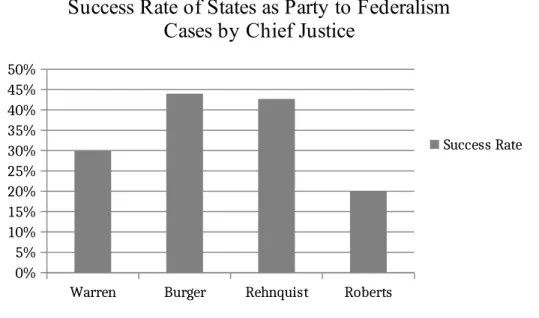
I begin my analysis with an examination of the overall winning percentage of states across Chief Justice tenures. Hypothesis I, which predicts that the Court has increasingly ruled in favor of states, suggests that the overall success rate of states should increase over time. Furthermore, Hypothesis II which states that conservative justices are more likely to vote in favor of states, leads me to expect that this percentage should be considerably higher under conservative Chief Justices Burger and Rehnquist than under the liberal Chief Justice Warren. Table 1 below shows data from the United States Supreme Court Compendium describing the success of states11 as party to a federalism case across the Warren, Burger, Rehnquist, and Roberts12 courts. These data13 suggest that, in a manner consistent with my hypotheses, the Supreme Court decided federalism cases in favor of the state more frequently under the tenure of a conservative Chief Justice than that of a liberal one. The liberal Court of Chief Justice Earl Warren awarded states only a 30% success rate, while state success improved considerably during the Burger and Rehnquist Courts, at 44% and 42.7%, respectively.14
11 State success rates in this table differ slightly from those estimated by the model to follow, due to slightly different case selection methods employed in the Compendium.
12 Data for the Roberts Court is recorded for terms through 2009 only.
13 The data do not include all federalism cases decided by the Supreme Court during the tenure of each Chief Justice. The table and chart encompass only those cases to which a state government was either the petitioner or the respondent.
Table 1
Success Rate of States as Party to Federalism Cases by Chief Justice
Chief Justice Year Percent Success Number of Cases
Warren 1953-1969 30 10
Burger 1969-1986 44 36
Rehnquist 1986-2005 42.7 19
Roberts 2005-2008 20 5
Figure 1 below presents a visual comparison of the data above, showing a clear increase from the liberal Warren Court to the subsequent conservative courts in state winning percentage.
Figure 1
Warren Burger Rehnquist Roberts 0%
5% 10% 15% 20% 25% 30% 35% 40% 45% 50%
Success Rate of States as Party to Federalism
Cases by Chief Justice
Success Rate
Hypothesis I. However, the winning percentage of states decreased very slightly from the Burger to the Rehnquist Court, suggesting that Hypothesis I overlooks a variety of factors besides simply chronology that have affected the Court’s behavior with respect to federalism. 2008 is the terminal year for the data shown in chart, meaning that the Roberts Court state win percentage is based on only five cases. I suspect that all else equal, a similar conservative tendency to uphold state claims more frequently will emerge in the Roberts Court over time. There are several potential explanations for these
outcomes. First, and most simply, the aggregate ideology of justices on the Supreme Court may have been directly responsible for increasingly conservative decisions in favor of states. Alternatively, the leadership of a particular Chief Justice may have caused his ideology to have more of an influence on federalism decisions than other justices. Another possible explanation could be that the political environment at the time contributed to certain attitudes toward states that contributed to the above patterns. Finally, the varying percentages may have been the result of other factors entirely. I will use a logistic regression analysis to isolate the specific factors that caused states to fare better during the conservative courts.
Table 2 below shows the results of a logistic regression model describing the effect of the aforementioned independent variables on the success of states before the Supreme Court between the years 1953 and 200815.
Table 2
Logistic Regression Estimates for State Success in Federalism Cases
(1954-2008)Variable B SE Exp(B)
Lower Court Direction -.386 .270 .680
Solicitor General 1.028 .296 2.794***
Total Amici Difference -.019 .016 .981
Polarization .189 .110 1.208**
Martin & Quinn Ideology Salience
State Government Ideology Policy Mood .576 .801 .000 -.029 .328 .440 .007 .039 1.779** 2.228** 1.000 .971
Number of Cases: 251
Mean of Dependent Variable: 57.9% Percent Categorized Correctly: 67.8% Reduction in Error: 17.1%
* = significant at .10 ** = significant at .05 *** = significant at .01
The above regression model performs considerably better than the null model, raising the prediction accuracy from 57.9% to 67.8% and reducing overall error by 17.1%. This increase in correct categorization indicates that we can make some sense of notoriously unpredictable federalism cases. The model shows several interesting results regarding the included variables and their effects on state winning percentages. As hypothesized, ideology does seem to play a role in the deciding of federalism cases. The effect of the Solicitor General as amicus curiae is clearly the most substantial in the model, and salience and polarization seem to have some power to determine case outcomes as well.
for the median justice, should be associated with a greater likelihood of state victory. The regression results are in agreement with this expectation. All else equal, the odds are 1.779 times higher that states would succeed as the court became more conservative. These findings illustrate the effect of justice ideology on the Supreme Court’s federalism decisions as decisions in favor of devolution are widely considered to represent a
conservative ideological position.
The variable measuring whether the United States Solicitor General filed an amicus brief in support of the state16 measures the influence of the executive branch on the Court’s federalism decisions. The odds ratio, significant at the .01 level, indicates that the odds that the Supreme Court will decide a case in favor of the state are 2.794 times greater if the Solicitor General has filed a brief of amicus curiae in support of the state party. Thus, the Court seems to be quite responsive to the preferences of the executive branch, supporting Hypothesis III. This conclusion attests to the power of institutional constraints as suggested in the strategic model. The analysis indicates that the justices are constrained by the position of the Solicitor General.
The polarization variable, significant at the .05 level, was constructed to measure trends associated with a highly polarized court in federalism cases. I did not have any specific prediction for the direction of the effect of this variable. However, the regression suggests that in the odds that the Supreme Court will rule in favor of the state are 1.208 times greater in a case of high polarization17 than in a minimally18 polarized court. The
16 The Solicitor General amicus variable includes only those cases in which the Solicitor General’s office filed a brief of amicus curiae, not those to which the Solicitor General was party.
effect of this variable indicates that more disagreement in federalism cases is loosely associated with a greater success rate for states.
The New York Times measure was included in an attempt to examine the effect of case salience on the direction of decisions. According to the outcome of the analysis, a state party to a case that appeared on the front page of the New York Times had 2.228 times greater odds of success than a state whose case did not appear on the newspaper’s front page. This conclusion indicates that highly salient cases tend to result in more state victories. Though this trend is not as simple to understand, it might be explained by the influence of public sentiment on justices’ actions, or justices’ desire to influence the outcomes of high salience cases. Since justices seem to act somewhat according to their ideological preferences, the analysis divided by Chief Justice may prove more interesting to this effect.
State government ideology did not reach significance in the model, and the odds of a state victory were nearly identical under a conservative versus a liberal state
The policy mood variable was also insignificant, indicating that the justices may not respond directly to general perceived public opinion when deciding federalism cases. Alternatively, and perhaps more likely, general public opinion and policy mood is not usually driven by federalism issues. Much of the evolution of federalism has occurred without much attention from the public. Even at times when state sovereignty issues do rise to political relevance, there are many other salient issues that determine policy mood in the United States. For example, while Republicans in Congress attempted to achieve “devolution revolution” in the 1990s, the United States was also involved in Gulf War peace negotiations, leading NATO in Kosovo, and the setup and implementation of the North American Free Trade Agreement, which undoubtedly received considerable attention from the American public.
the model. This does not mean that amicus curiae briefs have no influence on the court, but rather that this influence cannot be measured simply in terms of numbers.
The control variable for the direction of the lower court had little or no influence on the likelihood of state success in federalism cases. I did not expect this variable to influence decisions one way or the other, and the model does not provide evidence that suggests otherwise.
Following the estimation of an overall model spanning from 1954 to 2008, I chose to estimate smaller models for each Chief Justice era in an attempt to isolate the effects of certain variables and note key differences in the behavior of each Court. Table 3 shows a similar model segmented by Chief Justice. The Roberts Court has been excluded due to the lack of an adequate number of cases for logistic regression analysis. I have removed the lower court direction and total amici difference variables, as they were far from showing significance in the original model.
Table 3
Logistic Regression Estimates for State Success by Chief Justice
Warren Court (1954
19-1969)
Variable B SE Exp(B)
Solicitor General 1.358 .816 3.887*
Polarization -.111 .278 .895
Martin & Quinn Ideology .416 .505 1.517
Salience
State Government Ideology20
Policy Mood .872 -.016 -.185 .792 .021 .189 2.391 .984 .831
Number of Cases: 59 (43)21
Mean of Dependent Variable: 69.5% (65.1%)
Percent Categorized Correctly: 71.2% (76.7%) Reduction in Error: 2.4% (16.7%)
Burger Court (1969-1986)
Variable B SE Exp(B)
Solicitor General .723 .511 2.060
Polarization .213 .178 1.237
Martin & Quinn Ideology Salience
State Government Ideology Policy Mood -1.012 .372 .033 .181 1.171 1.296 .014 .118 .363 1.450 1.034** 1.199*
Number of cases: 88
Mean of Dependent Variable: 55.7% Percent Categorized Correctly: 63.6% Reduction in Error: 14.2%
Rehnquist Court (1986-2005)
Variable B SE Exp(B)
Solicitor General 1.192 .461 3.294***
Polarization .229 .179 1.257
Martin & Quinn Ideology Salience 1.753 1.138 1.056 .716 5.772** 3.121*
20 Variable begins in 1960 and estimation includes 43 cases.
State Government Ideology Policy Mood
-.024 -.132
.013 .106
.977** .876
Number of Cases: 91
Mean of Dependent Variable: 53.8% Percent Categorized Correctly: 70.3% Reduction in Error: 30.1%
* = significant at .10 ** = significant at .05 *** = significant at .01
The Solicitor General variable, significant at the .1 and .01 levels for the Warren and Rehnquist Courts, respectively, again shows that states have greater odds of success when the Solicitor General files an amicus brief in favor of the state party. During the Warren Court, state success odds were 3.887 times greater when the Solicitor General filed a brief on behalf of the state, and during the Rehnquist Court, states had 3.294 times greater odds of success under the same circumstances. The variable’s lack of significance for the Burger Court was unexpected, and could be a result of the smaller number of cases in individual Court models combined with the fact that the use of amicus curiae briefs is a relatively new pattern, at least to the extent that it has reached to date.
The Martin and Quinn measure for ideology was significant at the .1 level during the Rehnquist Court, indicating that ideology played quite a strong role in Court
amount of ideological turnover than in the overall model, thus making the effect of ideology somewhat difficult to measure.
The State Government Ideology variable did not prove significant in the Warren era analysis. During the Burger and Rehnquist Courts, State Government Ideology showed significance at the .05 and .1 levels, respectively. An interesting dichotomy can be observed between the coefficient for each term. During the Burger era, the odds of the most liberal state winning a federalism case were slightly (1.034 times) greater than the most liberal conservative state’s winning odds. These results are in agreement with my prediction for the variable, showing that liberal state governments who might not present policies highly abrasive to the less conservative justices on the court might have a better chance of success. However, a negative coefficient refutes my original prediction for the Rehnquist era. During terms from 1986 to 2005, the most conservative state government actually had 1.024 times greater odds of success than the most liberal.22 Though this finding seems counter-intuitive, it may be a result of the increase in staunchly
conservative justices on the Court during the Reagan and Bush presidencies. Perhaps some conservative justices are eager to assert their ideological preferences in cases that challenge them most directly, or at least tend to sympathize with conservative state policies more frequently.
Policy Mood showed slight significance in the Burger Court model, indicating that a state has 1.199 times greater odds of success in a Supreme Court case when the overall policy mood in the United States is at its most conservative. This suggests that the justices may pay some attention, consciously or subconsciously, to public opinion in
federalism case. The nuances and reasons for this effect would be an interesting topic for further study.
Salience showed limited significance in the Rehnquist Court model, indicating that a state has 3.121 times better odds of winning a case that appears on the front page of the New York Times. These results show a similar effect to that which we observed in the original, all-inclusive model. Patterns in Rehnquist Court decision-making may have especially contributed to the appearance of an overall trend.
The polarization variable was not significant in any of the models separated by court. The lack of significance may again be due to lower numbers of cases for the split models.
VII. State Sovereignty and the Affordable Care Act
In National Federation of Independent Business v. Sebelius, the Supreme Court famously validated nearly all provisions of the controversial Patient Protection and Affordable Care Act. The healthcare bill aimed to set the United States on the path to universal healthcare by implementing an Individual Mandate requiring all citizens to sign up for health insurance, as well as by expanding the federal Medicaid program23. While the Affordable Care Act cases dealt with a variety of constitutional issues including powers of congress, the Medicaid expansion caused an uproar from states’ rights activists who argued that it was a coercive measure that deprived states of their constitutionally granted freedoms.
The details of the Medicaid expansion as detailed in the original legislation were as follows. Proponents of the bill claim that the expansion will “fill in current gaps in coverage for the poorest Americans”24 by expanding eligibility to all individuals below 133% of the federal poverty level. States who agreed to participate would receive 100% compensation for all expenses associated with newly eligible enrollees from the federal government. The level of federal funding was set to decrease to 90% by 2020. States could also choose not to participate in the expansion. However, opting out would result in the cancellation of all federal funding for Medicaid programs.
Debate over the Medicaid expansion and the opinions of the justices presents a clear and recent example of ideology’s ever-present role in determining the outcomes of federalism cases. The federal government’s argument with regard to this particular provision in Sebelius was based upon constitutionally granted spending powers of
Congress. The Taxing and Spending Clause25 bestows Congress with the “power to... pay the Debts and provide for the common Defence and general Welfare of the United
States...” Funds that the federal government allocates to the states fall under this umbrella of spending activity. In New York v. United States (1992), the Court explicitly defended Congress’s power to attach conditions to funds allocated to states in order to “urge a State to adopt a legislative program consistent with federal interests.” However, when determining the constitutionality of conditioning federal highway funds to
encourage the adoption of a uniform drinking age in South Dakota v. Dole (1987), the Court hinted that there may in fact be some instances in which conditional spending might be “so coercive as to pass the point at which pressure turns into compulsion.” It is
24 Medicaid.gov
this concession that caused many opponents of the PPACA to dispute the constitutionality of the provision.
The United States Court of Appeals for the Eleventh Circuit unanimously upheld the Medicaid expansion as a constitutional exercise of congressional power. However, by a vote of seven to two,26 the Supreme Court ruled that the Medicaid expansion “[ran] contrary to our system of federalism” (Sebelius p.48). In the majority opinion Chief Justice Roberts calls the expansion “a gun to the head” of states, as those who might choose to opt out would stand to lose all federal Medicaid funding.
Conservatives on the Court noted that the threat of removing all existing Medicaid funding was entirely different in scope and potential damage from the threat of a 5% reduction in highway funds as upheld in Dole. In that case, states that failed to adopt the new drinking age had to run on a slightly tighter highway budget. Under the PPACA, non-participating states would have to pay for all of their eligible citizens’ Medicaid with no federal assistance. In addition, they argue that the expansion is a “new grant program, not an addition to the [preexisting] Medicaid program”27. As a new law, the expansion described as “unforeseeable by the States when they first signed on to Medicaid,” may not be bolstered by threats to recall funding from an entirely different program.
As one of only two dissenting justices on this opinion, Justice Ginsburg argued that the barrier to objection by states was legitimate, because if Congress had so decided, it could have “repealed Medicaid [and,] [t]hereafter,... could have enacted Medicaid II.” In other words, Congress could have created an entirely new Medicaid program to which states would be bound, so applying financial pressure to ensure the universal adoption of
a mere expansion was permissible. Liberals contended that the new Medicaid expansion was not a new program, but rather an amendment of a dysfunctional one, intended to improve care for the poorest Americans.
The Court’s split decision on the Medicaid expansion provision of the PPACA serves as compelling evidence of the influence of justice ideology on federalism decisions. The case marks the first time in history that the Supreme Court found an exercise of Congressional spending power unconstitutional due to coercion. The question of whether Congress’s threat to revoke Medicaid funding fell under its legal spending powers was essentially left to the justices’ discretion as to whether the general welfare of the nation is being served. Ginsburg calls Medicaid “a prototypical example of federal-state cooperation in serving the Nation’s general welfare.” Perhaps a justice who does not see value in the details of the expansion would be less inclined to permit it, as the Spending Clause does explicitly grant the power as a means to promote the general welfare.
subsidize the purchase of private plans by low-income enrollees29. Whether all states will eventually find solutions that benefit their citizens remains to be seen. For the time being, however, the Supreme Court’s decision to allow states to opt out of the Medicaid expansion marks a staunch protection of state sovereignty.
VIII. Conclusion
When I began this study, I expected to find that the ideologies of justices on the Supreme Court would be by far the strongest predictor of outcomes in federalism cases. Literature on the attitudinal model presents a compelling argument for ideology as the main influence on justices’ decisions. However, the data in this study tell a slightly different story, at least for federalism cases.
It is true that these cases are notoriously difficult to predict, but ideological differences do seem to account for noticeable differences in tendency to rule in favor of state claims between the Warren Court and the more conservative Burger, Rehnquist, and Roberts courts. The ideological influence is far from alone, however. The analysis proves that the Solicitor General, representative of the executive branch of the United States government, plays a powerful role in swaying the Court. This conclusion supports the assertion that the attitudinal model cannot be used alone to predict the votes of the justices. The strategic model seems to have some merit here, as the justices have continually responded to the preferences of the executive branch.
decision-making, and the reasons why would make an interesting topic for future study. Does this signal a response to public opinion? Finally it is apparent that court
polarization increases the chances of a state win. This may be a result of the nature of cases brought before the court. Perhaps a high level of debate is associated with a more compelling argument on the state side before a court that more often rules in favor of the federal government.
These conclusions are far from sufficient to fully explain the nuanced behavior of the Court with regard to federalism, especially in terms of individual justice attitudes. We can make logical conjectures about the way ideological leanings might affect
opinions related to federalism, but further research is necessary to determine exactly how these leanings are manifested in day to day decision-making. In addition, in order to thoroughly analyze the events observed in recent years, we must account for a
controversial healthcare bill and other recent developments whose effects on the balance of federalism are difficult to quantify at this time. The ever-changing nature of the Supreme Court and political realities makes it difficult to reliably apply the findings of this study to accurately predict future events with a very high rate of success.
These findings set the stage for a variety of new studies that speak to the
Reference
Bailey, Michael A., Brian Kamoie, and Forrest Maltzman. 2005. “Signals from the Tenth Justice: The Political Role of the Solicitor General in Supreme Court Decision Making.” American Journal of Political Science 49: 72-85
Berry, William D., Richard C. Fording, Evan J. Ringquist, Russell L. Hanson and Carl Klarner. 2010. “Measuring Citizen and Government Ideology in the American States: A Re-appraisal.” State Politics and Policy Quarterly 10: 117-35.
Cho, Chung-Lae and Deil S. Wright. 2001. “Managing Carrots and Sticks: Changes in State Administrators’ Perceptions of Cooperative and Coercive Federalism during the 1990s.” Publius 31(2): 57-80.
Cho, Chung-Lae and Deil S Wright. 2007. “Perceptions of Federal Aid Impacts on State Agencies: Patterns, Trends, and Variations across the 20th Century.” Publius 37(1):103- 130.
Cole, Richard L., Rodney V. Hissong, and Enid Arvidson. 1999. “Devolution: Where’s the Revolution?” Publius 29(4): 99-112.
Cole, Richard L. 2011. “The Current Status and Roles of State Advisory Commissions on Intergovernmental Relations in the US Federal System.” Public Administration Review 71(2): 190-195.
Collins Jr., Paul M. 2007. “Towards an Integrated Model of the U.S. Supreme Court’s Federalism Decision Making.” Publius 37(4): 505-531.’
Collins, Paul M., Jr. 2008. Friends of the Supreme Court: Interest Groups and Judicial Decision Making. New York, NY: Oxford University Press.
Conlan, Timothy J. 1991. “And the Beat Goes on: Intergovernmental Mandates and Preemption in an Era of Deregulation.” Publius 21(3): 43-57.
Cohen, I. Glenn. 2013. “Conscientious Objection, Coercion, the Affordable Care Act, and US States.” Ethical Perspectives 20(1): 163-186.
CQ Press: American Government A to Z Series: The Supreme Court Compendium, 4th edition. (2006). (4th ed.). Washington, DC: CQ Press.
Cuccinelli II, Kenneth T., Duncan Gethcell, Jr, E., & Wesley G. Russell Jr. 2012, “State Sovereign Standing: Often Overlooked, but Not Forgotten.” Stanford Law Review 64(1): 89-124.
Elazar, Daniel J. 1962. The American Partnership: Intergovernmental Co-operation in the Nineteenth-Century United States. Chicago: University of Chicago Press.
Elazar, Daniel J. 1966. American Federalism: A View from the States. New York: Crowell.
Forren, J. P. 2005. “The Tenth Amendment and State Sovereignty: Constitutional History and Contemporary Issues.” Publius35(3): 491-493.
Journal 84(3): 405-412.
George, Tracey E. and Lee Epstein. 1992. “On the Nature of Supreme Court Decision Making.” American Political Science Review 86(2): 323-337.
Gormley Jr., William T. 2006.“Money and Mandates: The Politics of Intergovernmental Conflict.” Publius 36(4): 523-540.
Haynie, Stacia L. 1992. “Leadership and Consensus on the U.S. Supreme Court.” The Journal of Politics 54(4): 1158-1169.
Kearney, Joseph D. and Thomas W. Merrill. 2000. "The Influence of Amicus Curiae Briefs on the Supreme Court." University of Pennsylvania Law Review 148(3): 743-853.
Kincaid, J. 1988. “The State of American Federalism: 1987.” Publius 18(3): 1-15.
Kincaid, J. 1990. “From Cooperative to Coercive Federalism.” Annals American Academy Political Social Science 50(9): 139-152.
Kincaid, J. 1998. “The Devolution Tortoise and the Centralization Hare,” New England Economic Review (May/June 1998).
Krane, Dale. 2007. “The Middle Tier in American Federalism: State Government Policy Activism during the Bush Presidency.” Publius 37(3): 453-477.
Lieske, Joel. 1993. “Regional Subcultures of the United States.” Journal of Politics
55(4): 888- 913.
Lindquist, Stefanie A & Rorie Spill Solberg. 2007. “Judicial Review by the Burger and Rehnquist Courts: Explaining Justices’ Responses to Constitutional Challenges.”
Political Research Quarterly 60(1): 71-90.
McGuire, Kevin T. 1998. “Explaining Executive Success in the U.S. Supreme Court.”
Political Research Quarterly 51(2): 505-526.
Maltzman, Forrest, James F. Spriggs, II, and Paul J. Wahlbeck. "Strategy and Judicial Choice: New Institutionalist Approaches to Supreme Court Decision-Making." Ed. Cornell W. Clayton and Howard Gillman. Supreme Court Decision-Making: New Institutionalist Approaches. Chicago: University of Chicago, 1999. 43-63. Print.
Martin, Andrew D. and Kevin M. Quinn. 2002. "Dynamic Ideal Point Estimation via Markov Chain Monte Carlo for the U.S. Supreme Court, 1953-1999." Political Analysis. 10:134-153.