Abstract
Although prior research has demonstrated a link between appearance-related talk and disordered eating attitudes and behaviors, almost nothing is known about the role of exercise-related talk. The present study aimed to investigate the relationship between exercise-related talk and the tendency to engage in exercise comparison with regard to disordered eating attitudes and behaviors. We examined the interaction of several variables pertaining to exercise-related talk and the tendency to engage in exercise comparison in identifying levels of body dissatisfaction and dietary restraint. Participants were 441 undergraduate females from a large, public university in the Southeastern United States who completed a survey assessing each construct as well as demographic information. Results indicated significant bivariate correlations between exercise-related talk and body dissatisfaction as well as between exercise-related talk and dietary restraint. Hierarchical multiple regression analyses were conducted to test interactions between exercise-related talk and tendency to engage in exercise comparison in identifying levels of body dissatisfaction and dietary restraint. No significant interactions were obtained pertaining to body dissatisfaction, although there were significant interactions between exercise-related talk variables and tendency to engage in exercise comparison in identifying dietary restraint. This study demonstrates that there are important
Exercise-Related Talk, Social Comparison, and Body Dissatisfaction There has been a substantial amount of research in recent years on the role of peer influences on an individual’s self esteem and body satisfaction (Lin & Kulik, 2002; Nichter, 2000; Salk & Maddox, 2012; Wasilenko, Kulik, & Wanic, 2007; Wasylkiw & Williamson, 2013). This research has examined a variety of topics, from conversations among peers about their bodies to the effects of exercising in the presence of peers. However, there are still many facets of the role of peers in impacting body image that have not been thoroughly studied. For example, while most of this research has focused on conversations about one’s body, particularly among female peers, much less is known about the impact of conversations about exercise. In this study, we will examine the relationship between women’s conversations about exercise and their body
dissatisfaction.
Fat Talk and Body Dissatisfaction
One type of conversation among female peers that has generated interest and research is “fat talk,” which refers to a type of conversation between peers characterized by negative comments about one’s own body (Nichter, 2000). Although some women may feel solidarity with their peers by engaging in mutual negative conversation about their bodies, it is not difficult to see how such conversations could adversely affect one’s satisfaction with her body by focusing her attention specifically on the parts of her body with which she is dissatisfied.
were told they were participating in a study of consumer behavior and, along with two female confederates, viewed three advertisements, the first two of which were neutral and the third of which showed an attractive female model in a swimsuit. In one condition, both confederates engaged in fat talk, comparing their own bodies to the model’s body. In a second condition, one confederate engaged in fat talk, but the other confederate
challenged her statements and fat talk in general. In a third condition, the confederates made neutral comments. The results demonstrated that state body dissatisfaction was significantly higher in the fat talk condition than in the control condition as well as marginally higher than in the challenge condition. Further, participants who actively engaged in fat talk themselves had significantly higher levels of body dissatisfaction and higher levels of guilt than participants who did not, reflecting a main effect of
participant’s engagement in fat talk. From a mediation perspective, the relationship between condition and state body dissatisfaction was mainly explained by the
participant’s engaging in fat talk. The relationship between condition and guilt was also mainly explained by the participant’s own participation in fat talk (Salk & Maddox, 2012).
not possible to infer causality from these findings, the results nonetheless demonstrate that there is a relationship between disordered eating and frequency of fat talk.
Exercise-related Talk and Body Dissatisfaction
While research seems to indicate that fat talk is negatively related to body
satisfaction, there has been little research on the relationship between conversations about exercise and body satisfaction. Wasylkiw and Williamson (2013) investigated this topic among female friend pairs. Each participant completed a questionnaire containing items pertaining to her friendship with the other woman in the pair as well as items assessing body image constructs, namely ideal and actual body size in order to determine degree of body satisfaction. To assess exercise talk among these women, participants were asked to indicate how often they talk to their friend about exercise on a scale from 0 (never) to 5 (usually). Surprisingly, the researchers found that exercise talk was negatively related to body dissatisfaction such that women who engaged in more conversation about exercise were less likely to be dissatisfied with their bodies.
This finding by Wasylkiw and Williamson (2013) was especially unexpected given the previous research indicating that conversations about one’s body in the form of fat talk negatively impact body satisfaction. To propose an explanation for these findings, the researchers drew from a study by Franzoi (1995) examining the difference between thinking of one’s body in terms of its appearance and thinking of one’s body in terms of its functionality. Specifically, Wasylkiw and Williamson (2013) suggested that
close examination of the nature of exercise-related conversations, including whether or not functionality was a focus; thus, the researchers suggested that future studies examine the specific topics covered in discussions about exercise rather than just the portion of the conversation spent on such topics.
Social Comparison and Body Dissatisfaction
Although Wasylkiw and Williamson (2013) proposed a potential explanation for the unexpected finding, more research is clearly needed. It is possible that the
relationship between exercise-related talk and body satisfaction is not as straightforward as it was presented to be by Wasylkiw and Williamson (2013). Rather, the consideration of a moderating variable may be necessary to further elucidate this relationship.
Specifically, it may be that some women’s body satisfaction is positively affected by talking about exercise, while others’ is negatively affected, depending on individual characteristics of the person engaging in the conversation.
An individual’s tendency to engage in social comparison may serve as a
consideration, who was “oversize;” or c) saw no picture of the other woman. Thus, the study created conditions in which the female participant would be aware that she was being directly compared to the other woman. Lin and Kulik (2002) found that participants who were told they were being compared to the thin woman had significantly lower body satisfaction than participants in either of the other conditions. Thus, the researchers concluded that comparing oneself to a thin peer had a negative effect on body
satisfaction, thus supporting comparison as a relevant construct in understanding body image.
With regard to comparison specifically in an exercise context, Wasilenko et al. (2007) found that women had significantly lower body satisfaction after exercising near a particularly fit peer compared to women who exercised near an unfit peer or no peer, likely due to the comparison process. Women who exercised near a fit peer also chose to exercise for significantly shorter amounts of time than those who exercised near an unfit peer or no peer (Wasilenko et al., 2007). The researchers suggested that the shortened exercise duration was due to the women’s desire to escape a situation invoked via comparison that caused them to feel badly about their bodies.
Research Aim and Hypotheses
The present study aimed to examine the relationship between exercise-related talk and body dissatisfaction in a variety of ways in a sample of female undergraduate
students.
who engaged in more exercise-related talk would have higher levels of body
dissatisfaction than women who did not engage in as much exercise-related talk. We also hypothesized that women who engaged in more exercise-related talk would engage in higher levels of dietary restriction than women who did not engage in as much exercise-related talk.
Additionally, we tested a moderator model involving an aspect of social
comparison that may explain some of the relationship between exercise-related talk and body dissatisfaction. In particular, we hypothesized that the tendency towards engaging in exercise comparison would have a moderating effect on the relationship between talking about exercise and body dissatisfaction such that women who both spent more time talking about exercise with a friend and engaged in high levels of exercise
comparison would have the highest level of body dissatisfaction. We also examined, in an exploratory fashion, the relationship between exercise-related talk and dietary restriction, incorporating exercise comparison as a moderator. Lastly, we examined whether an aspect of exercise conversation, namely talking about feeling guilty for not working out, might interact with exercise comparison to identify levels of body
dissatisfaction and dietary restraint.
Method
Participants and Procedure
sample was 18.71 years (SD = 1.01). Highest parental education served as a proxy for socioeconomic status, with the mean for the sample being 17.01 (SD = 2.67).
Participants were recruited from introductory psychology courses at the university and received course credit for their participation. All participants completed an online survey in a private setting of their choosing as part of a study presented as a study of peers and body image. A link to the survey and consent form was emailed to the participants. A research assistant also called each participant to highlight aspects of the consent form and to answer any questions about the study. After providing electronic consent, participants were directed to the questionnaires, which were presented in a fixed order and took 45-60 minutes to complete.
Measures
Exercise-related talk. We assessed the amount of time each participant reported talking to her closest female friend about exercise. Participants were first asked to indicate whether or not they talk about working out with their closest female friend. Those who indicated they did have such conversations were then asked to indicate what percentage of conversation with this individual they spend talking about working out, with the following options: <10%, 25%, 50%, 75%, or 100%. (Participants who reported not talking about exercise with their closest female friend were categorized as spending 0% of conversations on the topic, a category that was added in data analysis to the other options above.) Participants were also asked to indicate Yes or No to whether they discuss “feelings of guilt when [they] don’t work out” with their closest female friend.
(BEECOM; Fitzsimmons-Craft, Bardone-Cone, & Harney, 2012). This scale requires participants to rate how often they engage in a number of comparison behaviors on a scale of 1, Never, to 7, Always. Item responses are summed with higher scores reflecting greater comparison. The BEECOM is divided into three subscales: Body Comparison Orientation, Exercise Comparison Orientation, and Eating Comparison Orientation (Fitzsimmons-Craft et al., 2012). We focused on the exercise comparison measure (six items), which included statements like “I pay attention to how often my peers work out” and “When I work out, I evaluate how hard my workout was compared to how hard my friends say they worked out.” Prior research has demonstrated the construct validity of this subscale with positive correlations of the BEECOM total and subscale scores with measures of eating disorder symptoms, body dissatisfaction, general social comparison, and physical appearance social comparison (Fitzsimmons-Craft et al., 2012). In the current study, coefficient alpha was .93.
Body dissatisfaction. We assessed participants’ body dissatisfaction using the Body Parts Satisfaction Scale (BPSS-R; Petrie, Tripp, & Harvey, 2002). Each participant was asked to rate her satisfaction with aspects of her own body, such as height, weight, stomach, and hips, on a scale from 1, Extremely Dissatisfied, to 6, Extremely Satisfied (Petrie et al., 2002). In this study, the seven items reflecting a focus on weight/shape were averaged to arrive at an overall score, with higher scores reflecting greater body
concerns about body shape, symptoms of bulimia, and reports of feeling depressed, ashamed, and guilty (Petrie et al., 2002). In the current study, coefficient alpha was .91.
Dietary restraint. We assessed dietary restraint using the Restraint subscale of
the Eating Disorder Examination Questionnaire (EDE-Q; Fairburn & Beglin, 2008). Participants were asked to indicate on how many of the prior 28 days certain statements applied to them. Seven response options were presented for the five items on the
Restraint subscale: No days, 1-5 days, 6-12 days, 13-15 days, 16-22 days, 23-27 days, or Every day, with the following a sample item: “On how many of the past 28 days have you been deliberately trying to limit the amount of food you eat to influence your shape or weight (whether or not you have succeeded)?” Overall scores were based on the mean of the items such that higher scores reflect greater dietary restraint. Prior research provides evidence of the Restraint subscale of the EDE-Q as reliable, with a coefficient alpha of .84 in a sample of 139 in one study (Luce & Crowther, 1999) and .70 in a sample of 203 in another (Peterson et al., 2007). Construct validity has been demonstrated through positive correlations with the Restraint subscale of the Three-Factor Eating Questionnaire among White and Black women (Bardone-Cone & Boyd, 2007). In the current study, coefficient alpha was .81.
Demographic variables. We collected self-reported data on participant age,
race/ethnicity, highest parental education, and the presence/absence of weekly exercise, as well as weight and height to determine body mass index (BMI).
Data Analytic Plan
conducted multiple regression analyses following the guidelines prescribed by Cohen, Cohen, West, and Aiken (2003). In Step 1, one of the proposed independent variables (i.e., whether or not they talk about exercise, amount of exercise-related talk, or whether or not they talk about exercise-related guilt) as well as the proposed moderator, tendency to engage in exercise comparison, were entered. In Step 2, the two-way interaction of these two variables (e.g., presence/absence of exercise-related talk x tendency to engage in exercise comparison) was entered. Separate regression analyses were run for each of the outcome variables, body dissatisfaction and dietary restraint, and significant
interactions were graphed to determine the nature of the interactions.
All regression analyses were run with and without BMI and whether or not the individual exercises weekly as covariates. Because the pattern of results did not change with the addition of these covariates, results without covariates are presented for parsimony.
Results Descriptive Statistics
with dietary restraint (r = .12), presence of exercise talk (r = .22), and percentage of conversation spent talking about exercise (r = .24).
Correlational Analyses
In terms of the bivariate correlations that were a focus of this study, we first examined the relationships between each of the various exercise talk variables and body dissatisfaction. There was no significant correlation between the presence of exercise talk and body dissatisfaction. There was, however, a significant relationship between
percentage of conversation spent talking about exercise and body dissatisfaction such that more time spent talking about exercise was associated with lower body satisfaction (r = -0.14). Additionally, there was a significant relationship between presence of conversation about feelings of guilt after not working out and body satisfaction such that those who talked about guilt had lower body satisfaction (r = -0.22).
Next, we examined the relationships between each of the exercise talk variables and dietary restraint. Presence of exercise-related talk was significantly, but modestly, related to higher levels of dietary restraint (r = 0.10). Additionally, there was a significant relationship between percentage of conversation spent talking about exercise and dietary restraint such that talking more about exercise was associated with higher levels of dietary restraint (r = 0.17). Finally, there was a relationship between presence of
conversation about feelings of guilt after not working out and dietary restraint such that those who talked about guilt had higher levels of dietary restraint (r = 0.30).
Moderator Analyses: Body Dissatisfaction
comparison was not significant in identifying levels of body dissatisfaction, t(424) = -0.19, β = -0.03, p=.847, ΔR2 = 0.00 (see Table 2). Examination of main effects indicated that tendency to engage in exercise comparison was responsible for unique variance in body dissatisfaction, while absence or presence of talking about exercise was not.
The interaction of the amount of time an individual spent discussing exercise with her closest female friend, measured as a percentage of total conversation, and the
tendency to engage in exercise comparison was also not significant in identifying levels of body dissatisfaction, t(423) = 0.40, β = 0.02, p=0.688, ΔR2 = 0.00 (see Table 2). Examination of main effects again indicated that tendency to engage in exercise
comparison was responsible for unique variance in body dissatisfaction, while percentage of conversation with a close female friend dedicated to exercise was not.
Finally, the interaction of absence or presence of discussing, with her closest female friend, exercise-related guilt when she does not work out and tendency to engage in exercise comparison was not significant in identifying levels of body dissatisfaction, t(378) = -1.27, β = -0.20, p=0.204, ΔR2 = 0.003 (see Table 2). Examination of main effects indicated that tendency to engage in exercise comparison accounted for unique variance in body dissatisfaction, while absence or presence of discussing exercise-related guilt from not working out.
Moderator Analyses: Dietary Restraint
In this sample of college women, the interaction of absence or presence of talking about exercise with her closest female friend and tendency to engage in exercise
tendency to engage in exercise comparison was responsible for unique variance in dietary restraint, while absence or presence of talking about exercise was not.
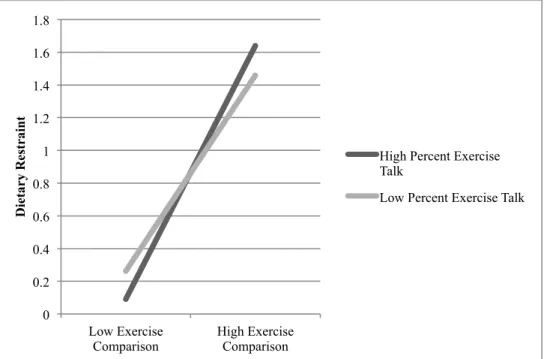
However, the amount of time an individual spent discussing exercise with her closest female friend did interact significantly with tendency to engage in exercise comparison to identify levels of dietary restraint, t(424) = 2.03, β = .08, p=.043, ΔR2 = .01 (see Table 3). The highest levels of dietary restraint were reported by those who had a high tendency to engage in exercise comparison and also reported high percentages of conversation with their closest female friends dedicated to exercise. (See Figure 1; in all figures, high and low levels of the independent variables are defined as one standard deviation above and below the mean, respectively.)
Additionally, absence or presence of discussing, with her closest female friend, exercise-related guilt when she does not work out and tendency to engage in exercise comparison interacted significantly to identify levels of dietary restraint, t(378) = -2.65, β = -.37, p=.008, ΔR2 = .01 (see Table 3). The highest levels of dietary restraint were reported by those who reported discussing exercise-related guilt with their close female friend and who were also high in levels of exercise comparison (see Figure 2).
Discussion
This study sought to examine the relationship between exercise-related talk and body dissatisfaction as well as the relationship between exercise-related talk and dietary restraint, including examining the tendency to engage in exercise comparison as a potential moderator of both relationships.
satisfaction as hypothesized, such that higher amounts of conversation dedicated to exercise were related to lower levels of body satisfaction, or higher body dissatisfaction. This finding is directly counter to the results obtained by Wasylkiw and Williamson (2013), who found that more exercise talk was associated with lower body dissatisfaction. Additionally, there was a relationship between presence of conversation about guilt after not working out and body satisfaction such that talking about guilt was related to lower body satisfaction (r = -0.22). The finding in the present study indicates that there is, as predicted, some relationship between exercise talk and greater body dissatisfaction.
Additionally, there was a pattern of positive relationships between dietary
restraint and each of the three variables of interest pertaining to exercise talk: absence or presence of exercise talk, amount of conversation dedicated to exercise, and absence or presence of exercise-related guilt talk. This finding demonstrates, as hypothesized, that greater amounts of exercise-related talk are associated with higher levels of dietary restraint.
individual’s degree of exercise comparison did not affect the strength of the relationship between various aspects of exercise-related talk and body dissatisfaction. However, of the independent variables examined, the tendency to engage in exercise comparison
consistently was the driving force in explaining variance in body dissatisfaction, with more exercise comparison associated with greater body dissatisfaction.
In contrast to the moderator model findings for body dissatisfaction, some significant interactions emerged when considering dietary restraint. Simply examining the interaction between absence or presence of exercise talk and tendency to engage in exercise comparison did not identify level of dietary restraint; however, the interaction of the amount of time an individual spent talking about exercise and the tendency to engage in exercise comparison did. Individuals who engaged in high percentages of conversation about exercise who also engaged in high levels of exercise comparison showed the
highest levels of dietary restraint. This pair of findings emphasizes that degree of exercise comparison affects the relationship between one measure of exercise-related talk
(frequency) and body dissatisfaction, but not another (absence/presence of talking about working out with a close friend, where presence of this conversation topic was endorsed by about 89% of the sample).
differences in dietary restraint based on whether or not the individuals discussed exercise-related guilt, suggesting that, among those who discuss feeling guilty, low levels of exercise comparison may be protective. Although there has not been prior research examining this interaction specifically, this finding is in line with research by Ousley et al. (2008) indicating that individuals with eating disorders engaged in more fat talk. While talking about exercise-related guilt is not exactly the same as fat talk, both types of talk involve negative conversations about topics related to one’s body with some aspect of comparison often embedded. More generally, it stands to reason that an individual who feels guilty about not having exercised who also compares herself to the exercise patterns of peers might want to take compensatory action in the form of dietary restraint.
Alternatively, it may be that individuals who are focused on dieting and who engage in social comparison are likely to feel guilty when they fail to exercise as much as they would like.
The present study had a number of strengths, including benefiting from a large sample size. Additionally, this study is the first to address the issue of exercise-related talk as it interacts with the tendency to engage in comparison; thus, all findings are informative, even if they are not significant. However, the study also had a number of limitations. First, participants were not comprehensively asked about specific aspects of their conversations about exercise, although they were asked about conversations
positive exercise-related talk; it may be the case that individuals in this sample discussed exercise in a way that was largely healthy and positive.
Additionally, the study would have benefited from more information pertaining to the amount and types of exercise individuals actually engaged in, as well as the exercise patterns of peers they compare to. This information might be relevant in assessing the types of comparisons individuals are making based on whether or not the individuals have comparable amounts and types of exercise. Further, the present study only asked about women’s conversations about exercise with their closest female friend; it is possible that these conversations are not representative of the participants’ exercise talk in general, and it is unknown whether men’s conversations about exercise would yield similar findings.
Future studies should examine more closely the nature of women’s conversations about exercise, including common topics of conversation, as well as the individuals with whom they most frequently discuss exercise. To further assess the effects of exercise talk and exercise comparison on various eating pathology-related outcomes, it might be useful to conduct experimental studies that manipulate whether or not individuals discuss
exercise and assess various factors before and after these conversations. Such an experimental design would also permit a test of whether this model is causal.
Additionally, future research should examine the differences in exercise talk and exercise comparison between individuals who engage in similar amounts and types of exercise versus those who have completely different exercise routines.
findings indicate that exercise talk and exercise comparison interact to identify level of dietary restraint, but not body dissatisfaction, among college women. Given these
References
Bardone-Cone, A. M., & Boyd, C. A. (2007). Psychometric properties of eating disorder instruments in Black and White young women: Internal consistency, temporal stability, and validity. Psychological Assessment, 19, 356-362. doi: 10.1037/1040-3590.19.3.356
Cohen, J., Cohen, P., West, S. G., & Aiken, L. S. (2003). Applied multiple
regression/correlation analysis for the behavioral sciences (3rd ed.). Mahwah, NJ: Lawrence Erlbaum Associates.
Fairburn, C. G., & Beglin, S. (2008). Eating Disorder Examination Questionnaire (EDE-Q 6.0). In C. G. Fairburn (Ed.), Cognitive behavior therapy and eating disorders (pp. 309-313). New York: Guilford.
Fitzsimmons-Craft, E.E., Bardone-Cone, A.M., & Harney, M.B. (2012). Development and validation of the Body, Eating, and Exercise Comparison Orientation Measure (BEECOM) among college women. Body Image, 9, 476-487. doi: 10.1016/2012.07.007
Franzoi, S.L. (1995). The body-as-object versus the body-as-process: Gender differences and gender considerations. Sex Roles, 33, 417-437. doi: 0360-0025D5/0900-0417507.50/0
Lin, L.F., & Kulik, J.A. (2002). Social comparison and women’s body satisfaction. Basic and Applied Social Psychology, 24, 115-123.
10.1002/(SICI)1098-108X(199904)25:3<349::AID-EAT15>3.0.CO;2-M
Nichter, M. (2000). Fat talk: What girls and their parents say about dieting (pp. 45-67). Cambridge, MA: Harvard University Press.
Ousley, L., Cordero, E.D., & White, S. (2008). Fat talk among college students: How undergraduates communicate regarding food and body weight, shape & appearance. Eating Disorders, 16, 73-84. doi: 10.1080/10640260701773546 Peterson, C.B., Crosby, R.D., Wonderlich, S.R., Joiner, T., Crow, S.J., Mitchell, J.E.,
Bardone-Cone, A.M., Klein, M., & le Grange, D. (2007). Psychometric properties of the Eating Disorder Examiniation-Questionnaire: Factor Structure and Internal Consistency. International Journal of Eating Disorders, 40, 386-389. doi:
10.1002/eat
Petrie, T.A., Tripp, M.M., & Harvey, P. Factorial and construct validity of the Body Parts Satisfaction Scale-Revised: An examination of minority and nonminority women. Psychology of Women Quarterly, 26, 213-221. doi: 10.1111/1471-6402.00060 Salk, R.H., & Engeln-Maddox, R. (2012). Fat talk among college women is both
contagious and harmful. Sex Roles, 66, 636-645. doi: 10.1007/s11199-011-0050-1
Wasilenko, K.A., Kulik, J.A., & Wanic, R.A. (2007). Effects of social comparison with peers on women’s body satisfaction and exercise behavior. International Journal of Eating Disorders, 40, 740-745. doi: 10.1002/eat
Wasylkiw, L., & Williamson, M.E. (2013). Actual reports and perceptions of body image concerns of young women and their friends. Sex Roles, 68, 239-251. doi:
Table 1
Correlations for Study Variables, Means and Standard Deviations of Continuous Variables, and Percent Endorsement for Dichotomous Variables
1 2 3 4 5 6 7
1. Absence/Presence of Exercise Talk
- 89.1%
2. Amount of Time Spent Talking About Exercise
.56*** - M=1.38, SD=.86
3. Absence/Presence of
Guilt Talk -- .11* - 68.4%
4. Dietary Restraint .10* .17*** .30*** - M=.89, SD=1.14
5. Body Dissatisfaction -.04 -.14** -.22*** -.54*** - M=3.59, SD=1.12 6. Tendency to Engage in
Exercise Comparison
.20*** .25*** .37*** .60*** -.45*** - M=18.90, SD=8.58 7. Absence/Presence of
Weekly Exercise
.22*** .24*** .02 .12** .02 .18*** - 73.7%
8. BMI .03 .09 .10 .19*** -.45*** .17** -.06 M=22.39, SD=3.73
Table 2
Hierarchical Multiple Regression Analyses of the Interaction of Exercise Talk and Tendency to Engage in Exercise Comparison in Relation to the Dependent Variable of Body Dissatisfaction
Steps and Predictors B SE B β t (dfs) ΔR2
Step 1 .20***
Absence/Presence of Exercise Talk -.20 .16 -.06 -1.28 (2,425)
Tendency to Engage in Exercise Comparison -.06 .006 -.46*** -10.39 (2,425)
Step 2 .000
Absence/Presence of Exercise Talk x Tendency to Engage in Exercise Comparison
-.004 .02 -.03 -.19 (1,424)
Step 1 .20***
Amount of Conversation on Exercise Talk -.03 .06 -.02 -.52 (2,424) Tendency to Engage in Exercise Comparison -.06 .01 -.44*** -9.8 (2,424)
Step 2 .000
Amount of Conversation on Exercise Talk x Tendency to Engage in Exercise Comparison
.003 .01 .02 .40 (1,423)
Step 1 .21***
Absence/Presence of Guilt Talk .12 .12 .05 1.04 (2,379)
Tendency to Engage in Exercise Comparison -.06 .01 -.43*** -8.74 (2,379)
Step 2 .003
Absence/Presence of Guilt Talk x Tendency to Engage in
Exercise Comparison -.02 .02 -.20 -1.27 (1,378)
Table 3
Hierarchical Multiple Regression Analyses of the Interaction of Exercise Talk and Tendency to Engage in Exercise Comparison in Relation to the Dependent Variable of Dietary Restraint
Steps and Predictors B SE B β t (dfs) ΔR2
Step 1 .36***
Absence/Presence of Exercise Talk .14 .15 .04 .95 (2,425)
Tendency to Engage in Exercise Comparison .08 .01 .60*** 15.21 (2,425)
Step 2 .003
Absence/Presence of Exercise Talk x Tendency to Engage in Exercise Comparison
-.03 .02 -.22 -1.45 (1,424)
Step 1 .36***
Amount of Conversation on Exercise Talk .01 .06 .01 .118 (2,425) Tendency to Engage in Exercise Comparison .08 .01 .60*** 14.80 (2,425)
Step 2 .01*
Amount of Conversation on Exercise Talk x Tendency to
Engage in Exercise Comparison .01 .01 .08* 2.03 (1,424)
Step 1 .36***
Absence/Presence of Guilt Talk -.22 .11 -.09* -2.01 (2,379)
Tendency to Engage in Exercise Comparison .08 .01 .57*** 12.81 (2,379)
Step 2 .01**
Absence/Presence of Guilt Talk x Tendency to Engage in Exercise Comparison
-.04 .01 -.37** -2.65 (1,378) Note. * p < .05. ** p < .01. ***p<.001.
Figure 1. Interaction of percentage of conversation with closest female friend dedicated to exercise and tendency to engage in exercise comparison in identifying levels of dietary restraint.
Figure 2. Interaction of absence or presence of conversation with closest female friend about exercise-related guilt and tendency to engage in exercise comparison in identifying levels of dietary restraint.
0 0.2 0.4 0.6 0.8 1 1.2 1.4 1.6 1.8 Low Exercise
Comparison High Exercise Comparison
D ie tar y R es tr ai n t
High Percent Exercise Talk
Low Percent Exercise Talk
0 0.2 0.4 0.6 0.8 1 1.2 1.4 1.6 1.8 Low Exercise
Comparison High Exercise Comparison
D ie tar y R es tr ai n t
Talk about Feelings of Guilt for Not Working Out