Deborah Barreau
American public libraries face many current challenges in meeting the ever-changing needs of their patronage. Traditional institutions are beginning to offer non-conventional services in order to maintain high levels of use among the community, prompting an overall review and analysis of organizational mission. New direction, objectives, goals and the incorporation of any new collections, services or programs require a solid
philosophical foundation before they can be properly implemented. This study examines an assortment of mission statements from a variety of public libraries in different
geographic locations throughout the United States. Separated by service population size, their unique mission statements are analyzed to reveal subtle differences in emphasis while highlighting major similarities.
Headings:
Public Libraries Public Libraries—U.S.
by Grant C. Lynch
A Master’s paper submitted to the faculty of the School of Information and Library Science of the University of North Carolina at Chapel Hill
in partial fulfillment of the requirements for the degree of Master of Science in
Library Science.
Chapel Hill, North Carolina April 2008
Approved by
Table of Contents
I. Introduction 03
II. Literature Review 11
III. Methodology 16
IV. Results and Discussion 23
V. Summary 30
VI. Future Study 34
VII. References 35
VIII. Appendix A. HAPLR Ratings, Data Set #1 38 IX. Appendix B. HAPLR Ratings, Data Set #2 43
X. Appendix C. Full Tag Clouds 48
XI. Appendix D. Word Lists 51
Tables and Figures
I. Table 1. Library Demographics 18
II. Table 2. Tag Cloud Data Set 20
III. Figure 1. Tag Cloud – Large Libraries (88 Tags) 24 IV. Figure 2. Tag Cloud – Small Libraries (110 Tags) 24 V. Figure 3. Tag Cloud: Combined Libraries 25
VI. Table 3. Tag Cloud Themes 26
VII. Figure 4. Comparative Analysis 28
Introduction
American public libraries are beginning to embrace the corporate bookseller-marketing plan, shifting away from traditional librarianship service in order to concentrate on providing some of the modern comforts that patrons have come to embrace in other customer service-oriented institutions (Wagner, 50). Rules and regulations once enforced are quickly being replaced by policies designed to attract people; hunger, thirst, volume-monitored voices and traditional media are all a part of the past, substituted now by on-site cafés, encouraged socializing and a virtual market flood of non-traditional resources (Whelan, 14).
The conservative, typical libraries of yesterday are more and more transforming into an information brokering center, with less focus on general education for the masses and more on individual information seeking (Vavrek, 71). Scholar John Berry adds: In 1852, the trustees of the Boston Public Library described that institution's founding mission as educational. In June 1948, the Library Bill of Rights defined the library as "an institution of education for democratic living." For that first century, the leaders of the library movement agreed that the library's central purpose was educational. A few years later we began to hear from a new cadre of administrators and trustees convinced that public libraries ought to be "run like a business" and that the business upon which they would focus should be the provision of information. Of course, they had already defined information as a marketplace commodity. [Bill] Crowley1 blames what he calls the ‘deprofessionalization of librarianship’ on that transformation of the public library from an educational and cultural institution to an information agency (8).
With concentration in popular collections, services and programs starting to shift in order to attract new age groups and expanded patronage, it is evident that public libraries across
the nation have already begun this upgrade. In fact, 94 percent of people have said that access to a public library within their community is “very valuable” (Marist Poll),
suggesting that communities are now springing up around public libraries for their utility; a necessary addition to any neighborhood of the 21st century.
Some organizations have gone even farther than some: the Perry Branch Library in Arizona recently opened to the public complete with every comfort and modern convenience library users have begun to embrace, but without the Dewey Decimal System. Instead, patrons can find materials by subject heading (as one might do inside a commercial bookstore) but without the help (or, some modernists would argue, the hindrance of) traditional call numbers. Although the staff was prepared to answer the potential barrage of questions, outrage or otherwise about the new system, none came. In fact, the response was “so overwhelmingly positive” (Whelan, 14) that the library
Director is planning on incorporating this model for another branch within the system. If that is successful, all 15 branches in the county will follow suit (15).
Additionally, LibraryThing2 developer Tim Spalding has recommended that public libraries embrace user-generated tagging in their catalog systems, as this is the way of the future (Blumenstein, 15). Bernard Vavrek even suggests that future library directors must take on the moniker of “entertainment” director, simply because the new fundamental of the public library is to entertain the public, not to inform (71).
Additionally, directing patrons to use computer systems for Web 2.0-centric activities has become much more the norm over conventional database or general catalog searching (Balas, 31).
In the classic sink-or-swim scenario, public librarians have intelligently embraced this transformation by rethinking some of the more conservative and traditional practices, advancing the library no longer as a quiet area designed exclusively for study (Wagner, 50). Professionals are now in full support of entertaining the patrons with games, cafés, and social functions, designed exclusively for the non-traditional library user (Balas, 30). As patrons transition from living and working in an industrial to an information society, public libraries are placing more and more emphasis on individual learning and digital interaction than ever before. They are becoming institutions designed for information access, patron3 comfort-related needs (i.e. comfortable seating, dining and coffee areas, etc.) and increasingly more focus is being put on the potential entertainment value of materials, interactive infrastructure and user-friendly systems (Whelan, 14).
Many scholars in the field have suggested that the Internet is now controlling individual information seeking in a way that traditional library service can no longer compete with (Vavrek, 70). It is in this vein that library professionals need to return to fundamentals in order to facilitate this transformation, or risk being swept away by it. American public libraries have always boasted a strong philosophical foundation at the root of every service, program and policy, and it is now time to reevaluate that base in order to incorporate the changes caused by the current evolution of the traditional library patron (Farkas, 50).
The American public library is changing in order to keep up with societal change, thus prompting an immediate appraisal of organizational mission: firm, philosophical groundwork must first lay the foundation of any upgrade or change within the system. This framework can be articulated through use of an organizational mission statement: it
helps to define how and why the organization exists, as well as further exemplifying the limitations, standards and conceptual restrictions on what the individual entities within the organization (in this example, new technologies) are held to.
John Berry has labeled this new era of the American public library as “Library 2.0.4” Regarding the technological revolution chartering the change of these institutions, he comments:
In libraries of every type, from…Cerritos, CA, to the ivy-covered halls of America's academic and research institutions, the new library is emerging. Librarians are winnowing a functional set of technological apparatus and software out of the onslaught of new devices for the discovery and retrieval of content and its incorporation into current knowledge or information. They are defining and selecting the best of the old and new services and organizational models to create what they call Library 2.0, although it looks as though they have already surpassed that place and number (Berry).
In other words, changes on the surface (in this case, technological) must be grounded with a firm philosophical foundation in order to be effective. If “Library 2.0” is at the forefront of the public library revolution, we must first work to identify a solid foundation in order to later justify breaking away from traditional services. New
technologies, services, and community needs requires library professionals to take an in-depth look at the mission of their particular organization in order to ensure relevance, objective effect and specific emphasis of certain elements.5
Additionally, philosophical questions about Web 2.0, social networking, open wireless systems, blogging, video sharing and more need to be addressed before an organization can embrace them. Similarly, ethical questions about quality of service, privacy and intellectual rights also present challenges; the answers to which can be
outlined in the organizational mission statement, the solid philosophical foundation upon which the institution rests.
In the context of this study, a mission statement is defined as a summary
describing the aims, values, and overall plan of an organization or individual. Statements such as these are typically not verbose or rambling, lengthy or pedantic. They reflect (and occasionally direct) the philosophical purpose of the organization, answering the question of existence applicable to the individual organization (Bart). The mission statement also reflects overall philosophy, intended focus of the institution as well as gauges for future outcomes (Wallace, 4). Scholar Janet Balas adds:
A clear sense of purpose provides an essential foundation for successful strategic planning for the future. Proposed and existing services, including space utilization, collection development, programming, outreach, and technology applications, should all reflect the library's mission, and we should evaluate their effectiveness on this basis, not on the basis of how new and trendy they are. Successful marketing also requires
understanding the organization's mission, since it would be almost impossible to "sell" a service if you could not explain its value. It is no longer enough to say that libraries matter; we must be able to express why they matter and demonstrate their value to users and potential users (31).
Several questions of interest are: what are the distinctions in philosophical direction as outlined in mission statements among assorted organizations? How can we best identify these variations? What do these differences (and similarities) tell us about the community, the patronage and the library itself?
organization around it. By examining the content of missions from demographically different groups of libraries, we may be able to identify specific similarities, common to all organizations, regardless of outside influences; as well as specific elements only suitable for that particular library.
In other words, it is by analyzing these outside variables that we can be better prepared to properly articulate a mission appropriate to the individual community that it applies to. It is in this light that not all missions are created equal (Bart, 31). By
stressing or highlighting certain elements pertaining exclusively to a unique community of patrons, a public library mission can be accurately tailored and appropriately applied in all aspects of the organization. Finally, analyzing outside variables like service
population size will present us with a preliminary look at differences among a variety of libraries, leading to a better understanding of how, and more importantly, why these distinctions are necessary.
This study is designed to identify the philosophical differences between two diverse groups of American public libraries, as separated by differing service population sizes. This particular variable was selected based on the potential for dissimilarities among the content of the mission statements, thus presenting a clear preliminary investigation. Another variable, such as comparing two groups of public libraries by hours open per week, may not produce much in the way of variability6. Service
population size immediately introduces diversity into the analysis, which may very well have a measurable impact on mission statement content.
While it is my expectation that both groups will have similarities, it is logical to suggest that there will be a few areas in which specific elements are not so much different, but instead feature stronger emphasis. I anticipate public libraries serving a large population (>300,000) to concentrate less in areas such as community and the individual patron and instead focus on access to information; essentially, less community, more access to resources for a more generalized public.
Since 62 percent of people in America choose a neighborhood based on access to a public library (Realtor), one would expect to find smaller libraries to take a more colloquial approach to the patron library experience, countered with the larger libraries attention on business or service-oriented language. Public libraries existing in
neighborhoods have access to a smaller, more specific group of repeat patrons. Larger organizations tend to serve a wider variety of people and therefore may be forced to sacrifice personal attention for the every individual for that of the more efficient and effective service for the overall general population of users.
It is in this regard that we may be able to infer that the larger organizations tend to engage the community as a single entity, contrasted with the smaller public libraries that have the everyday capacity to treat the surrounding community as a group of individuals, but who cannot afford the access to large collections and materials. The larger libraries that have this financial capacity and materials do not always have the human resources available to serve the individual needs of a community—instead concentrating on the
concept of community-at-large.
community. This study targets the first step in this process: as scholar Meredith Farkas comments in her article “The Evolving Library:”
One thing that hasn't changed in the past two years is that libraries need to constantly re-evaluate their services to meet the changing needs of their service population…Libraries need to be agile to meet the changing needs of their populations…Libraries that cannot adapt may find that they are no longer effectively serving their patrons (50).
By analyzing the content of what makes up a library’s mission statement, we can develop a philosophy influenced by common factors as seen in many, while combining it with distinctive local elements in order to create an entirely unique representation of the organization it supports.
Literature Review
Within the scope of this study, the following operational definition of “mission statement” will be assumed: any part of the administrative statement of purpose, vision or mission in which specific philosophical goals are outlined for the overall direction of the organization; it applies to all employees and is concise, assertive and employs a simple vernacular.
There are several collections of texts and articles that outline the purpose and philosophy behind essential elements of organizational mission statements. Found from databases ranging across Library and Information Science literature to more business and corporate sources, each focuses on a variety of issues, many of which center around choosing particular language to best reflect philosophical practices, or underlining the importance of incorporating employee input in design. There are a few specific texts, however, that are more appropriate for the range of this assignment, that spotlight the consequence of mission, why it should evolve over time, and how various organizations focus on varying aspects in order to best serve a specific population.
done in the future in order to meet the evolving needs of a once-traditional patronage); and finally that of specifically what sorts of changes are happening to public libraries across the nation that is bringing about such a philosophical overhaul.
Special attention should be placed on a few particular works such as those by Balas or Keller, as they outline not only how to develop a successful statement, but also bring to light many philosophical and ideological reasons for continuing to prominently feature it within the organization. The SLA document further outlines the differences between mission statements for current libraries, as compared to how they read in
previous years. For example, many areas in the digital realm such as Internet privacy and intellectual freedom are now showing up in mission statements, whereas many years ago this information was excluded7.
The articles and texts by Eblen, Smith, Zmuda and Nesta detail justifications for library mission, and discuss a bit about why they are such effective tools in the
workplace. For the purposes of this study, most of the material in this area was outside of the general scope; it does, however, suggest that much of the theoretical work in mission statements has great application in a variety of ways. According to this literature, most of the motivational and “problem” employee issues in the workplace can be greatly subdued with a properly articulated and appropriately tailored organizational mission statement. Some of the literature suggests that there will even be a possible reduction in
administrative supervision and constant reiteration of objectives to employees depending on how effective the mission of the organization is (Hernon, McClure).
Farkas, Crowley and Berry concentrated on the philosophy of libraries, with specific focus on direction and mission. This series of articles discussed some of the
urgency involved in mission statement reform (Farkas, 50) as well as how the role of the public library is changing. Crowley brought up several ethical issues with the evolution of these institutions, including speaking to the downfalls of a technology influx (47). Interestingly, he was the only author8 who spoke cynically about the amelioration of the American public library; he called for a return the educational roots that the organizations were founded on, as well as to withdraw from competing with information brokering powerhouses like Google and the proficiency of the individual Internet user.
Other collections of articles and books constituted a great deal of the available literature on the many effective ways in which employees are motivated and what techniques (focusing specifically on mission statement design) exist in order to boost productivity and overall morale. Authors such as McGriff and Hartzell touch on ways in which mission statements are used to accomplish this, detailing reasons as to why it is such an important tool within the organization. These works describe not so much the application of philosophical mission within the organization, but rather the influence of the very concept behind it. An awareness of purpose (and working towards a
commonality) has great power to drive not only library employees, but the community as well.
To explain, the authors pointed out that mission statements could be as effective
in theory as in application. Some scholars argue that it is the idea of having a mission to begin with that helps to motivate the staff (Weingand). Additionally, employee input and active involvement in the creation, maintenance or rethinking of the statement can be an effective way to empower employees (Wallace).
Some argue that public library administrators need to consistently reevaluate and lead with a library's mission in order to make reliable decisions on new programs, materials and services (Balas, 31). This outlines many of the key reasons that libraries need to have well-articulated, pronounced mission statements, adhered to by all
employees; Balas even goes as far as to suggest that the organization simply will not be successful without first adopting a directive—in this case, handled by administration and published to the staff, patrons and outside community (31).
There is a sizable amount of literature pertaining to the way in which mission statements can be employed by administration to motivate the staff; it is in this regard that philosophical analysis of mission can be applied to day-to-day operations of any particular library organization. In other words, mission statements are theoretical by nature, but have a very real, measurable effect on employees and the organization as a whole (Farkas).
Another collection of articles that fell outside of the scope of this study but are considered nonetheless address the many effective ways in which employees are
motivated and what techniques (focusing specifically on mission statement design) exist in order to boost productivity and overall morale. One particular gauge worth collecting a good deal of data on (especially considering that observing employee satisfaction {and trying to quantify such satisfaction and overall efficiency}) is that of a decline in
It is especially interesting to note here that it may be beneficial for another study in the future to take an in-depth look at “problem” employees to seek their views on mission statements within the organization. Todaro’s “The Truth is Out There” essay and the two articles by Osif offer a look at difficult employees (and techniques in order to rectify issues) while also discussing reward systems for effective work practices. It will also help to put into context yet another need for mission statements: is it possible that the “perfect” mission statement alleviates the need for administrative disciplinary practices?
This review rightfully ends with a discussion of Christopher Bart’s work. He has done extensive research on the effectiveness of mission statements within library
organizations. Throughout much of his work are detailed potential components (i.e. content) of statements, all of which can be uniquely tailored to specific organizations. He also argues that mission can be influenced by outside variables, saying:
Perhaps the most interesting and intriguing outcome of my research was the indication that the content of a mission statement may also be influenced by such variables as firm size and the type of industry in which it operates. To date, I have analyzed mission statements in high-tech versus low-tech organizations; in industrial versus consumer goods organizations; in innovative versus non-innovative organizations; and even in hospitals in the not-for-profit health care sectors. The results suggest that there are distinct industry preferences for specific items to be included in a firm’s mission (Bart, 32).
This directly connects with the purposes of this study: by identifying similarities and differences among two groups of public library mission statements depending on a specific variable9, it may be possible to suggest that there are, as Bart says, “distinct industry preferences” for certain elements within each organization’s statement.
Methodology
The analysis of the philosophical purpose and mission among several public libraries begins by examining the very highest rated organizations in contrasting
population categories. For this study, selections were drawn exclusively from the 2006 edition of Hennen’s American Public Library Ratings (HAPLR), a widely known 15-point ranking and evaluation system for over 9,000 public libraries. Of those, 12 were selected that were considered “large” organizations (338,719 to 1,314,241 service populations) and 12 that were considered substantially smaller (32,332 to 4,726 service populations).
The large libraries are (in order by HAPLR rating, followed by most current service population figures)10: Cuyahoga County Public Library (2006 SP11: 1,314,241); Multnomah County Library (2006 SP: 681,454); Columbus Metropolitan Library (2003 SP: 728,432); Denver Public Library (2003 SP: 557,478); Baltimore County Public Library (2006 SP: 787,384); Hennepin County Library (2006 SP: 1,122,093); Salt Lake County Library System (2006 SP: 978,701); Public Library of Cincinnati and Hamilton County (2006 SP: 822,596); Pikes Peak Library District (2006 SP: 576,884);
Montgomery County Public Libraries (2006 SP: 932,131); Johnson County Library (2006 SP: 516,731); and Saint Charles City-County Library District (2006 SP: 338,719).
The small libraries are (in order by HAPLR rating, followed by most current service population figures): Porter Public Library (2003 SP: 32,024); Upper Arlington Public Library (2006 SP: 31,326); Southwest Public Libraries (2003 SP: 29,165); St. Charles P.L.D. (2008 SP: 32,332); Massilllon Public Library (2006 SP: 32,315); Suffern Free Library (2003 SP: 10,954); Wadsworth Public Library (2006 SP: 20,155); North Canton Public Library (2008 SP: 16,780); Wickliffe Public Library (2000 SP: 13,484); Way Public Library (2006 SP: 16,902); Rocky River Public Library (2006 SP: 19,377); and Peters Township Public Library (2000 SP: 4,726)12.
The first data set is compiled of 12 public libraries in various locations across the United States, all ranked within the top 20 of the corresponding population category. An initial tag cloud13 was created to identify content frequency within this group, to be compared to the second group of 12 smaller (but evenly rated within category)
organizations. Using the online tool, several more clouds were created in order to refine the content analysis, as well as to bring thematic connections sharper into focus.
Tag clouds are an enterprising new way to visualize content in order to illustrate word frequencies. This technology is being applied to social bookmarking, image and video tagging on the Internet, and has practical research potential as well. It works by creating an image of all of the content of a particular text with high word frequencies represented by increased font size. Put another way, tag clouds are visual “clouds” in which size of the words corresponds to frequency within the selection.
Certain limiters can be placed on the content as the tag cloud is created, in order to produce a filtered result, empty of misleading, redundant or otherwise insignificant
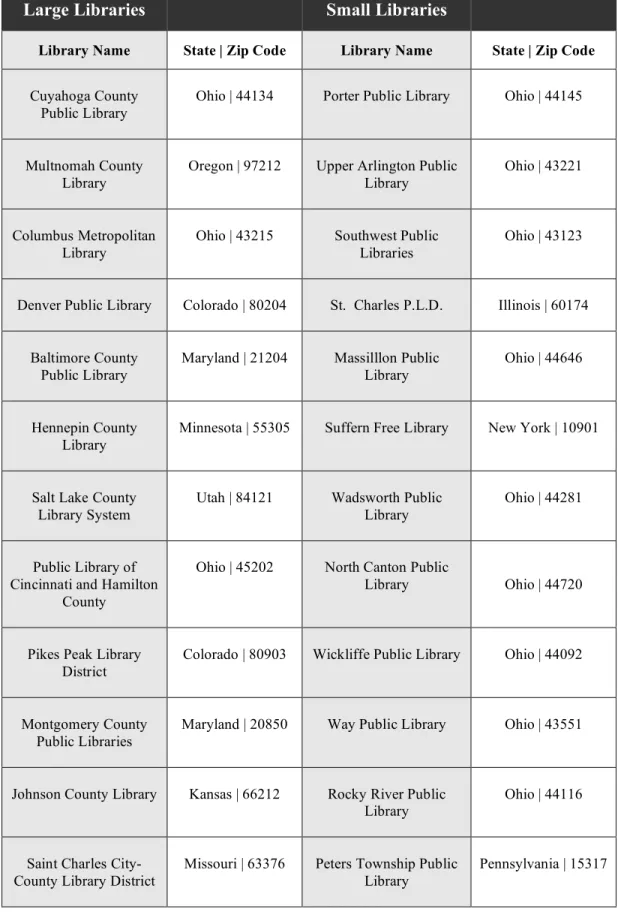
Table 1. Library Demographics
Large Libraries Small Libraries
Library Name State | Zip Code Library Name State | Zip Code
Cuyahoga County Public Library
Ohio | 44134 Porter Public Library Ohio | 44145
Multnomah County Library
Oregon | 97212 Upper Arlington Public Library
Ohio | 43221
Columbus Metropolitan Library
Ohio | 43215 Southwest Public
Libraries
Ohio | 43123
Denver Public Library Colorado | 80204 St. Charles P.L.D. Illinois | 60174
Baltimore County Public Library
Maryland | 21204 Massilllon Public Library
Ohio | 44646
Hennepin County Library
Minnesota | 55305 Suffern Free Library New York | 10901
Salt Lake County Library System
Utah | 84121 Wadsworth Public
Library
Ohio | 44281
Public Library of Cincinnati and Hamilton
County
Ohio | 45202 North Canton Public
Library Ohio | 44720
Pikes Peak Library District
Colorado | 80903 Wickliffe Public Library Ohio | 44092
Montgomery County Public Libraries
Maryland | 20850 Way Public Library Ohio | 43551
Johnson County Library Kansas | 66212 Rocky River Public Library
Ohio | 44116
Saint Charles City-County Library District
Missouri | 63376 Peters Township Public Library
data. In the case of the content for both library groups, words such as “library,”
“mission” and identifying information were among the words initially filtered out. These words were excluded because of their purpose—all but five of the 24 total libraries mentioned their own name within the mission. These data are not relevant to the goal of the study and were not included in the final clouds. Another level of filtering revolved around grouping similar words, such as “learn,” “learning” and “learned.” In this second example, the tag cloud incorporated three words into one, combining their frequencies.
Three tag clouds were ultimately created: one for each of the 12 public libraries in each population group, and one that combined all 24. This was designed in order to illustrate key components as seen across a varied and wide demographic of library systems. This naturally raises the question of which factors make up the essential language for articulating philosophical direction. Uncovering this element may be the ultimate goal if library professionals are to embrace the changes to come in the future. By comparing two drastically different library groups, we can make distinctions regarding how fundamentals change depending on certain variables.
As stated above, the first tag clouds created for each of the two library groups (as well as the combination between the two) contained much in the way of entirely unusable and inappropriate data. Obviously, a preliminary observation could potentially have lead to assuming that specific words such as “library” or “mission” have statistical
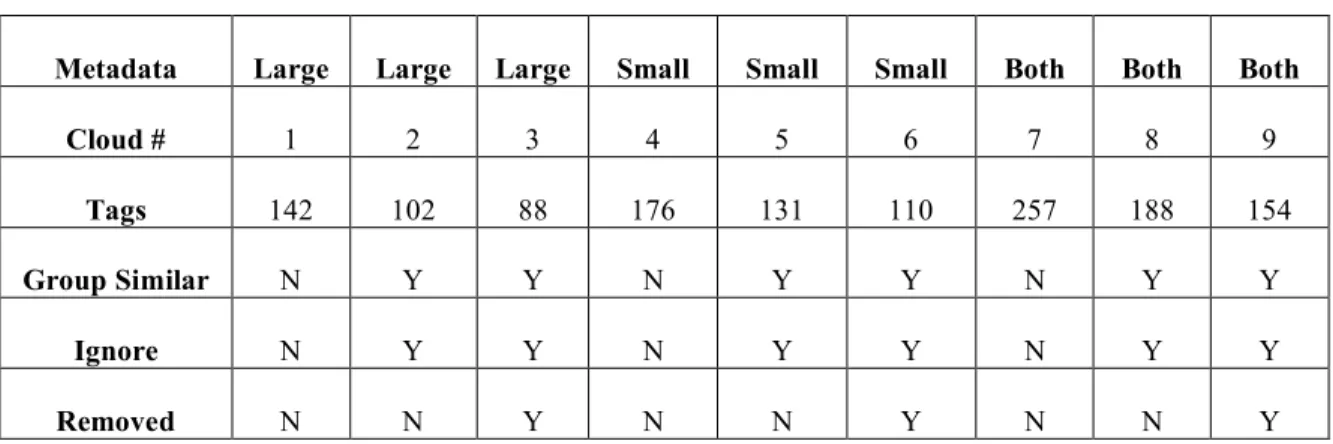
Table 2. Tag Cloud Data Set
Metadata Large Large Large Small Small Small Both Both Both
Cloud # 1 2 3 4 5 6 7 8 9
Tags 142 102 88 176 131 110 257 188 154
Group Similar N Y Y N Y Y N Y Y
Ignore N Y Y N Y Y N Y Y
Removed N N Y N N Y N N Y
Table 1 helps to define the content of each tag cloud before analysis takes place. Several limiters are included, and provide excellent room for variability over the course of data gathering. The frequencies of words, whether or not to group similar language, and ignoring common English vocabulary helped to create these refined tag clouds, each presenting a unique visual representation of the data. It is by analyzing this information that we can discover acute differences in design and emphasis; this will lead to a better understanding of philosophical mission among large and small library organizations.
Table 2 is designed according to the following key:
• Cloud #: This number refers to the clouds in the order that they were created. • Tags: This number refers to the number of word frequencies each tag cloud
featured. If we take, for example, tag cloud #1, #2 and #3 from the large libraries category, the tags correspond 142, 102 and 88. Tag cloud #1 shows 142 common words from the group of 12 large libraries. This is due to not
grouping similar words (such as “learn,” “learning” and “learned”) and not
clouds for all three categories were refined to the most accurate data set possible.
• Removed: This category eliminates identifying data14 among the
organizations, along with the words “mission,” “library,” as well as common words in English that have little to do with the scope of this study. The majority of the statements analyzed featured their own name and other identifying information (the name of the surrounding community and
township, among others) that could easily be removed in order to draw more focus to those elements appropriate for analysis.
Finally, general observation as to the kinds of tag clouds being created by the system was used in order to refine them one last time. Semantic variance was taken into consideration, and several words were grouped together based on either being
synonymous, or closely related according to the terms of this study. Table 1 illustrates the design of all three clouds for large, small and both library groups, although only the most filtered15 was considered in the results of this study. For comparison purposes, the second clouds created out of the total three can be found in Appendix C.
There was some semantic variance in each group of mission statements. Simply put, this results from connotation within the writing of the statements themselves. Grouping similar language, ignoring common English vocabulary and removing specific words from the mix helps to alleviate the issues caused by semantic variance to an extent;
14 As stated above, identifying information about each organization was removed not for confidentiality purposes, but because this data is unnecessary for a content analysis. See Appendices A and B for more information.
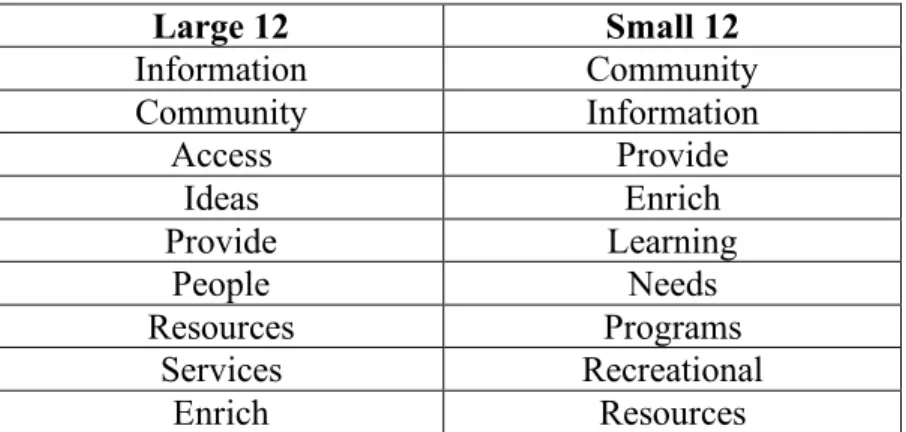
observing themes outside of the tag clouds themselves16 also helps to narrow the problems caused by this. The data included in Table 3 on page 26 features nine major elements in each group, ranked from highest to lowest frequencies, produced after extensive filtering.
The total frequencies of all of the words included in the statements can be found in Appendix D; this was the logical first step in identifying similarities and differences between the two groups of 12 libraries. From that point forward, the task became to narrow these word lists down, removing any and all data that did not apply to the comparison.
Results and Discussion
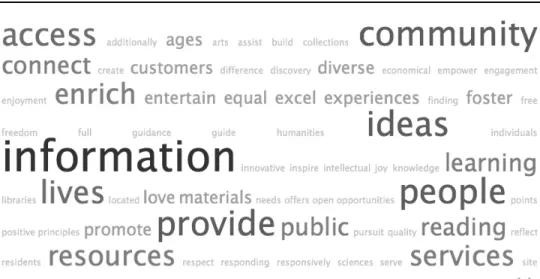
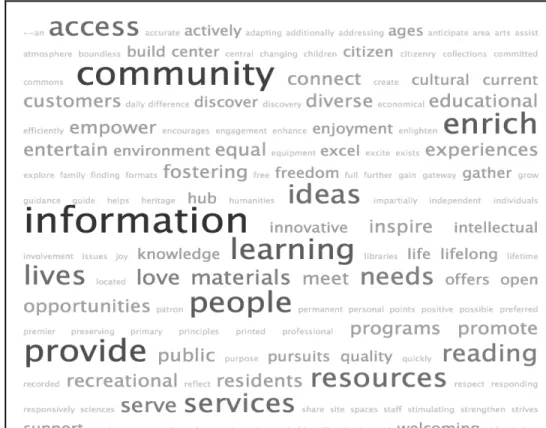
The following two figures on page 24 illustrate the refined word lists in a frequency-based tag cloud. Figure 1 presents the filtered content of the 12 large library mission statements, while Figure 2 shows the filtered content of the 12 smaller
organizations. These clouds are very telling in they way in which each illustrates word frequency by immersing the reader in a visual representation of emphasis. Figure 3 on page 25 is the final filtered tag cloud encompassing all 24 organizations; this was included in order to present the reader with an overall visual representation of traits common to both groups, regardless of the dependent variable.
Thematic similarities are evident by simple observation; in fact, several words are featured more prominently than others. It follows naturally that the third cloud (Figure 3) highlights a combination of all keywords, presenting an ultimate conclusion as to what types of similarities exist across all service populations. To begin with, however, we can identify some differences, however subtle, that appear when comparing the first group of 12 large libraries to the second group of 12 smaller organizations.
The following three tag clouds are the refined versions of all of the mission statements from a particular group, with the last cloud combining the content of both groups17:
Figure 1. Tag Cloud – Large Libraries (88 Tags)
Figure 3. Tag Cloud: Combined Libraries
In all three clouds, we can instantly see higher frequencies of specific words within text; by comparing Figures 1 and 2, we might be able to identify specific elements that are most prominent in library mission depending on service population size of the included organizations.
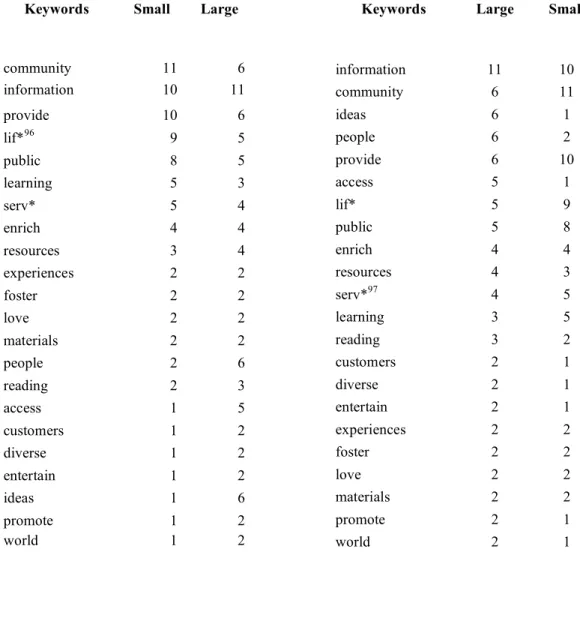
philosophical groundwork for the first time. Consult Tables 4 and 5 in Appendix E for further comparisons of the two groups.
Table 3 at the bottom of this page presents an analysis based entirely on thematic observation, having taken semantic variance into account as well. Specific words were chosen with consideration towards their high frequencies in the clouds—a larger word in the tag cloud implies that it appears in multiple statements, perhaps implying an area of focus for the organization. In other words, more frequently occurring words (such as “community,” “information,” or, in the case of the larger libraries, “access”) within the text of all of the mission statements reflects on the whole.
It appears, simply by observing the themes that run throughout each tag cloud, that the larger words (with higher frequencies within the group) represent emphasis as to philosophical direction of the organizations. This is entirely based on separating the two groups of 12 public libraries by service population size; another variable may very well change the outcome of the findings. It is in this regard that this research be continued, to apply as many variables as possible against the linguistic elements of mission statements in order to determine what elements are given the most focus by the organization and why.
Table 3. Tag Cloud Themes
Large 12 Small 12
Information Community
Community Information
Access Provide
Ideas Enrich
Provide Learning
People Needs
Resources Programs
Services Recreational
Proportionally, the two groups of public libraries share many similarities. That is, if frequency compared to the second group is not included (as illustrated in Table 3) but is only compared to the rest of the components in its own group, both groups of 12 organizations look very similar.
This raises some interesting questions: we can see that “Information,”
“Community,” “Provid*18,” “Enrich,” “Resources” and others are matched evenly, and mostly comparable in rank to the other. At first observation, it appears that the large 12 libraries put more emphasis on information and less on community; the opposite holding true for the small organizations. If we apply this logic to other word match-ups across the two groups, we find evidence of different emphasis on the same constant in many areas. It is these areas that are of most interest for the purposes of this study: what do large libraries value? What is the most important fundamental element of a public library? What central tenet can we rely on?
When the thematic observations are compared with that of analyzing frequencies of the same elements, definite patterns emerge. While Table 2 illustrates certain trends that run through each group, a more focused analysis can produce quantifiable results.
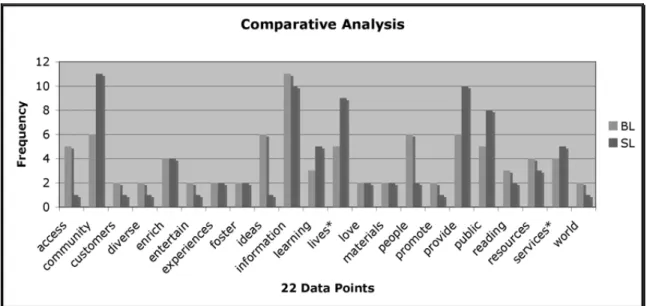
Figure 4 on page 28 is a chart of 22 common data points, as extrapolated from all 24 libraries. Large libraries (BL) are light gray, small libraries (SL) are dark gray. These elements were specifically chosen in order to show emphasis within each data group. As illustrated in Figure 4, small libraries stick out in three distinct areas: “community,” “provide,” and “public.” Larger libraries emphasize the following: “access,” “ideas,” “information” and “people.” The language emphasized by the smaller organizations
seems to revolve more around whom they serve rather than what the rhetoric of the larger libraries implies, what they serve.
Figure 4. Comparative Analysis
Another observation yields that larger libraries seem to feature language suited for
sparking or influencing projects, while the smaller organizations concentrate on “end-result” language, such as “education,” “learning,” “meet[ing],” and “needs.” In other words, statements of mission from the larger libraries tend to focus less on impacting the conclusion of any given patron-based need, and instead on initiating one. Conversely, it appears that much of the language included in the statements for the smaller
organizations is individually proactive: learning something from an experience, or gaining education; more emphasis is placed on community “needs” and “enrich[ing]” those needs.
that of justifying why this offers research potential, providing evidence for why a philosophical overhaul of American public library mission is needed in the near future, and illustrating subtle differences in the word-based content of organizational missions from different service population size libraries.
Tag clouds can be used for precisely this last purpose. As earlier explained, they highlight word frequencies as compared to others within a textual group. It is a terrific tool for making elementary observations about emphasis: larger words means greater frequency in the group, which may imply that more emphasis is given on that word than on others. From this tag cloud, inferences can be made about the textual group itself. In this regard, if the example were not public libraries but rather presidential speech
transcripts, it is highly likely that the words and phrases most often used (and therefore produce the highest frequencies) are the most important; the most heavily focused on.
Counting the frequency of words within tag clouds or lists tells us a great deal about the type of wording being used to design public library missions. By combining tag clouds with observing themes in word lists, one gains a better understanding of the kind of wording used in developing public library mission statements. Obviously, the words most frequently shown in the clouds and on the list are important, and certainly need to be considered when designing such a statement.
Summary
It is by stepping back from the whirlwind of activity involving the ongoing transformations of the American public library that we can analyze the fundamental state of philosophical mission and direction. It is at this point that we can then set aside that of facilitating the present amelioration to instead focus on the foundational principles of the institution and its place in society. As libraries begin to change, so to will their
fundamental construction: it is increasingly more prudent for public library professionals to remain focused on the conceptual foundations on which their operations are built.
The magnitude of an appropriate, relevant and grounded philosophical foundation becomes evident when examining the day-to-day operations of the American public library, in how it is perceived, utilized and funded by the community. According to Jeffrey Abrahams, “creating a mission statement will also aid a non-profit group in its applications for grants and other forms of financial aid. In some cases, a grant proposal isn’t complete unless it includes a mission statement” (Abrahams, 6). It is this positive financial (certainly very pragmatic) impact that may drive some to examine and review this defining purpose; others may do it based on virtue alone.
Additionally, it has been argued that the basis on which any successful organization makes its decisions is its mission statement (Balas, 30). This key,
implementation of such statements; an in-depth analysis of these variables is necessary prior to construction. In fact, the impact of service population size on the scope, breadth and influence of an organizational mission has now come into light: the emphasis and focus on specific philosophical elements may very well change depending on the size of the community the library serves.
From the data gathered, the preliminary findings indicate that there are indeed subtle differences between the two groups of 12 libraries in areas involving emphasis (or lack thereof) on specific traits common to both. Inferences may be able to be made from this data as well: in the case of large libraries, it appears that heavier prevalence of information and access outweigh that of service to the individual patron, and instead serve the greater community as a single conceptual entity. Conversely, it appears that the smaller organizations tend to give less emphasis to that of information and collections and instead look to meet the needs of the individual patrons.
This makes sense, if applied to common-sense knowledge of large library
organizations. A more diverse patron base implies that there will be less attention placed on the individual patron, and more on the general community as a whole. It also makes sense that a smaller library organization (especially those serving a population of 33,000 or less) would have more resources (and perhaps a slower pace as well) to deal directly with the individual patron. Diversity of the service population definitely has an effect on the way in which the library is managed; that is evident both in thinking about the
organizations resemble a more friendly, result-based approach. Result-based in this context implies the after-effect of public library use (such as “education,” “learning,” “meet[ing],” and “needs,” of the unique patrons), countered with the preparatory or
initiate use by the larger organizations (“access,” “resources,” and “services” of the common, general patronage as a whole).
Finally, it should be noted that the two data groups appeared to show far more similarities when compared proportionally than when compared to each other.
Removing the statistically significant emphasis of particular words, we may be able to infer that regardless of service population size, American public libraries have roughly the same philosophical goals.
Farkas, Berry and Crowley have all called for American public library mission statement reform. This study takes the first steps towards developing a plan to analyze organizational mission statements, as well as outlining a way to see what content is most emphasized within many mission statements from a variety of public libraries. Public libraries are changing: mission statements must not only guide this change, but
implement it with a solid philosophical base as well.
In his March 1998 article in CA Magazine entitled “Mission Matters,” Christopher Bart reminds us:
…great missions ultimately hold the key to getting people to work together. The starting point, though, is the actual words that make up the document. So, to get the maximum benefit out of your mission, invest the necessary time and energy to make sure that your statement says it right. Failure to do so may be an early indicator that your organization is in for a rough ride in the years ahead (Bart, 41).
Future Study
Future study may help to uncover what impact other variables have on American public libraries. It is possible to create multiple data sets, each matching these same (and more) organizations against other elements (such as rural vs. urban environments,
socioeconomic differences, geographic location, etc.) in order to produce a more detailed list common traits and trends. It is my hope that these results will have an impact on the Information and Library Science discipline; a firm understanding of the mission
References
“2004 National Association of REALTORS Profile of Home Buyers and Sellers,” National Association of Realtors 2004, 3 May 2006
<http://www.realtor.org/libweb.nsf/pages/fg307>.
Abrahams, Jeffrey. The Mission Statement Book 301 Corporate Mission Statements from America's Top Companies. Berkeley, Calif: Ten Speed Press, 1995.
Bart, C.K. "Making Mission Statements Count", CA Magazine, March, 1999, pp. 37-47.
Bart C.K. "Accepting the Mission", CA Magazine, August, 1999, pp.33-34.
Bart, C.K. "Mission Matters", CA Magazine, March, 1998, pp. 31-41. Reprinted in the CPA Journal, August, 1998, pp. 56-57.
Bart, C.K. "Mission Possible", CA Magazine, September, 1997, pp. 33-34.
Berry, John. "Reposition Public Libraries." Library Journal 130.14 (2007): 8.
Blumenstein, Lynn. "A Public Library Tries LibraryThing." Library Journal 132.11 (2007): 15-16.
Broady-Preston, J., et. al., Employees, customers and internal marketing strategies in LIS. Library Management v. 23 no. 8/9 (2002) p. 384-93.
Carson, Kerry D., Paula Phillips Carson, and Joyce Schouest Phillips. The ABCs of Collaborative Change The Manager's Guide to Library Renewal. Chicago: American Library Association, 1997.
Crowley, Bernard. "Save Professionalism." Library Journal 130.14 (2005): 46-48.
Eblen, S. "About Mission." School Library Media Activities Monthly 24.1 (2007): 17 23.
Farkas, Meredith. "The Evolving Library." American Libraries 38.6 (2007): 50.
“Free-Choice Learning,” Institute for Learning Innovation 2002, 2 May 2006 <http://www.ilinet.org/freechoicelearning.html>.
HAPLR Index. Thomas J. Hennen. Nov. 2007. Hennen's American Public
Hartzell, G. "Controlling Your Own Destiny." School Library Journal 48.11 (2002): 37.
Hernon, Peter, and Charles R. McClure. Evaluation and Library Decision Making. Information management, policy, and services. Norwood, N.J.: Ablex Pub, 1990.
Jatkevicius, J. The Search for Meaning and Significance in Public Libraries: A View of Employee Expectations and Organizational Leadership. Library Administration & Management v. 19 no. 3 (Summer 2005) p. 133-9.
Keller, K. "Libraries, Mission, & Marketing: Writing Mission Statements That Work." Library Mosaics 15.3 (2004): 21. Academic Search Premier. 23 Feb. 2008
L. Balas, J. (2007, February). Do You Know What Your Mission Is?. Computers in Libraries, 27(2), 30-32. Retrieved February 22, 2007, from Academic Search Premier database.
Manley, W. Why Management Theories Don't Add Up. American Libraries v. 37 no. 8 (September 2006) p. 96.
McGriff, N., C. Harvey II, and L. Preddy. "Collecting the Data: Monitoring the Mission Statement." School Library Media Activities Monthly 20.6 (2004): 26-29.
"Mission Statement." Webster's New Millennium™ Dictionary of English, Preview Edition (v 0.9.7). Lexico Publishing Group, LLC. 28 Nov. 2007.
Nesta, F. "Google Your Library's Mission." Library Journal 131.10 (2006): 36-37.
Osif, B. A., et. al., Manager's bookshelf: employee morale [bibliographical essay]. Library Administration & Management 12.1 (1998): 39-43.
Osif, B. A. "Personality and the Workplace: Difficult Employees [Biographical Essay]." Library Administration & Management 19.4 (2005): 212-217.
Rogers, S. L. Orientation for new library employees: a checklist. Library Administration & Management 8 (1994): 213-217.
SLA Adopts New Vision, Mission, and Core Values. (2004, January). Information Outlook.
TagCrowd. Daniel Steinbock. 1 Aug. 2006. Tag Crowd Alpha, Stanford University. 10 Feb. 2008 <http://www.tagcrowd.com>.
“The Public Library: A National Survey (Marist Poll),” New York Library Association 2003, 1 May 2006 <http://www.nyla.org/index.php?page_id=801>.
Todaro, J. B. The truth is out there: reasonable expectation of adult behavior [dealing with problem employees]. Library Administration & Management 13.1 (1999): 15-17.
Vavrek, Bernard. "Wanted! Entertainment Director." American Libraries: June/July 2001, Vol. 32, Issue 6, p. 68, 4 pp.
Verbesey, J. R., et. al., Confidential employee surveys for libraries: a valuable
management tool. Library Administration & Management 6 (Fall 1992): 180-1.
Wagner, Brett. "Patron or Customer (and Why)?" Library Journal 132.12 (2007): 50.
Wallace, Linda K. Libraries, Mission & Marketing Writing Mission Statements That Work. Chicago: American Library Association, 2004.
Whelan, Debra L. "Arizona Library Ditches Dewey." School Library Journal 53.7 (2007): 14.
Ziolkowski, D. M. Common sense, integrity, and expectations of excellence: practical advice on dealing with employee problems. Library Administration &
Management 7 (1993): 24-9.
Appendix A. HAPLR Ratings, Data Set #1
HAPLR Ratings,19 publication year: 200620
Data set #1: 12 Public Libraries in various locations across the United States, ranging in service population sizes from 338,719 to 1,314,241.
HAPLR Data Set #1:
• Name: Cuyahoga County Public Library21 • State: Ohio
• Zip code: 44134 • HAPLR score: 861
• HAPLR rank (within population category): #1
• Mission: To provide our community open access to resources that inform,
entertain, and enrich.22
• 2006 population: 1,314,24123
• HAPLR population category: 500,000+
HAPLR Data Set #2:
• Name: Multnomah County Library24 • State: Oregon
• Zip code: 97212 • HAPLR score: 855
• HAPLR rank (within population category): #2
Mission: Multnomah County Library enriches lives by fostering diverse
opportunities for all people to read, learn and connect. [Additionally,] Multnomah County Library upholds the principles of intellectual freedom and the public's right to know by providing people of all ages with access and guidance to information and collections that reflect all points of view.25
• 2006 population: 681,45426
• HAPLR population category: 500,000+
19 http://www.haplr-index.com/HAPLR100.htm 20 Data year 2004.
21 http://www.cuyahogalibrary.org/
22 http://www.cuyahogalibrary.org/StdBackPage.aspx?id=908#MISSION 23 http://quickfacts.census.gov/qfd/states/39/39035.html
24 http://www.multcolib.org/
HAPLR Data set #3:
• Name: Columbus Metropolitan Library27 • State: Ohio
• Zip code: 43215 • HAPLR score: 848
• HAPLR rank (within population category): #3
• Mission: At Columbus Metropolitan Library (CML), our mission is "to promote
reading and guide learning in the pursuit of information, knowledge, and wisdom."28
• 2003 population: 728,43229
• HAPLR population category: 500,000+
HAPLR Data set #4:
• Name: Denver Public Library30 • State: Colorado
• Zip code: 80204 • HAPLR score: 842
• HAPLR rank (within population category): #4
• Mission: The Denver Public Library connects people with information, ideas and
experiences to provide enjoyment, enrich lives and strengthen our community.31
• 2003 population: 557,47832
• HAPLR population category: 500,000+
HAPLR Data set #5:
• Name: Baltimore County Public Library33 • State: Maryland
• Zip code: 21204 • HAPLR score: 807
• HAPLR rank (within population category): #5
• Mission: Baltimore County Public Library will provide innovative, quality
services responding to the needs of our diverse community as we: promote the love of reading[,] excel at providing resources to customers of all ages[, and] create welcoming spaces for our community.34
• 2006 population: 787,38435
• HAPLR population category: 500,000+
27 http://www.columbuslibrary.org/
28 http://www.columbuslibrary.org/ebranch/index.cfm?pageid=17 29 http://quickfacts.census.gov/qfd/states/39/3918000.html 30 http://www.denverlibrary.org/
31 http://denverlibrary.org/about/index.html
32 http://quickfacts.census.gov/qfd/states/08/0820000.html 33 http://www.bcplonline.org/
HAPLR Data set #6:
• Name: Hennepin County Library36 • State: Minnesota
• Zip code: 55305 • HAPLR score: 802
• HAPLR rank (within population category): #6
• Mission: Hennepin County Library promotes full and equal access to information
and ideas, the love of reading, the joy of learning, and engagement with the arts, sciences and humanities.37
• 2006 population: 1,122,09338
• HAPLR population category: 500,000+
HAPLR Data set #7:
• Name: Salt Lake County Library System39 • State: Utah
• Zip code: 84121 • HAPLR score: 789
• HAPLR rank (within population category): #7
• Mission: The mission of the Salt Lake County Library System is to make a
positive difference in the lives of our customers by responsively providing
materials, information, and services at community libraries located throughout the Salt Lake Valley and/or via the Library's World Wide Web site.40
• 2006 population: 978,70141
• HAPLR population category: 500,000+
HAPLR Data set #8:
• Name: Public Library of Cincinnati and Hamilton County42 • State: Ohio
• Zip code: 45202 • HAPLR score: 751
• HAPLR rank (within population category): #8
• Mission: Connecting people with the world of ideas and information.43 • 2006 population: 822,59644
• HAPLR population category: 500,000+
HAPLR Data set #9:
• Name: Pikes Peak Library District4546
36 http://www.hclib.org/
37 http://www.hclib.org/pub/info/MissionVisionGoals.pdf 38 http://quickfacts.census.gov/qfd/states/27/27053.html 39 http://www.slco.lib.ut.us/
40 http://www.slco.lib.ut.us/selectionpolicy.htm
41 http://quickfacts.census.gov/qfd/states/49/49035.html 42 http://www.cincinnatilibrary.org/
43 http://www.cincinnatilibrary.org/info/mission.asp 44 http://quickfacts.census.gov/qfd/states/39/39061.html 45 http://www.ppld.org/
• State: Colorado • Zip code: 80903 • HAPLR score: 738
• HAPLR rank (within population category): #9
• Mission: It is our mission to inform, empower, inspire, and entertain through
service and resources that respect individuals and ideas, foster discovery, and build community.47
• 2006 population: 576,88448
• HAPLR population category: 500,000+
HAPLR Data set #10:
• Name: Montgomery County Public Libraries49 • State: Maryland
• Zip code: 20850 • HAPLR score: 735
• HAPLR rank (within population category): #10
• Mission: The public library offers free and equal access to services and resources
to assist the people of Montgomery County in finding ideas and information to sustain and enrich their lives.50
• 2006 population: 932,13151
• HAPLR population category: 500,000+
HAPLR Data set #11:
• Name: Johnson County Library52 • State: Kansas
• Zip code: 66212 • HAPLR score: 839
• HAPLR rank (within population category): #4
• Mission: Johnson County Library provides access to ideas, information,
experiences and materials that support and enrich people's lives.53
• 2006 population: 516,73154
• HAPLR population category: 500,000+
HAPLR Data set #12:
• Name: Saint Charles City-County Library District55 • State: Missouri
47 http://www.ppld.org/AboutYourLibrary/admin/Policies/mission.asp 48 http://quickfacts.census.gov/qfd/states/08/08041.html
49 http://www.montgomerycountymd.gov/content/libraries/index.asp
50 http://www.montgomerycountymd.gov/libtmpl.asp?url=/content/libraries/usingthelibrary/about.asp 51 http://quickfacts.census.gov/qfd/states/24/24031.html
52 http://www.jocolibrary.org/
53 http://www.jocolibrary.org/templates/JCL_InfoPage.aspx?id=2062 54 http://quickfacts.census.gov/qfd/states/20/20091.html
• Zip code: 63376 • HAPLR score: 868
• HAPLR rank (within population category): #3
• Mission: It shall be the Mission of the St. Charles City-County Library District to
serve as the information utility that provides excellent and economical public library services to the residents and tax-payers of St. Charles County.56
• 2006 population: 338,71957
• HAPLR population category: 250,000-499,999
Appendix B. HAPLR Ratings, Data Set #2
HAPLR Ratings,58 publication year: 200659
Data set #2: 12 Public Libraries in various locations across the United States, ranging in service population sizes from 32,332 to 4,726.
HAPLR Data set #1:
• Name: Porter Public Library60 • State: Ohio
• Zip code: 44145 • HAPLR score: 929
• HAPLR rank (within population category): #2
• Mission: Westlake Porter Public Library's mission is to educate, empower,
enlighten and excite by serving as a premier knowledge provider, a family activity center, and Westlake's information and community commons.61
• 2003 population: 32,02462
• HAPLR population category: 25,000-49,999
HAPLR Data Set #2:
• Name: Upper Arlington Public Library63 • State: Ohio
• Zip code: 43221 • HAPLR score: 898
• HAPLR rank (within population category): #4
• Mission: The Upper Arlington Public Library—Helps the community explore
current topics, Upper Arlington’s heritage and world issues Provides a central place for the citizens of Upper Arlington to gather and share ideas Encourages its residents to grow through a lifetime of learning.64
• 2006 population: 31,32665
• HAPLR population category: 25,000-49,999
58 http://www.haplr-index.com/HAPLR100.htm 59 Data year 2004.
60 http://www.westlakelibrary.org/
61 http://www.westlakelibrary.org/?q=node/245
62 http://www.infoplease.com/us/census/data/ohio/westlake/ 63 http://www.ualibrary.org/
64 http://www.ualibrary.org/admin.html#mission
HAPLR Data set #3:
• Name: Southwest Public Libraries66 • State: Ohio
• Zip code: 43123 • HAPLR score: 894
• HAPLR rank (within population category): #5
• Mission: Southwest Public Libraries will serve as the community's center for
independent lifelong learning—by building resources to provide the most accurate and current information possible in formats to meet citizen's needs—offering stimulating and entertaining materials and programs to educate and inspire— inspiring and fostering in children a permanent love of reading and learning.67
• 2003 population: 29,16568
• HAPLR population category: 25,000-49,999
HAPLR Data set #4:
• Name: St. Charles P.L.D.69 • State: Illinois
• Zip code: 60174 • HAPLR score: 881
• HAPLR rank (within population category): #6
• Mission: Discover your Library: Your gateway to information, reading
enjoyment, cultural enrichment, community involvement, and lifelong learning.70
• 2008 population: 32,33271
• HAPLR population category: 25,000-49,999
HAPLR Data set #5:
• Name: Massilllon Public Library72 • State: Ohio
• Zip code: 44646 • HAPLR score: 869
• HAPLR rank (within population category): #10
• Mission: The Massillon Public Library exists to provide the Massillon community
with resources for intellectual and informational pursuits and to provide an open environment which will further those pursuits.73
• 2006 population: 32,31574
• HAPLR population category: 25,000-49,999
HAPLR Data set #6:
• Name: Suffern Free Library75
66 http://www.swpl.org/
67 http://www.swpl.org/
68 http://www.infoplease.com/us/census/data/ohio/grove-city/ 69 http://www.st-charles.lib.il.us/
70 http://www.stcharleslibrary.org/contact/policy/strategicplan.htm 71 http://www.idcide.com/citydata/il/st-charles.htm
72 http://www.massillonlibrary.org/
• State: New York • Zip code: 10901 • HAPLR score: 881
• HAPLR rank (within population category): #7
• Mission: The Suffern Free Library, a primary information hub for the community,
provides diverse resources, innovative services and programs that enrich the lives of the residents of the Ramapo Central School District.76
• 2003 population: 10,95477
• HAPLR population category: 10,000-24,999
HAPLR Data set #7:
• Name: Wadsworth Public Library78 • State: Ohio
• Zip code: 44281 • HAPLR score: 900
• HAPLR rank (within population category): #3
• Mission: To be our community's preferred provider of information in a
welcoming environment.79
• 2006 population: 20,15580
• HAPLR population category: 20,000-24,999
HAPLR Data set #8:
• Name: North Canton Public Library81 • State: Ohio
• Zip code: 44720 • HAPLR score: 929
• HAPLR rank (within population category): #1
• Mission: The purpose of the North Canton Public Library is to serve the
community, and to enhance the quality of life of our customers.82
• 2008 population: 16,78083
• HAPLR population category: 10,000-24,999
HAPLR Data set #9:
• Name: Wickliffe Public Library84 • State: Ohio
75 http://www.suffernfreelibrary.org/
76 http://www.suffernfreelibrary.org/mission_long_range_plan.aspx 77 http://www.city-data.com/city/Suffern-New-York.html
78 http://www.wadsworth.lib.oh.us/
79 http://www.wadsworthlibrary.com/main/about_us.cfm?page_id=49 80 http://www.city-data.com/city/Wadsworth-Ohio.html
81 http://www.ncantonlibrary.org/
• Zip code: 44092 • HAPLR score: 937
• HAPLR rank (within population category): #2
• Mission: The mission of the Wickliffe Public Library is to serve all people
equally and impartially by actively addressing changing informational needs and by providing educational and recreational opportunities for lifelong experiences.85
• 2000 population: 13,48486
• HAPLR population category: 10,000-24,999
HAPLR Data set #10:
• Name: Way Public Library87 • State: Ohio
• Zip code: 43551 • HAPLR score: 917
• HAPLR rank (within population category): #4
• Mission: To be the hub where people of the Perrysburg area can gather to
experience community, gain access to information and discover boundless opportunities for enrichment of their daily lives.88
• 2006 population: 16,90289
• HAPLR population category: 10,000-24,999
HAPLR Data set #11:
• Name: Rocky River Public Library90 • State: Ohio
• Zip code: 44116 • HAPLR score: 907
• HAPLR rank (within population category): #5
• Mission: Rocky River Public Library --an informational, educational,
recreational, and cultural resource -- is committed to: Preserving its unique atmosphere and personal service, Adapting quickly and efficiently to anticipate and meet community needs, and Promoting freedom of information to all.91
• 2006 population: 19,37792
• HAPLR population category: 10,000-24,999
HAPLR Data set #12:
• Name: Peters Township Public Library93 • State: Pennsylvania
• Zip code: 15317 • HAPLR score: 900
85 http://www.wickliffe.lib.oh.us/mission.php
86 http://www.muninetguide.com/states/ohio/municipality/Wickliffe.php 87 http://www.waylibrary.info/
88 http://www.waylibrary.info/mission.html
89 http://www.city-data.com/city/Perrysburg-Ohio.html 90 http://www.rrpl.org/
• HAPLR rank (within population category): #6
• Mission: In support of an informed citizenry, Peters Township Public Library
provides printed and recorded materials, programs, equipment and staff services to meet the community's educational, professional, and recreational needs. The library strives to enrich and empower every patron by fostering a love of learning.94
• 2000 population: 4,72695
• HAPLR population category: 2,499-4,999
94 http://www.ptlibrary.org/general_info.html
Appendix C. Full Tag Clouds
• Metadata: 102 possible tags
o Frequencies shown
o Group Similar Words
• Metadata: 131 possible tags
o Frequencies shown
o Group Similar Words
• Metadata: 188 possible tags
o Frequencies shown
o Group Similar Words
Appendix D. Word Lists
• Small 12 Libraries
o Unique Words: 176 – Total Words: 387
Frequency Word Frequency Word
29 AND
22 THE
21 TO
15 OF
11 COMMUNITY
10 LIBRARY
8 A
8 PUBLIC
7 BY
7 S
7 INFORMATION
6 FOR
5 LEARNING
4 IS
4 IN
4 NEEDS
3 PROVIDES
3 SERVE
3 RESOURCES
3 PROVIDE
3 UPPER
3 MEET
3 ARLINGTON
3 PROGRAMS
3 INFORMATIONAL
3 AN
3 EDUCATIONAL
3 RECREATIONAL
2 WESTLAKE
2 WILL
2 MISSION
2 LIFELONG
2 AS
2 EDUCATE
2 CURRENT
2 PROVIDER
2 CENTRAL
2 MATERIALS
2 CENTER
2 FOSTERING
2 LOVE
2 READING
2 DISCOVER
2 YOUR
2 CULTURAL
2 ENRICHMENT
2 MASSILLON
2 EMPOWER
2 PURSUITS
2 GATHER
2 ENVIRONMENT
2 HUB
2 SERVICES
2 ENRICH
2 LIVES
2 BE
2 OUR
2 LIFE
2 ALL
2 PEOPLE
2 ITS
2 RESIDENTS
2 OPPORTUNITIES
1 POSSIBLE
1 WORLD
1 FORMATS
1 ISSUES
1 CITIZEN
1 ACTIVITY
1 OFFERING
1 STIMULATING
1 ENTERTAINING
1 SERVING
1 PLACE