Jeffrey L. Merron. Archivists Blog: A Content Analysis and Discussion of Blogs Maintained by Archives. A Master’s Paper for the M.S. in L.S. degree. November 15, 2011. 42 pages. Advisor: Christopher Lee
Individual archivists and archives as institutions have used weblogs, or blogs, as tools to communicate a wide variety of information since approximately 2002. The blogs, which have generally been considered an informal means of
communication, have varying target audiences (often unstated) and also differ greatly in subject matter, organization, frequency and length of posts, the
integration (or not) of user comments, and many other characteristics. This paper discusses the development of blogs in general and blogs created by libraries and archives in particular. It then presents a content analysis performed on a sample of 20 blogs maintained by archives. Finally, it examines the results of the content analysis in the context of the potential uses and benefits of blogs and suggests further research on the topic.
Headings: Archives
Archives -- United States -- Information Services Libraries -- Information Technology
ARCHIVISTS BLOG:
A CONTENT ANALYSIS AND DISCUSSION OF BLOGS MAINTAINED BY ARCHIVES
by
Jeffrey L. Merron
A Master’s paper submitted to the faculty of the School of Information and Library Science of the University of North Carolina at Chapel Hill
in partial fulfillment of the requirements for the degree of Master of Science in
Library Science.
Chapel Hill, North Carolina November 2011
Approved by
Table of Contents
Introduction and Literature Review...2
Content Analysis of Archive Blogs...10
Discussion...23
Suggestions for Further Research...29
Introduction and Literature Review
The first “weblogs,” which later became known as blogs, began appearing on the World Wide Web in the mid-1990s, although one authoritative source says the first weblog was authored by the creator of the Web, Tim Berners-Lee, and served as a directory of Web sites. (A copy of the page referred to, as it appeared in 1992, is still accessible. (Berners-Lee). Dave Winer (2002) cites his weblog, created in 1996, as one of the first, and notes that by 1999 weblogs had become common enough to be covered by news outlets such as the New York Times and Salon.com. In fact, 1999 was a crucial year in the growth of weblogs: at the start of that year, one chronicler of the phenomenon noted only 23 in existence, but by the middle of the year there were hundreds. Also in 1999 many services that made it easy for individuals to create their own blogs were launched, including Pitas, Blogger, Edit this Page, and Velocinews. (Blood)
Salon’s Scott Rosenberg (1999) offered this description of a weblog: Weblogs, typically, are personal Web sites operated by individuals who compile chronological lists of links to stuff that interests them, interspersed with information, editorializing and personal asides. A good weblog is updated often, in a kind of real-time improvisation, with pointers to interesting events, pages, stories and happenings elsewhere on the Web.
University Library News and Library News – Georgia Sate University Library
apparently the pioneers. By 2003 at least 27 academic libraries published blogs (Crawford, 2009). The benefits of blogs for both libraries and archives were clear and manifold, as Burns and Kohl (2008), archivists at Yale University, pointed out. They include: increased “visibility and access” to information about archives, the ease with which they provide archivists a method to communicate to a broad public without having to focus on technical issues, a continuous information flow that is facilitated by the weblog form and, in Yale’s case, by a decision to maintain a relatively formal tone and to allow many staff members to contribute, and by feedback that comes from tracking statistics, which enable the archivists to get a general sense of who is viewing their blogs (Burns and Kohl).
In a 2006 survey of how archives were using Web 2.0 tools, Elizabeth Yakel wrote that a general embrace of early Web technologies had given way to a wariness. “Archives have been less experimental in recent years and slow to adopt some of the more interactive features that support social navigation,” she wrote. She hypothesized that an increased workload demanded by the adoption of new technologies, in addition to a cautious attitude toward changing the traditional archivist-researcher relationship, were possible causes for general caution (Yakel, 159). Interestingly, Yakel discusses many Web 2.0 technologies in some detail, including tagging or folksonomy, social navigation (incorporating the
In contrast, Michael Stephens (2006) enthusiasm for blogs could hardly be contained in his report, “Web 2.0 & Libraries.” Apparently taking a page from the Elaine Benes school of exclamation points, a sampling of just a few pages of his report include the sentences and phrases, “Blogs are everywhere!” “Just a tool!” and “born to blog!” (Stephens, 15-17; Benes, a main character in “Seinfeld,” had a particular fondness for exclamation points that got her in trouble while working as a copy editor at Pendant Publishing. See Elaine and Mr. Lippman exclamation points (1993) or The Sniffing Accountant script (1993).
Stephens’ displays some ignorance regarding many aspects of the history of weblogs –for example, he characterizes early blogs as “‘what I had for
breakfast’ chronicles” when in fact the most well-known, groundbreaking weblogs of the mid-to-late 1990s were heavily link-and-information oriented (Stephens, 16). His discussion of blogs is also very simplistic, perhaps reflecting his perception of the knowledge level of his audience. Despite these flaws, his report includes some very useful information and analysis, including his breakdown of the different types and categories of library-related blogs. His listing includes:
• Library news;
• Marketing and promotion;
• Materials and resources (focusing on specific holdings); • Service-oriented (what services the library provides); • Projects (new plans and projects);
• Conferences (focusing on an individual meeting); • Internal (for employees only);
• Personal/Professional (authored by an individual librarian, with a
special focus on the librarian’s own work or interests) (Stephens, 19-20).
Stephens also has a solid list of “best practices for library blogs.” The content analysis will be based, in part, on the elements he cites that can be determined by blog readers, which are:
• “Find your voice and develop a mission.” (This can be partly
determined by the presence or absence of a mission statement – in an “about this blog” section or in one or more blog posts.);
• “Focus on content.” (Part of the content analysis will simply be a
determination of the frequency and length of posts.);
• “Share authorship.” (It can usually be determined if more than one
author contributes regularly to the blog.);
• “Post often and succinctly.” (Similar to “focus on content,” although
being “succinct” can also indicate that not enough information is being provided.);
• “Tag your posts.” (This makes it easier for readers (and authors) to
both search and organize blog content, and also makes blogs more searchable in the wider Web.);
• “Integrate blogs into your site.” (Links between the blog(s) and
other site elements, such as finding aids, catalogs, etc. Also
• “Create a feeling of transparency.” (Write about new project and
plans and how resources are and are not being used.);
• “Be human (first person).” (This means using the personal pronoun
“I,” and also allowing blog authors to be creative.) (Stephens, 29-30).
In a presentation on Web 2.0 and archives, Jane Stevenson (2010) discussed many interactive methods that archives are (and could) embrace, and emphasized that many of these, including blogs, served some aims that most archives share: the desire to increase both the number and types of users, demonstrate the archives’ relevance, and stimulate interaction. While she does not go into detail in the published version of her presentation, she does highlight the fact that “blogs provide a new type of communication” that often includes active participation by readers (Stevenson).
By 2007, according to a Library Journal survey, blogging had become a mainstream form of communication in libraries (Farkas, 2007). Of 839 librarians who maintained blogs surveyed, 15 percent worked in reference, 7 percent in “general public services,” and 5 percent in youth services. Thirty-four percent were already well-established in their careers, having more than 10 years experience, but a large majority – 70 percent – had maintained their blogs for less than two years (Farkas, 2007).
Some interesting categories: individual blogs, collaborative blogs, staff blogs, blogs aimed at patrons. Academic librarians, who at one point far outnumbered public librarians, still dominated in 2007 but public librarians had almost completely closed the gap. Reasons given for blogging: “sharing ideas with others” (69 percent), “building community” (38 percent), “contributing to the profession,” (23.2 percent), and “reaching out to patrons” (23 percent) (Farkas, 2007).
Most interesting, for purposes of this paper, is that, at least as of 2007, archives and special collections were among the areas found to be
“underrepresented.” Another key finding, one that has perhaps changed in the four years since the survey discussed was published, was that “libraries rarely dictate what their employees can and cannot blog about.” Also, Farkas correctly predicted that “the use of blogs within libraries also will grow as we continue to engage our users … the library blogosphere will expand as blogging becomes a more mainstream personal and professional activity.”
Chatfield et al (2010), in an article focusing on a survey of 22
blog-publishing health libraries conducted in 2008, agreed that “inherent costs, such as time investments, are often not considered” when libraries decide to publish blogs. While this causes some problems in consistency of publication, a much bigger issue centers on the why of blog publishing, rather than the what and how. In their literature review, the researchers found that “a recurring theme … is
that blogs are valuable because they have the potential to connect librarians with users, promote library resources and services, and increase staff participation in knowledge sharing … [but] There is little published that demonstrates these values in practice.” (Chatfield et al, 2010).
Even more damning is the citation of Bell by Chatfield et al; in the article “The library blog: innovative idea or wasted words,” Bell asserted that librarians had no evidence of a need or desire for blogs on the part of library patrons, no evidence after creating and maintaining their blogs that they had been worth the time spent on them, and perhaps most important, “that many blogs in academic libraries go unread.” (Chatfield et al; the quote is a paraphrase of Bell).
Tagging: Archives’ Use of a Related Web 2.0 Technology
Tagging did not become a popular phenomenon until 2003, with the launch of social bookmarking service Delicious (Surowiecki, 2006). The following year, Flickr, a photo sharing site, was launched with a significant feature being registered users’ ability to tag not only their own photos, but also the photos uploaded by other users.
Tagging is often discussed as a “Web 2.0” technology, one of the newer Internet capabilities that encourages information sharing and interactions
between content publishers and content consumers. (Other Web 2.0 technologies include blogs, social networking sites such as Facebook, news rating sites such as Digg, and podcasting.) Despite six years of tagging activity, as of 2009 “the professional literature suggests that some members of the archival community recognize the importance of embracing new technology to remain vital to users in the new digital era, but little evidence exists as to what archival repositories are doing to fulfill this critical mission.” (Samouelian). And as Peters (2011) points
out, despite a general enthusiasm for Web 2.0 tools and some substantial uses of such tools, “most relevant professional literature on Web 2.0 and libraries either detail [sic] the potential use of Web 2.0 in libraries, describes a case study of one tool in a library, or presents a list of best practices guide for libraries to
implement Web 2.0 tools.”
However, Samouelian, in her own survey of archives that have digital collections, found that 45 percent used Web 2.0 technologies, with
archival professionals are embracing Web 2.0 to promote their digital content and redefine their relationship with their patrons.”
The advantages and disadvantages of library-supplied metadata as
compared to folksonomy/tagging have been fairly well discussed over the years, and Samouelian, in her survey of archive managers, outlines them well. The perceived advantages of tagging, from the view of archivists, are, in brief:
a) increased promotion; b) benefits to patrons;
c) possible increase in number of archive users; and d) ease of implementation.
The major disadvantages are:
a) Web 2.0 technologies can take up a significant amount of archivists time;
b) lack of (archive-imposed)consistency; c) lack of (archivist) control.
Content Analysis of Archive Blogs
In this section I examine a sample of 20 “mature” blogs that have been published for at least two years and continue to be published. I report on:
• Authorship (single or multiple);
• Style (first person? Formal or informal?); • Organization (tags? Categories? Etc.); • Comments allowed?;
• Links to internal and external sites;
• Mission statement (presence or absence of).
Twenty English-language blogs based in the United States were selected for analysis. All had been in publication for a minimum of two years and had posted at least one entry in the five months prior to when the content analysis was performed, in August 2011. The decision to use these criteria as minimum requirements for inclusion was based on the following factors:
1) A desire to look at what may or may not be working in the present. The Web, and the way libraries, archives, and users think about and use the Web, has changed substantially over the years. An examination of blogs no longer in publication, and blog entries from more than a few years ago, would be historical in nature, and this is not a historical study.
post standards, and policies regarding external comments, for example. They also may not yet be fully constructed, in the sense that initial plans – examples perhaps including a mission
statement, links to social networking sites, or a blogroll – may not yet be fully realized.
Even with these criteria, the selection of blogs was not truly random. The blogs were selected from current listings of archives blogs maintained at the Archives 2.0 Web site; blogs were selected from separate listings of repository blogs, processing blogs, and catablogs. An attempt was made to choose a
proportional mixture of blogs from each category; for example, there are far more repository blogs than catablogs, so many more were selected from the repository blogs listing (Archives 2.0, “Blogs”).
In addition, an attempt was made to choose blogs that represented a
variety of archival institutions. Of the 20 blogs examined, 10 are directly affiliated with archives hosted by educational institutions, three with archives affiliated with corporations, one government archive, one museum archive, three archives maintained by independent nonprofit organizations, and two by local libraries. These numbers are roughly proportionate to the overall number of blogs that meet the criteria.
simple survival: what happens when the sole author is no longer willing, or able, to carry on? The answer, while not definitive, is clear from the scores of
abandoned archives blogs that can still be found on the Web. While these blogs may have had nominal institutional support, they were clearly not a priority, or an integral part of the library’s or archive’s communications plan. While some sole-authorship blogs simply cease publication when the author departs, others go on lengthy hiatuses, sometimes lasting many months, before they are then continued by another (usually sole) author.
In both cases, either the cessation of publication (with a remnant blog still available for viewing) or a very infrequent and inconsistent publication schedule creates clear image problems for an archive, and for the institution affiliated with the archive: what, the reader may wonder, is the archive attempting to
accomplish via its Web presence? Is the blog an indicator of how well (or poorly) an archive is organized in other areas? Most crucial, for purposes of an archive’s public relations and communications strategy, is that an abandoned or
inconsistently-published blog may represent wasted effort: for a blog to be most effective, readers must be able to both find useful information in the blog and also expect to continue to find new useful information – on new holdings acquired by the archive, on new collections processed, and, in many cases, on holdings that a reader may be interested in but have previously been unaware of. While individual entries can be useful long after publication, and can be
Regular posting of new content shows that you care about your blog, if you fail to demonstrate this, then why should anyone else care enough to read it?”
(Hammond, 2010).
While sole authorship and consistency and frequency of publication may not be directly related in the short term, the long-term risk to a blog’s health is clear. A single dedicated archivist/blogger may post frequently and consistently for years, but if maintaining the blog is not part of his or her job description, it’s possible that if the archivist moves on to another job or retires, that the blog will no longer be maintained. If multiple people contribute regularly to the blog, however, long-term continuity is no longer contingent on the job status of just one individual.
FIGURE 1
averaged one or two posts per month, five averaged between three and seven per month, and three averaged eight or more posts per month. (See Figure 2). The frequency of posts to Emma, the Brooklyn Historical Society’s “Catablog,” could not be determined.) None appeared to have a regular publication schedule, but 12 of the blogs published a consistent number of posts per month (this number, as stated above, varied depending on the blog), while seven went at least one full month of the six months analyzed without posting at all. Often posts were directly related to events such as new acquisitions or university events that might have some connection with the archive. For example, an archive that has significant holdings on advertising may produce a post relating to an upcoming campus event featuring an outside speaker giving a talk on the history of advertising. The post would typically include information about the event while also prominently featuring the archive’s related resources.
FIGURE 2
Most posts average from 250 to 750 words; some blogs clearly favor short posts while others display a clear preference for longer, article-length posts. Most are somewhere in the middle. Many blogs also include scans of items that are in their archives. These are usually items that are available for viewing elsewhere on the website; sometimes they may include photographs of three dimensional items and photos of archivists or others who are involved in a collection in one way or another.
Very few include multimedia other than images directly in the blog and multimedia such as audio, video, and an occasional slideshow. None appeared to link to published papers, theses, or dissertations that had been based, in whole or in part, on archival material. This is especially puzzling as it seems, at least
intuitively, that archives would benefit greatly by publicizing their usefulness, and that this would be most prominently shown by linking to work that had been done with archival material and with the implied assistance of the archive’s staff. Fourteen of the 20 blogs enable readers to respond or comment on posts; this capability is baked into most blogging platforms. However, 14 of the blogs received no comments, while three had only one or two total during the six-month period examined. There were three exceptions to this. “Wells Fargo, Guided by History” actively encourages comments and as a result some of the
However, the blog only works if there is a two-way dialogue. We look forward to
chatting with you!” Below that are short biographies of the four contributors to
the blog, along with thumbnail photos. Both the comment and the personal
sketches clearly encourage a personal connection between the readers and the
bloggers. Finally, “A View to Hugh: Processing the Hugh Morton Photographs
and Films” also promotes reader comments by featuring a speech bubble next to each blog post title. When one hovers his or her mouse pointer over the bubble, text that reads “Comment on [title of blog post]” appears. In addition, recent comments are listed in a sidebar near the top of the home page.
For example, although many blogs allow for readers to comment on posts, in reality comments are few and far between. Blyberg, in his discussion of
“Library 2.0” in general, talks about how interactive mechanisms inherent in Web 2.0 tools raise “serious questions over what is authoritative and what is non-authoritative [content, which ... comes from our patrons ... There is a lot of
fantastic non-authoritative data -- we just need to get off our high horses and decide to make it available.” (Blyberg).
Unfortunately, this lack of comments has been the bane of library blogs for many years. In his 2007 study of 231 academic library blogs, Crawford noted that only 86 – or 37 percent – of them had any comments. By 2009, when he
reexamined the same blogs, only 33 (16 percent) had any comments during the month long period studied (Crawford, 2009).
publishing the blog to interact or have some kind of dialogue with readers. In the case of archive blogs, many of these readers are either past or, potentially, future visitors to a repository. Other readers may include library administrators, alumni, and others whose support, both moral and financial, could be influenced by their impression of the blog.
This means many archive blogs are essentially digital newsletters, and it is not for lack of better examples or a result of immature technology. My findings illustrate that some archives have produced sophisticated blogs that embed many forms of multimedia into blog posts, promote reader interaction, and provide links to both internal and external resources within posts, as well as persistent links.
A key element of blogs, and something that motivates many bloggers to establish and maintain resources that provide little or no financial gain is that they provide a sense of personal connection either to the individual or
organization publishes the blog. But only six of the blogs examined use the first person voice (frequently referring to “I” or “we”) in most blog posts; eight avoid the use of the first person voice entirely. Six only use the word “I” on a very occasional basis. This means that 14 of the 20 blogs, or 70 percent, use an impersonal, third person voice – using terms such as “he,” “she,” “one,” and “they,” while at the same time not using first terms such as “I” or “we,” which can indicate that the writer of the post is expressing a personal point of view. (See Figure 3) This lessens the feeling that there is usually a single person – or
expression, and one potential advantage of blogs is they have a long tradition of being used for relatively informal communication. Even major, long-standing news outlets such as The New York Times often use blogs to present news and information in an informal fashion.
By use of the first person, bloggers indicate that what they are writing may be provisional – in other words, they may be describing an ongoing process or unfolding news story – and also may be signaling that they are doing so through a personal prism. However, some blogs are more formal in nature, but these tend to be commercial, “professional” blogs such as those produced by Gawker media, which has a staff of seven full-time writers. They may also be business or
corporate blogs with the clear intent of communicating with consumers. Even in these cases, some believe that it is a mistake to be too formal in a blog – that an appearance of “blogging by committee” can be a real turn-off to readers
(Simonis).
Use of the first person also promotes a sense of individual connection between author and reader. Blogger Darren Rowse points out that by telling stories about himself, and writing in an informal fashion – using both “I” and “you” on a regular basis -- he has both felt a very personal connection with bloggers who he reads regularly, and has had some of his readers – previously unknown to him – personally approach him “and say that they feel like they know me despite my never having communicated with them directly.” While some of
the techniques he suggests for writing in a more personal style may not be
your products, contribute to discussions in comments, and more,” he writes. “That personal connection can bring a blog to life!” (Rowse). If the blogger(s) recognize this as a problem, it can easily be solved. Blogs are by nature informal and, as a result, easy to change. It is much easier to change a blog’s style than it is, for example, to change the voice of an established newspaper or magazine.
FIGURE 3
Most of the blogs also seem to have uncertain policies and uneven
within blog entries. Twelve of the blogs provide a notable number of links to their own finding aids or to the archives website; six of the blogs provide primarily external links. There is some overlap: three provide both internal and external links, although most seem to do one or the other, but not both. These numbers include six blogs that rarely provide links within posts. One of the blogs does not have any links, either internal or external, within its blog posts.
The blogs examined had five different methods of organization in total and many of them combined several different methods organization, a common feature of many blogs. (See Figures 4 and 5) The five types of organization are:
1) reverse chronology, which means that the most recent post is at the top of the first page;
2) tagging, which means single words or short phrases that refer to either subject matter or types of information such as video audio etc;
3) a permanent list of recent postings on the home page; 4) a sidebar listing of posts grouped in reverse chronology by month;
FIGURE 4
FIGURE 5
10 blogs the connect to social networks nine connect to Facebook, eight connect to Twitter, three link to Digg, two to Reddit, two to StumbleUpon, one to
Delicious (a social bookmarking site) and one, Coca-Cola Conversations links to its own YouTube channel.
Eighteen of the blogs provide an "About" section or a mission statement.
Discussion
Tim O'Reilly (2005) in his seminal article entitled “What is Web 2.0,” discussed how Web 2.0, a term that included blogs among other interactive Web tools, differed at the time from what was then renamed “Web 1.0.” One of the most significant differences that he pointed out was that the Web originally was primarily a publishing system, and that Web 2.0 tools -- and here blogs were central – allowed it to become more of a participation system.
O’Reilly noted that blogs had, and have, the ability to replace the older systems that used directories or indexes as a way of organizing information. Yahoo! was the dominant Web force in the 1990s, as many used the site’s home page, which was a portal to hundreds of hand-compiled index pages that
provided links to Web sites and pages. The pages were organized using
traditional categories that can be found in most encyclopedias. In the early 2000s Google overtook Yahoo! by demonstrating the power of a sophisticated and
sharing sites encouraged users to tag not only the information they themselves posted or contributed, but also items that others had posted. Multiple tags, typically one or two words in length, could be applied to an item, and these tags, in aggregate, proved a powerful method for both organizing and finding relevant information.
O'Reilly also emphasized the power of harnessing collective intelligence, which soon became better known as “the wisdom of crowds,” after James Surowiecki’s best-selling book of that title (Surowiecki, 2004). While blogs are sometimes viewed as personal, corporate, or institutional pages that resemble diaries, at their best they are much more complex and can convey many different types of information than a simple diary. For example, the virtual absence of comments and scarcity of links reduces the potential academic and intellectual firepower of the blogs. As O'Reilly wrote, “An essential part of Web 2.0 is
harnessing collective intelligence, turning the web into a kind of global brain. The blogosphere is the equivalent of constant mental chatter in the forebrain, the voice we hear in all of our heads ... And as a reflection of conscious thought and attention the blogosphere has begun to have a powerful effect.”
written an undergraduate thesis, Master’s Thesis, and dissertation based largely on material from three different archives, having some knowledge of other researchers who were, or had, worked with the same material would have been a boon. Archive blogs have the very real potential not just to serve as publicity tools, but also to build communities of researchers. By failing to link to work by scholars who share similar interests, they greatly reduce the chance that any community will form, and they also fail to take advantage of a tremendous opportunity to publicize the value of their holdings.
Part of this effect has been enhanced by the permalink, which provides a persistent link for each blog post – meaning that the dynamic created by the reverse chronology format does not make it difficult to link to (and discuss) specific posts. Tom Coates (2003) writes:
It may seem like a trivial piece of functionality now, but it was effectively the device that turned weblogs from an
ease-of-publishing phenomenon into a conversational mess of overlapping communities. For the first time became relatively easy to gesture directly at a highly specific post on someone else's site and talk about it. Discussion emerged. Chat emerged. And – as a result – friendships emerged or became more entrenched. The permalink was the first – and most successful – attempt to build bridges between weblogs.
application. Therefore: set inclusive defaults for aggregating user data as a side effect of their use of the application.” (O'Reilly, 18-19, from Alexander)
There are several ways in which many blogs already harvest user
participation by default. One of the most common methods is to simply examine and use user data; most blogging software allows this to be done automatically. For example, many blogs post, in a home page sidebar, the most popular posts of the previous day, week, or month.
Many blogs also enable users to click on links, usually at the bottom of each post, which leads to a form allowing them to easily e-mail a blog post to an individual or to automatically publish a link to the blog post on Facebook or another social network. Another blog software function that all but one of the blogs examined can use is the ability to automatically note and link to reader comments on blog posts, or to highlight the “most commented upon” posts. This gives new readers or returning leaders in indication of what posts may be the most interesting and possibly indicate comments that have significant value.
J. Gordon Diane's III and Cory L. Nimer, in their article "The Interactive Archivist," commented on how harvesting user intelligence can add to the value of the archives’ web presence. They write:
They add:
The article enterprise is a collaborative one ... Web 2.0 has the potential to change [a] limited dynamic by increasing the number of collaborative opportunities available to archivists and opening the door to unlimited collaborators. An important aspect of these new conversations is the way that they change the relationship between the archivist and the user. Archivists can no longer remain the authoritative voice of knowledge; rather, they must engage as co-equals with the user and search for solutions together.
In his article "The blog as an archival tool: Coca-Cola conversations," Philip F. Mooney writes about how the Coca-Cola blog was created and the challenges posed by its creation. After choosing the technology, or software, to publish the blog – in this case TypePad, which is a large blog posting service, he writes:
Another critical component of the planning stage was to establish a clear set of guidelines for content and structure. Posts would need to occur several times a week (three to four stories was the unstated objective), and would concentrate on the themes defined in the blog's introductory statements. Stories appearing in the blog would have an informal tone that would be authoritative and would reflect the knowledge and experiences of the archivist-author. Above all, the blog could not become a public relations or marketing
mouthpiece that mimics brand or corporate websites. The third issue deserving comment is the critical one of commitment. Writing a blog requires discipline and resources. Administering the blog in its initial year required a minimum of 10 hours a week to select, compose, edit and post content; review and respond to
commentary; an benchmark against comparable institutional presences in cyberspace. Blog publishing also requires a continuity plan to account for vacations, illness or travel. The success of the blog requires a consistent publishing schedule. Blogs with a more sporadic posting history will quickly lose their impact, credibility and leadership.
content. Beginning in September 2008, a post each Friday invited readers to submit a clever or witty caption to accompany a historical photograph or quirky piece of advertising. Commentaries on those posts vastly exceeded reactions to regular posts."
What makes for a good weblog hasn't changed much since 1999 when Scott Rosenberg, in his article "Fear of links" in Salon, wrote about the benefits of weblogs. He wrote, "Pointing people to good links is a fundamental service -- a combination of giving directions to strangers and sharing one's discoveries friends." He added, "A good weblog is updated often, in a kind of real-time improvisation with pointers to interesting events, pages, stories and happenings elsewhere on the Web."
The title of Rosenberg’s article, “Fear of links," refers to the disdain that journalists had -- and still have, to a certain extent -- about providing links to external sites. They believe that by providing links they are, in essence, losing readers by indicating that there is useful information elsewhere. This is a “short sighted and ultimately self-defeating ways of thinking, though: a weblog that's mostly a table of contents for a single website is going to lack the variety of one that casts a wider net, and in the end it will fail to bill the regular and growing following that the for-profit owner seeks.”
In their 2006 Library Journal article, "Service for the next generation library," Casey and Savastinuk write about how Web 2.0 can be adapted to serve a library's users:
supplement and improve library services. User comments, tags, and ratings feed user-created content back into these web sites.
Ultimately this creates a more informative product for subsequent users.
In his case study of the implementation of a blog for the Northwestern University archives, Kevin B. Leonard (2009) wrote about how Northwestern set out to specifically implement a blog for the purposes of marketing – to increase the audience for their archives and also for their online presence.
He wrote, "An established brand is the product of constant
communication, designed to form clear associations. Blogging, then, can permit effective communication to define population or market niches. It can be
instrumental in building an archival brand." The point of creating a blog, he wrote, is “to increase exposure to the archives, its collections, and services, with a secondary goal of increasing traffic to our existing departmental website. An unstated hope was that greater exposure and traffic might drive more patrons to our door and expand the number of reference inquiries handled on a monthly basis.”
Suggestions for Further Research
Many or most of the problems with archives blogs that have been discussed throughout this paper seem to reflect less on the aims and desires of archives/archivists who maintain blogs, or on what subject matter may be most interesting to readers (and potential readers), than on the organizational
structures, it appears, from both secondary research as well as indicators within the blogs themselves, that Web 2.0 tools, including blogs, have not precipitated adequate restructuring of archives’ staffing or use of staff time (Blyberg). One unscientific survey of British public libraries suggests that those not blogging, despite a desire to do so, have been hampered by IT departments, inflexible organizational cultures, and a simple lack of time. (Hammond) While these results do not directly reflect on the blogs examined here, they are suggestive of the types of structural barriers that may be hampering blogs that do exist. It would be useful for researchers to either formally or informally survey U.S. archivists to determine the impact of institutional strictures on both existing blogs and on archives that do not have blogs.
During the past five years blogs, Facebook pages, and other social media have become the primary public face of archives as well as potentially, at least -- a major way to communicate with users and potential users. However,
responsibility for maintaining these resources may often rest with one individual who has many other duties; in other cases, responsibility can be less well
delineated, resulting in haphazard posting schedules and poor planning. Again, surveys and additional content analysis could determine the impact of sole authorship on the health of archive blogs – in other words, on the regularity and frequency of posts and on the encouragement and frequency of user comments.
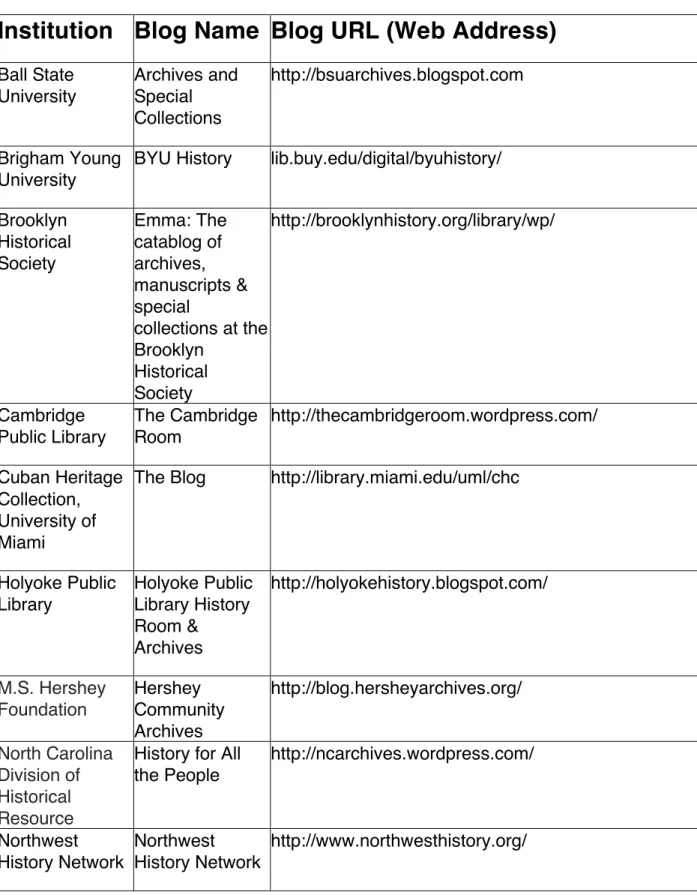
Figure 6: Archives Analyzed for this Paper
Institution Blog Name Blog URL (Web Address)
Ball State University Archives and Special Collections http://bsuarchives.blogspot.com Brigham Young University
BYU History lib.buy.edu/digital/byuhistory/
Brooklyn Historical Society Emma: The catablog of archives, manuscripts & special
collections at the Brooklyn Historical Society http://brooklynhistory.org/library/wp/ Cambridge Public Library The Cambridge Room http://thecambridgeroom.wordpress.com/ Cuban Heritage Collection, University of Miami
The Blog http://library.miami.edu/uml/chc
Holyoke Public Library Holyoke Public Library History Room & Archives http://holyokehistory.blogspot.com/ M.S. Hershey Foundation Hershey Community Archives http://blog.hersheyarchives.org/ North Carolina Division of Historical Resource
Pembroke Center for Teaching and Research Feminist Theory Archives http://feministtheorypapers.wordpress.com/ Smithsonian Institution Archives of American Art Blog http://blog.aaa.si.edu The Coca-Cola Company Coca Cola Conversations http://www.coca-colaconversations.com The Rhode Island Historical Society The Rhode Island Historical Society http://rihsgraphics.wordpress.com
Tufts University Digital
Collections and Archives sites.tufts.edu/dca/blog/ University of Massachusetts Dartmouth UMass Dartmouth Archives and Special Collections Blog http://jfarrar1895.wordpress.com University of New England Maine Women Writers’ Collection http://blog.une.edu/mwwc/ University of North Carolina-Chapel Hill
A View To Hugh: Processing the Hugh Morton Photographs and Films
http://www.lib.unc.edu/blogs/morton/
Wells Fargo Guided by
History http://blog.wellsfargo.com/guidedbyhistory/index.html Wesleyan University Special Collections and Archives Blog http://sca.blogs.wesleyan.edu/
Works Cited
Alexander, Christopher; Ishikawa, Sara; Silverstein, Murray; Jacobson, Max; Fiksdahl-King, Ingrid; Angel, Shlomo. (1977). A pattern language : towns, buildings, construction, New York : Oxford University Press.
Bell, S. “The library blog: Innovative idea or wasted words.” Library Issues 26, 1-4.
Berners-Lee, Tim. (1992) Information By Subject. Retrieved August 17, 2011 from:
http://www.w3.org/History/19921103-hypertext/hypertext/DataSources/bySubject/Overview.html.
Balas, Janet L. (2003, November). Here a blog, There a blog, Even the Library Has a Web Log. Computers in Libraries, 23(10), 41-43.
Blogs. (2011, March 9). Archives 2.0. Retrieved November 11, 2011 from: http://archives2point0.wetpaint.com/page/Blogs
Blogs. (2009). The Interactive Archivist. Retrieved September 17, 2011 from: http://interactivearchivist.archivists.org/technologies/blogs/
Blood, Rebecca. (2000, September 7). Weblogs: a history and perspective. Retrieved October 26, 2011, from:
http://www.rebeccablood.net/essays/weblog_history.html
http://www.blyberg.net/2006/01/09/11-reasons-why-library-20-exists-and-matters/
Burns, Kathleen T. and Kohl, Nancy. (2008). Blogging at the Beinecke:
Promoting Special Collections in the 21st Century. Retrieved August 17, 2011 from: http://www.library.yale.edu/~nkuhl/bloggingBRBL.pdf Casey, Michael E. and Savastinuk, Laura C. (2006, September 9). Library 2.0:
Service for the next-generation library. Library Journal. Retrieved August 17, 2011 from: http://www.libraryjournal.com/article/CA6365200.html Chatfield, Amy J.; Ratajeski, Melissa A.; Wang, John; and Bardyn, Tania P.
(2010, July). Communicating with Faculty, Staff, and Students Using Library Blogs: Results from a Survey of academic Health Sciences Libraries. Internet Reference Services Quarterly, 15(3), 149-168.
Chen, Sherab. (2009, October). Can blogging help cataloging? Using a blog and other web 2.0 tools to enhance cataloging section activities.(notes on operations). Library Resources Technical Services, 53(4), 251-260. Coates, Tom. (2003, June 11). On Permalinks and Paradigms ... Plasticbag.org.
Retrieved October 19, 2011 from:
http://www.plasticbag.org/archives/2003/06/on_permalinks_and_para digms/
Cox, Robert S. and Kovacs, Danielle. (2011) Alice in the Archives: The Evolution of the Catablog. From Theimer, Kate, ed. A Different Kind of Web: New Connections Between Archives and Our Users. Society of American
Crawford, Walt. (2011, March). Library 2.0 Five Years Later. Online, 35(2), 58-60.
Crawford, Walt. (2009, September). Academic Library Blogs: A Limited Update. Cites & Insights 9(10), 1-10. Retrieved October 20, 2011 from:
http://citesandinsights.info/civ9i10.pdf
Daines, J. Gordon III and Nimer, Cory L. (2009, May 18) Web 2.0 and Archives. The Interactive Archivist. Retrieved September 17, 2011 from:
http://interactivearchivist.archivists.org/
Elaine and Mr. Lippman - Exclamation Points. (1993) YouTube. Retrieved September 20, 2011 from:
http://www.youtube.com/watch?v=VSKn8RlD7Is
Farkas, Meredith. (2007, December 15). The Bloggers Among Us; A survey of the library blogosphere shows the mainstreaming of the medium. Library Journal 132(20), 40.
Farkas, Meredith. (2007). Future of Librarians Interview. CollegeOnline.org. Retrieved September 8, 2011 from:
http://www.collegeonline.org/library/librarians-online/meredith-farkas Hammond, Sarah. (2010, July 30) Public Library 2.0: Culture Change? Ariadne
64. Retrieved October 26, 2011 from:
http://www.ariadne.ac.uk/issue64/hammond
Kenney, Brian and Stephens, Michael. (2005, October 1) Talkin' Blogs. Library Journal Online. Retrieved October 12, 2011 from:
Kim, Y.M., & Abbas, J. (2010, May). Adoption of library 2.0 functionalities by academic libraries and users: A knowledge management perspective. The Journal of Academic Librarianship 36(3) 211-218.
Leonard, Kevin B. (2009, May 18). Blogs and Blog Marketing: Bringing New Users to the Northwestern University Archives. The Interactive Archivist. Retrieved September 17, 2011 from:
http://interactivearchivist.archivists.org/case-studies/blogs-at-nu/
Lietzau, Zeth. (2009, October). U.S. Public Libraries and Web 2.0: What’s Really Happening? Computers in Libraries 29(9) 6-10.
Matienzo, Mark A. (2006, September 22). On what ‘archives blogs’ are and what ArchivesBlogs is not. TheSecretMirror.com. Retrieved September 17, 2011 from: http://thesecretmirror.com/blog/2006/09/22/responsetolannon McFarland, Colleen. (2010). The Interactive Archivist: Case Studies in Utilizing
Web 2.0 to Improve the Archival Experience (web site review). Archival Issues 32(1) 50-51.
Mooney, Philip F. (2009, June 22). The Blog as an Archival Tool: Coca-Cola Conversations,” The Interactive Archivist. Retrieved September 17, 2011 from: http://interactivearchivist.archivists.org/case-studies/blog-at-coca-cola/
O’Reilly, Tim. (2005, September 30). What is Web 2.0?: Design patterns and business models for the next generation of software,” Retrieved September 1, 2011 from:
Peters, Mary E. (2011, April). Public Libraries use of Web 2.0 Tools. Master’s Paper, University of North Carolina at Chapel Hill. Retrieved October 19, 2011 from:
http://dc.lib.unc.edu/cdm4/item_viewer.php?CISOROOT=/s_papers&CI SOPTR=1405&CISOBOX=1&REC=1
Powell, Antoinette. (2007, June 1). That Bloggin' Pneumonia! Library Journal 132(10) 87-88.
Rosenberg, Scott. (1999, May 28). Fear of Links. Salon.com. Retrieved August 17, 2011 from:
http://www.salon.com/technology/col/rose/1999/05/28/weblogs/index. html
Rowse, Darren. (2011, March 28). How to Write in a More Personal and Engaging Tone. Retrieved October 27, 2011 from:
http://www.problogger.net/archives/2011/03/28/how-to-write-in-a-more-personal-and-engaging-tone/
Samouelian, Mary. (2009, Spring/Summer). Embracing Web 2.0: Archives and the Newest Generation of Web Applications. American Archivist 72(1) 42- 71.
Simonas, Linas. (2008, December 24). The Top 7 Flaws of Business Blogs. Retrieved November 11, 2011 from:
http://www.linassimonis.com/LSmark/2008/12/the-top-7-flaws-of-business-blogs/
Sommer, Thomas. (2009, December). UNLV Special Collections in the Twenty-First Century. Information technology and Libraries 28(4) 184-186, 190. Retrieved September 19, 2011 from:
http://www.ala.org/ala/mgrps/divs/lita/publications/ital/28/4/sommer2 .pdf
Stephens, Michael. (2006, July/August). Web 2.0 & Libraries: Best Practices for Social Software. Library Technology Reports 42(4) 8-14.
Stevenson, Jane. (2010, February 11). The impact of Web 2.0 on archives. The Archives Hub. Retrieved August 27, 2011 from:
http://www.slideshare.net/JaneStevenson/the-impact-of-web-20-on-archives
Surowiecki, James. (2006, October). 2006 Innovator of the Year: Joshua Schachter. Technology Review 109(4) 45.
Surowiecki, James. (2004). The Wisdom of Crowds: Why the Many Are Smarter Than the Few and How Collective Wisdom Shapes Business, Economies, Societies and Nations. New York: Doubleday.
The Sniffing Accountant. (1993, October 7). Seinfeld. NBC, 7 Oct. 1993. Television. Retrieved September 10, 2011 from:
http://www.seinfeldscripts.com/TheSniffingAccountant.htm>. Tonta, Y. (2008, June). Libraries and museums in the flat world: Are they
becoming virtual destinations? Library Collections, Acquisitions, & Technical Services 32(1) 1-9.
Winer, Dave. (2002, May 17). The History of Weblogs. Weblogs.com News. Retrieved August 17, 2011 from:
http://oldweblogscomblog.scripting.com/historyofweblogs>Last accessed 17 August 2011.
Xu, Chen, Ouyang, Fenfei and Chu, Heting. (2009). The academic library meets Web 2.0: Applications and implications. The Journal of Academic
Librarianship 35(4) 324-331.