Alexander H. Harding. Comic Book Metadata and Database Design. A Master’s Paper for the M.S. in IS degree. April, 2014. 45 pages. Advisor: Brad Hemminger
Current systems of metadata storage for American superhero comic books in the digital realm are limited in scope and capabilities. This study reviews eight systems of comic book metadata storage to determine the importance of metadata included and propose a more optimal system design in a relational database format for the storage of digital comic book information. As part of this work, a proposal for standardization of the comic book metadata fields is generated. Further development will be publicly maintained and shared through a Github repository.
Headings:
Comic Books, Strips, Etc – History & Criticism
Database Design
Metadata
Information Storage & Retrieval Systems
COMIC BOOK METADATA AND DATABASE DESIGN
by
Alexander H Harding
A Master’s paper submitted to the faculty of the School of Information and Library Science of the University of North Carolina at Chapel Hill
in partial fulfillment of the requirements for the degree of Master of Science in
InformationScience.
Chapel Hill, North Carolina April 2014
Approved by
Table of Contents
Introduction ... 2
Statement of Purpose ... 9
Systems Review ... 10
Markup Languages ... 11
Personal File Managers ... 12
Comics Databases ... 13
Retailers ... 15
Comparison ... 16
Methodology ... 17
Results ... 18
Metadata Descriptions and Proposed Standards ... 21
System Design ... 31
System Description ... 32
System Design: Entity Relationship Diagram ... 35
Discussion ... 36
Innovations ... 36
Weaknesses ... 39
Introduction
Since its inception, the American comic book industry’s stable of heroes
and universes has grown exponentially. Heroes of varying backgrounds and abilities
came to co-exist within universes created by the collection of heroes under the banners of
the publishers they belonged to. As the industry expanded, giving multiple heroes
multiple titles published on a monthly basis year-round, an editorial crisis came to light.
Given the expansive nature of the comic book storytelling medium, in which characters’
stories span decades of chronology and hundreds and thousands of single issues, there
comes a point in which there becomes too much to keep track of without retreading ideas
and contradicting previous events. Characters’ origin stories would change with alarming
frequency, and significant events in the chronology of characters would be included or
ignored as was most convenient to the author currently in charge of a character’s story.
This led to an inconsistent and often confusing experience for readers both new and
dedicated, as they could never truly be sure of who, what or where they were in a
particular story.
After fifty years of chaotic storytelling, DC Comics, one of the two major
publishers of comic books, produced Crisis on Infinite Earths. Crisis took the established
notion of the DC Universe as a “multi-verse” containing an infinite number of Earths,
continuity. To date, the DC Universe is divided into “pre-crisis” and “post-crisis”
continuity, and the idea of a universal continuity has been in place since Crisis on Infinite
Earth’s release in 1985. This is further complicated in numerous universe-wide
alterations to continuity (often referred to as “crises”), and the 2011 cancellation of all
series and subsequent rebooting for their “New 52” initiative.
Although a unified continuity is not a new or innovative concept, the execution of
the concept in the hands of the comic book industry is novel due to the unprecedented
size of the corpus. Typically, monthly comic books are published as series, which focus
on a singular character or singular team of characters. DC Comics currently publishes
anywhere between 40-60 series each month, and often limited series and promotional
tie-ins are added to this monthly list as well. Each issue is typically between 24 and 36
pages, which makes for a tremendous amount of story occurring simultaneously on a
monthly basis. Multiply that by the 75 year history of the company (or, for the sake of
convenience, the 28 years since Crisis on Infinite Earths), and the amount of literary
story is truly staggering.
Similar to the common television structure of episodes containing portions of
story that are completed over the course of a season, comic book issues often contain
small portions of story that are more cohesively read as a “story arc.” Some arcs are told
over a single series, however it is also common practice to employ what is called a
“crossover” event, in which a story is told over multiple issues of multiple series. This is
commonly done in order to facilitate interactions between characters and teams, as well
as synergistically cross-promote series for higher sales figures (ie: if a reader reads one
month, which may lead the reader to then continue purchasing those other series on a
monthly basis). Regardless of series, the traditional procedure is to collect story arcs into
larger books akin in size to graphic novels, often referred to as “trades,” in reference to
the physical publication of a “trade paperback.” From a literary standpoint, a story is
contained in these trades significantly more coherently than by a single issue.
Additionally, these trades are published in perpetuity, whereas single issues are published
only once during the month they are new. So for a reader to read a story without
following on a monthly subscription, common wisdom is to purchase trades from any
retailer (local comics stores, big box retailers like Barnes & Noble or Amazon).
Given the enormity of the universe, a major hurdle for readers new to comic
books is the sheer amount of history present in the universe. Browsing any comic book
forum or online community, the history of individual characters has grown to include
tremendous lineages.
As comics publishers release an increasing number of issues and stories, comic
book collection has become a major hobbyist market. The collectability of certain issues
and creation of storylines and variant covers has led to a significant amount of metadata
existing on a per-issue level, as certain comics with certain attributes place themselves
differently in comics collection. Furthermore, as the comics industry transitions into the
digital age, numerous attempts have been made to create metadata schemas for the
cataloguing of digital comics, some going as far as to attempt to mark up the physical
page into a machine-readable format. Various implementations for sorting digital
collections exist, and a number of significant comics databases exist on the public
and digital manifestations. Some go as far as to include characters and story arcs in their
relational model, allowing for research into character appearances across titles
chronologically and encounters therein. However, many of these implementations are
lacking in scope of completeness, and leave out crucial details either by design or as a
result of the limited scope of their design prior to implementation.
The comics storytelling medium is extremely fast paced, and almost every story,
be it a single issue or an arc covering a longer span of time, has a significant impact on
the universe as a whole. Characters die and are resurrected, are crippled and changed,
have minds erased or controlled, and teams are created and broken on an almost monthly
basis. Given that malleable nature, a timeline of character appearances in chronological
order of appearance does little good to a researcher. Knowing which characters appear in
a certain issue is certainly important data, but knowing who each character is in relation
to other characters and the aliases they take as heroes or villains at that point in history is
equally valuable data.
Given the relational nature of this data, further research on current comics
database implementation for analysis on strengths and weaknesses is an important topic
to the comics industry and readership. Discovering a relational model that allows for
recordable metadata corresponding to storytelling techniques and plot points could be key
in the visualization of data regarding characters’ arcs and chronologies in their decades of
existence in the medium.
As the comics industry transitions from paper books to digital sales, new
possibilities arise from the use of story-centric metadata. Predictive recommendations
appearances and even data-driven storytelling are all made possible by the inclusion of
literary metadata in an ordinary database system. Similar to Netflix’s system of
categorical tagging (Madrigal, 2014), a comic book system of plot elements would enable
predictive ratings and recommendations, and could even be used to inform content
creation.
In recent years, the comic book has become increasingly popular for academic
study. There is an abundance of literature concerning the creation of collections of
comics and graphic novels for use in public and academic libraries, yet there is a noted
dearth of any academic work focusing on comics either digitally or from the perspective
of innate organization. Most academic literature focuses on the importance of graphic
novels as a medium in a popular fiction collection, or the ways in which popular titles can
be obtained to round out a well-curated collection. However, given the popular nature of
comic books, the public internet is filled with opinions and research ranging from
personal blogs to pieces authored by industry professionals and even software designed
for the organization of private collections of digital comics. The phenomenon of popular
opinion eclipsing academic research is fairly common in literature reviews of
library-focused research papers; Catherine Clements quotes Will Savage’s notion that histories
of the medium are largely “popular” and not “academic,” and in their own structure
“contain no known documentary apparatus to support them (Clements, 26).
Unfortunately for this study, the rising trend of research into comic book literature
focuses on areas of research having very little overlap with the innate organizational
characteristics of superhero comics themselves, as they focus on existing trade paperback
at cataloguing comics in the digital realm focus not on the metadata inherent to comics as
a storytelling medium, but instead are intent on cataloguing the physical properties of a
comic even in digital form. Given the relational nature of the comic book storytelling, a
wealth of connectivity calls for an organizational schema by which comics can be related
to one another. Comic book universes “weave together a cohesive, metatextual tapestry”
(Friedenthal, 2012), which, if properly tracked using modern digital informational
organization schemas, could be invaluable to analyzing the medium. The idea of a
“universal continuity,” in which characters interact via crossover events and guest
appearances, guarantees a consistency from one title to the next. “Significant changes or
occurrences in any single book that takes place within the DC Universe are, by the
strictures of this continuity, reflected in every other DC Universe title. Thus, a simple,
working definition of this kind of continuity could be as follows: Continuity in a comic
book superhero universe is the meta-narrative created out of the sum total of meetings,
relationships, battles, births, deaths, and other twists of plot and characterizations that
have taken place within that universe” (Friedenthal, 2012). By using these connections to
create a schema of inherent connectivity, a database of comic book issues could be sorted
and analyzed in entirely new fashions, discovering trends and timelines for charting
character continuity while also offering the physical sort features regarding publishing
expected of a comics database. A system involving character tracking and plot element
storage could also be crucial in Netflix-like categorical ratings and suggestions, which in
a digital retail environment could drive sales and properly cross-promote products.
However, it seems as if research on the medium is firmly rooted in the past, and finding
from the industry’s nature, in that physical comic book collection has come to be as
important as the stories they contain. Frederick Wright’s notion that “For many comic
book readers and collectors, the idea that a comic book can exist other than in print may
be difficult to accept” (Wright, 2008) is validated by the lack of research, either public or
academic, concerning comics in any sense other than the organization of comics by
purely physical characteristics. Similarly, while many systems exist as repositories of
metadata for comic books, many are incomplete and lacking in key metadata fields.
Digital retailers present very little metadata about the comic books they sell, which makes
navigating their inventories often difficult and confusing for new readers. An aggregation
of metadata fields across a number of different systems could prove to be invaluable in
Statement of Purpose
Given the problems discussed in the introduction, this study aims to complete four
goals:
1. Review and critique current systems of digital comic book metadata storage 2. Analyze the metadata storage fields present in the systems to determine the
frequency of their appearance.
3. Propose standards of definition for the metadata fields described.
4. Use goals 1-‐3 to inform the design of an optimal relational database model including new innovations based on the perceived weaknesses of the systems reviewed.
Subsequent discussion of the results of these goals will follow after the design of the
proposed system and definitions of metadata standards, as well as discussion of new
Systems Review
Many databases and software packages exist both in open-source and commercial
implementations aimed at cataloguing comics. Although all of these exist in the digital
realm, a closer examination finds a significant bias towards the digital record keeping of
physical comic books.
Digital comic book systems can be broken down into four rough categories:
markup languages, personal file managers, databases and retailers. Markup languages
aim to use XML markup to describe a physical comic book, turning the entirety of the
content of a comic into a machine-readable format. Personal file managers attempt to
provide a metadata system for managing personal file collections, typically comprised of
DRM-free issues (or, unfortunately, pirated material). Databases attempt to act as
thorough repositories of comic book information, and retailers provide a space for the
sale of digital comics and limited comics exploration.
Both the markup languages and personal file managers base their systems on
XML, either by creating an entire document representation in the markup languages or by
creating small XML metadata files included in the comic book archive files used in the
personal file managers. XML is an excellent language for the storage of metadata, as the
language is designed to store information in a human- and machine-readable format for
easy data processing. It is also easily validated to conform to a custom written template
Database systems use a relational database format, typically MySQL, to store the
data in a much more versatile format. Most databases include a frontend interface using
HTML/CSS and PHP to connect to the database and display or edit information. This is
the eventual design goal, and will be the format of the product of this research.
Retailers’ systems are not made publicly available, and therefore all research
involving retailers’ systems is derived entirely from the frontend interface. Retail systems
likely use an underpinning of traditional relational databases, but are focused more on
content delivery and purchasing than storing thorough information. However, more
complete information could allow for easier discovery of new comics for a user to
purchase.
Markup Languages
John A. Walsh’s recent implementation, Comic Book Markup Language (CBML) is an
attempt to mark up the physical comic into an XML format for machine readability.
CBML concerns itself with completely digitizing the written page, highlighting “the
boon-ness and bookishness of these documents, their material properties and
bibliographic characteristics. Graphic narratives typically manifest as “books,” stapled or
otherwise bound leaves, perhaps thirty-six pages, with an interesting and complex
structure, incorporating the graphic narrative –the sequential art and text or ‘comics’
content – alongside a rich assortment of paratexts: advertisements, fan mail and so on”
(Walsh, 2012). CBML is an incredibly fascinating and valuable resource, yet the focus is
again on the physical texts themselves. A similar project, Advanced Comic Book Format
(ACBF) also focuses on marking up the full text of a comic and focusing on representing
print comics in the digital medium more so than the idea of the comic’s inherent sort
“characters” fields, but mostly again focus on the physical. Both offer similar schemas
(with CBML being significantly more thorough) for organizing the text and images on a
page, but other than general title and publisher information do not offer any form of story
sorting.
Personal File Managers
The most popular, open-source filetype for DRM-free digital comics is that of the comic
book archive. Available in .cb7, .cba, .cbr, .cbt, and .cbz (in which the last digit
corresponds to a different method of compression), a comic book archive is essentially a
compressed archive of digital images intended to be viewed in sequence (Wikipedia).
Many implementations of this standard allow for an XML file to be added into this
archive to track comics metadata, some with varying schemas. Comicbooklover is an
application developed by BitCartel, available at
http://www.bitcartel.com/comicbooklover/ . Comicbooklover attempts to create an
iTunes-like interface for organizing digital comics files, and includes a variety of
available sort fields. Unfortunately, because the metadata schema is not standardized,
organization done within comicbooklover is only compatible with other comicbooklover
products (such as their iOS app), and does not translate into other viewers and readers.
Comicbooklover’s metadata schema is fairly comprehensive, and has an interesting
system of user input to make up for its weaknesses. Comicbooklover includes a system of
user tagging, which allows for creative users to form their own search indexes. Although
the system does not track characters or story arcs, one could add a “Batman” or “Dark
Knight Returns” tag to issues involving the character or story, and use that as a sort field
CoMet, by DenVog, available at http://www.denvog.com/comet . DenVog accurately
summarizes the problem with non-standard formats in their specification documents:
“Currently programs, web sites, databases, and applications all use their own naming
schema for describing comic books. This makes it difficult, particularly for newcomers,
to get comics into software programs or web sites they wish to use to track their
collections. It becomes even more complicated when users wish to share or move
information about their collections across platforms (i.e. PC to iPad), between software
programs, or packaged as comic book archives (typically CBR or CBZ files)” (DenVog).
CoMet does a great job of creating an ease-of-use XML schema with a fair amount of
metadata for describing a comic. It however also does not catalogue any story data other
than being able to include character names. Both comicbooklover and CoMet both have
levels of completeness acceptable for the cataloguing of simple digital comics, yet both
are focused on the single-issue level. As metadata schemas, the intent and practice of
these implementations is to allow the user to add metadata on a per-issue basis, which
severely limits any data generation other than basic sorting. This is inherent to metadata
as a concept; for relational data, a traditional database is much better suited to the task.
Comics Databases
General comic book databases exist as well, some with exhaustive completeness in terms
of stored metadata. However, these databases again focus on providing a digital platform
for reference to print comics and their collection. The Grand Comics Database (GCD),
available at http://www.comics.org is a major online database for comics collection. GCD
makes their documentation freely available, and as such a physical schema whitepaper is
Book Database, accessible at http://www.comicbookdb.com, is another prominent
database, containing almost 300,000 single issues. Both of these databases go to great
length to add copious amounts of metadata on multiple levels, and accomplish a much
higher degree of completeness than the markup languages previously discussed. Both
databases include all publishing information, ranging from author and ISBN to printing
type and paper stock. Both also relationally model characters and story arcs separate from
the issues themselves, giving them the flexibility to see what characters were in what
issues and arcs, who characters are affiliated with by group, and even show a
chronological list of issues appeared in by character. This is a significantly more
comprehensive story view than the attempts of markup languages like CBML and ACBF,
which are much more focused on cataloguing the page than the story. Databases like
CBD and GCD are fantastic tools for reference on characters, but are very much focused
on physical comic book collections. Both databases have “my collection”
implementations, which function as a digital repository for the cataloguing of your own
personal collection of comics. This collection is done both in retrospect and in perpetuity,
as they offer “pull-list” like functionality, where users can note which series they
subscribe to and have the database automatically add new issues to their personal
collections, much as pull-lists work in a local comics shop. A definite issue on both
databases is the lack of clear lines of query, as user search is restricted to basic keyword
matching and full entity views. A user could search for “Batman” (although each
database has multiple Batman listings for multiple Batmen), and a user could search for
“Joker,” but a user can’t search for comics involving both Batman and the Joker.
absolutely possible, if not immediately presented to the user. Both databases also attempt
to categorize issues both by the series they belong to and the story arc they belong to.
This can be very helpful in organizing a story arc that is not collected trade paperback
form. However, because both databases are curated by their users, data varied across
issues and story arcs, with vacillating tagging of characters and arcs to issues in the
systems.
Retailers
In the United States, the largest digital comics retailer is Comixology. Both
Marvel Comics and DC Comics, as well as many of the larger independent labels, sell
their digital catalogues and new monthly issues through Comixology. Comixology has a
web app, and standalone apps for iOS, Android, Windows 8 and the Kindle Fire.
Comixology has a basic search function, and a similarly typical amount of metadata
stored per issue. Comixology also stores story arcs in a similar fashion to many of the
databases previously discussed, which is inherently more useful when reading actual
comics as the application is able to tell you what’s next in the series and what’s next in
the story arc upon completion of an issue. Otherwise, the metadata used in Comixology’s
user-facing collections adheres to similar standards of creator-based metadata.
Another major repository of digital comics in Marvel Comics’ Marvel Unlimited.
Marvel Unlimited is a subscription service that offers the entirety of Marvel’s back
catalogue for a monthly or yearly fee. Like comixology, Marvel Unlimited offers a web
app or applications for the major tablet operating systems, and stores the same set of
standard metadata per issue. Marvel Unlimited also supports story arc functionality when
Comparison
In order to better inform the design of a new system, a comparison of captured
metadata across multiple implementations is essential. Although most of the systems
described do not encompass the fully relational model in their user-facing
implementations, they all share a similar set of overlapping metadata fields that would
serve as the backbone for any future comics database. Comparing both the systems
described and creating a full list of metadata structures appearing across all systems, then
analyzing this data both by system type and across the systems in total would provide an
understanding key to informing future systems design. Additionally, detailed descriptions
of the metadata fields themselves and what they aim to capture is important to fuller
understanding of the purposes of each and the merits of their inclusion in a system. This
is also an opportunity to propose new standards for the metadata fields present in the
system design, which can prove beneficial for future designers to better understand the
Methodology
The eight systems reviewed and selected were examined to better catalogue the metadata
included in each. If further information such as whitepapers or schemas were available,
these were used for analysis; however, only two offered this information. Comic book
markup language (Walsh, 2012) and the Grand Comics Database (Grand Comics
Database, 2013) offered these deeper looks at their systems, but all other systems were
analyzed by registering for or installing the implementations and examining the available
metadata fields either by examining user-facing data or the tools available for editing or
adding entries.
A spreadsheet was created, with columns for each system. As new metadata fields
were discovered, rows were created for the discovered fields. A system of binary
weighting was used across all eight implementations, where a column received either a
“1” or a “0” in a metadata field row, indicating that it either did or did not include that
metadata, respectively. After all eight systems were analyzed, each field of metadata was
itself reviewed to determine the meaning of the metadata field. Similar fields or fields
with similar purpose and intent were merged into one row, with exceptions, as described
in the “findings” section of this paper.
The data was then filtered by system type, rather than by individual systems. This
allowed for a greater understanding of what metadata fields are traditionally included
Results
After further analysis of the systems described in the literature review, twenty-eight types
of metadata were found across the eight systems. Some of these data types were
purpose-oriented, and would not warrant inclusion in a database system, such as full document
markup and volume information.
Second, it became readily apparent that the two full-document markup systems, while
interesting for discussion, contained little to no metadata. These systems were concerned
with describing the content of a comic more so than the context within which a comic
book fits, and in their purpose-built systems a significant portion of metadata was not
included.
To that end, the decision was made to exclude the two from defining what metadata
structures were considered significant enough to be used in informing system design.
Now given a baseline total of six systems, any metadata appearing in three or more
systems (50% of total or higher) was considered significant in informing system design.
Similarly, it was important to note which metadata types appeared in each of the three
types of systems surveyed. As the intended goal is informing the design of a database
system as a repository of information, some information included in personal file
managers may not be significant. Additionally, identifying metadata present in databases
analyze flaws in retailer metadata presentation as more thorough information can be
greatly beneficial to customers attempting to navigate the enormity of the collection
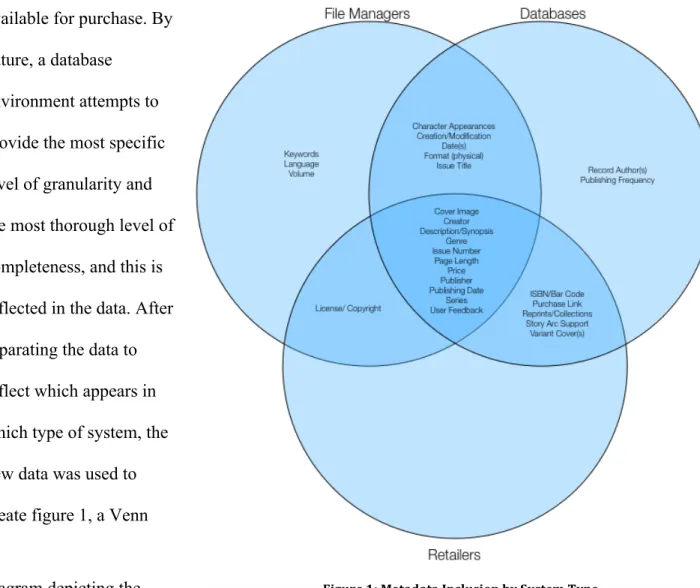
available for purchase. By
nature, a database
environment attempts to
provide the most specific
level of granularity and
the most thorough level of
completeness, and this is
reflected in the data. After
separating the data to
reflect which appears in
which type of system, the
new data was used to
create figure 1, a Venn
diagram depicting the
systems in which each metadata field appears. Eleven fields appeared in all three types of
systems, two only in databases, three only in file managers, and none were exclusive to
retailers. One appeared in only file managers and retailers, four were exclusive to file
managers and databases, and five were shared between only databases and retailers.
The metadata fields that only appeared in a file manager system type were typically
purpose-driven, and likely will not be important to future system design. The next section
provides fuller explanation of each type of metadata, and includes discussions when
necessary analyzing the necessity of inclusion of a particular piece of metadata.
*Markup language, not included in analysis
BOLD indicates appearance in three or more systems
CoM
et Comicbooklover CBML* ACBF* GCD CBD Comixology
Marvel Unlimit
ed Character
Appearances X X X X
Cover Image X X X X X X X
Creator X X X X X X X
Description/Synop
sis X X X X X X X
Record Author(s) X X X
Creation/Modificat
ion Date(s) X X X X
Format (physical) X X X
Full Document
Markup X X
Genre X X X X X
ISBN/Bar Code X X X
Issue Number X X X X X X
Issue Title X X X X X
Keywords X X
Language X X X
License/ Copyright X X X
Page Length X X X X X
Price X X X X X
Publisher X X X X X X X
Publisher City X
Publishing Date X X X X X X X
Publishing
Frequency X
Purchase Link X X X
Reprints/Collections X X
Series X X X X X X
Story Arc Support X X X X
User Feedback X X X X X
Variant Cover(s) X X X X
Metadata Descriptions and Proposed Standards
Character Appearances
Appears in 3 systems
Currently implemented differently across systems. Proposed standard would
include the ability to store characters (by real name) as well as their aliases,
and organizations that they belong to and appear in. Appearances of
characters/aliases/organizations should be chronicled by issue, and can use the
issue dates to track chronology.
Cover Image
Appears in 6 systems
An image file containing the cover of an issue. This can be stored in the
system or separately and referred to via file path/URL. A thumbnail can be
displayed on the main interface, which would act as a link to the full image.
Creator
Appears in 6 systems
Creators are any persons involved with the creation of the comic. Typically
the names of these people are listed on the cover, indica and/or splash page.
Creators can be writers, pencillers, inkers, colorists, editors and many other
roles. The system should allow for any number of creators to fill any number
Description/Synopsis
Appears in 6 systems
A small blurb describing the issue or collected edition. Proposed system
should use the publisher provided description provided in the monthly
solicitation for the issue.
Record Author
Appears in 2 systems
An entry in the system denoting which user edited a tuple in the database, as
well as the change made.
Creation/Modification Date
Appears in 3 systems
An extension of the record author. Records a timestamp along with the user
information.
Format (physical)
Appears in 3 systems
This field records the physical format of the comic book issue or collected
edition as it exists in the physical realm. This information is not particularly
important for monthly issues, but determines whether a collected edition is a
softcover or hardcover edition.
Full Document Markup
This field refers to the full markup of a document, as specified in the
Advanced Comic Book Format and Comic Book Markup Language. This is
not an essential field for a database system or even general metadata, as it is
its own purpose-built type of metadata system for storing comic pages, and it
will not be used in the proposed system.
Genre
Appears in 4 systems
A field recording the genre in which an issue is included. Often this can just
be “superhero,” but many comics fall under the headings of other genres such
as “horror,” “romance,” “supernatural” and many others. This field in the
proposed system should be a single word or short phrase describing the genre.
ISBN/Bar Code
Appears in 2 systems
This field should capture the ISBN of collected editions, or the barcode
numbers on the front of an issue. The barcode information on an issue can
sometimes be indicative of other factors (variant, printing), but many issues
do not include a bar code.
Issue Number
Appears in 6 systems
The issue number is one of the major pieces of metadata in identifying an
issue. The issue number is typically just an integer, although sometimes issues
cut”). The issue number, in combination with the series, is typically capable of
forming a composite key, although a separate ID is still recommended.
Issue Title
Appears in 4 systems
Often an issue will have a title or subtitle naming the issue. This title is
sometimes just the name of an arc and the number of the issue within the arc,
and sometimes is just a title on its own. This field can also store any other text
on the front of an issue if there is no title.
Keywords
Appears in 1 system
Two of the systems allowed for user tagging of keywords to assist search
within the system. These two systems were ACBF and Comicbooklover, and
is more intended for personal collections than for online databases. The
keyword tagging acts as a surrogate to make up for the lack of other metadata
fields, under the logic that the absence of any field can be recreated using
keyword tagging. This will not be included in the proposed system design.
Language
Appears in 2 systems
A general field to denote the language that the issue is written in. Many of the
systems are intended for American superhero comics, so they do not include
this field. This will not be included in the proposed system, as the proposed
system is intended for American superhero comics and it can be assumed that
License/Copyright
Appears in 2 systems
This is another aggregated field for a type of metadata that varies greatly
among systems. Unfortunately, most systems did not make it clear what they
intended this field to be used for, and the thoroughness of its completion
throughout the systems was left wanting. This will not be included in the
proposed system design.
Page Length
Appears in 5 systems
The number of pages in a particular issue, typically 24 or 36. Larger for
collected editions. Stored as an integer.
Price
Appears in 5 systems
The cover price of an issue. Typically included on the bar code or top left
corner of an issue. This is different from the sale price for issues on digital
retailers such as comixology, but instead a reflection of the original price
listed on the issue. Collected editions typically store a MSRP price on their
barcode as well.
Publisher
Appears in 6 systems
The publisher responsible for the issue. Publishers should be stored as a
separate entity in the system, so that browsing by publisher can be
Publisher City
Appears in 1 system
Likely a relic of an older time, when publisher city was a common listing
among comic books. This is no longer a common practice, and is not included
in the majority of systems. This will not be included in the proposed system
deisgn.
Publishing Date
Appears in 6 systems
This field typically refers to the cover date on a comic book issue, with some
exceptions. Comic book cover dates often appear on the cover, yet sometimes
appear on the indicia inside the book itself. Typically, cover dates are dated
between one and three months ahead of the actual date published, and is only
displayed in a month/year format. This comes from an old tradition, in which
dating covers later than actual publishing can make consumers think an issue
is current rather than older, and also functions as a pull date (the date on
which the issue can be sent back to the publisher for a refund)(Wikipedia). For
collected editions, this is just a publication date.
Publishing Frequency
Appears in 1 system
Although this field only appears in one system, it does represent a valid field
of metadata. Traditionally all comics are published monthly, although some
a month cycle. However, many new “digital-first” series are published
bi-weekly or bi-weekly, and are collected in a single physical issue monthly
containing the three or four digital issues (White, 2012). This will not be
stored in the proposed system, but warrants further study as to the best way to
include it.
Purchase Link
Appears in 3 systems
This field is a given for digital retailers like comixology, but for other systems
such as the public databases including a purchase link using an affiliate code
for websites such as amazon offer a great way to monetize their system in a
way other than advertisements. This will not be included in the proposed
design, as it is an academic project and not for profit.
Reprints and Collections
Appears in 2 systems
Different from story arcs, this metadata field records where issues have been
reprinted and/or collected in other works that would not otherwise be readily
apparent from the other metadata. This includes foreign translation reprints
and collection in “best of” collections and anniversary collections. This is not
necessary in the proposed system, as the collections are themselves stored and
issues are related to them. A thoroughly completed data set including issues
and collected editions would allow this information to be derived through
Series
Appears in 6 systems
As previously discussed in “issue number,” this is a crucial component to
identifying an issue. To solve the issue of multiple series having the same
name (for example, most of DC has relaunched their series with the same
series name but beginning with issue number 1 in 2011), series are
differentiated by including the date range or start date in the title. The “New
52” Batman series is listed as “Batman (2011)” to differentiate it from the
series before it. This will be stored in the system in this format, as a separate
entity with its own attributes.
Story Arc Support
Appears in 4 systems
Support for including information about a story arc was limited and different
across the systems it appeared in, but warrants mention as a single aspect.
Some systems chose to relate issues to a story arc, and some related issues to
the collected edition that encompasses the story arc (a weakness, as often
many issues are included in a story arc that do not get collected in the
paperback versions). However, story arc support is key to a database system
for digital comics, and an improved aspect of this will be crucial to designing
User Feedback
Appears in 5 systems
Many systems included a form of user feedback, which varied from a rating
using five stars or out of 10, or sometimes even just a comments section in
which a user can make comments about an issue. Some also included a section
for “reviews,” in which users could write a fuller review of an issue or
collected edition. Ratings systems appeared to be more frequently used than
full text reviews. The proposed design will include a system of user ratings
intended for a rating out of five, likely displayed as five stars in the interface.
Variant Cover(s)
Appears in 4 systems
An important aspect to physical comics collection is variant covers. Often an
issue will be printed with a variant cover drawn by a different artist, or a
pencils-only cover of the original (that is, without being inked and colored).
These are usually manufactured with rarity in mind and function as a retailer
incentive. If a retailer orders (typically) twenty issues of a given title, they’ll
receive one copy of a variant cover. If they order one hundred copies, they’ll
receive a pencils-only cover. In addition to traditional variants, often multiple
printings will receive a slightly different color (typically the same cover as the
first printing tinted a different hue) to differentiate. (Wikipedia). Many
systems treat variant covers as a separate issue forked from the first print
issue, and clone all metadata from the original to the variant. Variant covers
covers in the digital file. In the proposed system design, variants will be stored
as separate issues related to the issue they are variants of.
Volume
Appears in 2 systems
The volume field is specific to collected editions, not issues. It refers to
collected editions that are broken up into volumes, a common practice in
collected editions. A traditional book contains between five and ten single
issues (150-300 pages), and events that span more issues are broken up into
multiple collected editions. Larger collected editions that encompass the
entirety of events, including all issues and tie-in issues (issues not important to
the main story but involved in the event) are referred to as omnibuses, and
often eclipse the thousand page mark. This will not be stored in the system, as
System Design
Given the data acquired from the metadata survey, the twenty-two fields
appearing in three or more systems (50% or greater from the six systems included for
analysis) warranted inclusion in system design. With a SQL database end goal in
mind, a written description was necessary to fully understand the desired capabilities
of the system to be designed. The design is aimed to not only contain the metadata
elements supported by the research, but also to add new enhancements to existing
system designs for capturing new or different metadata structures. Some of these
improvements come from the system design itself, and some come from more
extensive use of SQL as a language for displaying related data.
The goal for this system is to create a MySQL database structure, and use
PHP to create a front-facing and user-accessible interface for adding and editing data
in the database. This system design is a foundation for that project, and further
development of the project can be seen or contributed to at
https://github.com/JaguarPhD/comicsdb .
The design described is an attempt to convey the metadata structures from the
research captured in a relational format. As such, some metadata fields supported by
the research may not appear or may appear in different ways, as some are intended to
System Description
Publishers have a name. Publishers publish series. A series must be published
by a publisher, and a series can only be published by a single publisher.
A series has a title. A series contains issues, and the dates of these issues can
be used to determine the start and end dates of a series. Issues must be in a series.
Issues have an issue number, a cover price, a cover date and a cover image. An issue
that is a variant cover of another issue will be related to that issue in a separate table.
An issue can have many variants.
Creators have a first and last name. There are multiple roles that a creator can
have (author, penciller, inker, colorist, letterer, etc.). An issue must have at least one
creator, but can have any number of creators. All creators must have a role.
Story arcs contain issues, and have a title. A story arc contains many issues, and an
issue can appear in more than one story arc. Story arcs contain plot elements. A plot
element functions like a keyword, and can be used in many arcs (and a single arc can
have many plot elements).
Story arcs and issues are both (separately) collected in collected editions. A
collected edition is any printed collection (colloquially referred to as a "trade") in
trade paperback, hardcover or digital form collecting a larger story. Collected
Characters appear in issues. Many characters appear in a single issue, and
characters appear in many issues. A character has a first, middle and last name. If a
character's real name is unknown, they gain an entry with null fields. A character
often has an alias. An alias refers to the "nom de guerre" of a character, such as
"Batman" for Bruce Wayne or "Superman" for Clark Kent. A character can have
many aliases, and an alias can be used by many characters. When capturing a
character appearance in the database, a ternary relationship between character, alias
and issue is best. This way, using the cover dates of the issues, a character's
relationship with their aliases can be tracked over time.
Organizations are also stored by the system. Often organizations and teams
(such as the Justice League, Teen Titans and Avengers) appear in issues as well.
Organization appearances in issues are stored as a ternary relationship between
character, organization and issue. This ternary relationship functions similarly to that
of the issue, character and alias, by tracking organizational membership across
issues. This would not only allow for tracking of an organization's appearances over
time, but also storing group membership over time.
Users in the system have a username, password and email address. Users are
capable of giving a rating (out of ten) to issues, series, story arcs and collected
editions. Each rating is saved as a relationship with the item they are rating. In this
way, a user can only rate an entity once. For the sake of simplicity, creation and
modification records are not saved in this system. In production, keeping record of
who creates and modifies entries in the system is very beneficial, however in order to
relationship for each entity in the database) have been omitted from the design
Discussion
Given the research, the proposed metadata fields as laid out in the relational
design provides for an optimally thorough repository of comic book information. The
system encompasses the entirety of the physical comic characteristics that current
systems aim to capture, while embracing the digital and relational nature of the data to
provide new and innovative data storage to enrich the content contained in the database.
Similarly, the research indicated an extreme lack of standardization of definitions for
metadata fields. Although the essential idea of certain types of metadata was shared
across multiple systems, the definition of each field and the manner in which it was
stored or implemented differed greatly across the different systems that contained them.
The proposed standards for metadata definitions, along with the manner in which they are
stored in the system design, will hopefully be influential in design of future systems and
proliferation of completeness of information in digital retailers.
Innovations
Story Data: The system design includes plot elements as a table related to story arcs.
Although this idea isn’t explored in tremendous detail, adapting the metadata element of
“keywords” to support a pre-defined list of plot elements can be beneficial for
recommendations based on the system of user ratings. By examining the plot elements
recommendations can be made in a retailer system to drive sales by accurately predicting
a user’s taste. This area of the system warrants further examination and further research
in order to determine a proper list of keywords and the manner in which they relate,
similar to the system implemented by Netflix (Madrigal, 2012).
Character Tracking: To this point, systems have included character tracking as an
arbitrary binary relationship: a character appears in an issue or story. In the proposed
system design, this is greatly expanded and improved. In the comic book world,
characters change aliases relatively often, and often an alias is used by many characters.
For example, Dick Grayson started as Robin before growing up and taking the name
Nightwing. In the late 2000’s, in the absence of Bruce Wayne (the original Batman),
Grayson took the place of Batman. Additionally, Grayson is one of six characters to serve
as Robin (also including Jason Todd, Tim Drake, Carrie Kelly and Stephanie Brown) ,
and one of four to serve as Batman (including Bruce Wayne, Jean-Paul Valley and Terry
McGinnis). There are also multiple versions of each alias, as used in different types of
comics. Traditionally, database systems store each version of Batman differently, titled to
be specific. For example, Comicbookdb lists 51 separate characters starting with the term
“Batman.” This covers different versions of the character as well as different characters
using the alias. In the proposed system, storing the different versions of an alias as
needed as aliases separate from characters, and storing each value as a ternary
relationship between character, alias and issue allows for much richer tracking of
characters and aliases. Using this system, one can track a character’s appearances over
character’s changing aliases over time, as well as how many times they’ve appeared as
each alias. Similarly, the same can be done by alias instead of by character, and chart the
alias’s appearances over time and the breakdown of who appeared as that alias over time
as well as how many times each character has appeared as that alias. This system is
significantly more powerful than the existing system of binary relationship storage
between character and issue, and allows for a large increase in clarity when determining
the history of a character or alias. This system could also allow for a visualized timeline
of a character, as the character’s appearances and alias can be charted over time as they
appear in issues by cover date. The system can also be used to track interactions between
characters by determining which issues characters appear in together.
Additionally, this system replicates the same process of relations between
characters and aliases for characters and organizations. Previous systems include binary
relationships between characters and organizations and organizations and issues,
respectively. A similar ternary relationship is in place in the proposed system design to
relate characters, issues and organizations. This allows a user to not only know that an
organization appears in an issue or story and that a character is a member of an
organization, but also to use the cover dates to know when a character appears as part of
an organization and when they don’t.
Further thought is being put towards the end of combining these ternary
relationships to a single quaternary relationship between character, alias, organization and
issue. However, this presents problems in that more often than not characters appear
without organization and creates a large amount of null fields stored, and reduces
for situations in which changes in organization or alias occur simultaneously for the
benefit of reduced storage capacity.
Creator storage: The way in which storage of creators is handled also varied greatly
from system to system. Some had a predefined list of roles that you could input any name
to, some had predefined lists of creators (with their roles attached, stored as a table for
each role) and each role/creator entry could be tagged to an issue. In the proposed system,
a table of creators (first and last name) and a table of roles exist and are tagged in a
ternary relationship with issues. This allows for more flexibility, as oftentimes creators
fill different roles in different issues. Many writers are also artists, and sometimes even
do lettering/inking/coloring themselves. The same is true of the opposite, often artists can
write their own series. The proposed system allows for complete flexibility of any
combination of creator and role.
Weaknesses
As previously discussed, the proposed system does not currently support
recording of users along with creation and modification of entries in the database.
However, this is a fairly simple concept and can be done with relative ease. All that is
needed is a table for changes that is in a relationship with the users table and every
respective table in the database. This table can record the user’s ID, the table’s ID, the
field changed and a timestamp.
The “plot element” field also requires significant research on its own. Although
conceptually the field has merit, the list of plot elements to be used in the system
warrants further study in order to properly function in the system. If it is left to users to
become prevalent quickly. This table should be used internally and using predetermined
and well researched ideas for optimal prediction of recommendation.
The proposed system also does not include purchase links or internal storage for
digital comic book files. As this is an academic project, purchase and profit was not a
goal of this system. However, common storage techniques or even URL links to an
affiliate page on a reseller like Amazon could provide for easy monetization of the
system, as users who find an issue or collected edition via the system can have a way to
Bibliography
Amatriain, X., & Basilico, J. (2012, April 6). [Web log message]. Retrieved from
http://techblog.netflix.com/2012/04/netflix-recommendations-beyond-5-stars.html
Bell, M (2006). The Salvation of Comics: Digital Prophets and Iconoclasts.Review of
Communication, 6(1/2), 131-140. Doi 10.1080/15358590600763417
BitCartel. (2013, November 01). Comicbooklover. Retrieved from
http://www.bitcartel.com/comicbooklover/
Canonical, L. (2012, April 01). Abcf - file format specifications 1.0. Retrieved from https://launchpad.net/acbf/trunk/1.0/ download/ACBF - File Format
Specifications-1.0.zip
Canonical, L. (2012, April 01). Abcf-xmlschema-1.0. Retrieved from
https://launchpad.net/acbf/trunk/1.0/ download/ACBF-XMLschema-1.0.zip
Christianson, J. E. (2011, November 29). [Web log message]. Retrieved from http://buquad.com/2011/11/29/the-comiquad-judging-a-book-by-its-cover/
Clements, C. (1999). Building a comics collection: A plan for academic libraries.
(Master's thesis, University of North Carolina)Retrieved from
https://cdr.lib.unc.edu/indexablecontent?id=uuid:6a2cdd05-de67-4e44-9cfa-c27ebf7f0f82&ds=DATA_FILE
ComicbookDB. (2013, November 01). The comic book database. Retrieved from
http://comicbookdb.com/
Comic book archive. (n.d.) In Wikipedia. Retrieved from
http://en.wikipedia.org/wiki/Comic_book_archive
Comixology. (2014, February 20). Comixology: Batman (2011) Retrieved from
https://www.comixology.com/Batman-2011-1/digital-comic/13928
Cover Date. (n.d.). In Wikipedia.Retrieved from
Bibliography, Continued
DenVog LLC. (2013, November 01). CoMet specification. Retrieved from
http://www.denvog.com/comet/comet-specification/
DenVog LLC. (2013, November 01). CoMet about page. Retrieved from
http://www.denvog.com/comet/
Friedenthal, A. (2012). Monitoring the past: Dc comics' crisis on infinite earths and
the narrativization of comic book history. ImageTexT: Interdisciplinary Comics
Studies, 6(2), Retrieved from
http://www.english.ufl.edu/imagetext/archives/v6_2/friedenthal/
Grand Comics Database. (2013, October 09). Grand comics database - new schema.
Retrieved
from http://dev.comics.org/additional_wiki_files/new_schema.html
Grand Comics Database. (2013, November 01). Grand comics database. Retrieved from
http://www.comics.org
Madrigal, A. C. (2014, January 02). How netflix reverse engineered hollywood. The
Atlantic. Retrieved from
http://www.theatlantic.com/technology/archive/2014/01/how-netflix-reverse-engineered-hollywood/282679/
Marvel Comics. (2014, March 20). Amazing spiderman #121 (1963) Retrieved from:
http://marvel.com/comics/issue/6507/amazing_spider-man_1963_121
McCloud, S. (2000). Reinventing comics: How imagination and technology are
revolutionizing an art form. (1 ed.). William Morrow Paperbacks.
McCloud, S. (1994). Understanding Comics: The Invisible Art. (1 ed.). William Morrow
Paperbacks.
Oliveros, J.C. (2007). VENNY. An interactive tool for comparing lists with Venn Diagrams.
http://bioinfogp.cnb.csic.es/tools/venny/index.html
Variant Cover. (n.d.). In Wikipedia.Retrieved from http://en.wikipedia.org/wiki/Variant_cover
Walsh, J. (2012). Comic book markup language: An introduction and rationale. Digital
Humanities Quarterly, 6(1), Retrieved from
Bibliography, Continued
White, M. (2012, August 14). A look around the digital-first comics
landscape. Publishers Weekly, Retrieved from
http://www.publishersweekly.com/pw/by-topic/digital/content-and-e-books/article/53552-a-look-around-the-digital-first-comics-landscape.html