Factors Affecting Facility-Based Delivery in Indonesia
THE UNIVERSITY OF NORTH CAROLINA AT CHAPEL HILL THE GILLINGS SCHOOL OF GLOBAL PUBLIC HEALTH
MATERNAL AND CHILD HEALTH
Fall 2011
2
Table of Contents
I. Introduction ... 2
II. Literature/Evidence Review ... 3
III. Methods ... 5
Location... 5
Population ... 6
Instrument Design ... 7
Measures/Analytic Techniques ... 9
IV. Results ... 10
Background Characteristics ... 10
Delivery Location ... 11
Reasons for Delivery Location Choice ... 13
Cost of Delivery Services ... 14
Physical Access Barriers ... 15
Influencing Factors for Facility-Based Deliveries ... 16
Disrespect and Abuse ... 17
V. Discussion/Recommendation ... 19
VI. References... 22
VII. Appendix 1 – Survey Instruments English ... 25
3 I. Introduction
As the 2015 deadline for the Millennium Development Goals (MDG) approaches, Indonesia still suffers
from a high maternal mortality rate (MMR) of 228 per 100,000 live births.(1) The fifth MDG goal, which seeks a reduction in maternal mortality by 75% between 1990 and 2015, looks to Indonesia to reduce its MMR from an initial 421 per 100,000, as cited in the 1991 Indonesia Demographic and Health Survey
(IDHS), to 100 per 100,000.(2) While the government has previously implemented several population-level programs that have reduced the MMR, Indonesia’s large and diverse population, wealth disparity and urban/rural divide continue to contribute to maternal deaths. Additionally, the 1998 and 2004 government decentralization efforts allowed local governments more say and choice in their
investments, instead of these decisions being handed down from the national government in Jakarta.(3) To this effect, local funding is often first spent on visible and tangible infrastructure improvement, with remaining money allocated to services such as education and health. This has increased the health
disparities between regions, as certain regions may put more emphasis on maternal health than others.(4) MDG 5 seeks to improve maternal health both by reducing by three-quarters the MMR and increasing universal access to reproductive health care. In Indonesia, women die every hour due to complications during pregnancy and delivery which are exacerbated by the fact that 53% of deliveries
take place at home and 24% of deliveries are assisted by a traditional birth attendant (TBA) with no formal training.(1)(5) Women’s decisions on where to deliver their children are based on a variety of factors including cost, distance to facility and the type of provider available to assist them. The goal of
this study was to increase our understanding of the reasons women choose to either stay home or deliver in a facility and to determine the breakdown of facilities used between the public and private sector. Overall, this study will inform programmatic decision making in an effort to reduce access
4 II. Literature Review/Evidence Review
In developing countries, especially those in South East Asia and sub-Saharan Africa, cultural and societal
norms lead to high levels of home-based deliveries. While exact figures vary depending on the country, and further the regions within the country, in a study based on data from 48 DHS surveys spanning the globe, more than half of the deliveries took place at home.(6) Home deliveries are also most common
amongst the poor.(6) The link between mother’s education and skilled care has been studied
extensively and we know that higher levels of education lead to more autonomy and decision making power, a greater ability to acquire and understand knowledge and improved attitudes toward health problems and facilities. (7-9) Mothers’ education is an important predictor for home vs. facility based
birth.(10) Studies done in both Bangladesh and Nepal note that low education levels are associated with women delivering at home.(10,11) The research done on delivery location in Nepal also raises multi-parity as an indicator of home delivery, stating that the more children a woman has, the more likely she
is to continue delivering at home.(11) Additionally, many women consider their previous birthing experience as a proxy for future deliveries; therefore if they had no complications and delivered at home, they perceive that all future births can safely occur at home.(12,13) Women in Indonesia and Timor Leste cited birth complications as the only reason they would travel to a facility.(12,13)
Cost is a major barrier in women’s access to delivery services. Some countries, including Indonesia, have created government insurance schemes that will pay for the delivery services for poor women. In January 2011, the Government of Indonesia created a new public assistance insurance
scheme called jampersal that allows all women, regardless of level of income, to deliver for free at a facility.(14) Unfortunately, the government has not yet uniformly rolled this program out to all of the districts. Jampersal, and other insurance schemes, aim to alleviate the burden of cost on the woman,
5 transportation, food and childcare.(13)(12) Despite the free delivery at a health facility, a study in West Java, Indonesia showed that women preferred the services of TBAs or were either confused or
embarrassed about using the government insurance program and ultimately delivered at home.(12) In many developing countries, distance to a health facility is a major factor in the selection of delivery care services.(15-17) It often takes women hours or days to arrive at a health facility due to
poor infrastructure. This encourages women to stay at home to deliver their children. The issues of distance and transportation often overlap since transportation is very unreliable and often women are on foot. Skilled birth attendants (SBA) noted that distance and transportation in Bangladesh make it challenging to get to women’s homes in time for the delivery.(18) Accordingly, we can extrapolate to
infer that the women in question would likely have difficulties reaching a health facility.
The studies mentioned have strengths and limitations in their analysis of factors affecting delivery location. The study population is different in all studies, some of which are more representative
than others. The data from Timor Leste and Indonesia sought “specifically unusual cases” and focused on one province that is known to rely heavily on TBAs, respectively.(12,13) Therefore, these results may not be generalizable to the entire population of these countries, nor to the greater Southeast Asia region. The sample size from Matlab, Bangladesh was greater than 41,000 people, but since Matlab has
been a research center since the 1980s the Matlab population may be influenced by the fact that it is a study site and therefore may not be representative of the larger population. Finally, by changing the perspective and interviewing SBAs instead of women, data from another study in Bangladesh attempts
to prove that home-based deliveries are dangerous, due to lack of equipment and medicine, and inconvenient for the SBAs, and therefore, women need to travel to health facilities to deliver.(18)
This study seeks to understand the reasons that women choose non-facility based births versus
6 decision to choose a facility. With a perceived growing trend in facility-based disrespect and abuse, women were also asked to report on disrespect, mistreatment and abuse that they experienced,
witnessed or heard during their delivery. At present, no other research has been published which looks at women’s perceptions of non-facility based deliveries versus facility-based deliveries in the same timeframe and location as this research.
III. Methods
The dependent variable of this study is the delivery location which has five possible outcomes: home,
puskesmas, private clinic, public hospital and private hospital (see definitions below). The mediator variables that directly affect women’s choice in delivery location include cost of delivery and physical
access barriers, such as distance to facility and availability of transportation. Furthermore, there are several independent variables including level of education, level of income, age, availability of insurance (either publicly provided by the government or privately obtained), and knowledge and attitudes of
maternal and child health (MCH). In this model, age, level of education and level of income play a central role as the basis to other independent variables that affect women’s choice. The information from this study will inform programmatic decision-making for Jhpiego1, including the relationship between influencing factors and the delivery location. Jhpiego’s goal is to analyze the influencing
factors to determine what, if any, programs can be implemented to increase the knowledge of women and to reduce barriers to access.
Location: This study was designed with the programmatic needs of Jhpiego in mind, and the data were collected by the author, with assistance from a translator who was formally trained as a
7 midwife and therefore had intimate knowledge of the subject matter. The survey was conducted in four districts in Indonesia, where JHPIEGO currently works. By working in these districts, a relationship was
already established with the District Health Offices and the mission for the project was pre-determined. The four districts spanned the islands of Sumatra and Java and included Minas, Karawang, Bojonegoro and Serang, respectively. In Minas, Karawang and Serang, we surveyed women in six different villages,
and in Bonjonegoro we surveyed women in five different villages. Within each district, we coordinated with the District Health Officer (DHO) to choose the villages and facilities where the interviews would be conducted. Villages were purposively selected in collaboration with the DHO and village midwives based on at least one of the following criteria: availability and interest of village midwife to coordinate
gathering of woman for the survey; villages facilitating mother’s centering groups; and villages with an antenatal care (ANC) clinic.
Population: The participants in this study included three predetermined groups of women: pregnant women, postpartum women who delivered in a facility, and postpartum women who delivered at home or in a facility not covered in this study. Postpartum was defined as no more than six months after delivery. For our purposes, facility was defined by the following health care posts: puskesmas, or community health centers established and funded by the government and including at least one
midwife, nurse and doctor; private clinic which included private midwifery practices or private clinics that employed at least one midwife and one doctor; public hospital, established and paid for with government funding; and private hospital, established and paid for by private donors. Non-facility was
defined as: home or pustu (sub-health center), poskesdes (village health post) or polindes (village maternity post), which all generally have little to no equipment and often a midwife or nurse as the only consistent health care provider available. These distinctions were defined with the help of Jhpiego staff,
8 Bojonegoro, the district level government invested a lot of money into the polindes which were often better equipped than some of the puskesmas. Despite this, and due to the country-wide precedent of
polindes usually having fewer resources than puskesmas, we continued to include them as non-facilities. In each district we sought to interview 12-15 women per day with the goal of interviewing 100 women from each group. After the DHO selected the villages, the village midwives were charged with
finding approximately 15 pregnant and postpartum women that fit the parameters of our study. All women identified who met the study criteria for pregnancy/post-partum status were eligible to be interviewed, regardless of age, parity etc. The sample was a convenience sample as participants were selected at the convenience of the village midwife and is therefore not a statistically representative
sample of the population. We collaborated with the DHO and village midwives one week before our arrival in each district and therefore the village midwives had time to consult with pregnant and
postpartum women and invite them come to the meeting place (often a health post) at a specified time
and place. While the village midwife attempted to find equal numbers of pregnant, non-facility delivery postpartum and facility-delivery postpartum women, she was not always able to. Our final number of participants was 300 and the breakdown included 93 pregnant women, 91 postpartum non-facility deliveries and 116 postpartum facility deliveries. We were unable to meet the goal of 100 women per
group due to the women’s availability or because their postpartum status fell outside of the six month timeframe. Participants were all compensated with snacks while waiting for the interview to begin and with a wellness kit, including a toothbrush, toothpaste, soap and washcloth, when the interview was
complete. No monetary compensation was provided. An overview of the study, with a request for consent, was read to each participant, and each woman signed the Informed Consent document allowing us to begin the interview.
9 When interviewing the participants, each woman was given an identification number, and only
information relating to the district and village we were in was collected. Each question and, where
applicable, list of responses was read to the participant to avoid any problems with illiteracy and to ensure that the questions were read the same way each time. The questions are a combination of previously validated questions from the IDHS, questions about disrespect and abuse from the Averting
Maternal Death and Disability (AMDD) questionnaire used during facility exit interviews in Tanzania, and questions that we ourselves created. After conducting the literature review, and reviewing other surveys that sought data on quality of care and the reasons that women choose where to seek medical
care, we created the remaining questions. We
sought the answers to questions around birth and delivery planning including delivery location, delivery attendant (TBA, midwife,
OBGYN, etc.), cost, and distance to facility. We asked about presence of any birth
complications and if participants were referred to higher level medical establishments for these
complications. The primary research goal was to identify the reasons that women choose to deliver at the location of their choice. We
asked all postpartum women where they delivered and followed up by asking, “Why did you choose to deliver at that location?” We
then asked all postpartum women who did not deliver at a facility, and all pregnant women, “Which of the following would encourage you to go to a Box 1: Consolidation of reasons for choosing delivery location
Original Question Options Analysis Categories Cost
Insurance
Distance
Transport Available
Cleanliness
Good supply of drugs and equipment Type of health provider
Experience of health provider Attitude of health provider Relationship with health provider Being treated with respect Midwife Unavailable
Safety for mother and child Afraid
Health worker recommended Referred by another facility Recommendation from family Facility where usually go
Privacy Comfort Childcare
Weather
Didn’t make it in time
Nothing
Cost
Physical Access
Quality of Services
Knowledge
Recommendations
Convenience
Other
10 facility to deliver?” This list of possible responses originally had 16 options which were read to all respondents, including an “other” category, from which women could choose as many options as were
applicable to them or give us a reason that was not included. When the “other” responses were listed out, the number of choices increased to 24. These response options were consolidated into eight categories for analysis, as seen in Box 1.
For the majority of the 300 participants, this question was difficult to understand. For the first two districts that we visited, the same response options were provided for all women. For the last two districts, we amended the responses to facilitate understanding and created separate responses for those who had or were choosing to deliver in a facility and for those who hadn’t or were choosing not to
deliver in a facility. For example, instead of asking if “distance” was the reason a woman either chose a facility or didn’t, we asked women who chose a facility if “the facility was close to your home” and women who didn’t choose a facility if “the facility was far from your home.” With the former wording,
women had a difficult time understanding this question, and the translator would have to ask it multiple times in order to receive a response. With the wording amended, women were more easily able to understand and answer this question.
Measures/Analytic Techniques: The overall dependent variable in this study is delivery location. The independent variables that we will explore as affecting this are age and education level with cost of delivery and distance to facility as mediating factors. We will further explore how the questions around the perception of influencing factors affected the choice of delivery location.
All quantitative analyses were performed using Stata SE 12. Data were primarily analyzed using descriptive statistics, specifically cross-tabulations. With a relatively small total sample size, the sample size was very small for some subgroups, such as older women, women with a secondary level education,
11 and 40-49, education collapsed to “some elementary,” “some junior high,” and “senior high/secondary,” and income collapsed to low, mid and high.
This study was exempt from Institutional Review Board (IRB) approval on the basis that is was considered to be a programmatic study informing program implementation rather than contributing to generalizable knowledge.
IV. Results/Findings
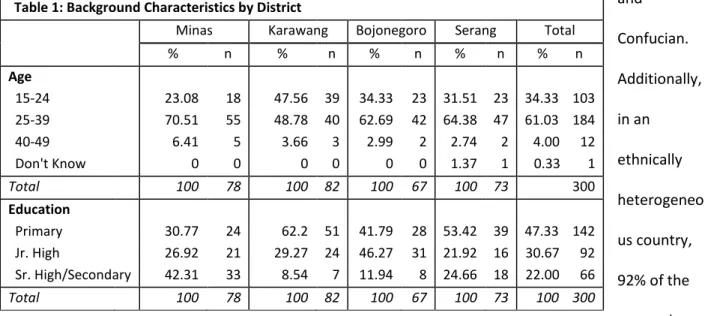
Background Characteristics - Descriptive statistics for background characteristics are presented in Table 1. The mean age of respondents was 28, and the majority of the respondents fell in the age range of 25-39. Most women had either some primary or some junior high school education, but relatively few had
any senior high school or secondary education experience. In this predominantly Muslim society, all 300 respondents were married women. Data on religion and ethnicity are not shown; however 278 (92%) of the women self-identified as Muslim, while the remaining 22 (7%) self-identified as Protestant, Catholic
and Confucian. Additionally, in an
ethnically heterogeneo us country,
92% of the respondents were Javanese, Batak or Sundanese, and the remaining 7% were Malay, Minang, Nias and Ache (data
not shown).
Table 1: Background Characteristics by District
Minas Karawang Bojonegoro Serang Total
% n % n % n % n % n
Age
15-24 23.08 18 47.56 39 34.33 23 31.51 23 34.33 103 25-39 70.51 55 48.78 40 62.69 42 64.38 47 61.03 184 40-49 6.41 5 3.66 3 2.99 2 2.74 2 4.00 12 Don't Know 0 0 0 0 0 0 1.37 1 0.33 1
Total 100 78 100 82 100 67 100 73 300
Education
Primary 30.77 24 62.2 51 41.79 28 53.42 39 47.33 142 Jr. High 26.92 21 29.27 24 46.27 31 21.92 16 30.67 92 Sr. High/Secondary 42.31 33 8.54 7 11.94 8 24.66 18 22.00 66
12 Place of Delivery – All postpartum
respondents reported the location of
their most recent delivery, while pregnant women reported the planned
location of their upcoming delivery. The
results listed in Table 2 contrast the actual and planned delivery locations of all 300 respondents, while Figure 1
provides a graphical representation. The postpartum data combines facility and non-facility births. Of
the postpartum women, 24% (n=49) chose private clinic as their planned location, followed by 19% (n=40) of women choosing puskesmas. Of the 93 pregnant respondents, private clinic and home were
almost evenly
divided as planned delivery location, with
36% (n=34) and 32% (n=30) of women,
respectively. Table 3 identifies delivery location by the respondents’ background characteristics, providing more detail by
district, age, education level and income level. Breaking down these background characteristics by district allows us to see the disparities between the districts. Overall, home deliveries accounted for
Pregnant (Planned) Postpartum (Actual)
% n % n
Home 32.26 30 33.82 70
Puskesmas 17.20 16 19.32 40
Private Clinic 36.56 34 23.67 49
Hospital 2.15 2 9.18 19
Private Hospital 1.08 1 3.86 8
Other 10.75 10 10.14 21
Total 100 93 100 207
0 5 10 15 20 25 30 35 40
Home Puskesmas Private Clinic Public Hospital Private Hospital
Other
Wom
e
n
Delivery Location
Figure 1: % Distribution of Delivery Location Postpartum
vs. Pregnant
13 almost 34% of all postpartum interviews, followed by private clinics at 23.6%. For home deliveries, Serang and Karawang have the highest incidences, while Bojonegoro has the least. Bojonegoro has the
lowest incidence of home deliveries, however has the highest incidence of other non-facility deliveries most of which occurred at the polindes. Puskesmas and private clinic deliveries fell around the same range across all districts. The highest percentages of home deliveries occurred with women between
15-24 years old and those with some elementary education. Hospital deliveries were rare across districts, and often occurred only for those women with birth complications. In terms of income, the highest percentage of low income women delivered at home, while the highest percentage of high income women delivered at a private clinic. While the total sample population in this table is small, it
does speak to the background characteristics between districts and may help to understand the reasons
2
Missing data for two women on level of income.
Table 3: Actual Place of Delivery by Background Characteristics – Postpartum Women2 Home Puskesmas Private
Clinic
Public Hospital
Private Hospital
Other Total
% n % n % n % n % n % n % n
District
Minas 32.69 17 21.15 11 28.85 15 3.85 2 9.62 5 3.85 2 100 52
Karawang 44.83 26 27.59 16 17.24 10 6.90 4 3.45 2 0 0 100 58
Bojonegoro 2.17 1 21.74 10 32.61 15 0 0 2.17 1 41.30 19 100 46
Serang 50.98 26 5.88 3 17.65 9 25.49 13 0 0 0 0 100 51
Age
15-24 37.14 26 21.43 15 18.57 13 7.14 5 4.29 3 11.43 8 100 70
25-39 33.33 42 19.05 24 26.19 33 8.73 11 2.38 3 10.32 13 100 126
40-49 18.18 2 9.09 1 27.27 3 27.27 3 18.18 2 0 0 100 11
Education
Elementary 44.44 48 17.59 19 17.59 19 7.41 8 3.70 4 9.26 10 100 108 Junior High
School
18.87 10 24.53 13 28.3 15 9.43 5 1.89 1 16.98 9 100 53 Senior
High/Secondary
26.09 12 17.39 8 32.61 15 13.04 6 6.52 3 4.35 2 100 46
Income Level
Low 36.00 27 17.33 13 21.33 16 9.33 7 0 0 16.00 12 100 75
Middle 34.45 41 22.69 27 23.53 28 6.72 8 5.88 7 6.72 8 100 119
High 9.09 1 0 0 45.45 5 27.27 3 9.09 1 9.09 1 100 11
14 that influence women’s decisions regarding their delivery location.
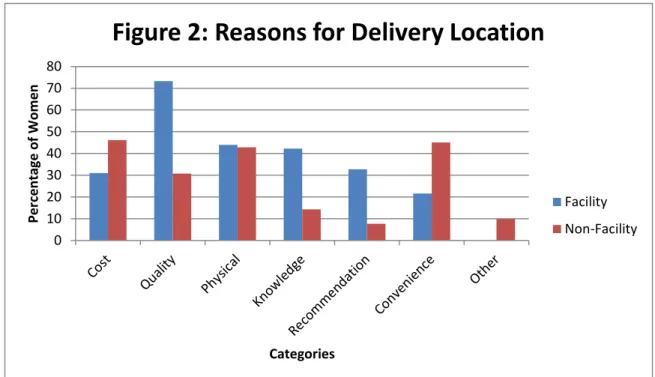
Reasons for Delivery Location Choice: Women in this study chose their delivery location for a variety of reasons, including cost, level of quality, physical access, knowledge, recommendations and convenience. Women chose as many of these categories as were applicable to them and Table X, below, shows the distribution of these responses. For facility deliveries, most women responded that
quality of services (73%), physical access (44%) and their own knowledge (42%), were the top reasons for choosing a facility. These women knew and understood the quality of services provided at facilities,
including experienced health providers, supplies of drugs and equipment, and cleanliness. Physical
access, in terms of distance to facility location and availability of transportation, were not barriers for them. Finally, their own knowledge that facility deliveries were safer for both mother and child prompted their decision.
The non-facility delivery postpartum women cited cost (46%), convenience (45%) and physical
access (43%) as their reasons for choosing a non-facility delivery. Since most of the non-facility deliveries in this survey occurred at home, where childbirth is presumably less expensive, it’s
0 10 20 30 40 50 60 70 80
Per
ce
n
tage
o
f Wom
e
n
Categories
Figure 2: Reasons for Delivery Location
Facility
15 understandable that cost was a barrier in their ability to seek care at a facility. The convenience
category, as mentioned above in Figure 2, is comprised of: usual facility, comfort, and childcare. The
women that chose convenience stated that they previously delivered at home with no complications and therefore choose their home again, wanted their families surrounding them at the time of birth and had other responsibilities, such as childcare, that they could not abandon. Physical access also provided
barriers for these women in seeking care at facilities, in that they lived too far from a facility or that they did not have adequate transportation available. These data are important and tells us two things: women who are going to facilities understand that quality of care and maternal and child health and safety are important, and that cost and physical access barriers are preventing other women from
seeking the same services. Cost of Delivery Services: Postpartum women in our
survey were asked to recall the cost of their
deliveries. Note that this total includes the cost of paying the provider as well as any medications needed during the delivery, but does not include auxiliary costs, such as the cost of transportation
and food while at their delivery location. Cost of delivery is broken down into the following categories: Free, 1-250,000 INR, 250,000-500,000 INR, 500,000-1 million INR, and more than 500,000-1 million INR. At the
time of this survey, those figures translated to less than $21, $21-$42, $42-$83 and greater than $83, respectively. Figures 3 and 4 above show the
breakdown of costs for both non-facility deliveries, respectively. While no-cost deliveries were 29.3
0.9 23.3
25 17.2
4.3
Figure 4: Facility Cost of
Delivery
Free
1-250K
250-500K
500K - 1M
>1M
Don't Know
15.4
20.9
27.5 34.1
Figure 3: Non-Facility Cost of
Delivery
Free
1-250K
250-500K
16 somewhat common in both populations, these were commonly the result of using either government or private insurance, and are not the result of not paying for the delivery. In some cases, women citing
extreme poverty who delivered at home with a TBA paid in material goods such as fabric, livestock or rice. Of the 207 postpartum women, there were only 3 of these cases. The cost of delivery for non-facility births also varied depending on the provider. Twenty non-non-facility deliveries occurred with a TBA
and 44 with a midwife (data not shown). Interestingly, we found that the cost to deliver with a midwife was the same, regardless of whether the delivery was performed at the pregnant woman’s home or at the midwife’s private facility. This was the case in all districts. Across all non-facility births attended to by either a TBA or a midwife, no women delivering with a TBA had no-cost deliveries, while eight women
delivering with midwives did. In four cases, women delivering with TBAs paid the same cost as women who delivered with a midwife. If cost is the greatest barrier to facility-based care, increased education amongst pregnant women needs to identify that costs for facility-based delivery with a midwife can be
less expensive, or equal to, the cost of delivering at home.
Physical Access Barriers: In many developing
countries, distance to facilities and
access to transportation are two barriers that limit women from accessing health care services. For non-facility deliveries, women cited physical access barriers as the second most common reason for not
Table 4: Physical Access - Non-facility Deliveries Distance to closest facility
(minutes)
Cost of transport to closest facility (INR)
Do you have access to a motorcycle or
car?
% n % n % n
<15 51.7 47 Free 10.9 10 Yes 96.7 88
15-30 14.3 13 <10,000 67.0 61 No 3.3 3
30-60 1.1 1 10,000-50,000 20.9 19
60-90 2.2 2 50,000-100,000 0 0
<90 1.1 1 >100,000 1.1 1
Don’t Know 29.7 27
17 seeking facility-based care. All participants in this study were asked about their proximity to the closest facility, the availability of transportation and the cost of transportation. The distance question was
asked both in terms of kilometers and time, and although time is a more subjective measure, more women were able to accurately answer this question. Table 4 presents the data on physical access barriers. Of the 91 women delivering in a non-facility, 52% of them said that the closest facility was less
than 15 minutes from their home, and 13% said it was between 15 and 30 minutes. Note that this is measured in time only and does not take into account the mode of transit, such as walking versus using a motorcycle. Only 4% lived greater than 30 minutes from a facility, but 30% were unable to answer the question. Women were also asked if they or their family had access to a motorcycle or car, and 97%
said that they did. In terms of the cost of transportation, 67% of these women said that the cost of traveling to the closest health facility was less than 10,000 IDR (approximately $1.15) while 21% said that it would cost between 10,000 – 50,000 INR ($1.15 - $5.65).
Influencing Factors for Facility-Based Deliveries: This study sought to identify the factors that would encourage women to choose facility-based care. We asked all pregnant women who were
planning on a non-facility delivery and all postpartum women who
had recently had a non-facility delivery, “Which of the following would encourage you to go to a
facility for delivery?” using the same response categories mentioned above. Women chose as many options as were applicable to them. Table 5 describes the
factors that pregnant and postpartum women cited that would influence their decision to seek facility-based care for deliveries. Cost, quality of services and physical access were the top cited reasons for
Table 5: Influencing Factors that would encourage non-facility deliveries to choose a facility, %
Pregnant Postpartum
Cost 19.5 41.76
Quality 13.98 39.56
Physical 16.13 32.97
Knowledge 1.08 17.58
Recommendation 2.15 4.4
Convenience 6.45 8.79
Other 0 0
18 both groups. This essentially means that if cost was reduced, quality of services increased and physical access barriers removed, that these women would be more likely to choose facility-based care for their
deliveries.
Increased knowledge of maternal and child safety is an important influential factor for
postpartum women, but negligible for pregnant women. Of interest as well is the percentage of women
who cite that nothing would influence their decisions to deliver in a facility. These percentages are relatively low, but speak to the fact that no matter the intervention, some women will continue to deliver at home.
Disrespect and Abuse: A current trend in research looks at the incidence of disrespect and abuse at facilities as these relate to behaviors in seeking facility-based care. We asked postpartum women, regardless of delivery location, if they were treated in any way that made them feel disrespected during their delivery. Only 3.4% of these women felt disrespected (data not shown). For all postpartum and
pregnant women, we also asked if they experienced, witnessed or heard about any of the following abuses occurring anytime at a facility: being shouted at or scolded; being hit, beat or slapped; treatment threatened to be withheld because woman couldn’t pay; threatening for any other reason,
abandonment when care was needed; not being able to leave the hospital with baby due to failure to
pay. Of all of the categories listed, women most often cited that the heard about one of these abuses happening, specifically with shouting or scolding and abandonment during care. Otherwise, instances of experiencing or witnessing these abuses were very low or nonexistent. That said, little reason exists to
assume that disrespect or abuse at facilities relates to these women’s decisions to seek facility-based deliveries.
Table 6: Report of Disrespect and Abuse by District
Minas Karawang Bojonegoro Serang
% n % n % n % n
19
Yes 5.77 3 0 0 0 0 9.8 5
No 94.23 49 100 58 100 46 90.2 46
Total 100 52 100 58 100 46 100 51
Shouting or Scolding
Experienced 1.92 1 1.72 1 2.17 1 5.88 3
Witnessed 1.92 1 0 0 0 0 1.96 1
Heard About 25 13 44.83 26 28.26 13 27.41 15
None of the Above 71.15 37 53.45 31 69.57 32 62.75 32
Total 99.99 52 100 58 100 46 98 51
Hitting, Slapping, Pinching
Experienced 0 0 0 0 0 0 3.92 2
Witnessed 0 0 0 0 0 0 0 0
Heard About 1.92 1 20.69 12 4.35 2 0 0
None of the Above 98.08 51 79.31 46 95.65 44 96.08 49
Total 100 52 100 58 100 46 100 51
Threaten to withhold treatment
Experienced 3.85 2 0 0 0 0 0 0
Witnessed 0 0 0 0 0 0 0 0
Heard About 3.85 2 12.07 7 10.87 5 11.76 6
None of the Above 92.31 48 87.93 51 89.13 41 88.24 45
Total 100.01 52 100 58 100 46 100 51
Threaten for other reasons
Experienced 0 0 0 0 0 0 0 0
Witnessed 0 0 0 0 0 0 0 0
Heard About 0 0 0 0 0 0 0 0
None of the Above 100 52 100 58 100 46 100 51
Total 100 52 100 58 100 46 100 51
Abandonment
Experienced 7.69 4 0 0 4.35 2 3.92 2
Witnessed 0 0 1.72 1 0 0 3.92 2
Heard About 21.15 11 27.59 16 10.87 5 13.73 7 None of the Above 71.15 37 70.69 41 84.78 39 78.43 40
Total 99.99 52 100 58 100 46 100 51
Unable to leave hospital due to failure to pay
Experienced 0 0 0 0 0 0 0 0
Witnessed 0 0 0 0 0 0 0 0
Heard About 21.15 11 74.14 43 56.52 26 43.14 22 None of the Above 78.85 41 25.86 15 43.48 20 56.86 29
20 V. Discussion/Recommendations
Many factors play into a woman’s decision on where to seek delivery services during her pregnancy.
Previous literature has shown a strong link between age, level of education and cost of delivery and delivery location. This study supports the associations between level of education and delivery location and cost of delivery and delivery location, but does not support the association between age and delivery location. In this study, we found that women who are seeking facility-based care are doing so
because they seek a higher quality of services and know that they and their child will be safer. It’s important to note that even though cost was not one of the main factors influencing their decision, it was still important. Many of the facility-based deliveries were paid for either with jampersal or another insurance, covering some or all of the cost. Had insurance not been available for these women, it’s
possible that they would have chosen non-facility deliveries. For women not seeking facility-based deliveries, cost and physical access were the two main barriers. Women’s perceptions of the cost of delivery and the distance to their closest facility persuaded them to delivery either at home or at a
less-equipped facility. The government needs to scale up their roll-out of jampersal and ensure that all districts in Indonesia are aware of the program. During this study, we found that jampersal was available in only two of the four districts, and was being improperly used in one district by midwives
who administered home deliveries. A media campaign would further inform women and their communities about this service. Without this free delivery service available, and since cost is a main factor in choosing one’s delivery location, women will likely continue to deliver at home. These home based births will contribute to the national MMR and infant mortality rate in Indonesia. With distance
as a perceived barrier, but the data showing that most facilities are within 30 minutes of a woman’s home, the government should sensitizing the population so that each household knows the closest facility available to them. Additionally, though transportation cost itself was not identified as a barrier,
21 transportation system for pregnant women. Since a large percentage of women cited an improvement in quality of services as an influential factor that would encourage them to seek facility-based deliveries,
ensuring a minimum quality standard in all facilities is essential. In Minas, one village that was 20 kilometers from the closest puskesmas had established a community transportation system. Women who sought to deliver at the puskesmas were provided free transportation. With government or
non-governmental assistance, similar programs can be implemented to give more women opportunities at facility-based delivery. Since 97% of women had access to some type of transportation, and since distances to facilities did not often exceed 30 minutes, this assumes the perception of physical access barriers is exaggerated. Additional reasons must be compounding a woman’s decision to seek a
non-facility based delivery.
Though education campaigns informing women of the dangers of home delivery already exist, they should be scaled up and continued. These can include the pregnant women’s education classes
currently being conducted, but also midwives and community lay health workers should be educated, trained and educating women as well. We also learned that, although disrespect and abuse at facilities exists, it may be more hearsay than it is experienced or witnessed. There is no indication that either of these factors influenced delivery location among the women in this survey.
Limitations and Strengths: This study was conducted to inform programmatic decisions for Jhpiego’s maternal and child health improvement projects, and data were collected from sites in which the organization currently works. Limitations of this study include time and selection bias. Due to the
scope of this research, limited time was available to pilot test our survey tool. This led to changing a substantial question in our survey to ensure that all respondents understood. Additionally, for this sample, we purposively sought to select equal numbers of postpartum women who delivered in facilities
22 location of postpartum women due to this bias. Complete information on the number and availability of facilities in each district was not available. Without this, it is difficult to compare the actual choices of
women with facilities. We also measured parity, but did not analyze parity as a confounder to a
women’s choice of delivery location. Despite these limitations, this study will inform the government of Indonesia, via Jhpiego and USAID, of the influential factors that will encourage women to choose facility
deliveries. This will essentially help guide policy decisions at the district levels and eventually improve maternal health outcomes.
Next steps: In addition to the recommendations above, further research should be done on additional factors that influence women’s choices. These could focus solely on delivery location and
what additional changes would encourage women to seek facility-based care. This could easily be done in tandem with research on behavior change.
23 References
(1) Indonesia demographic and health survey, 2007. Jakarta, Indonesia; Columbia, Md., USA: Statistics Indonesia : National Family Planning Coordinating Board : Ministry of Health; ORC Macro; 2008.
(2) Maternal Mortality Ratio | UNFPA Available at: http://indonesia.unfpa.org/issues-and-challenges/maternal-mortality-ratio. Accessed 10/23/2011, 2011.
(3) Indonesia - East Asia Decentralize - Indonesia Available at:
http://web.worldbank.org/WBSITE/EXTERNAL/COUNTRIES/EASTASIAPACIFICEXT/INDONESIAEXTN/0,,co ntentMDK:22441076~pagePK:141137~piPK:141127~theSitePK:226309,00.html. Accessed 10/23/2011, 2011.
(4) Interview with District Health Officer in Bojonegoro, Dui Anik Listijarini. 2011.
(5) United Nations Population Fund. Maternal Mortality, Indonesia. Available at:
http://indonesia.unfpa.org/issues-and-challenges/maternal-mortality-ratio. Accessed September 19, 2011.
(6) Montagu D, Yamey G, Visconti A, Harding A, Yoong J. Where do poor women in developing countries give birth? A multi-country analysis of demographic and health survey data. PLoS One 2011 Feb
28;6(2):e17155.
(7) Kunst AE, Houweling T, Van LW, De Brouwere V. A global picture of poor-rich differences in the utilisation of delivery care. Safe motherhood strategies: a review of the evidence 2001.
(8) Ensor T, Cooper S. Overcoming barriers to health service access: influencing the demand side. Health Policy Plan 2004;19(2):69.
(9) Raghupathy S. Education and the use of maternal health care in Thailand* 1. Soc Sci Med 1996;43(4):459-471.
(10) Chowdhury ME, Ronsmans C, Killewo J, Anwar I, Gausia K, Das-Gupta S, et al. Equity in use of home-based or facility-home-based skilled obstetric care in rural Bangladesh: an observational study. The Lancet 2006;367(9507):327-332.
(11) Bolam A, Manandhar D, Shrestha P, Ellis M, Malla K, Costello A. Factors affecting home delivery in the Kathmandu Valley, Nepal. Health Policy Plan 1998;13(2):152.
(12) Titaley C, Hunter C, Dibley M, Heywood P. Why do some women still prefer traditional birth attendants and home delivery?: a qualitative study on delivery care services in West Java Province, Indonesia. BMC pregnancy and childbirth 2010;10(1):43.
24 (14) With Jampersal, govt provides childbirth care, contraceptives | The Jakarta Post Available at:
http://www.thejakartapost.com/news/2011/06/10/with-jampersal-govt-provides-childbirth-care-contraceptives.html. Accessed 10/10/2011, 2011.
(15) Newland L. Of paraji and bidan. The daughters of Hāritī: childbirth and female healers in South and Southeast Asia 2002;7:256.
(16) Thaddeus S, Maine D. Too far to walk: maternal mortality in context. Soc Sci Med 1994;38(8):1091-1110.
(17) Onah HE, Ikeako LC, Iloabachie GC. Factors associated with the use of maternity services in Enugu, southeastern Nigeria. Soc Sci Med 2006;63(7):1870-1878.
25
APPENDIX I – SURVEY INSTRUMENTS ENGLISH
PERCEPTIONS OF FACILITY-BASED CARE QUESTIONNAIRE
POSTPARTUM FACILITY BIRTH
OVERSHEET
Interviewer Name Identification Number:
District
Health care facility Facility name
Interview date & starting time Interview ending time
INTRODUCTION & INFORMED CONSENT
Hello, our names are Sara and Isti and we work for the Maternal and Child Health Integrated Program (MCHIP). We are conducting a national survey about women’s perceptions on giving birth at health facilities. We would very much appreciate your participation in this survey. I want to ask questions about your current pregnancies or your most recent pregnancy and delivery to determine how we can increase the number of women who go to facilities to give birth. This information will help MCHIP to assist the government in the planning of health services. The survey usually takes between 15 and 25 minutes to complete. Whatever information you provide will be kept strictly confidential and will not be shown to other persons. Participation in this survey is voluntary, and if we should come to any question you don't want to answer, just let me know and I will go on to the next question; or you can stop the interview at any time. However, we hope that you will participate in this survey since your views are important.
At this time, do you want to ask me anything about the survey? May I begin the interview now?
Signature of interviewee: Date:
________________________________ _______________________
ELIGIBILITY
I would like to ask you some questions to find out if you are eligible to participate:
1.
Was your most recent delivery at a health facility? 1 Yes2 No – GOTO Non-Facility Survey
2.
How many births have you had?3.
How many of these children of these are still alive?4.
When was your last delivery?If not within the last 6 months, participant is not eligible for survey.
A. Demographics
I would like to start by asking you some questions about yourself and your household.
5.
How old were you at your last birthday?26
6.
Have you ever attended school? 1 Yes2 No – GOTO 8
7.
What is the highest level of school you attended? 1 Elementary 2 Junior High School 3 Senior High School 4 University5 No Formal Education 98 Don’t know
8.
What is your religion? 1 Islam2 Protestant 3 Catholic 4 Hindu 5 Buddha 96 Confucian 98 Other
9.
Which ethnic group do you belong to?10.
What is your marital status? 1 Never married2 Currently married 3 Separated
4 Divorced 5 Widowed
6 Living with partners as if married 98 DK
11.
Aside from your own housework, are you currently working?1 Yes
2 No – GOTO 13
12.
What is your occupation, that is, what kind of work do you mainly do?1 Professional, Technical 2 Managers and Administration 3 Clerical
4 Sales 5 Services
6 Agricultural Worker 7 Industrial Worker 8 Other
13.
Last month, what was your family’s income?14.
How many people in your household contribute to that income?15.
Who manages money in your house? 1 You2 Your husband/partner 3 Both you and your husband/partner 4 Your parents B. Pregnancy and Birth Planning
Now I’m going to ask you about your previous pregnancies, and we’ll mostly focus on your most recent pregnancy.
27 2 Private clinic
3 Public hospital 4 Private hospital 98 DK
17.
Why did you choose that facility to deliver? SELECT ALL THAT APPLY(Prompted Question)
1 Cost 2 Distance 3 Cleanliness
4 Transport available 5 Drugs and equipment 6 Type of health provider 7 Experience of health provider 8 Attitude of health provider 9 Being treated with respect
10 Relationship with health provider 11 Facility where usually go
12 Safety for mother and child 13 Health worker recommended 14 Referred by another facility 15 Other (specify)
98 DK
18.
During your pregnancy, did you have a plan for the following: Where to deliver?
With whom to deliver?
Cost?
Transportation?
1 Yes 2 No If yes, where? 1 Yes 2 No If yes, with whom? 1 Yes 2 No If yes, how? 1 Yes 2 No If yes, how?
19.
Did the cost of childbirth influence you to either stay home or go to a health facility?1 Yes 2 No 98 DK
20.
What was the cost of your delivery? Facility fee
Fee for medication
98 DK
21.
How did you pay for your delivery? (Prompted Question)1 Your own money 2 Jampersal 3 Jamkestu 4 Jamkesmas 5 SKTM
6 Private insurance
22.
Would you go to a facility if delivery were free? 1 Yes 2 No 98 DK23.
Which of the following facilities is the closest to your home?28
24.
How far, in kilometers, do you live from the closet facility?1 <5 km 2 5-10 km 3 11-15 km 4 16-20 km 5 >20 km 98 DK
25.
How far, in minutes, do you live from the closest facility? 1 <15 minutes 2 15-30 minutes 3 31-60 minutes 4 61-90 minutes 5 > 90 minutes 98 DK26.
Do you or your family have access to a motorcycle or car? 1 Yes 2 No 98 DK27.
What kind of transportation did you use to go to the facility where you delivered?1 Walk 2 Motorcycle 3 Car
4 Public Transportation 5 Ambulance
28.
How much did transportation cost to arrive at the facility where you delivered?1 Free 2 <10,000 RP
3 10,000 – 50,000 RP 4 50,000 – 100,000 RP 5 >100,000 RP
C. Delivery and Care
Now I’m going to ask you about your previous delivery.
29.
When you arrived at that facility to deliver your baby, how long did you wait for care?1 I did not wait 2 < 15 minutes 3 16 – 30 minutes 4 > 30 minutes 98 DK
30.
Who was in the room assisting with your delivery? SELECT ALL THAT APPLY(Prompted Question)
1 TBA 2 Midwife 3 Doctor 4 OBGYN
5 Family Member 98 DK
31.
What was the mode of delivery? 1 Vaginal2 Vaginal with instruments 3 Cesarean Section
32.
How do you rate your experiences during your delivery at that health facility?1 Very Good 2 Good
3 Neither good nor bad 4 Bad
29
33.
Did you have any birth or after birth complications that required you to go to another facility?1 Yes
2 No GOTO 37
34.
Were you referred from that facility or did you go directly to the hospital to manage your complication?1 Yes, Referred 2 Yes,Went directly
3 Did not go to the hospital 98 DK
35.
Which hospital did you go to? 1 Public hospital2 Private hospital
Record name of hospital.
36.
How do you rate your experience during your birth complication at that facility?1 Very Good 2 Good
3 Neither good nor bad 4 Bad
5 Very bad 98 DK
37.
Will you go to the facility, where your previous delivery occurred, for your next birth?1 Yes 2 No
38.
Which of the following influenced your decision to deliver in a facility?SELECT ALL THAT APPLY
(Prompted Question)
1 Cost 2 Distance 3 Cleanliness
4 Transport available 5 Good supply of drugs and equipment
6 Type of health provider 7 Experience of health provider 8 Attitude of health provider 9 Relationship with health provider 10 Being treated with respect 11 Facility where usually go 12 Safety for mother and child 13 Health worker recommended 14 Referred by another facility 15 Other (specify)
98 DK
39.
Would you recommend to your friends and family to deliver at the same location where you delivered? Which of the following is the most important reason influencing your decision?1 Yes 2 No
1 Cost 2 Distance 3 Cleanliness
4 Transport available 5 Good supply of drugs and equipment
30 9 Relationship with health provider 10 Being treated with respect 11 Facility where usually go 12 Safety for mother and child 13 Health worker recommended 14 Referred by another facility 15 Other (specify)
98 DK
40.
Which is the second most important? 1 Cost2 Distance 3 Cleanliness
4 Transport available 5 Good supply of drugs and equipment
6 Type of health provider 7 Experience of health provider 8 Attitude of health provider 9 Relationship with health provider 10 Being treated with respect 11 Facility where usually go 12 Safety for mother and child 13 Health worker recommended 14 Referred by another facility 15 Other (specify)
98 DK
41.
Which is the third most important? 1 Cost2 Distance 3 Cleanliness
4 Transport available 5 Good supply of drugs and equipment
6 Type of health provider 7 Experience of health provider 8 Attitude of health provider 9 Relationship with health provider 10 Being treated with respect 11 Facility where usually go 12 Safety for mother and child 13 Health worker recommended 14 Referred by another facility 15 Other (specify)
98 DK D. Experience of Disrespect or Abuse
31 Some of these questions may be upsetting or stressful. As I said before, you can skip any question you are not comfortable answering, and you can stop the interview at any point.
42.
At any point during your stay in this facility for this delivery were you treated in a way that made you feel disrespected?1 Yes 2 No 98 DK
Now we’re going to read you a list of things that sometimes happen to women who have given birth in a facility. For each of these things, please tell me if you have 1) experienced it during your recent delivery at this facility, 2) witnessed it done to other women delivering in this facility, 3) heard about it done to other women delivering in this facility, or 4) none of the above.
43.
Health providers shouting at or scolding patient SELECT ALL THAT APPLY1 Experienced 2 Witnessed 3 Heard about 4 None of the above 98 DK
44.
Hitting, slapping, pushing, pinching or otherwise beating patientSELECT ALL THAT APPLY
1 Experienced 2 Witnessed 3 Heard about 4 None of the above 98 DK
45.
Health providers threatening to withhold treatment because patient could not paySELECT ALL THAT APPLY
1 Experienced 2 Witnessed 3 Heard about 4 None of the above 98 DK
46.
Health providers threatening patient for any other reason SELECT ALL THAT APPLY1 Experienced 2 Witnessed 3 Heard about 4 None of the above 98 DK
47.
Abandonment during delivery or at any other time when patient needed careSELECT ALL THAT APPLY
1 Experienced 2 Witnessed 3 Heard about 4 None of the above 98 DK
48.
Woman or baby not allowed to leave the hospital due to failure to paySELECT ALL THAT APPLY
32 PERCEPTIONS OF FACILITY-BASED CARE QUESTIONNAIRE
POSTPARTUM NON-FACILITY BIRTH
OVERSHEET
Interviewer Name Identification Number:
District
Health care facility Facility name
Interview date & starting time Interview ending time
INTRODUCTION & INFORMED CONSENT
Hello, our names are Sara and Isti and we work for the Maternal and Child Health Integrated Program (MCHIP). We are conducting a national survey about women’s perceptions on giving birth at health facilities. We would very much appreciate your participation in this survey. I want to ask questions about your current pregnancies or your most recent pregnancy and delivery to determine how we can increase the number of women who go to facilities to give birth. This information will help MCHIP to assist the government in the planning of health services. The survey usually takes between 15 and 25 minutes to complete. Whatever information you provide will be kept strictly confidential and will not be shown to other persons. Participation in this survey is voluntary, and if we should come to any question you don't want to answer, just let me know and I will go on to the next question; or you can stop the interview at any time. However, we hope that you will participate in this survey since your views are important. At this time, do you want to ask me anything about the survey?
May I begin the interview now?
Signature of interviewee: Date:
________________________________ _______________________
ELIGIBILITY
I would like to ask you some questions to find out if you are eligible to participate: 1. Was your most recent delivery at a health facility? 1 Yes – GOTO Facility Survey
2 No 2 How many births have you had?
3.
How many of these children of these are still alive?4.
When was your last delivery?If not within the last 6 months, participant is not eligible for survey.
A. Demographics
I would like to start by asking you some questions about yourself and your household.
5.
How old were you at your last birthday?98 DK
33 2 No – GOTO 7
7.
What is the highest level of school you attended? 1 Elementary 2 Junior High School 3 Senior High School 4 University5 No Formal Education 6 Don’t know
8.
What is your religion? 1 Islam2 Protestant 3 Catholic 4 Hindu 5 Buddha 96 Confucian 98 Other
9.
Which ethnic group do you belong to?10.
What is your marital status? 1 Never married2 Currently married 3 Separated
4 Divorced 5 Widowed
6 Living with partners as if married 98 DK
11.
Aside from your own housework, are you currently working?1 Yes
2 No – GOTO 12
12.
What is your occupation, that is, what kind of work do you mainly do?1 Professional, Technical 2 Managers and Administration 3 Clerical
4 Sales 5 Services
6 Agricultural Worker 7 Industrial Worker 8 Other
13.
Last month, what was your family’s income?14.
How many people in your household contribute to that income?15.
Who manages money in your house? 1 You2 Your husband/partner 3 Both you and your husband/partner 4 Your parents B. Pregnancy and Birth Planning
Now I’m going to ask you about your previous pregnancies, and we’ll mostly focus on your most recent pregnancy.
16.
Where was your most recent delivery? 1 My home with TBA34 3 Other (Specify)
17.
Why did you choose to deliver at that location? SELECT ALL THAT APPLY(Prompted Question)
1 Cost 2 Distance 3 Cleanliness
4 Transport available 5 Drugs and equipment 6 Type of health provider 7 Experience of health provider 8 Attitude of health provider 9 Being treated with respect
10 Relationship with health provider 11 Facility where usually go
12 Safety for mother and child 13 Health worker recommended 14 Referred by another facility 15 Other (specify)
98 DK
18.
During your pregnancy, did you have a plan for the following: Where to deliver?
With whom to deliver?
Cost?
Transportation?
1 Yes 2 No If yes, where? 1 Yes 2 No If yes, with whom? 1 Yes 2 No If yes, how? 1 Yes 2 No If yes, how?
19.
If your plan is to deliver at home, why didn’t you choose a facility?If plan was to deliver at a facility, GOTO 20.
20.
Did the cost of childbirth influence you to either stay home or go to a health facility?1 Yes 2 No 98 DK
21.
What was the cost of your delivery? Facility fee
Fee for medication
98 DK
22.
How did you pay for your delivery? (Prompted Question)1 Your own money 2 Jampersal 3 Jamkestu 4 Jamkesmas 5 SKTM
6 Private insurance
23.
Would you go to a facility if delivery were free? 1 Yes 2 No 98 DK24.
Which of the following facilities is the closest to your home?35 4 Private hospital
25.
How far, in kilometers, do you live from the closet facility?1 <5 km 2 5-10 km 3 11-15 km 4 16-20 km 5 >20 km 98 DK
26.
How far, in minutes, do you live from the closest facility? 1 <15 minutes 2 15-30 minutes 3 31-60 minutes 4 61-90 minutes 5 > 90 minutes 98 DK27.
Do you or your family have access to a motorcycle or car? 1 Yes 2 No 98 DK28.
How much does transportation cost to travel to the closest health facility?1 Free 2 <10,000 RP
3 10,000 – 50,000 RP 4 50,000 – 100,000 RP 5 >100,000 RP
C. Delivery and Care
Now I’m going to ask you about your previous delivery.
29.
Did you have to wait for care at the location where you delivered?1 I delivered at home 2 I did not wait 3 < 15 minutes 4 16 – 30 minutes 5 > 30 minutes 98 DK
30.
Who was in the room assisting with your delivery? SELECT ALL THAT APPLY(Prompted Question)
1 Family member 2 TBA
3 Midwife 4 Doctor 5 OBGYN
6 Family Member 98 DK
31.
What was the mode of delivery? 1 Vaginal2 Vaginal with instruments 3 Cesarean Section
32.
How do you rate your experience at the location of your delivery?1 Very Good 2 Good
3 Neither good nor bad 4 Bad
5 Very bad 98 DK
33.
Did you have any birth or after birth complications that required you to go to a different facility?1 Yes
36
34.
Were you referred by your TBA or midwife to go to a facility or did you go directly to the facility to manage your complication?1 Yes, Referred 2 Yes,Went directly 3 Did not go to facility 98 DK
35.
Which facility did you go to? 1 Puskesmas2 Private clinic 3 Public hospital 4 Private hospital Record name of facility.
36.
How do you rate your experience during your birth complication at that facility?1 Very Good 2 Good
3 Neither good nor bad 4 Bad
5 Very bad 98 DK
37.
Will you deliver at the same location, where your previous delivery occurred, for your next birth?1 Yes 2 No
38.
Which of the following would encourage you to go to a facility to deliver?SELECT ALL THAT APPLY (Prompted Question)
1 Cost 2 Distance 3 Cleanliness
4 Transport available 5 Good supply of drugs and equipment
6 Type of health provider 7 Experience of health provider 8 Attitude of health provider 9 Relationship with health provider 10 Being treated with respect 11 Facility where usually go 12 Safety of mother and child 13 Health worker recommended 14 Referred by another facility 15 Other (specify)
98 DK
39.
Would you recommend to your friends and family to go to the same location that you went, to deliver? Which of the following is the most important reason influencing your decision?1 Yes 2 No 1 Cost 2 Distance 3 Cleanliness
4 Transport available 5 Good supply of drugs and equipment
37 9 Relationship with health provider 10 Being treated with respect 11 Facility where usually go 12 Safety of mother and child 13 Health worker recommended 14 Referred by another facility 15 Other (specify)
98 DK
40.
Which is the second most important? 1 Cost2 Distance 3 Cleanliness
4 Transport available 5 Good supply of drugs and equipment
6 Type of health provider 7 Experience of health provider 8 Attitude of health provider 9 Relationship with health provider 10 Being treated with respect 11 Facility where usually go 12 Safety of mother and child 13 Health worker recommended 14 Referred by another facility 15 Other (specify)
98 DK
41.
Which is the third most important? 1 Cost2 Distance 3 Cleanliness
4 Transport available 5 Good supply of drugs and equipment
6 Type of health provider 7 Experience of health provider 8 Attitude of health provider 9 Relationship with health provider 10 Being treated with respect 11 Facility where usually go 12 Safety of mother and child 13 Health worker recommended 14 Referred by another facility 15 Other (specify)
98 DK D. Experience of Disrespect or Abuse
38 Some of these questions may be upsetting or stressful. As I said before, you can skip any question you are not comfortable answering, and you can stop the interview at any point.
42.
At any point during your stay in this facility for this delivery were you treated in a way that made you feel disrespected?1 Yes 2 No 98 DK
Now we’re going to read you a list of things that sometimes happen to women who have given birth in a facility. For each of these things, please tell me if you have 1) experienced it during your recent delivery at this facility, 2) witnessed it done to other women delivering in this facility, 3) heard about it done to other women delivering in this facility, or 4) none of the above.
43.
Health providers shouting at or scolding patient SELECT ALL THAT APPLY1 Experienced 2 Witnessed 3 Heard about 4 None of the above 98 DK
44.
Hitting, slapping, pushing, pinching or otherwise beating patientSELECT ALL THAT APPLY
1 Experienced 2 Witnessed 3 Heard about 4 None of the above 98 DK
45.
Health providers threatening to withhold treatment because patient could not paySELECT ALL THAT APPLY
1 Experienced 2 Witnessed 3 Heard about 4 None of the above 98 DK
46.
Health providers threatening patient for any other reason SELECT ALL THAT APPLY1 Experienced 2 Witnessed 3 Heard about 4 None of the above 98 DK
47.
Abandonment during delivery or at any other time when patient needed careSELECT ALL THAT APPLY
1 Experienced 2 Witnessed 3 Heard about 4 None of the above 98 DK
48.
Woman or baby not allowed to leave the hospital due to failure to paySELECT ALL THAT APPLY
39 PERCEPTIONS OF FACILITY-BASED CARE QUESTIONNAIRE
PREGNANT
OVERSHEET
Interviewer Name Identification Number:
District
Health care facility Facility name
Interview date & starting time Interview ending time
INTRODUCTION & INFORMED CONSENT
Hello, our names are Sara and Isti and we work for the Maternal and Child Health Integrated Program (MCHIP). We are conducting a national survey about women’s perceptions on giving birth at health facilities. We would very much appreciate your participation in this survey. I want to ask questions about your current pregnancies or your most recent pregnancy and delivery to determine how we can increase the number of women who go to facilities to give birth. This information will help MCHIP to assist the government in the planning of health services. The survey usually takes between 15 and 25 minutes to complete. Whatever information you provide will be kept strictly confidential and will not be shown to other persons. Participation in this survey is voluntary, and if we should come to any question you don't want to answer, just let me know and I will go on to the next question; or you can stop the interview at any time. However, we hope that you will participate in this survey since your views are important. At this time, do you want to ask me anything about the survey?
May I begin the interview now?
Signature of interviewee: Date:
________________________________ _______________________
ELIGIBILITY
I would like to ask you some questions to find out if you are eligible to participate:
1.
How many births have you had?2.
How many of these children of these are still alive?3.
Are you currently pregnant?If no, participant is ineligible for survey.
A. Demographics
I would like to start by asking you some questions about yourself and your household.
4.
How old were you at your last birthday?98 DK
5.
Have you ever attended school? 1 Yes2 No – GOTO 7
40 4 University
5 No Formal Education 98 Don’t know
7.
What is your religion? 1 Islam2 Protestant 3 Catholic 4 Hindu 5 Buddha 96 Confucian 98 Other
8.
Which ethnic group do you belong to?9.
What is your marital status? 1 Never married2 Currently married 3 Separated
4 Divorced 5 Widowed
6 Living with partners as if married 98 DK
10.
Aside from your own housework, are you currently working?1 Yes
2 No – GOTO 12
11.
What is your occupation, that is, what kind of work do you mainly do?1 Professional, Technical 2 Managers and Administration 3 Clerical
4 Sales 5 Services
6 Agricultural Worker 7 Industrial Worker 8 Other
12.
Last month, what was your family’s income?13.
How many people in your household contribute to that income?14.
Who manages money in your house? 1 You2 Your husband/partner 3 Both you and your husband/partner 4 Your parents B. Pregnancy and Birth Planning
Now I’m going to ask you about your previous pregnancies, and we’ll mostly focus on your most recent pregnancy.