40%—and the use of local, rather than global, modeling to differentiate astrophysical signal from
various forms of radio contaminants. Our algorithm also makes frequent use of robust Chauvenet
rejection (RCR), a new outlier rejection algorithm. RCR is capable of resolving both accurate and
precise mu and sigma values for distributions containing as high as 85% contaminated data, making it
particularly advantageous for removing radio contamination. Together, these techniques produce allow
our image processing software to produce contaminant-cleaned and photometrically viable images for
professional and amateur use.
Fig. 1.—Green Bank Observatory 20-meter diameter radio tele-scope. (Photo credit: GBO)
1.
INTRODUCTION
Skynet is a network of 24 robotic and optical telescopes
scattered across four continents that brings students,
ed-ucators, and professionals access to high-fidelity
astron-omy equipment through a common web-based interface.
Since conceived in 2005, the network has collected over
50,000 users and taken over 15-million images.
Conse-quently, Skynet contributes to diverse research projects,
spanning between work on gamma-ray bursts (Reichart
et al. 2005, Haislip et al. 2006, Dai et al. 2007, Updike
et al. 2008, Nysewander et al. 2009, Cenko et al. 2011,
Cano et al. 2011, Bufano et al. 2012, Jin et al. 2013,
Morgan et al. 2014, Martin-Carrillo et al. 2014, Friis et
al. 2015, De Pasquale et al. 2016, Bardho et al. 2016,
*The author would like to acknowledge the significant
collab-oration with his adviser Dr. Daniel Reichart, along with the cur-rent and former students and software engineers in the Skynet group, specifically Dylan Dutton, Michael Maples, and Travis Berger.
Melandri et al. 2017), variable stars (Layden et al. 2010,
Gvaramadze et al. 2012, Wehrung et al. 2013,
Mirosh-nichenko et al. 2014, Abbas et al. 2015, Khokhlov et al.
2017, 2018), pulsating white dwarfs (Thompson et al.
2010, Barlow et al. 2010, 2011, 2013, 2017, Reed et al.
2012, Bourdreaux et al. 2017, Hutchens et al. 2017),
su-pernovae (Foley et al. 2010, 2012, 2013, Pignata et al.
2011, Valenti et al. 2011, 2014, Pastorello et al. 2013,
Milisavljevic et al. 2013, Maund et al. 2013, Fraser et al.
2013, Stritzinger et al. 2014, Inserra et al. 2014, Takats et
al. 2014, 2015, 2016, Dall’Ora et al. 2014, Folatelli et al.
2014, Barbarino et al. 2015, de Jaeger et al. 2016,
Gutier-rez et al. 2016, Tartaglia et al. 2017, 2018, Prentice et al.
2017), near-earth objects (Brozovic et al. 2011, Pravec et
al. 2014), and even recently the detection of gravitational
wave sources (Abbott et al. 2017a, 2017b, Valenti et al.
2017, Yang et al. 2017).
As part of the American Recovery and Reinvestment
Act of 2009 and in collaboration with Green Bank
Obser-vatory (GBO), Skynet acquired its first radio telescope
from GBO: the 20-meter diameter single-dish radio
tele-scope (Figure 1). After updating of the teletele-scope’s
hard-ware in 2010 and integrating the data acquisition
soft-ware into Skynet, the telescope is now operable by
ed-ucators, students, and professionals through the Skynet
web-interface
2.
In addition to data acquisition, Skynet also offers
in-house processing for images.
While professional
im-age processing procedures are well-established for optical
telescopes, the same is not true for radio telescopes. As
such, Skynet sought to develop equally reliable and
pow-erful processing capabilities for data collected by the new
radio telescope. The two primary challenges to
build-ing such a processbuild-ing pipeline for radio images are (1)
developing the ability to extract radio contaminants in
a user-defined, yet statistically meaningful way, and (2)
providing a means to map radio data to a pixel based
Fig. 2.—Mapping patterns. Left:Raster.Middle: Nodding.Right: Daisy.
age without loosing the resolution capabilities of the
tele-scope. This paper aims to update and validate Skynet’s
preliminary solutions to addressing these two challenges
(Berger 2015) as well as to introduce additional
function-ality and robustness to the processing suite for further
contaminant reduction and scientific use.
1.1.
Radio Data Acquisition and Analysis Techniques
Radio telescopes differ from optical telescopes in two
primary ways: (1) given the low energy of the photons,
the receiver has extremely low resolution and effectively
acts as a single pixel would for a optical CCD. (2) As
a consequence of the low-resolution receiver, it becomes
extremely inefficient and financially nonviable to map an
image pixel by pixel. Instead, radio observations are
col-lected as a sparse grid of single pixel measurements which
later are interpolated to form a final image. The
meth-ods through which these grids are collected are described
below.
1.1.1.
Mapping Patterns
Because radio telescopes operate using a single-pixel
camera receiver, there are two common procedures used
to collect the radio data. First is the point-and-shoot
method, where the telescope slews point-to-point on a
predetermined mapping grid, stopping to integrate at
each predetermined location to produce a flux value. The
point-and-shoot procedure requires frequent acceleration
and deceleration of the telescope—known to cause
sub-stantial wear on the telescope mount. The alternative
method that Skynet has chosen to employ is an on-the-fly
mapping technique where the telescope receiver
contin-ues to integrate as the telescope moves. This minimizes
the amount of strain experienced by the telescope to start
and stop its motion, while also providing greater
flexi-bility for different mapping patterns and a user defined
sampling rate (our default is 0.2 beamwidths).
Specifi-cally, through on-the-fly mapping, the 20-meter telescope
is capable of collecting data in three standard patterns
(Figure 2).
•
Rasters mapping patterns most closely resemble
the rectangular grid utilized by the point-and-shoot
method. Here the telescope maintains either a
con-stant right ascension or declination while sampling
at a constant interval in the alternative coordinate
to produce a single scan. These scans are produced
at predetermined intervals across the field of view
to build a survey of individual scans which together
form the raster mapping pattern.
•
Noddings are mapping patterns that utilize the
rotation of the earth to minimize the amount of
impulse experienced by the telescope.
Popular
for meridian-transit telescopes, the pattern slews
the telescope parallel to the elevation coordinate
thereby utilizing the rotating of the earth to cover
the field of view.
•
Daisy mapping patterns are the most complex
pattern, but also the pattern that puts the least
amount of strain on the telescope. By slowly
accel-erating and decelaccel-erating the telescope around the
source of interest, the telescope never has an abrupt
halt to transition its orientation and collect a new
scan. Instead the telescope smoothly transitions
from one scan into the next. Another advantage
of the daisy pattern is that it can be configured
to collect an arbitrarily large number of scans or
’pedals’ to cross over the source.
Given the variety of mapping patterns, we made it a
requirement of our algorithm to be independent of the
mapping structure of the observation. So long as gaps
between scans do not exceed the Nyquist sampling rate
(≈
0
.
4 beamwidths), all information can theoretically be
recovered.
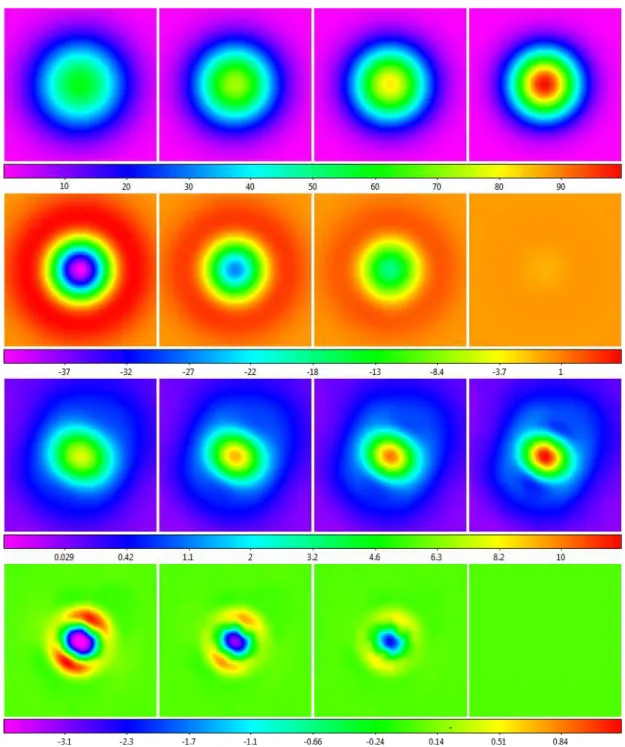
Fig. 3.—First Row: Simulated Gaussian point source sampled on a 1/5-beamwidth grid signal modeled using, from left to right: 1-beamwidth weighted averaging, 2/3-beamwidth weighted averaging, 1/2-beamwidth weighted averaging, and weighted modeling, as described in§2.6.Second Row:Residual error of each technique. Third Row: Cassiopeia A observed with one of the 20-meter’s L-band unfocused linear polarization channels using a 1/5-beamwidth raster. Weighted averaging fails to recover the telescope’s unfocused beam pattern, which is structured. Fourth Row:Difference between each of these techniques and weighted modeling. Square-root and squared scalings are used in the third and fourth rows to emphasize fainter structure (units are dimensionless, with one corresponding to the noise diode; see§2.1.)
So long as the model is sufficiently flexible to model the
source and there is sufficient data to constrain, if not
over-constrain the model, the signal can be recoverable
at any location without blurring. The approach is
out-lined in
§2.6 which demonstrates its ability to resolve
simulated data with less that 1% error near the center of
the beam pattern.
In addition to our decision to model, rather than
av-erage, data, we have also constructed our algorithm to
do all contaminant cleaning before surface modeling—
whereas regridding techniques require cleaning to be
done after signal modeling to accommodate techniques
like frequency clipping within a 2D fourier transform.
1.3.
Contamination Types
Fig. 4.—Weighted modeling of 20-meter data from the third row of Figure 3, at two representative points. Modeled surfaces span two beamwidths, but are most strongly weighted to fit the data over only the central, typically, 1/3 – 2/3 beamwidths, as described in§2.6. Only the central point (red) is retained.
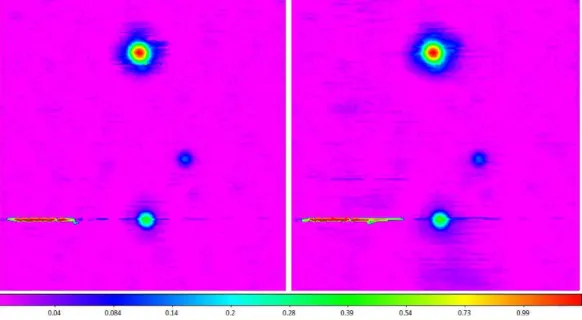
Fig. 5.—Raw map of Virgo A, 3C 270, and 3C 273—top, middle right, and bottom, respectively—acquired with a 1/10-beamwidth raster from the 20-meter in L band. The asymmetric beam pattern characterized in Figure 3 is partially corrected because the left and right channels have been combined prior to surface modeling. Lo-cally modeled surface (§1.2, see§2.6) has been applied for visualiza-tion only. Major signal contaminants (§1.3) are present throughout the image: En-route drift is seen as the the low-level variations along the horizontal scans, RFI is visible during the scan that passes through 3C 273 and near Virgo A, and elevation-dependent signal becomes pronounced toward the upper right (≈11◦ above the horizon).
have collectively been referred to as the ”scanning effect”.
These include 1/f noise, pink noise, and environmental
variations in the atmosphere or spillover when the
tele-scope points too close to the ground. These low-level
contaminants are most noticeable scan-to-scan and can
be made to vary over longer or shorter angular distances
by moving the telescope faster or slower.
Sofue & Reich (1979) attempt to eliminate en-route
drift by first isolating the en-route drift through unsharp
masking and then modeling the drift using a second-order
polynomial while using sigma clipping to extract only the
small-scale structure from the scan. The faults in these
procedures, however, are (1) that low-order polynomials
may be inadaquate when modeling en-route drift over
large angular scales, (2) unmasking requires the
blur-ring of data, a disadvantage we are seeking to avoid, and
Fig. 6.—Green Bank Observatory 40-foot diameter radio tele-scope. (Photo credit: GBO)
(3) sigma clipping is a non-robust outlier detection
algo-rithm.
Emerson & Grave fourier transform the data and mask
near-zero frequencies that contain the en-rout drift.
Ide-ally, this procedure is conducted when there are two
maps with scans in orthogonal directions each
trans-formed such that the real spacial frequencies can be
re-tained. While this method does not assume that en-route
drift can be modeled with a simple low-order function, it
does unfortunately require that data be processed on a
grid, and for best effects, requires that two orthonormal
surveys be collected for the most accurate processing.
Furthermore, this technique is not generalizable for
non-rectangular mapping patterns, eliminating the possibility
to remove the drift from daisies and noddings.
contam-Fig. 7.—Flowchart of our algorithm for contaminant-cleaning and mapping small-scale structures. Blue boxes represent the internal algorithms, green ovals are the I/O of the corresponding algorithms, particularly the raw data, noise models, and maps. Red ovals are user-chosen parameters useful for isolating wanted and unwanted structures as well as final mapping.
inant. Given that temporarily local RFI does not exceed
a beamwidth in scale, and moreover does not extend into
multiple scans, it is possible to model data over the
char-acteristic beamwidth scale in a 2D space and isolate the
contaminant.
Elevation dependent signal occurs when the telescope
slews close enough to the ground that terrestrial signal
begins to spill into the antenna. Often this signal gets
disguised in en-route drift, but it becomes apparent at
high elevations.
Despite the differing modes of contaminant production,
our algorithm models all of these contaminants the same
way.
By locally modeling the data with second-order
polynomials, and using a robust form of outlier rejection
to eliminate inaccurate local model values, our algorithm
is capable of constructing a global model for each data
point free of contamination.
1.4.
Robust Chauvenet Rejection
Sigma clipping is one of the simplest forms of outlier
rejection; however, it is also one of the crudest. To use
sigma clipping, scientists have the flexibility to
deter-mine how many sigma to consider characteristic of a
distribution before excising them from the data set—a
highly non-statistical procedure. One of the more
pop-ular attempts to remove this user-dependent ambiguity
is Chauvenet’s rejection, which is sigma clipping plus a
reasonable rejection criteria:
N P
(
>
|z|) = 0
.
5
,
(1)
18400 18450 18500 0.4
0.5 0.6 0.7
Fig. 8.—40-foot gain calibration data, with the noise diode first on and then off, and best-fit model. Circled points have been robust-Chauvenet rejected, including data taken during the transi-tions from off to on and on to off, and RFI-contaminated data. The background level increased during the calibration, but our model accounts for this: Simply averaging each level, instead of modeling each level with a line, would have underestimated the result.
7.24 7.25 7.26 7.27 7.28 7.29
16.2 16.4 16.6 16.8 17 -0.005
0 0.005
Fig. 9.—Point-to-point noise measurement technique.Top: The technique used for gain-calibrated 20-meter data—circled points were robust-Chauvenet rejected. Bottom:Deviations. Mean and standard deviations are measured from the non-rejected points, for each scan.
contaminated distributions. We have developed a new
form of outlier rejection called robust Chauvenet
rejec-tion (Maples et. al. 2017) which resolves this ambiguity
through the use of more robust measures of central
ten-dency including mode, median, and the 68%-percentile
deviation in an iterative fashion to remove the most
ex-treme outliers before using more precise metrics such as
the mean. This technique is used frequently throughout
this paper, serving as a field-test to the integrity of the
algorithm.
2.
SOFTWARE
0 50 100 150 200 0.004
0.005 0.006 0.007
Fig. 10.—Corrected 1D noise measurements vs. scan number for a 20-meter observation, and best-fit model. Only two points met the robust Chauvenet rejection criterion, and then only barely, which is not unusual given that intra-scan outliers have already been rejected (Figure 9). The 1D noise level increased by ≈20% over the course of this observation.
In this section we outline the set of algorithms
cre-ated to contaminant clean and map small-scale
astro-physical structure (Figure 7). In
§2.1 we calibrate the
telescope against often small, variations in gain. In
§2.2
we measure the point-to-point variation in signal which
can be used to understand the characteristic noise of the
data along a particular scan. In
§2.3 we separate
small-scale astronomical structure from both long- and
short-duration RFI (including en-route drift, elevation signal,
and large scale structure).
In
§2.4, we cross-correlate
our scans to account for any time delay effect between
the coordinate and signal device. In
§2.5 we measure
the noise differences between scans as a metric to further
isolate instances of short-duration RFI from data points
near the signal. In
§2.6 we detail our surface modeling
algorithm’s ability to interpolates data without blurring
it beyond the instrument’s resolution. Finally, in
§2.7 we
outline the various image data products produced for the
user.
2.1.
Gain Calibration
Signal measurements in radio telescopes are calibrated
against a noise diode. Ideally this is done when the
tele-scope tracks the same point across the sky to minimize
the amount of interference in the measurements. These
measurements, however, are imperfect and are
suscepti-ble to extraneous noise as well as sensitivity to the diode
transitioning between on and off. Consequently, we use
RCR to reject the anomalous data and then we fit a line
for both the diode being on and the diode being off. The
difference between these two lines, ∆, is what is used to
calibrate the data (Figure 8).
Given that the 40-foot telescope
3and the 20-meter
telescope do not vary substantially over the time scale
3 Skynet also makes use of data collected by the 40-foot
L and X bands, and consequently, we recommend larger background-subtraction scales here. This compo-nent was significant in L band prior to 8/1/14, as can be seen in the third row of Figure 3, as well as in Figure 5. Post 8/1/14, it was significantly re-duced, but not altogether eliminated. This component corresponds to ap-proximately 2% – 3% and 4% – 5% of the integrated beam pattern in L and X band, respectively. If this is not a concern, these minimum recom-mended 1D background-subtraction scales can be lowered to 3 and 4 the-oretical beamwidths, respectively.
of the observation, we choose to calibrate only at the
be-ginning and end of the observation. We then allow the
user to choose between using the calibration at the
be-ginning ∆
1, end ∆
2, or a linear interpolation between
the two:
∆(
t
) = ∆
1+ (∆
2−
∆
1)
t
−
t
1t
2−
t
1.
(2)
We calibrate each polarization channel individually and
the user can choose to continue using either channel or a
composite channel that sums the fluxes of both.
2.2.
1-D Noise Measurement
Here we measure the standard deviation of data on the
most fundamental object type, the scan. For each data
point within the scan, we fit a line to the two nearest
non-rejected data points, and measure the deviation of
the central point off of that line (Figure 9). Once a
col-lection of these deviations are collected, we use RCR to
extract the average deviation value, which tends towards
zero, and its standard deviation which we then use as
the noise model for the scan. We also allow for the noise
value to change over time, so once all individual scan’s
noise model has been constructed, we fit a line to their
standard deviations using RCR to model the change in
noise over time (Figure 10). This prevents scans that
have excessive RFI from producing an
uncharacteristi-cally high noise value for a temporally anomalous set of
events. The final value is the noise model for each signal
measurement within that scan.
2.3.
Background Subtraction
The majority of contaminants in radio data occur at
the background level. Flux measurements can be biased
8 10 12 14 16
7.6 7.65 7.7
Fig. 11.— Top: A local background model applied in the for-ward direction and anchored to an arbitrary point from Figure 5, near 3C 270. Circled points indicate data that are within one background-subtraction scale length, but that still remain above the model. Middle: Forward- and backward-directed local back-ground models, anchored to every point in the scan. Bottom: Global background model, constructed as a non-linear combina-tion of lowest local background models.
by the dish pointing too close to the horizon causing the
earth’s own radio emission to interlace with the
astro-physical data. Features of long-duration RFI can
cor-rupt a broad region of data points between one or more
scans. Atmospheric variation and large-scale
astrophys-ical structure can overlap with the small-scale structure
source. To distinguish these deviant features from the
small-scale sources, traditional algorithms fit lines
be-tween each point to every other point, and maintain only
those that have all data between them above the line.
This results in a global background model that falls
en-tirely beneath the data, underestimating the background
contamination given its extreme sensitivity to radio noise
in the negative direction (Figure 11).
To distinguish between astrophysical sources and
back-ground contaminants, our algorithm instead models data
locally over a user-defined scale. At each point, the
al-gorithm collects all data within the user-defined scale
and in the same scan. It then fits a quadratic regression
model to the data (as opposed to linear which is often
too inflexible to model contaminants), and calculates the
total deviation of the collected data from the model. If
the deviation exceeds the characteristic noise of the scan
(as determined in
§2.2), the most deviant point off of the
model is removed, and the model is refit
4. This cycle is
4 To ensure the model does not underestimate the background
7.6 7.65 7.7 7.6 7.65 7.7
8 10 12 14 16
7.6 7.65 7.7
Fig. 12.—Top:A preliminary local background model, anchored to the same point as in Figure 11. Circled points have been itera-tively rejected as too high, given the modeled noise level (§2.2); the larger points were not rejected. Middle: Final local background models once the original point is unanchored and is free to be re-jected. Bottom:Global background model, constructed from the final local background models.
iterated through until the total deviation off of the model
is less than the scatter within the original data.
5These
models will be fit through each data point, and once the
model falls within the scatter of the scan, the resulting
values of the model at each of the data points’ location
will be saved.
Once complete, each datum will contain a distribution
of local-model values from these background fits, from
which RCR can extract an accurate and precise
global-model for the background flux at that point. We use
weights that strengthen models that are produced near
the center of the data, as their regression is more likely
to be a more appropriate fit than unbound tales:
w
ij=
P
j
N
ij1 +
xij−µiσi
2+
δ
xij−µiκi
4,
(3)
where
P
j
N
ijis the number of non-rejected dumps that
contributed to the
i
th local background model,
w
ijis the
weight of the
j
th point from the
i
th local background
model,
x
ijis the angular distance of this point along the
scan,
µ
iis the dump-weighted mean angular distance of
value. At this point, we unanchor this point and allow the model to be refit and iteratively allow points back in to ensure there was not an overrejection of data. This allows the global model to fit within the noise level of the data rather than under it (Figure 12)
5If the algorithm continues to reject data such that there is no
longer sufficient data to model a quadratic regression, the algorithm will attempt a linear fit and repeat this procedure.
-2 0 2 -1 0 1
Fig. 13.—Gaussian random noise background-subtracted (top) and residuals (bottom) vs.W, the sum of the weights of the non-rejected local background models that determine the global back-ground model at each point, for 1/10- and 1/5-beamwidth rasters, and for 1-, 3-, 6-, 12-, and 24-beamwidth background-subtraction scales (background-subtraction scale times sampling density of the data sets increases from left to right). The RMS of the data varies with W, but not with background-subtraction scale or sampling density independently. Curves are 1-, 2-, and 3-σmodel noise en-velopes that have been fitted to all of these data simultaneously (Equations 6 and 7).
all of the non-rejected points from the
i
th local
back-ground model,
σ
iis the dump-weighted standard
devia-tion of these values,
κ
iis analogous to standard
devia-tion, and is related to these values’ kurtosis:
κ
i=
" P
j
N
ij(
x
ij−
µ
i)
4P
j
N
ij#
1/4,
(4)
and
δ
is zero for linear local background models and one
for quadratic local background models (analogous terms
can be added for higher-order local background models).
Once calculated, the the user has a global background
model which can be subtracted off of the original data
to remove long-duration RFI, elevation dependence,
en-route drift, and underlying large-scale structure.
2.3.1.
Background Subtraction Verification
To test the validity of this procedure, we designed a
simulated data set that layers increasingly prominent and
complex containment types.
6The first layer includes a
standard gaussian noise model across the image. We
ap-ply our background subtraction procedure using 6-,
12-, and 24-beamwidth background scale and evaluate its
Fig. 14.—Left:Factor by which background subtraction reduces en-route drift (red), long-duration RFI (green), large-scale astronomical signal (blue), elevation-dependent signal (purple), and short-duration RFI (black) in our simulated data, for background subtraction scales of 3, 6, 12, and 24 beamwidths (dashed curves). Factor by which background and RFI subtraction (see§2.5) reduce these contaminants (solid curves). Right: Fraction of the noise level to which these contaminants are reduced. If nothing is plotted, the contaminant is completely eliminated on this scale. For these measurements, each contaminant was simulated separately, and in the absence of sources.
performance by measuring the residual off of the
uncon-taminated values (Figures A.1 and A.2). We find that
the background subtracted data are neither biased high
or low and the noise level is nearly identical to that of
the original data. Furthermore, the RMS of the residuals
is much less than the original data. These quantities are
determined by the number of local models to the point
j
’s
global models, as well as their collective weights. For
ex-ample, for smaller background scales or closer to the edge
of the scan where fewer data are collected, the greater the
residual RMS values. These residuals are plotted against
the summed weight,
W
, of all local models in Figure 13
where
W
=
X
i
w
ij.
(5)
We supplement this data using 1- and 3-beamwidth
background scales and find that the noise level of the
background-subtracted data is well-modeled by:
σ
1≈
0
.
979
−
0
.
275
e
−W/109(6)
and that the RMS of the residuals is well-modeled by:
σ
2≈
0
.
131 + 0
.
334
e
−W/1415,
(7)
of
W
suggesting that no additional variability is being
included through the routine itself.
In conclusion, background subtraction errors in the
ab-sence of small- or large-scale data by a factor as high as
≈
47% of the original noise for small
W
values to as low
as
≈
13% for large values of
W
. Furthermore, these are
random errors biasing the data equally in the positive
and negative directions, reducing the noise of the data
by
≈
30% for very small values of
W
to only
≈
2% for
large values of
W
.
Next we add simulated gaussian point sources to our
image as well as short duration RFI (Figure A.3). We
again background subtract with scales of 6-, 12-, and
24- beamwidths, and extract their residuals (Figure
A.4). We find three underlying causes of the residuals.
The first is an underestimation directly underneath the
source, however it is independent of the brightness of the
source. The bias level is best defined by
peak bias level
≈ −
(0
.
5
−
1)
×
noise level
background subtraction scale 6 beamwidths
.
(8)
which is at a sufficiently low level that it can be ignored.
Furthermore, when the sources are replaced with cosine
functions with less winged tails, the factor decreases by a
factor between 2 and 3. These systematic biases are
fur-ther corrected by our RFI-subtraction algorithm (§2.5)
in regions near the sources.
The second bias is attributed to sources that are close
in proximity as collectively they can exceed the length of
the original background subtraction scale. These effects
are best mitigated by use of larger background-scales
such as 12- and 24-beamwidths.
The final bias occurs when a source lay within 1- to
2-beamwidths of the edge of the survey—an area where
the background model no longer has sufficient data to
constrain its regression. This is a known deficiency in
our algorithm, but it is local and easy to define allowing
us to give the user the option to clip these data before
surface-modeling if desired.
Next in our simulated image we include en-route drift
and long-duration RFI (Figure A.5). Like the gaussian
noise and the point sources, we model these data
us-ing a 6-, 12-, and 24-beamwidth scale and measure the
residuals (Figure A.6).
We find that the background
subtraction routine is effective at reducing the effects
of the contaminants given that the background-scale is
sufficiently below the scale of the large-scale structure
(12-beamwidths in this simulation). We find that
en-route drift and long-duration RFI are reduced by
fac-tors of
≈3 and
≈5, to
≈96% of and
≈53 times the
noise level, respectively, when background-subtracted on
double this scale (24-beamwidths); by factors of
≈63
and
≈630, to
≈5% and
≈39% of the noise level,
re-spectively, when background-subtracted on half of this
scale (6-beamwidths); and by even greater factors when
background-subtracted on even smaller scales (see
Fig-ure 14). These gains are significantly furthered by our
RFI-subtraction algorithm.
Lastly we include 2D large-scale structure and find that
the results are closely paralleled to that of long-duration
RFI and en-route drift (Figure A.7). We find that
large-scale astronomical and elevation-dependent signal is
re-duced by factors of
≈26 and
≈670, to
≈3 times and
≈18% of the noise level, respectively, when
background-subtracted on the scale of the map (24 beamwidths); by
factors of
≈830 and
≈3400, to
≈11% and
≈4% of the
noise level, respectively, when background-subtracted on
the 6-beamwidth scale; and by even greater factors when
background-subtracted on even smaller scales (Figure
A.8).
2.3.2.
20-Meter and 40-Foot Data
After verifying functionality of background subtraction
on simulated data, we proceed to test its functionality on
real data from the 20-meter and 40-foot telescopes. We
demonstrate its function on a 20-meter L-band raster of
Virgo using both small and large background-subtraction
scales (Figure 15), two heavily contaminated maps of
An-dromeda (Figure 16), a daisy map of 3C 84 taken with
the 20-meter in X Band to demonstrate its application
on non-rectangular mapping patterns (Figure 17), and
finally two nodding maps of the sun using the 40-foot
(Figure 18).
2.4.
Time-Delay Correction
In the case of the 20-meter telescope, the signal is
in-tegrated over a user-defined time, and coordinate
infor-mation is recorded at the midpoint of this integration
time. However, with the 40-foot, signal is run through an
RC filter, with a user-defined time constant, typically 0.1
seconds, but signal and coordinate values are sampled
si-multaneously, resulting in an effective delay between the
two due to the time constant (Figure 20). This results in
alternating coordinate errors in alternating scans. Even
with the 20-meter, the same can happen if the signal and
coordinates computers’ clocks become unsynchronized.
To correct for this, we cross-correlate adjacent scans.
The position of the maximum value of the
cross-correlation gives the best angular shift between the scans,
and the square root of this value gives a weight. If the
scans intersect a source, the best angular shift is well
defined, and the weight is correspondingly high. If they
intersect only noise, the best angular shift is not well
de-fined and the weight is low. For all adjacent scans we
measure the best angular shift and reject outliers using
RCR and take the mean of the remaining values and
di-vide by the telescopes slew speed to convert to time. We
again perform RCR to eliminate periods of telescope
ac-celeration (Figure 19). We then take the final time and
interpolate the telescope’s coordinate values accordingly.
2.5.
RFI-Subtraction
Once long-duration contamination has been removed
and the individual scans are aligned with one
an-other, the algorithm proceeds to remove remaining
RFI-contaminants.
The procedure involves fitting a
two-dimensional cosine to local data, and, in a manner
sim-ilar to background subtraction, rejecting deviant points
and remodeling the cosine until the total deviation
be-tween data and model falls within the characteristic noise
(§2.5.1) of the survey.
2.5.1.
2-D Noise Model
Fig. 15.—20-meter L-band raster from Figure 15 background-subtracted, with 7- (left; Table 1) and 24- (right) beamwidth scales (the map is 24 beamwidths across). Locally modeled surfaces (§1.2, see§2.6) have been applied for visualization only. Hyperbolic-arcsine scaling is used to emphasize fainter structures.
Fig. 17.— Left: Raw map of 3C 84, acquired with the 20-meter in X band using a 20-petal daisy pattern. Right: Data from the left panel background-subtracted, with a 6-beamwidth scale (Table 1). Locally modeled surfaces (§1.2, see§2.6) have been applied for visualization only.
0.001 0.01 0.1 1 -10
Fig. 19.—Best angular shift between adjacent scans vs. cross-correlation weight for all scans in a 20-meter observation. Many of the low-weight best angular shifts are not well defined, because their corresponding scans are noise-dominated. A few of the high-weight best angular shifts are incorrect, due to RFI contamination (consequently, simply taking the weighted mean of these values would yield a poor result). To eliminate both cases: For each best angular shift, we calculate the probability that it could, by chance alone, be as close as it is to both its preceding and proceeding values,a and eliminate all best angular shifts for which this
proba-bility exceeds one half divided by the best angular shift sample size (e.g., Chauvenet 1863, Maples et al. 2017; squared points). The remaining best angular shifts repeat consistently for at least three consecutive measurements, and consequently are likely due to as-tronomical signal, not noise or RFI contamination. We take the unweighted mean of these values (line), robust-Chauvenet rejecting any remaining outliers (circled points).b
aFor two, adjacent, best angular shifts, δ
i and δi+1, it is
not difficult to show that this probability is given by pi,i+1 =
|δi+1−δi| ∆
2−|δi+1−δi| ∆
, where ∆ is the angular length of the
scans. For three, this probability is given by 2pi−1,ipi,i+1. bWe reject outliers as described in§8 –§10 of Maples et al. 2017,
using iterative bulk rejection followed by iterative individual rejec-tion (using the mode + broken-line deviarejec-tion technique, followed by the median + 68.3%-value deviation technique, followed by the mean + standard deviation technique), using the smaller of the low and high one-sided deviation measurements. Data are weighted equally, in case any of the remaining high-weight data are still bi-ased by RFI contamination (or by source saturation, as is the case in Figure 18).
as the 2-D noise, and its measurement includes taking
each data point within a scan, identifying the closest
da-tum in the proceeding and preceding scans, fitting a line
to those two datum and then measuring the deviation of
the original point from this line. Once all data deviations
within the scan have been measured, RCR is then used
to remove the most discrepant deviations and to extract
the precise across-scan noise value for that scan. This is
repeated for each scan within the survey. Once all scans
have a characteristic two-dimensional noise value, a line
is fit to these data across the scans on which RCR is
again performed. This prevents scans contaminated by
long-duration RFI to bias the characteristic noise of the
larger survey (Figure 22). When fitting to
uncontami-nated gaussian data, we find this method overestimates
the true noise value by 22.9%. We correct each scan’s
noise value accordingly.
z
(∆
θ
) =
(
f
cos
2 π∆θ 2θRF I+
z
0if ∆
θ < θ
RF I0
otherwise
,
(9)
where ∆
θ
is the 2D angular distance from the model’s
center,
θ
RF Iis a user-defined RFI-subtraction scale, and
f
, the first of the two fitted parameters, normalizes the
function in the first term, and
z
0, the other fitted
param-eter, adds a small, local, background value(Figure 23).
This allows us to model a point source almost exactly
when
θ
RF I≈
1 beamwidths, and if
θ
RF Iis chosen to be
slightly smaller than the true FWHM of the telescope’s
beam pattern, it can be used to separate astrophysical
signal from marginally sub-beamwidth structures.
This model is centered at each data point, and the
algo-rithm proceeds to calculate the total deviation of all data
from the model. If the deviation exceeds the anticipated
two-dimensional noise value, it then proceeds to reject
the most positive outlier if
f >
0 or the most discrepant
outlier if
f <
0 and refit. The procedure continues on
until the standard deviation of the non-rejected points
is consistent with the noise model. The end product
re-sults in a singular local model, defined only at the
non-rejected points (Figure 25). This procedure is repeated
for all data within the survey, constructing a distribution
of local models for each data point.
Once local models are constructed for each data point,
the algorithm performs RCR on each datum’s local
model distribution to construct the global model value.
RCR’s output produces the RFI-cleaned data points
which will be used for surface modeling (§2.6). All data
that never earned a local model are assumed to be RFI
and are excised from the data set.
In theory, the RFI-subtraction scale need be only
slightly smaller than the FWHM of the beam pattern to
successfully remove contaminants. However, in practice,
the source may be more peaked than the model or
asym-metric. In these cases, a smaller RFI-subtraction scale is
recommended, but the user is cautioned to remain aware
that smaller scales risk high rejection rates of data that is
part of the astrophysical source (Figure 32). We present
recommended RFI-subtraction scales for both the
20-meter and 40-foot telescopes in Table 2.
2.5.3.
RFI-Subtraction Verification
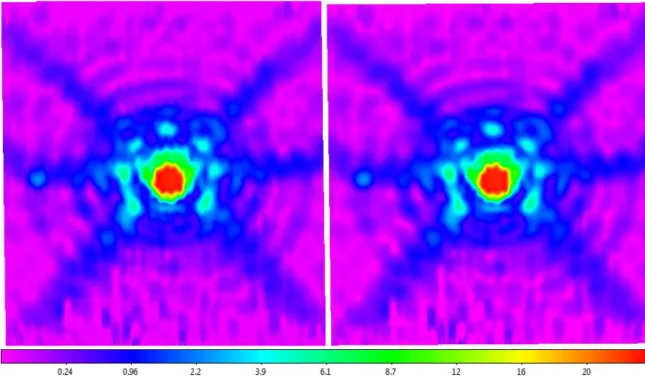
Fig. 20.— Background-subtracted map of Cassiopeia A in L band, acquired with the 20-meter with signal and position computers’ clocks unsychronized, before (left) and after (right) time-delay correction. Locally modeled surfaces (§1.2, see§2.6) have been applied for visualization only. Square-root scaling is used to emphasize fainter structures.
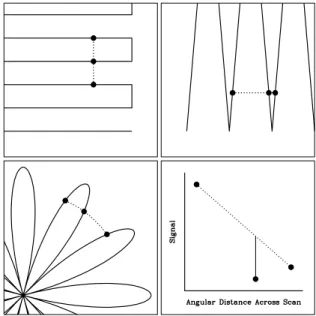
Fig. 21.— Scan-to-scan measurement technique as applied to the three primary mapping techniques. Residuals are measured (bottom right), and mean and standard deviations are measured from the non-rejected points, for each scan.
First we analyze the algorithm’s performance on gaussian
noise with a RFI-subtraction scale of 0.95 beamwidths as
well as a RFI-subtraction scale of 0.5 beamwidths
(Fig-ure B.1). We find that the RFI-subtracted data are not
biased high nor low and the noise level is significantly less
than the original background-subtracted data. We then
TABLE 2
Maximum Recommended 2D RFI-Subtraction Scale for the Telescopes and Receivers of§2, in Theoretical
Beamwidths
Telescope Receiver Scale
Left or Right Left + Right Channel Channel
20-meter L (HI + OH)a 0.8 0.9
20-meter L (HI)b 0.7 0.8
20-meter L (OH)b 0.9 1.1
20-meter X 0.8 0.8
40-foot L (HI) 0.7 0.7
aBefore August 1, 2014
bAfter August 1, 2014
Fig. 22.— Left: Corrected 2D noise measurements vs. scan number for the 20-meter observation from Figure 10, after background-subtracting on a 6-beamwidth scale, and best-fit model (solid line). Circled points have been robust-Chauvenet rejected. 1D noise model from Figure 10 is included for comparison (dashed line). The 2D noise level is≈28% higher, due to residual 1D structures (e.g., residual en-route drift) post-background subtraction. Right: Same, but with a 24-beamwidth background-subtraction scale. In this case, the 2D noise level is≈46% higher than the 1D noise level, because contaminants are less completely eliminated on longer background-subtraction scales (e.g., Figure 14).
-2 -1 0 1 2
0 0.2 0.4 0.6 0.8 1
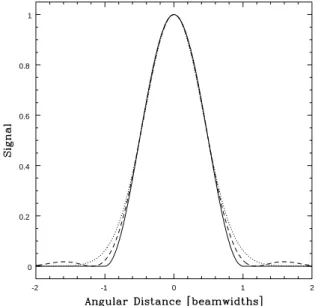
Fig. 23.—Local model (Equation 9) withθRF I= 1 beamwidth and z0 = 0 (solid curve), and Airy (dashed curve) and Gaussian
(dotted curve) functions, each with FWHM = 1 beamwidth.
Next we include 1D large-scale structure
contamina-tion in the form of en-route drift and long-duracontamina-tion RFI.
We find that long duration RFI is now reduced by a
factor of
≈
19000 to
≈
1% of the noise level when the
background-scale was 24-beamwidths (Figure B.3). The
signal was further reduced when the background-scale
approached 6-beamwidths. We also find that en-route
drift is reduced by a combined factor of
≈
20 to
≈
16% of
the noise level when background subtracted on the scale
of the map; this factor increases to a factor of
≈
730 or
≈
0
.
4% of the noise level when background-subtracted
on the 6-beamwidth background-subtraction scale. For
reference, the basket-weaving technique of Winkel, Floer
& and Krauss (2012) reduces en-route drift by a factor
of
≈
10 under ideal circumstances.
Finally, we include 2D large-scale structure
contamina-tion through the inclusion of elevacontamina-tion-dependate signal
and background structure (Figure B.4). Away from the
sources, we find that the elevation-dependent signal is
reduced by a combined factor of
≈
2800 or
≈
4% of the
noise level when background subtracted on the scale of
the map (24-beamwidths). The signal is reduced to
im-measurable levels when background subtracted on the
6-beamwidth scale. We find that the astronomical signal
is reduced by a combined factor of
≈
800 to
≈
11% of
the noise level when subtracted on the scale of the map,
and to a factor of
≈
5900 or
≈
2% of the noise level when
background-subtracted with a 6-beamwidth scale.
2.5.4.
RFI-Subtraction on Real Data
After verifying the effectiveness of RFI-subtraction on
simulated data, we proceed to test its functionality on
real data. First we use a wide-field survey with extreme
amounts of RFI-contamination collected by the 40-foot
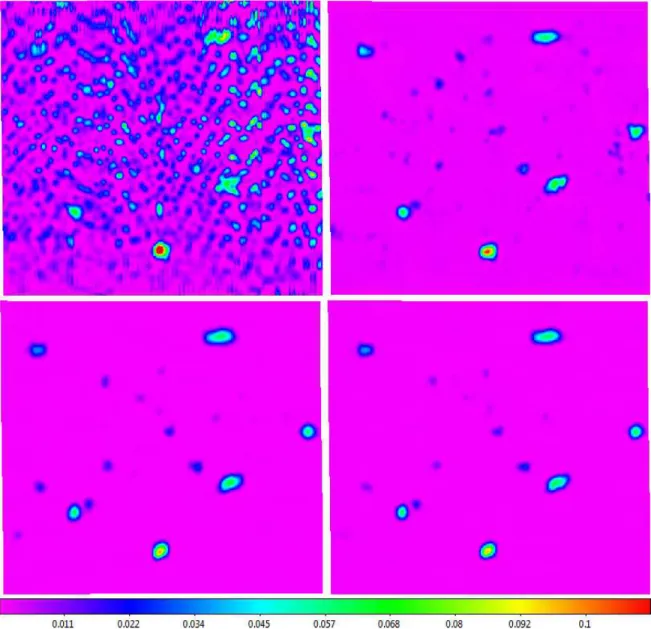
telescope (Figure 26). The contamination was the result
of a broadband emitter from the Roanoake, VA airport
located 100 miles south of Green Bank. The signal is
linearly polarized appearing in only one of the telescopes
two channels. We find that after RFI-subtraction the
contaminated and uncontaminated channels are nearly
identical.
We also apply our RFI-subtraction procedure to
Fig-ure 16 and FigFig-ure 15 to produce FigFig-ures 27 and 30.
0
0.1
0.2
0
0.1
0.2
0
0.1
0.2
0
0.1
0.2
0
0.1
0.2
195
190
185
180
0
0.1
0.2
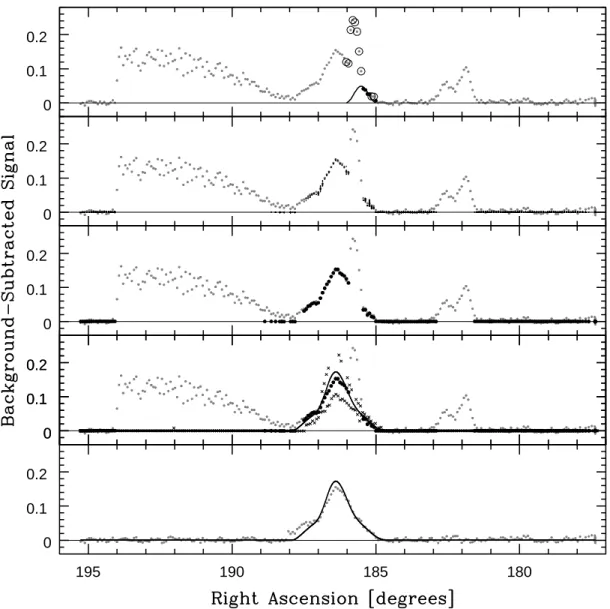
Fig. 24.—First:1D cross-section along a scan that simultaneous visualizes a profile of a single 2D local model, centered on an arbitrary point from the left panel of Figure 15, near Virgo A (curve). We have contaminated this scan with three instances of simulated RFI (the original, uncontaminated data are plotted in the fifth panel). Circled points have been iteratively rejected as too high, given the modeled noise level (§2.5.1); the larger, darker points were not rejected. Second: Every local model that intersects this scan, evaluated at each local model’s non-rejected points (smaller, darker points). All simulated RFI has been rejected, being too narrow—as compared to the RFI-subtraction scale (θRF I = 0.9 beamwidths; Table 2)—either along or across the surrounding scans. Third: Global model (larger, darker points), produced via RCR on the distributions of local models at each point. Fourth: 1D cross-section of the 2D surface model (§1.2, see§2.6), constructed from the 2D global model, three scans of which are shown (this scan = larger, darker points; adjoining scans = crosses). Differences between data and model are due primarily to residual en-route drift, which differs from scan to scan. Fifth: The same, but constructed from the original, uncontaminated data, demonstrating the effectiveness of this approach to RFI subtraction.
removed. This is best demonstrated by our constructed
map of Jupiter, a particularly faint radio emitter (Figures
28 and 29), and Barnard’s loop (Figure 33). A similar
appending procedure is available to the user for
sepa-rate fields of view; however, greater care must be
exer-cised to ensure that the data is equally calibrated, and
that the edge of one map is not characterized as an
out-lier compared to the other map given both
background-subtraction and RFI-background-subtraction’s underestimation near
the ends of scans.
Finally, we test RFI-subtraction on a daisy mapping
pattern to verify the functionality on non-rectangular
mapping types (Figure 31).
2.6.
Surface Modeling
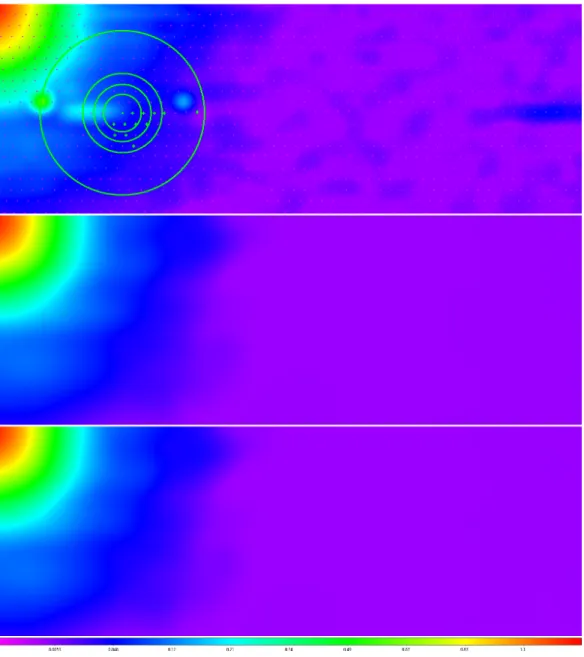
computa-Fig. 25.—Top: Zoom-in of the first panel of Figure 24, but in 2D. Purple dots mark observation points. Green contours mark the 0%-, 25%-, 50%-, 75%-, and 100%-of-peak levels of the local model. Green plusses mark observation points within the domain of the local model that were not rejected, for being too high, given the modeled noise level (§2.5.1). Locally modeled surface (§1.2, see§2.6) has been applied for visualization only. Middle: Zoom-in of the fourth panel of Figure 24, in 2D.Bottom:Zoom-in of the fifth panel of Figure 24, in 2D, which is nearly identical, despite not being contaminated with the simulated RFI.
tion time, but given that our data is already contaminant
cleaned there is substantially less computation time
ded-icated to surface modeling than would be required by
previous algorithms.
For each pixel, we fit a flexible surface model to all data
that are within 1-beamwidth, weighting data that are
closest to the pixel highest. We evaluate the model only
at that pixel, so it only needs to fit well here. We have
found using a third-order 2D polynomial is sufficient at
modeling the data without blurring beyond instrument
resolution while also having few enough parameters to
ensure the fit is always well constrained for most
sam-pling densities and mapping patterns:
z
(∆
x,
∆
y
) =
3
X
i=0 3−i
X
j=0
a
ij(∆
x
)
i(∆
y
)
j,
(10)
where
z
is the locally modeled signal, ∆
x
and ∆
y
are
angular distances from the central pixel along each
co-ordinate, and
a
ijare the polynomial coefficients.
At
this pixel, Equation 10 simplifies to
z
(0
,
0) =
a
00, which
streamlines the computation. We repeat this process for
all pixels in the image.
We weight the data using a similar model to equation
9 except raised to a power:
w
(∆
θ
) =
cos
α π∆θ2 beamwidths
if ∆
θ <
1 beamwidth
0
otherwise
,
(11)
where:
α
=
−
log 2
log
cos
πθw4 beamwidths
,
(12)
Fig. 26.—Top Left: Background-subtracted mapping of, from right to left, 3C 84, NRAO 1560/1650, 3C 111, 3C 123, 3C 139.1, and 3C 147, as well as fainter sources, acquired with the 40-foot in L band, using a maximum slew speed nodding pattern. The data are heavily contaminated by linearly polarized, broadband RFI, affecting only one of the receiver’s two polarization channels. Top Right: Data from the top-left panel time-delay corrected and RFI-subtracted, with a 0.7-beamwidth scale (Table 2). Bottom Left: Identically processed data from the receiver’s other, relatively uncontaminated polarization channel, for comparison. The RFI-subtraction algorithm is not perfect, but performs very well given the original, extreme level of contamination. Bottom Right: Background-subtracted and time-delay corrected data from both, equally calibrated polarization channels first appended and then jointly RFI-subtracted. Locally modeled surfaces have been applied for visualization (§1.2, see§2.6).
function. This weighting scheme allows for the weight
to approach zero at the
θ
w= 1 limit. This ensures no
discontinuities as new data is introduced to the moving
model. For smaller
θ
wvalues, we weight points nearest to
the pixel as most significant to generate a more accurate
fit. However, smaller
θ
wvalues also reduce the number
of points to constrain the model risking the potential
in-crease in noise and a less precisely modeled fit. We have
found that Equation 10, is sufficiently flexible to
repro-duce most all diffraction-limited structures, to
>
99%
accuracy, if
θ
w≤
1
/
3 beamwidths. That said, unless one
is trying to visualize narrow contaminants like RFI or
en-route drift, there is no advantage to surface modeling
using
θ
w<
1
/
3 beamwidths. Furthermore, for increasing
values of
θ
wbeyond 1
/
3, image accuracy is reduced only
marginally, while precision grows significantly more
pre-cise. For example,
θ
w= 1
/
2, 2
/
3, and 1 beamwidths
re-sult in only
≈2%,
≈4%, and
≈6% underestimates at the
source’s peak, respectively, and these underestimates are
almost perfectly compensated by overestimates at the
source’s base. Finally,
θ
wmust be sufficiently large to
encompass enough data to constrain equation 10.
To
ensure this requirement, our algorithm enforces that
θ
w=
max
θ
min, min
4
3
×
θ
gap,
1 beamwidth
,
(13)
where
θ
gapis the largest spacing between the pixel and
the nearest local points as discussed in Figure 37. For
computational efficiency and modeling accuracy, we
mea-sure the value of
θ
gapfor each data point and interpolate
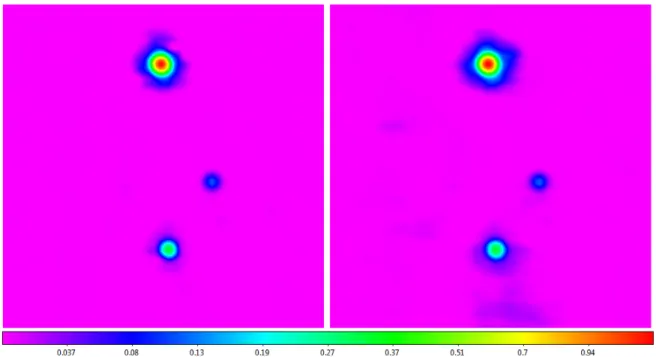
afore-Fig. 27.—Background-subtracted and time-delay corrected 40-foot noddings of Andromeda from Figure 16 (1) separately RFI-subtracted (left and middle), and (2) appended and then jointly RFI-subtracted (right), with a 0.7-beamwidth scale (Table 2). These maps are relatively free of RFI; as such, the appended map is nearly identical to what one gets from averaging the first two maps, but is nearly twice as efficient to produce, computationally (see below). Locally modeled surfaces have been applied for visualization, with a minimum weighting scale of 1/3 beamwidths (§1.2, see§2.6).
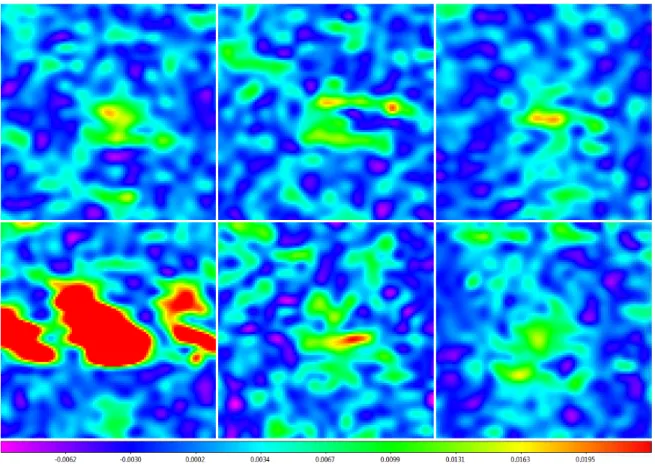
Fig. 28.—Six background-subtracted mappings of Jupiter, acquired with the 20-meter in L band, using 1/5-beamwidth rasters. Jupiter is only marginally detected in each, except for the fourth, which is significantly contaminated by RFI. Locally modeled surfaces (§1.2, see
Fig. 29.—Top Row:The six background-subtracted mappings of Jupiter from Figure 28 appended and jointly RFI-subtracted, with 0.9-(left), 0.1- (middle), and≈0- (right) beamwidth RFI-subtraction scales.Bottom Row: The same, but excluding the fourth, significantly RFI-contaminated mapping from Figure 28. Smaller RFI-subtraction scales recover more near noise-level signal. Because multiple 0.2-beamwidth mappings are used, the RFI-subtraction scale can be as low as 0.1-0.2-beamwidths and still be completely effective at eliminating RFI. Locally modeled surfaces have been applied for visualization, with a minimum weighting scale of 1/3 beamwidths (§1.2, see§2.6).
Fig. 31.—Background-subtracted 20-meter X-band daisy of 3C 84 from Figure 17 RFI-subtracted, with a 0.8-beamwidth scale (Ta-ble 2). Locally modeled surfaces have been applied for visualiza-tion, with a minimum weighting scale of 2/3 beamwidths (§1.2, see
§2.6).
mentioned surface modeling procedure. If is determined
there is insufficient data to constrain the model within
the
θ
wradius, we excise the pixel from the data set. This
procedure is generalized to all mapping patterns and
co-ordinate types as demonstrated by its success of a daisy
mapping (Figure 31) and in converting from equatorial
to galactic coordinates (Figure 36).
2.7.
Default Data Products
Upon completion of each 20-meter mapping, Skynet
produces six default data products:
1.
Raw Maps
use the pre-processed data and a
θ
w=
0 and only apply the surface modeling routine to
the data to visualize sub-beamwidth contaminants.
2.
Contaminant-Cleaned Maps
surface model
us-ing
θ
min= 2
/
3 after the data has undergone
background subtraction, time-delay correction, and
RFI-subtraction.
3.
Path Maps
plot one point on the center of each
coordinate to show the mapping pattern. We
gen-erate two path maps, one prior to time-delay
cor-rection, and one after the correction–both include
points that were excised through RFI-subtraction.
4.
Scale Maps
are the calculated weighting scale
used for surface modeling at each pixel.
5.
Weight Maps
record the weighted number of data
points that went into the model fit. This includes
the product of the proximity-dependent weight and
the number of dumps that contributed to each of
the included points, divided by a number that
cor-rects for the non-independence of the value over a
scale that is related to the RFI-subtraction scale.
ing scale of
θ
w= 1
/
3 beamwidth, to every pixel within
a 1-beamwidth radius of the first-guess pixel. The
cen-teroid is given by the extremum of this function. This
procedure is iterated until convergence.
Once the centroid is identified, we then measure the
background noise
µ
, the standard deviation of the
back-ground level
σ
, and the uncertainty in our measurement
of the background level,
µ
σ. These metrics are calculated
using the weight map and contaminant-cleaned map as
well as RCR to eliminate pixels contaminated by Airy
rings, other sources, etc. We then sum the pixel values in
the aperture, subtracting the weighted-mean background
level from each pixel.
The total photometric error bar is then given by:
σ
phot=
f
σphotv
u
u
t
σ
2Nap
X
i=1
h
w
i
anw
i/N
i+ (
N
apσ
µ)
2,
(14)
where the sum is over the number of pixels in the
aper-ture,
N
ap,
w
iis each pixel’s weight-map value,
h
w
i
anis
the average weight-map value of the pixels in the
annu-lus that were used to measure
σ
,
N
iis a number that, at
least approximately, corrects for the non-independence
of the
i
th-pixel’s value over both the RFI-subtraction
and surface-modeling (weighting) scales, and
f
σphotis an
empirically determined correction factor.
We now proceed to test the accuracy of our
photom-etry algorithm on the simulated sources. Using
recom-mended processing parameters, we find that the
mea-sured values underestimates the true values marginally
for the highest-S/N sources, but increasingly so for
lower-S/N sources. These underestimates are significant
rel-ative to the expected level of uncertainty–provided by
the 100 re-simulations of the data in which the noise
and en-route drift had been randomized.
This is to
be expected, however, as the RFI-subtraction routine
systematically dims the source particularly if the
RFI-subtraction scale is high. A similar effect occurs when
θ
wis large. Having measured these effects for a large range
of RFI-subtraction scale values and values of
θ
wwe have
assembled the following empirical correction factor:
f
phot= exp
"
0
.
22
θ
ap
2
.
5
0.52z
peak1000
σ
−1.20 θap2.5
−0.39
×
Θ (
θ
RF I, θ
min, θ
ap)]
,
Fig. 32.— Background-subtracted 20-meter L-band raster of Cassiopeia A from Figure 35 RFI-subtracted, (1) with the maximum recommended RFI-subtraction scale from Table 2 (0.8 beamwidths), which partially eliminates the first Airy ring (left), and (2) with half of this scale, which retains this structure (right). Locally modeled surfaces have been applied for visualization, with a minimum weighting scale of 1/3 beamwidths (§1.2, see§2.6). Square-root scaling is used to emphasize fainter structures.
TABLE 3
Aperture Photometry of Simulated Sources from§3.3 and§3.6a Source
Ratio Brightness Percent Error Error Bars (%)
Measured Corrected True Measured After Internal External Total
Correction Calculated Simulated (from (from calculation correction) and correction)
2 / 1 0.252 0.252 0.255 -1.3 -1.0 0.2 0.1 0.2 0.2
3 / 1 0.110 0.111 0.112 -1.7 -0.2 0.2 0.4 0.6 0.7
4 / 1 0.061 0.064 0.062 -2.5 2.7 0.4 0.8 2.0 2.0
5 / 1 0.038 0.040 0.040 -5.2 -0.1 1.0 1.0 2.0 2.2
6 / 1 0.028 0.032 0.031 -12.4 1.6 1.7 0.7 5.3 5.6
7 / 1 0.018 0.026 0.022 -18.8 16.4 1.9 3.3 10.6 10.8
8 / 1 0.016 0.019 0.020 -23.1 -4.6 2.1 1.3 7.3 7.6
9 / 1 0.009 0.015 0.012 -26.8 22.1 2.7 2.3 13.1 13.4
10 / 1 0.007 0.012 0.010 -35.1 14.8 2.3 2.5 13.8 14.0
a Relative to the brightest source. This particular data set was generated using the less-winged beam function of Equation 9 and
Fig. 33.— Four 20-meter L-band rasters of Orion A, Orion B, and Barnard’s Loop, separately background-subtracted, with a 20-beamwidth scale (larger than the minimum recommended scale from Table 1, given the size of Barnard’s Loop), time-delay cor-rected, appended, jointly RFI-subtracted, with a 0.4-beamwidth scale (to preserve Airy rings), and surface-modeled, with a min-imum weighting scale of 2/3 beamwidths. Logarithmic scaling is used to emphasize Barnard’s Loop and fainter sources.
Fig. 34.—2.5-beamwidth diameter aperture and 10-beamwidth diameter annulus that we use in Table 4, centroided on Cas-siopeia A, from the right panel of Figure 32. Outlying pixels within the annulus, corresponding to Airy rings, other sources, etc., have been eliminated (compare to Figure 32). Square-root scaling is used to emphasize fainter structures.
phot
2
.
5
1000
σ
×
Θ (
θ
RF I, θ
min, θ
ap)
.
(19)
We find that these expressions hold relatively
indepen-dently of whether the beam function is narrow- or
broad-winged. When applied to the measured values, we find
that the values fall within one total error bar of their
true values (Table 3).
Finally, we proceed to test the accuracy of our
small-scale structure mapping algorithm by photometering real
sources, particularly the calibration sources Cassiopeia
A, Cygnus A, Taurus A, and Virgo A, and compare them
to previously modeled expectations. We took 24
observa-tions of each source over a few days, photometered each
with a 2.5-beamwidth diameter aperature, and took the
ratios of these values, and then averaged these ratios as
done previously in Trotter et al. (2017). We list these
values in Table 4 and they match their expected values
within uncertainties.
4.
CONCLUSION
In summary, we have presented an algorithm that
pro-ceeds in the following manner:
1. Our algorithm models background contamination
locally using quadratic regression while also
mak-ing use of a new outlier rejection algorithm,
ro-bust Chauvenet outlier rejection, to remove
signif-icant fractions of signal from en-route drift,
long-duration RFI, and elevation-dependent signal.
7 This is given by summing the µ-subtracted pixel values in
the aperture out to a user-selected radius, and dividing this by the sum of the peak-normalized beam function, evaluated at these same locations. For the cosine-squared beam function in Figure 23, the latter sum is approximately given by:
1 θ2 pix πθ2 2 + cosπθ
π +θsinπθ−
1
π
, (16)
where θ < 1 is the user-selected radius in beamwidths, andθpix is the number of beamwidths per pixel (our default value is 0.05;
§2.6). For the Gaussian beam function in Figure 23, this is instead given by:
1.13309−1.13309e−2.77259θ2 θ2
pix
. (17)
Fig. 35.—The left panel of Figure 32, instead processed without the noise-level prior (see Footnote 27), and visualized with square-root scaling on the left, and with regular, linear scaling on the right. The surface model undershoots at the base of this high-S/N, well-focused, point source, especially where the first Airy ring has been partially eliminated by the RFI-subtraction algorithm. Consequently, the noise-level prior is normally included (Figure 32). Note, however, that even without the noise-noise-level prior, this is a small effect, and is only barely noticeable when visualized on regular, linear scaling (right).
Fig. 36.— Left: The weighting scale map from the top-right panel of Figure 37, but instead processed after converting to Galactic coordinates. Right: The corresponding final image, also processed in Galactic coordinates, after imposing a minimum weighting scale of 2/3 beamwidths, so it can be compared to the left panel of Figure 30. In Figure 30, we process the same data, but in its original, equatorial coordinate system. Furthermore, this field is at high Galactic latitude, and consequently serves as a good example of the equal-areas and equal-distances properties of our sinusoidal projection (see below). Equal areas means that sources cover the same number of pixels, and consequently should yield approximately the same photometry (see§3): The three sources in this map yields the same photometry as in the left panel of Figure 30 to within 3%, despite the greater (diagonal) distortion that these sources can experience at high Galactic latitudes. Equal distances refers to distances along horizontal lines, as well as along the central vertical axis, being distortion-free.