Clean hands, clean stethoscope:
Increasing stethoscope hygiene among nursing students through training.
Nickolai C. Detert
A project presented to the faculty of The University of North Carolina at Chapel Hill
in fulfillment of the requirements for Undergraduate Honors
Date of Completion: March 29, 2015
Honors Advisory Approval: _
Abstract
Background: Hospital-acquired infections are a source of mortality and financial drain
on healthcare systems and families, and all potential vectors of pathogen transmission must be identified. The stethoscope is an often overlooked piece of equipment common in healthcare that can transmit disease. After handwashing was found to dramatically reduce infection, rigorous handwashing training became common and culture shifted. This project introduced training new nursing students in stethoscope hygiene
procedures to determine if their awareness and practices would change to include cleaning their stethoscopes compared to students who did not receive the intervention. Method: New nursing students were given pre- post-intervention surveys to compare
baseline knowledge before and after stethoscope hygiene was introduced into their curriculum as an evaluated skill. Students were observed in skills labs to evaluate skill transfer. As a comparison group, senior nursing students not given the training were given a single survey to determine baseline knowledge. They were observed in clinical rotations for evidence of the application of stethoscope hygiene.
Results: Students given the training showed significant increase in awareness of
stethoscope hygiene post-intervention and a significant number applied the skill in encounters with simulated patients. Students not given the training showed lower levels of both awareness and utilization of the skill.
Conclusions: Stethoscope hygiene training does lead to increased awareness and use
Clean hands, clean stethoscope: Increasing stethoscope hygiene among nursing students through training
Hospital-acquired infections (HAIs) are an ever-present and growing problem in healthcare facilities around the globe with over 700,000 documented cases in the United States (CDC, 2012). This equates to approximately 1 in 25 hospitalized patients being affected by HAIs. Patient deaths directly related to HAIs are more difficult to calculate, but estimates range from 75,000 (CDC, 2012) to almost 100,000 per year (Anderson, Pyatt, Weber, Rutala, & NC Dept of Public Health, 2013). In addition to the emotional toll on families and caregivers, the economic costs of HAIs are staggering: in North Carolina alone, associated costs to the most common pathogens causing HAIs were calculated to be between $224 and $617.7 million annually, or $436,000 to $1.1 million per hospital (Anderson, Pyatt, Weber, Rutala, & NC Dept of Public Health, 2013).
Reducing HAIs through prevention has become a priority for institutions,
pathogens from the equipment versus the environment. A key example of the latter, and the focus of this research project, is the stethoscope.
The stethoscope, an essential tool for healthcare providers, has been identified as a reservoir of pathogenic organisms and, until recently, awareness of its potential lethality was largely underestimated. An examination of the literature reveals the global lack of training, awareness, and consequently compliance with sanitizing stethoscopes before patient contact by healthcare workers (HCW) worldwide.
Review of Literature
Handwashing and Stethoscope Hygiene
Arguably the most common and emphasized infection control skill in healthcare is handwashing, and for good reason: pathogenic microorganisms can be transferred from patient to patient through direct contact. The colonization of some HCW hands has been shown to contain more than four times more colony forming units (CFU), or visible bacterial growths, per square centimeter than the average individual (WHO, 2009). Therefore the importance of handwashing before and after patient contact is ingrained in healthcare students routinely and repeatedly. A vast majority of healthcare facilities have a handwashing policy, and organizations like The World Health Organization (WHO) and the Center for Disease Control and Prevention (CDC) have produced clear and extensive guidelines outlining the importance of hand hygiene.
stethoscopes as an essential instrument for assessment and diagnosing patients. The CDC (2008) stated “virtually no risk has been documented for transmission of infectious agents to patients through noncritical items” (p. 11). Such statements may affect the attention given to stethoscope hygiene by HCWs and the institutions that train them. Stethoscope as a Fomite
The stethoscope is found in almost every type of inpatient and outpatient setting and is used by providers, nurses, and ancillary staff. It is one of the only pieces of equipment in healthcare to touch the skin and/or clothing of almost every patient and subsequently touch the skin and/or clothing of the HCW. A stethoscope has the potential to transfer microbes between patients with various disease statuses.
The stethoscope diaphragm has been shown to be the most contaminated portion of the instrument: in a study of 58 Nepalese HCW stethoscopes over 89% of diaphragms were grew at least one microorganism and 65% of bells and 72% of earbuds were contaminated (Bhatta, et al., 2011).
Multiple studies in a variety of settings demonstrate the stethoscope’s potential as a pathogenic fomite. Bhatta et al. (2014) found 89% (n=58) of stethoscopes were contaminated with significant numbers of CFUs. In a Nigerian study, 79% (n=84) stethoscopes were discovered to be contaminated with several organisms including Pseudomonas aeruginosa, Enterococcus faecalis, and Escherichia coli. Furthermore 100% of stethoscopes that had never been sanitized were contaminated with potentially harmful microbes (Uneke, et al., 2014).
study 85% (n=300) of stethoscopes were found to be contaminated with some form of bacteria, and 9% (n=31) were found to carry potentially pathogenic organisms. Eighteen percent (n=64) grew greater than 100 CFU (Bernard, et al., 1999).
Pathogenic contamination varies by the setting in which the stethoscope is used. An analysis of a New Jersey emergency department (ED) stethoscopes (n=50) showed 32% (n=16) of stethoscopes tested positive for methicillin-resistant Staphylococcus aureus (MRSA) (Merlin, et al., 2009). Comparatively, a cross-departmental study of 112 stethoscopes in a hospital in Mexico showed 16% (n=18) carried MRSA (Campos-Murguía, León-Lara, Muñoz, Macías, & Álvarez, 2014).
An argument could be made that many healthcare facilities who have intensive care units or specialized isolation rooms have so-called ‘dedicated stethoscopes’ for use in one room with only one patient, and that the likelihood of disease transmission via stethoscope is minimal. However, Young (2014) examined 26 dedicated stethoscopes and found that 96% (n=25) were contaminated.
Noncompliance
Research in a variety of settings and with multiple healthcare disciplines has consistently shown an overall lack of compliance and/or awareness of stethoscope hygiene among HCWs. In a 2012 study of over 1,300 nurses, nurse practitioners, and physicians at Children’s Hospital of Boston, only 24% reported cleaning their
stethoscope at every patient contact, almost 40% cleaned once or less a day, and 3.8% reported never having cleaned their stethoscope (Muniz, Sethi, Zaghi, Ziniel, &
hospital protocol to conduct SH between every patient (Hudson, 2003). Stethoscope hygiene studies were in conducted in Nepal, Nigeria, and Pakistan revealing 20% of physicians, 33% of nurses, and 67% of medical students reported never having cleaned their stethoscopes (Bhatta, et al., 2011; Uneke, et al., 2014; Hyder, 2012).
Training
One barrier to SH is a lack of formal training: in a study of over 300 British medical students, only nine reported ever being taught to clean their stethoscopes in school (Saunders, Hryhorskyj, & Skinner, 2013). In a Pakistani survey of medical practitioners over 90% reported never being taught SH (Hyder, 2012).
An educational intervention was conducted in a hospital in the Philippines to determine if training would improve SH. It involved 172 HCWs and consisted of a four-week program of lecture, performance feedback, and various reminders including flyers and stethoscope tags to remind the user to clean the stethoscope. An experimental group received the training while a control group did not. Contamination of the
experimental group’s stethoscope was reduced from 69% pre-intervention to 27% post-intervention. Post-intervention surveys showed improved knowledge and frequency of SH by participants given the intervention (Grecia, Malanyaon, & Aguirre, 2008).
Beyond isolation units there appears to be no official SH protocols. Several previous studies recommend including SH education/protocols in schools and hospitals (Burrie, 2011; Saunders, Hryhorskyj, & Skinner, 2013; Muniz, Sethi, Zaghi, Ziniel, & Sandora, 2012; Uneke, et al., 2014).
increases the likelihood of future adherence even when witnessing contradicting
practices in the clinical setting. In Hinkin and Cutter’s (2014) study of nursing students, they showed that after witnessing clinical preceptors performing certain skills incorrectly a majority (59.1%) applied the standards of care they were taught.
Cleaning Technique
Two techniques have been identified as effective in removing a majority of microbes from a stethoscope. Lecat et al (2009) showed that using standard isopropyl alcohol pads to thoroughly wipe the stethoscope diaphragm reduced CFUs by 92.5%, while using hospital-grade ethanol-based cleanser (EBC) reduced contamination by 92.8%. The results of CFU reduction in another study were slightly different: cleaning with alcohol pads resulted in 71% (n=17) of stethoscopes growing zero CFUs.
Conversely only 20% (n=12) of stethoscopes cleaned using EBC grew zero CFUs. The study authors noted that due to convenience and to encourage compliance, EBC
cleaning was still an acceptable alternative (Mehta, Halvosa, Gould, & Steinburg, 2010). Conceptual Framework
This study is based upon the basic concepts of Ericcson’s Deliberate Practice theory of skill learning, mastery, and refinement. Ericcson (2008) states,
(b) motivated to improve, (c) provided with feedback, and (d) provided with ample opportunities for repetition and gradual refinements of their
performance (p. 991).
The educational intervention described in this research would potentially serve as a foundational component of Deliberate Practice. Students would understand the importance of SH through education and integrate the skill into their patient care through repetition and feedback. According to Deliberate Practice these factors may be used to improve consistent execution of SH.
Research Hypothesis and Goal
This project was designed to test the hypothesis that new nursing students given an educational intervention of SH will have a higher adherence rate of the skill when observed in non-evaluated settings compared to senior nursing students not given the intervention and observed in clinical settings. The goal of the research is to determine if setting a training baseline will create a significant increase in stethoscope hygiene amongst students which could potentially transfer with them into the healthcare workforce, thus increasing adherence to stethoscope hygiene in healthcare.
Methodology
Sample
Setting
The study setting was the School of Nursing at the University of North Carolina in Chapel Hill (UNC-CH).
Research Design
The project was a quasi-experimental study. In addition to observation, the control group was given a survey to determine knowledge or awareness of SH. The experimental group was given an initial survey prior to any SH instruction. After completing their initial skills module which included the educational intervention, they were observed in a concurrent assessment skills course to see if SH transferred into other aspects of their curriculum. Post-intervention surveys were distributed and linked via dummy ID for comparison. See Appendix A for survey example. This research received UNC Institutional Review Board (IRB) exemption in October, 2014, and informed consent was not required.
Educational Intervention
The educational intervention consisted of skill training and reinforcement: SH was linked with handwashing in order to associate the two and potentially improve muscle memory. Students were trained to use either isopropyl alcohol pads or EBC to sanitize the instrument. Formal evaluation of SH was concurrent with the handwashing skill evaluation. Skill training was provided at three points:
1. Training videos included SH with handwashing.
2. SH was taught in skills modules requiring stethoscope use.
Surveys
Content review of the survey was conducted by select UNC faculty for simplicity, and applicability. The survey was identical for both groups, including pre- and post- questions. The survey was designed to assess student knowledge and awareness of infection control around stethoscopes. The questions were worded in general terms and open-ended to avoid a Hawthorne Effect (individuals aware they are being observed may alter their normal behavior).
Observations
Observations were conducted by clinical faculty after receiving descriptions of proper SH procedure. Faculty also received an observation rubric for recording (see Appendix B) and support throughout the process as needed by the study principal investigator (PI). The control group was observed in their clinical setting by their clinical faculty. Faculty observed whether students conducted SH or not before either entering a patient room or before physically touching the patient with the stethoscope.
Due to curriculum flow, the intervention group was observed in their Health Assessment Lab rather than in the clinical setting. These labs occurred after the SH educational intervention in their Fundamental Skills course. Specifically, students were observed by lab faculty during cardiac, respiratory, and gastrointestinal (GI) assessment labs which involved using a stethoscope on a partner who simulated a patient. Faculty in the assessment course were instructed to model SH when providing skill
Stethoscope Culturing
Cultures were obtained from two stethoscopes as a visual demonstration of stethoscopes as fomites and to illustrate the effectiveness of cleaning. The first stethoscope, labeled “dirty” had been used in a clinical setting involving extensive patient contact up through 90 minutes prior to swabbing and had not been cleaned in over a week. The other stethoscope, labeled “clean” was swabbed within five minutes after being cleaned with a standard 70% isopropyl alcohol pad. A third culture, labeled “single patient”, came from the same stethoscope after being placed on the PI’s skin to simulate a single patient contact.
Samples were obtained from the diaphragm of the stethoscopes using sterile cotton applicator sticks and culturing was done on Sheep Blood Agar Plates (SBAP). The applicators were swabbed on the SBAP and incubated at 37.0°C / 5.0% CO₂ / 24 hours. The resultant bacterial colonies were Gram stained and photomicrographs were taken.
Analysis
Results
The sample included 52 surveys and 32 students observed in the control group and 36 paired surveys and 62 students observed in the experimental group.
Survey results.
Control group. Fifty percent (50%, n=52) completed the survey. Using descriptive statistics, 25% (n=13) of respondents stated that SH was an important infection control procedure prior to patient contact, and 44% (n=23) indicated that the stethoscope could serve as a fomite.
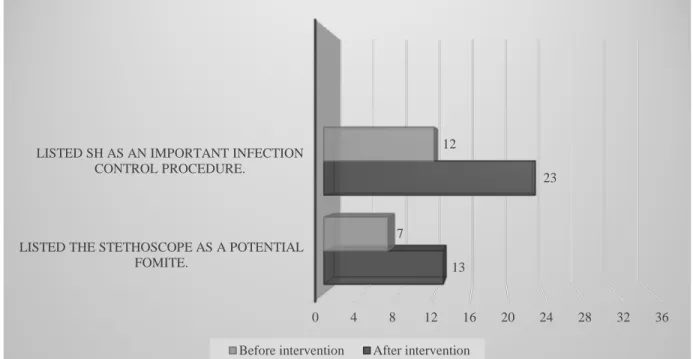
Experimental group. Fifty-five percent (55%, n=36) completed the pre- and post-intervention survey. Descriptive statistics were used to note the change between pre- and post-intervention survey data. There was a significant difference from pre- to post-intervention for the recognition of the stethoscope as an important infection control procedure prior to patient contact. Before the intervention 33.3% (n=12) of students listed SH as an important infection control procedure prior to patient contact compared to 64% (n=23) post-intervention. Prior to the intervention 19.4% (n=7) listed the
stethoscope as a potential fomite, compared to 36% (n=13) post-intervention. The results of the McNemar test of dependent proportions (see Figure 1) showed that the increase in SH as infection control was statistically significant (p=0.003) while the
Survey comparison. The baseline knowledge regarding SH as an infection control procedure for both groups was compared using Pearson’s Chi-square. The difference between the groups was insignificant: Χ²(1) = 0.726, p=0.39. The results for respondents listing the stethoscope as a fomite were significantly different between the groups: Χ²(1) = 5.82, p=0.16.
Figure 1. Pre- and Post-intervention Survey Results (n=36)
Table 1. McNemar’s Crosstabs of Results.
Notes. a, b Row total = Pre-intervention total. c, d Column total = Post-intervention total. e
Number of respondents who did not list in pre- survey and did list in post-intervention survey 50% increase (12 of 24) in listing SH as infection control, 27.5% increase (8 of 29) listed stethoscope as a fomite
0 4 8 12 16 20 24 28 32 36
LISTED THE STETHOSCOPE AS A POTENTIAL FOMITE.
LISTED SH AS AN IMPORTANT INFECTION CONTROL PROCEDURE.
13
23
7
12
Before intervention After intervention
Stethoscope as Fomite
Pre-intervention
Post-Intervention Not
listedc Listed
d
Not listeda 21 8e
Listedb 2 5
SH as Infection Control
Pre-intervention
Post-Intervention Not
listedc Listed
d
Not listeda 12 12e
Observation results. Thirty-one percent (31%, n=32) of the control group were
observed by faculty in clinical settings. Only one student (3%, n=1) was observed conducting SH. There were not enough data points to conduct statistical analysis of these results.
Observations were made at three points during Health Assessment lab for the experimental group. Performance of SH in specific labs (n=62 for all) were 53.2% in cardiac, 51.6% in respiratory, and 46.8% in GI. Cochran’s Q test was used to determine significance. The result was Q(2) = .813, p=0.67. There is no evidence of significant variation in skill adherence over the observation period
Culture results. The dirty SBAP grew 38 CFUs (see Figure 2) and the single
patient encounter SBAP grew five (see Figure 3). The clean SBAP did not grow any CFUs and thus was not cultured. Five slides were from the single patient SBAP, seven from the dirty SBAP (including two double-sample slides) for a total of 12 slides and 14 cultures submitted for photomicrography. All five slides from the single patient SBAP and six cultures from the dirty SBAP grew Gram-positive clustered cocci. Additionally, three cultures from the dirty SBAP grew Gram-positive chain bacilli.
Discussion
The data from pre- and post-intervention surveys indicates that students exposed to SH as a formal component of their nursing training showed significant increases in awareness of SH as a necessary step before patient contact. There was not a
significant increase in knowledge about the stethoscope as a fomite, however,
knowledge of SH as an infection control procedure is more pertinent to skill use than knowledge of the stethoscope as a fomite. The results support the hypothesis that knowledge of SH through repeated training will increase. The recognition of
stethoscopes as fomites by the control group may be attributed to the level of the student in the nursing program: they had more classroom and clinical time, skill experience, and attitude development to learn about fomites.
Limitations
This project had some significant limitations, namely the sample size, survey, observation data and student experience. The sample size was small and limits confidence in transferability of the results to larger populations. The survey was developed by the author and does not have established psychometrics. The
observational data from the control group was small and not statistically significant, eliminating meaningful comparison to the experimental group. The two groups were observed in different settings which could affect the perceived importance of conducting SH. Additionally, they were observed in different timeframes: a single event vs. multiple time points, and the experimental group was observed over a relatively short time period closely following exposure to the intervention. Conclusions about long-term skill retention cannot be made with confidence.
The baseline experience of the two groups varied. The new students in the control group generally had prior careers, many included healthcare jobs, which could influence their knowledge or habits. The senior students had more academic and skills training in nursing than the experimental group. The differences add extraneous
variables that could affect the outcomes and conclusions from data analysis. Further Research
More observational research is needed to make stronger conclusions about SH and academic training more reliable. Future studies should involve larger sample populations using validated surveys, and observations between control and
Long-term research could include a longitudinal study of students given the intervention to determine skill transfer and retention over a longer time period and as students graduate and enter the clinical workplace.
Conclusions and Recommendations
Although there is a preponderance of evidence that stethoscopes can harbor a multitude of microbes, including pathogenic species, there was no documented
evidence that linked stethoscope contamination to HAIs. Understandably, it is difficult to definitively correlate an instrument that comes in contact with a multitude of patients and HCWs as a causative agent for one patient. Likewise, there is no evidence conclusively eliminating stethoscopes as a source of HAIs. While sources such as the CDC list stethoscopes as non-critical healthcare equipment, this study supports its criticality. Thus stethoscopes should be regarded as a potential vector for infection.
Introducing SH as an evaluated, reinforced, and repetitively trained component of nursing education does increase student awareness of the skill as compared to
students who do not receive formal training. Additionally, observational evidence
Implications
References
Anderson, D., Pyatt, D., Weber, D., Rutala, W., & N. C. Dept of Pulbic Health (2013). Statewide costs of health care-associated infections: Estimates for acute care hospitals in North Carolina. American Journal of Infection Control(41), 764-768. Bernard, L., Kereveur, A., Durand, D., Gonot, J., Goldstein, F., Mainardi, J., . . . Carlet, J. (1999). Bacterial contamination of hospital physicians’ stethoscopes. Infection Control and Hospital Epidemiology, 20(9), 626-628. doi:10.1086/501686.
Bhatta, D., S., G., M., A., H., T., A., G., J., M., & A., G. (2011). Stethoscopes: A possible mode for transmission of nosocomial infections. Journal of Clinical and
Diagnostic Research, 5(6), 1173-1176.
Burrie, N. (2011). Stethoscopes as vectors of infections. Australian Medical Student Journal, 2(1), 32-35.
Campos-Murguía, A., León-Lara, X., Muñoz, J., Macías, A., & Álvarez, J. (2014). Stethoscopes as potential intrahospital carriers of pathogenic microorganisms. American Journal of Infection Control(42).
doi:http://dx.doi.org/10.1016/j.ajic.2013.06.015.
Center for Disease Control and Prevention. (2012). Data and Statistics: HAI Prevelance Survey. Retrieved September 12, 2014, from www.cdc.gov:
http://www.cdc.gov/HAI/surveillance/index.html.
Grecia, S., Malanyaon, O., & Aguirre, C. (2008). The effect of an educational
intervention on the contamination rates of stethoscopes and on the knowledge, attitudes, and practices regarding the stethoscope use of healthcare providers in a tertiary care hospital. Philippine Journal of Microbiology and Infectious
Diseases, 37(2), 20-33.
Hinkin, J., & Cutter, J. (2014). How do university education and clinical experience influence pre-registration nursing students' infection control practice? A descriptive, cross-sectional survey. Nurse Education Today, 34, 196-201. doi:10.1016/j.nedt.2013.09.005.
Hudson, H. (2003). Stethoscopes and infection control: A study into the use of
stethoscopes in a paediatric ward and their possible contamination. Journal of Child Health Care, 7(2), 142-143. doi:10.1177/1367493503007002011.
Hyder, O. (2012). Cross-sectional study of frequency and factors associated with stethoscope cleaning among medical practitioners in Pakistan. Eastern Mediterranean Health Journal, 18(7), 707-711.
Lecat, P., Cropp, E., McCord, G., & Haller, N. (2009, April). Ethanol-based cleanser versus isopropyl alcohol to decontaminate stethoscopes. American Journal of Infection Control(37), 241-243. doi:10.1016/j.ajic.2008.08.006.
Longtin, Y., Schneider, A., Tschopp, C., Renzi, G., Gayet-Ageron, A., Schrenzel, J., & Pittet, D. (2014, March). Contamination of stethoscopes and physicians’ hands after a physical examination. Mayo Clinic Proceedings, 89(3), 291-299.
Mehta, A., Halvosa, J., Gould, C., & Steinburg, J. (2010). Efficacy of alcohol-based hand rubs in the disinfection of stethoscopes. Infection Control and Hospital
Epidemiology, 31(8). Retrieved from http://www.jstor.org/stable/10.1086/655437. Merlin, M., Wong, M., Pryor, P., Rynn, K., Marques-Baptista, A., Perritt, R., . . . Fallon, T.
(2009). Prevelance of methicillin-resistant staphylococcus aureus on the stethoscopes of emergency medical service providers. Prehospital Emergency Care, 13(1), 71-74. doi:10.1080/10903120802471972.
Merriam-Webster, Inc. (2015). Retrieved from Definition of 'fomite': http://www.merriam-webster.com/medical/fomite.
Muniz, J., Sethi, R., Zaghi, J., Ziniel, S., & Sandora, T. (2012). Predictors of stethoscope disinfection among pediatric health care providers. American Journal of Infection Control, 40, 922-925. doi:10.1016/j.ajic.2011.11.021.
Rutala, W., Weber, D., & Committee, H. I. (2008). Guideline for disinfection and sterilization in healthcare facilities. Center for Disease Control and Prevention. Saunders, C., Hryhorskyj, L., & Skinner, J. (2013). Factors influencing stethoscope
cleanliness among clinical medical students. Journal of Hospital Infection, 84, 242-244. doi:10.1016/j.jhin.2013.04.003.
The World Health Organization. (2009). WHO guidelines on hand hygiene in health care. Geneva, Switzerland: WHO Library in Cataloguing-in-Publication Data. Uneke, C., Ndukwe, C., Nwakpu, K., Nnabu, R., Ugwuoru, C., & Prasopa-Plaizier, N.
Appendix A.
Survey Example for Baseline SH Awareness (Control Group)
This survey is part of an ABSN-4’s honors project, and your participation is voluntary. Additionally, observation of skills transfer will be made by your clinical faculty over the remainder of the semester. The data collected will be used to describe student behavior and not be linked to you. You will never be identified. Please answer the
questions to the best of your ability and thank you for being a part of nursing research! Completing and turning in this survey implies consent to participate in data collection.
1. How many year(s) of previous healthcare experience have you had prior to entering this program? Only include experience with hands-on patient care (NA, CMA, LPN, etc.).
a. No experience b. <1 year
c. 1-2 years d. 3-5 years e. >5 years
2. What personal infection control procedures do you think are important before every patient contact? List two in addition to hand washing.
3. List at least three potential fomites (objects or surfaces capable of harboring pathogens) that could come into contact with a patient and/or healthcare worker in a typical exam room.
Note: Experimental group pre- and post-intervention surveys contained dummy ID instructions. All
Appendix B.
Observation Rubric for Faculty
Note: Students were assigned a permanent label to keep results consistent across all labs. Observations
1, 2, and 3 corresponded to Cardiac, Respiratory, and GI labs. Observations 4 & 5 were provided for
additional data as needed. No faculty utilized the extra columns for a lab exercise.
YES NO YES NO YES NO YES NO YES NO
STUDENT A STUDENT B STUDENT C STUDENT D STUDENT E STUDENT F STUDENT G STUDENT H
Mark 'yes' if the student uses alcohol wipes or hand sanitizer to clean at least the diaphragm of the stethscope. Observation 5