The Impact of Integrating Emergency Dispatch Systems with Public Automated
External Defibrillator Locations:
A Systematic Review of the Literature and an Original Research Study Design
By
William A. Carter
A Master’s Paper submitted to the faculty of the University of North Carolina at Chapel Hill
in partial fulfillment of the requirements for the degree of Master of Public Health in
the Public Health Leadership Program.
Chapel Hill
2011
_________________________
_________________________
Date
_________________________
_________________________
[2]
Abstract
Background: Out-of-hospital cardiac arrest, most commonly due to heart disease, kills as many as 450,000 people each year in the United States. Devices called automated external defibrillators can detect if this condition is due to an abnormal heart rhythm, and if so, can deliver a timed electrical shock. Though the use of defibrillators by the public is known to be both safe and effective, the impact of their integration into the 9-1-1 system remains unclear.
Objective: To systematically review evidence on the effect that incorporating public defibrillator locations into the 9-1-1 dispatch system has on survival rates from out-of-hospital cardiac arrest, and to design a research study to evaluate this relationship.
Methods: To systematically review the evidence, this author searched the MEDLINE, CINAHL, EMBASE, and The Cochrane Library (January 1, 2000 to May 1, 2011) using MeSH terms such as “automated external defibrillator” and “emergency medical services.” Additional articles were identified through a bibliography search of selected articles. To design an original research study, this author used both the results of the systematic evidence review and previous studies conducted in the medical literature to specifically address public defibrillator integration.
Results: The initial systematic review of the evidence yielded 128 citations. After review of the abstracts, 6 articles were identified for full text review. After applying inclusion and exclusion criteria, all of the articles were excluded. Manual review of two selected bibliographies revealed an additional article selected for a full text review; it was subsequently excluded. The
systematic evidence review resulted in no articles meeting inclusion criteria for data analysis, leading this author to design a research study to answer the clinical question.
The proposed study design is a multiphase before-after cohort occurring over 60 consecutive months in Orange County, NC. The study population includes all patients with out-of-hospital cardiac arrest from a cardiac etiology over 18 years of age treated by EMS. Phase 1 will serve as a lead-in period to bring the EMS agency up to full implementation of the 2005 AHA
[3]
will serve as an intervention period with an integrated emergency dispatch system in addition to the 2005 AHA guidelines over 24 months. Primary outcome will be survival to discharge
[4]
[5]
Introduction
Purpose
The integration of publically located automated external defibrillators (AEDs) with the 9-1-1 emergency dispatch center and EMS systems is poorly studied. Existing reports suggest that integration between EMS systems and public AEDs is limited1,2. For example, in North Carolina in 2002, only 19% of all AED locations were known to EMS systems and only 1 of 100 counties had AED locations incorporated into computer aided 9-1-1 dispatch systems1.
The purpose of this paper is to perform a systematic review of the literature to evaluate if the integration of registered public AED databases with the 9-1-1 emergency dispatch system improves survival from out-of-hospital cardiac arrest (OHCA). I plan to answer the question: Does the incorporation of public AED location databases with the emergency dispatch system in addition to full AHA compliance improve survival to discharge rates from out-of-hospital cardiac arrest as compared to systems operating with full AHA implementation only? Knowing this answer will help EMS systems determine if such integration would be possible and necessary to enhance the current level of care they provide.
Background
[6]
rest of the body. If this normal rhythm is disturbed, resulting in something known as an arrhythmia, cardiac arrest and eventually cardiac death can occur.
One lethal arrhythmia, known as ventricular fibrillation or simply VF, leads to an overall quivering of the myocardium instead of a coordinated contraction. When this life-threatening arrhythmia occurs, AEDs can be used to increase the chances of resuscitation from cardiac arrest. AEDs are small, easy to use devices that can be employed by the trained and untrained alike when someone is found to be unconscious from suspected OHCA5. AEDs are able to detect if a person is in VF, and if so, deliver a timed electrical shock to allow the heart to regain a normal rhythm.
Unfortunately, the public has no way of knowing if any particular location has an AED, or where it is precisely located. While many instances of OHCA occur at private residences instead of highly traveled public places, one study shows that VF and other shockable rhythms occur more frequently in public areas, suggesting that AEDs are best placed in these areas and not in private homes6.
Cardiac Arrest
As previously mentioned, OHCA occurs to nearly half a million people each year in the United States. Both the incidence and mortality of OHCA varies significantly from one
[7]
Over 280,000 of the 450,000 cases of cardiac arrest each year are caused by coronary heart disease (CHD), which affects over 17 million American adults and results in over 1 million heart attacks each year8,9. The prevalence of CHD hints at the impact it has on the American way of life, even the entire nation and its economy. CHD was responsible for almost 2 million short-stay hospitalizations in the past year alone, with almost half a million bypass surgeries. In all, CHD leads to an estimated $177 billion each year in both direct and indirect cost8. Other causes of cardiac arrest include cardiac abnormalities such as cardiomyopathy and congestive heart failure.
Although cardiac arrests are usually sudden with little or no warning, many risk factors exist and are similar to those associated with CHD. Smoking, diabetes, and a lack of physical activity have all been shown to increase one’s risk of heart disease. Perhaps the largest risk factor is age, something that most physicians agree serves as a red flag, mainly because the incidence of CHD and the presence of other risk factors tend to increase as we age.
Decreasing one’s risk by exercising, smoking cessation, and having a healthy diet all help prevent cardiac arrest. Blood pressure and cholesterol control can also serve as therapeutic ways to decrease risk.
Automated External Defibrillators
[8]
bystander CPR as compared to CPR alone10. Knowing the history of AEDs, how they work, and how they are used is important, but this will not be addressed in detail here.
Time to first defibrillation is the single most important predictor of survival, meaning the quicker an AED is utilized for a person in OHCA, the better their chances of living. Survival drops 7-10% for each minute that a person in arrest goes without defibrillation1,5,11. Additionally, prior research has shown that only approximately 8% of individuals who suffer OHCA will survive to hospital discharge12.
The geographic placement of AEDs is unknown. In recent years, public buildings and athletic facilities, as well as airports and casinos, have begun to mount AEDs in public places for use by the lay public. Some have suggested that planners use fire extinguisher placement as a rough template for where to put an AED, but this has been shown to be problematic and too costly13. A better solution could be to place AEDs in areas with a known history of having cases of OHCA, areas also known as being at “high-risk” of having an event. Investigators have attempted to identify these high-risk locations for OHCA14,15. While the majority of OHCAs occur in private residences, locations with high population density (e.g. apartment complexes, nursing homes) and locations with high traffic volume (e.g. shopping malls, sports facilities, public transportation stations) may be public sites of primary importance for AED placement.
Public-Access Defibrillation
[9]
The success of PAD programs hinges on both the knowledge and attitude of the public towards AEDs. Schober and colleagues have shown that in Amsterdam, the public is largely unaware of the availability of public accessible defibrillators. That same study revealed that 64% knew what a defibrillator is used for when asked, but only 6% spontaneously mentioned its use as something that should be done in a suspected cardiac arrest6. Despite this, other
studies have shown that the usage rate of AEDs by their owners in public locations has
remained high at about 13%, and AEDs were frequently taken to suspected cases of OHCA16.
Weisfeldt and colleagues report that bystander application of an AED prior to EMS arrival is associated with an increase in survival from 9% to 24%17. Other studies also indicate that defibrillation by the lay public is efficient, safe, and cost-effective18. However, the life-saving capability of AEDs is for naught if the public does not know where the machine is located. An AED may be just around the corner but unless the lay responder knows this, the device is useless. Almost all cardiac arrests necessitate a 9-1-1 call; if the 9-1-1 center had knowledge of AED locations, then lay responders could be directed to the nearest AED for use during an OHCA.
Chain of Survival
In 1992, the American Heart Association (AHA) adopted a resuscitation process known as the chain of survival, its goal being to save more lives during cardiovascular emergencies. The process is as follows: recognize an emergency, call 9-1-1, begin CPR, and use an AED19. Their axiom of “early access, early CPR, early defibrillation” serves as a reminder of the
[10]
arrest goes without defibrillation, the lower their odds of survival20. If PAD programs are able to accurately identify key locations at high-risk for having a cardiac arrest, placement of AEDs can be carried out and the public informed.
Identification of High-Risk Areas
Effective geographic placement of AEDs is a critical step in having a successful PAD program. The PAD trial in 2004 identified high-risk areas as those with at least 250 adults over 50 years of age present for at least 16 hours per day, or have a history of at least 1 witnessed sudden cardiac arrest every 2 years21. Since 2005, the AHA has recommended strategic deployment of AEDs in these areas, with unguided placement often resulting in an inadequate supply of AEDs22. In other words, unguided placement with a limited supply of devices would put defibrillators in areas where they are less needed, leaving fewer devices in high-risk areas.
[11]
The 2005 American Heart Association Guidelines
The 2005 update of the AHA Guidelines for Cardiopulmonary Resuscitation (CPR) and Emergency Cardiovascular Care (ECC) resulted in a new emphasis being placed on three areas: chest compressions, strict control of ventilation, and postresuscitation support24. The changes included a 30:2 compression-to-ventilation ratio instead of 15:2, the use of airway impedance devices to avoid hyperventilation, and the induction of hypothermia in indicated cases. The goal of each area is to increase survival from OHCA using the best evidence available.
Evidence shows that a full and sequential implementation of the 2005 guidelines dramatically increases survival to discharge rates in cases of OHCA25,26,27. Hinchey and colleagues reported an increase in overall survival from 4.2% at baseline to 11.5% at full implementation. Sayre and colleagues describe a 54% increase in survival (from 6.1% to 9.4%); post-guidelines patients had 1.8 greater odds of survival as compared to pre-guidelines patients. Lick and colleagues describe an even larger increase in survival rate from 8.5% to 19%. These results show that a phased full implementation of the 2005 AHA guidelines can significantly increase survival to discharge from OHCA.
What We Need to Know
In summary, evidence suggests that in order to maximize survival from OHCA, an emergency system needs to do the following: fully implement the 2005 AHA guidelines, identify areas at high-risk for having cardiac arrest events, and develop an efficient PAD program that places AEDs in public high-risk places. What we do not know is if going the extra step of
[12]
Methods
Focus
The focus of this systematic review is to answer the following question: Does the incorporation of public AED location databases with the emergency dispatch system in addition to full AHA compliance improve survival to discharge rates from out-of-hospital cardiac arrest (OHCA) as compared to systems operating with full AHA implementation only? Past studies have focused primarily on the effectiveness of AEDs in treating cardiac arrest and what
locations would most likely benefit from having an AED. Although these factors are important, simply placing AEDs in areas of high population density or where there is heavy pedestrian traffic does not give us the full picture of how these machines could impact patient outcomes.
This paper will not be reviewing literature that explains how AEDs work, how they are used, their use by the public, or what geographic areas would benefit most from their
[13]
Eligibility Criteria
The nature of the question limits the ability to randomize, as a 9-1-1 caller cannot be randomized to either a dispatch center with an integrated AED system or one that is not integrated. Such randomization would not be ethical, as it would deny someone of the life-saving treatment of an AED in an emergency situation. However, it is possible that other investigators could develop a design that would allow for randomization while preserving ethical standards. Cohort studies by their nature require an investigator to identify a group of
individuals who have been exposed to some factor, who are then followed to determine if any of the group develops some outcome; they offer causal data and are good for outcomes with high mortality. Case control studies seek to identify some exposure that is associated with some outcome that has already occurred; they are relatively inexpensive and short in duration. Both cohort studies and case-control studies could be useful in finding an answer to this paper’s question.
[14]
Included Excluded
Study Design: Observational –
Cohort and Case-Control studies help to determine exposure-outcome relationship
Descriptive –
Ecological studies use data already available
RCTs – due to difficulty of
randomizing 9-1-1 callers to either an integrated or non-integrated dispatcher Case series – OHCA
is not a new phenomenon
Population: All adults suffering
from OHCA due to a cardiac etiology.
Cardiac arrest resulting from either trauma or drug-related causes.
Intervention: A 9-1-1 dispatch
system incorporated with known locations of public AEDs
Any intervention other than access to an integrated system
Comparison: Group 1 – Control
group where 9-1-1 callers have access to a system fully
compliant to AHA guidelines only
Group 2 – Study group where 9-1-1 callers have access to a fully AHA compliant system that is also integrated with known public AED locations
Any control group that does not fully
implement AHA guidelines, or is not solely AHA compliant
Any study group that is not fully AHA
compliant and integrated
Outcome Measured: Survival to discharge Any outcome other
[15]
Time Frame: At least 3 years of data
for both groups
Less than 3 years of data for each group
Table 1. Eligibility criteria.
Search Strategy
I conducted a systematic review of the literature regarding known automated external defibrillator locations and their integration with emergency medical services communication systems. I searched all articles limited to English language published from January 1, 2000 to May 1, 2011. I searched the MEDLINE and CINAHL databases in addition to the Cochrane Library using the following phrase: “(automated external defibrillator OR defibrillator, automated external) AND (emergency medical service communication systems OR emergency medical services/organization and administration).” I also searched the EMBASE database using the following phrase: “(automated external defibrillator OR defibrillator, automated external) AND (emergency medical services).” The above search phrase was exploded by the MEDLINE search engine to include both MeSH terms and text terms. Additional candidate articles were identified by reviewing bibliographies of selected articles from the search.
Key Words
Automated external defibrillator or Defibrillator, automated external Emergency medical services
Emergency medical service communication systems
Emergency medical services/organization and administration
[16]
Data Extraction
[17]
Internal Validity
Criteria:
Accurate ascertainment of cases; nonbiased selection of cases/controls with exclusion criteria applied equally.
Initial assembly of comparable groups and their maintenance throughout.
Measurements are equal, reliable, and valid.
Measurement of exposure accurate and applied equally to each group.
Appropriate attention to potential confounding variables.
Clear definition of interventions.
Adjustment for potential confounders in analysis.
Ratings: Good – Meets all criteria; nonbiased selection of case and control participants (if applicable); comparable groups are assembled and maintained throughout; reliable and valid measurement instruments are used and applied equally to groups; interventions are spelled out clearly; appropriate attention to confounders in analysis.
Fair – Recent, relevant, without major apparent selection; attention to some but not all important confounding variables; generally comparable groups assembled initially;
measurement instruments are acceptable and generally applied equally.
[18]
comparable or maintained; unreliable or invalid measurement instruments are used or not applied equally among groups.
Table 3. Criteria for assessing internal validity28.
External Validity
Criteria:
Study population – The degree to which the people who were involved as subjects in the study constitute a special
population; the following features may cause experience in study to be different from what would be observed in the general population.
Demographics: age, gender, ethnicity, education, and income of study participants.
Co-morbidities: the frequency of co-morbid conditions in the study population.
Refusal rate: among eligible study subjects; a high rate makes enrollees in study unrepresentative. Adherence: features of the study that make
participants comply with study intervention.
Situation – The degree to which the clinical experience in the situation in which the study was conducted is likely to be reproduced in other settings.
[19]
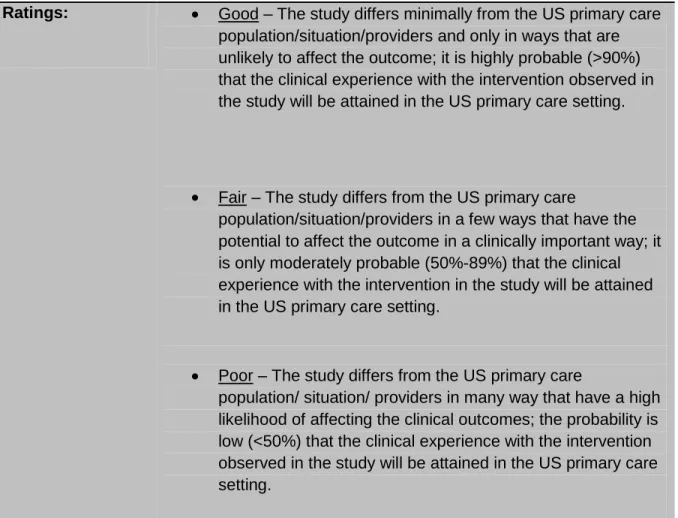
Ratings: Good – The study differs minimally from the US primary care
population/situation/providers and only in ways that are unlikely to affect the outcome; it is highly probable (>90%) that the clinical experience with the intervention observed in the study will be attained in the US primary care setting.
Fair – The study differs from the US primary care
population/situation/providers in a few ways that have the potential to affect the outcome in a clinically important way; it is only moderately probable (50%-89%) that the clinical experience with the intervention in the study will be attained in the US primary care setting.
Poor – The study differs from the US primary care
population/ situation/ providers in many way that have a high likelihood of affecting the clinical outcomes; the probability is low (<50%) that the clinical experience with the intervention observed in the study will be attained in the US primary care setting.
Table 4. Criteria for assessing external validity28.
Overall Quality
High Quality: Good internal and external validity.
Moderate: Good internal validity with at least fair external validity or at least fair internal and external validity.
Low Quality: Either fair internal validity with poor external validity or poor internal validity.
[20]
Results
Search Results
The initial MEDLINE search yielded 128 citations. After review of the abstracts, 122 were excluded for reasons including: wrong study design, patient survival was not the measured outcome, measured outcome was not survival to discharge, and there was no abstract or full viewable text. The remaining 6 full text articles were reviewed in their entirety.
[21]
duplicates and already identified in the MEDLINE search. After applying inclusion and exclusion criteria to the full text articles, all 6 articles were excluded in the review. Four full text articles were excluded because they did not measure the specified outcome of survival to discharge and two articles were excluded because they did not address the 9-1-1 dispatch system.
After manual review of two selected bibliographies of papers that most closely addressed the clinical question, 62 additional citations were identified and their abstracts reviewed. Of these, 1 study was found and reviewed in its entirety. This article was
subsequently excluded because it did not measure any specified intervention. In total, all 7 articles selected for a full text review were excluded.
Figure 1. Results of literature search.
194 citations initially identified through literature search, 62 through bibliography search
[22] Fig. 1 – Flow of articles.
*Reasons for exclusion of abstracts included: wrong study design (181), patient
survival was not the measured outcome (6), measured outcome was not survival to discharge (34), and there was no abstract or full viewable text (28).#
Reasons for exclusion of full articles included: did not measure the specified outcome of survival to discharge (4), did not address the 9-1-1 dispatch system (2), or did not measure any specified intervention (1).
Limitations
This systematic review describes only the current availability of evidence published in the last ten years in English. Despite using carefully predefined review and selection
methodology, this paper is still susceptible to the fact that only data that has been published and made available to the public can be reviewed. I did not include any ongoing trials or
unpublished data. The possibility exists that this writer may have not identified studies through the literature search, which potentially limits the comprehensive nature of the literature search.
Conclusion
7 articles retrieved for full text review
[23]
Given this review, what can be said about the current research regarding the impact that an integrated emergency dispatch system has on OHCA survival? First and foremost, the literature suffers from a lack of observational or descriptive studies that directly address the above question. Virtually every investigation to date deals with either the placement of AEDs in public areas or the effect of public defibrillation on outcomes. To their credit, Myers and
colleagues were the only investigators to address the issue of unregistered public AEDs and the importance of informing EMS of AED locations to direct 9-1-1 callers to the nearest public AED1. The next wave of research in this area must attempt to answer the question of whether or not an AED integrated emergency dispatch system leads to increased survival from OHCA. For now, no inference can be made about causality and we therefore must remain uncertain whether or not such an integrated system would lead to increased survival rates.
Secondly, much of the literature on this topic comes from large, urban areas that are not easily generalized to smaller or rural areas. Large urban areas by default have many more public locations whereby an AED can be placed for public use during an emergency. Many of the tools and procedures that were analyzed may not be as easily implemented in rural counties or areas of low population density. Just as future initiatives need to be tested prospectively, so too must they be studied in both urban and rural populations. Lastly, much of the literature seems to suggest a more limited role for EMS. Future focus should be placed on developing EMS as a more expansive entity capable of knowing not only where events happen, but also where emergency equipment is located in relation to those events.
[24]
discuss the need to develop and refine PAD programs6,17,18. Random placement of AEDs does not work, and often times results in areas that need the most not having any; instead,
identification of high-risk areas should guide placement to ensure that optimal public benefit is achieved14,15. Lastly, identifying pools of unregistered AEDs is crucial when compiling a location database that would eventually be incorporated into the dispatch system1.
As previously stated, a lack of data on the subject prevents this writer from making a definite conclusion regarding the potential impact of an integrated emergency dispatch system. It is not known if such integration would confer any benefit at all beyond that which is already gained by full implementation of AHA guidelines, but this is precisely why the following question needs to be answered: Does incorporating known locations of AEDs with the 9-1-1 emergency dispatch system increase a person’s chances of surviving cardiac arrest?
[25] REFERENCES
1. Myers JB, French D, Webb W. Lack of integration of automated external defibrillators with EMS response may reduce lifesaving potential of public-access defibrillation. Prehospital Emergency Care. 2005;9(3):339-343.
2. Rea TD, Olsufka M, Bemis B, et al. A population-based investigation of public access defibrillation: Role of emergency medical services care. Resuscitation. 2010;81(2):163-167.
3. Jameson, J. N. St C., Dennis L. Kasper, Harrison TR, et al, eds. Harrison's Principles of Internal Medicine. New York: McGraw-Hill Medical Publishing Division; 2005.
4. Nichol G, Rumsfeld J, Eigel B, et al. Essential features of designating out-of-hospital cardiac arrest as a reportable event: A scientific statement from the american heart association
[26]
critical care; council on cardiovascular nursing; council on clinical cardiology; and quality of care and outcomes research interdisciplinary working group. Circulation. 2008;117(17):2299.
5. Marenco JP, Wang PJ, Link MS, Homoud MK, Estes N. Improving survival from sudden cardiac arrest. JAMA: the journal of the American Medical Association. 2001;285(9):1193.
6. Schober P, van Dehn FB, Bierens JJLM, Loer SA, Schwarte LA. Public access defibrillation: Time to access the public. Ann Emerg Med. 2011.
7. Nichol G, Thomas E, Callaway CW, et al. Regional variation in out-of-hospital cardiac arrest incidence and outcome. JAMA: the journal of the American Medical Association.
2008;300(12):1423.
8. Lloyd-Jones D, Adams RJ, Brown TM, et al. Heart disease and stroke statistics--2010 update: A report from the american heart association. Circulation. 2010;121(7):e46.
9. Zheng ZJ, Croft JB, Giles WH, Mensah GA. Sudden cardiac death in the united states, 1989 to 1998. Circulation. 2001;104(18):2158.
10. Hallstrom AP, Ornato JP, Weisfeldt M, et al. Public-access defibrillation and survival after out-of-hospital cardiac arrest. N Engl J Med. 2004;351(7):637.
11. Winkle RA. The effectiveness and cost effectiveness of Public‐Access defibrillation. Clin Cardiol. 2010;33(7):396-399.
12. Sasson C, Rogers MAM, Dahl J, Kellermann AL. Predictors of survival from out-of-hospital cardiac arrest. Circulation: Cardiovascular Quality and Outcomes. 2010;3(1):63.
13. Mell HK, Sayre MR. Public access defibrillators and fire extinguishers: Are comparisons reasonable? Prog Cardiovasc Dis. 2008;51(3):204-212.
14. Lerner EB, Fairbanks RJ, Shah MN. Identification of Out‐of‐Hospital cardiac arrest clusters using a geographic information system. Acad Emerg Med. 2005;12(1):81-84.
[27]
16. Jorgenson DB, Skarr T, Russell JK, Snyder DE, Uhrbrock K. AED use in businesses, public facilities and homes by minimally trained first responders. Resuscitation. 2003;59(2):225-233.
17. Weisfeldt ML, Sitlani CM, Ornato JP, et al. Survival after application of automatic external defibrillators before arrival of the emergency medical system. J Am Coll Cardiol.
2010;55(16):1713-1720.
18. Nichol G, Huszti E, Birnbaum A, et al. Cost-effectiveness of lay responder defibrillation for out-of-hospital cardiac arrest. Ann Emerg Med. 2009;54(2):226-235. e2.
19. American heart association: Chain of survival.
http://www.heart.org/HEARTORG/CPRAndECC/WhatisCPR/ECCIntro/Chain-of-Survival_UCM_307516_Article.jsp.
20. Gold LS, Fahrenbruch CE, Rea TD, Eisenberg MS. The relationship between time to arrival of emergency medical services (EMS) and survival from out-of-hospital ventricular fibrillation cardiac arrest. Resuscitation. 2010;81(5):622-625.
21. Aufderheide T, Hazinski MF, Nichol G, et al. Community lay rescuer automated external defibrillation programs: Key state legislative components and implementation strategies: A summary of a decade of experience for healthcare providers, policymakers, legislators, employers, and community leaders from the american heart association emergency
cardiovascular care committee, council on clinical cardiology, and office of state advocacy. Circulation. 2006;113(9):1260.
22. Folke F, Lippert FK, Nielsen SL, et al. Location of cardiac arrest in a city center: Strategic placement of automated external defibrillators in public locations. Circulation. 2009;120(6):510.
23. Folke F, Gislason GH, Lippert FK, et al. Differences between out-of-hospital cardiac arrest in residential and public locations and implications for public-access defibrillation. Circulation. 2010;122(6):623.
[28]
25. Hinchey PR, Myers JB, Lewis R, et al. Improved out-of-hospital cardiac arrest survival after the sequential implementation of 2005 AHA guidelines for compressions, ventilations, and induced hypothermia: The wake county experience. Ann Emerg Med. 2010;56(4):348-357.
26. Lick CJ, Aufderheide TP, Niskanen RA, et al. Take heart america: A comprehensive, community-wide, systems-based approach to the treatment of cardiac arrest. Crit Care Med. 2011;39(1):26.
27. Sayre MR, Cantrell SA, White LJ, Hiestand BC, Keseg DP, Koser S. Impact of the 2005 american heart association cardiopulmonary resuscitation and emergency cardiovascular care guidelines on out-of-hospital cardiac arrest survival. Prehospital Emergency Care.
2009;13(4):469-477.
28. U.S. preventive services task force procedure manual.
[29]
An Original Design of a Research Study
Introduction
Purpose
[30]
effectively increase knowledge and identify the true benefit of an integrated public defibrillation/9-1-1 dispatch system.
Emergency Medical Services
Emergency medical services, or EMS, is a critical component in the treatment of any patient having an out-of-hospital cardiac arrest (OHCA). Of all unexpected cardiac deaths that occur annually, EMS treats roughly 60%1. Patients requiring bystander cardiopulmonary
resuscitation (CPR) and/or defibrillation are usually hemodynamically unstable and often require advanced care by EMS providers to restore and maintain spontaneous circulation2. An integral part of the American Heart Association’s (AHA) chain of survival is the recognition of an
emergency and calling 9-1-1 to initiate the emergency response system.
Steps Necessary to Implement the 2005 American Heart Association Guidelines
The 2005 update to the AHA’s guidelines featured many changes, but the three areas most affected were the CPR compression-ventilation rates, hyperventilation, and
post-resuscitation measures. First, the compression-ventilation ratio has been changed from 15:2 to 30:2, placing an even greater emphasis on circulating the oxygenated blood that already exists in the circulatory system. If a bystander responds to a suspected victim or cardiac arrest and is not trained in CPR, then the bystander should provide compression-only CPR without rescue breaths3; however, trained responders that feel comfortable to do so should provide both
[31]
either a part of continuing medical education that is required of all emergency medical personnel or a separate, special training session. Alternatively, off-the-shelf training materials provided by the AHA can take the place of a training program and still be effective4.
Second, tighter controls on ventilation rates have been instituted to decrease
hyperventilation. Hyperventilation has been shown to decrease survival due to the resulting increase in intrathoracic pressure, which decreases coronary perfusion in cardiac arrest
patients5. One way to combat this is by using an oral airway in conjunction with a nonrebreather mask to give two quick breaths per round of CPR, with endotracheal intubation attempted after 3 rounds of CPR6. The use of impedance threshold devices also serves to prevent unnecessary air from entering the chest during CPR, which helps to increase blood return to the heart and improves short-term survival7,8.
Lastly, the induction of therapeutic hypothermia by EMS as a means of postresuscitation support cools the body to improve neurological outcomes. One study shows that the induction of hypothermia by means of rapid infusion of up to 2L of 4°C normal saline by EMS is feasible and an effective method of lowering core body temperature9. Other studies have shown that therapeutic hypothermia is beneficial to patients suffering from cardiac arrest10, leading to
improved neurological outcomes following the return of spontaneous circulation11,12. A summary of the recommended AHA guidelines for induced hypothermia can be seen in Figure 1.
Figure 1. Summary of induced hypothermia13
Induction:
Cool patients to between 32-34°C for at least 24 hours Median time to target body temperature is approx. 8 hours IV cold fluids (0.9% saline or Ringer’s lactate)
[32]
Focused Clinical Question
Research Design: Observational before-after cohort
Focused Question: Does incorporating known public locations of AEDs with the 9-1-1 emergency dispatch system increase a person’s chances of surviving out-of-hospital cardiac arrest?
Population: All patients with out-of-hospital cardiac arrest from a cardiac etiology over 18 years of age
Intervention: A 9-1-1 dispatch system incorporated with known locations of public AEDs
Maintenance:
Cooling blankets that circulate cold-water or air Continue cold or wet blankets on torso
Optional intravascular cooling catheters (femoral or subclavian vein)
Rewarming:
[33]
Comparison: An EMS system that has fully implemented the 2005 AHA
guidelines for CPR and emergency care versus a fully AHA implemented EMS plus a 9-1-1 dispatch system incorporated with public AED locations
Primary Outcome: Survival to hospital discharge
Secondary Outcome: Survival to admission, presence of a pulse upon Emergency Department arrival, and return of spontaneous circulation
Time Frame: Sixty (60) consecutive months
Table 1. Focused clinical question for the proposed study. AED – automated external defibrillator. EMS – emergency medical services. AHA – American Heart Association.
Materials and Methods
Focus
The aim of this research is to determine whether incorporating public AED locations into the 9-1-1 dispatch structure of EMS agencies that have fully implemented the 2005 AHA
[34]
conducted in the medical literature, utilizing basic tools and measures from those studies with modifications to specifically address public AED integration.
Setting
This study will take place in Orange County, North Carolina, which is a county of
approximately 133,000 residents14. The county EMS service receives more than 11,000 calls to 9-1-1 annually15. The EMS system consists of 33 paramedics and 21 emergency medical technicians (EMTs), as well as fire fighters and other first responders. The Orange County emergency services network not only partners with EMS and fire departments, but it also includes law enforcement and social services that provide assistance to Orange County residents14. All advanced life support (ALS) providers receive initial didactic training in accordance with state law, and must undergo annual continuing medical education requirements to maintain certification.
Study Design
[35]
spontaneous circulation (ROSC) (see Figure 1). County EMS administrators will be required to perform monthly quality assurance measures to ensure compliance, and if their responder compliance rate falls below 95% they will be given performance feedback with ways to bring them up to said limit.
The adoption and implementation of the 2005 AHA guidelines in phase 1 will be carried out using training sessions provided by the medical director and county training officer at the beginning of the phase and every three months for a total of four sessions. The initial session will involve all paramedics and EMTs in a weekend didactic and clinical training session given by the medical director. Each of the remaining sessions will be a one-day review provided by the county training officer.
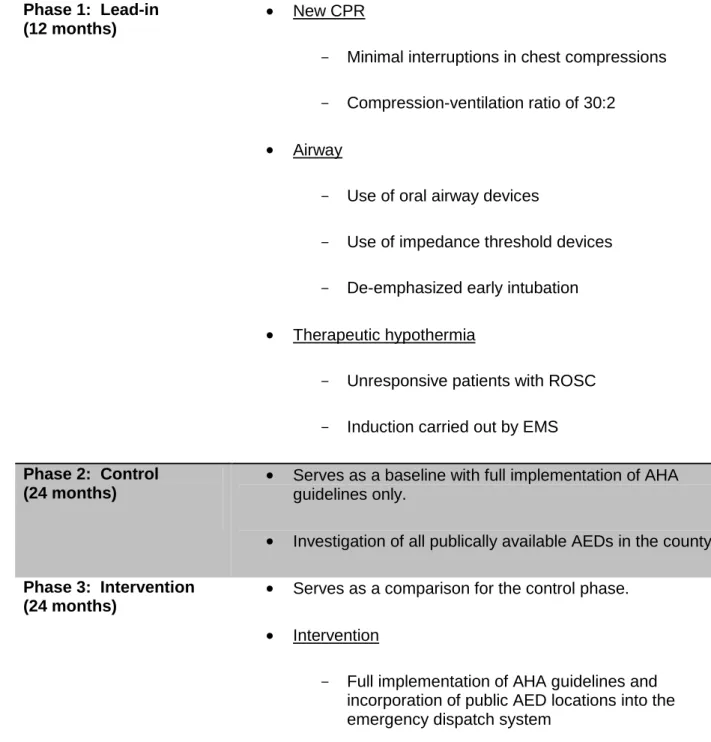
Phase 2 will last for 24 months after the completion of phase 1 and will serve as a baseline or control phase. During this time, all EMS agencies and personnel will be in full compliance of the 2005 AHA guidelines and all patients will be treated accordingly with continued quality assurance and performance feedback to the EMS personnel. Phase 2 will also involve the identification of all publically available AEDs in the county, which will result in a database that will be incorporated into the emergency dispatch system at the conclusion of the 24 months. Finally, phase 3 will last for 24 months and will involve the use of an integrated public AED/emergency dispatch system in addition to the treatments implemented in phase 1. Table 2 summarizes this study design.
Study Population
[36]
hospital, meaning patients who have their resuscitation efforts terminated before transport will also be included. Exclusion criteria will include non-cardiac or traumatic causes of arrest as determined by official cause of death, obvious death (defined as the presence of mortal wounds such as decapitation or the presence of rigor mortis), and patients with a legal and valid do-not-resuscitate (DNR) order made available to EMS. This study will have to be approved by the institutional review board of the University of North Carolina.
Outcome Measurement and Data Analysis
The primary outcome will be survival to hospital discharge. Secondary outcomes will be survival to hospital admission, presence of a pulse upon Emergency Department arrival, and return of spontaneous circulation. Study data will be collected from the EMS electronic patient care reporting system entered immediately after the patient encounter. Additional data and survival outcomes will be manually gathered from hospital records by trained personnel
performing data review after the event has occurred. Data will also be collected by review of 9-1-1 records to determine usage rates of publicly accessible AEDs.
In order to assess the effects of having an integrated 9-1-1 dispatch system, the
intervention and control groups will be compared with respect to survival to discharge rates and will be evaluated using Pearson’s chi-square analysis (Χ2
[37]
Phase 1: Lead-in (12 months)
New CPR
- Minimal interruptions in chest compressions - Compression-ventilation ratio of 30:2
Airway
- Use of oral airway devices
- Use of impedance threshold devices - De-emphasized early intubation
Therapeutic hypothermia
- Unresponsive patients with ROSC - Induction carried out by EMS
Phase 2: Control (24 months)
Serves as a baseline with full implementation of AHA guidelines only.
Investigation of all publically available AEDs in the county.
Phase 3: Intervention (24 months)
Serves as a comparison for the control phase. Intervention
- Full implementation of AHA guidelines and incorporation of public AED locations into the emergency dispatch system
Table 2. Summary of study design. CPR – cardiopulmonary resuscitation. ROSC – return of spontaneous circulation. EMS – emergency medical services. AHA – American Heart Association. AED – automated external defibrillator.
[38]
Descriptive analysis of both the phase 2 baseline control group and the phase 3
intervention group – including age, gender, ethnicity, initial cardiac rhythm, EMS/9-1-1 response interval, arrest location, defibrillation prior to EMS arrival, bystander-witnessed arrest, and advanced management – would be included here [Table 3]. This would be followed by the primary and secondary survival outcomes from each of the study groups [Table 4].
Primary Outcome of Interest
This topic will be assessed through the descriptive analysis in Table 4. The results will be difficult to predict. However, I believe the results will be positive; similar to past studies that showed improved survival with full implementation of the 2005 AHA guidelines, I expect to see improved survival with incorporation of public AED locations into EMS agencies already
practicing those guidelines. A statistically significant increase should be expected in the primary outcome of survival to hospital discharge among adult patients with out-of-hospital cardiac arrest. It will be difficult to predict the exact magnitude of this suspected relationship. I believe the potential improvement in OHCA survival will be close to but not as dramatic as the effect of fully implementing the 2005 AHA guidelines.
Secondary Outcomes of Interest
This topic will also be assessed through the descriptive analysis in Table 4. The results will be difficult to predict, but I believe there will be as large an improvement in these measures as that predicted in the primary outcome. I suspect that any improvement in primary outcome that the intervention group sees would be accompanied by a commensurate improvement in secondary outcome measures.
[39]
Out-of-hospital cardiac arrest is a life-threatening event that affects people of all races and walks of life. However, it can safely and effectively be treated by both the lay public and emergency trained professionals alike. Devices called automated external defibrillators, or AEDs, are able to detect if a person’s heart has an abnormal rhythm that can be corrected with a timed electrical shock, which the devices deliver. When combined with bystander CPR, AEDs can double the survival rates for persons having an out-of-hospital cardiac arrest16, which is the basis behind the concept of public access defibrillation (PAD).
Knowledge and public awareness of PAD appear to be important components of any effective public health policy aimed at improving survival from cardiac arrest. The American Heart Association’s (AHA) chain of survival is dependent on the public’s ability to at least recognize an emergency and hopefully know how to provide basic life saving skills, such as CPR and the use of an AED. The systematic evidence review (SER) was valuable in that it identified a key area for which little is known and virtually no data or evidence exists. This fact, along with studies from related topics, was instrumental in creating my research design.
The SER made me aware that the medical community was lacking in knowledge regarding the potential impact of incorporating public AED locations into the emergency
dispatch system and the effect it would have on OHCA survival. Therefore, it is evident that we must increase the information available by carrying out studies such as the one described by this writer in this paper. The process of obtaining this information is time consuming and many logistical and fiscal barriers remain challenges to overcome.
[40]
My research design suggests an effective way of determining whether incorporating public AED locations into the 9-1-1 dispatch system will make a difference in survival rates from OHCA. The strengths of this study design include a clear, focused clinical question. Given the growing number of people living with heart disease, cardiac arrest will continue to be an issue of concern among medical experts and the public. Therefore, the clinical question is clear and relevant and the design of the study is appropriate.
All adult patients with out-of-hospital cardiac arrest from a cardiac etiology will be treated by standard of care alone – which includes full implementation of the 2005 AHA guidelines – to determine baseline survival rates. This will be compared to patients with the same condition that will be treated with standard of care plus a fully integrated emergency dispatch system to determine if such integration improves those survival rates. The exclusion of non-cardiac or traumatic causes of arrest, obvious death, and patients with a legal and valid DNR will strengthen the study.
The limitations of this study include the relatively small sample size. With an overall population of about 133,000 in Orange County, NC and an OHCA incidence of 0.55 per 1,000 (Rea, 2004), I expect just 75 cases annually. This means there will only be about 150 cases in both the control group and the intervention group. Although the study will be powered to find statistically significant differences, the small numbers will be difficult to generalize to larger EMS agencies or the entire population. The external validity will be satisfactory, but will not approach that of a large multi-center randomized controlled trial.
[41]
There exists the possibility that an emergency dispatch system integrated with public AED locations could improve survival from out-of-hospital cardiac arrest beyond the current standard of care. Future studies should take a look at the role that public defibrillation plays in prehospital emergency care, specifically in the area of survival to discharge and how an integrated system might affect this measure. Prior to recommending that all county EMS agencies incorporate a comprehensive database of public AED locations into their 9-1-1 dispatch system, studies should be conducted in a manner consistent with that which is contained within this paper to better elucidate this topic.
Characteristics Phase 2 (Control)
(n=x)
Phase 3 (Intervention) (n=x)
[42]
Male sex (%)
Ethnicity
Black White Hispanic Other
Initial cardiac rhythm
VF/VT Asystole PEA
EMS response interval
Defibrillator to scene ≤10 min Defibrillator to scene ≤5 min
Arrest location
Residential Public
Defibrillated prior to EMS arrival
Yes No
Bystander-witnessed arrest
Yes
No (EMS only)
Advanced management
On-scene
Receiving hospital
Table 3. Characteristics of included patients with out-of-hospital cardiac arrest where resuscitation was attempted. VF/VT – ventricular fibrillation/ventricular tachycardia. PEA – pulseless electrical activity. EMS – emergency medical services.
Survival Outcome Phase 2 (Control)
(n=x)
Phase 3 (Intervention) (n=x)
[43] Admission to hospital (%)
Pulse on hospital arrival (%)
Return of spontaneous circulation (%)
Table 4. Survival outcome measures for both the control group and intervention group.
[44]
1. Chugh SS, Jui J, Gunson K, et al. Current burden of sudden cardiac death: Multiple source surveillance versus retrospective death certificate-based review in a large U.S. community. J Am Coll Cardiol. 2004;44:1268.
2. Rea TD, Olsufka M, Bemis B, et al. A population-based investigation of public access defibrillation: Role of emergency medical services care. Resuscitation. 2010;81(2):163-167.
3. Sayre MR, Berg RA, Cave DM, Page RL, Potts J, White RD. Hands-only (compression-only) cardiopulmonary resuscitation: A call to action for bystander response to adults who experience out-of-hospital sudden cardiac arrest: A science advisory for the public from the american heart association emergency cardiovascular care committee. Circulation. 2008;117(16):2162.
4. Sayre MR, Cantrell SA, White LJ, Hiestand BC, Keseg DP, Koser S. Impact of the 2005 american heart association cardiopulmonary resuscitation and emergency cardiovascular care guidelines on out-of-hospital cardiac arrest survival. Prehospital Emergency Care.
2009;13(4):469-477.
5. Aufderheide TP, Lurie KG. Death by hyperventilation: A common and life-threatening problem during cardiopulmonary resuscitation. Crit Care Med. 2004;32(9):S345.
6. Garza AG, Gratton MC, Salomone JA, Lindholm D, McElroy J, Archer R. Improved patient survival using a modified resuscitation protocol for out-of-hospital cardiac arrest. Circulation. 2009;119(19):2597.
7. Aufderheide TP, Pirrallo RG, Provo TA, Lurie KG. Clinical evaluation of an inspiratory
impedance threshold device during standard cardiopulmonary resuscitation in patients with out-of-hospital cardiac arrest. Crit Care Med. 2005;33(4):734.
8. Cabrini L, Beccaria P, Landoni G, et al. Impact of impedance threshold devices on
cardiopulmonary resuscitation: A systematic review and meta-analysis of randomized controlled studies. Crit Care Med. 2008;36(5):1625.
[45]
10. Azmoon S, Demarest C, Pucillo AL, et al. Neurologic and cardiac benefits of therapeutic hypothermia. Cardiol Rev. 2011;19(3):108.
11. Walters JH, Morley PT, Nolan JP. The role of hypothermia in post-cardiac arrest patients with return of spontaneous circulation: A systematic review. Resuscitation. 2011;82(5):508-516.
12. Cabanas JG, Brice JH, De Maio VJ, Myers B, Hinchey PR. Field-induced therapeutic hypothermia for neuroprotection after out-of hospital cardiac arrest: A systematic review of the literature. J Emerg Med. 2011;40(4):400-409.
13. Neumar RW, Nolan JP, Adrie C, et al. Post-cardiac arrest syndrome: Epidemiology, pathophysiology, treatment, and prognostication A consensus statement from the international liaison committee on resuscitation (american heart association, australian and new zealand council on resuscitation, european resuscitation council, heart and stroke foundation of canada, InterAmerican heart foundation, resuscitation council of asia, and the resuscitation council of southern africa); the american heart association emergency cardiovascular care committee; the council on cardiovascular surgery and anesthesia; the council on cardiopulmonary,
perioperative, and critical care; the council on clinical cardiology; and the stroke council. Circulation. 2008;118(23):2452.
14. Orange county, North Carolina. http://www.co.orange.nc.us/index.asp. Accessed 06/01, 2011.
15. Orange county emergency services call data: 2010-11.
http://www.co.orange.nc.us/emergency/About.asp.