Informed Consent for Elective Abortion: A Policy Analysis for North Carolina.
By
.. Lily K Pemberton
A Master's Paper submitted to the faculty of · the University ofNorth Carolina at Chapel HilL
In partial fulfillment of the requirements for the degree of Master of Public Health in
the Public Health Leadership Program.
Abstract:
Abortion is a divisive issue. People on both the pro-life and pro-choice sides of the debate hold strong beliefs about the morality of abortion and how available it should be to women with unintended pregnancies. Its controversy not withstanding, it is an extremely common occurrence. More than a million women had an abortion in 2005, and estimates suggest that one in four women in America will have an abortion in her lifetime. Therefore, abortion services are a significant component of women's health care.
The informed consent process for elective abortion is an important element in the quality of medical care women receive. The purpose of pre-procedural counseling is to help the woman make an informed decision and to provide her with emotional support if it is needed' .This
process should inform the woman of the risks, benefits and alternatives to the procedure, and the risks and benefits of the alternatives. Shared decision making requires that the consent
procedure should also allow time for the woman to ask questions and provide a medium for the woman and her physician to discuss her values and beliefs in an effort to make the best decision for her. The prevalence of abortion, and the imperative to provide high quality care combine to make the informed consent process a matter of public health.
The political and social tensions surrounding abortion have engendered numerous regulations on the provision of abortion services. This paper focuses on regulation of the
informed consent process for elective abortion. Supporters of proposed regulations argue that the regulations help women by ensuring that they are given the information that they need to make informed decisions, and time to think over their decisions4• Two bills currently before the NC legislature, the Woman's Right to Know Bill and the Ultrasound Before an Abortion Bill, would mandate additional requirements for the informed consent process for elective abortion,.
This paper is an analysis of the content of these bills, with evaluations of the risks of abortion stated in the materials, and of the implications of the regulations for women's health. The paper progresses through a history of abortion politics and social attitudes towards abortion; a discussion of the intention of informed consent and the ethical principles it was designed to uphold; a review of the evidence for the harms of abortion to women's health, focusing on the psychiatric health consequences of abortion; and a presentation and discussion of data from a series of elite interviews. The paper concludes with policy recommendations.
Table of Contents
Table of Contents _____________________________________________________ ii In"oduction: _________________________________________________ ~---Historical Background of Abortion in the United States _________________________ _ Ideologies & Social Attitudes towards abortion in the US:
---1 4 11
Social attitudes towards abortion in the US: ... 11
"Pro-choice" and "Pro-life" ideologies: ... 11
Informed Consent: ___________________________________________________ 13 Informed Consent for Elective Abortion:--- 17
Systematic Review: _ _ _ _ _ _ _ _ _ _ _ _ _ _ _ _ _ _ _ _ _ _ _ _ _ _ _ _ _ 22 1ntroduction ... 22
Methods ...•... 24
Results ...•...•... 26
...•... 30
Limitations of this review: ... 30
Discussion ...•...•... 31
Elite Interviews: _______________________________________________________ 33 Introduction: ...•...•....•...•... 33
Methods: ... 34
Results: ...•...•... 35
Limitations: ...•...•... 51
Discussion: ...•...•... 52
Policy R e c o m m e n d a t i o n s :
-Acknowkdgemen~: _______________________________________________ _
Introduction:
Abortion is a legal medical practice in the US. A woman's right to have an abortion is protected under the right to privacy, according to the 1973 Supreme Court ruling Roe v. Wade5 • It is a common procedure; based on current practice, one in four women in America will have an abortion in her lifetime1 . However, vocal objection to the legality and practice of abortion has never abated in the United States. Since Roe v. Wade, politicians and activists who oppose abortion have passed legislation, primarily at the state level, placing special regulations on abortion that are different from those applying to other elective surgical and medical procedures. One type of legislation that has seen particular success is regulation of the informed consent process for elective abortion.
The informed consent process for an elective abortion involves pre-procedural counseling. Informed consent is considered separate from options counseling, where women with unintended pregnancies may discuss with a health care provider whether they want to keep the pregnancy and raise the child, keep the pregnancy and give the child up for adoption, or terminate the pregnancy. If a woman decides to terminate the pregnancy after options
procedure differently from other procedures receiving routine pre-procedural counseling. Although I present informed consent and options counseling as separate entities in this paper, it is important to note that they overlap. In most clinical situations it is difficult to separate the elements of counseling and consent from one another.
Both the practice of abortion and the informed consent process related to the procedure are critical issues for women's reproductive health, and as such have significant implications for public health. Despite the overall decline in the abortion rate since the 1980s, abortion is still one of the most commonly performed medical procedures in the United States2• 6• 7. With
This paper is a policy analysis exploring the informed consent process for elective
abortion in North Carolina (NC). Two bills are currently being debated in the NC legislature that
would enact further regulation on the informed consent process for elective abortion. The
primary research question is: Do the current bills being proposed in NC fulfill the ethical
principles of informed consent in medical practice, and will they support women in making
informed decisions about their reproductive health?
This paper progresses through an analysis of the social and political history of
reproductive health policies in NC and compares the social and political climate for elective
abortion in NC to that of other states in the Southeast. Included in this discussion is an analysis
of current policies for the informed consent process for elective abortions in the US, the
presentation of two bills being proposed in the NC legislature that would regulate the informed
consent process for elective abortion, and a review of the existing medical literature to evaluate
the content of the identified policies. The paper includes a systematic summary and analysis of
review articles on psychiatric consequences associated with elective abortion to investigate the
quality of the available evidence on this topic. An essential component of this evaluation and
analysis is interviews with elite stakeholders, including experts in the fields of reproductive
health services, reproductive health policy, women's health advocacy, and political analysis. All
of the information gathered contributes to the evaluation of the two proposed bills in NC. The
bills are evaluated based on whether they fulfill the ethical principles of the informed consent
process and whether they will benefit the health of women in the state ofNC. The paper
concludes with a discussion of the public health implications of the proposed bills and
recommendations for future policies and research into the effects of regulation of the informed
This study provides readers with an analysis of the social and political factors that influence reproductive health policies in the Southeast, and in particular NC. The study offers readers a full discussion of the risks of abortion for women's health, and a review of the ethical issues that arise when materials mandated for the informed consent process for abortion are motivated by non-medical purposes or beliefs.
Historical Background of Abortion in the United States
In the 1960s, women were entering the workforce and college at an increasing rate and
yet still held the primary caretaking role for children9 • These increasing demands and the
imbalance of responsibility made the need for safe and reliable fertility control paramount. In the
absence of safe and legal abortion, and with limited availability of effective contraception,
women in need of fertility control resorted to illegal abortions9 . lllegal abortions became
commonplace. These practices undermined the legitimacy of government policies, but also
endangered the lives of the women who were using them9. Although sometimes performed
safely, illegal abortion was often dangerous to the life of the woman9•
In the late 1960s, the increasing prevalence of illegal abortions prompted the AMA to
shift its position and begin supporting legalization of abortion procedures when performed by
physicians.9 Analysts of the political climate and motivations underlying this shift present two
contrasting views. In one of these analyses, observers attribute the AMA's change in official
policy to members witnessing the suffering of women from complications of illegal abortion9 .
According to this theory, many doctors drew the conclusion that these complications were
unnecessary and tragic9 • A second theory attempting to explain the transition within the AMA
holds that physicians wanted to take control of abortion away from others and keep it under their
sole supervision and authority10 . During this time, some medical professionals and concerned
citizens banded together to provide illegal-but medically safe---abortions9. One of the most
famous of these was the Chicago-based group called Jane, a group that started with volunteer
doctors, who then trained lay women to perform the procedure safely. This organization
delivered illegal but safe abortion services to thousands of women9 .
The discussion of women's rights and the threat to women's health presented by
existing laws limiting reproductive freedom. In addition, the legitimacy of American law was actively threatened by the disregard for the illegality of abortion9 . This disregard was
demonstrated by those who were willing to perform abortions, even under the threat of arrest and loss oflicense. The philanthropist and activist John D. Rockefeller III called for abortion law reform in the 1970s. He made the argument that abortion was inevitable and unstoppable and that, at the time, its prohibition was leading to large-scale disrespect for the law. He argued that abortion should be legalized for the sake of maintaining social order and stabilitY .
By the 1970s, the Women's Movement, abortion activities and criticism of ineffective policies had generated a climate ripe for change in reproductive health policies9• Promotion of the AMA's interests and concern for the sanctity of American social order were not the only factors driving the need for change. Pro-eugenics policies also played a role. Pro-eugenic policies that began in the 1920s and continued through the 1970s supported state-funded, selective abortions and the sterilization of poor women and women with non-white racial
backgrounds11 . One example is the NC Eugenics Board. In 1929, NC passed a state eugenics law that allowed for the sterilization of individuals found to be mentally diseased, feeble-minded or epileptic and whose sterilization was in the interest of the mental, moral or physical
improvement of the patient or inmate or of the public good. NC established a state Eugenics Board in 1932. The board received petitions for sterilization from penal institutions, charitable institutions and from county welfare superintendents. Eugenic scientists believed that
feeblemindedness was a hereditable condition, and that it was responsible for poverty,
Starting in the 1920s, research began that eventually undennined the assumptions of eugenic science, but many eugenics-related policies were not challenged directly until the 1940s. Most states saw a decline in the number of state-ordered sterilizations in the 1940s, but there was an expansion of the program in Georgia, NC and Virginia. The program in NC promoted
sterilization as one of several solutions to poverty and illegitimacy and increasingly targeted Black women. The focus in the 1960's on the "culture of poverty'' replaced hereditary theories as justification for eugenic sterilization. In the 1960s, the availability of better contraception, passage of voluntary sterilization laws, and the reform of abortion laws contributed to a decline in pro-eugenics policies for abortion and sterilization. Above all, by the late 1960s, organized feminist activities raised women's right to control their own fertility to the public agenda11 • The
Women's Movement, actively introducing into the discussion the belief that control over one's own reproductive autonomy is a basic human right, was both necessary and sufficient to the shift in political culture from acceptance of general prohibitions on abortion to acceptance of abortion as part of what came to be known as reproductive rights 9•
Constitutional right to privacy under the Due Process Clause of the 14th Amendment of the United States Constitution, the Supreme Court's decision in Roe vs. Wade defined abortion as a Constitutionally protected practice.
Since Roe vs. Wade, anti-abortion advocates have been increasingly involved in challenging the legality and administration of reproductive health services. Although Supreme Court rulings have consistently upheld Roe vs. Wade since its inception, abortion opponents have successfully limited abortion in both social and political arenas13. The first major success was the passage of the Hyde Amendment in 1977. This amendment cut of the availability of federal funds for most abortion services and thereby significantly decreased the accessibility of abortion for poor women 9 .
Challenges to the legality of Roe vs. Wade have come from within and without the political realm. "Pro-Life" groups have organized public demonstrations and encouraged the obstruction of abortion providers' actions through both violent and non-violent means. In
addressing their constituents' interests and their own beliefs, elected officials and interest groups have introducedspecific legislation with the intent oflimiting access to abortion services.
Anti-abortion tactics have changed significantly over time. Tactics that opponents began using in the mid-1990s have been particularly successful in generating limitations on abortion access. Prior to this time, violence against abortion providers and patients was the most pronounced anti-abortion tactic. Since 1977, 80,000 acts of violence or disruption have been reported at abortion clinics, including 7 murders of providers, 17 attempted murders, 41 bombing of clinics, 166 cases of arson, and 125 assaults6. The trend in violent acts has been decreasing since the early 1990s, but this record represents the violent history of the anti-abortion
protesters reason that they are acting to protect the unborn from abortion providers and from women who are willing to end the lives of innocent children. The fetus-centered argument implies that women make a rational and autonomous choice to have an abortion, and in doing so demonstrate selfishness and a lack of morals or values14.
The administration under George W. Bush has aggressively attempted to grant rights to fetuses. It has extended coverage to fetuses under the State Children's Health Insurance Program (SCHIP); expanded the mission of the federal Advisory Committee on Human Research
Protection to include embryos; and expressed support for the Unborn Victims of Violence Law, a law that criminalizes harming fetuses separately from harming the pregnant woman6.
In the mid-1990s, anti-abortion leaders changed their tactics from overt violence and an emphasis on the fetus' right to life to anti-abortion messages emphasizing a desire to protect women's health15. The "woman-centered" anti-abortion campaign endorses and promotes the belief that abortion places a woman's health at risk. This approach cites medical literature that supports links between abortion and poor health outcomes like breast cancer, depression, and high-risk future pregnancies.
The woman-centered approach demonstrates a shift in the representation of anti-abortion advocates' attitudes toward the procedure. In effect, this focus re-positions anti-abortion
advocates as defenders, rather than critics, of pregnant women who have had or who are
exploit this inability to make an appropriate decision in order to profit by providing the procedure 14.
The woman-centered anti-abortion strategy is actively seeking the enactment of several key policy changes on both the State and Federal level. These include laws requiring abortion providers to counsel women, using specific materials developed by the state, on the potential harms of abortion to their health; laws mandating the use of materials that describe details of abortion procedures for both early and late term abortion; laws requiring the provision of
materials that describe fetal development throughout pregnancy as a part of the informed consent process for elective abortions; and laws requiring waiting periods (usually 24 hours) after the materials have been presented prior to the procedure 16. The new anti-abortion strategy has been extremely effective in changing policy, and many states have adopted special policies for the informed consent process for elective abortion 17 • Examples of success with this approach include the groundbreaking 1992 US Supreme Court decision in Planned Parenthood of Southeastern Pennsylvania vs. Casey, where additional state restrictions on the provision of
Ideologies & Social Attitudes towards abortion in the US:
Social attitudes towards abortion in the US: US public opinion about abortion is diverse.
A public opinion poll in 2003 reported that 60% of Americans think that it has become too easy to obtain an abortion20• However, most people in the US believe that patients should have access to legal treatments, even in situations where the physician may be troubled by the moral implications of those treatments21 . About 49% of US citizens consider themselves more "pro-choice" and 45% consider themselves more "pro-life"20• Fifty-five percent of Americans support a woman's right to a first trimester abortion, and 75% support increased public funding for family planning services and counseling.20
Social attitudes and acceptance of abortion for any reason (i.e. abortion on demand) have declined since the mid-1980's; but the general public opinion towards abortion indicates that it is an accepted practice, especially for women with a health indication or with psychosocial reasons for seeking a termination. By the age of 45, 43% of all US women will have had an abortion6. This large percentage of the population indicates that abortion is accepted and used by women in the US, even if they may not report being "pro-choice" or in favor of abortion on demand.
"Pro-choice" and "Pro-life" ideologies: Abortion is one of the most divisive issues in
the US. Differences in opinion exist about the morality of abortion in general and under specific circumstances, but disagreements usually stem from a deeper source. People on opposite sides of this issue often differ in the way that they think about women's roles in society and in the way they perceive sex and sexuality.
closely related to religious affiliation, and that liberal attitudes toward abortion are positively correlated with high educational level, low parity, and support for female equality 8 .
Based on these survey results, individuals who disapprove of abortion can be characterized as typically Roman Catholic or fundamentalist Protestant and strongly committed to organized religion; on the conservative or traditional end of the spectrum with regard to women's role in life, premarital sex, sex education and civil liberties; and have no more than a high school or some college education8. Individuals who approve of the legality of abortion tend to be non religious or Jewish; not strongly committed to organized religion; they are likely to think of women's role in more liberal terms and to have college or graduate level degrees8•
Although these data describe the general population's attitudes and beliefs, it is also important to investigate the beliefs and attitudes of people who are activists in the "pro-life" and "pro-choice" movements. A sociological study of over 200 activists on both sides of this issue finds that activists from opposing camps are very different from one another in
sociodemographic characteristics and overall values. Differences in sociodemographics reflect the same trends as in the general population described above8• More important differences were between the values of activists. Pro-life activists felt that men and women were intrinsically different, that a women's place was in the home, and that the primary purpose of sexuality is procreation. Consequently, this group is generally opposed to most forms of contraception, and consider an unanticipated pregnancy not as unwanted but unexpected8.
financially prepared for parenthood, and wished to limit family size to conform to their social
and economic goals. Therefore, they perceived contraception as very important and useful.
While pro-choice activists approved of abortion for family planning, most did not
approve of abortion as a form of birth control8• Family planning is the ability to decide when one
wants to have children and the spacing of those children. Birth control-the practice of using
some method to decrease the likelihood of getting pregnant-is one element of family planning.
All methods of birth control have failure rates and may be used inconsistently; thus, unintended
pregnancies are possible even for a woman using birth control. It appears that activists on both
sides of this debate have deeply vested interests, not only in the outcome of the pregnancy, but in
much wider issues including the role of women in society. Because of these deeply rooted
interests, the abortion debate is likely to remain heated8 .
InfOrmed Consent:
The woman's health-centered anti-abortion movement relies heavily on the concept of
informed consent, a critical component of ethical interaction between patients and their
providers. This movement seeks to pass legislation that requires doctors to follow specific
guidelines in the informed consent process for elective abortion, using the justification that
women having abortions need to be informed about the risks of abortion to their health and about
available alternatives to abortion such as adoption. Because the concept of informed consent is
central to this strategy, it is important to understand the definitions and intentions of the informed
consent process as they apply to current thinking and application of medical ethics.
Many ethicists and organizations have defined the principles of medical ethics. The basic
principles accepted and currently promoted among US physicians are beneficence,
is guided by the duty of practitioners to protect the life and health of their patients (beneficence and nonmaleficence) and to respect patient autonomi2. Faden and Beauchamp define patient autonomy as the right of competent patients to make informed choices about their medical options, intentionally and without controlling influences or coercion22-24 .
Legal doctrine, ethical theories and contemporary understandings of the patient-physician relationship all underscore the importance of full patient comprehension as a means to support patient autonomi3 . Many researchers with an interest in the ethics of informed consent conclude that consent is an essential component of doctor-patient interactions because it is a means by which ethical ideals of respecting patients' autonomy can be realized25.28.
Consent is understood and defined by different theoretical models27 . "Real" consent is the understanding of consent that is used in the fields of Medicine and Law. This model assumes positivist concepts to define the parameters of consene . Positivism distinguishes factual
concepts through defining dichotomies (informed vs. ignorant, free choice vs. coercioni7•
treatmenr9• 30 • Respect for patient's consent reflects an appreciation of the physical and mental integrity of patients and defends them from unwanted interventions, deception or coercion27 . A patient's thoughts, feelings and values are important elements of the consent process because they influence the choices that a patient perceives as acceptable. Social pressures, anxiety or distress can inhibit a patient's ability to make an informed decision free from coercion, and for this reason it is assumed that these pressures should be reduced or eliminated by presenting accurate information in a neutral manner7 . These principles culminate in the Informed Consent Doctrine, a basic legal rule for medical practice that states that a procedure cannot occur without first obtaining consent from the patient12•
For medical interventions, it is accepted that consent means a voluntary, un-coerced decision made by a competent and autonomous person on the basis of adequate information and deliberation31• Conceptually, the informed consent process requires several steps: assigning the person decision-making capacity, disclosing relevant information about the procedure, ensuring that the patient understands the information slhe has been given, ensuring that the patient is making a voluntary choice, and authorizing the participant's decision32.
mentally handicapped, severely emotionally disturbed, or very young, there is little question that he or she is competent to make an informed decision3 .
According to these standards, informed consent involves knowing about the nature and purpose of the intervention; the intended effects and possible side effects of the intervention; the risks, harms and potential benefits for the procedure; and any reasonable alternatives to the procedure. Voluntary consent involves freedom from force, fraud, deceit, duress, overreaching or other ulterior forms of constraint or coercion; knowing about the right to refuse or withdraw without punishment; and the right to ask questions and to negotiate aspects of treatrnenr9• 30 .
Medical decision making is an essential component of medical ethics and risk management28 . The process of medical decision making is based on patient autonomy and informed consenr8. Shared decision making is an important part of informed consent because it facilitates communication between physician and patient. That communication helps to bridge the gap between medical knowledge of the possible risks and benefits of an intervention and the consequences that matter the most to a patient based on his or her values and beliefs27 . The need for shared decision making is in part driven by pressures from the bioethical and legal fields to move away from paternalism and respect patient autonomy3. Ideally, medical decision making is informed by the best evidence about the risks, benefits, and alternatives, it also encompasses patient -specific characteristics and values34 . A fundamental goal in enhancing patient choice is to enable patients to come to an autonomous decision which reflects personal preferences. Consent is promoted as a means by which these ideals can be achieved32• 33 •
embodied in the basic standards of the leading professional medical associations 16. All states
reqnire health care providers to obtain consent from patients prior to performing non-emergency
procedures. These requirements generally mandate that providers give patients information on
the risks and alternatives to the procedure. The rules that govern what is included in the risks and
benefits vary, but generally rest on the best medical evidence to provide patients with the risks
and benefits of the procedure and all the reasonable alternatives to that procedure, including the
consequences of non-treatment34 •
InfOrmed Consent fOr Elective Abortion:
Two controversial elements oflegislation related to the informed consent process for
elective abortions are requirements regarding the content of pre-abortion educational materials
and the use of mandatory waiting periods following the delivery of these materials prior to the
abortion.
Of these, the former most directly interferes with the concept of informed consent. Some
of these policies require the discussion of materials that are not consistent with the intent of the
informed consent process for all other elective procedures. An example of deviation from routine
informed consent is the provision of materials that may not be relevant to the decision of the
woman35 • Some of the materials describe multiple abortion procedures, including late-term
abortions, and may include descriptions of fetal development throughout gestation through a
term pregnancy. However, ninety percent of abortions are performed before 12 weeks of
gestational age16. As more than 90% of women who receive abortions do so in the first
trimester, the descriptions of fetal development and late-term abortion procedures are irrelevant
and pregnancy support services may not be relevant to a woman seeking an abortion, especially if financial concerns are not the primary motivation for the choice to terminate35 .
In another example of policies inconsistent with the fundamental elements of informed consent, Richardson et al.'s analysis of pre-abortion counseling materials presenting health risks associated with abortions found that the content of some of the materials was misleading, inaccurate, or provided incomplete information35 . These materials often contain misinformation about the risks of abortion to a woman's health. Examples include a link between elective abortion and an increased risk for breast cancer, infertility or complications with future
pregnancies, and negative mental health outcomes. None of these health risks has been clearly linked to elective abortion by the body of available evidence35 . One of the most statistically rigorous studies on the abortion-breast cancer link, published in the New England Journal of Medicine in 1997, found no connection between abortion and breast cancer36. In 2003, the National Cancer Institute (NCI) conducted a systematic review of the evidence and concluded that there was clearly no link between abortion and breast cancer15. No systematic review of the evidence has linked legal and safe abortions to loss of future fertilitf5 • Finally, the best
predictor of a woman's mental health after an abortion is her mental health prior to the abortion; there is no currently accepted body of evidence that abortions cause mental health problems in women Is, 35-37.
The second legislative tactic mentioned above involves mandatory waiting periods for abortions, a now common policy approach for activists and legislators opposed to abortion4•
Those who support this legislation argue that it is intended to educate women seeking abortions and give them time to consider their decisions4. This argument makes the assumption that most women seeking abortions have not given their decision enough thought prior to making an
. fi b . 14
appomtrnent or an a ortwn .
Mandated waiting periods are typically 24 hours. Some mandates allow for women to be given the consent materials over the phone or by mail, but others require that the woman receive the consent materials in person, necessitating at least two visits to the clinic17• 38. Critics of mandatory waiting periods, particularly those that require two visits to an abortion clinic, assert that they cause women to have abortions later in pregnancy, which increases the risks associated with the procedure38 . Waiting periods can also create additional costs for women in the form of lost time working and the possible costs of travel and childcare 4 . Another concern is that
requiring more than one visit may threaten a loss of confidentiality if the woman has to justifY her absence from work with a note from a physician4.
For abortion consent, many states have detailed and specific requirements for the informed consent process16• The 1992 Supreme Court Decision in Planned Parenthood of Southeastern Pennsylvania vs. Casey let stand a state statute mandating a 24-hour waiting period
Currently, 32 states have enacted abortion counseling laws under the banner of informed consent, detailed in Table I.
T b l l S t t L a e : ae awswt 'th !liD orme dC on sen tP roce ures S d uect 'fi all IC y ~ or El ec tve f Ab 0 rti on I?
State Waiting Description Description of Ability Inaccurately Inaccurately Describes Accessing period of all fetal of a portrays asserts negative ultrasound common development fetus to risk to possible emotional services abortion throughout feel future link responses
procedures pregnancy pain fertility between only breast
cancer and abortion
Alabama 24 lrr w w
Alaska w w w w
Arkansas Prior w w v.w
day
Georgia 24hr w w V,W v
Idaho 24lrr w w
Kansas 24lrr w w w
Kentucky 24lrr w
Louisiana 24lrr w w v
Michigan 24lrr w w
Minnesota 24lrr w w V,W
Mississippi 24hr w
Nebraska 24hr w w
North Dakota 24hr w
Ohio 24lrr w
Oklahoma 24lrr w w V,W w V,W
Pennsylvania 24lrr w w South Carolina llrr w w
South Dakota 24lrr w w w w
Texas 24lrr w w w w w
Utah 24hr w w w v
Virginia 24lrr w w
West Virginia 24lrr w w w w
Wisconsin 24lrr w w V,W
*Key: W= written materials, V= materials delivered verbally, Source: Guttmacher Institute. Allan Guttmacher Institute State Policies in Brief
2008.
Many states in the Southeastern United States have policies mandating that certain topics are covered as a part of pre-abortion counseling. For example, Georgia has a policy that requires the discussion of fetal pain and abortion alternatives and support services for those alternatives. South Carolina, Tennessee and Virginia have policies that require the discussion of alternatives to abortion and support services for those alternatives16.
would require material to be included as part of the pre-abortion consent process. The first bill, "Woman's Right To Know" (House Bill1552), would mandate that providers would be counsel women about the medical risks of abortion, including the alleged risk of psychological harm; provide detailed information about fetal development throughout gestation, using conception instead of a woman's last menstrual period (LMP) to date the pregnancy; present materials describing the abortion procedures available at all stages of pregnancy, and present materials discussing financial support services available to a woman if she decides to keep her pregnancy. This bill would also require physicians, if they perform a prenatal ultrasound, to inform the woman that she has the right to view the ultrasound image. The bill includes the requirement that any woman considering abortion who calls a clinic where abortions are provided has a right to speak with a physician over the phone. If a physician failed to adhere to the policy, he or she would be at risk for legal punishment including having to pay civil remedies to the plaintiff (who could be the patient, or the father of the fetus who was aborted).
The other pending bill, "Ultrasound Before an Abortion" (House Bill 1782), would require a physician to perform an ultrasound prior to performing an abortion and to review the image with the woman prior to her giving informed consent. This bill would allow women to refuse to see the image. Both bills are attached in the Appendix to this document.
nation's first state-supported birth control program in 1937, the condom project in 1940, and reforming the illegal status of abortion in 196i 1 . In contrast, many neighboring states did not have widespread public health programs that supported public birth control programs and did not reform their abortion laws prior to the Supreme Court decision, Roe vs. Wade, in 197310.
Currently, North Carolina stands out among southeastern states by not having a waiting period for abortion services and not having special informed consent processes required by law for elective abortion.
The next section addresses the following questions: What are the social and political factors in North Carolina's history that may explain this difference between NC and its neighboring states? Are the current bills to enact policies that direct the informed consent process for elective abortion in NC likely to pass? What are the medical and ethical implications if these bills are adopted in NC?
Systematic Review:
Introduction: Many supporters of mandated informed consent procedures for elective
abortion argue that abortion carries significant risks for women's health and that women should have the right to know about these risks prior to consenting to have an abortion 4• 38• 40 . Supporters of the mandatory waiting period that follows mandatory counseling argue that a woman needs adequate time to think about her decision prior to having an abortion 4 • The medical evidence that supports the health risks of abortion has questionable quality, and most studies that have
examined the effect of a waiting period on a woman's satisfaction with her choice to have an abortion have found that waiting periods do not offer any benefit to a woman's decision making process 4' 38 .
risks. Care should be taken when reading any review article to determine if the authors used
rigorous standards of inclusion, exclusion, and evaluation of existing evidence; and if the authors
were transparent about how they weighed the available evidence to draw any conclusions.
Elements of high quality review articles include using a systematic approach to identifying
studies, and a transparent system of evaluating those studies, and including a thorough
description of methodology and reasoning supporting both evaluation and conclusions. Lower
quality studies tend to be less transparent and the conclusions are not always well justified.
Review articles on the health risks of abortion are of varying quality. Some have significant
sources of error and bias, while others are of high quality. Many studies on abortion have
limitations of study design or the tools used to measure outcomes, and high quality review
articles will discuss those limitations in their evaluation of the evidence.
One of the requirements in the pending laws in North Carolina is mandatory waiting
periods after the informed consent procedure has taken place prior to the abortion. Supporters of
mandatory waiting periods argue that they are intended to inform women seeking abortions and
give them time to consider their decisions4. 1bis legislation implies that a woman needs time
after the counseling to make an .informed decision, and to participate in a healthy
decision-making process. For this reason, the issue of the quality of evidence for the mental health
sequelae of elective abortion is particularly pertinent.
In this review I will evaluate the quality of several review articles on the risks to
women's mental health associated with elective abortions. The guiding question for this review
is: What is the quality of existing literature reviews of the evidence for mental health risks of
Methods: To identifY review articles for inclusion in this review, I searched the
databases ofPubMed, lSI Web of Science, CINAHL, and Psychlnfo using the keywords or MeSH terms (induced abortion OR therapeutic abortion OR elective abortion) AND (stress disorders, post-traumatic OR post-traumatic stress disorder OR depressive disorder OR
depressive symptoms OR adjustment disorder OR major depression OR post abortion syndrome OR anxiety disorder) AND (informed consent OR decision making). Searches for the risk of poor mental health outcomes yielded 23 articles. I read the abstracts of all of these articles, and included articles that met the selection criteria in my review. I also included references found in articles included in the review if they were review articles and met the other inclusion and exclusion criteria. The selection criteria include that the article is a review article or
meta-analysis and that the article topic is the risk of mental health outcomes associated with elective or induced abortion. My inclusion criteria were any review articles that discuss the evidence linking elective abortion to poor mental health outcomes conducted since 1970. My exclusion criteria were articles that are not review articles, and that do not discuss the risks or incidence of the negative mental health outcomes associated with elective abortion. A single reviewer (L.K.P .) read all abstracts and decided which articles fulfilled the inclusion and exclusion criteria.
Using the inclusion criteria, I identified 23 articles. After reviewing the abstracts and excluding articles that did not meet selection criteria, I was left with four articles addressing the risk of psychiatric disorder from abortion yielded four articles. One article reviewed the evidence for many health outcomes associated with elective abortion, and was included for the section about mental health outcomes. I conducted a systematic evaluation of the review articles.
following criteria: the type of review (systematic or descriptive), the presence of a focused key question (defining the population of interest, the intervention in the study, the control group used for comparison, and the outcomes of interest), whether a comprehensive search strategy was used, whether a thorough method for appraisal of the quality of the included articles was applied to all of the articles in the review, analysis of any heterogeneity between articles in the review, whether publication bias was assessed, the strength of the evidence presented, and the use of statistical analysis when appropriate. Each article was assessed using these criteria to determine if the quality of the article was poor, fair, or high.
Review articles are of two types, systematic and descriptive. Systematic reviews use a comprehensive search strategy and reproducible inclusion and exclusion criteria. Article
selection should ideally be conducted by more than one author in order to decrease selection bias in the review. Together, these processes help to eliminate the bias of the author in the selection of articles for the review. Narrative or descriptive reviews tend to ask broader questions, with the author selecting the evidence to be included in the review. These articles tend to not have a methods section describing the selection process for the articles that are reviewed, are prone to having bias, and are difficult to reproduce.
population, intervention, control, and outcome to be combined for analysis as a whole. The content of the articles and the conclusions from the evidence from each article, along with the quality of the article, are described in Table 2 of the Results section.
Results: The systematic review article by Thorp et al. found that induced abortion
increased the risk for mood disorders strongly enough to provoke attempts at self-harm41 • The article had no focused key question, and asked broad questions about the evidence for negative health outcomes associated with elective abortion. The authors conducted a comprehensive literature search, and detailed their search strategy in their methods section. However, one major review article was excluded that did fit the inclusion criteria, and did not fit the exclusion
criteria. The reason given for the exclusion of this article was that the authors did not believe that it had any additional information to add to the other articles included in the review. The articles were abstracted by a single author, which can lead to bias.
The strength of the evidence and statistical analysis of the paper is moderate. The evidence from the included articles was presented in an evidence table. No statistical analysis was done. This is appropriate considering the possible heterogeneity of the studies included in the review. While the evidence table gives details about the type of study and the amount of time for follow-up for each study, the table does not list the control or comparison group for each study, nor the quality of the individual studies. The comparison group is important because it influences the meaning of a study's results and the comparison groups for many studies on the mental health consequences of abortion vary from study to study. Most of the evidence presented by Thorp eta!. indicates that poor mental health outcomes are associated with elective abortion. This is concerning, and a detailed analysis of the included articles needs to be done in order to ascertain if the studies that are included are valid.
The overall quality rating for the article by Thorp et a!. is poor. This study had an initially sound method of identifYing articles to include in the review, but did not adhere to the inclusion and exclusion criteria by excluding one article based on neither criterion. There is a lot of potential for bias in the inclusion of the articles that are reviewed because they were abstracted by only one author, without a method for ensuring minimization of bias. In the analysis and conclusions, more weight was given to studies that found associations between negative mental health outcomes and elective abortion; although no methodology or reasoning for this additional weight was given.
feel conflicted, ambivalent, or coerced into making the decision to terminate; and women having late terminations for reasons of fetal anomaly. Most research on late-term abortions is on
abortions for fetal anomalies and finds negative mental health symptoms following the abortion, but these symptoms tend to improve with time and that they may be due to the psychosocial stress of having the diagnosis of a fetal anomaly42.
This article was a descriptive review and asked the key question: What is the role of psychiatrists in pregnancy terminations? This question is inadequately focused; it does not specify a population, intervention, control and outcome. The authors did not conduct a
systematic review, and therefore did not conduct a comprehensive literature search. They do not describe the methods of their literature search and how they selected articles, making selection bias a possibility and decreasing the validity of their conclusions. However, there were articles in the review that had both positive and negative findings in looking for associations between elective abortion and poor mental health outcomes.
Most of the articles included by Morris eta!. were appraised individually. The strengths and weaknesses of some articles were combined in the analysis of the quality of the studies reviewed. Heterogeneity among the findings of the articles was described in detail. Reasons for differences in findings were described thoroughly as being due to differences in control
difficult. The authors did not conduct a quantitative analysis on the cumulative data, but this is appropriate considering the heterogeneity among the studies included in the review.
The quality rating for Morris et a!.' s article is fair. The article is not systematic, and there are no details about the methods that the authors used for selecting articles. However, most articles that are included are analyzed for quality, and the strengths and weaknesses of the articles are described.
The Turrel eta!. article is also a descriptive review.431bis article asked a focused key question about the primary outcome of interest, negative mental health outcomes, and a focused key question about secondary outcomes, the psychosocial variables that affect whether or not a woman is at elevated risk for negative mental health outcomes following an abortion. The article found that most women feel relief following an abortion for an unintended pregnancy and see the experience as an opportunity for emotional growth and learning. The variables that seem to make some women more prone to negative mental health outcomes include the demographic variables of: younger age, not having any other children, having an abortion later in pregnancy, and having strong religious beliefs that abortion is wrong. The psychosocial variables that seem to be
associated with poor mental health outcomes include not having adequate information, feeling coerced into having the abortion by family/friends, and not feeling comfortable with the decision making process.
They also remark on the limitations of descriptive studies and the potential sources for bias due
to retrospective and prospective cohort study designs. Differences in the article findings were
discussed and possible reasons suggested, including (as in the Morris et al. article) differences in
study design, control or comparison population, differences in measurement tools used for the
outcomes, and differences in follow-up times. Publication bias was not assessed formally in the
article. The evidence is presented in a qualitative evidence table that gives a comprehensive
overview of the studies used in the review.
The overall quality rating for the article by Turrel et al. is fair because the article is not a
systematic review, and therefore has the potential for bias in the inclusion of articles. However,
the authors use thorough and consistent measures to appraise the articles included in the review, ·
and a complete discussion of the strengths and weaknesses of the articles, as well as of the
review article, is offered.
The fourth article, a dissertation by Martucci et al., was only available as an abstract at
the time of this review and not available in print through the University Librarl4. At this time I
am attempting to obtain a complete copy of the dissertation. This dissertation is a meta-analysis
of the data available on the psychosocial predictors of psychological sequelae of induced
abortion. This study found that abortion subjects have lower prevalence of psychiatric symptoms
post-abortion than prior to the abortion and that the variables of education level, number of
children, level of perceived support, and decision making behaviors were predictors of
psychological sequelae of abortion. The quality of the literature selection process, literature
analysis, and data analysis carmot be assessed at this time.
Limitations o(this review: This review is a small-scale systematic review, where the
used her discretion in defining those criteria. The evaluation of the quality of the articles was also based on criteria chosen by the author and was conducted by the author, which can also introduce bias. However, the author attempted to be as systematic as possible in selecting the review articles to be included and in evaluation of those articles for quality. The same definitions were applied to all articles to determine what type of study, whether or not the study used a focused key question, and the quality criteria for the analysis that each article presented for the articles included in the review.
Table 2: Summary of the review articles analyzed:
Author& Main results Focused Comprehensive #of We;e Differences Publication Strength of Quality Type of Key literature search articles articles in article Bias evidence of rating
article Question? strategy? reviewed appraised fmdings assessed? negative
using explained mental
standard thoroughly? health
methods sequelae
foe
validity?
Thorp. J.M., Induced No. Yes. 10 No. No No. Low Poor.
Hartmann, aOOrtion
K.E., increased the Shadigan, E.. risk for
Systematic mood Review 41 disorders
Morris, K., Poor mental No. No. 27 Yes. Yes. No. Fair Fair.
Orr, F. health
Descriptive outcomes not
Review42 associated
with elective
abortion.
Turrell, S.C., No evidence Yes. No. 9 Yes. Yes. No. Fair Fair.
Arms worth, supporting a
M.A.,Gaa, traumatic
J.P. post-abortion Descriptive syndrome for Review. 43 most women.
Martucci, J.. Abortion Yes. N/A 10 N/A N/A N/A N/A N/A
Systematic subjects have Review 44 fewer
psychiatric symptoms
post~abortion
than pre~
abortion.
Discussion: The results of this review of the existing review articles on the evidence for
and three out of four indicate that the women who are likely to experience poor mental health
outcomes can be identified by certain demographic and psychosocial variables and counseled
accordingly. The article by Thorp eta!. drew the conclusion that since poor mental health
outcomes might occur in some women, and since elective abortion is a very common procedure
in the United States, all women seeking elective pregnancy terminations should be counseled
about the possible negative mental health outcomes. It is not clearly explained why the authors
drew this conclusion and gave more weight to the evidence supporting risks for poor mental
health outcomes than to articles that did not support the association. The only explanation given
in the discussion is that some articles found evidence for poor mental health outcomes, and that
poor mental health consequences associated with abortion cannot be ruled out. However, the
authors do not provide adequate descriptions of the quality of the articles that reported poor
mental health outcomes to support the reasoning behind their conclusions.
The other articles conclude that the majority of women seeking elective abortions have a
positive mental health status after the procedure. The general consensus is that women who
might be at higher risk for experiencing negative mental health outcomes can be identified
through adequate pre-abortion assessment and pregnancy options counseling. Red flags to
identify women who might be at increased risk for poor mental health outcomes include women
who are feeling conflicted, who are without support, or who are being coerced into having the
abortion. These articles were vulnerable to bias because they were not systematic reviews.
However, the evidence presented in these articles had both positive and negative findings for the
associations between elective abortion and mental health, and each article that was included was
thoroughly appraised for quality, strengths and weaknesses, which bolsters the validity of these
It appears from this evidence that women may need to be assessed during pregnancy options counseling to see if they may be experiencing conflict, lacking support, or subject to coercion and therefore be at higher risk for negative mental health outcomes, and that women at higher risk might benefit from more detailed counseling and facilitation of their decision making process. For most women seeking abortion, there is little threat of a poor mental health outcome. From the evidence presented, it appears that women may experience both positive and negative mental health sequelae, and that the likelihood of a positive outcome is high. If counseling about mental health sequelae associated with elective abortion is to be included in the informed consent process for abortion, both the positive and negative mental health outcomes that are possible should be included in this discussion.
Elite Interviews:
Introduction: In my investigation into the social and political climate for abortion in NC, it was essential to include interviews with elite stakeholders. Elite interviews are interviews with people who hold important or exposed areas of expertise in a particular arena 45 . Elite interviews are useful when one wants to know what a group of people think, or how they interpret a series of events, and his or her beliefs and ideologies4645. The goal of interviews is not to establish "the truth", but to provide insight into the mindset of those who have played a role in shaping the society in which we live, and to assess for agreement between different stakeholders45. Interviews can help in interpreting documents, interpreting personalities and beliefs of people .who are advocating for a certain cause, provide information that is not recorded elsewhere, and help the researcher understand the context, tone and atmosphere of the area of research 45 .
reliability of the respondent can be questionable, if for no other reason than forgetfulness.
Therefore, the responses need to be taken in light of the fact that they are all subjective and may
not be completely factually accurate 45 . Respondents can also change their minds or give
different answers at different points in their life, and so their responses are not always
reproducible 45 .
I was interested in the perceptions of people invested in reproductive health policy
regarding the practice of abortion, the practice of informed consent for abortion, and the two bills
being proposed in the N C legislature at the time of writing this paper. I wanted to elicit responses
from people who were both opposed to abortion and from people who were invested in
maintaining access to abortion services because I feel that it is important to understand the
perspectives of people on both sides of the issue. I also wanted a deeper understanding of the
motivations and beliefs that people had in developing their position and advocacy either to
promote or decrease abortion access for women. Interviewing these stakeholders is a method
whereby subtleties in their beliefs and attitudes can be drawn out through conversation 46 .
Methods: I obtained _IRB approval from the University of North Carolina at Chapel Hill prior to
the start of identifying respondents for participation in this study. Respondents were identified as people
occupying elite stakeholder positions using publicly available data. An additional list of potential
respondents was provided by a person identified as an elite stakeholder. Requests for study participation
were sent to nine identified stakeholders, and I received nine responses from the original nine requests.
One person clid not have time to participate, and two others no longer held the position from which I had
identified them. I conducted six structured interviews with the remaining elite stakeholders. The
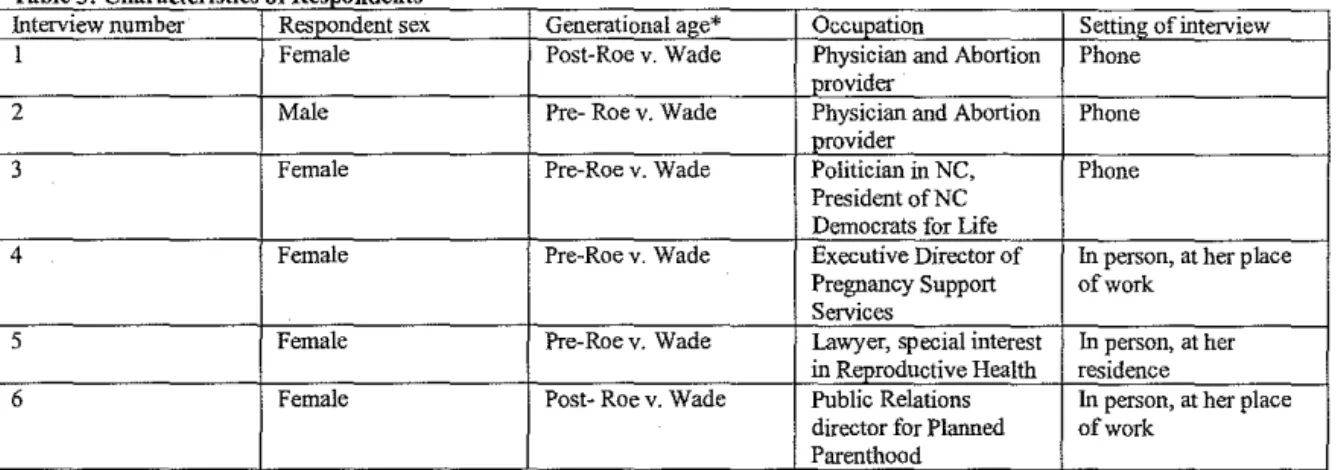
characteristics of the respondents are presented in Table 3. I conducted two interviews over the phone,
and conducted the other four in person, at the location of choice of the respondent. Each respondent
to 60 minutes in duration and were guided by an interview questionnaire that had been approved by the
IRB. Additional questions were asked if clarification was needed. All interviews were recorded using a
digital recorder and I transcribed all interviews. Following transcription, I erased the digital copies of the
interviews. I had taken notes during the interviews in case of recorder malfunction and to note additional
observations during the interview. I analyzed the transcripts to identify major themes in the interviews,
and then I coded them. These themes and illustrative quotes from the interviews are presented in the
Results section of the paper. The accuracy and validity of the themes and coding were checked by
discussing the analysis with my adviser, Dr. Trude Bennett.
Table 3: Characteristics of Respondents
Interview number Respondent sex Generational age* Occupation Setting of interview
l Female Post-Roe v. Wade Physician and Abortion Phone provider
2 Male Pre- Roe v. Wade Physician and Abortion Phone provider
3 Female Pre-Roe v. Wade Politician in NC, Phone President ofNC
Democrats for Life
4 Female Pre-Roe v. Wade Executive Director of In person, at her place Pregnancy Support of work
Services
5 Female Pre-Roev. Wade Lawyer, special interest In person, at her
in ~oductive Health residence
6 Female Post- Roe v. Wade Public Relations In person, at her place
director for Planned of work
Parenthood
* Generational age indicates whether the respondent personally experienced social and political events leading up to the 1973 Supreme Court decision of Roe v. Wade.
Results: Out of the six transcripts, I identified nine major themes, with sub-themes emerging
within five of those major themes. The dominant themes I identified were: women's understanding and
knowledge about abortion; abortion services; women's health; morality; stigma of abortion; mistrust; role
of abort;on regulations; political climate for abortion; and leadership.
Women's understanding and knowledge about abortion
Under the major theme of women's understanding and knowledge, I identified three sub-themes.
These sub-themes are (1) factual knowledge about the abortion procedure; (2) understanding of the
consequences of the abortion procedure; and (3) decision-making abilities of women seeking abortions.
Ail respondents recognized that women need to have a full understanding of the abortion
comfortable decision. However, within these sub-themes, there are striking differences between
respondents who were providers or advocates for abortion services, and respondents who were opposed to
the procedure of elective abortion.
Factual knowledge about the abortion procedure: Respondents who were directly involved with
the provision of abortion services or advocates for abortion rights held the opinion that women seeking
abortions were generally well informed about the details, risks, and alternatives to the procedure when
they made an appointment for an abortion. One respondent reported that when she asked women to
describe the risks and alternatives to abortion, they were usually able to do so.
Respondents who were opposed to abortion did not specifically address whether women had
adequate knowledge about the actual procedure, but expressed a belief that women needed to be told
about the risks and alternatives to abortion and implied that this was not currently the practice of abortion
providers, and that women generally were unaware of the risks and alternatives to abortion unless
physicians informed them.
Understanding of the consequences of the abortion procedure: Respondents who were opposed
to abortion expressed concerns that women had not had time to think through or did not understand the
full implications of the abortion procedure. This observation is illustrated by the following quotes:
Respondent: "I think that people should see the, the realization of what they are intending to do ... it is a human life and that if you are going to dispose of that human life ... you should understand that that is what it is."
Respondent: "having an abortion is an extremely fmal decision, I mean, you can't backtrack on it, once it's done it's done ... and I think people should understand that."
In contrast, respondents who were involved in the provision of abortion services stated that
patients requesting abortion services had a clear understanding of the consequences of the abortion
procedure.
Decision-making abilities of women seeking abortion: All respondents conveyed that there are
different stages of decision making that a woman goes through in her decision to have an abortion. A few
respondents indicated that this decision making process was on a continuum. They believed that women
could interface with abortion providers or pregnancy support services at any point along this decision
making spectrum, and where they were on the spectrum would influence their decision making process.
At one end of the decision making spectrum are women who are facing the realization that they have an
unintended pregnancy. Respondents differed in their expressed beliefs about where in the spectrum of the
decision making process the majority of women seeking abortion can be found. The respondents who
were opposed to abortion indicated that most women considering abortion services are in distress about
their situation and may not be thinking about their options clearly. They felt that most women seeking
abortion were at an early stage in the decision making process. These respondents indicated that women
at this stage were not in an appropriate frame of mind to make rational decisions about whether or not to
have an abortion:
Respondent: "We find often with the women that we work with when they first fmd out that they have a positive pregnancy test the immediate reaction is shock, disappointment, all kinds of emotions tend to rise to the top there ... but as ... time goes on ... I also think we should have a waiting period within the informed consent. .. just to let emotions settle down ... with the passage of time our, our thought processes ... tend to settle down a little bit and we can sometimes make decisions that. .. we might not regret later on."
At the other end of the spectrum are women who have thought through all of their options,
weighed the risks and benefits and consequences, assessed their available support systems and consulted
the people they feel they need to consult. Some of the respondents felt that most of the women they
encountered who had scheduled abortions were at this stage in the decision making process. While there
was a recognition among some of these respondents that women may be driven by concerns about the
cost or demands of having a child, this factor did not make these respondents feel that women in this
situation were in despair or unable to think rationally about their decision.
Respondent: "I think some of the legislation assumes that women haven't...really thought about this decision ... That's not our experience in serving women, our experience is that when women come in,
It's not taken lightly, and they have reached the conclusion that they do not want to maintain the pregnancy."
As these quotes illustrate, the respondents see women as being in different stages of the decision
making process, having different levels of understanding about the full consequences of having an
abortion, and that their general knowledge level about the risks and alternatives of the abortion procedure
differ. One respondent indicated that the differences in opinion about where women are in the decision
making process might be due to differences between women who go to crisis pregnancy centers with the
suspicion that they are pregnant and women who make appointments for abortions:
Respondent: "Right under 50% ... of women faced with an unintended pregnancy will maintain the pregnancy, period ... those are just decisions women make ... I don't know .. .if [crisis pregnancy center workers] have just caught women ... in the early stages of trying to figure out what they are going to do and ... they haven't really made a decision ... it's not firm yet... But women who come in for a pregnancy test and women who ... schedule an appointment and come in for an abortion are ... women at very different times and under very different circumstances in terms [of] their thinking about what they are doing."
Abortion Services:
This theme i.ricludes respondents' descriptions of their perceptions of abortion providers and
current abortion practices. The subthemes are: (I) attitudes of abortion providers and current practices of
abortion, and (2) perceptions of an "abortion industry". There were major discrepancies between the
perceptions about the attitudes of abortion providers toward their patients described by respondents who
were opposed to abortion, and the attitudes towards patients that were described by abortion providers.
Attitudes of abortion providers & current practices of abortion:_The respondents who were
abortion providers described what they did for the informed consent process for women, and expressed
their concerns about making sure that the women they served were well-informed and had the opportunity
to ask questions and be as involved during the abortion procedure as they wanted to be.