KEVIN M. BOYLE. Numerical Calculation of Aspiration
Efficiency of Aerosols into Thin Walled Sampling Inlets
(Under The Direction of Dr. MICHAEL R. FLYNN)
Aspiration efficiency of particles from a flowing
airstream into a thin walled sampling inlet is accurately
predicted using a numerical model. The model combines the
Boundary Integral Equation Method for predicting the
velocity field into the inlet with an analytical solution to
the particle equations of motion. A two and a three
dimensional model are examined. Results for the three
dimensional model correlate well with an empirical model of
aspiration efficiency. The method can be generalized to a
wide range of airstream, sampling inlet, and particle
I . BACKGROUND...1
11 . THEORY...7
III. METHOD...13
IV. RESULTS...31
V, DISCUSSION...39
VI. CONCLUSION...48
VII. FUTURE WORK...49
VIII. APPENDIX...53
IX. REFERENCES...118
I would like to thank Dr. Michael R. Flynn, Department
of Environmental Sciences and Engineering, for his guidance
and constant encouragement throughout the course of this
project. I am also grateful to Dr. David Leith and Dr.
Russell W. Wiener for their comments and suggestions
regarding the content and preparation of this report.
I extend my sincerest appreciation to my wife, Ellen,
and daughter, Sarah, for their understanding and support
throughout this project.
I would also like to thank the United States Air Force
for providing the opportunity and financial support needed
to complete my program of study.
This research was funded by the U.S. Environmental
Protection Agency under grant NO. 44213.
AEROSOLS INTO THIN-WALLED SAMPLING INLETS
by
Kevin M. Boyle
Unbiased sampling of airborne particulate from a
flowing stream requires that the size distribution and
concentration of aerosol collected be identical to that of
the aerosol in the free stream. Sampling errors occur
during aspiration of the aerosol from the free stream to the
face of the inlet and during transmission of the aerosol
along the sample tube. Additional losses or gains may occur
due to particle bounce from the front edge of the sample
tube. In this paper, a numerical model for determining the
aspiration component of overall sampling efficiency for any
arbitrarily shaped thin edged inlet is presented.
BACKGROUND
Sampling errors due to aspiration occur when particles
fail to enter the sampling inlet with the air. Particles
have inertia which may prevent them from accelerating,
decelerating, or changing their direction fast enough to
move with the air (Agarwal and Liu, 1980). Particles also
possess additional motion due to gravity. Aerosol
location, Co, (Belyaev and Levin, 1972).
Ea = Ci (1)
Co
One effect on aspiration efficiency would be loss or
gains of particles due to bounce off the front of the
sampling inlet. By modeling the system as a thin walled
sampling inlet, particle rebound effects are assumed
negligible and do not contribute to the overall aspiration
efficiency (Belyaev and Levin, 1974).
Both numerical modeling and physical experiments have
attempted to describe aspiration efficiency. Belyaev and
Levin (1972, 1974) used flash illumination to photograph
particle trajectories and develop equations to predict
inertial aspiration efficiency. Durham and Lundgren (1980),
developed aspiration equations from experimental data for
aspiration efficiency during anisokinetic sampling with
nozzle misalingment and sampler inlet velocity different
from oncoming wind velocity. Their equations account for
the projected area of the nozzle when it is misaligned.
Jaysekera and Davies (1980) and Davies and Subari (1982)
also performed experiments and derived aspiration equations
which were similar to the equations of Belyaev and Levin.
Extensive measurements of sampling efficiency were made
by Tufto and Will eke (1982), and Okazaki, Wiener, and
non-and work cited above, Hangal non-and Willeke (1990) proposed a
unified model to predict aspiration efficiency, Ea. The
general expression , equation(2), is:
Ea = 1 + (R cos e - l)f (2)
where R is the velocity ratio, e is the sampling angle and f
is an inertial parameter. For the case of 0° sampling angle
the inertial parameter, f, is based on the work of Belyaev
and Levin (1974) and is shown in equation (3).
f = 1 - 1 /[I + (2 + 0.617/R) Stk] (3)
R = Uo/Ui
Uo is the free stream velocity
Ui is the inlet velocity
Stk is the Stokes number
For C to 60° sampling angle the parameter is based
on the work of Durham and Lundgren (1980), equation (4).
f = [1 -1/[1 +(2 + 0.617/R)stk']]
[1 - 1/[1 + 0.55stk' exp(0.25stk')]3/
[1 - 1/[1 + (2.617)stk']] (4)
where
stk- = Stk exp (0.0226) (5)
To model the movement of particles in air it is
trajectory paths have been developed by Agarwal and Liu
(1980), Addlesee (1980), and Dunnett and Ingham (1986,
1988). Agarwal and Liu determined the theoretical flow field
into a thin walled sampling inlet considering both particle
inertia and gravitational settling. A numerical calculation
procedure was used to solve the axisymmetric Navier-Stokes
equations and particle motion equations.
Addlesee, (1980) studied the intake efficiency of a
Case11a cascade impactor. The impactor was modeled as a two
dimensional infinite slot with no end effects. A solution
to the flow field was developed by assuming that viscous
forces were not significant and calculating stream lines
using potential theory. From the flow field developed, the
particle equations of motion were solved assuming that
Stokes law is applicable (Re < 1). The equations were put
into finite difference form and solved by relaxation.
Dunnett and Ingham (1986) developed a mathematical
theory to predict aspiration efficiency of two dimensional
blunt bodies using the Boundary Integral Equation Method.
Once the velocity field of the system was known, the
particle equations of motion are solved assuming that the
Reynolds number is always less than 1.0 and thus Stokes'
drag could be applied. The equations were put in finite
difference form and solved numerically. In 1988 they
expanded the two dimensional solution to an axisymmetric
techniques.
Flynn and Miller (1989) used the boundary integral
equation method to model air flow into local exhaust hoods.
Their solutions follow the same logic as Dunnett and Ingham
and give good agreement with analytic solutions for flow
into an infinitely flanged rectangular hood with a constant
velocity at the hood face, and with other empirical models.
The advantage of their model was that it reduced a 3
dimensional air flow solution to a 2D area solution along
the boundary of a specified domain.
This research employs the model of Flynn and Miller to
estimate the air flow into a sampler inlet, and then applies
the solution for the particle equations of motion developed
by Alenius (1989) to determine aspiration efficiency. The
particle motion equations are described in the THEORY
section which follows.
The referenced numerical models to calculate aspiration
efficiency were limited by the geometry of the solution
domain and employed finite difference techniques to solve
the particle equations of motion. By combining the 3D
airflow solution of Flynn and Miller with the analytic
solution to the equations of motion proposed by Alenius
domain and sampling inlet over a wide range of particle size
To model particle flow, a method for determining the
characteristics of the flow field into an arbitrarily shaped
and oriented sampling inlet is required. Once the flow
field is described, particles can be placed into the field,
assigned initial conditions, and tracked. From the
trajectories, an estimate of the aspiration efficiency can
be made and compared with previous models or experimental
data.
The boundary integral equation method (BIEM) is a
method of solving a potential flow problem for any
arbitrarily shaped domain. The assumptions in the
development are inviscid, incompressible, irrotational flow
which leads to the following expressions:
grad-V = 0 (continuity equation for (6)
incompressible flow ),
and;
curl V = 0 (irrotational flow). (7)
Irrotational vector fields possess a potential function such
that the vector is equal to the gradient of the potential,
<t), and thus
V = grad 0. (8)
By combining the above equations
grad-V = grad-(grad <t>) or
Equation (9) is Laplace's equation. By applying the
divergence theorem and Green's second identity, an equation
can be derived which relates the velocity potential an any
singular point (P) to the potential and normal derivatives
of potential along the boundary of a specified domain.
The derivation (Liggett and Liu, 1983) yields the
following equations which form the basis of the Boundary
Integral Equation Method for two and three dimensional
domains.2D: a<t>(T) = Sr [((fl>/R) 6R/6n) - ((InR) 60/6n)] dS (10)
3D: -a0(P) = Ss [(0(6(1/R)/6n)) - ((l/R)60/6n)] dA (11)
0 = velocity potential
60/6n = velocity normal to the boundary
a = solid angle about (P)
R = distance from singular point (P) to
a point on the boundary,
r = closed curve surrounding and defining
the 2D domain
SI = closed surface surrounding and defining
the 3D domain
dS = differential element on r
dA = differential area on S.
The above equations can be written in discrete form in
either two (Liggett and Liu, 1983) or three dimensions
(Flynn and Miller, 1989). After specifying either <t> or
6*/6n at each node on a discretized boundary of N nodes,
equation (10) or (11) is written for each node by
boundary values are known, (P) can be located at any
internal location and the left hand side of equation (10) or
(11) differentiated to give the velocity at the internal
point.
Once the velocity field is determined, particles can
be placed in the air stream and their motion tracked. This
model uses an analytical solution to the particle equations
of motion developed by Alenius (1989). The general form of
.the equation is:
d2r/dt2 - [Q(Re)/T(u-(dr/dt))]-g = 0 (12)
where bold face variables denote vector quantities.
In the above equation, the following notation is used:
d2r/dt2 (=dv/dt) is the acceleration of the particle
Q(Re) is a dimensionless factor based on the
Reynolds number and the drag
coefficientT is the particle relaxation time in air
u is the air velocity at the particle
location
dr/dt=v is the velocity of the particle
g is the earth's gravity
0 is the null vector
r is the particle position vector
velocity u vary along the trajectory of the particle and
thus indirectly with time t. If the air velocity at the
points where the particle is successively located can be
described as a linear function of the time that has elapsed
and Q(Re) is assumed to be constant over the time interval,
an analytical solution to the general equation can be
obtained. This condition is approximately met if the motion
of the particle is successively calculated using
sufficiently small time intervals. A complete derivation is
presented in the appendix. The analytic solution is:
v(t-ff) = Uat'+Ub-(Ub-v(t))exp-[Q(Re)t'/T] (13)
r(t+t') = r(t)+Ua/2t'2+Ubt'
-(Ub-v(t))T/Q(Re)(l-expQ(Re)tVT) (14)
where t' is the size of the time step and Ua and Ub have
been added to simplify the appearance of the equation:
Ua = (u(t) -u(t-t'))/t' (15)
Ub = u(t)-(Ua-g)T/Q(Re). (16)
Particles can now be tracked in any domain in which the
air field is known, and the efficiency of aspiration
determined. Aspiration efficiency is calculated as the
ratio of particles entering the inlet to particles in the
undisturbed flow field far upstream, equation (1). Figure 1
Freestream
Critical
Trajectory
SAiyiPLiNG INLET
Co Uo Ao = CI Ul Al
Fiaure 1. Conceptual Stream Tube. The flux of Pa»^i°l«^^^
th?ough the upst?eam plane equals that of particles passing
airstream of given velocity, Uo, into an inlet sampling at a
constant velocity, Ui. The boundaries of the stream tube
represent all particle trajectories which just enter the
tube. These trajectories are called critical trajectories.
Particles located outside this tube would not be drawn into
the inlet. The flux of particles passing through the
upstream plane of the stream tube is particle concentration,
Co, multiplied by the stream tube cross sectional area, Ao,
times the freestream velocity, Uo. By
equating the flux of particles through the plane of the
stream tube upstream from the inlet to that through the
plane of the sampler face, Ci Ai Ui, the expression in
equation (17) is obtained.
Co Ao Uo = Ci Ai Ui (17)
From equation (1), Ea = Ci/Co, thus:
Ea = Ao Uo/Ai Ui (IB)
In equation (18), the characteristics of the sampler
inlet, Ai and Ui, are known as well as the free stream
velocity, Uo. By determining the coordinates of the
critical trajectory start points in the free stream, an
estimate of Ao and Ea can be made. This can be done by
iteratively assigning particle locations in the free stream
and tracking each particle in the domain until the critical
METHOD
The model was developed using a simple two dimensional
problem which was then expanded to a more complex three
dimensional case. Both isoaxial and non-isoaxial inlet
orientations were modeled. Non-isoaxial conditions
consisted of orienting the inlet at a pitch angle of 30° to
the freestream.
Two Dimensional Model
The two dimensional problem was modeled as an infinite
slot. The coordinate system to visualize in two dimensions
is an x-y cartesian system with the origin located at the
center of the inlet. The positive x direction extends along
the centerline of the hood face and the y direction is up
and down, with gravity acting in the -y direction.
The air flow into the slot was modeled using the
boundary integral equation method which provided a solution
everywhere on the boundary of the domain for the potential
and the normal derivative of potential. From the boundary
solution, the exact velocity components at any internal
point were calculated.
A FORTRAN computer program for the two dimensional
boundary integral equation solution, written by Liggett and
Liu (1983), was used for the 2D solution. The program,
called GM8, returned the boundary values and the local air
velocity components within the domain needed to calculate
written to solve the Alenius solution to the equations of
motion, (11) and (12), and track particles within the
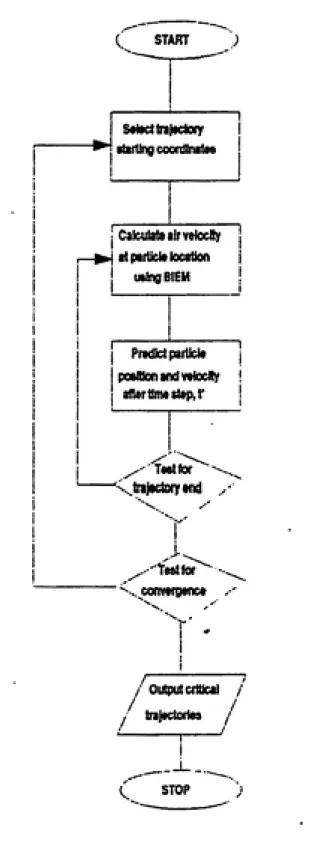
domain. Figure 2 shows the flow of logic in the program.
The boundary of the domain in the simple 2-D case is
shown in figure 3. The origin of the coordinate axes are
located at the center of the sampling inlet. The upper
lower, front and rear boundaries of the domain are at a
distance of 20 inlet diameters from the inlet face. The
remaining boundary consists of a rectangular indentation to
represent the sampling nozzle of diameter equal to its
width.
In figure 3, the boundary conditions are marked. The
upper, lower, and rear boundary are situated far enough away
from the sampling inlet to have potential due exclusively to
the free stream velocity, or:
0 = Uox(x) + Uoy(y) (19)
where Uox and Uoy are the magnitude of the free stream
velocity components and x,y are the location coordinates.
The boundary condition on the line opposite the hood face is
60\6n = Uox, the free stream velocity normal to the surface.
On the upper and lower edges of the sampling inlet the
boundary conditions are 60\6n = 0, no flow through the walls
of the nozzle. At the face of the inlet 60\6n is equal to
sampling velocity, Ui.
For the situation where an inlet pitch angle was
( START ;
I S«tecttni|ectorY
"^ starling coordinates
Calculate air velocity
at particle location
! using BIEM
Predict particie |
poeltion and velocity !after time step, f !
,.. Test lor
trajectory end
,''Test for
convergence
/ Output critical /
, trajectories j
STOP
Figure 2. Flow diagram for the two dimension and 3
^s Uox(iO
+ Uoy(y)
Uox(x)
+ Uoy(y)
^ = Uox(x) + Uoy(y)
ͣ
---•---•---•—'---•
Y 1
6^/6n s 0
X i
•---ͣ---i6^l6n s 0
• •
i---•---1
• anodes
1---
ͣ
---i
6^/in
4 =Uox
^ = Uox(x) •<- Uoy(y)
Figtire 3. 2D model boundary with coordinate axes, boundary
condtions, and ssunple discretization shown. 0 = potential,
boundary calculated. Rather boundary conditions were
adjusted to represent the freestream, Uo, as
the resultant of the free stream normal to the front
boundary, Uox, and a crossdraft, Uoy. This required a
coordinate system conversion where the gravity vector in the
X and y direction were -g sin(e) and -g cos(e) respectively,
e was the angle of misalignment and g the magnitude of the
gravity vector. The origin of this coordinate system was
still centered at the inlet face.
The solution required the domain to be discretized into
nodal elements as shown in figure 3. Much finer
discretization than presented in the example is required
because numerical accuracy during calculation of internal
points suffers when the internal point is within 1 element
length of the boundary.
The initial conditions assigned to the particles in the
free stream are that they are falling at their terminal
settling velocities and moving in the air stream (Addlesee,
1980) at the velocities calculated by the BIEM solution.
Terminal settling velocity (Vts) was calculated using
Stokes' Law:Vts = T g (20)
where t is the particle relaxation time (Reist, 1984) and g
is the acceleration due to gravity.
In two dimensions, it was necessary to define the
critical trajectories to calculate aspiration efficiencies.
This is because in two dimensions equation (18) reduces to:
Ea = do Uo/di Ui (21)
where di is the inlet diameter, and do is the distance
between the upper and lower critical trajectories. Internal
air velocity coordinates were calculated using BIEM, then
the particle position and velocity were predicted using the
analytical solution and the process repeated. The critical
trajectories were determined by selecting a point far
upstream and tracking a particle from this point either into
(capture) or past (miss) the inlet. Once a missed and
captured trajectory were found the average of the two
starting points determined the next point. Convergence
occurred when the distance between the particle trajectory
start point which is captured and that which escapes is less
than a preset value. The program was designed to locate
both an upper and lower critical trajectory corresponding to
the upper and lower edges of the sampling inlet. The
distance, s, between the upper and lower critical
trajectories, do, was determined using the distance formula,
equation (22).
S = ((Xl-X2)2 + (yi-y2)2 + (21-22)2)54 (22)
Three Dimensional Model
In three dimensions, Uo, Ai, and Ui are given and Ac is
determined to calculate aspiration efficiency, equation
(18). Ao is the area of the trajectory tube at an upstream
sampling velocity. This area represents the boundary of the
stream tube at an upstream location in which particles will
enter the sampling inlet (Fig 1).
The shape of the three-dimensional domain is a square
sided volume of half-width equal to 20 inlet widths.
Extending from the rear wall of the volume into the center
of the volume for a distance of 20 inlet widths is a
sampling inlet with a square cross section. An equal area
square is used to model a circular inlet to simplify the 3D
boundary discretization.. The origin of the cartesian
coordinate system is located at the center of the inlet.
The X direction extends away from the hood face along its
centerline. The z coordinate represents the height of the
domain and the y coordinate represents the width.
For boundary conditions, the potential is specified on
the front, rear, top, bottom and side faces of the 3D
domain. The velocity is specified over the inlet face as
Ui, and at the walls of the inlet tube as 0 cm/sec. As in
2D, the boundaries of the 3D domain are situated far enough
away from the inlet to have potential due exclusively to the
free stream:0 = Uox(x) + Uoz(z) (23)
Here, Uox represents the velocity perpendicular to the front
face of the domain and Uoz is the crossdraft vector used
when the sampling angle did not equal zero. As in 2D, the
gravity components in the coordinate system must be adjusted
The flow field is defined using the same theory as in
two dimensions but using a FORTRAN program written by Flynn
and Miller (1989) to solve the BIEM problem for three
dimensions.
Particle trajectories were calculated in the same
manner as in two dimensions with BIEM providing the local
air velocity components at the particle location. The
particles were assigned initial conditions as described in
the 2D section and the equations of motion, with a third
dimension added, were solved to predict the particle's next
position and velocity. The program logic is the same as
that shown in figure 2.
Because the domain is now in three dimensions, the
region cannot be discretized into lines between nodes,
rather, the boundary must be divided into areas. Flynn and
Miller (1989) used triangular elements on the boundary.
Examples of the discretization input files for the boundary
are presented in the appendix.
The critical trajectories in 3D were determined by
selecting a point far upstream and tracking a particle from
this point either into the inlet (capture) or out of the
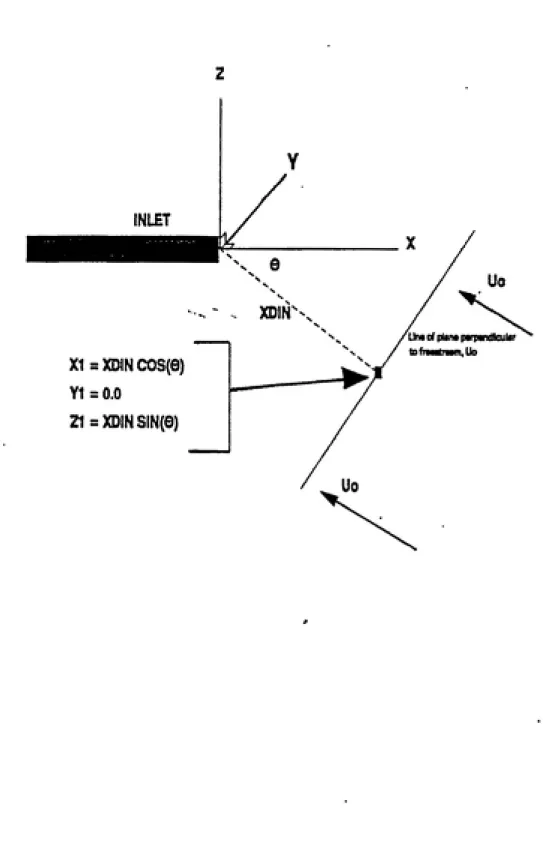
domain (miss). The start point is a specified number of
inlet diameters, XDIN, in front of the inlet and in the
direction of the resultant velocity vector in the x-z plane.
For 0", this point is along the x axis at x=XDIN, y=0, z=0,
the first trajectory start point, figure 4, is calculated
as:
X = XDIN cos(e)
y = 0.0 (24)
z = XDIN sinO)
The rationale for choosing this start point is to
obtain a capture trajectory around which starting points for
the critical trajectories can be centered. If this first
point does not yield a capture, the start point is
incrementally adjusted up or down along a line perpendicular
to the free stream and the trajectory is recalculated. The
process is repeated until a first capture identified.
Once a capture trajectory is found, a series of start
points at which to begin critical trajectories are defined
at a distance far enough away from the coordinates of the
first capture to have a high probability of a miss. These
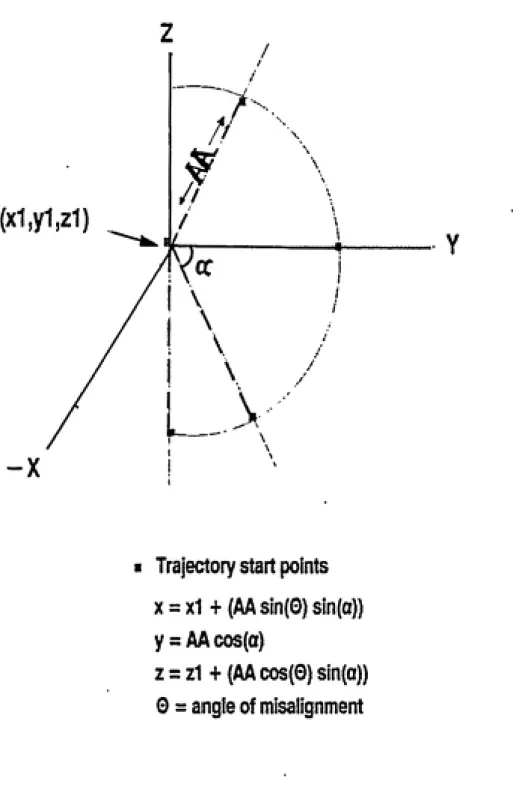
points are located a specified distance, AA, from the
coordinates of the first capture (xl,yl,zl) in incremental
degree steps, a, around a semicircle in the plane
perpendicular to the free stream, figure 5. Critical
trajectories for only one half the area were calculated due
to the symmetry of the problem.
The equations for these points are:
X = xl + (AA sin(e) sin(a))
LlM 0) pMn* ptrpwdlculr
lefiMitrtMn.Uo
X1 B XDtN COS(e)
Y1 = 0.0
Z1=XDINSIN(e}
Figure 4. Location of initial trajectory start point.
(X1,Y1,21) is initially placed at a distance XDIN in front
of the inlet along a line perpencular to Uo in the X-Z
{x1,y1,z1)
^
Trajectory start points
x = x1 + (AAsJn(0)sln(a))
y = AA cos(a)
z = z1 + (AA cos(0) sin(a))
0 = angle of misalignment
Figure 5. Trajectory start points are located on a
semicircle centered around (X1,Y1,Z1) at degree increments,
a, along rays a distance AA from the center.
If the start points defined in equation (25) result in
a capture, the start point is incrementally adjusted farther
from the initial capture point and the trajectory is
recalculated until a miss identified.
Each first capture and initial miss coordinate
combination results in a ray the end points of which define
the upper and lower bounds of the critical trajectory and
all rays are contained in the same plane perpendicular to
the free stream. From this point, the starting coordinates
of the last miss and last capture trajectory are averaged to
determine the coordinates of the next start point on the
ray. The process is repeated until the convergence criteria
was satisfied. Critical trajectories are found for each
starting point around the semicircle.
The output of the particle tracking routine is a series
of points representing the critical trajectories which
define Ao. The area, Ao, is calculated numerically with a
FORTRAN program using the trapezoid rule. From Ao, Ea is
calculated using equation (18).
The models, both 2D and 3D, were verified by comparing
the computed aspiration efficiency with the unified
aspiration model proposed by Hangal and Willeke (1990),
equation (2).
The Programs
The two dimensional program was compiled and run using
Microsoft Fortran version 2. The entire aspiration
program initially calculates the boundary solution for the
domain then calls subroutines to calculate particle velocity
and position, and internal air velocity components at the
particle's location. All 2D simulations were run on a Dell
386 personal computer and took approximately 15 minutes to
complete. Each program run calculates approximately 30
separate trajectories with approximately 100 points
calculated per trajectory.
Figure 6 shows an example of the output of the 2D
program with particle positions plotted as trajectories.
The particle trajectories were plotted using a simple
routine written in BASIC (see appendix). The distance
between the upper and lower critical trajectories was the
basis of determining the aspiration efficiency as defined in
equation (22). A commented version of the 2D program is
contained in the appendix.
The 3D program is much more complex than the 2D version
because of the addition of a third dimension and the
resulting complexities of solving the BIEM equations.
Because of this, 3D simulations were run on a Convex Super
Computer. The 3D simulations were run using two FORTRAN
programs. The first program, 4PTGQ.F, is the BIEM boundary
solution program. The input for this program was a boundary
node and element file for each combination of sampling
velocity, Ui, wind velocity, Uo, and sampling angle, 6. The
input file contained 367 nodes, N, leading to N linear
• iiHiin'.- ... .iii.iii.-."..'...;j!
ͣ
]:,
ͣ
;;,...; ;''"'":'
ͣ
'.'''-1 ͣͣ-.,,ͣ.-v,,.:
ͣ
/*.•. ͣ'. '''ͣͣͣ:
EFF = "'^012572 %>
ͣ
UO = -250 -... %•
DP = .0005 %:
-DIN = 1 %^:
THETA = 29.9991 •. ^
UI = 1000
Figure 6. Sample of 2D trajectory plots. Trajectories
originate in the plane of the freestream perpendicular to
point gaussian quadrature. This program took 5.5 minutes to
run on the Convex and returned potential and velocity values
for each node on the boundary of the domain.
Once the output to 4PTGQ.F was received, it was
imported as input to the 3D particle tracking program,
TRK15.F. This program consists of a driver to specify
particle location, test for convergence, and call
subroutines to perform the BIEM internal air velocity,
particle position, and particle velocity calculations.
TRK15.F was designed to calculate 13 trajectories at 15° (a
= 15° in equationkk (25)) increments around a semicircle
surrounding the initial capture point (see figure 5). This
leads to the calculation of approximately 10 trajectories
per starting point, over the 13 starting points specified by
the degree increment, a, with 20-30 points along each
trajectory to determine the fate of the particle. A typical
combination of program variables shown below took 68 minutes
of computer time on the Convex:
Uo = 500 cm/sec
Ui = 250 cm/sec
particle diameter = 5 ^m
e = 30 degrees
time step = 0.0005 seconds
convergence criteria = 0.05 cm
3D Isoaxiai Sample Output
VImM
...{ͨ
-->ͣ
XDN
-^— Uo
Ua-2S0 on/sK, Ui-IOOO an/s*c
2gn
Plot of critical trajectories
in freestream, view AA.
Figure 7. Plot of critical trajectory start points in their
starting plane. The area inside the curves is the estimate
of Ao in equation (14). The area is assumed symmetrical
3D Non-isoaxjai Sample Output
mwM
X
\
Uo=2S0 cm/sec. Ui=1000 cm/S6c
-e---
ͣ
—B-Plot of critical trajectories
lnfreestream,viewAA.
Figure 8. Plot of critical trajectory start point in their
starting plane. The area inside the curves is the estimate
of Ao in equation (14). Z', Y' represent the local
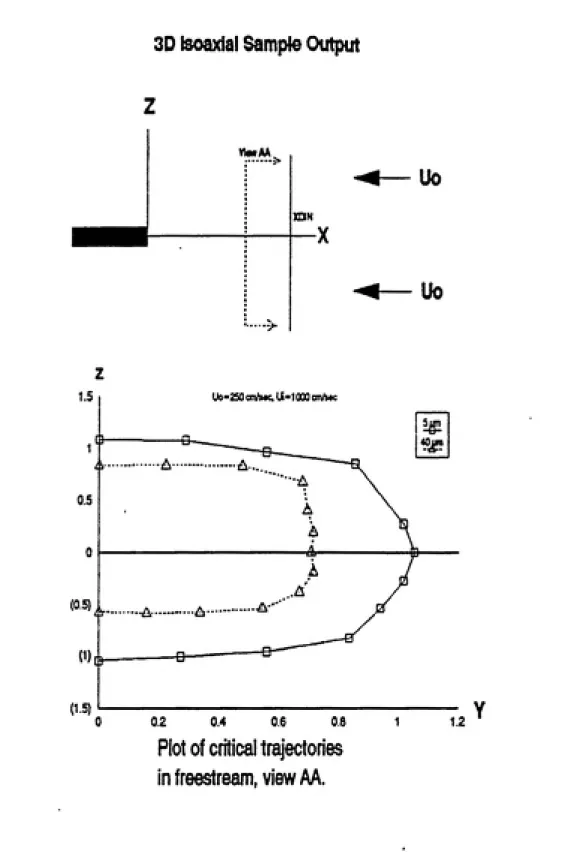
Figure 7 is an example of output for an isoaxial set of
conditions. The plot consists of the location of the
critical trajectories in the y-z plane at a constant value
of X (distance in front of the sampling inlet) equal to XDIN
in equation (24). In this case, x is constant because the
sampling angle is 0* and the freestream is flowing in a
direction perpendicular to the plane at x = XDIN.
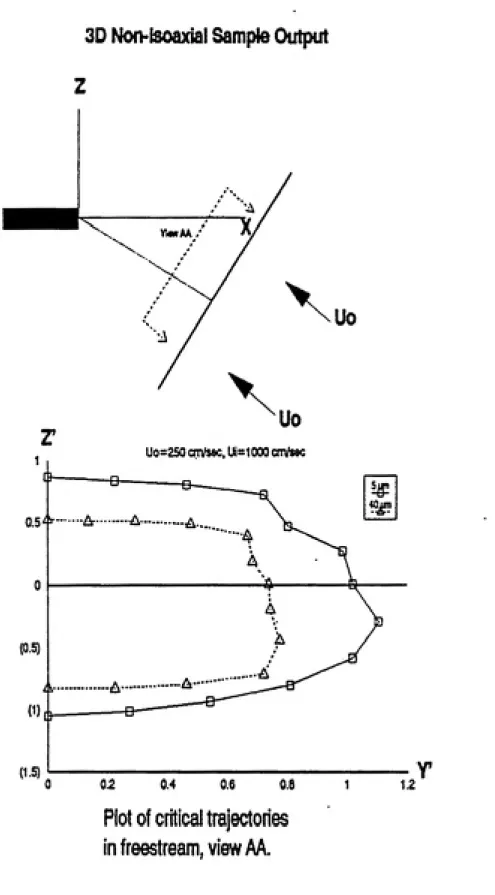
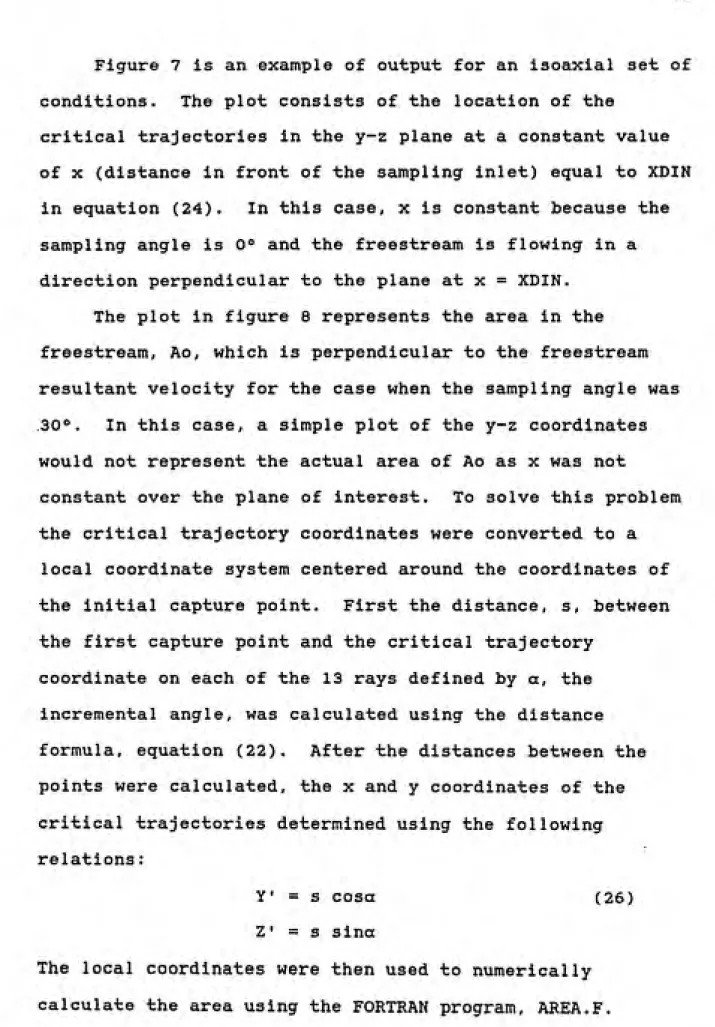
The plot in figure 8 represents the area in the
freestream, Ao, which is perpendicular to the freestream
resultant velocity for the case when the sampling angle was
30°. In this case, a simple plot of the y-z coordinates
would not represent the actual area of Ao as x was not
constant over the plane of interest. To solve this problem
the critical trajectory coordinates were converted to a
local coordinate system centered around the coordinates of
the initial capture point. First the distance, s, between
the first capture point and the critical trajectory
coordinate on each of the 13 rays defined by a, the
incremental angle, was calculated using the distance
formula, equation (22). After the distances between the
points were calculated, the x and y coordinates of the
critical trajectories determined using the following
relations:Y' = s cosa (26)
Z' = s sina
RESULTS
Several combinations of free stream velocity, Uo, inlet
size, di, inlet sampling velocity, Ui, sampling pitch angle
(misalignment to the free stream), and particle aerodynamic
diameter, dae, were run through the 2D and 3D programs.
Table 1 summarizes the input variables which coincide with
input parameters used by Wiener (1987).
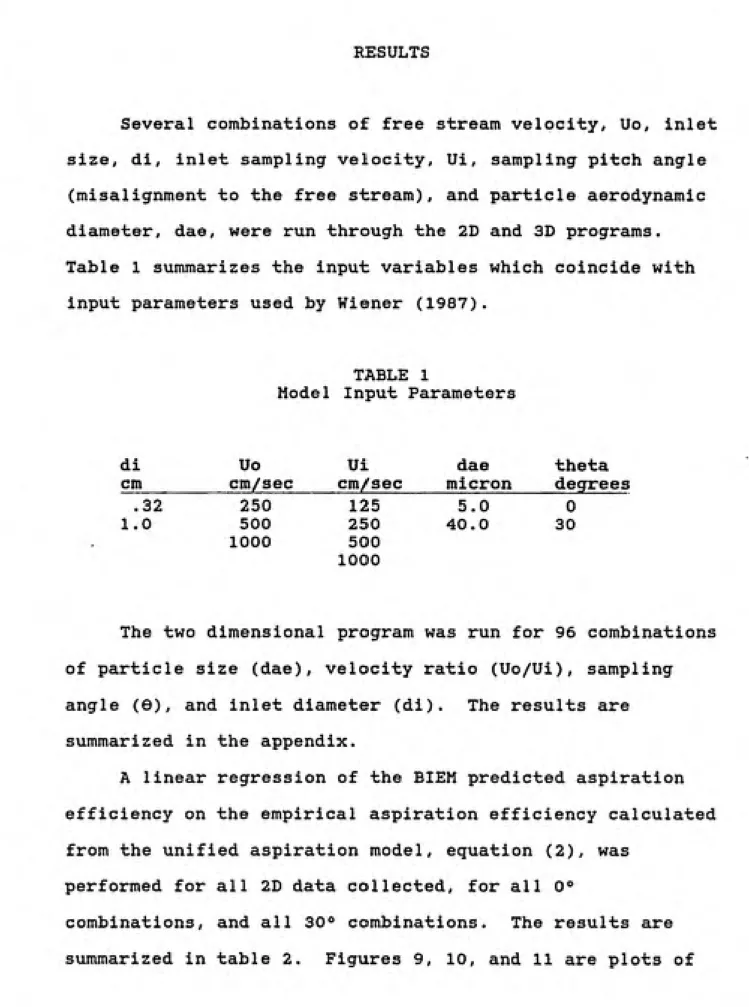
TABLE 1
Model Input Parameters
di Uo Ui dae theta
cm________cm/sec____cm/sec____micron degrees
.32 250 125 5.0 0
1.0 500 250 40.0 30
1000 500
1000
The two dimensional program was run for 96 combinations
of particle size (dae), velocity ratio (Uo/Ui), sampling
angle (6), and inlet diameter (di). The results are
summarized in the appendix.
A linear regression of the BIEM predicted aspiration
efficiency on the empirical aspiration efficiency calculated
from the unified aspiration model, equation (2), was
performed for all 2D data collected, for all 0"
combinations, and all 30° combinations. The results are
the 2D aspiration simulation versus the unified aspiration
model, equation (2).
TABLE 2
Two Dimensional Model Linear
Regression Results
CATEGORY SLOPE Y INT LCL(i) UCL!2) R2( 3)
All Data All 0° All 30° 0.842 0.963 0.664 0 0 0 074 077 118 0.788 0.941 0.599 0.895 0.986 0.729 0.917 0.993 0.911
(1) LCL - 95% lower confidence limit for slope
(2) UCL - 95% upper confidence limit for slope
(3) R2 - correlation coefficient
The 3D results are presented in the appendix and
summarized in figures 12, 13, and 14. Table 3 contains the
linear regression results which compare the numerical
prediction of aspiration efficiency with the unified model
of Hangal and Willeke, 1990.
TABLE 3
Three Dimensional Model Linear
Regression Results
CATEGORY SLOPE Y INT LCL <1) UCL12! R2 ( 3)
All Data All 0° All 30° 1.062 1.059 1.064 -0.062 -0.026 -0.096 1.026 1.036 0.980 1.099 1.082 1.148 0.995 0.999 0.991
(1) LCL - 95% lower confidence limit for slope
(2) UCL - 95% upper confidence limit for slope
Alt 2D (0 and 30 degrees)
2 4 6
Unified Model Aspiration Efficiency
Figure 9. 2D results, all data. Plot of the predicted
efficiency developed from the BIEH and Alenius theories
against the empirical unified aspiration efficiency model of
Isoaxial Case (0 degrees)
ct#
2 4 6
Unified Model Aspiration Efficiency
Figure 10. 2D results, isoaxial data. Plot of the
predicted efficiency developed from the BIEM and Alenius
theories againstthe empirical unified aspiration efficiency
Non-lsoaxiai Case (30 degrees)
4
J2^
2 4 6
Unified Model Aspiration Efficiency
Figure 11. 2D results, no'n-isoaxial data. Plot of the
predicted efficiency developed from the BIEM and Alenius
^6
-C
(D
O
IE
lu
c
0
%
a
(0
<
0)
All 3D (0 and 30 Degrees)
4
-D /^
u
^
X
1 1 12 4 6
Unified Model Aspiration Efficiency
Figure 12. 3D results, all data. Plot of the predicted
efficiency developed from the BIEM and Alenius theories
against the empirical unified aspiration efficiency model of
3D Isoaxlai Case (0 degrees)
LlMcfPirtiet
2 4 6
Unified Model Aspiration Eficiency
Figure 13. 3D results, isoaxial data. Plot of the
predicted efficiency developed from the BIEM and Alenius
theories against the empirical unified aspiration efficiency
3D Non-lsoaxlai Case (30 degrees)
LiMofPwfial
2 4 6
Unified Model Aspiration Efficiency
Figure 14. 3D results, non-isoaxial data. Plot of the
predicted efficiency developed from the BIEM and Alenius
theories against the empirical unified aspiration efficiency
DISCUSSION
The two dimensional model showed good agreement with
the unified aspiration model for the isoaxial conditions.
From table 2, the slope of the regression line for the 0"
sampling angle is 0.96. A slope of 1.0 would indicate
perfect agreement with the unified model. The largest error
in the 2d model occurred when the velocity ratio was less
than 1. In this case, the inlet velocity was 2 to 4 times
greater than the wind velocity leading to large changes in
air velocity and direction as the particles approached the
inlet face.
The nonisoaxial 2D model was tested for a 30° sampling
angle and showed poor agreement with the unified model. The
percent difference between the unified model aspiration
efficiency and the predicted aspiration efficiency was as
large as -71%. The slope of the regression line for this
set of conditions was .66.
Overall, the 2D model fairly represented the aspiration
efficiency of aerosols into a thin edged inlet. The
regression equation, slope of 0.84, was biased due to the
poor agreement of the 30° model with the unified model.
As shown in table 3, the three dimensional solution
performed significantly better in all categories when
compared to the 2D model. The slopes of the regression
lines were close to 1.0 for all cases indicating that the
values when compared to the unified aspiration efficiency
model. Table 4 shows a comparison of the 2D percent error
with that of the 3D model for the same combinations of
velocity ratios, sampling angle and particle diameter. As
can be seen, in most cases, the 3D model led to an
improvement in the aspiration efficiency value.
TABLE 4
Comparison of 2D Model Error
with the 3D Resultsuo UI THETA DP 2D ERR 3D ERR
1000 125 0 5 22% 2%
1000 125 0 40 4% 5%
250 1000 0 5 12% -9%
250 1000 0 40 26% 9%
1000 125 30 40 -39% 5%
250 1000 30 5 -11% -11%
250 1000 30 40 -3% -10%
500 500 0 5 1% 3%
500 500 30 5 -10% 0%
500 250 0 5 11% 6%
500 250 30 5 -6% 7%
500 125 0 5 26% 4%
500 125 30 5 17% 10%
Some error was introduced into the above comparison
because the unified model of aspiration efficiency was
developed for circular, thin edged inlets. This may have
some effect on the comparison of calculated efficiency with
the aspiration efficiency derived from the computer. This
does not, however, affect the model calculation of
efficiency because the actual areas using the square inlet
Boundary discretization, particle start point,
convergence criteria, and time step (f) were the most
important parameters in determining accurate solutions.
Boundary discretization had to be dense enough so that
calculations of internal velocities were performed at
distances greater than the distance between nodes on the
nearest boundary (Flynn and Miller, 1989). This was
accomplished by developing a 2D boundary consisting of 75
nodes with dense discretization near the inlet face and
along the inlet sides. The appendix contains a sample input
file for the 2D boundary discretization. With this
discretization, few aberrations in internal velocity
calculations were seen. This was not the case for the 3D
solution.
The three dimensional model boundary discretization
was proportional to the 2D discretization with the sides of
the triangular elements equal in length to the distance
between nodes in the 2D discretization. This led to an
input file containing 367 nodes defining 693 elements. As
described by Flynn and Miller, the triangular elements are
defined by numbering the element with the node numbers
corresponding to the vertices of the triangular element in a
clockwise fashion looking out of the domain. This was done
for approximately 1/2 of the elements starting at the inlet
face and along the walls of the inlet using a triangular
element generating program written for this problem. The
LOTUS spreadsheets because of the complex interactions of
common nodes along the edges of each facet of the cube and
at its corners.
Even with this dense 3D boundary discretization,
internal calculation of air velocities at points less than
0.05 cm from the face and walls of the inlet were extremely
inaccurate with the values being orders of magnitude larger
than the freestream velocity. This led to large errors in
the prediction of particle location which is dependent in
part on accurate calculation of air velocity at the
particle's current location. To avoid this error, capture
criteria for the particle was extended by a factor of 0.05
cm in front of the inlet face and around its edges. This in
effect enlarged the face area, Ai, to 1.11 cm^ for a square
inlet of side equal to 1.0 cm. This enlarged area was the
area used in the aspiration efficiency equation (18).
The effect of enlarging this area was to alter the
actual average air velocity moving into the "inlet". Over
the face of the inlet the air velocity was specified as Ui.
Over the thin layer defining the addition to the actual
inlet, the average velocity had a value which was a function
of the free stream velocity and the sampling velocity.
Because of this there is some error in the specification of
Ui in equation (184) and hence Ea.
Another problem with the 3D boundary discretization
velocity is also specified, but is different than that of
the first surface. In the final model, this occurred only
at the nodes surrounding the edges of the face of the
sampling inlet. Here, the velocity over the face was
specified as the sampling velocity, Ui, and the velocity on
the edge of the tube and along its length was specified as 0
cm/sec. This caused a discontinuity of velocity at the
edges of the sampling inlet. The effect of the
discontinuity was to cause inaccuracies in interpolation of
velocities over the elements involved. This interpolation
error was minimized by inserting a very thin row of elements
just inside the edges of the inlet. For the final model the
width of this small layer was 0.001 cm.
Particle start points were important because the
aspiration efficiency calculation requires the critical
trajectory start points to be in the free stream. It was
found that at distances of 6 inlet diameters from the inlet,
local air velocity and direction was within 5% of the
specified free stream velocity. This agrees with the
findings of Belyaev and Levin (1972) and held true for both
2D and 3D models.When determining the location of critical trajectories,
the distance between the last capture trajectory start point
and last miss trajectory start point was compared to the
convergence criteria. Once the distance reached a preset
the 2D model was set at 0.01 cm after iterations at criteria
smaller than this caused a less than 1% change in the
calculated efficiency. The convergence criteria for the 3D
model led to good agreement with the unified model when set
at 0.05 cm.
The time step was the most critical factor in
developing accurate particle trajectories. Time steps that
were too large resulted in predictions of trajectories that
were too coarse to accurately predict the particle movement.
Unnecessarily small time steps caused excessive computing
time. Through a series of program tests, 0.0003 seconds was
chosen as the time step for the 2D model with a further
reduction by a factor of 10 once the particle came within 1
inlet diameter of the sampling inlet to account for the
large velocity changes near the face of the inlet.
The time step and the convergence criteria for the 3D
model were not as sensitive in the determination of the
aspiration efficiency as they were in the 2D case. Since
the 3D model more realistically represented the physics of
the problem, accurate solutions were obtained for time steps
ranging from 0.001 to 0.0003 seconds with the time step
being halved when the particle was within 1 inlet diameter
of the inlet face.
Because the size of the time step indirectly predicts
the distance the particle will move; positions predicted
when the air is turning and accelerating will not lie on the
for velocity ratios of 2 and 4 where the estimate of Ea was
consistently larger than the unified model prediction. In
this case, the air is approaching the inlet faster than the
inlet is sampling and must diverge around the inlet.
Particle trajectories will also diverge but the predicted
position will lie slightly inside of the actual trajectory.
This causes an overestimate of Ao leading to an increase in
the prediction of Ea.
When running the model under certain conditions, the
time step and capture criteria became very critical in
determining whether a trajectory resulted in a miss or
capture. In the three dimensional model, when Uo = 1000, Ui
= 125 cm/sec, and 9 = 30°, the best estimate of aspiration
efficiency was off by 39% when compared to the unified
model. Under these conditions the air flow is approaching
the inlet at 8 times the sampling rate causing significant
divergence of the air streamlines around the face of the
inlet. This situation combined with the sampling angle
results in particle trajectories which move virtually
straight up in the positive z direction at locations within
0.1 cm of the inlet face when the particle is approaching
the inlet from above the centerline. The air velocity in
this area is also moving very fast. The combination of high
velocity particle and steep angle of approach toward the
situation when in actuality a capture should have occurred.
This causes an underestimation of Ao leading to a prediction
of Ea which is too small. This situation occurred for the
last four rays around the start point semicircle and is the
reason for the poor performance of the model under these
conditions. This situation can be eliminated by reducing
the size of the time step but would lead to a large increase
in computing. The same problem was seen in the 2D model and
prevented identification of an upper critical trajectory.
By specifiying an incremental angle of 15° in the 3D
model, the program was limited to locating 13 critical
trajectories. The effect of decreasing a has not been
analyzed but would lead to a finer outline of the critical
trajectory stream tube and a more accurate calculation of
Ao. One anomaly in the output was seen when the ray
specified conincided with the corners of the inlet.
Critical trajectories associated with these rays tended to
lie outside range of critical trajectories on either side of
this point. In one program test, eliminating these rays
from the program improved the model result from a 26% to a
4% error.
The results presented in this paper show that the
solutions agree with the unified empirical model of Hangal
and Willeke (1990). The advantage of this model is that it
can be expanded to situations beyond that investigated.
These situations include modeling a yaw angle, multiple
angle as opposed to a pitch angle would require only a shift
in the direction of the gravity component in the currently
available boundary file. Modeling of multiple inlets and
differing inlet geometries could be accomplished by
reworking boundary files to represent the new inlet
CONCLUSION
The boundary integral equation method can be used to
accurately describe the air flow field into a thin edged
inlet. Once the flow is described, Alenius's (1989)
analytical solution to the particle equations of motion can
be used to locate critical aerosol trajectories and
accurately predict aspiration efficiency, A simple two
dimensional model described here can accurately predict
aspiration efficiency for small particles when the velocity
ratio is close to 1. In this case, the critical
trajectories are symmetric about the center of the inlet.
When an angle of misalignment is introduced and/or the
velocity ratios differ significantly from 1.0, a three
dimensional model is required to describe critical
trajectories and thus aspiration efficiency.
The 3D model can accurately predict aspiration
efficiencies which are in good agreement with the unified
aspiration efficiency model for all forward sampling angles
proposed by Hangal and Willeke (1990). Further refinements
to the model should improve the accuracy of aspiration
efficiency estimates.
Finally, this model has the capability of predicting
aspiration efficiencies for inlets of differing shapes and
orientations including multiple inlets, yaw angles, and
inlets of differing geometry. By reworking the boundary
input files, inlets of any geometry, location, sampling
FUTURE WORK
Successful calculation of particle trajectories depends
on several adjustable variables in the program including
boundary discretization, calculation time step, convergence
criteria, and capture criteria. While this paper
demonstrates that the method can accurately track particles
for given conditions, the above variable have not been
tested to determine their optimum values. A study of these
variables will help determine the contribution of each to
the overall error in the program.
Boundary discretization of the 3D domain required to
solve the BIEM problem can be difficult due to the number of
triangular elements required. Also, when constructing a
closed domain, a number of common nodes appear along the
edges of each face of the boundary and at the corners. This
can lead to cases where one node is contained in up to 6
distinct triangular elements. Boundary files for this
project were manually prepared for about 50% of the domain.
Full automation of this process would greatly increase the
applicability of this method.
Finer discretization at the face of the inlet and along
the walls of the inlet will decrease the distance a particle
can come within the inlet and inlet sides before internal
air velocity calculations no longer represent the
conditions. In this project, that distance was 0.05 cm.
nodes and triangular elements required to describe the
boundary and may increase the size of the boundary file by
as much as 50% and subsequently increase computing time.
Finer discretization may be avoided by adding an
interpolation scheme to the program. This subroutine would
be invoked when the particle entered the volume around the
face of the inlet where internal velocity calculations
showed large error. While this will cause some error in the
prediction of internal velocity, it is expected it will be
less than that of assuming a captured trajectory has
occurred when the particle enters this area.
Rediscretization of the inlet and walls to more closely
represent a circular inlet may also lead to a better
comparison of the model with the unified aspiration
efficiency equation. This could be done by modelling the
inlet as an equal area hexagon or octagon. Automation of
the boundary file would be paramount in this case as the
discretization would become extremely tedious.
It may be necessary to add a routine to the program to
automatically decrease the time step if the distance between
successive points becomes large or the particle jumps across
the boundaries of the inlet. Alternatively, the path of the
particle can be analyzed to see if it crossed the inlet and
a routine added to the capture criteria which records a
capture when this situation occurs.
The boundary input files and start point routines were
not general enough to support negative (downward pointing)
inlet orientations. However, by simply changing the sign on
the gravity vector and representing the negative angle as a
positive angle, predictions of aspiration efficiency may be
obtained.
Combination of the 3D boundary solution program with
the particle tracking routine and the area integration
routine would further streamline the efficiency
Calculation of Particle Trajectories:
Particle transport is influenced by a gravity force and
a drag force due to the friction of the surrounding air. By
Newton's second law, particle mass times acceleration is
equal to the sum of the forces on the particle,
€
F = ma (1)
where F is the force, a is the acceleration and bold face
quantities represent vectors.
The frictional force can be expressed by the following
equation:
Fd = - Cd(Re) Ap pi vr vr (2)
CC 2
where
Cd(Re) is the dimensionless friction factor
dependent on the Reynolds number
CC is the Cunningham slip correction
Ap is the projected area of the particle
pi is the density of the medium (air)
vr is the particle velocity relative to the
air.Cd(Re) is dependent on the particle Reynold's number,
Re = vr dp pi (3)
Ml
where
dp is the particle diameter (assumed
spherical)
fjl is the viscosity of the air.
Several expressions for Cd(Re) can be found in the
literature (Reist, 1984) with most yielding no major
deviation (Alenius, 1987). For this project the expressions
used by Alenius are incorporated into a simplifying
expression:
Cd(Re)=24/Re Q(Re)
where Q(Re) is defined as: (4)
Q(Re) = 1 for 0 < Re <= 0.5
Q(Re) = 1 + 0.15 Reo-6e7 for 0.5 < Re <= 800
Q(Re) = 0.44 Re/24 for 800 < Re < 20000.
By combining equations (3) and (4) into equation (2)
and Introducing the expression for particle relaxation time,
Fd/m = Q(Re)/T vr (5)
where
T = dp» pi CC (6)
18 Ml
From equations (1) and (5) the particle motion can be
described as:
d2r/dt2 - [Q(Re)/T(u-(dr/dt))]-g = 0 (7)
where
r is the particle position vector
g is the acceleration due to gravity
u is the air velocity at the point where
the particle is located.
Equation (7) is analytically solvable if the factor
Q(Re) is constant and the air velocity u at the points where
the particle is successively located can be described as a
linear function of the time that has elapsed until the
particle reached the point. This condition can be
approximately met it the motion is calculated in
sufficiently small time steps.
If we introduce an expression for the linear behavior
of the air velocity over the time interval being studied,
u(t) = (u(t)-u(t-t')/t'+b (8)
where
t is time
t' is the length of the time step
b is some initial value of velocity
For ease of writing we define the first part of the above
expression as ua:
ua = (u(t)-u(t-f)/f) (9)
Now if we let A=Q(Re)/T equation (7) can be rewritten
as:
dv/dt - A(uat+b) + Av - g = 0
recognizing that d^r/dt^ = dv/dt,
or, dv/dt + Av = A(uat+b)- g (10)
If equation (10) is multiplied through by e*t the left
hand side of the equation will be a derivative.
eAt(dv/dt) + e*t(Av) =(eAt)A(uat+b)- g(eAt)
Integrating both sides of the above equation from tl to t2
gives:
v,t2)eAt2-V(ti)e*ti = [(uat2)e*t2 - (ua/A)eAt2
+(b)eAt2 + (g/A)eAt2]
- [(uat2)e*ti - (ua/A)eAti
58
Adding V(ti)e*'^i to both side of the equation, dividing
through by 0**2 and simplifying gives an expression for
V(t2):
v<t2) = uat2 - ua/A + b + g/A
- {(uatl) - ua/A + b + g/A - V(11>}eA(11 -12> (12)
If we define a simplifying term,
Ub = u(t)-(Ua-g)T/Q(Re)
and define tl as t, and t2 as the time at the end of the
times step, t' (t2 = t + t'), substitute the air velocity at
time t for b, and replace A with Q(Re)/T, then the solution
is:
v(t+f) = Uat'+Ub-(Ub-v(t))exp-tQ(Re)t'/T] (13)
Integrating the equation (13) again will give the particle
position:
r(t+t') = r(t)+Ua/2f2+Ubt'
-(Ub-v(t))T/Q(Re)(l-expQ(Re)f/T) (14)
Equation (13) and (14) are analytical solutions to the
particle equations of motion and are used in both the 2D and
2D Boiindary Discretization Sample:
Potential specified on top and rear sides.
Velocity specified over front, bottom, inlet face
and sides.
DIN 1 cm
THETA 30
degrees
UI 1000cm/sec
UO -250
cm/sec
UOX -216 .5064UOY 125
(inlet diameter)
(nozzle angle)
(sampling velocity)
(wind velocity)
(x component of UO)
(y component)
NODE PHI DPHI ID ICT
1 20 2 20 3 20 4 20 5 20 6 20 7 20 8 20 9 19.99 10 15 11 10 12 5 13 0 14 -5 15 -10 16 -15 17 -20 18 -20 19 -20 20 -20 21 -20 22 -17.5 23 -15 24 -12.5 25 -10 26 -7.5 27 -5 28 -4.5 29 -4 30 -3.5 31 -3 32 -2.5 33 -2 34 -1.5 35 -1
15 0 -216 .5064 3 0
10 0 -216 5064 3 0
5 0 -216 .5064 3 0
0 0 -216 5064 3 0
-5 0 -216 .5064 3 0
-10 0 -216 5064 3 0
-15 0 -216 5064 3 0
-20 0 -216 5064 3 0
-20 0 -125 3 0
-20 0 -125 3 0
-20 0 -125 3 0
-20 0 -125 3 0
-20 0 -125 3 0
-20 0 -125 3 0
-20 0 -125 3 0
-20 0 -125 3 0
-20 1830 13 0 2 1
-15 2455. 13 0 2 0
-10 3080 13 0 2 0
-5 3705. 13 0 2 0
-0.5 4267 .63 0 2 2
-0.5 0 0 3 0
-0.5 0 0 3 0
-0.5 0 0 3 0
-0.5 0 0 3 0
-0.5 0 0 3 0
-0.5 0 0 3 0
-0.5 0 0 3 0
-0.5 0 0 3 0
-0.5 0 0 3 0
-0.5 0 0 3 0
-0.5 0 0 3 0
-0.5 0 0 3 0
-0.5 0 0 3 0
51 -2 0.5
52 -2.5 0.5
53 -3 0.5
54 -3.5 0.5
55 -4 0.5
56 -4.5 0.5
57 -5 0.5
58 -7.5 0.5
59 -10 0.5
60 -12.5 0.5
•
61 -15 0.5
62 -17.5 0.5
63 -20 0.5
64 -20 5
65 -20 10
66 -20 15
67 -20 20
68 -15 20
69 -10 20
70 -5 20
71 0 20
72 5 20
73 10 20
74 15 20
75 20 20
•
» 0 0 0 0 0 0 0 0 0 0 0 0 0 0 0 0 0 0 0 0 0 0 0 0 0 0 0 4392.63 4955.13 5580.13 6205.13 6830.13 5747.6 4665.06 3582.53 2500 1417.47 334.94 -747.6 00 3 0
0 3 0
1000 3 0
1000 3 0
1000 3 0
1000 3 0
1000 3 0
1000 3 0
1000 3 0
1000 3 0
1000 3 0
0 3 0
0 3 0
0 3 0
0 3 0
0 3 0
0 3 0
0 3 0
0 3 0
0 3 0
0 3 0
0 3 0
0 3 0
0 3 0
0 3 0
0 3 0
0 3 0
0 2 1
0 2 0
0 2 0
0 2 0
0 2 0
0 2 0
0 2 0
0 2 0
0 2 0
0 2 0
0 2 0
0 2 0
216.5064 3 2
3D Boundary Discretization Sample;
INPUT FILE FOR 3D CASE, 367 NODE, 693 ELEMENTS
Potential specified at all faces except at boudary of tube
and at the face. I>ur corners specified with potential.
DIN 1 cm (inlet diameter)
THETA 30 degrees (nozzle angle)
UI 1000 cm/sec (sampling velocity)
UO -250 cm/sec (wind velocity)
UOX -216.5064 (x component of UO)
UOY 0 (y component)
NODE X Y 2 PHI DPMI ID ICT
1 0 -0.5 -0.5 0 0 2 0
2 0 -0.5 -0.499 0 0 2 0
3 0 -0.5 -0.375 0 0 2 0
4 0 -0.5 -0.25 0 0 2 0
5 0 -0.5 -0.125 0 0 2 0
6 0 -0.5 0 0 0 2 0
7 0 -0.5 0.125 0 0 2 0
8 0 -0.5 0.25 0 0 2 0
9 0 -0.5 0.375 0 0 2 0
10 0 -0.5 0.499 0 0 2 0
11 0 -0-5 0.5 0 0 2 0
12 0 -0.499 -0.5 0 0 2 0
13 0 -0.499 -0.499 0 1000 2 0
14 0 -0.499 -0.375 0 1000 2 0
15 0 -0.499 -0.25 0 1000 2 0
16 0 -0.499 -0.125 0 1000 2 0
17 0 -0.499 0 0 1000 2 0
18 0 -0.499 0.125 0 1000 2 0
19 0 -0.499 0.25 0 1000 2 0
20 0 -0.499 0.375 0 1000 2 0
21 0 -0.499 0.499 0 1000 2 0
22 0 -0.499 0.5 0 0 2 0
23 0 -0.375 -0.5 0 0 2 0
24 0 -0.375 -0.499 0 1000 2 0
25 0 -0.375 -0.375 0 1000 2 0
26 0 -0.375 -0.25 0 1000 2 0
27 0 -0.375 -0.125 0 1000 2 0
28 0 -0.375 0 • 0 1000 2 0
29 0 -0.375 0.125 0 1000 2 0
30 0 -0.375 0.25 0 1000 2 0
31 0 -0.375 0.375 0 1000 2 0
32 0 -0.375 0.499 0 1000 2 0
33 0 -0.375 0.5 0 0 2 0
34 0 -0.25 -0.5 0 0 2 0
35 0 -0.25 -0.499 0 1000 2 0
36 0 -0.25 -0.375 0 1000 2 0
37 0 -0.25 -0.25 0 1000 2 0
38 0 -0.25 -0.125 0 1000 2 0
39 0 -0.25 0 0 1000 2 0
40 0 -0.25 0.125 0 1000 2 0
41 0 -0.25 0.25 0 1000 2 0
42 0 -0.25 0.375 0 1000 2 0"
43 0 -0.25 0.499 0 1000 2 0
44 0 -0.25 0.5 0 0 2 0
45 0 -0.125 -0.5 0 0 2 0
46 0 -0.125 -0.499 0 1000 2 0
47 0 -0.125 -0.375 0 1000 2 0
48 0 -0.125 -0.25 0 1000 2 0
49 0 -0.125 -0.125 0 1000 2 0
50 0 -0.125 0 0 1000 2 0
51 0 -0.125 0.125 0 1000 2 0
52 0 -0.125 0.25 0 1000 2 0