* MSc, Nursing and Midwifery Care Research Center, School of Nursing and Midwifery, Isfahan University of Medical Sciences, Isfahan, Iran.
** MSc Student, School of Nursing and Midwifery, Isfahan University of Medical Sciences, Isfahan, Iran. *** MSc, Deputy of Health, Isfahan University of Medical Sciences, Isfahan, Iran.
**** MSc, Department of Midwifery, School of Nursing and Midwifery, Isfahan University of Medical Sciences, Isfahan, Iran. Correspondence to: Soheila Ehsanpour, MSc.
E-mail: [email protected]
Original Article
A comparative study on attitude of contraceptive methods users towards
common contraceptive methods
Soheila Ehsanpour*, Maedeh Mohammadifard**,
Shahla Shahidi***, NafiseSadat Nekouyi****
Abstract
BACKGROUND: Family planning is a method of thinking and a life style which is chosen voluntarily and according to the attitudes and responsible determination of the couples in order to promote the hygiene and convenience of the family. This study aimed to identify and compare the attitudes of the users of common contraceptive methods with regard to each me-thod separately.
METHODS:The descriptive study was conducted in 2010. The study samples included 378 women using common contracep-tive methods as LD pills, IUD (intrauterine devices), condom, withdrawal, tubectomy (females sterilization) and vasectomy as well as withdrawal method. The samples were selected through systemic random sampling from 9 health care centers. The data collection tool was a researcher-made. In order to determine the validity and reliability of the questionnaires, the content validity and Cronbach’s alpha correlation coefficient methods were used. In order to analyze the data, the descriptive and infe-rential statistical methods (ANOVA) were used.
RESULTS: Mean score of attitude regarding different contraceptive methods in the group who were users of the same me-thod was above the users of all the meme-thods; however, total attitude score toward the contraceptive meme-thods was approx-imately similar to each other in all the groups and there was no significant difference among the different groups.
CONCLUSIONS:The findings of this study showed that attitude is an important factor in choosing the contraceptive me-thods; therefore, this issue should to be taken into account by the family planning planners and consultants.
KEY WORDS: Attitude, contraceptive methods, family planning.
IJNMR 2010; 15(Special Issue): 363-370
ne of the major problems developing countries confront with is the increasing growth of population which in fact is a serious threat for the global community. Nowa-days, family planning services and its inform-ing is not considered only as the key to the population growth and improving women and children's health, but also it is assumed as one of the fundamental human rights.1 It is
esti-mated that annually 80 million women all over the world have unintended pregnancy among whom 45 million would end up to the abortion. Every year, pregnancy complications cause
death of more than half a million women worldwide and also cause disability in 120 mil-lion women.2 High rate of unintended
pregnan-cy exists despite the fact that most of the wom-en are at risk of unwanted pregnancies use con-traceptive methods.3 According to the obtained
data from new integrated monitoring and eval-uation system (IMES), 29.4% of all the cies in 2005 reported as unintended pregnan-cies.4 Most of the unintended pregnancies occur
when using contraceptive methods be discon-tinued or be used non-continuously or inap-propriately.5
Ability of a woman to start a successful, con-tinuous and appropriate contraceptive method is influenced by many different factors; e.g. access to the health care, community, cultural attitudes and personal attitude can all be consi-dered as obstacles to apply correct use and ef-fective method of the women to family plan-ning objectives.6 Beekle in a study on awareness
and determinants of family planning practice showed that knowledge and access to the ser-vices alone could not be adequate for accep-tance of contraceptive devices. Furthermore, in developing countries, where women are de-pendent upon old traditions and social con-straints, knowledge and awareness about fami-ly planning acceptance would not be the onfami-ly decisive factor as well as reduction in reproduc-tivity rate.7 A study in the United States showed
that there are a series of complicated factors for non-use or ineffective use of contraceptive me-thods among Hispanic women. Although eco-nomic factors and access to the health care are important factors, it has been proven that knowledge, attitude and cultural values impact on reproductivity behavior.8 Ozgoli et al also in
their study showed that the proponents of va-sectomy start sterilization with poor awareness and positive attitude and eligible individuals did not undergo it with neutral attitude.9
More-over, in a study in Lebanon, non-continuous and unstable causes of using condom men-tioned as 5 factors as different vain believes, re-duce in sexual pleasure, bad experiences, fear and anxiety during the sex and negative atti-tude of society to consumers of the condom.10
Tendency to use a contraceptive method as well as any other desire depends upon the indi-vidual’s general attitude toward using that me-thod.11 Knowing individuals’ attitudes can be of
high importance. Provided with being aware from people’s attitudes, their behavior would be predicted and be controlled, and as we all know, predicting and controlling the behaviors is of high importance for many people like community health practitioners.12 Furthermore,
it should be noted that although sexual relation-ship, pregnancy and child birth are inevitable part of the human beings everywhere, social
and cultural environment in this regard have such high diversity so that they cause that not all the contraception methods and devices be equally accepted everywhere.13
However, there are some attitudes and trends in human being (such as superstition, delusions, and prejudices) which would be identified based on distantness from the reali-ty. Because, these attitudes and trends fre-quently counterpart social measures and ana-lyzing the cause of difference between beliefs and facts is of high priority.14 This note also
should always be kept in mind that contracep-tive consulting is more than proving informa-tion or answering to the quesinforma-tions of the clients; but health staff should explore and modify their attitudes and beliefs in this area.9
According to this and considering that in re-cent years there were very little comprehensive researches about attitudes towards contracep-tive methods in Iran and have mostly been about permanent methods and/or about fami-ly planning and there was no comprehensive study to review the attitude towards the com-mon contraceptive methods on users of these methods; therefore, the present study aimed to determine and compare the attitude of the common contraceptive methods users about their own used method and other methods.
Methods
This was a cross-sectional descriptive study which conducted in 2010. The study population included the women aged 15-49 years referred to Isfahan health centers who were the current consumers of one of the common contraceptive methods. Sampling conducted in 9 health cen-ters which randomly were selected and then, the study subjects of this study, (378 women) who were the consumers of combined LD pill, IUD, condom, withdrawal, tubectomy and va-sectomy, were selected in regular systematic random sampling in proportion with the num-ber of the women under the coverage of family planning of each center.
The inclusion criteria included as the follow-ing: all the married women aged 15-49 years referred to Isfahan health centers who were the
current consumers of one of the common con-traceptive methods at least for six months, Ira-nian citizenship, the least literacy ability and having at least one child.
The data were collected through a research-er-made questionnaire. The questionnaire con-sisted of two parts; the first part related to the individual-reproductivity characteristics of the consumers of the common contraceptive me-thods and the second part related to attitude survey of the women toward common contra-ceptive methods. In the second part, totally there were 44 attitude phrases among which 8 phrases associated with pills method, 8 phrases related to condom method, 9 phrases related to intrauterine devices, 6 phrases related to va-sectomy for men and 7 phrases related to tu-bectomy for women and 6 phrases related to the withdrawal method. The attitude questions fol-lowed the Likert scale; i.e. the questions were 5-degree Likert scale and range of the answers began with "completely agree" and ended with "completely disagree". Scoring the attitude phrases was like where the direct of the sen-tences was in accordance with the subject, score 4 was given to the completely agree and in cas-es that the direct of the sentenccas-es was not in agreement with the attitude subject, score 4 was given to the completely disagree. Thereafter, the obtained scores of each method separately were added together. In this study, for comparability of the attitude score among the groups, the atti-tude score was calculated as 100. The score higher than 75 considered as desirable attitude, the scores between 50-75 as semi- desirable and the scores between 25-50 as undesirable and the scores less than 25 also as extremely unde-sirable attitude.
Validity of the questionnaire was deter-mined by content validity method and reliabili-ty of the questionnaire confirmed by determin-ing Cronbach’s alpha coefficient. Cronbach’s alpha coefficient calculated as 0.71 and thus, the questionnaire was used to study the study ob-jectives. The data were analyzed using Software SPSS11 and also descriptive statistics (frequency
distribution table, mean, SD) and inferential sta-tistical method (ANOVA).
Results
The results showed that the maximum and min-imum mean age of the women respectively were in tubectomy method 38.65 (5.13) and nat-ural method 28.84 (5.55) years. The maximum and minimum mean of the number of the child-ren respectively were seen in tubectomy me-thod 3.09 (1.02) and withdrawal meme-thod 1.42 (0.64). In this study, 77.8% of the women were high school graduates and lower. Most of the study subjects were housewives (86.7%) and the lowest numbers of them were working mothers (13.3%). In regard with tendency to reproduc-tivity in the future, the most frequency (54.1%) was associated with withdrawal method. In terms of frequency distribution of the previous contraceptive method, the highest frequency was associated with withdrawal method (35.2%) and the lowest frequency (1.3%) also was associated with injection method. In terms of frequency distribution of experience of unin-tended pregnancy, the highest frequency was associated with tubectomy (57.1%) and the low-est frequency was associated with condom me-thod (22.2%) and in general, 34.9 percent of them stated that they have had unintended pregnancy. In terms of the used method before the unintended pregnancy, the results of the present study indicated that the most cases of unintended pregnancy occurred in all the me-thods during using the withdrawal method (49.3%). Besides, this method indicated that 27% of the users of the withdrawal method had un-intended pregnancy that 70.6% of them have used withdrawal method before their unin-tended pregnancy; nonetheless, they continued to use this method.
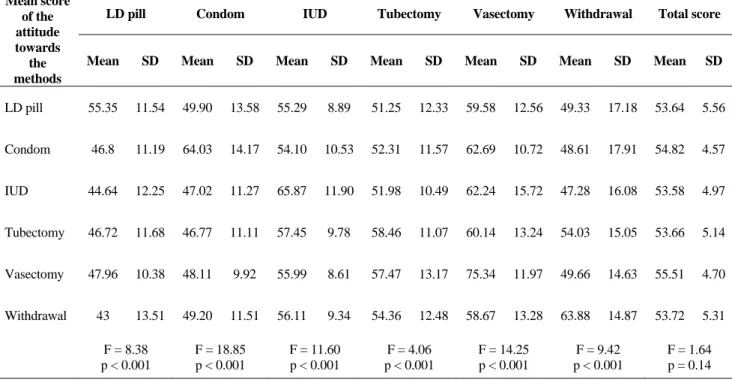
According to table 1, the results indicated that mean score of attitude towards different contraceptive methods in the group used the same method was higher than users of other methods; however, the total score of attitude was almost similar in all the groups and there was no significant difference between different groups.
Furthermore, according to table 2, the results of the present study indicated that about pills
method, 1.9% of them had desirable attitude, 32.5% had semi-desirable attitude, 60.8% had
Table 1. Comparing the attitude score toward contraceptive methods separately by the common contraceptive methods
Mean score of the attitude towards the methods
LD pill Condom IUD Tubectomy Vasectomy Withdrawal Total score
Mean SD Mean SD Mean SD Mean SD Mean SD Mean SD Mean SD
LD pill 55.35 11.54 49.90 13.58 55.29 8.89 51.25 12.33 59.58 12.56 49.33 17.18 53.64 5.56
Condom 46.8 11.19 64.03 14.17 54.10 10.53 52.31 11.57 62.69 10.72 48.61 17.91 54.82 4.57
IUD 44.64 12.25 47.02 11.27 65.87 11.90 51.98 10.49 62.24 15.72 47.28 16.08 53.58 4.97
Tubectomy 46.72 11.68 46.77 11.11 57.45 9.78 58.46 11.07 60.14 13.24 54.03 15.05 53.66 5.14
Vasectomy 47.96 10.38 48.11 9.92 55.99 8.61 57.47 13.17 75.34 11.97 49.66 14.63 55.51 4.70
Withdrawal 43 13.51 49.20 11.51 56.11 9.34 54.36 12.48 58.67 13.28 63.88 14.87 53.72 5.31 F = 8.38
p < 0.001
F = 18.85 p < 0.001
F = 11.60 p < 0.001
F = 4.06 p < 0.001
F = 14.25 p < 0.001
F = 9.42 p < 0.001
F = 1.64 p = 0.14
Table 2. Frequency distribution of dividing the attitude score about the methods in the study subjects
Attitude toward
the methods. Dividing
the attitude
score
LD pill Condom IUD Tubectomy Vasectomy Withdrawal Total score
Num ber
Per- cen-tage
Num-ber
Per- cen-tage
Num ber
Per- cen-tage
Num ber
Per- cen-tage
Num ber
Per- cen-tage
Num ber
Per cen-tage
Num ber
Per- cen-tage Desirable
(>75) 7 1.9 16 4.2 16 4.2 12 3.2 66 17.5 26 6.9 - -
Semi-desirable (50-75)
123 32.5 158 41.8 254 67.2 206 54.5 233 61.6 170 45 292 77.2
Undesira-ble (25-50) 230 60.8 194 51.3 107 28.3 156 41.3 75 19.8 159 42.1 86 22.8
Extremely undesirable (<25)
18 4.8 10 2.6 1 0.3 4 1.1 4 1.1 23 6.1 - -
undesirable attitude and 4.8% also had extreme-ly undesirable attitude. About condom method, 4.2% of the study subjects had desirable atti-tude, 41.8% had semi-desirable attiatti-tude, 51.3% had undesirable attitude and 2.6% also had ex-tremely undesirable attitude. About IUD me-thod, 4.2% of the study subjects had desirable attitude, 67.2% had semi-desirable attitude, 28.3% had undesirable attitude and 0.3% also had extremely undesirable attitude. About tu-bectomy method, 3.2% of the study subjects had desirable attitude, 54.5% had semi-desirable at-titude, 41.3% had undesirable attitude and 1.1% also had extremely undesirable attitude. About vasectomy method, 17.5% of the study subjects had desirable attitude, 61.6% had semi-desirable attitude, 19.8% had unsemi-desirable atti-tude and 1.1% also had extremely undesirable attitude. About withdrawal method, 6.9% of the study subjects had desirable attitude, 45% had semi-desirable attitude, 42.1% had undesirable attitude and 6.1% also had extremely undesira-ble attitude and about the total attitude of all the subjects about contraceptive methods, 77.2% had semi-desirable attitude and 22.8% had un-desirable attitude.
Discussion
The findings of this study showed that the highest frequency of the attitude scores about LD pills method (60.8%) was associated with the women with undesirable attitude and mean scores of the pill method was lower than other methods; that considering to the responses of the participants, it can be said that the fear re-sulted from the pill’s side effects was due to its hormonal combination, and whereas a large number of the participants believed that pills method was an effective contraceptive method. Lee and Jezewski (2007) showed that women, regardless of their ethnicity, age and living area, scare from oral contraceptive method and this negative feeling had been due to concerns about side effects and health risks.15 Furthermore, the
worldwide researches recommended that pills if properly administered, it would be preferable to its risks. Using pill would be safer than preg-nancy and labor; but women would never think
that pregnancy has any risk. In addition, nowa-days the pills have very low dose of estrogen and progesterone. The hormonal dose which was taken daily in 1960s was equal to dose of one week of today’s pills.2,15
The highest frequency of the attitude scores about condom method (51.3%) was associated with the women with undesirable attitude and mean scores of the condom method was lower than other methods (IUD, tubectomy, vasecto-my, withdrawal method) which could be due to reduction of sexual pleasure in men and women and also due to unpleasantness of the condom method.16 Study results of Hounton et al (2005)
about understanding barriers to use condom, it was shown that the imagined efficacy of the in-dividual (imperfect efficacy) and the related problems to use condom were the barriers of using condom.16 In the study of Randolph et al
(2007) titled as "sexual pleasure and condom use", it was indicated that many men and wom-en believed that condom would reduce the sex-ual pleasure; besides, particularly the men, who believed condom would reduce the sexual plea-sure, used condom with lower probability.17 In
the study of Kulczycki (2004) in Lebanon, non-continuous and unstable causes of using con-dom mentioned as five factors as different vain believes, reduction in sexual pleasure, bad ex-periences, fear and anxiety during the sex and negative attitude of society to consumers of the condom and also mentioned its usage as lack of physiological side effects.10
The highest frequency of the attitude score toward intrauterine devices method (67.2%), was associated with the women with semi-desirable attitude and mean scores of IUD me-thod was higher than other meme-thods (pill, con-dom, tubectomy and withdrawal) and was low-er in comparison with vasectomy method. More desirable attitude in comparison with other me-thods could be due to high efficacy, ease of use, lack of interference with sexual relationship and no need for daily remembrance; however, the researcher believed that the main cause of de-sirable attitude of the women was due to encou-ragement of the staff to utilize this method. However, there are some shortages for
consul-tant to remove the side effects of IUD and false beliefs. Women’s attitude towards IUD would be formed through her knowledge from the me-thod as well as her assessment from relative risks and associated benefits to use it. In some of the cases, the false information would over-come which also would be exacerbated through reporting the severe side effects of the old IUDs (which are not available anymore).18
In the present study also, 50.8% of the partici-pants announced that IUD cause infection, while the infection associated with IUD, only would occur at the first 20 days of insertion and it is due to cervical infection which is not diagnosed during the IUD placement. Alna-kash (2008) in a study titled as "influence of IUD perceptions on method discontinuation" showed that almost half of the women asked to take the IUD out; fears and false beliefs were the cause of IUD discontinuation.19 In the
present study also, concerns about IUD side effects have been observed. Therefore, by train-ing and consulttrain-ing the clients about possible side effects and how to confront with them would remove their concerns.
The highest frequency of the attitude scores about tubectomy (54.4%) was associated with the women with semi-desirable attitude, and mean scores of tubectomy method was higher than other methods (pill, condom and with-drawal) and was lower in comparison with va-sectomy and IUD. This more desirable attitude toward other methods could be due to high ef-ficacy, lack of concern about unintended preg-nancy and lower restriction feeling in sexual relationship. In the study of Sharemi et al (2003) titled as "reviewing the awareness and attitude of the women of Rasht City towards tubectomy and its side effects", only 5.5% of the partici-pants had positive attitude toward tubectomy and 72% of them had moderate attitude and 12.1% also had negative attitude. About the atti-tude toward tubectomy, the following percen-tages believed that was not an appropriate me-thod as: 52.1% of the women due to cause of low back pain, 30.7% due to pelvic and abdo-minal pain , 41.5% due to hemorrhage and 21.8% due to complication of ovarian cysts.
While other participants, for answering to the questions, selected “I do not know” and “I am disagree” choices.20 Difference in attitudes in the
study of Sharami might be due to study popula-tion and the obtained informapopula-tion might have been different by them that the information could influence the attitude of the individual; besides, it could be due to difference in dividing the mean scores to positive, moderate and nega-tive categories.
The highest frequency of the attitude scores of vasectomy (61.6%) was associated with the women with semi-desirable attitude and mean scores of vasectomy method was higher than other methods (pill, condom, withdrawal, IUD and tubectomy). This more desirable attitude in comparison with other methods could be due to high confidence to this method, no need for surgery and lower side effects. In the study of Naeimi et al (2003) titled as "reviewing the awareness and attitude of the married men about vasectomy in Dehdasht City on the stu-died men in 2003", 44 percent of them had poor attitude, 24.8 percent had moderate attitude and 21.2 percent of the also had good attitude.21
Manhoso and Hoga (2005) quoted from Medici (1999) stated that vasectomy has surrounded by more beliefs, prejudices, bias and superstition than other methods. The opposition of the men with vasectomy was due to fear of losing their manhood, sexual function and fear of surgery. According to their survey, the positive expe-rience of other men was the most important fac-tor in removing the fear associated with vasect-omy and decision-making about it. In fact, in-terpersonal relations have a major role in chang-ing the attitude of the men towards vasecto-my.22 However, in the present study, in
re-sponse to the phrase “vasectomy is a private issue and no one should get informed about it except the couple”, 38.1 percent of the women selected “I am agree” and “I am completely agree” and 48.9 percent selected “I have no idea” and this indicated the lack of tendency of the participants to talk about vasectomy surgery to others.
Furthermore, the present study indicated that 57.21% of the consumers of pill, condom
IUD and withdrawal methods had no tendency for future reproductivity; however, they used no permanent method. One of the causes of lack of acceptance of this issue might be due to shortage of information obtained through effec-tive sources and consequently receiving incor-rect information from other individuals. In the study of Ozgoli et al (2004) it was shown that the eligible individuals did not carry out the methods not because of unawareness and ig-norance, not even incompatible with religious beliefs and negative attitudes but also more due to fear of the side effects and wives’ disagree-ment; besides, their obtained information were acquired not from a reliable sources but from friend and those around them.9
The highest frequency of the attitude scores about withdrawal method (45%) was associated with the women with semi-desirable attitude and mean score of the withdrawal method was lower than other methods such as IUD, tubect-omy and vasecttubect-omy and was almost similar to condom and pill methods that the lower atti-tude probably could be due to fear from unin-tended pregnancy. In the study of Yanikkerem (2006), 84.4% of the women announced that they were satisfied with this method and ac-cording to them 69.9% of their spouses were orgasm with this method. Besides, 53.6% an-nounced that withdrawal method was more effective. Only 1.4% of them stated that with-drawal method impaired their sex health and65.2% announced that they were afraid of pregnancy when using this method.23
Sometimes, health staff do not consider the withdrawal method as a contraceptive method
and in health care centers, it was seen that healthcare givers extremely prohibit the women from this method and try to refrain people from using this method; while some of the people have a very positive attitude toward this me-thod. In the study of Yanikkerem (2006), even after training the women, 57.6% of them con-tinued using the withdrawal method and had no tendency to change their method and be-lieved that this method had been effective.23
Health staff should know that some of the clients trust this method even if they do not re-port using it! Withdrawal method should be recognized as “better than nothing” in contra-ceptive method. Withdrawal method may not be that effective as much as modern methods, but according to the documents, it can be effec-tive as much as condom (at least for contracep-tive method to prevent from pregnancy).24
Therefore, instead of insisting to the couples using withdrawal method to use modern me-thods, more effective ways such as sexual absti-nence during the fertile period and using emer-gency contraception methods should be taught to them.
The findings of the present study showed that attitude is an important factor in selecting con-traceptive method and it has a major role in be-haviors related to use contraceptive methods; therefore, reviewing the attitude of the users is an important issue in consulting the contracep-tive method.
The authors declare no conflict of interest in this study.
References
1. Rastak L. Correlation between socio-demographic characteristics and contraceptive methods. Shahrekord Univer-sity of Medical Sciences Journal. 2005; 7(2): 21-8. [In Persian].
2. Belfield T. Principles of contraceptive care: choice, acceptability and access. Best Pract Res Clin Obstet Gynae-col. 2009; 23(2): 177-85.
3. Whitaker AK, Johnson LM, Harwood B, Chiappetta L, Creinin MD, Gold MA. Adolescent and young adult women's knowledge of and attitudes toward the intrauterine device. Contraception. 2008; 78(3): 211-7.
4. Health Department, Population and Family Health Office with Cooperation of Universities of Medical Sciences and Iran’s Health Care System. IMES, Integrated Monitoring and Evaluation System. Tehran: Department of Health and Medical Education; 2005.
5. Glasier A, Shields WC. Can we improve contraceptive use?. Contraception. 2006; 73(1): 1-3.
6. Singh R, Frost J, Jordan B, Wells E. Beyond a prescription: strategies for improving contraceptive care. Contra-ception. 2009; 79(1): 1-4.
7. Beekle AT, McCabe C. Awareness and determinants of family planning practice in Jimma, Ethiopia. Int Nurs Rev. 2006; 53(4): 269-76.
8. Sangi-Haghpeykar H, Ali N, Posner S, Poindexter AN. Disparities in contraceptive knowledge, attitude and use between Hispanic and non-Hispanic whites. Contraception. 2006; 74(2): 125-32.
9. Ozgoli G, Ahmadi M, Goli Sh, Akbarzadeh Baghban A. Comparison of knowledge, attitude and other related fac-tors to sterilization between sterilization method users and contraceptive methods users in Hamedan city in 2003. Journal of Reproduction and Infertility. 2004; 5(3): 259-267. [In Persian].
10. Kulczycki A. The sociocultural context of condom use within marriage in rural Lebanon. Stud Fam Plann. 2004; 35(4): 246-60.
11. Norouzi M, Abedi HA, Farmahini-Farahani M. A Study of Different Justifications of Mothers Selecting their Fa-vorite Postpartum Contraceptive Methods in Isfahan Health Centers, 2001. Journal of Ardabil University of med-ical sciences. 2002; 2(5): 48-52. [In Persian].
12. Karimi Y. Attitude and attitude change. Tehran: Virayesh, 1998. [In Persian].
13. Sereshti M, Delaram M, Rafian M. Incidence and View Point of pregnant Women about Factors Associated with Unwanted pregnancy in Shahrekord. Scientific Journal of Hamadan Nursing & Midwifery Faculty. 2005; 13(2): 8-14. [In Persian].
14. Ramachandran L, Dharmalingam T. A textbook of health education. Trans Shafiei F, Azargashb E. Tehran: Uni-versity of Tehran; 2006.
15. Lee J, Jezewski MA. Attitudes toward oral contraceptive use among women of reproductive age: a systematic re-view. ANS Adv Nurs Sci. 2007; 30(1): E85-103.
16. Hounton SH, Carabin H, Henderson NJ. Towards an understanding of barriers to condom use in rural Benin using the Health Belief Model: a cross sectional survey. BMC Public Health. 2005; 5:8.
17. Randolph ME, Pinkerton SD, Bogart LM, Cecil H, Abramson PR. Sexual pleasure and condom use. Arch Sex Behav. 2007; 36(6): 844-8.
18. The ESHRE Capri Workshop Group. Intrauterine devices and intrauterine systems. Hum Reprod Update. 2008; 14(3): 197-208.
19. Alnakash AH. Influence of IUD perceptions on method discontinuation. Contraception. 2008; 78(4): 290-3. 20. Sharami H, Milani F, Oudi M. Survey of attitude and knowledge about tubal ligation and its complications in
women residing in Rasht. Journal of Medical Faculty Guilan University of Medical Sciences. 2004; 12(48): 52-60. [In Persian].
21. Naeimi E, Chaman R, Pour-Mahmoodi A, Ghaffarian Shirazi HR. A study on knowledge and attitude of married males toward vasectomy in Dehdasht, 1382. Armaghane-danesh. 2003; 8(31): 69-79. [In Persian].
22. Manhoso FR, Hoga LA. Men's experiences of vasectomy in the Brazilian Public Health Service. Int Nurs Rev. 2005; 52(2): 101-8.
23. Yanikkerem E, Acar H, Elem E. Withdrawal users' perceptions of and experience with contraceptive methods in Manisa, Turkey. Midwifery. 2006; 22(3): 274-84.
24. Jones RK, Fennell J, Higgins JA, Blanchard K. Better than nothing or savvy risk-reduction practice? The impor-tance of withdrawal. Contraception. 2009; 79(6): 407-10.