Maintenance. A Master’s Paper for the M.S. in I.S degree. April, 2008. 35 pages. Advisor: Jane Greenberg
This paper reports on a two-part study focusing on automatic metadata maintenance
for NC Health Info, a health information web portal for North Carolina residents. The first examination is an analysis of web changes and their potential impacts on
metadata quality. The second examination proposes a framework for semi-automatic
metadata maintenance, which builds off of a hierarchy of evaluation proposed by
Greenberg (2005). This work is supported by a baseline counting of the average
number of Dublin Core Metadata elements on Dublin Core website and a conceptual framework enhanced with mathematical Set Theory. The results lead to a model that
enables catalogers to review only a portion of the web resources with detected
changes. The proposed approach aims to benefit the metadata generation and
maintenance by reducing human effort and time consumption while ensuring high
metadata quality.
Headings:
Web Change Detection Consumer Health Website
Subject Metadata
Metadata Maintenance
NC HEALTH INFO AND GO LOCAL: AN ANALYSIS OF WEB CHANGE IMPACTS ON METADATA QUALITY AND A PROPOSED FRAMEWORK FOR
SEMI-AUTOMATIC METADATA MAINTENANCE
by Jie Jin
A Master’s paper submitted to the faculty of the School of Information and Library Science of the University of North Carolina at Chapel Hill
in partial fulfillment of the requirements for the degree of Master of Science in
Information Science.
Chapel Hill, North Carolina April 2008
Approved by
Table of Contents
1. Introduction ...2
2. Literature Review...3
2.1 Web Change Detection and Study...3
2.2 Consumer Health Web Portal...5
2.3 Web Resources Classification...7
2.4 Metadata Generation and Quality Evaluation...8
3. Research Goal...10
4. Methodology and Framework...11
4.1 Capture and Study Changes…………...12
4.2 Metadata Quality Evaluations...16
4.2.1 Empirical Evaluation...16
4.2.2 Semantic Evaluation...19
4.2.3 Final Evaluation Score...27
5. Future Research...28
6. Conclusion...29
1.
Introduction
This study is based on the cataloging process of NC Health Info and Go Local
(NCHI) which is a web portal to provide access to information of heath conditions,
diseases, wellness and local health services, especially for the North Carolina residents. It
is available at http://www.nchealthinfo.org/. This site is developed and maintained by
Health Science Library (HSL) of University of North Carolina at Chapel Hill. Also, joint
efforts between HSL and School of Information and Library Science, University of North
Carolina at Chapel Hill have been made to improve the work of NCHI catalogers. The
NCHI database stores various information including URL, Name, Phone Number, City,
County etc. which are treated as metadata records for each web resource. Nevertheless,
the knowledge of health issues is constantly changing due to new discoveries and
important breakthroughs, which are always quickly disseminated on the web. In addition,
health services are also considered highly dynamic in terms of rapid and frequent
changes of service hours, locations and personnel who provide varying services etc.
Therefore, coping with changes by ensuring the metadata quality and timeliness of its
maintenance become the great challenge to the catalogers.
Based on the understanding of that manual metadata generation and maintenance
operation, this study has conducted an analysis of web changes occurring to resources
archived by NCHI so as to find out the metadata field that constitutes the greatest
changes within the study period. Moreover, based on the result of this analysis, it
proposes a conceptual application model for metadata maintenance using the concept of
metadata quality evaluation. As a semi-automatic approach, this model attempts to
increase the degree of automation and reduce the amount of time required by human
while ensuring high quality metadata records. Specifically, there are two main tasks
discussed in this study:
1) Among all the data tables where web resources’ metadata records are stored,
determine the field that constitutes the greatest change in the study period
2) Develop an application model for metadata quality evaluation at both empirical level
and semantic levels so that a combinational evaluation score can be produced, on
which the decision of the need of further human reviews will be based.
2. Literature Reviews
2.1 Web Change Detection and Study
World Wide Web is a highly dynamic space, which means the resources residing
on the Internet involve great changes over time. In order to study such constant changes
and to better manage them, several applications, such as WATZNEW
(http://www.watznew.com), URL-Minder (www.urlminder.com) have been developed for
researches have been conducted under the same topic. As is discussed by
Francisco-Revilla et al. (2001), many of the existing applications have the disadvantages
of treating presentational changes as substantial relevant changes. In their study, they
classified the nature of changes into categories such as content changes, presentational
changes, structural changes, behavioral changes. Based on this classification, they
attempted to develop an approach to automatically evaluate the relevance of changes in
the web pages. However, their system, Path Manager, also had limitations in lacking
support of indirection, which means frames embedded in the web pages cannot easily be
handled; because, the application does not check URLs contained in the frames, unless
these URLs appear as part of the path being checked. Also, monitoring JavaScript or
other page behaviors was regarded as another challenge due to the complexity of web
specifications adopted by various browsers to handle dynamic page objects. Therefore,
human efforts still seem to be indispensable in such process. Flesca & Masciari (2002)
also attempted to propose a technique to provide a change monitoring service on the web.
The unique aspect of this technique was that it represents a web document as a tree and
allows the users to concentrate on a particular part of the tree, which they call “sub-trees”.
Then a query can be built up to check if a change to specific portion of the document has
occurred. This approach was derived from the similarity measure between two
documents using graph theory. The similarity of two trees (documents) is defined by
considering the edge or association between two nodes on the two sub-trees of user’s
maturity of it was still limited to be at personal web updating level. Douglis (1997) and
other fellow researchers conducted their study to evaluate the rate and nature of change of
Web resources. Their results showed that the content type and rate of access have a great
impact on the metrics used to measure the changes such as ratio of changes, access
frequency etc., while size of the web resource had little effect. Koehler (2002) also
confirmed the point that “ Web pages change when either the content of the page is
modified or when the hypertext links form the page are changed, added to, or deleted
form the page. Using software, it is possible to ascertain whether change occurs, it is less
easy to determine whether change is substantive or not. The determination of substantive
change is inherently subjective.” He concluded that the longevity of a web page is
depending on its domain type and purpose; content pages have less survival rate than
navigations pages.
2.1 Consumer Health Web Portal
More and more people are using the Internet to search for health-related information.
According to Bendict (2000), about 52 million Americans look for health information
online at least once a month, and 40% among whom show that this type of information
affect their health care decision. More recently, according to health report written by Fox
(2006), 80% of American internet users, or some 113 million adults, have now searched
for health information online now. Apparently, the growth of online health information
seeking is significant. Studies have been conducted to understand the characteristics of
behavior. Chin (2002) mentioned that the quality and reliability of health information on
the web have become a great concern to the consumers. In their article, Luo and Najdawi
(2004) conducted a review on how many of the health portals are making effort to use
different measures to build the trust between the sites and consumers. They considered
that the health information catalog, as one of the common features, is a mechanism for
organizing health or medical treatment and services information and providing links to
other health-related sites where consumers may further seek other information or obtain
answers to their questions. This feature was available in most of health portals studied in
their research. Lastly, they concluded that though maybe difficult and varied,
trust-building measures need to be used by health portals to increase their trustworthiness
to the consumers. MedlinePlus is a web-based consumer health information resource built
by National Library of Medicine (NLM). It is widely considered as one the most
authoritative health information portals. According to Miller, Lacroix and Backus (2000),
with the rapid growth of using Internet for health information seeking, health portals
become especially value and useful to the consumers. Facing high usage intensity,
building and maintaining such service is challenging. The authors talked about various
concerns in their study, including: Keeping information up to date with high quality and
reliability as well as efficiently organizing and selecting the web resources are the goals
of MedlinePlus’s team. In particular, they described how the health topics are developed
based on the analysis of users’ search terms along with other statistics. As part of the
difficulties due to the continuous growth of the availability of health information on the
web. Cline and Haynes (2001) confirmed the fact of vastly increasing use of the Internet
for health information seeking. Although providing “widespread access to information
and advantages of interactivity, information tailing and anonymity…”, inequity in
accessing information, design features, information quality and evaluation skills have
been perceived as problems. The authors advocated that the Internet needs to be viewed
as “part of the larger health communication system” and “taken advantage of
incorporating extant communication concepts”. They have raised the significance of
understanding consumers’ Internet health information seeking behavior, considerations
on potential benefits and quality concerns and identification of criteria for service
evaluation. Besides discussing about the navigational difficulties caused by information
overload, disorganization of web content, etc., authors also pointed out that, since there is
hardly a proper filtering process, health information with low quality can be very
dangerous to its users. Therefore, the best case will be ensuring the quality at its source
where it is generated by authors or catalogers; and for evaluating such type of
information, a consensus has to be reached that “Health-related websites should be
judged by the quality of health information found on them and by design features that
may facilitate or impede the use”.
2.3 Web Resources Classification
Researchers have been attempting to explore methods for web resources
assignment of subject descriptor terms from a predefined controlled vocabulary. Text
Mining is a typical technique implemented for this purpose. Given the machine power,
the human subjectivity can be maximally avoided and degree of automation is expected
to be increased. Golub (2003) gave a brief of different automated classification
approaches, including text categorization, document clustering and document
classification. The purpose of his study was to determine the utilization of controlled
vocabulary in automated classification of textual web pages, in the context browsing. He
attempted to classify web pages based on controlled vocabulary by using the term
frequency and weight assignment. Yang and Lee (2005) proposed an automatic approach
to generate semantically related labels/themes for web resources by using text mining
techniques, a process including clustering, labeling and generation. However, besides
necessary technical skills, the implementation of text mining approaches do require
sufficient training data at its initial stage before the assignments can be done, this
somehow presents a difficulty to its adopters.
2.4 Metadata Generation and Quality Evaluation
In this study, “Metadata Generation” is concentrated on subject metadata and to
correctly classify web resources under different health concepts and assigning them with
most relevant health topics. The quality of the metadata records is directly reflected by
the how accurately these web resources are given the correct subjects. Unfortunately, in
practice, it is proved to be hard to avoid the metadata records being subjectively or
domain-specific knowledge. With more understanding of automatic classification
techniques, researches have been trying to use them for metadata generation. Liddy et al.
(2002) applied Natural Language Processing and Machine Learning techniques to
automatically generate metadata for educational resources and drew controlled
vocabulary terms from he ERIC Thesaurus. Within this particular context, they have
found the minimal difference between automatically generated metadata and manually
assigned metadata during evaluation may be reached. Meanwhile, applications for the
same purpose are being built. Dublin Core Metadata Initiative has a dedicated web page
(http://dublincore.org/tools/) for available tools and software built based on Dublin Core
standard. AMeGA project, Greenberg, Spurgin and Crystal (2006), was to explore and
produce a list of recommended functionalities for applications supporting automatic
metadata generation in the library / bibliographic control community through a survey
conducting. In Greenberg (2004), her research results indicated the positive contribution
of extraction and processing algorithms and harvesting metadata from META tags created
by authors to automatic metadata generation. In Paynter (2005), besides talking about
implementing text classification to assign metadata values from a given controlled
vocabulary to the web resources, Paynter also described the development of an automatic
metadata assignment tool, IVIA, which is used to give descriptive metadata to resources
kept in virtual libraries, metadata repositories and digital libraries with reference to
Library-Standard Metadata. This study covered both metadata assignment and evaluation
concerned, Bruce and Hillmann (2004) provided a comprehensive top-level list of
metadata quality measures and metrics such as completeness, accuracy, provenance,
conformance to expectations, logical consistency and coherence, timeliness and
accessibility. It has been mentioned that “automated metadata validation or evaluation is
usually cheaper than human validation. Automated techniques potentially enable humans
to use their time to make more sophisticated assessments. Cost-effective machine-based
techniques represent ‘the least we can do’ to ensure metadata quality, possibly with more
expensive human techniques following on...” In addition, Jane Greenberg has developed
a layer cake of criteria for metadata quality evaluation in Greenberg (2005). Both Bruce
and Hillmann (2004) and Greenberg (2005) are the fundamental principles where the
proposed application model are based upon.
3. Research Goal
The goal of this study is to identify the aspect of web resources’ metadata records
structured in NCHI database that constitutes the greatest changes over the study period
from December 5, 2007 to March 5, 2007, based on result of which, a conceptual
framework is to be developed by using a set of metadata quality evaluation criteria as a
semi-automatic approach for metadata maintenance. It is aimed that this research can
benefit the metadata generation and updating operation as part of the whole cataloging
process by ensuring the metadata quality and reducing the cost of human labor and
4. Methodology and Framework
The data collection period was from December 5, 2007 to March 5, 2007. There
are 5 copies of databases have been archived on each of the following dates: December 5,
2007, December 27, 2007, Jan 15, 2008, February 5, 2008 and March 5, 2008, from
which December 5, 2007, Jan 15, 2008, February 5, 2008 and March 5, 2008 are used to
for this study. Although it is not the main focus of this study, a special feature, “Local
Service Term - Health Topic Paring”, used by NC Health Info site’s content organization
needs to be described for the benefit of understanding how metadata records are assigned
to the web resources. NCHI staff have developed a list of service terms that are
specifically used for describing health services in the State of North Carolina, while the
list of Health Topics are used by MedlinePlus. Local Service Terms are qualified by
pairings with appropriate Health Topics. Each web resources archived will be labeled
with one or more parings. Based on this concept, there are two types of display pages in
NC Health Info site: Local Service Term Display and Health Topic Display. Local
Service Term display shows only resources cataloged to that term for a certain location,
for instance, “Nursing Homes”, then “Orange County”; on the other hand, the Health
Topic display works the same way; users may choose “Breast Cancer”, then “Orange
County”, the resultant display also includes resources necessary to manage Breast Cancer
labeled by local service term such as Clinics, Oncologists and Support Groups. Hence,
users are allowed to choose either of these two displays and then a specific location to
function provided by NC Health Info site, the paring mechanism is sufficiently serving
the purpose of facilitating the health information seeking through the site. The idea of the
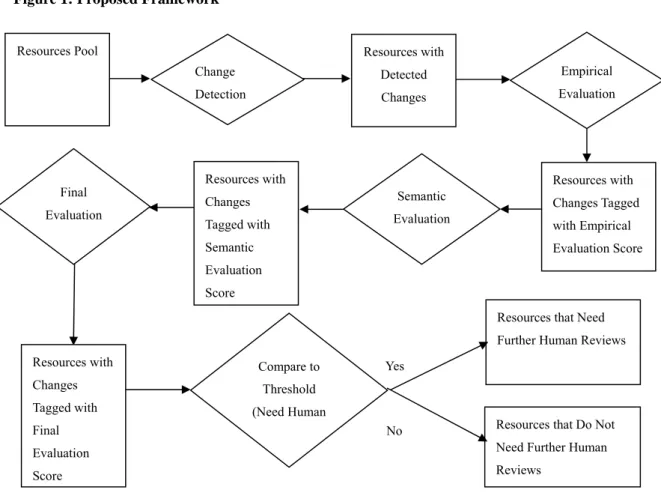
methodology can be summarized by Figure 1. This method for the case study of NCHI is
at its conceptual and experimental level.
Figure 1: Proposed Framework
4.1 Capture and Study Web Changes
The Web is an information space with high changing rate and frequency.
Moreover, in the consumer health field, the knowledge of health issues is constantly
changing due to new discoveries and important breakthroughs, which are always quickly
disseminated on the web. In addition, health services are also considered highly dynamic
Empirical Evaluation Yes No Resources with Changes Tagged with Empirical Evaluation Score Change Detection Semantic Evaluation Resources with Changes Tagged with Semantic Evaluation Score Final Evaluation Compare to Threshold (Need Human Resources with Changes Tagged with Final Evaluation Score
Resources Pool Resources with Detected Changes
Resources that Need Further Human Reviews
in terms of rapid and frequent changes of service hours, services provided, locations and
personnel. Therefore, in order for an efficient and effective semi-automatic metadata
maintenance approach to be developed, the web changes occurring to the web resources
collected by NC Health Info site have to be captured and studied. These “changes” are
expected to be the changes that are substantively affecting the quality of metadata records
generated by catalogers, which, without timely and accurate updating, may decrease the
usefulness of the site. Thus, catalogers are monitoring web resources on a regular basis.
As soon as there are content changes found, they will manually review them one by one.
Based on their experience, if one change is deemed to be substantial, then a metadata
record updating is executed to the database where the resources’ descriptive data is stored.
This is considered as a part of metadata maintenance operation.
All of the archived databases are sharing the same schema in which a set of
dedicated tables are created to hold metadata records used for web resources description.
Among all the data fields, the URL, City, Phone_prefix, Phone_last_4_digits, Local
Service Term – Health Topic Paring are empirically believed to be the fields that may
constitute the majority of the changes. Therefore, in this study, the change capturing is
focused on them. It needs to be kept in mind that each resource may have more than one
city_id assigned to it to reflect its service locations and more than one parings gned to it
to reflect the health topics its content covers. For convenience, the
field-ideassintifprocess is completed through a simple approach: table to table
Table 1: Total Number of Unique Web Resources Collected by Each Database Archived
Date Dec 5,2007 Jan 15, 2008 Feb 5, 2008 Mar 5, 2008
# of Records 5080 6206 6208 6208
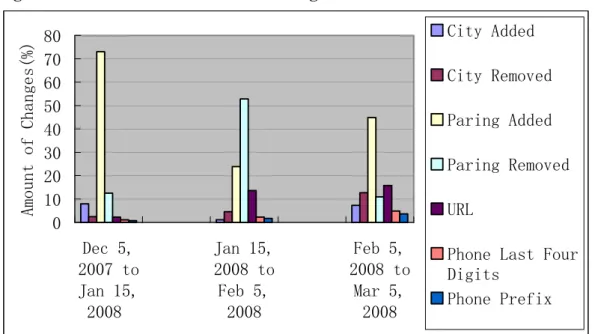
Table 2: Fields Change Tracking for Dec 5,2007 to Jan 15,2007, Jan 15, 2008 to Feb 5, 2008 and Feb 5, 2008 to Mar 5, 2008
Dec 5,2007 to Jan 15,2008 Jan 15, 2008 to Feb 5, 2008 Feb 5, 2008 to Mar 5,
2008 Number of Changes Changes in percentage (%) Number of Changes Changes in percentage (%) Number of Changes Changes in percentage (%)
City Added 1774 7.92 2 1.14 12 7.27
City Removed 542 2.42 8 4.55 21 12.73
Paring Added 16354 73.04 42 23.86 74 44.85
Paring Removed 2807 12.54 93 52.84 18 10.91
URL 505 2.26 24 13.64 26 15.76
Phone Last Four Digits 240 1.07 4 2.27 8 4.85
Phone Prefix 170 0.76 3 1.70 6 3.64
Figure 2: Column Chart of Tracked Changes for 3 Time Intervals
0 10 20 30 40 50 60 70 80 Dec 5, 2007 to Jan 15, 2008 Jan 15, 2008 to Feb 5, 2008 Feb 5, 2008 to Mar 5, 2008 Amo unt of C hange s(%) City Added City Removed Paring Added Paring Removed URL
Phone Last Four Digits
Phone Prefix
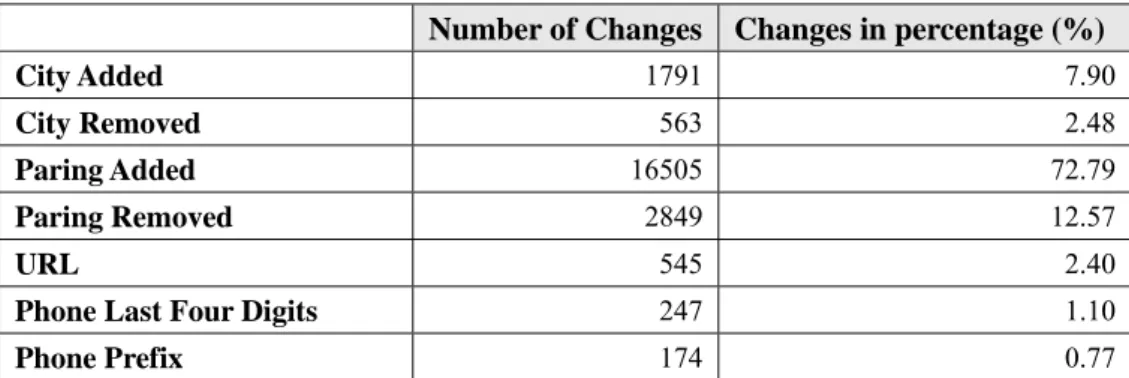
Number of Changes Changes in percentage (%)
City Added 1791 7.90
City Removed 563 2.48
Paring Added 16505 72.79
Paring Removed 2849 12.57
URL 545 2.40
Phone Last Four Digits 247 1.10
Phone Prefix 174 0.77
Figure 3: Column Chart of Tracked Changes for Dec 5, 2008 to Mar 5, 2008
0 10 20 30 40 50 60 70 80
Dec 5, 2008 to Mar 5, 2008
A mou nt o f Ch ange s i n pe rcen t (%
) City Added
City Removed
Paring Added
Paring Removed
URL
Phone Last Four Digits
Phone Prefix
From the results above, it can be apparently seen that the paring is the data field that
constitutes the most changes among all. The nature of this field is practically keywords
for describing the main idea of the content. Hence, it is reasonable to regard these parings
as descriptive metadata or subject metadata of each web resource. The function of this
type of metadata is defined as “describes a resource for purposes such as discovery and
identification. It can include elements such as title, abstract, author, and keywords…”
4.2 Metadata Quality Evaluations
After the portion of web resources with changes are captured, they will be fed to
an application whose output is able to determine whether human evaluation is needed for
a particular web resource based on a set of evaluation criteria. The conceptual model of
this application is proposed in this study. The entire process of metadata quality
evaluations consists of three sequential stages namely Empirical Evaluation, Semantic
Evaluation and Final Evaluation Score Calculation, which is based on Metadata
Evaluation Hierarchy discussed in Greenberg (2005). Each of Empirical Evaluation,
Semantic Evaluation stages produces a score for the web resource and based these scores,
a final evaluation score is calculated at the third stage and to be compared with a
threshold so that the decision on whether catalogers will need to review the resources can
be made.
4.2.1 Empirical Evaluation
The purpose of Empirical Evaluation is to measure the degree of a web resource’s
compliance to a particular metadata standard and furthermore, depending on the standard
used, to determine its completeness and redundancy.
In this study, The Dublin Core Metadata Standard (www.dublincore.org) is
selected due to fact that it provides a metadata element set intended to facilitate discovery
of electronic resources. Dublin Core Metadata Standard was originally built for
author-generated description of web resources, now it has gained the significant amount
government agencies and commercial organizations. 15 elements are defined in Dublin
Core Metadata Element Set including: Title, Creator, Subject, Description, Publisher,
Contributor, Date, Resource Type, Format, Identifier, Source, Language, Relation,
Coverage, Rights. There are two important steps for this level of evaluation: 1) Dublin
Core Metadata Element(s) Generation and 2) Empirical Evaluation Score Calculation.
1) Dublin Core Metadata Element(s) Generation
In order to be able to automatically extract the elements that are used by a web
resource, a free online application named DC-dot
(http://www.ukoln.ac.uk/metadata/dcdot/) is employed. It is listed as one of the utilities
for metadata generation and extraction on Dublin Core Official website
(http://dublincore.org/tools/). The function of DC-Dot is to “retrieve a Web page and
automatically generate Dublin Core metadata, either as HTML <meta> tags or as
RDF/XML, suitable for embedding in the <head>...</head> section of the page…”
(http://www.ukoln.ac.uk/metadata/dcdot/). By using DC-Dot’s extraction and generation
results, it is easy to determine the number of Dublin Core elements that a certain web site
can be generated from.
2) Empirical Evaluation Score Calculation
What was surprisingly found in this study is that it seemed to be impractical to
assume if a web resource can be extracted or generated with 15 elements by DC-Dot, it
will get a score of 100%; because, after running DC-Dot against the commonly used
implementation of Dublin Core Metadata Standard, it was found that there has been none
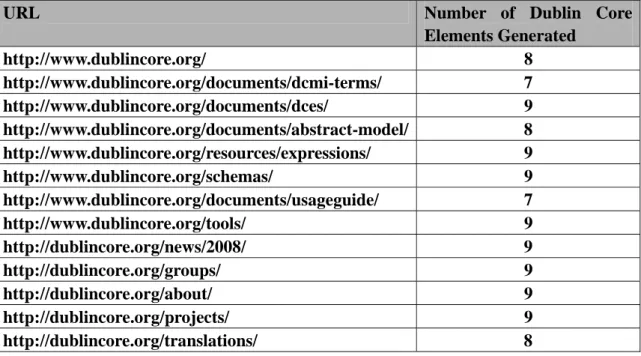
of these pages have entirely 15 elements extracted or generated. The result is shown in
the Table 4
Table 4: Number of Dublin Core Elements Extracted or Generated from Web Pages on Dublin Core Official Site
URL Number of Dublin Core
Elements Generated
http://www.dublincore.org/ 8 http://www.dublincore.org/documents/dcmi-terms/ 7
http://www.dublincore.org/documents/dces/ 9
http://www.dublincore.org/documents/abstract-model/ 8
http://www.dublincore.org/resources/expressions/ 9
http://www.dublincore.org/schemas/ 9 http://www.dublincore.org/documents/usageguide/ 7
http://www.dublincore.org/tools/ 9 http://dublincore.org/news/2008/ 9 http://dublincore.org/groups/ 9 http://dublincore.org/about/ 9 http://dublincore.org/projects/ 9 http://dublincore.org/translations/ 8
We can see that the average number of Dublin Core terms extracted or generated for this
set of commonly accessed pages on www.dublincore.org is approximately 8. Therefore, it
is proposed that a web resource will be given a score 100% at Empirical Evaluation level
if the number of unique Dublin Core Metadata Elements it can be extracted or generated
with is equal to or more than 8. In order for this concept to be illustrated in a more
detailed way, one example is presented to show how it works in practice. A health-related
particular website is created for AIDS Community Residence Association. The DC-Dot
result is shown below where Dublin Core elements are bolded.
Figure 4: The DC-Dot Extraction and Generation Result for http://acra-org.com
<link rel="schema.DC" href="http://purl.org/dc/elements/1.1/" />
<link rel="schema.DCTERMS" href="http://purl.org/dc/terms/" />
<meta name="DC.title" content="ACRA - AIDS Community Residence Association" />
<meta name="DC.subject" content="Home; Case Management; Links; Housing; Information
For Clients; Newsletter; Contact Us; Frequently Asked Questions; How Can I Help" />
<meta name="DC.date" scheme="DCTERMS.W3CDTF" content="2007-09-15" />
<meta name="DC.type" scheme="DCTERMS.DCMIType" content="Text" />
<meta name="DC.format" content="text/html" />
<meta name="DC.format" content="5225 bytes" />
<meta name="DC.identifier" scheme="DCTERMS.URI" content="http://acra-org.com" />
There are 6 unique Dublin Core elements for this health information site. Hence, for the
purpose of Empirical Evaluation, the web resource will get a score of 6/8 that is 75%.
4.2.2 Semantic Evaluation
As is perceived, both knowledge of health issues and health service information is
constantly changing and can be quickly distributed over the Internet. In the proposed
application model, once a content change occurring to the web resource has been detected,
its metadata records existing in NCHI database is no longer accurate. Therefore, besides
from the result in 4.1, the proposed application model at semantic level in this study is to
mainly deal with subject metadata changes occurring to the web resources. The reason of
applying Semantic Evaluation is to determine how accurately terms picked from existing
controlled vocabulary are assigned to the web resource as its metadata records. In the
case of NC Health Info website (NCHI), when there is a change occurred to a web
resource in terms of addition, removal or alteration of its content. A certain web resources
will be first assigned one or more pairings of local service terms and health topics, this
set will then be compared with the existing set of parings given to this web resource.
Lastly, a score of Semantic Evaluation is to be calculated based on the result of the
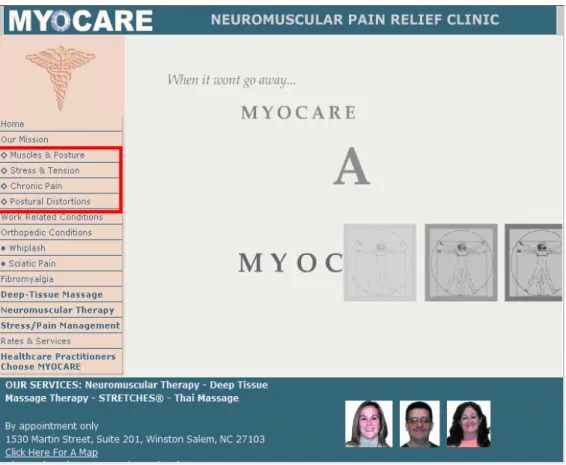
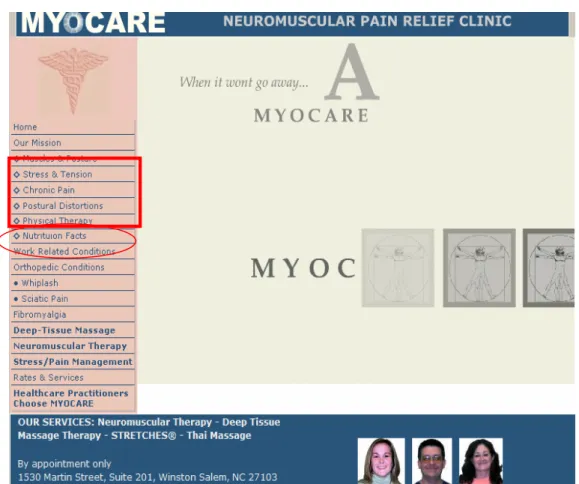
comparison. Figure 5 and Figure 6 demonstrate how content changes affect the subject
metadata assignment in the case of content addition. A sample site,
http://www.myocare.net, is randomly chosen from NCHI database and artificial changes
are created solely for demonstration purpose in this paper. They do not reflect what
Figure 5: Sample Site’s Main Page at Time Point 1
Based on “Our Mission” on the left navigation bar as well as other information provided
by the website, the catalogers assigned following local service – health topics parings as
subject metadata to this piece of resource:
Massage/Bodywork Therapists -- Stress
Massage/Bodywork Therapists -- Pain
Massage/Bodywork Therapists –Fibromyalgia
Massage/Bodywork Therapists –Complementary and Alternative Medicine
Clinics – Health Facilities
Clinics – Stress
Clinics – Pain
However, after certain period of time, there may be two new terms are added to
“Our Mission” shown in Figure 6 to reflect the service expansion of the site and the rest
of the content remains the same. With the addition to the content, it is certain that new
subject metadata will need to be added to the metadata records of this web resource,
which could be the following pairings:
Health Education – Nutrition
Physical Therapist – Pain
There are two important steps in this process: 1) Assignment of Subject Metadata and 2)
The Semantic Evaluation Score Calculation based on the comparison result.
1) Subject Metadata Assignment
Certainly, Text Mining techniques can find their role here to automatically assign
subject metadata to the web resources, when changes occur. However, how accurate this
process can be is still under researchers’ speculation. In this study, it is believed that a
straightforward and simple word for word / phrase for phrase mapping can be used to
automatically select the terms or health topics from the existing list for topic annotation
purpose. There are three potential matching rules are proposed in this study so that a
match between terms in content and terms in the predefined list of health topics
Exact Matching: a word or phrase will match to a member in the predefined list of
health topics. For instance, “Drug Abuse” in the content matches to the “Drug Abuse”
in the lists.
Partial Matching: a word or phrase will not completely match to a member in the
predefined list of health topics, but partially. For instance, “Massage Therapy” in the
content partially matches to “Massage / Body Therapist” in the lists.
Stemming Matching: with the availability of many existing stemming algorithms such
as Porter Stemming Algorithm (http://tartarus.org/~martin/PorterStemmer/), it is
feasible to stem all the words in both content and lists which does require certain
amount of computational power so that a match may be found if two terms are sharing
list of health topics.
Moreover, it is highly likely that web resources are using terms that do not appear exactly
the same as those in the predefined lists while sharing an identical meaning. Hence, the
use of synonym list has been brought to the scope of this study. The necessity of
including such a list is to increase the ability of the application for capturing the
extensiveness of the resource content in practice. For instances, “Bone Specialist” is
considered as a synonym of “Orthopedists”, “Bodywork Therapists” is considered as a
synonym of “Massage Therapists”. Thus, the use of synonyms is a special case of Exact
Matching Rule. Therefore, as along as a certain term in the web resource content
follows any one of the matching rules(Exact Matching, Partial Matching, Stemming
Matching) or falls into the synonym list, the content where this term appears will be
labeled with corresponding member of predefined list of health topics.
2) Semantic Evaluation Score Calculation
At this step, the method to calculate Semantic Evaluation Score Calculation can
be explained by borrowing the concept of Set Theory. For a particular web resource R
with detected changes, we can assume Set A represents the set of existing subject
metadata generated previously for describing R and Set B represents the set of subject
metadata generated through the assignment process in Step 1. Then we can count the
number of elements in both Set A and Set B, which are denoted as NA and NB, the number
of elements in their intersection set, which is denoted by N A∩B and their union set which
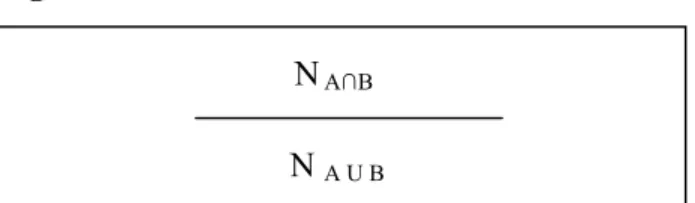
resource R, the ratio of the number of set elements shared by the existing set of subject
metadata(Set A) and the newly generated set of subject metadata(Set B) to the total
number of set elements of the union of Set A and Set B. This is can be represented as
Figure 7.
Figure 7: Semantic Evaluation Score for R
N A∩B
NA U B
There are possibly four cases that may take place in this step:
Case 1: The Intersection of Set A and Set B will be an empty set, denoted by A∩B = Ø,
which is shown in Figure 8. For this case, it means there are no overlapping subject
metadata terms shared by both sets. Thus, the Semantic Evaluation Score of this web
resource is 0.
Figure 8: Case 1
Case 2: There is a overlapping part between Set A and Set B shown in Figure 9. For this
case, it means there is certain number of subject metadata terms shared by both sets.
Figure 9: Case 2
A B
A B
Case 3: The Intersection of Set A and Set B is Set A, denoted by A∩B = A, which is
shown in Figure 10. For this case, it means the set of newly assigned subject metadata
includes all the members of the subject metadata set previously assigned to the resource.
Mostly, it is due to content addition.
Figure 10: Case 3
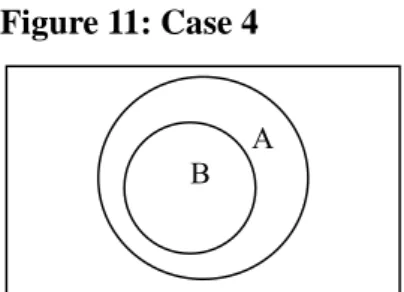
Case 4: The Intersection of Set A and Set B is Set B, denoted by A∩B = B. which is
shown in Figure 11. For this case, it means the set of previously assigned subject
metadata includes all the members of the subject metadata set newly assigned to the
resource. Mostly, it is due to content removal.
Figure 11: Case 4
The following example is to illustrate how Semantic Evaluation Score Calculation works
in practice.
Case 1: Set A = {Topic A, Topic B},
Set B = {Topic C, Topic D}
N A∩B = 0 and N A U B= 4 A
Score = 0 = 0%
Case 2: Set A = {Topic A, Topic B, Topic C},
Set B = {Topic B, Topic C, Topic D, Topic E}
N A∩B = 2 and N A U B= 5
Score = 2 / 5 = 40%
Case 3: Set A = {Topic B}
Set B = {Topic A, Topic B}
N A∩B = 1 and N A U B= 2
Score = 1 / 2 = 50%
Case 4: Set A = {Topic A, Topic B, Topic C, Topic D}
Set B = {Topic A, Topic B}
N A∩B = 2 and N A U B= 4
Score = 1 / 2 = 50%
4.2.3 Final Evaluation Score
As the last step where the need of further human evaluation will be decided on,
the Empirical Evaluation and Semantic Evaluation Scores are combined to produce the
Final Evaluation Score. The formula shown in Figure 12 will be used for this calculation.
Figure 12: Final Evaluation Score Calculation
Empirical Evaluation Score in percentage + Semantic Evaluation Score in Percentage
For example, if a web resource gets an Empirical Evaluation Score of 60% and a
Semantic Evaluation Score in of 80%, its final score will be (60% + 80%) / 200% =
0.7(70%). Finally, a threshold value will be determined by users who are adopting this
framework, one potential method is to use average final score of all the web resources
with detected changes. This value will be taken as a cut-off point and catalogers will need
to manually review those web resources have the scores lower than this cut-off point.
5. Future Research
Some aspects of the study can be furthered in the future. The proposed application
model for semi-automatic metadata maintenance is still at its conceptual level. It will be
necessary and helpful to build a working version so that more testing and data analysis of
its efficiency and accuracy can be conducted. The study of web changes still presents a
great space for researchers; for instance, how to distinguish presentational changes from
substantial changes is still an important issue. Specifically for websites providing health
information that are constantly subject to the content changes, researches of how to make
correct judgment on the substantiality of changes will be extremely valuable. Moreover,
in this study, there are three matching rules are proposed are they are treated equally,
which may be considered as a limitation at some point; because, the nature of different
rules may actually affect the accuracy level of subject metadata assignment. Thus,
score calculation methods discussed in this paper is still subject to adjustments. Users
who would like to adopt this approach may add some other measures or adjust how these
score are produced based on their own needs and acceptance level so that they can more
accurately and realistically determine the need of human effort for metadata quality
evaluation. Furthermore, for the same purpose of developing semi-automatic approaches,
instead of working at data or element level, usability studies from an interface design
angle can also be potentially implemented to the current cataloging system so that visual
enhancements with the functionalities such as keyword highlighting may be added to the
existing system to ease the human work.
6. Conclusion
There is no doubt that more and more people have been using Internet to seek for
health-related information. And this is one of the important reasons of the birth and
development of NC Health Info (NCHI) site. Ensuring high content quality and building
the firm trust are deemed to be the key to the success of consumer health website, such as
NCHI. However, the rapid growth of the Internet and high frequency of web content
changes have presented a great challenge to the catalogers at NCHI in generating and
maintaining the metadata records of web resources archived in the database. They are
required to properly update and assign relevant health subjects to the resources in a
timely manner so that users can always easily find the latest health information they are
by NCHI catalogers is considered to be high labor-cost and time consuming. This study is
to inject the computational power to metadata quality evaluation as part of the metadata
generation and maintenance process.
Based on the case study of NCHI web site, it has been confirmed that among all
the fields used to describe a particular health-related web resource, the one representing
the health topics which are considered as subject metadata records constitutes the most
changes over the study period, and therefore, requires the most maintenance effort.
Therefore, a semi-automatic approach is proposed from a metadata quality evaluation
angle, which is essentially a conceptual model of an application performing metadata
quality examination at empirical and semantic levels. The output of this model is an
evaluation score assigned to each web resource that is to be compared to a threshold. The
catalogers will only need to review the web resources that are scored lower than the
threshold. Although at conceptual level, this application is expected to be able to reduce
the amount of subjectivity, inconsistency and time consuming involved in the human
metadata generation and maintenance process while ensuring high quality of the metadata
7. Bibliography
Bendict, C. (2000, December 11). E-health: Act 2. Los Angeles Times.
Bruce, T. R. & Hillmann, D. I. (2004). The continuum of metadata quality: Defining, expressing, exploiting. In D. I. Hillmann & E. L. Westbrooks (Eds.) Metadata in Practice (pp.238 - 256). Chicago, IL: American Library Association.
Bang, D.L., Farrar S., Sellers, J. W., & Buchanan, D. H. (1997). Consumer Health Information Services: Preliminary Findings About Who Is Using Them. Journal of
Medical Systems, 22(2), pp. 103-115.
Chin, T. (2002, June 17). Patients Put Trust in Internet Health Information. American Medical News.
Cline, R. J. W., & Haynes, K. M. (2001). Consumer Health Information Seeking on t he Internet: The State of the Art. Health Education Research, 2001 December, 16(6), pp. 671-92.
Douglis, F., Ball, T., Chen, Y., & Koutsofio, E. (1998). The AT&T Internet Difference Engine: Tracking and Viewing Changes on the Web. World Wide Web, 1(1), pp. 27 -44.
Douglis, F., Feldmann, A., Krishnamurthy, B. & Mogul, J. (1997). Rate of change and other metrics: A live study of the World Wide Web. USENIX Symposium on Internet
Technologies and Systems, pp.147-158.
Flesca, S., & Masciari, E. (2002). Efficient and effective Web Change Detection. Data & Knowledge Engineering. August, 2003, 46(2), pp. 203 – 224.
Fox, S. (2006). Report on Online Health Search 2006. PEW Internet and American Life Project. October 29, 2006. Website:http://www.pewinternet.org/PPF/r190/re
port_display.asp
Digital Libraries. June 24-26, 2001, Roanoke, Virginia.
Golub, K. (2003). Using Controlled Vocabularies in Automated Subject Classification of Textual Web Pages, in the Context of Browsing. Bulletin of the IEEE Technical
Committee on Digital Libraries, 2(2). Retrieved October 29, 2005, from
http://www.ieee-tcdl.org/Bulletin/v2n2/golub.golub.html
Greenberg, J., Spurgin, K. & Crystal, A. (2006) Functionalities for automatic Metadata Generation Applications: A Survey of Metadata Experts’ Opinions. International
Journal of Metadata, Semantic and Ontologies, 1(1): pp. 3-20
Greenberg, J. (2004) Metadata Extraction and Harvesting: A Comparison of Two Automatic Metadata Generation Applications. Journal of Internet Cataloging, 6(4): 59
-82
Greenberg, J. (2005). Metadata Quality: A Hierarchy of Criteria. In the Proceedings of the American Society for Information Science and Technology, Charlotte, North Carolina, October 28-November 2, 2005, 42(1).
Koehler, W. (2002).Web Page Change and Persistence – A Four-Year Longitudinal Study. Journal of the American Society for Information Science and Technology. January, 2002, 53 (2), pp. 162 - 171 .
Liddy, E. D., Allen, E., Harwell, S., Corieri, S., Yilmazel, O., Diekema, A., et al. (2002). Automatic Metadata Generation & Evaluation. In Proceedings of the 25th Annual International ACM SIGIR Conference on Research and Development in Information Retrieval.
Luo, W. H., &Najdawi, M.(2004). Trust-building Measures: A Review of Consumer Health Portals. Communications of the ACM. January, 2004, 47(1), pp.: 108 – 113.
Miller N., Lacroix, E., & Backus, J. E. B. (2000) MEDLINEplus: building and
maintaining the National Library of Medicine's consumer health Web service. Bull Med Libr Assoc. January, 2000, 88(1), pp.11–17.
Paynter, G. W. (2005). Developing practical automatic metadata assignment and evaluation tools for internet resources. InProceedings of the 5th ACM/IEEE-CS joint conference on Digital libraries.
Understanding Metadata. (2004). Bethesda, MD: NISO Press:
Yang, H. C., &Lee, C. H. (2005) Automatic Metadata Generation for Web Pages Using a Text Mining Approach. In Proceedings of the 2005 International Workshop on Challenges in Web Information Retrieval and Integration (WIRI’05).
Yeh, P.J., Li, J.T., &Yuan, S.M.. (2001). Tracking the Changes of Dynamic Web Pages in the Existence of URL Rewriting. In Proceedings of the Fifth Australasian Conference