Advisor: Jane Greenberg
This paper presents research and development work for the Dryad metadata application profile. Dryad is a digital repository for datasets underlying published works in
evolutionary biology and related fields. The paper details the phased implementation of the repository and the corresponding modular application profile. The paper reviews the application profile methodology, reviews each element description, and describes how the schema supports the unique functionalities of each phase of Dryad. The approach presents a method for bringing the Level One application profile, which is currently being tested for Phase One of Dryad, into conformance with the Dublin Core Singapore
Framework. The benefits of compliance with the Singapore Framework include maximum interoperability and long-term quality control of the schema. In addition, conformance will allow for the Dryad application profile to be utilized by other initiatives. Finally, this paper proposes a Level Two Dryad application profile and a means of implementation.
Headings:
Application profile Metadata
Dublin Core
by
Sarah W. Carrier
A Master’s paper submitted to the faculty of the School of Information and Library Science of the University of North Carolina at Chapel Hill
in partial fulfillment of the requirements for the degree of Master of Science in
InformationScience.
Chapel Hill, North Carolina April 2008
Approved by
Chapter 1: Introduction………1
Chapter 2: Literature Review……….……..4
Chapter 3: Project Background………..10
Chapter 4: The Singapore Framework………...19
Chapter 5: Methods for the Singapore Framework………21
Chapter 6: Level Two Application Profile……….26
Chapter 7: Next Steps………28
Chapter 8: Summary and Conclusions………...30
Chapter 9: Bibliography……….31
Appendix A: The Dryad Level One Application Profile………...34
Appendix B: Singapore Framework Components – Level One Application Profile…….48
Chapter 1: Introduction
Since October 2006, the Metadata Research Center (MRC)1 at the School of Information and Library Science (SILS)2, UNC Chapel Hill and the National
Evolutionary Synthesis Center (NESCent)3 have been collaborating to develop a digital data repository that will host datasets underlying published research in evolutionary biology and related fields. The repository, called Dryad4, is intended to fulfill a research and scholarly communication service to the evolutionary biology community by
providing a centralized means of data storage and access. Dryad will closely link
publications and the underlying data with a focus on “data-centric” services that would be useful to the life science community. Specifically, the system will facilitate scholarly research and collaboration through sophisticated data retrieval, reuse, and manipulation.
During the earliest stages of repository planning, the Dryad development team established the functional requirements of the system (Dube, Carrier, & Greenberg, 2007). A chief component of the functional requirements focused on the role of metadata and how the metadata architecture would be structured in order to function within the larger system. As part of this work, the MRC developed an application profile of metadata elements necessary to fully describe evolutionary biology datasets with a
1
http://ils.unc.edu/mrc/
2 http://sils.unc.edu/ 3
http://www.nescent.org/index.php
4
consideration for preservation and retrieval. Application profiles, as defined by Heery and Patel, are “schemas which consist of data elements drawn from one or more namespaces, combined together by implementers, and optimized for a particular local application” (2000).
In order to ensure the maximum interoperability of the repository with other information systems, the Dublin Core5 metadata standard was selected as the foundation scheme for the Dryad application profile. However, the unique “data-centric,” domain-specific model of Dryad required the development team to incorporate other established metadata standards used by science communities, with particular attention to standards adopted by the life sciences. In addition, the close pairing of data objects with published documents required that the team consider namespaces that support the preservation of heterogeneous objects and those that facilitate digital publishing. Therefore, the namespaces considered by the team included PREservation Metadata Implementation Strategies (PREMIS)6, Data Documentation Initiative (DDI)7, Ecological Metadata Language (EML)8, and Darwin Core9.
The Dryad repository is being implemented in a phased fashion, with Phase One focusing on the capture, preservation, and simple retrieval of data objects, in addition to any article metadata with which they are associated. The Level One application profile represents the Phase One functionalities of Dryad. Metadata elements chosen for the Level One application profile support basic preservation, retrieval and reuse. Phase Two
5
http://dublincore.org/
6
http://www.loc.gov/standards/premis/
7
http://www.icpsr.umich.edu/DDI/
8 http://knb.ecoinformatics.org/software/eml/ 9
implementation will be initiated after proven success with Phase One. The functionality of this phase will include advanced preservation and retrieval, version representation and tracking, data manipulation and synthesis, and will focus greater attention on data life cycle management.
Dryad is currently in Phase One, and the development team is in the process of evaluating the Level One metadata structure. As we assess our Level One metadata structure, we are also conducting observations and planning for the development of Dryad’s Level Two metadata structures, which will be expressed through an application profile that builds upon the first manifestation. As part of our metadata development plan, we will also bring the Level One application profile into conformance with the recently published Dublin Core Singapore Framework. This step will ensure the maximum interoperability and long-term quality control of the schema, and allow our application profile to be utilized by other initiatives.
Chapter 2: Literature Review
The metadata standards community has published numerous guidelines describing the design and development of an application profile. In addition, existing literature points to the numerous purposes and functions of application profiles. Application profiles have been developed by many initiatives, and reports and descriptions of these projects have influenced the development of the Dryad schema. Literature in these areas has informed the work presented in this research and will be described in the following two sections.
2.1. The Application Profile
The concept of an “application profile” emerged from a need to expand Dublin Core to accommodate domain- or community-specific semantics (Baker, Dekkers,
Fischer, & Heery, 2005). As stated above, an application profile combines elements from existing namespaces in order to accommodate a purpose that is not sufficiently met by one metadata schema. Makx Dekkers details the requirements of an application profile as initially described by Thomas Baker (2001):
• A definition of entity classes described by the application profile and an identification of the functions that the schema is intended to support.
• A declaration of what elements are included in the schema and details about their semantics, rules for their usage, and allowable value data types.
• Details about which controlled vocabularies would be used to restrict the allowable values for particular fields.
Application profiles serve numerous purposes for domain-specific collections. Such purposes, with particular importance to Dryad, include (Baker, Dekkers, Fischer, & Heery, 2005):
• Helping communities to harmonize metadata practices.
• Identifying domain-specific terminologies as candidates for formal standardization.
• Assisting in the guiding of semantic mappings and format conversions.
The Dublin Core community has developed standards for the development and documentation of application profiles. For example, the Dublin Core Application Profile (DCAP) Guidelines encourage interoperability based on Dublin Core and harmonization of usage and convergence (Baker, Dekkers, Fischer, & Heery, 2005). The DCAP provides guidelines for the structure and content of Dublin Core-based application profiles such as Dryad’s. Included in the guidelines are instructions about identifying terms with appropriate precision, specifically through the citation of a Uniform Resource Identifier (URI), if available. Descriptions of term usage attributes are also required by the guidelines and include the identification of the term, definitional attributes, relational attributes, and any constraints on term usage. Constraints on term usage would include information about whether the term is required and the repeatability of the element (Baker, Dekkers, Fischer, & Heery, 2005). The DCAP guidelines stress the importance of human-readable descriptions, and therefore expressing schemas as text documents is emphasized. However, the guidelines do give recommendations for expressing
application profiles in RDF and XML.
Application profiles should be based on the DCMI Abstract Model in order to be fully machine-processable (Nilsson, Miles, Johnston, & Enoksson, 2007). The DCMI Abstract Model describes the components of the Dublin Core schema and provides a structure for how they are related and combined. For the purposes of this research, the DCMI
Description Set Model component of the Abstract Model is of particular interest. The Description Set Model specifies how information about resources is represented through Dublin Core. Each description within the set refers to a specific resource. Examples of a resource are anything that can be identified, which would include, for example, a
document or an image. Statements about the resource include a URI for identification purposes and a value surrogate, which can either be literal or non-literal (Powell, Nilsson, Naeve, Johnston, 2007; Nilsson, Miles, Johnston, & Enoksson, 2007).
statements and reports regarding the significance of metadata’s role in enhancing interoperability have been issued as a result of task forces, workshops, and research studies from multiple domains (e.g., Hunter & Lagoze, 2001; Chan & Zeng, 2006; Joint Task Force on Library Support for E-Science, 2007; National Science Board, 2005; Borgman, 2007).
The publication of application profiles, which provide a structure in which domain-specific metadata schemas can be developed, assist in serving community needs and guarantee interoperability. In summary, De Roure and Hendler state:
Achieving interoperable infrastructure requires the development of common vocabularies and metadata frameworks as the basis for description, discovery, and integration of the services, together with the use of domain-specific knowledge for problem solving in order to compose services (2004).
2.2. Related Work
Application profiles have been used in numerous initiatives with success, and the lessons learned in those endeavors have implications for the Dryad project, although many are “document-centric” rather than “data-centric.” The Joint Information Systems Committee (JISC)10, UKOLN11, and the Eduserv Foundation12 developed an application for eprints (also known as “preprints” or scholarly works) (Allinson, Johnston, & Powell, 2007). The Eprints application profile employs the DCMI Abstract Model notion of “description sets” where object metadata is represented in complex sets of entities. The approach taken in this project is to represent five entities: ScholarlyWork, Expression, Manifestation, Copy, and Agent. The concept of the five entities is drawn from the
10 http://www.jisc.ac.uk/ 11
http://www.ukoln.ac.uk/
12
Functional Requirements for Bibliographic Records (FRBR) (IFLA Study Group on the Functional Requirements for Bibliographic Records, 1998). The Eprints application profile, therefore, represents the original scholarly work itself, any versions of the work (reprints, copies, etc.), and the different actors (people, institutions, etc.) that are involved with the various versions (Allinson, Johnston, & Powell, 2007). The Eprints application profile, like Dryad’s, is based on Dublin Core, but incorporates some community-specific elements outside the scope of Dublin Core that are necessary for the full functionality of the schema.
A similar example is the DiVA project application profile that is intended to describe digital academic documents (Müller, Klosa, Andersson, & Hansson, 2003). The inspiration for the DiVA application profile stemmed from a need to properly represent the granularity in document description, the need to state relationships and hierarchies, and to facilitate flexibility of format. DiVA was also derived from FRBR and
incorporates the concept of “manifestation.”
There are two additional examples of application profiles based on Dublin core that are relevant to the Dryad project. The first is the Government Application Profile (Cumming, Aargaard, Dekkers, Murphy, & Borras, 2001). The Government Application Profile is intended to clarify the use of Dublin Core in the government context. The second relevant project from the government domain is the UK e-government metadata standard application profile (Powell, 2000). The intention of this application profile is to facilitate the development of UK e-government portals.
being linked with published articles in the field of chemistry (Lyon, 2003). The eCrystals Open Repository utilizes the eBank schema (Lyon & Cole, 2008). The eCrystals
repository will support a federation of data repositories for crystallography. It functions much like Dryad in that eCrystals makes available raw, derived, and results data.
Chapter 3: Project Background
During the first stage of the project, the Dryad development team established the functional requirements, followed by the development of an application profile of metadata elements necessary to fully describe evolutionary biology datasets. The team sketched out a series of typical scenarios of use in order to detail the functional
requirements (Dube, Carrier, & Greenberg, 2007). Two examples of typical scenarios that would be facilitated by the metadata structure are:
• A user depositing a dataset as a requirement for publication.
• A user searching for datasets that are applicable to their own research. This user could search by author, dataset description, species name, etc.
After consulting with Dryad team members and stakeholders in the project, the current Phase One Dryad workflow can be described as follows, with metadata being created in the third step:
Figure 1: The Dryad Workflow
concluded that the requirements had to support the following key aspects of Dryad's functioning:
• Heterogeneous digital datasets • Long-term data stewardship
• Tools and services available to repository users • Incentives for use
• Reduced barriers for use, specifically reduced technical barriers • Authors’ intellectual property rights
• Datasets underlying published material
Another important consideration in developing the functional requirements was to identify the object types and data types that would be hosted by Dryad, including
information about the life cycle of these object and data types (Carrier, Dube, & Greenberg, 2007). Consideration of these issues was also essential to the decisions informing the development of the application profile. The object types that would be included in Dryad include:
• Publication (e.g., journal article, conference paper) • Published piece of data in the publication (e.g. a table) • Dataset behind the published data (e.g. supplemental data)
• Initial data source (e.g., American Ornithologists’ Union checklist) • Newly created data (e.g., data derived from any of above)
The data types that would be supported by Dryad include:
• Structured labeled data (e.g., tabular data with column and row headings)
• Structured unlabeled data (e.g., tabular data without column and row headings, or with undecipherable headings)
• Unstructured textual data (e.g., readable text)
• Unstructured non-textual data (e.g., maps, graphs, images)
Therefore, the long-term functional requirements for Dryad are as follows: • Computer-aided metadata generation and augmentation.
• Specialized modules linking data submission and published material. • Data and metadata quality control by integrating human and automatic
techniques.
• Support for basic metadata repository functions, such as resource discovery, sharing, and interoperability.
After developing the above functional requirements, the team determined that the ideal implementation for Dryad would take a phased approach. Based in part on
feedback given at a workshop that took place in December 2006, the user community established that the ideal implementation would involve an archival space being set up as soon as possible. This initial archival space would provide basic services and offer basic functionalities in order to address the data deluge taking place in the field of evolutionary biology. The workshop attendees determined that the second priority would be to
incorporate more sophisticated functionalities after the archival space was in operation13. This determination affected the design of what became the “Level One”
application profile. The repository development team concluded that the Level One application profile represents the Phase One functionalities of Dryad. Metadata elements chosen for the application profile provide basic preservation, retrieval and reuse. In addition, the team established that the linkages between publications and underlying data objects would best be represented in a modular fashion, with a “Publication” module that is related to the “DataObject” module. Therefore, the two entities supported by the Level One application profile are Publication and DataObject.
The Dryad team employed a multi-method approach to develop the application profile. In approaching the process, the team utilized the steps detailed by Makx Dekkers (2001):
1. Define metadata requirements.
2. Select most appropriate existing standard metadata element set.
13
3. Where possible, use standard elements for locally required elements, possibly narrowing semantics and adding local rules and vocabularies.
4. Define remaining elements in private namespace.
In addition, the methods used by the team included a requirements assessment, content analysis, and crosswalk analysis (Carrier, Dube, & Greenberg, 2007). The requirements assessment is described above and included an incorporation of typical use case
scenarios, functional requirements, and stakeholder interests.
The next step in the process was content analysis as defined by Krippendorff (2004). The team first examined various metadata schemas and employed the content analysis methodology to identify relevant elements. For each schema being analyzed, the following questions were asked:
• Which schema is being analyzed and what elements are included? • How is the schema defined?
• What are the recommended, mandatory, and optional elements?
• In what context was the schema designed, and how is it currently applied within the community for which it was developed?
• How does the context relate specifically to Dryad?
The results of the content analysis for the Level One Dryad application profile will be detailed in the next sections.
A Dublin Core-based application profile was chosen in order to assure full interoperability and compatibility with other systems. In addition, Dublin Core is an accepted standard within the metadata community, with enough flexibility to adapt to Dryad's needs. However, the objects stored in Dryad will be heterogeneous in nature, with only a fraction of the data in text form. Therefore, the metadata team decided to examine other namespaces designed for the sciences, the social sciences, and,
For each namespace the Dryad team considered required and recommended elements. The first step in the process was to look at the Dublin Core14,15 standard and identify elements that are particularly applicable for a Phase One application. We sought to also include two well-known namespaces from the social science and science
communities: the Data Documentation Initiative (DDI) for social science metadata and the Ecological Metadata Language (EML) for ecology and environmental research. Particular attention was given to elements that gave more detail to the description of the data object not accomplished by the Dublin Core. In addition, the PREservation
Metadata Implementation Strategies (PREMIS) schema was considered by the team in order to ensure long-term data object preservation support. Finally, the Darwin Core schema, which is designed for metadata about collection specimens and the geographic occurrence of species, was included in the content analysis.
DDI 3.0 is scheduled for release in April 2008, although this new version will not supersede the previous Version 2.1. The DDI schema has five main sections with
varying granularity of description: 1. Document Description 2. Study Description 3. Files Description
4. Data (Variables) Description 5. Other Related Materials
The Dryad application profile team decided that all levels from the DDI could be considered appropriate for inclusion in the Dryad schemas, both Level One and Level Two.
14
http://dublincore.org/documents/dces/
15
EML Version 2.0.1 is a metadata schema developed for the field of ecology and is utilized by the Knowledge Network for Biocomplexity (KNB)16. The schema is of particular relevance to Dryad not only due to the domain-specificity, but also because EML is intended for the description of digital resources. EML elements are organized into hierarchical modules at various levels of granularity. The team was particularly interested in the “eml-dataset module” for dataset-specific information and the data organization modules that describe the structures of datasets. Another module that is of interest to the Dryad team is the “eml-software module,” which describes offers great detail about the software used to generate a dataset, therefore ensuring that the data can not only be viewed, but that it can be processed and reused.
The PREMIS metadata model ensures the preservation of digital objects and was also considered for the Dryad application profile. The team found that PREMIS focuses mainly on specific technical metadata rather than descriptive metadata, agents, rights, or media/hardware details (PREMIS Working Group, 2005). Therefore, we reasoned that it was best to take advantage of the full scope of the PREMIS technical metadata elements in later levels of the application profile, and concentrate on mapping descriptive metadata for Level One of the application profile. We did, however, decide to include the element “fixity,” which is a hidden value that tracks whether unauthorized changes have been made to the content.
Darwin Core is a known metadata standard within the evolutionary biology community. DwC 1.4 is currently a draft version under discussion, and the Dryad team considered elements from DwC 1.2 and 1.21. Of particular interest were elements
16
describing the collection specimens, with the determination that any geographical information about the specimen could be accomplished with Dublin Core “coverage.” Elements from the Darwin Core schema are considered for both the Level One and Two application profiles.
After the completion of the content analysis, the final step in developing the Level One application profile was a crosswalk analysis. The crosswalk between the schemas enabled the team to compare and contrast the various namespaces and took the form of a spreadsheet. Included in the crosswalk were the element name and prefix, the element definition, and examples of use. Semantic overlaps in the crosswalk were “normalized” by the group. Since the DDI is partially derived from Dublin Core, equivalent elements were simple to identify. Similarly, the top-level structure of EML has been designed to be compatible with the Dublin Core syntax. The crosswalk informed the group as to which namespaces and elements supplemented the central Dublin Core elements. For example, we saw that it would be most appropriate to include the Darwin Core element “Species” to fill in a gap where other, more general namespaces could not offer an appropriate substitute. As a result of the crosswalk approach, the team decided to choose Dublin Core elements unless another namespace filled an obvious void. Where a
namespace’s element mapped directly to Dublin Core, the Dublin Core element was chosen.
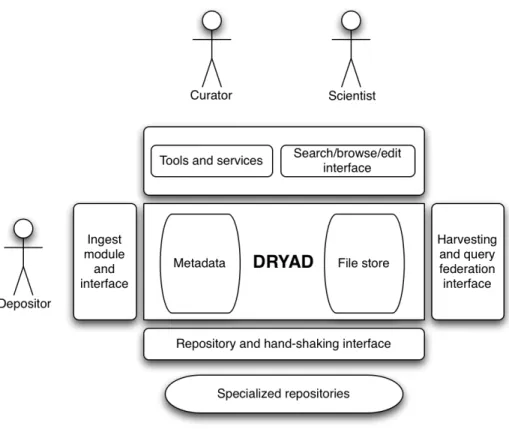
Figure 2: The Dryad System Architecture
articles provide valuable recommendations for the structure and design of the Level One application profile.
According the DCAP guidelines, the Dryad application profile was described in a table format, with each element described with sufficient detail to provide for human understandability (Baker, Dekkers, Fischer, & Heery, 2005). This step ensures that the application profile is text-based, human-readable, and conforms to Dublin Core
Chapter 4: The Singapore Framework
The Singapore Framework was presented at the International Conference on Dublin Core and Metadata Applications in Singapore, September 2007 (Apps, 2007; Nilsson, Baker, & Johnston, 2008). In order to ensure the interoperability of Dublin Core application profiles, the Singapore Framework was developed as a standard for machine-understandable representations of metadata schemas (Nilsson, Baker, & Johnston, 2008). Description Set Profiles (DSPs) are the key aspect of the framework. Through an XML-based DSP, the structure of the application profile is represented in an interoperable, machine-readable format. Utilization of the DSP ensures the quality and long-term reusability of the schema (Nilsson, Miles, Johnston, & Enoksson, 2007).
This Master’s paper research presents work undertaken to make the Dryad application profile compliant with the Singapore Framework. A driving motivation behind bringing the Level One project application profile into conformance with the Singapore Framework revolves around the concept of interoperability. The issue of interoperability is particularly important to Dryad as the system reaches its full
functionality, which would include search, retrieval, “hand-shaking” with other repositories, exposing metadata for harvesting purposes, and web services.
As described in The Singapore Framework for Application Profiles, the document package for a Dublin Core Application Profile (DCAP) contains five components
• Functional requirements, which describe the functions that an application profile is intended to support, plus functions that are not within the project's scope. Mandatory.
• Domain model, which defines the basic entities described by the application profile and their relationships and defines a basic scope. Mandatory.
• Description Set Profile (DSP), which defines a set of metadata records that are valid instances of an application profile. Mandatory.
• Usage guidelines, which describe how to apply the application profile. Optional. • Encoding syntax guidelines, which describe any application profile-specific
syntaxes and/or guidelines. Optional.
Specifically, the DSP is an information model and XML expression of an application profile. A DSP is based on the DCMI Abstract Model, specifically the Description Set Model, and functions in the following ways (Nilsson, 2007):
• As a formal representation of the constraints of a DCAP. • As a configuration for databases.
• As configuration for metadata editing tools.
There are two levels of templates in a DSP and reference the structure of the DCMI Abstract Model Description Set: a Description template and a Statement template. The Description template contains the Statement templates and refers to a particular
Chapter 5: Methods for the Singapore Framework
This section will provide an overview of the methods utilized to bring the Dryad Level One application profile into conformance with the Singapore Framework. First, issues specific to the Dryad application profile will be reviewed and second, the approach for revising the application profile to comply with the Singapore Framework will be detailed. Some of the challenges involved with this procedure are also described.
5.1. Dryad Level One Application Profile Overview
Two unique aspects of the Dryad Level One application profile inform the formalization of the schema according to the Singapore Framework. Of particular importance is the module structure of the Dryad application profile, which contains a publication module and a data module. Second, it is important to note that the Level One functionalities of Dryad in Phase One implementation only include the simplest
relationships between articles and the underlying data. This relationship can be described as a “one to many” relationship between publication and dataset, with many data objects associated with one publication. Versions of publications and versions of datasets are not accommodated in Level One, and therefore will not be represented in the Description Set Profile. In comparison, the Eprints DSP, which is currently the only example of a fully formed DSP, includes five modules or entities: Scholarly Work, Expression,
application profile; however, similar functionality will be accommodated in the Level Two application profile.
It is also of importance to reemphasize that Dryad is “data-centric” in focus, and that the storage and retrieval of a published article is not the focal point of the functioning of the repository. Therefore, the scope of the Level One application profile and its
representation is more focused on how the published article relates to the data object, insofar as providing context for the hosted dataset.
5.2. Singapore Framework Procedures
As described above, the Singapore Framework has five components: • Functional requirements
• Domain model
• Description Set Profile (DSP) • Usage guidelines
• Encoding syntax guidelines
The scope of this research includes implementation of all of the components, excluding the optional “encoding syntax guidelines,” which do not apply to the Dryad application profile. The encoding syntax guidelines would apply to an application profile that has schema-specific encoding rules.
the formal declaration of the Dryad functional requirements according to the Singapore Framework guidelines.
The second step was to define the domain model. The domain model defines the basic entities described in the application profile (Nilsson, Miles, Johnston, & Enoksson, 2007). Relationships between the entities are also described. In the case of the Level One application profile for Dryad, there are two entities: the Publication and the
DataObject. The relationship between the Publication entity and the DataObject can be described as “isSupplementedBy.” In Level One, many DataObjects can supplement a Publication. Not until Level Two will reuse be tracked in a way that there are multiple publications associated with one DataObject.
In the context of the domain model, the Eprints project domain model example is not directly applicable for the Level One application profile. As stated, the Phase One functionality of Dryad will not represent manifestations or versions of the data objects and the associated published articles. In addition, the Eprints model is document-centric as it is based on the Functional Requirements for Bibliographic Records (FRBR). Due the unique linking of publications and datasets, the roles of the entities described by the application profile become more complicated, and also, therefore, the representations of those relationships:
Creating metadata for electronic “documents,” such as prepublications,
Please see Appendix B.2. for a representation of the Dryad domain model in UML format.
The third step in the process was to represent the application profile as a
Description Set Profile (DSP). As mentioned above, the DSP defines a set of metadata records that are valid instances of an application profile (Nilsson, Miles, Johnston, & Enoksson, 2007; Nilsson, 2007). The Dryad DSP XML file was successfully validated using the World Wide Web Consortium XML validation service17. The entire Dryad Level One application profile DSP can be viewed in Appendix B.3.
A Description Set Profile does not, however, address human-readable
documentation, definition of vocabularies, or version control (Nilsson, 2007; Enoksson, 2007). Therefore, a supplemental step involved the parsing of the DSP into a human-readable format for viewing online. A specialized Wiki-syntax for the Description Set Profile was developed by the developers of the Singapore Framework to parse the XML into a readable format. The syntax was developed specifically for the MoinMoin Wiki engine18 and is accomplished through a parser extension. An example of the output is available and uses the Eprints application profile as a model19. In addition to the Wiki-syntax developed by Enoksson and others (Enoksson, 2007; Nilsson, Miles, Johnston, Enokkson, 2007), an XSLT can be used to accomplish the parsing for display online. At the time of writing, the tool for generating Wikis is not yet installed for general use, and
17
http://www.w3.org/2001/03/webdata/xsv?docAddrs=http%3A%2F%2Fwww.ils.unc.edu %2F%7Escarrier%2Fdryad%2FDSPLevelOneAppProf.xml&warnings=on&style=xsl# 18
http://moinmo.in/
19
therefore the human-readable version of the Dryad DSP is available online and is displayed using an XSLT20.
The fourth step of the Singapore Framework was to formalize the application profile usage guidelines. The Dryad development team has defined the usage guidelines for both the Level One application profile and the Phase One of Dryad at the following URL:
https://www.nescent.org/wg_digitaldata/Public:Dryad_Level_One_Cataloging_Guideline s. The length of the guidelines precludes inclusion in this paper, and therefore, the
content has been added to the Dryad project Wiki space for public viewing.
The final step of the Singapore Framework was to consider whether to include the optional encoding syntax guidelines. These guidelines define application profile-specific encoding and are not applicable in the Level One Dryad application profile.
In addition to the usage guidelines and the DSP that are available online,
information for each component of the Dryad application profile has been organized into a project Wiki page for viewing21.
20
http://www.ils.unc.edu/~scarrier/dryad/DSPLevelOneAppProf.xml
Chapter 6: Level Two Application Profile
As stated above, the Level One Dryad application profile includes what the Dryad team determined to be the minimum of requirements for deposition and is designed to collect basic metadata about the data object for the purposes of ingestion, archiving and access. This level, which is being implemented as Phase One of the Dryad repository, supports discovery, preservation, and encourages data use and understanding. In addition, the Level One application profile reflects the simplest relationships between data objects and the publication with which they are associated.
The Level Two application profile, which is under development, will include metadata that support more advanced functionalities such as sophisticated use/reuse, manipulation and synthesis. In addition, the Level Two application profile will support version tracking and more advanced data life cycle management. The Level Two
application profile therefore reflects the requirements of the Phase Two Dryad repository as envisioned by the development team. Specific elements would support the following services for data objects in Dryad:
• Expanded metadata about preservation • Enhanced granularity of data description
• More information about methodology and workflow
• More about known linkages (to publications, to other datasets, etc.) • Tracking of use and reuse
• Provenance information
As part of this research, I propose a Level Two application profile for Phase Two of Dryad. The same methods and procedures as undertaken for the Level One application profile development were employed for the Level Two application profile. The Level Two application profile builds upon the functionalities of the Level One schema. The same namespaces were consulted in order to accomplish the needs of the Phase Two Dryad repository.
In addition to the namespaces already described, the MicroArray Gene Expression Markup Language (MAGE-ML)22 has been consulted in order to increase the granularity of description options for data objects. MAGE-ML describes and communicates
information about experiments based on DNA microarrays. Appendix C. includes a description of terms composing the proposed Level Two Dryad application profile.
22
Chapter 7: Next Steps
The next steps involved with the Level One application profile implementation include continued testing and validation of the existing schema by the Dryad team. Phase One Dryad will be officially released to the public in the coming months, after which we will be seeking feedback from users regarding the deposition process, and be able to further examine the use and effectiveness of the Level One application profile and our overall metadata architecture.
Further steps include community acceptance, “hand-shaking” with other
repositories, and full exposure of metadata to web services and metadata harvesters. The development team expects that the application profile in the Singapore Framework format will play a large role in this transition. Community acceptance will be furthered through the documentation of the development process and the web publication of the application profile based on the Singapore Framework. Once the mechanism is in place, another important step will be to convert the Level One DSP into the specialized Wiki-syntax for display online. The model for Description Set Profiles and the Singapore Framework itself is still evolving, and as the model advances, so will the Dryad application profile. Therefore, the Dryad schema is viewed as an ongoing, developing structure.
Next steps for the Level Two application profile involve: 1. Implementation
4. Reevaluation
The implementation of the Level Two schema will involve supplementing the current Level One application profile with the additional metadata elements. After successful completion of the listed next steps, the Level Two application profile will also be brought into conformance with the Singapore Framework.
Chapter 8: Summary and Conclusions
This research described the development and implementation of the Level One Dryad application profile, which is currently in testing phase. In addition, this paper described the approach undertaken to bring the Level One application profile into conformance with the Singapore Framework. Finally, this research examined and proposed the Level Two Dryad application profile.
The research described in this paper will assist the Dryad project to move forward into the next phase of implementation. With Level One progress underway, a definition of the Level Two schema will move the repository into Phase Two. In addition, the public documentation and publishing of the Level One application profile will raise the profile of the project and increase community awareness and acceptance.
The work presented in this paper can assist other initiatives in developing
Chapter 9: Bibliography
Allinson, J., Johnston, P., & Powell, A. (2007). A Dublin Core Application Profile for Scholarly Works. Ariadne, 50. Retrieved April 6, 2008, from
http://www.ariadne.ac.uk/issue50/allinson-et-al/
Altman, M., & King, G. (2007). A Proposed Standard for the Scholarly Citation of Quantitative Data. D-Lib Magazine, 13(3/4). Retrieved April 6, 2008, from
http://www.dlib.org/dlib/march07/altman/03altman.html
Apps, A. (2007). DC2007 ‘Application Profiles: Theory and Practice’. Ariadne, 53. Retrieved April 6, 2008, from http://www.ariadne.ac.uk/issue53/dc-2007-rpt/
Baker, T., Dekkers, M., Fischer, T., Heery, R. (2005). Dublin Core Application Profile Guidelines. Retrieved April 6, 2008, from http://dublincore.org/usage/documents/profile-guidelines/
Borgman, C. L. (2007). Scholarship in the Digital Age: Information, Infrastructure and the Internet. Cambridge, MA: The MIT Press.
Carrier, S., Dube, J., & Greenberg, J. (2007). The DRIADE Project: Phased Application Profile Development in Support of Open Science. In Proc. Int’l Conf. on Dublin Core and Metadata Applications 2007,35-42. Retrieved April 6, 2008, from
http://www.dcmipubs.org/ojs/index.php/pubs/article/viewFile/39/19
Chan, L. M., Zeng, M. L. (2006). Metadata Interoperability and Standardization–A Study of Methodology Part 1: Achieving Interoperability at the Schema Level. D-Lib Magazine,
12(6). Retrieved April 6, 2008, from http://www.dlib.org/dlib/june06/chan/06chan.html Cox, S., Jones, R., Lawrence, B., Milic-Frayling, N., & Moreau, L. (2006).
Interoperability Issues in Scientific Data Management (Version 1.0). Technical report, The Technical Computing Initiative, Microsoft Corporation. Retrieved April 6, 2008, from http://download.microsoft.com/download/f/b/3/fb3d02b8-2210-4d0d-a747-9519eafae6c1/ScientificDataManagement4.18.07.pdf
Cumming, M., Aargaard, P., Dekkers, M., Murphy, P., & Borras, J. (2001). Government Application Profile. Retrieved April 6, 2008, from http://dublincore.org/documents/gov-application-profile/
De Roure, D., & Hendler, J. A. (2004). E-Science: The Grid and the Semantic Web.
Dekkers, M. (2001). Application Profiles, or How to Mix and Match Metadata Schemas.
Cultivate Interactive, 3. Retrieved April 6, 2008, from http://www.cultivate-int.org/issue3/schemas/
Dube, J., Carrier, S., & Greenberg, J. (2007). DRIADE: A Data Repository for Evolutionary Biology. In Proceedings of the 2007 Conference on Digital Libraries
(Vancouver, BC, Canada, June 18 - 23, 2007). JCDL ’07. ACM, New York, NY, 481. Enoksson, F., ed. (2007). Draft: Wiki Format for Description Set Profile. Retrieved April 6, 2008, from http://dublincore.org/architecturewiki/DSPWikiSyntax
Heery, R., & Patel, M. (2000). Application Profiles: Mixing and Matching Metadata Schemas, Ariadne, 25. Retrieved April 6, 2008, from
http://www.ariadne.ac.uk/issue25/app-profiles/
Hunter, J. and Lagoze, C. (2001). Combining RDF and XML schemas to enhance interoperability between metadata application profiles. In Proceedings of the 10th
International Conference on World Wide Web (Hong Kong, Hong Kong, May 01 - 05,
2001). WWW '01. ACM, New York, NY, 457-466.
IFLA Study Group on the Functional Requirements for Bibliographic Records. (1998). Functional Requirements for Bibliographic Records. Retrieved April 6, 2008, from http://www.ifla.org/VII/s13/frbr/frbr.htm
Jantz, R., & Giarlo, M. (2005). Digital Preservation: Architecture and Technology for Trusted Digital Repositories. D-Lib Magazine, 11(6). Retrieved April 6, 2008, from http://www.dlib.org/dlib/june05/jantz/06jantz.html
Joint Task Force on Library Support for Science. (2007). Agenda for Developing E-Science in Research Libraries Final Report and Recommendations to the Scholarly Communication Steering Committee, the Public Policies Affecting Research Libraries Steering Committee, and the Research, Teaching, and Learning Steering Committee. Retrieved April 6, 2008, from http://www.arl.org/bm~doc/ARL_Escience_Final.pdf Koch, T., Duke, M., & Coles, S. (2005). Metadata Application Profile: eBank UK project. Retrieved April 6, 2008, from http://www.ukoln.ac.uk/projects/ebank-uk/schemas/profile/
Krippendorff, K. (2004). Content Analysis: An Introduction to Its Methodology (2nd ed.). Thousand Oaks, CA: Sage.
Lyon, L. (2003). eBank UK: Building the Links Between Research Data, Scholarly Communication and Learning. Ariadne, 36. Retrieved April 6, 2008, from
Lyon, L., & Coles, S. (2008, January). eCrystals Federation: Open Repositories for
Global Open Science. Presented at a DRIVER Summit, Göttingen, Germany. Retrieved
April 6, 2008, from http://www.ukoln.ac.uk/ukoln/staff/e.j.lyon/cni-dec07-final.ppt Müller, E., Klosa, U., Andersson, A., & Hansson, P. (2003). The DiVA Project -Development of an Electronic Publishing System. D-Lib Magazine, 9(11). Retrieved April 6, 2008, from http://www.dlib.org/dlib/november03/muller/11muller.html National Science Board. (2005). Long-Lived Digital Data Collections: Enabling Research and Education in the 21st Century. Washington, D.C.: National Science Foundation.
Nilsson, M., Miles, A.J., Johnston, P., & Enoksson, F. (2007). Formalizing Dublin Core Application Profiles Description Set Profiles and Graph Constraints. In Proceedings of
the 2nd International Conference on Metadata and Semantics Research (CD-ROM),
Ionian Academy, Corfu, Greece.
Nilsson, M., ed. (2007). DCMI Description Set Profile Specification. Retrieved April 6, 2008, from http://dublincore.org/architecturewiki/DescriptionSetProfile
Nilsson, M., Baker, T., & Johnston, P. (2008). The Singapore Framework for Dublin Core Application Profiles. Retrieved April 6, 2008, from
http://dublincore.org/architecturewiki/SingaporeFramework/
Powell, A. (2000). A UK e-Government Metadata Framework. Retrieved April 6, 2008, from http://www.ukoln.ac.uk/metadata/publications/e-gov-metadata/
Powell, A., Nilsson, M., Naeve, A., Johnston, P., & Baker, T. (2007). DCMI Abstract Model. Retrieved April 6, 2008, from http://dublincore.org/documents/abstract-model/index.shtml
Appendix A: The Dryad Level One Application Profile
Note: Documentation in “gray” includes recent suggestions for how to handle a metadata issue, and has not yet been reviewed by the Dryad development team.
A.1. Descriptive Header
Title Dryad Level One Application Profile Contributor Metadata Research Center (MRC)
Contributor National Evolutionary Synthesis Center (NESCent) Coverage.spatial USA
Date.issued 2008-04-07
Description This document describes the Level One application profile designed by the MRC and NESCent for use with the Phase One implementation of Dryad.
Format Text
Identifier https://www.nescent.org/wg_digitaldata/Public:Level_One_Application_Profile
Language Eng
Status Version 1.0 Subject Metadata
A.2. Term Usage – Dataset
Term URI http://purl.org/dc/elements/1.1/identifier Defined by http://purl.org/dc/elements/
Name Identifier
Label Identifier Source
Definition
An unambiguous reference to the resource within a given context.
Source Comments
Recommended best practice is to identify the resource by means of a string or number conforming to a formal identification system. Example formal identification systems include the Uniform Resource Identifier (URI) (including the Uniform Resource Locator (URL)), the Digital Object Identifier (DOI) and the International Standard Book Number (ISBN).
Local Definition The unique identifier of the data object or dataset.
Local Comments Will be assigned a Dryad-specific unique handle for identification and citation purposes.
Type of term Element Obligation Mandatory Occurrence Non-repeatable Datatype String
Term URI http://purl.org/dc/elements/1.1/creator Defined by http://purl.org/dc/elements/1.1/
Name Creator
Label Author
Source Definition
An entity primarily responsible for making the content of the resource.
Source Comments
Local Definition The entity or entities responsible for the creation and development of the dataset. Local Comments Should be the same as the associated publication, unless a different set of authors is
explicitly stated. Currently, authority control is manual. Type of term Element
Occurrence Repeatable Obligation Mandatory Datatype String
Term URI http://purl.org/dc/elements/1.1/contributor/ Defined by http://purl.org/dc/elements/1.1/
Name Contributor
Label Coauthor
Source Definition
An entity responsible for making contributions to the resource.
Source Comments
Examples of a Contributor include a person, an organization, or a service. Typically, the name of a Contributor should be used to indicate the entity.
Local Definition The entity or entities responsible for contribution to the creation and development of the data set.
Local Comments Coauthors would be included as contributors. Type of term Element
Occurrence Repeatable Obligation Recommended Datatype String
Term URI http://purl.org/dc/elements/1.1/title Defined by http://purl.org/dc/elements/1.1/
Name Title
Label Title
Source Definition
A name given to the resource.
Local Definition Descriptive title of the dataset.
Local Comments Human-readable description of the dataset. Should not be more than 100 characters. If the author does not provide any additional information, we will use the filename as the title, and assume that the contents of the file are obvious to anyone who reads the associated article.
Type of term Element Occurrence Non-repeatable Obligation Mandatory Datatype String
Term URI http://purl.org/dc/elements/1.1/rights Defined by http://purl.org/dc/elements/1.1/
Name Rights
Label Rights Statement Source
Definition
Information about rights held in and over the resource.
Local Definition Statement regarding rights held in and over the resource.
Local Comments A short human-readable phrase describing the access rights, which may also be machine-readable. For example:
• Public Domain
• Copyright held by publisher
A blank value indicates that the dataset is a “normal” status item. Type of term Element
Occurrence Non-repeatable Obligation Mandatory Datatype String
Term URI http://purl.org/dc/elements/1.1/description Defined by http://purl.org/dc/elements/1.1/
Name Description
Label Description
Source Definition
An account of the resource.
Local Definition Human-readable description of the dataset.
Local Comments Can contain much more detail than the title. Any description that seems too long to put in this element (e.g., more than one page of text) should be placed in a separate file, which will be a supplemental data stream of this object. It will be given a name of the form READMEx.yyy, where x is a sequence number (omitted if only one documentation file is submitted) and yyy is the file extension of the original (documentation) file.
Type of term Element Occurrence Non-repeatable Obligation Optional Datatype String
Term URI http://purl.org/dc/elements/1.1/subject Defined by http://purl.org/dc/elements/1.1/
Name Subject
Label Subject
Source Definition
The topic of the resource.
Source Comments
Typically, a Subject will be expressed as keywords, key phrases or classification codes that describe a topic of the resource. Recommended best practice is to select a value from a controlled vocabulary or formal classification scheme.
Local Definition Dataset keywords.
Local Comments Keywords from the publication will be attached to datasets only when it is obvious that they apply. Other keywords may be manually applied to datasets.
Type of term Element Occurrence Repeatable Obligation Recommended Datatype String
Term URI http://purl.org/dc/terms/issued Defined by http://purl.org/dc/terms/
Name Date of Issue
Label Date of Issue Source
Definition
Local Definition Publication date.
Local Comments If you don't choose “this has been published before”, automatically filled with the current date. Otherwise specify the date on which it was previously published.
Type of term Element refinement
Refines http://purl.org/dc/elements/1.1/date Has Encoding
Scheme
http://purl.org/dc/terms/W3CDTF
Constraints The value must always be taken from the specified encoding scheme. Obligation Mandatory
Occurrence Non-repeatable
Datatype Date
Term URI http://purl.org/dc/terms/modified Defined by http://purl.org/dc/terms/
Name Date Modified
Label Date Modified Source
Definition
Date on which the resource was changed.
Local Definition Date on which the dataset was changed Type of term Element refinement
Refines http://purl.org/dc/elements/1.1/date Has Encoding
Scheme
http://purl.org/dc/terms/W3CDTF
Constraints The value must always be taken from the specified encoding scheme. Obligation Mandatory
Occurrence Non-repeatable
Datatype Date
Term URI http://purl.org/dc/terms/available Defined by http://purl.org/dc/terms/
Name Date Available
Label Embargo Date
Source Definition
Date (often a range) that the resource became or will become available.
Local Definition A date after which the dataset will be made public. Local Comments This is only used for datasets under embargo.
Type of term Element refinement
Refines http://purl.org/dc/elements/1.1/date Refines http://purl.org/dc/terms/date Has Encoding Scheme http://purl.org/dc/terms/W3CDTF Obligation Optional Occurrence Non-repeatable Datatype Date
Term URI http://purl.org/dc/elements/1.1/type Defined by http://purl.org/dc/elements/1.1
Name Type
Source Definition
The nature or genre of the content of the resource.
Local Definition The type of resource.
Local Comments Choose an appropriate type, most likely “Dataset” or “Image”.
Type of term Element Obligation Mandatory Occurrence Non-repeatable Datatype String
Term URI http://purl.org/dc/terms/temporal Defined by http://purl.org/dc/terms/
Name Temporal Coverage
Label Date Range
Source Definition Temporal characteristics of the resource.
Local Definition The temporal description of the data set including start date and end date of the collection/creation of the data set.
Local Comments Temporal period may be a named period, date, or date range. Textual description of the time span covered by the dataset.
Type of term Element refinement
Refines http://purl.org/dc/elements/1.1/coverage Has Encoding Scheme http://www.w3.org/TR/NOTE-datetime Has Encoding Scheme http://dublincore.org/documents/dcmi-period
Constraints Values must be always be taken from the specified encoding scheme. Obligation Optional
Occurrence Repeatable Datatype String
Term URI http://purl.org/dc/terms/spatial Defined by http://purl.org/dc/terms/
Name Locality
Label Locality
Source Definition Spatial characteristics of the intellectual content of the resource.
Local Definition The spatial description of the data set specified by a geographic description and geographic coordinates.
Local Comments Textual description of the geographic area covered by the dataset. Spatial topic may be a named place or a location specified by its geographic coordinates.
Type of term Element refinement
Refines http://purl.org/dc/elements/1.1/coverage Has Encoding Scheme http://dublincore.org/documents/dcmi-point Has Encoding Scheme http://dublincore.org/documents/dcmi-box Has Encoding Scheme http://www.getty.edu/research/tools/vocabulary/tgn/index.html Has Encoding Scheme http://obo.cvs.sourceforge.net/obo/obo/ontology/environmental/gaz.obo?view=log
Constraints Values must be taken from an encoding scheme. Other encoding schemes may be used where appropriate.
Occurrence Repeatable Datatype String
Term URI http://purl.org/dc/terms/extent Defined by http://purl.org/dc/terms/
Name Extent
Label Extent
Source Definition
The size or duration of the resource.
Local Definition The size of the file storage. Type of term Element refinement
Refines http://purl.org/dc/elements/1.1/format Obligation Mandatory
Occurrence Non-repeatable Datatype String
Term URI http://purl.org/dc/terms/format Defined by http://purl.org/dc/terms/
Name Format
Label File Format
Source Definition
The file format, physical medium, or dimensions of the resource.
Local Definition The format in which the data set is stored.
Local Comments Code indicating the type of file. This is automatically detected by DSpace, but can be modified manually.
Type of term Element refinement
Refines http://purl.org/dc/elements/1.1/format Obligation Mandatory
Occurrence Non-repeatable Datatype String
Term URI http://purl.org/dc/terms/isPartOf Defined by http://purl.org/dc/terms/
Name Is Part Of
Label Is Part Of
Source Definition
A related resource in which the described resource is physically or logically included.
Local Definition Identifier of the published article with which data set is associated. Local Comments The identifier of the publication.
Type of term Element refinement
Refines http://purl.org/dc/elements/1.1/relation Has Encoding Scheme http://purl.org/dc/terms/URI Has Encoding Scheme http://www.isbn.org/standards/home/index.asp Has Encoding Scheme http://www.issn.org/
Constraints It is recommended that values be taken from an encoding scheme. Other encoding schemes may be used where appropriate.
Occurrence Repeatable Datatype String
Term URI http://purl.org/dc/elements/1.1/language Defined by http://purl.org/dc/elements/1.1/
Name Language
Label Language
Source Definition
A language of the resource.
Local Definition The language of the data file.
Local Comments If the data file includes human-readable text, choose an appropriate language.
Type of term Element Has Encoding Scheme http://purl.org/dc/terms/ISO639-2 Has Encoding Scheme http://purl.org/dc/terms/RFC3066 Occurrence Non-repeatable Obligation Optional Datatype String
Term URI http://wiki.tdwg.org/twiki/bin/view/DarwinCore/SpecificEpithet Defined by http://digir.net/schema/conceptual/darwin/manis/1.21/darwin2.xsd
Name Species
Label Species
Source Definition
The phylogenetic specific epithet of the cataloged item.
Local Definition The specific epithet of the scientific name applied to the organism. Local Comments As DarwinCore moves to version 1.4, “Species” will be replaced with
“SpecificEpithet.”
Type of term Element Has Encoding Scheme http://www.itis.gov/ Has Encoding Scheme http://www.ubio.org/ Occurrence Repeatable Obligation Optional Datatype String
Term URI http://www.ddialliance.org/cocoon/DDI/LIBRARY/Version2-1.xsd?element-definition=contactType&reps=*
Defined by http://www.ddialliance.org/DDI/dtd/version2-1-all.html
Name Contact
Label Contact
Source Definition
Names and addresses of individuals responsible for the work. Individuals listed as contact persons will be used as resource persons regarding problems or questions raised by the user community. The URI attribute should be used to indicate a URN or URL for the homepage of the contact individual. The email attribute is used to indicate an email address for the contact individual.
information. Type of term Element Occurrence Repeatable Obligation Optional Datatype String
Term URI http://www.ddialliance.org/cocoon/DDI/LIBRARY/Version2-1.xsd?element-definition=depositrType&reps=*
Defined by http://www.ddialliance.org/DDI/dtd/version2-1-all.html
Name Depositor
Label Depositor
Source Definition
The name of the person (or institution) who provided this work to the archive storing it.
Local Definition The name of the person who deposited the dataset in the repository. Type of term Element
Occurrence Repeatable Obligation Optional Datatype String
Term URI http://www.loc.gov/standards/premis/v1/Object-v1-1.xsd Defined by http://www.oclc.org/research/projects/pmwg/premis-final.pdf
Name Fixity
Label Fixity
Source Definition
Information used to verify whether an object has been altered in an undocumented or unauthorized way.
Local Definition Information used to verify whether an object has been altered in an undocumented or unauthorized way.
Local Comments Automatically generated by Dryad.
Type of term Element Occurrence Non-repeatable Obligation Optional Datatype String
Term URI http://knb.ecoinformatics.org/software/eml/eml-2.0.1/eml-software.html Defined by http://knb.ecoinformatics.org/software/eml/eml-2.0.1/eml-software.html
Name Software
Label Software
Source Definition
The software element contains general information about a software resource that is being documented. This field is intended to give information for software tools that are needed to interpret a dataset, software that was written to process a resource, or software as a resource in itself. It is based on eml-resource and Open Software Description (OSD) a W3C submission. There can be multiple implementations within a software package because a physical software package can run on multiple hardware and/or operating systems.
Source Comments
The eml-software module contains general information that describes software resources. This module is intended to fully document software that is needed in order to view a resource (such as a dataset) or to process a dataset. The software module is also imported into the eml-methods module in order to document what software was used to process or perform quality control procedures on a dataset.
Local Comments A Dryad-specific controlled vocabulary may be developed to populate this field.
Type of term Element Occurrence Repeatable Obligation Optional Datatype String
A.3. Term Usage – Publication
Term URI http://purl.org/dc/elements/1.1/identifier Defined by http://purl.org/dc/elements/
Name Identifier
Label Identifier
Source Definition
An unambiguous reference to the resource within a given context.
Source Comments
Recommended best practice is to identify the resource by means of a string or number conforming to a formal identification system. Example formal identification systems include the Uniform Resource Identifier (URI) (including the Uniform Resource Locator (URL)), the Digital Object Identifier (DOI) and the International Standard Book Number (ISBN).
Local Definition The Digital Object Identifier of a journal article.
Comments Select URI and enter the DOI of the publication in URL form, if available.
Otherwise, use the most “permanent” URL available that represents the publication. Type of term Element
Refined by http://purl.org/dc/terms/bibliographicCitation Obligation Mandatory
Occurrence Non-repeatable
Datatype URI
Term URI http://purl.org/dc/terms/bibliographicCitation Defined by http://purl.org/dc/terms/
Name Bibliographic Citation Label Bibliographic Citation Source
Definition
A bibliographic reference for the resource
Source Comment
Recommended practice is to include sufficient bibliographic detail to identify the resource as unambiguously as possible, whether or not the citation is in standard format.
Local Definition The citation information for the journal article.
Local Comments A plain-text citation. Currently, copied from the publisher's site if available. Some attempt should be made to normalize case (don't include all caps). In the future, this may be automatically generated, to provide consistent formatting.
Type of term Element refinement
Refines http://purl.org/dc/elements/1.1/identifier Occurrence Repeatable
Obligation Optional Datatype String
Term URI http://purl.org/dc/elements/1.1/creator Defined by http://purl.org/dc/elements/1.1/
Label Author Source
Definition
An entity primarily responsible for making the content of the resource.
Source Comments
Examples of a Creator include a person, an organization, or a service. Typically, the name of a Creator should be used to indicate the entity.
Local Definition Author(s) of the article.
Local Comments List the full names of authors. Do not just copy abbreviated names from a citation, try to find the actual names. Currently, authority control is manual.
Author/contributor names will typically be formatted as “Lastname, Firstname” OR as “Lastname, A. B.”, depending on the text received from the publisher. We will optimize for searches on lastname only, knowing that Firstname may often only be available as initials. We will store email addresses for disambiguation. Initially, we won't track email addresses in normal metadata, just letting DSpace track the submitter in the provenance.
Type of term Element Occurrence Repeatable Obligation Mandatory Datatype String
Term URI http://purl.org/dc/elements/1.1/contributor Defined by http://purl.org/dc/elements/1.1/
Name Contributor
Label Coauthor
Source Definition
An entity responsible for making contributions to the resource.
Source Comments
Examples of a Contributor include a person, an organization, or a service. Typically, the name of a Contributor should be used to indicate the entity.
Local Definition Coauthor(s) of the article. Type of term Element
Occurrence Repeatable Obligation Recommended Datatype String
Term URI http://purl.org/dc/elements/1.1/title Defined by http://purl.org/dc/elements/1.1/
Name Title
Label Title
Source Definition
A name given to the resource.
Local Definition Title of the article. Type of term Element
Occurrence Non-repeatable Obligation Mandatory Datatype String
Term URI http://purl.org/dc/terms/issued Defined by http://purl.org/dc/terms/
Name Date of Issue
Label Date of Issue Source
Definition
Definition
Local Definition Date of publication.
Local Comments The official date of publication. Year is required. Include month and day if possible.
Type of term Element refinement
Refines http://purl.org/dc/elements/1.1/date Has Encoding
Scheme
http://purl.org/dc/terms/W3CDTF
Constraints The value must always be taken from the specified encoding scheme. Obligation Mandatory
Occurrence Non-repeatable
Datatype Date
Term URI http://purl.org/dc/elements/1.1/rights Defined by http://purl.org/dc/elements/1.1/
Name Rights
Label Rights Statement Source
Definition
Information about rights held in and over the resource.
Local Definition Statement regarding rights held in and over the resource.
Local Comments A short human-readable phrase describing the access rights, which may also be machine-readable. For example:
• Creative Commons license (CC-BY) • Public Domain
• Copyright held by publisher
A blank value indicates that the dataset is a “normal” status item. Type of term Element
Occurrence Non-repeatable Obligation Mandatory Datatype String
Term URI http://purl.org/dc/elements/1.1/language Defined by http://purl.org/dc/elements/1.1/
Name Language
Label Language
Source Definition
A language of the resource.
Local Definition The language of the text. Local Comments Choose an appropriate language.
Term URI http://purl.org/dc/terms/abstract Defined by http://purl.org/dc/terms/
Name Abstract
Label Abstract
Source Definition
A summary of the resource.
Local Definition The abstract from the publication. Type of term Element refinement
Refines http://purl.org/dc/elements/1.1/description Refines http://purl.org/dc/terms/description Occurrence Non-repeatable
Obligation Required Datatype String
Term URI http://purl.org/dc/elements/1.1/subject Defined by http://purl.org/dc/elements/1.1/
Name Subject
Label Subject Keywords Source
Definition
The topic of the resource.
Source Comments
Typically, a Subject will be expressed as keywords, key phrases or classification codes that describe a topic of the resource. Recommended best practice is to select a value from a controlled vocabulary or formal classification scheme.
Local Definition Article keywords.
Local Comments Initially, only explicitly stated keywords will be cataloged as such. In the future, we hope to perform more automatic keyword extraction. Species/taxa names will be cataloged as such, and will not be replicated as keywords (though they will be searchable as keywords).
Type of term Element Occurrence Repeatable Obligation Required Datatype String
Term URI http://purl.org/dc/elements/1.1/type Defined by http://purl.org/dc/elements/1.1
Name Type
Label Type
Source Definition
The nature or genre of the content of the resource.
Local Definition The type of resource. Local Comments Choose “Article.”
Type of term Element Obligation Mandatory Occurrence Non-repeatable Datatype String
Term URI http://purl.org/dc/elements/1.1/publisher Defined by http://purl.org/dc/elements/1.1
Label Publisher Source
Definition
An entity responsible for making the resource available.
Local Definition
Journal publisher.
Local Comments The original publisher of the article. Note: This should be a publishing company, which is normally different than the journal name.
Type of term Element Obligation Mandatory Occurrence Repeatable Datatype String
Term URI http://purl.org/dc/terms/hasPartOf Defined by http://purl.org/dc/terms/
Name Has Part
Label Has Part
Source Definition
The described resource includes the referenced resource either physically or logically.
Local Definition The identifier of the dataset(s) that underlie the publication. Local Comments The DOI for the publication.
Type of term Element refinement
Refines http://purl.org/dc/elements/1.1/relation Has Encoding Scheme http://purl.org/dc/terms/URI Has Encoding Scheme http://www.isbn.org/standards/home/index.asp Has Encoding Scheme http://www.issn.org/
Constraints It is recommended that values be taken from an encoding scheme. Other encoding schemes may be used where appropriate.
Obligation Required Occurrence Repeatable Datatype String
Term URI http://purl.org/dc/terms/isPartOf Defined by http://purl.org/dc/terms/
Name Is Part Of
Label Is Part Of
Source Definition
A related resource in which the described resource is physically or logically included.
Local Definition Digital Object Identifier of the published article with which data set is associated. Comments Example - urn:ISSN:0740-8188
Type of term Element refinement
Refines http://purl.org/dc/elements/1.1/relation Has Encoding Scheme http://purl.org/dc/terms/URI Has Encoding Scheme http://www.isbn.org/standards/home/index.asp Has Encoding Scheme http://www.issn.org/