M
ATCHG
AME: L
EARNING FROM THEE-M
ENTORINGP
ROGRAM TOM
OSTE
FFECTIVELYM
ATCHM
ENTORS ANDP
ROTÉGÉSBy
Victoria Kindon
A Master's paper submitted to the faculty of the School of Information and Library Science of the University of North Carolina at Chapel Hill
in partial fulfillment of the requirements for the degree of Master of Science in Library Science.
Chapel Hill, North Carolina
April, 2000
Approved by:
______________________________ Dr. Barbara M. Wildemuth
Victoria Kindon. Match Game: Learning from the E-Mentoring Program to Most Effectively Match Mentors and Protégés. A Master’s paper for the M.S. in L.S. degree. April, 2000. 37 pages. Advisor: Dr. Barbara M. Wildemuth
Abstract
Mentoring in its formal and informal state is a common practice in many facets of human
relationships. As mentoring gains acceptance in both the education and business worlds,
it is important to begin formalizing the process by which mentors and protégés are
matched. How can matching of mentors and protégés be done in the future to produce
the most effective relationships possible? Previous mentoring programs have used a
number of different factors to match mentors with protégés. Among these are several key
factors, such as race, personality and attachment theory, which have been examined more
closely. Data that was collected for the E-Mentoring program developed at the
University of North Carolina at Chapel Hill is the basis for suggestions for matching
mentors and protégés. Useful information such as their expectations of the program and
their relationships were obtained from the interview data; however, due to logistical and
transcriptions problems, open-ended surveys might be a better approach to gathering this
data. Due to the importance of this issue, there is hope it will continue to be researched
further in the future.
Headings
Mentoring
Mentoring in education
TABLE OF CONTENTS
Abstract ... 1
Introduction ... 3
Background ... 5
Research Methods ... 15
Results ... 24
Discussion ... 30
Conclusion ... 35
References ... 37
Table 1 Descriptions of Discussion Forums 18
Table 2 Participants' Roles in E-Mentoring 19
Table 3 Results from student surveys 24
Table 4 Results from mentor surveys 25
Appendix A Daresh and Playko personality scale
Appendix B Four personality styles that may facilitate the matching process Appendix C Student personal profile form
Appendix D Mentor personal profile form Appendix E Student survey form
Appendix F Mentor survey form
Appendix G Extended version of interview questions covered in student interviews
INTRODUCTION
Mentoring in its formal and informal state is a common practice in many facets of human
relationships. A mentor can be a teacher or an advisor who provides support and knowledge.
Mentoring is in use in many different organizations. Partnering a new teacher with a seasoned
teacher is very popular in education. Companies frequently institute mentoring programs in order to
help new employees become comfortable and productive more quickly. However, industry and
education aren’t the only institutions that believe mentoring helps people grow. Organizations such
as Big Brothers/Big Sisters suggest that one-to-one adult mentoring works as a strategy for
supporting children at risk.
As mentoring gains acceptance in both the education and business worlds, it is important to
begin formalizing the process by which mentors and protégés are matched. Previously, this
matching has been accomplished through subjective means rather than research-based practices.
However, in order for mentoring programs to reach their potential, the matching process must be
improved. Particulars about this process need to be researched and refined so that stronger
mentor-protégé relationships can be formed.
A first step in this line of research was undertaken as part of the E-Mentoring project, an innovative
program developed at the University of North Carolina--Chapel Hill in 1998. Established under the
auspices of the Partnership for Minority Advancement in the Biomolecular Sciences (PMABS), the
project is designed to support corporate scientists in mentoring college-level biology students over
the Internet. While the technological, research and collaboration concepts were mapped out clearly,
one factor of the program remained essentially uncharted. How should the mentors and students be
matched? The mentoring literature and other telementoring programs were examined, but the
researchers were unable to create a solid matching strategy. The current research was undertaken in
of their relationship. Looking forward, we asked, How can matching of mentors and protégés be
BACKGROUND
Previous mentoring programs have used a number of different participant attributes to match
mentors with protégés. These attributes have been considered and applied with little consistency or
research up to this point. Each group of researchers has largely relied solely on their own judgment
and circumstances to create a model for matching that is only meant to serve the purposes of their
own program. However, several key factors have been examined more closely by researchers such
as Wallace (1994) and Thomas (1993). These key factors could be used as starting points for a
study of how to better match mentors with protégés.
Matching By Race
The first example of an issue that may have an effect on the mentor-protégé relationship is
race and cultural background. Like other issues that are debated concerning how to match mentors
and their protégés, there is no consensus about how to treat race when pairing. In fact, according to
Wallace (1994) there has been little research done to support any practices, and the arguments for
and against cultural matching are to some degree “ideological premises based on beliefs rather than
research” (p. 25).
Some developers of mentoring programs argue that protégés should be matched with a
mentor of the same race. There has been some research to support this philosophy. Thomas, a
researcher in the field of management, examined mentoring relationships between black and white
managers and found that racial similarity helped the mentoring process occur more smoothly. He
further concluded that, when white managers felt anxious about cross-racial differences, as a pair
they were unable to connect and the protégé, the individual that is supposed to gain the most out of
the relationship, loses out on a valuable experience (Thomas, 1989).
Some researchers also believe that, when mentors and protégés are from the same racial
For example, a study of black professionals cites race as having “a significant impact in mentoring
relationships involving blacks” (Kalbfleisch & Davies, 1991). Many of the professionals believed
that race is a common topic that is threaded through the typical, professional mentor/protégé
relationship. This, in turn, helped new black professionals feel they had an ally to go to when race
does have an impact on their professional careers.
There are some mentoring program developers that feel, however, that cross-race matching
is necessary to benefit all of society. Some view cross-racial matching as helping to alleviate the
United States' negative racial history. In other words, matching mentors with protégés of different
racial backgrounds may help white participants overcome the negative stereotypes of blacks that
still exist. Also, black participants may change their conceptions of white people as the enemy that
established unjust institutions.
A third view is that mentor-protégé matching by race should not be a priority over the
individual's development (Steele, 1990). For example, if a new, African-American employee has a
law degree and is interested in entertainment law, he or she should not be matched with a black
accountant with a background in taxes just because that person is also black. If the new employee
has an opportunity to be matched with the most powerful, knowledgeable lawyer in the company
that focuses on movie production contracts, the employee’s professional development should be
weighed more than his or her race. Proponents of these matching techniques are not necessarily
naive enough to think that everyone does, or should, live in a “color-blind” society, but they do
argue that matching on race isn’t always in the best interests of the protégé. One should also note,
however, that these statements fall into the ideological rather than research-based claims, as stated
earlier by Wallace (1994).
The question remains: even though it's quite clear that the development of the
mentor-protégé relationship is intimately connected to the dynamics of culture and environment, can one be
mentoring relationship? A 1992 Center for Intergenerational Learning (CIL) review did find that
homogeneous matching did expedite trust, but it did not guarantee a successful mentoring match.
While trust is an important factor in mentoring relationships, it was found that the establishment of
trust earlier in the relationship is key to a successful match.
Another study that supports this philosophy was conducted in Washington, D.C., (S. W.
Morris & Company, 1992). White, black, Central American and Vietnamese teenagers were asked
to describe the types of adult role models with whom they would like to connect. Ideal
characteristics included generosity, organization, caring, and reliability. Non-native English
speakers also suggested bilingual ability. However, there was no real consensus when it came to
race. Some specifically asked for an adult from their country of origin or that the leader be the
same race as themselves. Others expressed no specific ethnic or cultural or racial background, but
stressed traits such as understanding, non-discriminatory attitudes and good listening skills. Race
did matter to some of the teens when it came to adults with whom they would like to have contact,
but many more expressed a preference for a match based on personality traits over race.
In 1993 the Big Brother/ Big Sister Association conducted evaluations of their programs,
which are based on the concepts of mentoring, and looked at the issue of race in the relationships.
They found that “minority youth in same-race matches and those in cross-cultural matches were
equally likely to have met with their Big Brother or Big Sister during the study period, and their
rates of interaction were also similar” (Furano et al., 1993). Therefore, race may have played a role
in the success of the relationship, but wasn’t necessarily the decisive factor.
Personality
Another characteristic to consider in matching is personality styles as presented by Daresh
and Playko (1992). They believe people behave according to specific behavioral rules; (1) people’s
(3) organizations should encourage the celebration of differences; and (4) organizations should
realize the benefits of capitalizing on the strengths of the individual.
Given this belief that people do and should behave differently, Daresh and Playko (1992)
have devised a scale by which they match up personalities based on traits that they believe mesh
well together. It is not a scale that groups people into similar personality types for the purpose of
matching, but rather is based on matching different traits that they believe will work well in a
mentoring relationship. In order for personality types to be determined, participants are asked to fill
out a survey that rates certain personality traits (see Appendix A). The authors suggest that
information generated from the rating scale groups the person into a certain personality style. The
groupings they suggest are supportive, directive, facilitative and scientific personality styles (see
Appendix B). From these categories mentoring program facilitators could match, for example, a
supportive mentor with a facilitative protégé. The issue, the author states, is "not to find overlap,
[but to]… appreciate the nature of differences as they might relate to mentor-protégé relationships”
(Daresh & Playko, 1992).
Attachment Theory
John Bowlby, an expert on attachment and loss, defines attachment theory as “a quest for a
particular kind of affective contact with an other” (Bowlby, 1982). Bowlby (1984) demonstrates
what attachment theory is in the following example: A newly mobile infant, for example, does not
always stay at his mother's side:
The part of the example that most applies to mentoring relationships is the second part—if
mentors do not establish themselves as permanent roles in the protégés' lives, regardless of other
factors, the relationship will not be successful. That permanence doesn’t necessarily mean that the
mentors are constantly checking up on the protégés and remaining in continual contact, but it
creates a relationship that allows the protégés to know that their mentors have a quiet presence in
their life. Attachment research presents evidence that in order for attachment to occur, individuals
must acquire a concept of the person as having permanence (Ainsworth, 1989). Therefore,
attachment may not occur if the individuals being mentored do not trust, become acquainted with or
perceive their mentors as “permanent” figures in their lives (Wallace, 1994).
These traits illustrate the complexity of human relationships and why matching mentors and
protégés is a multifaceted process. Race, the effects of attachment theory, and personality are key
factors that have been examined due to their potential influence on the mentoring relationship.
Major Electronic Mentoring Projects and Their Matching Practices
The following is a review of some of the major electronic mentoring programs. They are
similar enough to the E-Mentoring program being studied here to warrant review of the techniques
they use to match pairs. However, as will become apparent, the scope of these programs is much
wider than that of the E-Mentoring project, which can distort the usefulness of the information and
the realistic application of the techniques. The following facets of the programs are described:
• Overview of the program
• Scale (grade level, number of participants, etc.) • How the program matches mentors with protégés
MentorNet
• Overview
one of their participating colleges or universities with professional scientists and engineers working in industry, and help them form e-mail based mentoring relationships.
• Scale
Almost 40 universities and colleges from around the US have students participating. Currently 973 students and 693 mentors are participating in the program. Over 500 student/mentor pairs were formed during 1998-1999.
• How they match
The following information, located on the mentor.net web site explains to students how they will be matched with mentors:
“…we are able to match based on characteristics that are important to the success of the ementoring relationships. Our prior program evaluations have found that matching students with mentors based on educational fields (such as electrical engineering, chemistry), on industry sectors (such as telecommunications, consulting), and on a student's educational level with the mentor's earned degree (such as a Ph.D. student with a mentor who has earned a doctorate) are helpful for a good ementoring match. Next, we consider your preferences for being matched with a mentor. You may prefer to be mentored by an alumnus/a from your school or to be mentored by someone who is interested in discussing issues that are of relevance to you (such as job search issues or
work/personal life balance issues). Though we cannot provide perfect matches for everyone, past experience suggests that a match based on similar interests and a sincere effort to build a mentoring relationship that results in a mutually beneficial ementoring relationship… If both you and your prospective mentor accept the match, then we will exchange contact information between the two of you. If either one of you decides not to accept the match, we will notify the other mentoring partner and put you both back into our pool of mentors and students.”
Hewlett-Packard Telementor Program (HP)
• Overview
The Hewlett-Packard Telementor Program (http://www.telementor.org/hp) serves 5th-12th grade students and college students in the areas of math, science, communication skills and
career/education planning. Pairs average two to three e-mail exchanges weekly.
• Scale
During the Fall 1996 HP survey, a total of 1,323 mentors and 1,429 protégés responded. In the program's three-year history, more than 4,000 e-mail mentor relationships have been formed between HP employees and students worldwide, involving more than 400 schools in the United States, Canada, France, Australia, Germany and Singapore.
• How they match
Accepted students are matched with mentors based on the information they provided on their application forms. Each mentor will receive a "match" message listing the contact information for the program teacher, students, and other mentors assigned to this class. A number of participants noted they seemed "mismatched." A review of the mentor/protégé matching process seems warranted. The most positive remarks about the program usually followed a statement of how strongly they felt about the good mentoring relationship they had established. According to a member of their staff, David Neils, mentors match themselves with a project and then a student within that project. He also stated that they also have a fulltime staff person who monitors all the match information.
(David Neils, personal communication, October 17, 1999).
CoVis: Learning Through Collaborative Visualization
• Overview
From it’s beginning, CoVis has been attempting to build a learning community that spans K-12 schools, scientific research labs, and science museums. Project staff put significant effort into recruiting science experts from academia and industry who are willing to volunteer time to assist CoVis students with their projects. The Internet-based CoVis mentor database enables teachers to match these volunteers up with teams in their classrooms for mentoring relationships spanning weeks or months.
• Scale
Thousands of students, over a hundred teachers, and dozens of researchers and scientists working to improve science education in middle and high schools have been involved in the CoVis project
• How they match
Matching is project based, rather than student-mentor based. If there isn’t a mentor readily
available with the knowledge desired, a mentor is sought. CoVis will not randomly match projects and mentors; if a good match is unavailable the project doesn’t receive a mentor.
Electronic Emissary • Overview
The Electronic Emissary (http://www.tapr.org/emissary) was prototyped in the fall of 1992 and went online early in February 1993. According to Emissary literature it is the longest-running Internet-based telementoring and research effort serving K-12 students and teachers around the world.
• Scope
From 1993 to Summer 1999 they have supported 137 projects.
• How they match
Teachers then request certain mentors by completing a form to request a match with the expert whom they have selected. They describe the project the students will be working on that may help facilitators match them with alternative experts.
Due to the limited number of experts available and the precise nature of matching on well-formulated projects, many times the Emissary project is unable to provide an appropriate mentor. In fact, currently, they are no opportunities available for new Emissary-sponsored telementoring projects.
Various factors such as race and personality have been taken into account when matching mentors with protégés. However, the literature is inconclusive and appears to be based on ideological premises rather than research, as was so wisely stated by Wallace (1994). While there is a
RESEARCH METHODS
The research reported in this paper is one component of an electronic mentoring project
developed at the University of North Carolina at Chapel Hill. The following is a description of the
project and how it was used to generate results for this study on the matching of mentors and
protégés.
What is E-Mentoring (Electronic Mentoring)?
In the Fall of 1998 an electronic mentoring program was developed entitled “E-mentoring:
Electronic Mentoring for Tomorrow’s Scientists." It was developed by the Collaborative Electronic
Learning Laboratory (CELL), which is part of a larger organization called the Partnership for
Minority Advancement in the Bimolecular Sciences (PMABS). PMABS is an educational alliance
among seven of North Carolina’s historically minority universities, the University of North Carolina
at Chapel Hill, Ortho-Clinical Diagnostics (OCD, a Johnson & Johnson company), and many state
high schools collaborating in science education. Dr. Walter Bollenbacher established PMABS in
1989. Its mission is to significantly increase the number of knowledgeable and motivated students
pursuing and attaining careers in science.
With funding from PMABS, OCD and the Howard Hughes Medical Institute, CELL was
established to employ information technology and multidisciplinary collaboration to support
enhanced science education for North Carolina’s minority students. CELL is actively pursuing
ways to use technology to collaborate across distances, as well as to help students develop
technological skills. CELL’s objectives include:
• Development of minority students who are skilled in science and proficient in using information technology.
• Integration of information and communication technologies into the culture.
The E-Mentoring project is one way that CELL achieves these objectives. E-Mentoring
connects university science students with mentors via electronic tools. The goals of the project are
to give students the opportunity to interact one-on-one with experts in their field, learn about the
corporate view of science and develop a broader and more diverse set of professional contacts. It is
hoped students will gain practical experience, knowledge and contacts not otherwise available to
them. The principal investigator is Dr. Diane Sonnenwald of the School of Information and Library
Science, University of North Carolina at Chapel Hill. During 1999, she was assisted by Dr. Barbara
Wildemuth, Emily Brassell, and the author, all at the University of North Carolina at Chapel Hill.
Description of Project Participants
There were nine mentors who participated in the Fall 1999 E-Mentoring project. Their
average age was 43 with a minimum of 32 and a maximum of 56. There were 6 male mentors and 3
female mentors. They were all employees of Ortho-Clinical Diagnostics (OCD). Raritan, NJ was
home to 3, and 6 resided in Rochester, NY. All had PhDs in chemistry or biology.
The corporate scientists mentored 12 college biology students at Elizabeth City State
University in Elizabeth City, NC. The average age was 21 with a minimum of 19 and a maximum
age of 23. The distribution of gender was quite different among the students than the mentors.
There were 2 male and 10 female student participants. All students were enrolled in a biology
course entitled “Frontiers in Molecular Biology” and were required to participate in the
E-Mentoring program. This particular class was chosen due to the interest of the professor, Dr. Gary
Harmon. While their participation in the E-Mentoring program was required, and did affect their
E-Mentoring Project Tools
The students and mentors had various Web-based tools with which to communicate to one
another and the other participants. Each tool was based on the distance education software WebCT.
The use of this software gave CELL personnel some control over the design of the interface plus
access to all the posted messages for research and facilitation purposes. The site was password
protected so only registered participants had access to the tools.
Tools
a.) Discussion Forums: Forums are separate discussions within the E-Mentoring program. Sometimes they are also referred to as bulletin boards. They can be public (available to all participants) or private (available to a select group of participants). Participants that do not have access to a private forum will not be able to view, read or post messages in that forum. Table 1 lists the forums available for the project
Table 1. Descriptions of Discussion Forums
Type of Forum Accessible to… Purpose
Mentor/Student Mentor and Student pair One-on-one conversation
Students Only Students Group discussion about
student issues Faculty & Students Students and Professor of
class
Consultation about class issues
Facilitator & Mentor/ Student
Individual Student or Mentor and Facilitator
Private consultation with Facilitator about E-Mentoring project or tools
Mentors Only Mentors Group discussion about
mentor issues Faculty & Mentors Mentors and Professor of
class
Consultation about class issues
b.) Real-Time Chat: This tool was designed to allow participants to arrange or join into spontaneous chat sessions that took place in real-time. Unfortunately due to firewall constraints at the corporate end, the chat function did not function if accessed from the mentors’ offices. It did, however, work between students, Dr. Harmon and the facilitators.
c.) Calendar and Class Syllabus: These features allowed students, mentors and faculty to post important dates, such as the date of an exam or when someone was going to be on vacation, as well as personal dates such as birthdays. Participants could edit only the notes they added to the calendar.
Other static Web pages located within the E-Mentoring site included participant profiles, help
pages, netiquette, mentoring resources, and a photo “scrapbook” of the participating locations and
E-Mentoring events.
Selecting the Sample for this Research Project
Two mentor/protégé pairs were chosen for in-depth analysis. Pairs rather than individuals
were chosen to be examined to see if patterns in the pre-program data had any effect of the
relationship.
It was also decided that participants that were interviewed by the same researcher would be
chosen. This was based on the hypothesis that information from the interviews, obtained either by
what they said or non-verbal cues, influenced the matching process. Dr. Diane Sonnenwald
interviewed the four participants in this sample.
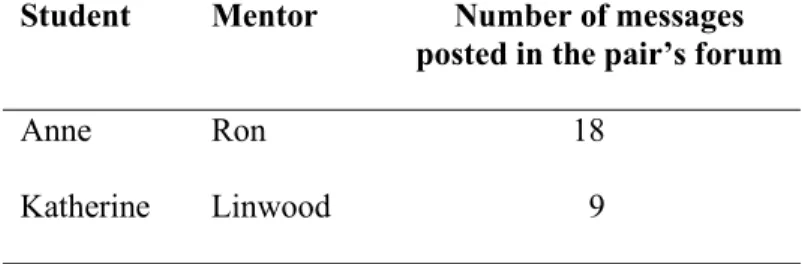
An exemplary pair and a pair that didn’t communicate as much as was hoped were chosen. These
decisions were based on the quantity plus the quality of the messages exchanged. Average messages
per pair 12.3 Max=23, min=4. For example, a pair may have posted a high number of messages but
the transactions could have been fraught with short, “Just checking in” messages. This would not
(mentor). The less than exemplary pair consisted of Katherine (student) and Linwood (mentor) (see
Table 2).1
Table 2. Participants' Roles in E-Mentoring
Student Mentor Number of messages posted in the pair’s forum
Anne Ron 18
Katherine Linwood 9
Data Used in the Analysis
There were four main sets of information that were analyzed to try and answer the research
question: personal profiles, survey responses, participant interviews, and an interview with Dr.
Sonnenwald. The method used to analyze each set of information follows.
Personal Profiles
After each participant enrolled in the E-Mentoring program, they were asked to fill out a
questionnaire that described themselves and their interests. The purpose of the questionnaire was
two-fold. First, it was intended to provide a description of their personal and scientific interests that
would be available to the other program participants, and second, it was intended to gather
information that would be used to form mentor-protégé pairs. Each personal profile was included in
the E-Mentoring Web site along with a photo of the participant. The purpose of these profiles was
to allow the participants to get to know each other a bit better since the scientists and students
would never speak or see each other in person.
The participants were asked to write their responses to a set of questions (see Appendices C
and D). The students and mentors' profile forms differed in the phrasing of the questions; however,
the general gist of the questions remained the same. The information provided from this form was
examined by the researchers for the purpose of forming pairs.
The survey included both open-ended questions and questions that had multiple response
options. The questions that had to do with personal information such as why they liked biology and
what kinds of extracurricular activities they enjoyed were open-ended. Questions that asked
specifics about their career and educational goals provided options for them to chose from. These
questions also had an “Other” choice in case they wanted to add something that wasn’t listed.
Survey Responses
Students and mentors were also asked to fill out a written survey prior to the beginning of
the program. The researchers were interested in learning about participants’ expectations of the
E-Mentoring program as well as their experience with different technologies. The mentor survey
asked them what effect they thought they would have on the student, the affect the student would
have on them, and demographic information.
Researchers were also interested in gathering the same information from the students but
wanted to know about their future goals and study habits in addition to the topics addressed above.
Since the research question posed in this paper is geared less toward participants' technological
background and more about their expectations of the program and their personal traits, again only
certain questions were examined in this analysis. Therefore, while the students were asked to
respond to 33 questions, only 10 are appropriate to use in this study. In the same vein, the mentors
were asked to respond to 20 questions while only 5 were appropriate for examination here. To view
the complete questionnaires, please refer to Appendices E and F. The questions with asterisks in
Interview Data
Each participant in the study was interviewed by Dr. Sonnenwald. The mentors were
interviewed prior to being paired with students, while the students were interviewed shortly after
they were matched. This was merely a result of timing and logistics rather than by design. The
interviews focused on two areas—the person’s information needs and their thoughts about
mentoring and E-Mentoring. Again, since their information needs (how they found information,
what information they needed for specific assignments or projects, etc.) wouldn’t necessarily affect
how they should be matched, only the second part of the interview was examined for this paper.
Following are the questions, in brief, that interviewers were asked to cover during the interview
regarding mentoring and E-Mentoring. To view a copy of the extended versions of the questions,
please see Appendices G and H.
Questions Asked Students
• You may have heard about the E-Mentoring program that will be part of the Frontiers in Biology course. What are your expectations of the program? What impact do you expect that your mentor will have on you?
• What academic and personal areas or topics would you like to discuss with your mentor?
• What characteristics do you expect your mentor to have?
• What sort of relationship do you anticipate having with your mentor?
• What impact do you expect to have on your mentor?
• Do you have any concerns as you begin the E-Mentoring program? Are there specific things that you expect to find challenging?
• What have been your previous experiences with respect to mentoring? E.g., have you participated in a formal (or informal) mentoring program before? Either as a mentor or protégé?
Questions Asked Mentors
• Why are you volunteering to participate in the E-Mentoring program?
• What characteristics do you expect your students to have?
• What impact would you like to have on your student(s)? What impact do you expect to have on your student(s)?
• Do you expect your student to have an impact on you? How? Why?
• Do you have any concerns about the E-Mentoring program? What are they?
• Are there specific things that you expect to find challenging?
• What have been your personal experiences with respect to mentoring? For example, have you participated in a formal (or informal) mentoring program before? Either as a mentor or protégé? • Is there anything you’d like to ask me?
Interview with Principal Investigator, Dr. Diane Sonnenwald
An interview with Dr. Diane Sonnenwald was conducted not only because she is the
principal investigator of E-Mentoring, but also because she conducted the personal interviews of the
participants in this sample. She also took part in the actual matching process, along with the course
instructor, and could explain how the matching was accomplished. The following are the questions
used to guide the interview:
• What type of information was taken into consideration when matching the students and the mentors?
• What type of information did you gain from the interviews that were influential in the matching process?
• What type of effect do you think it had that no one really volunteered (mentor or student) to participate?
• What were the goals of your matching (i.e. strong with weak, strong with strong, etc)
RESULTS
Upon examination of the information collected from the E-Mentoring program, the
following results were discovered from each data source.
Personal Profiles
The amount of information supplied by participants and the tone in which they conveyed
their thoughts revealed a lot about their personalities. For example, Ron, who was an extraordinary
mentor, supplied lots of information about himself. He provided both detailed professional and
personal information. His tone was friendly, down-to-earth and not the least bit condescending.
Katherine, on the other hand, was much more direct. She answered each question with very
short answers and used few adjectives
Reading between the lines, as well as looking at the direct information, is necessary when
learning about a person and how they might contribute in a mentoring relationship. The profiles
were beneficial in getting the participants to talk about themselves. The open-ended format of the
questionnaire facilitated this, while at the same time, revealed much about the personalities of
participants who were less inclined to freely express themselves.
Survey Responses
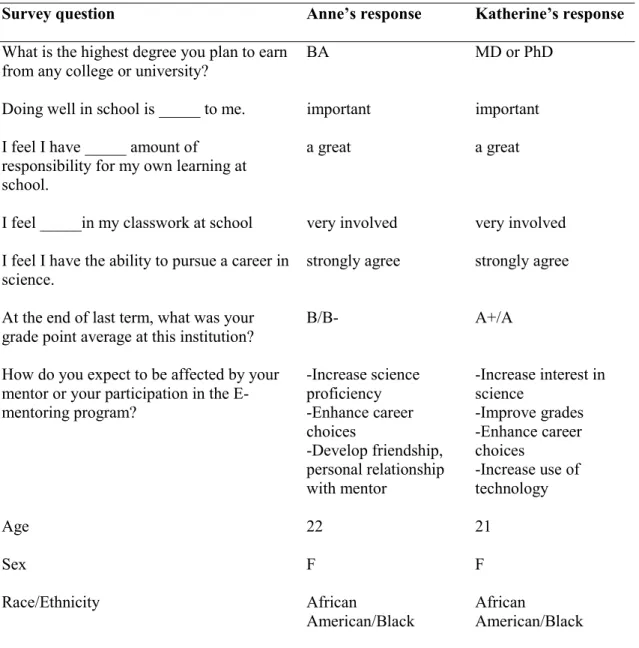
See Tables 3 and 4 to view the survey results used for this paper. As described above, this
research draws on only a subset of the survey questions. The complete survey forms can be seen in
Table 3. Results from student surveys
Survey question Anne’s response Katherine’s response
What is the highest degree you plan to earn from any college or university?
BA MD or PhD
Doing well in school is _____ to me. important important I feel I have _____ amount of
responsibility for my own learning at school.
a great a great
I feel _____in my classwork at school very involved very involved I feel I have the ability to pursue a career in
science. strongly agree strongly agree
At the end of last term, what was your grade point average at this institution?
B/B- A+/A
How do you expect to be affected by your mentor or your participation in the E-mentoring program? -Increase science proficiency -Enhance career choices -Develop friendship, personal relationship with mentor
-Increase interest in science
-Improve grades -Enhance career choices
-Increase use of technology
Age 22 21
Sex F F
Race/Ethnicity African
American/Black
African
Table 4. Results from mentor surveys
Survey question Ron’s response Linwood’s response
How do you expect to affect the student(s) you are mentoring?
Increase interest in science
Enhance career choices
Increase self-confidence
Increase interest in science
Enhance career choices
Increase use of technology How do you expect to be affected by the
E-Mentoring program and by your students?
-Develop my
professional network by making new contacts -Gain personal satisfaction from helping others -Learn about contemporary science education at the university level
-Gain personal satisfaction from helping others
-Gain more experience in mentoring
-Learn about
contemporary science education at the university level
Age 56 53
Sex M M
Race/Ethnicity White White
Interview Data
During the interview process, each participant revealed what they wanted out of the
mentoring relationship as well as their expectations of the project. For example, Linwood stated
that he would prefer a scientifically curious protégé. He also told Dr. Sonnenwald he wasn’t really
interested in answering students' technical questions about biology—that was the job of the
professor, not him. He was also very candid in his approach to the program. He stated that if the
student was not really curious and willing to learn, then the interactions would probably be quite
Ron, on the other hand, spoke of his willingness to work on both a professional and personal
level with the students. He had mentored in the past and enjoyed the activity. He was also excited
about getting to know the students and advising them about their future. He seemed open to
learning from the students as well as teaching them.
Katherine, while highly recommended academically by Dr. Harmon, was very timid in her
interview. Many of her answers were short phrases or single words. When asked about her
expectations, she revealed first that she expected to be much more computer literate. Topics she
wanted to talk about with her mentor were about graduate school, medical school and careers. She
expected her mentor to be trustworthy, patient and caring. She wanted her mentor to know that she
worked very hard in school and is dedicated to her schoolwork.
Anne also revealed a desire to discuss careers and graduate school, but also included topics
such as lab techniques and school assignments. She wanted her mentor to be a good listener and be
open-minded, especially if she wasn’t as fluent as her mentor was in certain subjects. The type of
relationship she envisioned was similar to the student/professor relationship but a little more
personal. Also, it was important to her to talk about assignments not only when she was having a
problem, but also in a more general sense.
Interview with Dr. Sonnenwald
From the beginning of the project, Dr. Sonnenwald explained that the research team had
explored what kind of matching technique they wanted to apply. After looking at race, gender,
career interests, even personal interests, the researchers ultimately determined that such a small
participant group of 12 students and 9 mentors would not be ideal for matching on such limited
particulars. However, matching did have to occur, and Dr. Sonnenwald began our interview by
She explained that matching on anything other than interests would be troublesome. For
example, if they wanted to pursue matching by race, either similar or differing races, they would
have problems. In the whole pool of participants, all of the students were African-American and all
of the mentors were white. Therefore, they had no choice but to pair students and mentors with
differing races.
Researchers also could not ask students or mentors of what race would they prefer to be
paired with. If even one student expressed a preference for an African-American or other minority
mentor, researchers would have been unable to accommodate that request. This also went for
mentors. If they expressed a desire to only mentor students from the same racial background as
themselves, that request would have had to been denied.
Another "real world" problem was the mismatched number of students and mentors. To
achieve a one-to-one ratio, the same number of scientists and students would be necessary. Since
there were 12 students and only 9 mentors, some mentors had to work with more than one student.
At an initial project meeting with the mentors, some had requested more than one student protégé.
They expressed a desire to be able to compare the relationships. However, when it came to
assigning more than one student to some mentors, their enthusiasm for multiple protégés cooled.
This created matching problems when more than one student would be a good match with a
particular mentor, but that mentor had stressed a need to maintain a relationship with only one
student.
Dr. Sonnenwald asked Dr. Harmon to rate the students according to their scholastic and
intellectual ability. This provided a framework for matching serious students with mentors who
requested students who take their education seriously. This was a slightly successful approach since
Dr. Harmon ranked Katherine as a serious student and she was matched with a mentor that was
Another important factor is getting to know the participants' environment, especially the
mentors. For example, matching a student who is extremely interested in entering the exact same
field as the mentor, with a mentor that has just had 60% of his team laid off (and feels bitter about
it) may disturb the protégé more than necessary.
Lastly, Dr. Sonnenwald also felt that engaging the mentor proactively could overcome
poorly matched pairs. She recognized the limitations to ideal matching and felt that the project
facilitators would need to keep the mentors interested in working with the student in order to help
DISCUSSION
When examining survey responses, their subjectivity must be taken into account. Both
students and mentors are likely to answer questions in a way that does not accurately reflect how
they actually behave. For instance, the students' results regarding their grades and interest in school
may be inflated. Dr. Sonnenwald revealed during her interview that students tend to inflate their
GPA when asked. They knew the researchers would be looking at their responses and may have
inflated their enthusiasm for school to make a good impression. Therefore, this information should
be weighed less when trying to generate good matches.
Also, survey responses can be interpreted differently, both by those answering the questions
and by researchers analyzing the answers. For example, based on a cursory look at his survey
answers, Ron looked more interested in himself (Develop my professional network by making new
contacts), and Linwood looked like a dedicated philanthropist (Gain personal satisfaction from
helping others). However, Ron’s response could be interpreted in a different way. Perhaps he was
signaling that he regards the students as scientific peers rather than in a hierarchical relationship.
This seemed more in line with what Ron was like during the program. So while the answers to
these questions somewhat reveal what the participant is thinking about the mentoring relationship,
other data needs to be taken into account as well. An open-ended question might provide better
results than providing possible answers for the participants.
Attributes that could be used for matching Race
Since this program was and will continue to be piloted between corporations and historically
minority universities, the issue of race is very important. There are definite opinions as to what
works best—same-race mentoring or cross-race matching. Preliminary research concerning the
conclusion of the E-Mentoring program reveals than not one student complained about racial
more salient characteristics. If matching on race is important, then the study can be designed to
recruit with that goal in mind. Otherwise, race should be a less important factor in matching.
Academic seriousness/interest/ability
Dr. Sonnenwald stated during her interview that Dr. Harmon was asked to rate the students
in order of their scholastic abilities. Getting professor input was a good idea since he knows the
students the best of all those involved in the E-Mentoring project, but would have to be more
organized and focused to be really instrumental in the matching process. For example, Dr. Harmon
rated only on scholastic ability. It might be beneficial to widen this rating system to add other
intellectual characteristics. This may be true since Linwood was really interested in being matched
with an intellectually curious student, which was interpreted as matching him with a student that
was rated high on the scholastic scale. An intellectually curious student may not necessarily receive
the best grades, which might result in a mismatched pair, as Linwood and Katherine were.
Personality traits
Although Daresh and Playko’s (1992) ideas about asking the participants to respond to
questions regarding their personality traits is not based on any kind of fact or supported by any
research, they may be on to something. Asking participants to think about the kind of person they
are and then providing us with that kind of information has potential for matching with personality
in mind.
Using this kind of information, researchers might be able to match pairs that are more
tolerant of traits that are essential in forming a positive mentoring relationship. For example, would
expresses feelings? What about a strongly disciplined student with a very spontaneous mentor?
Also, just having the participants complete the survey might get them thinking more about what
they want to get from the mentoring relationship.
Expectations
One of the most valuable points to be learned from the interviews is that they should be
conducted prior to matching, especially concerning participants’ expectations of the program. The
interview information revealed a lot about the participants that might have helped in matching.
Questions about their expectations of the program and qualities they would like to see in the other
participants showed that they knew about what they would like to see occur. For example, when
Katherine was asked about her expectations of the program, she said she expected to learn about the
technology. Instead of being matched with Linwood who obviously wanted a scientifically curious
student, she may have better been matched with someone who wanted to also explore the
technology. Some factors of the success of Ron and Anne may have been that they both expected to
learn from each other. This indicated a more mutual relationship rather than a hierarchical
relationship, which can be interpreted from Linwood’s comments about not really bothering if the
discussions were not intellectually stimulating to him.
In regards to expectations, specific survey questions might be looked at closely when
matching mentors and protégés. Student questions such as “How do you expect to be affected by
your mentor or your participation in the E-mentoring program?” reveal a lot about these particular
students that may affect the matching process. For example, Anne, who appears to be the more laid
back of the two students in the sample, cited personal and social effects (Enhance career choices,
Develop friendship, personal relationship with mentor) while Katherine cited more academic effects
shed light on their attitudes toward school, life and relationships, but also they indicate what these
two women were hoping to get out of the mentoring relationship.
Mentor involvement
Perhaps mentors should be asked to participate more in selecting a protégé. This will
potentially engage them more in the project, as Dr. Sonnenwald suggested, and get them really
thinking about what mentoring is. The risk one runs when engaging the participants in matching is
disappointment if they don't get matched with whom they want. However, one would hope that
mentors would be mature enough to deal with this type of minor disappointment.
Status: hierarchical vs. equal
Based on the survey results, feelings of equality among participants are something that
should be explored further. For example, some students may feel more comfortable in a mentoring
relationship that is hierarchical. They may feel that they want to learn from the mentor rather than
having the learning be reciprocal. Perhaps participants should be asked in the survey what would
make them feel most comfortable, what they expect and what they would prefer in terms of the
relationship dynamics.
Recommendations
The E-Mentoring project is being implemented in a second pilot in Spring 2000 using
similar program parameters. Therefore it is important to examine how participants were matched
and what can be done more effectively. For example, interview data can be extremely valuable;
however, it must be obtained in a manner that makes it useful during the matching process. Instead
of having to wait for the interviews to be transcribed, information could be generated from
about what they hope to gain from the program, their expectations of the program, what kind of
mentor/student they would like to be matched with, and how they perceive mentoring relationships.
Then interviewers don't have more information than the other researchers about the
participants--they can all review the data together. Also, if this program becomes widely accepted, it will be
impossible to individually interview all participants. Therefore the survey format is more feasible
CONCLUSION
While this analysis of the data surrounding matching, specifically in terms of the
E-Mentoring project, has added to the discussion about how to most effectively match mentors and
protégés, it's not the end.
One of the weaknesses of this study is the limited sample size and scope of the context.
These weaknesses result in the problematic solutions of similar studies—inability to generalize
these findings to other projects. However, there are some general recommendations that may be
applicable to other electronic mentoring programs.
The first is using a survey, instead of interviews, to collect data about expectations and
assumptions of the participants. In this study, the interview data was very important in revealing
information about each participant. However, it was too time consuming to use effectively. Other
electronic mentoring programs can learn from this difficulty.
The second recommendation is to examine the appropriate attributes that should be applied
during the matching process. For example, if one of the goals of the mentoring is to expose young
black teenagers to the realities of being a minority in the workplace, race has to be taken into
account. It may be, however, that the mentoring goal is to provide support for specific students who
are at risk to drop out of high school because they are in foster homes. Then matching students
based on attachment theory would be more appropriate. In other words, it should be the goals of the
electronic mentoring project that drive the decisions about attribute selection.
The last recommendation is to involve the mentors more proactively in the matching
process. Dr. Sonnenwald’s suggestion of involving the mentors more in all aspects of the
mentoring process is a sound one. In many cases, the mentors are busy people with many
responsibilities on their plates. Giving them more ownership of the whole process may encourage
This study is just one step toward understanding how mentors and protégés can be matched
more effectively. Hopefully research will continue to be done in the field to create the most
REFERENCES
Ainsworth, M. (1989). Attachments beyond infancy. American Psychologist, 44(4), 709-716.
Bowlby, J. (1982). Attachment and loss, vol. 1 : Attachment, 2d ed. New York: Basic Books.
Bowlby, J. (1984). Caring for the young: influences in development. In RS Cohen, BJ Cohler & SE Weissman (Eds.). Parenthood: A psychodynamic perspective. New York: Guilford.
Center for Integrated Learning (CIL). (1992, Winter). Cultural sensitivity: A recurring mentoring issue. LinkLetter: A Newsletter of Linking Lifetime.
Philadelphia: CIL.
Daresh, J.C. & Playko, M.A. (1992, April). A method for matching leadership mentors and protégés. Paper presented at the annual meeting of the Association for Supervision and Curriculum Development, New Orleans, LA. (ERIC Document ED 344 315)
Furano, K., Roaf, P.A., Styles, M.B. & Branch, A.Y. (1993). Big Brothers/ Big Sisters: A study of program practices. Philadelphia: Public/Private Ventures.
Kalbfleisch, P.J. & Davies, A.B. (1991, July). Minorities and mentoring: Managing the multicultural institution. Communication Education, 40(3), 266-271.
Neils, David. (1999, October 19). Request for information – Matching practices of Hewlett-Packard Telementor Program. E-mail to Victoria Kindon.
Steele, S. (1990). The content of our character: A new vision of race in America. New York: HarperCollins.
Thomas, D.A. (1989). Mentoring and irrationality: The role of racial taboos. Human Resource Management, 28(2), 279.290.
Thomas, D.A. (1993). Racial dynamics in cross-race developmental relationships. Administrative Science Quarterly, 38, 169-194.
S.W. Morris and Company. (1992). What young adolescents want and need from out-of-school programs.
Appendix A.
Daresh and Playko personality scale. The technique uses a scale to first assess the participant's
personality traits. They are asked to rate themselves as either "Dominant" (1) or "Easy Going" (4)
with regard to the different personality traits (Daresh and Playko, 1992).
Directions: Circle one of the numbers that best indicate how you see yourself.
Dominant 1 2 3 4 Easy-Going
Appears confident….reserved Passive…aggressive Responsive…self-controlled
Takes charge…goes along Formal…informal Disciplined…spontaneous
Communicated readily…hesitant communicator Initiates social contact…lets others initiate
Asks questions…makes statements Overbearing…shy
Appears active…appears thoughtful Relaxed…assertive
Withholds feelings…expresses feelings Pushy…gentle
Discriminating…impulsive Extrovert…introvert
Appendix B.
Four personality styles that may facilitate the matching process
(Daresh and Playko, 1992).
Alternative Mentor-Protégé Styles
We believe that four basic behavioral styles exist which might be used to describe individuals
regardless of whether they are classified as “mentors” or “proteges.” Brief descriptions of each of
these four styles are as follows:
1. Supportive Style: This style demonstrates a high degree of respect for interpersonal
relations. Individuals who possess this style try to minimize conflict and promote
the happiness of everybody. Some people see the supportive style as
accommodating and friendly, while others might view it as “wishy-washy.” Those
who are supportive tend to whatever may be needed to please others, but his may
leave them frequently overcommitted. Supportive types are highly people-orientated
individuals who will generally rely on others to give directions about how to get
tasks done.
2. Directive Style: Individuals who demonstrate this style love to run things and have
others do the job their way. These people are viewed as highly businesslike and
efficient by some, while others view them as threatening and unfeeling. These
people want to make sure that the job gets done, and they get impatient with lengthy
descriptions about effective process.
3. Facilitative Style: Facilitators tend to get involved with people in active, rapidly
changing situations. They are seen as socially outgoing and friendly, imaginative
and vigorous. Some view this style as dynamic and energetic while others perceive
highly creative people who are also likely to generate ideas with little practical
follow-through or concern for details.
4. Scientific Style: This style places great emphasis on problem solving and conceptual
skills. Those who approach issues in this style tend to want such data before they
make any decisions. As a result, they are viewed by others as methodical and
thorough, although this behavior might frustrate some who look at their behavior as
Appendix C.
Student personal profile form.
Welcome to the E-Mentoring Project!
E-mentoring is the establishment and continuance of a mentoring relationship between students, teachers, and mentors using communications and information technology. This project is being administered by Dr. Diane Sonnenwald, Dr. Barbara Wildemuth, Victoria Kindon and Emily Brassell of the School of
Information and Library Science at the University of North Carolina, Chapel Hill.
As part of the “Frontiers in Molecular Biology”course that you have enrolled in for the Fall 1999 semester, you will be interacting with a scientist in the field as part of the e-mentoring project.
We are currently developing profiles of all those participating. These profiles will help introduce students, mentors, and faculty to each other; as well as help us match you with an appropriate mentor.
To submit your profile, please complete the following form and return it by June 1, 1999 to: Dr. Gary Harmon, Department of Biology, Campus Box 713 ECSU, Elizabeth City, NC 27909. *Please note that the information you provide for items that are italicized will be made available to all participants. Those items not in italics will be only available to the administers of the
e-mentoring project for matching purposes.
Name:
E-mail address (if available):
Major(s) & Minor(s):
Science topics I am most interested in discussing with a mentor (check as many as you wish):
* General Biology * Chemistry
* Biochemisty * Ecology
* Biostatistics * Genetics
* Bio-medical Engineering * Marine Science
* Cell Biology * Other:
* Molecular Biology/Biotechnology
Career topics I am most interested in discussing with a mentor (check as many as you wish):
*Medical school *Balancing career and family *Getting a job/internship *Publishing
*Grad school in biomolecular sciences *Professional organizations
*Research *Other:
Why I'm interested in biology:
What classes I take; what classes I really enjoy:
Career plans:
Free time interests; part-time job; family; unique quality about me; interesting facts about me; etc...
Student Profile Example:
“My name is Pat Student and I'm a junior Biology major at ECSU. I first got interested in biology when I was a kid playing at the beach. I used to enjoy examining fish and other sea creatures that washed up on the beach. It seems gross now, but my parents introduced me to the wonders of living things.
In addition to my basic biology requirements, I have also taken some advanced chemistry and a genetics course. I also take a Spanish class each semester.
Although I don't know much about how to become a bio-medical engineer, I think that's what I might like to do for a living.
I've lived in North Carolina my whole life. I have one brother, who also attends ECSU part-time. I enjoy fishing, running and reading John Grisham novels. I also love cats and can't wait to have one of my own once I graduate.”
Thank you for your time and attention! We look forward to working together with you this fall.
Dr. Diane Sonnenwald, Dr. Barbara Wildemuth, Victoria Kindon and Emily Brassell
Please return this form by June 1, 1999 to:
Dr. Gary Harmon, Department of Biology, Campus Box 713, ECSU, Elizabeth City, NC 27909
Mentor personal profile form.
Welcome to the E-Mentoring Project!
E-mentoring is the establishment and continuance of a mentoring relationship between students, teachers, and mentors using communications and information technology. This project is being administered by Dr. Diane Sonnenwald, Dr. Barbara Wildemuth, Victoria Kindon and Emily Brassell of the School of
Information and Library Science at the University of North Carolina, Chapel Hill.
We are currently developing profiles of all participants. These profiles will help introduce students, mentors, and faculty to each other; as well as help us match you with appropriate students.
To submit your profile, please respond to the following questions and return the form as soon as possible to Diane Sonnenwald at CB#3360, University of North Carolina at Chapel Hill, Chapel Hill, NC 27599-3360. *Please note that the information you provide for items that are italicized will be made available to all participants. Those items not in italics will be only available to the administers of the
e-mentoring project for matching purposes.
Name:
E-mail address:
Field of Study (College Major):
Science topics I am most interested in discussing with students: (Please check as many topics as you wish)
General Biology Chemistry
Biochemisty Ecology
Biostatistics Genetics
Bio-medical Engineering Marine Science
Cell Biology Other:
Molecular Biology/Biotechnology
Career topics I am most interested in discussing with students: (Please check as many topics as you wish)
Medical school Balancing career and family
Getting a job/internship Publishing
Grad school in biomolecular sciences Professional organizations
Research Other:
Science patents and invention
Career history and goals:
Free time interests; part-time job; family; unique qualities about me; interesting facts about me; etc...
Mentor Profile Example:
“My name is Chris Mentor and I'm a researcher at Ortho-Clinical Diagnostics which is a division of Johnson and Johnson. I received my Bachelor’s degree in biochemistry from University of Michigan in 1983. I first got interested in biology during my sophomore year in high school—dissecting the frogs was fun. I enjoyed learning how living things live and breathe.
After college, I worked in a cancer research lab in Boston. I thought I would go to medical school after a few years in the lab, but I realized I enjoyed research so much I’d continue in this line of work. In 1990 I moved to NJ and was lucky enough to land a satisfying research job at Ortho-Clinical. I enjoy the fact that my daily work positively contributes to the field of biochemistry.
To keep abreast of advances in the field, I read science journals and try to attend conferences that are applicable to my work.
I currently live in Hoboken, New Jersey with my wife who is a grade school teacher and three sons. I enjoy fishing on the weekends and tooling around in my garden.”
Thank you for your time and attention! We look forward to working together with you this fall.
Appendix E.
Student survey form. Please note that questions in bold were taken into consideration for this paper.
PRE-SEMESTER SURVEY: STUDENTS (September 1999)
We appreciate you taking the time to complete the following questions. Your answers are important because they may shape the future of the E-Mentoring program by enabling us to build the best E-Mentoring system possible. Thank you very much.
Name ______________________________
Academic Profile
1. Prior to this semester, how many credits have you completed toward your undergraduate degree?
_______ credits
2. Are you a full-time student or a part-time student?
❍ Full-time student ❍ Part-time student
3. Please list the biology courses that you’ve already taken at Elizabeth City State University.
________________________________________ ________________________________________
________________________________________ ________________________________________
________________________________________ ________________________________________
4. Why did you decide to take this course (Frontiers in Molecular Biology)? (Check all that apply.)
❒ to fulfill a general education requirement ❒ to fulfill a requirement for my major ❒ the subject matter looked interesting ❒ the instructor has a good reputation ❒ it was offered at a convenient time ❒ it was offered at a convenient location
❒ it was offered via ________________________________ technology ❒ other (please specify) _______________________________________
❍ Yes ❍ No
6. What is the highest degree you plan to earn from any college or university?
❍ Certificate ❍ A.A. or A.A. S. ❍ B.A. / B.S. ❍ M.A. / M.S. ❍ Ph.D. / Ed.D. ❍ J.D.
❍ M.D.
❍ other (please specify ____________________________ ) ❍ I don't expect to earn a degree.
7. Which of the following best describe(s) your reason for taking college courses at this time? (Check all that apply.)
❒to advance in current job or career ❒to discover new job opportunities ❒ personal enrichment
❒to earn a college degree
❒ other (please specify: _____________________________________________)
8. Doing well in school is _____ to me.
❍ important
❍ somewhat important ❍ somewhat unimportant ❍ unimportant
9. I feel I have _____amount of responsibility for my own learning at school.
❍ a great ❍ some ❍ little ❍ no
10. I feel _____in my classwork at school.
❍ very involved ❍ somewhat involved ❍ somewhat uninvolved ❍uninvolved
11. I feel I have the ability to pursue a career in science.
❍ strongly agree ❍ agree
❍ am unsure ❍ disagree
❍ strongly disagree
12. At the end of last term, what was your grade point average at this institution?
B-❍C ❍D or F
13. Do you live on campus or off campus?
❍ On campus ❍ Off campus
14. If you live off campus, on average how many hours per week do you spend on campus excluding time spent in classes or working for pay?
_____________ hours per week
Expectations of the E-Mentoring Program
15. How do you expect to be affected by your mentor or your participation in the E-mentoring program? (Select from the items below the top three items that you believe represent the greatest impact areas.)
❒ Increase interest in science ❒ Increase science proficiency ❒ Improve grades
❒ Enhance career choices
❒ Increase motivation to succeed at school ❒ Increase self-confidence
❒ Increase involvement at school ❒ Increase use of technology
❒ Develop friendship, personal relationship with mentor ❒ Other _________________________
Technology/Information Use
Rate your ability to do each of the following:
(Circle the appropriate number, from 1, no knowledge/ability, to 5, expert user.)
No knowledge/ ability Some knowledge, but little ability Novice user Inter-mediate user Expert user
16. Create a word processed document on a computer
1 2 3 4 5
17. Send and receive e-mail 1 2 3 4 5
18. Search for information on the Internet/World
Wide Web 1 2 3 4 5
19. Participate in online chat sessions 1 2 3 4 5
20. Participate in threaded e-mail discussions (i.e., use electronic bulletin boards)