A Workbook for Developing
Risk-Based Adaptation Plans
A Workbook for Developing
Risk-Based Adaptation Plans
Climate Ready Estuaries
EPA Office of Water
Preface ...1
Introduction and How to Use This Workbook ...5
Vulnerability Assessment
Step 1—Communication and Consultation ...13Step 2—Establishing the Context for the Vulnerability Assessment ...19
Step 3—Risk Identification ...23
Step 4—Risk Analysis ...35
Step 5—Risk Evaluation: Comparing Risks ...45
Action Plan
Step 6—Establishing the Context for the Action Plan ...51Step 7—Risk Evaluation: Deciding on a Course ...55
Step 8a—Finding Adaptation Actions ...65
Step 8b—Selecting Adaptation Actions ...81
Step 9—Preparing and Implementing an Action Plan ...93
Step 10—Monitoring and Review ...97
Appendices
Appendix A—Workflow Map ...103Appendix B—Cross-Reference to Other Resources ...105
Appendix C—EPA Resources to Evaluate the Vulnerability of Specific Species, Sites or Sectors ...109
Appendix D—Conceptual Diagrams ... 111
Appendix E—Climate Change Impact Resources ... 115
Purpose
Identifying risks associated with climate change and managing them to reduce their impacts is essential. This Workbook presents a guide to climate change adaptation planning based on EPA’s experience with
watershed management, the National Estuary Program and the Climate Ready Estuaries program. The
Workbook will assist organizations that manage environmental resources to prepare a broad, risk-based
adaptation plan.
The audience for this Workbook is professionals at organizations that manage environmental resources,
especially organizations with a coastal or watershed focus. They are knowledgeable about their systems but not necessarily sophisticated about climate science or risk management. They may be addressing a myriad of issues that require immediate attention and have limited time to focus on adaptation planning for the future. Furthermore, they may need to adapt to climate change impacts within their organization’s existing resources. Despite these challenges, managers who realize that climate change will affect their ability to meet their goals will see the need to incorporate climate change risk into their planning. Although risk management and risk-based vulnerability assessments have been highlighted or
recommended by experts in the field of climate change adaptation,1 to date only a handful of risk-based plans have been published. Interviews with coastal managers conducted by Climate Ready Estuaries staff in 2011 revealed that managers are not sure what is meant by a “risk-based vulnerability assessment,” and would like tools to help them proceed.
Uses
The Workbook responds to these impediments as well as to gaps and needs—identified below—that
were recognized in climate change strategic planning.
• In the interagency National Action Plan: Priorities for Managing Freshwater Resources in a Changing Climate (2011), under Recommendation 3, “Strengthen assessment of vulnerability of water resources to climate change,” EPA agreed to lead Action 11: “Continue development of tools and approaches that build capacity for water-related institutions to conduct vulnerability assessments and implement appropriate responses” (page 24).
• EPA’s National Water Program 2012 Strategy: Response to Climate Change (2012) calls for the Office of Water to “Address climate change adaptation and build stakeholder capacity when
1 Recommendations of risk-based approaches appear in, for example:
Intergovernmental Panel on Climate Change. 2007. Summary for Policy Makers.
Government Accountability Office. 2009. Observations on Federal Efforts to Adapt to a Changing Climate. National Research Council. 2010. Informing an Effective Response to Climate Change.
National Research Council. 2010. Adapting to the Impacts of Climate Change. Interagency Ocean Policy Task Force. 2010. National Ocean Policy.
Interagency Climate Change Adaptation Task Force. 2010. Progress Report of the Interagency Climate Change Adaptation Task Force: Recommended Actions in Support of a National Climate Change Adaptation Strategy.
Government Accountability Office. 2013. Climate Change: Future Federal Adaptation Efforts Could Better Support Local Infrastructure Decision Makers.
implementing [National Estuary Program] Comprehensive Conservation and Management Plans and through the Climate Ready Estuaries Program” (page 49).
• In the National Fish, Wildlife and Plants Climate Adaptation Strategy (2012), Goal 4 reads, “Tools, such as vulnerability and risk assessments and scenario planning, can inform and enable management planning and decision-making under uncertainty. Identifying, developing, and employing these types of tools will help managers facilitate adaptation of individual species, increase habitat resilience, and help identify where changes to the built environment may conflict with ecosystem needs” (page 68).
• The National Ocean Council Implementation Plan (April 2013) states, “Agencies will take a number of actions to improve the resilience of coastal communities and enhance their ability to adapt to the impacts from climate change, extreme weather events, and ocean acidification....They will offer tools and training courses on how to design and implement vulnerability assessments and develop a national assessment of coastal and ocean vulnerability to both climate change and ocean acidification” (page 16).
• Executive Order 13653 (November 1, 2013) states, “The Federal Government must build on recent progress and pursue new strategies to improve the Nation’s preparedness and resilience. In doing so, agencies should promote: (1) engaged and strong partnerships and information sharing at all levels of government; (2) risk-informed decisionmaking and the tools to facilitate it; (3) adaptive learning, in which experiences serve as opportunities to inform and adjust future actions; and (4) preparedness planning.”
This Workbook helps meet the need for guidance on conducting climate change vulnerability
assessments at a watershed scale, provides decision-support tools, helps people plan climate change adaptation strategies, and builds the capacity of local environmental managers. The Workbook helps EPA
to fulfill the commitments that it has made to assist local and regional organizations to effectively plan for climate change impacts.
An organization’s own goals and an understanding of the political and ecological context in which it operates are essential pieces of the process. This Workbook helps managers to systematically and
progressively develop and build that information into an action plan. When users have gone through the
Workbook, they will have produced a planning-level document that can guide their responses to climate
change risks. This will help them anticipate change and reach their organizational goals.
Content
The Workbook presents a step-by-step application of a risk management methodology to climate
change adaptation. By taking a risk-based approach to assessing vulnerability, users have a formal way to choose among adaptation actions. Selected actions are not simply beneficial, they rise to the top because they will be best for reducing risk.
The Workbook uses the risk management process in an international standard (ISO 31000—Risk
Management), and tailors it to respond to the practices and norms of the climate change community. Specifically, the ISO methodology (which is conceived as a start-to-finish application of a risk
management process) was modified to accommodate a two-part process consisting of (1) a stand-alone vulnerability assessment, followed (either immediately or after a period of time) by (2) an action plan. When faced with many discrete risks, managers can benefit from a process that will help them prioritize those that should receive attention, and decide on how to mitigate them. Each place-based organization’s vulnerability assessment and action plan will be unique: the risk management process and this Workbook embrace that philosophy.
The risk management process in the Workbook is informed by a review of existing resources and relevant
information. NOAA’s Roadmap for Adapting to Coastal Risk, NOAA’s Adapting to Climate Change: A Planning Guide for State Coastal Managers, ICLEI’s Preparing for Climate Change: A Guidebook for Local, Regional, and State Governments, NWF’s Scanning the Conservation Horizon: A Guide to Climate Change Vulnerability Assessment, and U.S. Global Change Research Program resources were especially useful.
EPA’s National Estuary Program also informs the approach presented in the Workbook. The NEP has
four cornerstones: (1) focus on the watershed, (2) integrate science into the decision-making process, (3) foster collaborative problem solving, and (4) involve the public. The Workbook responds to those
principles by:
• advancing a risk management approach that is appropriate for the scale of a coastal watershed; • accommodating the large number of risks likely to be encountered;
• calling for organizations to have scientists and other experts advise on risks to consider and their consequences; and
• promoting a process that is especially suited to public engagement and building consensus. An organization like a National Estuary Program, whose management structure has robust mechanisms for involving citizens and scientists, may be able to write an adaptation plan using its regular consultation processes.
The development of this Workbook benefitted greatly from ongoing peer input solicited from EPA
colleagues, watershed managers and federal interagency partners. Numerous presentations about the
Workbook were made to the climate change adaptation community of practice over the past two years.
A pilot project to field test the vulnerability assessment methodology ran from September 2012 to September 2013; early results were presented at a stakeholder workshop on vulnerability assessments in February 2013. The vulnerability assessment half of this Workbook was the focus of that workshop,
which provided valuable insight into questions that stakeholders would have as they used the Workbook.
In October 2013 a draft of the complete Workbook was made available on the EPA website to provide
further opportunities for input. Finally, the Workbook draft was submitted to five coastal/watershed
management experts for formal independent peer review.
Limitations and Caveats
The Workbook is part of a growing and dynamic body of literature on how to evaluate vulnerability and
respond to climate change. Although risk management itself has been successfully used for decades, adaptation to climate change is a rapidly developing field. New material is constantly being published. Many excellent governmental and non-governmental tools and publications are available that explain how to conduct community outreach, identify and comment on the severity of expected climate impacts, or provide instruction on how to assess the vulnerability of a specific species, site or sector to a particular climate change risk. This Workbook identifies other helpful resources and directs users to them.
Similarly, scientific understanding of the magnitude of climate change and its impacts is also growing as we learn more about how global and local environments are responding and how the climate is projected to change. This Workbook points users to information about climate change from the U.S.
Global Change Research Program as a primary source. It also draws on other peer-reviewed assessments and government reports when needed. EPA’s Climate Ready Estuaries website will link to the latest information from USGCRP and other sources as it is published.
Every place is unique, as is every organization and every situation. The range of technical expertise, resources, ecotypes and stakeholders varies immensely among target audiences of the Workbook. A
decision support tool that accounts for this diversity is essential. The Workbook is prescriptive about
steps to take, but users have great flexibility to make their needed decisions along the way. The process assumes that users have a good understanding of their place, resource or environment and are familiar with the stressors that are in play and how their system may respond. This Workbook is a roadmap that
will help users to (1) apply a risk-based methodology to their organization’s goals, (2) weigh various risks, (3) consider associated impacts on goals, and (4) thoughtfully plan for each risk.
Contact information
For information, questions or comments about this document, contact Michael Craghan, Ph.D., of Climate Ready Estuaries, at U.S. Environmental Protection Agency, Office of Water, Office of Wetlands, Oceans and Watersheds, 1200 Pennsylvania Avenue NW, Mail Code 4504T, Washington, DC 20460, or by email using [email protected].
Climate change will bring additional challenges to places and ecosystems that are already under environmental stress. The expected climate changes will worsen existing problems as well as bring new problems. The process described in this Workbook leads you to take a broad look at how climate
change will affect your environmental system and your organization. The creation of a planning-level risk-based vulnerability assessment will help you develop an action plan with effective solutions that your stakeholders and partners can help implement.
The likelihood and consequences of all risks are to at least some extent unknowable. However,
understanding the suite of climate change risks presents a special type of challenge, one for which most places have few examples or little experience to draw upon:
• The risks will stem from many stressors (changes in air and water temperature, intensification of the hydrologic cycle, sea level rise, and other associated problems) and impacts will be numerous and diverse.
• When risks will materialize and with what intensity are not precisely known. Some risks will have slow, steady onsets (e.g., those driven by sea level rise or warming air temperatures). Other risks will have sudden onsets as thresholds are crossed (e.g., invasive species arrive) or familiar risks will interact with new environmental regimes (e.g., flooding when runoff from stronger precipitation interacts with higher river levels caused by sea level rise).
• We do not know how robust or fragile systems will be when climate stresses begin to accumulate. As well, we do not completely understand how climate stressors will be mediated by the
environment or the sensitivity and adaptive capacity of living organisms.
The characteristics of the climate change problem also take away many of the commonly used risk management responses:
• A place-based organization—by itself—will have essentially no effective way to prevent climate change, and some effects will be inescapable.
• Climate risks cannot be studied using repeatable observations the way industrial processes or chemical reactions can. Incredibly diverse factors combine to influence how climate will change and interact to produce climate change’s effects: no matter how much time and resources you spend on the problem, it will not be possible to precisely know what will happen 15, 30 or 60 years in the future.
• Since we do not know how intense the change will be in coming decades, and we are not sure how our systems will respond, it is not going to be possible to quantify either costs or benefits in any highly accurate (or easy) way, especially at the spatial scale for which the Workbook is
intended.
• Some risks will be very expensive to mitigate; others will be impossible to mitigate. It could take decades to mitigate some risks (e.g., drought impacts on drinking water supply). With some risks, adaptive management techniques will be required.
• Another element that makes managing environmental change different from other risk
management contexts is that the public must be involved. Responses must change something in the environment, and in most cases, the public is going to have to accept those changes as
well as pay for them. When a private firm manages its own risks it might seek to take every cost-effective action it can. In environmental management, public considerations and the actual cost will make that kind of strategy impossible.
Of course, all environmental planning is plagued by mysteries. Oil spills, hurricanes, population changes, fires or invasive species are equally unpredictable in terms of what, whether or when they will occur, and how bad they might be. Yet plans are made and potential responses are developed for the risks. These risks and hazards are effectively managed by identifying, analyzing, evaluating and mitigating them.2 Climate change risks can be managed the same way.
Who Should Use This Workbook?
This methodology is appropriate for any type of place-based planning—including hazard mitigation. However, the Workbook
was designed with environmental professionals who manage watersheds or coastal places and protect the health of aquatic ecosystems as its main audience. This Workbook assumes that
users:
• represent an organization that has environmental goals or objectives;
• start with some sense that climate change will pose a threat to what their organization is trying to accomplish;
• are comfortable using science to inform decision-making; and
• have sufficient knowledge of their environmental system (or can partner with those who do) to understand how climate changes may affect the way it functions.
The risk management methodology adopted in the Workbook is best used:
• at a spatial scale that is large enough that risks are numerous and diverse and small enough that managers know the territory;
• where using qualitative risk analysis is well suited; • where many stakeholders are involved; and
• where responses have to be prioritized because not all can be implemented.
EPA and others have resources (see Appendix C) that may be more appropriate than this Workbook
when organizations have a narrower scope than a watershed scale planning effort (e.g., focus on a single species or habitat type).
Risk Management
A risk management process helps with decision-making when organizations are faced with uncertainty about whether they will be able to meet their goals. Risk management guides an organization to help it determine what risks are important and need to be addressed. The process encourages a broad look at all potential risks to an organization’s goals. The process is systematic and builds on information generated in previous steps, allows for judgments and decisions, and allows users to incorporate new data and information as they become available.
Begin sidebar elaboration defining how the word “organization” is used in this workbook.
“Organization”
ISO 31000 “can be used by any public, private or community enterprise, association, group or individual” (p. 1). The Workbook, like the standard it is based on, uses the term “organization” to refer to any user. End of Sidebar2 FEMA’s Mitigation Planning How-To Guide # 1 (FEMA 386-1), Introduction Table 1, describes a very similar process for hazard mitigation planning.
Risk management is a flexible process. How it is implemented depends on the organization and the purpose for which it is used. Sometimes, when people initially hear that they will be participating in a risk management process, they misperceive what that will mean. Risk management can be a lengthy, demanding process. It often entails laboratory analysis, extensive use of statistical analysis, and other difficult, costly or time-consuming steps. However, when there is no direct, imminent threat to health or safety or a planning-level assessment is acceptable, then less intensive approaches to risk management can be appropriate. The identified risk management framework can be used for chemical exposure, engineering decisions or global climate change, but how each step is executed or what types of conclusions can be reached may be different. Risk management is about your organization: your goals and objectives, your context, your priorities, your decisions on how to respond. Systematically working through your situation with a risk
management framework will help you:
• find risks that you might have overlooked and avoid surprises;
• assess risks differently than you otherwise would have;
• find strategies that can address more than one risk and increase efficiency; • make better decisions; and
• increase the odds that you will be able to reach your goals.
You will also have a reference to why you think something is important and needs attention as well as a communication tool that allows others to understand system challenges.
The ISO 31000—Risk Management methodology is the
foundation of this Workbook. Here, the start-to-finish procedure
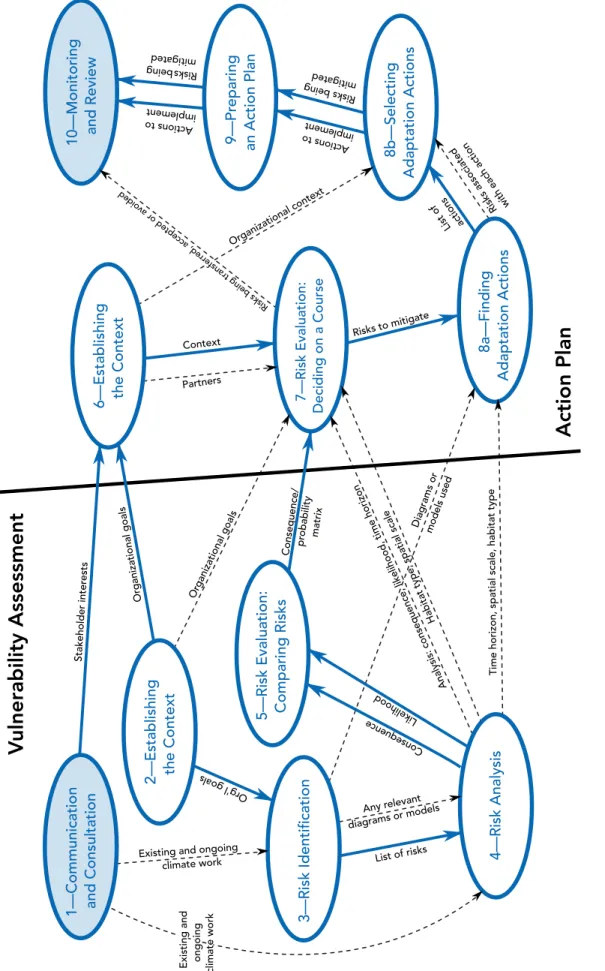
described in the standard is divided into two halves to be consistent with the community of practice for climate change adaptation (Figure I-1). Part 1 is referred to as a vulnerability assessment (which in the Workbook’s methodology can be a
stand-alone product); Part 2 is an action plan. Part 2 also includes implementation of the action plan.
Sidebar elaboration on how the U.S. Government Accountability Office defines risk management.
Risk management
“Risk management allows entities to operate more effectively in environments of uncertainty by providing the discipline and structure in which to address these issues, since risk management is not an end in itself, but an important component of an entity’s management process. As such, risk management is interrelated with, among other things, an entity’s governance, performance management, and internal controls. The process of risk management provides the rigor and structure necessary to identify and select among alternative risk responses whose cumulative effect is intended to reduce risk, and the methodologies and techniques for making selection decisions. This process enables entities to enhance their capability to identify potential adverse events, assess risks, and establish integrated responses. Further, this phase in the planning process would include support and buy-in from upper levels of management and stakeholders. Acceptance for concepts of the model from this group provides the groundwork for future discussions.”U.S. Government Accountability Office. 2006. Risk Management: Further Refinements Needed to Assess Risks and Prioritize Protective Measures at Ports and Other Critical Infrastructure. GAO-06-91, pp. 104–05. End of sidebar
Sidebar elaboration that outlines the final products for each of the two parts of the workbook.
Adaptation to
climate change
Part 1: workbook Steps 1–5
• Vulnerability assessment.
Part 2: workbook Steps 6–10
• Action plan. • Implementation. End of sidebar
Vulnerability
Assessment
Action Plan
2—Establishingthe Context 3—Risk Identification
4—Risk Analysis
5—Risk Evaluation: Comparing Risks
6—Establishing the Context 1—Communication
and Consultation
10—Monitoring and Review 7—Risk Evaluation:
Deciding on a Course
8a—Finding Adaptation Actions
8b—Selecting Adaptation Actions
9—Preparing an Action Plan
F
igurei-1.
A roadmap showing Step 1 through Step 5 of the vulnerability assessment and Step 6 through Step 10 of action planning. Communication and consultation should be part of every step. Monitoring and review keeps the whole adaptation plan up to date.vulnerability Assessments
A vulnerability assessment is an understanding of how climate change will uniquely affect your
organization. The organization is the center of attention, and the reasons why it exists (i.e., its purpose, mission, goals or objectives) are the base units of the vulnerability assessment.
Organizational goals are the focus of concern. Goals are why organizations exist and what motivates them; goals provide a context for changes. The vulnerability assessment half of a risk-based adaptation plan is different from a climate change impacts study that describes how the future will be different if the climate is different. An impact that is identified without reference to a goal is just a detail. There is no context to say it is good or bad or that something should be done about it or not. Context comes from people or organizations. They can say that an impact will help, hurt or have no effect on what they are trying to do (Table I-1). If impacts will be unwanted, goals might still be attainable if risk-reducing actions can be implemented.
T
ablei-1. D
iFFerencesamongTypes oFclimaTechangeproDucTs Table comparing and contrasting the intent and contents of climate change projections, climate change impacts studies, and risk-based vulnerability assessments. Climate changeprojection Climate change impacts study Risk-based vulnerability assessment What is it? A description of what future
climate (and correlated phenomena such as sea level) will be like.
A description of how the future will be different if the climate is different.
A ranked description of how climate changes would keep an organization from reaching its goals.
Who creates it? Climate modelers, assisted by scientists and social scientists who can provide the understanding or input necessary for scenarios or simulations.
Practitioners and experts who are qualified to describe how stressors would affect various human or natural systems.
Organizations, assisted by stakeholders, practitioners and other experts.
Example finding The average annual temperature is expected to be 5°F warmer in 2100 than it was in 1990.
Warmer water provides better conditions for algal blooms and bacteria, and they are expected to become more plentiful.
There is a moderate risk that harmful algal blooms and higher bacteria levels from warmer water temperature will keep us from providing a safe place for people to swim.
Climate parameters
Climate projections are the calculated values for the modeled parameters.
Changing parameters
become stressors. Changing parameters become stressors.
impacts Not considered (unless a general awareness of impacts and a resulting change of globally significant behavior is incorporated into modeling scenarios).
Impact studies are a presentation about how things would be different because of climate change. Impacts could be described for a river, a forest, an island or a city. The study would describe what its future conditions would be like.
Knowledge of climate projections and future climate change impacts is a needed input.
Organization goals
Goals are not considered. Climate is the subject of modeling that tends to be done at a global scale or for areas that are much larger than any manager’s responsibility.
Goals are not considered, although what someone considers to be important (whether stated or implied) will affect which impacts receive attention.
The introduction of an organization’s goals is what differentiates a vulnerability assessment from an impacts study. The work can become the basis for action instead of a general report.
Risks Not considered. This is largely about understanding the stressors.
Not considered because goals are necessary to have risks.
A vulnerability assessment is an evaluated set of risks that describes how climate change stressors would affect goals.
Risk-reducing actions
Not considered. Does not have a basis for
selecting or implementing actions.
The vulnerability assessment is input for choosing actions.
End of table
In using this Workbook’s risk management process for preparing a vulnerability assessment, you will
take a broad look at all potential climate change risks, qualitatively assess them for their likelihood of occurrence and their consequences if they were to occur, and consult with your key stakeholders to gain buy-in and agreement on the assessment.
The Workbook has five steps that lead to a climate change vulnerability assessment:
• Step 1—Communication and Consultation
Informing key people about the vulnerability assessment and asking for input. • Step 2—Establishing the Context for the vulnerability Assessment
Identifying organizational goals that are susceptible to climate change. • Step 3—Risk identification
Brainstorming about how climate stressors will interact with your goals. • Step 4—Risk Analysis
Developing an initial characterization of consequence and likelihood for each risk. • Step 5—Risk Evaluation: Comparing Risks
Using a consequence/probability matrix to build consensus about each risk.
A vulnerability assessment represents a step forward, not an end in itself. However, the Workbook treats
a vulnerability assessment as a potential stand-alone product. A vulnerability assessment is a precursor to an action plan, but it will have value on its own for communication, coordination and decision support. A vulnerability assessment is a product to be used with your board of directors, senior management, and peer organizations, and with other levels of government. It is helpful for working with others to obtain funding, resources, buy-in or approval. Additionally, a broad look at all potential problems allows others to scan across places, compare neighboring systems, and find partners for addressing common risks. A vulnerability assessment is also a tool that will help you answer a series of questions about risks and mitigating options that you will need to ask when preparing your action plan.
While it is not necessary to have a stand-alone vulnerability assessment, there can be benefits to pausing after the assessment becomes available. Time to let the vulnerability assessment findings sink in may be useful. Pausing also provides an opportunity for consensus building before an action plan is developed. It is also a time to speak to potential partners about collaborating or dividing up tasks. A response that will effectively mitigate some risks to tolerable levels could be very expensive or politically sensitive. Securing resources that can be applied to climate change problems can also take time. Further, some risks might not start to cause problems for several more decades. For these reasons completing a vulnerability assessment could mark a temporary break in the adaptation process.
This is a risk management process for climate change. Taking a few days, weeks or months before launching into the action planning process could be useful. However, if there is no strategy to use an interim period or if the benefits of pausing are small, keep going with the action planning steps.
Action Plans
An action plan is a document that explains how you will manage your climate change risks. After
completing a vulnerability assessment, you will have identified the risks that have the highest potential to affect your organization’s ability to meet its goals.
The vulnerability assessment process helped you decide which risks to focus on. Now you will identify actions that might help to decrease those risks and increase the sustainability of your system. Making these decisions when you have limited resources and probably cannot mitigate all of your risks will not be easy. Pursuing win-win solutions or no-regrets actions will be appealing options that make sense regardless of what the future brings. Steps 6–10 of the Workbook lead to a climate change action plan:
• Step 6—Establishing the Context for the Action Plan
• Step 7—Risk Evaluation: Deciding on a Course
Deciding at a high level whether you will mitigate, transfer, accept or avoid each risk. • Step 8a—Finding Adaptation Actions
Finding mitigating actions that look promising for further investigation. • Step 8b—Selecting Adaptation Actions
Screening potential actions, and selecting a set of risk-reducing actions to implement. • Step 9—Preparing and implementing an Action Plan
Creating a plan to track mitigating actions and which risks they address. • Step 10—Monitoring and Review
Keeping track of your actions and maintaining your vulnerability assessment.
This is a planning-level process to identify options. Much more detailed work will need to be done before any of the actions is ready to be implemented. The final steps in this Workbook set up a process
to track the status of your risks and to identify who will have the lead for various risk mitigation strategies.
Working with Others
In environmental management, it is impossible to be fully effective without engaging stakeholders. Involving others will pay off in many ways as you develop your adaptation plan. You will learn what topics potential partners are concerned about, who can contribute expertise, and whether you have support for moving forward. The process described in this Workbook is well suited for a collaborative
approach where key stakeholders can participate and work toward consensus. There is no one best way for communicating with stakeholders, and different methods will be appropriate in different steps of the
Workbook. Workbook steps have lists of resources that can help with external communications. Appendix
B also has cross-references to other guides that may be helpful.
Partnering with another organization in your area that has similar interests in assessing climate change can be a great opportunity. When you go through your communication and consultation process (Step 1), you should ask if your stakeholders want to join together to assess climate change effects.
If you decide to partner with another organization on a vulnerability assessment, Step 2—Establishing the Context for the vulnerability Assessment provides an opportunity to identify common goals you will jointly consider. If the other organization is already a key partner, it is likely that there is significant overlapping interest and a common context can be established for this assessment.
During Step 3—Risk identification and Step 4—Risk Analysis, working together to identify and assess risks can save resources or time, and lead to a common outcome. There can be great benefits to collaborating, and you certainly should when it makes sense. Partners might assess the same risk differently simply because their organizations have different purposes. Always remember to keep your organization’s needs in mind.
In Step 6—Establishing the Context for the Action Plan and Step 7—Risk Evaluation: Deciding on a Course, partnering opportunities are an important part of the process. Identifying who has mutual interests and who can take the lead in mitigating particular risks will be a great way to accomplish more than any organization can do by itself.
In Step 9—Preparing and implementing an Action Plan and Step 10—Monitoring and Review, let your partners know how you are doing. You will want to hear about their progress too.
Using the Workbook
Most of the information you need already exists. Some resources that will be helpful include the following:
• Your organization’s management plan or strategic plan (for example, a National Estuary Program’s Comprehensive Conservation and Management Plan).
• Knowledge of your organization’s goals and objectives, key programs, and activities. • Knowledge of your organization’s history, operational procedures, and key stakeholders or
partners.
• Maps of your watershed or study area.
• Any existing assessments or climate readiness work that covers your study area. Regional and sectoral studies from the National Climate Assessment can be useful.
EPA’s Handbook for Developing Watershed Plans to Restore and Protect Our Waters (Chapter 5, pp. 5-1 through 5-49, http://water.epa.gov/polwaste/nps/handbook_index.cfm) has recommendations for where to find and how to gather existing data.
It is important to follow the risk management steps in order. Each step builds on the previous one in this systematic process (Appendix A). Skipping ahead will lead to an incomplete or imperfect outcome, but you can always go back and repeat previous steps as more information becomes available.
Each step in the Workbook contains the following sections:
• What Is [Step x]. • Objective of This Step. • Process.
• To Get Started.
• A document to develop or a table to fill out. • Additional Resources.
The tables and documents that you produce as you go through the Workbook are a record of your
process and decisions. The tables from Step 2– Step 9 are progressive: information generated in one step informs the steps that follow. Keeping track of your contacts and sources will make it much easier if later you need to inform your stakeholders or reconsider your conclusions. The record you develop during the vulnerability assessment will be very useful when it is time to develop an action plan because a major part of the decision-making process will be a consideration of how to reduce the vulnerability of your system. Knowing how you reached your determinations about the likelihoods and consequences of scores of risks will be the key to reducing them.
Sidebar elaboration pointing to the resources in Appendix B that may be helpful in using the workbook.
Cross-reference to climate
change planning you may
have already completed
If your organization, community, region or state has already used NOAA’s Roadmap for Adapting to Coastal Risk, ICLEI’s Preparing for Climate Change—A Guidebook for Local, Regional, and State Governments, or NOAA’s Adapting to Climate Change: A Planning Guide for State Coastal Managers, the information generated in that work will be helpful to you in conducting this vulnerability assessment. In Appendix B, sections of the NOAA and ICLEI processes are cross-referenced to identify helpful information and to assist those who have already worked with those resources. End of sidebarWhat is “Communication and Consultation”?
As you begin, communication and consultation is an opportunity to inform your key stakeholders and partners about why a climate change adaptation plan is necessary, as well as to describe the process and the expected products. Consulting with stakeholders helps to build support for adaptation and is essential in developing agreement on the outcome of this process. It is also an opportunity to gain knowledge and information from them.
Objective of This Step
The objective of this step is to list your key stakeholders and learn their particular interests or concerns about climate change risks and the adaptation planning process. You will also prepare a schedule for stakeholder involvement.
Process
You should reach out to others who are interested in what you are doing or who can help with your adaptation planning. Communicate the purpose of this work to decision-makers within your organization and to key stakeholders. Everyone should understand what you are trying to accomplish and the expected outcomes.
Be able to describe what happens in each of the steps before reaching out. What you tell and ask other people will be much more useful if you know how the rest of the process will unfold. Some may be involved throughout the entire process, while others may have a particular interest in a single step or area of focus. However, when Step 5 is completed, key people should not be surprised to learn that you have a climate change vulnerability assessment and that you will be using that assessment to determine what further actions are necessary.
Reaching out
Every organization has a unique group of stakeholders. Local governments, nonprofits, federal agencies or watershed groups all have different structures and different parties that pay attention to what they do. Who is involved in climate change adaptation planning is an organizational decision. Leading candidates would include:
• anyone who would be part of organizational strategic planning;
• anyone who would help decide an annual work plan;
• anyone who could help with the vulnerability assessment; and
• anyone who might be able to help with implementing adaptation actions.
Including the public in your planning can be helpful. The “Additional Resources” section in this step has many resources about how the community can help, as well as strategies for engaging with them. Communication and consultation should occur throughout your planning, not just when it starts and ends. Actively review the information developed here in this step and listed in Table 1-1 before each subsequent step and update it throughout the process to track and guide communication and consultation efforts.
Sidebar elaboration of criteria to help users identify key stakeholders to involve in adaptation planning.
Stakeholder involvement in the
National Estuary Program
In Section 320 of the Clean Water Act, Congress said that the members of [an NEP’s] initial management committee should include (in addition to states and government agencies), “local governments,” and “affected industries, public and private educational institutions, and the general public...” Stakeholder engagement is baked right into an NEP.Involving stakeholders will lead to a better assessment and wider public support. In Community-Based Watershed Management: Lessons from the National Estuary Program (pp. 13–14), EPA says that members of a citizen’s advisory committee generally meet one or more of these criteria:
• Serve as spokespersons for a major user or interest group and bring information back to that group.
• Are well-respected leaders in the community. • Have experience in the development of water
quality and resource management policy. • Have experience with volunteer nonprofit
groups, the general public, outreach and education activities, and the media. • Understand the technical and economic
feasibility of the pollution control options under consideration.
• Understand the consensus-building process. • Are energetic and motivated individuals. End of sidebar
Key messages to communicate at the outset
It will not be possible to explain to others what the conclusions of the vulnerability assessment are going to be. However, it will be possible to explain what you will be doing, how conclusions will be reached, and what could be the next steps. Along with the organizational goals and objectives you are considering for this assessment, key messages should include the following:
• This vulnerability assessment is being launched because there is reason to believe that climate change impacts will affect what your organization is trying to accomplish.
• The purpose of the vulnerability assessment is to understand the risks that may occur, the likelihood of occurrence for each risk, and the consequence if a risk should occur.
• Risk management is part of decision-making. If climate changes are going to affect your organization’s ability to reach its goals, then you need to know what the impacts might be in order to continue being effective.
• Different perspectives on risk identification, risk analysis and risk evaluation are important, and participation is welcome.
• The outcome of the vulnerability assessment is an understanding of likely climate change risks; any adaptation actions will be determined after that.
Key questions for your consultations with stakeholders
By nature, your stakeholders are invested and concerned with what you are doing. They can be a great help as you develop and ultimately implement your adaptation plan. Let them know how you plan to use their input. Your communication and consultation should strive to find answers to key questions about how stakeholders can improve your vulnerability assessment or action plan:
• Do they have resources, reports or data that they can contribute?
• Do they know of any climate change work on stressors or impacts that exists or is ongoing? • Do they want to actively participate in the process or simply be informed of progress or updates? • Can they help with risk identification or risk analysis?
• When it is time to decide on adaptation actions, would they be able to help implement actions to reduce risks?
• Do they have any “no-go”s that you should know about? Are there any topics that they are not willing to discuss or consider?
To Get Started
The first group of people to turn to is your organization’s key personnel: your board of directors, management, staff, and the people who are regularly involved with what you do.
T
able1-1. s
TakeholDerinvolvemenT Table for users to record stakeholder information.Stakeholder interests/concerns Level of involvement During which step(s) should you reach out
to them?
1. o Not participating
o Stay informed
o Active participant
2. o Not participating
o Stay informed
o Active participant
3. o Not participating
o Stay informed
o Active participant
n. o Not participating
o Stay informed
o Active participant
End of table
Additional Resources
Also see Appendix B.
EPA resources for involving the community
EPA. 2010. Getting In Step: A Guide for Conducting Watershed Outreach Campaigns. 3rd ed. http://www.epa.gov/owow/watershed/outreach/documents/getnstep.pdf
EPA. 2013. Getting in Step: Engaging and Involving Stakeholders in Your Watershed. 2nd ed. http://cfpub.epa.gov/npstbx/files/stakeholderguide.pdf
EPA. 2008. Handbook for Developing Watershed Plans to Restore and Protect Our Waters. http://water.epa.gov/polwaste/nps/handbook_index.cfm
EPA. 2005. Community-Based Watershed Management: Lessons from the National Estuary Program (NEP). Chapter 3, pp. 11–15.
http://water.epa.gov/type/oceb/nep/upload/2007_04_09_estuaries_nepprimeruments_NEPPrimer.pdf EPA. 2002. Community Culture and the Environment: A Guide to Understanding a Sense of Place. http://www.epa.gov/care/library/community_culture.pdf
Climate Ready Water Utilities. Climate Ready Water Utilities Workshop Planner. http://water.epa.gov/infrastructure/watersecurity/climate/
Resources for engaging stakeholders
NOAA Coastal Services Center. 2007. Introduction to Stakeholder Participation. http://csc.noaa.gov/digitalcoast/publications/stakeholder
National Wildlife Federation. 2011. Scanning the Conservation Horizon—A Guide to Climate Change Vulnerability Assessment. Chapter 2, p. 32.
http://www.nwf.org/~/media/PDFs/Global-Warming/Climate-Smart-Conservation/NWFScanningtheCons ervationHorizonFINAL92311.ashx
USDA U.S. Forest Service. 2011. Responding to Climate Change in National Forests: A Guidebook for Developing Adaptation Options. pp. 22-28.
http://www.treesearch.fs.fed.us/pubs/39884
Cooperative Institute for Coastal and Estuarine Environmental Technology and Wells Reserve NERR. 2008. Collaborative Learning Guide for Ecosystem Management.
What is “Establishing the Context for the vulnerability
Assessment”?
In this step you will explicitly identify your organization’s goals. These goals will establish the scope and boundaries for the vulnerability assessment process. This information will help keep you focused: climate changes that do not affect your organization’s goals would not be part of your assessment.
Objective of This Step
The objective of this step is to find and list your organizational goals.
Process
Every organization exists for a reason. Your charter or strategic plan lists these purposes. In this step you are not being asked to generate these purposes; all you need to do is find your already existing goals and formally incorporate them into the vulnerability assessment process. List these goals in Table 2-1.
Your organization is the center of attention
Your vulnerability assessment is specifically about your organization. It is not about your region or your place. Your organization, like all the others that work there, was created to fulfill some responsibility or to accomplish something that needed attention. You have a mission that describes what you strive for and why you are unique. Your organization has a role in your community and that role is why your patrons, partners and supporters look to you.
A characteristic of environmental management is to look holistically at a place. However, right now you need to focus on your niche within it. Many climate change impacts in your location will not affect why you exist or what you work on. You don’t need to take on every challenge that climate change may bring to your place.
The purpose of a climate change adaptation plan is to make sure you can continue to achieve the organizational goals to accomplish your mission. Essentially you are reviewing your organization’s already-existing goals to see how climate change may threaten their achievement. A vulnerability assessment that is attentive to your organization will help you write an action plan that will keep you on track. You are not setting out to write a plan for your whole region (unless that is part of your responsibility).
How others fit in
At the watershed scale for which the Workbook is designed, it would be common to find government
agencies, communities, nonprofits and others who care about the same things and share your organizational goals. If two organizations are common partners, their goals are probably similar enough that they could work together on parts of a vulnerability assessment. They might need to evaluate the consequences of the risks to their respective organizations differently because they have different contexts and different missions, but risk identification and other elements of the risk analysis could be done jointly. These organizations will probably want to coordinate later about action plans related to those goals as well.
Goals are the fundamental elements
Goals are the natural unit for seeing what problems climate change may present and therefore they have important roles in the vulnerability assessment.
Goals describe what your organization intends to achieve, and are therefore perfect for defining the scope of your vulnerability assessment. Your vulnerability assessment should include everything that affects your goals, while omitting everything that has no effect on them. A useful
Sidebar elaboration defining strategic goals.
Goals
“Strategic goals should reflect the broad, long-term, outcomes the agency aspires to achieve by implementing its mission. Strategic goals communicate the agency efforts to address national problems, needs, challenges, and opportunities on behalf of the American people. Both the way strategic goals are framed and the substance they communicate are important to consider. Strategic goals should reflect the statutory mission of the agency, and most agency activity will align to the strategic goals. Strategic goals need not be as specific as strategic objectives, however, and need not reflect every activity that the agency must undertake to accomplish its mission.”
OMB. 2013. Circular No. A–11 (2013), Section 230—Agency Strategic Planning. End of sidebar
test that keeps your task from getting ever larger is to ask whether you would allocate resources for efforts that have no effect on your goals. Your assessment should focus on the things your organization cares about. You have already articulated your priorities when setting your goals.
In addition, if there is no goal to test against climate stressors, then there will be no risks. The plain detail that a stressor would cause something to occur in a place does not have meaning within itself. Once it could affect a goal, an impact takes on a consequence. For example: you might identify that it could rain tomorrow—but that would be just an incident; for many people that information would have no value. However if you say it could rain tomorrow and we might not be able to have the picnic we planned, then you introduce a consequence and you have a risk. A goal is the necessary piece for naming risks. There will be climate change impacts all over your region but risks can only emerge if you cross climate change stressors with your goals.
Your organization may have goals that would be affected by climate change (e.g., controlling water pollution or maintaining habitat) but may have others (e.g., recycling waste) that would not be affected much at all. You will have to decide which of your organization’s goals will be considered in this
vulnerability assessment. For a planning-level study like this, you should move forward with all of those that could be affected by climate change.
Clean Water Act goals
If your organization’s goals fit under the Clean Water Act umbrella, then the risk identification checklist for those themes in Step 3 may be useful when you reach that step.
Purposes in Clean Water Act §320, and the Estuaries and Clean Waters Act of 2000: • Control point and nonpoint sources of pollution and clean up pollution. • Maintain and improve estuarine habitat.
• Protect and propagate fish, shellfish and wildlife, including control of nonnative species. • Protect public water supplies and recreational activities, in and on the water.
To Get Started
Turn to your organization’s strategic plan, management plan or charter, which should identify your mission, goals, objectives, or the issues your organization cares most about.
T
able2-1. o
rganizaTional goalsTable for users to record their organizational goals.Goal Does it correspond with
one of the Clean Water Act purposes? (Y/N) 1.
2. 3. n. End of table
Additional Resources
Also see Appendix B.
EPA resources about goal setting and strategic planning
EPA. 2005. Community-Based Watershed Management: Lessons from the National Estuary Program. http://water.epa.gov/type/oceb/nep/upload/2007_04_09_estuaries_nepprimeruments_NEPPrimer.pdf EPA. 1992. National Estuary Program Guidance: Comprehensive Conservation and Management Plans: Content and Approval Requirements.
http://nepis.epa.gov/Exe/ZyPURL.cgi?Dockey=20004XHU.txt EPA. Climate Ready Water Utilities (CRWU).
What is “Risk identification”?
This is the process of generating a broad list of reasonably foreseeable ways that climate change stressors could keep your organization from achieving its goals. It is important to consider all potential risks during the risk identification step. If risks are not identified in this step, they will not be analyzed and evaluated in the steps that follow.
Objective of This Step
The objective of this step is to create a broad list of climate change risks that might affect your organization’s ability to achieve its goals.
Process
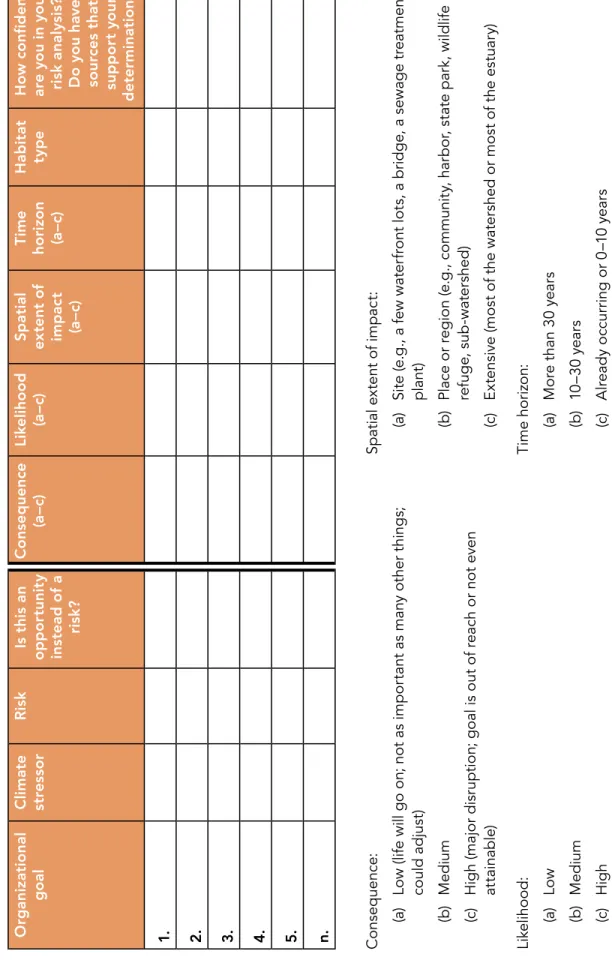
The work in this step involves using your understanding of your place to identify risks by thinking about how climate change stressors would interact with your organization’s goals. Compile a list of all of your risks in Table 3-3 using information in the checklists of Tables 3-1a through 3-1d and anything you add to Table 3-2.
What is a “risk”?
Risks threaten things that are of value. In the context of climate change, a risk is the possibility that a given climate change stressor will affect your organization’s ability to meet its goals. A risk is a problem to be managed by finding ways to lower its principal characteristics: likelihood and consequence. In this step, you will cross your goals with climate change stressors to identify risks.
Climate change stressors
The Workbook uses seven types of climate change stressors to organize thinking:
• Warmer summers (overall climate)
This stressor is generally about the warm season being even warmer. This stressor (like warmer winters, below) is about the general climate. Air, surface, soil and groundwater temperatures will be warmer. The general climate effects of having warmer oceans or lakes are included here. • Warmer winters (overall climate)
This stressor is about a cold season not being as cold as it formerly was. • Warmer water
This stressor (regardless of season) comes from a higher temperature of water bodies (including the ocean) and affects the chemical, physical or biological characteristics of the water body itself. • increasing drought
Drought is a deficiency in precipitation over an extended period. The magnitude of the deficiency, the duration or the number of droughts could be greater.
• increasing storminess
This category encompasses all aspects of intensifying precipitation in any form: more seasonal precipitation, more total precipitation during events, higher rates of precipitation during events. Stronger or more frequent instances of extratropical and tropical cyclones, blizzards or other weather conditions are included here. If they are acting as stressors, then floods, waves, coastal storm surge and wind are part of this storminess category.
• Sea level rise
This stressor is about the ocean being higher than it formerly was. It includes effects of higher water levels right at the shore, as well as how elevated coastal water levels affect inland systems. • Ocean acidification
For the Workbook, this category is primarily conceptualized as related to ocean acidification via
atmospheric inputs of carbon dioxide.
If you find that your place is impacted by an additional climate stressor that is not listed above, then add it to your set. Conversely, for your risk identification, if a stressor is not relevant to what your organization does, or if there are good reasons to believe the impact it is associated with would not matter, then omit it.
Risk paths
Recall that a risk is the possibility that a given climate change stressor will affect your organization’s ability to meet its goals. Stressors and goals are embedded in the risk. You could be prevented from reaching a goal because the environment changes in some way or because the projects you undertake to reach your goal would fail in some way.
If there is any potential sequence (climate change stressor, and what follows) for an unwanted
consequence (not reaching your goal), then you have a risk. The risk develops along the path between the cause and the effect. For example:
• Stressor X could , and the result is that we might not attain Goal Y.
• Warmer water (stressor) could lead to bacteria being more abundant in the river (path), and we might not be able to provide healthy drinking water (unrealized goal).
• More intense precipitation (stressor) could lead to flooding that knocks a sewage pump station offline (path) and we might not be able to treat all the sewage that is discharged to the bay (unrealized goal).
• Sea level rise (stressor) will lead to more beach erosion (path) and we might not be able to maintain the endangered bird species nesting sites (goal).
F
igure3-1.
The top diagram depicts an ideal business as usual scenario. At your place, yourorganization undertakes various projects that help you to achieve your goals. In the bottom diagram a climate change stressor is introduced to the business as usual situation (or to a no-action scenario). The stressor could change the way the environment functions or change the effectiveness of the projects that you would undertake, and potentially lead to unrealized goals. After the stressor is introduced, if you can describe some chain of events that could happen that might keep you from realizing a goal, then you have a risk.
Local environment +
Organizational projects
Business as usual Climate change
stressor
Achieve goal
Achieve goal
Paths can be simple or complex. Paths might involve contingencies or future human activity.
A diagram of a system can be very helpful for visualizing how climate change stressors could alter its operations. It is not necessary to have climate change stressors in the diagram; the illustrations are just a tool to help you think about where stressors could introduce unwanted effects. Diagrams can be simple sketches of sequential events (Figure 3-2). If you can easily locate a conceptual diagram (Appendix D) for a system comparable to yours, then a tool like that can be useful as well. Diagrams do not have to be comprehensive or even exact representations of reality. They are simply tools to help you brainstorm and identify risks.
Most strategic initiatives are built on existing processes, and much of the organization is involved in the day-to-day work of delivering service to our customers. The Postal value chain is a series of closely linked processes, supported by a common infrastructure.
The overall quality and cost of the system depends not only on the actions of the Postal Service, but also on the actions of mailers and mail service providers.
Value Chain
U.S. Postal Service
F
igure3-2.
A visual depiction of the current system helps with identifying risks. Climate change stressors like increasing storminess or hotter summers can be imagined to affect efficient mail delivery in many ways. A diagram like this, from the USPS FY 2012 Annual Report to Congress, helps prompt questions such as “How would more wind and rain affect maintenance at post offices?” “Would hotter conditions require more air conditioning?” “Does increasing temperature affect vehicle or aircraft operations”? “Would more intense precipitation or more heat alert days affect mail delivery?” You might have come up with these risks even without an illustration—but if you can have a diagram that helps you think, then use it.What you need to do
Every path that you can conceive is a risk to a goal and should be recorded in this risk identification step. At this point, you need to rely on your expertise and knowledge about your system. In this step you want to come up with as many of those possible pathways as you can.
Cross each climate change stressor with each of the goals you listed in Step 2. The intent is to generate a list of the ways that each stressor could keep you from reaching the goal. This is much like a brainstorming session. See Figure 3-3 for an example of how the process works for one goal and one stressor.
F
igure3-3.
An example of how to generate a list of what could happen in the space between introduction of a stressor and failure to realize a goal.Record each risk (stressor, path and goal) in Table 3-3. If a potential risk is not identified in this step, it will not move forward in the vulnerability assessment process, so write down everything. Step 4—Risk Analysis and Step 5—Risk Evaluation: Comparing Risks are where you analyze and evaluate the list of risks you generate in this step.
Don’t dismiss risks!
Even risks that you might think are insignificant should be captured in this step. Don’t prematurely dismiss anything. You may learn that a stakeholder thinks it is important, or in some instances further analysis might show that a risk is not trivial at all. If you dismiss it now, it does not get considered later. If it is in fact a trivial risk, the systematic process of risk management allows it to be assigned to such a category in Step 4. Treat this step as a brainstorming session and document every risk you and your team can identify.
Risks are not inevitable
A risk is not certain to happen, a risk could happen. You will analyze its likelihood in Step 4. Further, if you decide that you want to change its likelihood, understanding the risk path could help you to find ways to take action. You probably cannot—by yourself—change a stressor coming from global climate change, and you probably don’t want to change your goal, so if you do want to change the likelihood or consequence of the risk you have to disrupt the path that transfers the risk from stressor to goal.
More than one problem from the same cause
The same environmental stressor may intersect with several of your goals. You may find that you
seemingly identify the same risk many times. As an example, sea level rise may push saltwater farther up rivers. This could have implications for drinking water sources, freshwater wetlands or shellfish habitat. This is why you are asked to note which organizational goal is associated with a risk. Goals are implicitly embedded in risks. In this sea level rise example, you really haven’t identified the same risk of saltwater
Warmer water
Toxicity of pollutants
may increase
Water can hold less
dissolved oxygen
Greater algae growth
may occur
Parasites and bacteria
have greater abundance,
survival or transmission
Climate change
stressor
Paths
Unrealized goal
Maintain
water
quality
reaching farther upstream three times: you have identified three separate risks that stem from the same stressor-driven process. You might design an adaptation action for the drinking water risk that leaves the other two risks intact: they really are three different risks.
Help identifying risks
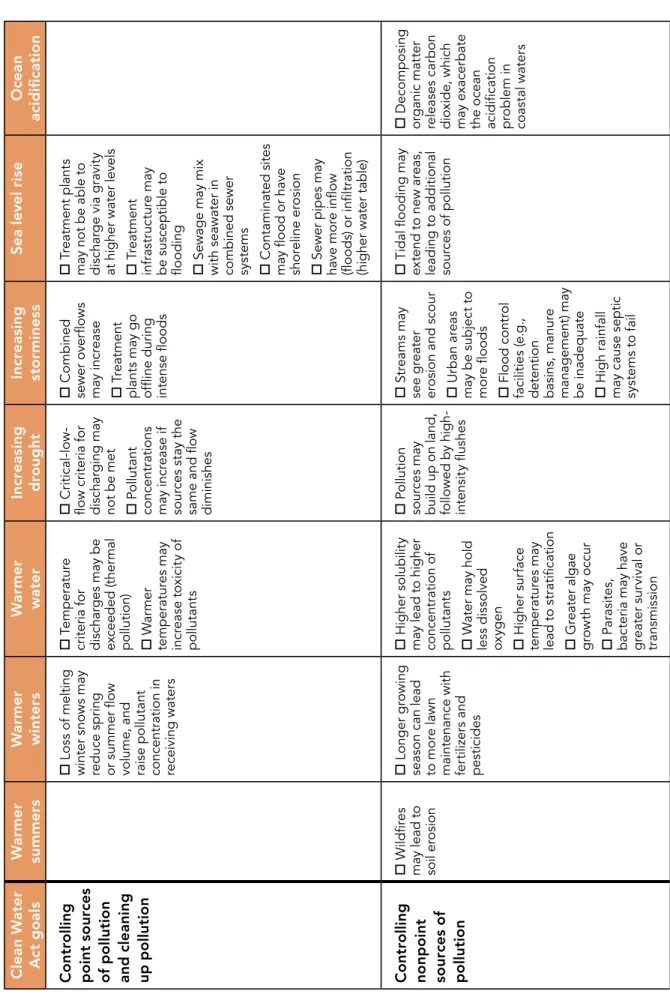
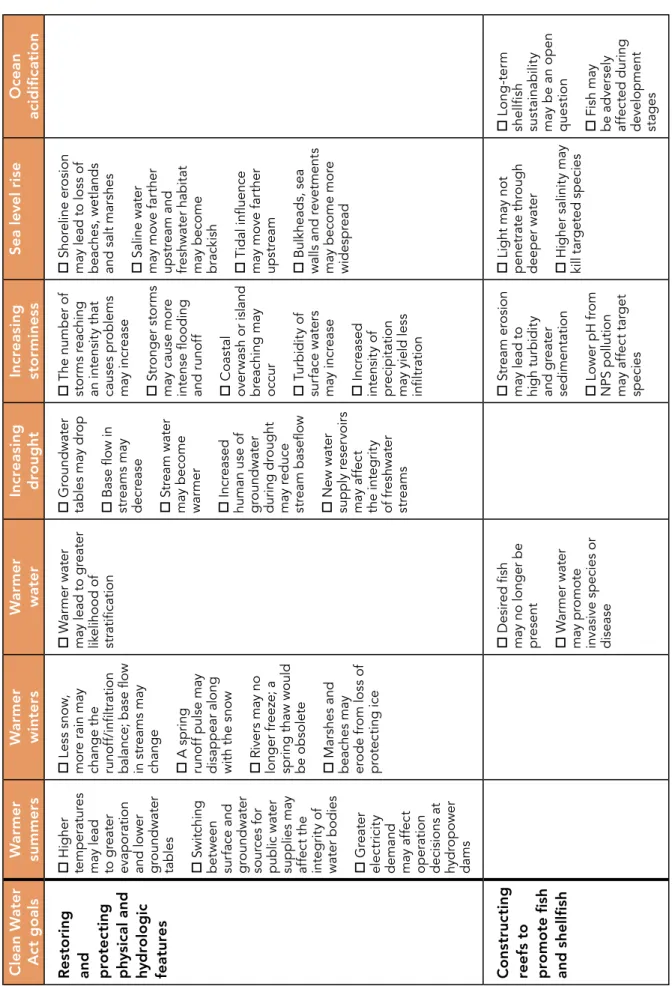
This step has four tables (Tables 3-1a through 3-1d) that cross-reference the seven types of climate change stressors with the purposes of clean water legislation to provide a starter list of more than 100 potential risks. If your organization has other types of goals, then add those goals to a table like Table 3-2 and identify the relevant climate change risks. More places to turn for risk references are listed in the “Additional Resources” section.
Opportunities (possibility of benefits)
You might identify potential circumstances arising from any of the seven climate change stressors that could be beneficial instead of harmful. These may reduce the severity of some other risk or just be positive outcomes on their own. If it is the latter, an opportunity may free resources to address other risks or even change the way your organization goes about business. If you identify any opportunities related to your organization’s goals, make note of them. They will be picked back up in your action plan to ensure that you take advantage of them.