
Sharif University of Technology
Scientia IranicaTransactions B: Mechanical Engineering www.scientiairanica.com
A novel multiple objective tness function for DSA
transmission parameter optimization
K. Chae
a, S.R. Lee
b, H. Liu
cand S. Yoon
a;a. College of Information and Communication Engineering, Sungkyunkwan University, 300 Cheoncheon-dong, Jangan-gu, Suwon-si, Gyeonggi-do 440-746, Korea.
b. Department of Information and Electronics Engineering, Mokpo National University, 1666 Cheonggye-myeon, Muan-gun, Jeollanam-do 534-729, Korea.
c. School of Electrical Engineering and Computer Science, Oregon State University, Corvallis, Oregon, 97331, USA. Received 22 May 2014; received in revised form 21 December 2014; accepted 3 February 2015
KEYWORDS Dynamic spectrum access;
Cognitive engine; Objective tness function; Transmission parameter optimization; Genetic algorithm.
Abstract. A novel multiple Objective Fitness Function (OFF) is proposed for transmis-sion parameter optimization in dynamic spectrum access. The proposed scheme consists of two phases: In the rst phase, four OFFs are individually designed, where the spectrum band index is additionally considered unlike the conventional OFFs. In the second phase, then, the individual OFFs are combined to form a multiple OFF, where the individual OFFs may be dierently stressed depending on the transmission scenario of interest. In simulation results, nally, the proposed multiple OFF is found to provide the optimal parameter set for transmission under various types of scenarios.
© 2015 Sharif University of Technology. All rights reserved.
1. Introduction
As higher date-rate wireless applications have devel-oped rapidly, nowadays, ecient use of the limited frequency spectrum has become more critical [1], and the Dynamic Spectrum Access (DSA) is considered as a solution to the spectrum scarcity problem [2], where frequency bands, that are not used as much as they could be, may be used for Secondary Users (SU), i.e. unlicensed users [3]. To utilize the underused bands, an SU detects whether or not the underused spectrum band is occupied by the Primary User (PU), and subsequently, if the band is not being used, the SU utilizes the band with the transmission parameters being optimized through a special structure called cognitive engine [4].
Considering that the channel status on each
spec-*. Corresponding author. Tel.:+82-31-290-7973; Fax: +82-31-290-7231
E-mail address: [email protected] (S. Yoon)
trum band could be dierent, it would be better for the SU if we could select a spectrum band with the best channel status out of the vacant spectrum bands. So, in this paper, we consider a transmission param-eter optimization taking the spectrum band selection into account, unlike the conventional optimization methods [5-8], and develop the associated multiple Objective Fitness Function (OFF) to be incorporated in a cognitive engine. We consider a cognitive engine based on the Genetic Algorithm (GA) in this paper.
Although the development of the multiple OFF was investigated preliminarily in [9,10]. Chae et al. [9,10] do not provide details of each individual OFF design and the multiple OFF development, and moreover, due to the limitations, both, in the range of the spectrum band measured in a real environment and in the diversity of the transmission parameter set and scenario used in simulation, the results presented in [9,10] are not enough to validate the performance and the applicability to real environments of the multi-ple OFF. In this paper, we provide a detailed discussion
of the four individual OFFs and the multiple OFF, and present extensive numerical results, validating the use of the proposed multiple OFF in real environments.
The remainder of this paper will proceed as follows. Section 2 introduces the cognitive engine with its OFF, and Section 3 rst designs four individual OFFs including the spectrum band selection as a parameter, and then, develops a multiple OFF. Sec-tion 4 shows that the proposed multiple OFF performs well for parameter optimization under various types of transmission scenarios via numerical results, and nally, Section 5 concludes this paper.
2. System model
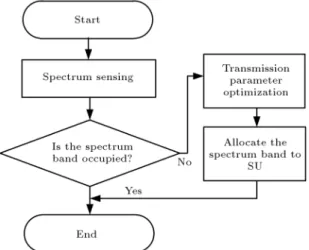
Assuming that environment parameters such as noise density are given, we can depict the overall process of the DSA incorporating the transmission parameter optimization as shown in Figure 1. Conventionally, the following three transmission parameters are considered in the optimization process: The SU transmit power, the modulation index, and the SU signal bandwidth. However, it should be noted that the transmission channel status also strongly depends on the spectrum band, and thus, in this paper, we include the spectrum band index as a new transmission parameter to be optimized and denote the four parameters by Ps, M,
Bs, and k, respectively.
In a cognitive engine based on the GA, each candidate of the transmission parameters is represented by multiple bits on a chromosome structure depicted in Figure 2. In this paper, we consider a chromosome
Figure 1. Transmission parameter optimization in DSA systems.
Figure 2. An example of a chromosome structure representing the transmission parameters.
structure with a length of ten bits to represent the four transmission parameters: The rst four bits are assigned for Ps, and the three two-bit strings of the
following six bits are assigned for M, Bs, and k,
respectively, i.e. we consider 16(24), 4(22), 4(22), and
4(22) candidates of Ps, M, Bs, and k, respectively.
Denoting the individual OFFs corresponding to the four transmission parameters by fflg4l=1 each and
the weight values of the individual OFFs by fwlg4l=1
each, we can represent the multiple OFF f as: f =X4
l=1
wlfl; (1)
i.e. as a weighted sum of the individual OFFs, where 0 fflg4l=1 1 and
P4
1wl = 1. Each individual
OFF represents a performance measure associated with each transmission parameter, and the weight values reect the priority among the performance measures for a given transmission scenario, e.g. the throughput measure would be more weighted for multimedia data transmission, and on the other hand, high reliability transmission would give more weight to the error rate measure.
3. Proposed OFFs
In the rst part of this section, we present four perfor-mance measures associated with the four transmission parameters, and design four individual OFFs for the four performance measures. Next, in the second part, the designed individual OFFs are combined to form a multiple OFF, and the overall optimization process incorporating the multiple OFF is described.
3.1. Four individual OFFs
3.1.1. Individual OFF for SU transmit power
The Bit Error Rate (BER) is one of the best perfor-mance measures for the SU transmit power, since the BER is strongly related to the signal transmit power for a given background noise density. Specically, the BER, denoted by Pb, can be represented as:
Pb= B 2Ps
s log2(M) N0; (2)
where N0 is the noise density. Then, considering that
the OFF value is between 0 and 1, we design the individual OFF f1 as:
f1=loglog10(0:5) log10(Pb) 10(0:5) log10(Pbmin)
; (3)
for the SU transmit power, where Pmin
b represents the
minimum value of Pb.
From Eq. (3), it is easily observed that f1achieves
the maximum and minimum values, i.e. 1 and 0, when Pb = Pbminand 0.5 (the worst case value), respectively.
3.1.2. Individual OFF for modulation index
It is well known that a higher modulation index yields a higher throughput, and thus, it is natural to choose the throughput as a performance measure associated with the modulation index. Denoting the maximum and minimum modulation indices given in a transmission scenario by Mmax and Mmin, respectively, we design
the individual OFF f2 as:
f2= loglog2(M) log2(Mmin)
2(Mmax) log2(Mmin); (4)
for the modulation index, where we can see that the maximum and minimum values of the individual OFF are obtained when M = Mmax and Mmin, respectively.
3.1.3. Individual OFF for SU signal bandwidth As the SU bandwidth becomes wider, the SU system performs better; however, at the same time, the SU interference to the PU increases. Since the SU is an unlicensed user, the interference to the PU caused by the SU bandwidth should be strictly controlled. Considering that the SU transmit power as well as the SU signal bandwidth has a large inuence on the interference, we design the individual OFF f3 as:
f3= 1 a
Ps Psmin
Pmax
s Psmin
b
Bs Bsmin
W (k) Bmin s
; (5) for the SU bandwidth, where the positive numbers a and b add up to one and reect the relative inuences of the SU transmit power and bandwidth, respectively, on the interference to the PU; Pmax
s and Psminrepresent
the maximum and minimum values of Ps, respectively,
W (k) is the kth PU spectrum bandwidth, and Bmin s is
the minimum value of Bs and is less than or equal to
W (k).
3.1.4. Individual OFF for spectrum band index Prior to the transmission parameter optimization, a detection process, called the spectrum sensing, is per-formed to nd vacant spectrum bands among spectrum bands assigned to the PU. The spectrum sensing often provides more than two spectrum bands as vacant ones, and thus, it would be useful if we could choose one with the best channel status among the provided vacant spectrum bands. In this paper, we dene the best vacant spectrum band as one with the highest vacancy probability and the largest bandwidth among the vacant spectrum bands detected by the spectrum sensing.
Since the spectrum sensing is a detection process based on a comparison between a test statistic and a threshold for a given spectrum band, as the dierence between the test statistic and threshold becomes larger, the detection probability increases and the vacancy probability, in which the associated spectrum band is
vacant, also increases. Considering that all of the terms in an individual OFF have values between 0 and 1, thus, we design the term:
D(k) Dmin
Dmax Dmin
; (6)
to take the vacancy probability into account in select-ing the best vacant spectrum band, where D(k) = T (k) (k) with T (k) a test statistic and (k) a threshold of the kth spectrum band, and Dmax and
Dmin represent the maximum and minimum values of
D(k), respectively. Similarly, denoting the maximum and minimum values of the kth spectrum bandwidth W (k) by Wmax and Wmin, respectively, we design the
term:
W (k) Wmin
Wmax Wmin
; (7)
which becomes 1 and 0 when W (k) = Wmaxand Wmin,
respectively.
In addition, we consider the suitability of the SU signal bandwidth to the vacant spectrum bands, i.e. the vacant spectrum bandwidth would be eciently used if we could choose a vacant spectrum band with a bandwidth similar to the SU signal bandwidth. Thus, adding the term:
Bs Bsmin
W (k) Bmin s
; (8)
where Bmin
s is the minimum value of the SU signal
bandwidth Bs, and combining Formulae (6) to (8), we
obtain the individual OFF f4 as:
f4=x
D(k) Dmin Dmax Dmin
+ y
W (k) Wmin Wmax Wmin
+ z
Bs Bsmin
W (k) Bmin s
; (9)
where the positive numbers x, y and z add up to one and reect the relative contributions of the vacancy probability, the PU bandwidth, and the SU bandwidth, respectively, on the selection of the best vacant spec-trum band.
3.2. Multiple OFF
From Eqs. (1), (3), (4), (5) and (9), we can depict the overall transmission parameter optimization process incorporating the proposed multiple OFF as shown in Figure 3, where the environment parameters are provided by the spectrum sensing process, and the GA continues to evaluate the multiple OFF with the candidate values of the transmission parameters until it obtains the optimum transmission parameters maximizing the multiple OFF.
Figure 3. The overall process of the proposed transmission parameter optimization method.
As mentioned earlier, the weight values of the multiple OFF depend on given transmission scenarios: For example, since the BER and throughput are the most important performance measures for high relia-bility transmission and multimedia data transmission, respectively, w1and w2would be larger than the others
for the former and latter transmission, respectively. In the next section, we demonstrate the optimization results for various transmission scenarios to validate the performance of the proposed multiple OFF. 4. Simulation results and discussion
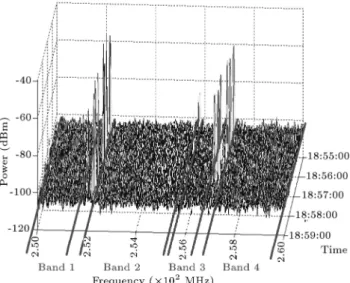
For simulations, we developed a cognitive engine incorporating the proposed multiple OFF based on the MATLAB graphic user interface programming; a screen shot of its control panel is shown in Figure 4, where we can input weights of the multiple OFF and candidate values of the transmission parameters. To validate the performance of the proposed multiple OFF in real environments, we use the spectrum bands of [250 MHz, 260 MHz] and [210 MHz, 220 MHz]
Figure 4. The cognitive engine simulator.
Figure 5. The frequency spectrum of [250 MHz, 260 MHz] bands.
Figure 6. The frequency spectrum of [210 MHz, 220 MHz] bands.
measured in urban areas which are shown in Figures 5 and 6, where Band 1 Band 4 represent vacant spectrum bands detected by the spectrum sensing.
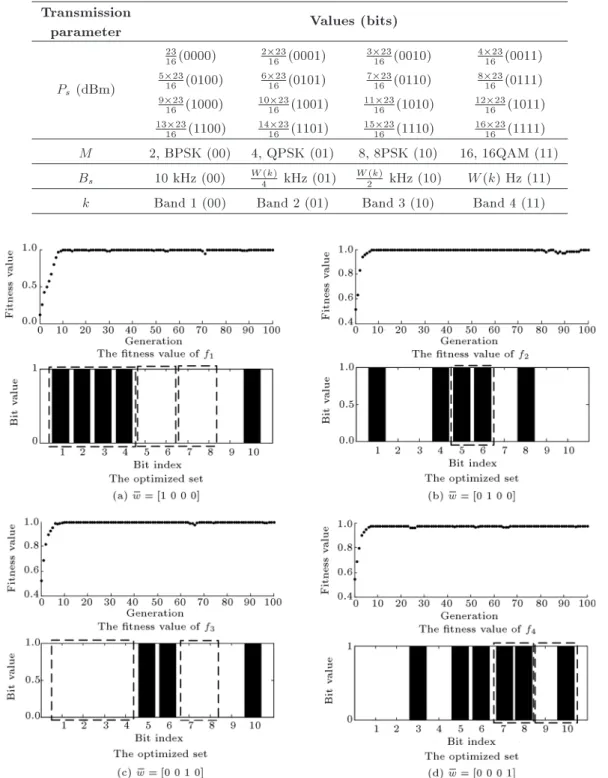
Table 1 shows the candidate values of the four transmission parameters (Ps, M, Bs, and k) and the bit
representation of each candidate value. The noise den-sity N0 is obtained from the spectrum band with the
lowest power density between 250 MHz and 260 MHz; the spectrum sensing uses an energy detector [11] with a threshold determined with the false alarm probability of 0.01. For the multiple OFF, a and b are set to 1
2 in
f3, and x, y, and z are set to 13 in f4.
4.1. Verication of the individual OFFs
To verify the performance of the four individual OFFs, in this section, we use the following unit vectors:
w = [w1; w2; w3; w4] = [1; 0; 0; 0]; [0; 1; 0; 0]; [0; 0; 1; 0],
and [0; 0; 0; 1] with which the multiple OFF reduces to f1, f2, f3, and f4, respectively.
Table 1. Candidates of transmission parameters. Transmission
parameter Values (bits)
Ps (dBm)
23
16(0000) 22316 (0001) 32316 (0010) 42316 (0011) 523
16 (0100) 62316 (0101) 72316 (0110) 82316 (0111) 923
16 (1000) 102316 (1001) 112316 (1010) 122316 (1011) 1323
16 (1100) 142316 (1101) 152316 (1110) 162316 (1111)
M 2, BPSK (00) 4, QPSK (01) 8, 8PSK (10) 16, 16QAM (11) Bs 10 kHz (00) W (k)4 kHz (01) W (k)2 kHz (10) W (k) Hz (11)
k Band 1 (00) Band 2 (01) Band 3 (10) Band 4 (11)
Figure 7. Fitness values and optimized sets when: (a) w = [1; 0; 0; 0], (b) w = [0; 1; 0; 0], (c) w = [0; 0; 1; 0] and (d)
w = [0; 0; 0; 1] in the spectrum band of [250 MHz, 260 MHz].
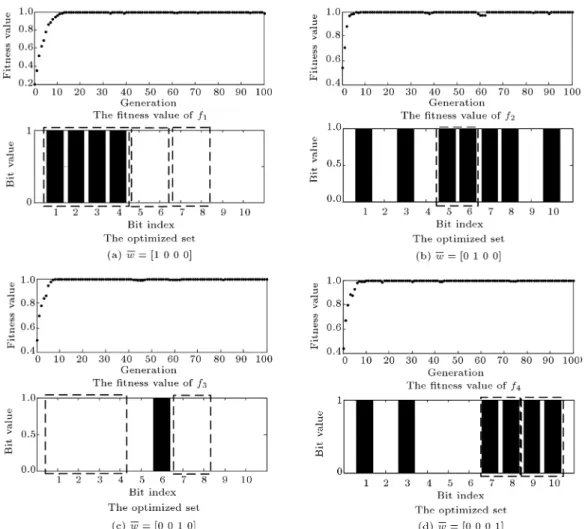
Figures 7 and 8 show the tness value of each individual OFF and the optimized set when w = [1; 0; 0; 0], w = [0; 1; 0; 0], w = [0; 0; 1; 0], and w = [0; 0; 0; 1] in the spectrum bands of [250 MHz, 260 MHz] and [210 MHz, 220 MHz], respectively.
From Figuers 7(a) and 8(a), it is seen that the individual OFF f1 converges to one, yielding an
optimized parameter set; it is observed that the
1st-4th bits of the chromosome are `1111', the 5th and 6th bits are `00', and the 7th and 8th bits are `00', which means that the SU signal is transmitted with the highest transmit power, the lowest modulation index, and the narrowest bandwidth. Yet, the SU spectrum band is randomly selected since the individual OFF f1
is not a function of k.
Figure 8. Fitness values and optimized sets when: (a) w = [1; 0; 0; 0], (b) w = [0; 1; 0; 0], (c) w = [0; 0; 1; 0], and (d)
w = [0; 0; 0; 1] in the spectrum range of [210 MHz, 220 MHz].
the 5th and 6th bits are `11', which means that the highest modulation index is selected. However, the individual OFF f2 is not a function of the other
parameters, and thus, the 1st-4th bits and 7th-10th bits are randomly selected by the GA.
From Figures 7(c) and 8(c), we can observe that the 1st-4th bits are `0000' and the 7th and 8th bits are `00', which allow the SU signal to have the lowest power and the narrowest bandwidth, and thus, the interference to the PU is minimized (i.e., f3 is
maximized).
From Figures 7(d) and 8(d), we can observe that the 9th and 10th bits are `01' in Figure 7(d) and `11' in Figure 8(d). Thus, Band 2 in the spectrum band of [250 MHz, 260 MHz] and Band 4 in the spectrum band of [210 MHz, 220 MHz] are chosen, which are the largest ones in each spectrum band. In addition, it is seen that the 7th and 8th bits of the chromosome are `11' both in Figures 7(d) and 8(d), which means that the SU uses the whole spectrum of the largest band. On the other hand, for the transmit power (the 1st-4th bits) and the modulation index (the 5th and 6th bits), the corresponding bit values are randomly
selected since the individual OFF f4 is not a function
of Ps and M.
4.2. Transmission parameter optimization with the multiple OFF
Figures 9 and 10 show the parameter optimization results for various transmission scenarios including the multimedia service mode, high reliability service mode, and low PU interference service mode in the spectrum bands of [250 MHz, 260 MHz] and [210 MHz, 220 MHz], respectively.
Figures 9(a) and 10(a) show the vectors and optimization results for the multimedia service mode. Since the throughput and data rate are the most important measures in the multimedia service mode, we give more weights to f2 and f4 to obtain a higher
modulation index and a wider bandwidth, and thus, the optimization yields a set with the highest modulation index (16) and the widest bands (Band 2 and Band 4 in the spectrum bands of [250 MHz, 260 MHz] and [210 MHz, 220 MHz], respectively).
Figures 9(b) and 10(b) show the vectors and optimization results for the high reliability service
Figure 9. Optimized sets for the (a) multimedia service mode, (b) high reliability service mode, and (c) low PU interference service mode in the spectrum band of [250 MHz, 260 MHz].
Figure 10. Optimized sets for the (a) multimedia service mode, (b) high reliability service mode, and (c) low PU interference service mode in the spectrum band of [210 MHz, 220 MHz].
mode. In this mode, the SU needs a low BER to transmit data with a high reliability. The highest transmit power (23 dBm), the lowest modulation index (2), and the narrowest SU bandwidth (10 kHz) are selected from the gures. On the other hand, Band 2 is selected due to the weight value of f3 being the
second largest.
Figures 9(c) and 10(c) show the vectors and optimization results for the low PU interference mode, where we can observe that the lowest transmit power (23
16 dBm) and the narrowest SU bandwidth (10 kHz)
are selected. On the other hand, the largest modulation index (16) is selected due to the weight value of f2being
the second largest. 5. Conclusion
A novel multiple OFF has been proposed to provide the SU with an optimized transmission parameter set in DSA systems. Including the spectrum band index as a new optimization parameter, we have modeled the mul-tiple OFF as a weighted sum of four individual OFFs. Subsequently, we have designed the four individual OFFs, based on the performance measures associated with the transmission parameters, and then, we have obtained the multiple OFF by combining the designed four individual OFFs. Numerical results demonstrate that the individual OFFs achieve their goals, and also, the multiple OFF performs well in optimizing the SU transmission parameters under a variety of scenarios. Acknowledgments
This research was supported by the Ministry of Sci-ence, ICT and Future Planning (MSIP), Korea, under Grant IITP-2015-H8601-15-1006 of the Convergence Information Technology Research Center (C-ITRC) program supervised by the Institute for Information and Communications Technology Promotion (IITP) and by Priority Research Centers Program through the NRF of Korea under Grant 2009-0093828 with funding from the Ministry of Education, Science and Technology.
References
1. Nair, S.S., Schellenberg, S., Seitz, J. and Chatterjee, M. \Hybrid spectrum sharing in dynamic spectrum access networks", In Proc. International Conference on Information Networking (ICOIN), Bangkok, Thailand, pp. 324-329 (2013).
2. Song, M., Xin, C., Zhao, Y. and Cheng, X. \Dynamic spectrum access: from cognitive radio to network radio", Int. J. Next-Generation Networks, 19(1), pp. 23-29 (2012).
3. Yadav, P., Chatterjee, S. and Bhattacharya, P.P.
\A survey on dynamic spectrum access techniques in cognitive radio", Int. J. Next-Generation Networks, 4(4), pp. 27-46 (2012).
4. Yuech, T. and Arslan, H. \A survey of spectrum sensing algorithms for cognitive radio applications", IEEE Commun. Surveys & Tutorials, 11(1), pp. 116-130 (2009).
5. Rieser, C.J. \Biologically inspired cognitive radio en-gine model utilizing distributed genetic algorithms for secure and robust wireless communications and networking", Ph.D. Dissertation, Virginia Polytechnic Institute and State University, Blacksburg, VA (2004). 6. Rondeau, T.W., Le, B., Rieser, C.J. and Bostian, C.W. \Cognitive radio with genetic algorithms: Intelligent control of software dened radios", In Proc. Software Dened Radio Forum Tech. Conf., Phoenix, AZ, pp. C3-C8 (2004).
7. Maldonado, D., Le, B., Hugine, A., Rondeau, T.W. and Bostian, C.W. \Cognitive radio applications to dynamic spectrum allocation", In Proc. IEEE Int. Symp. New Frontiers in Dynamic Spectrum Access Networks, Baltimore, MD, pp. 597-600 (2005). 8. Wang, L.-C., Wang, C.-W. and Adachi, F.
\Load-balancing spectrum decision for cognitive radio net-works", IEEE J. Selected Areas in Commun., 29(4), pp. 757-769 (2011).
9. Chae, K., Lee, Y. and Yoon, S. \A novel cognitive engine based on genetic algorithm", in Proc. Int. Conf. Syst. Networks Commun. (ICSNC), Venice, Italy, pp. 42-45 (2013),
10. Chae, K., Liu, H. and Yoon, S. \Transmission param-eter optimization method for GA-based cognitive en-gines", In Proc. Int. Conf. Wireless Networks (ICWN), Las Vegas, NV, pp. 139-143 (2014).
11. Urkowitz, H. \Energy detection of unknown determin-istic signals", Proc. IEEE, 55(4), pp. 523-531 (1967).
Biographies
Keunhong Chae received the BSe degree in In-formation and Communication Engineering from Sungkyunkwan University, Suwon, Korea, in 2014. He is currently working toward the PhD degree in the College of Information and Communication Engineer-ing, Sungkyunkwan University. His research interests include binary oset carrier modulation and cognitive radio.
Seong Ro Lee received the BS degree in Electronics Engineering from Korea University, Seoul, Korea, in 1987, and the MS and the PhD degrees in Electrical Engineering from Korea Advanced Institute of Science and Technology, Daejeon, Korea, 1990 and 1996, re-spectively. In September 1997, he joined the Division of Electronics Engineering, Mokpo National University,
Jeonnam, Korea. His research interests include digital communication system, mobile and satellite commu-nications system, applications of telematics, USN and embedded system. He serves as chairman of detection and estimation committee for the Korea Information and Communications Society.
Huaping Liu received the BS and MS degrees in Electrical Engineering from the Nanjing University of Posts and Telecommunications, Nanjing, China, in 1987 and 1990, respectively, and the PhD degree in Electrical Engineering from the New Jersey Institute of Technology, Newark, NJ, USA, in 1997. From July 1997 to August 2001, he was with Lucent Technologies, Whippany, NJ, USA. Since September 2001, he has been with the School of Electrical Engineering and Computer Science, Oregon State University, Corval-lis, OR, USA, where he is currently a Professor. His research interests include ultra-wideband systems, multiple-input multiple-output antenna systems,
chan-nel coding, and modulation and detection techniques for multiuser communications.
Seokho Yoon received the BSe (summa cum laude), MSe, and PhD degrees in Electrical Engineering from Korea Advanced Institute of Science and Technology (KAIST), Daejeon, Korea, in 1997, 1999, and 2002, respectively. From March 2002 to June 2002, he was with the Department of Electrical Engineering and Computer Science, Massachusetts Institute of Technology (MIT), Cambridge. From July 2002 to February 2003, he was with the Department of Elec-trical Engineering, Harvard University, Cambridge, as a Postdoctoral Research Fellow. In March 2003, he joined the College of Information and Communication Engineering, Sungkyunkwan University, Suwon, Korea, where he is currently an Associate Professor. His research interests include spread spectrum systems, mobile communications, detection and estimation the-ory, and statistical signal processing.
![Figure 9. Optimized sets for the (a) multimedia service mode, (b) high reliability service mode, and (c) low PU interference service mode in the spectrum band of [250 MHz, 260 MHz].](https://thumb-us.123doks.com/thumbv2/123dok_us/8385073.2227855/7.892.518.774.152.722/figure-optimized-multimedia-service-reliability-service-interference-spectrum.webp)
