Sharif University of Technology
Scientia IranicaTransactions B: Mechanical Engineering www.scientiairanica.com
An evolutionary method to vision-based
self-localization for soccer robots
C.-Y. Chen
and C.-C. Ko
Department of Information and Telecommunications Engineering, Ming Chuan University, Taoyuan, Taiwan, ROC. Received 22 May 2014; accepted 28 April 2015
KEYWORDS Evolutionary algorithm; Omnidirectional vision system; Soccer robot; Self-localization; Path planning.
Abstract. In this paper, a method using an evolutionary algorithm to automatically set-up the color-feature model of an omnidirectional vision system will be introduced. The mentioned method, in addition to avoiding the issue of over-reliance on lighting conditions when the soccer robot is performing image processing, can also very eectively speed up the parameter setup procedure of the robot vision system. Hence, when the robot is moving in the soccer eld, it can nish target object detection and self-localization in real time. In order to verify the eectiveness of the mentioned method, tests have been conducted under dierent bad lighting conditions, and the experimental results show that the soccer robot can always set up the parameters of the vision system. It can also set up the color-feature model that is applicable to the operational environment at that moment and detect target objects such as goals and the eld. Meanwhile, through relative location between detected target objects and the robot, self-localization and path planning can be nished.
© 2015 Sharif University of Technology. All rights reserved.
1. Introduction
The design of intelligent robots has become one of the developmental focuses of international academic research and industry application in recent years, and some advanced industrialized countries have even treated robot competitions as a strategic means to promote domestic creativity teaching. Currently, there are two robot-soccer associations, RoboCup and FIRA, devoting to the promotion of robot soccer games [1,2], and each year, international cup robot soccer games and international forums are held regularly for the exchange of research results. The robot soccer game is interdisciplinary integrated research work covering articial intelligence, automatic control, image process-ing, mechanism design, sensor systems and electronic communication. The holding of robot soccer games can internationally promote and stimulate the exchange
*. Corresponding author. Tel.: +886-3-350-7001#3737; Fax: +886-3-359-3879
E-mail address: [email protected] (C.-Y. Chen)
and development of technology related to articial intelligence, the strength design of mechanisms and multi-sensor system applications. In order to allow robots the means to play soccer in the soccer eld in-dependently, from a practical design aspect, the robot must be able to, from image analysis results, decide the movement direction of the robot body. Meanwhile, it must be able to implement functions such as path plan-ning, avoiding obstacles and dynamic object tracking. Moreover, cooperative strategies among several soccer robots, such as assisting, defending and ball passing, should also be considered. The design process can not only eectively enhance the students' implementation capability, but can also help the incubation of creativity and a collaborative spirit. Hence, its importance has received more and more attention from both academia and industry.
The design of a vision system is core technology for a robot. Although academia has spent several decades studying human vision systems, the related functions and principles of the human eye still cannot be fully understood. Hence, the use of machine vision
2072 C.-Y. Chen and C.-C. Ko/Scientia Iranica, Transactions B: Mechanical Engineering 22 (2015) 2071{2080
to simulate human vision is a pretty tough challenge. After a robot has used a vision system to complete the image analysis of the peripheral environment, based on recognition and judgment, the robot can then make a correct response. For video input amounts of 30 images per second, if massive features need to be found and compared for each image, it is not dicult to imagine that there is a huge amount of image and operational data hidden behind the vision system of the robot. Not only this, during the processing process, if situations such as optical source conditions or vision angles change, or if the sudden disappearance or emergence of objects in the environment are encountered, a exible response is needed. That is, when the visional system of a robot is facing environmental changes, its image processing must be very robust. Only when the robot can process environmental uncertainty correctly can its utility goal be reached.
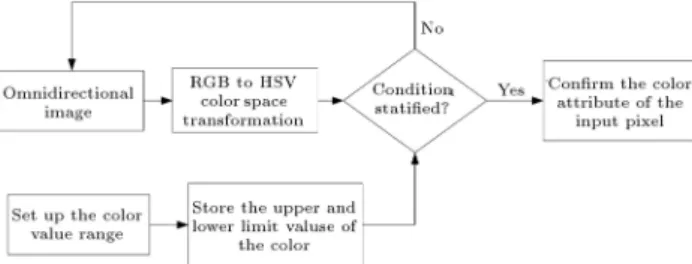
In the eld of the robot soccer game of the FIRA association, the appearance of target objects is distinguished by specic colors. Here, the robot is black, the soccer eld is a green background painted with white lines, the soccer ball is orange, and the gates at both sides of the eld are, respectively, yellow and blue. Therefore, if the robot is to have the capability of identifying the target object in the soccer eld, the simplest method is to use the color information of the target object as a feature. After the image is acquired by the omnidirectional camera at the top of the robot, the image information will be transmitted through the YUV color system, and then converted into the RGB color system to be used by the subsequent image analysis module. Digital images, using the RGB color system, could be easily and signicantly aected by optical beam changes. Hence, before performing image analysis, we will rst use the look-up table method to perform color space transformation from RGB to HSV, so as to reduce the inuence of brightness on the color of the object [3]. After completing image transformation, we need to set up the upper and lower limit values of the color of each target object, and set up the color-feature model. Using the setup color feature model, we can then detect and extract target objects, such as balls and gates, from dierent input images. The process is shown in Figure 1.
Figure 1. The setup process of the color-feature model of the FIRA robot system.
In the current architecture of FIRA medium-sized soccer robots, the participant must, based on the lighting condition of the operation site, manually set up, one by one, the color range value of each robot on all the target objects in the soccer eld, in order to set up a color-feature model that can meet the needs. Such a model construction method, based on the trial and error method, is very tedious and time-consuming. In fact, in the current rules, even in the indoor game, the luminance of the game site still allows a dierence within 300 lumens. Hence, the light source within the environment of the game site is not uniform and consis-tent. As the robot moves in the soccer eld constantly, the gray levels and hues of the omnidirectional image acquired will change accordingly, too. Hence, over-simplied video processing architecture cannot satisfy the current situation. It is estimated that several years in the future, the game of a medium-sized soccer robot group will be all in natural light instead of a stable indoor lighting source, and this will bring more stringent challenges to the vision system design of the robot.
The evolutionary computing technique is an op-timal solution search mechanism that is constructed based on a biological evolutionary concept. All kinds of dicult combinatorial optimization problems can be solved by its use. After almost 30 years of eort, evo-lutionary computing has its own unique research eld, which includes Evolution Strategy (ES), Evolutionary Programming (EP), Genetic Algorithm (GA), Simu-lated Annealing (SA), PSO [4], and Ant Colony Opti-mization (ACO). All these computing techniques have respective advantages and disadvantages: Take GA, for example, it has advantages such as a parallel multi-point search and easy integration with other methods. However, the convergence speed at solving problems is not so good. Although SA has better convergence characteristics, parallel implementation is dicult [5]. Some scholars try to use the swarm intelligent behavior of natural phenomena to develop a hybrid optimization algorithm [6,7], so that complementary eects, among dierent methods, can be achieved. PSO, among lots of algorithms, has characteristics such as less parameter settings, robustness and high convergence speed [8]. Currently, in academia, much research has applied PSO in image processing, with larger amounts of computing data, in pattern recognition or video processing [9-12], and all results prove that it has a good performance on complicated problems.
In the present paper, we have presented a de-sign method for a robot evolutionary vision system based on PSO, which allows the robot to, before the operation, follow the light source environment, and make automatic evolutions for the needed color-feature model. Hence, it can replace the traditional time-consuming method based on trial and error for all
Figure 2. FIRA medium-sized soccer robot: (a) Hardware architecture; and (b) actual appearance.
kinds of parameter setup. Eventually, the robot can be more robust to cope with future ever complicated and changing game environments.
2. Introduction of FIRA medium-sized soccer robot system
The architecture of FIRA medium-sized soccer robots can be divided into a top layer omnidirectional vision system, a motor drive module and a bottom layer om-nidirectional moving mechanism. Figure 2(a) and (b) show its appearance.
2.1. Omnidirectional vision system
A Medium-sized soccer robot uses an omnidirectional camera to construct a vision system to acquire images in the peripheral environment. The output NTSC analog signal, after A/D conversion into a digital signal and after image processing and analysis, will be able to display the information of the environment. Robots equipped with omnidirectional cameras, during the game process, do not need to rotate the camera specif-ically to know the peripheral images of 360 degrees, which eectively enhances its detection capability and change-coping speed within the environment. The horizontal vision of an omnidirectional camera is 360 degrees, and the vertical vision is -10 degrees to 55 degrees, which are shown in Figure 3(a). Since an omnidirectional mirror has its image formed through optical reection of the peripheral image, which leads to serious distortion on the actually observed image, its image formation is of concentric divergence, and an object that has longer distance from the robot body itself will receive more serious distortion, as shown in Figure 3(b).
Figure 3. Omnidirectional visional system: (a) Appearance of omnidirectional visional camera; and (b) omnidirectional image.
2.2. Motor drive module and omnidirectional moving mechanism
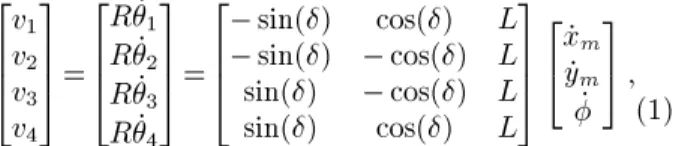
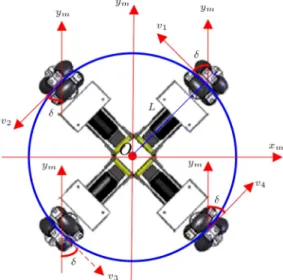
This study has used an Altera Nios II Development board to construct a motor drive module to control the rotation of the motor. The four-wheeled omni-directional chassis structure allows the robot to make 360 degrees omnidirectional movements on the ground. Thus, the mobility of the robot is eectively enhanced. Figure 4 shows the relationship between the four-wheeled chassis design structure and velocity vectors, and the four-wheeled movement equation is represented in Eq. (1) [13-15]:
2 6 6 4
v1
v2
v3
v4
3 7 7 5=
2 6 6 4
R _1
R _2
R _3
R _4
3 7 7 5=
2 6 6 4
sin() cos() L sin() cos() L sin() cos() L sin() cos() L 3 7 7 5
2 4_x_ymm
_ 3 5 ;
(1)
where vi is the moving velocity of the ith wheel; _xm
is the moving speed of the robot on the xm axis; _ym
2074 C.-Y. Chen and C.-C. Ko/Scientia Iranica, Transactions B: Mechanical Engineering 22 (2015) 2071{2080
Figure 4. The correlation between the four-wheeled omnidirectional chassis structure and velocity vectors.
is the rotational angular velocity of the robot; L is the distance from the omnidirectional wheel to the omnidirectional movement robot chassis center O; R is the radii of the omnidirectional wheel; and _i is the
rotational angular speed of the ith wheel.
3. Using PSO to construct the vision system 3.1. Particle swarm optimization
Since Kenney and Eberhart developed the PSO in 1995, it is regarded as an evolutionary computation technique to solve many optimal problems. Based on imitation of simplied social models, PSO can be considered a swarm-based learning scheme, like sh schooling and bird ocking. According to the natural foraging behavior of bird ocking, birds nd food by ocking (not by each individual). In the PSO learning process, each single solution is a bird, referred to as a particle. This PSO learning algorithm simulates the swarm-like behavior of natural creatures. The individual particles y gradually towards the positions of their own and their neighbors' best previous experiences in a huge search space. From this study, it shows that the PSO is given more opportunity to \y" into desired areas to get better solutions. Therefore, PSO can discover reasonable solutions much faster than other evolutionary algorithms. Like GA, the PSO needs to dene a proper tness function that evaluates the quality of every particle's position. The position, called the global best (gbest), is the one which has the highest tness value among the entire swarm. The location, called the personal best (pbest), is the one which has each particle's best experience. Based on every particle's momentum, and the inuence of both personal best (pbest) and global best (gbest) solutions, every particle adjusts its velocity vector at each iteration. The PSO learning formula is described
as follows [4,9]:
Vi;m(t + 1) = :Vi;m(t) + c1 rand( )
(pbesti;m(t) Xi;m(t)) + c2 rand( )
(gbestm(t) Xi;m(t)); (2)
Xi;m(t + 1) = Xi;m(t) + Vi;m(t + 1); (3)
where m is the dimensional number; i denotes the ith particle in the population; V is the velocity vector; X is the position vector; is the inertia factor; and c1and c2
are the cognitive and social learning rates, respectively. Note that these two rates control the relative inuence of the memory of particles and the neighborhood. 3.2. Using PSO to automatically set up a
color-feature model
As shown in Figure 1, soccer robot uses the color information of the target object to recognize the object. Hence, before each driving of the robot, we have to follow the lighting conditions at that time within the HSV color space and aim at each target object to set up a suitable color-feature model. The HSV color system is formed by information, such as Hue, Saturation and Value, and its advantage is in separating the brightness component from the color information. Hence, the inuences of lighting change can be reduced. When these three basic attributes are used to describe the color, it can better t human sensory recognition, compared to the RGB color system. After completing construction of the color feature model, the soccer robot can use it to analyze the image, and the specic target object meeting the threshold condition can then be recognized.
In this paper, we have used PSO to realize an evolutionary vision system, so that the robot can follow the lighting condition of the environment it is in to make automatic evolutions of the color-feature model it needs. The architecture is shown in Figure 5. Before the start of a game, when both the ball and the robot are settled at xed positions, at this moment, the soccer robot can, through the PSO algorithm, set up the needed color-feature model to complete the parameter setup procedure before the game.
3.2.1. Encoding of the particle
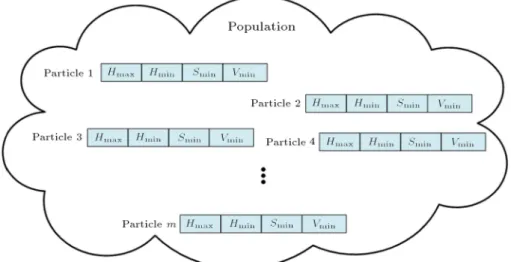
To achieve the goal of using the PSO algorithm to make the automatic evolution of a color-feature model, we rst have to generate an initial population, and the encoding value of each particle in the population represents the solution parameters of a dierent color-feature model. Evaluation of the capability to success-fully extract the target objects is its adaptability to the environment. The encoding form of the particle is shown in Figure 6. According to practical operational
Figure 5. An evolutionary visional system architecture diagram based on the PSO algorithm.
Figure 6. The encoding form of particle.
experience, we have found that under most conditions, when the upper limit values of parameters, such as the saturation and value of the color-feature model, are xed at maximal values (i.e. Smax= 100, Vmax= 100),
it facilitate extraction of the target objects. Therefore, in this research, we have set up the encoding values of the particles as the set of the upper and lower limit val-ues of Hue, and the lower threshold valval-ues of saturation and value; that is, X = fHmax; Hmin; Smin; Vming, and
0 5 H 5 360, 0 5 Smin< 100, and 0 5 Vmin< 100.
3.2.2. Fitness function evaluation
The tness function, in the PSO algorithm, is an index used to assess the tness of a particle to its environment. In this paper, we have used the target object image extracted from an optimal color-feature model using experience value as a template. Then, it
is compared, one by one, to the target object image extracted by each particle in the PSO population, to calculate the similarity between each other. Hence, the corresponding tness value can then be obtained. Eqs. (4) and (5) have explained the method, using implementation of the operation of image subtraction to assess the dierence of two target object images:
d(fTemplate; fobtained)
=
M
X
i=1 N
X
j=1
jfTemplate(i; j) fobtained(i; j)j ; (4)
Fitness = d(f 1
Template; fobtained) + eps; (5)
2076 C.-Y. Chen and C.-C. Ko/Scientia Iranica, Transactions B: Mechanical Engineering 22 (2015) 2071{2080
fTemplate is the standard extracted result of the target
objects.
The color-feature model of the soccer robot should be set up completely, according to the lighting condi-tions, before the game. After the ball and the soccer robot are settled, the robot will then start to perform the automatic setup procedure of the color-feature model. In the setup method, each particle in the PSO algorithm represents a dierent color-feature parameter set. Then, the parameter set, aiming at the acquired image, can obtain the extracted result, fobtained, for
the target object. This result will then be compared to the standard extracted result, fTemplate, which is stored
in advance in the robot. Then, an evaluation value of superior or inferior performance can be obtained. After the nishing of the iteration procedure, the optimal solution can be used to obtain the applicable color-feature model under that lighting condition. Figure 7 illustrates the use of the image subtraction method for assessing the tness value of the particle. In this gure, the encoding value of each particle corresponds to the extraction judgment condition of one set of the target object. After the subtraction is made between the extracted target object image and the sample image, the dierence pixels are represented by red. When the red block is larger, it means the error is larger, hence, the particle should have a smaller tness value. On the
contrary, when the red block is smaller, it means the tness value is larger.
After completing all particle tness value assess-ments, the next thing is to follow Eqs. (2) and (3) to correct the position and movement velocity of all the particles in the population. The search direction will, in the iterative process, gradually approach the position of global optimum.
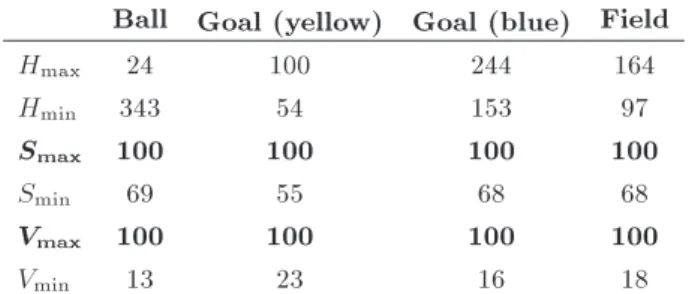
4. Implementation results and discussions Figure 8(a) is an omnidirectional image obtained un-der ideal lighting conditions, and Table 1 shows the parameter values of the color-feature model setup using trial and error. Using the extraction rules in
Table 1. The parameter values of the color-feature model under ideal lighting conditions.
Ball Goal (yellow) Goal (blue) Field
Hmax 24 100 244 164
Hmin 343 54 153 97
Smax 100 100 100 100
Smin 69 55 68 68
Vmax 100 100 100 100
Vmin 13 23 16 18
Figure 7. The calculation of the dierence among images to get the tness function assessment result.
Figure 8. Omnidirectional image under ideal lighting conditions: (a) The original image; (b) the extraction result of target objects; and (c) the recognition result.
Figure 9. Target objects detection result after lighting conditions change: (a) Brighter lighting condition; (b) the extraction result of the target objects; and (c) the recognition result.
Figure 10. Target objects detection result after lighting conditions change: (a) Darker lighting condition; (b) the extraction result of the target objects; and (c) the recognition result.
Table 1, we can obtain the extraction results of target objects, such as the ball, the goals and the eld, as in Figure 8(b). After conrming the block position of the target objects, from information, such as distance and relative angle of the center point pixel of the acquired image (Figure 8(c)), we can then calculate the actual distance and relative position of the target object in the soccer eld.
Since the lighting conditions of the soccer eld usually change, along with the game time or game site, usually, when the lighting conditions are changed, the originally setup color-feature model will have diculty in detecting the target object successfully. Figure 9(a) and Figure 10(a) show, under somehow brighter and darker lighting conditions, cases when the color-feature model of Table 1 is used to undertake target object detection. It is clear that most target objects can no longer be extracted successfully, and the results are as shown in Figure 9(b)-(c) and Figure 10(b)-(c). In the example of Figure 9, only the ball and the eld can be successfully detected, and all the blue and yellow gates cannot be detected. Figure 10 is an example of the failed detection of a yellow gate, and the blue gate and eld block in this case cannot all be fully acquired.
In order to avoid the inuence of lighting condi-tion changes on the vision system of the soccer robot, and the subsequent failure of analysis of the peripheral environment using preset judgment conditions, in this research, we have used the PSO algorithm to set up a color-feature model dynamically. Hence, we can cope with the change in lighting conditions to perform the parameter adjustment of the model. In the experiment,
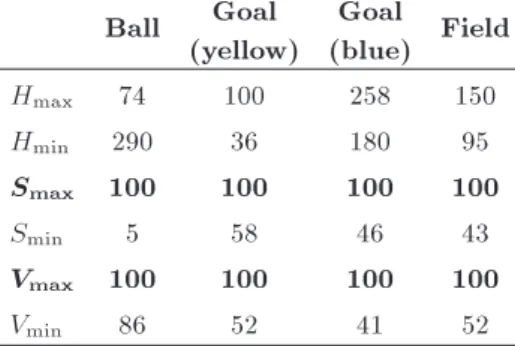
Table 2. The parameter values of the color-feature model obtained under brighter lighting condition.
Ball Goal (yellow)
Goal
(blue) Field
Hmax 74 100 258 150
Hmin 290 36 180 95
Smax 100 100 100 100
Smin 5 58 46 43
Vmax 100 100 100 100
Vmin 86 52 41 52
we have set up the number of particles of PSO to be equal to 20, the iteration number = 50, and c1= c2=
1:5.
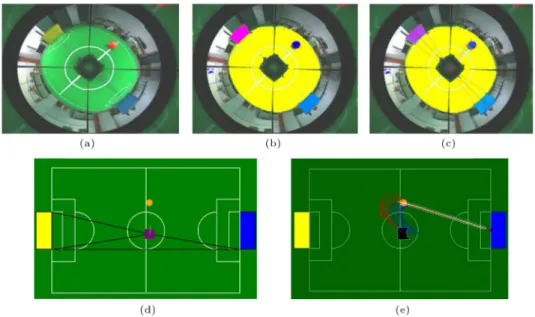
After the robot and all the target objects on the soccer eld are placed in their xed positions, Table 2 shows the obtained evolutionary color-feature model using PSO under brighter lighting conditions (Figure 11(a)). Through the extraction condition of Table 2, we can successfully detect all the target objects, as shown in Figure 11(b) and (c). After com-pleting the recognition of the target objects, the soccer robot can further use a self-localization algorithm to conrm the relationship, such as relative location and distance between the target objects [16] (Figure 11(d)). Meanwhile, soccer ball shooting is implemented accord-ing to the path plannaccord-ing result (Figure 11(e)).
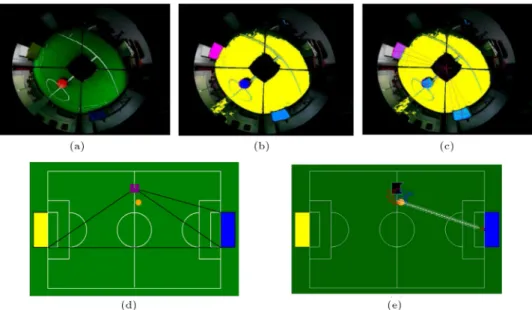
As the robot moves to dierent locations and under dierent viewing angles, the image acquired by the omnidirectional camera will change (Figure 12(a)). However, through the extraction condition of Table 2,
2078 C.-Y. Chen and C.-C. Ko/Scientia Iranica, Transactions B: Mechanical Engineering 22 (2015) 2071{2080
Figure 11. The extraction and recognition results of target objects using the color model parameters (Table 2) constructed by PSO: (a) Brighter lighting condition; (b) the extraction result of the target objects; (c) the recognition result; (d) the self-localization result; and (e) the path planning result.
Figure 12. The extraction and recognition results of target objects using Table 2 after robot has changed its position during the walking process: (a) The omnidirectional image obtained at dierent locations; (b) the extracted result of target objects; (c) the recognition result; (d) the self-localization result; and (e) the path planning result.
we can still detect all the target objects, which are as shown in Figure 12(b)-(c). Figure 12(d) shows the self-localization result, and Figure 12(e) is the path planning result.
Based on the same procedures, we have conrmed the model construction capability of PSO under a darker environment, which is shown in Figure 13(a). The parameter values obtained from the color-feature model are listed in Table 3. Figure 13(b)-(e) show the results of target object extractions, self-localization results, and path planning. Here, we can nd that the evolutionary vision system constructed based on PSO,
Table 3. The parameter values of the color-feature model obtained under brighter lighting condition.
Ball Goal (yellow)
Goal
(blue) Field
Hmax 48 110 275 143
Hmin 316 41 220 119
Smax 100 100 100 100
Smin 37 98 98 76
Vmax 100 100 100 100
Figure 13. The extraction and recognition results of target objects using the color model parameters (Table 3) constructed by PSO: (a) Darker lighting condition; (b) the extraction result of the target objects; (c) the recognition result; (d) the self-localization result; and (e) the path planning result.
Figure 14. The extraction and recognition results of target objects using Table 3 after robot has changed its position during the walking process: (a) The omnidirectional image obtained at dierent locations; (b) the extracted result of target objects; (c) the recognition result; (d) the self-localization result; and (e) the path planning result.
and under dierent lighting conditions has a very good tting capability.
Similarly, if the robot is under such a darker lighting condition, even after arbitrary movement, its vision system can still correctly analyze and recognize the acquired omnidirectional images under dierent viewing angles, as shown in Figure 14.
5. Conclusion
In this paper, a method for the automatic setup of a color-feature model using PSO is introduced. The
method can very eciently accelerate the parameter setup process of the vision system of a FIRA soccer robot. Meanwhile, it can surmount the over-relying issue of the current architecture on lighting conditions when undertaking target object detection. In order to verify the eectiveness of the mentioned method, we have performed tests with dierent lighting condi-tions in the experiment. The results show that the parameters can be smoothly adjusted in the vision system of the soccer robot, and the color-feature model applicable to the operational environment at that time can then be set up. In addition, we have also displayed,
2080 C.-Y. Chen and C.-C. Ko/Scientia Iranica, Transactions B: Mechanical Engineering 22 (2015) 2071{2080
in this paper, the self-localization and path planning function of a soccer robot after it has successfully detected the target objects. Moreover, the related experimental results are sucient to explain that the evolutionary vision system design method proposed can indeed be applied in a soccer robot game.
Acknowledgments
This research was supported by the National Science Council of the Republic of China under Contract No. NSC 102-2221-E-130 -021.
References
1. Robocup, http://www.robocup.org/ (2014). 2. FIRA Cup, http://www.ra.net/ (2014).
3. Gonzalez, R.C. and Woods, R.E., Digital Image Pro-cessing, Addison Wesley (1992).
4. Kennedy, J. and Eberhart, R. \Particle swarm op-timization", Proceedings of the IEEE International Conference on Neural Networks, pp. 1942-1948 (1995). 5. Chen, H., Flann, N.S. and Watson, D.W.\Parallel ge-netic simulated annealing: Amassively parallel SIMD algorithm", IEEE Trans. Parallel Dist. Syst., 9(2), pp. 126-136 (1998).
6. Soliman, M.S., Tan, G.Z. and Abdullah, M.Y. \Novel adaptive hybrid optimization (AHO) technique using biologically-inspired algorithms with FLC", Interna-tional Conference on Computer Science and Software Engineering, pp. 1230-1233 (2008).
7. Premalatha, K. and Natarajan, A.M. \Hybrid PSO and GA for global maximization", Int. J. Open Prob-lems Compt. Math., 2(4), pp. 597-608 (2009).
8. Reyes-Sierra, M. and Coello, C.A.C. \Multi-objective particle swarm optimizers: A survey of the state-of-the-art", Int. J. Comput. Intell. Res., 2(3), pp. 287-308 (2006).
9. Chen, C.Y., Chen, C.H. and Ho, H.P. \A real-time skin color based human face tracking system using an evolutionary search strategy", Journal of Applied Science and Engineering, 16(3), pp. 249-259 (2013).
10. Yin, P.Y. \Genetic particle swarm optimization for polygonal approximation of digital curves", Pattern Recogn. Image Anal., 16(2), pp. 223-233 (2006). 11. Kwolek, B. \Particle swarm optimization based object
tracking", Fund. Inform., 95(4), pp. 449-463 (2009). 12. Chander, A., Chatterjee, A. and Siarry, P. \A new
social and momentum component adaptive PSO al-gorithm for image segmentation", Expert Syst. Appl., 38(5), pp. 4998-5004 (2011).
13. Ho, C.Y. \Design and implementation of self-localization system for omnidirectional vision-based soccer robot", Master Thesis, Tamkang University (2009).
14. Hashemi, E., GhaariJadidi, M. and GhaariJadidi, N. \Model-based PI-fuzzy control of four-wheeled omnidirectional mobile robots", Robot. Auton. Syst., 59(11), pp. 930-942 (2011).
15. Huang, H.C. \Intelligent motion controller design for four-wheeled omnidirectional mobile robots using hy-brid GA-PSO algorithm", Proceedings of the IEEE International Conference on Systems, Man, and Cy-bernetics, pp. 2267-2272 (2011).
16. Wang, H.Y. \Strategy design for multiple soccer robots", Master Thesis, Tamkang University (2008).
Biographies
Ching-Yi Chen received his PhD degree from Tamkang University, New Taipei City, Taiwan, in 2006, and is currently Associate Professor in the Department of Information and Telecommunications Engineering at Ming Chuan University. His main research interests include swarm intelligence, pattern recognition, and embedded systems.
Chi-Chiang Ko received a BS degree in Informa-tion and TelecommunicaInforma-tions Engineering from Ming Chuan University, Taoyuan City, Taiwan, in 2012, and an MS degree in Computer Science and Information Engineering from the National Central University, Taoyuan City, Taiwan, in 2014. His current research interests include computer vision and robot percep-tion.