Making Education Work
A report from an Independent Advisory Group
chaired by Professor Sir Roy Anderson
Content
03 Preface
06 Executive Summary
09 Chapter 1: Aims and objectives 13 Chapter 2:
Education policy in England
19 Chapter 3: International developments 29 Chapter 4:
Changing education and skills needed: the view from HEIs and employers
43 Chapter 5:
Exploring the ‘skills gap’ 51 Chapter 6:
Conclusions and recommendations
About Pearson
Pearson is the world’s leading learning company, with over 40,000 employees working to support learners in over 70 countries. Our products and services are used in schools, higher education and professional environments around the world, creating opportunities for people of all ages and backgrounds to transform their lives.
Whether it’s designing qualifications in the UK, supporting colleges in the US, training school leaders in the Middle East or helping students in China to learn English, we aim to help people make progress in their lives through learning. By working with our partners in the education community and beyond to share insight, experience, data and ideas, we are helping to improve learning and outcomes for everyone. Learn more at pearson.com.
For Pearson, contact: Mary Griffin or Sharon Wood Pearson
One90 High Holborn London WC1V 7BH T: 0207 190 4190
E: [email protected], [email protected] W: www.pearson.com
Text: © Roy Anderson 2014
Anderson, R. (2014) Careers 2020: Making Education Work. Permission is granted under a Creative Commons Attribution 3.0 Unported (CCBY 3.0) licence to replicate, copy, distribute, transmit, or adapt all content freely provided that attribution is provided as illustrated in the reference below. To view a copy of this licence, visit http://creativecommons.org/licenses/ by/3.0 or send a letter to Creative Commons, 559 Nathan Abbott Way, Stanford, California 94305, USA.
Sample reference: Anderson, R. (2014) Careers 2020: Making Education Work
The publisher would like to thank the following for their kind permission to reproduce their photographs:
(Key: b-bottom; c-centre; l-left; r-right; t-top)
Cover images: Front: Pearson Education Ltd: Ian Wedgewood t, Studio 8 bl; photolibrary.com: Holger Hill br. All other images © Pearson Education Ltd.
Preface
In 1987, Professor Sir Gordon Higginson was invited by the then prime minister, Margaret Thatcher, to review the A level (advanced level) system. His reviewing committee, taking evidence from industry, commerce and education, recommended increased breadth in the subjects taught and suggested a move to at least five subjects. The report won wide support from professionals. However, the government could not countenance tampering with the ‘gold standard’ of A level. Higginson predicted that it might take another 15 years to broaden the subject range taught to 16- to 18-year-olds.
A casual observer from another country might conclude that little has changed in education policy for 16- to 18-year-old students within the English school system over the past 60 years. The A level was introduced in 1951 with first examination in 1953. It could be taken on a subject–by subject basis according to the strengths and interests of the student. Today, students typically take three to four subjects that are taken of the ‘gold standard’ qualification, resulting in a high degree of specialisation when students leave school for employment or further/higher education.
With respect to detail, however, a great deal has changed in content, the range of subjects that can be taken, and assessment (including grading). Over the past few decades students, teachers and parents have experienced very – perhaps too – frequent changes in all three factors, as governments and Secretaries of State for Education have changed.
Over this time period the world has changed significantly with globalisation in, for example, trade, communication, technology and employment. In the words of Thomas Friedman, in his book The World is Flat: A Brief History of the Twenty-First Century, globalisation has created a level playing field in commerce and trade. Increasingly, advances in technology also create equal access to information for all who can connect to the World Wide Web and hence influence in a substantial way educational opportunities. What is much debated, however, is how best to prepare young people to enter this world and have a productive and enjoyable life. Do they need different skills from those offered by our specialised A level system?
When I was asked by Rod Bristow at Pearson to put together an independent Advisory Group of senior fi gures from business and higher education to consider these issues, the puzzle of why the A level system I experienced as a student had changed so little, and yet the world had changed a great deal, made me quickly accept this chance to explore what global changes implied for the English educational system and educational policy designed to support economic growth. I have been privileged in this task to have the skills and experience of an Advisory Group consisting of senior fi gures from business and universities. The content of this report aims to contribute to the debate of whether the ‘gold standard’ of A level be broadened to include both more academic disciplines and teaching on the so called softer skills, such as communication and team work, which are so important in employment and university.
Professor Sir Roy Anderson Imperial College January 2014
The Advisory Group
Chair: Sir Roy Anderson FRS, FMedSci
Sir Roy is Professor of Infectious Disease Epidemiology in the School of Public Health, Faculty of Medicine, Imperial College London and Director of the Centre for Neglected Tropical Disease Research. His recent appointments include Rector of Imperial College London and Chief Scientist at the Ministry of Defence, UK. His research interests are in interdisciplinary studies at the interface between medicine, biology, mathematics and computation.
Advisory Group members Jane Beine
Head of Partner Development at John Lewis Rod Bristow
President, Core Markets, Pearson Professor Sir David Bell
Vice Chancellor, the University of Reading Professor Nick Butler
Visiting Fellow and Chair of the King’s Policy Institute, King’s College London Dr Jonathan Copus
Chief Financial Officer, Salamander Energy Professor Dame Julia Goodfellow Vice Chancellor, the University of Kent Steve Holliday
Chief Executive, the National Grid Professor Sir John Holman
Professor in the Chemistry Department, University of York Tony Moloney
UK Manager for Education and Skills, the National Grid Professor Clive Page
Professor of Pharmacology and Head of Sackler Institute of Pulmonary Pharmacology, King’s College, London
Sir Michael Rake
Chairman of BT Group plc, Deputy Chairman of Barclays PLC, President of the
Confederation of British Industry, and a member of the Prime Minister’s Business Advisory Group
Ralph Saelzer
Managing Director, Liebherr Sunderland Works Professor David Taylor
Professor of Pharmaceutical and Public Health Policy, School of Pharmacy, UCL. The Panel thanks Pearson for their sponsorship of their work and this report.
Executive summary
In recent years, surveys by employers and higher education institutions in the UK have suggested that students are not as well prepared as they should be by age 18 for the transition from secondary education to employment and/or to university. Concomitantly, international surveys of educational attainment in different countries in core competences such as reading and mathematics suggest that our performance is standing still while other countries, with fast growing economies, are moving forward to meet the educational needs in a fast changing world.
This report records the deliberations of an independent Advisory Group, consisting of senior figures from the worlds of higher education and industry, on identifying the skills and knowledge required by 18-year-olds to support successful transition to the next stage in their lives and, in so doing, address the ‘skills gap’ identified by the Confederation of British Industry (CBI) and others.
Our work specifically focused on a number of key issues:
• the setting and governance of education policy in England to meet the country’s long term economic and social needs
and, more specifically:
• whether a broader curriculum than that offered by A levels is desirable
• whether the teaching of the so called ‘softer’ skills alongside academic skills is essential and
• articulating the skills in terms of the needs of employers and universities.
In writing this report we are very aware of the many changes to post-16 education that have taken place over the past few decades and the burden this has imposed on the teaching profession. In suggesting further change, we do this in the hope that education policy in the UK can be formulated via cross-party agreement to develop long term strategic education planning to better prepare learners with the skills for success in the future while supporting the country’s economic growth and social well being.
The report represents the outcomes of phase 1 of the work of the Advisory Group.
It articulates a shared vision from employers and higher education on skills needs and both sets out recommendations for stakeholders and identifies the need for further research in partnership with schools, students, industry and higher education institutions.
Our discussions were augmented by the views of focus groups of employees and higher education representatives. These conclusions are presented below as eight recommendations for change and a further five recommendations for enhanced action.
Recommendations
Recommendation 1
The secondary curriculum must support the economic strategy of the country. To ensure long term planning for the secondary curriculum linked to this strategy, the creation of an independent body is recommended representing all key stakeholders (the teaching profession, the employers, higher education and political parties). Responsibility for the secondary curriculum, its delivery, and assessment should remain vested in government. The role of the independent body would be to provide wide representation and consistency, and mitigate disruption associated with the frequency of change in the role of the Secretary of State for Education, an appointment that has changed regularly over the past 25 years with an average time in post of just over two years. Advice from the independent body should be strategic, for the long term, and must reflect the social and economic ambitions of the country.
Recommendation 2
The A level system should be slowly changed to a baccalaureate type system in which a broader curriculum (including core English, mathematics and the Extended Project qualification) which meets the requirements of a designed framework for key competences as outlined in recommendation 3, is provided for all post-16 learners.
Recommendation 3
England must, as soon as possible, formally adopt a framework for key competences guided by recent international developments (such as the European Framework), which includes: communication in English and in foreign languages, competence in mathematics, science and technology and digital competence, learning to learn individually and as part of a team, personal, interpersonal and intercultural competence, including an understanding of codes of conduct and the importance of business ethics, a sense of initiative and entrepreneurship, creativity and cultural awareness. These competencies must fall under the inspection framework and should be embedded throughout the curriculum and associated qualifications.
Recommendation 4
Project work evidenced by the Extended Project and other qualifications should become a key requirement for university entrance.
Recommendation 5
Non-cognitive skills and attributes such as team working, emotional maturity, empathy, and other interpersonal skills are as important as proficiency in English and mathematics in ensuring young people’s employment prospects. Assessment should reflect this reality and so investment is needed to support assessment experts in finding ways of reliably evidencing these skills.
Recommendation 6
A national careers service should be created and its advice aligned with the areas of the government’s growth strategy, to gear the education system more clearly towards
Recommendation 7
An exchange of staff between schools and employers is essential to enhance teachers’ engagement with the worlds of business and industry. Employers and employer representative groups must collaborate with school and college leadership groups to design and implement a national scheme to promote this exchange.
Recommendation 8
Access to high quality teaching and learning is currently unequal – technology offers a way to resolve this – at least in part. Government should investigate virtual learning as a way to improve the quality of provision and make it more consistent for all students in public and private sectors.
Recommendation 9
The roles of BIS and DfE should be reviewed by government to ensure much closer working relationships, and a shared set of objectives for the education system as a whole. The case for placing all education responsibilities, including apprenticeships, within one department should be examined.
Recommendation 10
We should learn from curriculum design and content initiatives in high performing countries, as judged by international rankings (e.g. PISA), commission further research to investigate why England’s performance has stagnated and other countries have improved, and implement policies to increase our performance relative to other countries.
Recommendation 11
Greater focus on the quality and recognition of vocational learning for all students is necessary to increase understanding and acceptance of the diversity of routes available to learners, and to enable them to acquire the skills necessary to support progression to further or higher education and employment.
Recommendation 12
In association with our second recommendation for a broader curriculum, the cognitive skills of application, analysis and evaluation should be delivered and assessed in all qualifications, in line with the methodology adopted for mathematics in the current A level reform programme.
Recommendation 13
Government should continue the development and promotion of programmes to encourage the most highly qualified graduates to enter the teaching profession.
Chapter 1:
Chapter 1: Aims and objectives
Why the project was initiated
For many years, repeated surveys by employers and higher-education institutions have suggested that students are not as well prepared as they should be by age 18 for the transition from secondary-level education to employment or to university.1
In autumn 2012, in advance of both the reform of both national suites of qualifications – GCSE and A level – scheduled to be introduced from September 2015, Pearson invited Sir Roy Anderson to set up and chair an independent advisory group to investigate this concern. The Advisory Group, consisting of key figures from the worlds of higher education and industry, was asked to identify the skills and knowledge required by well educated 18-year-olds to support successful transition to the next stage in their lives and, in so doing, address the ‘skills gap’ identified by the CBI and others. The results of the Group’s deliberations would be publicly available in time to contribute to the qualification-reform agenda.
The work of the Advisory Group was structured in two phases: Phase 1
• Identification of the skills and knowledge required by 18-year-olds for progression to higher education and/or employment, primarily through secondary research.
• Agreement about the evidence learners would need to provide to assure HE and employers that they had acquired these skills.
This Report signals the end of the first phase. Its intention is to articulate a shared vision from employers and higher education on skills needs. It sets out recommendations for stakeholders and identifies the need for further research with schools and students.
Phase 2
The next step will be to consult more widely on the implications and practical steps for executing the Report recommendations, and to bring together the partnerships and expertise necessary to develop higher quality skills learning for young people.
Phase 2 will be longer term and require the support and involvement of a wider range of key stakeholders: from policy makers whose support is essential to embedding skills securely in the curriculum, from employers and higher education institutions who will need to identify and select students with the appropriate set of transferable skills, from awarding bodies
1 ‘Changing the pace’, CBI/Pearson education and skills survey (2013). http://www.cbi.org.uk/media/2119176/ education_and_skills_survey_2013.pdf.
Chapter 1: Aims and objectives
who may develop qualifications and/or other materials to support skills development, from teachers who will need to deliver the skill set and, most importantly, from the students who will need to develop and apply the skills.
The gap in skills is not unique to the UK. In many countries there is a shortage of individuals with appropriate skills to meet the demands of increasing globalisation with its dependence on cutting-edge technology and communication. Governments in all major economic centres report a need to improve and expand education strategies to address the need for 21st century skills.2 England needs to address this gap in skills to ensure that it is not left behind
in the global economy.
Global mobility is creating demand for a more flexible, adaptable employee. Creativity and innovation are increasingly relevant to the modern business environment where a ‘job for life’ is unlikely and working life is likely to represent a series of consecutive specialisms, with focus on the acquisition and development of transferable skills.3
Ministers, the Department for Education (DfE) and agencies including Ofsted and Ofqual have created a new educational landscape which could provide an opportunity for employers and universities to have some input into qualification development. Ministers, for example, have indicated their wish for higher education to have a new role in setting the content of A levels.4 This has been realised through the creation of the A level Content Advisory Board
(ALCAB) by the Russell Group of universities.5
Similarly, there is potential for employers to engage with the development of vocational qualifications.6 While the opportunity exists for both employers and higher education to
help shape the skills, knowledge and personal attributes needed by learners for their future success, the opportunity is dependent on the interest and goodwill of government and may not survive a change in administration.
The OECD notes that ‘To improve the transition from school to work, regardless of the economic climate, education systems should work to ensure that individuals have the skills that are needed in the labour market, and reduce the proportion of young adults who are neither in school nor in work.’7 The current educational context creates an opportunity to try
again to address this issue, to produce young people with the skills they need to succeed in the very competitive global market of today and the coming decades.
2 http://www.p21.org/
3 Pearson employer focus group on skills needs.
4 http://ofqual.gov.uk/files/2013-09-06-letter-to-SoS-GCSE-and-alevel-reform.pdf
5 https://education.gov.uk/childrenandyoungpeople/youngpeople/qandlearning/alevels/b00220415/changes-a-levels/ sos-russell-group
Chapter 2:
Education policy in
England
Chapter 2: Education policy in England
Background
England, Wales, Scotland and Northern Ireland operate devolved education systems with each country’s government having overall responsibility for national education policy. In England, education is overseen by two government departments: the Department for Education (DfE) and the Department for Business, Innovation and Skills (BIS). Full-time education is compulsory for all students aged between 5 and 16, although from 2013, those aged 16–17 must be in education or if employed, in training; this requirement extends to age 18 from 2015. While the system is transparent in that most information is in the public domain, decision-making processes are often complex and difficult to understand. The senior years of secondary education (Years 12 and 13) allow learners aged 16 and above to specialise, either by taking typically three or four A level qualifications or other academic qualifications such as the Pre-U, or by following a vocational programme or a mixture of vocational and academic qualifications.
The National Curriculum
A national curriculum sets out the knowledge, understanding and skills that society wishes its children to acquire. National curricula generally specify aims and values, content and skills in varying levels of detail. The concept of a national curriculum is not unique to the UK; it exists in some form in most countries. Where England differs from a number of other countries is in the degree of prescription. The Coalition Government indicates its intention to reduce the level of prescription1, but this is balanced by the high degree of specificity of
content in the national suites of qualifications (GCSEs and GCEs)2 – a specificity which, it is
proposed, will be retained and/or enhanced in the current reform of A level.3
Significantly however, the major difference between the National Curriculum in England and national curricula in other countries is in terms of ‘ownership’. The Education Reform Act 1944 vested power for the education system including ‘matters connected with educational theory and practice’4 in the ‘minister’, and proposed setting up a Central Advisory Council for Education in
England (with a parallel council in Wales) to advise the minister ‘on ... matters connected with educational theory and practice’. Membership of the councils was solely the responsibility of the minister however, meaning that the advice could not be wholly independent.
1 http://www.education.gov.uk/schools/teachingandlearning/curriculum/nationalcurriculum2014/nationalcurriculum 2 http://www2.ofqual.gov.uk/downloads/category/191-gce-as-and-a-level-subject-criteria
3 https://www.education.gov.uk/consultations/index.cfm?action=consultationDetails&consultationId=1934&external= no&menu=1
Chapter 2: Education policy in England
In England, successive education legislation, including the Education Reform Act of 1988 which established the National Curriculum, has permitted ministers, and later successive Secretaries of State for Education, to retain overall ownership of, and responsibility for, the curriculum, unlike other countries where the responsibility tends to sit more broadly within government.5
Managing the education system
The DfE is responsible for teaching and learning for children in primary schools and for young people under the age of 19 years in secondary schools and in further education.6
The Secretary of State for Education’s responsibilities include setting education policy in relation to the structure of national qualification suites, i.e. GCSEs and A level. The DfE also influences vocational qualifications through the requirements performance tables.
Changes in government on a five-year electoral cycle can lead to significant modifications in policy. This, perhaps inevitably, makes it difficult for new developments to become successful, particularly those new qualifications which require a long lead-in time. John Bangs, formerly Assistant Secretary, Education and Equal Opportunities and Professional Development at the National Union of Teachers, said ‘that schools were at the whim of new governments, which can pick apart years of work within days of taking office. Qualifications have become utterly politicised.’7 This theme was echoed by Stephen Twigg, then Shadow Secretary for
Education and Skills, in a speech to the Policy Exchange in January 2013: ‘We can only achieve lasting and sustainable reform if there is a coalition of support across politics…’.8
The recognition of the need for consensus, however, has yet to achieve political support.
5 1988 Education Reform Act
6 Further education is funded by SFA, which reports to BIS. 7 The Guardian, 26 August 2009.
Chapter 2: Education policy in England
Coalition Government education policy
Significant changes to educational policy are being introduced by the Coalition Government, which is strongly supportive of a predominantly academic curriculum until at least age 16. One of the early changes in policy was the removal of the additional support available to the 14–19 Diploma which was introduced by the previous administration.9 This ultimately led to
the demise of the Diploma. In January 2013, the Secretary of State wrote to Ofqual to outline the changes to the A level structure from September 2015.10 Later policy announcements
include changes to GCSE qualifications from September 2015, a revised National Curriculum in the core subjects and restrictions on the range of vocational qualifications that will be reported on performance tables for use both pre- and post-16.
These planned reforms have resulted in some criticism that education policy was overly focused on academic learning and that insufficient was being done to address the concerns raised by the CBI and others that students lacked the broader skills needed for transition to employment at 18. In response, on 22 April 2013, Matthew Hancock, Minister for Skills, announced the introduction of a Technical Baccalaureate (the TechBacc) from September 2014.11 This is not intended as a qualification; rather it is a performance table measure
that records the achievement of some students taking advanced (Level 3) vocational programmes. The programme must include a DfE approved Technical Level qualification, a core mathematics qualification and an extended project.
Opposition policy
The Labour Party has yet to formally publish its education policy, and has been almost silent on its proposals for A level. However, some indications of its thinking may be inferred from the speeches of the former Shadow Secretary of State for Education, Stephen Twigg. For example, Mr Twigg has described current government policy as an attempt to ‘recreate the past’ and suggested that the central question that needs to be addressed is ‘how do we reform our education system so that it equips young people with the skills, knowledge, resilience and character that they need to play their part both as active citizens and as future business leaders and entrepreneurs?’12
9 http://media.education.gov.uk/assets/files/pdf/t/the%20departments%20letter%20to%20ofqual%206%20april%20 2011.pdf
10 http://media.education.gov.uk/assets/files/pdf/l/ofqual%20letter%20alevels%20v2.pdf
11 https://www.gov.uk/government/news/new-techbacc-will-give-vocational-education-the-high-status-it-deserves 12 http://www.labour.org.uk/a-blueprint-for-one-nation-education-vocational-education,2013-01-23
Chapter 2: Education policy in England
A TechBacc remains a central part of Labour’s education policy, One Nation Education. The initial thinking is broadly similar to the model proposed by the coalition government, but final details are yet to be published. This proposal, which may be a qualification or a performance measure only, would include: a requirement to study English and mathematics to age 18, compulsory work experience and vocational programmes accredited by business. As part of its drive to improve the status and quality of practical and technical skills, the Labour Party also intends to increase the number and quality of apprenticeships to support students towards successful careers.13
Labour proposes engaging employers in designing high-quality apprenticeships, creating a new ‘Fast Track’ for apprentices into the civil service, matching the Fast Stream for graduates, making it a requirement for all large firms with government contracts to provide apprenticeships and ensuring that businesses are involved in the design of the curriculum. Labour’s One Nation Skills Taskforce, led by Professor Chris Husbands from the Institute of Education, aims to address the vocational versus academic dichotomy by developing rigorous academic and vocational routes in order to improve the confidence of young people, parents, education providers and universities.
Chapter 3:
Chapter 3: International developments
Background
Globally, education systems typically operate in much the same way as they did at the start of the 20th century. However, reforms are now taking place in many countries in order to respond to and shape economic and social developments in the 21st century.1
There is growing awareness of the need to move from an industry-based to an information-based economy because of the progressive development of the information sector. New ways of living and working require new skills, and education systems are beginning to respond to the changes.2
International education projects
Given the importance of the skills agenda, it is perhaps unsurprising that a number of high profile, internationally focused projects have emerged. Some of the best-known are described below.
Partnership for 21st Century Skills (P21)
This is a national organisation in the United States that advocates 21st century readiness for every student. The organisation proposes aligning classroom environments with real work environments and suggests that, to face the demands of higher education, career challenges and a globally competitive workforce, every student needs 21st century knowledge and skills defined as the 3Rs and 4Cs.
• The 3Rs include standard academic subjects: English, reading or language arts; mathematics; science; foreign languages; civics; government; economics; arts; history and geography. • The 4Cs include: critical thinking and problem-solving, communication, collaboration, and
creativity and innovation.
1 Transforming Education: Assessing and teaching 21st-Century Skills (2009) – Call to action: Launch of ATC21S Project in London. http://atc21s.org/wp-content/uploads/2011/04/Cisco-Intel-Microsoft-Assessment-Call-to-Action.pdf 2 Assessment and Teaching of 21st Century Skills – Editors: Patrick Griffin, Barry McGraw and Esther Care (Springer)
– page 2.
‘Anticipating the evolution of social demand for skills must be the basis for improving the quality of learning outcomes. We then need to put the premium on skills-oriented learning throughout life instead of qualifications-focused education upfront. That’s about fostering demand-sensitive and relevant learning.’ Andreas Scheicher, Deputy Director for Education and Skills and Special Advisor on Education Policy, OECD
Chapter 3: International developments
P21 aims to position 21st century readiness at the centre of the US education programme by building collaborative partnerships between education, business, and community and government leaders.
Assessment and Teaching of 21st Century Skills (ATC21S)3 is an international research
project led by the University of Melbourne, that is trialling ways of assessing these 21st century skills.
OECD Programme for International Student Development (PISA)
PISA has become the international benchmark for measuring educational outcomes in reading, mathematics and science since its foundation in 1999 and through its three-yearly surveys of skills in over 70 countries. It focuses on the application of knowledge in reading, mathematics and science to problems with a real-life context. The critical thinking and problem-solving skills that PISA measures are the sorts of skills that many nations now believe are important to their economic well-being.
The European Commission’s strategic framework for education and training
Politicians at European level have long recognised that education and training are essential to the development of today’s knowledge society and economy. The EU’s strategy emphasises countries working together and learning from each other. While each EU member state is responsible for its own education and training systems, EU policies are designed to help address common challenges.
There are several related EU initiatives to help make qualifications, experiences and skills better appreciated and easier to recognise throughout the EU for individuals, businesses and other organisations. These give greater access to learning or employment opportunities in different countries and encourage greater mobility.Recommendation 2006/962/EC of the European Parliament of December 2006 sets out the key competences in the shape of knowledge, skills and attitudes fundamental for each individual in a knowledge-based society. This recommendation proposes a reference tool for European Union (EU) countries to ensure that these key competences are fully integrated into their strategies and infrastructures, particularly in the context of lifelong learning.4
The framework defines eight key competences and the essential knowledge, skills and attitudes related to each of them.
1. Communication in the mother tongue, which is the ability to express and interpret concepts, thoughts, feelings, facts and opinions in both oral and written form (listening, speaking, reading and writing) and to interact linguistically in an appropriate and creative way in a full range of societal and cultural contexts.
3 Consortium based at University of Melbourne (Cisco/Intel/Microsoft-funded – includes collaboration between founder countries Australia, Finland, Singapore, USA). http://atc21s.org/
Chapter 3: International developments
2. Communication in foreign languages which involves, in addition to the main skill dimensions of communication in the mother tongue, mediation and intercultural understanding. The level of proficiency depends on several factors and the capacity for listening, speaking, reading and writing.
3. Mathematical competence and basic competences in science and technology.
Mathematical competence is the ability to develop and apply mathematical thinking in order to solve a range of problems in everyday situations, with the emphasis being placed on process, activity and knowledge. Basic competences in science and technology refer to the mastery, use and application of knowledge and methodologies that explain the natural world. These involve an understanding of the changes caused by human activity and the responsibility of each individual as a citizen.
4. Digital competence involves the confident and critical use of information society technology (IST) and thus basic skills in information and communication technology (ICT).
5. Learning to learn is related to learning, the ability to pursue and organise one’s own learning, either individually or in groups, in accordance with one’s own needs and awareness of methods and opportunities.
6. Social competence refers to personal, interpersonal and intercultural competence and all forms of behaviour that equip individuals to participate in an effective and constructive way in social and working life. It is linked to personal and social well-being. An understanding of codes of conduct and customs in the different environments in which individuals operate is essential.
Civic competence, particularly knowledge of social and political concepts and structures (democracy, justice, equality, citizenship and civil rights), equips individuals to engage in active and democratic participation.
7. Sense of initiative and entrepreneurship is the ability to turn ideas into action. It involves creativity, innovation and risk-taking, as well as the ability to plan and manage projects in order to achieve objectives. The individual is aware of the context of his/ her work and is able to seize opportunities that arise. It is the foundation for acquiring more specific skills and knowledge needed by those establishing or contributing to social or commercial activity. This should include awareness of ethical values and promote good governance.
8. Cultural awareness and expression which involves appreciation of the importance of the creative expression of ideas, experiences and emotions in a range of media (music, performing arts, literature and the visual arts).
These key competences are intended to be interdependent, with an emphasis in each case on critical thinking, creativity, initiative, problem-solving, risk-assessment, decision-taking and constructive management of feelings.
Chapter 3: International developments
Developments in international education
Significant secondary education reforms are taking place around the world. This chapter summarises the reforms taking place in a sample of countries:
• Hong Kong • Singapore • USA • Germany • Finland.
These countries were selected for a number of reasons: their success in international benchmarking tests, for example PISA and TIMSS, and/or the timing of their educational reform programmes, including an increased emphasis on skills development. The increased emphasis on skills and resulting changes to the curricula reflect the importance national governments place on skills acquisition and development. Although ahead of the UK in terms of development, it is important to recognise that the emphasis on skills is still relatively new in these countries. While an increased emphasis on skills development is evident, it is too early to evaluate its impact in many cases.
Hong Kong
Hong Kong has been experiencing many challenges, both because of the fast changing and competitive economic environment in the Asia-Pacific Region and the transition in July 1997 from being a British colony to a Special Administrative Region (SAR) of China.5
In 2000, the government of Hong Kong Special Administrative Region (HKSAR) agreed to adopt a 3-year senior secondary and 4-year undergraduate academic system to enable a more flexible, coherent and diversified senior secondary curriculum.6 Students take the
Hong Kong Diploma of Secondary Education (HKDSE) at the end of their secondary education.7 The first cycle was completed in 2012. There are four core subjects: English,
mathematics, Chinese and liberal studies. Students then choose two or three elective subjects from a choice of 20. There are also some applied learning subjects, modelled on the idea of the BTEC, and six other modern foreign languages which can also form part of the students’ choices.
5 Hong Kong educational reforms in the last decade: reform syndrome and new developments, Yin Cheong Cheng, Hong Kong Institute of Education, HKSAR, China – page 66.
6 The New Academic Structure for Senior Secondary Education and Higher Education: Action Plan for investing in the future of Hong Kong – Education and Manpower Bureau (May 2005) – page 1. http://334.edb.hkedcity.net/doc/ eng/report_e.pdf
Chapter 3: International developments
The extensive education reform has placed great emphasis on the whole-person development of students, lifelong learning capabilities and a global outlook.8 ‘Learning is the key to one’s
future, and Education is the gateway to our society’s tomorrow.’9 The curriculum aims to
broaden students’ knowledge base by enhancing their social, national and global awareness, as well as developing their multi-perspective and critical thinking skills through the study of a wide range of issues using a multi-disciplinary enquiry approach.
The introduction of these reforms has not been without problems, particularly as teachers have needed to adopt a different approach to delivery of the new, more integrated curriculum. However, these issues were mitigated by the relatively long lead-in time.
Singapore
During the last decade, Singapore’s education system has remained consistently at or near the top of most major world education ranking systems.10 Its key success factors are the
close working relationship between the Ministry of Education, the National Institute of Education, responsible for teacher education, and teachers, as well as the relatively long timelines allowed for implementation to ensure that all stakeholders are fully engaged with the changes.
A wide range of initiatives designed to tailor education to students’ abilities and interests, to provide more flexibility and choice, and to transform the structures of education have been put in place over a number of years. Career paths and incentives for teachers were revamped and teacher education upgraded. Curricula and assessment changes put greater emphasis on project work and creative thinking,11 and educators are focusing their classroom teaching
on 21st century competencies that include managing information, solving problems, contributing socially, thinking globally and acting ethically.
The curriculum emphasis is less on covering content and more on stimulating students’ understanding while supporting their interests and aspirations: teaching delivers a holistic curriculum across different domains of learning rather than focusing on subjects. Students are expected to engage with the processes of learning, building confidence, and encouraging curiosity and critical thinking rather than concentrating on the product. Singapore’s current focus is on implementing 21st century skills through project-based learning, more differentiated teaching and with greater emphasis on formative and qualitative assessment.
8 HKSAR, China website.
9 Reform Proposal for the Education System in Hong Kong – Education Commission (EC) submitted to the Hong Kong Government – (September 2000) – Foreword. http://www.e-c.edu.hk/eng/reform/annex/Edu-reform-eng.pdf 10 Strong Performers and Successful Reformers in Education: Lessons from PISA for the United States – OECD 2010.
http://www.oecd.org/pisa/46623978.pdf
11 Strong Performers and Successful Reformers in Education: Lessons from PISA for the United States – OECD 2010. http://www.oecd.org/pisa/46623978.pdf
Chapter 3: International developments
USA
The USA does not have a national education system and school policy is set by each state. There is no national high-school graduation examination and the curriculum is set at district level.
The Common Core Standards (in English language arts and mathematics) are the result of a state-led effort that established a single set of clear education standards, from kindergarten to 12th grade. They have been adopted by 45 states, the District of Columbia, four territories, and the Department of Defense Education Activity. They are evidence based and incorporate the knowledge and skills young people need in order to succeed at college and in careers, so that fully prepared students are able to compete successfully in the global economy.12
In surveys, teachers have embraced these higher standards, and say that a greater emphasis on critical thinking, literature and real-world problem-solving speaks to what they love about teaching.13
Currently there is inter-state collaboration to develop common assessments that will be aligned to the Common Core Standards. These will replace the existing end-of-year state assessments and should be available in at least some states from the 2014/2015 academic year.
Germany
The education system in Germany leads to early selection at age 12, when young people are divided between grammar schools (gymnasium) leading to the Abitur (for entry to higher education), lower-level academic secondary schools (Realschule) and the English equivalent of secondary modern schools (Hauptschule). While the German system of early selection has been subject to some criticism, its vocational training system, with its combination of classroom and business, theory and practice, learning and working, is recognised worldwide as a highly effective model for vocational training and is as a major contributor to the country’s economic success.
In Germany, ‘... half of all youngsters in upper secondary school are in vocational training, and half of these are in apprenticeships.’14 There is strong support for vocational training in
Germany, where apprentices aged 15–16 spend more time in the workplace receiving on-the-job training than they do in school, and after three to four years are almost guaranteed a full-time job.
12 www.corestandards.org
13 http://www.ed.gov/blog/2013/06/new-flexibility-for-states-implementing-fast-moving-reforms-laying-out-our-thinking/
14 Andreas Woergoetter – Head of country studies at OECD’s economic department (2012) http://www.bbc.co.uk/ news/business-18868704
Chapter 3: International developments
Many companies participate voluntarily in vocational training, often at their own expense, because they believe that this is the best way to meet their own need for skilled staff. Businesses that take part in the practice consider training their own new employees the best form of personnel recruitment, saving on recruitment costs and the cost of new-employee training. Trainees benefit by receiving market-relevant training that improves their chances in the labour market.
In 2012, the German Embassy brought together German and American businesses and local education and training providers, with the aim of developing training programs best suited to businesses’ needs. This Skills Initiative was developed to identify and spread best practices in sustainable workforce development from Germany in the USA.15
Finland
The Finnish education system is similar to the German system, comprising pre-primary education, basic education, and general upper secondary education leading to one of two pathways: vocational education and training or higher education provided by polytechnics and universities. Finnish educators enjoy broad autonomy over curriculum and instruction, and schools are largely self-governed.
The transformation of the Finns’ education system began some 40 years ago as the key propellant of the country’s economic recovery plan. Educators had little idea it was so successful until 2000, when the first results from PISA revealed Finnish youth to be the best young readers in the world. Three years later, they led in mathematics. By 2006, Finland was first out of 57 countries in science. In the 2009 PISA scores released last year, the nation came second in science, third in reading and sixth in maths among nearly half a million students worldwide.16 (It should however be noted that Finland’s performance in the 2012
PISA tests saw it slip to 12th place overall).
Teachers are highly qualified (a Master’s degree is a requirement) and the teaching profession is highly regarded, which means that the most talented and highly motivated individuals apply to train as teachers. The assessment of schools and students is undertaken to produce information to support learning rather than for school ranking, and school inspections do not exist.
Activities at all levels of the education system are built on interaction and partnerships, and Finnish school authorities cooperate with subject and teacher associations, and as a result there is strong support for and engagement with curriculum development.
15 www.germany.info/Vertretung/usa/en/07_Climate_Business_Science/02_Bus_w_Germany/skills-initiative.html 16 http://www.smithsonianmag.com/people-places/Why-Are-Finlands-Schools-Successful.html#ixzz2dAgGKUri
Chapter 3: International developments
The senior years of secondary education allow students to follow either academic or vocational pathways. Teaching of general subjects is organised into modules which are flexibly delivered – not necessarily in year groups. The provision of vocational education is based on quantitative analysis of long-term national needs with the expectation that future skills needs will be met by a supply of suitably qualified young people. Vocational learning is delivered through either schools-based vocational learning or apprenticeships. Each vocational qualification requires at least three years of study and includes a minimum of half a year’s work experience.
A number of issues arise from these international comparisons. First, the degree to which England should align with these developments in countries that perform well in the PISA assessments and whose economies are also performing well. The Advisory Group believes that England should take careful note of these developments to broaden the 16- to 18-year-old curriculum, given our current position on the PISA rankings.
An emphasis on vocational learning would be a major change in direction for the England educational system, but we believe that it would be a sensible change to help improve the countries’ economic performance as well as enhance the employment prospects for our students. Third, the emphasis on the ‘softer skills’ captured in the country programmes outlined above is one we believe should be adopted in England.
Chapter 4:
Changing education and
skills needs: the view
Chapter 4: Changing education and skills needs: the view from HEIs and employers
Background
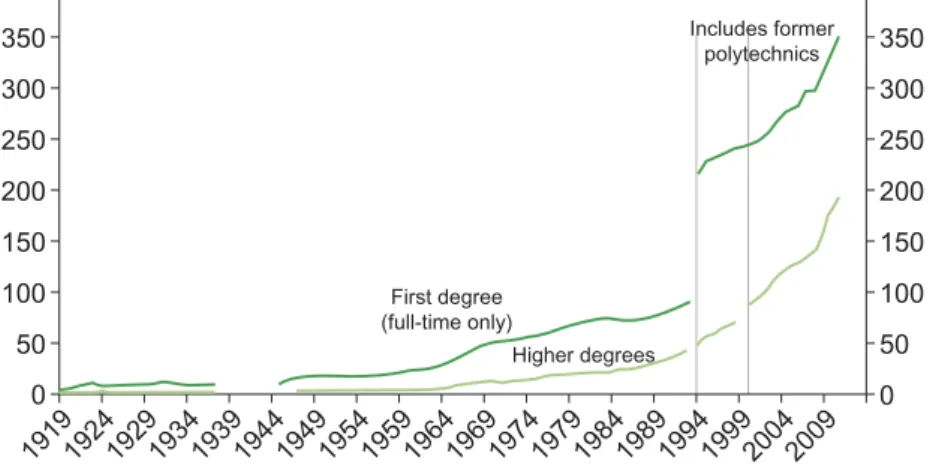
Over the past 100 years, significant changes have taken place in every phase of education, including that at universities. The most significant of these is the increasing numbers of learners completing secondary education and graduating with a first degree. This expanding trend is summarised in the table below (Bolton, 2012):
Year Numbers taking school-leaving examinations Numbers graduating with a first degree
c.1900 In 1919, 28,800 pupils were entered for one or more
school certificate examinations in England and Wales. In 1920, 3,200 were entered for one or more Higher School Certificate examinations.
In 1922–23, 9,200 students were awarded first degrees.
1950s In 1953–54, 10.7% of the relevant age group passed five
or more GCE O levels at schools in England and Wales; 5.5% of the relevant age group passed one or more GCE A level.
In 1950, 17,300 students were awarded first degrees.
2010s In 2010–11, 79.6% of pupils in their last year of
compulsory education in the UK achieved five or more GCSE grades A*–C or equivalent. In 2002–04, 39.2% of the relevant age group passed one or more GCE A level.
In 2010–11, 331,000 full-time students were awarded first degrees.
Figure 1: Undergraduate students in the UK1
Figure 2: Students obtaining university degrees in the UK (thousands)2
Overall participation in higher education increased from 3.4% in 1950, to 8.4% in 1970, 19.3% in 1990 and 33% in 2000.
1 House of Commons Report, SN/SG/4252 2 House of Commons Report, SN/SG/4252
500,000
Year 0
1,000,000 1,500,000 2,000,000 2,500,000
2000/01 2001/02 2002/03 2003/04 2004/05 2005/06 2006/07 2007/08 2008/09 2009/10 2010/11 2011/12
50
1919192419291934193919441949195419591964196919741979198419891994199920042009
0 100 150 200 250
First degree (full-time only)
Includes former polytechnics
Higher degrees
300 350
50 0 100 150 200
Students obtaining university degrees in the UK (thousands)
250 300 350
Driven by successive governments’ commitment to widening participation in higher education, the variety of pathways taken into HE study has become broader, with students following purely academic, purely vocational or a mixture of academic and vocational routes. In addition, students increasingly represent a wider range of social, educational and economic backgrounds. Inevitably perhaps, students are entering university with a range of skills, some better developed than others.
With academic routes frequently viewed as the ‘gold standard’ route into HE study, there has long been concern that the academic focus of A level is too narrow for progression to university (Roberts and Higgins, 1992). Similar concerns continue to be expressed: Professor Don Nutbeam, Vice Chancellor at the University of Southampton, writing in the
Guardian in 2009, set out his concerns about the structural problem in the English education system: that we channel young people into narrow pathways for learning.
We share this concern. At 14 and 15, young people make choices in education in preparation for A level or vocational study and subsequent university entry. Many will abandon study of a foreign language, and by 16, large numbers will also drop English and/or mathematics. By 16, most students will focus on a relatively limited combination of subjects. Recent reform, including the Extended Project, has gone some way to addressing the perceived narrowness of A level, but significant challenges remain and young people continue to learn more and more about less and less.
First-degree attainment numbers in the late 1940s were boosted by government schemes to support those who had served in the armed forces. The 1960s also saw a major expansion as numbers doubled in seven years to more than 50,000. The only downturn in numbers in recent times was in the number of first degrees awarded in the mid-1980s. This in part reflected earlier trends in staying-on rates, A level performance and demographics. It was also magnified by the early 1980s peak which, as with staying-on rates, may have been affected by the economic recession.
The data include degrees awarded at former polytechnics from 1994 onwards. This extension of what constituted a university meant that the number of university degrees awarded more than doubled. There was much less impact on the number of higher degrees awarded. A change in the treatment of students qualifying from a ‘dormant’ status in 2000 had a much greater impact. The sharp growth in the number of degrees awarded in the last three years reflects earlier increases in student numbers. These figures cover all students regardless of their home country. In 2011/12, 84 per cent of full-time first-degree and 41 per cent of higher-degree awards were to home students.
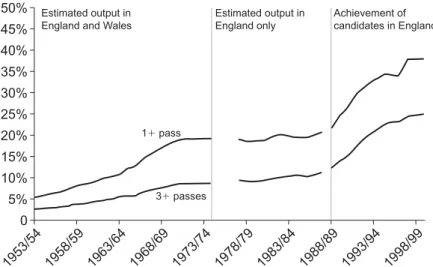
Figure 3: A level achievement at schools and colleges % of the relevant age group3
As a result, university departments with high numbers of applications, i.e. highly selective departments, indicate that they have less faith that the current post-16 curricula successfully develop the skills and knowledge needed for successful transition to undergraduate programmes. In their view, A levels are less effective tools to form the basis of selection than they were in the past. This was principally because students who were diligent about learning for the test were able to get high marks and the skills that were most valuable in higher education are not tested. While the introduction of the A* had some impact in helping selection procedures, concerns were raised about the breadth of the overall assessment methods used in A level.4
Employers have long recognised the importance of education to business performance. Previously, their focus had been students leaving the education system and moving into employment at age 16 or 18. More recently, employers have adopted a wider vision, recognising that different approaches are needed throughout the education system to ensure that learners transitioning to employment have had the time to develop key employability skills. As the focus of employer concerns has shifted from ‘work readiness’ to a focus on the well rounded individual, with the CBI claiming in November 2012 that ‘As well as academic rigour, we need schools to produce rounded and grounded young people who have the skills and behaviours that businesses want.’5
An emphasis on rounded and grounded individuals permeates employer surveys that focus on the needs of all learners, not only the most able. In First steps: a new approach for our schools, published in 2012, the CBI noted that ‘the current education system fosters a cult
3 House of Commons Report, SN/SG/4252
4 Ipsos MORI ‘Fit for Purpose’ report Ofqual/12/5145 April 2012. http://ofqual.gov.uk/ofdoc_categories/changes-to-qualifications/ 5 http://www.cbi.org.uk/media/1845483/cbi_education_report_191112.pdf 1953/5 4 1958/5 9 1963/6 4 1968/6 9 1973/7 4 1978/7 9 1983/8 4 1988/8 9 1993/9 4 1998/9 9 0 5% 10% 15% 20% 25% 30% 35% 40% 45%
50% Estimated output in
England and Wales
11 pass
31 passes
Estimated output in
England only Achievement ofcandidates in England
A level achievement at schools and colleges % of the relevant age group
of the average; too often failing to stretch the most able or support those that need most help’ and suggests that this might be an unintended consequence of the use of school and college performance measures.6
In the UK there are skills shortages, for example in medicine, engineering, science and computing, alongside high, though falling, youth unemployment. In engineering and manufacturing, skills needs are changing as technology impacts on ways of working. Employers regularly voice concerns about the potential gap in expertise as new technologies emerge and as the workforce ages.
This situation needs to be urgently addressed if our economy is to sustain the green shoots of recovery.
Students’ lack of basic skills
John Cridland, the CBI’s Director General, noted that ‘skills are at the heart of our ability to sustain economic growth. It is essential that our schools equip every young person with the attitudes and competencies they need to lead fulfilling and productive lives.’7 The OECD
notes that ‘the most promising solution … is investing effectively in skills throughout the life cycle; from early childhood, through compulsory education, and throughout a working life.’8
This focus on the importance of skills development, and its intrinsic links with the country’s economic future, permeate employers’ thinking.
Similar concerns exist in higher education. A survey of UK deans of science in 2003 shows that an overwhelming majority believe the elementary knowledge and mathematical and practical skills of first-year undergraduates are worse than those of their peers a decade previously.9 Many believe that little has changed today and express concern that remedial
action has not taken place to counter the effects of ‘spoon-feeding’ at school. The most problematic situation was found in the physical sciences, where 70 per cent of deans reported that less than half of new students had the appropriate or necessary skills. Overall, just under half the students on 58 per cent of courses lacked the necessary mathematical skills; just under half of students on 47 per cent of courses lacked the necessary practical skills; and under half the students on 34 per cent of courses lacked the elementary knowledge appropriate for their studies.
The Institute of Directors (IoD) surveyed more than 100 university admissions tutors and found that 41 per cent thought the quality of first-years had declined. Just 28 per cent thought standards among students had risen.10 Universities have responded to this ‘skill
gap’ by providing a range of additional support for students – particularly in their first year. This remedial activity is normally focused on enhancing students’ generic, transferable skills.
6 http://www.cbi.org.uk/media/1845483/cbi_education_report_191112.pdf 7 2012 CBI Survey Learning to grow. http://www.cbi.org.uk/media/1514978/
cbi_education_and_skills_survey_2012.pdf
8 OECD Report Better Skills Better Jobs Better Lives (2012). http://skills.oecd.org/documents/ OECDSkillsStrategyFINALENG.pdf
9 THES. 2 May 2003.
10 http://press.iod.com/2008/08/11/iod-warns-of-credibility-gap-in-education/
Written skills
Many sources indicate that the general level of literacy of students entering higher education11
is a cause of concern. Concerns focus particularly on12 essay-writing skills, the ability to
structure an argument, and poor knowledge of grammar. A significant majority of university lecturers13 identified academic writing as a weakness of first-year undergraduates. In another
research project, 49 per cent of those surveyed reported that students with vocational qualifications had weaker written communication skills.14
Mathematics and practical numeracy
Universities have consistently expressed concerns about the general level of mathematics skills demonstrated by students entering higher education. While the mathematics skills required differ by subject, some skills are considered essential across almost all subjects. For example, statistical skills are essential to support quantitative and qualitative academic research. Mathematical modelling and problem-solving skills are valued across a range of STEM and humanities subjects.15
Social scientists have expressed concerns about the marginalisation of quantitative methods and students’ lack of understanding of mathematically based arguments. Lecturers consistently report that students find it difficult to apply their mathematical knowledge in new contexts.16
An additional issue is that many HE courses have significant mathematics content but mainly recruit students with GCSE mathematics. These students may have achieved the minimum entry requirement of grade ‘C’ at GCSE and may not have studied mathematics for at least two years. This issue is exacerbated by the lack of emphasis on mathematical skills in some A level subjects. As a result, tutors have concerns about the mathematical preparation of their students. They also expressed concern about the inappropriateness of using GCSE as a predictor of mathematical competence.17 While many university courses
require mathematical knowledge, insufficient numbers of students study the subject post-16.
18 ACME recommended that ‘there should be an emphasis on building students’ confidence
in mathematics, and their ability to use mathematics in a range of familiar and unfamiliar contexts.’
There is considerable anecdotal evidence that A level mathematics and physics do not adequately support students’ mathematical skills for related degrees. This view is supported by research from the Institute of Physics19, which indicates that the majority of academics felt
that students were not at all well prepared for the mathematical content they would meet as 11 Ipsos MORI ‘Fit for Purpose’ Report – page 74. http://ofqual.gov.uk/ofdoc_categories/changes-to-qualifications/ 12 Pearson Edexcel Universities Research internal report – page 2.
13 Cambridge Assessment Lecturer Survey: Executive Summary – page 2. http://www.cambridgeassessment.org.uk/ images/116010-cambridge-assessment-he-research-survey-of-lecturers-executive-summary.pdf
14 Pearson’s Exploration of University Admissions – page 100.
15 Ipsos MORI ‘Fit for Purpose’ Report – page 64. http://ofqual.gov.uk/ofdoc_categories/changes-to-qualifications/ 16 Pearson Edexcel Universities Research: Overview Report – page 2.
17 ACME: Mathematical Needs report – page 15. http://www.acme-uk.org/media/7627/acme_theme_b_final.pdf 18 ACME: Mathematical Needs report – page 15. http://www.acme-uk.org/media/7627/acme_theme_b_final.pdf 19 Institute of Physics report July 2011 – Mind the Gap: Mathematics and the transition from A-Levels to physics and
undergraduates. Even students with GCE mathematics lacked sufficient mathematical fluency. A different issue exists with bioscience programmes, as students began with a wide variety of mathematical backgrounds from A level to grade C at GCSE. Increasingly, mathematical skills are as important in biology and medicine as they are in physics and engineering. Research commissioned by the UK Centre for Bioscience and the Higher Education Academy20
reported poor confidence which prevented students from attempting quantitative problems. Specific areas for inclusion were identified as rearranging simple equations and the use of ratio and proportion.
Higher-order thinking skills
One of the top three areas in which university lecturers thought undergraduates were least prepared is higher-order thinking skills.21
Problem-solving and reasoning
Employers indicated that young people with A levels have more evident skills in problem-solving and reasoning than those with other comparable qualifications, but reported a weakness in graduates’ problem-solving skills.22 This conflicts with the view from HE, where
course assessors believed that students with vocational qualifications had stronger team-working and problem-solving skills than those with academic qualifications, because the skills were engrained in the vocational qualifications and the work experience that often came with them.23
Lateral thinking
In addition to the skills listed earlier, there is a need to improve students’ ability to link knowledge across topics24, as this was identified as a weakness in first-year undergraduate.25
Constructing balanced arguments from evidence and assessing the validity and soundness of arguments are also essential for successful transition to undergraduate programmes.26
Students have a tendency to accept arguments and information uncritically, so are able to recall factual information, but sometimes lack the ability to critically assess or really understand the materials they read.
Independent enquiry
It has been noted in a variety of studies that students in higher education are struggling to work independently and to manage their own time: they want to be told exactly how to do 20 A survey of the mathematical landscape within bioscience undergraduate and postgraduate Uk education – page 6.
http://www.heacademy.ac.uk/assets/documents/stem-conference/BioSciences2/Jennifer_Koenig.pdf
21 Cambridge Assessment: A review of the literature examining the pedagogical differences between A level and university: Executive Summary – page 7. http://www.cambridgeassessment.org.uk/Images/116018-cambridge-assessment-he-research-literature-review-executive-summary.pdf
22 CBI Report: Education and Skills Survey 2012 – page 34. http://www.cbi.org.uk/media/1514978/cbi_education_ and_skills_survey_2012.pdf
23 Pearson Edexcel’s Universities Research – page 11. 24 Pearson Edexcel’s Universities Research – page 2.
25 Cambridge Assessment Lecturers Survey: Executive Summary – page 2. http://www.cambridgeassessment.org.uk/ images/116010-cambridge-assessment-he-research-survey-of-lecturers-executive-summary.pdf
26 Ipsos MORI ‘Fit for Purpose’ report – page 76. http://ofqual.gov.uk/ofdoc_categories/changes-to-qualifications/
their work.27 In addition, many students seem to experience a culture shock in the change
of teaching and learning styles at university as compared with school.
Another of the top three areas in which lecturers thought undergraduates were least prepared is independent enquiry.28 HEIs also expressed concern about students’ lack of research
skills, including: finding legitimate and trustworthy sources; extended writing; referencing; and building arguments from evidence.29
Cambridge Assessment reports that HE lecturers sense gaps in students’ intellectual curiosity and motivation. This was reiterated in the Ipsos MORI ‘Fit for Purpose’ report which stated that, while not a skill in its own right, one of the key perceived gaps in some students’ outlook when arriving at higher education is intellectual curiosity or a ‘love of their subject’.30
Current first year undergraduate students are considered to be better prepared for university study in a number of skill domains: ICT skills, teamwork and collaboration.31 In addition,
49 per cent of course assessors indicated that students with vocational qualifications had stronger team-working skills than students with academic qualifications32.
Employer–school and HE–school links
Employers and universities are keen to address the skills gap by working directly with schools and colleges. Recent years have seen an increase in the number of employer- and HE-led initiatives designed to better prepare students for progression.
A significant number of employers are already working with schools and colleges and many are considering deepening their relationships.One of the key advantages of closer relations between employers and schools is in increasing motivation for students by providing opportunities for them to engage directly with employers and with real life and relevant contexts. Employers also benefit from this relationship, by cutting recruitment costs, by nurturing the interests of talented young people, by identifying opportunities for staff engagement and motivation and, ultimately, by raising brand awareness.
Employer representative groups are increasingly reaching out to schools and colleges. For example, the CBI has called on business leaders to become local champions in schools and colleges across the UK, to enthuse and inspire young people about the world of work from an early age, and the British Chambers of Commerce (BCC) president noted in 2013 that businesses she speaks to, up and down the country, want to work with young people, and are happy to train and employ them.
27 Pearson Edexcel’s Universities Research – page 2.
28 Cambridge Assessment Lecturers Survey: Executive Summary – page 2. http://www.cambridgeassessment.org.uk/ images/116010-cambridge-assessment-he-research-survey-of-lecturers-executive-summary.pdf
29 Ipsos MORI ‘Fit for Purpose’ report – page 76 / Pearson Edexcel’s Universities Research – page 2. 30 Cambridge Assessment Lecturer Survey – page 2 / Ipsos MORI ‘Fit for Purpose’ report – page 79.
31 Cambridge Assessment Report: A review of the literature examining pedagogical differences between A level and university: Executive Summary – page 2. http://www.cambridgeassessment.org.uk/Images/116018-cambridge-assessment-he-research-literature-review-executive-summary.pdf
32 Pearson’s Exploration of University Admissions – page 11.