Int. J. Food System Dynamics 4 (4), 2013, 248‐260
Benefits
through
Utilising
EPC
Network
Components
in
Service
‐
Oriented
Environments
–
an
Analysis
Using
the
Example
of
the
Food
Industry
Ralph
Tröger
1,
Robert
Reiche
2,
and
Gerhard
Schiefer
31
GS1 Germany, 2EuroPoolSystem, 3University of Bonn
troeger@gs1‐germany.de; [email protected]; schiefer@uni‐bonn.de
Received March 2013, accepted July 2013, available online February 2014
ABSTRACT
Improvements in the food sector imply enhancements of delivering food which is safe, affordable, readily available,
and of the quality and diversity consumers expect. However, prevalent information systems (IS) of companies in the
food industry are not ready to support further significant improvements. They especially lack the capability to
exchange relevant information in an efficient manner.
Since recently, two major developments can be observed from IS perspective: the spreading of service‐oriented
architectures (SOA) as well as an increase in mass serialization (due to public and private traceability requirements,
e.g.). So far, though most important due to food safety, a growing need to become more efficient as well as an
increasing information demand of consumers, the food sector has attracted little attention in literature concerning
an analysis about the potential of both service‐orientation and the Electronic Product Code (EPC) Network. This is
why this paper will investigate to which extent these two developments can contribute to facilitate food companies’
IS helping them to maintain their competiveness.
As a starting point, the research paper will depict the state of the art including SOA and the EPC Network. After
describing the research approach, it will proceed with a characterisation of the food sector including an
examination why there is need for action. Based on current research findings as well as experience gathered in
recent projects, the paper will investigate the application of the EPC Network with its three major components, i. e.
EPCIS (EPC Information Services), ONS (Object Name Service) and the EPC Discovery Services, as part of future IS
architectures in this sector. The paper will close with a discussion whether the envisioned IS architecture is
appropriate to accomplish the previously identified challenges and requirements in the food sector in a more agile,
efficient and effective way. What is more, it will highlight the most pressing challenges and provide an outlook as to
the following steps of the research.
Keywords: Electronic Product Code, EPC Network, EPCIS, Food Industry, SOA, Object Name Service, Discovery
Services
1 Introduction
According to ETP F4L (2007), improvements in food networks are based on the vision to continually improve delivering food which is safe, affordable, readily available, and of the quality and diversity consumers expect. Assuring affordability and availability asks for efficiency in food chain operations and waste minimisation. Ensuring food safety and quality asks for appropriate controls, transparency and the support of trust through the provision of information and of guarantees for their trustworthiness. The role
of ICT for improving collaboration and information exchange between enterprises in the food supply network is undisputed.
Since recently, two major developments can be observed from information systems (IS) perspective: the spreading of service‐oriented architectures (SOA) as well as an increase in mass serialisation (due to public and private traceability requirements). So far, though most important due to food safety, a growing need to become more efficient as well as an increasing information demand of consumers, the food sector has attracted little attention in literature concerning an analysis about the potential of both service‐orientation and the Electronic Product Code (EPC) Network.
Based on end user requirements and as‐is system architectures in the food sector, this paper will investigate the appropriate design of an IS architecture in order to accomplish these requirements in a more agile, efficient and effective way. Thereby, a focus will be set on the benefits of EPC adoption. Hence, the remainder of our paper is structured as follows: in chapter 2, we will outline the state of the art, whereas focusing on SOA and the basic components of the EPC network. In chapter 3, we will depict the object of the study and the chosen research methodology. This is followed by a description of today’s characteristic IS architecture in the food sector (chapter 4). In the course of chapter 5, we then will analyse the applicability of the EPC Network as part of a future IS architecture for this industry. The paper closes with a conclusion as well as with an outlook on subsequent research activities.
2
State
of
the
art
2.1 SOA
Service‐oriented architectures can be seen as a shift “... from a company‐centric development approach that requires specific technologies to a development paradigm focusing on interoperability and open standards” (Baskerville et al., 2005, p. 764). They are already spreading in many organisations and establish “... an architectural model that aims to enhance the efficiency, agility, and productivity of an enterprise (...)” (Erl, 2008, p. 38). In this context, surveys of IT professionals worldwide indicate that “... a majority of companies [is] actively working on SOA initiatives” (Luthria and Rabhi, 2012, p. 46).
The three major elements of any SOA are services, service repositories, and enterprise service busses (Tröger and Alt 2010, p. 33). A service can be characterised as a well‐defined, self‐contained, and reusable module providing specific functionalities which is independently deployable and has a standardised interface. A service repository mainly contains the technical information about services (i.e., their addresses and descriptions and “... acts as the central modelling and design environment” (Alt and Smits, 2010, p. 5). Last but not least, an ESB (Enterprise Service Bus) can be considered to be an “... open, standards‐based message bus designed to enable the implementation, deployment, and management of SOA based applications” (Alt and Smits, 2010, p. 3).
An example of a modern, service‐based approach is the EPC Network. It represents the vision of a system of interconnected companies aiming at enhanced efficiency, visibility, and information quality. It is based on open standards defined by GS1, which is the globally leading organisation for supply chain standards (whereas the probably most prominent example is the Global Trade Item Number (GTIN), which is worldwide applied on almost every consumer item).
2.2 The EPC Network
In a nutshell, the EPC Network terms an infrastructure to access and exchange visibility data about specific objects identified with an EPC. The EPC is a unique, individual identification scheme for many kinds of business objects (i.e. articles, returnable transport items, shipments, documents, etc.). The four most relevant EPC schemes for the food industry and their application domains as specified in the EPC Tag Data Standard (GS1
EPCglobal, 2011): Serialized Global Trade Item Number (SGTIN), Serial Shipping Container Code (SSCC), Global
Table 1.
Relevant EPC schemes for the food sector
EPC scheme Area of application Example (URI form)
SGTIN Trade items urn:epc:id:sgtin:4012345.066666.12345 SSCC Shipments; logistics unit loads urn:epc:id:sscc:4012345.1234567891 GRAI Returnable/ reusable items urn:epc:id:grai:4012345.77777.678 SGLN Locations urn:epc:id:sgln:4012345.66666.5
GS1 has developed a comprehensive and free available stack of standards from identification via capture through to exchange of EPC‐related information. Though numerous publications state otherwise (e.g.,
Balakrichenan et al., 2011; Zhengxia and Laisheng, 2010; Fabian and Guenther, 2009), it is vital to
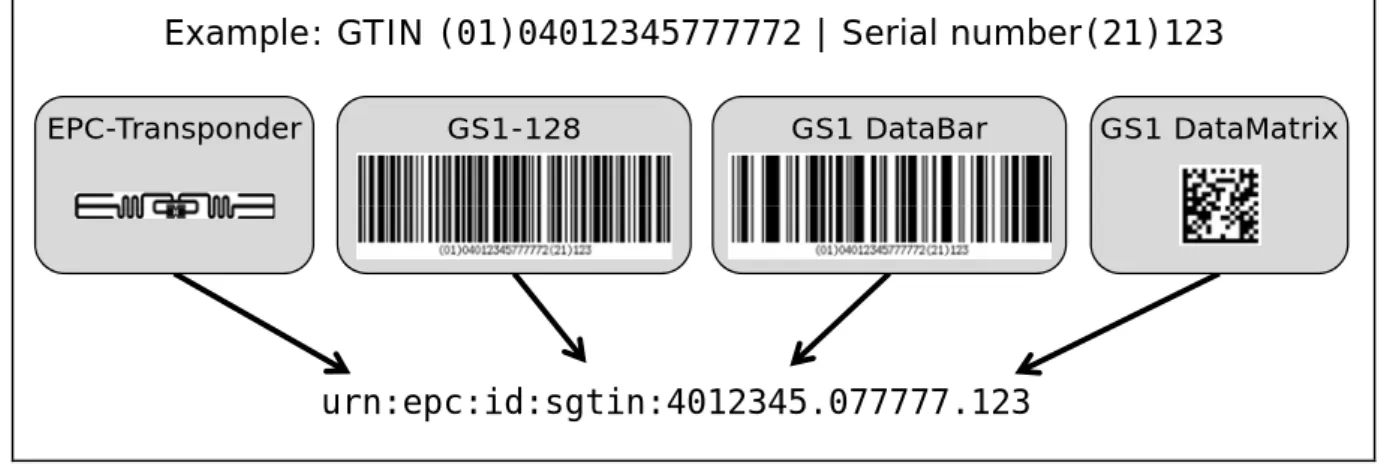
understand that RFID (Radio Frequency Identification) technology is not necessarily required in order to utilise the EPC Network. Thus, an EPC can also be generated from 1D or 2D codes (see figure 1).
urn:epc:id:sgtin:4012345.077777.123
Example: GTIN
(01)04012345777772
| Serial number
(21)123
GS1 DataBar
EPC-Transponder GS1-128 GS1 DataMatrix
Figure 1. Data carrier independence of the EPC
The EPC Network has three major components: EPC Information Services (EPCIS), Object Name Service (ONS), and EPC Discovery Services (EPCDS), which are briefly explained in the following chapters. Their interaction as well as the integration of a company in the EPC Network is displayed in figure 2.
EPCs
+
timestamp
+
location
+
business
context
Internal
information
systems
(1…n)
EPCIS
capture
applications
O
rganiz
a
tion
(1…n)
Enterprise
Service
Bus
(ESB)
event
capture
event
query
master
data
query
EPCIS
Repository
EPC
Discovery
Service
(1…n)
Local ONS
ONS
(op
tional)
by
p
a
ss
fo
r
real
‐
time
push
Figure 2. Integration of an organisation in the EPC Network
2.2.1 EPC Information Services
EPCIS is a specification which enables applications to leverage EPC data both within and across companies. It defines a standard interface for EPCIS capture and query operations as well as an EPCIS event data model. Thereby, an EPCIS event comprises four dimensions: what (i.e., one or more unique identifiers), when (the moment of time the EPCIS event occurred), where (two identifiers describing the read point and the business location) and why (a list of business transaction types as well as two identifiers – business step and disposition – collectively providing the business context).
EPCIS has two decisive strengths: firstly, the utilisation of a standardised vocabulary, which enables each business partner an unambiguous interpretation of event messages. In this context, the Core Business Vocabulary, an accompanying standard to EPCIS, provides a set of intersectoral valid business processes (for instance, inspecting, packing, receiving) and dispositions (in_transit, retail_sold, returned, etc.). Secondly, it enables each network partner to associate any EPCIS event with a business transaction such as purchase order or dispatch advice.
In order to capture and query EPCIS event data, the EPCIS standard provides open, standardised interfaces that allow for seamless integration in service‐oriented system environments.
2.2.2 Object Name Service
ONS is based on the Domain Name System (DNS) and a means to lookup pointers to services (for instance, localisation of EPCIS repositories) based on the GS1 Company Prefix (GCP) which is part of every GS1 identification key such as the GTIN or the Global Location Number (GLN) and ensures global uniqueness. ONS does not support queries at the serial number level.
In order to obtain information about an object, a local ONS resolver has to convert the identifier of that object (e.g., the GS1 key GTIN 4012345222227) into a Fully Qualified Domain Name (FQDN) and issue a DNS (Domain Name System) query for NAPTR (Naming Authority Pointer) records for that domain (for
instance, 0.2.2.2.2.2.5.4.3.2.1.0.4.0.gtin.gs1.id.onsepc.com). The DNS infrastructure then returns a series of answers that contain service types and associated data, i.e. most probably URLs pointing to one or more services (see table 2 for an example). The querying client (a smart phone app, e.g.) then can invoke the required service.
Table 2.
ONS query result example (NAPTR record)
Order Pref. Flags Service Regexp Repl.
0 0 u http://www.gs1.org/ons/04012345222227 !^.*$!http://epcis.example.com/! .
As the former ONS standard was criticised due to its hierarchical architecture (Balakrichenan et al., 2011,
p. 726 ff.; Fabian and Guenther, 2009, p. 124 f.), i.e. all queries had to be rooted via onsepc.com, which is
under legislation of the United States of America, it was superseded by a new version. Thereby, ONS 2.0 follows the idea of a federated structure and is based on a peer network of ONS nodes (GS1, 2012a).
2.2.3 EPC Discovery Services
At the time of writing this paper, the EPCDS standard is still in the process of development. However, EPCDS will provide a lookup mechanism to find multiple sources of information for specific EPCs. As serial level data is commercially sensitive since it can be used to analyse volumes of goods, business relations as well as flow patterns, security mechanisms will play a vital role with EPCDS. Thus, only both authenticated and authorised clients can query for links to information resources of specific EPCs, which a Discovery Service gets by authenticated partners.
2
Object
of
study,
research
question
and
methodology
In this paper, we will focus on the food supply chain which is confronted with a variety of significant challenges:
Complexity in logistics management, e.g. due to an increasing distance between production and consumption as well as a division of labour on a global scale (Metro Group, 2011; Bunte et al., 2009;
Van der Vorst et al., 2005)
Legal obligations such as the EC regulation 1224/2009 on fish traceability (EU, 2009) or the EC regulation 1169/2011 “... on the provision of food information to consumers” (EU, 2011, p. 18) Lacking technical standardisation (Kagerer et al., 2011, p. 55)
Growing customer demand for information about food products (Mata et al., p. 2011) in order to better select products and comprehend the impacts of their buying decisions (Beulens et al., 2005; Van der Vorst et al., 2005; Bunte et al., 2009; Fritz and Schiefer, 2010)
As a starting point of our research, we interviewed European food industry representatives with regard to their requirements (see Sebők et al., 2012 for a detailed description). From a business perspective, the results can be summarised in five issues: (a) tracking & tracing along the entire supply chain, (b) provision of accurate food quality information, (c) online monitoring of transport conditions, (d) separation of unsafe food, and (e) proactive exception reporting. From the technical point of view, easy and flexible EDI integration of business partners as well as securing ownership of data were named as most pressing. Taking into account the promising features of EPCIS, ONS, and EPC Discovery Services (see chapter 0), the central research question of this paper is as follows: Is an IS architecture which is based on EPC Network
components applicable to meet challenges and requirements in the food sector in a more efficient, flexible,
and effective way?
Apart from the above mentioned expert interviews, our research is based on literature research, case studies as well as various prototypical implementations. Furthermore, we take into account current standard development activities.
3
IS
architecture
as
‐
is
In general, the IS infrastructure in the food sector is characterised by a high diversity of different systems with various levels of complexity. What is more, there is a significant gap between the readiness of companies to adopt, invest and maintain a comprehensive IT infrastructure between small, medium and
large companies. Thus, exchange of information becomes more and more challenging for business partners in the supply network.
Whereas transaction‐related information exchange between medium and large food enterprises often has been realised via inexpensive, though proprietary and not scalable systems, EDI with small enterprises (producers, e.g.) usually is accomplished with web portals for manual data input. This gap in the IT infrastructures inhibits information exchange between agri‐food enterprises in general and results in a multitude of issues in respect to the previously defined requirements that need to be overcome for enabling change in the future. The following paragraphs elaborate this in more detail.
3.1 Tracking and Tracing along the entire supply chain
Traceability focuses on the ability to document and trace a specific product forward and backward along its path through the supply network and on the tracking of products moving downstream (see Vernede et
al., 2003; Van der Vorst et al., 2005; Folinas et al., 2006; Gellynck et al., 2007; Fritz and Schiefer, 2009). The current practice of traceability in the food sector is not standardised. Due to legal requirements (see EC, 2002), traceability has to be ensured in order to identify the movements of food and feed following the ‘one step up and one step down’ principle.
The identification of food and feed stuff is realised by defining batches. A batch system allows to aggregate different quantities of products of the same type following defined rules. However, batch sizes are diverging from actor to actor. To provide an example, the batch size defined by a farmer may incorporate a complete field of a single product or the produce of harvested products per day. The batches also differ in size between different actors in the supply chain. While agricultural trade companies aggregate the delivered products of the same kind from different farmers to larger product batches which can reach truck loading size, the distribution centres disaggregate these batches to smaller ones for delivering products to the retail companies (Reiche, 2012).
The key system requirement for tracking and tracing that can be extracted from the current situation is that any system development for chain‐wide tracking and tracing has to consider the different legacy systems and has to be prepared for processing and linking different kinds of batch identification codes and standards. Since traceability records are the backbone of linking product‐related information to physical products, this gap inhibits the exchange of product information for specific product batches and the communication over more than one stage in the supply network.
3.2 Accurate food quality information
The exchange of product‐related information especially about quality and safety of food products can influence the competitiveness of agri‐food enterprises, which leads to a decreased willingness to share this information with other enterprises (Reiche, 2011; Lehmann, 2011; Fritz and Schiefer, 2010). The lack of control over data and its distribution, especially in situations when competitors are involved, is a high risk and was a major reason why chain‐wide central systems failed in the past. However, past food safety scares (EHEC, Dioxin, etc.), intransparency with regard to the origin (due to re‐labelling of products) and cultivation methods (organic vs. not organic) challenged trust on the demand side.
Retailers invest tremendous efforts e.g. in organising pre‐harvest controls for agricultural trade organisations and information gathering to proof the safety and quality of the products they offer. This development is driven by the increased information demand of consumers as well as the pressure from NGOs creating statistics on e.g. pesticide residues in fresh fruits and vegetables offered by different retailers. On the other side of the supply network agricultural trade organisations have to deal with competition from abroad.
A practical solution to solve this issue is the provision of product‐related information including laboratory analysis reports, farm records on production activities, handling advice, certification or other related documents linked to a specific product batch. The utilisation of existing information at the different stages and its linkage to an identified product batch is the major prerequisite for establishing product‐related information provision along the supply chain. This information provision has the potential to increase trust in products and organisations in the network as well as enables retail groups to provide detailed information on their products to the consumer. However, the gathering of product quality information from multiple sources in different formats as well as the provision of product quality records is a challenge that has to be met in order to increase the level of transparency and to reduce transaction costs.
This asks for new developments enabled by web‐based solutions for information exchange to open new forms of information provision with decentral organisation schemes, which (1) gives every company the freedom to decide which information can be shared with which business partner and (2) enables the
provision and receiving of product quality information in an easy way without the implementation of individual interfaces with various business partners.
3.3 Online monitoring of transport conditions
Monitoring information is considered as real‐time status observation of transport processes. Current applications range from simple positioning information to sensor‐based monitoring of the ambience in the cargo area of a truck during transport, the fuel level and fuel consumption, the monitoring of the backdoors of trucks for security purposes as well as various other aspects during transportation of goods. Related systems are often developed according to individual organisational needs for tracking their transports and are therefore not standardised. However, this data is only available to the logistics service providers running such systems. Information sharing with business partners is more the exception then the rule and inhibits the development of cross‐company discovery of critical events and collaborative problem solving strategies.
Especially SMEs in the transport sector are still using paper‐based organisation schemes in order to avoid high software development and adoption costs due to their low e‐readiness level. Calling the truck driver is still an often applied method for getting status information and is very common amongst small logistics service providers.
3.4 Separation of unsafe food
Lessons from past food scares and incidents prove that the food industry still has to cope with the optimal handling of product recalls. There are many implemented processes and strategies for handling unsafe produce from blocking its distribution up to the communication of public recalls. However, a public recall is the last resort for a food company and comes always along with a loss of reputation. Public recalls are only necessary to prevent negative impacts on consumers’ health when products already have reached the retail point of sale. The most prominent examples for preventive product recalls can be found in the fresh fruit and vegetable sector. Every time an NGO or governmental organisation publishes results of pesticide monitoring reports, products from a country with a negative result have to be removed from the markets due to the loss of trust of consumers in the fresh products from this specific country.
The samples however are not representative due to the small sample sizes and the high number of different farmers involved in agricultural production. This causes tremendous amounts of unnecessary food waste and reduces income of farmers as well as reputation of agricultural production of specific countries. A significant improvement of the current situation would be a monitoring system combining the previous described tracking and tracing requirements, the provision of accurate product quality information and exception notification that allows separating unsafe from safe products based on laboratory results of acknowledged laboratories before they reach the point of sale. This also could lead to a reduction of public recalls.
3.5 Proactive exception reporting
Exception notification is understood as the communication of critical deviations (in transport, e.g.) or other external events requiring re‐planning. Based on transparency, focus is on the detection of the deviations and the timely notification of all involved stakeholders in a complex business network environment to enable corrective actions. The challenge for exception notification is to communicate the exception information (what, when, where, why) from the point of occurrence to all parties affected. The identification of involved companies is based on the previous described challenges for tracking and tracing and the different traceability schemes implemented in the sector. Currently, there is no known IS that allows the communication of exceptions to the very involved and identified actors in the supply network.
4
IS
architecture
to
‐
be
In contrast to hitherto system architectures, current research findings as well as experience gathered in recent projects indicate that all requirements mentioned in section 3 can be tackled by utilising EPC Network components, especially EPCIS. The following subsections summarise our research results.
4.1 Tracking and Tracing along the entire supply chain
Companies of the food sector have already started recognising the value added of the EPC Network for T&T. This is why a variety of different pilot projects have been accomplished recently, e.g. in the fish (Hild, 2010), the meat (Friedlos, 2010), or the beverage industry (GS1 Hong Kong and GS1 Italy, 2012). All have
in common that EPCIS was used as the fundamental technology (see the following figure for a simplified illustration).
EPCIS Repository
Retailer
Distributor
Producer
What? When? Where? Why?
Shipment 345
2013‐01‐22, 05:20
Goods issue area B Shipping, in transit
Reusable boxes 3,4,5 2013‐01‐24, 08:30 Sales floor
Stocking, sellable/ accessible
xml xml
xml
EPCIS Capture Interface EPCIS Query Interface
EPCIS Repository
EPCIS Capture Interface EPCIS Query Interface
EPCIS Repository
EPCIS Capture Interface EPCIS Query Interface
xml xml
xml
Reusable boxes with product A 2013‐01‐21, 15:41
Field 12
Producing, packed
Figure 3. Functional principle of EPCIS
Assuming that business partners capture all their relevant process steps (i.e. harvesting, (re)packing, shipping, receiving, etc.) as EPCIS event messages and make them available in an EPCIS repository, they have a powerful data base for both
intra‐ and intercompany process control, documentation and optimisation.
For instance, let us presume that an organisation (a food laboratory, e.g.) detects that there is an issue with a specific batch of meat. As for today, there are no IS in place capable to automatically trace back that batch to its origin as well as to discover where else it has gone. However, with regard to customer safety, quick and efficient mechanisms are required.
EPCIS enables companies (or their authorised business partners who have been granted data access, respectively) accomplishing that in a very efficient and scalable manner. Furthermore, each organisation decides if and to what extent they want to share EPC‐related data with other parties, i.e., everyone retains full data ownership. For this purpose, the EPC Discovery Services, which are not yet available, are not necessarily required. In the future however, there most likely will be various trusted information providers offering both authorised and authenticated organisations links where they can query for EPC‐ related data.
In order to utilise EPCIS, companies just have to identify their business objects in a globally harmonised and unique way (see section 2.2). In this context, a growing number of food companies already use GS1 identifiers in their supply chains. Apart from assigning products a GTIN (sometimes along with batch or even serial numbers), many of them apply the SSCC and the GRAI for identifying a shipment and a reusable transport item, respectively (GS1 Germany, 2008, p. 6 ff.; Swedberg, 2008).
4.2 Accurate food quality information
Until recently, consumers had little chance to access detailed information about batched products. For instance, smart phone apps like ‘Barcoo’ provide features such as price comparison, food traffic light, and test reports. However, these data are based on product class level, i.e. there is no possibility to get information on batch or instance level.
In contrast to that, recent research projects illustrate that the EPC Network is suited to offer consumers a real value added in providing information on the basis of a product’s batch or even serial number: for instance, in a trial in Sweden, EPCIS event data which had been captured along the fish supply chain was linked to a map showing the end customer where the fish was caught and processed. (Hild, 2010)
Another of today’s issues consists in the limited possibility to point to product‐related services: oftentimes, a manufacturer prints a QR code on a product packaging, which contains just a hard‐ encrypted URL. Thus, only one service can be invoked by the customer.
As soon as the ONS is available though, companies can offer their end customers a huge variety of services as they are able to register an arbitrary number of services (in different languages, for different target markets, e.g.) with the ONS provider. What is more, they just need one (1d or 2d) code on their products instead of two or more. Last but not least, they have the flexibility to update their service addresses (which is not possible in case of hard‐encrypted URLs). Recently, a first proof of concept along with 30 brand owners providing data for more than 900 products in 8 countries was successfully accomplished (GS1, 2012b).
4.3 Online monitoring of transport conditions
As mentioned above, EPCIS is already utilised in several projects as the underlying technology for capturing, querying and exchanging event data (i.e., what has happened, when, where and why). What makes it even more powerful is its extensibility. Therefore, it can also be used to convey data such as temperature, air humidity, or other arbitrary status information. This extension mechanism has been proofed for online transport monitoring in various trials, for instance in the beverage and the fish industry.
As for the first one, several Italian wine producers employed EPC RFID tags along with temperature sensors placed in cartons, on pallets, and in the warehouse in order to improve shipment visibility as well as quality assurance. The transponder and sensor data were captured at several read points along the supply chain from vineyards in Italy via a warehouse and retail outlet in Hong Kong and stored in an EPCIS repository, hence enabling real‐time shipment monitoring (Swedberg, 2012).
The second case is related to a rather similar project in Iceland which also used EPC RFID transponders in combination with temperature loggers (recording the current temperature in the fish tubs or boxes every 10 minutes). The case company – HB Grandi (one of the largest Icelandic fishing companies) – used EPCIS to link the logistics units with their temperature profiles as well as to enable stakeholders to access these data in order to proof compliance with delivery conditions or legal obligations (Gunnlaugsson et al. 2011).
4.4 Separation of unsafe food
Taking into consideration the significant number of food recalls occurring (for instance, more than 700 between 2000 and 2003 just in the US (Salin et al., 2006, p. 150)), the quick and efficient limitation of the potential impacts is crucial. Though not being implemented for this specific purpose (but to permanently guarantee freshness of meat), the EPCIS‐based meat replenishment system with Real’s Future Store serves as a good example (Swedberg, 2008). Thereby, all meat trays are identified with an individual EPC enabling the retailer to identify and sort out all products that have exceeded their respective best‐before date.
The more supply chain partners of the food chain document all relevant process steps such as harvesting/ slaughtering, (re)packing, shipping, etc. via EPCIS, the easier it will become to separate food of concern. In this regard, the next version of the EPCIS standard is expected to incorporate new, powerful functionalities based on requirements which have been raised by food industry representatives. The two most important ones consist in a new EPCIS event type and the ability of batch/ lot traceability. (Traub, 2012) Thus, even irreversible transformation steps such as the processing of carved meat into several trays of ground meat or the making of a pizza can then be captured. This will enable companies to efficiently identify products in which specific ingredients have been incorporated and which way both ingredients and products have gone through the supply network.
The EPC Discovery Services, though not necessarily required meeting this requirement, will further ease and accelerate a future inter‐companywide identification and separation of food. Authorised parties then can query for all organisations which have information about a product of concern. Nevertheless, each company still obtains full data ownership over its EPC event data as an EPC Discovery Service provider will just return the links (i. e. service addresses) to the respective EPCIS interfaces.
4.5 Proactive exception reporting
Due to global supply chain structures, fast changing supply and demand situations, short product life cycles, volatile business relations as well as considerable legal obligations, the food sector is prone to many kinds of critical exceptions. Therefore, more and more companies apply concepts such as Supply Chain Event Management. The latter “… may be characterised as an approach to achieve inter‐ organisational visibility over logistical processes enabling companies to detect [and react to] critical exceptions in their supply chains in time (...) before they have a negative impact on given business plans” (Tröger and Alt, 2010, p. 32).
EPCIS supports proactive exception information particularly due to being able triggering event messages not only in predefined time intervals, but also as soon as certain conditions are fulfilled – even in real time, if required. Thus, it can be used to detect if, for instance, the air humidity or temperature level within a transport unit exceeds a given threshold as well as if shipments are incomplete or delayed (Tröger, 2012).
Currently, a prototypical solution is implemented in the course of the EU‐funded research project SmartAgriFood. The prototype (taking the example of the fruits and vegetables business) is based on the scenario that an arbitrary business partner discovers an issue with a certain produce. Thereby, EPCIS is used to efficiently trace the flow of this produce through the supply network and to identify the respective sender(s) and recipient(s). Based on that, an alert is sent to the affected organisations.
5
Discussion,
conclusion
and
outlook
This paper aimed at exploring whether EPC Network components should become key elements in future IS architectures for companies of the food sector. To this end, we first provided an introduction to SOA and in particular to EPCIS, ONS, and EPC Discovery Services. After outlining our research strategy, we then depicted the current state of IS in the food sector, whereas disclosing that key end user requirements cannot be met.
This was followed by an analysis whether those needs can be met if companies had implemented the above mentioned components. Based on a variety of recent pilot projects and research activities we could demonstrate that the EPC Network – especially EPCIS – indeed supports all five user requirements (see table 3). Thus, the research question raised in chapter 0 can be answered in the affirmative.
Table 3.
Food industry requirements supported by EPC Network components
User requirements ... supported by EPC Network components
EPCIS ONS EPCDS
(a) Tracking & Tracing along the entire supply chain x x (b) Accurate food quality information x x (c) Online monitoring of transport conditions x (d) Separation of unsafe food x x (e) Proactive exception monitoring x
However, there is a variety of challenges which need to be overcome in order to achieve a large‐scale adoption. Especially SMEs in the food sector need to be enabled participating in EDI in an easy way as the uptake of innovative internet technologies is always linked to the willingness to adopt and invest in modern ICT. Though all leading ERP systems are able to communicate via EPC standard‐compliant interfaces, there is still a gap in the readiness of SMEs in the food sector to adopt such ERP systems. Therefore, particularly SMEs have to be enabled utilising the EPC Network through providing e.g. inexpensive, service‐based solutions.
One appropriate approach is the integration of SMEs in research initiatives such as the EU‐funded Future Internet Private Public Partnership program. In the first phase (2011‐2013), so‐called generic enablers (including EPCIS, e.g.) based on business requirements have been specified and tested in various prototypical implementations. In the second phase (2013‐2015), those generic enablers are evaluated in a variety of parallel implementations in different industries in order to pave the way for large‐scale implementation in the third phase (beyond 2015).
References
Alt, R., Smits, M. (2010). Design Options for Service Directories in Business Networks. In: Proceedings of the 18th European Conference on Information Systems, Pretoria, 2010
Balakrichenan, S., Kin‐Foo, A., Souissi, M. (2011). Qualitative Evaluation of a proposed Federated Object Naming Architecture. In: Proceedings of the International Conference on Internet of Things and 4th International Conference on Cyber, Physical and Social Computing; 2011
Baskerville, R., Cavallari, M., Hjord‐Madsen, K., Pries‐Heje, J., Sorrentino, M., Virili, F. (2005). Extensible Architectures: The Strategic Value of Service‐Oriented Architecture in Banking. In: Bartmann, D., Rajola, F., Kallinikos, J., Avison, D., Winter, R., Ein‐Dor, Ph., Becker, J., Bodendorf, F., Weinhardt, Ch. (eds.): Proceedings of the 13th European Conference on Information Systems, Regensburg, 2005
Beulens, A. J. M., Broens, D.‐F., Folstar, P., Hofstede G. J. (2005). Food safety and transparency in food chains and networks – Relationships and challenges. In: Food Control, Vol. 16, No. 6, 2005
Bunte, F., Dijkxhoorn, Y., Groeneveld, R., Hofstede, G. J., Top, J., van der Vorst, J., Wolfert, S. (2009). Thoughts for Food – The impact of ICT on agribusiness. Report 2009‐029, LEI Wageningen UR, The Hague, 2009 ETP F4L (European Technology Platform on Food for Life) (2007). Strategic Research Agenda of the European
Technology Platform ‘Food 4 Life’ 2007‐2020. http://etp.ciaa.be/documents/CIAA‐ETP%20broch_LR.pdf; accessed 2012‐10‐17
Erl, Th. ( 2008). Principles of Service Design. Prentice Hall: Upper Saddle River, 2008
European Parliament and Council (Ed.) (2011). Regulation (EC) No 1169/2011 on the provision of food information to consumers, amending Regulations (EC) No 1924/2006 and (EC) No 1925/2006 of the European Parliament and of the Council, and repealing Commission Directive 87/250/EEC, Council Directive 90/496/EEC, Commission Directive 1999/10/EC, Directive 2000/13/EC of the European Parliament and of the Council, Commission Directives 2002/67/EC and 2008/5/EC and Commission Regulation (EC) No 608/2004; October 2011
European Parliament and Council (Ed.) (2009). Regulation (EC) No 1224/2009 establishing a Community control system for ensuring compliance with the rules of the common fisheries policy, amending Regulations (EC) No 847/96, (EC) No 2371/2002, (EC) No 811/2004, (EC) No 768/2005, (EC) No 2115/2005, (EC) No 2166/2005, (EC) No 388/2006, (EC) No 509/2007, (EC) No 676/2007, (EC) No 1098/2007, (EC) No 1300/2008, (EC) No 1342/2008 and repealing Regulations (EEC) No 2847/93, (EC) No 1627/94 and (EC) No 1966/2006; November 2009
European Parliament and Council (Ed.) (2002). Regulation (EC) No 178/2002 of the European Parliament and of the Council laying down the general principles and requirements of food law, establishing the European Food Safety Authority and laying .down procedures in matters of food safety February 2002
Fabian, B., Guenther, O. (2009). Security Challenges of the EPCglobal Network. In: Communications of the ACM, Vol. 52, No. 7, 2009
Folinas, D., Manikas, I., Manos, B. (2006). Traceability data management for food chains. In: British Food
Journal, Vol. 108, No. 8, 2006
Friedlos, D. (2010). New Zealand Group uses EPCglobal Network to Track Lifestock. In: RFID Journal, August 2010
Fritz, M., Schiefer, G. (2010). The Challenge of Reaching Transparency: „T‐readiness‟ of Enterprises and Sector Networks. In: International Journal on Food System Dynamics, Vol. 1, No. 3, 2010
Fritz, M., Schiefer, G. (2009). Tracking, tracing and business process interests in food commodities: A multi‐level decision complexity. In: International Journal of Production Economics, Vol. 117, No. 2. 2009
Gellynck, X., Januszewska, R., Verbeke, W., Viaene, J. (2007). Firm's costs of traceability confronted with consumer requirements. In: Theuvsen, L., Spiller, A., Peupert, M., Jahn, G. (eds): Quality Management in Food Chains. Wageningen Academic Publishers, Wageningen, 2007
Gunnlaugsson, V. N., Thakur, M., Foras, E., Ringsberg, H., Gran‐Larsen, Ø., Margeirsson, S. (2011). EPCIS standard used for improved traceability in the redfish value chain. MITIP, Trondheim, 2011
GS1 (Ed.) (2012a). GS1 Object Name Service (ONS) Version 2.0, 2012
GS1 (Ed.) (2012b). GS1 Trusted Source of Data. Pilot Report January 2012. http://www.gs1.org/docs/b2c/GS1_TSD_Pilot_Report_Summary.pdf; accessed on 2012‐08‐06
GS1 EPCglobal (Ed.) (2011). GS1 EPC Tag Data Standard Version 1.6, 2011 GS1 EPCglobal (Ed.) (2008). EPCglobal Object Name Service (ONS) 1.0.1. 2008
GS1 Germany (Ed.) (2008). GS1 Germany. In: IW Consult (ed.): EPC/ RFID for Fresh Meat Container Logistics. Prozeus – eBusiness in Practice for SMEs, Cologne, 2008
GS1 Hong Kong, GS1 Italy (Ed.) (2012). An inebriant journey: Global wine supply chain visibility via EPCIS network. http://www.gs1.org/docs/transportlogistics/2012_05_GS1HKItaly_WinetraceabilityCase.pdf; accessed 2012‐12‐18
Hild, N. (2010). Success of EPCIS pilot in Swedish Fishery. Swedish pilot applies EPCIS standard to food traceability. http://www.trace.eu.org/admin/news/file/20100623_eTrace%20EPCIS%20success_article‐ eng%20v%202.pdf; accessed 2012‐09‐27
Kagerer, Ch. Schoberth, M., Töller, D, (2011). IT structure dacilitates the recording of results. In:
Fleischwirtschaft International, Nr. 5, 2011
Lehmann, R. J. (2011). Sustainability Information Services for Agri‐Food Supply Networks: Closing Gaps in Information Infrastructures. ILB Press: Bonn, 2011
Luthria, H., Rabhi, F. A. (2012). Service‐Oriented Architectures: Myth or Reality? In: IEEE Software, Vol. 29, No. 4, 2012
Mata, J., Lippke, S., Dieckmann, A., Todd, P. (2011). Meat label information: Effects of Separate Versus Conjoint Presentation on Product Evaluation. In: Journal of Applied Social Psychology, Vol. 41, Issue 4, 2011
Metro Group (2011). Spektrum RFID; http://www.future‐store.org/fsi‐internet/get/documents/FSI‐ /multimedia/pdfs/broschueren/WISSB_Publikationen _Broschueren_SpektrumRFID.pdf; accessed 2012‐07‐ 30
Reiche, R., Lehmann, R., Schiefer, G. (2012). Pilot Fresh Fruit and Vegetables. In: SmartAgriFood: Deliverable 300.2 – SmartFoodLogistics – Generic Enablers and Architectural Requirements, 2012
Reiche, R. (2011). Information Logistics in Agri‐Food Supply Networks. Cuvillier: Göttingen, 2011
Salin, V., Darmasena, S., Wong, A., Luo, P. (2006). Food‐Product Recalls in the U.S., 2000‐2003. In: Journal of
Distributed Research, Vol. 37, Issue 1, 2006
Sebők, A., Viola, K., Gábor, I., Homolka, F., Hegyi, A. (2012). Smart Agri Food – Deliverable D 700.1: Inventory of long and short term future needs of food chain users for future functions of internet. Public Project Report, http://www.smartagrifood.eu/sites/default/files/content‐files/downloads/SAF_D700.1_Final.pdf; accessed 2013‐01‐03
Swedberg, C. (2012). GS1 Pilot Program Shows How RFID Can Track International Wine Shipments. In: RFID Journal, July 2012
Swedberg, C. (2008). At Metro’s New Future Store, RFID Helps Assure Meat Quality. In: RFID Journal. June 2008 Traub, Ken (2012). Next‐Generation EPCIS. RFID Journal; October; 2012
Tröger, R. (2012). How can we make the Future Agri‐Food Business more efficient, transparent, and safe? EPCIS as Enabler for Supply Chain Event Management, Smart Agrimatics Conference, Paris, 2012
Tröger, R., Alt, R. (2010). Service‐oriented Supply Chain Event Management ‐ A Case Study from the Fashion Industry. In: Informatik 2010 ‐ Business Process and Service Science ‐ Proceedings of ISSS and BPSC. Bonn 2010
Van der Vorst, J., Beulens, A., van Beek, P. (2005). Innovations in logistics and ICT in food supply chain networks. In Jongen, Wim M. F. and Meulenberg, M. T. G. (eds.): Innovations in Agri‐Food Systems – Product Quality and consumer acceptance; Wageningen Academic Publishers, 2005
Vernède, R., Verdenius, F., Broeze, J. (2003). Traceability in food processing chains: state of the art and future developments. KLICT Position paper; http://library.wur.nl/file/wurpubs/LUWPUBRD_00337965‐ _A502_001.pdf; accessed 2012‐12‐19
Zhengxia, W., Laisheng, X. (2010). Modern Logistics Monitoring Platform Based on the Internet of Things. In: Proceedings of the International Conference on Intelligent Computation Technology and Automation, 2010