arXiv:1709.07004v1 [astro-ph.SR] 20 Sep 2017
WHITE DWARF ROTATION AS A FUNCTION OF MASS AND A DICHOTOMY OF MODE LINEWIDTHS:
KEPLEROBSERVATIONS OF 27 PULSATING DA WHITE DWARFS THROUGHK2CAMPAIGN 8
J. J. HERMES1,2, B. T. GÄNSICKE3, STEVEND. KAWALER4, S. GREISS3, P.-E. TREMBLAY3, N. P. GENTILEFUSILLO3, R. RADDI3, S. M. FANALE1, KEATONJ. BELL5, E. DENNIHY1, J. T. FUCHS1, B. H. DUNLAP1, J. C. CLEMENS1,
M. H. MONTGOMERY5, D. E. WINGET5, P. CHOTE3, T. R. MARSH3,ANDS. REDFIELD6 Draft version September 22, 2017
ABSTRACT
We present photometry and spectroscopy for 27 pulsating hydrogen-atmosphere white dwarfs (DAVs, a.k.a. ZZ Ceti stars) observed by theKeplerspace telescope up toK2Campaign 8, an extensive compilation of
obser-vations with unprecedented duration (>75 days) and duty cycle (>90%). The space-based photometry reveals pulsation properties previously inaccessible to ground-based observations. We observe a sharp dichotomy in os-cillation mode linewidths at roughly 800 s, such that white dwarf pulsations with periods exceeding 800 s have substantially broader mode linewidths, more reminiscent of a damped harmonic oscillator than a heat-driven pulsator. ExtendedKeplercoverage also permits extensive mode identification: We identify the spherical
de-gree of 61 out of 154 unique radial orders, providing direct constraints of the rotation period for 20 of these 27 DAVs, more than doubling the number of white dwarfs with rotation periods determined via asteroseis-mology. We also obtain spectroscopy from 4m-class telescopes for all DAVs withKeplerphotometry. Using
these homogeneously analyzed spectra we estimate the overall mass of all 27 DAVs, which allows us to mea-sure white dwarf rotation as a function of mass, constraining the endpoints of angular momentum in low- and intermediate-mass stars. We find that 0.51−0.73M⊙ white dwarfs, which evolved from 1.7−3.0M⊙ZAMS
progenitors, have a mean rotation period of 35 hr with a standard deviation of 28 hr, with notable exceptions for higher-mass white dwarfs. Finally, we announce an online repository for ourKeplerdata and follow-up
spectroscopy, which we collect atk2wd.org.
Keywords:stars: white dwarfs–stars: oscillations (including pulsations)–stars: variables: general
1. INTRODUCTION
Isolated white dwarf stars have been known to vary in brightness on short timescales for more than half a century (Landolt 1968). The roughly 2−20 min flux variations are
known to result from surface temperature changes caused by non-radialg-mode pulsations, excited by surface convection
(see reviews byWinget & Kepler 2008,Fontaine & Brassard 2008, andAlthaus et al. 2010).
Given the potential of asteroseismology to discern their in-terior structure, white dwarfs have been the targets of exten-sive observing campaigns to accurately measure their periods, which can then be compared to theoretical models to probe deep below the surface of these stellar remnants. Early ob-servations of white dwarfs showed pulsations at many periods within the same star, further demonstrating their asteroseis-mic potential (Warner & Robinson 1972). However, obser-vations from single sites were complicated by aliases arising from gaps in data collection.
Starting in the late 1980s, astronomers combated day-night aliasing by establishing the Whole Earth Telescope, a co-operative optical observing network distributed in longitude around the Earth acting as a single instrument (Nather et al.
Electronic address:[email protected]
1Department of Physics and Astronomy, University of North Carolina, Chapel Hill, NC 27599, USA
2Hubble Fellow
3Department of Physics, University of Warwick, Coventry CV4 7AL, UK 4Department of Physics and Astronomy, Iowa State University, Ames, IA 50011, USA
5Department of Astronomy, University of Texas at Austin, Austin, TX 78712, USA
6Wesleyan University Astronomy Department, Van Vleck Observatory, 96 Foss Hill Drive, Middletown, CT 06459, USA
1990). Dozens of astronomers trekked to remote observa-tories across the globe for these labor-intensive campaigns, facing complications ranging from active hurricane seasons (O’Brien et al. 1998) to near-fatal stabbings (Vauclair et al. 2002). Many campaigns lasted up to several weeks with duty cycles better than 70%, delivering some of the most complete pictures of stellar structure and rotation in the 20th century for stars other than our Sun (e.g.,Winget et al. 1991,1994).
Given the resources required, however, only a few dozen pulsating white dwarfs have been studied with the Whole Earth Telescope. Pulsating hydrogen-atmosphere white dwarfs (DAVs, a.k.a. ZZ Ceti stars) are the most numerous pulsating stars in the Galaxy, but fewer than 10 were observed with this unified network.
The advent of space-based photometry from CoRoTand Keplerhas revolutionized the study of stellar interiors,
rang-ing from p-modes in solar-like oscillators on the main
se-quence and red-giant branch (e.g.,Chaplin & Miglio 2013) to
g-modes in massive stars and hot subdwarfs (e.g., Degroote
et al. 2010;Reed et al. 2011). For example, fromKeplerwe
now have excellent constraints on core and envelope rotation in a wide range of stars (Aerts 2015). We have also seen new types of stochastic-like pulsations in classical heat-driven pul-sators, such asδScuti stars (Antoci et al. 2011) and hot subd-warfs (Østensen et al. 2014).
However, this revolution did not immediately translate to white dwarf stars, few of which were identified or observed in the originalKeplermission. We aim to rectify that shortfall
with an extensive search for pulsating white dwarfs observ-able byK2. After the failure of its second reaction wheel, Ke-plerhas entered a new phase of observations,K2, where it
(How-Table 1
Target selection criterion for the first 27 pulsating DA white dwarfs observed byKeplerandK2.
KIC/EPIC RA & Dec Alt. g (u−g,g−r) (B−R,R−I) Source K2 Proposal Selection Disc.
(J2000.0) Name (mag) (AB mag) (AB mag) Catalog Field (GO) Method
4357037 19 17 19.197 +39 27 19.10 · · · 18.2 (0.50,−0.17) · · · KIS K1 40109 Colors 1
4552982 19 16 43.827 +39 38 49.69 · · · 17.7 · · · (0.02, 0.03) SSS K1 40050 Colors 2
7594781 19 08 35.880 +43 16 42.36 · · · 18.1 (0.56,−0.16) · · · KIS K1 40109 Colors 1
10132702 19 13 40.893 +47 09 31.28 · · · 19.0 (0.50,−0.16) · · · KIS K1 40105 Colors 1
11911480 19 20 24.897 +50 17 21.32 · · · 18.0 (0.43,−0.16) · · · KIS K1 40105 Colors 3
60017836 23 38 50.740−07 41 19.90 GD 1212 13.3 · · · Eng DDT KnownZZ 4
201355934 11 36 04.013−01 36 58.09 WD 1133−013 17.8 (0.46,−0.17) · · · SDSS C1 1016 KnownZZ 5 201719578 11 22 21.104 +03 58 22.41 WD 1119+042 18.1 (0.39,−0.01) · · · SDSS C1 1016 KnownZZ 6 201730811 11 36 55.157 +04 09 52.80 WD 1134+044 17.1 (0.49,−0.11) · · · SDSS C1 1015 Spec.Teff 7 201802933 11 51 26.147 +05 25 12.90 · · · 17.6 (0.42,−0.19) · · · SDSS C1 1016 Colors · · · 201806008 11 51 54.200 +05 28 39.82 PG 1149+058 14.9 (0.45,−0.13) · · · SDSS C1 1016 KnownZZ 8 206212611 22 20 24.230−09 33 31.09 · · · 17.3 (0.47,−0.14) · · · SDSS C3 3082 Colors · · · 210397465 03 58 24.233 +13 24 30.79 · · · 17.6 (0.65,−0.12) · · · SDSS C4 4043 Colors · · ·
211596649 08 32 03.984 +14 29 42.37 · · · 18.9 (0.54,−0.18) · · · SDSS C5 5073 Colors · · · 211629697 08 40 54.142 +14 57 08.98 · · · 18.3 (0.46,−0.15) · · · SDSS C5 5043 Spec.Teff · · ·
211914185 08 37 02.160 +18 56 13.38 · · · 18.8 (0.36,−0.21) · · · SDSS C5 5073 Colors 9
211916160 08 56 48.334 +18 58 04.92 · · · 18.9 (0.40,−0.13) · · · SDSS C5 5073 Colors · · ·
211926430 09 00 41.080 +19 07 14.40 · · · 17.6 (0.47,−0.20) · · · SDSS C5 5017 Spec.Teff · · · 228682478 08 40 27.839 +13 20 09.96 · · · 18.2 (0.35,−0.14) · · · SDSS C5 5043 Colors · · ·
229227292 13 42 11.621−07 35 40.10 · · · 16.6 (0.46,−0.12) · · · ATLAS C6 6083 Colors · · · 229228364 19 18 10.598−26 21 05.00 · · · 17.8 · · · (0.10, 0.03) SSS C7 7083 Colors · · ·
220204626 01 11 23.888 +00 09 35.15 WD 0108-001 18.4 · · · SDSS C8 8018 Spec.Teff 7 220258806 01 06 37.032 +01 45 03.01 · · · 16.2 (0.41,−0.21) · · · SDSS C8 8018 Colors · · ·
220347759 00 51 24.245 +03 39 03.79 PHL 862 17.6 (0.43,−0.18) · · · SDSS C8 8018 Colors · · · 220453225 00 45 33.151 +05 44 46.96 · · · 17.9 (0.42,−0.15) · · · SDSS C8 8018 Colors · · ·
229228478 01 22 34.683 +00 30 25.81 GD 842 16.9 (0.43,−0.19) · · · SDSS C8 8018 KnownZZ 5 229228480 01 11 00.638 +00 18 07.15 WD 0108+000 18.8 (0.45,−0.17) · · · SDSS C8 8018 KnownZZ 6
References. — Discovery of pulsations announced by (1)Greiss et al.(2016); (2)Hermes et al.(2011); (3)Greiss et al.(2014); (4)Gianninas et al.(2006); (5)Castanheira et al.(2010); (6)Mukadam et al.(2004); (7)Pyrzas et al.(2015) — search for DAVs in WD+dM systems; (8)Voss et al.(2006); (9)Hermes et al.(2017c)
ell et al. 2014). This has significantly expanded the number of white dwarfs available for extended observations. We have targeted all suitable candidate pulsating white dwarfs, to pro-vide a legacy of high-cadence, extended light curves.
We present here an omnibus analysis of the first 27 DAVs observed by theKeplerspace telescope, including follow-up
spectroscopy to measure their atmospheric parameters. Only six of the DAVs presented here were known to pulsate prior to theirKeplerobservations, and only two of those six had more
than 3 hr of previous time-series photometry.
Our manuscript is organized as follows: In Section2 we outline our target selection, and we describe our space-based photometry in Section3. We detail our spectroscopic obser-vations from the 4.1-m SOAR telescope and present our full sample analysis in Section4. The first part of our light curve analysis, in Section5, centers on mode stability as a function of pulsation period. We summarize some of the large-scale trends we see in the DAV instablity strip as observed by Ke-plerandK2in Section6. We then explore the asteroseismic
rotation periods of 20 out of 27 of the DAVs in our sample, and place the first constraints on white dwarf rotation as a function of mass in Section7. We conclude with notes on in-dividual objects in Section8, as well as final discussions and conclusions in Section9. Table5in the appendix features all pulsations discovered and analyzed here: 328 entries corre-sponding to 154 independent modes of unique radial order (k)
and spherical degree (ℓ) in 27 different stars, the most exten-sive new listing of white dwarf pulsations ever compiled.
2. CANDIDATE DAV TARGET SELECTION
Table1 details the selection criteria for the first 27 DAVs observed by Kepler with short-cadence (∼1 min) exposures through K2 Campaign 8 and analyzed here, including the
Guest Observer (GO) program under which the target was
proposed for short-cadence observations.
White dwarfs hotter than 10,000 K are most effectively se-lected based on their blue colors and relatively high proper motions (e.g.,Gentile Fusillo et al. 2015). However, only two white dwarfs were known in the 105-square-degree Kepler
field two years prior to its launch in 2009: WD 1942+499 and WD 1917+461. An extensive search in the year before launch — mostly fromGalexultraviolet excess sources and faint blue
objects with high proper motions — uncovered just a dozen additional white dwarfs in the originalKeplerfield (Østensen
et al. 2010), just one pulsating (Østensen et al. 2011). The most substantial deficiency for white dwarf selection came from the lack of existing blue photometry of theKepler
field, in either the SDSS-u′ or Johnson-U; in 2009 there was
very little coverage from the Sloan Digital Sky Survey (SDSS) of theKeplerfield. Two surveys filled this gap several years
afterKeplerlaunched: TheKepler-INT Survey (KIS),
provid-ingU-g-r-i-Hαphotometry of the entireKeplerfield (Greiss
et al. 2012), as well as aU-V-Bsurvey from Kitt Peak
Na-tional Observatory (Everett et al. 2012).
The KIS proved to be an excellent resource for finding new pulsating white dwarfs; we used it to discover ten new DAVs in theKepler field (Greiss et al. 2016). Unfortunately, only
five were observed before the failure of the spacecraft’s sec-ond reaction wheel. K2has now afforded the opportunity to
observe dozens of new candidate pulsating white dwarfs in each new campaign pointing along the ecliptic.
DAV pulsations, excited by a hydrogen partial-ionization zone, occur in a narrow temperature range between roughly 12,600−10,600 K for canonical-mass (0.6M⊙) white dwarfs
KIC/EPIC K2 Kp Data CCD Ap. Targ. T0(BJDTDB Dur. Duty Res. 1% FAP 0.1% FAP 5hAi WMP Pub. Field (mag) Rel. Chan. (px) Frac. −2454833.0) (d) (%) (µHz) (ppt) (ppt) (ppt) (s)
4357037 K1 18.0 25 68 1 0.55 1488.657916 36.31 98.9 0.159 1.018 1.050 0.963 358.1 · · ·
4552982 K1 17.9 25 68 4 0.85 1099.398257 82.63 88.1 0.070 0.722 0.722 0.665 778.2 1
7594781 K1 18.2 25 45 1 0.52 1526.113126 31.84 99.3 0.182 0.749 0.781 0.664 333.3 · · ·
10132702 K1 18.8 25 48 2 0.61 1373.478019 97.67 91.8 0.059 1.431 1.483 1.441 749.3 · · ·
11911480 K1 17.6 25 2 2 0.48 1472.087602 85.86 84.7 0.067 0.764 0.794 0.766 276.9 2
60017836 Eng. 13.3 −1 76 93 0.97 1860.040459 8.91 98.9 0.649 0.284 0.297 0.172 1019.1 3
201355934 C1 17.9 14 39 4 0.33 1975.168594 77.52 92.9 0.075 0.478 0.493 0.462 208.2 · · ·
201719578 C1 18.1 14 67 11 0.88 1975.168222 78.80 94.7 0.073 0.956 0.993 0.883 740.9 · · ·
201730811 C1 17.1 14 46 8 0.98 1975.168490 77.18 94.7 0.075 0.253 0.262 0.242 248.4 4
201802933 C1 17.7 14 29 11 0.95 1975.168648 77.24 94.9 0.075 0.605 0.630 0.592 266.2 · · ·
201806008 C1 15.0 14 29 33 0.91 1975.168653 78.91 95.3 0.073 0.311 0.322 0.162 1030.4 · · ·
206212611 C3 17.4 10 46 6 0.97 2144.093232 69.18 98.3 0.084 0.304 0.314 0.321 1204.4 · · ·
210397465 C4 17.7 10 54 8 0.96 2228.790357 70.90 98.7 0.082 0.945 0.980 0.879 841.0 · · ·
211596649 C5 19.0 10 58 4 0.99 2306.600768 74.84 98.7 0.077 1.695 1.762 1.809 288.7 · · ·
211629697 C5 18.4 10 38 5 0.98 2306.600916 74.84 98.7 0.077 0.758 0.784 0.772 1045.2 · · ·
211914185 C5 18.9 10 46 5 0.97 2306.600805 74.84 98.7 0.077 0.922 0.955 0.976 161.7 5
211916160 C5 19.0 10 25 6 0.82 2306.601137 74.84 98.5 0.077 1.191 1.237 1.256 201.3 · · ·
211926430 C5 17.7 10 9 6 0.96 2306.601189 74.84 98.4 0.077 0.471 0.486 0.456 244.2 · · ·
228682478 C5 18.3 10 39 10 0.74 2306.600932 74.84 98.2 0.077 0.395 0.410 0.413 301.1 · · ·
229227292 C6 16.7 8 48 4 0.98 2384.453493 78.93 98.2 0.073 0.347 0.357 0.277 964.5 · · ·
229228364 C7 17.9 9 39 7 0.98 2467.250743 78.72 98.0 0.074 0.487 0.508 0.495 1116.4 · · ·
220204626 C8 17.2 11 54 19 0.83 2559.058649 78.72 98.3 0.074 0.805 0.832 0.846 642.7 · · ·
220258806 C8 16.4 11 59 8 0.90 2559.058611 78.72 96.0 0.074 0.155 0.161 0.154 206.0 · · ·
220347759 C8 17.7 11 64 8 0.83 2559.058460 78.72 96.5 0.074 0.458 0.470 0.476 209.3 · · ·
220453225 C8 18.0 11 68 9 0.93 2559.058403 78.72 96.7 0.074 0.625 0.646 0.631 1034.9 · · ·
229228478 C8 17.0 11 35 22 0.97 2559.058796 78.72 98.5 0.074 0.514 0.534 0.535 141.8 · · ·
229228480 C8 18.9 11 54 8 0.89 2559.058649 78.72 98.6 0.074 2.501 2.586 2.618 280.0 · · ·
References. —Kepler/K2data analyzed by (1)Bell et al.(2015); (2)Greiss et al.(2014); (3)Hermes et al.(2014); (4)Hermes et al.(2015a); (5)Hermes et al.(2017c)
spectroscopy, which is available for many white dwarfs in SDSS (e.g.,Mukadam et al. 2004).
We targeted four new DAVs observed through K2
Cam-paign 8 based on serendipitous SDSS spectroscopy, which revealed atmospheric parameters within the empirical insta-bility strip (Kleinman et al. 2013). The majority of our new DAV candidates did not have spectroscopy and were selected based on their (u−g,g−r) colors, mostly from SDSS (Gentile
Fusillo et al. 2015), plus one from (u−g,g−r) colors from an
early data release of the VST ATLAS survey (Gentile Fusillo et al. 2017). Three color-selected white dwarfs in Campaign 5 were proposed for short-cadenceK2observations for possible
planetary transits (GO program 5073).
We also selected two DAVs from the Supercosmos Sky Sur-vey (SSS) catalog ofRowell & Hambly(2011), identified as white dwarfs based on their proper motions and selected as DAV candidates by their (B−R, R−I) colors. This includes
the white dwarf with the longest space-based light curve, ob-served in the originalKeplerfield (Hermes et al. 2011).
Finally, six DAVs observed byK2were known to pulsate
before the launch of the spacecraft (KnownZZ). Our full se-lection information is summarized in Table1, including the publication announcing the discovery of variability when rel-evant. We plan to publish our full list of candidate DAVs, including limits on those not observed to vary withK2
obser-vations, at the end of the mission.
We note that in fact 29 DAVs have been observed by the
Keplerspacecraft through Campaign 8. However, we exclude
two DAVs from our analysis here because they each have more than 100 significant periodicities, deserving of their own individual analyses. Neither star appears to be in ten-sion with our general trends or results. The excluded DAVs (EPIC 211494257 and EPIC 212395381) will be detailed in two forthcoming publications.
3. SPACE-BASEDKEPLERPHOTOMETRY
All observations analyzed here were collected by theKepler
spacecraft with short-cadence exposures, which are co-adds of 9×6.02 s exposures for a total exposure time of 58.85 s, including readout overheads (Gilliland et al. 2010). Full de-tails of the raw and processedKeplerandK2observations are
summarized in Table2.
For the five DAVs observed in the original Kepler
mis-sion, we analyzed light curves processed by the GO office (Stumpe et al. 2012;Smith et al. 2012). We produced final light curves using the calculated PDCSAP flux and flux un-certainties, after iteratively clipping all points 5σ from the light curve median and fitting out a second-order polyno-mial to correct for any long-term instrumental drift. Only two DAVs in the original mission were observed for more than one quarter, and their full light curves have been ana-lyzed elsewhere (Bell et al. 2015for KIC 4552982 andGreiss et al. 2014for KIC 11911480). Here we analyze only Q12 for KIC 4552982 and Q16 for KIC 11911480, to remain relatively consistent with the duration of the other DAVs observed with
K2. All original-mission observations were extracted from
data release 25, which includes updated smear corrections for short-cadence data7, which is the cause of the amplitude dis-crepancy in KIC 11911480 observed byGreiss et al.(2014).
Reducing data obtained during the two-reaction-wheel-controlledK2mission requires more finesse, since the
space-craft checks its roll orientation roughly every six hours and, if necessary, fires its thrusters to remain accurately pointed. Thruster firings introduce discontinuities into the photometry. For each DAV observed withK2, we have downloaded its
short-cadence Target Pixel File from Mikulski Archive for Space Telescopes and processed it using the PYKE software
package managed by theKeplerGO office (Still & Barclay
2012). We began by choosing a fixed aperture that maxi-mized the signal-to-noise (S/N) of our target, extracted the tar-get flux, and subsequently fit out a second-order polynomial to 3-day segments to flatten longer-term instrumental trends. We subsequently used the KEPSFF task by Vanderburg & Johnson(2014) to mitigate theK2motion-correlated
system-atics. Finally, we iteratively clipped all points 5σ from the light curve median and fit out a second-order polynomial to the whole dataset to produce a final light curve8.
We list the size of the final fixed aperture (Ap.) used for our extractions in Table2, along with the CCD channel from which the observations were read out. Channel 48 and espe-cially Channel 58 are susceptible to rolling band pattern noise, which can lead to long-term systematics in the light curve (see Section 3 ofHermes et al. 2017aand references therein).
We note the “Targ. Frac.” column of Table2, which esti-mates (on a scale from 0.0−1.0) the total fraction of the flux
contained in the aperture that belongs to the target. This is im-portant for crowded fields, since eachKeplerpixel covers 4′′
on a side. Amplitudes have not been adjusted by this factor, which should be applied when comparing pulsation ampli-tudes reported here to ground-based ampliampli-tudes or star-to-star amplitude differences. Our target fraction values for DAVs in the original mission come from theKeplerInput Catalog
(Brown et al. 2011). K2targets do not have such estimates,
so we have calculated the target fraction for DAVs inK2by
modeling the point spread function of our target and compar-ing the modeled flux of the target to the total flux observed in the extracted aperture. We perform this calculation using the pixel-response function tool KEPPRF in PYKE.
The light curves described here are the longest systematic look ever undertaken of white dwarf pulsations. All but three of the 27 DAVs have more than 69 days of observations with high duty cycles, in most cases exceeding 98%. This long-baseline coverage provides frequency resolution to better than
0.08µHz in almost all cases. The high duty cycle ensures an
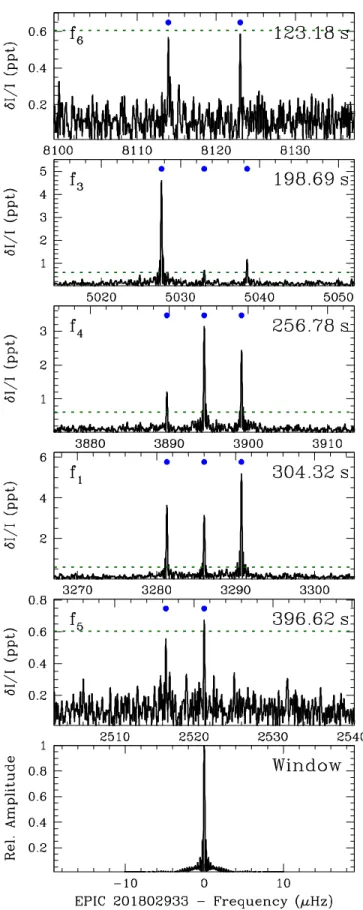
exceptionally clean spectral window, easing the interpretation of the frequency spectra and simplifying mode identification. Figure 1 highlights a representative amplitude spec-trum for a hot DAV: EPIC 201802933 (SDSSJ1151+0525,
Kp=17.7 mag), observed for more than 77 days inK2 Cam-paign 1. All Fourier transforms we compute have been over-sampled by a factor of 20, calculated from the software pack-age PERIOD04 (Lenz & Breger 2005). We fit for and re-moved all instrumental artifacts arising from the long-cadence sampling rate, at integer multiples of roughly 566.48µHz (Gilliland et al. 2010). All panels of Figure1are on the same frequency scale, including the spectral window.
We computed a significance threshold for all DAVs from a shuffled simulation of the data, as described inHermes et al. (2015a). In summary, we keep the time sampling of our ob-served light curves but randomly shuffle the flux values to create 10,000 synthetic light curves, noting the highest peak in the Fourier transform for each synthetic dataset. We set our 1% (0.1%) False Alarm Probability (FAP) at the value for which 99% (99.9%) of these synthetic Fourier transforms do not have a peak exceeding that amplitude. We also list in Table2the value for five times the average amplitude of the entire Fourier transform, 5hAi.
For all DAVs we adopt the 1% FAP as our significance threshold and produce a period list of observed pulsations,
de-8All reduced light curves are available online athttp://www.k2wd.org.
KIC/EPIC g Facility, Night of Exp. Seeing Airm. S/N Teff-1D ∆Teff logg-1D ∆logg Teff-3D logg-3D MWD
(mag) (s) (′′) Avg. (K) (K) (cgs) (cgs) (K) (cgs) (M⊙)
4357037 18.2 WHT, 2013 Jun 06 3×1200 0.9 1.07 77 12750 240 8.020 0.062 12650 8.013 0.62
4552982† 17.7 WHT, 2014 July 25 5×1200 0.7 1.06 76 11240 160 8.280 0.053 10950 8.113 0.67
7594781 18.1 WHT, 2014 July 25 6×1800 0.8 1.11 70 12040 210 8.170 0.059 11730 8.107 0.67
10132702 19.0 WHT, 2013 Jun 06 3×1500 0.9 1.06 70 12220 240 8.170 0.072 11940 8.123 0.68
11911480 18.0 WHT, 2013 Jun 07 3×1200 1.0 1.22 68 11880 190 8.020 0.061 11580 7.959 0.58
60017836 13.3 SOAR, 2016 Jul 14 5×30 2.1 1.11 210 11280 140 8.144 0.040 10980 7.995 0.60
201355934 17.8 SOAR, 2017 Apr 20 5×300 1.2 1.13 73 12050 170 8.016 0.047 11770 7.972 0.59
201719578 18.1 SOAR, 2017 Apr 14 8×300 1.4 1.22 62 11390 150 8.068 0.047 11070 7.941 0.57
201730811 17.1 SOAR, 2015 Jan 28 4×420 1.0 1.24 139 12600 170 7.964 0.043 12480 7.956 0.58
201802933 17.6 SOAR, 2016 Feb 14 3×360 1.4 1.23 75 12530 180 8.136 0.046 12330 8.114 0.68
201806008† 14.9 SOAR, 2016 Jun 22 7×180 1.1 1.29 161 11200 140 8.182 0.040 10910 8.019 0.61
206212611 17.3 SOAR, 2016 Jul 14 3×300 1.4 1.07 77 11120 150 8.170 0.048 10830 7.999 0.60
210397465 17.6 SOAR, 2016 Sep 01 5×300 1.8 1.27 50 11520 160 7.782 0.054 11200 7.713 0.45
211596649 18.9 SOAR, 2017 Feb 28 7×600 1.8 1.22 51 11890 180 7.967 0.057 11600 7.913 0.56
211629697† 18.3 SOAR, 2016 Dec 27 13×420 2.6 1.29 71 10890 150 7.950 0.060 10600 7.772 0.48
211914185 18.8 SOAR, 2017 Jan 25 9×600 2.0 1.38 61 13620 380 8.437 0.058 13590 8.434 0.88
211916160 18.9 SOAR, 2017 Apr 21 10×480 1.2 1.60 56 11820 170 8.027 0.053 11510 7.958 0.58
211926430 17.6 SOAR, 2016 Dec 27 11×420 2.2 1.30 98 11740 160 8.065 0.045 11420 7.982 0.59
228682478 18.2 SOAR, 2016 Jan 08 4×600 1.3 1.28 99 12340 170 8.226 0.046 12070 8.184 0.72
229227292† 16.6 SOAR, 2016 Feb 14 6×180 1.2 1.20 103 11530 150 8.146 0.042 11210 8.028 0.62 229228364† 17.8 SOAR, 2016 Jul 05 8×420 1.9 1.06 147 11330 140 8.172 0.043 11030 8.026 0.62
220204626 18.4 SOAR, 2016 Jul 05 7×420 1.7 1.22 74 11940 250 8.255 0.061 11620 8.173 0.71
220258806 16.2 SOAR, 2016 Jul 14 3×180 2.1 1.18 134 12890 200 8.093 0.047 12800 8.086 0.66
220347759 17.6 SOAR, 2016 Jul 05 5×300 1.5 1.32 81 12860 200 8.087 0.047 12770 8.080 0.66
220453225† 17.9 SOAR, 2016 Jul 05 7×300 1.6 1.49 72 11540 160 8.153 0.045 11220 8.035 0.62
229228478 16.9 SOAR, 2014 Oct 13 6×180 1.3 1.19 75 12610 180 7.935 0.045 12500 7.929 0.57
229228480 18.8 SOAR, 2016 Aug 07 7×600 1.0 1.17 65 12640 190 8.202 0.047 12450 8.181 0.72
References. — We use a†symbol to mark the first six outbursting white dwarfs (Bell et al. 2015;Hermes et al. 2015b;Bell et al. 2016,2017)
tailed in Table5in the appendix. Our first set of uncertainties on the period, frequency, amplitude, and phase in Table5arise from a simultaneous non-linear least-square fit to the signif-icant peaks, calculated with PERIOD04. All light curves are barycentric corrected, and the phases in Table 5are relative to the first mid-exposure time (T0) listed in in Table2. The
frequencies of variability are not in the stellar rest frame, but many have high enough precision that they should eventually be corrected for the Doppler and gravitational redshift of the white dwarf (e.g.,Davies et al. 2014).
Importantly, we are able to identify the spherical degree (ℓ) of 61 of the 154 independent modes in these DAVs (roughly 40%), based on common frequency patterns in the Fourier transforms, which in turn illuminates the rotation periods of these stellar remnants (see Section7). When identified, we group in Table 5 each set of frequencies of the same ra-dial order (k) and spherical degree (ℓ), and include the
mea-sured frequency splittings. We relax the significance thresh-old for a handful of modes that share common frequency splittings, which occasionally helps with identifying the cor-rect azimuthal order (m) for modes present. We have not
at-tempted to quantify the exact radial orders of any of the pul-sations here, but leave that to future asteroseismic analysis of these stars.
4. FOLLOW-UP WHT & SOAR SPECTROSCOPY
We complemented our space-based photometry of these 27 DAVs by determining their atmospheric parameters based on model-atmosphere fits to follow-up spectroscopy obtained from two 4-m-class, ground-based facilities. We detail these spectroscopic observations and their resultant fits in Table3. Our spectra have been obtained, reduced, and fit in a homoge-nous way to minimize systematics.
DAVs in the originalKeplermission field are at such high
declination (δ >+39 deg) that they can only be observed
from the Northern hemisphere, so we used the Intermediate-dispersion Spectrograph and Imaging System (ISIS) instru-ment mounted on the 4.2-m William Herschel Telescope (WHT) on the island of La Palma for these five northern DAVs. Their spectra were taken with a 600 line mm−1grating and cover roughly 3800−5100 Å at roughly 2.0 Å resolution
using the blue arm of ISIS. A complete journal of observa-tions for these five DAVs is detailed in Greiss et al.(2016), and we only list in Table3the night for which most observa-tions were obtained.
All K2 fields lie along the ecliptic, so we obtained
spec-troscopy of all K2 DAVs with the Goodman spectrograph
(Clemens et al. 2004) mounted on the 4.1-m Southern As-trophysical Research (SOAR) telescope on Cerro Pachón in Chile. Using a high-throughput 930 line mm−1 grating, we adopted grating and camera angles (13 degrees and 24 de-grees, respectively) which yield wavelength coverage from roughly 3600−5200 Å. With 2×2 binning, our dispersion is
0.84 Å pixel−1. To capture as much flux as possible, we use a 3′′slit, so our spectral resolution is seeing limited, roughly
3 Å in 1.0′′seeing and roughly 4 Å in 1.4′′seeing.
For each DAV, we obtained a series of consecutive spectra covering at least two cycles of the highest-amplitude pulsa-tion, as derived from theKeplerphotometry. We also made
attempts to observe our targets at minimum airmass, which we list in Table3, along with the mean seeing during the ob-servations, measured from the mean FWHM in the spatial di-rection of the two-dimensional spectra.
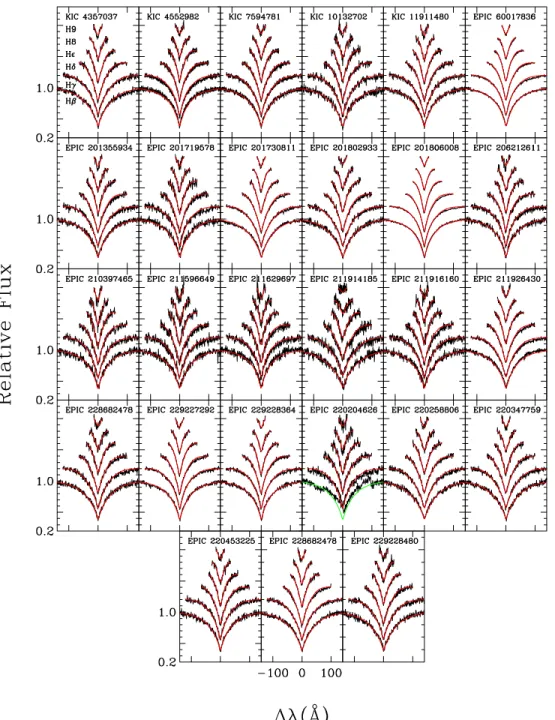
Figure 2. The averaged, normalized spectra for the 27 DAVs observed throughK2Campaign 8, overplotted with the best-fit atmospheric parameters detailed in Table3. We observed the five DAVs from the originalKeplermission with the ISIS spectrograph on the 4.2-m William Herschel Telescope; all others were observed with the Goodman spectrograph on the 4.1-m SOAR telescope. Tremblay et al.(2011) describes the models and fitting procedures, which use ML2/α= 0.8; atmospheric parameters have been corrected for the three-dimensional dependence of convection (Tremblay et al. 2013).
wavelength calibrate and apply a heliocentric correction, and perform a final weighted average of the one-dimensional (1D) spectra. We flux calibrated each spectrum to a spectrophoto-metric standard observed using the same setup at a similar air-mass, and used a scalar to normalize this final spectrum to the
gmagnitude from either the SDSS, VST/ATLAS, APASS, or
KIS photometric surveys, in order to correct its final absolute flux calibration.
We use the mean seeing to compute the spectral resolution, which informs the S/N per resolution element of the final spectra; the values listed in Table3 were computed using a 100-Å-wide region of the continuum centered at 4600 Å.
We fit the six Balmer lines Hβ-H9 of our final 1D spectra to pure-hydrogen, 1D model atmospheres for white dwarfs. In
short, the models employ the latest treatment of Stark broad-ening, as well as the ML2/α= 0.8 prescription of the mixing-length theory. A full description of the models and fitting pro-cedures is contained in Tremblay et al.(2011). For each in-dividual DAV, the models were convolved to match the mean seeing during the observations.
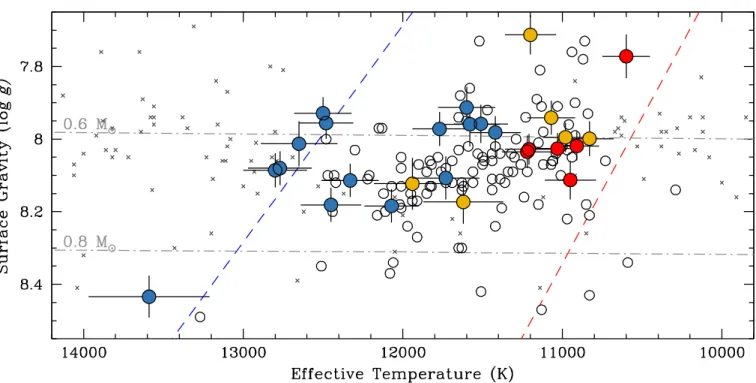
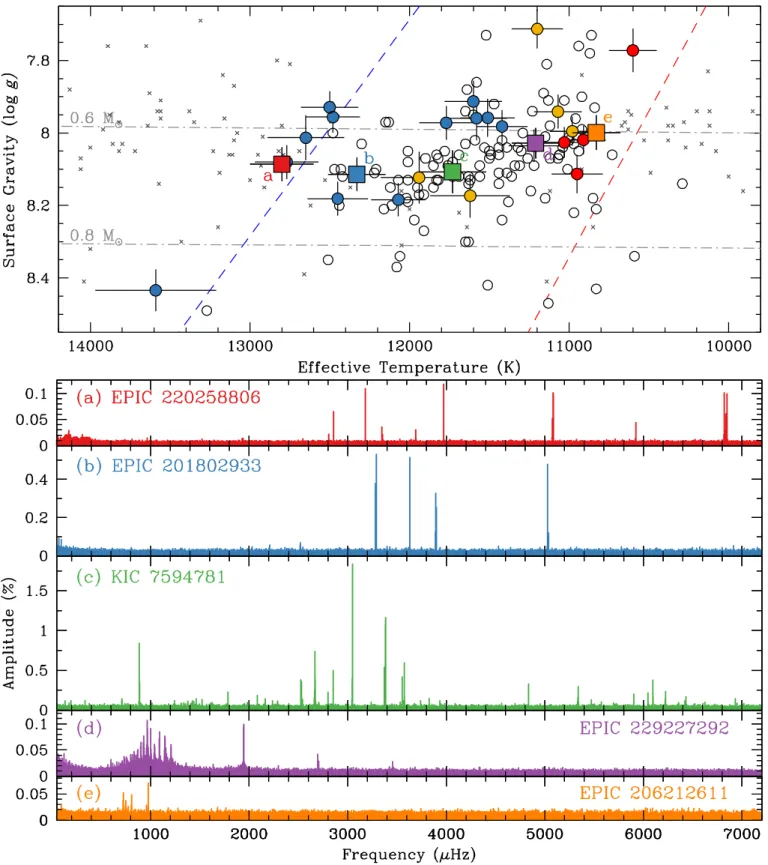
Figure 3. The DAVs withKeplerdata in the context of the empirical DAV instability strip, demarcated with blue and red dashed lines most recently updated by
Tremblay et al.(2015). We mark all DAVs with weighted mean pulsation periods shorter than 600 s in blue, and those greater than 600 s in gold (see Section6). Cool DAVs which show outbursts are marked in red (see Section6). Known DAVs from ground-based observations are shown with open circles, and DAs not observed to vary to higher than 4 ppt are marked with grey crosses (Gianninas et al. 2011;Tremblay et al. 2011). All atmospheric parameters have been analyzed with the same models, using ML2/α=0.8, and corrected for the 3D-dependence of convection (Tremblay et al. 2013). Dash-dotted gray lines show cooling tracks for 0.6M⊙and 0.8M⊙white dwarfs (Fontaine et al. 2001).
logg-3D. We adopt these 3D-corrected atmospheric
parame-ters as our estimates of the effective temperature and surface gravity of our 27 DAVs here, and use them in concert with the white dwarf models ofFontaine et al.(2001) (which have thick hydrogen layers and uniformly mixed, 50% carbon and 50% oxygen cores) to estimate the overall mass of our DAVs. Our overall mass estimates do not change by more than the adopted uncertainties (0.04M⊙ for all white dwarfs here) if
we instead use the models ofRenedo et al.(2010), which have more realistic carbon-oxygen profiles resulting from full evo-lutionary sequences.
Notably, two DAVs in our sample have line-of-sight dM companions, one of which strongly contaminates the Hβline profiles. For this DAV (EPIC 220204626, SDSSJ0111+0009) we have omitted the Hβline from our fits.
Our fitting methodology differs slightly from that adopted byGreiss et al. (2016) in that we fit the averaged spectrum rather than each spectrum individually, so our reported param-eters are slightly different than reported there, but still within the 1σ uncertainties. However, we note that the values for KIC 4357037 (KISJ1917+3927) were misreported inGreiss et al.(2016), and are corrected here.
We put our spectroscopic effective temperatures and sur-face gravities in the context of the empirical DAV instability strip in Figure3; we show the empirical blue and red edges found byTremblay et al.(2015). All atmospheric parameters, including literature DAVs and white dwarfs not observed to vary, have been determined using the same 1D models using ML2/α=0.8, and all have been corrected to account for the 3D-dependence of convection. SinceKepleris often sensitive
to lower-amplitude pulsations than from the ground, it appears the empirical blue edge of the instability strip may need ad-justing by roughly 200 K to hotter temperatures, but we leave that discussion to future analyses.
We adopt in Figure3a color code that we will use through-out the manuscript. We mark in blue all DAVs with a weighted mean period (WMP) shorter than 600 s (as described in more detail in Section6), which cluster at the hotter (blue) half of the instability strip. We mark in gold all DAVs with a WMP exceeding 600 s. Finally, we mark in red the first six outburst-ing DAVs (Bell et al. 2017), all of which we mark in Table3 with a† symbol. These outbursting DAVs are also all cooler
than 11,300 K and exhibit stochastic, large-amplitude flux ex-cursions we have called outbursts.
Outbursts in the coolest DAVs were first discovered in the long-baseline monitoring of theKeplerspacecraft (Bell et al.
2015) and confirmed in a second DAV observed inK2
Cam-paign 1 (Hermes et al. 2015b). Detailed discussion of this interesting new phenomenon is outside the scope of this pa-per, but we have previously demonstrated that outbursts affect (and may be affected by) pulsations (Hermes et al. 2015b).
Interestingly, there are threeK2pulsating white dwarfs near
or even cooler than the first six outbursting DAVs. One of these three is GD 1212, which only has 9 days of observations, so the limits on a lack of outbursts are not robust. GD 1212 was re-observed byK2 for more than 75 days in Campaign
12, and will be analyzed in a future publication. We will dis-cuss our insights fromK2into the evolution of white dwarfs
through the DAV instability strip in Section6. 5. A DICHOTOMY OF MODE LINEWIDTHS
Long-baselineKeplerphotometry has opened an
unprece-dented window into the frequency and amplitude stability of DAVs. From early observations of the first DAV observed withKepler, we noticed broad bands of power in the Fourier
Figure 4. We show detailed portions of the Fourier transforms of four DAVs observed withK2to show that pulsations with periods exceeding roughly 800 s (frequencies<1250µHz) have power broadly distributed outside the spectral window of theKeplerobservations. For every DAV we have fit a Lorentzian to each independent mode, as described in Section5. At top left we show two modes in EPIC 201806008 (PG 1149+058): f8b, likely them= 0 component of anℓ= 2 mode centered at 907.6 s, has power broadly distributed, with HWHM=0.868µHz, whereas f6c, them=+1 component of theℓ= 1 mode centered at 412.40 s, has a sharp peak with HWHM=0.056µHz. Similarly, in the top right panels we show two modes in EPIC 229227292 (ATLASJ1342−0735): the band of power centered at 1073.44 s, which has HWHM=1.632µHz, is significantly broader than them=−1 component of theℓ= 1 mode centered at 370.05 s. The bottom left panels show similar behavior in EPIC 201719578 (WD 1119+042): the 922.60 s mode in the same star has a HWHM of 0.836µHz, whereas the 404.60 s mode has a HWHM of 0.045µHz. Finally, we show KIC 10132702 (KISJ1913+4709) in the bottom right panel, where the 715.86 s mode has a HWHM of 1.632µHz, whereas the 615.44 s mode has a HWHM of 0.104µHz. The x-axis (frequency) scales are identical for each star. The best fits for each mode are detailed in Table5and over-plotted here; the HWHM of Lorentzian fits to all 27 DAVs are shown in Figure5.
cool DAV, GD 1212, observed during an engineering test run forK2 (Hermes et al. 2014). The broadly distributed power
was reminiscent of the power spectra of stochastically driven oscillations in the Sun or other solar-like oscillators (Chap-lin & Miglio 2013). However, as noted inBell et al.(2015), white dwarfs have a sound-crossing time orders of magnitude shorter than their observed pulsation periods, so these broad linewidths cannot be related to stochastic driving.
Additionally, it became clear that not all white dwarfs with long-baseline, space-based observations showed such broad linewidths. For example, we observed multiple DAVs with hotter effective temperatures and shorter-period pulsations that were completely coherent, within the uncertainties, over several months of Kepler observations (Greiss et al. 2014;
Hermes et al. 2015a).
Within the larger sample of the first 27 DAVs, we have no-ticed an emergent pattern: a dichotomy of mode linewidths, even within the same star, delineated almost entirely by the pulsation period. The shorter-period modes appear stable in phase, producing narrow peaks in the Fourier transform, while the longer-period modes are phase unstable, spreading their power over a broad band in the Fourier transform. To quan-tify this behavior we have fit Lorentzian envelopes to every
significant pulsation period, and compare the period deter-mined to the half-width-at-half-maximum (HWHM,γ) of the Lorentzian fits. Motivated byToutain & Appourchaux(1994), we have fit each thicket of peaks in the power spectrum (the square of the Fourier transform) with the function
Power = Aγ2
(ν−ν0)2+γ2+B (1)
whereArepresents the Lorentzian height, γ is the HWHM, ν0 is the central frequency of the peak, andB represents a
DC offset for the background, which we hold fixed for all modes in the same star as the median power of the entire power spectrum. We have only fit the region within 5µHz to each side of the highest-amplitude peak within each band of power; this highest peak defines our initial guess for the central frequency, and we use an initial guess for the HWHM of 0.2µHz, roughly twice our typical frequency resolution.
Figure 5. The half width at half maximum (HWHM) of Lorentzian functions fit to all significant peaks in the power spectra of the 27 DAVs observed through K2Campaign 8 by theKeplerspace telescope; our procedure is described in Section5. We use the same color classification as in Figure3, where blue are objects with WMP<600 s, gold with WMP>600 s, and red those with outbursts (see Section6). We have excluded any nonlinear combination frequencies in this analysis. We see a sharp increase in HWHM at roughly 800 s, indicating that modes with relatively high radial order (k>15 forℓ= 1 modes) are not coherent in phase, similar in behavior to stochastically excited pulsators. We save discussion of the possible physical mechanisms behind this phenomenon for future work (Montgomery et al., in prep.).
DAVs in Figure4were observed by theKeplerspacecraft for
more than 78 days with a duty cycle exceeding 91%. We ob-serve that modes exceeding roughly 800 s (with frequencies below roughly 1250µHz) have much broader HWHM, often exceeding 1µHz.
These broad bands of power are most likely represen-tative of a single mode that is unstable in phase, remi-niscent of a damped harmonic oscillator. For example, in the top left panels of Figure 4 we show two modes in EPIC 201806008 (PG 1149+058), the second outbursting DAV discovered (Hermes et al. 2015b). The mode f6cis the
m=+1 component of theℓ= 1 mode centered at 412.40 s — the two other components are seen at slightly lower frequency (we discuss this splitting in the context of rotation in Sec-tion7). The HWHM of f6cis consistent with the spectral win-dow: γ= 0.056µHz. At much lower frequency, we identify the mode f8b as the likelym= 0 component of anℓ= 2 mode centered at 907.58 s. It has power much more broadly dis-tributed, withγ= 0.868µHz, too narrow to encompass other normal modes of different degree or radial order, but much broader than the spectral window.
We extend this Lorentzian analysis of mode linewidths to the entire sample of 27 DAVs in Figure5, which shows the period and HWHM computed for every Lorentzian fit to all 225 significant pulsations (we exclude all nonlinear combina-tion frequencies from Figure5; see Section6). We performed the same experiment by fitting Gaussians to each peak and ob-tained a nearly identical distribution, so our choice of function does not significantly alter our results.
We see a sharp increase in HWHM at roughly 800 s, in-dicating that modes with relatively high radial order (k>15 forℓ= 1 modes) are not phase coherent, exhibiting behavior similar to stochastically excited pulsators, though we do not believe the mode instability is related to stochastic driving.
One possibility is that the broad linewidths arise from a pro-cess that has disrupted the phase coherence of the modes. In analogy with stochastically-driven modes, we relate the ob-served mode linewidth (HWHM) to its lifetime (τ) via the relationτ = 2/(πγ) (Chaplin et al. 2009). Doing so for the longer-period modes (γ >1µHz), we find mode lifetimes of order several days to weeks. This is comparable to the damping rates we expect for roughly 1000 s ℓ= 1 modes of typical pulsating white dwarfs (Goldreich & Wu 1999). We will explore possible physical mechanisms to explain these broad linewidths in a future publication (Montgomery et al., in prep.).
Determining a pulsation period to use for asteroseismol-ogy of the coolest DAVs with the longest-period modes is different than for the hot DAVs with narrow pulsation peaks that are determined via a linear least-squares fit and cleanly prewhiten. Therefore, for all modes with fitted HWHM ex-ceeding 0.2µHz, we do not include their linear-least-square fits in Table5, and instead only include the periods and ampli-tudes as determined from the Lorentzian fits in Table5, with period uncertainties computed from the HWHM.
6. CHARACTERISTICS OF THE DAV INSTABILITY STRIP Pulsations in DAVs are excited by the “convective driving” mechanism, which is intimately tied to the surface hydrogen partial-ionization zone that develops as a white dwarf cools below roughly 13,000 K (Brickhill 1991; Wu & Goldreich 1999). Driving is strongest for pulsations with periods near-est to roughly 25 times the thermal timescale at the base of the convection zone (Goldreich & Wu 1999).
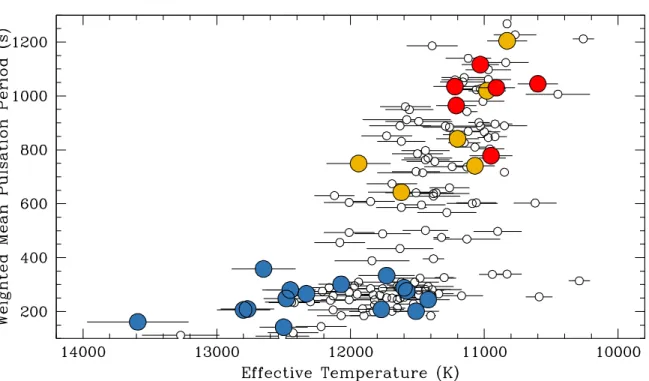
en-Figure 6. FollowingClemens(1993), we plot the effective temperature versus the weighted mean pulsation period (WMP) of each DAV analyzed here, using the same color classification used in Figure3. We also show in white circles the 114 known DAVs from the literature with spectroscopy analyzed in the same way, also plotted in Figure3.
semble characteristics of the DAV instability strip, especially the lengthening of periods with cooler effective temperature, have been considered for decades (e.g.,Clemens 1994), and were most recently summarized observationally byMukadam et al.(2006).
The most common way to visualize the increasing mode pe-riods as DAVs cool is to compute the weighted mean period (WMP) of the significant pulsations (Clemens 1993). The WMP is linearly weighted by the amplitude of each mode, such that WMP = P
iPiAi/ P
iAi, where Pi and Ai are the period and amplitude, respectively, of each significant inde-pendent pulsation detected (excluding nonlinear combination frequencies). We show the WMPs of all 27 DAVs observed by
KeplerandK2so far in Figure6, in addition to the WMP and
temperatures of previously known DAVs with atmospheric parameters determined in the same way, byGianninas et al. (2011) andTremblay et al.(2011).
Extensive coverage by theKeplerspace telescope affords an
even more nuanced exploration of the DAV instability strip. With our follow-up spectroscopic characterization of the first 27 DAVs observed with Kepler andK2, we can effectively
put the evolutionary state of our pulsating white dwarfs into greater context. Figure7highlights five DAVs that are repre-sentative of five different stages of evolution through the DAV instability strip, including color-coded Fourier transforms of each representative object. These data reveal important trends in the period and amplitude evolution of DAVs through the in-stability strip. Since there are likely mass-dependent effects, we describe this sequence for DAVs near the mean field white dwarf mass of 0.62M⊙, in order of hottest to coolest DAVs:
(a) DAVs begin pulsating at the blue edge of the instabil-ity strip with low-k(1<k<6)ℓ= 1,2 modes from roughly 100−300 s and relatively low amplitudes (∼1 ppt). We
high-light in red in Figure7the hot (12,800 K) white dwarf EPIC 220258806 (SDSSJ0106+0145) that appears to fall at the blue edge of the instability strip. This DAV has stable pulsations ranging from 116.28−356.14 s (WMP = 206.0 s), most of
which are clearly identified as both ℓ= 1 and ℓ= 2 modes (see Table5), although no modes have amplitudes in excess of roughly 1 ppt. The hottest DAVs in our sample have relatively low-amplitude modes. For example, the hottest DAV cur-rently known is EPIC 211914185 (SDSSJ0837+1856) which has just two relatively low-amplitude (1−3 ppt) dipole modes
centered at 109.15 s and 190.45 s (Hermes et al. 2017c). An example of a blue-edge DAV in this phase of evolution well-studied from ground-based observations is G226−29 (Kepler
et al. 1995).
(b) As DAVs cool by a few hundred degrees from the blue edge, they retain relatively short-period pulsations but their observed amplitudes increase. For example, the 12,330 K EPIC 201802933 (SDSSJ1151+0525) has amplitudes up to roughly 5 ppt with modes ranging from 123.11−396.62 s
(WMP = 266.2 s). These low-kmodes are expected to have
extremely long mode lifetimes (Goldreich & Wu 1999), and most modes in these hot DAVs with mode periods shorter than 400 s appear coherent in phase. A well-known example of this phase of DAV evolution is G117-B15A (Robinson et al. 1995; Kepler et al. 2000).
1
10
100
WD Rotation Period (hr)
0.4
0.5
0.6
0.7
0.8
0.9
W
D
M
as
s
(
M
⊙)
1.0
1.5
2.0
2.5
3.0
3.5
4.0
Z
A
M
S
P
ro
g
en
it
o
r
M
as
s
(
M
⊙)
1
10
100
White Dwarf Rotation Period (hr)
0
2
4
6
8
10
N
Kepler
&
K2
Kawaler (2015)
Figure 8. We compare asteroseismically determined rotation periods for all known pulsating white dwarfs, detailed in Table4. All white dwarfs presented here appear to be isolated stars, so these rotation periods should be representative of the endpoints of single-star evolution; we have excluded the only known close binary (a WD+dM in a 6.9-hr orbit), EPIC 201730811 (SDSSJ1136+0409,Hermes et al. 2015a). The left histogram shares the color-coding of the right panel, which compares white dwarf rotation as a function of mass. Estimates of the ZAMS progenitor masses for each white dwarf are listed on the right axis. Notably, EPIC 211914185 (SDSSJ0837+1856) is more massive (0.88±0.03M⊙) and rotates faster (1.13±0.02 hr) than any other pulsating white dwarf (Hermes et al. 2017c); we see evidence for a link between high mass and fast rotation, but require additional massive white dwarfs to confirm this trend.
Objects in the middle of the DAV instability strip represent a transition from hot, stable pulsations to cool DAVs with os-cillations that are observed to change in frequency and/or am-plitude on relatively short timescales. G29−38 is a prominent,
long-studied example of DAV representative of this phase in the middle of the instability strip (Kleinman et al. 1998).
(d)Keplerobservations have now confirmed what appears
to be a new phase in the evolution of DAVs as they approach the cool edge of the instability strip: aperiodic outbursts that increase the mean stellar flux by a few to 15%, last several hours, and recur sporadically on a timescale of days. Out-bursts were first discovered in the original Kepler mission
(Bell et al. 2015), and quickly confirmed inK2(Hermes et al.
2015b). Observational properties of the first six outbursting DAVs are detailed in Bell et al. (2017). Aside from many long-period pulsations, almost all of the outbursting DAVs ob-served byKepleralso show at least one and sometimes
mul-tiple shorter-period modes. Figure7 highlights the Fourier transform of the 11,210 K outbursting DAV EPIC 229227292 (ATLASJ1342−0735), which is dominated by pulsations from
827.7−1323.6 s (WMP = 964.5 s) but also shows significant
periods centered around 514.1 s, 370.0 s and 288.9 s (see Ta-ble5). From the brightest outbursting DAV observed so far (PG 1149+058) we saw strong evidence that the pulsations re-spond to the outbursts (Hermes et al. 2015b).
(e) Finally, a handful of DAVs have effective temperatures as cool or cooler than the outbursting DAVs but do not experi-ence large-scale flux excursions, suggesting that not all DAVs outburst at the cool edge of the instability strip. The coolest DAVs tend to have the longest-period pulsations with rela-tively low amplitudes. We highlight in Figure7the star EPIC 206212611 (SDSSJ2220−0933), which is one of the coolest
DAVs known, at 10,830 K. We do not detect any outbursts to a limit of 5.5%, following the methodology outlined inBell
et al. (2016). This DAV has modes from 1023.4−1381.2 s
(WMP = 1204.4 s), all at relatively low amplitudes below 1 ppt.
7. ROTATION RATES
The oscillations observed in white dwarfs are non-radialg
-modes, which can be decomposed into spherical harmonics. Pulsations can thus be represented by three quantum numbers: the radial order (k, often expressed asnin other fields of
as-teroseismology), representing the number of radial nodes; the spherical degree (ℓ), representing the number of nodal lines expressed at the surface of the star; and the azimuthal order (m), representing the number of nodal lines in longitude at the
surface of the star, ranging from−ℓtoℓ.
Due to strong geometric cancellation of higher-ℓ modes, we typically observeℓ= 1,2 modes in white dwarfs. Rota-tion causes a lifting of degeneracy in the pulsaRota-tion frequen-cies, causing a mode to separate into 2ℓ+1 components inm
(Unno et al. 1989). If all multiplets are present, this can re-sult in triplets (for ℓ= 1 modes) and quintuplets (for ℓ= 2 modes) in the presence of slow rotation. This is corrobo-rated by the many DAVs we observed withKeplerthat show
triplets and quintuplets of peaks evenly spaced in frequency: an exquisite example is the hot DBV PG 0112+104 (Hermes et al. 2017b). Observationally (and in contrast to solar-like oscillations), white dwarf pulsations do not partition mode energy equally into the variousmcomponents, such that the
amplitudes of differentmcomponents for a givenk, ℓare not necessarily symmetric.
signif-Star Name RA & Dec (J2000) Class Teff-3D WD Mass ∆MWD Prog. Mass ∆MProg. δνℓ=1 Prot Ref.
(K) (M⊙) (M⊙) (M⊙) (M⊙) (µHz) (hr)
Literature values for all classes of pulsating white dwarfs compiled byKawaler(2015)
Ross 548 01 36 13.58−11 20 32.7 DAV 12300 0.62 0.04 2.36 0.47 · · · 37.8 1
HL Tau 76 04 18 56.63 +27 17 48.5 DAV 11470 0.56 0.04 1.93 0.44 · · · 52.8 2
HS 0507+0434 05 10 13.94 +04 38 38.4 DAV 12010 0.72 0.04 3.00 0.52 3.6 40.9 3
KUV11370+4222 11 39 41.42 +42 05 18.7 DAV 11940 0.71 0.04 2.92 0.51 25.0 5.9 4
GD 154 13 09 57.69 +35 09 47.1 DAV 11120 0.65 0.04 2.49 0.48 2.8 53.3 5
LP 133−144 13 51 20.24 +54 57 42.6 DAV 12150 0.59 0.04 2.13 0.45 · · · 41.8 6
GD 165 14 24 39.14 +09 17 14.0 DAV 12220 0.67 0.04 2.68 0.50 · · · 57.3 1
L19-2 14 33 07.60−81 20 14.5 DAV 12070 0.69 0.04 2.75 0.50 13.0 13.0 7
SDSSJ1612+0830 16 12 18.08 +08 30 28.1 DAV 11810 0.78 0.04 3.50 0.55 75.6 1.9 8
G226-29 16 48 25.64 +59 03 22.7 DAV 12510 0.83 0.04 3.68 0.57 · · · 8.9 9
G185-32 19 37 13.68 +27 43 18.7 DAV 12470 0.67 0.04 2.64 0.49 · · · 14.5 10
PG 0122+200 01 25 22.52 +20 17 56.8 DOV 80000 0.53 0.04 1.75 0.42 3.7 37.2 11
NGC 1501 04 06 59.39 +60 55 14.4 DOV 134000 0.56 0.04 1.94 0.44 · · · 28.0 12
PG 1159−035 12 01 45.97−03 45 40.6 DOV 140000 0.54 0.04 1.81 0.43 · · · 33.6 13
RX J2117.1+3412 21 17 08.28 +34 12 27.5 DOV 170000 0.72 0.04 2.98 0.52 · · · 28.0 14
PG 2131+066 21 34 08.23 +06 50 57.4 DOV 95000 0.55 0.04 1.88 0.43 · · · 5.1 15
KIC 8626021 19 29 04.69 +44 47 09.7 DBV 30000 0.59 0.04 2.10 0.45 3.3 44.6 16
EPIC 220670436 01 14 37.66 +10 41 04.8 DBV 31300 0.52 0.04 1.68 0.42 15.4 10.2 17
Rotation rates from DAVs analyzed here
KIC 4357037 19 17 19.20 +39 27 19.1 DAV 12650 0.62 0.04 2.30 0.47 6.7 22.0 0
KIC 4552982 19 16 43.83 +39 38 49.7 DAV 10950 0.67 0.04 2.67 0.50 8.0 18.4 18
KIC 7594781 19 08 35.88 +43 16 42.4 DAV 11730 0.67 0.04 2.66 0.49 5.5 26.8 0
KIC 10132702 19 13 40.89 +47 09 31.3 DAV 11940 0.68 0.04 2.73 0.50 13.2 11.2 0
KIC 11911480 19 20 24.90 +50 17 21.3 DAV 11580 0.58 0.04 2.07 0.45 1.97 74.7 19
EPIC 60017836 23 38 50.74−07 41 19.9 DAV 10980 0.57 0.04 2.00 0.44 21.2 6.9 0
EPIC 201719578 11 22 21.10 +03 58 22.4 DAV 11070 0.57 0.04 2.01 0.44 5.5 26.8 0
EPIC 201730811 11 36 55.16 +04 09 52.8 DAV 12480 0.58 0.04 2.08 0.45 56.7 2.6 20
EPIC 201802933 11 51 26.15 +05 25 12.9 DAV 12330 0.68 0.04 2.69 0.50 4.7 31.3 0
EPIC 201806008 11 51 54.20 +05 28 39.8 DAV 10910 0.61 0.04 2.29 0.47 4.7 31.3 0
EPIC 210397465 03 58 24.23 +13 24 30.8 DAV 11200 0.45 0.04 1.23 0.38 3.0 49.1 0
EPIC 211596649 08 32 03.98 +14 29 42.4 DAV 11600 0.56 0.04 1.91 0.44 1.8 81.8 0
EPIC 211629697 08 40 54.14 +14 57 09.0 DAV 10600 0.48 0.04 1.40 0.40 2.3 64.0 0
EPIC 211914185 08 37 02.16 +18 56 13.4 DAV 13590 0.88 0.04 4.02 0.60 131.6 1.1 21
EPIC 211926430 09 00 41.08 +19 07 14.4 DAV 11420 0.59 0.04 2.16 0.46 5.8 25.4 0
EPIC 228682478 08 40 27.84 +13 20 10.0 DAV 12070 0.72 0.04 2.97 0.52 1.4 109.1 0
EPIC 229227292 13 42 11.62−07 35 40.1 DAV 11210 0.62 0.04 2.33 0.47 5.0 29.4 0
EPIC 220204626 01 11 23.89 +00 09 35.2 DAV 11620 0.71 0.04 2.92 0.51 6.1 24.3 0
EPIC 220258806 01 06 37.03 +01 45 03.0 DAV 12800 0.66 0.04 2.58 0.49 4.9 30.0 0
EPIC 220347759 00 51 24.25 +03 39 03.8 DAV 12770 0.66 0.04 2.56 0.49 4.7 31.7 0
References. — (0) This work; (1)Giammichele et al.(2016); (2)Dolez et al.(2006); (3)Fu et al.(2013); (4)Su et al.(2014); (5)Pfeiffer et al.(1996); (6) Bognár et al.(2016); (7)Bradley(2001); (8)Castanheira et al.(2013); (9)Kepler et al.(1995); (10)Pech & Vauclair(2006); (11)Fu et al.(2007); (12)Bond et al. (1996); (13)Charpinet et al.(2009); (14)Vauclair et al.(2002); (15)Kawaler et al.(1995); (16)Østensen et al.(2011); (17)Hermes et al.(2017b); (18)Bell et al.
(2015); (19)Greiss et al.(2014); (20)Hermes et al.(2015a) — excluded from Figure8since white dwarf in close, post-common-envelope binary; (21)Hermes
et al.(2017c).
icantly simplifies mode identification and affords us the op-portunity to probe internal rotation for 20 of the 27 DAVs we present here. For example, Figure1 shows the five dipole (ℓ= 1) modes in EPIC 201802933 (SDSSJ1151+0525) iden-tified from their splittings. Evidence for splittings in other DAVs analyzed here can be found in Section8.
To first order, the observed pulsation frequency splittings (δν) are related to the stellar rotation frequency (Ω) by the relation
δν=m(1−Ck,ℓ)Ω (2)
whereCk,ℓ represents the effect of the Coriolis force on the
pulsations, as formulated by Ledoux (1951). For high-k
modes that approach the asymptotic, mode-independent limit forℓ= 1 modes,Ck,1→0.50. However, the low-k(especially
k<10) modes found in hot DAVs can suffer from strong mode-trapping effects that also significantly alterCk,ℓ (e.g.,
Brassard et al. 1992). Theoretical DAV models in, for exam-ple,Romero et al.(2012), predictCk,1values typically ranging from roughly 0.45−0.49, with exceptions down toCk,1∼0.35 for strongly trapped modes.
For the 20 DAVs here for which we have identified modes,
all have at least one and many have multiple sets of ℓ= 1 modes; the full catalog of asteroseismic rotation rates for white dwarfs is detailed in Table4. To provide the best model-independent estimates for the rotation periods of the newly identified DAVs here, we compute the median frequency split-ting of all identifiedℓ= 1 modes (δνℓ=1), which we list in
Ta-ble4. We then hold fixedCk,1= 0.47 and useδνℓ=1to estimate
the DAV rotation period. We put these new DAV rotation pe-riods into the context of all other white dwarfs with measured rotation periods from asteroseismology compiled byKawaler (2015) in Figure8.KeplerandK2have more than doubled the
number of white dwarfs for which we have measured internal rotation from pulsations.
We note that it is necessary to perform a complete astero-seismic analysis in order to estimate the best values forCk,ℓ
for the pulsation modes presented here. This also affords the opportunity to significantly improve constraints on the rota-tion period; the choice ofCk,ℓ for each mode dominates the
es-timate each rotation period has a systematic uncertainty of roughly 10%, though we note thatCk,ℓcannot exceed 0.50.
Importantly, because we have measured the atmospheric parameters of all DAVs observed withKeplerso far, we have
for the first time a large enough sample to determine how rota-tion periods in white dwarfs differ as a funcrota-tion of the overall white dwarf mass. We see in Figure8suggestions of a trend of decreasing rotation period with increasing white dwarf mass. We also include on the right axis estimates for the ZAMS progenitor mass, calculated from the cluster-calibrated white dwarf initial-to-final-mass relation ofCummings et al.(2016) for progenitor stars with masses below 4.0M⊙.
A first-order linear fit to the white dwarf mass-rotation plot in the right panel of Figure8 yields an estimate of the final white dwarf rotation rate as a function of progenitor mass:
Prot= (2.36±0.14)−MZAMS/(0.0024±0.0031), whereProt is the final rotation period expressed in hours andMZAMSis the ZAMS progenitor mass in solar masses. This linear trend is not yet statistically significant; we are actively seeking more white dwarfs with masses exceeding 0.72M⊙ (which likely
arise from>3.0M⊙ZAMS progenitors) to improve estimates
of this relationship.
The mass distribution of white dwarfs with rotation periods measured from pulsations is very similar to the mass distri-bution of field white dwarfs determined byTremblay et al. (2016). If we restrict our analysis to only white dwarfs within 1σof the mean mass and standard deviation of field white dwarfs (i.e., nearly 70% of all field white dwarfs), we are left with 34 pulsating white dwarfs with masses from 0.51−
0.73M⊙ which have a mean rotation period of 35 hr with a
standard deviation of 28 hr (35±28 hr). The mean rotation
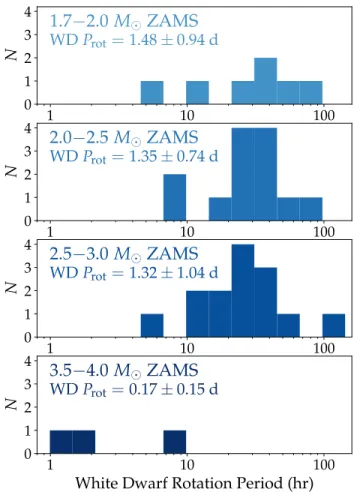
period is essentially the same if we break the subsample into progenitor ZAMS masses spanning 1.7−2.0M⊙(35±23 hr),
2.0−2.5M⊙(32±18 hr), and 2.5−3.0M⊙(32±25 hr).
How-ever, the small sample of three massive white dwarfs, which evolved from 3.5−4.0M⊙ progenitors, appear to rotate
sig-nificantly faster, at 4.0±3.5 hr. This is visualized in Figure9.
The originalKeplermission yielded exceptional insight into
the rotational evolution of stars at most phases of stellar evo-lution (Aerts 2015), and now we can provide final boundary conditions on the question of internal angular momentum evo-lution in isolated stars. For example,Keplerdata have been
especially effective at illuminating differential rotation and angular momentum evolution in 1.0−2.0M⊙ first-ascent red
giants (e.g.,Mosser et al. 2012), where it was found that their cores are rotating roughly 10 times faster than their envelopes. Still, this is an order of magnitude slower than expected ac-counting for all hypothesized angular momentum transport processes (e.g., Marques et al. 2013;Cantiello et al. 2014). Moving further along the giant branch,Keplerhas shown that
2.2−2.9M⊙core-helium-burning secondary clump giants do
not have as much radial differential rotation and have cores rotating at roughly 30−100 days (e.g.,Deheuvels et al. 2015).
For decades we have known that white dwarfs have rel-atively slow rotation, given their surface rotation velocities usually do not exceed upper limits of 15 km s−1, correspond-ing to periods longer than several hours (Koester et al. 1998). This is surprising: if we completely conserve the angular mo-mentum of a 3.0M⊙ main-sequence star with an initial
rota-tion period of 10 hr, its white dwarf remnant would be rotat-ing faster than a few minutes (Kawaler 2004). We establish here that the majority of isolated descendants of 1.7−3.0M⊙
ZAMS progenitors rotate at 1.5 d, with a narrow dispersion
1 10 100
0 1 2 3 4
N
1.7
−
2.0
M
⊙ZAMS
WD
P
rot=
1.48
±
0.94 d
1 10 100
0 1 2 3 4
N
2.0
−
2.5
M
⊙ZAMS
WD
P
rot=
1.35
±
0.74 d
1 10 100
0 1 2 3 4
N
2.5
−
3.0
M
⊙ZAMS
WD
P
rot=
1.32
±
1.04 d
1 10 100
White Dwarf Rotation Period (hr)
0 1 2 3 4
N
3.5
−
4.0
M
⊙ZAMS
WD
P
rot=
0.17
±
0.15 d
Figure 9. Rotation rates of pulsating, apparently isolated white dwarfs as a function of initial stellar mass, using the cluster-calibrated IFMR from
Cummings et al.(2016). The 34 pulsating white dwarfs with masses from 0.51−0.73M⊙(which descended from roughly 1.7−3.0M⊙ZAMS stars) all have a mean rotation period of roughly 35 hr regardless of binning, but more massive white dwarfs (>0.75M⊙, which descended from>3.5M⊙ ZAMS stars) appear to rotate systematically faster.
between 0.5−2.2 d at the conclusion of their evolution. We
note that we are sensitive to rotation periods longer than 15 d given our frequency resolution, but the longest rotation period we measure is 109.1 hr (roughly 4.5 d) in EPIC 228682478.
8. NOTES ON INDIVIDUAL OBJECTS
KIC 4357037 (KISJ1917+3927): With “only” 36.3 d of
nearly uninterruptedKepler observations, this is one of our
shortest datasets, but still the data reveal seven independent pulsations, five of which we identify asℓ= 1 modes; we show in Figure10the two highest-amplitude modes, f1and f2. As noted in Section4, the atmospheric parameters for this ob-ject were misreported inGreiss et al.(2016), but are corrected here and find Teff = 12,650 K. Most periods we observe are in line with such a hot DAV, with the identifiedℓ= 1 modes spanning 214.40−396.70 s. However, there are several
long-period modes that do not appear to be nonlinear difference fre-quencies, at 549.72 and 956.11 s. The latter mode at 956.11 s (bottom panel of Figure10) is significantly broader than the spectral window, with HWHM=0.318µHz, suggesting it is an independent mode in the star, given its position in Figure5. It is at a much longer period than typically observed in such a hot DAV, posing an interesting question of how it is excited at the same time as other modes with three times shorter periods.
KIC 4552982 (KISJ1916+3938): This was the first DAV
discovered in the original Kepler mission field and has the
Figure 10. The highest-amplitude modes in KIC 4357037 (KISJ1917+3927), f1 and f2 (ℓ = 1 modes marked with blue dots), illuminate the medianℓ= 1 splitting of 6.8µHz, corresponding to a 22.0-hr rotation period. We could not identify the longest-period mode also present in this star at 956.11 s (unidentified modes marked with green dots), which has a considerably broader line width than the shorter-period modes.
dwarf ever recorded, spanning more than 1.5 yr. Our analy-sis here is focused on the HWHM of the modes present, and thus only includes roughly 3 months of data from Q12, to remain consistent with the frequency resolution of the other DAVs analyzed here. A more detailed light curve analysis, including discussion of the mean period spacing and results from Lorentzian fits to the fullKeplerdataset, can be found in
Bell et al.(2015). The triplet at f1remains the only mode we have identified in this DAV; the large amplitude of this coher-ent mode at f1drives down the WMP of this DAV to 750.4 s, which we report from the period list ofBell et al.(2015). Our rotation rate differs slightly from that reported byBell et al. (2015) since we adopt a lower assumed value forCk,ℓ.
KIC 7594781 (KISJ1908+4316): This DAV has a relatively
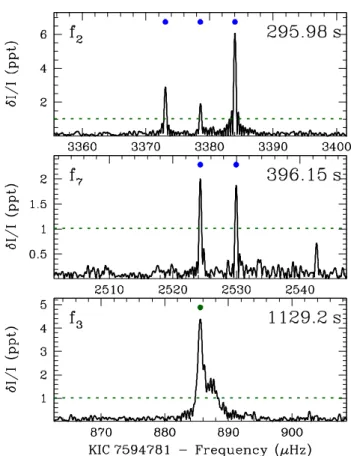
short dataset, with just 31.8 d of observations in Q16.2. We identify three modes in the star asℓ= 1 with a median splitting of 5.5µHz, two of which are shown in Figure11, suggesting a rotation period of 26.8 hr. Such a rotation rate would yield ℓ= 2 splittings of roughly 8.6µHz, so we suggest that f1may be anℓ= 2 mode, although the data are not definitive. As with KIC 4357037, there is a much longer-period, highly broad-ened mode, here at 1129.19 s. Interestingly, this mode, f3,
combines with many other modes in the star to give rise to the most of the 14 nonlinear combination frequencies present. When f3combines with other modes its unique line width is reproduced; for this reason, although we could not identify any suitable combinations, we caution that f4may not be an independent mode in the star but could possibly be a com-bination frequency of f3in some way given the shape of f4.
Figure 11. We show two modes in KIC 7594781 (KISJ1908+4316) which share the medianℓ= 1 splitting of 5.5µHz, suggesting a rotation period of 26.8 hr. This DAV has a broadened long-period mode atf3(1129.19 s) which appears in many of the nonlinear combination frequencies (Table5).
Interestingly, f3is relatively stable in amplitude but changing rapidly in frequency. Its frequency in the first 5 days of data is relatively stable at 885.243±0.057µHz (7.08±0.32 ppt), but its power in the last 5 days ofKeplerdata less than 27 d
later had almost completely moved to 888.285±0.067µHz
(6.14±0.32 ppt). There is still much to be learned about the causes of the short-term frequency, amplitude, and phase in-stability in white dwarf pulsations from further analysis of thisKeplerdata — nonlinear mode coupling appears to be the
only way to explain how white dwarf pulsations can change character so rapidly (e.g.,Zong et al. 2016).
KIC 10132702 (KISJ1913+4709): We are able to identify
seven of the eight independent modes in this DAV, five of which are shown in Figure 12. The periods span roughly 461.1−977.6 s, and most have broad HWHM, with a median
HWHM exceeding 0.35µHz. Both our medianℓ= 1 splitting of 13.5µHz and medianℓ= 2 splitting of 21.3µHz suggest a roughly 11.2 hr rotation period, confirming that our mode identifications are internally self-consistent.
KIC 11911480 (KISJ1920+5017): This hot DAV (also
cata-loged as KIC 100003912) was thoroughly discussed inGreiss et al.(2014), who present an analysis of data from both Q12 and Q16, allowing for the identification of four of the five in-dependent modes present. Here we only analyze data from Q16 but arrive at the same mode identifications.
EPIC 60017836 (GD 1212): We detailed our initial
pulsa-tion period list of GD 1212 in Hermes et al. (2014), which was the first published result using data from the two-wheel-controlledK2mission. After an extensive analysis using only
the final 9 days of the K2engineering data, we have
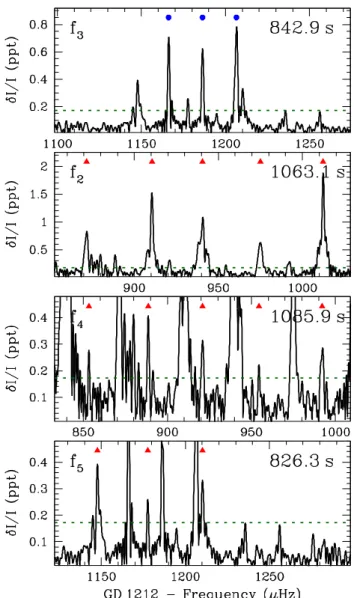
Figure 12. We show several components ofℓ= 1 modes (marked with blue dots) andℓ= 2 modes (red triangles) in KIC 10132702 (KISJ1913+4709). The top two panels highlight the two dipole modes, with a medianℓ= 1 splitting of 13.5µHz. We also show what we have identified as three different quadrupole modes, with a medianℓ= 2 splitting of 21.3µHz. Our tentative midentification for these modes is detailed in Table5. Both sets of splittings suggest a rotation period of roughly 11.2 hr.
the star rotates with a period of roughly 6.9 hr. At the top of Figure13we show the only identifiedℓ= 1 mode, f3, which
has a splitting of 21.3µHz and is embedded within theℓ= 2
mode f5. Additionally, we find two consecutive quadrupole
modes embedded within one another: f2 and f4; the median ℓ= 2 splitting is 33.7µHz. There are additional modes, in-cluding many nonlinear combination frequencies, presented inHermes et al. (2014) from the full 11.5 d of engineering data on GD 1212, which were not significant from only this 9-d dataset. We note thatK2has revisited GD 1212 for more
than 75 d during Campaign 12.
EPIC 201355934 (SDSSJ1136−0136): We observe just
Figure 13. We show oneℓ= 1 mode (marked with blue dots) and threeℓ= 2 modes (red triangles) in GD 1212. The dipole mode has anℓ= 1 splitting of 21.3µHz, and our three different quadrupole modes have a medianℓ= 2 splitting of 33.7µHz. Our tentativemidentification for these modes is detailed in Table5. Both sets of splittings are self-consistent and reveal a rotation period of roughly 6.9 hr.
three significant peaks in this DAV, all shown in Figure14. None of the peaks appear to be components of the samek, ℓ multiplet, which means we cannot estimate the rotation pe-riod of this white dwarf; this is possible if the star is seen roughly pole-on, such that we only observe them= 0
compo-nents. This DAV was known to pulsate before the launch of
Kepler, but the only photometry is a discovery run yielding
just one period at 260.79 s (Castanheira et al. 2010, shown as open circle in Figure14), nearest to f1in ourK2observations.
EPIC 201719578 (SDSSJ1122+0358): The periods in this
cool DAV range from 367.9−1095.4 s, but only the three