CHARACTERIZING AND FACILITATING PROSPECTIVE TEACHERS’ ENGAGEMENT WITH STUDENT THINKING ABOUT FRACTIONS
Katherine Baker
A dissertation submitted to the faculty at the University of North Carolina at Chapel Hill in partial fulfillment of the requirements for the degree of Doctor of Education in the School of
Education.
Chapel Hill 2017
ABSTRACT
Katherine Baker: Characterizing and Facilitating Prospective Teachers’ Engagement with Student Thinking About Fractions
(Under the direction of Susan N. Friel)
Reform-based mathematics instruction emphasizes that mathematics is learned through reasoning and sense-making rather than strict memorization and is taught through facilitation rather than telling (NCTM, 1989, 1991, 1995, 2000). Teachers’ engagement with student thinking to inform instruction is central to such teaching. Engagement with student thinking involves eliciting and using evidence of student thinking in instruction (NCTM, 2014). This case study explored how three prospective teachers placed at 4th grade engaged with student thinking
in mathematics and used this thinking to guide instruction during six weeks of their student teaching experiences. The prospective teachers were placed at the same school and same grade level and were supported through facilitated team meetings in a community of practice (Wenger, 1998) in which they were coached in the pedagogical and content needs of their instructional units that focused on fractions.
and engaged with student thinking. Although their community of practice was initially
facilitated by a participant-researcher, the prospective teachers voluntarily adopted and extended the community structure outside of the researcher-scheduled meetings.
The study highlights the importance of studying and supporting prospective teachers in the context of the student teaching experience in order to help transfer intentions for teaching learned during teacher preparation coursework into practice. The findings offer several contributions to the field, including a suggested model of support to encourage prospective teachers’ engagement with student thinking in mathematics and a proposed model for
For the 4th and 5th graders who know me as Ms. Phelps, thank you for sharing your thinking with me.
ACKNOWLEDGEMENTS
I am grateful beyond the space of this section for the support I was provided on this journey. It was as much a journey of self as it was a collaborative effort. I will try to express my sincere gratitude to all those collaborators here, but please know, you have a place in my heart for life.
First, my sincere appreciation to Dr. Susan Friel. She serendipitously found me teaching math in a 5th grade classroom and has mentored me through each step of my professional life. It is such a rarity to have another who knows your professional growth so intimately, and for that I am grateful. Susan, you observed and refined. You are a coach, a collaborator, and an
inspiration.
Next, I would like to thank my committee members. Each of you played a role in my growth and in shaping this dissertation to completion. I appreciate your thoughtful insight, extensive feedback, and encouragement.
This study would not have been possible without three prospective teachers taking a leap of faith and opening their practices to me. Kristi, Nora, and Liz, if you want it, you have my support for life. I cannot wait to hear of your first-year teaching adventures. May you always put children’s thinking first (especially in your mathematics classrooms). To their cooperating teachers, thank you for encouraging a future that centers on children and their thinking.
a blessing to me and to the educational system. A sincere appreciation for my elementary teaching colleagues; each of you has left an impression and have shaped my career and dissertation into what it is.
Finally, to my family and friends who are my family, I am uplifted by you daily. You guided me back from moments of “paranoia plateau” and watched me sail into “completion cove,” and you are loved for it. You supported the process with patience and pride, and in some cases, with firsthand tips of survival. I left this time emotionally sound because of your acts of kindness, especially those in the form of meals and hugs. To Whit, and to our next generation that will someday join us, much love. (Next gen, your dad and I are already planning your math lessons).
TABLE OF CONTENTS
LIST OF TABLES ... xii
LIST OF FIGURES ... xiii
LIST OF ABBREVIATIONS ... xiv
CHAPTER 1: INTRODUCTION ... 1
Purpose of Study ... 5
Overview of Research Design and Questions ... 7
Terminology ... 8
Dissertation Organization ... 9
CHAPTER 2: LITERATURE REVIEW ... 10
Conceptual Framework ... 12
Review of the Research around Engagement with Student Thinking ... 15
Theme 1: Context of the Student Teaching Experience ... 15
Theme 2: Prospective Teacher Content Knowledge, Pedagogical Knowledge, and Beliefs ... 22
Theme 3: Student Understanding of Fractions ... 35
Summary: Envisioning the Prospective Teacher’s Mathematics Teaching Experience... 44
CHAPTER 3: STUDY METHODOLOGY ... 45
Design Overview ... 45
Design Rationale ... 46
Study Context... 47
Data Collection and Instruments ... 50
Archival Data ... 51
Interviews ... 52
Community of Practice Team Meetings ... 54
Observations and Informal Debrief Sessions ... 55
Student Pretests and Posttests ... 56
Data Analysis ... 59
Question 1: Directed Content Analysis ... 60
Question 2: Contextual Analysis ... 66
Question 3: Thematic Analysis ... 67
Question 4: Analysis Through Student Strategy Framework and Learning Progression ... 68
Validity Through Quality and Rigor ... 68
Researcher Positionality ... 70
Special Considerations and Issues of Ethic ... 71
Researcher Bias ... 71
Assumptions ... 72
Population of Interest ... 73
Place of Research ... 74
CHAPTER 4: FINDINGS ... 75
Orientation to the Chapter ... 76
Team Meeting Structure ... 76
Researcher Involvement ... 78
Prospective Teachers’ Stories ... 78
Prospective Teacher 1: Kristi’s Story ... 79
Prospective Teacher 3: Liz’s Story ... 88
The Relevance of the Prospective Teacher Stories ... 91
Question 1: How Might a Prospective Teacher’s Engagement with Student Thinking Be Characterized? ... 91
Kristi’s Engagement with Student Thinking ... 94
Nora’s Engagement with Student Thinking ... 95
Liz’s Engagement with Student Thinking ... 97
Analysis Consideration with Respect to Engagement with Student Thinking ... 98
Question 1 Summary ... 98
Question 2: In What Ways Does Context Influence a Prospective Teacher’s Engagement with Student Thinking? ... 99
Teacher Preparation Program ... 100
The Influence of the Classroom Setting ... 104
The Influence of the Relationship with Cooperating Teacher ... 106
Question 2 Summary ... 112
Question 3: In What Ways Does a Community of Practice Structure Facilitate Prospective Teachers’ Engagement with Student Thinking in the Area of Fractions? ... 112
The Influence of Support Within the Team Meetings ... 113
Support of Unplanned Meetings ... 125
Support of Camaraderie ... 127
Question 3 Summary ... 129
Question 4: How Does a Prospective Teacher’s Engagement with Student Thinking Influence Student Understanding of Fractions in the 4th Grade? ... 130
Question 4 Summary ... 140
CHAPTER 5: DISUCSSION AND CONCLUSION ... 142
Model of Support ... 143
Envisioning the Use of the Levels of Engagement with Children’s Mathematical Thinking with Prospective Teachers ... 154
Limitations and Future Research ... 159
Study Duration ... 159
Study Size and Scalability ... 160
Participants ... 160
Generalizability ... 161
Future Research ... 162
Concluding Thoughts ... 163
APPENDIX A: PROSPECTIVE TEACHER INSTRUCTIONAL UNIT OVERVIEW CALENDAR ... 165
APPENDIX B: INTERVIEW PROTOCOL AND INTERVIEW QUESTIONS... 166
APPENDIX C: COMMUNITY OF PRACTICE TEAM MEETING FACILIATION PLANS... 171
APPENDIX D: OBSERVATION PROTOCOL ... 177
APPENDIX E: INSTITUTIONAL REVIEW BOARD CONSENT FORM ... 178
APPENDIX F: STUDENT PRETESTS AND POSTTESTS ... 182
APPENDIX G: OVERVIEW OF THE PRODUCTIVE TALK MOVES... 191
APPENDIX H: OVERVIEW OF THE SYSTEMS FOR ANALYSIS ... 192
LIST OF TABLES
Table 2.1. Levels of Engagement with Children’s Mathematical Thinking ... 14
Table 2.2. Interpretations of Fractions, Exemplified as Using 3/4 ... 27
Table 3.1. Types and Definitions of Case Studies ... 47
Table 3.2. Data Collection Crosswalk ... 52
Table 3.3. Data Collection Timeline ... 58
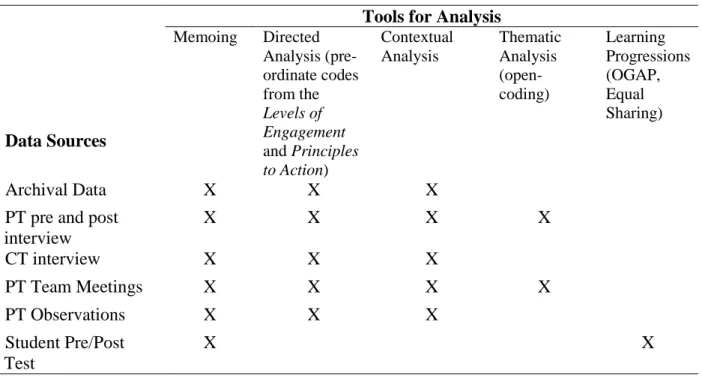
Table 3.4. Data Analysis Crosswalk ... 60
Table 3.5. Data Analysis System: Directed Content Analysis using the Levels of Engagement with Children’s Mathematical Thinking ... 63
Table 3.6. Principles to Actions Mathematics Teaching Practice ... 66
Table 3.7. Indicators of Quality Research ... 69
Table 4.1. Overview of Prospective Teacher Profiles According to the Levels of Engagement with Children’s Mathematical Thinking ... 94
Table 4.2. Prospective Teacher Classroom Information ... 105
Table 4.3. One-Day Excerpt from Prospective Teacher Curriculum Guide ... 123
Table 4.4. Classroom Average Expressed as Percent ... 131
LIST OF FIGURES
Figure 1.1. The Intertwined Strands of Proficiency (NRC, 2001) ... 3
Figure 2.1. Mathematical Knowledge for Teaching (Ball, Thames, & Phelps, 2008) ... 24
Figure 2.2. Fraction Interpretations and Representations Matrix (iTalk2Learn Project, 2014) ... 28
Figure 2.3. Types of Strategies – Equal Sharing Problems (Empson & Levi, 2011) ... 39
Figure 2.4. The OGAP Fraction Progression (Petit, Laird, Marsden, & Ebby, 2015) ... 41
Figure 2.5. Effective Mathematics Teaching Practices (NCTM, 2014, p. 10) ... 42
Figure 4.1. Overview of Prospective Teacher Profiles According to Levels of Engagement with Children’s Mathematical Thinking ... 94
Figure 4.2. Additive Coordination Pictorial Representations ... 116
Figure 4.3. Classroom Average Expressed as Percent and Delta Growth... 131
Figure 4.4. Student Response on Item 1 from Pretest to Posttest... 133
Figure 4.5. Student Descriptions on Item 8 of Posttest ... 139
LIST OF ABBREVIATIONS CGI Cognitively Guided Instruction
CT Cooperating Teacher
IMAP Integrating Mathematics and Pedagogy IRB Institutional Review Board
NCTM National Council of Teachers of Mathematics NRC National Research Council
CHAPTER 1: INTRODUCTION
To fail children in mathematics, or to let mathematics fail them, is to close off an important means of access to society’s resources. (Schoenfeld, 2002, p. 13)
The study of teacher content knowledge in mathematics education has shifted from a study of how teachers understand procedural mathematics operations to a study of how they make sense of mathematics, which includes understanding operations and the concepts of
mathematics (Olanoff, Lo & Tobias, 2014). This shift in teacher content knowledge expectations reflects the changing views of mathematics education in the United States. In the 1980s a shift in focus to the cognitive processing of content fueled the development of a research-base that examined children’s thinking in mathematics and suggested how to facilitate instruction from a child’s point of understanding (Carpenter, 1979; Carpenter, Fennema, Peterson, Chiang & Loef, 1989; Carpenter, Hiebert & Moser 1979, 1983; Carpenter & Fennema, 1992; Clements & Battista, 1990; Hiebert et al., 1997; NCTM, 1991; Simon, 1995). This research, accompanied with dismal student mathematics scores reflecting the 1970s Back to Basics movement, helped to motivate the development of the National Council of Teachers of Mathematics (NCTM)
Standards that proposed a new model of reform-based mathematics pedagogy (Berry, Ellis & Hughes, 2013; Schoenfeld, 2004).
NCTM’s Curriculum and Evaluation Standards for School Mathematics (1989) was the first set of standards to establish a view of mathematics instruction and learning equated with the reform-based movement. The reformed view asserts that mathematics is learned through
rather than telling. The Standards movement in mathematics education (NCTM, 1989, 1991, 1995, 2000) coupled with the new direction in research about teaching and learning addressed the content of mathematics, how students learn mathematics, and how mathematics is taught K-12.
Learning environments that support students’ reasoning and sense making in mathematics focus on discourse and the use of pedagogy that emphasizes facilitation rather than direct
instruction (NCTM, 1991). Principles that guide the creation of these environments were articulated within the framework of the standards movement in mathematics (NCTM 1989, 1995). The principles assert that all students deserve access to high quality mathematics
instruction and the opportunity to do and understand mathematics. Reform-based mathematics instruction that is focused on problem solving supports the development of a foundation of mathematical competence that provides better opportunities in the life outside the classroom (NCTM, 2000).
NCTM (1991, 1995) focused attention on the characterization of effective mathematics instruction, which highlighted what students need to know and do mathematically with a
Figure 1.1. The Intertwined Strands of Proficiency (NRC, 2001) The NRC defined the five mathematical strands as follows:
Conceptual understanding: comprehension of mathematical concepts, operations, and relations
Procedural fluency: skill in carrying out procedures flexibly, accurately,
efficiently, and appropriately
Strategic competence: ability to formulate, represent, and solve mathematical problems
Adaptive reasoning: capacity for logical thought, reflection, explanation, and justification
The emphasis on mathematical proficiency implies a shift in how mathematics is learned and taught and highlights the use of student thinking to inform instructional decisions (NCTM, 2014). Effective mathematics teaching that leads to students’ mathematical proficiency requires teachers to understand that students bring their own thinking and strategies into the classroom and to position this thinking as valuable to instruction. In short, supporting mathematical
proficiency requires that teachers engage with student thinking to provide effective mathematics instruction.
Most recently, the content of K-12 mathematics in the Common Core State Standards for Mathematics (National Governors Association Center for Best Practices, 2010) was conceived within a framework of learning progressions or trajectories (Battista, 2011; Clements & Sarama, 2004; Daro, Mosher, & Corcoran, 2011; Fosnot & Dolk, 2001). Again, students are expected to learn mathematics through reasoning and sense making as originally charged by the NCTM standards (1989, 1991, 1995, 2000). Teachers move students through the progression of the content through elicitation of student thinking and integration of this thinking into instruction. Environments that support this type of learning focus on productive discourse and on the use of pedagogy that emphasizes facilitation (NCTM, 1991, 2000, 2014).
The reformed view’s historical shifts in the nature and kind of mathematics instruction punctuated the need for responsive teaching (Ball & Forzani, 2011; Empson, 2014; Jacobs & Empson, 2015; Richards & Robertson, 2016). Responsive mathematics teaching facilitates and supports engagement with children’s mathematical thinking.
The emphasis on responsive teaching has implications for the design and implementation of teacher preparation programs. There is a need for teacher preparation programs to support a prospective teacher’s engagement with student thinking in mathematics instruction.
Purpose of Study
A time-honored practice in teacher preparation programs involves the prospective teacher’s participation in field experiences, both as field-based experiences integrated into their coursework, and as a culminating student teaching experience toward the end of their preparation (Darling-Hammond, 2006; Hollins, 2011). The culminating student teaching experience is often a semester-long field-based placement in which the prospective teacher practices her craft in the setting of a practicing cooperating teacher’s classroom while a university supervisor provides oversight of the prospective teacher’s work. The triad among the prospective teacher,
cooperating teacher, and university supervisor is the traditional format of student teaching mentorship and supervision (Borko & Mayfield, 1995; Nguyen, 2009; Rodgers & Keil, 2007; Slick, 1998). The triad members serve as the bridge for the prospective teacher’s transition from the teacher preparation program’s intended preparation to actual pedagogical practice.
Shifting the focus from the cooperating teacher and university supervisor as the sole bridge from the teacher preparation program to initial licensure, this study explored an additional support of a community of practice (Wenger, 1998). A community of practice is a group of people who share common concerns or passions for something they do and learn how to do this thing better by interacting (Wenger, 1998; Wenger, McDermott, & Snyder, 2002b). Although traditionally an interpersonal structure of practicing professionals rather than prospective professionals, it is within a community of practice that prospective teachers may become their own bridge from teacher preparation program vision to practice.
Lave & Wenger, 1991). The collective learning that occurs within a community of practice results in the development of shared practices that reflect the dynamics, pursuits, and social relations of the group (Wenger, 1998; Wenger, McDermott, & Snyder, 2002a). In this study, a community of practice structure was used as an innovation to the traditional prospective teacher preparation structure of the triad as sole support during the student teaching experience. The cooperating teacher, university supervisor, and prospective teacher still interacted in a traditional triad, but additionally, a group of prospective teachers engaged in a community of practice that provided additional support, clarification, and development related to working with student thinking as the focus of instruction. It is not the cooperating teacher or university supervisor’s practice that was examined, but rather, if and how the community of practice structure supported and provided direction for the development of prospective teachers’ beliefs and practices. This study investigated the community of practice as a vehicle to help prepare prospective teachers for the work of reform-based mathematics instruction, with specific attention to the work of
revealing and using students’ thinking in learning fractions.
Currently, there is a lack of research about how to influence prospective teachers’
engagement with student mathematical thinking during the student teaching experience. There is an extensive body of research on how to influence prospective teachers’ beliefs towards
influenced (Fennema et al. 1996; Franke, Carpenter, Levi, & Fennema, 2001; Steinberg,
Empson, & Carpenter, 2004). This study contributes to a missing area of research; research that investigates if and how context and supports can influence prospective teacher beliefs and actions towards engagement with student thinking, and if and how those influences impact
prospective teachers’ understanding and use of student thinking in instructional decision making. Overview of Research Design and Questions
In this study, three prospective elementary teachers formed a community of practice and participated in researcher-facilitated team meetings during the student teaching experience in order to develop and support one another’s pedagogical strategies and assessment techniques that focused on the use of student thinking in learning fractions. A case study methodology was used to study the prospective teachers in their community of practice and to consider how the work around engagement with student thinking within the community of practice team meetings was made evident in their teaching practices. It was hypothesized that the intensive focus through case study would allow for new insights that could greatly impact future studies and teacher preparation program structures. The following four research questions were addressed in the context of a 4th grade student teaching experience focused on teaching and learning fractions:
1. How might a prospective teacher’s engagement with student thinking be characterized?
2. In what ways does context influence a prospective teacher’s engagement with student thinking?
3. In what ways does a community of practice structure facilitate prospective teachers’ engagement with student thinking in the area of fractions?
The first research question considered a way to modify existing frameworks that characterize teacher engagement with student thinking for use with prospective teachers. The second research question considered the relevance of the prospective teachers’ teacher
preparation program and student teaching placement school to examine if and how context influenced their engagement with student thinking. Additionally, the question led to an
examination of other aspects of context that may influence prospective teacher engagement with student thinking. These include, but were not limited to, cooperating teacher support, classroom dynamics, and/or prior course instruction. The third question delved into the examination of the prospective teacher community of practice and if and how this structure and its supports
influenced their engagement with student thinking. The fourth question was dependent on the prior three questions and took into account if this manner of instruction was effective in promoting students’ conceptual understanding of fractions.
Terminology
Several key terms were used in the development and presentation of this dissertation research. The researcher and reader require a shared meaning of the following terminology.
Community of practice was defined as a group of people who share common concerns or passions for something they do, and learn how to do this thing better by interacting (Wenger, 1998; Wenger, McDermott, & Snyder, 2002b). This study used team meetings as required meeting time for the community of practice participants to unpack reform-based mathematics pedagogies. The voluntary aspect of a community of practice (Wenger, 1998) resulted from the participants’ willingness to meet and extend their collaboration and cooperative learning outside of the required team meetings.
a university teacher preparation program and an elementary school site. The context introduced elements of potential influence that included participants’ prior coursework, interpersonal relationships, and classroom dynamics.
Engagement with student thinking was defined as the elicitation and use of evidence of student thinking in instruction (NCTM, 2014). This study’s focus was prospective teachers’ elicitation and use of students’ mathematical ideas and strategies around fractions to inform instruction.
Fraction was defined as a non-negative rational number that can be written in the form a/b where a and b are both integers and b does not equal zero (Behr, Lesh, Post, & Silver, 1983; Charalambous & Pitta-Pantazi, 2005; Kieran, 1976; Olanoff, Lo, & Tobias, 2014). This
definition of fraction and its multiple mathematical interpretations and representations are explored in Chapter 2.
Dissertation Organization
CHAPTER 2: LITERATURE REVIEW
Schoenfeld (2002) claimed that students’ poor achievement in mathematics was a result of traditional direct instructional approaches to teaching and learning mathematics. The use of prescriptive curricula that permit teachers little discretion suffocates the intuitive mathematics that students bring to classrooms, yet these lockstep curricula are all too common (Schoenfeld, 2002, 2004). Instead of traditional methods of direct instruction, there is a need for instruction that attends to the ways students think, makes sense of this thinking, and integrates student thinking into the planning of mathematics instruction.
The purpose of this research was to study the community of practice as proposed method of support for elementary prospective teachers that encouraged their engagement with student thinking. The research was guided by the following research questions addressed in the context of a 4th grade student teaching experience focused on instruction of fractions:
1. How might a prospective teacher’s engagement with student thinking be characterized?
2. In what ways does context influence a prospective teacher’s engagement with student thinking?
3. In what ways does a community of practice structure facilitate prospective teachers’ engagement with student thinking in the area of fractions?
The study of fractions was the content focus for this dissertation research because it was the topic of the prospective teachers’ instructional units taught during their student teaching placements and was the content domain for their teacher preparation program professional portfolio requirements. In the Common Core State Standards for Mathematics (National
Governors Association Center for Best Practices, 2010), Number and Operations in Fractions is a significant content domain in the elementary curriculum. According to the North Carolina Assessment Specifications (North Carolina Department of Public Instruction, 2015) the weight distribution of the fractions content domain assessed on the 4th grade End of Grade Assessment is 27-32%. This distribution increases to 47%-52% by 5th grade. The NC Department of Public Instruction emphasizes the importance of understanding fraction concepts for elementary students. Additionally, the National Mathematics Advisory Panel (2008) asserted that
proficiency with fractions should be a goal for K-8 education because fraction understanding is currently underdeveloped yet is foundational for algebraic understanding. A study focused around the enhancement of prospective teachers’ instruction in this content area is justified.
Conceptual Framework
In the 1980s, research and professional development around students’ problem-solving strategies with whole number operations emerged as an important focus in the Cognitively Guided Instruction (CGI) program (Carpenter, 1979; Carpenter, Fennema, Peterson, Chiang, & Loef, 1989; Carpenter & Moser, 1984). CGI is grounded in how “teachers use research based knowledge about children's thinking and problem solving to make decisions as they plan and implement instruction, and how this instruction affects their students’ learning” (Carpenter & Fennema, 1992, p. 458). CGI was developed as a model of professional development in which listening and attending to students’ thinking was at the forefront of instructional decision-making in order to support children’s mathematical development (Carpenter, Fennema, Franke, Levi, & Empson, 1999, 2014). Teacher participants in CGI professional development learn the research-base around students’ mathematical problem-solving strategies of word problems with various problem structures, and then learn how to use this knowledge to make instructional decisions. Students’ understandings are elicited through problem posing, observation, questioning, and discussion. Students listen and learn from one another to further their mathematical development with the guidance of the teacher.
14
Table 2.1. Levels of Engagement with Children’s Mathematical Thinking
Level Teacher Orientation (Beliefs) Teacher Activity (Practices) Level 1 Does not believe students in his or
her classroom can solve problems unless they have been taught how
Does not provide opportunities for solving problems Does not ask students how they solved problems
Does not use students’ mathematical thinking in making instructional decisions
Level 2 Begins to view students as
bringing mathematical knowledge to learning situations
Believes students can solve problems without being explicitly taught a strategy Talks about value of variety of solutions and expands types of problems they use
Is inconsistent in beliefs and practices related to showing children how to solve problems Permits issues other than students’ thinking to drive selection of problems and activities
Level 3 Believes it is beneficial for students to solve problems in own ways because they make more sense to them; wants the students to understand what they are doing
Provides a variety of different problems for students to solve Provides an opportunity for students to discuss their solutions Listens to students talk about their thinking
Level 4A Believes students’ mathematical thinking should determine evolution of curriculum and the ways in which teachers
individually interact with students
Provides opportunities for students to solve problems and elicits their thinking Describes in detail individual students’ mathematical thinking
Uses knowledge of thinking of students as a group to make instructional decisions
Level 4B Knows how what an individual student knows fits in with how children’s mathematical understanding develops
Creates opportunities to build on student’s mathematical thinking Describes in detail individual students’ mathematical thinking
Uses what he or she learns about individual students’ mathematical thinking to drive instruction
Note. Adapted from “Capturing Teachers’ Generative Change: A Follow-Up Study of Professional Development in Mathematics” by M. Franke, T.
Review of the Research around Engagement with Student Thinking
The research relevant to the potential influences prospective teachers’ engagement with student thinking was reviewed and is presented using the following themes: (a) the context of the student teaching experience and the relationships formed in this experience, (b) the content and pedagogical knowledge and beliefs held by the prospective teachers, and (c) student
understanding of fractions. These bodies of literature worked in tandem to inform the study structure, specifically regarding how prospective teachers’ engagement with student thinking could be captured. The literature also informed the structure and use of the community of practice team meetings that the prospective teachers were a part of during the student teaching experience.
Theme 1: Context of the Student Teaching Experience
The term context is used in reference to the entirety of the student teaching experience situated in both a teacher preparation program and a school site where the internship takes place. The physical sites, along with their norms and people, introduced potential influences into a prospective teacher’s practice. The research related to teacher preparation program structures and interpersonal relationships was explored to better examine the context of this study.
regarded primarily as an independent showcase of teaching by the prospective teacher (Borman et al. 2009; Lortie, 1975). Research varies regarding teacher preparation program structures, duration, and strategies that best support prospective teachers and influence what they do in practice (Andrew, 1990; Borman et al., 2009; Darling-Hammond, 2006). Thus, an understanding of the structure of the particular teacher preparation program of the participants in this study was important to later analysis phases regarding the teacher preparation program’s potential
influences.
Relationships formed during the student teaching experience. Researchers agree that the student teaching experience is of utmost importance in the preparation of prospective
teachers for the career (Ben-Peretz & Rumney, 1991; Borko & Mayfield, 1995;
Darling-Hammond, 2006; Hollins, 2011; Yee, 1969), yet doubts have been raised about the effectiveness in transferring the university intended message to practice. This is in part due to the intricate relationships at play during student teaching. Learning to teach mathematics is a complex process, and complicating it is the interaction of ideas, beliefs, knowledge, and attitudes of those in the profession (Ball, 1990; Ball & Cohen, 1999; Ma, 1999).
The triad. Central to this dialogue is the relationship among the practicum triad
consisting of the prospective teacher, cooperating teacher and university supervisor (Nguyen, 2009).Each member functions as an individual while simultaneously functioning as a unit. This interplay of relationships impacts if and how a prospective teacher implements reform-based initiatives in mathematics instruction and whether student thinking is emphasized in the
classroom. When relationship interactions are planned and implemented thoughtfully to include “feedback about specific lesson components, suggestions about new ways to think about
p. 515) then prospective teacher transformation is realized However, many relationship interactions with prospective teachers are not about content and pedagogy toward reform.
Prospective teacher relationship with cooperating teacher. When comparing the
members of the triad, the cooperating teacher has the most influence on the attitudes of the prospective teacher (Borman et al., 2009; Philipp et al., 2007; Yee, 1969). In one early landmark study (Yee, 1969), the attitudes of 124 cooperating teacher and prospective teacher pairs and their twelve university supervisors were measured before and after the student teaching semester. Influence was investigated across all directions in the triad (cooperating teacher to prospective teacher, prospective teacher to cooperating teacher, prospective teacher to university supervisor, and university supervisor to prospective teacher). The study found highly significant results for influence from the cooperating teacher to the prospective teacher, in that prospective teachers shifted their attitudes to more closely align with their cooperating teachers by the end of the student teaching semester. This seminal study set the stage for more recent studies in mathematics education about purposeful prospective teacher placements with cooperating teachers that utilized student thinking.
To test their assumption, Philipp et al. (2007) randomly assigned 159 prospective teachers into one of the five groups that either: (a) learned about children’s thinking through watching videos of children solving problems, (b) watched the same problem-solving videos and also directly interviewed children about the math problems, (c) visited elementary school
classrooms of specially selected teachers trained in and using reform-based practices around children’s mathematical thinking, (d) visited elementary classrooms close to campus as a matter of convenience, and (e) experienced the regular slated mathematics content course (control group). The prospective teachers assigned to groups 1-4 concurrently participated in the same mathematics content course as the control group.
The study found that prospective teachers who visited the specifically selected reform-based mathematics classrooms experienced belief changes towards reform ideals. The group with the least amount of change towards reform (change towards traditional practices) was that of prospective teachers visiting the conveniently located classrooms. In fact, these prospective teachers experienced even less change toward reform ideologies than the control group who received no additional supports. The results indicated that being paired with random cooperating teachers actually interfered with the prospective teachers’ learning of reformed-based ideals, which implies that any work done in university coursework may be for naught if purposeful placements are not made.
solution strategy that was dismissed by the teacher. The group watched the vignette in the fall and re-watched in the spring after the year of student teaching placements.
In the fall, the cooperating teachers were initially bothered that the teacher in the video missed a teachable moment by dismissing the student’s alternative strategy, but they rationalized that the teacher did this to avoid confusion for others in the class. The prospective teachers were concerned about the teacher’s dismissiveness of the individual child and wondered how the moment might affect his feelings. In the spring, the cooperating teachers’ reactions to the video remained consistent, but the prospective teachers changed to agree with the cooperating teachers. They shared the belief that the alternative strategy should not be shared because it
overly-complicates a lesson to introduce other strategies in a mathematics classroom. A group
consensus was then made that the mathematics problem used by the teacher in the vignette was a faulty problem choice if it allowed for multiple solution strategies to emerge and thus student confusion. During the spring session, the prospective teachers were deemed better at their jobs by the cooperating teachers, even though they had adopted pedagogical moves that were less conducive to reformed-based ideals. The study suggested that if a cooperating teacher disregards or fails to elicit student thinking in the classroom, then the prospective teacher will most likely disregard and fail to elicit it as well. The study concluded that teacher preparation programs must attend to prospective teacher and cooperating teacher beliefs and help prospective teachers manage the tensions that might exist between themselves and their cooperating teachers.
Prospective teacher relationship with university supervisor. Traditionally, the university
mathematics teaching episodes exposed that the guiding theme was university paperwork, such as prospective teacher assignments and completing the university official observation form (Borko & Mayfield, 1995). Slick (1998) termed this ‘supervisor as overseer’ in which the supervisor is asked to evaluate and judge the prospective teachers but little else is fleshed out by the university regarding the role and relationship of the university supervisor and prospective teacher.
When pedagogy was discussed in teaching post-conferences, it was rarely about the mathematics content or teaching methods and more often it was concerned about classroom management. This held true even when a prospective teacher taught a mathematics content error in the lesson. The researchers hypothesized that this was because the mathematics was not a featured component of the university observation and because university supervisors were not trained in mathematics content. When university supervisors were later interviewed about their goal for post-conferences, the primary goal was to maintain a positive tone and positive
relationship with the prospective teachers, and not about content or pedagogy. The findings imply that the teacher preparation program and prospective teacher cannot rely on the university supervisor to be the sole bridge from coursework theory to practice.
Relationships among prospective teachers. Since a teacher preparation program cannot
prospective teachers’ perceptions of cohort models suggested that interactions in the cohort must foster a community spirit in order to enhance prospective teacher preparation. Negative
relationships within prospective teacher cohorts, like cliques, negatively influenced teacher preparation program aims.
To conceptualize learning within communities is to acknowledge that learning is social (Wenger, 1998). Communities of practice are ‘‘groups of people who share a concern, a set of problems, or a passion about a topic, and who deepen their knowledge and expertise in this area by interacting on an ongoing basis’’ (Wenger, McDermott & Snyder, 2002a, p.4). Within any community of practice there exist varying levels of participation. The three main levels of community participation have been defined as core group members, active group members, and peripheral members (Wenger, 1998; Wenger, McDermott & Snyder, 2002b). The core group members are active participants in the community who identify the issues of the community and tackle those issues. Within this core group, a coordinator organizes and connects the community; but with maturation of the community, the core members also take upon leadership roles with the coordinator. Active members are involved in the issues of the community, but without the consistency and intensity of the core group members. Peripheral members are at the sidelines of the community and watch the interactions of the core and active members.
In the greater context of the schools and grade level teacher teams, prospective teachers often assume the role of peripheral members due to being the novices in the profession
and an opportunity to better address the needs of children, the prospective teachers also viewed the paired placements as a loss of individuality, and as a means for competition, or as sense of “trying to outdo” one another (p.293). The current study attempted to build on the positive aspects of paired placements identified in Goodnough et al. while minimizing the negative aspects by placing prospective teachers together, but with different cooperating teachers at the same grade level. The intent was to allow prospective teachers to develop individuality of teaching styles while removing competition and providing the prospective teachers the opportunity to learn from and support one another.
There is a basic human need to belong, to contribute, and to feel significant (DuFour & Eaker, 1998). A professional learning community (PLC) model is the manifestation of this human need within the educational setting (DuFour, 2004). A PLC can be considered a specific model within the framework of community of practice. A PLC is structured around three tenets: ensure students will learn, create a culture of collaboration, and focus on results. In the PLC model “every teacher team participates in an ongoing process of identifying the current level of student achievement, establishing a goal to improve the current level, working together to achieve that goal, and providing periodic evidence of progress” (DuFour, 2004, p.5).
Theme 2: Prospective Teacher Content Knowledge, Pedagogical Knowledge, and Beliefs Important to understanding a prospective teacher’s instruction is perspective on the types of knowledge and beliefs teachers hold. Teacher knowledge is historically credited with the work of Shulman (1986) and his identification of three categories of teaching content
as knowledge of the learners and learning process of that discipline. Curricular content knowledge is knowledge of the programs and resources available to teach a discipline and the discerning of how best to use them. Literature around knowledge for teachers was reviewed for the domain of mathematics and specifically fractions to better understand what knowledge the prospective teachers in this study may or may not hold.
Mathematical beliefs were also examined as they influence how a prospective teacher enacts her teaching practices. Regarding the terminology used throughout the next subsections, the word belief is interpreted using Pajares’ (1992) view, which drew upon the work of past researchers (Rokeach, 1968; Bandura 1986; Nespor, 1987). From this view, a belief is a form of truth in the deeply personal sense; whereas knowledge is based on objective fact, belief is based on judgment. Beliefs influence how individuals make sense of the world and are strong
predictors of behavior. Self-efficacy is used to address an individual’s beliefs about his or her abilities to successfully accomplish a task that influences how he/she approaches goals, tasks, and challenges (Bandura, 1977; Swars 2004, 2005).
Mathematical knowledge for teaching. Ball and Bass (2000) established three overarching issues to address regarding mathematics teaching: identification of the content knowledge that matters for teaching, understanding ways the knowledge needs to be held, and unveiling what is required to learn in order to use knowledge in practice. Ball and Bass’ second and third issues charge teacher preparation programs to look beyond traditional university course mathematics content to other aspects that may impact how prospective teachers understand, hold, and use this knowledge.
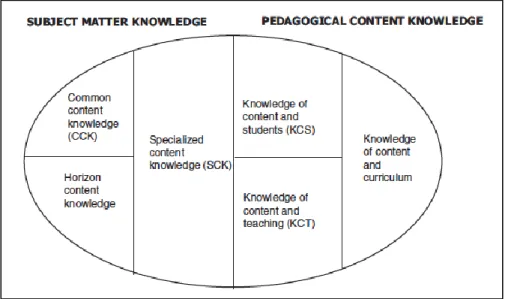
2008; Hill & Ball, 2004; Hill et al., 2008; Hill, Rowan & Ball, 2005; Hill, Schilling, & Ball, 2004). This framework is known as Mathematical Knowledge for Teaching and is the skill bundle needed for the work of effective mathematics teaching. Mathematical Knowledge for Teaching is comprised of subject matter content knowledge and pedagogical content knowledge (see Figure 2.1). Each domain contains subcategories that lend themselves specifically to teaching mathematics.
knowledge of content and students, knowledge of content and teaching and Shulman’s original curricular content knowledge. Knowledge of content and students means to have a command of the mathematics and a knowledge of one’s students. Knowledge of content and teaching then combines the knowledge of the mathematics being taught with knowledge of how to instruct.
Mathematical Knowledge for Teaching provides a framework for how teacher educators might think about prospective teacher preparation. A reflective stance around Mathematical Knowledge for Teaching is important during coursework and the student teaching experience. Reflection around the domain of knowledge of content and students is especially important when considering a prospective teacher’s work of engaging with student thinking.
Subject matter knowledge. An examination of the research around fractions through the
lens of Mathematical Knowledge for Teaching is warranted, because this is the instructional content matter of the prospective teachers in the current study. Lamon (2007), in the Second Handbook of Research on Mathematics Teaching and Learning (Lester, 2007),claimed that of all the mathematical curriculum topics, it is fractions, ratios, and proportions that are “protracted in terms of development, the most difficult to teach, the most mathematically complex, the most cognitively challenging, the most essential to success in higher mathematics and science, and one of the most compelling research sites” (p. 629). Pedagogical content knowledge in such a
complex domain must target core cognitive structures such as students’ ways of thinking and mechanisms for growth (Lamon, 2007).
bipartite symbols with a/b notation. In this interpretation, a fraction is a symbol of a notational system for writing numbers.
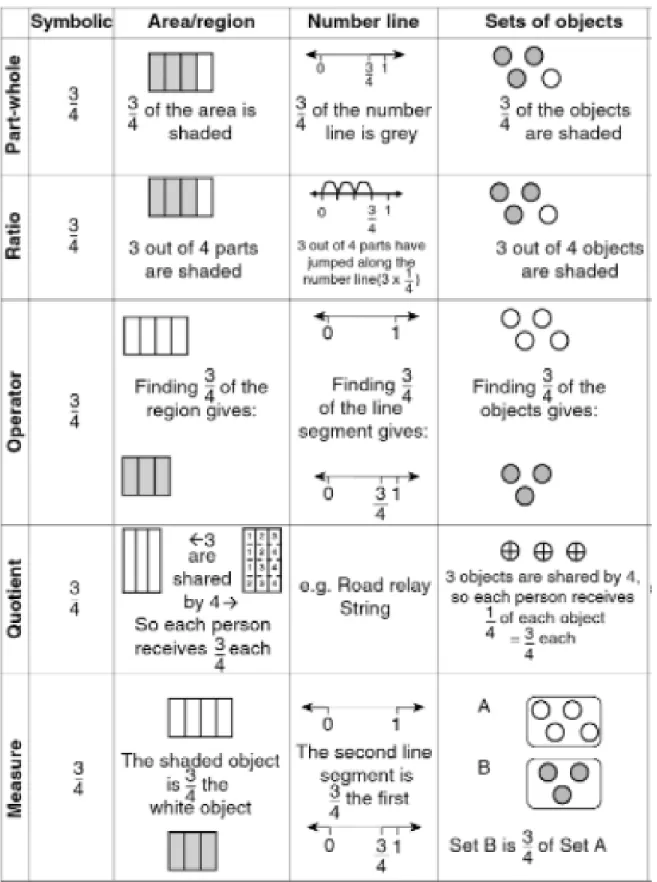
Fractions can also be interpreted as non-negative rational numbers and explored as the following (see Table 2.2): part-whole models, ratio, operator, quotient, and measures (Behr et al. 1983; Charalambous & Pitta-Pantazi, 2005; Kieran, 1976). However, fractions are typically taught conceptually as part-whole using area and set models. Lamon (2007) claims this limited focus leaves students “with an impoverished notion of the rational numbers” (p.635).
Table 2.2. Interpretations of Fractions, Exemplified as Using 3/4 Interpretation Definition and Implication for Children
Part-whole In part-whole cases, a continuous quantity or a set of discrete objects is partitioned into a number of equal-sized parts. E.g. a pie is divided into four equal parts (quarters) and three are eaten, so 3/4 of the pie has been eaten.
Children need to: understand that (a) the parts into which the whole is partitioned must be of equal size; (b) the parts, taken together, must equal to the whole; (c) the more parts the whole is divided into, the smaller the parts become; and (d) the relationship between the parts and the whole is conserved, regardless of the size, shape or orientation of the equivalent parts (Leung, 2009).
Ratio A fraction can be seen as a ratio of two quantities; in this case it is seen as a part-part interpretation and it is considered to be a comparative index rather than a number (Carraher, 1996). E.g. Three parts out of every four are red.
Children need to: understand the relative nature of the quantities. They also need to know that when two quantities in the ratio are multiplied by the same positive number, the value of the ratio is unchanged (Leung, 2009).
Operator A fraction is interpreted as an operator when it is applied as a function to a number, set or object. E.g. showing 3/4 of a pie chart or finding 3/4 of 24.
Children need to: interpret a fractional multiplier in a variety of ways; name a single fraction to describe a composite operation, when two multiplicative operations are performed; and relate outputs to inputs (Leung, 2009).
Quotient The quotient interpretation is the result of a division. It results in a number that can be placed on a number line. E.g. 3 ÷ 4 = 3/4.
Children need to: identify fractions with division and understand the role of the dividend and the divisor in this operation (Leung, 2009).
Measure In a measure interpretation a unit fraction is identified (e.g. 1/4) and how many units are used repeatedly determine a distance from a predetermined starting point (e.g. 3 x 1/4 = 3/4).
Children need to: use given unit interval to measure any distance from the origin; locate a number on a number line; and identify a number represented by a point on the number line (Leung, 2009) or region (Pantziara & Philippou, 2012).
Much of the fractional content knowledge prospective teachers hold is based on their own experience with “harmful algorithms,” or those algorithms performed without sense making instead of requiring fraction number sense (Utley & Reeder, 2012, p.1). Reeder and Utley (2007) defined fraction sense as “an intuitive feel for fractions and fraction relationship; flexible thinking about fractions (e.g. can use benchmark fractions to determine reasonableness of fraction operations)” (p.2). It is important that prospective teachers have this sense if they are to nurture it in students. Many prospective teachers leave their teacher preparation program
coursework with remaining misconceptions around fractions (Olanoff, Lo & Tobias, 2014; Utley & Reeder, 2012), thus the need for a study that continues to examine the support of prospective teachers’ instruction of this content domain once in the field.
Pedagogical content knowledge. Once some of the content implications for elementary
students have been considered and the prospective teacher is attuned to crucial aspects of the content, their energy can be freed towards understanding how they can elicit this mathematics from students. While student fraction strategies can be in written form, an educator learns the most about student understanding when she can attach this work on paper to the students’ explanations and conversations. In order to move a student towards a more sophisticated strategy, a prospective teacher must learn to listen to children, and thus purposeful classroom discussions are used.
others’ reasoning. In order to achieve these goals, a teacher elicits the discussions through purposeful teaching moves referred to as productive talk moves (Chapin, O’Connor, &
Anderson, 2003, 2013). The set of productive talk moves are comprised of strategic questioning and conversational prompts. Teachers may elicit students to turn-and-talk to one another, or ask students to repeat, rephrase, or add on to what a classmate said. When used thoughtfully, the talk moves produce discussions rich with data about students’ understanding.
Once a prospective teacher has the tools to elicit and engage in talk around mathematics, she must think about the mathematics content and structure that encourages it. The orchestration of a discussion-based lesson is elaborated upon in Stein, Engle, Smith, and Hughes’ (2008) Five Practices Model. This model explicitly states that it is a teacher’s role to: (1) anticipate student responses to challenging mathematical tasks; (2) monitor students’ work on and engagement with the tasks; (3) select particular students to present their mathematical work; (4) sequence the student responses that will be displayed in specific order; and (5) connect different students’ responses and connect the responses to key mathematical ideas. The Five Practices model gives structure to mathematics discussions by bringing to the forefront the selection of mathematical tasks that are cognitively worthy of student discussion. It is worth noting that this framework closely aligns with the recommended instructional implications of the CGI research (Carpenter et al., 2014; Empson & Levi, 2011).
Prospective teacher beliefs about mathematics and teaching mathematics.
at the university level. Lortie (1975) termed this the apprenticeship-of-observation and claimed that because of their extensive experience with school and teachers, many prospective teachers hold the belief that they already know everything they need to know in order to be experts in their jobs. Therefore, if teacher preparation programs want to instill change consistent with reform-based mathematics, prospective teachers’ beliefs and the effects of the beliefs cannot be overlooked. In fact, much of the work of the teacher preparation program must revolve around confrontation of the apprenticeship of observation and shape beliefs about teaching and learning (Darling-Hammond, 2006).
Much of the research on prospective teachers’ beliefs and self-efficacy in mathematics references Pajares’ (1992) who asserted that researchers cannot look solely to content and teacher thinking to impact reform movements, but they must also examine what teachers believe and the ways teachers believe. Although educational researchers may not agree on a working definition of beliefs, they do agree that all teachers hold beliefs about the career and their roles, thus understanding beliefs is important to future education initiatives.
Battista (1994) researched beliefs specifically in the context of mathematics. Historically, mathematics was seen as computation, so teaching mathematics meant providing students with a set of skills and learning mathematics meant remembering and using these set skills. Battista asserted that when this is a teacher’s belief system about mathematics they are “robbing their students of opportunities to ‘do’ mathematics” (p.467). These beliefs also block the reform movement from making headway, because they do not align with the reform philosophies of mathematical sense-making and reasoning.
official training. Most likely, prospective teachers were products of traditional mathematics curriculums themselves, thus traditional beliefs are ingrained when they enter their fieldwork. A teacher preparation program’s work is to reveal and shift prospective teachers’ beliefs about the subject in general and about the teaching and learning of mathematics.
The structure of coursework can be one mechanism to develop prospective teachers’ beliefs that align with mathematics reform (Ambrose, 2004; Burton, 2012; Swars, 2004, 2005; Wilkins & Brand, 2004). Wilkins and Brand (2004) used the Mathematics Belief Instrument with 89 prospective teachers to evaluate a mathematics methods course in relation to beliefs. The methods course was modeled after the reform-based mathematics initiatives. It was student-centered and utilized an investigative approach to mathematics with manipulatives, hands-on explorations, and cooperative groups. Wilkins and Brand evaluated both magnitude and direction of change in beliefs to determine the success of the methods course. They found that after being a part of a methods course of this nature, prospective teachers’ self-efficacy about mathematics was changed in a positive way and their beliefs about what mathematics is and what it entails became more consistent with the reform movement. The research affirmed that
prospective teachers’ underlying beliefs about mathematics must be determined and addressed alongside content and pedagogy in coursework to hope to spur change in practice.
they already know all they need to know to be teachers and will do well teaching due to their personal experience of being students in classrooms (p. 91). This optimistic bias must be acknowledged and addressed if prospective teachers are to make meaningful changes in their instruction.
Ambrose (2004) established four mechanisms to elicit belief change and belief formation in prospective teachers: (a) create emotion-filled experiences in courses, (b) develop a positive community that will instill positive beliefs in relation to mathematics, (c) reflect on beliefs so that hidden beliefs become overt, and (d) offer experiences or reflections that help prospective teachers connect beliefs to other beliefs. Ambrose’s goal was to provide the four mechanisms for belief change within an iterative cycle of work with children, reflection, and instructor feedback.
As part of this cycle, prospective teachers submitted reflections and were interviewed about their experience in the course. Prospective teacher responses showed changes in their beliefs about teaching and student learning towards the reformed ideals, suggesting that an iterative cycle of work with children can spur belief evolution for prospective teachers. However, if this extensive work is done during the methods coursework, considerations must be made regarding how to continue the support into the student teaching experience
Swars (2004, 2005) also studied her own practice, but did so within the construct of teacher efficacy. Teacher efficacy represents a teacher’s belief that teaching can bring about change regardless of external factors and a belief the teacher has the skills and abilities to
influence student learning and behavior. Swars used the Mathematics Teaching Efficacy Beliefs Instrument (2005) companioned with interviews to provide insight in what contributes to
prospective teachers’ mathematics teacher efficacy. Prospective teachers were part of a
reform pedagogical techniques like manipulative use, hands-on learning of concepts and group work. Fieldwork experiences were also a part of the course during which participants taught three mathematics lessons that they had practiced earlier during their course time in local elementary schools.
Swars (2004, 2005) found that prospective teachers with the lowest mathematics teacher efficacy levels reported negative mathematics experiences in earlier years and felt that they had been denied sense-making opportunities in their own elementary experiences. However, a prospective teacher with high teaching efficacy levels also reported negative personal experience with mathematics but viewed this as a catalytic moment because her struggle could make her a more aware teacher. An encouraging finding from Swars was that prospective teachers with the lowest self-efficacy scores felt that they could eventually teach mathematics effectively; they would just require more time, support, and effort. This points to the responsibility of teacher preparation programs to find ways to embed continued content support during the student teaching experience and not just during the methods coursework.
Thanheiser, Philipp, Fasteen, Strand, and Mills (2013) took a slightly different approach to coursework when they interviewed prospective teachers about their understandings of
approach in order for prospective teachers to discover mathematics so that they could then help students do the same. The intention of the interviews was that prospective teachers would see the value of learning on a conceptual level rather than a rote level, so that they would carry this value forward into their classrooms during the student teaching experience.
Much of the literature on prospective teacher mathematical knowledge for teaching and their beliefs suggests how to unveil and influence the beliefs during teacher preparation program coursework. The current study’s intent was to address how beliefs and knowledge transfer to and potentially change during the student teaching experience, especially with the support of a community of practice. Based on the proceeding literature, it was hypothesized that team meetings of the community of practice embedded in the student teaching experience would provide for the continued development of belief and knowledge development toward reformed-based mathematics.
Theme 3: Student Understanding of Fractions
Previous research provided the background in order to better understand if and how the supports in this study would facilitate prospective teachers’ engagement with student thinking. Additional literature was examined to take into account student understanding, specifically in the content domain of fractions, and to best understand how prospective teachers may elicit, use, and progress student understanding.
Student understanding in reformed-based mathematics. The NRC’s (2001) definition of mathematical proficiency was considered in order to unpack the intended meaning of the term student understanding. Mathematical proficiency requires a command of five strands:
Procedural fluency: skill in carrying out procedures flexibly, accurately, efficiently, and appropriately
Strategic competence: ability to formulate, represent, and solve mathematical problems
Adaptive reasoning: capacity for logical thought, reflection, explanation, and justification
Productive disposition: habitual inclination to see mathematics as sensible, useful, and worthwhile, coupled with a belief in diligence and one’s own efficacy (p. 116)
Mathematical proficiency emerged from mathematics research within the constructivist and cognitivist frameworks (Carpenter, 1979; Clements & Battista, 1990; Secada, 1991; Simon, 1995; Wheatley, 1991). The reformed-based mathematics movement is based on several tenets of constructivism including:
Knowledge is actively created or invented by the child, not passively received from the environment.
Children create new mathematical knowledge by reflecting on their physical and mental actions.
No one true reality exists, only individual interpretations of the world.
Learning is a social process in which children grow in the intellectual life of those around them.
In constructivist learning environments, mathematics learning is structured around student thinking. Constructivist teachers who believe in mathematical proficiency for all children work towards “a problem solving environment in which developing an approach to thinking about mathematics is valued more highly than memorizing algorithms and using them to get right answers” (Schifter & Fosnot, 1993, p. 9).
Student understanding about fractions. Since the prospective teachers in this study provided instruction within the domain of fractions, an examination of student conceptual
understanding within the domain was needed. The most common ways to instruct about fractions in elementary schools is through the part-whole model (Alajimi, 2012; Lamon, 2007). However, this model is limiting and counterintuitive to how children think about fractions. Children come into the classroom with natural abilities to partition objects and to think about fractions in the context of sharing items, e.g. four students share six candy bars. How much candy bar do they each get if they share equally? (Charles & Nason, 2000; Confrey, Maloney, Nguyen, Mojica, & Myers, 2009; Empson, 1995, 1999; Empson and Levi, 2011; Lamon, 1996; Pothier & Swada, 1983; Steffe, 2001; Streefland, 1993). Equipartitioning is the act of dividing into equal-sized groups or parts. Fraction research in the area of equipartitioning is focused on children’s
intuitive strategies and provides educators with a set of typical student understandings to look for and notice while teaching. If a prospective teacher is to maintain the dedication to student thinking and influencing student understanding, then attention must be given to students’ equipartitioning strategies.
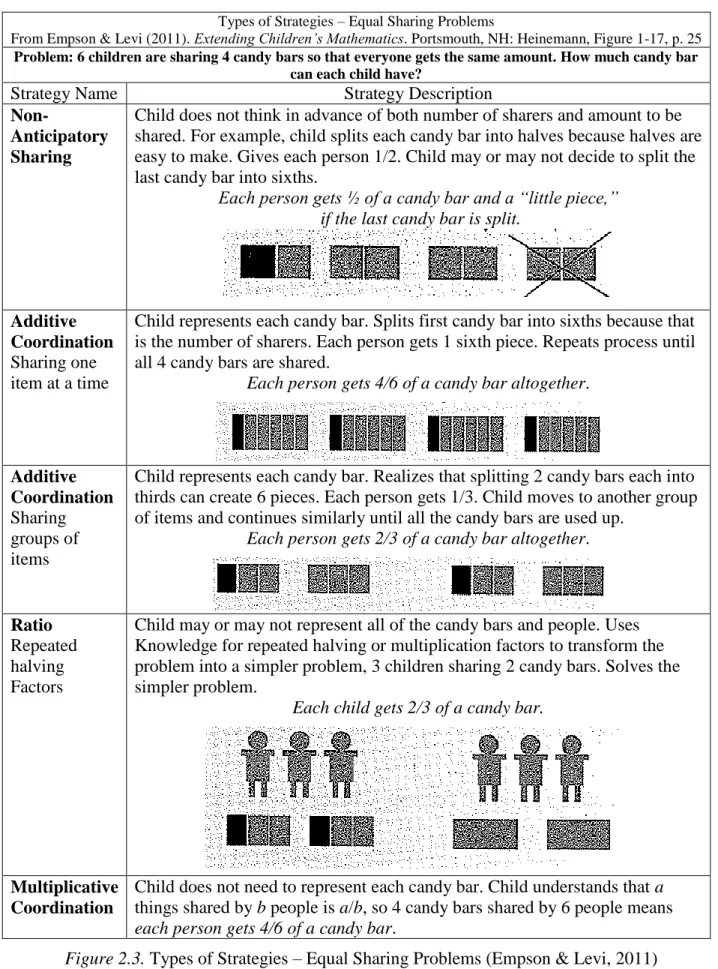
provide a framework of typical student strategies that result from these types of problems. Although the authors did not explicitly refer to their set of typical student partitioning strategies as a trajectory, they make clear that the evolution of these strategies follows a predictable pattern with children. The partitioning strategies children employ within the Equal Sharing framework are: Non-Anticipatory Sharing, Additive Coordination (either sharing one item at a time or sharing groups of items at a time), Ratio, and Multiplicative Coordination (see Figure 2.3).
The Equal Sharing strategies framework is considered the typical progression of strategies employed by children, however, the authors emphasized that the teacher plays a critical role in connecting and extending children’s thinking through the number choices and discussions used in the Equal Sharing problems. This aligns with Sarama and Clements’ view that, “students may skip levels altogether, or may revert to previous levels when faced with changes in tasks or even benign alterations in their instructional environment” (as cited in Blanton, Brizuela, Gardiner, Sawry, & Newman-Owens, 2015, p.5). The fact that children use different strategies at different times points to the need for prospective teachers to understand the typical strategies in order to look for and respond to them accordingly in the classroom
environment.
Figure 2.3. Types of Strategies – Equal Sharing Problems (Empson & Levi, 2011)
Types of Strategies – Equal Sharing Problems
From Empson & Levi (2011). Extending Children’s Mathematics. Portsmouth, NH: Heinemann, Figure 1-17, p. 25
Problem: 6 children are sharing 4 candy bars so that everyone gets the same amount. How much candy bar can each child have?
Strategy Name Strategy Description
Non-Anticipatory Sharing
Child does not think in advance of both number of sharers and amount to be shared. For example, child splits each candy bar into halves because halves are easy to make. Gives each person 1/2. Child may or may not decide to split the last candy bar into sixths.
Each person gets ½ of a candy bar and a “little piece,” if the last candy bar is split.
Additive Coordination Sharing one item at a time
Child represents each candy bar. Splits first candy bar into sixths because that is the number of sharers. Each person gets 1 sixth piece. Repeats process until all 4 candy bars are shared.
Each person gets 4/6 of a candy bar altogether.
Additive Coordination Sharing
groups of items
Child represents each candy bar. Realizes that splitting 2 candy bars each into thirds can create 6 pieces. Each person gets 1/3. Child moves to another group of items and continues similarly until all the candy bars are used up.
Each person gets 2/3 of a candy bar altogether.
Ratio Repeated halving Factors
Child may or may not represent all of the candy bars and people. Uses Knowledge for repeated halving or multiplication factors to transform the problem into a simpler problem, 3 children sharing 2 candy bars. Solves the simpler problem.
Each child gets 2/3 of a candy bar.
Multiplicative Coordination
The Equal Sharing strategies progression is one way for educators to think about
classifying student thinking. However, it serves to examine student work only around one type of word problem context. Prospective teachers must also be equipped with ways to examine student thinking around other types of fractional situations. The Ongoing Assessment Project (OGAP) Fraction Progression (Petit et al., 2015, p. 196; Figure 2.4) can be used as a companion to the equal sharing problems to explore other types of student thinking.
The OGAP Fraction Progression portrays a developmental continuum of student
Eliciting, using, and progressing student understanding. NCTM’s (2014) Principles to Actions: Ensuring Mathematical Success for All defined eight effective mathematics teaching practices that align with the reform ideals (Figure 2.5). When used together, these practices support student understanding of the mathematics at hand.
Figure 2.5. Effective Mathematics Teaching Practices (NCTM, 2014, p. 10) While all eight of the mathematics teaching practices are essential to a reformed
classroom, requiring mastery implementation of eight practices is overwhelming to a fledging in the profession. Often, prospective teachers are coached in and collaborate around the