Longitudinal Course of Suicidal Ideation and Predictors of its Persistence – A NESDA Study
Liia Kivelä1, Annegret Krause-Utz1, Joanne Mouthaan1, Maartje Schoorl1, Rianne de Kleine1, Bernet Elzinga1, Merijn Eikelenboom2, Brenda WJH Penninx2, Willem van der Does1*, &
Niki Antypa1*
1Department of Clinical Psychology, Institute of Psychology, Leiden University, The
Netherlands
2Department of Psychiatry, Amsterdam Public Health Research Institute, Amsterdam UMC,
Vrije
*Corresponding Authors:
Niki Antypa, PhD ([email protected])
and Willem van der Does, PhD ([email protected]) Department of Clinical Psychology
Abstract
Introduction
Suicide remains one of the most common causes of death worldwide, claiming up to 800,000 lives annually, translating to one death every 40 seconds (WHO, 2018). For every suicide death, 20 suicide attempts are estimated to occur (WHO, 2014), and almost 10% of the general population experiences suicidal ideation at some point in their lives (Nock et al., 2008). Suicidal ideation is known to precede and increase the risk of suicide (Nock et al., 2008; Rossom et al., 2017). Although suicidal ideation assessed at a single time point is a poor predictor of subsequent suicide attempt and mortality (Busch et al., 2003; Oquendo et al., 2006), persistent suicidal ideation markedly increases the risk of suicide (Kessler et al., 1999). In fact, ‘serious’ suicide attempters (i.e., those with clear intent to die) report suicidal ideation lasting weeks to months prior to attempt (Anestis et al., 2014). However, most studies rely on assessments of suicidal ideation performed at a single time point, and the persistence of suicidal thoughts remains a largely neglected topic in suicidology.
Many psychosocial factors can increase the risk of suicidal ideation and behavior. Among these, a past suicide attempt is the strongest predictor for subsequent suicide (Antypa et al., 2013; Hawton et al., 2013). Mental disorders are also a major risk factor. Over 90% of people who make a serious suicide attempt (Beautrais et al., 1996) or die from suicide have a history of a psychiatric disorder (Cavanagh et al., 2003; Henriksson et al., 1993). The diagnosis most often associated with suicide is depression (Beautrais et al., 1996; Henriksson et al., 1993; Nock et al., 2008), but anxiety disorders are closely linked due to their high comorbidity with depression (Hawton et al., 2013). Approximately 30-40% of people with suicide mortality also have personality psychopathology (Duberstein & Conwell, 1997; Henriksson et al., 1993). Borderline personality disorder (BPD) traits (i.e., subsyndromal BPD symptoms, such as affective instability, instable relationships and self-harming impulsivity) specifically are associated with high rates of suicide attempts (84%) and deaths (10%) (Black et al., 2004; Yen et al., 2004; Zimmerman et al., 2012). These and other psychopathological syndromes (e.g., schizophrenia, addictions) represent important risk factors, but they are also quite common. Compared with these large numbers, suicide remains a relatively rare event. Predicting a rare event, in this case inferring suicide risk from psychiatric status, is hence limited by the low base rate of suicide (Yufit & Lester, 2005). Since a fatal suicide is usually preceded by long periods of continuous or intermittent suicidal ideation, it may be more fruitful to investigate the predictors of persistent suicidal ideation. Furthermore, research may benefit from consideration of additional risk factors.
of suicide (O’Connor & Knock, 2014; Smith et al., 2006). Suicidal ideation and suicide have been found to be more strongly associated with hopelessness than depression (Minkoff et al., 1973; Kuo et al., 2004). In a prospective study of 207 individuals hospitalized for suicidal ideation, ‘hopelessness about the future’ correctly classified 91% of the individuals who subsequently died by suicide (Beck et al., 1985). Furthermore, hopelessness reactivity (i.e., the tendency to respond with hopeless cognitions to mild sadness) was higher in remitted depressed individuals with a history of suicidal ideation than in remitted depressed individuals without such history (Antypa et al., 2010).
Loneliness has also been implicated in the etiology of suicidal ideation: this includes both subjective (i.e., feeling lonely) and objective loneliness (i.e., living alone and/or lack of friends) (Stravynski & Boyer, 2001). Among older adults, lack of social relationships was the variable most strongly associated with suicidal ideation, surpassing depressive symptoms (Almeida, 2012). However, this association was not observed in adolescents (Lasgaard et al., 2011).
More recently, insomnia, both as a symptom of depression and as an independent disturbance, has been associated with suicide (Bernert et al., 2005; McCall & Black, 2013; Perlis et al., 2016). Sleep disturbances are reported by up to 92% of suicide attempters (Hall et al., 1999). Insomnia symptoms were also found to predict suicidal ideation and behavior independently of depressive symptoms and hopelessness in a prospective study of young adults (Ribeiro et al., 2012).
Suicide risk is also increased after exposure to stressors (WHO, 2017), particularly interpersonal conflicts or loss (Hall et al., 1999; Stroebe et al, 2005), independent of psychiatric status (Foster et al., 1999). However, some studies found no association between suicide and number or severity of current stressors (Cavanagh et al., 1999). In addition to recent stressors, childhood trauma is associated with increased suicidal ideation and behavior in both adolescents and adults (Almeida, 2012; Brodsky et al., 2001; Brown et al., 1999). In particular, emotional and sexual abuse confer increased risk (Brown et al., 1999; de Araújo & Lara, 2016).
with its persistence (Zhang et al., 2011). Low social support, domestic violence, and high depressive symptoms were also associated with persistence (Wilcox et al., 2010).
In summary, considerable heterogeneity exists in the course of suicidal ideation over time (Goldston et al., 2016), and approximately one third of patients report persistent ideation (Borges et al., 2008; Handley et al., 2013). Consequently, it is important to describe suicide risk not only in terms of current severity but also in terms of chronicity (Wortzel et al., 2014). However, the aforementioned studies only included two assessment time points and were limited in the range of included predictors.
The aim of the present study was to assess the course of suicidal ideation over nine years and to investigate predictors of its persistence. We used data from the Netherlands Study of Depression and Anxiety (NESDA), a large naturalistic cohort study of adults with and without depression and anxiety disorders (Penninx et al., 2008). We tested predictors previously implicated in the incidence of suicidal ideation – insomnia symptoms, hopelessness, loneliness, BPD traits, negative life events, childhood trauma – to examine how they influence (i) the course of suicidal ideation over time, and (ii) the maintenance or development of persistent suicidal ideation over time. We hypothesized that individuals with more insomnia symptoms, hopelessness, loneliness, BPD traits and recent negative life events, and more severe childhood trauma history would (i) experience more suicidal ideation; and (ii) have an increased likelihood of experiencing persistent suicidal ideation, controlling for socio-demographics, clinical diagnosis and severity, medication use, and suicide attempt history. Post-hoc mediation analyses were run for significant predictors of persistent ideation, and rationales for those were based on prior literature.
Method Participants and procedure
Participants for the NESDA were recruited between 2004-2007 from the community and health care settings in Amsterdam, Groningen and Leiden. After a baseline assessment of socio-demographic and clinical variables (see Penninx et al., 2008 for rationale and methods), follow-up assessments were performed at 2, 4, 6, and 9 years. At baseline, the NESDA sample consisted 2,981 adults aged 18-65 years.
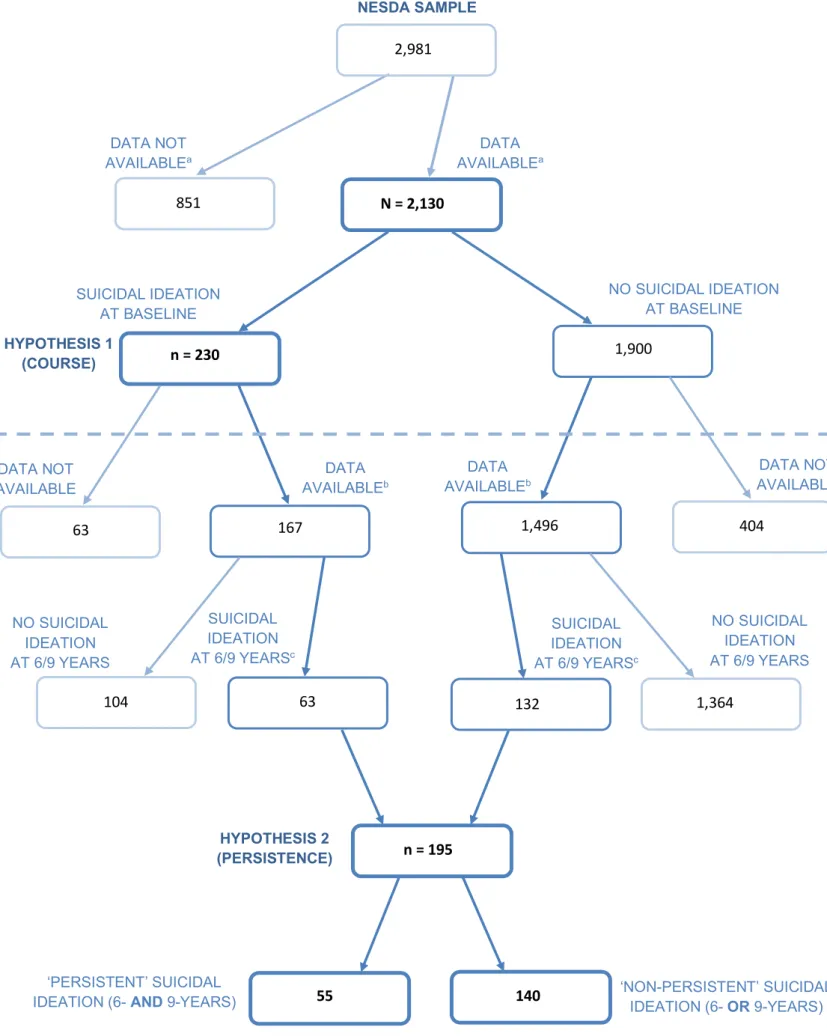
(11%) were categorized as ‘suicidal ideators’ (i.e., reported at least mild suicidal ideation at baseline, Beck Scale for Suicide Ideation (BSSI)>0), while 1,900 (89%) were ‘non-suicidal’ (i.e., no suicidal ideation at baseline, BSSI=0). We further restricted our sample to those participants who were suicidal ideators at baseline (n=230; see Figure 1). This was done because most participants (77%) did not report any suicidal ideation at any assessment point, and as our research question relates to the course of suicidal ideation in those already affected rather than the development of ideation in currently asymptomatic individuals.
Persistence of suicidal ideation As primary inclusion criteria for the persistence analyses (Hypothesis 2), participants were required to have available data on 1. the predictors at baseline, 2- and 4-year follow-ups, and 2. suicidal ideation at 6- and 9-year follow-ups (n=1,663). We further restricted our sample to those participants who reported suicidal ideation at the 6- and/or 9-year follow-ups (i.e., excluding people with no suicidal ideation at both assessment points), as we were interested in the differences between those with persistent as compared to non-persistent suicidal ideation (assuming that reporting suicidal ideation at two successive assessment points indicates persistence). In order to assume a non-overlapping
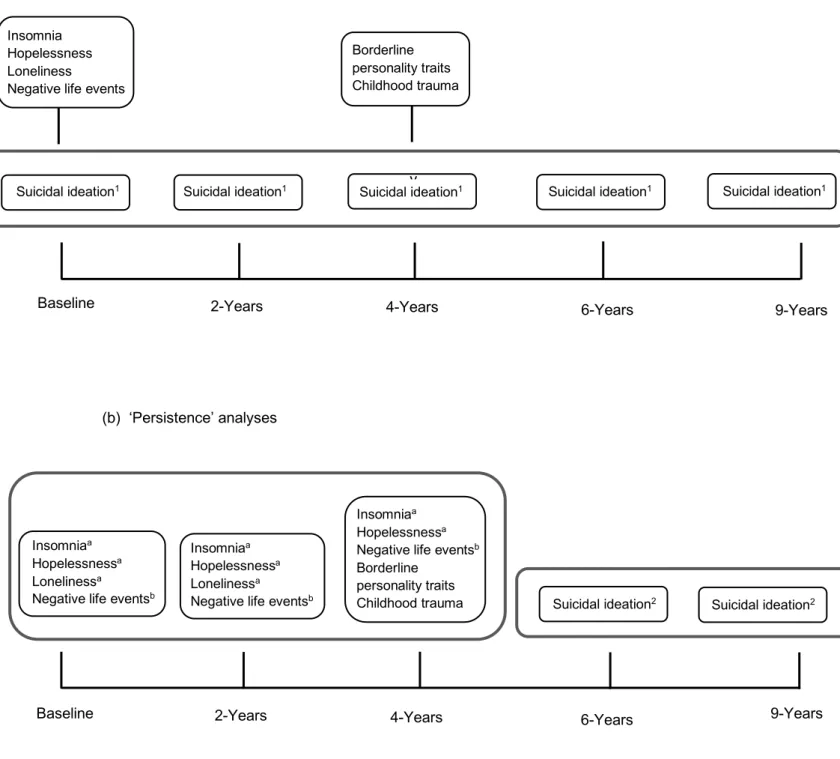
timeline, the outcome (suicidal ideation) was measured at 6- and 9-year follow-up, and the predictors and covariates were derived from baseline, 2- and 4-year follow-up (Figure 2). This allowed for a longitudinal assessment of both the outcome and predictors, therefore providing an improved measure of the predictors over time. Of the 1,663 participants with available data, 1,468 (88%) reported no suicidal ideation at both 6 and 9 years (and were excluded), 140 (8%) reported suicidal ideation at either 6 or 9 years (i.e., non-persistent suicidal ideation), and 55 (3%) reported suicidal ideation at both 6 and 9 years (i.e., persistent suicidal ideation), resulting in a sample of 195 participants (Figure 1). Comparisons between samples for course analyses and persistence analyses are provided in the supplement. 32% (n=63) of the participants included in the persistence analyses were also included in the course analyses.
<Figure 1 & Figure 2>
Materials
Sociodemographic data on participants’ age, gender, nationality, marital status, education and employment were collected at baseline (Penninx et al., 2008).
Clinicaldiagnosis and severity,medication use (selective serotonin reuptake inhibitors (SSRIs), other antidepressants (tricyclic antidepressants, monoamine oxidase inhibitors, atypical antidepressants), benzodiazepines, hypnotics/sedatives), and suicide attempt history were assessed at baseline, and 2- and 4-year follow-up. Current and lifetime diagnoses of depressive (major depressive disorder, dysthymia) and anxiety disorders (generalized anxiety disorder, social phobia, panic disorder, agoraphobia) were assessed at baseline, and current diagnoses (i.e., past 6 months) were established again at 2- and 4-year follow-up using the Composite International Diagnostic Interview (CIDI 2.1), a DSM-IV criteria concurrent standardized diagnostic interview (Robins et al., 1988; WHO, 1998). Severity of depressive symptoms was assessed with the Inventory of Depressive Symptomatology (IDS; Rush et al., 1986; Rush et al., 1996).
Suicidal ideation was assessed at baseline and all follow-ups using a 5-item version of the Beck Scale for Suicide Ideation (BSSI), a screening measure of current (past week) suicidal ideation administered by the interviewer (Beck et al., 1979). The items are rated on a 3-point Likert-scale, and the sum score ranges from 0 to 10 (severe suicidal ideation). Respondents with a positive score on at least one of the five items of the BSSI were categorized as suicidal ideators (Kooistra et al., 2018; Lamers et al., 2016). Internal consistency of the BSSI was acceptable in our sample (α > .74).
Hopelessness was measured at baseline, and 2- and 4-year follow-up with the Leiden Index of Depression Sensitivity (LEIDS; van der Does, 2002) Hopelessness/Suicidal reactivity subscale (5 items). Example subscale items include: “When I feel down, I more often feel hopeless about everything” and “When I feel sad, I feel as if I care less if I lived or died” (Solis et al., 2017). Total scores range from 0 to 20 (severe hopelessness). It has been found to be a valid measure to differentiate depressed patients with and without past suicidal ideation (Antypa et al., 2010). Even though the subscale taps questions relating to suicidal ideation, these are conditional hypothetical items measuring reactivity and not actual suicidal ideation at the current moment, thereby differentiating the scale from the BSSI.
the subjective feeling of loneliness rated on a 3-point Likert-scale, with a total score ranging from 0 to 11 (severe loneliness).
Insomnia symptoms during the past month were assessed at baseline and 2- and 4-year follow-up with the Women’s Health Initiative Insomnia Rating Scale (WHI-IRS) (Levine et al., 2003). The WHI-IRS consists of 5 items (e.g., “Did you have trouble falling asleep?”) rated on a 5-point Likert-scale, with a sum score ranging from 0 to 20 (severe insomnia symptoms). Scores ≥9 are indicative of clinically significant insomnia.
Borderline personality traits were assessed at the 4-year follow-up with the Personality Disorder Questionnaire (PDQ-4; Hyler et al., 1990). Ten items of the PDQ-4 correspond to DSM-IV BPD criteria. The items (e.g., “I’ll go to extremes to prevent those who I love from ever leaving me”) are rated by the respondent as true/false. All ‘true’ items produce a total score ranging from 0 to 10. Scores ≥5 are indicative of the presence of BPD.
Recent negative life events were assessed at baseline and 2- and 4-year follow-up using the Brugha List of Threatening Experiences (Brugha et al., 1985), which assesses the occurrence of 12 negative life events (incl. unemployment, violence, death and illness of close others). A total score of the number of events is produced. At baseline, events in the past year were assessed; at 2- and 4-year follow-up, the number of events since the previous interview was assessed.
Childhood trauma history was assessed at the 4-year follow-up with the Childhood Trauma Questionnaire (CTQ; Bernstein & Fink, 1998). CTQ is a standardized self-report questionnaire with 25 items measuring the severity of five types of trauma: emotional abuse, physical abuse and sexual abuse, emotional neglect and physical neglect. Each subscale produces a score ranging from 5 (no trauma) to 25 (severe trauma).
Statistical Analysis
The data were analyzed with IBM SPSS Statistics 23.0 (SPSS Inc, Chicago, Illinois). We examined characteristics at baseline and assessed group differences between those with and without current suicidal ideation using independent samples t-tests for continuous and chi-squared tests for categorical variables.
employment status), 2) sociodemographic covariates with time interactions, 3) baseline clinical covariates (lifetime psychopathology, current diagnosis, depressive symptom severity, comorbidity, medication, suicide attempt history), 4) clinical covariates with time interactions, 5) baseline predictors (insomnia symptoms, hopelessness, loneliness, BPD traits, childhood trauma, negative life events), and 6) predictors with time interactions. All continuous predictors were grand-mean centered by subtracting the mean from each individual observation. For the final model, we included the predictors that emerged as significant in the prior individual models. We included the covariates and predictors, time, quadratic time (i.e., acceleration/deceleration over time), and time interactions as fixed effects, and time as random effect (specifying an unstructured correlation matrix, which provides the most flexibility, does not assume constant variance across occasions and allows for dependence between measurement occasions; Daniels & Zhao, 2003). The resulting covariance matrix, the G matrix, presents the variances of the random intercept and random slope (time), and the covariance between them (Heck et al., 2014). We performed the Benjamini-Hochberg procedure to control the false discovery rate with multiple testing (Benjamini & Hochberg, 1995; Glickman, Rao, & Schultz, 2014).
Persistence of suicidal ideation Logistic regression analysis was performed to see whether the predictors at Time A (i.e., at baseline and at 2- and 4-year follow-up, using the mean score of the first three assessment points) predicted persistent suicidal ideation at Time B (i.e., reporting persistent suicidal ideation at both 6- and 9-year follow-up, vs. non-persistent suicidal ideation i.e., reporting suicidal ideation at either 6- or 9-years), controlling for the covariates (as measured at Time A). Time A did not overlap with Time B in order to establish a timeline between predictors and outcome (Figure 2b). Significance was determined at α < .05, two-sided.
Results Sample description
Demographic information and differences between those with and without suicidal ideation at baseline are presented in Table 1. Suicidal ideators were less likely to be married or have a partner, or to be currently working; they had more lifetime and current psychopathology (diagnosis and severity), and more comorbidity (i.e., more than one current diagnosis of a depressive and/or anxiety disorder). They were also more likely to take medication, and to have a history of a suicide attempt. They had more insomnia symptoms and BPD traits, hopelessness, loneliness, and childhood trauma history. No other differences were observed (all p’s > .05). Correlations between the outcome and predictors at baseline are presented in the supplement. No multicollinearity was observed.
<Table 1>
Longitudinal course of suicidal ideation
We first ran six preliminary models with 1) sociodemographic covariates, 2) sociodemographic covariates with time interactions, 3) clinical covariates, 4) clinical covariates with time interactions, 5) predictors, and 6) predictors with time interactions (see supplement). For the final model (Table 2), we included the factors that emerged as significant in their individual models.
There was significant interindividual variation in participants’ initial levels of suicidal ideation at baseline, (Var(υ0j) = 1.03, χ2(1) = 4.82, p < .001). Participants with more insomnia
symptoms (t(212) = 2.63, p = .009), and hopelessness (t(214) = 5.47, p < .001), had higher suicidal ideation (all p’s > .05 for the other predictors).
On average, individuals’ suicidal ideation decreased over time, with an estimated decrease of –0.60 points per year, (t(309) = –6.89, p < .001). This decrease decelerated over time (i.e., the participants experienced less decline with increasing time), by an estimated 0.04 points per year, (t(347) = 8.84, p < .001). Of the 230 people who reported suicidal ideation at baseline, 33% also reported ideation at the 2-year follow-up, with 31%, 26% and 23% reporting ideation at the 4-, 6- and 9-year follow-ups, respectively. Of those who continued to report ideation after baseline (n=96), 16% reported ideation consistently across all assessment points.
There was significant variation in participants’ course of suicidal ideation over time, (Var (υ1j) = 0.02, χ2(1) = 2.76, p = .006). Those with more BPD traits (t(194) = 2.99, p = .003)
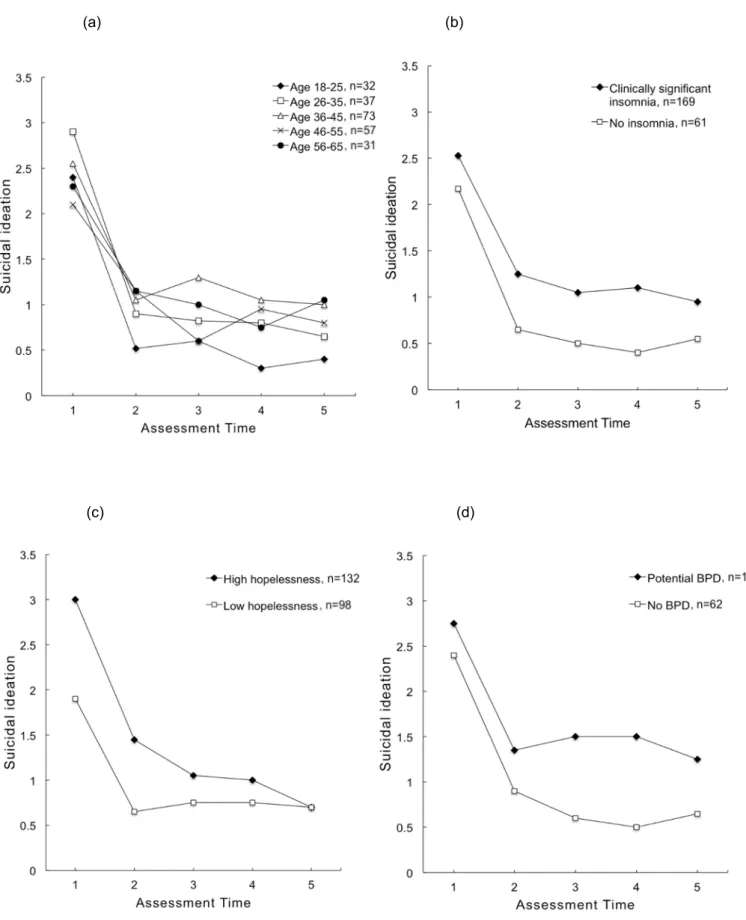
experienced more decline over time (t(200) = –4.24, p < .001) (all p’s > .05 for other predictors). Older participants also had less decline in suicidal ideation over time (t(198) = 2.24, p = .026); however, the effect of age was no longer significant after correcting for multiple comparisons. Figure 3 presents the average suicidal ideation course trajectories for a) different age groups, b) individuals with/without clinically significant insomnia (WHI-IRS≥9), c) with high/low hopelessness (i.e., above or below the group mean, LEIDSHOP≥10), and d) with/without potential BPD (PSQ-4BPD≥5).
<Table 2 & Figure 3>
Predictors of persistent suicidal ideation
We had data on 195 participants who reported either persistent suicidal ideation (i.e., present at both 6- and 9-year follow-ups, n=55) or non-persistent suicidal ideation (i.e., present at either 6- or 9-year follow-up, n=140; for participant flow see Figure 1).
The logistic regression results are presented in Table 3. There was a significant effect of insomnia symptoms (Wald’s χ2(1) = 5.14, p = .023), hopelessness (Wald’sχ2(1) = 8.89, p =
.003) and use of other antidepressants (Wald’s χ2(1) = 4.41, p = .036) on persistent suicidal
ideation. The model explained 34% of the variance in persistent suicidal ideation, correctly classifying 79% of the cases, with a sensitivity of 49% and specificity of 91% (χ2(25)= 53.09, p = .001).
<Table 3>
Mediation analysis (Post-hoc)
The logistic regression results on persistent suicidal ideation showed two significant predictors: insomnia symptoms and hopelessness. On the basis of prior literature arguing that hopelessness might be a mediating factor linking insomnia symptoms with suicidal ideation (Mc Call & Black, 2013), we ran a post-hoc mediation analysis with insomnia symptoms (mean of baseline and 2-year up) as the predictor, hopelessness (mean of 2- and 4-year follow-up) as the mediator, and persistent suicidal ideation (6- and 9-year follow-follow-up) as the outcome. Because ‘use of other antidepressants’ was significant in the previous analysis, we included it as a covariate.
The total effect of insomnia symptoms on persistent suicidal ideation was significant (b
also predicted more hopelessness (b = 0.292, SE = 0.064, 95% CI [0.166, 0.419]), and more hopelessness in turn predicted persistent suicidal ideation (b = 0.190, SE = 0.045, 95% CI [0.102, 0.279]). After accounting for hopelessness, the effect of insomnia symptoms on persistent suicidal ideation (i.e., the direct effect) was no longer significant (b = 0.071, SE = 0.041, 95% CI [–0.009, 0.152]) (Figure S1b). However, the indirect effect of insomnia symptoms through hopelessness was significant (b = 0.056, SE = .019, 95% CI[0.026, 0.100]). Hopelessness accounted for 49.6% of the effect of insomnia symptoms on persistent suicidal ideation.
Discussion
Our aim was to assess the course of suicidal ideation and to identify predictors of its persistence. In a growth model analysis, those with more severe insomnia symptoms and hopelessness reactivity had higher initial levels of suicidal ideation. Overall, suicidal ideation decreased over time, but those with more BPD traits experienced less decrease and those with more hopelessness reactivity experienced more decrease over time. In a logistic regression analysis, insomnia symptoms and hopelessness reactivity predicted persistence of suicidal ideation. Hopelessness reactivity mediated the effect of insomnia symptoms on persistent ideation. In summary, hopelessness reactivity and insomnia were associated with both aspects of suicidal ideation – current level and chronicity.
Our results are mostly in line with prior literature. Insomnia symptoms have been associated with suicidal ideation both cross-sectionally and longitudinally (Bernert et al., 2005; Ribeiro et al., 2012). Over 90% of suicide attempters report sleep disturbances (Hall et al., 1999), and short sleep duration has been associated with suicidal ideation in the general population as well (Goodwin & Marusic, 2008). A recent study found that insomnia symptoms predicted increases in suicidal ideation among young adults at risk of suicide (Bernert et al., 2017). We found that insomnia symptoms predicted having (or developing) persistent suicidal ideation. However, insomnia symptoms assessed at a single time point (i.e., at baseline) did not emerge as a significant predictor (in interaction with time) in our growth model analysis. In our persistence analysis we measured insomnia symptoms over a longer period of time (i.e., using the mean of the first three assessment time points) and this probably provided a more reliable index of chronic insomnia symptom severity (although the WHI-IRS only assesses the presence of insomnia symptoms in the past month).
the initiation and maintenance of sleep (Monti, 2011), while sleep deprivation can lead to alterations in the serotonergic system (Eimenhorst et al., 2012). Likewise, abnormalities in serotonin function have been observed in suicide victims (Chatzittofis et al., 2013). Chronic sleep deprivation has also been shown to be detrimental to cognitive functioning, leading to impaired decision making (Noh et al., 2012). Consequently, for insomniacs suicide may present as the only tangible solution to their problems (McCall & Black, 2013). Hopelessness is also, by definition, associated with a perceived lack of options. Hence, lack of sleep may worsen any hopelessness the individual is experiencing, therefore conferring additional risk. Although a previous study of (predominantly male) young adults in the military did not find hopelessness to mediate the relationship between insomnia symptoms and prospective (one month) suicidal ideation (Ribeiro et al., 2012), we observed a significant mediating effect of hopelessness; longer-term sleep disturbance may be required to lead to increased hopelessness. It appears that insomnia symptoms in itself may not directly increase the risk of persistent suicidal ideation, but that insomnia symptoms can lead to more hopelessness, which in turn leads to the persistence of suicidal ideation.
finding that the majority of those who reported suicidal ideation at baseline did not continue to report ideation at the 2-year follow-up is also consistent with the ‘Fluid Vulnerability Theory’, which states that suicidal crises are often time-limited and suicide risk fluctuates over time (Bryan & Rudd, 2016). We also note that the mean suicidal ideation in our sample was low and the scores non-normally distributed, with a positive skew. Therefore, while most participants experienced decreases in suicidal ideation over time, they had only mild suicidal ideation to begin with.
We also found that participants with comorbid BPD traits experienced less decline in suicidal ideation over time. It is well established that chronic suicidal ideation is a central feature of BPD (for reviews see Black et al., 2004; Paris, 2002). A previous NESDA study found comorbid BPD traits to be associated with recurrent suicide attempts (Stringer et al., 2013).BPD traits are also associated with suicide attempts and ideation among mood disorder patients (Aaltonen et al., 2017). Our results add to these findings by demonstrating that individuals with more BPD traits also exhibit a worse course of suicidal ideation.
Loneliness, negative life events, and history of childhood trauma were not associated with either the course or persistence of suicidal ideation. Loneliness has previously been associated with increased odds of suicidal ideation cross-sectionally (Stravynski & Boyer, 2001), and thwarted belongingness was found to mediate the effect of insomnia on suicidal ideation (Chu et al., 2016). However, previous longitudinal studies have failed to demonstrate loneliness to predict suicide (Lasgaard et al., 2011; Koivumaa-Honkanen et al., 2001). Findings on the relationship between negative life-events and suicide risk are also inconsistent (Cavanagh et al., 1999; Hall et al., 1999). Finally, we did not replicate the finding that individuals with a history of childhood trauma are at increased risk of suicide ideation later in life (Almeida, 2012; Brown et al., 1999). The effects of childhood trauma have been shown to be strongest for those with a history of emotional and sexual abuse (Brown et al., 1999; de Araújo & Lara, 2016), whereas neglect appears to be less strongly associated with subsequent suicidal ideation and behavior (Norman et al., 2012). In our sample, experiences of neglect were more prevalent than those of abuse.
Further, depressive/anxiety diagnoses/comorbidity were not associated with the course or persistence of suicidal ideation. Depressive symptoms previously distinguished between those with persistent and non-persistent suicidal ideation (Wilcox et al., 2010), and we also first observed an effect of symptom severity (which includes a suicidal ideation item): those with more severe depressive symptoms had increased odds of persistent suicidal ideation. However, this effect was no longer significant after the inclusion of insomnia symptoms and hopelessness reactivity, which emerged as significant predictors of persistence. This is contrary to prior findings of depression mediating the effect of insomnia symptoms on suicidal ideation (Allan et al., 2017; Bryan et al., 2015). Further, although SSRIs have sometimes been associated with increased suicidal risk (especially among children and adolescents, see e.g., Gibbons et al., 2007), we observed that other types of antidepressants predicted the persistence of suicidal ideation over time. This association may be explained by increased use of such medications among those with more treatment-resistant depression. Finally, we observed that older participants experience less decline of suicidal ideation over time, in line with reports that suicide rates generally increase with age (Hawton & van Heeringen, 2009; WHO, 2014).
our findings of hopelessness in the persistence analysis may be partly influenced by a predisposition to suicidal ideation rather than hopelessness in general.
The present study also has distinct strengths. We used a long follow-up period and took into account a wide range of sociodemographic and clinical factors, which were also assessed longitudinally. This is important in explaining a complex phenomenon such as suicidal ideation, in which multiple chronic risk factors are known to be involved (Franklin et al., 2017; Hawton & van Heeringen, 2009; Oquendo et al., 2006).
References
Aaltonen, K.I., Rosenström, T., Baryshnikov, I., Karpov, B., Melartin, T., Suominen, K., Heikkinen, M., Näätänen, P., Koivisto, M., Joffe, G., Isometsä, E., 2017. Mediating role of borderline personality traits in the effects of childhood maltreatment on suicidal behaviour among mood disorder patients. Eur. Psychiat. 44, 53-60.
Allan, N.P., Conner, K.R., Pigeon, W.R., Gros, D.F., Salami, T.K., Stecker, T., 2017. Insomnia and suicidal ideation and behaviors in former and current US service members: Does depression mediate the relation? Psychiatry Res. 252, 296-302.
Almeida, O.P., Draper, B., Snowdon, J., Lautenschlager, N.T., Pirkis, J., Byrne, G., Sim, M., Stocks, N., Flicker, L., Pfaff, J.J., 2012. Factors associated with suicidal thoughts in a large community study of older adults. Br. J. Psychiatry201, 466-472.
Anestis, M.D., Soberay, K.A., Gutierrez, P.M., Hernández, T.D., Joiner, T.E., 2014. Reconsidering the link between impulsivity and suicidal behavior. Pers. Soc. Psychol. Rev.18 (4), 366-386.
Antypa, N., Antonioli, M., Seretti, A., 2013. Clinical, psychological and environmental predictors of prospective suicide events in patients with bipolar disorder. J. Psychiatr. Res. 47 (11), 1800-1808.
Antypa, N., van der Does, A.J.W., Penninx, B.W.J.H., 2010. Cognitive reactivity: investigation of a potentially treatable marker of suicide risk in depression. J. Affect. Disord. 122, 46-52.
Beautrais, A.L., Joyce, P.R., Mulder, R.T., Fergusson, D.M., Deavoll, B.J., Nightingale, S.K., 1996. Prevalence and comorbidity of mental disorders in persons making serious suicide attempts: a case-control study. Am. J. Psychiatry 153,1009-1014.
Beck, A.T., Steer, R.A. Kovacs, M., Garrison, B., 1985. Hopelessness and eventual suicide: a 10-year prospective study of patients hospitalized with suicidal ideation. Am. J. Psychiatry142 (5), 559-563.
Beck, A.T., Kovacs, M., Weissman, A., 1979. Assessment of suicidal ideation: the Scale for Suicidal Ideation. J. Consult. Clin. Psychol.47 (2), 343-352.
Bernert, R.A., Hom, M.A., Iwata, N.G., Joiner, T.E., 2017. Objectively assessed sleep variability as an acute warning sign of suicidal ideation in a longitudinal evaluation of young adults at high suicide risk. J. Clin. Psychiatry 78 (6), 678-687.
Bernstein, D.P., Fink, L., 1998. Childhood Trauma Questionnaire: a retrospective self-report manual. San Antonio, Texas: The Psychological Corporation.
Black, D. W., Blum, N., Pfohl, B., Hale, N., 2004. Suicidal behavior in borderline personality disorder: prevalence, risk factors, prediction, and prevention. J. Pers. Disord. 18 (3), 226–239.
Borges, G., Angst, J., Nock, M.K., Ruscio, A.M., Kessler, R.C., 2008. Risk factors for the incidence and persistence of suicide-related outcomes: a 10-year follow-up study using the National Comorbidity Survey. J. Affect. Disord.105, 25-33.
Bostwick, J.M., Pankratz, V.S., 2000. Affective disorders and suicide risk: a reexamination. Am. J. Psychiatry157,1925-1932.
Brodsky, B.S., Oquendo, M., Ellis, S.P., Haas, G.L., Malone, K.M., Mann, J.J., 2001. The relationship of childhood abuse to impulsivity and suicidal behavior in adults with major depression. Am. J. Psychiatry158,1871-1877.
Brown, J., Cohen, P., Johnson, J.G., Smailes, E.M., 1999. Childhood abuse and neglect: specificity of effects on adolescent and young adult depression and suicidality. J. Am. Acad. Child Adolesc. Psychiatry 38 (12), 1490-1496.
Brugha, T., Bebbington, P., Tennant, C., Hurry, J., 1985. The List of Threatening Experiences: a subset of 12 life event categories with considerable long-term contextual threat. Psychol. Med. 15, 189-194.
Bryan, C.J., Gonzales, J., Rudd, M.D., Bryan, A.O., Clemans, T.A., Ray-Sannerud, B., Wertenberger, E., Leeson, B., Heron, E.A., Morrow, C.E., 2015. Depression mediates the relation of insomnia severity with suicide risk in three clinical samples of US military personnel. Depress. Anxiety 32 (9), 647-655.
Bryan, C.J., Rudd, M.D., 2016. The importance of temporal dynamics in the transition from suicidal thought to behavior. Clin. Psychol. Sci. Pr. 23 (1), 21-25.
Busch, K.A., Fawcett, J., Jacobs, D.G., 2003. Clinical correlates of inpatient suicide. J. Clin. Psychiatry64, 14-19.
Cavanagh, J.T.O., Carson, A.J., Sharpe, M., Lawrie, S.M., 2003. Psychological autopsy studies of suicide: a systematic review. Psychol. Med.33,395-405.
Chatzittofis, A., Nordström, P., Hellström, C., Arver, S., Åsberg, M., Jokinen, J., 2013. CSF 5-HIAA, cortisol and DHEAS levels in suicide attempters. Eur. Neuropsychopharmacol. 23 (10), 1280-1287.
Chu, C., Klein, K.N., Buchman-Achmitt, J.M., Hom., M.A., Hagan, C.R., Joiner, T.E., 2015. Routinized assessment of suicide risk in clinical practice: An empirically informed update. J. Clin. Psychol. 71 (12), 1186-1200.
Daniels, M.H., Zhao, Y.D., 2003. Modelling the random effects covariance matric in longitudinal data. Stat. Med. 22 (10), 1631-1647.
de Araújo, R.M.F., Lara, D.R., 2016. More than words: the association of childhood emotional abuse and suicidal behavior. Eur. Psychiat.37, 14-21.
de Jong-Gierveld, J., Kamphuis, F., 1985. The development of a Rasch-type loneliness scale. Appl. Psychol. Meas. 9 (3), 289-299.
Duberstein, P.R., Conwell, Y., 1997. Personality disorders and completed suicide: a methodological and conceptual review. Clin. Psychol. Sci. Pract. 4 (4), 359-376. Eikelenboom, M., Smit, J.H., Beekman, A.T.F., Kerkhof, A.J.F.M., Penninx, B.W.J.H., 2014.
Reporting suicide attempts: consistency and its determinants in a large mental health survey. Int. J. Methods Psychiatr. Res. 23 (2), 257-266.
Eimenhorst, D., Kroll, T., Matusch, A., Bauer, A., 2012. Sleep deprivation increases cerebral serotonin 2A receptor binding in humans. Sleep 35 (12), 1615-1623.
Fergusson, D.M., Woodward, L.J., Horwood, L.J., 2000. Risk factors and life processes associated with the onset of suicidal behavior during adolescence and early adulthood. Psychol. Med.30,23-39.
Forsell, Y., 2000. Death wish in the very elderly: data from a 3-year follow-up study. Acta Psychiatr. Scand. 83,115-120.
Foster, T., Gillespie, K., McClelland, R., Patterson, C., 1999. Risk factors for suicide independent of DSM-III-R Axis I disorder. Br. J. Psychiatry175,175-179.
Franklin, J.C., Ribeiro, J.D., Fox, K.R., Bentley, K.H., Kleiman, E.M., Huang, X., Musacchio, K.M., Jaroszewski, A.C., Chang, B.P., Nock, M.K., 2017. Risk factors for suicidal thoughts and behaviors: a meta-analysis of 50 years of research. Psychol. Bull. 143(2), 187-232.
Goldston, D.B., Erkanli, A., Daniel, S.S., Heilbron, N., Weller, B., Doyle, O., 2016. Developmental trajectories of suicidal thoughts and behaviors from adolescence through adulthood. J. Am. Acad. Child Adolesc. Psychiatry55 (5), 400-407.
Goodwin, R.D., Marusic, A., 2008. Association between short sleep and suicidal ideation and suicide attempt among adults in the general population. Sleep 31 (8), 1097-1101. Hall, R.C.W., Platt, D.E., Hall, R.C.W., 1999. Suicide risk assessment: a review of risk factors
for suicide in 100 patients who made severe suicide attempts. Psychosomatics 40, 18-27.
Handley, T.E., Attia, J.R., Inder, K.J., Kay-Lambkin, F.J., Barker, D., LEwin, T.J., Kelly, B.J., 2013. Longitudinal course and predictors of suicidal ideation in a rural community sample. Aust. N. Z. J. Psychiatry 47 (11), 1032-1040.
Hawton, K., Casañas i Comabella, C., Haw, C., Saunders, K., 2013. Risk factors for suicide in individuals with depression: a systematic review. J. Affect. Disord.147, 17-28.
Hawton, K., van Heeringen, K., 2009. Suicide. Lancet 373, 1372-1381.
Hayes, A.F., 2012. PROCESS: a versatile computational tool for observed variable mediation,
moderation, and conditional process modeling.
http://www.afhayes.com/public/process2012.pdf (accessed 20 May 2018).
Heck, R.H., Thomas, S.L., Tabata, L.N., 2014. Multilevel and longitudinal modeling with IBM SPSS. Routledge, New York.
Henriksson, M.M., Aro, H.M., Marttunen, M.J., Heikkinen, M.E., Isometsä, E.T., Kuoppasalmi, K.I., Lönnqvist, J.K., 1993. Mental disorders and comorbidity in suicide. Am. J. Psychiatry150,935-940.
Hyler, S.E., Skodol, A.E., Kellman, H.D., Oldham, J.M., Rosnick, L., 1990. Validity of the Personality Diagnostic Questionnaire – Revised: comparison with two structured interviews. Am. J. Psychiatry 147, 1043-1048.
Kessler, R.C., Borges, G., Walters, E.E., 1999. Prevalence of and risk factors for lifetime suicide attempts in the National Comorbidity Survey. Arch. Gen. Psychiatry 56 (7), 617-626.
Koivumaa-Honkanen, H., Honkanen, R., Viinamäki, H., Heikkilä, K., Kaprio, J., Koskenvuo, M., 2002. Life satisfaction and suicide: a 20-year follow-up study. Am. J. Psychiatry 158 (3), 433-439.
Kuo, W.H., Gallo, J.J., Eaton, W.W., 2004. Hopelessness, depression, substance disorder and suicidality: a 13-year community-based study. Soc. Psychiatry Psychiatr. Epidemiol.39 (6), 487-501.
Lamers, F., Beekman, A.T.F., van Hemert, A.M., Schoevers, R.A., Penninx, B.W.J.H., 2016. Six-year longitudinal course and outcomes of subtypes of depression. Br. J. Psychiatry 208, 62-68.
Lamers, F., Hoogendoorn, A.W., Smit, J.H., van Dyck, R., Zitman, F.G., Nole, W.A., Penninx, B.W., 2012. Sociodemographic and psychiatric determinants of attrition in the Netherlands Study of Depression and Anxiety. Compr. Psychiatry 53, 63-70.
Lasgaard, M., Goossens, L., Elklit, A., 2011. Loneliness, depressive symptomatology, and suicide ideation in adolescence: cross-sectional and longitudinal analyses. J. Abnorm. Child Psych. 39, 137-150.
Levine, D.W., Kripke, D.F., Kaplan, R.A., Lewis, M.A., Naughton, M.J., Bowen, D.J., Shumaker, S.A., 2003. Reliability and validity of the Women’s Health Initiative Insomnia Rating Scale. Psychol. Assess. 15 (2), 137-148.
McCall, W.V., Black, C.G., 2013. The link between suicide and insomnia: theoretical mechanisms. Curr. Psychiat. Rep. 15,389.
Minkoff, K., Bergman, E., Beck, B.T., Beck, R., 1973. Hopelessness, depression, and attempted suicide. Am. J. Psychiatry130 (4), 455-459.
Monti, J., 2011. Serotonin control of sleep-wake behavior. Sleep Med. Rev. 15, 269-281. Myers, K., McCauley, E., Calderon, R., Treder, R., 1991. The 3-year longitudinal course of
suicidality and predictive factors for subsequent suicidality in youths with major depressive disorder. J. Am. Acad. Child Adolesc. Psychiatry30 (5), 804-810.
Nock, M.K., Borges, G., Bromet, E.J., Alonso, J., Angermeyer, M., Beautrais, A., Bruffaerts, R., Chiu, W.T., de Girolamo, G., Gluzman, S., de Graaf, R., Gureje, O., Haro, J.M., Huang, Y., Karam, E., Kessler, R.C., Lepine, J.P., Levinson, D., Medina-Mora, E., Ono, Y., Posada-Villa, J., Williams, D., 2008. Cross-national prevalence and risk factors for suicidal ideation, plans and attempts. Br. J. Psychiatry192,98-105.
Norman, R.E., Byambaa, M., De, R., Butchart, A., Scott, J., Vos, T., 2012. The long-term health consequences of child physical abuse, emotional abuse, and neglect: a systematic review and meta-analysis. PLoS Med. 9 (11), e1001349.
O’Connor, R.C., Nock, M.K., 2014. The psychology of suicidal behavior. Lancet Psychiatry 1 (1), 73-85.
Oquendo, M.A., Currier, D., Mann, J.J., 2006. Prospective studies of suicidal behavior in major depressive and bipolar disorder: what is the evidence for predictive risk factors? Acta Psychiatr. Scand. 114,151-158.
Paris, J., 2002. Chronic suicidality among patients with borderline personality disorder. Psychiatr. Serv. 53 (6), 738-742.
Penninx, B.W.J.H., Beekman, A.T.F., Smit, J.H., Fitman, F.G., Nolen, W.A., Spinhoven, P., Cuijpers, P., de Jong, P.J., van Marwijk, H.W.J., Assendelft, W.J.J., van der Meer, K., Verhaak, P., Wensing, M., de Graaf, R., Hoogendijk, W.J., Ormel, J., van Dyck, R., 2008. The Netherlands Study of Depression and Anxiety (NESDA): rationale, objectives and methods. Int. J. Methods Psychiatr. Res. 17 (3), 121-140.
Perlis, M.L., Grandner, M.A., Chakravorty, S., Bernert, R.A., Brown, G.K., Thase, M.E., 2016. Suicide and sleep: is it a bad thing to be awake when reasons sleep? Sleep Med. Rev. 29, 101-107.
Pigeon, W.R., Caine, E.D., 2010. Insomnia and the risk for suicide: does sleep medicine have interventions that can make a difference? Sleep Med. 11,816-817.
Preacher, K.J., Hayes, A.F., 2004. SPSS and SAS procedures for estimating indirect effects in simple mediation models. Behav. Res. Methods Instrum. Comput. 36 (4), 717-731. Ribeiro, J.D., Pease, J.L., Gutierrez, P.M., Silva, C., Bernert, R., Rudd, M.D., Joiner, T.E.,
2012. Sleep problems outperform depression and hopelessness as cross-sectional and longitudinal predictors of suicidal ideation and behavior in young adults in the military. J. Affect. Disord.136, 743-750.
Robins, L.N., Wing, J., Wittchen, H.U., Helzer, J.E., Babor, T.F., Burke, J., Farmer, A., Jablenski, A., Pickens, R., Regier, D.A., Sartorius, N., Towle, L.H., 1988. The Composite International Diagnostic Interview: an epidemiologic instrument suitable for use in conjunction with different diagnostic systems and in different cultures. Arch. Gen. Psychiatry45 (12), 1069-1077.
Rush, A.J., Giles, D.E., Schlesser, M.A., Fulton, C.L., Weissenburger, J., Burns, C., 1986. The Inventory of Depressive Symptomatology (IDS): preliminary findings. Psychiatry Res. 18, 65-87.
Rush, A.J., Gullion, C.M., Basco, M.R, Jarrett, R.B., Trivedi, M.H., 1996. The Inventory of Depressive Symptomatology (IDS): psychometric properties. Psychol. Med. 26, 477-486.
Smith, J.M., Alloy, L.B., Abramson, L.Y., 2006. Cognitive vulnerability to depression, rumination, hopelessness and suicidal ideation: multiple pathways to self-injurious thinking. Suicide Life Threat. Behav. 36 (4), 443-454.
Solis, E., Antypa, N., Conijn, J.M., Kelderman, H., van der Does, W., 2017. Psychometric properties of the Leiden Index of Depression Sensitivity (LEIDS). Psychol. Assess.29 (2), 158-171.
Stravynski, A., Boyer, R., 2001. Loneliness in relation to suicidal ideation and parasuicide: a population-wide study. Suicide Life Threat. Behav. 31 (1), 32-40.
Stringer, B., van Meijel, B., Eikelenboom, M., Koekkoek, B., Licht, C.M.M., Kerkhof, A.J.F.M., Penninx, B.W.J.H., Beekman, A.T.F., 2013. Recurrent suicide attempts in patients with depressive and anxiety disorders: the role of borderline personality traits. J. Affect. Disord. 151,23-30.
Stroebe, M., Stroebe, W., Abakoumkin, G., 2005. The broken heart: suicidal ideation in bereavement. Am. J. Psychiatry162,2178-2180.
ten Have, M., de Graaf, R., van Dorsselaer, S., Verdurmen, J., van ‘t Land, H., Vollebergh, W., Beekman, A., 2009. Incidence and course of suicidal ideation and suicide attempts in the general population. Can. J. Psychiatry 54 (12), 825-833.
van der Does, W., 2002. Cognitive reactivity to sad mood: structure and validity of a new measure. Behav. Res. Ther. 40, 105-120.
Wilcox, H.C., Arria, A.M., Caldeira, K.M., Vincent, K.B., Pinchevsky, G.M., O’Grady, K.E., 2010. Prevalence and predictors of persistent suicide ideation, plans, and attempts during college. J. Affect. Disord.127 (1-3), 287-94.
World Health Organization, 2018. Suicide Fact Sheet. Geneva: WHO.
http://www.who.int/mediacentre/factsheets/fs398/en/ (accessed 31 January 2018). World Health Organization, 2014. World Report on Violence and Health. Geneva: WHO. World Health Organization, 1998. Composite International Diagnostic Interview (CIDI),
Wortzel, H.S., Homaifar, B., Matarazzo, B., Brenner, L.A., 2014. Therapeutic risk management of the suicidal patient: stratifying risk in terms of severity and temporality. J. Psychiatr. Pract. 20 (1), 63-67.
Yen, S., Shea, M. T., Sanislow, C. A., Grilo, C. M., Skodol, A. E., Gunderson, J. G., McGlashan, T.H., Zanarini, M.C., Morey, L. C., 2004. Borderline personality disorder criteria associated with prospectively observed suicidal behavior. Am. J. Psychiatry 161 (7), 1296-1298.
Yufit, R.I., Lester, D., 2005. Assessment, treatment, and prevention of suicidal behavior. Hoboken, New Jersey.
Zhang, Y., Law, C.K., Yip, P.S.F., 2011. Psychological factors associated with the incidence and persistence of suicidal ideation. J. Affect. Disord. 133,584-590.
Table 1.
Sample characteristics at baseline
All (N=2130) Baseline Suicidal ideators (n=230, 11%) Non-suicidal (n=1900, 89%) Chi-square/ t-test p-value Sociodemographics
Gender, female (n, %) 1430 (67%) 153 (67%) 1277 (67%) 0.04 .834
Age, years (m, sd) 42.4 (13.1) 41.4 (12.0) 42.5 (13.3) 1.30a .195
Nationality, Dutch (n, %) 2090 (98%) 223 (97%) 1867 (98%) 1.90 .168
Married/with partner (n, %) 1502 (71%) 136 (59%) 1366 (72%) 16.08 < .001
Children (n, %) 1168 (55%) 117 (51%) 1051 (55%) 1.64 .201
Education, years (m, sd) 12.5 (3.2) 12.2 (3.2) 12.5 (3.2) 1.23a .220
Currently working (n, %) 1308 (61%) 105 (46%) 1203 (63%) 27.01 < .001
Religious (n, %) 793 (37%) 85 (37%) 708 (37%) 0.01 .928
Clinical characteristics Diagnosis (n, %)
Lifetime depression 1355 (64%) 222 (97%) 1133 (60%) 120.63 < .001
Lifetime anxiety 1191 (56%) 192 (84%) 999 (53%) 79.47 < .001
Current depression 785 (37%) 189 (82%) 596 (31%) 227.56 < .001
Dysthymia 185 (9%) 70 (30%) 115 (6%) 153.79 < .001
Major depression 712 (33%) 181 (79%) 531 (28%) 237.44 < .001
Current anxiety 843 (40%) 166 (72%) 677 (36%) 114.56 < .001
GAD 276 (13%) 76 (33%) 200 (11%) 92.23 < .001
Social phobia 439 (21%) 109 (47%) 330 (17%) 113.02 < .001
Panic disorder(with/out agoraphobia) 421 (20%) 84 (37%) 337 (18%) 45.65 < .001
Agoraphobia
Symptom severity (m, sd)
123 (6%) 19.9 (13.7) 17 (7%) 36.8 (11.8) 106 (6%) 17.8 (12.5) 1.24 –22.81a .266 < .001
Any comorbidity 634 (30%) 169 (74%) 465 (25%) 235.68 < .001
Comorbid depression and anxiety 487 (23%) 143 (62%) 344 (12%) 225.92 < .001
Medication (n, %)
SSRIs 343 (16%) 67 (29%) 276 (15%) 32.39 < .001
Other antidepressants 168 (8%) 38 (17%) 130 (7%) 26.46 < .001
Benzodiazepines 296 (14%) 57 (25%) 239 (13%) 25.54 < .001
Hypnotics/sedatives 133 (6%) 32 (14%) 101 (5%) 25.90 < .001
Suicidal ideation (m, sd) 0.3 (1.0) 2.5 (1.8) -
Suicide attempt history (n, %) 272 (13%) 78 (34%) 194 (10%) 103.38 < .001
Borderline personality traits (m, sd) 1.8 (1.9) 3.3 (2.3) 1.6 (1.8) –10.95a < .001
Clinical level (n, %) 221 (10%) 68 (30%) 153 (8%) 102.11 < .001
Insomnia (m, sd) 8.0 (5.0) 11.4 (5.4) 7.6 (4.8) –10.36a < .001
Clinical level (n, %) 912 (43%) 169 (74%) 743 (39%) 99.00 < .001
Hopelessness (m, sd) 4.6 (4.5) 10.5 (5.0) 3.8 (3.8) –19.28a < .001
Loneliness (m, sd) 4.2 (3.7) 7.0 (3.4) 3.9 (3.6) –12.62a < .001
Childhood trauma (m, sd) 40.3 (13.9) 48.6 (16.9) 39.2 (13.1) –8.14a < .001
Emotional abuse 8.6 (4.4) 11.2 (5.6) 8.3 (4.1) –7.65a < .001
Physical abuse 5.9 (2.6) 6.8 (3.5) 5.8 (2.5) –3.93a < .001
Sexual abuse 6.1 (3.0) 7.1 (4.2) 6.0 (2.8) –4.06a < .001
Emotional neglect 12.3 (5.1) 15.2 (5.2) 11.9 (5.0) –9.30a < .001
Physical neglect 7.4 (2.8) 8.4 (3.2) 7.3 (2.7) –5.24a < .001
Negative life events (m, sd) 0.8 (1.1) 0.9 (1.0) 0.8 (1.0) –1.81a .070
Table 2.
Linear mixed-effects growth model of suicidal ideation (N = 230)
b SE 95% CI Variance Covariance
Intercept 1.978 0.467 1.058, 2.897 1.025 –0.053
Time –0.603 0.088 –0.776, –0.431 0.018
Quadratic time 0.038 0.004 0.030, 0.047
Sociodemographics
Age –0.005 0.008 –0.021, 0.011
Employment status 0.231 0.195 –0.154, 0.616
Clinical characteristics
Symptom severity –0.005 0.009 –0.023, 0.014
Hypnotics/sedatives 0.344 0.279 –0.205, 0.893
Suicide attempt history 0.356 0.214 –0.066, 0.778
Predictors
Insomnia† 0.053 0.020 0.013, 0.093
Hopelessness†† 0.116 0.021 0.074, 0.157
Borderline personality traits 0.025 0.045 –0.064, 0.115
Emotional abuse 0.028 0.020 –0.010, 0.067
Sexual abuse 0.008 0.025 –0.041, 0.058
Interactions
Time X Age 0.003 0.001 0.001, 0.006
Time X Employment status 0.003 0.032 –0.059, 0.065
Time X Symptom severity 0.002 0.002 –0.001, 0.005
Time X Hypnotics/sedatives –0.088 0.046 –0.178, 0.003
Time X Suicide attempt history –0.041 0.035 –0.109, 0.028
Time X Insomnia –0.005 0.003 –0.012, 0.001
Time X Hopelessness†† –0.015 0.003 –0.022, -0.008
Time X Borderline personality traits† 0.022 0.007 0.008, 0.037
Time X Emotional abuse –0.003 0.003 –0.009, 0.004
Time X Sexual abuse –0.008 0.004 –0.016, 0.001
Table 3.
Logistic regression model on persistent (n = 55) versus non-persistent suicidal ideation (n = 140) (Total N = 195)
MODEL 1 MODEL 2 MODEL 3
OR (CI 95%) OR (CI 95%) OR (CI 95%)
Sociodemographics
Gender 0.73 (0.38-1.42) 0.86 (0.42-1.78) 0.91 (0.37-2.12)
Age 1.00 (0.97-1.03) 1.00 (0.97-1.03) 0.99 (0.96-1.03)
Nationality 0.77 (0.08-7.35) 0.55 (0.48-6.36) 0.40 (0.02-7.46)
Marital status 0.81 (0.41-1.63) 0.89 (0.41-1.92) 0.91 (0.37-2.23)
Education 1.03 (0.93-1.14) 1.06 (0.95-1.19) 1.12 (0.98-1.28)
Employment status 1.92 (1.00-3.69) 1.72 (0.84-3.54) 1.50 (0.68-3.33)
Clinical characteristicsa
Depression 0.99 (0.28-3.47) 1.00 (0.27-3.76)
Anxiety 0.37 (0.11-1.26) 0.25 (0.06-1.08)
Symptom severity b 1.07 (1.03-1.11) *** 1.01 (0.96-1.06)
Comorbidity 1.87 (0.47-7.42) 1.57 (0.34-7.37)
SSRI’s 0.81 (0.38-1.70) 0.97 (0.43-2.22)
Other antidepressants 2.38 (1.09-5.17) * 2.66 (1.07-6.63) *
Benzodiazepines 0.59 (0.23-1.50) 0.64 (0.23-1.78)
Hypnotics/sedatives 0.78 (0.27-2.24) 0.62 (0.20-1.92)
Suicide attempt history 1.23 (0.47-2.26) 0.79 (0.32-1.95)
Predictors
Insomnia b 1.14 (1.02-1.28) *
Hopelessness b 1.21 (1.07-1.36) **
Loneliness b 1.03 (0.88-1.20)
Borderline personality traits 1.11 (0.89-1.38)
Emotional abuse 1.05 (0.94-1.18)
Physical abuse 1.12 (0.93-1.35)
Sexual abuse 0.94 (0.84-1.07)
Emotional neglect 0.98 (0.88-1.10)
Physical neglect 0.90 (0.74-1.10)
Negative life events c 0.95 (0.84-1.07)
‘NON-PERSISTENT’ SUICIDAL
IDEATION (6- OR 9-YEARS)
‘PERSISTENT’ SUICIDAL
IDEATION (6- AND 9-YEARS)
851
HYPOTHESIS 1 (COURSE)
SUICIDAL IDEATION
AT 6/9 YEARSc
SUICIDAL IDEATION
AT 6/9 YEARSc
NO SUICIDAL IDEATION AT 6/9 YEARS NO SUICIDAL
IDEATION AT 6/9 YEARS
NO SUICIDAL IDEATION AT BASELINE SUICIDAL IDEATION AT BASELINE DATA AVAILABLEb DATA AVAILABLEb DATA NOT AVAILABLE DATA NOT AVAILABLE DATA AVAILABLEa DATA NOT AVAILABLEa HYPOTHESIS 2 (PERSISTENCE)
N = 2,130
n = 230 1,900
63
63 167
104
1,496 404
1,364 132
n = 195
Figure 1. Participant flow. aParticipants were required to have data available on suicidal ideation and the predictors at baseline, and at least
one follow-up; bParticipants were required to have data available on suicidal ideation at 6- and 9-year follow-up, and on the predictors and covariates at baseline, 2- and 4-year follow-up; cParticipants were required to have suicidal ideation (BSSI>0) at 6- and/or 9-year follow up.
55 140
NESDA SAMPLE
(a) ‘Course’ analyses
(b) ‘Persistence’ analyses
Figure 2. A schematic overview of the assessment time points for the outcome (suicidal ideation) and predictors in the (a) ‘Course’
analyses and (b) ‘Persistence’ analyses. 1Suicidal ideation sum score.
2Suicidal ideation present/absent.
aMean of Baseline, 2- and 4-year follow-up, bSum of Baseline, 2- and 4-year follow-up.
Note: Borderline personality traits and childhood trauma were only assessed at the 4-year follow-up.
v
Suicidal ideation2
Insomniaa
Hopelessnessa
Negative life eventsb
Borderline personality traits Childhood trauma
Insomniaa
Hopelessnessa
Lonelinessa
Negative life eventsb
Insomniaa
Hopelessnessa
Lonelinessa
Negative life eventsb
Insomnia Hopelessness Loneliness
Negative life events
Suicidal ideation1
Suicidal ideation1
Suicidal ideation1
Suicidal ideation1
Baseline
Baseline
2-Years
2-Years
4-Years
4-Years
6-Years
6-Years
9-Years
9-Years
Suicidal ideation1
Suicidal ideation2
(a) (b)
(c) (d)
Figure 3. Average suicidal ideation course trajectories for different groups; BPD Borderline personality disorder, T1;