arXiv:1512.03391v2 [math.AG] 30 Dec 2015
PREHOMOGENEOUS SPACES
JAMES DAMON1
Abstract. We consider the topology for a class of hypersurfaces with highly nonisolated singularites which arise as “exceptional orbit varieties”of a special class of prehomogeneous vector spaces, which are representations of linear alge-braic groups with open orbits. These hypersurface singularities include both determinantal hypersurfaces and linear free (and free*) divisors. Although these hypersurfaces have highly nonisolated singularities, we determine the topology of their Milnor fibers, complements and links. We do so by using the action of linear algebraic groups beginning with the complement, instead of using Morse-type arguments on the Milnor fibers. This includes replac-ing the local Milnor fiber by a global Milnor fiber which has a “complex ge-ometry”resulting from a transitive action of an appropriate algebraic group, yielding a compact ”model submanifold”for the homotopy type of the Mil-nor fiber. The topology includes the (co)homology (in characteristic 0, and 2-torsion in one family) and homotopy groups, and we deduce the triviality of the monodromy transformations on rational (or complex) cohomology.
Unlike isolated singularities, the cohomology of the Milnor fibers and com-plements are isomorphic as algebras to exterior algebras or for one family, mod-ules over exterior algebras; and cohomology of the link is, as a vector space, a truncated and shifted exterior algebra, for which the cohomology product structure is essentially trivial. We also deduce from Bott’s periodicity theo-rem, the homotopy groups of the Milnor fibers for determinantal hypersurfaces in the “stable range”as the stable homotopy groups of the associated infinite dimensional symmetric spaces. Lastly, we combine the preceding with a The-orem of Oka to obtain a class of “formal linear combinations”of exceptional orbit hypersurfaces which have Milnor fibers which are homotopy equivalent to joins of the compact model submanifolds. It follows that Milnor fibers for all of these hypersurfaces are essentially never homotopy equivalent to bouquets of spheres (even allowing differing dimensions).
Introduction
In this paper we investigate the topology of a class of highly nonisolated hy-persurface singularitiesE, each of which arises as the hypersurface of exceptional orbits, theexceptional orbit variety, for a rational representation of connected com-plex linear algebraic group ρ : G→ GL(V) with an open orbit U. Such a space with group action has been studied by Sato and Kimura [So], [SK] and is called by
1991 Mathematics Subject Classification. Primary: 11S90, 32S25, 55R80 Secondary: 57T15, 14M12, 20G05.
Key words and phrases. linear algebraic groups, solvable, reductive, prehomogeneous spaces, determinantal hypersurfaces, classical symmetric spaces, exceptional orbit varieties, linear free divisors, global Milnor fibration, cohomological triviality of Milnor fibration, topology of Milnor fibers, complements, links, quivers, Hopf algebras, exterior algebras.
(1) Partially supported by the Simons Foundation grant 230298 and the National Science Foundation grant DMS-1105470.
them a prehomogeneous vector space, which we will shorten in this paper to just
prehomogeneous space. Both determinantal hypersurfaces and linear free divisors
belong to this class. We consider how the topology of such singularities can be determined.
For nonisolated singularities with small dimensional singular set, a body of work by Siersma [Si], [Si2], [Si3], Tibar [Ti], Nemethi [Ne], Zaharia [Z], etc. has used Morse-theoretic methods to extend the results for isolated singularities, and show that the Milnor fiber is still homotopy equivalent to a bouquet of spheres, except now the spheres may have different dimensions. One might ask to what extent such results apply to these hypersurfaces of exceptional orbits, which now have highly nonisolated singularities. Complex Morse theory has been applied to determine the vanishing topology of “nonlinear sections”of these hypersurfaces in terms of “singu-lar Milnor fibers”in results by Mond, Goryunov, Bruce, Pike, and this author, see e.g. [DM], [Br], [D1, D2], [GM], and [DP3]. However, these results provide little information about the topology of the hypersurface singularities themselves. We shall see that the structure of these singularities are quite different from those stud-ied in the above work. In fact, to determine their topology we take a very different approach which makes substantial use of their representations via prehomogeneous spaces.
For the exceptional orbit varieties, we will be concerned with the topology of the Milnor fiber, the complement and the link; and we determine their homotopy types along with the (co)homology structure, homotopy groups, and the monodromy action. The changes in approach which make this possible are:
i) reversing the usual approach from first determining the Milnor fiber and monodromy to then compute the topology of the link and complement by beginning instead with the complement and deducing the topology of the link and Milnor fiber.
ii) replacing the local Milnor fiber by a global Milnor fiber, which is a smooth affine hypersurface that has a “model complex geometry”resulting from the transitive action of an associated linear algebraic group, yielding as a deformation retract a compact submanifold;
iii) using the relation between the two algebraic group actions and the topology of maximal compact subgroups to deduce the cohomological triviality of an associated fibration of the groups; and
iv) using the preceding to determine the topology and cohomology of the Mil-nor fiber.
We will explicity compute the cohomology of the Milnor fiber, the complement and the link for two classes: determinantal hypersurfaces, which are varieties of singular matrices in the spaces ofm×mmatrices which may be symmetric, general, or skew-symmetric (with m even); and exceptional orbit varieties in the general equidimensional case. This second class will in particular apply to both linear free (and free*) divisors, introduced for reductive groups by Buchweitz-Mond [BM] and determined for “block representations”of solvable groups in Damon-Pike [DP], [DP2].
homotopy equivalent to compact classical symmetric spaces of Cartan; and besides obtaining their cohomology we give their homotopy groups in a stable range using Bott periodicity. As well, certain of the Milnor fibers exhibit 2-torsion in their cohomology. We further show that for either class, excluding the symmetricm×m
matrices with m even, the monodromy acts trivially on the (rational or) complex cohomology of the Milnor fiber. For the links in either case, we compute the co-homology vector space as a truncated and shifted exterior algebra and determine that its cohomology product structure is “almost trivial”, Theorems 3.2 and 4.5.
For the complex cohomology of the complement for reductive groups these results extend those obtained in Granger-Mond et al. [GMNS], although in that paper they also prove the cohomology is computed by the logarithmic complex, which we do not. The results here also extend the results obtained for the complement and Milnor fiber in the case of solvable algebraic groups in Damon-Pike [DP].
Lastly, we combine in§6 the results on exceptional orbit hypersurfaces we have described together with a Theorem of Mutsuo Oka [Ok] and the results of Siersma et al to compute the topology of a class of hypersurface singularities which are formed as “formal sums”of hypersurface singularities each of which is either an exceptional orbit hypersurface which we consider or is a weighted homogeneous nonisolated hypersurface singularity considered by the Siersma group. These yield hypersurface singularities whose Milnor fibers are homotopy equivalent to joins of compact manifolds, or more generally to a bouquet of suspensions of such joins of compact manifolds.
We would like to thank both David Mond and Shrawan Kumar for their input from several valuable conversations on these questions, and the referee for a number of very useful suggestions.
1. Prehomogeneous Spaces and the Wang Sequence
A Special Class of Prehomogeneous Spaces. We consider a special class of representations of a connected complex linear algebraic groups ρ : G → GL(V) which have an open orbit U. We specifically consider the cases where the excep-tional orbit variety, which is the union of the orbits of positive codimension, is a hypersurfaceE. IfH is the isotropy subgroup for a pointv0∈ U, thenH is a closed algebraic subgroup ofG, and it is a basic fact, see e.g. Borel [Bo2], that both G
andH have maximal compact subgroupsK, resp. L, withL⊂K, which are strong deformation retracts ofG, resp. H, and of the same ranks asGandH.
For example this will include the cases where V = M is one of the spaces of complex matricesM =Symm orM =Skm (form= 2k) acted on by GLm(C) by
B·A = BABT, or , M =M
m,m and GLm(C) acts by left multiplication. Each of these representations have open orbits and the resulting prehomogeneous space has an exceptional orbit varietyE which is a hypersurface.
Definition 1.1. Thedeterminantal hypersurfacefor the space ofm×msymmetric or general matrices, denoted byM =Symm orM =Mm,mis the hypersurface of singular matrices defined by det :M →Cand denoted byDsy
m forM =Symm, or Dmfor M =Mm,m. For the space ofm×mskew-symmetric matricesM =Skm (form= 2k) the determinantal hypersurface of singular matrices is defined by the Pfaffian Pf :Skm→C, and is denoted byDskm.
the isotropy subgroup H of a point in the open orbit is finite. If an appropriate defining equation forE, obtained from the coefficient determinant of the associated vector fields for the action, is reduced thenE is a “linear free divisor”, introduced by Mond and Buchweitz [BM]; and otherwise it is a slightly weaker linear free* divisor with nonreduced defining equation. Partial results on the topology of the complement were obtained if G is reductive, see e.g. [GMNS]) and also for the complement and Milnor fiber for “block representations”forGsolvable (see [DP], [DP2]). We shall determine the topology in the general case.
For any of these cases, the action ofG commutes with the usualC∗-action on
V; hence, the exceptional orbit varietyE is also invariant, and hence has a homo-geneous reduced defining equation f of degree n. In the case of equidimensional representations there is a defining equation given by the coefficient determinant of the associated vector fields of degreeN = dimCV = dimCG. If E is a linear free divisor, this is a reduced definng equation, which we may choose forf; if not then degf =n < N.
We consider the Milnor fibration of the hypersurface germ (E,0) in the standard form as f−1(S1
δ)∩D2εN with Dε2N the disk about 0 of sufficiently small radiusε,
S1
δ the boundary of the disk about 0 in Cof radiusδ, for 0< δ << ε. Because of the homogeneity off we may adapt a standard argument for isolated singularities to obtain the global description of the Milnor fibration.
Lemma 1.2. The Milnor fibration of(E,0) is diffeomorphic to the fibration f|E:
E→S1, whereE =f−1(S1), with fiber F=f−1(1). This is the restriction of the fibration f : V\E → C∗ to S1 ⊂C∗, and the inclusion E ⊂V\E is a homotopy
equivalence.
Proof. The proof is a slight modification of that for the case of isolated singularities. It uses the induced homogeneousR+-action to establish a diffeomorphism of fibra-tions betweenE=f−1(S1) andf−1(S1
δ). If 0< δ << εare sufficiently small, it is proven that the restriction of the distance-squared functionk · k2tof−1(S1
δ)\Dε2N has no critical points, and by Morse theory we deduce that the Milnor fibration is diffeomorphic as a fibration to f−1(S1
δ). For the case of equidimensional represen-tations of solvable linear algebraic groups the details are given in the proof of [DP, Thm 3.2]. The general case follows the same line of reasoning.
We refer to the fibration F ֒→ E → S1 as the global Milnor fibration and F as the global Milnor fiber. We note that by e.g. Kato-Masumoto [KM], provided
N ≥2,F is path-connected.
Second, the cohomology of the complementV\E(and henceE), can be expressed in terms of the maximal compact subgroups.
Lemma 1.3. If Gand the isotropy subgroup H of v0 ∈ U have maximal compact
subgroupsK, resp. L, thenV\E is homotopy equivalent to K/L. Hence, H∗
(V\E) ≃H∗ (K/L).
Proof. First, the action of G on v0 ∈ U, gives the open orbit V\E =U ≃ G/H as a homogenenous space. It is sufficient to show the inclusion K/L ֒→ G/H
We consider the long exact homotopy sequence of the fibrations (see e.g. [Sp, Chap 7,§2, Thm 10]) in the horizontal rows of (1.1).
(1.1)
L −−−−→ K −−−−→ K/L
i′
y i
y i0
y
H −−−−→ G −−−−→ G/H
which has the form
(1.2)
−−−−→ πj(L, Id) −−−−→ πj(K, Id) −−−−→ πj(K/L,{L}) −−−−→
i′ ∗
y i
∗
y i0∗
y
−−−−→ πj(H, Id) −−−−→ πj(G, Id) −−−−→ πj(G/H,{H}) −−−−→ We note that when j = 0, both i∗ and i∗′ are bijections of pointed sets so K is connected andH andLhave the same finite number of connected components. The homotopy equivalencei′
:L ֒→Hrestricts to a homotopy equivalencei′
:L0֒→H0 of the connected components of the identity. Thus, i′
∗ : πj(L, Id) =πj(L0, Id)≃
πj(H0, Id) =πj(H, Id) is an isomorphism for all j ≥0. Hence, we can apply the five Lemma to conclude first thatπi(K/L,{L})≃πi(G/H,{H}) for alli≥0. As both are path-connected CW-complexes, it follows by Whitehead’s theorem that
K/Lis homotopy equivalent toG/H, giving the result.
Next, we consider the global Milnor fibrationF ֒→E→S1. First, from the long exact homotopy sequence for the fibration, we obtainπi(F)≃πi(E) fori≥2 and, asF is path-connected, the short exact sequence
(1.3) 1 −−−−→ π1(F) −−−−→ π1(E) −−−−→p π1(S1) −−−−→ 1.
Hence, by the Hurewicz theorem and the universal coefficient theorem,p∗:H1(E)→
H1(S1) is surjective, and p∗ : H1(S1;k) → H1(E;k) is injective for any field k of characteristic 0, so the image of a generator of H1(S1;k) is a nonzero class
s1 ∈ H1(E). Furthermore, this class restricts to 0 in H1(F;k), so then does the idealhs1i ·H∗
(E;k).
Example 1.4. For the case of complex cohomology, ifγ is a generator ofπ1(S1), then there is a β ∈ π1(E) such that f∗(β) = γ. Hence, dff =f∗
(dz
z) is a closed 1-form which satisfies Z
β
df f =
Z
f∗(β)
dz
z = 2πi .
Hence ,ω1 = dff defines a nontrivial cohomology class s1 in H1(E;C). Moreover, its restriction toF is 0 asdf = 0 asf ≡1 on F. Thus, the idealChs1i ·H∗
(E;C) restricts to 0 inH∗(F;C).
We denote it by the triple (X, G, H). It provides a method for beginning to under-stand the geometry of the global Milnor fiber. Actually, Thurston’s definition of geometry over the reals requiredX be simply connected, which we refer to it as a
simple model geometry. However, without this restriction, the following is true.
Proposition 1.5. For a prehomogeneous space defined by the representation ρ :
G→GL(V)with exceptional orbit variety a hypersurface, there is a connected codi-mension one algebraic subgroupG′
0ofGwhich acts transitively on the global Milnor
fiberF, with isotropy subgroup H′
so that(F, G′
, H′
)defines a model complex ge-ometry onF. This model is simple in the case of determinantal hypersurfaces.
The proof of this will follow from results in § 2. This model geometry type representation of the global Milnor fiber is the essential ingredient, in place of Morse theory, for the analysis of the topology. To carry out this analysis, we will make considerable use of the Wang cohomology sequence to relate the cohomology ofE with that ofF.
The Wang Sequence. We consider a fibrationF ֒→E→p S1. We letσ=σ 1 be the monodromy map whereσt denotes the lift of the curveϕ(t) =e2πit onS1. to the family of homeomorphismsσt:F →Ft=p−1(ϕ(t)).
Definition 1.6. We say that the fibrationF ֒→E →S1 is(rationally)
cohomo-logically trivial ifσ∗ :H∗
(F;Q)→H∗
(F;Q) is the identity.
Remark 1.7. By the universal coefficient theorem it likewise follows that for any field kof characteristic 0, σ∗
=id onH∗
(F;k) and conversely if it holds fork of characteristic 0 then it also holds forQ. Also, if H∗
(F;Z) is a free abelian group then it also follows that the Milnor fibration is cohomologically trivial for integer coefficients.
We also might ask whether the monodromy is geometrically trivial in that it is homotopy equivalent to the identity. David Mond has been able to show di-rectly for several examples in the equidimensional case, including certain quiver representations, that the monodromy is geometrically trivial; however, for certain other equidimensional cases we discussed neither of us were unable to verify this. For now there is no general result for geometric triviality of monodromy, even for certain special classes such as quiver representations, so it is still an open ques-tion. However, we will see that being cohomologically trivial will suffice for many questions.
To begin, there is the following result.
Proposition 1.8. For the fibrationF ֒→E→S1, withF connected and ka field
of characteristic0, the following are equivalent.
i) The fibration is cohomologically trivial.
ii) there is an isomorphism of graded vector spaces.
H∗
(E;k) ≃ Λ∗
khs1i ⊗H∗ (F;k)
≃ H∗(F;k) ⊕ khs1i ⊗H∗(F;k).
(1.4)
iii)
Moreover, if the preceding hold then (1.4) is an isomorphism of gradedΛ∗ khs1i -modules, where the exterior algebra Λ∗
khs1iis on one generators1.
Proof. First, we immediately observe that ii) imples iii). Second, suppose i) holds. We consider the Wang sequence in cohomology (see e.g. [Sp, Chap. 8§5 Cor. 6]) applied to our situation.
(1.6) −−−−→ Hq(F;k) −−−−→θ Hq(F;k) −−−−→ Hq+1(E;k)
i∗
−−−−→ Hq+1(F;k) θ
−−−−→ Hq+1(F;k) −−−−→ whereθ=id−σ∗ forσthe monodromy map.
If the fibration is cohomologically trivial, thenσ∗
=id, and (1.6) reduces to the short exact sequences forq≥ −1,
(1.7) 0 −−−−→ Hq(F;k) −−−−→ Hq+1(E;k) i∗
−−−−→ Hq+1(F;k) −−−−→ 0 It then follows that the Betti numbers, which equal βq = dimkHq(·;k), satisfy
βq+1(E) =βq(F) +βq+1(F) forq≥ −1 (whereβ−1= 0). This says that there is a graded vector space isomorphism (1.4) and also that (1.5) holds.
Third, if iii) holds we show that i) holds. For anyq≥0, let Kq = ker(I−σ∗) :
Hq(F;k) → Hq(F;k) and C
q = coker (I−σ∗). Then, dimkKq = dimkCq and from (1.6)
(1.8) βq+1(E) = dimkKq+1+ dimkCq = dimkKq+1+ dimkKq.
Hence, if we choose an r >dimF so that Hj(F;k) = 0 forj ≥r, then summing (1.8) overqyields
dimkH
∗
(E;k) = r−1
X
q=−1
dimkKq+1 + r
X
q=0
dimkKq
= 2 r
X
q=0
dimkKq
(1.9)
Hence, if the fibration is not cohomologically trivial then for some q, dimkKq <
dimkHq(F;k). It follows that the RHS of (1.9) is less than 2 dimkH∗(F;k), so iii)
doesn’t hold.
Lastly, if the above hold, then (1.4) is an isomorphism of graded vector spaces, and (1.6) reduces to the short exact sequences (1.7). Thus, for each q, we can find a set of elements {ϕ(1q), . . . , ϕ(mq)q} in H
q(E;k) which restrict to a basis for
Hq(F;k). Then, we can apply the Leray-Hirsch Theorem, see e.g. [Sp, Chap. 5, §7,Thm 9], to conclude that H∗(E;k) is a free H∗(S1;k)-module on this set of generators. As H∗(S1;k)≃Λ∗khs1i, we conclude that (1.4) is an isomorphism of graded Λ∗khs1i-modules.
results to draw conclusions about the cohomology of the complement, the Milnor fiber and link ofE using the preceding notation.
We have already considered both the cohomology of the complement and Milnor fiber. Since E is invariant under the usual C∗
-action, we may use the restricted
R+-action to conclude that L(E) = E ∩S2N−1 is diffeomorphic to the link of E, whereS2N−1 denotes the unit sphere about the origin inV.
To describe the cohomology of the link we use the following notation. For a compact connected orientable manifold X, we introduce the graded vector space
^
H∗(X;k) [r] which will denote the vector space H∗(X;k), truncated at the top degree and shifted upward by degree r. Then we can summarize the topology of the exceptional orbit varietyE by the following.
Proposition 1.9. Suppose ρ : G → GL(V) is a representation which belongs to the special class of prehomogeneous spaces.
i) Cohomology of Milnor fiberF:
If the global Milnor fibration is cohomologically trivial, then
H∗(F;k) ≃H∗(E;k)/(khs1i⌣ H∗(E;k))
where as graded vector spaces,
H∗
(E;k) ≃H∗
(F;k) ⊕ (khs1i ⊗H∗
(F;k)) ; ii) Cohomology of the ComplementV\E:
H∗
(V\E;k) ≃H∗
(K/L;k) ; iii) Cohomology of the LinkL(E):
If K/Lis orientable, then
e H∗
(L(E);k) ≃H∗(^K/L;k) [2N−2−dim
RK/L] ;
Proof. We have already discussed i) in Proposition 1.8, and ii) in Lemma 1.3. For the link, as E is homogeneous (of degree n), the complement V\E is also invariant under the usualC∗
action. Thus, we may contract using theR+-action to conclude thatE\{0}is homotopy equivalent to the linkL(E) andV\E is homotopy equivalent to the complement of the link S2N−1\L(E). Thus,
(1.10) H∗(S2N−1\L(E);k) = H∗(V\E;k).
Second, we apply Alexander duality for subspaces of spheres (see e.g. [Ma, Chap. XIV, Thm 6.6]) to conclude for allj
(1.11) Hej(L(E);k) ≃ He
2N−2−j(S2N−1\L(E);k). Hence, combined with (1.10), we obtain for allj
(1.12) Hej(L(E);k) ≃ He2N−2−j(V\E;k). By Lemma 1.3
(1.13) H∗
(V\E;k) ≃ H∗
(K/L;k)
If q = dimRK/L, then, as K/L is compact and orientable, by Poincar´e duality Hq−r(K/L;k)≃Hr(K/L;k) for all 0≤r≤q. Thus, forj= 2N−2−(q−r), we obtain from (1.12) for 0< r < q
(1.14)
e
H2N−2−q+r(L(E);k) ≃ Heq−r(K/L;k) ≃ Heq
Ifr=qwe obtain
e
H2N−2)(L(E);k) ≃ He0(K/L;k) = 0.
This last equation also follows as dimRL(E) = 2N−3. Ifj= 0 in (1.12) andN >2
then as 2N−2> N = dimRK/L, e
H0(L(E);k) ≃ He2N−2(K/L;k) = 0.
Combining (1.14) and the comment following it with (1.13), yields the result if
N >2.
The only cases whenN≤2 areSym1,M1,1, andSk2, each of which is dimension 1 with GL1(C) =C∗,K=S1,H ={1}, andE={0}. In each case the Milnor fiber is a single point, the link is empty, and the complement is homotopy equivalent to
S1. Then, iii) has to be understood as correct forHej(L(E);k) forj ≥0 and then
the result is true.
Then, we will use these results to determine when the global Milnor fibrations arising from two classes of exceptional orbit hypersurfaces are cohomologically triv-ial, and show that the cohomology H∗
(K/L;k) is either an exterior algebra or a module over an exterior algebra.
2. Modeling Global Milnor Fibers for Exceptional Orbit Hypersurfaces
Letρ:G→GL(V) be a representation of a connected linear algebraic groupG
defining a prehomogeneous space with exceptional orbit variety E a hypersurface. We will identify a subgroup of Gwhich defines a model complex geometry on the global Milnor fiber F. Using this we relate the corresponding maximal connected compact subgroups via an exact sequence that gives a fibration which we show is always cohomologically trivial.
For now we consider the general case with E a hypersurface with reduced ho-mogenous defining equationh= 0. We first define a representationχofGonChhi as follows. Ifg∈G, then we letg∗
h(v) =h(g−1·v) forv∈V. As the action ofg−1 preserves the orbits ofG,g∗
hstill vanishes onE. Thus, by the Nullstellensatz,g∗
h
is a multiple ofh. Also, as the action ofgis given by a linear transformation ofV,
g∗
his again a polynomial of the same degree ash; hence,g∗
h=cg·h, forcg ∈C. This defines a representationχ0 :G→GL(Chhi)≃C∗. We letG′ = ker(χ0) and
G′
0denote the connected component of the identity of G
′. We begin with a simple Lemma.
Lemma 2.1. In the preceding situation,χ0 is non-trivial and induces by a lifting
an exact sequence
(2.1) 1 −−−−→ G′
0 −−−−→ G χ
−−−−→ C∗ −−−−→ 1
where G′ and G′
0 are linear algebraic groups with dimCG′0 = dimCG−1 and
rank (G′
0) = rank (G)−1. Moreover, if Gis reductive, respectively solvable, then
so isG′
0 reductive, respectively solvable.
Proof. First, if χ0 were trivial, then G acts trivially on h; hence, it will preserve the fibers h−1(w) for anyw∈C. This says that the orbits ofGare all of positive codimension, so there is no open orbit, a contradiction. Thus,χ0 is surjective and
G/G′ ≃C∗
SinceG′
is a closed subgroup ofG, it is an algebraic subgroup, as is the subgroup
G′
0. Also,G ′
and G′
0 have the same dimension and rank. FromG/G ′
≃C∗ we see dimCG′0= dimCG′ = dimCG−1.
As G′
is algebraic, it has only finitely many connected components. Thus, the quotient mapG/G′
0→G/G ′
≃C∗
is a finite covering map ofC∗
and henceG/G′ 0≃
C∗. Thus, we have the exact sequence given in (2.1), whereχdenotes the lifting of
χ0 for the covering map.
Next, if T denotes a maximal algebraic torus ofG of dimension k= rank (G), thenχ0|Tis still ontoC∗, otherwise its image would be{1}. Since every element in
Gis conjugate to an element ofT,χwould be trivial onG, which as we just saw is impossible. Thus, ker(χ0|T) is a torus of dimensionk−1. Thus, rank (G′)≥k−1. If rank (G′) =k, then there is a maximal algebraic torusT′⊂G′ of rankk. Then,
T′
is also a maximal algebraic torus ofGandχ0|T′
is trivial, a contradiction. Thus, rank (G′
) =k−1.
If G is solvable, then so is its subgroup G′
0. If G is reductive, and K is the maximal compact subgroup with Lie algebrak, theng=k+ik. If ˜χ:g→Cis the Lie algebra homomorphism associated toχ, then as it isClinear, it is the complex-ification of ˜χ|k. Hence, the Lie algebra ofG′
,g′= ker( ˜χ) is the complexification of ker( ˜χ) =k′
, the Lie algebra ofK′
. Thus, if G′
0 and K ′
0 denote the corresponding connected components of the identity, then as K′
0 is compact, and k ′
a real form forg′
, then by [GW, Thm 2.4.7, Prop. 2.4.2],G′
0and thenG′ are reductive. This completes the proof.
Second, we consider the associated exact sequence of maximal compact sub-groups. For the maximal compact subgroupK⊂G, χ(K) is a connected compact subgroup ofC∗
, and hence is either {1} or S1. Again if χ(K) ={1}, let T 0 be a maximal torus ofK contained in a maximal algebraic torusT of Gand homotopy equivalent to it. Since χ0|T0 is trivial, it follows that χ|T is trivial, which is a contradiction.
We let χ′ =χ|K andK′ = ker(χ′), G′∩K. We also let K′
0 be the connected component of the identity ofK′, soK′
0⊂G ′ 0.
Then, we have the following diagram with rows exact, and the vertical arrows are inclusions.
(2.2)
1 −−−−→ G′
0 −−−−→ G χ
−−−−→ C∗ −−−−→ 1
i′ x i x
i0
x
1 −−−−→ K′
0 −−−−→ K χ′
−−−−→ S1 −−−−→ 1
We remark that the bottom row is exact, because the coveringK/K′
0→K/K′ ≃S1 is the restriction of the covering forG/G′
0→G/G′.
There are three things that we want to show in this situation: i) i′
is a homotopy equivalence; ii) G′
0acts transitively on the global Milnor fiberF; and iii) the fibrationK′
0֒→K→S1is cohomologically trivial.
Proof. Each of the rows of (2.2) gives fibrations: G′
0֒→G→C ∗
andK′
0֒→K→
S1. Since K is the maximal compact subgroup of G, i: K ֒→ G is a homotopy equivalence, as is the inclusioni0 :S1 ֒→C∗. Then, we may consider the induced maps for the long exact sequences in homotopy for the two fibrations, and again by the 5-lemma, since both i and i0 are homotopy equivalences, it follows that
i′
∗ : πj(K0′) ≃ πj(G′0) for all j ≥ 0. Since they are both path-connected CW-complexes, it follows by Whitehead’s theorem thati′
is a homotopy equivalence.
Next, as G′
0 acts trivially onh, it acts on the fibers of h, and in particular on the global Milnor fiberF. Let H′
be the isotropy subgroup ofG′
0 for a pointv0 in
F, and letL′⊂K′
0be the maximal compact subgroup ofH ′.
Lemma 2.3. In the preceding situation, G′
0 acts transitively on the global Milnor
fiber and K′
0/L′ ⊂F is a deformation retract. In the equidimensional case, H′ is
finite and hence equalsL′ andG′
0 is a finite regular covering space of F with group
of covering transformations H′
.
Proof. By Lemma 2.1, dimCG′0 = dimCG−1 and it acts on the global Milnor
fiber F of dimCF =N −1, where dimCV =N. If v0 ∈ F, then asv0 ∈ U, the orbit map Φ : G →V sending g 7→ g·v0 is a local submersion at Id. Hence, if
dΦ(Id)|TIdG′0 has rank< N−1, thendΦ(Id) has rank< N, contradicting it being a submersion. Thus,dΦ(Id)|TIdG′0has rankN−1, and asG
′
0 preserves the fibers ofh, Φ(G′
0)⊂F, so its image is a neighborhood ofv0. As this is true at each point
v0∈F, The orbit ofv0 under G′0 is open inF. Thus, any orbit ofG′ inF is open in F. AsF is connected (by e.g. Kato-Matsumoto [KM]), there can only be one orbit andG′
0acts transitively onF. Hence, ifH′ is the isotropy subgroup inG′0of
v0,F is diffeomorphic toG′
0/H′. Also, by the same argument given in Lemma 1.3,
K′
0/L′⊂G′0/H′ is a deformation retract, establishing the first result.
In the equidimensional case, dimCG′0 = dimCF = N −1. As they have the
same dimension, the isotropy subgroup of a point is a zero dimensional algebraic subgroup, and hence finite. AsG′
0 is connected andF ≃G ′ 0/H
′ ,G′
0 is a covering space as stated.
Remark 2.4. We see now that Proposition 1.5 follows from Lemma 2.3, since (F, G′
0, H ′
) gives the model complex geometry forF. For the determinantal hyper-surfaces, the singular sets forDsy
m, Dm, andDskm (m even) have codimension≥2, so by Kato-Matsumoto [KM] the Milnor fibers are simply connected, so the model is simple.
We also remark that Lemma 2.3 gives an alternate approach to the topological structure of the Milnor fiber. Rather than trying to represent it as being homotopy equivalent to a bouquet of spheres, it gives a compact submanifold which is a deformation retract.
We complete this section by establishing for a fibration of connected compact Lie groups that cohomological triviality always hold.
Lemma 2.5. For an exact sequence of compact connected Lie groups
(2.3) 1 −−−−→ K′
0 −−−−→ K χ′
−−−−→ S1 −−−−→ 1
The associated fibration K′
Proof. First, by the same arguments as in Lemma 2.1 but for compact groups, dimRK0′ = dimRK−1 and rankK0′ = rankK−1 =k−1.
Thus, by the basic Hopf structure theorem, the cohomology with coefficients in a field kof characteristic 0 of a compact connected Lie group of rankk is a Hopf algebra which is isomorphic to an exterior algebra on k generators of odd degrees (see e.g. Borel [Bo] which treats the more general Leray Structure theorem for Hopf algebras, wherekmay be a perfect field). Thus,H∗(K;k) is isomorphic to an exterior algebra onkgenerators andH∗(K′
0;k) is isomorphic to an exterior algebra on k−1 generators. Thus, dimkH∗(K;k) = 2k, and dimkH∗(K0′;k) = 2k−1.
Hence, dimkH∗(K;k) = 2 dimkH∗(K0′;k), so by Proposition 1.8 the fibration is
cohomologically trivial.
This last result by itself will not imply that the global Milnor fibration is coho-mologically trivial. In fact, we see in the next section that it fails for a family of determinantal hypersurfaces. However, the preceding will provide the crucial pieces in§5 to prove that for any prehomogeneous space defined from an equidimensional representationρ:G→GL(V) of a connected linear algebraic group G, the global Milnor fibration is cohomologically trivial.
3. Topology of Determinantal Hypersurfaces
We first consider the determinantal hypersurfaces which arise as the exceptional orbit varieties of the representations of GLm(C) on M =Symm, Mm,m, or Skm (form = 2k), given before Definition 1.1. We separately state the results for the topology of the Milnor fibers, and the complements and links.
Theorem 3.1. The Milnor fibers of the determinantal hypersurfaces are homoge-neous spaces homotopy equivalent to compact symmetric spaces of “classical type” (classified by Cartan) given in Table 1. The cohomology with coefficients in a fieldk
of characteristic0 of the Milnor fiber is either an exterior algebra, or a free module on two genersators over an exterior algebra, as given in Table 1. Also, the Milnor fibration is cohomologically trivial for all cases except the case ofm×msymmetric matrices with meven.
Moreover, for the regular and skew-symmetric cases the formulas remain true when k is replaced by Z, while for the symmetric case there is 2-torsion in the Milnor fiber and the mod-2cohomology of the Milnor fiber is given by theZ2-exterior
algebra
H∗
(SUm/SOm(R);Z2) = Λ∗Z2hs2, s3, ..., smi
withsj of degreej.
Along with the topology of the Milnor fiber, we can also give the topology of the complement and the (co)homology of the link in the next theorem.
Determinantal Milnor Fiber Symmetric H∗ (F,k)
Hypersurface F Space
Dsy
m SLm(C)/SOm(C) SUm/SOm Λ∗khe5, e9, . . . , e2m−1i (m = 2k+1)
Dsy
m SLm(C)/SOm(C) SUm/SOm Λ∗khe5, e9, . . . , e2m−3i · {1, em} (m = 2k)
Dm SLm(C) SUm Λ∗khe3, e5, . . . , e2m−1i Dsk
m, m= 2k SL2k(C)/Spk(C) SU2k/Spk Λ∗khe5, e9, . . . , e2m−3i
Table 1. The generators of the cohomologyek are in degree k; and the structure is an exterior algebra for all cases except for D2syk, for which the structure is a free module on 1 andemover the exterior algebra.
Determinantal Complement H∗(M\D,k)≃ Shift Hypersurface M\D H∗(K/L,k)
Dsy
m GLm(C)/Om(C) Λ∗khe1, e5, . . . , e2m−1i m+12
−2 (m = 2k+1) ∼Um/Om(R)
Dsy
m GLm(C)/Om(C) Λ∗khe1, e5, . . . , e2m−3i m+12
+m−2 (m = 2k)
Dm GLm(C)∼Um Λ∗khe1, e3, . . . , e2m−1i m2−2 Dsk
m GL2k(C)/Spk(C) Λ∗khe1, e5, . . . , e2m−3i m2
−2 (m = 2k) ∼U2k/Spk
Table 2. The cohomology of the complements M\D and links
L(D) for each determinantal hypersurface D. The complements, are homotopy equivalent to the quotients of maximal compact sub-groupsK/Lwith cohomology given in the third column, where the generators of the cohomologyek are in degreek; and the structure is an exterior algebra. For the links L(D), the cohomology is iso-morphic as a vector space to the cohomology of the complement truncated in the top degree and shifted by the degree indicated in the last column.
The cohomology of the link L(D)is isomorphic as a graded vector space to the cohomology of the complement truncated in the top degree and shifted in degree. The shift isN−2whereN = dimCM for all cases except the symmetric case with m even; and in that case the shift isN−2 +m. Then the products in the reduced cohomologyHe∗
(L(D);C)are0except possibly for the single producte∗ 1⌣1
∗
, where thee∗
1 and1 ∗
are the images in degreesN−1, resp. N−2, of e1,1∈H∗(M\D;C)
in all cases except for the symmetric case with meven.
xz−y2= 0, we see it is a Morse singularity with cohomology as stated. In addition, in Table 2, the complement has cohomologyCh1, e1i; and after truncating e1 and shifting by 3, we obtain that the reduced complex cohomology of the linkL(Dsy2 ), which isRP3, is nonzero only in degree 3, where it isC.
Next D2 is defined by an equation of the form xw−yz = 0. Again it is a Morse singularity and the table with m = 2 gives for the complex cohomol-ogy of the Milnor fiber Λ∗Che3i = Ch1, e3i. The complement has cohomology Λ∗Che
1, e3i = Ch1, e1, e3, e1e3i, which when truncated and shifted gives the re-duced complex cohomology of the linkL(D2) as beingCin degrees 2, 3 and 5 and zero otherwise. Similarly,Dsy4 is defined by the Pfaffian of the formxw−yv+zu= 0, which is again a Morse singularity and the Table withm= 2 gives as the complex cohomology of the Milnor fiber Λ∗Che5i=Ch1, e5i; and the reduced complex coho-mology of the linkL(Dsk
2 ) is Cin degrees 4, 5 and 9 and zero otherwise. Because in the later two cases the link is a compact oriented manifold, we see that the one possible nonzero producte∗
1⌣1 ∗
is indeed nontrivial.
Example 3.4. Beyond the cases in Example 3.3, the classical approach of rep-resenting the Milnor fiber as a bouquet of spheres no longer applies as the coho-mology algebra would be trivial with no torsion. For example, forDsy3 , the Table gives the complex cohomology as Λ∗C
he5i = Ch1, e5i; however, we also have for
Z2-cohomology, Λ∗Z2hs
2, s3i=Z2h1, s2, s3, s2s3i, which gives 2-torsion in degrees 2 and 3 and a non-trivial product structure. Likewise, other higher determinantal hypersurfaces have Milnor fibers not homotopy equivalent to a bouquet of spheres.
The cohomology of the complementSym3\D3syis the exterior algebra Λ∗Che 1, e5i=
Ch1, e1, e5, e1e5i. Also,N−2 = 6−2 = 4, so the linkL(D3sy) has reduced complex cohomologyCh1∗, e∗
1, e∗5i with degrees 4,5,9. where the producte∗1 ⌣1∗ still has to be determined.
Stable Homotopy Groups of the Milnor Fibers. Third, using the periodicity Theorems of Bott, we can also give the stable homotopy groups of the Milnor fibers up to the appropriate stable range. Again this is because we have already identified them as being homotopy equivalent to the classical symmetric spaces, so the results of Bott, as applied to these spaces, yield the calculations, with it only being necessary to observe where the stable range begins in each case. For the three cases, we the corresponding infinite dimensional symmetric spaces are given by:
SU=∪∞
n=1SUn, SU/SO=∪∞n=1SUn/SOn, and SU/Sp=∪∞n=1SU2n/Spn. We also let the Milnor fibers of the determinantal hypersurfaces be denoted by:
Fm, Fmsy, and Fmsk. Then, the homotopy groups of the Milnor fibers can be given up to the end of the stable range in terms of the stable homotopy groups of the infinite dimensional symmetric spaces as follows.
Theorem 3.5. The homotopy groups of the Milnor fibers up to the end of the stable range are as follows.
i)
πj(Fm) ≃ πj(SUm) ≃ πj(SU) for j <2m ii)
ii) for m= 2k
πj(Fmsk) ≃ πj(SU2k/Spk) ≃ πj(SU/Sp) for j <4k−2
where the stable homotopy groups are given in Table 3.
πj(G/H)
j= 0 1 2 3 4 5 6 7 8 9
SU 0 0 0 Z 0 Z 0 Z 0 Z
SU/SO 0 0 Z2 Z2 0 Z 0 0 0 Z
SU/Sp 0 0 0 0 0 Z Z2 Z2 0 Z
Table 3. The stable homotopy groups of the infinite dimensional symmetric spaces G/H. They are periodic of period dividing 8, with the periodicity beginning atj= 2.
We note that for the Milnor fibers Fm,m ≥6, Fmsy, m≥11, andFmsk,m ≥6, exhibit all of the homotopy groups appearing in Table 3 in their stable ranges.
Proofs of the Theorems.
Proof of Theorem 3.1. We first observe that in all three cases the determinantal hypersurface is homogeneous defined by either det−1(0) for M =Symm or M =
Mm,mor Pf−1(0) forM =Skm(form= 2k). By Lemma 1.2, we may consider the Milnor fibers of the global Milnor fibration.
The simplest case is for the Milnor fiber for the determinantal hypersurfaceDm form×m matricesMm,m, which is justF = det
−1(1) =SL
m(C). It is homotopy equivalent to its maximal compact subgroup SUm, and so, for example, by [MT, Chap. 3, Thm 6.5],its cohomology is a Hopf algebra given by the exterior algebra
H∗
(SUm;Z) ≃ Λ∗Zhe3, . . . , e2m−1i.
where on theei are of degreei(which correspond by transgression homomorphisms to the Chern classes). Furthermore, by replacingZbyk, a field of characteristic 0, we obtain the corresponding result for cohomology with coefficients ink.
The second case Dsy
m is for the m×m symmetric caseM =Symm. We claim the Milnor fiber F = det−1(1), is diffeomorphic toSLm(C)/SOm(C). First, the action ofSLm(C) onF byA7→BABT is transitive. We know by the classification of symmetric matrices under the equivalenceA7→BABT, that if det(A)6= 0, then there is a B ∈ GLm(C) such that BABT = Im, the m×m identity matrix. If det(B) =b6= 0 and det(A) = 1, then det(B) det(A) det(BT) =b2= 1 = det(I
m). Hence, if we replaceBbyB′
=b−1B, thenB′
AB′T =b−2·I
m=Im, and det(B′) = 1. Thus, the orbit ofImunder SLm(C) isF.
Moreover, the isotropy subgroup of Im under the action of SLm(C) is {B ∈
SLm(C) : B ImBT = Im}, which is SOm(C). Hence, F ≃ SLm(C)/SOm(C). Lastly, the groupsSLm(C), resp. SOm(C), are homotopy equivalent to their max-imal compact subgroups, which areSUm, resp. SOm(R). Hence, by the argument given in Lemma 1.3, SLm(C)/SOm(C) is homotopy equivalent to SUm/SOm(R), which is one of the classical symmetric spaces (see [MT, Chap. 3, §6]). Thus,
H∗
is given in e.g. [MT, Chap. 3, Thm 6.7] depends on whetherm is even or odd. If
mis odd = 2k+ 1, then for a field kof characteristic 0, it is an exterior algebra
H∗
(SUm/SOm(R);k) = Λ∗khe5, e9, ..., e2m−1i.
Ifmis even = 2k, then it is a free module of rank 2 over an exterior algebra
H∗(SUm/SOm(R);k) = Λ ∗
khe5, e9, ..., e2m−3i{1, em} In the last casee2
m6= 0, but instead equals an expression involving products of the odd degree generators..
The remaining case is for the m×m skew-symmetric case M = Skm with
m = 2k. In this case the global Milnor fiber F = Pf−1(1) is diffeomorphic to
SLm(C)/Spm(C).
First, the action of SLm(C) on F by A 7→ BABT is transitive. We know by the classification of skew-symmetric matrices under the equivalence A 7→BABT, that if det(A)6= 0, then there is aB∈GLm(C) such thatBABT =Jm, whereJm is the 2×2 block diagonal matrix with 2×2 diagonal blocks
0 1 −1 0
. Again if
det(B) =b6= 0 and Pf(A) = 1, then Pf(BABT) = det(B)Pf(A) =b= 1 = Pf(J m). Hence,B∈SLm(C); thus, the orbit ofJmunderSLm(C) isF. The isotropy group of Jm in SLm(C) is{B ∈SLm(C) : BJmBT =Jm} =Spk(C). Thus, as before,
F ≃SL2k(C)/Spk(C).
Lastly, the groupsSL2k(C), resp.Spk(C), are homotopy equivalent to their max-imal compact subgroups, which areSU2k(C), resp.Spk. We concludeSL2k(C)/Spk(C) is homotopy equivalent to SU2k(C)/Spk, which is again one of the classical sym-metric spaces of compact type (see [MT, Chap. 3,§6]).
Then, by [MT, Chap. 3, Thm 6.7]
H∗
(SU2k(C)/Spk;Z) = Λ∗Zhe5, e9, ..., e2m−3i
where againei has degreeiandm= 2k. We obtain the corresponding result with Zreplaced byk.
For the symmetric case, we again apply [MT, Chap. 3, Thm 6.7] to conclude that the mod-2 cohomology is as claimed.
The only remaining claim is that the Milnor fibrations are cohomologically trivial except in the case ofm×msymmetric matrices withmeven. This will follow from the results in Theorem 3.2 together with Proposition 1.8.
Proof of Theorem 3.2. The proof will follow in each case from Proposition 1.9. In the case ofMm,m, the complement is GLm(C), which has maximal compact subgroupUmwith cohomology a Hopf algebra given by the exterior algebra
H∗
(Um;Z) ≃ Λ∗Zhe1, e3, . . . , e2m−1i,
and replacing Z byk we obtain the corresponding result for cohomology with k coefficients.
Second, in the skew-symmetric caseM =Skmwith m= 2k, the isotropy sub-group of GLm(C) forJmis{B ∈GLm(C) :BJmBT =Jm}=Spm(C). They have maximal compact subgroupsUm, resp. Spk(R). Second by [MT, Chap. 3, Thm 6.7],
H∗
(U2k(C)/Spk;Z) = Λ∗Zhe1, e5, e9, ..., e2m−3i,
Third, the symmetric case is the most subtle. We will verify it for complex cohomology and then the result will follow for any field k of characteristic 0. For M = Symm, the isotropy subgroup of GLm(C) for Im is {B ∈ GLm(C) :
BImBT = Im} = Om(C). They have maximal compact subgroups Um, resp.
Om(R); and Om(R) has two connected components with SOm(R) being the con-nected component of the identity. Thus, first by Proposition 1.9, H∗(M\E;C)≃
H∗(U
m/Om(R);C). Second by [MT, Chap. 3, Thm 6.7], we may compute the cohomologyH∗(U
m/SOm(R);C), which depends on whetherm is even or odd. If
mis odd = 2k+ 1, then it is an exterior algebra
(3.1) H∗(Um/SOm(R);C) = Λ∗Che1, e5, e9, ..., e2m−1i.
Ifmis even = 2k, then it is a free module of rank 2 over an exterior algebra (3.2) H∗
(Um/SOm(R);C) = Λ∗Che1, e5, e9, ..., e2m−3i{1, em}. To obtain the results forH∗(U
m/Om(R);C) fromH∗(Um/SOm(R);C) we use that
p : Um/SOm(R) → Um/Om(R) is a double covering obtained from Um/SOm(R) as a quotient of the action of Om(R)/SOm(R) ≃ Z2. This action is given by a covering transformation τ of Um/SOm(R) defined as follows. We let Cm denote the diagonal matrix which equals 1 except for the last entry, which is −1. Then,
τ(A·SOm(R)) =A·Cm·SOm(R). This is well-defined as SOm(R) is normal in
Om(R) so ifA′ =A·D withD∈SOm(R), thenA′·Cm=A·D·Cm=A·Cm·D′ withD′
=·C−1
m ·D·Cm∈SOm(R). Then,Um/Om(R) is the resulting quotient. We obtain by a standard result, see Lemma 4.2,
(3.3) H∗(Um/Om(R);C) ≃ H ∗
(Um/SOm(R);C) Z2
.
The subtle point of the calculation is to compute the RHS of (3.3). Then, the result for the symmetric case follows from the following Lemma.
Lemma 3.6. The action ofτ∗onH∗(U
m/Om(R);C)is given byτ∗(e4i+1) =e4i+1
for alli, and if mis even,τ∗(e
m) =−em
It follows from the Lemma that in the odd dimensional casem = 2k+ 1 the entire cohomology is invariant underτ∗
. By contrast, in the even dimensional case
m = 2k, the exterior algebra generated by all of the odd degree generatorse4i+1 is invariant under τ∗
; however the elements in the module onem over the exterior algebra are all sent to their negatives. Thus, the invariant cohomology underτ∗
is exactly the exterior algebra as stated. Before proving the Lemma, which gives the result for the symmetric case, we give the remaining argument for the link.
By Proposition 1.9 we obtain the cohomology as the truncated and shifted co-homology of the complement. If K/L is orientable then the degree is shifted by 2N−2−dimRK/L. With the sole exception of them×msymmetric matrices with m even, for the determinantal hypersurfaces,K/Lis orientable. For example, we can see this because the cohomology computed in Table 2 is nonzero in the degree = dimRK/L. However, for m×m symmetric matrices with m even, this is not
true, soK/Lis not orientable so we will consider this case separately.
Then, for the other cases, the complement is a quotient of reductive groups
G/H withN = dimC(G/H) = dimRK/L, so the shift is given byN−2. For the
symmetric case with m even, the cohomology is still an exterior algebra, but top nonzero cohomology occurs in degreembelow the top degree (N = dimRK/L), if
we follow the argument in Proposition 1.9, we see that the shift must be altered to
The properties of the cohomology product follow by considering degrees. We have dimRL(D) = 2N−3,H2N−4(L(D);C) = 0 (asH2(K/L;C) = 0) in each case.
Excluding the symmetric case withmeven, the lowest positive degree classes have degreesN−2 for 1∗
andN−1 fore∗
1, then the lowest dimensional products in the reduced cohomology are given by: 1∗
∪1∗
of degree 2N−4 and hence 0, ande∗ 1∪1
∗ of degree 2N−3. All other products have higher degree and hence are 0. For the symmetric case withmeven, the lowest degree term 1∗has degreeN−2 +m, so the lowest degree product will have degree 2(N−2 +m) = 2N−3 + (2m−1)>2N−3 so all products are zero in this case.
Lastly, we return to the question of the Milnor fibration being cohomologically trivial. Since H∗(E;C)≃H∗(M\E;C), the calculations of the cohomology given by Theorems 3.1 and 3.2 (and the universal coefficient theorem) imply in each case except for the symmetric case withmeven, that (1.5) is satisfied, so by Proposition 1.8, the Milnor fibration is cohomologically trivial. In the symmetric case with
m = 2k even, from Table 1 we see the cohomology of the Milnor fiber is a free module on two generators over an exterior algebra onk−1 generators, and has total dimension 2k; while from Table 2 the cohomology of the total space is an exterior algebra onkgenerators and has the same total dimension 2k. Thus, (1.5) does not hold, so the Milnor fibration for these cases is not cohomologically trivial.
Proof of Lemma 3.6. We letτ′denote the diffeomorphism ofU
ndefined byτ′(A) =
A·Cm. Then, τ′ descends in the quotient map p: Un → Un/On(R) to yield τ. Furthermore, by [MT, Chap. 3,§6, Thm 6.7], the mapp∗ in complex cohomology uniquely sends p∗(e
4j+1) = ˜e4j+1 in H∗(Un;C) for all j with e4j+1 nonzero in
H∗(U
n/On(R);C). Here we use ˜e2j+1 to denote the exterior algebra generators of
H∗
(Un;C). Since Un is connected, we can choose a path fromCm toId, and this defines a homotopy betweenτ′
and the identity map onUn. Thus,τ′ ∗(˜e4j+1) = ˜
e4j+1 for allj. Then,
p∗(τ∗(e4j+1)) = τ′ ∗(p∗(e4j+1)) = τ′∗(˜e4j+1) = ˜e4j+1 = p∗(e4j−3).
By the uniqueness of p∗(e
4j+1), we concludeτ∗(e4j+1) =e4j+1 as claimed. It remains to consider in the case m = 2k, τ∗(e
m) which is the Euler class
e(E) of the m dimensional bundle E over Um/SOm(R) defined from the stan-dard representation of SOm(R) on Rm. We consider the fibration p′ :Um/Tk →
Um/SOm(R) whereTk is thek-torusSO2(R)×· · ·×SO2(R) (withkfactors). Then
p′ ∗ :H∗
(Um/SOm(R);C)→H∗(Um/Tk;C) is injective. Also, the pull-backp′ ∗(E) splits into oriented real 2-plane bundles (or usingSO2(R)≃U1, complex line bun-dles)L1⊕L2⊕ · · · ⊕Lk. Thenτ∗(e(E)) =e(τ∗E). SinceCmis in the normalizer ofTk, we can define a diffeomorphismτ′′
ofUm/Tk byτ′′(A·Tk) = (A·Cm·Tk). This is seen to be well-define just as wasτ′
. Then, p′ ∗
(τ∗
(em)) = p′ ∗(τ∗(e(E))) = τ′′ ∗(p′ ∗(e(E))). Also, by the splitting,
p′ ∗
(e(E)) =Qkj=1e(Lj). Thus,τ′′ ∗(p′ ∗(e(E))) =
Qk j=1τ
′′ ∗
e(Lj). Now, the effect ofτ′′on the firstk−1 factors ofTk is as the identity soτ′′ ∗e(L
j) =e(Lj) forj < k.
On the last factorτ′′
acts by multiplication by the reflection matrixC2=
1 0 0 −1
.
Thus, τ′′ ∗
e(Lk) =−e(Lk). Hence,τ′′ ∗(p′ ∗(e(E))) =−e(E). Finally, from the above we conclude
p′ ∗(τ∗(e(E))) = τ′′ ∗(p′ ∗(e(E))) = −p′ ∗(e(E)).
Sincep′ ∗ is injective, we finally concludeτ∗(e
m) =τ∗(e(E)) = −e(E) = −em, as
claimed.
Proof of Theorem 3.5. Lastly, for Theorem 3.5, we begin by noting that the groups in Table 3 are obtained from Bott periodicity, see [MT, Chap. 4, §6,Table 4.1]. Then, as we already know that the Milnor fibers are homotopy equivalent to the specific classical symmetric spaces, it is only necessary to see that the stable ranges are as stated. This follows by standard type arguments applying the homotopy long exact sequence to the fibrationsSUn ֒→SUn+1 →S2n+1, resp. SO(n)(R)֒→
SOn+1(R)→Sn, and Spn ֒→Spn+1 →S4n−1, together with SOn(R)֒→SUn →
SUn/SOn(R), andSpn֒→SU2n→SU2n/Spn(R) to obtain i)
πj(SUn) ≃ πj(SUn+1) for j≤2n−1 ; ii)
πj(SUn/SOn(R)) ≃ πj(SUn+1/SOn+1(R)) for j≤n−1 ;and iii)
πj(SU2n/Spn) ≃ πj(SU2(n+1)/Spn+1) for j≤4n−2.
This gives the stable range.
4. Cohomology of the Complement and Link for the Equidimensional Case
We next return to the class of special prehomogeneous spaces defined by equidi-mensional representationsρ:G→GL(V) of a connected linear algebraic group. In this section, we compute the topology of the complement and link of the exceptional orbit varietyE.
Topology of the Complement.
Theorem 4.1. Consider a prehomogeneous space defined by an equidimensional representation of a connected linear algebraic group ρ : G → GL(V) with excep-tional orbit variety E and maximal compact subgroup K. Then, for a field k of characteristic 0,
(4.1) H∗(V\E;k) ≃ H∗(K;k) = Λ∗khs1, s2, . . . , ski.
wheresj are classes of odd degree qj.
In addition, πi(V\E)≃πi(K)for i >1; and there is a short exact sequence (4.2) 1 −−−−→ π1(K) −−−−→ π1(V\E) −−−−→ H −−−−→ 1
whereH is the isotropy subgroup of Gat a point v0∈V\E.
Proof. First, for (4.1) we may again apply the Hopf structure theorem for a compact connected Lie groupKand a fieldkof characteristic 0,H∗
(K;k), to conclude it is a Hopf algebra which is isomorphic to an exterior algebra on classes of odd degree. This gives the structure forH∗
AsKis homotopy equivalent toGwe conclude thatH∗
(G;k) is also given by the RHS of (4.1). However, let v0∈ U, the open orbit ofG, and letH be the isotropy subgroup of v0, which is finite as dimCG = dimCV. Then, G/H ≃ U = V\E.
Thus, we may replaceV\E byG/H. Lastly, it is sufficient to show that
(4.3) H∗
(G/H;k) = H∗ (G;k).
This follows in two steps. First, there is the standard Lemma (see e.g. [Bn, Chap III, Thm2.4]).
Lemma 4.2. If the finite groupH acts freely on a manifold M, then for a fieldk
of characteristic0 or relatively prime to |H|,
H∗
(M;k)H = H∗
(M/H;k)
whereH∗(M;k)H denotes the subspace invariant under the induced action ofH on
cohomology
Hence,
(4.4) H∗(G;k)H = H∗(G/H;k) Second, we have the averaging map
avgH:H∗(G;k)→H∗(G;k)H [τ]7→ 1
|H|
X
σ∈H
σ∗ ([τ]) (4.5)
which is an isomorphism. This follows since as G is connected, for any cocycleτ
onG, the cohomology classes [σ∗(τ)] = [τ] for allσ∈G; so [avg
H(τ)] = [τ]. For the second part, we use the long exact sequence in homotopy for the fibration
H ֒→G→G/H (just as in [DP, §3]) to obtain the desired isomorphisms and the
exact sequence.
We state an immediate consequence for the case of an equidimensional represen-tationρ:G→GL(V) of a connected solvable linear algebraic group with an open orbit. As Ghas a maximal compact subgroupTk, wherek= rank (G), we obtain from Theorem 4.1.
Corollary 4.3. Supposeρ: G→GL(V) is an equidimensional representation of a connected solvable linear algebraic group which defines a prehomogeneous space with exceptional orbit variety E. If rank (G) =k, then V\E is a K(π,1) with πa finite extension ofZk by the finite isotropy group H of a point inU; and
H∗(V\E;k) = Λ∗khs1, s2, . . . , ski.
where each sj is of degree one.
Topology of the Link. We can immediately deduce the cohomology of the link of the exceptional orbit varietyE. For an exterior algebraA= Λ∗
khs1, s2, . . . , ski, with generatorssi of odd degreesqi,we let
g
Λ∗khs
1, s2, . . . , ski[r]
denote the algebra obtained fromAby removing the top degree term, and shifting degrees upward by degreer. Then, there is the following result for the linkL(E) of E.
Theorem 4.5. Letρ:G→GL(V)be an equidimensional representation of a linear algebraic group defining a prehomogeneous space with exceptional orbit variety E, and a maximal compact subgroup K. Then, for a field kof characteristic 0, there is an isomorphism of graded vector spaces
e
H∗(L(E);k) ≃ He∗(L(E);k) ≃ Λg∗khs
1, s2, . . . , ski[2N−2−dimRK] whereN = dimCV = dimCGandk= rank (G).
Proof. This result follows from Proposition 1.9 using Theorem 4.1.
Corollary 4.6. In the situation of Theorem 4.5,
i) IfGis solvable and6≃(C∗)N, then the degree shift> N−2; hence products
in the reduced cohomology He∗
(L(D);k) are0.
ii) WhenGis reductive, the degree shift equalsN−2, so products in the reduced cohomologyHe∗
(L(D);C)are0except possibly for the single producte∗ 1∪1
∗
, where the e∗
1 and 1 ∗
are the images in degrees N −1, resp. N −2, of e1,1∈H∗(M\D;k).
Proof of Corollary 4.6. IfGis solvable and6≃(C∗
)N then dim
RK <dimCG=N;
hence, 2N−2−dimRK > N−2. Thus the product of two classes inHe∗(L(D);k)
have degree≥2N−2 and hence is 0.
For the equidimensional case whenGis reductive, dimCG= dimRKandH =L
is finite, soN= dimCG= dimRK/L. Hence, the degree shift is simplyN−2.
Then, the argument follows as for the analogous property in Theorem 3.2.
As a second corollary we consider the number of irreducible components of E. Each component Wi such will contribute a generator from the fundamental class
Wi∩S2N−1
toH2N−3(L(E);k). Applying Theorem 4.5 we obtain as a corollary Corollary 4.7. For a representation ρ : G → GL(V) as in Theorem 4.5, the number of irreducible components ofE equals dimH1(K;k). In particular, whenG is solvable, the number equals rank (G).
Proof. The generators of
H2N−3(L(E);k) ≃ H2N−3(L(E);k).
are given by the fundamental classes Wi∩S2N−1 for the components Wi of E. Thus, by Theorem 4.5, the number of components equals dimkH1(K;k).
IfGis solvable of rankk, thenK=Tk so dim
kH1(Tk;k) =k
Example 4.8. We compare the topology of the links for the exceptional orbit hypersurfaces in M2,2 defined for 2×2 matrices
x y z w
multiplication by GL2(C); the linear free* divisorE′
2(defined byx(xw−yz)) for the representation for Cholesky factorization using the solvable groupB2×N2T (with
B2 the Borel subgroup of lower triangular matrices andN2T the upper triangular unipotent matrices); and the linear free divisor E2 (defined by xy(xw−yz)) for the representation for modified Cholesky factorization using the solvable group
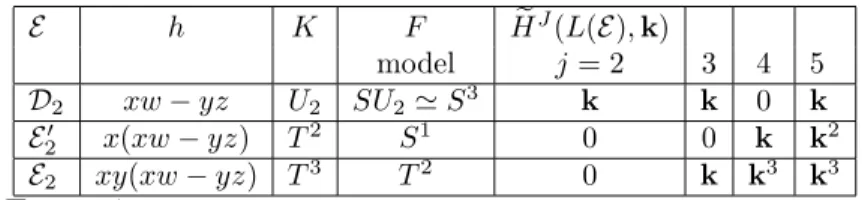
B2×C2T (withB2 the Borel subgroup of lower triangular matrices andC2T ≃C ∗ the invertible diagonal matrices with top entry 1) (also see [DP2] for the second and third). Table 4 gives the maximal compact subgroupsK, compact model for the Milnor fiber, and the reduced cohomology of the links in the nonvanishing dimensions. These exhibit the increased complexity of the cohomology of the link, and changes in the topology of the Milnor fiber resulting from successively adding two hyperplanes to obtain the linear free divisorE2.
E h K F HeJ(L(E),k)
model j= 2 3 4 5 D2 xw−yz U2 SU2≃S3 k k 0 k E′
2 x(xw−yz) T2 S1 0 0 k k2 E2 xy(xw−yz) T3 T2 0 k k3 k3
Table 4. Three exceptional orbit hypersurfaces arising from equidi-mensional representations in Example 4.8, with defining equationh= 0, together with the maximal compact subgroup K of G, the compact model for the global Milnor fiberF, and the nonzero reduced cohomol-ogy groupsHeJ
(L(E),k).
5. Topology of the Milnor Fiber for Equidimensional Representations
We next apply the preceding results on the cohomology of the complement to-gether with properties of the the Wang sequence in §1 and the results for equidi-mensional representations in§2 to compute the topology of the Milnor fiber of E. We use the notation of§§1 and 2.
Theorem 5.1. Consider a prehomogeneous space defined by an equidimensional representation ρ : G → GL(V) of a connected linear algebraic group G of rank k with maximal compact subgroup K and exceptional orbit variety E. Then, the global Milnor fibration ofE is cohomologically trivial. Furthermore, for a field kof characteristic 0,
H∗
(F;k) ≃ Λ∗
k< e2, . . . , ek> .
Here ej=i∗(sj), where i:F ֒→V\E is the inclusion and
H∗(V\E;k) ≃ H∗(K;k) ≃ Λ∗k< s1, s2, . . . , sk>
withdegs1= 1.
Moreover, the homotopy groups ofF are given byπj(F)≃πj(G)for j≥2; and
there is the exact sequence
(5.1) 1 −−−−→ π1(G′
where H is the isotropy group of G′
0 for a point in F and π1(G ′
0) is in the exact
sequence
(5.2) 1 −−−−→ π1(G′
0) −−−−→ π1(G) −−−−→ Z −−−−→ 1
Proof. We can apply apply Proposition 1.9 and Theorem 4.1, to compute for the global Milnor fibration, the cohomology
(5.3) H∗
(E;k) ≃ H∗
(V\E;k) ≃ H∗ (K;k),
where
(5.4) H∗(K;k) ≃ Λ∗khs1, . . . , ski withk= rankK.
Second, by Lemma 2.3,G′
0 is a finite covering space ofF, so by Lemma 4.2 and then Lemma 2.2,
(5.5) H∗(F;k) ≃ H∗(G′0;k) ≃ H ∗
(K0′;k) Finally by Lemma 2.5, sinceK′
0֒→K→S1is cohomologically trivial, we have by Proposition 1.8 that dimkH∗(K;k) = 2 dimkH∗(K0′;k). Combining the preceding
we obtain
(5.6) dimkH
∗
(E;k) = 2 dimkH
∗ (F;k).
Thus, by Proposition 1.8 the global Milnor fibration is cohomologically trivial. Also, by the discussion for (1.3) in §1, there is a nontrivial classs1 ∈H1(E;k), and we may chooses1to be one of the generators of the exterior algebra. Thus, combining (5.3) and (5.4) we have an isomorphism of algebras
(5.7) H∗(E;k) ≃ Λ∗khs2, . . . , ski ⊕ (hs1i ·Λ∗khs2, . . . , ski). where the product in the second summand is cup prouct.
As the cohomology of the global Milnor fibration is cohomologically trivial, the second summand on the RHS of (5.7) maps byi∗
:H∗
(E;k)→H∗
(F;k) to be 0. It follows by consideration of dimensions and Proposition 1.8 that the first summand maps byi∗
isomorphically toH∗
(F;C). This gives the desired conclusion.
For the homotopy groupsπj(F), we use the finite covering spaceG′0→F with covering groupH′
. The exact sequence (5.1) follows from the basic relation between fundamental groups for a regular covering, and the higher homotopy groups follow from e.g. the long exact homotopy sequence for a fibration. Lastly the exact sequence (5.2) follows from the long exact homotopy sequence of the fibrationG′
0֒→
G→C∗ since bothG′
0 andGare connected.
Linear Free and Free* Divisors for Solvable Linear Algebraic Groups. We consider the case of an equidimensional representationρ:G→GL(V) defining a prehomogeneous space whenG is solvable, with exceptional orbit varietyE. As
G has a maximal compact subgroup Tk, where k = rank (G), we already know by Theorems 4.5 and 5.1 that the cohomology of both the complement V\E and Milnor fiberF are an exterior algebras onk, resp. k−1 generators, all of which are of degree 1.
As in Theorem 4.1 of [DP], we can explicitly construct the generators from the basic relative invariants pi of the representation. ρ. By Corollary 4.7, there are