THE INTERPLAY OF WORLDVIEWS AND HEURISTICS IN THE PROCESSING OF PERSUASIVE MESSAGES
Robert Gerald Magee
A dissertation submitted to the faculty of the University of North Carolina at Chapel Hill in partial fulfillment of the requirements for the degree of
Doctor of Philosophy in Mass Communication in the School of Journalism and Mass Communication.
Chapel Hill 2006
Approved by,
Advisor: Sriram Kalyanaraman Reader: Jane D. Brown
© 2006
iii ABSTRACT
ROBERT GERALD MAGEE: The interplay of worldviews and heuristics in the processing of persuasive messages
(Under the direction of Sriram Kalyanaraman)
A person’s worldview might moderate the way a persuasive message is processed, sometimes in the opposite direction of that intended by communicators. This dissertation explored the possibility that a worldview can influence the way a persuasive message is perceived.
Building on the construct of worldview, the heuristic-systematic model of persuasion, and terror management theory, this dissertation examined the question in a
between-participants post-test only 2 (expertise cue) X 2 (argument quality) X 2 (mortality salience) X a relativist worldview (a measured variable) experiment (N= 149). Some participants in the experiment were reminded of their eventual death, while others were asked to think of watching television. Then, participants’ tendency toward a relativist or traditional worldview was assessed. Participants viewed mock ads that featured either strong or weak arguments and had either an expertise cue or no cue at all, after which they rated the ads in terms of their attitudes toward the ad (Aad), the attitudes toward the brand (Abrand), and behavioral
intentions.
Worldview had a main effect on global evaluations of the ads, such that participants who tended toward a relativist worldview had lower evaluation of the ads and lower
v To Sandra,
My wife, best friend, and strongest encourager. Every day I spend with you, you amaze me even more.
Thank you for tirelessly and selflessly supporting me.
Thank you for believing in me, for encouraging me, for pushing steadfast, firmly, gently.
You lift me with your smile, with compassion,
You lead me forward with your love of life, with the joy of discovery. You ground me, reminding me of who I am and of your love for me.
ACKNOWLEDGEMENTS
My parents, Bob and Dolores, have offered constant encouragement, and their wisdom and counsel have been a delight. Being their child is an incomparable gift.
My adviser and friend, Sriram “Sri” Kalyanaraman, provided challenging insight, guidance, and motivation. A rigorous scientist and compassionate colleague, Sri is truly a scholar worthy of emulation.
vii
TABLE OF CONTENTS
Page
LIST OF TABLES . . . xi
LIST OF FIGURES . . . xii
Chapter I. Introduction and Theory . . . 1
Purpose . . . 6
Worldview . . . 9
Wittgenstein . . . 11
Kuhn . . . 13
Lippmann . . . 15
A relativist worldview . . . 17
The dynamic nature of worldviews . . . 20
Heuristic-Systematic Model of Persuasion . . . 21
Co-occurrence. . . 22
Multiple motives . . . 24
Antecedent traits . . . 25
Persuasion Knowledge Model . . . 28
Change of meaning . . . 30
Persuasion knowledge and worldview . . . 31
Chapter
II. Method . . . 36
Participants . . . 36
Stimulus materials . . . 36
Mortality salience . . . 36
Need for closure . . . 37
Worldview . . . 38
Argument quality . . . 39
Expertise cue . . . 41
Dependent variables . . . 41
Procedure . . . 42
Chapter III. Results . . . 45
Descriptive statistics . . . 45
Scale assessment . . . 45
Order and manipulation checks . . . 46
Slope analysis . . . 48
Tests of hypotheses. . . 49
Argument quality main effect . . . 50
Expertise cue main effect . . . 50
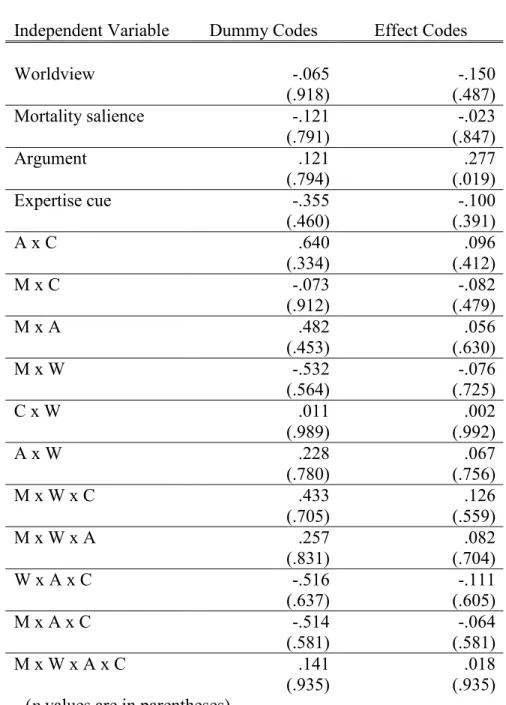
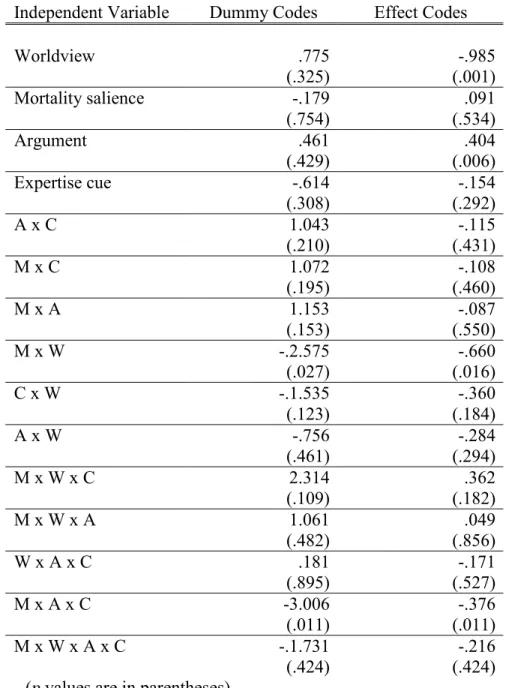
RQ1: Main effect of worldview . . . 51
H1: Worldview as a moderator of expertise cue . . . 52
ix
H3: Additivity, attenuation, and bias . . . 55
RQ2: Worldview as a moderator of the interaction of argument quality and expertise cue . . . 57
RQ3: Main effect of mortality salience . . . 58
RQ4a: Mortality salience as a moderator of expertise cue . . . 59
RQ4b: Mortality salience as a moderator of argument quality . . . 60
RQ5: Mortality salience as a moderator of the interaction of argument quality and expertise cue . . . 61
H4: Mortality salience as a moderator of the accessibility of worldview . . . 63
H5: 3-way interaction of mortality salience, worldview, and expertise cue . . . 64
H6: 3-way interaction of mortality salience, worldview, and argument quality . . . 66
Summary of results . . . 69
Chapter IV. Discussion . . . 71
Purpose and goals . . . 71
Interpretation of findings . . . 72
Worldview . . . 74
Worldview and argument quality affected different dependent variables . . . 76
Mortality salience . . . 77
Worldview as a moderator of an expertise cue . . . 79
Worldview as a moderator of argument quality . . . 80
Heuristic-Systematic Model . . . 81
Bias . . . 84
Persuasion Knowledge Model . . . 85
Terror Management Theory . . . 86
Terror Management Theory’s functional explanation . . . 88
Mediation in persuasion . . . 92
Worldview as an antecedent variable . . . 95
Matching . . . 97
Practical implications . . . 97
Limitations . . . 98
Threats to internal validity . . . 98
Threats to external validity . . . 99
Other limitations . . . 100
Suggestions for future research . . . 101
APPENDICES . . . 103
Appendix A. Tables . . . 103
Appendix B. Figures . . . 119
Appendix C: Materials . . . 167
xi
LIST OF TABLES
Table Page
1. Hypotheses and research questions . . . 104
2. Descriptive statistics . . . 105
3. Tests of unidimensionality and reliability . . . 105
4. Correlation and covariance . . . 106
5. Slopes of dummy codes and effect codes for Aad . . . 107
6. Slopes of dummy codes and effect codes for Abrand . . . 108
7. Slopes of dummy codes and effect codes for behavioral intentions . . . 109
8. Slopes with reverse-coded variables for Aad . . . 110
9. Slopes with reverse-coded variables for Abrand . . . 111
10. Slopes with reverse-coded variables for behavioral intentions . . . 112
11. Slopes with multiple reverse-coded variables for Aad . . . 113
12. Slopes with multiple reverse-coded variables for Abrand . . . 114
13. Slopes with multiple reverse-coded variables for behavioral intentions . . . 115
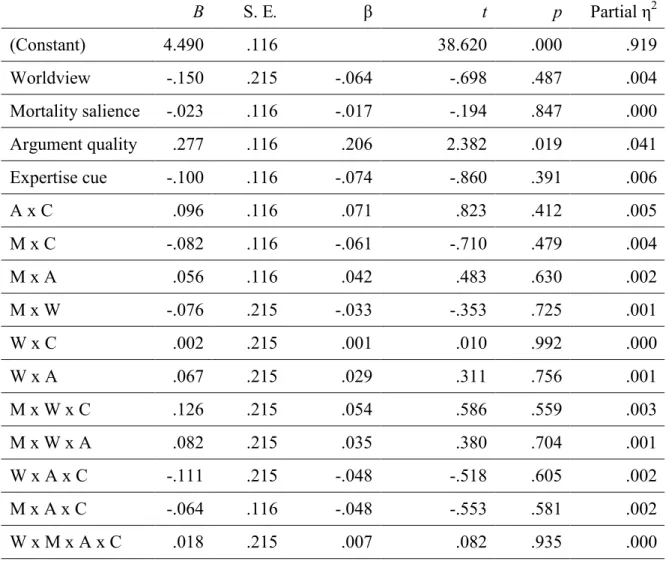
14. Regression of dependent variable Aad . . . 116
15. Regression of dependent variable Abrand . . . 117
LIST OF FIGURES
Figure Page
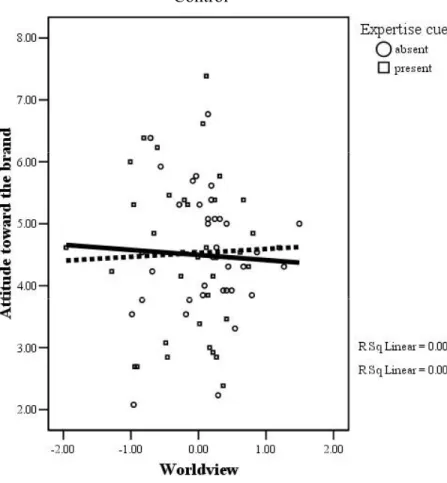
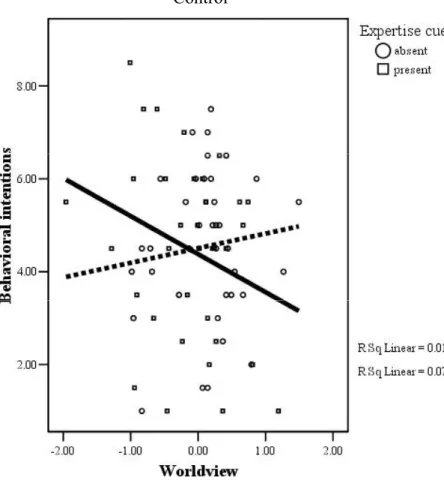
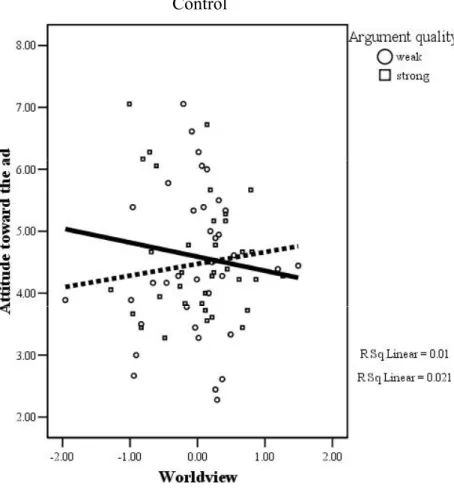
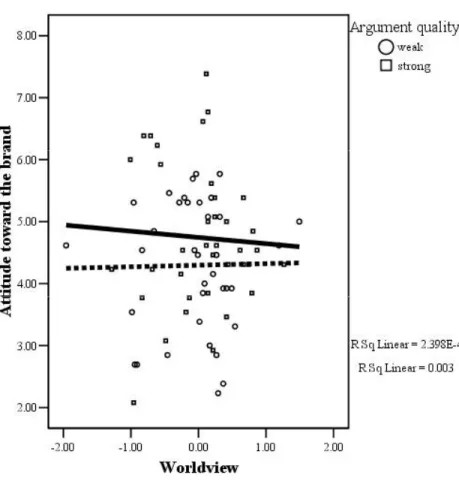
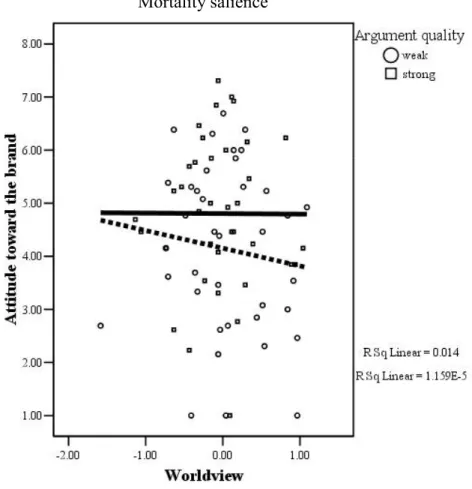
1. Comparison of worldview to analogous constructs . . . 120 2. Counterbalanced order . . . 120 3. Main effect of worldview on dependent variables . . . 121 4a. Graph of 3-way interaction of mortality salience, worldview, and
expertise cue for Aad . . . 122
4b. Graph of 3-way interaction of mortality salience, worldview, and
expertise cue for Aad . . . 123
5a. Graph of 3-way interaction of mortality salience, worldview, and
expertise cue for Abrand. . . 124
5b. Graph of 3-way interaction of mortality salience, worldview, and
expertise cue for Abrand . . . 125
6a. Graph of 3-way interaction of mortality salience, worldview, and
expertise cue for behavioral intentions . . . 126 6b. Graph of 3-way interaction of mortality salience, worldview, and
expertise cue for behavioral intentions . . . 127 7a. Graph of 3-way interaction of mortality salience, worldview, and
argument quality for Aad . . . 128
7b. Graph of 3-way interaction of mortality salience, worldview, and
argument quality for Aad . . . 129
8a. Graph of 3-way interaction of mortality salience, worldview, and
argument quality for Abrand. . . 130
8b. Graph of 3-way interaction of mortality salience, worldview, and
argument quality for Abrand . . . 131
9a. Graph of 3-way interaction of mortality salience, worldview, and
argument quality for behavioral intentions . . . 132 9b. Graph of 3-way interaction of mortality salience, worldview, and
xiii
10a. Three-way interaction of expertise cue, argument quality, and
mortality salience for Aad . . . 134
10b. Three-way interaction of expertise cue, argument quality, and
mortality salience for Aad . . . 135
11a. Three-way interaction of expertise cue, argument quality, and
mortality salience for Abrand . . . 136
11b. Three-way interaction of expertise cue, argument quality, and
mortality salience for Abrand . . . 137
12a. Three-way interaction of expertise cue, argument quality, and
mortality salience for behavioral intentions . . . 138 12b. Three-way interaction of expertise cue, argument quality, and
mortality salience for behavioral intentions . . . 139 13a. Three-way interaction of worldview, argument quality, and
expertise cue for Aad . . . 140
13b. Three-way interaction of worldview, argument quality, and
expertise cue for Aad . . . 141
14a. Three-way interaction of worldview, argument quality, and
expertise cue for Abrand . . . 142
14b. Three-way interaction of worldview, argument quality, and
expertise cue for Abrand . . . 143
15a. Three-way interaction of worldview, argument quality, and
expertise cue for behavioral intentions . . . 144 15b. Three-way interaction of worldview, argument quality, and
expertise cue for behavioral intentions . . . 145 16. Mortality salience and expertise cue for Aad, given weak arguments . . . 146
17. Mortality salience and expertise cue for Abrand, given weak arguments . . . 147
18. Mortality salience and expertise cue for behavioral intentions,
given weak arguments . . . 148 19. Interaction of mortality salience and argument quality for Aad,
20. Interaction of mortality salience and argument quality for Abrand,
given no cue . . . 150
21. Interaction of mortality salience and argument quality for behavioral intentions, given no cue . . . 151
22. Interaction of mortality salience and worldview for Aad . . . 152
23. Interaction of mortality salience and worldview for Abrand . . . 153
24. Interaction of mortality salience and worldview for behavioral intentions . . . 154
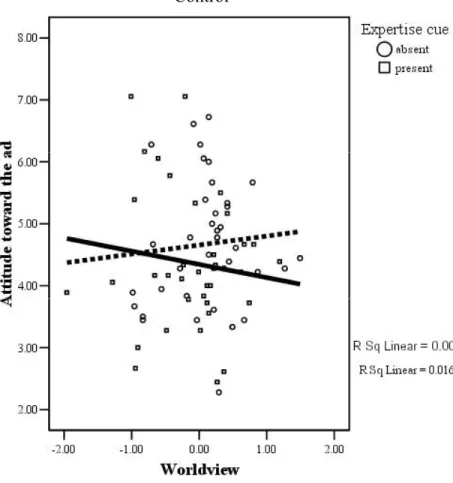
25a. Interaction of worldview and mortality salience when cue is absent for Aad . . . 155
25b. Interaction of worldview and mortality salience when cue is present for Aad . . . 156
26a. Interaction of worldview and mortality salience when cue is absent for Abrand . . . 157
26b. Interaction of worldview and mortality salience when cue is present for Abrand . . . 158
27a. Interaction of worldview and mortality salience when cue is absent for behavioral intentions . . . 159
27b. Interaction of worldview and mortality salience when cue is present for behavioral intentions . . . 160
28a. Interaction of worldview and mortality salience when arguments are weak for Aad . . . 161
28b. Interaction of worldview and mortality salience when arguments are strong for Aad . . . 162
29a. Interaction of worldview and mortality salience when arguments are weak for Abrand . . . 163
29b. Interaction of worldview and mortality salience when arguments are strong for Abrand . . . 164
xv
30b. Interaction of worldview and mortality salience when arguments are
Chapter I
Introduction and Theory
Robert, Sandra, and Sara were reading magazines at a coffee shop one morning, and
Robert noticed an ad for a new artificial sweetener. The ad touted the product as having
superior taste and health benefits and being especially designed for gourmet cooking. The ad
also featured a picture of Martha Stewart, widely reputed as an expert in home and garden
matters, and said that she designed the sweetener based on her extensive experience. The
product was also tested rigorously in her laboratories.
Robert was persuaded by the ad. “Someone with as much knowledge and experience
as Martha Stewart must know what she is talking about,” he said. “That’s how progress is
made, through innovation and testing.”
Robert was generally optimistic about the advances of science and believed that
progress through science and technology was good. He usually took seriously the advice of
experts in most areas of his life, taking advantage of their objective and usually unbiased
perspective.
Sandra, on the other hand, was more skeptical, saying that she would need to try the
sweetener first-hand before being convinced.
“How do you know that what she’s saying is really true?” Sandra asked. “Of course,
2
Sandra placed as much stock in her own opinions as she did in experts’ opinions,
which, in her mind, is what they were: opinions, not facts. No one could be truly objective.
Sara looked up from reading an article about Patsy Cline, the promising country
singer whose life was cut short in a plane crash.
“You’re right,” she said. “How can we know if anything is real? I wouldn’t even try
it.”
Sara shared Sandra’s conviction about the uncertainty of expert knowledge, but today
she seemed more adamant.
“Laboratory studies are so biased anyways,” Sara said. “First, saccharine was
supposed to be a healthy alternative, until reports of cancer in laboratory animals surfaced.
Then, aspartame was promoted as being better, but it has some kind of vague warning about
phenylketonuria, whatever that is. I’m sure it’s just a matter of time before harmful side
effects are discovered for this product, too.”
Her friends returned to their magazines, but Sara continued. “Cellphones are
convenient, but you can get a brain tumor; modern agriculture feeds millions but ravages the
environment; margarine was better than butter, now it’s worse than butter. How can we
really know anything anymore?”
After a pause, Sara ordered another mocha latte, her favorite, but this time with
whole milk and extra cinnamon.
that scientific development was an important reason for that progress. It is possible for experts, and people in general, to be unbiased and objective. Robert was more persuaded by the ad because the message, with its strong assertion of superior results claims of laboratory testing and expert experience, was in line with his assumptions about life.
Sandra, on the other hand, did not hold Robert’s conviction that experts are
necessarily better informed. She realized that some reputed experts could be mistaken and others could be biased by personal concerns such as profit. The ad’s claims of Martha Stewart’s authoritative expertise, therefore, did not ring true to Sandra.
Sara tended to share Sandra’s perspective regarding the impossibility of certainty or objective and value-free knowledge. However, Sara had just read about the untimely death of a singer, and that article had prompted anxious concerns about her mortality. The anxiety caused her nonconsciously to defend her worldview, her understanding of how the world is, and because the influence of her worldview had been heightened, it had a greater influence over the way she perceived the ad.
4
A persuasive media message can be perceived in different ways, depending, in part, on the worldview, or basic assumptions about reality, of the person receiving the message. In addition, situational factors, such as a reminder of one’s mortality, can make a person’s worldview more available and applicable for influencing how a message is interpreted. The image of Martha Stewart was intended to activate an implicit belief that experts like Martha Stewart can be trusted. However, among readers like Sandra and Sara, whose relativist worldview included a general distrust of experts, the image did not have the intended effect.
Persuasion research has been a vibrant arena of study since the 1950s, particularly in its relation to attitude research (Johnson, Maio, & Smith-McLallen, 2005). Persuasion has received substantial research attention in such diverse disciplines as communication (e.g., Dillard & Pfau, 2002; O’Keefe, 2002), psychology (e.g., Chaiken & Trope, 1999; Petty & Cacioppo, 1986), and marketing (e.g., Bettman, 1979; Friestad & Wright, 1994; Howard & Sheth, 1969), and has informed scholarly work in fields such as political science and public health.
A desire for greater insight in the 1970s led to a focus on the mental processes that fuel persuasion, and the introduction of dual-process theories of attitude change in the 1980s enabled researchers to make great gains in understanding persuasion and attitudes (Eagly & Chaiken, 2005). Dual-process models maintain that attitude change occurs through two paths. One path—the central, systematic, or conscious route—is via the careful scrutiny and rational evaluation of a persuasive message’s arguments. Processing via the second path—the
Building on dual-process theories, researchers have studied the influence of a number of individual differences on persuasion (Briñol & Petty, 2005; Oliver, 2002), including a preference for complex thinking (Cacciopo & Petty, 1982), a need to reach a firm decision quickly (Jost, Glaser, Kruglanski, & Sulloway, 2003; Kruglanski, Webster, & Klem, 1993), personality, and culture (Fiske, Kitayama, Markus, & Nisbett, 1998). The number of
dimensions on which people can vary is virtually without limit, but many shared characteristics on which people differ include demographic characteristics such as age, ethnicity, or gender, or psychographic characteristics such as values, attitudes, and lifestyles.
Research based on the heuristic-systematic model (HSM) has begun to recognize the influence of core beliefs and assumptions—what this dissertation terms a worldview—on the processing of persuasive messages (Giner-Sorolla, Chaiken, & Lutz, 2002; Pomerantz, Chaiken, & Tordesillas, 1995). Indeed, some formulations of the HSM explicitly note the potential role of centrally held beliefs as the basis for forming judgments (Chen & Chaiken, 1999), but the construct of centrally held beliefs has not been explicated fully enough for it to play a larger role in the theory. A worldview, which comprises what Chen and Chaiken described as centrally held beliefs, is a set of core a priori assumptions about reality with which a person perceives and interprets surrounding events and information (Koltko-Rivera, 2004; Naugle, 2002).
6
explaining the importance of their experimental manipulations, researchers too often acknowledge but promptly ignore larger and more powerful social forces that bear on the results of their study (Oliver, 2002). Thus, a large portion of the variance in typical
experimental studies remains unexplained. Even if including worldview variables increases the variance explained by 5% to 10%, the effort would be worthwhile (Koltko-Rivera, 2004). Persuasion scholarship has seen a growing body of research that explains how individual differences, such as personality traits or cognitive styles, lend greater insight to a theoretical understanding of attitudes and behavior.
Thus far, research has rarely examined the role of an individual difference similar to worldview in the heuristic-systematic model in persuasion, nor has it fully examined what might cause one’s worldview to become more accessible. Consumers are being bombarded by innumerable persuasive media messages, some of which, naturally, are more effective than others. An understanding of the reasons why people respond in different ways to the same message, and why some people pay more attention to some messages than others will help researcher understand the condition under which some effects occur (Oliver, 2002). Incorporation of worldview as an individual difference variable in media effects research holds promise for shedding more light on an important dimension on which people vary, explaining how Robert, Sandra, and Sara can see the same persuasive message and be affected in different ways.
Purpose
(Chaiken, 1980; Chaiken, Liberman, & Eagly, 1989), this dissertation tests if a relativist worldview can moderate how persuasive messages are processed. A person who has a relativist—sometimes referred to as a constructivist—worldview believes that truth is
contextual and norms are situational and that personal experience—and not abstract universal principles—is the basis for determining what is real (Berzonsky, 1994; Gergen, 2001).
This dissertation has several goals. One, it aims to contribute toward theory development by illustrating the possible role of worldview as a moderator in the heuristic-systematic model, because a person’s response to cues such as source credibility might depend on one’s worldview. Research in the model has noted the importance of the belief structure into which attitudes are embedded (Pomerantz et al., 1995), but this finding has received relatively little systematic attention. Chen and Chaiken (1999, p. 79) also urged further research in the multiple motives framework of the model, and this dissertation hopes to contribute toward that end. The multiple motives framework posits that the way a person processes a persuasive message can vary depending one which motive is most salient. In addition to wanting to have a valid and accurate attitude toward a topic presented in a
persuasive message such as an ad, individuals are motivated at times to impress other people or to defend their existing self-identity and worldview. In some regards, the defense
motivation parallels the key mediating mechanism of terror management theory, namely, existential anxiety that leads to the defense of one’s cultural worldview. This dissertation explores that point of connection between the theories in an advertising context.
8
useful in several fields such as political communication or health communication, will require specifying cognitive and motivational variables that influence media use and the processes of media effects. In the field of political communication, for example, McLeod suggested that broader moderators of media use, such as worldviews and values, likely influence political communication and said that such variables should be explicated and incorporated into the models. In that vein, this dissertation seeks to demonstrate how worldviews can shed light on cognitive processes central to communication theory.
This dissertation also responds to the call for a greater appreciation of epistemology in social psychological experimental research (Jost & Kruglanski, 2002). Understanding the social context in which people move is essential for understanding their thoughts and behavior. Jost and Kruglanski highlighted several promising developments, including the recognition that a shared social reality is essential for a meaningful interpretation of stimuli. Cultural psychology, they said, represents a successful effort toward integrating experimental social psychology and insights from social constructionism. By taking into account personal epistemology in social psychology, researchers stand to gain a deeper understanding of human cognition and behavior.
This chapter first explicates the construct of worldview and its relationship to dual-process models of attitude change and terror management theory. Based on the review of the literature, several hypotheses and research questions are proposed. Chapter 2 details the experimental procedures and describes the stimulus materials and dependent variables used to test the hypotheses. Chapter 3 presents the results of the experiment. Chapter 4 discusses the findings and their theoretical implications, addresses limitations, and offers potentially fruitful avenues of further research.
Worldview
A worldview is a set of assumptions about physical and social reality that shapes the way a person perceives and interprets the world (Koltko-Rivera, 2004; Naugle, 2002). A worldview also provides a sense of meaning to reality and guides the inferences a person draws from what he or she experiences (Koltko-Rivera). These core constructs, or a priori assumptions, form the foundation for knowing and understanding, guiding cognition and behavior. McLeod, Sotirovic, and Holbert (1998) described worldviews as basic beliefs about how the world works. McLeod, Kosicki, and McLeod (2002) defined worldviews as a
person’s “lay theories about the world around them” (p. 239) and said a worldview can be descriptive—how the world is—or normative—how the world ought to be. In this
dissertation, a worldview is defined as a chronically accessible collection of core
10
are often socially constructed and culturally bound, being formed by language and social interaction (Naugle). The social environment in which a person’s worldview develops has an enduring effect on the perception of media content and how the content is processed.
Worldviews could be considered higher-order constructs that are distinct from lower-order constructs such as attitudes. As Chaffee (1991) noted, if social attitudes are defined as enduring predispositions, one should not expect much change or variance. Studies of
“attitude change,” then, would be an oxymoron, if that definition were employed. Chaffee’s observation highlighted the need for a clear explication of constructs. Attitude has been employed to denote everything from values, as in Rokeach’s (1968, 1974) value-attitudes, to mutable opinions (Wyer & Albarracín, 2005). Theoretical clarity requires a well defined explication of a construct and its relation to other antecedent or consequent constructs (Cronbach & Meehl, 1955).
Concern with worldviews and their constituent beliefs is not unique to mass communication, however. The concept is found in many disciplines, including cultural anthropology, theology, and philosophy (Naugle, 2002). In psychology, cultural worldview has been posited as a mediating mechanism in terror management theory (Greenberg,
Solomon, & Pyszczynski, 1997; Greenberg et al., 2003). The construct also parallels to some degree personal core constructs (Kelly, 1955), lay epistemologies (Kruglanski, 1989), folk epistemology (Fiske, Kitayama, Markus, & Nisbett, 1998), epistemological beliefs
in social psychology defines a worldview as a set of core assumptions about the nature of reality that form the foundation of values and attitudes.
Scholars have long recognized the importance of people’s fundamental beliefs and how those beliefs might influence how people perceive the world. Worldviews and the core dimensions that they comprise (Kotlko-Rivera, 2004) are analogous to Wittgenstein’s (1972) idea of world picture and icons/narratives, to Kuhn’s (1996) paradigm and exemplars, and to Lippmann’s (1922) pseudoenvironment and stereotypes (Figure 1), each of which is
discussed in the sections that follow.
Wittgenstein
The concept of worldview, or Weltanschauung, was introduced by Kant and often is translated as “philosophy of life” or left intact in German. The term denoted a general perspective that made sense of the world. Wittgenstein, as he explored how language shapes the way people think and behave, sought to move away from the idea, as expressed in Hegel’s writing and common in philosophy, that a Weltanschaaung inherently competed against others to be the most accurate and all-encompassing view of the world. Instead, Wittgenstein posited that a “world picture” [Weltbild] is learned in childhood and serves as a framework for a person’s thoughts, values, and actions. The interpenetration of human activity (“forms of life”) and words (“language games”) formed the foundation of a person’s experience and understanding as they, Naugle (2002) said, “embody and express the
fundamental features and categories of the world” (p. 157). A world picture creates a person’s reality in that it represents reality and also “forms one’s way of seeing and
12
world picture is not acquired after its testing or evaluation. Wittgenstein writes in On Certainty (1972), “But I did not get my picture of the world by satisfying myself of its correctness; nor do I have it because I am satisfied of its correctness. No: it is the inherited background against which I distinguish between true and false” (p. 15e). A world picture is not a rational analytical system of thought, in a Cartesian sense, and it is not necessary for it to be thoroughly consistent internally. It is, rather, an icon-based way of experiencing the world and making sense of it. Thus, a worldview could be expected to have greater influence on heuristic processing of information than on systematic or analytic processing.
Thus, a worldview, like a lens, can influence how people persuasive message such as an ad, and how people might respond to different arguments or cues. When worldview functions as a riverbed, it can also influence thought processes, such as the degree to which people engage in careful systematic analysis of a message and heuristic processing.
Kuhn
Like Wittgenstein, Kuhn (1996) sought to integrate social influence and thought, though at a societal level, with an explanation of the community-based development of scientific knowledge. Kuhn defined a scientific paradigm as an understanding of reality that unifies inquirers and sets the direction of research. When its explanatory and predictive utility is stretched beyond capacity, the paradigm is replaced in a wholesale fashion by a new one. Kuhn drew an important distinction between events in the world and perceptions of those events. The perceptions can vary according to language or culture or social group:
Notice that two groups, the members of which have systematically different sensations on receipt of the same stimuli, do in some sense live in different worlds. We posit the existence of stimuli to explain our perceptions of the world, and we posit their
immutability to avoid both individual and social solipsism. About neither posit have I the slightest reservation. But our world is populated in the first instance not by stimuli but by the objects of our sensations, and these need not be the same, individual to individual or group to group. To the extent, of course, that individuals belong to the same group and thus share education, language, experience, and culture, we have good reason to suppose that their sensations are the same (Kuhn, 1996, p. 193).
14
situations as being like some and unlike others. Kuhn’s notion of exemplars was unlike its use by much of social psychology (e. g., Smith, 1998). Social psychology researchers use exemplars to refer to concrete examples, whereas Kuhn used the term to denote abstract archetypal ideals. For many social psychologists, events that share characteristics of a population of similar events function as exemplars. Exemplars are representations of actual instances and help people store more specific information than do abstractions (Smith, 1998). For Kuhn, however, exemplars are not so-called classic examples in that exemplars are not concrete. Rather, exemplars transcend particular instances of events or objects. An object might be considered to be a classic example if it closely resembles an exemplar, but such an object would not be the exemplar itself. In that regard, Kuhnian exemplars resemble
culturally based heuristics that can shape how a person understands a persuasive message. Unlike Wittgenstein and social psychologists (e.g., Bandura’s Social Cognitive Theory, 2001), Kuhn did not consider cognitive processes to occur after perception. Instead, interpretation occurs concurrently with perception, Kuhn (1996) argued, writing, “What I have been opposing in this book is therefore the attempt, traditional since Descartes but not before, to analyze perception as an interpretive process, as an unconscious version of what we do after we have perceived” (p. 193). Perception, for Kuhn, is not an active evaluative thought process, but an instantaneous or automatic action shaped by exemplars. Like Wittgenstein, Kuhn sought to move away from a Cartesian conception of perception as a rational analytic process. Kuhnian exemplars, then, subconsciously shape what is noticed and valued in a message and what is ignored or discarded as anomalous, much like
Cues in a persuasive message can trigger the application of exemplars through which a person perceives the message. An image of a laboratory scientist, for instance, might be perceived differently, depending on the meaning attached to that archetypal image.
Lippmann
Focus on constructs analogous to worldview is not a new development in mass communication theory. Decades earlier, Lippmann (1922) had noted that people’s
understanding shapes their perception of the world. With his famous phrase “the pictures in our heads,” Lippmann distinguished between reality and people’s perception of the world, inserting between a person and the environment a “pseudo-environment,” a mental
representation of the environment. People act on their mental models of reality rather than reality itself.
Because people have limited experience, Lippmann said, very few of a person’s mental images are based on direct observation. Much of the inventory of mental pictures can be socially constructed, either received from other people or constructed by the individual. Although the images reside in the individual, they are the property of the society in which the person lives. Meaning is embedded in the socially constructed mental pictures, which may vary in the extent to which they represent the world.
16
attribute traits to people, particularly with regard to ethnicity (Allport, 1954). Lippmann’s definition of stereotypes bears substantial similarity to Kuhn’s exemplars in that they carry meaning and shape perception. Lippmann wrote, “For the most part we do not first see, and then define, we define first and then see. In the great blooming, buzzing confusion of the outer world we pick out what our culture has already defined for us, and we tend to perceive that which we have picked out in the form stereotyped for us by our culture” (p. 81). These stereotypes, or exemplars to borrow Kuhn’s term, form what Wittgenstein would call world pictures. The hallmark of a perfect stereotype, Lippmann wrote, “is that it precedes the use of reason; is a form of perception, imposes a certain character on the data of our senses before the data reach the intelligence” (p. 98). Like exemplars, stereotypes are not part of an interpretive cognitive process that occurs after perception, but constructs that precede it. Lippmann argued that understanding the pictures in a person’s head is a prerequisite for understanding behavior.
The constellation of the pictures in one’s head constitutes a worldview. The core dimensions on which worldviews vary usually include beliefs regarding human nature, the relationship between human beings and nature, one’s orientation toward time, the possibility of certain knowledge, the organization of social relations, and causality (Dalbert, Lipkus, Sallay, & Goch, 2001; Ibrahim & Owen, 1994; Koltko-Rivera, 2004).
Social Survey (Davis, Smith, & Marsden, 2004) has included items to measure respondents’ worldviews. A battery of seven items (denominated “World Image”) probed foundational beliefs such as fatalism, theism, causality, and human nature. In mass communication,
McLeod, Sotirovic, and Holbert (1998) operationalized three worldviews: a just worldview, a belief that people are treated fairly in the world; a fatalistic worldview, a belief that a person cannot change events; and a knowable worldview, a belief that the world can be known and that a person can change matters.
A relativist worldview
This dissertation focuses on one worldview, relativism, sometimes referred to as social constructivism or social constructionism. It is important to note that “social
18
knowledge is impossible. Thus, values and standards of behavior are the product of a given society and, therefore, are relative, not absolute, in their applicability. It is this second definition that is employed in this dissertation to describe a relativist worldview.
Social constructivists, people who hold a relativist worldview, maintain that
observations, descriptions, and norms are the product of the society or culture in which one lives (Gergen, 2001). Therefore, truth is contextual and socially determined, not universal. Constructivists believe each person can and should play an active role in developing a sense of identity (Berzonsky, 1994; Gergen, 1991). However, that role extends beyond forging a self-identity; in every area of existence one must play an active role in determining what is true. A person who has a relativist worldview tends to value the self as the source of
knowledge but maintains that no one can have absolute or certain knowledge. In a relativist worldview, absolute objectivity is impossible, and one person’s perspective is just as valid as that of another. Facts themselves have no inherent independent meaning; they derive
meaning from the interpretation that one gives them.
Such relativist epistemological assumptions lead one to discount the credibility of expert knowledge. Authorities are fallible, as is human reason in general. Intuition and affect are valid ways of knowing, and knowledge gained through personal experience trumps any categorical claim. Universal pronouncements and abstract propositional principles are discounted. Any claim of certain knowledge, therefore, is suspect. Further, the enterprise of science is value-laden and cannot be wholly objective.
expertise heuristic that advertisers assumed they could activate, “Experts’ statements can be trusted,” would instead be the opposite, “Experts’ statement cannot be trusted.” Instead of giving the message added credibility, such an appeal would be ineffective in an audience that is characterized by a relativist worldview. Further, a strong persuasive argument that relies on an appeal to universal principles is likely to be discounted.
If a worldview is chronically accessible, it should have a general influence over what one sees and how one makes sense of what one perceives. Because it is unclear at this point if such a worldview will have a main effect on the global evaluations of the ads, the
following research question is proposed:
RQ1: What effect, if any, will a relativist worldview have on the global evaluations of persuasive ads?
A relativist worldview is characterized by a conviction that absolute objectivity is impossible and that scientific knowledge is fallible. Further, because truth is relative and dependent on context, the validity of universal propositional statements is suspect. Therefore, a relativist worldview should attenuate the effectiveness of ads employing a strong argument based on propositional statements or ads featuring an expertise cue.
H1: A relativist worldview will exhibit an inverse relationship to evaluations of ads containing an expertise cue. In other words, the more relativist one’s worldview is, the less favorable one’s evaluation of persuasive messages that feature an
20
H2: A relativist worldview will exhibit an inverse relationship to evaluations of ads containing a strong propositional argument. In other words, the more relativist one’s worldview is, the less favorable one’s evaluation of persuasive messages that feature arguments based on propositional statements.
Evaluations of the persuasive messages will be lower among participants who have a relativist worldview. One’s chronically accessible worldview will be considered applicable, or diagnostic, and function as a lens through which one evaluates both arguments and heuristic cues.
The dynamic nature of worldviews
Conceptions of worldview as a filter tend to portray worldview as a chronic
disposition. This dissertation, however, borrowing from cultural psychology (Briley, Morris, & Simonson, 2000; Hong, Morris, Chiu, & Benet-Martinez, 2000), adopts a dynamic
constructivist approach to worldviews. That is, although worldviews are rather stable and enduring over time, their effect in a particular situation is dynamic, depending on the cues that might heighten their influence. Although a worldview is chronically accessible, any number of factors may temporarily increase the worldview’s accessibility. In addition, features of the object of one’s attention could function as cues to make the available worldview deemed relevant or applicable in forming an opinion regarding that object.
People’s fundamental patterns of thought or “complex conceptual structures” such as deep cultural ideologies can be primed nonconsciously (Bargh, 2006). Culturally or
more accessible and relevant to the message at hand, thereby influencing how information is processed. A person’s worldview could function as a source of heuristics primed by
situational cues. Given this possibility, one model that is particularly relevant in explaining this relationship in the context of persuasion is the heuristic-systematic model (Chaiken, 1980; Chaiken et al., 1989).
Heuristic-Systematic Model of Persuasion
The heuristic-systematic model of persuasion (Chaiken, 1980; Chaiken et al., 1989) is a dual-process account of attitude change. Persuasion occurs through one of two paths. A person can process information systematically through effortful analysis, through the application of heuristics that require substantially less effort, or through a combination of both. While one engages in conscious elaborative thought in the systematic route to reach an accurate conclusion regarding an object, in the heuristic route one employs “mental
shortcuts” or takes cues from characteristics of the message to develop a valid attitude (Chaiken, 1980; Chaiken et al., 1989). Persuasion that occurs via the systematic route is held to be more enduring because the arguments are integrated into one’s existing cognitive structure (Petty & Cacioppo, 1986). Persuasion that occurs on the basis of cues is more ephemeral, either decaying after time or being highly susceptible to change when confronted with counterarguments.
22
conduct elaborative thought and will rely instead on cognitive shortcuts for developing an attitude toward the topic. Dual-process theories largely assume that systematic processing tends to be objective and rational and that heuristic thinking is more likely to be biased. If people engage in effortful rational analysis, they will reach objective and true conclusions, although heuristic processing can exert a biasing influence on systematic processing (Chaiken & Maheswaran, 1994).
Co-occurrence
favorable effect of a strong argument for a politician might be reduced if it were paired with an endorsement by a public figure suspected of political corruption.
Chen and Chaiken (1999) maintained that heuristic processing entails some level of awareness, unlike the Barghian notion of implicit processing, in which many cues never enter a person’s consciousness (Bargh & Chartrand, 1999). In the heuristic-systematic model, observers normally must be aware of the cue in order to perceive it, but they need not be aware of the activation of the heuristic or their processing of information. Heuristic
processing can be started by cues in either the message or the communication context, but in addition to being triggered by situational cues, heuristics may also be triggered by internal information, such as observers’ mood states or opinions. Such internal or dispositional cues, Chen and Chaiken noted, are more likely to spark nonconscious heuristic processing.
An example of a heuristic cue is source expertise (e.g., “Experts’ statements can be trusted”), which Chaiken et al. (1989) suggested would lead a person to form a positive attitude toward a target without evaluating systematically all of the information available. If a person believes that an expert source lends credibility to a message, then that person might devote less effort to analyzing the message itself, accepting its validity based on the
associated source.
24
Heuristic processing is more likely to occur in conditions of low involvement. A person in a state of low involvement has little motivation to exert enough effort to analyze a message systematically. Thus, when a person is unwilling to scrutinize an advertising message a cue in that message can activate a heuristic that will be used to evaluate the product favorably (or unfavorably). Under conditions of high involvement, a person is motivated to analyze a message systematically and will be less likely to depend largely on mental shortcuts to make an evaluation.
Multiple motives
attitudes and beliefs that are closely linked with one’s sense of self. Chen and Chaiken cited values, a social identity, and personal characteristics as self-definitional beliefs that a person might seek to defend.
Antecedent traits
Although the bulk of heuristic-systematic research focuses on the two processing modes, researchers have noted that some antecedent traits exert an influence on both modes. A person’s ideology, for example, can influence both heuristic and systematic processing (Giner-Sorolla et al., 2002). A deep structure of core beliefs and assumptions can form a foundation for some attitudes and opinions and make the attitudes less malleable. Some attitudes are resistant to change, therefore, because they are embedded in a larger structure of values, ideologies, identities, and knowledge (Pomerantz et al., 1995). Thus, the systematic elaboration of a message might not be enduring if the goal of the message is to produce an attitude that is incongruent with one’s existing belief structure. This also suggests that one’s worldview should exert an influence on both systematic and heuristic processing, and not just the heuristics employed. Of course, many attitudes may not be rooted in core beliefs, but instead are constructed as needed (Feldman & Lynch, 1988) and therefore be susceptible to a number of dispositional and contextual factors. In these instances, one’s worldview might be diagnostic for constructing attitudes on issues where none had existed.
26
experience to have a judgmental impact, the observer must have some “theory” (p. 87) with which to interpret information. An individual’s theory, which Chen and Chaiken defined as “previously learned judgment rules” (p. 87), is triggered by one’s subjective experience and becomes a heuristic that is applied in a given situation.
In the heuristic-systematic model, a worldview might be classified as a dispositional or internal source of heuristics that, like theory, enables one to make sense of one’s
experience. Although the construct of an internal theory parallels in many respects that of worldview, a worldview is trans-situational and much broader than what Chen and Chaiken (1999) defined as learned rules for evaluating a particular situation. A worldview is not learned, in an active sense; much of a worldview, like implicit cultural theories (Chiu et al., 2000), is acquired via culture and language. Thus, a given group of people can share a particular worldview, which can be characteristic of a culture or subculture. While each individual might have an internal theory or set of rules for making judgments that develops according to personal experience, which results in as many theories as there are individuals, many people can be characterized by a common worldview.
Because the systematic and heuristic modes are independent, one mode is not held to moderate the other. Instead, they have a joint, or net, effect. A cue does not amplify the effect of an argument, it merely adds to it. In many studies of additivity, attenuation, or bias, the cue is presented before the argument. Participants are told that the communicator is an expert (e.g., a college professor) or a nonexpert (e.g., a high school senior) before they proceed to read an argument about a given topic (e.g., comprehensive exams). Thus, the cue and arguments are presented sequentially. In this study, however, the arguments and cues are presented simultaneously, as in the Maheswaran and Chaiken (1991) study, which used ads for an answering machine.
The additivity hypothesis of the heuristic-systematic model predicts that the effect of systematic information and heuristic cues will be compounded when they are congruent. Therefore, evaluations of ads containing both an expertise cue and a strong argument should be higher than those of ads containing either a strong argument or an expertise cue alone, all of which should be higher than evaluations of ads containing a weak argument and no expertise cue.
H3: Evaluations of ads containing both an expertise cue and a strong argument will be stronger than those of ads containing the expertise cue alone or a strong argument alone.
28
The relationship of expertise cue, argument quality, and worldview leads to the following research question:
RQ2: Will a relativist worldview moderate the joint effect of both an expertise cue and a strong argument?
Of course, one’s worldview is not the only dispositional factor that influences how persuasive messages are processed. Any number of individual differences can affect one’s attitudes toward a persuasive message. It is possible, also, that people form differing attitudes toward an advertisement and the product it promotes, particularly if people draw on their experience with other attempts at persuasion. Instead of one general attitude, people might form separate attitudes toward the topic of a message and the source of that message. One model that explains this phenomenon is the persuasion knowledge model (Friestad & Wright, 1994).
Persuasion Knowledge Model
persuasion attempt denotes any effort toward attitude change and includes an ad, a message, or a campaign.
Like the heuristic-systematic model, but unlike the elaboration likelihood model, the persuasion knowledge model assumes that people have more than one motivation. People are motivated to hold a valid topic attitude, but they also can be motivated to hold a valid agent attitude. The salience of these goals may be mixed. For example, in a given situation a target might be highly motivated to hold a valid attitude toward a particular agent and less
motivated to develop a valid attitude toward a topic. The persuasion knowledge model leaves open the possibility that targets may have more than these two goals. Other goals could include maintaining high self-esteem or earning the admiration of another person (which parallels the impression motivation in heuristic-systematic model).
Targets and agents have three types of knowledge. Topic knowledge, the traditional concern of dual-process theories, concerns information related to the product. Agent
knowledge concerns information related to a company or sales representative. Persuasion knowledge concerns information regarding the persuasion process. Persuasion knowledge can be characterized as schemata regarding persuasion, including beliefs about psychological mediators in persuasion, marketers’ actions and their effects, and one’s efficacy in dealing with persuasion efforts. Persuasion knowledge operates during heuristic processing and systematic processing and under conditions of both low and high involvement.
30 Change of meaning
A key contribution of the persuasion knowledge model is the “change-of-meaning” principle. A cue that is valid in the heuristic-systematic model could be perceived as a tactic. Once this occurs, the action changes meaning and the effectiveness is minimized or lost entirely. It does not matter whether the agent intended the action to be a tactic or not; what matters is that the target perceived the action as a tactic. Some tactics might be effective as long as they remain tacit. Once a target becomes aware of a tactic, though, the effect is no longer automatic and is eliminated.
One could assume the converse and have what this author would call the
“reinforcement-of-meaning” principle. If a technique is perceived as a tactic, but one that is evaluated under persuasion knowledge as being appropriate or respectful, then the
effectiveness of that tactic is heightened, not minimized. This approach assumes a nonadversarial model, of course. The difference between a change of meaning and a reinforcement of meaning is based on a qualitative difference between types of persuasion knowledge; it is not based on any expert/novice distinction that derives from the amount of persuasion knowledge a target possesses.
The notions of the “reinforcement-of-meaning” principle and the
incongruent with the argument will reduce the effectiveness of the message or otherwise change its meaning in unintended ways.
One key distinction between the HSM and PKM, however, is that additivity and attenuation are described primarily in terms of strength, with bias incorporating a change in valence. The change-of-meaning principle, however, focuses on a change in valence, but not strength. More precise predictions and explanations can be proffered by separating the related ideas of strength and valence.
Persuasion knowledge and worldview
Although both persuasion knowledge and worldview can be thought of as belief-based sources of influence on information processing, they are not equivalent. Persuasion knowledge comes from both a target’s personal experience and reflection and from a shared cultural folk model of persuasion. Persuasion knowledge is learned over time, and because persuasion knowledge is learned over time, it is dynamic, continually evolving. Persuasion knowledge and worldviews are distinct constructs, though. Unlike persuasion knowledge, which is learned and more changeable, the core assumptions of a worldview are largely tacit and much less malleable. A person who holds relativist assumptions believes that science is value laden and that absolute objectivity is impossible. The assumption that truth is relative and contextual is not labile like persuasion schemata regarding, say, a salesperson.
Persuasion knowledge, like other nonfoundational schemata, is influenced by or situated in one’s culture and worldview.
32
persuasion to which the construct of worldview might relate, namely the heuristic-systematic model and the persuasion knowledge model. One final element to be examined is terror management theory and its relationship to theories of worldview and persuasion.
Terror Management Theory
Worldviews can be assessed as a latent set of core beliefs that are internal, but situational cues can prime a latent worldview’s salience and bring it to bear on the way a person interprets events. Terror management theory (Greenberg et al., 1997; Greenberg et al., 2003; Pyszczynski et al., 2004) holds that awareness of one’s own mortality triggers anxiety, which leads people to cope with it in two ways: by defending their cultural worldview and boosting their self-esteem. Fear is a strong motivating force, and to deal with their anxieties, people endeavor to maintain their existing self identity and understanding of the world (Pyszczynski & Cox, p. 428). These actions serve to buffer the effects of existential anxiety.
A cultural worldview is socially constructed and dependent on social validation. Pyszczynski et al. (2004) define a cultural worldview as shared symbolic conceptions of reality that provide a sense of meaning and order to one’s existence. In addition, a cultural worldview offers a standard of values and a promise of literal or symbolic immortality. It is derived from culture but internalized in each individual, varying across cultures and persons.
persuasion, such as resistance to persuasive appeals (Shehryar & Hunt, 2005) and the relationship of death-related thoughts and personal relevance (Solomon, Greenberg, Pyszczynski, & Pryzbylinski, 1995).
A mortality salience induction can generate two types of responses. A proximal response occurs when participants consciously deal with their concerns immediately after the manipulation. This serves to reduce death-related anxiety. If participants are not able to engage in a proximal response, then after a short period of time they engage in distal
nonconscious responses such as stereotyping that appear to the participant to be unrelated to an awareness of their mortality.
Greenberg et al. (2003) defined and operationalized the worldview through national U.S. identity and measured an increase in pro-U.S. bias as defense of the cultural worldview. This assumes, of course, the pre-existence of a pro-U.S. bias, which mortality salience should intensify. They found that mortality salience resulted in an increase in U.S. nationalism. However, nationalism is only one element of a cultural worldview. It is likely that other types of thought patterns were intensified, as well.
34
primary motivation from accuracy to defense, which heightens the influence of one’s
worldview, which in turn influences the accessibility and diagnosticity of available heuristics. Although mortality salience should lead to defensive processing in general, it is still uncertain what main effect, if any, mortality salience would have on an expertise cue, argument quality, or general evaluations of ads. It is also uncertain if mortality salience would interact with an expertise cue or with argument quality to affect evaluations of ads. Therefore, the following research questions are posed:
RQ3: What effect, if any, will mortality salience have on evaluations of ads?
RQ4: Will mortality salience interact with an expertise cue or with argument quality to affect the evaluation of ads?
If mortality salience affects the influence of either argument quality or an expertise cue, it is uncertain in what way mortality salience might moderate the product of the additivity hypothesis. This three-way interaction of expertise cue, argument quality, and mortality salience leads to the following research question:
RQ5: Will mortality salience moderate the joint effect of both an expertise cue and a strong argument?
dissertation predicts, therefore, that manipulating mortality salience will heighten the accessibility of one’s worldview.
H4: Mortality salience will affect worldview such that the slope of the worldview scores will be greater in the mortality salience condition than in the alternate condition.
If a relativist worldview interacts with an expertise cue to moderate the effect of the cue on the evaluation of ads, and if mortality salience intensifies the influence of a worldview, these effects should combine to intensify the two-way interaction predicted in H1. Likewise, if a relativist worldview interacts with a strong propositional argument to moderate the effect of argument quality, mortality salience should make the interaction predicted in H2 even stronger.
H5: Mortality salience, worldview, and an expertise cue will interact such that participants’ evaluations of ads will be lower (higher) than the two-way interaction tested in H1.
Chapter II Method
The hypotheses were tested in a post-test only 2 (Expertise cue, within participants) X 2 (Argument quality, between participants) X 2 (Mortality salience, between participants) X a relativist worldview (a measured variable, between participants) mixed-factorial
experiment (N= 156). The design is illustrated in Figure 2.
After being assigned to either a mortality salience condition or a control condition, the degree to which participants’ worldview tended toward relativism was assessed. Participants then viewed ads that contained an argument quality manipulation and an expertise cue manipulation after which they reported their attitude toward the ad, attitude toward the brand, and behavioral intentions.
Participants
Participants were drawn from undergraduate students of journalism and mass
communication at a major southeastern university and were offered course credit in exchange for their participation.
Stimulus materials
questions: “Please briefly describe the emotions that the thought of your own death arouses in you” and “Jot down, as specifically as you can, what you think will happen to you as you physically die and once you are physically dead.” In the Greenberg et al. control condition participants were asked about dental pain. Halloran and Kashima (2004), however, asked participants to complete similar questions about watching television as a control condition. Because this dissertation concerns epistemological assumptions and not pain, it employed the Halloran and Kashima control condition of watching television.
Need for closure. Because the effects of the mortality salience manipulation are strongest following a short delay, a filler task was used before measuring the effects of the
38
Worldview. To reduce mono-operation bias, two instruments were used to measure a participant’s worldview. A relativist worldview was assessed via the Constructivist
Assumptions Scale (Berzonsky, 1994) and the Attitudes About Reality Scale (Unger et al., 1986).
The Constructivist Assumptions Scale (Appendix C) is a 12-item instrument designed to evaluate the extent to which a person agrees with constructivist assumptions on the
possibility of objective and permanent knowledge. Although the measure was developed in the context of ascertaining a person’s identity style or conception of the self, it is equally useful in probing a person’s attitudes toward the nature of reality in general. Statements include: “What we see with our own eyes is influenced by our expectations,” “Scientific facts are universal truths; they do not change over time” (reversed), and “Truth is relative. What is true at one point in time may not be true at another.” The scale has a reported Cronbach’s alpha of .80.
Argument quality. A series of strong and weak arguments was developed for 10 ads for consumer goods, durable goods, and a political candidate and a political issue. These arguments, as well as the arguments from two ads used in separate published studies that manipulated argument quality (Petty, Cacioppo, & Schumann, 1983; and Sengupta,
Goodstein, & Boninger, 1997), were administered in a pretest (N= 37) to determine which of the 144 statements ranked highest and lowest. On a 9-point Likert-type scale the mean
evaluations ranged from 2.27 to 7.42. The results of the pretest revealed that the arguments used in published studies ranked as high and as low as the other arguments generated for the pretest. In the interest of comparability with previous studies, therefore, it was decided to employ the published ads and adapt them for the present experiment with the substitution of expertise cues for the celebrity endorser cues used in those studies.
40
A second ad was for a razor (Petty et al., 1983; Kahle & Homer, 1985). The razor in the original study (Petty et al.) was branded “Edge,” which might prime associations with “Edge” shaving cream, a popular product, among some participants. The brand was changed, therefore, from “Edge” to “Quest” to minimize potential confounds. The brand name
appeared in the upper center portion of the page, with a stock photo of a razor in the upper right-hand corner. Below the brand name and photo appeared the statement “Until you try the new Quest disposable razor, you’ll never know what a ‘really close shave’ is.” A stock photo of a razor in water with a blue background filled in the lower left-hand quarter of the page. At the bottom center of the page appeared the statement “Get the Quest difference!” The arguments appeared in the lower right-hand quarter of the page. The original study (Petty et al.) featured five strong statements and five weak statements, but only three statements of each type were used in this dissertation so that the manipulation of argument quality would be comparable with that of the mouthwash ad. The strong arguments were “Special
chemically formulated coating eliminates nicks and cuts and prevents rusting;” In direct comparison tests, the Quest blade gave twice as many close shaves as its nearest competitor;” and “Unique angle placement of the blade provides the smoothest shave possible.” The weak arguments were “Floats in water with only a minimum of rust, spotting, or corrosion;” “In direct comparison tests, the Quest blade gave no more nicks and cuts than its competition;” and “The Quest razor comes in various sizes, shapes, and colors, with a matching case.”
Expertise cue. In the ad for mouthwash, expertise was manipulated by placing in the upper right-hand corner a stock photograph of a female chemist wearing a white lab coat and protective goggles studying a test-tube of liquid. The phrase “Developed by Ritual Laboratories” was superimposed over the lower portion of the photograph. In the ad for razors, expertise was manipulated by placing in the upper right-hand corner a stock photograph of a male engineer wearing a white lab coat and protective goggles measuring small rectangular metal plates with calipers. The phrase “Developed by Quest Laboratories” was superimposed over the lower portion of the photograph. In those ads in which the cue did not appear, the space was empty.
A mock legal notice in fine print (6-point font) was placed at the bottom of each ad. The notice at the bottom of the mouthwash ad read: “© 2005 Ritual. Patent Pending. All rights reserved.” The notice at the bottom of the razor ad was similar: “© 2005 Quest. Patent Pending. All rights reserved.” Each ad was designed to resemble a publisher’s proof with crop marks of a full-page ad in a magazine. For each ad, four versions were created, each of which featured either a strong or weak argument and the presence or absence of an expertise cue (Appendix C). Participants viewed only one version of each ad, depending on the experimental condition and counterbalancing sequence to which they were assigned. The order of the ads, argument quality, and expertise cues was counterbalanced via Latin squares. The counterbalanced order is illustrated in Figure 1.
42
differential scales using prompts from the Attitude Toward the Business (Overall) scale (Bruner, James, & Hensel, 1992; Kalyanaraman & Oliver, 2001). Examples include: “Appealing-Unappealing;” “Clear-Confusing;” “Interesting-Boring;” and
“Positive-Negative” (see Appendix C). Behavioral intentions were measured on a 9-point Likert-type scale using prompts from the Behavioral Intention scale (Bruner et al., 1992). The two items were the following: “Rate the probability that you would purchase this product;” and “Rate the probability that you would try a free sample of this product” (see Appendix C).
Procedure
The dissertation involved 156 undergraduate students, who participated in exchange for course credit as part of the participant pool in the School of Journalism and Mass Communication. Of the total, 74% were female, and 78% were Caucasian, which reflected the composition of the population of undergraduate journalism students at the university.
The study took place in a large classroom in the School of Journalism and Mass Communication. The majority of the sessions took place in the afternoon or early evening. The number of participants in an experimental session ranged from 6 to 15. After a brief introduction and explanation, each participant completed the study independently.
Participants in a single session were randomly assigned to different experimental conditions. When larger numbers of participants were present, it was nearly possible to conduct all 16 conditions simultaneously, which avoided the possibility that a particular session might be confounded with experimental condition.
et al., 1989). Therefore, to promote a condition of low-involvement processing, participants were told that they were participating in a series of studies that measure a variety of topics, including philosophies of life and attitudes toward many things in general, such as media use and advertising. They were told that their responses would be used to refine experimental materials that would be used in future studies. To minimize the possibility of missing data, however, participants were encouraged to complete each questionnaire completely before proceeding to the next one.